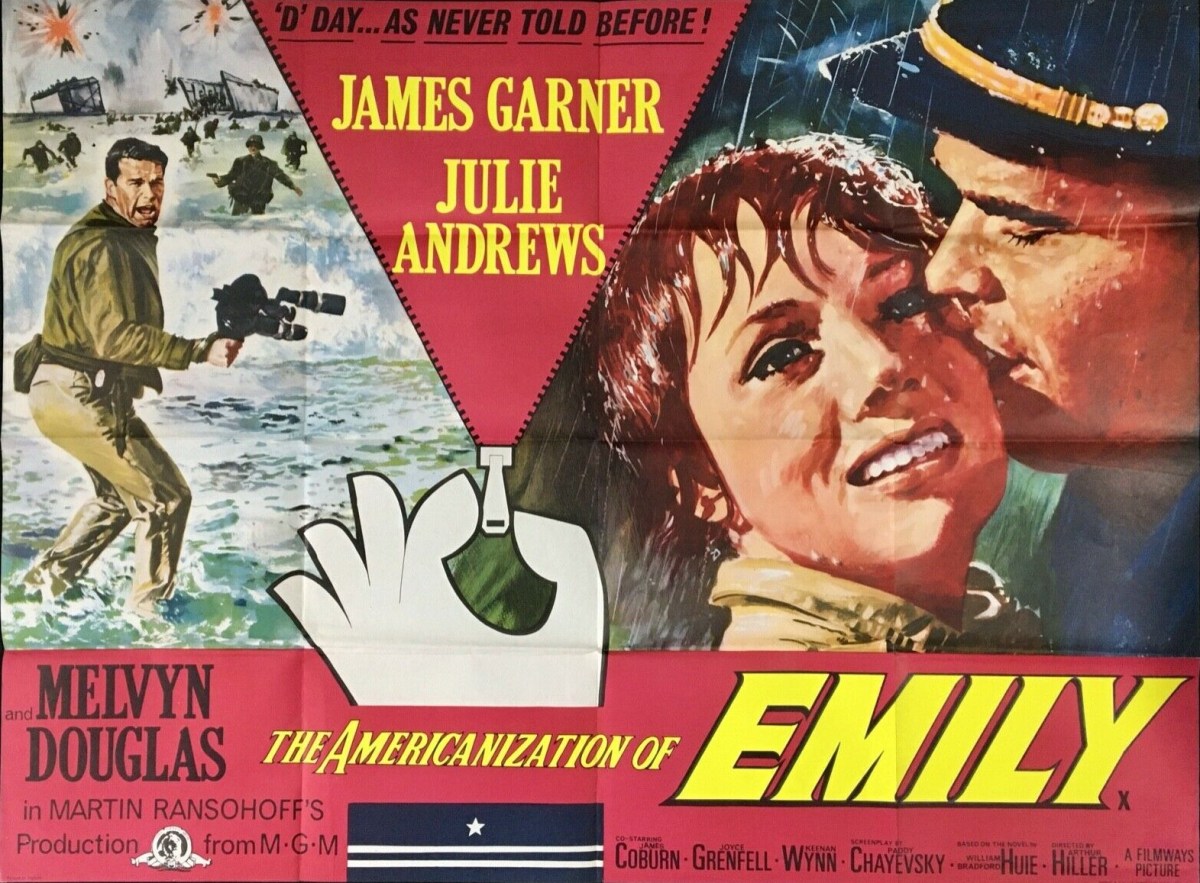
It’s an immoral job but someone’s got to do it. In wartime, generals need their perks – Winston Churchill with his cigars and champagne the best advocate. And those who supply the perks – Dog-Robbers in American parlance – expect their own perks in the form of a backroom job where they are never exposed to danger. Top U.S. Navy dog-robber in World War Two London on the eve of D-Day is Lt. Commander Edison (James Garner) who can spirit up whisky, steaks, nylon stockings and women, happy even to deliver shoulder massages for boss Admiral Jessop (Melvyn Douglas).
And like the recently-reviewed The Charge of the Light Brigade (1968) what’s mostly on the minds of top commanders is jostling for power, how to win the public relations battle on D-Day and prevent the politicians considering scrapping the service post-war. So Jessup comes up with a brilliant wheeze. What if the first man to die on Omaha Beach was a sailor? Allowing for the construction of a memorial to the “unknown sailor,” a feasible proposition given the Navy demolition unit is scheduled to land on French shores in advance of the invasion force. Edison is enlisted to film the anticipated death.
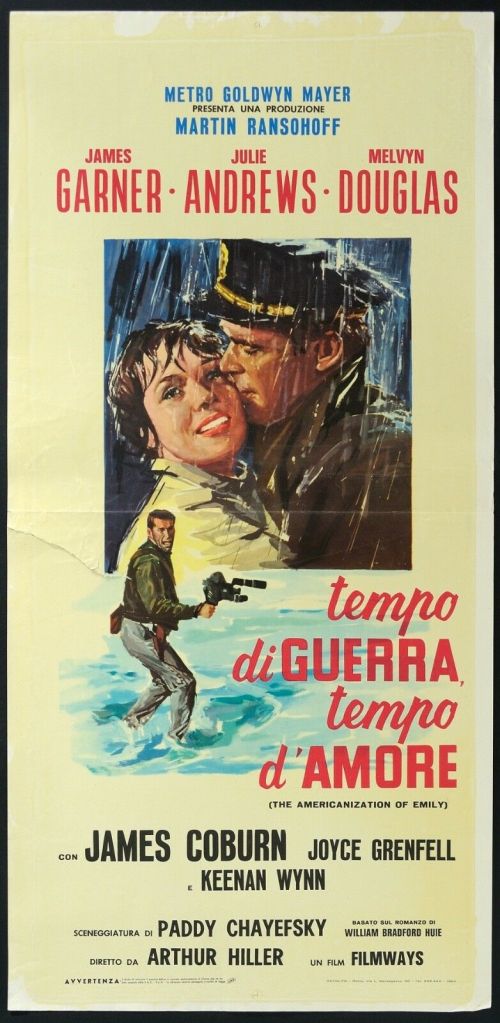
But Edison, whose brother died at Anzio, is a coward and does everything possible to avoid the job. He struggles to get English girlfriend Emily (Julie Andrews), whose father and brother died in the war, to share his perspective and is counting on buddy Lt. Commander Cummings (James Coburn) to get him out of it. But Cummings has his own ideas and Edison ends up the sacrificial lamb.
And it would be a brilliant black comedy except that, in the interests of a happy ending, Edison, despite being shot on the beach by Cummings, turns up alive.
In that case it becomes a fascinating exploration of the realities of war, the moral and immoral coming to grief in a moral vacuum that ensures that the higher up the food chain the less likelihood there is of dying and, ironically enough, the better opportunity to enjoy, while the masses are on strict rations, the good things of life. Emily would act as the movie’s conscience except that Edison is having none of war’s hypocrisy. He doesn’t want to die for his country and may be following to the letter General Patton’s dictat of making the “other poor bastard die for his country.” He doesn’t so much take a stand against the absurdities of war as stand up for the sanctity of life, in particular his own life, unwilling to fall for the “futile gesture of virtue.”
There’s plenty of what you should and shouldn’t do during wartime, arguments passionately argued for and against duty, though even the self-appointed conscience Emily stops short of turning her nose up at the finer things of life, no matter by what dodgy means they fall her way. that her life teeters on hypocrisy is scarcely explored.
And it does its utmost not to fall into the trap of the wartime romance genre, will-he-won’t-he survive the dangerous mission, precisely because you could never mistake Edison for a hero. And you need a hero not an ordinary joe for that particular genre to work. So what you’re left with is something else entirely, a man brave enough to be seen naked, exhibiting exactly the same lack of scruples in saving his own life as his commanders would employ to have him lose it. It’s kind of complicated that way.
Throw in another get-out clause on behalf of the Allied command, the notion that no high-up would embark on such a selfish vainglorious action, and that Jessup only does so because he is temporarily unhinged after the loss of his wife, when in fact history is littered with generals committing troops to wholesale slaughter for their own reasons.
Ediuon is such a charming character that if you wanted someone to plead the case on behalf of the cowardly you couldn’t make a better choice. The whole idea shouldn’t work at all because it’s only the bad guys, the shifty ones that turn up in every war movie, who carry the cowardice flag. The film is so cleverly structured, with examples of the impact of loss all around, that it’s virtually impossible to vote against Edison. And part of the cleverness is the casting. If such a good egg as Emily can fall in love with Edison it somehow makes him a less despicable character. He’s certainly not as shifty as Jessup who dreamed up the bizarre stunt in the first place or Cummings, intent on exploiting it.
James Garner (36 Hours, 1964) excelled at playing the morally dubious, the cowardly sheriff played for laughs in Support Your Local Sheriff (1969) his biggest box office hit, but this isn’t far short of his very best work, and an exceptionally bold role for a star. Julie Andrews was already trying to move away from her goody-two-shoes debut in Mary Poppins (1965) that would be further enhanced by The Sound of Music (1965) and while her characterisation is not, on the surface, that far away from either role, the depth she displays here, the sorrow and the soulfulness, give this a edgier riff.
Good support from James Coburn (Dead Heat on a Merry-Go-Round, 1966), Melvyn Douglas (Hotel, 1967), Keenan Wynn (Man in the Middle/The Winston Affair, 1964) and Joyce Grenfell (The Yellow Rolls Royce, 1964).
Director Arthur Hiller (Tobruk, 1967) most of the time walks a very fine line but manages to create a very thoughtful movie that humanized what other anti-war pictures failed to make personal. Oscar-winner Paddy Chayefsky (Marty, 1955) based the screenplay on the bestseller by William Bradford Huie (Wild River, 1960).
Another in the mini-genre concerning power politics in the Armed Forces. Would make a good triple bill if teamed with The Charge of the Light Brigade and Man in the Middle.


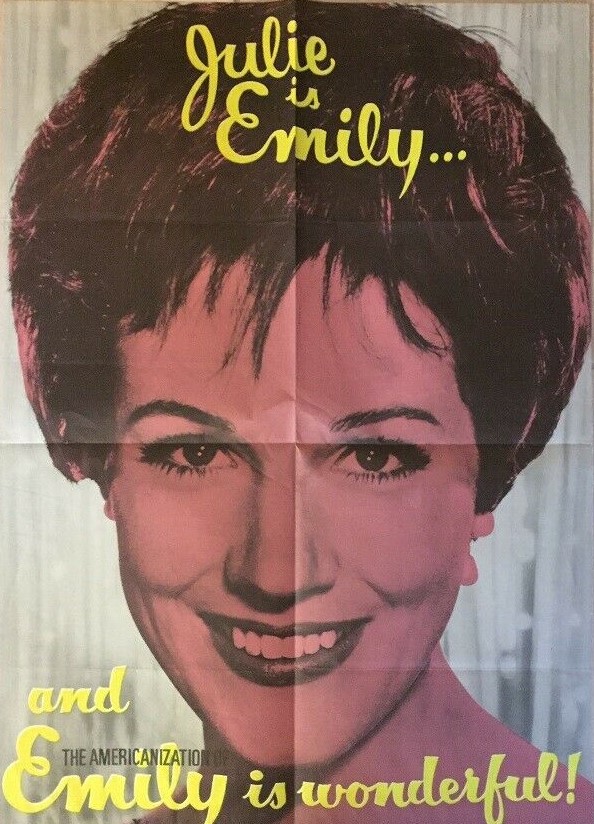
Minor typo with Edison’s name about four or five parts from the end. A a terrible pic of Andrews; has she no ears?
LikeLiked by 2 people
Once people found out she had no ears her career came crashing down.
LikeLiked by 1 person
“According to the 14 Jul 1959 NYT, William Bradford Huie’s The Americanization of Emily was published by E. P. Dutton & Company on 12 Aug 1959 as a continuation of the story of “Lieut. Comdr. Charles E. Madison,” who served as the narrator in The Revolt of Mamie Stover (1941). Shortly after the book’s publication, the 10 Feb 1960 NYT reported that Huie met with filmmaker Jack Clayton about a possible motion picture adaptation, and a 27 Jul 1960 LAT article noted that he was also interested in the work of Canadian director Daniel Petrie. However, General Artists Corporation (GAC) vice president Ned Brown told the 24 Jan 1963 DV that Huie’s novel failed to attract financiers until he prepared the material as a completed screenplay. Once in its new form, the property was picked up by Martin Ransohoff at Filmways, Inc. While the 30 Apr 1962 DV reported that Norman Rosten had completed the first half of a rewrite, a 13 Feb 1963 Var item suggested that Huie was still involved in the scripting process nearly a year later. On 10 Apr 1963, Var announced that Paddy Chayefsky had been assigned to complete the script, for which he received sole writing credit. Meanwhile, the 21 May 1962 LAT reported that William Holden had agreed to play the male lead opposite a yet unnamed British actress. With a star attached, items in the 6 Aug 1962 DV, 10 Oct 1962 DV, and 29 Jul 1963 LAT stated that the project drew the attention of directors Michael Gordon, George Roy Hill, and William Wyler. Wyler was reluctant to remain onboard, and on 11 Sep 1963, DV announced that he left the picture due to disagreements over the script, claiming that the necessary rewrites would conflict with his commitment to The Sound of Music (1965, see entry), from which he also later resigned. Blake Edwards was considered as a possible replacement, and the 8 Oct 1964 LAT claimed Robert Wise, who took over for Wyler on The Sound of Music, turned down a $400,000 contract because he “didn’t like the story.” Arthur Hiller was named the new director in a 30 Sep 1963 DV brief, which also reported that James Garner had stepped in for William Holden. Garner had originally been cast as “Lieut. Comdr. ‘Bus’ Cummings,” a role that was then assumed by James Coburn. The 10 Jun 1963 DV stated that Harry Caplan, a noted friend of William Holden, was signed as the film’s production manager. Items in the 18 Dec 1963 DV and 22 Jan 1964 Var named Justin Smith and Ned Wynn among the cast, but their participation could not be confirmed. Wynn was the son of actor Keenan Wynn, who appears in the film as “Old sailor.” The search for an actress to play British motorpool driver “Emily Barham” lasted over a year. The 6 Aug 1962 DV, 3 Apr 1963 LAT, and 18 Jun 1963 DV claimed Susannah York, Lee Remick (an American), and Shirley Eaton were all in contention for the role before the 4 Sep 1963 NYT announced that Julie Andrews had agreed to star. Several sources noted that this marked the first non-singing role for Andrews, who first gained acclaim as “Eliza Doolittle” in the Broadway production of My Fair Lady, recently completed the Walt Disney Pictures musical, Mary Poppins (1964, see entry), and signed a contract to headline the screen version of The Sound of Music. Principal photography began outside the Houses of Parliament in London, England, on 13 Oct 1963, according to a DV item published the following day. Once exteriors were completed in London, the unit returned to Los Angeles, CA, for the remainder of production. The 7 Nov 1963 DV indicated that studio work took place at the Metro-Goldwyn-Mayer (MGM) backlot in Culver City, while a 12 Nov 1963 DV article referred to Desilu Productions’ Gower Street facility in Hollywood. The 23 Dec 1963 DV edition stated that the D-Day beach sequence included two LCVPs (Landing Craft, Vehicle, Personnel) obtained by “civilian sources,” as the U.S. Navy refused to provide the vessels due to the script’s cynical attitude toward war. Beach footage was shot in Oxnard, CA, but complications arose when the 9 Jan 1964 DV reported high tides and strong coastal winds caused damage to the set. Filming concluded shortly thereafter. However, on 27 Jan 1964, DV stated that James Garner, James Coburn, and Judy Carne were called to re-shoot a scene in which Carne appeared nude. Throughout production, producer Martin Ransohoff had become embroiled in a dispute with Production Code Administrator Geoffrey Shurlock over several instances of nudity by Carne, Janine Gray, and Kathy Kersh. Ransohoff filmed the material in defiance of Shurlock’s objections, but the 18 Mar 1964 DV indicated he was forced to back down in order to obtain a Code Seal of approval from the Motion Picture Association of America (MPAA). A NYT article published the following day explained that Ransohoff’s decision to cut the scenes was prompted by warnings from MGM executive Robert H. O’Brien, who refused to release the picture without a seal. Ransohoff planned to include the excised footage in the European release, and publicly admonished the MPAA for its strict censorship regarding nudity. The story suggested that Ransohoff may have amplified the controversy as a way to promote the film and increase its box-office prospects, although he denied such accusations. On 21 Mar 1964, editor Tom McAdoo died of a heart attack. Although the 12 Mar 1964 DV announced that editing had already been completed, an 8 Apr 1964 Var item named Tom McCarthy as his replacement for the remainder of post-production. According to a 17 Sep 1964 DV brief, Johnny Mandel reallocated one of his themes from the soundtrack to his score for The Sandpiper (1965, see entry), which was also produced by Ransohoff. The 1 Sep 1964 DV reported that Andy Williams had recorded the film’s title song, “Emily,” for Columbia Records, while modern sources noted that renditions were also performed by artists such as Frank Sinatra, Tony Bennett, and Barbra Streisand. According to a 4 Nov 1964 Var article, two additional endings had been planned that significantly differed from the final version. In an early draft, Madison was to remain dead following the landmine accident on Omaha Beach, while Cummings was promoted to admiral and Emily Barham placed in an insane asylum with Madison’s boss, “Adm. William Jessup.” However, the scene’s costly parade sequence was deemed too expensive for the limited budget, and filmmakers considered another scenario in which Cummings was condemned for his role in Madison’s death and reassigned to the North Pole. James Coburn reportedly shot footage for this version, which was ultimately never used. Although Ransohoff hoped for a quick opening, the 3 Aug 1964 DV stated that he had agreed to wait until Disney released Mary Poppins, which was a hit at the box-office. The Americanization of Emily premiered 27 Oct 1964 at the Loew’s State Theatre in New York City before beginning simultaneous engagements at the State and Loew’s Tower East Theatres the following day. The picture opened in Los Angeles on 25 Dec 1964. The critical depiction of wartime heroism conveyed in Huie’s original text and Chayefsky’s screenplay elicited a mixed response from critics and audiences. Arthur Hiller published a defense of the film in the 3 Jan 1965 LAT after attending a public screening at a local theater, claiming that many viewers misinterpreted the tone as disapproval of soldiers instead of a “comment on the lunacy of the attributes…[attached] to war” that were often celebrated. The film received Academy Award nominations for Art Direction (Black-and-White) and Cinematography (Black-and-White). On 6 Sep 1967, NYT announced that The Americanization of Emily had been re-released as Emily to capitalize on the recent popularity of James Coburn and considerable stardom of Julie Andrews, who had since won an Academy Award for Mary Poppins and enjoyed success in The Sound of Music, Hawaii (1966, see entry), and Thoroughly Modern Millie (1967, see entry). The following summer, the 5 Jul 1968 NYT reported plans for a musical stage adaptation produced by Norman Rosemont and Barry Kobrin, but the project did not move ahead.”
LikeLiked by 1 person
Wow, that is a lot. Thanks a bunch.
LikeLike