
Every now and then I come across a book and think this would make a good film. I’ve just finished this particular book and already I can see four movies in it.
A fellow, mostly what these days we’d term a nerd – physically awkward, doesn’t have a girlfriend – a farmer’s son, but not in one of those rich prairie farms with corn as high as an elephant’s eye, but so dirt-poor there’s no electricity or running water, so poor he spend two years harnessed like a mule to a grader on back-breaking road work. His only education is a bare pass as the lowest grade of teacher’s college.
He takes a teaching job in a big town. The job is teaching public speaking and coaching the debating team. The debating team has never won anything, not even locally. Our fellow starts building student confidence. On his first day he has the students stand up in class and for ten seconds make animal noises. He encourages them to be silly – and not afraid. Everyone being silly is one way of helping the students bond. Even the shy kids don’t mind being silly in public.
Then they were asked to make a 30-second speech on any subject. Then it was a minute, then five minutes. But by this stage, speeches had to be rehearsed. And kids couldn’t spout nonsense. They had to know their stuff. They had to research.
And once you were able to stand up in front of your fellow students for five minutes, the audience was encouraged to heckle and pick holes in your argument. But there was an odd thing, the kids liked the way he nagged away at them because it meant he cared. He had improved their social skills no end already and now he wanted to go further. Even the rebels sought his approval.
Of course, his fellow teachers had no idea what he was trying to do and mostly sniggered behind his back because he still looked like a gangly nerd.
Then the debating started. Kids willingly stayed in hours after class, declaiming, being heckled and nagged. Then our fellow did something unheard of. He sent his debating team out on tour, covering hundreds of miles. No one had ever seen the like, not even from the city or state champions. They went into informal “no-decision” contests with all the schools they might meet in a debating competition. The subject that year was the jury system so the teacher and the students researched the subject to death.
When the proper city championship began, the shy students discovered there was unexpected gold in all this hard work. They were treated as heroes. They were welcomed as visitors in other schools and when they came home the teacher ensured the local media was recording their success. They would get sent out individually to another school to talk on some subject and audiences were rapt. People applauded.
Initially, there was no public support. A debate on home soil might attract an audience of seven. But soon the debating hall filled up. Cheerleaders led the chanting and turned cartwheels the way they did for football games.
The city championship had been won by the same school four years in a row. This school had never, in its history, won. This time was the first.
Next came the state championship. The school was in a fever. They had never come anywhere near competing at state level. But after winning 67 consecutive victories they were on the brink. One more victory would do it.
Hollywood would have changed the narrative. They would have given our lonely fellow a girlfriend, who originally hated him but then grew to like him as much as his students. And Hollywood would have ensured they became state champions. But the truth is they lost. Even so a banquet was held in their honor, the teacher won a pay raise.
The second movie is another underdog story. At any college in America, athletes are the top dogs. They get the preferential treatment. If there’s any easy jobs going round, or anything remotely beneficial, it goes to them. Even in a piss-poor low-grade college, the footballer is unchallenged.
Our fellow was never going to make a football team, too gangly, awkward, clumsy. The football team had a secret society to help them stay in control. Our fellow was always going to be blackballed. So he set up his own secret society. And he worked like a dog to become the top dog, stealing away those precious positions that gave a poor student breathing space.
But the third tale is best of all, in terms of a politician doing what he’s there to do, which is to improve the lot of his constituents. By this time our man is a politician and determined to help the farming community where he grew up.
There was no electricity where he grew up. The utility companies argued it was too expensive to install and in any case the dirt-poor farmers couldn’t afford it so it would be a foolish investment. No electricity meant no movies, no radio and no labor-saving devices like washing machines, pumps for running water, electric irons, machines for grinding corn or sawing wood or feeding the livestock.
Water came from a well 50-100 feet deep, nearly 100 yards from a house. It came up one bucket at a time, weighing 32lb. An average farm used 200 gallons of water a day. An average bucket held four gallons. Water was required for washing, cleaning, cooking, ironing.
Without electricity, fires for cooking, washing and heat came from wood stoves. They were hard to start and almost impossible to keep going. The room was a furnace in a land that in the summer was also a furnace. Since there was no electricity, there was no refrigeration. Fruit and vegetables had to be canned the day they became ripe, and not all fruit and vegetables conveniently ripened on the same day, all the fruit on one tree wouldn’t even ripen at the same time.
The women on these farms were all bent over, old before their time, from their arduous physical labor.
Barely 10 per cent of the nearly seven million farms in America had electricity. And even when the Government forced the utility companies to change their rules, that still left these piss-poor farmers out on a limb because they still didn’t fit the criteria.
So our fellow set out to change all that. He not only worked his socks off but proved he had innate political skills, knew how to get the best out of people who opposed him, and eventually – this involved also the building of a dam which he was instrumental in pushing through – he got his people water.
However, in terms of national impact, the fourth tale beats that. In 1940, without our fellow, the Democrats would have lost the Presidential election. Franklin D. Roosevelt was risking his personal popularity in any case by going for an unheard-of third term in office. Roughly a month before the election is looked like the Democrats were heading for a heavy defeat.
One of the reasons was that the party was hopeless at fundraising. Many of the people who chaired such committees were useless, promoted simply because they were next in line. Candidates desperate for cash to launch a campagn were denied any money. The Republicans, the party representing big business, were much better prepared in that line.
Our man, a very minor politician, somehow inveigled himself into a very minor position on the campaign committee and set about raising funds. He called in a lot of favors. He raised more money that the party had seen in a lifetime.
But he didn’t just hand out money willy-nilly. He targeted candidates whose seats were most at risk. He asked them how much they needed and gave it to them. But given he was in regular contact with the guys on the ground floor, he invented something new and incredibly useful. He got these guys to poll their guys and fed this information back to party HQ. Although rudimentary polling existed, it took weeks to be analyzed and disseminated, so virtually useless in the last few weeks of a campaign. He was able to provide up-to-the-minute information on the state of play in every state and therefore allocate more funds if necessary.
If I tell you our fellow – I hesitate to call him “our hero” – was LBJ, you’ll probably cringe. Because Lyndon B. Johnson was accused of all sorts in the Oliver Stone’s specious film JFK, and was condemned for escalating the war in Vietnam, something that cast a huge shadow over anything else he did, and virtually for succeeding generations destroyed his reputation at a stroke.
Robert Caro, the author of the book I’m reading, The Path to Power (The Years of Lyndon Johnson, Vol 1), doesn’t much like our fellow. Caro spends acres of print space demolishing our fellow’s personality, as if being driven was a flaw and power was almost certainly abused.
Now there’s no doubt that LBJ stuck his nose in the trough, but so did virtually every other politician – it’s not a job these days that evinces much praise. But what he did do which 99 per cent of all other politicians did not was he got the job done. He had such energy and determination that he achieved far more than your average politician, and virtually always for the benefit of the common man, of which he was one. Nobody wanted to give his farmers electricity and if it hadn’t been for LBJ they wouldn’t have gotten any. Nobody had been asked to cough up to help a campiagn fund and if he hadn’t stepped into the breach Roosevelt would not have been elected.
This book is 800 pages long and there are four other volumes to come. But if LBJ achieved this much so early in his career, goodness knows what he’d manage later.
If nobody wants to make a movie, then a mini-series would get the job done. Our lovelorn fellow eventually does marry and have affairs with – gasp! – beautiful women and that’s long before he gets anywhere near the Presidency.
Apologies for venturing miles off my determined course but I’ve been so absorbed in this book I’ve had less time to watch movies. I’m not American so my knowledge of longdead American presidents is scant, but this was an eye-opener.
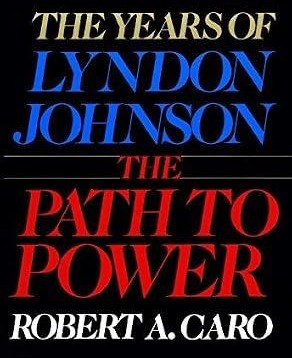
Robert A. Caro, The Path to Power, the first volume of the LBJ biography, was first published to universal acclaim in 1982. Caro, now 90, is working on the final volume.
Question mark image by Simone Secci on Unsplash

 The Magnificent 60s
Some fine movies have been done on LBJ already. However, he is a very divisive figure in out history. The Vietnam War completely besmirched his reputation. The Great Society program was also a massive waste of money that really achieved nothing. I myself never cared for him at all. But he is was a very colorful character. In the end he was a better Senator than President.
LikeLiked by 1 person
I’ve just checked on imdb and to my surprise there’s a whole bunch of movies and even a TV series. So I might check some of them out. See if they’re streaming somewhere. Any ideas?
LikeLike
Not sure what you have access too. Rob Riener’s LBJ is on Prime(here)and AppleTV. PATH TO WAR is on HBO as is ALL THE WAY. The very good LBJ: The Early Years is on YouTube.
LikeLiked by 1 person
Thanks, I found two items on YouTube and found the Randy Quaid DVD.
LikeLike
Brian, no apologies necessary for this very enlightened statement, “Apologies for venturing miles off my determined course but I’ve been so absorbed in this book I’ve had less time to watch movies. I’m not American so my knowledge of longdead American presidents is scant, but this was an eye-opener.” Yes, Robert A. Caro’s THE YEARS OF LYNDON JOHNSON: THE PATH TO POWER(1982) is an eye-opener for anyone, anywhere in our world.
When I first read this volume one of the five book series in 1982, I was a young political activist, and it was very much an eye-opener to me in learning about the uses and abuses of political power, of which Lyndon Baines Johnson(LBJ) was a master of. I’ve since read the other three published volumes: MEANS OF ASCENT(1990), MASTER OF THE SENATE(2002), and THE PASSAGE OF POWER(2012). The fifth and final volume is still in the works and as of May 2026 the 90-year-old Robert A. Caro has 983 typed pages. Too me, Caro’s series is the gold-star literary treatment of LBJ, and his times. I recommend it as essential reading for anyone interested in the man or the time period of 1931-1969.
I’ve viewed a couple of the made for TV movies made about LBJ and they are good as far as they go, but Caro’s monumental books are far deeper and more comprehensive. It would take a lengthy mini-series to even come close to covering the larger-than-life LBJ. That said, I did enjoy Randy Quaid’s robust performance of Johnson in NBC-TV’s LBJ: THE EARLY YEARS, which was first aired Sunday, February 1, 1987. I viewed it that night and liked it, even though compared to Caro’s THE PATH TO POWER it seemed to me that it skipped years at a time and this makes it somewhat jarring in effect, although I realize that it’s hard to cover twenty-nine years in 155 minutes. Anyway, I think there are some very compellingly wonderful scenes shown, but just not a complete picture. Also, the producers should have given Robert A. Caro some kind of credit, because I think scriptwriter Ken Trevey lifted quite a bit of his work. The cast has a lot of familiar faces, besides Quaid and I recommend watching it.
PATH TO WAR is a Home Box Office(HBO) movie first aired on Saturday May 18, 2002. I first viewed it a couple of years later on a DVD. This was director John Frankenheimer’s last movie, and I think it’s a good one. Michael Gambon stars as President Lyndon Baines Johnson during the years of becoming embroiled in the Vietnam War(1965-68) at the expense of LBJ’s vision of The Great Society. The Vietnam War was LBJ’s albatross and Director/Producer Frankenheimer gives us a movie showing the tension and tumult that defined LBJ’s White House years. Although Caro’s final book, which is about LBJ’s Presidency and aftermath, hasn’t been published yet, in interviews Frankenheimer has cited reading Caro’s earlier volumes as part of what shifted his view of LBJ toward a more complex, tragic figure.
PATH TO WAR is not only about LBJ, and Gambon gives a really good performance, but also about other powerful men debating their consciences and each other. Too me this was the heart and mind of the movie with these discussion debates between LBJ(Gambon), Defense Secretary Robert McNamara(Alec Baldwin), Special Presidential Advisor Clark Clifford(Donald Sutherland), Secretary of State Dean Rusk(John Alyward), Undersecretary of State George Ball(Bruce McGill), and other advisors. This is good drama. Scriptwriter Daniel Giat and Executive Producer Howard Dratch did about ten years of Historical research for this movie starting with Clark Cliffords COUNSEL TO THE PRESIDENT: A MEMOIR(1991) and onward. Historical consultants for the movie were Michael Beschloss(edited TAKING CHARGE: THE JOHNSON WHITE HOUSE TAPES, 1963-64 published 1997, REACHING FOR GLORY: LYNDON JOHNSON’S SECRET WHITE HOUSE TAPES, 1964-65 published 2001, and several other works on the Presidency), Robert Dallek(LONE STAR RISING: LYNDON JOHNSON AND HIS TIMES, 1908-1960 published 1991, FLAWED GIANT: LYNDON JOHNSON AND HIS TIMES, 1961-1973 published 1998, and LYNDON B. JOHNSON: PORTRAIT OF A PRESIDENT published 2004 and many other books on the presidency), and Deborah Shapely(THE LIFE AND TIMES OF ROBERT MCNAMARA-1993, and others).
I think PATH TO WAR is well worth viewing and I intend to seek out and view Jay Roach’s HBO movie ALL THE WAY(2016) starring Bryan Cranston as LBJ and Rob Reiner’s LBJ(2016) starring Woody Harrelson as LBJ. I’ve been very interested in President Lyndon Baines Johnson since I was a youngster, and I lived during this period of USA History having been born when Dwight Eisenhower was President and growing up during the presidencies of Kennedy, Johnson, Nixon, Ford, and Carter. It just seems like yesterday.
LikeLiked by 1 person
I’ve bought the Path to War DVD. Actually, I’ve read all four volumes already. This is me re-reading them all. I’m at vol 2 and the 1948 Senate election.
LikeLike
Brian, MEANS OF ASCENT(1990) covers the actions during the senate election of 1948 of legendary lawman Texas Ranger Frank Hamer and Texas Governor Coke Stevenson entering the Texas State Bank in Alice, Texas to examine the tally sheets for the infamous ballot box 13. They came into town like gunfighters of the old days. The crowd of men supposedly guarding the bank got out of Hamer’s way when he ordered them to “git!” Hamer was deadly, to say the least, he led the posse that killed Bonnie Parker and Clyde Barrow in 1934. I enjoyed reading this part of the book, it read like a Western movie.
LikeLiked by 1 person
I’ve just got to the end of that part in the book. Hamer was some character.
LikeLike