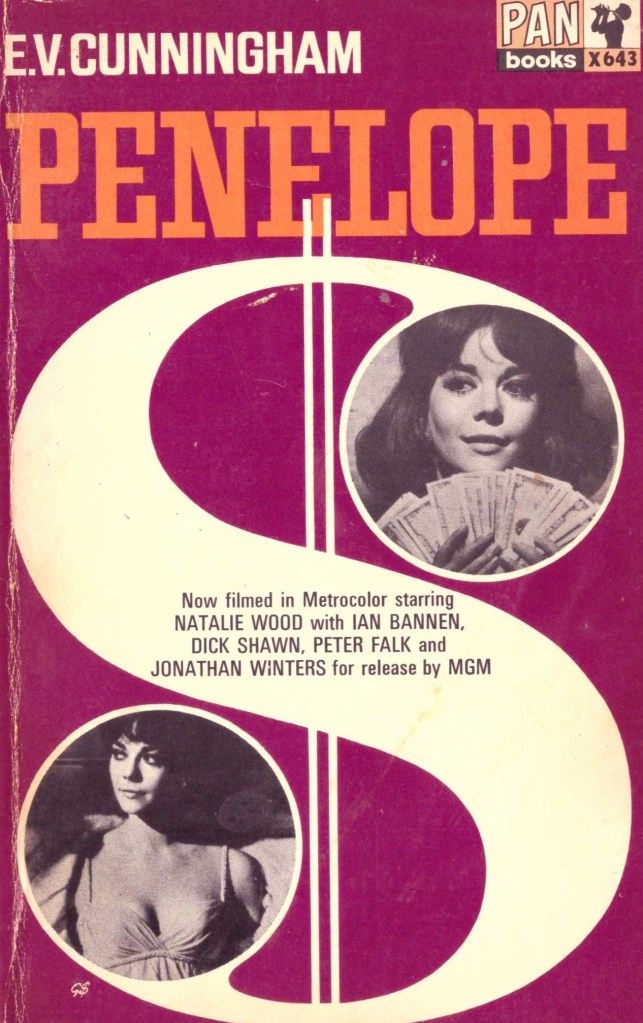
Penelope (1966) ***

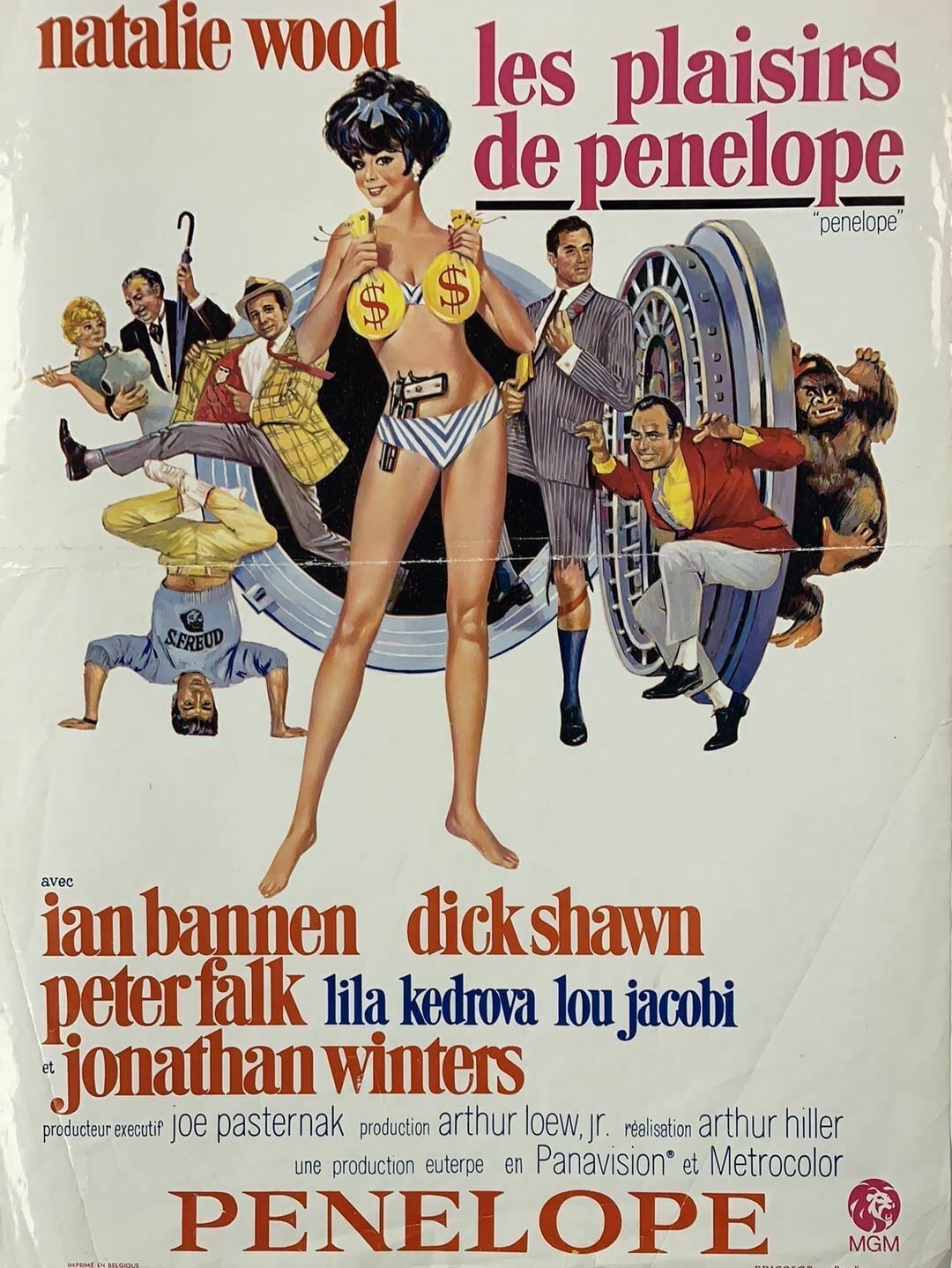
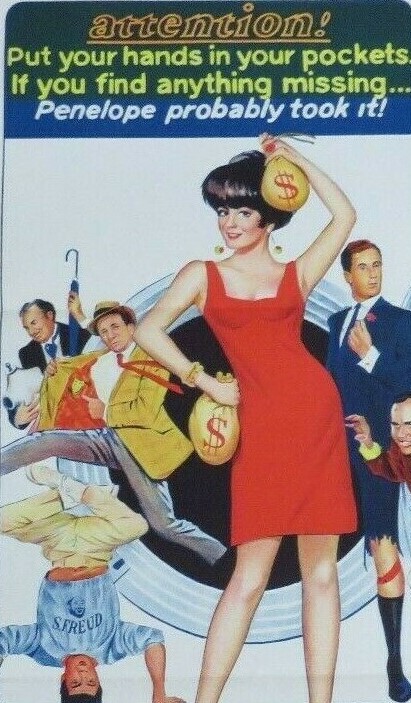
Comedic twist on the heist movie with Natalie Wood (This Property Is Condemned, 1966) as a kleptomaniac. Given its origins in a tight little thriller by E.V. Cunningham, pseudonym of Howard Fast (Mirage, 1965), it’s an awful loose construction that seems to run around with little idea of where it wants to go. Wood, of course, is a delightfully kooky heroine who takes revenge on anyone who has ignored or slighted her by stealing their possessions.

The picture begins with her boldest coup. Cleverly disguised as an old woman, she robs the newest Park Avenue bank owned by overbearing husband James (Ian Bannen). This prompts the best comedy in the movie, a man with a violin case (Lewis Charles) being apprehended by police, the doors automatically locking after a clerk falls on the alarm button, James trapped in the revolving doors losing his trousers in the process.

In flashback, we learn that she turned to thievery after a rape attempt by Professor Klobb (Jonathan Winter), her college tutor, and while half-naked managed to make off with his watch fob. She stole a set of earrings from Mildred (Norma Crane) after suspecting she is having an affair with James. “Stealing makes me cheerful,” she tells her psychiatrist, Dr Mannix (Dick Shawn) and while admitting to dishonesty denies being a compulsive thief. After the bank robbery she even manages to relieve investigating officer Lt Bixby (Peter Falk) of his wallet.

Nobody suspects her, certainly not her husband who could not conceive of his wife having the brains to carry out such an audacious plan. Bixby is a bit more on the ball, but not much. Clues that would have snared her in seconds if seen by any half-decent cop are missed by this bunch. And generally that is the problem, the outcome is so weighted in Penelope’s favor. The plot then goes all around the houses to include as many oddballs as possible – boutique owners Sadaba (Lila Kedrova) and Ducky (Lou Jacobi), Major Higgins (Arthur Malet) and suspect Honeysuckle Rose (Arlene Golonka). Naturally, when she does confess – to save the innocent Honeysuckle – nobody believes her in part because everyone has fallen in love with her. Bixby, just as smitten, nonetheless makes a decent stab at the investigation.

Howard Fast under the pseudonym of E.V. Cunningham wrote a series of thrillers with a woman’s name as the title. He was on a roll in the 1960s providing the source material for Spartacus (1960), The Man in the Middle (1964), Cheyenne Autumn (1964), Sylvia (1965), Mirage (1965) and Jigsaw (1968).

Taken as pure confection it has its attractions. It’s certainly frothy at the edges and there are a number of funny lines especially with her psychiatrist and the slapstick approach does hit the target every now and then. The icing on the cake is top class while the cake itself has little of substance. It strikes a satirical note on occasion especially with the Greenwich Village cellar sequence. It doesn’t go anywhere near what might be driving this woman towards such potential calamity – that she gets away with it is only down to her charm. There has probably never been such a pair of rose-tinted spectacles as worn by Penelope, even though her every action is driven by revenge.

Without Natalie Wood it would have sunk without trace but her vivacious screen persona is imminently watchable and the constant wardrobe changes (courtesy of Edith Head) and glossy treatment gets it over the finishing line. It’s one of those star-driven vehicles at which Golden Age Hollywood was once so adept but which fails to translate so well to a later era. Ian Bannen (Station Six Sahara, 1963) is in his element as a grumpy husband, though you would wonder what initially she saw in him, and Peter Falk (Robin and the 7 Hoods, 1965) delivers another memorable performance.  Dick Shawn (A Very Special Favor, 1965) is the pick of the supporting cast though screen personalities like Lila Kedrova (Torn Curtain, 1966), Jonathan Winters (The Loved One, 1965) and Lou Jacobi (Irma la Douce, 1963) are not easily ignored.  Johnny Williams a.k.a John Williams wrote the score.

Director Arthur Hiller (Tobruk, 1967) delivers as much of the goods as are possible within the zany framework. Veteran Oscar-winner George Wells (Three Bites of the Apple, 1967) wrote the screenplay but it’s a far cry from the far more interesting source material and I would have to wonder what kind of sensibility – even at that time – could invent a comedy rape (not in the book, I hasten to add).

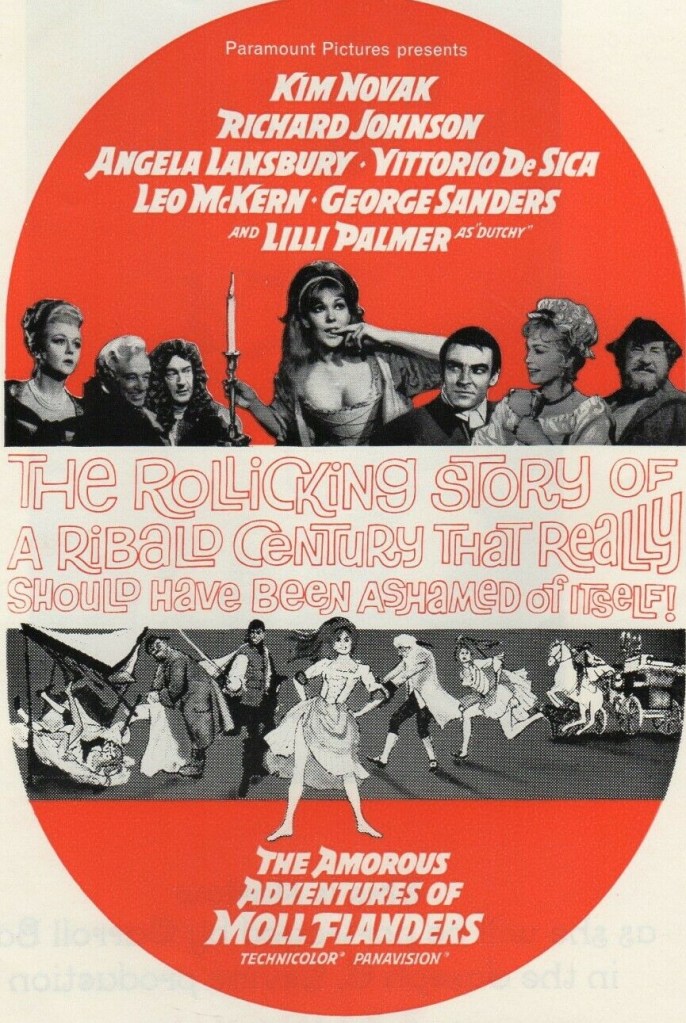
The Amorous Adventures of Moll Flanders (1965) ***

The Husband-Hunting Adventures of Moll Flanders” might have been a more accurate title and if you were seeking a template for a multi-character eighteenth-century Olde English picture majoring on sexual shenanigans here would be a very good place to start. Of course, Tom Jones (1963) was the precursor but told the story from the male perspective and here it is from the more vulnerable female point-of-view. Despite the hilarity and the sexual proclivities on show, it remains abundantly clear that marriage remains a refuge, where the those without a title can gain either security or status by contrast, such a contract is viewed as a means of further enrichment for the already wealthy.

So orphan housemaid Moll Flanders (Kim Novak) has a difficult time persuading the elder brother (Daniel Massey) of her wealthy employer to marry her. Instead, he takes her as his mistress, leaving her no option but to marry the drunken fool of a younger brother (Derren Nesbitt) and instantly regretting her decision. When he drowns, you would have thought that would solve her problems. But this was the eighteenth century and a widow with no fortune (and therefore power) of her own can easily be tossed out penniless.

A widowed banker (George Sanders) might be a prospect especially as she has the wits to prevent him being entirely robbed by highwayman Jemmy (Richard Johnson). Plans to marry him thwarted, she takes a job for food and lodgings with Lady Blystone (Angela Lansbury) and her husband, an impoverished Count (Vittorio De Sica), who are constantly pursued by debt collectors. Meanwhile Jemmy has taken the decision to marry a rich woman and become a kept man.

But this set of characters becomes enmeshed, so the tale unfolds in classic fashion. Assuming Moll to be moneyed, Jemmy masquerades as the owner of three ships. Nothing, of course, works out for anybody, certainly not those pretending to be something they are not while aspiring to wealth beyond their reach, but it all concludes in propitious fashion as the actions of the various principals become embroiled.

While certainly having an inclination towards the amorous, Moll wishes for that within the context of true love, rather than selling her physical wares to the highest bidder. So for a picture sold on immorality – the “rollicking ribaldry” of the poster – there is an unsung moral standpoint. Finding safe passage into affluence proves very tricky indeed. And what appears at first glance to be merely a picaresque episodic tale turns out to be very well structured indeed. And those looking for cleavage will find it here in abundance, as if some kind of rationing had been imposed on clothing, or that it was matters of economy that dictated that the area around the bosom be left unclothed. Being the lusted-after heroine it falls to Moll Flanders to shed even more of her attire from time to time.

You are more likely to laugh out loud at the moments of offbeat humour – a flotilla of ducks heading in Moll’s direction when she cries for help in a lake, the Count while acting as a butler demanding a tip – but it is more of a gentle satire. There is some of the expected bedroom farce but, mercifully, no recourse to a food fight. It is handsomely-mounted and meets the highest expectations of the costume drama.

Kim Novak (Of Human Bondage, 1964) easily passed the English-accent-test and carries the picture with ease. Richard Johnson (Deadlier than the Male, 1967) reveals a rakish side so far hidden in his more dramatic works to date. And there is a fine supporting cast including George Sanders (The Quiller Memorandum, 1966), Angela Lansbury (Harlow, 1965), Vittorio De Sica (The Shoes of the Fisherman, 1968), Lili Palmer (The Counterfeit Traitor, 1962) as Jemmy’s mistress, Leo McKern (Assignment K, 1968) as Jemmy’s sidekick going by the name of Squint, Daniel Massey (Star!, 1968) and Derren Nesbitt (Nobody Runs Forever/The High Commissioner, 1968). In bit parts look out for Cecil Parker (Guns at Batasi, 1964), Dandy Nichols later of Till Death Us Do Part television fame and Carry On regular Peter Butterworth.

All directed with some style by Terence Young (Mayerling, 1968) and adapted from the lengthy Daniel Defoe novel by Denis Cannan (A High Wind in Jamaica, 1965) and Roland Kibbee (Valdez Is Coming, 1971).

An old-fashioned romp with, if you can bothered to look, a moral center.

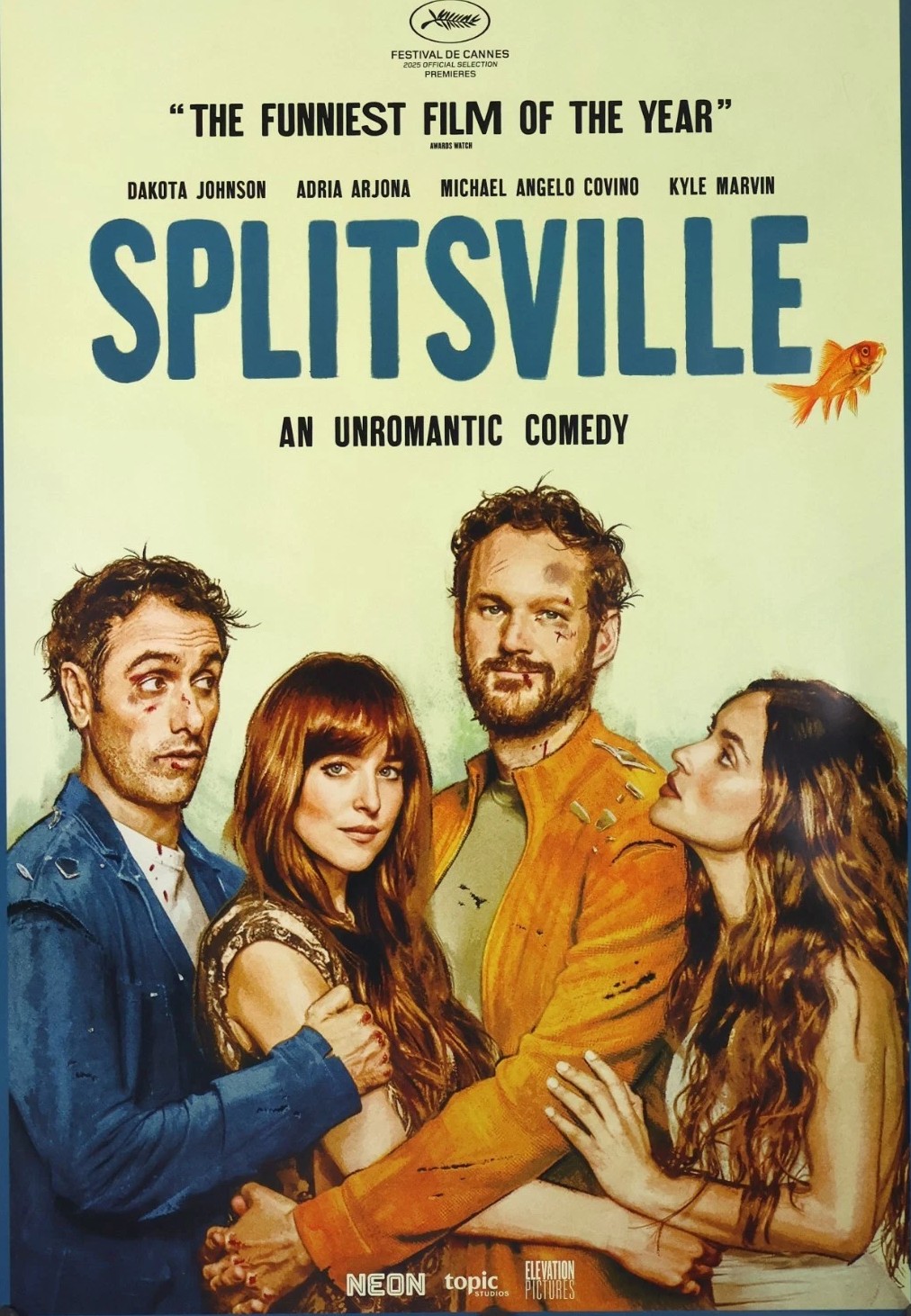
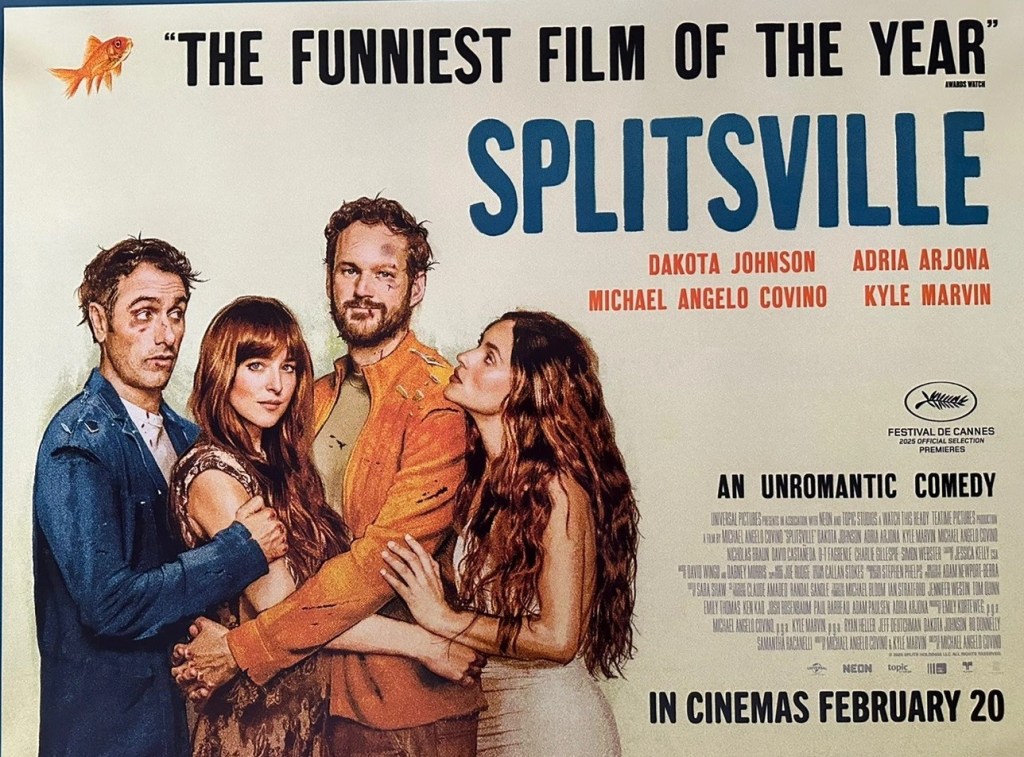
Splitsville (2026) ** Seen at the Cinema

Might have worked back in the day when you could have enlisted the likes of Jack Lemmon and Walter Matthau whose grouchy sniping sparked The Odd Couple (1968) and Grumpy Old Men (1993). At a pinch might have stood a chance with Will Ferrell (Anchorman, 2004) and Vince Vaughn (The Wedding Crashers, 2005) and others of similar ilk, who might be oiks but had some charm. Starring writer-director Michael Angela Covino (The Climb, 2019) and his writing partner Kyle Marvin (The Climb) as the male leads, this has no chance at all, especially as this pair are responsible for the whole mess.

Theoretically, Dakota Johnson (Madame Web, 2024) is the star but given she only acts with her lips and not her eyes, it’s not much of a step-up. Whenever the narrative gets in trouble, which is most of the time, the movie resorts to the crudest kind of slapstick fights where furniture only exists to be broken and windows and even goldfish tanks to be smashed.

The odd thing is this might have worked a treat if the perspective had shifted from the out-of-their-league Carey (Kyle Marvin) and Paul (Michael Angelo Corvino) to their glossy, sexy, partners, Julie (Dakota Johnson) and Ashley (Adria Arjona). The casting looks like wishful thinking in the first place, the nerds snaring gorgeous women, but what really sinks the project as we learn as the movie progresses is that the feminist attitudes of the women are a bad thing, and that their inclination to take on multiple partners outside their marriages, with the tacit approval of their husbands, and the independence inherently expressed, should not be celebrated and that the sooner the errant women come to appreciate their faithful men the better – at least that’s what the happy ending says.

I only laughed out loud once and that was a crude bit. I’m not sure if Kyle Marvin has it written into his contract, or is taking advantage of his position as a co-writer, that his large schlong gets a good few outings – though maybe this is a modern ironic twist in that it’s the naked male rather than the naked female we see in the shower – but it was the appearance of his privates in an embarrassing situation that got the laugh.

The story is bonkers. Lively Ashley wants a divorce because her dull teacher husband isn’t sexually imaginative. He scuttles off to hunker down with best friend Paul, a millionaire property developer, and wife Julie only to discover they have an open marriage, of which he takes advantage, only to find that he has crossed a line with Paul. Meanwhile, Ashley has taken up with nay number of ripped hunks, that Carey accommodates, so desperate is he to maintain any kind of relationship with her. For some reason – narrative insanity perhaps – all of Ashley’s lovers take the same approach, once dumped they can’t bear to leave their apartment and Carey, being the accommodating sort, ends up cooking and cleaning for them all.

When Ashley’s business goes bust and he’s imprisoned for fraud, he determines to turn over a new leaf and that might work except that’s a fraud. He’s got no reason to turn over a new leaf since, apparently, he only went along with the open marriage idea to placate his wife and has been faithful all the time. Given the already shaky premise, this makes the edifice tumble along with Ashley’s revelation that she’s realized just how much better Carey is suited for her than all her other men. There’s a ramshackle climax where various people conspire to make other people jealous in the hope of winning back their true love. Naturally, this goes all slapstick – by this point you’re wondering if there’s anything left to break.

Three questions are left dangling: what attracted Dakota Johnson to the script given she’s got so little to do; why the movie took such an old-fashioned tack instead of one where the faithful have to work out how to hold onto their unfaithful free-spirited women; and how this was greenlit in the first place.

It’s the kind of movie that appears promising and you think it’s going to improve as it goes along. I was foolish enough to believe it would. The couple next to me gave up after three-quarters of an hour.

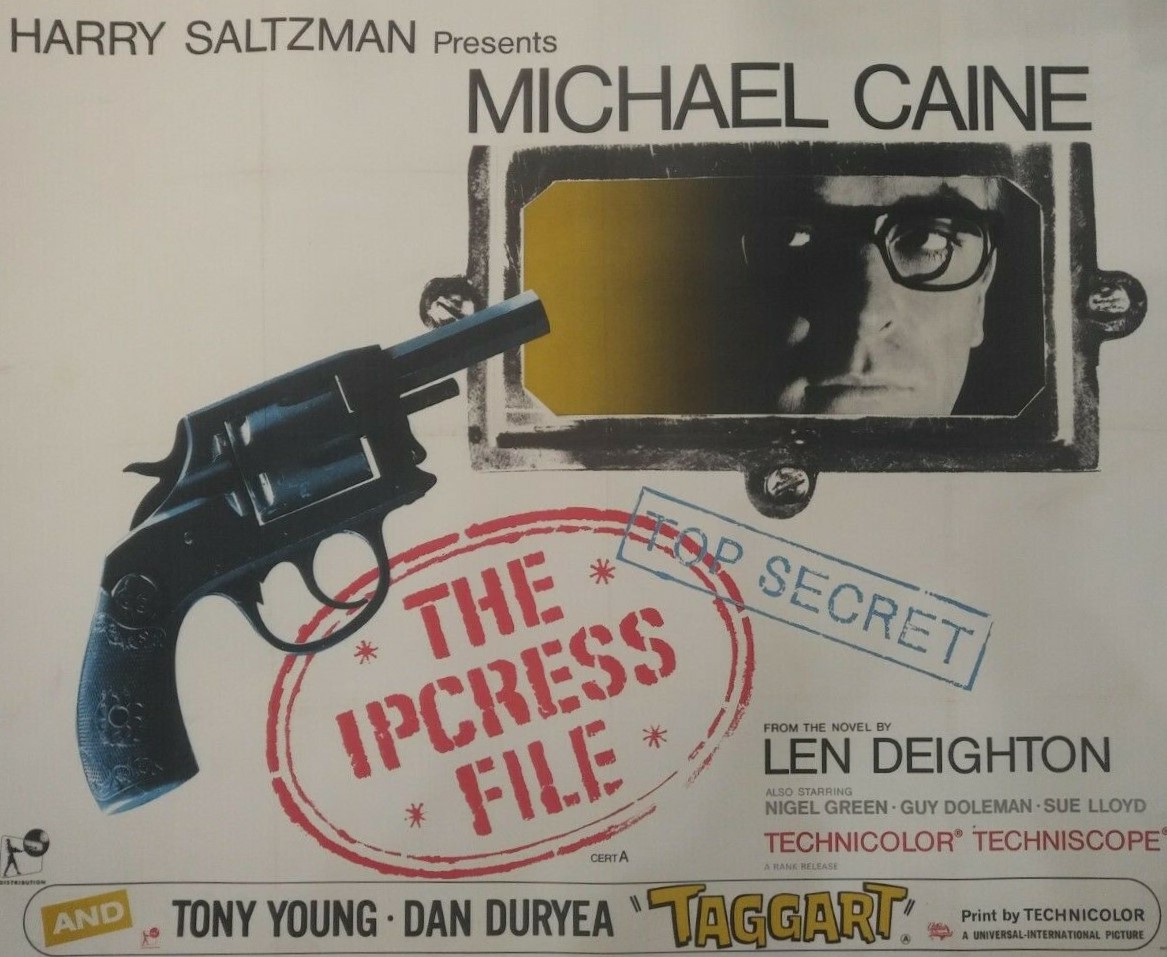
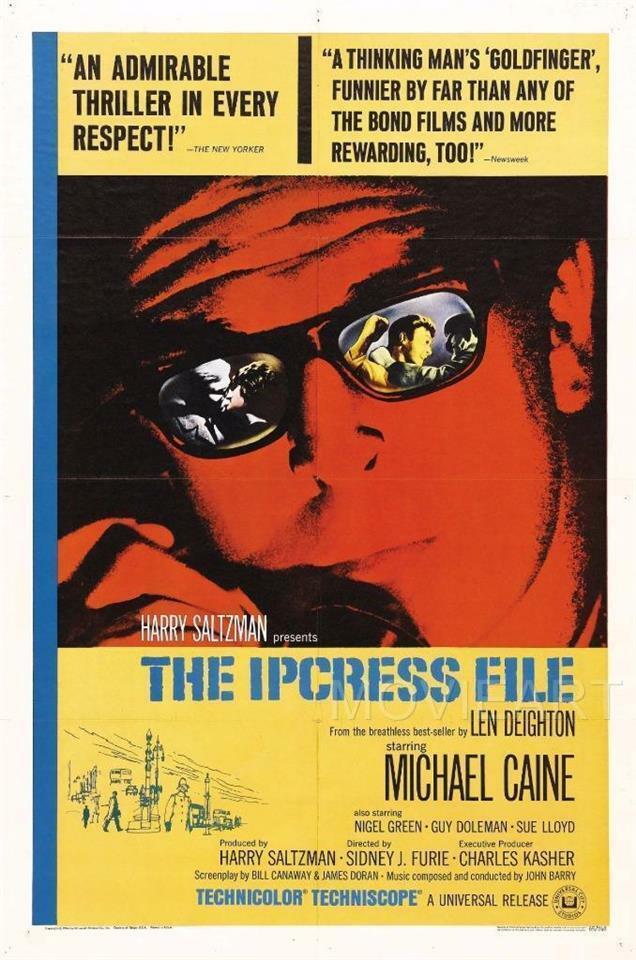
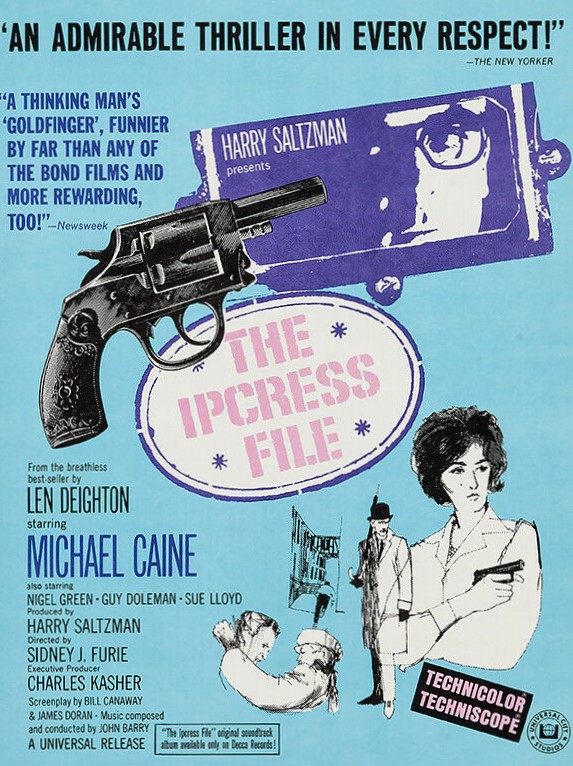
The Ipcress File (1965) *****

Stylish take on the espionage genre when it was still in its infancy and could accommodate stylish directors like Sidney J. Furie (The Appaloosa, 1966). Eschewing the bombastic effects and villains of the James Bond series, relying more on intrigue and the elements of betrayal that other practitioners of the dark arts such as John Le Carre espoused, this is as much a character study and presents in some cases a fairer picture of the class struggle in Britain than most kitchen-sink dramas. So it’s either going to put you off entirely or make you appreciate the film more when I tell you that my favorite scene is the fistfight between Harry Palmer (Michael Caine) and shaven-headed thug Housemartin (Oliver MacGreevy) outside the Royal Albert Hall in London that is shot entirely through the windows of a traditional red telephone box. You can’t say bolder than that.

The credit sequence, more famously ripped off by William Goldman for private eye saga Harper/The Moving Target (1966), is equally inspired. An alarm clock wakes Palmer, he reaches out for the girl who shared his bed last night to discover she is gone and then punctiliously and as if time-shifted to the twenty-first century when it would be the norm proceeds to grind fresh coffee beans, fill a cafetiere with only as much liquid as would constitute a small espresso, dresses and last but not least searches among the disturbed bedclothes for his gun.

Palmer is transferred from dull surveillance duties to a team hunting for missing scientists. Given both his insolent and insubordinate manner, he is not expected to fit in to a service riddled with the upper-classes. His new superior Dalby (Nigel Green), a “passed-over major,” owes his present situation to Palmer’s former boss Colonel Ross (Guy Doleman) and both sport three-piece suits, bowler hats and umbrellas and speak in those clipped tones that invariably carry undertones of menace. Where James Bond’s front, the import-export business, is rather more upmarket, here the background is considerably downmarket, Dalby masquerading as the owner of an employment agency and distributor of fireworks. It is insatiably bureaucratic, reams of forms to be filled in. What Palmer has in common with James Bond, beyond fisticuffs, is the ability to think outside the box and in this case picks the brains of a policeman friend to track down the wanted villain, code-named Bluejay (Frank Gatliff)  

As in the best post-Bond espionage, there are traitors everywhere, and the departments employing spies tend to employ other spies to spy upon them, though in this case Palmer has the luck to draw the sexy Jean (Sue Lloyd). When Palmer picks up the trail of Ipcress, the plot thickens. There is no shortage of action, a gun battle, fisticuffs, but it presents a different approach to modern espionage, with a properly rounded hero – one who can cook (as did author Len Deighton who wrote a cookery column) for a start – while the ladies, with whom he shares a roving eye with Bond, are not required to turn up in bikinis.

There is deft employment of that favorite British cultural emblem – irony – and one wonderful scene takes place in a park where Dalby taps his cane in appreciation of a brass band. Throw in a bit of brainwashing and it’s a completely different proposition to Bond who could escape such a dilemma in a trice. There is a clever ending.

Michael Caine (Hurry Sundown, 1967), complete with spectacles, is superb as Palmer, making enough of an impression that the series ran for another  four episodes. The stiff-upper-lip brigade have a field day in Nigel Green (Jason and the Argonauts, 1963) and Guy Doleman (Thunderball, 1965), the latter shading it with his purported sense of humor. Sue Lyon (Corruption, 1968) is excellent as the seemingly unattainable gal who falls within Palmer’s purvey but not entirely due to his charm. The villains, too, are not from the James Bond school of cut-outs, but come across as equally human, and the chief rascal you could argue has the most finely developed sense of humor of the lot. Throw in Gordon Jackson (Danger Route, 1967) and Freda Bamford (Three Bites of the Apple, 1967) as the bureaucratic attack-dog Alice and you have a very well cast movie.

Sidney J. Furie divided critics. Some believed he was ahead of his time, others that he was in thrall to arty French directors, and a reasonable number who didn’t give a stuff as long as he delivered the goods. But his predilection for odd angles here proves a strength, his  compositional excellence also spot-on, one scene in particular where in a library Palmer looks down on the villain with Housemartin on a landing between. And he takes great delight in emphasizing the class distinctions, both bosses have huge offices with a small desk in the corner, and when Ross places briefcase, umbrella and bowler hat on the desk of Dalby it could not be a more clear invasion.

And you can’t forget the score by espionage doyen John Barry (Goldfinger, 1964). W.H. Canaway (A Boy Ten Feet Tall, 1963) and James Doran, making his movie debut, adapted Len Deighton’s classy bestseller but a fair amount of polish was added by thriller writer Lionel Davidson (Hot Enough for June, 1964), Johanna Harwood (Dr No, 1962), Lukas Heller (The Dirty Dozen, 1967) and Ken Hughes (Arrivederci, Baby, 1966).    

A spy classic.

Discover WordPress

A daily selection of the best content published on WordPress, collected for you by humans who love to read.

The Atavist Magazine

by Brian Hannan

WordPress.com News

The latest news on WordPress.com and the WordPress community.