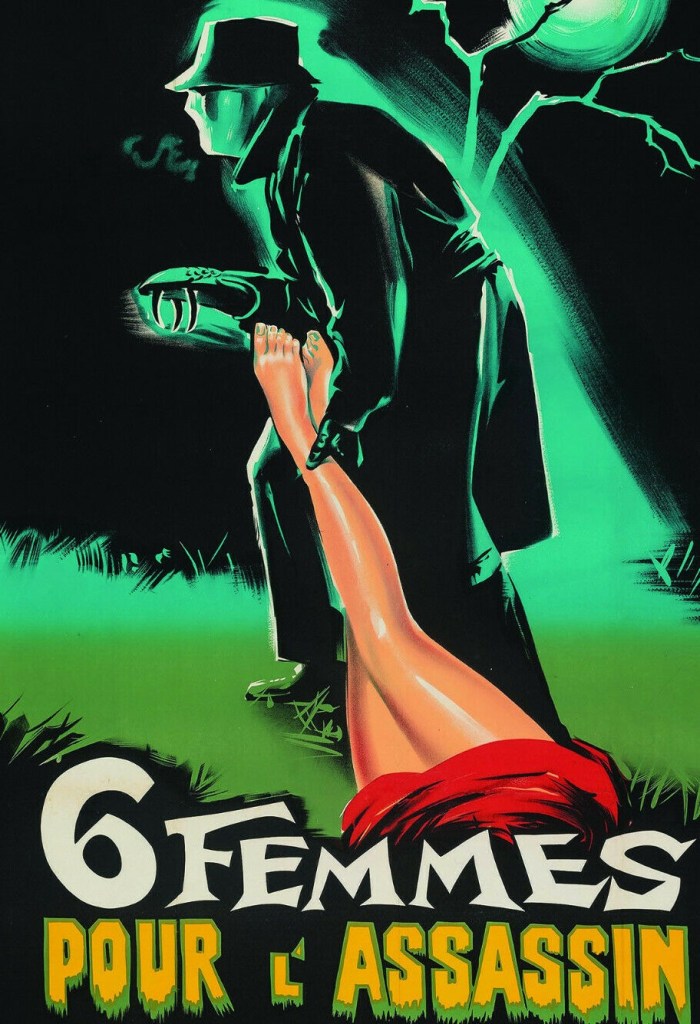
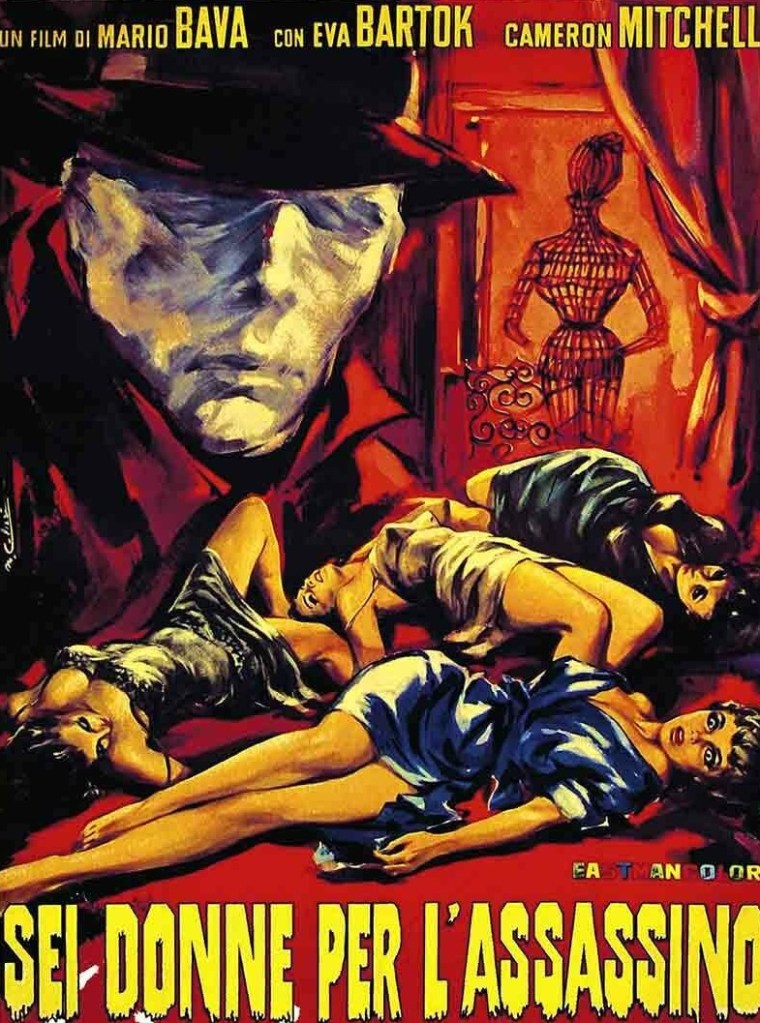
Director Mario Bava channels his inner Douglas Sirk in a rich color palette for this early version of giallo. About as surprisingly rich is the camerawork, which, for a low-budget picture is exceptionally accomplished, tracking, drifting, bobbing between characters. This early in the 1960s, nudity was not so prevalent but setting a movie in a fashion house – ensuring the beauty quotient is remarkably high – provided sufficient opportunity for ladies to be seen (within a work context naturally) in a certain amount of undress and you can be sure the killer leaves them half-naked. And it’s not the usual giallo sex maniac at work either but, despite the volume of murders, a killer driven by a desire to conceal shame.
Blackmail, theft, abortion, cocaine addiction, pregnancy, impotence and illicit affairs are among the secrets the protagonists wish to keep hidden, all risking exposure by a diary kept by the first victim Isabella (Francesco Ungaro). So rather than a whodunit, it’s a whydunit. The killer is particularly creepy, face concealed behind white gauze like an Egyptian mummy. As the Italian title explains, six women are intended for the chop, so that kind of rules out a great deal of tension as you spend your time counting. Are we nearly there yet? And as we run out of obvious potential victims, who the heck is there left to kill? Of course, by that time, we are into twist territory and that element is certainly neatly done.
The main candidates for the murderer are: Franco (Dante DiPaolo), Riccardo (Franco Ressel), Cesare (Luciano Piggozi). Massimo (Cameron Mitchell) and Marco (Massimo Righi). These are the official ones, rounded up by Inspector Silvestri (Thomas Reiner). But that still leaves housekeeper Clarice (Harriet Medin) in her black leather coat. And a fashion house being a festering wound of jealousy, sex, status and privilege you wouldn’t discount any of the models either nor an owner Cristiana (Eva Bartok) who is such a slave-driver she denies her seamstresses time to mourn.
Emotions would be running high in this establishment never mind with a killer on the loose. Relationships are so fraught that even when this is the worst possible time to be alone in a house, certain of the models refuse to offer sanctuary to others and one, Tao-Li (Claude Dantes), just plans to head for the hills (Paris, in other words) and abandon the others. Add to that a high degree of stupidity. When Greta (Lea Lander) discovers the disfigured corpse of Nicole (Arianna Gorini) in the trunk of her car, rather than calling the police, she drags the body into the house and hides it under the stairs while her butler is about to serve tea. Except it’s not out of folly, it’s because Greta, like all the women here, wishes to protect a male, passion reigning supreme to the extent that the thought of losing a lover even if he is a murderer is too much to bear.
The inspector’s task would be made easy if the killer had a distinctive modus operandi. Death occurs through strangulation, suffocation, drowning (though with cut wrists to make it look like suicide), falling from a great height and Nicole’s face thrust into a stove. If victims take a long time to die, it’s not from the killer’s sadism but his/her incompetence. Virtually none are speedily dispatched, murder not as easy as you might imagine, an idea that Hitchcock purloined in Torn Curtain (1966)
For most of the time the way the camera moves you would wouldn’t think you were watching a film about a serial killer (in those days as rare in reality as in fiction) but a dense emotional tale as spun by the likes of Luchino Visconti (The Leopard, 1963) amidst a backdrop of wealth and beauty. Setting aside the murders, there is a feast of intrigue, and a rich seam of characters, though the central theme seems to be (not surprising for the era) that money and beauty are not as fulfilling as love, something that women will commit various crimes (though stopping short of murder) to achieve.
I would imagine it was just such intricate camerawork that put audiences off the picture on initial release, a big flop in Italy and, if screened anywhere else (as in Britain) the lower part of a double bill. Not quite as intense as Bava’s previous The Whip and the Body (1963) nor so stylistically driven as Danger : Diabolik (1968) and some way short of horror masterpieces like Black Sabbath (1963), this is still an interesting watch, something of a template for future giallo and from a pure directorial perspective glorious to watch.
The number of characters featured and the time spent on the various deaths limit the opportunities for any one star to dominate but Hungarian Eva Bartok (Operation Amsterdam, 1960) leads the line on the female side while American transplant Cameron Mitchell (Minnesota Clay, 1964) and Dante DiPaulo (Sweet Charity, 1969) vie for male acting honors. The screenplay was a joint effort by Marcello Fondato, Giuseppe Barilla and Bava.
YouTube has this for free though be warned it comes with ads and for the sumptuous photography alone you may want in any case to splash out.
Unusual drama mainlining on Californian surf, sex, bikers, a mystery of Blow-Up (1966) dimensions and the best entrance since Ursula Andress in Dr No (1962). Displays a 1960s vibe with a 1950s pay-off as the “hitchhiker” of responsibility rears its ugly head.
A woman thrown out of a car narrowly escapes being run over. The cops jack in the investigation after television actress Vickie (Jacqueline Bisset) refuses to explain why she’s been badly beaten up. And so we enter flashback mode to supposedly find out. She makes a glorious entrance, emerging from the sea, minus bikini top, into the lives of surfer Denny (Michael Sarrazin), jazz pianist Choo-Choo (Bob Denver) and ageing beach bum and tennis hustler Collie (Tony Franciosca). From the off, she’s enigmatic, gives a false address, won’t explain bruises on her arm, has something clandestine going on with television producer Caswell (Warren Stevens) and like Blow-Up we are only privy to snippets of information.
She’s half-in half-out of a relationship with Dennis, with Collie hovering on the periphery hoping to pick up the pieces to his sexual advantage. Contemporary issues clog the background, Choo-Choo tries a camp number complete with pink dog to avoid the draft, a neighbor threatens to shoot Parker for wandering around in shorts and habitually stealing his newspaper, epithets like “degenerates” are tossed around, Choo Choo’s girlfriend Thumper, while appearing in movies with titles like Suburban Lust Queen acts den mother, there’s not much actual exciting surfing, and a biker called Mr. Clean is somehow involved.
The romance plays out well, Vicky unsure, Denny convinced but without a livelihood to offer and unable to get a straight answer out of her. Choo-Choo gets the gig of his dreams in Las Vegas and there’s an rape scene, more unsettling because it’s committed by Denny with the bizarre justification of getting “just for once something on my terms.” And there’s the equally disquieting sense that the only explanation for Vickie’s behavior is to tab her a nymphomaniac, walking out of an argument with a mysterious man in a beach house to drop her clothes for a bout of sex with Mr Clean.
I must have seen a different picture from everyone else. A good few critics at the time and reviewers since appear to think Vickie was also victim of a gangbang by the bikers, but I can’t see why. When he sees Vickie coming down from the beach house, Mr. Clean shouts “everybody split” and his buddies clear the beach. However, Mr. Clean, ironically, gives the best indication of her state of mind, explaining that Vickie “kept staring back at the house and moaning about how she wanted to die” while he enjoyed the best night of his life sex-wise.
Denny and Collie prove not to be the pussycats they appear, bearding the bikers in their den and beating up Mr. Clean while Denny goes on to deliver a hiding to Caswell. But what this film turns out to be is an examination of vulnerability, how easily those with a new sense of freedom are trapped. An examination of contemporary mores, perhaps, but in not resolving the mystery of Vickie ultimately fails to deliver, especially as it does not, from the outset, carry the kind of artistic credentials of Antonioni in Blow-Up.
Perhaps the mystery needs no resolution, it’s just same old-same old dressed up in the novelty of sexual freedom. There’s no idea of why Vickie was beaten up, and essentially abandoned on the road to become accident fodder, and no hint really of why she fell foul of someone so badly she needed disposed of, no notion that she was a threat to anyone. (Or, for that matter, no explanation of what happened to her bikini top and why, if she was so apparently free with her charms, she was so shy about being seen half-naked.) On the other hand, victim may well have been Vicky’s destiny from the get-go, that kind of innocence only waiting to be defiled.
In any 1960s contemporary picture there’s always the temptation to accept as truthful or reject as phony the lives shown. The idea that sexual freedom bestows actual freedom is usually the issue until consequence (i.e. old-fashioned Hollywood morality) comes into play. This is less heavy-handed than, for example, Easy Rider (1969) or Bob & Carol & Ted & Alice (1969). The characters make decisions to grow up or to stay locked in a world of easy sex, dope and money. There’s no grand finale, just a more realistic drifting apart, and it’s only Vickie who comes apart, although that process had begun long before she met the drifters.
Jacqueline Bisset (The Detective, 1968), in her divinely posh British accent, comes over well as an attractive screen presence and complex character. In fact, she has a bigger part here than in Bullitt (1968) or The Detective (1968). If you wanted anyone to portray a soulful hippie you need look no further than tousle-haired Michael Sarrazin (In Search of Gregory, 1969) and normally if you required someone on the sly, despicable side, Tony Franciosca (Fathom, 1967) might well be your first port of call, but Franciosca proves the surprise here, classic wind-up merchant and predator who exhibits considerable vulnerability when he realizes he is losing the worship of the idealistic young.
Former British matinee idol Michael Wilding (A Girl Named Tamiko, 1962) and Norma Crane (Penelope, 1966) appear as Vickie’s parents. Bob Denver (Who’s Minding the Mint, 1967) and Michele Carey (The Spy with My Face, 1965) are solid support. Director Harvey Hart (Fortune and Men’s Eyes, 1970) tries to cover too much ground and could have done with narrowing the focus. Future Bond screenwriter Tom Mankiewicz (son of Joseph L.) made his screenwriting debut adapting the book by William Murray.
The DVD is a bit on the pricey side, but if you just want to check it out, YouTube has a print.
Bizarre movie seeks cult audience! You might as well have stuck that on the poster. When I tell you the film climaxes like a Monty Python sketch with four successive men giving birth – from a variety of orifices – the first three to emerge different versions of the same character, the last the dead husband James (Paapa Essiedu) of Harper (Jessie Buckley). And that men also appear fully naked, in the form of some kind of vegetation, and can survive despite having an arm spliced from elbow to fingers. And that James desperately wants her to feel guilty about his suicide, triggered by her demanding a divorce.
Of course, all this could be taking place in her tormented mind except that she steadfastly refuses to admit to torment over the suicide even though she does scream her head off in church. If any of this is remotely realistic it points to someone with a severe downer on men, since there is not a single likeable one in sight. Men, in fact, are just four-letter words (choose your own) whose sole purpose is to accuse women of not loving them enough. And women – cue symbolism – are all born of Eve and inclined to eat a forbidden apple.
None of this would be so bad if in attempting a psychological thriller and/or horror film (I am assuming horror because of the births and arms sliced in two) there was actually a shock or two or even a general sense of creepiness. On the plus side, should this ever achieve cult status – “makes Titane look like Paddington” (1 or 2, you choose) – then I am sure director Alex Garland will only be too happy to turn up for a tenth anniversary Q&A and explain his intentions and/or symbolism and if he’s very lucky find an audience composed of students who have written a thesis on the film.
So the story – or did you think there wasn’t one – sees Harper repair to a village in the country to a fantastic country house with all the trimmings including an Aga and a baby grand for two weeks holiday to recover from the suicide, her mind still so muddled that she’s not thought to change her married name. It’s the kind of village where there appears a considerable amount of inbreeding. The letting agent (Rory Kinnear) looks suspiciously like the long-haired vicar (Rory Kinnear) and the rude schoolboy (Rory Kinnear) and the policeman (Rory Kinnear) and the bollocks-naked stalker (Rory Kinnear).
Harper gets lost in the unfamiliar countryside and happens across a tunnel where the echo effects could have been created by Robert Fripp and is then chased by a man (Rory Kinnear anyone?) and then catches sight of the naked man who later appears in her garden looking like an rewilded exhibit from the Chelsea Flower Show. The various versions of the man appear at different points and even when the letting agent appears good (and brave) actually he is just as bad.
I felt sorry for the Oscar-nominated Jessie Buckley (The Lost Daughter, 2021) for having to put up with this script. I also felt sorry for Rory Kinnear (No Time to Die, 2021) with a movie career so far consisting of supporting roles who must have been convinced that the chance to channel his inner Alec Guinness/Peter Sellers and play multiple characters would have been his breakthrough.
I did not in the slightest feel any sympathy towards Alex Garland (Ex Machina, 2014) for dreaming up this pile of tosh. This is one those films that strides the critic/moviegoer divide. Around 70 per cent of critics on Rotten Tomatoes gave it a positive review but moviegoers disagreed and, as surveyed by Cinemascore, gave it a D score (on a rank from A to F).
An unexpected delight. More farce than spoof and more Hitchcockian thriller than espionage adventure, but bursting with laughs. Spinning on the premise of mistaken identity, a New York banker becomes mixed up with diamond smugglers while being pursued by a posse of Europe’s shadiest characters and a very determined femme fatale. All the more enjoyable because identity confusion is very difficult to pull off unless you have a top class cast like Cary Grant and Eva Marie Saint in North by Northwest (1959).
Landing in Lisbon, New York banker William Beddoes (James Garner) is mistaken for the emergency replacement for a recently-deceased British spy. It’s not just embassy officials like Hatton Jones (Robert Coote) who are afflicted by this notion, the villains are so determined to get rid of their man two bombs are planted in his car. Attending his supposed predecessor’s funeral brings Beddoes into contact with glamorous Aurora (Melina Mercouri). Smuggler Steve (Anthony Franciosca) offers his service to Beddoes to help recover $5 million in stolen industrial diamonds. To complicate matters, identity is also an issue for Steve, who while working under an assumed name is outed by Amy (Sandra Dee) who recognizes him as her family’s former gardener.
Unable to convince anyone he is not who he says he is, Beddoes is swept into the conspiracy, his every move under surveillance by rival villains, including Florian (Gregoire Aslan) and Milo the Murderer (Arnold Diamond), while Aurora attempts seduction to bring him to heel. Eventually, while never ruling out double-cross, Beddoes, Aurora, Steve, Amy and embassy officials work together to decipher a series of clues revolving around rice, azaleas, a red pig and a man who sneezes, none of which align with obvious meanings and naturally are interpreted as something to do Red China or the Iron Curtain.
A picture based on a simple premise is better than a spoof that labors to create a plot and so it’s true here. Everything springs from the mistaken identity and the diamond hunt, and as one twist effortlessly follows another characters with conflicting agendas collide. Beddoes spends all his time trying to escape from kidnap, assassination or seduction. It’s helter-skelter stuff, so no surprise that chases, of the Buster Keaton variety, produce laughs. I found myself laughing out loud at the scene where Steve can’t find anywhere to sit in a café that is not next to a villain, Beddoes getting attacked by drapes, an ambassador (Cecil Parker) more concerned with knotty chess problems than espionage, and a great visual gag where Beddoes wallops a cop. Escaping pursers, Steve takes a short cut that leads him straight back into danger.
Naturally, the whole enterprise is loaded with confusion, not least because making the wrong decision, taking the wrong turn and making the wrong assumption sets up the next gag. Throw in ambulance theft, Beddoes sitting in a row of hookers in jail, a tape recording turning up in a bread roll and you get the idea.
The cast could have been hand-picked for this kind of picture. James Garner (The Hour of the Gun, 1967) is the natural successor to Cary Grant in the double-take department. This role is a play on previous ones where he was the trickster and not the patsy. He’s more stiff-upper-lip than the Brits. Comedy skills honed on this one that were put to terrific use in Support Your Local Sherriff (1969). And while Melina Mercouri (Topkapi, 1964) is more than a little over-the-top, the dominant woman from whom ordinarily Beddoes would run a mile, but also possessing the cunning survival instincts lacking in an innocent like him. One scene that depicts their contrasting characters so well is when she runs around half-naked to create a diversion and he chases after trying to cover her up, clearly no idea that distraction is necessary.
Tony Franciosca (The Swinger, 1966) leads with his teeth, his smarminess undercut by Sandra Dee reminding him he is a glorified gardener. Dee (Tammy and the Doctor, 1964), however, never manages to stray from her ingénue roots. An excellent supporting cast includes Robert Coote (The Swinger), Gregoire Aslan (Moment to Monet, 1966), Cecil Parker (A Study in Terror, 1965). This was British actress Dulcie Gray’s final film.
The movie had a fractured genesis. Original director Cliff Owen (The Vengeance of She, 1968) fell out with the stars and was shunted aside in favor of Ronald Neame (Gambit, 1966), more adept at male-female chicanery. The screenplay originated from comedic masters – Richard Breen (Do Not Disturb, 1965) and T.E.B. Clarke (The Lavender Hill Mob, 1951) – based on the book Diamonds for Danger by David E. Walker. And there are many delightful lines. “I’m my own bait,” spouts Aurora. Trying to placate Amy, Steve explains “It’s unusual to find this many dead spies in one day.”
The movie failed to register with the public which was astonishing. At a time when theme songs helped turn other films like Alfie (1965) into successes, the movie contained the tune that would give Frank Sinatra his first number one single in over a decade, “Strangers in the Night.” Unfortunately, the movie did not carry Sinatra’s imprimatur. The music in the film was an instrumental. Had Sinatra’s voice been heard in the movie it might have turned it into a hit.
For a long time, this under-rated delightful comedy was hard to find. There still is not a Region 1 DVD, but you can find it on Region 2 and YouTube has kindly provided a free copy.
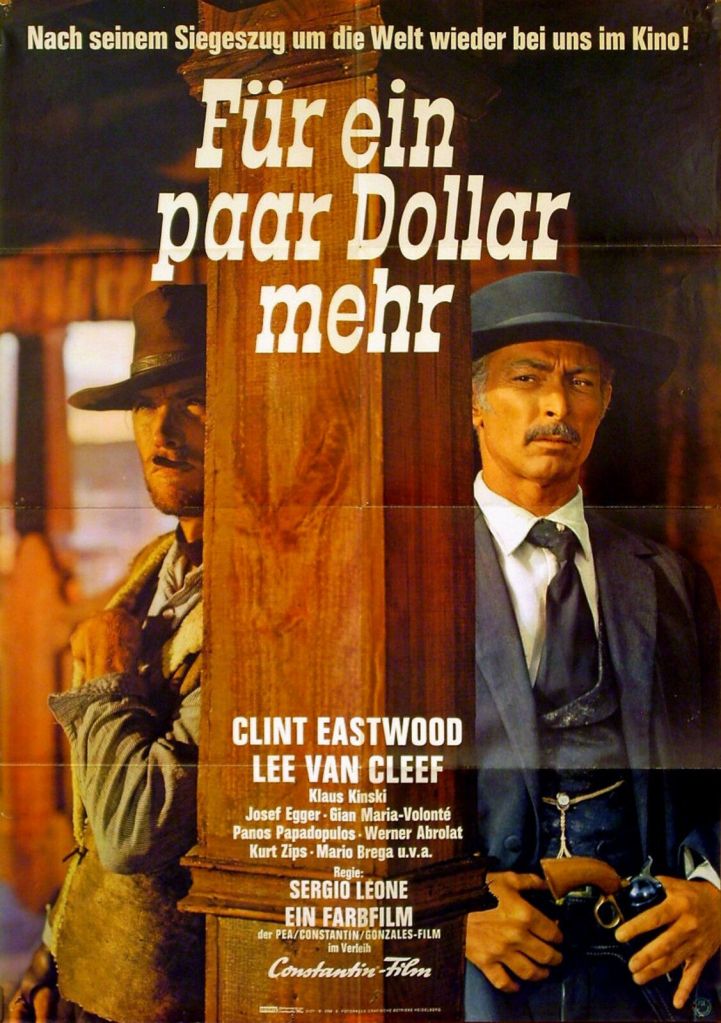
The prospective casting was tantalizing. How about Clint Eastwood and Lee Marvin, a pairing for the ages, two of the toughest guys in screen history? Failing that, Eastwood and Charles Bronson, The Man With No Name vs The Monosyllabic Man? The role of Colonel Mortimer could also have gone to Henry Fonda or Robert Ryan before in one of the movie business’s oddest tales it ended up with Lee Van Cleef.
In due course Bronson and Fonda would work with Sergio Leone in the director’s best film, Once Upon a Time in the West (1969). Fonda’s agent had already dodged Leone’s entreaties once, having rejected A Fistful of Dollars (1964). Marvin was, in fact, all set, an oral agreement in place until a few days before shooting began on For a Few Dollars More he suddenly opted instead for Cat Ballou (1965), a decision that won him an Oscar and turned him into an unlikely star.
When none of his first choices proved available or interested, Leone turned to Van Cleef. Or, more correctly, a photo of the actor pulled from an old casting catalog. Although a western buff like Leone remembered Van Cleef from his debut in High Noon (1952) plus Gunfight at the O.K. Corral (1957), The Tin Star (1957) and a dozen other bit parts and supporting roles in westerns, Van Cleef had not been credited in a movie since The Man Who Shot Liberty Valance (1962).
He proved virtually impossible to track down. No small surprise there because he earned a living mostly as a painter now, a car accident having left him with a limp. He couldn’t run, much less ride anything but a docile horse. He required a stepladder to get mounted. Leone flew to Los Angeles and his first sight of Van Cleef, older than his photograph, proved his instincts correct, Van Cleef’s face “so strong, so powerful.” The salary on offer, for a down-on-his-luck actor scarcely able to pay a phone bill, was a fat purse of $10,000. (Eastwood’s salary was $50,000 plus a profit share compared to just $15,000 for the first film).
Leone put him to work right away, the day he arrived in Italy filming reaction shots. It was just as well his input that day was so simple because, as Clint Eastwood had discovered, the language barrier was a problem. Equally disconcerting was that Van Cleef had no idea why he had been chosen, and since A Fistful of Dollars had not been released in the U.S., no inkling of the kind of western the director had in mind. At Eastwood’s urging, he nipped out to a local cinema and returned with the understanding that the script was “definitely second to style.” Van Cleef was easy to work with, and although he could put away a fair amount of liquid refreshment it never interfered with his work. He came ready for direction.
Leone had not wanted to make a sequel. His original plan was a caper picture called Grand Slam or a remake of Fritz Lang’s classic M to star Klaus Kinski or an autobiographical drama – Viale Glorioso – set in the 1930s. Jolly, the producers of A Fistful of Dollars, offered him a 30 per cent profit share on that film if he made a sequel, as they felt he was legally obliged to do. Instead, furious with his treatment at their hands, the director hit upon the title of a sequel For a Few Dollars More, the actual storyline only coming to fruition when he came across a treatment called The Bounty Killer by Enzo dell’Aquilla and Fernando Di Leo, who in exchange for a large sum, surrendered their screen credits. Luciano Vincenzoni completed the screenplay in nine days, leavening it with humor, after the director and his brother-in-law Fulvio Morsella had produced a revised treatment, Leone also involved in the final screenplay.
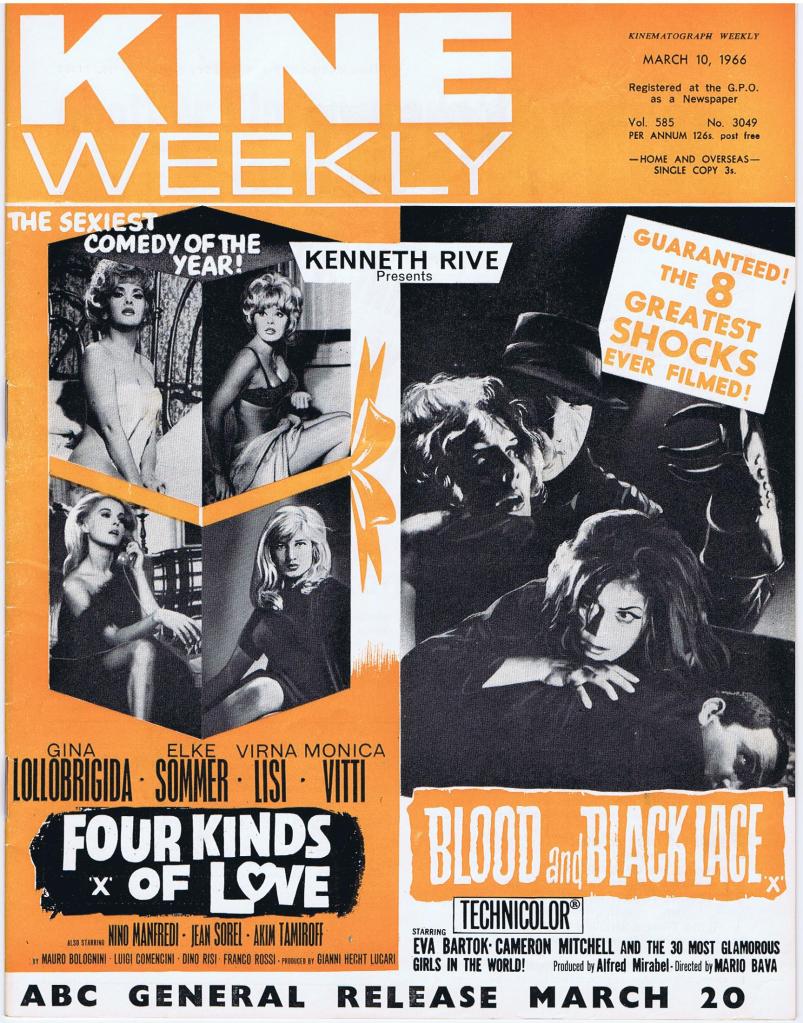
Jolly Films, the makers of “A Fistful of Dollars” already had experience of selling its films abroad. But as with Mario Bava’s “Blood and Black Lace” they were usually sold outright with no share of the box office and in turn sold as a supporting feature for a fixed price to an exhibitor.
Leone found a new backer in Alberto Grimaldi, an Italian entertainment lawyer who worked for Columbia and Twentieth Century Fox and had produced seven Spanish westerns. He promised to triple the first film’s budget to $600,000, with the director on a salary and 50 per cent profit share.
Success bred artistic confidence. A Fistful of Dollars had broken all box office records in Italy, grossing $4.6 million, and so Leone sought to improve on his initial offering and develop an “authorial voice.”
Thematically, with two principals, initially rivals who end up as “argumentative children,” it took inspiration from westerns like The Bravados (1958) – the photo and the chiming watch – and Robert Aldrich’s Vera Cruz which pitched Burt Lancaster against Gary Cooper. While bounty hunters had cropped up in Hollywood, they were not ruthless killers, actions always justified, rather than merely professionals doing their job. So in some sense Leone was drawing upon, and upending, films like Anthony Mann’s The Naked Spur (1953) and The Tin Star, Andre De Toth’s The Bounty Hunter (1954) and Budd Boetticher’s Ride Lonesome (1959). Just as Clint Eastwood’s bounty hunter underwent change, gradually the character played by Gian Maria Volonte evolved from a straightforward outlaw called Tombstone to a stoned, sadistic bandit named El Indio.
With artistic pretension came attention to detail. Leone required historical exactitude not just relating to weapons used, but their ballistics and range. Lee Van Cleef’s arsenal included a Buntline Special with removable shoulder stock, Colt Lightning pump action shotgun, Winchester ’94 rifle, and a double-barreled Lefaucheux. Carlo Simi’s town, constructed near Almeria, contained a two-storey saloon, undertaker’s parlor, barbershop, telegraph office, jail, hotel and an adobe First City Bank. And there was nothing pretty about it. The saloon was dirty and overcrowded, machines belching so much smoke it “looked as if a man could choke in there.” Filming took place between mid-April and the end of June 1965.
Perhaps the biggest area for improvement was the music. Ennio Morricone had scored another nine films since A Fistful of Dollars. Both director and composer had ambitious ideas about how to use the music. The score was not recorded in advance, nor was Morricone given a screenplay, instead listening while Leone told him the story and asked for individual themes for characters. Morricone would play short pieces for Leone and if met with his approval compose longer themes. Each character had their own leitmotif, sometimes the same instrument at different registers, the flute brief and high-pitched for Monco (Eastwood) but in a low register for Mortimer, church bells and a guitar representing El Indio. In a very real sense, they were experimenting with form. Bernardo Bertolucci regarded Morricone’s music as “almost a visible element in the film.” Musical ideas regarding El Indio’s watch, however, were developed at the rough cut stage, its repetitive melody becoming “sound effect, musical introduction and concrete element in the story.”
As well as creating music for audiences, Leone’s films are punctured with music that holds particular meaning for characters, here the watch and in Once Upon a Time in the West the harmonica, in both films flashback used to assist understanding.
The myth of why it took so long for either film to reach the United States was based on two misconceptions, firstly that Japanese director Akira Kurosawa, whose Yojimbo (1961) A Fistful of Dollars closely resembled, had blocked its progress, secondly that it relied on screenwriter Vincenzoni to make the breakthrough via a contact working for United Artists.
In fact, there were more obvious reasons for resistance from American distributors. In the first place, you could not discount snobbery. The notion that the country that had invented the western should now be reliant on importing them from Italy seemed a shade abhorrent. Although For a Few Dollars More was sold to 26 countries in a day at the annual Sorrento trade fair in 1965 – at the same fair a year earlier there had not been a single taker for A Fistful of Dollars – the United States was not among the buyers, distributors perhaps even more daunted by the prospect of introducing so much violence to American audiences reared on the traditional western.
Foreign movies that made the successful transition to the United States arrived weighted down with critical approval and/or awards or garlanded with a sexy actress – Brigitte Bardot, Anna Magnani, Sophia Loren among the favored – and risqué scenes that Hollywood dare not include for fear of offending the all-mighty Production Code.
But sex was a far easier sell in the U.S. than violence. And an actor with no movie marquee such as Clint Eastwood did not fill exhibitors with delight and even the notion that A Fistful of Dollars was a remake of Akira Kurosawa’s Yojimbo (1961) failed to stir the critics (as with The Magnificent Seven being a remake of Seven Samurai, most viewing the notion as repellent). So both the first and second pictures in the “Dollars” trilogy were stuck in distribution limbo for three and two years, respectively, before being screened in America.
And, initially, it had appeared that Italian audiences shared the same distaste for a cultural intruder such as A Fistful of Dollars. One cinema chain owner refused to book the film on the grounds that there were not enough female characters. A Fistful of Dollars was released in Italy in August, a dead period, since the month is so hot and everyone has abandoned the city for the beach. It opened – only in Florence and with neither publicity nor advertising – on August 27th 1964, a Friday, and did poor business that day and the next. But by Monday, it was a different story, takings had doubled and over the following two days customers were being turned away. New films typically played first-run for 7-10 days in Florence, A Fistful of Dollars ran for three months, triggering a box office story of Cinderella proportions.
But my research indicated there had been ample opportunity for an American distributor to snap up the rights to A Fistful of Dollars in 1965, two years before it was finally released there. In the first place, the music rights had already been purchased by New York firm South Mountain Music in March 1965 in expectation the film would acquire release that year. In December 1965 Arrigo Colombo, partner in Jolly, flew to the United States for the specific purpose of lining up a major distributor for A Fistful of Dollars. The company had previously secured U.S. distribution for horror product like Castle of Blood (1964) and Blood and Black Lace (1964) but those were outright sales.
With the movie already sold to Spain, West Germany, France and Japan, Colombo aimed to conclude a deal for the English-speaking market, “purposely holding back” from releasing the picture in those countries as he sought an all-encompassing contract. At that point, Kurosawa no longer stood in the way, that issue “now cleared up” settled in the normal fashion by financial inducement, in an “amicable settlement” Toho snagging the Japanese and Korean rights, the deal sweetened with a minimum $100,000 against a share of global profits. But Colombo went home empty-handed, unable to secure any deal and his temerity ridiculed by trade magazine Variety
Although Sergio Leone had one other legal obstacle to surmount that would not have got in the way of a U.S. distribution deal, the worst that could happen being that a contract might be struck with a different company. Italian companies Jolly Films/Unidis, which had backed the original, took umbrage at Leone going ahead with the sequel without their financial involvement, cutting them off from the profit pipeline. So in April 1966 they took Leone to court in Rome arguing that For A Few Dollars More “represented a steal as well as unlawful competition for its own Fistful.” Four months later the judge denied the claim on the grounds that “the character played by Clint Eastwood in each film is not characterized to such a degree that a likeness exists” (even though to all intents and purposes it was the same character, cigar, poncho, gun, bounty hunting!). Ironically, Italian laxity in such matters counted against Eastwood when he failed to prevent the distribution of a film based on two segments of Rawhide stitched together.
It would also be highly unusual if United Artists was not aware of both A Fistful of Dollars and For A Few DollarsMore since, in keeping tabs on the foreign performance of both Goldfinger (1964) and Thunderball (1965) the studio could scarcely fail to notice the Italian westerns close on their box office tail, the second western outpointing Thunderball in daily averages in Rome.
But the story still, erroneously, goes that it was the intervention of writer Vincenzoni which proved decisive. He had contacts in U.S, namely Ilya Lopert of United Artists. Grimaldi was, meanwhile, trying to sell U.S. and Canada rights relating to the second picture. Vincenzoni arranged for UA’s representatives to view A Fistful of Dollars in Rome and cut himself in for a slice of the profits when the distributor surprisingly purchased the entire series.
Since A Fistful of Dollars had already been sold to most major territories, UA could only acquire the North American rights – for a reported $900,000 – but for the other two films gained a considerably larger share of global distribution
United Artists was an unusual company among the Hollywood hierarchy, and not primarily due to recurrent Oscar success, but because it had, completely unexpectedly, hit box office gold with James Bond. There was nothing particularly odd about a series, as Tarzan, Sherlock Holmes etc (still flourishing in the 1960s) testified. What was distinctive about the Bonds was that each picture – the four so far had earned close to $150 million worldwide, not counting merchandising – had done better than the last, which went against the standard rule of sequels of diminishing returns and higher costs. Given the opportunity to buy into a ready-made series (two films in the can, the third in production) UA made an “attempt to calculatedly duplicate the (Bond) phenomenon” and in so doing “create a trend.” Assuming the movies would follow the Bond formula of increased grosses with each successive picture, the studio was prepared to spend “many hundreds of thousands” of dollars to establish the first picture.
United Artists embarked on an unusual sales campaign to the trade. Instead of marketing the pictures one at a time, they started to promote the series with the tagline “A Fistful of Dollars is the first motion picture of its kind, it won’t be the last.” The advertising campaign was unusual in that it was based entirely around introducing the character rather than the story (much in the same way as James Bond had been), three separate slivers of the poster devoted to visual aspects, the cigar, gun and poncho, each carrying mention of “The Man With No Name,” such anonymity one of the talking points of the movies.
Cinema managers were briefed on release dates, A Fistful of Dollars in January 1967, the sequel for April and The Good, the Bad and the Ugly for Xmas that year. Like the Bonds, it was expected that box office would progressively, if not explosively, increase. The studio unveiled a “hard-hitting campaign” designed to “intrigue the western or action fan.”
However, the North American premiere was held not in the United States but Canada, at the Odeon-Carlton in Toronto. Having committed to a four-week engagement, a risky prospect for an unknown quantity, the cinema started advertising a teaser campaign three weeks in advance. During the first week, posters were not just focused on the “man with no name” but also “the film with no name” and the “cinema with no name,” all those elements removed from the artwork until the second week of the campaign. UA allocated $20,000 in marketing, up to four times the usual amount spent on a launch there, and was rewarded with strong results – “bullish but not Bondish” Variety’s verdict.
However, the UA gamble did not pay off, especially when taking into account the high cost of buying the rights allied to huge marketing costs. Initial commercial projections proved unrealistic. Despite apparently hitting the box office mark in first-run dates in key cities, the film was pulled up short by its New York experience. Shunted straight into a showcase (wide) release rather than a first-run launch, it brought in a pitiful $153,000 from 75 theaters – even The Quiller Memorandum (1966) in its second week did better ($150,000 from 25). As a consequence when For a Few Dollars More was released in April/May, UA held off boking it into New York until “a suitable arrangement” could be made, which translated into hand-picking a dozen houses famed for appealing to action fans plus 600-seat arthouse the Trans-Lux West.
United Artists predicted $3.5 million in rentals (the amount returned to studios after cinemas take their cut of the gross) for A Fistful of Dollars and $4.5 million with For a Few Dollars More. Neither came close, the latter the marginally better performer with $2.2 million in rentals (enough for a lowly 41st on the annual chart) with the first film earning $2.1 million in rentals (46th) way behind more traditional performers like Hombre ($6.5 million for tenth spot), El Dorado ($5.9 million in 13th) and The War Wagon ($5.5 million in 15th).
The vaunted Bond-style box office explosion never materialized and it might have helped if UA had kept closer watch on the actual revenues posted in Italy for the series. While For a Few Dollars More increased by $2 million the takings of A Fistful of Dollars, the final film in the trilogy, The Good, the Bad and the Ugly produced lower grosses than even the first.
However, it did look as if The Good, the Bad and the Ugly would come good. UA opened it in two first-run cinemas in New York where each house retained it for six weeks. But although the final tally of $4.5 million (24th spot in the annual rankings) was the best of the series, it did not herald returns that made it anywhere near comparable to the Bonds.
It’s possible the movies did better in terms of admissions than the box office figures show. Distributors pushing foreign product into arthouses were generally able to achieve a high share of the rental – 50 per cent the going rate – because they were able to set rival arthouses against each other and movies with a sexy theme/star had inbuilt box office appeal, La Dolce Vita (1960) and And God Created Women (1956) the classic examples. But that would not be possible when trying to interest ordinary cinemas with a film lacking in sex.
When I researched the early Bonds for a previous Blog, I found that United Artists had only managed to achieve bookings for Dr No (1962) by lowering its rental demand. Exhibitors paid the studio just 30 per cent of the gross. And I wondered if perhaps the same occurred with A Fistful of Dollars given the star, like Sean Connery, was completely unknown. Of course, it would not explain why the series did not grow as expected.
Of course, there was a surprising winner and an unexpected loser in the whole ‘Dollars’ saga. Clint Eastwood emerged as the natural successor to John Wayne with a solid box office – and later critical – reputation for American westerns starting off with Hang ‘Em High (1968) which beat The Good, the Bad and the Ugly at the box office, while Sergio Leone’s Once Upon a Time in the West (1969) proved a huge flop in the U.S.
Christopher Frayling, Sergio Leone, Something To Do With Death (Faber & Faber, 2000), p160-162, p165-200; “Italo’s Own Oater Leads Box Office,” Variety, December 2, 1964, p16; “South Mountain Buys Dollar Score,” Variety, March 10, 1965, p58; “Jolly’s Colombo Discovers N.Y.C. Busy at Xmas,” Variety, December 22, 1965, p3; “Tight Race for Box Office Honours in Italy Looms as Thunder Leads Dollars,” Variety, January 65, 1966, p15; “Dollars World Distribution for UA,” Variety, March 22, 1966, p22; “Clint Eastwood Italo Features Face Litigation,” Variety, April 13, 1966, p29; “UA Cautious on Links to Italo Fistful; Faces Slap from Kurosawa,” Variety, July 13, 1966, p7; “Rome Court Rejects Plea for Seizure of Few Dollars Made By Fistful Film,” Variety, August 3, 1966, p28; “Clint Eastwood vs Jolly on 2 Segs of Rawhide ‘Billed’ New Italo Pic,” Variety, September 7, 1966, p15; “Italy Making More Westerns, Spy Films Than Star Vehicles,” Box Office, October 31, 1966, p13; “Hemstitched Feature,” Variety, November 23, 1966, p22; “UA Division Holds Screenings of Westerns,” Box Office, December 12, 1966, pE2; Advertisement, Variety, December 21, 1966, p12-13; “UA Gambles Dollars As Good As Bonds,” Variety, December 28, 1966, p7; “Fred Goldberg Shows Ads on UA ‘Dollar’ Films,” Box Office, January 2, 1967, pE4; “Review,” Box Office, January 9, 1967, pA11; “Fistful of Dollars: Male (and Italo) B.O.,” Variety, January 18, 1967, p7; “Fistful of Dollars: The Glad Reaper,” Variety, February 1, 1967, p5; “This Week’s N.Y. Showcases,” Variety, February 8, 1967, p9; “Fistful’s Weaker N.Y. B.O. Clench,” Variety, February 8, 1967, p7; “Methodical Campaign Kicks Off Ideal Fistful Ballyhoo in Toronto,” Box Office, May 1, 1967, pA1; “Few DollarsMore Runs 30% Ahead of First Dubbed Italo-Made Western, So Bond Analogy Makes Out,” Variety, May 31, 1967, p4; “N.Y. Slow to Fall Into Line,” Variety, May 31, 1967, p4; “B’way Still Boffo,” Variety, July 12, 1967, p9; “Carefully Picked,” Variety, July 12, 1967, p4; “B’way Biz Still Big,” Variety, July 19, 1967, p9; “Big Rental Films of 1967,” Variety, January 3, 1968, p25; “B’way B.O. Up,” Variety, January 31, 1968, p9; “Big Rental Films of 1968,” Variety, January 8, 1969, p15.
Sergio Leone played the numbers game – one hero/anti-hero for debut A Fistful of Dollars (1964), doubling down in For a Few Dollars More, bad guys in triplicate for The Good, the Bad and the Ugly (1966) and virtually an entire spread – Charles Bronson, Henry Fonda, Jason Robards and Claudia Cardinale (not quite fitting the anti-hero mold) – for his masterpiece Once Upon a Time in the West (1969), upping the artistic ante with every episode. For a Few Dollars More is part sequel, part caper and part dress rehearsal.
Looking back on this Leone venture now you can’t help but be influenced by what followed in particular Once Upon a Time in the West, and the way in which themes, ideas and characters introduced here are more fully developed. You could start with the musical motif. Here a fob watch that plays a little tune, as important to its owner, the outlaw El Indio, as Bronson’s harmonica and coming complete with revelatory flashback. Oddly enough, you can find comparison between El Indio and railroad baron Morton from the later film in their almost orgasmic expressions (El Indio is stoned half the time, possibly the first western villain to be hopped up on marijuana) to what they perceive as a dream (water in the case of Morton). As with Once two enemies team up, here Eastwood and Lee Van Cleef, there Bronson and Fonda, and there’s an almost identical sequence when the pair, working in tandem, clear a street of gunmen. Although there’s no revolving camera, the final shoot-out takes space in a space marked out as a circle.
Revenge here is triggered by a murdered sister rather a brother. And Indio is at least as clever as Fonda, matching him in grandiose ambition and treachery. And there’s even an irritating insect, and a railroad, but that’s just a nuisance. Perhaps the most telling moment in Once, the one where Leone took command of his artistry was in the massacre at the ranch, a child brutally dispatched on screen whereas here when a child is murdered it is off-screen.
The story’s an unusual one for a sequel. Having established the Man with No Name (Clint Eastwood) – actually given a name here, Monco – as a gunslinger par excellence, the new film pits him against Colonel Mortimer (Lee Van Cleef) not just a rival bounty hunter but in some senses smarter. If it came to a shootout, the longer range of the Colonel’s weaponry would challenge Monco’s skills. When they discover they are both seeking the same wanted man, El Indio (Gian Maria Volonte), they decide to join forces. Monco, however, is tasked with being the inside man and must join the gang.
Halfway through, the picture switches tack and becomes a caper movie. El Indio plans to knock off the “fortress” of a bank in El Paso to the tune of half a million dollars. So, unexpectedly perhaps for a western, we get the usual heist preparation and logistics. El Indio’s cunning plan pivots on creating a diversion by robbing a bank elsewhere, Monco part of the small group tasked with that job. Turns out El Indio is disinclined to share the spoils, making the job of the bounty hunters easier by arranging for his own bunch to be killed off.
The twists and turns of the plot, El Indio trying to outwit everyone, Colonel Mortimer not easily duped, gives this more zip than you might expect. Sure in the first 20 minutes the body count is exceptionally high, but once it settles down becomes more character-driven.
There’s a surprising amount of humor, a boy huckster ripping off Monco, a trio of gunslingers turning tail after a demonstration of Mortimer’s marksmanship, a rapacious wife lusting after a “tall” man since, in a visual punch line, her husband is revealed as short.
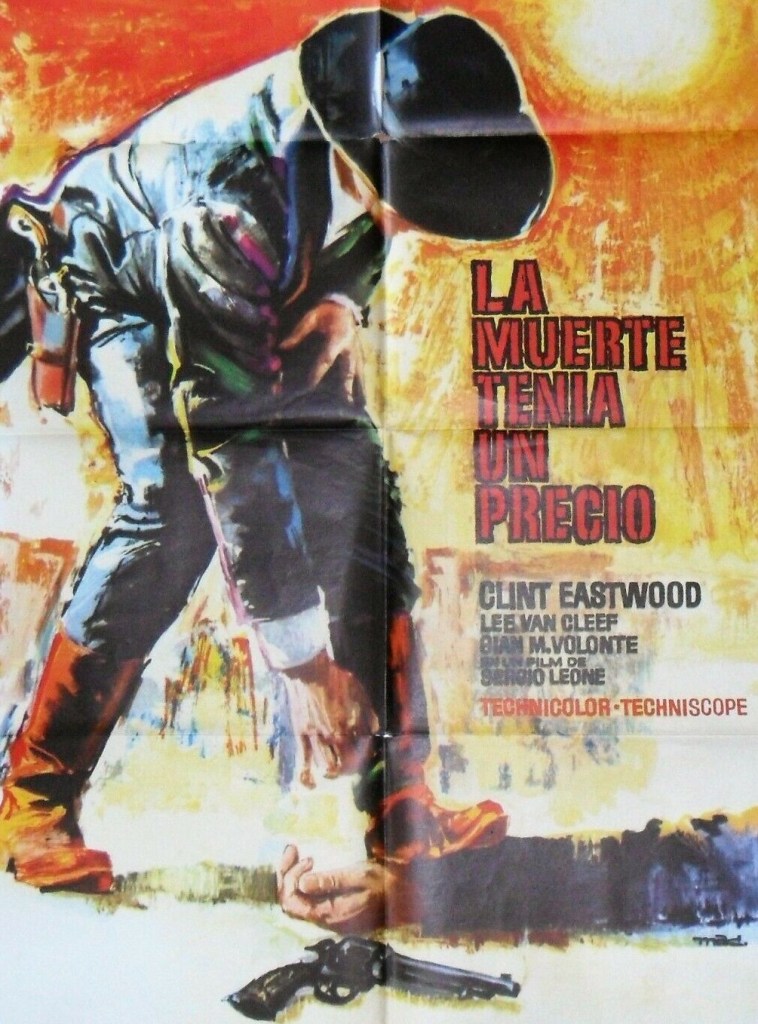
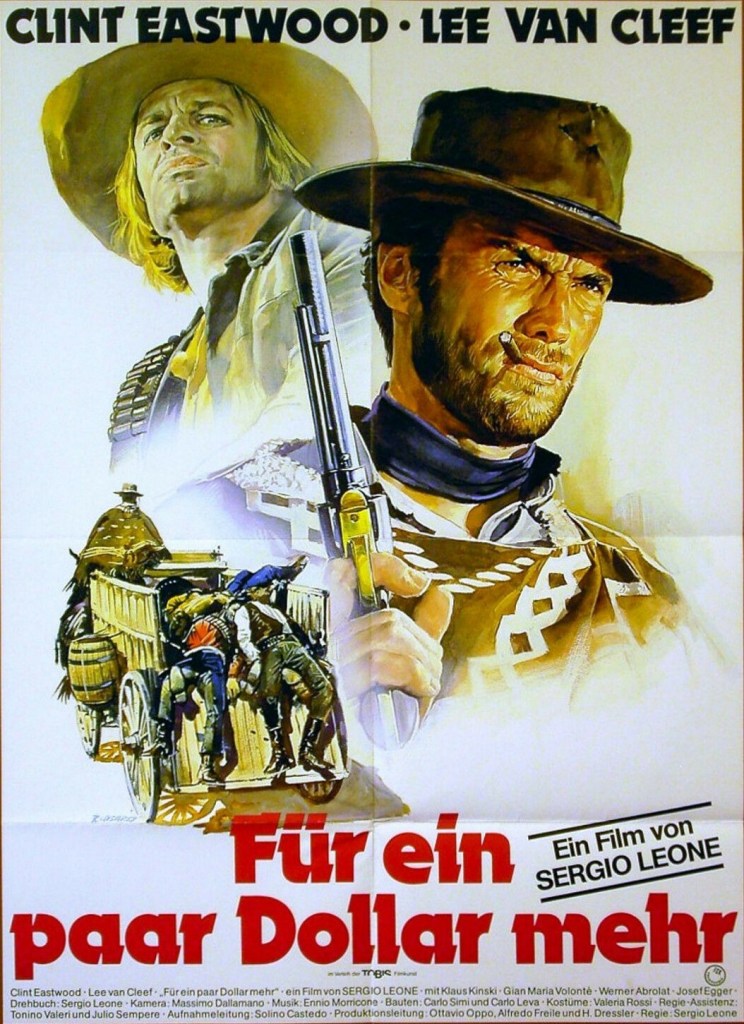
The German poster eliminated Lee Van Cleef in favor of local box office hero Klaus Kinski.
And, of course, there is Leone’s visual splendor, his unrivalled ability to create scenes, build tension, not quite to the baroque levels of Once but getting there, the “hat” shoot-out, Mortimer standing tall nonplussed as bullets zing along the ground coming closer and closer. Supporting characters are well observed, El Indio’s sidekicks Nino (Mario Brega) and Groggy (Luigi Pistilli), though in the scene-stealing stakes nobody can beat the glowering scene-stealer-in-chief, Juan Wild (Klaus Kinski), who scarcely needs to be saddled with a hunchback to steal a scene.
It was a rehearsal for Ennio Morricone too, as he developed individual themes from individual characters. It took a posse of writers to nail this down – Leone, sometime producer Fulvio Morsella (My Name Is Nobody, 1973), Luciano Vincenzoni (The Good, the Bad and the Ugly), Sergio Donati (Once Upon a Time in the West), Fernando Di Leo (Kiss, Kiss, Bang, Bang!, 1966) and Enzo Dell’Aquila (Seven Guns for the MacGregors, 1966).
Note: although movies could often take a while to work their way round the world, the first two “Dollars” pictures, despite their success in Continental Europe, took forever (in Hollywood terms) to reach the U.S. and Britain, not reaching either country till 1967, hence the oddity of the release date.
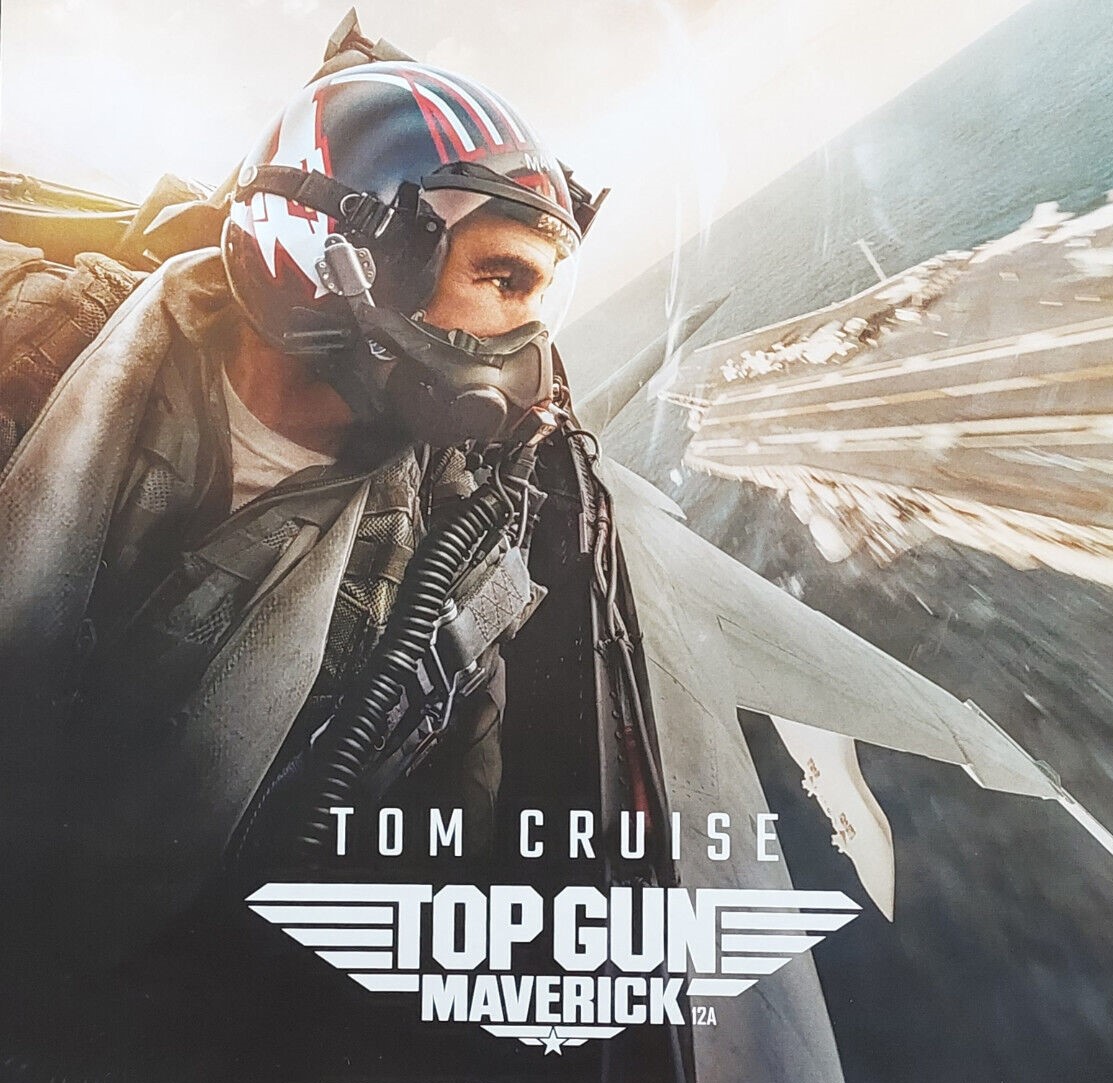
Box office performance is really the only measure the concerns Hollywood – Maverick: Top Gun setting a new Memorial Day high – but it’s not the only record studios are interested in breaking. Setting records for highest screen average and numbers of screens utilized is also important because it provides an indication, hopefully of a potential smash, at the very least of studio intent and exhibitor initial response to a movie. So the notion that Maverick: Top Gun received the biggest-ever U.S. release – in terms of screens – would not have gone unremarked by the industry. The more screens, the bigger the prospective pie.
In the run-up to opening when studios had little more than hype to sustain publicity, the number of screens was seen as a marketing tool. If that many exhibitors had signed up, they must be right. Many films in the past did not reach their box office potential simply because they were starved of screens and in failing to involve the necessary number of theaters opened themselves up to piracy.
The new screens mark set by Maverick: Top Gun was 4,732. You might be surprised to learn screen numbers in this range were being targeted as long ago as Shrek 2 (2004) when the animation juggernaut slammed into 4,223 palaces, beating with a vengeance the previous record held by Lord of the Rings: Return of the King (2003) by over 500. See what I mean – the bigger the volume of screens, the more screenings, the screens-plus-screenings equation resulting in bigger box office, usually, as in this case, of the record variety.
But Shrek 2’s record was there to be challenged – and it was. Madagascar (2005) set a new screens record followed by others like Mission: Impossible 3 (2006), Pirates of the Caribbean: Dead Man’s Chest (2006), Spiderman (2007), The Dark Knight (2008), Harry Potter and the Half-Blood Prince (2009), Twilight: Eclipse (2010) all the way to Despicable Me 3 which debuted on 4,535 screens. Sequels also had a built-in awareness factor.
The idea of getting a film out on as many screens as possible as soon as possible is not a new idea. Go back almost a century, to the advent of sound, and Warner Brothers employed the same technique for The Jazz Singer (1927), not exactly at launch, but a few months later in March 1928 in 235 theaters and not for the reasons laid out above but to give exhibitors who had installed expensive sound equipment a crack at a proper full-length movie. Following this was a system that would last from the silent era all the way through to the 1970s-1980s.
First-run was the key rather than what was initially called “saturation” or “simultaneous release” or “wide release” or “day-and-date” and also fell into the localized subset of “showcase.” Movies were launched in giant (by today’s standards) theaters seating 1,000-6,000 (Radio City Music Hall) and played there until the first-run juice had been extracted and then moved down a food chain delineated by ticket price down to as many levels as twelve, an automatic delay built into each shift down to ensure that moviegoers who wanted to pay the cheapest prices did not get ahead of the queue. In the silent era, prints were expensive and they were in short supply, so day-and-date was a risky prospect. Movies opened in different cities at different times and the same print went through hundreds of hands until it was unplayable.
Even so wide release – of any number – was viewed very early on as a marketing tool, Carl Laemmle the first to recognize the possibilities when he played Traffic in Souls (1913) in nine houses and by 1921 the idea, driven by phenomenon, had taken off when Charlie Chaplin’s The Kid (1921) was shown day-and-date in 300 venues. But such a wide release remained a rarity, most films going down the traditional route. The next stage was signaled by Cecil B. DeMille, wearing his marketing hat, when he invented the local world premiere. The Buccaneer (1938) launched in New Orleans and used the unprecedented nationwide publicity – gained by ferrying hundreds of reporters down from big cities in specially-appointed trains on an all-expenses paid jaunt – to precipitate a simultaneous release in 200 cinemas.
Area saturation was a natural development. The Westerner (1940) opened exclusively in Texas and broke 94 records in its first 94 engagements. Then came marketing genius Terry Turner who created the sequential area release, shifting huge numbers of prints week-by-week state-by-state. By concentrating advertising expenditure on a single area, Turner started “blitz marketing” and not necessarily for star-driven vehicles, Hitler’s Children (1943) the first to benefit.
But with too few movies being made, especially after studios were forced to sell off their lucrative cinemas chains by government decree in the late 1940s, first-run cinemas were inclined to hold onto big hits for weeks and months on end rather than participate in any simultaneous release program whose biggest beneficiaries were always the smaller cinemas. By the end of the 1950s and start of the 1960s, simultaneous release was accorded pictures of the here-today-gone-tomorrow variety, horror, sci-fi, exploitation and other low-budget items. One of the reasons why The Magnificent Seven (1960) did so poorly at the box office on initial release was it was sent out on the area saturation system, meaning in the first place it could not be held over since the prints were due somewhere else the following week, and it was viewed by audiences as a movie that fitted that low-budget criteria.
It was the exhibitor who revived the area saturation plan for pictures with decent marquee values. Wisconsin theatre owner Ben Marcus organised exhibitors into area groupings to assist studios in launching such films as The Great Imposter starring Tony Curtis and The Devil at 4 O’Clock (1961) with Frank Sinatra and Spencer Tracy. Out of this emerged the “showcase” release pattern whereby in, initially, New York and Los Angeles, movies headed straight into multiple engagements either immediately after first run or bypassing first run entirely. In 1963 a total of 124 movies were shown in Los Angeles using this system resulting in a $21.8 million gross from 3,769 playdates. By 1964 in New York The Carpetbaggers raked in $862,000 from just 25 theaters and with the Bond movies racking up box office records in first run their appearance in showcase proved invaluable.
But just as saturation was booming, demand suddenly slackened, shortage of movies, the collapse of studios, the demise of the roadshow, ensuring that by the early 1970s saturation release, whether national or local, was largely being used by low-budgeters, reissues, blaxploitation, king fu, soft porn or movies that went “four-wall” (i.e. the theaters were rented by a studio rather than the exhibitor doing the renting). Four-wall was largely the remit of nature documentaries, but Warner Brothers used it for Billy Jack (1971) and The Exorcist (1973), United Artists for Last Tango in Paris (1972) and Universal for Breezy (1973) directed by Clint Eastwood.
Legend of course has it that Universal created the modern wide release with Jaws (1975). That just happens to be myth. Jaws opened day-and-date in just 409 theatres. What Jaws instigated, purely by chance, was a reversal, a different approach to high-end big-budget pictures. “Studios with what they believed were guaranteed winners had consistently used a different scenario. The Exorcist opened in 24 theaters, Earthquake (1974) in 62, Papillon (1973) in 109 and The Godfather Part II (1974) in 157. Movies that opened in the Jaws range and above – Magnum Force (1973) in 418, The Man with the Golden Gun (1974) in 635, The Trial of Billy Jack (1974), Breakout (1975) and The Master Gunfighter (1975) in 1,000-plus were not expected to last as long. Statistics proved that for features with high box office expectation the slower limited roll-out was the more effective approach,” I wrote in 2019. I argued then and still believe that Universal expected Jaws to be a movie, as evidenced by the release strategy, that made a quick buck and the studio was as astonished as anyone when it skyrocketed.
But as production costs increased it was essential to get revenue in as quickly as possible so, except in rare cases, from the 1980s onwards, wide release became the norm. Even so it was another decade after Jaws before releases on 2,000 screens appeared, Rambo: First Blood II (1985) first there. Four years later – front-loading now the aspiration – the summer of 1989 saw 2,327 screens for Indiana Jones and the Last Crusade, 2,202 for Star Trek V: The Final Frontier, 2,410 for Ghostbusters II and 2,194 for Batman. Crocodile Dundee II (1988) had already upped the ante by opening in 2,837. A new high of 3,012 screens set by Mission Impossible (1996) did not last long, The Lost World (1997) leaving that in the dust with 3,565 screens. Screen records switched from studio to studio until the 4,000-mark was busted.
Maverick: Top Gun is just the latest in a long list of would-be blockbusters to take a similar approach. Any takers for next year’s Mission: Impossible – Dead Reckoning – Part One to be the first to hit 5,000 screens?
NOTE: The following week Cruise broke his own record when Maverick: Top Gun added another 19 screens. The new record is 4,751 screens. On top of that it had a record low box office fall of just 33% at a time when blockbuster generally drop 50% or more in their second week.
SOURCE: Brian Hannan, In Theaters Everywhere, A History of the Hollywood Wide Release, 1913-2017 (McFarland, 2019).
And just like that Old Hollywood thumped a nose at super-heroes and jumped back to the top of the tree. Of course, that’s if you discount Tom Cruise as being a super-hero of box office dimensions and one with his own franchise Mission Impossible which at times has single-handedly kept his marquee value alive.
Unusually, for a sequel, this has taken account of the passing of time. No shoe-horning Maverick (Tom Cruise) into the role of current hot-shot pilot and there is a past he has to deal with, two relationships in fact, with Rooster (Miles Teller) the son of Goose, whose death Maverick is accused of causing, and with Penny (Jennifer Connelly), an on-again off-again affair too often too easily fractured. But, of course, the main thrust of the picture is Maverick taking on everybody, the top brass in the shape of Admiral Simpson (Jon Hamm) and Admiral Bates (Charles Parnell), his pupils and the unnamed bad guys.
It’s pretty nifty in using character flaw to justify the plot. That Maverick is anywhere near being recruited as teacher and not gainfully employed as a high-flying Admiral somewhere – as is former-rival-cum-buddy Iceman (Val Kilmer) – is down to the fact that he has resisted well-justified promotion in order to keep flying and because, well, he tends to piss off his superiors. But he still has the juice, in the opening sequence taking an experimental plane way beyond its capabilities (another plot point, by the way).
Somewhat older, not necessarily that much wiser, Maverick’s introduction to the Top Gun base is a tad humiliating, drummed out of Penny’s bar for not being able to pay his tab, watching wistfully as younger guns batter out his favorite tune on the piano, and aware that he has personal bridges to mend, that maybe, just this time, he might have the maturity to manage.
There’s the usual cocky bunch led by Hangman (Glen Powell), Phoenix (Monica Barbaro) and Payback (Jay Ellis) plus Bob (Lewis Pullman), his call sign apparently a contraction of first name Robert but in reality standing for baby-on-board. In true reality television style there are heats, only four pilots making the cut to fly the desperate mission against the enemy.
And here’s where the picture takes off (pardon the pun). The aeronautics are just breathtaking and if you happen to catch it in Imax or an equivalent you’re going to be rocked by the sound as well. It’s unbelievable stuff. If there’s any CGI in there it’s not in the shapes of aliens, and looks distinctly old Hollywood. The kind of epic airplane stunts for which you run out of superlatives. And in best James Bond fashion the clock is ticking.
A resoundingly human story, relationships that looked cut-and-dried proving more fluid, until a band of brothers are properly worked up. Even as you wonder just how they are going to involve Maverick in a finale in which he should be a back-seat driver, a deft screenplay provides the answer. Maverick stands up for older guys everywhere, like an ageing pro brought back to save a football game.
Nostalgia has never been more vividly utilized. In terms of satisfactory denouement this is along the lines of the resolutions in Star Wars VII: The Force Awakens (2015) rather than the desultory reappearance of Decker (Harrison Ford again) in Blade Runner 2049 (2017). Some great scenes from the original have been touchingly reinvented, snippets of the original themes inserted at vital points plus a Lady Gaga offering.
It could easily have sunk not so much from the weight of expectations (and the long Covid-induced delay) but from a clunky re-boot, as producers determined, story be damned, to get all their ducks in line. Instead, there’s enough recycling to catch satisfy the previous generation of fans and sufficient whip-smacking wizardry to pull in the new generation, which determinedly steers clear of anything non-CGI.
Cruise is just superb, potentially an Oscar-nominated performance, as the guy who refuses to be jaded, who requires not one wingman but a whole team of them, with still the individuality and self-confidence that manuals cannot deliver. Given a job that set him up not to be a scene-stealer (teachers just ain’t action heroes) Cruise effortlessly steals the show, and its maturity more than double-balls-out cojones that does the trick.
Full marks to Joseph Kosinski (Oblivion, 2103) for fulfilling those weighty expectations, for keeping the movie focused when the temptation must have been to insert more romance, buff up issues facing the rest of the gang, add too much more when what this always needed was so much less, let the action show the way and Cruise carry the story. Much as I like Miles Teller in this I was hoping he would go on to better top-billed parts after Whiplash (2014). Glen Powell (Everybody Wants Some, 2016) is another one Hollywood should be trying to make more of. I could say the same for the gutsy Monica Barbero (The Cathedral, 2021). This is the kind of movie to make the next generation of stars, especially as it solidified the reputation of the last of the older generation in Tom Cruise.
Incidentally, while I was at the cinema for this I saw a cracking trailer for the next Mission Impossible picture so cruise is going to continue his box office roll for a while.
Regular readers will know that this Blog occasionally turns its attention to stories about the “Behind the Scenes” aspects of movie-making. This has become a surprisingly popular element of the Blog, many of these stories generating as many views as straightforward reviews. So I thought you might like to know which “Behind the Scenes” articles have proved most popular in the two years I’ve been writing the Blog.
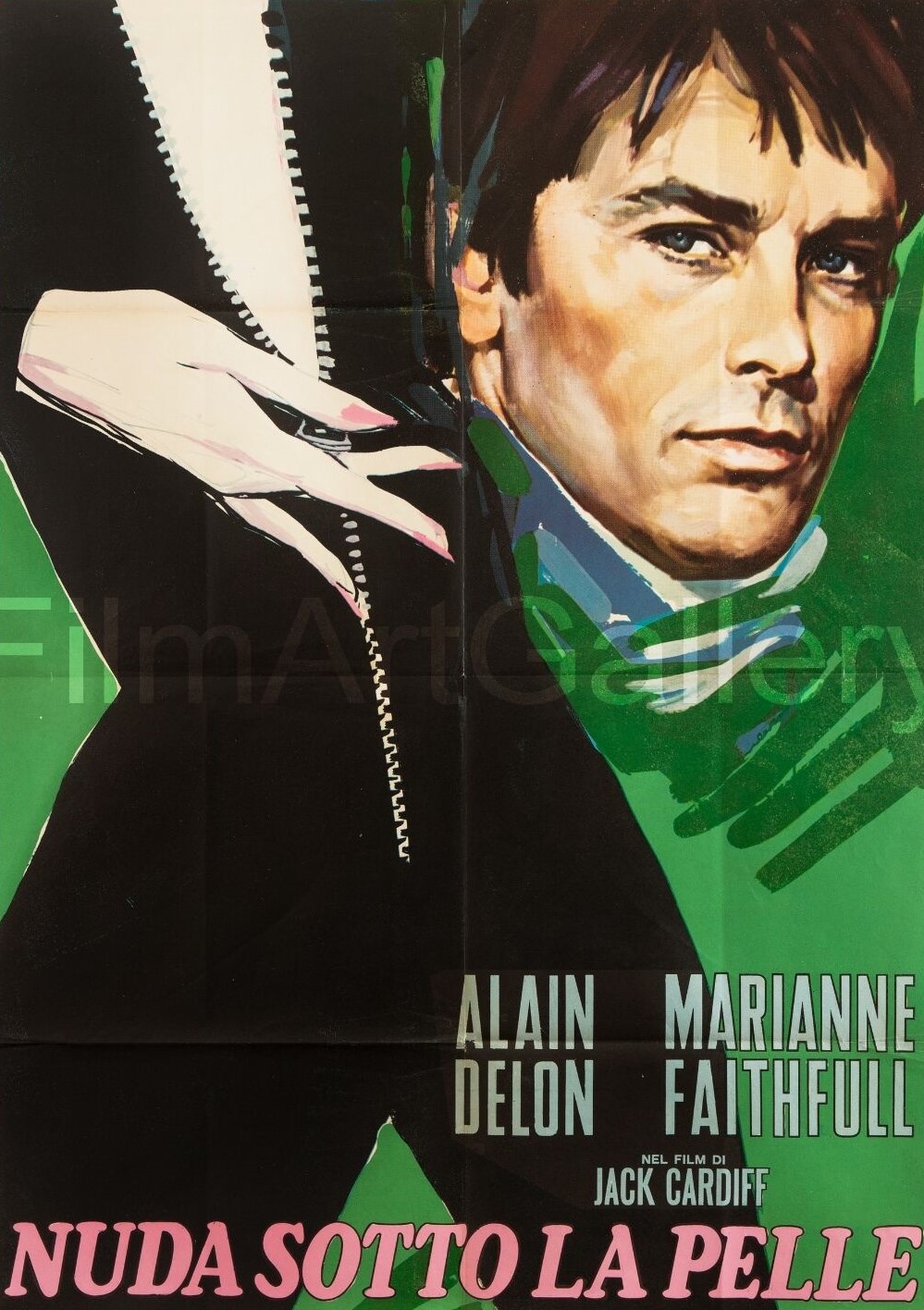
The Girl on a Motorcycle (1968). Cult classic starring Marianne Faithful and Alain Delon had a rocky road to release, especially in the U.S. where the censor was not happy.
The Guns of Navarone (1961). The “making of” could have been a film in itself, from director being fired, screenwriter rewriting the Alistair MacLean classic, audacious casting, and life-threatening injuries.
The Satan Bug (1965). Alistair MacLean again as director John Sturges hit a heap of problems adapting the pandemic classic for the big screen.
Ice Station Zebra(1968).John Sturges second venture into Alistair MacLean territory proved as sticky as the first, but with a bigger budget.
Waterloo(1970).Sergei Bondarchuk faced as many problems trying to bring this Napoleon epic to the screen as the French Emperor had fighting the British and Austrians.
The Wicker Man (1973). Now considered a classic, but not then, as a change of management at the British studio virtually sabotaged the picture.
Genghis Khan (1965). A venture into epic European filmmaking with an all-star cast led by Omar Sharif.
Hour of Gun (1967). More problems mounted for John Sturges as he embarked on an ambitious and thoughtful reinvention of the Wyatt Earp legend.
The Godfather (1972). Francis Coppola might have thought twice about making the Mafia epic had he known just how many problems he would encounter.
The Biggest Bundle of Them All(1968). British director Ken Annakin had his hands full on this Italian heist picture starring Raquel Welch.
Valley of the Dolls (1967). Translating the biggest bestseller of the decade into a movie proved calamitous.
The Spy with My Face(1965). How MGM broke the rules and managed to turn an expanded episode of The Man from U.N.C.L.E. television series into a box office smash.
The Great Escape (1963). How John Sturges created a P.O.W. classic with a little help from Steve McQueen.
Once Upon a Time in the West(1968). The story behind Sergio Leone’s masterpiece whose score by Ennio Morricone has conceivably sold more albums than the film sold tickets.
The Cincinnati Kid (1965). What happened after Sam Peckinpah was fired for adding salacious unscripted scenes and filming in black-and-white.
Cast a Giant Shadow (1965). Producer Melville Shavelson faced an uphill struggle bringing an unwieldy biopic starring Kirk Douglas, John Wayne and Frank Sinatra to the screen.
The Secret Ways (1961), Star Richard Widmark turned producer in a bid to improve his box office value but ran afoul of the director.
The Night They Raided Minskys / The Night They Invented Striptease (1968). Convoluted attempt by neophyte director William Friedkin to make a movie celebrating America’s vaudeville past.
The Way West(1965). Long-in-the-works western starring Kirk Douglas and Robert Mitchum.
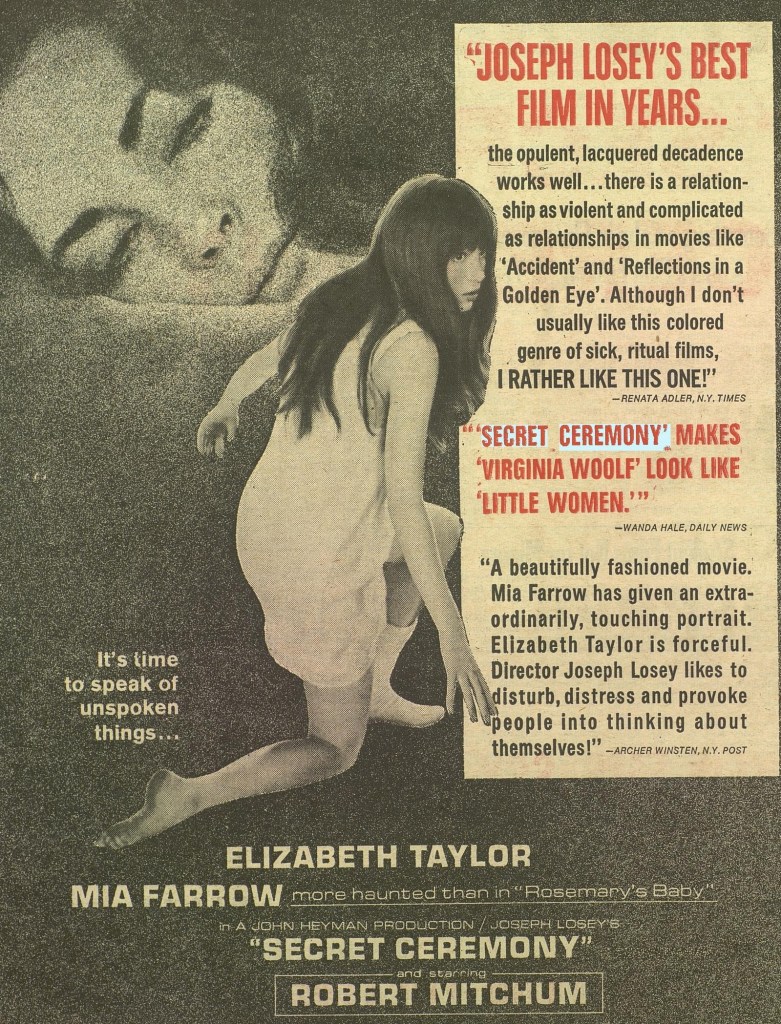
The Secret Ceremony (1968). Elizabeth Taylor’s boldest role of the decade was fraught with incident.
I started this Blog two years ago this month and to my astonished delight it is now read in over 120 countries. I am now well past over 500 reviews. So I thought you might be interested to know which of these reviews has attracted the most attention. This isn’t my choice of the top films in the Blog, but yours, my loyal readers. The chart covers the films viewed the most times since the Blog began, from June 1, 2020 to May 31, 2022.
The Secret Ways (1961). Richard Widmark exudes menace in this adaptation of an early Alistair MacLean spy thriller set in Hungary during the Cold War. Senta Berger has a small role.
Jessica (1962). Innocently gorgeous widow Angie Dickinson finds her looks turn so many male heads in a small Italian town that the female population seeks revenge.
Ocean’s 11 (1960). The Rat Pack makes its debut – Frank Sinatra, Dean Martin, Sammy Davis Jr. et al plan an audacious Las Vegas robbery.
Pharoah(1966). Priests battle kings in Polish epic set in ancient Egypt. Fabulous to look at and thoughtful.
Fraulein Doktor (1969). Suzy Kendall in the best role of her career as a sexy German spy in World War One.
The Golden Claws of the Cat Girl (1968). Cult French movie starring Daniele Gaubert as a sexy cat burglar.
The Swinger (1966). Ann-Margret struts her stuff as a magazine journalist trying to persuade Tony Franciosca she is as sexy as the character she has written about.
It’s Not All Rock’n’Roll (2020). Ageing rocker Dave Doughman aims to mix a career with being a father in this fascinating documentary
A Place for Lovers (1969). Faye Dunaway and Marcello Mastroianni in doomed love affair directed by Vittorio De Sica.
The Venetian Affair (1966). Robert Vaughn hits his acting stride as a former CIA operative turned journalist investigating suicide bombings in Venice. Great supporting cast includes Elke Sommer and Boris Karloff.
Moment to Moment (1966). Hitchcockian-style thriller with Jean Seberg caught up in murder plot in the French Riviera. Also features Honor Blackman.
4 for Texas (1963). Frank Sinatra and Dean Martin face off in a Robert Aldrich western featuring Ursula Andress and Anita Ekberg with Charles Bronson in a smaller part.
Age of Consent (1969). Helen Mirren stars as the nubile muse of jaded painter James Mason returning to his Australian roots.
The Double Man (1967). Yul Brynner chases his doppelganger in the Swiss Alps with Britt Ekland adding a touch of glamour.
Subterfuge(1968). C.I.A. operative Gene Barry hunts an M.I.5 mole in London. Intrigue all round with Joan Collins supplying the romance and a scene-stealing Suzanna Leigh as a villain.
A House Is Not a Home (1965). Biopic of notorious madam Polly Adler (played by Shelley Winters) who rubbed shoulders with the cream of Prohibition gangsters.
Can Heironymous Merkin Ever Forget Mercy Humpe and Find True Happiness? (1969). Off-the-wall musical directed by star Anthony Newley that has to be seen to be believed. Joan Collins pops up.
Pressure Point (1962). Prison psychiatrist Sidney Poitier must help racist Nazi Bobby Darin.
Deadlier than the Male (1967). Richard Johnson as Bulldog Drummond is led a merry dance by spear-gun-toting Elke Sommer and Sylva Koscina in outlandish thriller.
Valley of Gwangi (1969). Special effects genius Ray Harryhausen the star here as James Franciscus and Gila Golen encounter prehistoric monsters in a forbidden valley.
The Naked Runner (1967). With his son held hostage, Frank Sinatra is forced to carry out an assassination in East Germany.
Orgy of the Dead (1965). Bearing the Ed Wood imprint, mad monster mash-up with the naked dead.
Once a Thief (1965). Ann-Margret is a revelation in crime drama with ex-con Alain Delon coerced into a robbery despite trying to go straight. Supporting cast boasts Jack Palance, Van Heflin and Jeff Corey.
The Sicilian Clan (1969). Stunning caper with thief Alain Delon and Mafia chief Jean Gabin teaming up for audacious jewel heist with cop Lino Ventura on their trail. French thriller directed by Henri Verneuil. Great score by Ennio Morricone.
Dark of the Sun / The Mercenaries (1968). More diamonds at stake as Rod Taylor leads a gang of mercenaries into war-torn Congo. Jim Brown, Yvette Mimieux and Kenneth More co-star. Based on the Wilbur Smith bestseller
Stiletto (1969). Mafia hitman Alex Cord pursued by tough cop Patrick O’Neal. Britt Ekland as the treacherous girlfriend heads a supporting cast including Roy Scheider, Barbara McNair and Joseph Wiseman.
Maroc 7 (1967). Yet more jewel skullduggery with Gene Barry infiltrating a gang of thieves in Morocco who use the cover of a fashion shoot. Top female cast comprises Elsa Martinelli, Cyd Charisse, Tracy Reed and Alexandra Stewart.
The Rock (1996). Former inmate Sean Connery breaks into Alcatraz with Nicolas Cage to prevent mad general Ed Harris blowing up San Francisco. Michael Bay over-the-top thriller with blistering pace.
The Swimmer (1968). Burt Lancaster’s life falls apart as he swims pool-by-pool across the county. Superlative performance.
Hour of the Gun (1967). James Garner as a ruthless Wyatt Earp and Jason Robards as Doc Holliday in John Sturges’ realistic re-telling of events after the Gunfight at the O.K. Corral.
Fade In (1968). Long-lost modern western with Burt Reynolds serenading low-level movie executive Barbara Loden whose company is actually filming Terence Stamp picture Blue.
Dr Syn Alias the Scarecrow (1963). The British movie version of Disney American television mini-series sees Patrick McGoohan as a Robin Hood-type character assisting local smugglers.
P.J./New Face in Hell (1968). Private eye George Peppard is duped by shady millionaire Raymond Burr and mistress Gayle Hunnicutt in murder mystery.
Sol Madrid/The Heroin Gang (1968). In his second top-billed role David MacCallum drags hooker Stella Stevens to Mexico to capture drugs kingpin Telly Savalas.
A Twist of Sand (1968). Diamonds again. Smugglers Richard Johnson and Jeremy Kemp hunt long-lost jewels in Africa. Honor Blackman is along for the voyage.
Genghis Khan (1965). Omar Sharif plays the legendary warlord who unites warring Mongol tribes. Stellar cast includes Stephen Boyd, James Mason, Francoise Dorleac, Eli Wallach, Telly Savalas and Robert Morley.
Interlude (1968). Bittersweet romance between famed conductor Oskar Wener and young reporter Barbara Ferris.
Woman of Straw (1964). Sean Connery tangles with Gina Lollobrigida in lurid tale of murder and inheritance.
Bedtime Story (1964). Marlon Brando and David Niven are rival seducers on the Riviera targeting wealthy women.
Sisters (1969). Intrigue, adultery and incest haunt Nathalie Delon and Susan Strasberg as they try to recapture the innocence of the past.








 The Magnificent 60s