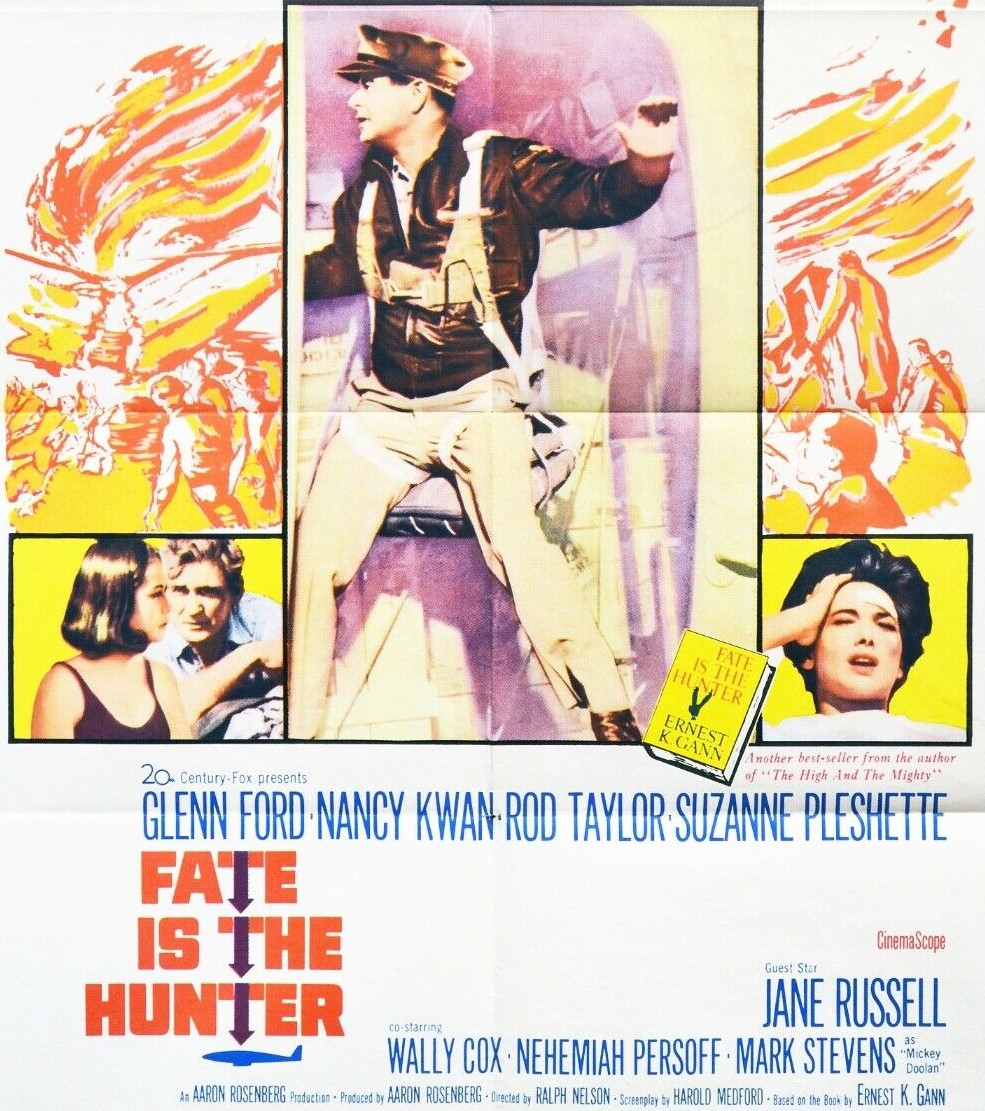
Fate Is the Hunter (1964) ***

More like Flight from Ashiya (1964) than Flight of the Phoenix (1965) in that airline disaster triggers flashback rather than contemporaneously finding a solution to the problem, but similar in tone to the more recent Flight (2012) and Sully (2016) where the automatic response of the authorities was to blame pilot error rather than ascertain mechanical malfunction. Unlike the two modern pictures, pilot Jack Savage (Rod Taylor) cannot be interrogated in court because he died in the explosion. So investigator Sam McBane (Glenn Ford) seeks some corresponding incident in the past which might account for the pilot making such a mistake.

Other options face McBane. Sabotage could be the cause since  a passenger took out a $500,000 insurance policy days before boarding the twin-engine plane. Bird strike cannot be ruled out after feathers are found in the engine. Or it could be simple misfortune. Three inbound planes all running late prevent the plane returning immediately to Los Angeles and it would have landed safely on a beach except for hitting a temporary structure. But engineers hardly need to pore over the evidence. The fault is staring them in the face. Savage had reported two engines catching fire but the wreckage reveals one engine intact.
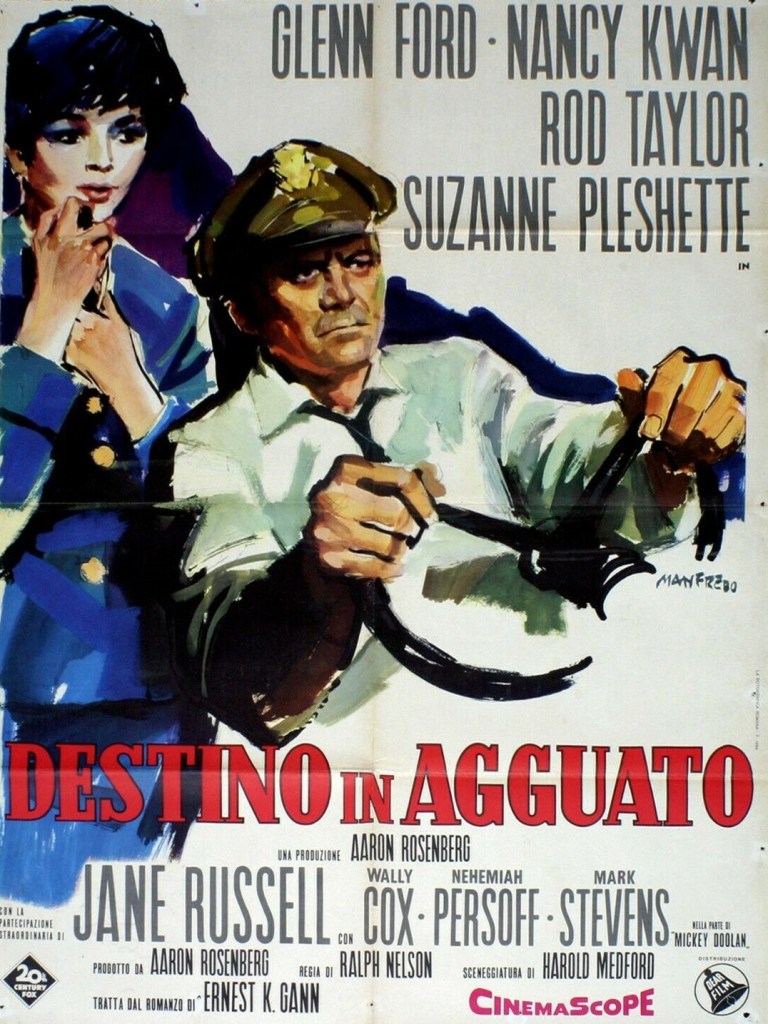
However, the only survivor, stewardess Martha Webster (Suzanne Webster) maintains that two red warning lights were flashing, indicating malfunction in both engines. But since she is badly injured and in a woozy state, this is not taken as gospel. So McBane dips into the playboy past of Savage, a buddy, a man with such appeal he can serenade real-life figures as Jane Russell (playing herself). Two occasions highlight the man’s heroic history of  emergency landings. So can he be the unreliable character painted by a jilted fiancée (Dorothy Malone) or the drinker who should not have been in a bar so soon before take-off?

The tight-lipped shoulder-hunched humorless soulless McBane, described as “one of the best-built machines” known to man, finds himself questioning his own attitudes as he uncovers more of his friend’s life. But when it comes to the big enquiry, televised, he has no better an explanation to ascribe the unexpected collision of different events  than the “fate” of the title. Naturally, that mystical prognosis hardly goes down well with his superiors. Luckily, McBane comes to his senses and suggests a simulation which does, in fact, pinpoint the flaw.

It’s relatively easy to pinpoint the flaw in the picture. Audiences expecting a disaster movie with characters stranded by a crash were disappointed to find that by cinematic sleight-of –hand they were being presented with The Jack Savage Story, which with the larger-than-life character and his various aviation and romantic adventures would easily have made a picture in its own right. Stuck instead with the glum McBane as their guide, who, beyond his steadfastness, does not come into his own until the last 15 minutes, seemed an unfair trick. The explosion of the doomed plane at the 10-minute mark is easily the dramatic highlight and the continued flashbacks rather than adding to the tension often eased it.
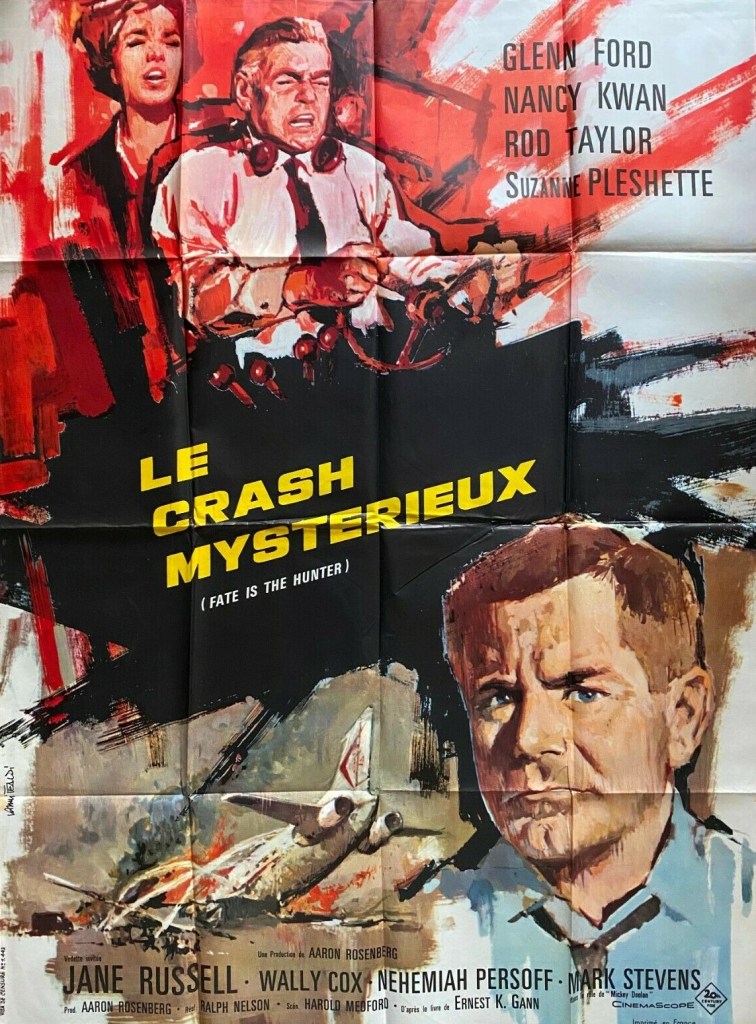
With four stars above the title, audiences might have anticipated some kind of four-sided triangle, but the two female stars scarcely appear although Martha has one excellent scene, shocked when asked to don her uniform again, and Sally (Nancy Kwan) enjoys a fishing meet-cute with Savage.

That said, if you accept as McBane as more of a private eye, his surly demeanor fits, and the Savage life story is certainly a fascinating one and the various aviation episodes unusual enough to maintain interest. Glenn Ford (Is Paris Burning?, 1965), his box office sheen waning and about to shift exclusively to westerns, is always watchable but there’s no real depth to the character. Rod Taylor (Dark of the Sun, 1968) is at his most exuberant and that’s no bad thing, and beneath the bonhomie a good guy at heart, but his portrayal provides little of the shade that would make it thinkable he was to blame. Suzanne Pleshette (The Power, 1968) and Nancy Kwan (Tamahine, 1963) are both under-used. Look out for Mark Stevens (Escape from Hell Island, 1963), Jane Russell (Gentlemen Prefer Blondes, 1953) in her first movie in seven years, and Dorothy Malone (The Last Sunset, 1961).

Ralph Nelson (Once a Thief, 1965) sticks to the knitting but four scenes stand out: the explosion, Martha’s breakdown at the sight of her uniform, the stewardess during the simulation staring down the plane at the empty seats filled with sacks of sand, and an excellent composition (which Steven Spielberg pays homage to in West Side Story) of a character being preceded into a scene by his very long shadow. Also worth pointing out is that, in almost James Bond style,  the opening sequence lasts ten minutes before there is any sign of the credits.

Harold Medford (The Cape Town Affair, 1967) wrote the screenplay based very loosely on the eponymous bestselling memoir by Ernest K. Gann, whose The High and the Mighty had been turned into a hit picture a decade before. The author was so furious with how much the adaptation veered from his biography – which often pointed out the dangers of flying, recurrent pilot death and airplane unworthiness a main theme – that he took his name off the credits, missing out on an ancillary goldmine as the movie, a box office flop, proved a television staple.

The Power (1968) ***

Low budget sci-fi effort that had little chance in the box office stakes that year up against the big budget psychedelic 2001: A Space Odyssey and the visceral Planet of the Apes. Producer George Pal and director Byron Haskin, the key figures behind War of the Worlds (1953), would later become among the most exalted in the sci-fi genre, but the cult of the 1950s sci-fi movies did not exist yet. Yet if made today, we would be treating this as an origin story with a sequel already in the works and creation of its own universe on the cards.

As the budget can only accommodate a few explosions and a derisory number of tiny special effects, emphasis is placed on imagination as the source of tension. The uncanny remaining unexplained helps ensure mystery remains character-driven. Wisely, the film makers steer clear of providing any detail on the strange force.

It begins with the neat title “Tomorrow.” As part of a planned space program, a team of scientists  experimenting on the limits of human endurance discover that one of them has unusual powers. As a group they are able to make revolve a piece of paper attached to a vertical pencil without establishing who is the driving force. When Professor Hallson (Arthur O’Connell) is found dead in a centrifuge, the only clue being a scrap of paper bearing the name Adam Hart, suspicion falls on the other members. Professor Tanner (George Hamilton) is dismissed when the investigation discovers his credentials are fraudulent.   

Seeking to prove his innocence, Tanner goes on the run before establishing that the main suspects are the mysterious Adam Hart and three of the original team – military chief Nordlund (Michael Rennie), Professor Scott (Earl Holliman) and Tanner’s girlfriend Professor Lansing (Suzanne Pleshette). But he is mostly baffled by the goings-on which include being dumped in an air force target range. He could be the culprit but again so many odd occurrences take place when others are present that it would be hard to pin the blame on Tanner. As the corpses begin to pile up, the list of potential suspects naturally decreases.

A toy winks at Tanner, walls appear were there were none before, a man is convinced Tanner is someone else (not Hart), a high-flying professor’s wife lives in a trailer, characters collapse under psychic assault, a young woman trying to seduce an old man discovers she is kissing a corpse, the imagery appears inspired by Salvador Dali and Hieronymus Bosch,  and you could easily argue that Tanner’s academic records have been deliberately erased. On the more prosaic side, the cops are next to useless, there’s a car chase and a sequence in a lift shaft, but the bulging eyeballs suggested in the posters are a marketeer’s invention. There’s even a clever joke, Tanner  misreading a newspaper headline “Don’t Run” as being a message to him.

The oddities are sufficiently off-beam to appear as figments of the imagination and it certainly seems Tanner suffers from hallucinations.  And there are some deliciously off-key characters, an old woman obsessed with fly-swatting, a sultry waitress. If Hart is the superhuman then experiments may have taken place long before now. In his hometown, people still act on instructions Hart handed out a decade before and accomplices are in place such as Professor Van Zandt (Richard Carlson).

Adding to the mood are philosophic discussions about the existence (as already a fait accompli) of a superhuman: some want to clone him, others would happily submit to him.

Byron Haskin (Conquest of Space, 1955) and George Pal ( The Time Machine, 1960) have marshalled their puny resources with exceptional skill, down to hiring as leading man George Hamilton (Your Cheatin’ Heart, 1964), so far from being a big star at the time that audiences would not automatically assume he had to be the good guy, and peopling the production with names from 1950s sci-fi like Michael Rennie (The Day the Earth Stood Still, 1951) and Richard Carlson (Creature from the Black Lagoon, 1954).

George Hamilton, in the days before the perma-tan became his calling card, is surprisingly good and the supporting cast does what a good supporting cast should do. Suzanne Pleshette (Nevada Smith, 1966) convinces as the lover who could be the cool killer. Also look out for 1940s glamor puss Yvonne De Carlo and a staple of The Munsters television series (1964-1966), Aldo Ray (Johnny Nobody, 1960) and Miko Taka (Walk, Don’t Run, 1966).

Perhaps the biggest coup was the recruitment of triple Oscar-winner Miklos Rosza (Ben-Hur, 1959) who provided a memorable score.

In most sci-fi films, the danger is readily identified. Here, you might hazard a guess but whenever you come close some clever sleight-of-hand misdirects. For most of the time I was happily intrigued, enough coming out of left field to provide distraction. This is a masterclass in how extract the most from very little.

Behind the Scenes: “Number One” (1969)

Apart from Ben-Hur and El Cid, most of Charlton Heston’s movies in the 1960s were domestic box office disappointments. Despite this, he was deemed to be still flying high at the marquee, placed seventh in the annual star rankings just as negotiations began in 1967 for Pro (the title changed to Number One just a few months before release). Given there was little interest in American sports in the rest of the world, it was deemed a gamble. That was not just reflected in the budget – a miserly $1.15 million- but in Heston’s salary of $200,000. He and director Tom Gries (Will Penny, 1968) agreed to “work at substantially lower incomes in exchange for a bigger percentage.”

But to make any decent money, of course the movie had to be a big hit. Compare that to the $750,000 he stashed away for The Hawaiians (1970), admittedly after Planet of the Apes (1968) hit the jackpot, but still. From The War Lord, Heston had “learned actors should not put their own money into scripts,” but taking a pay cut appeared a more sensible route.

The movie was a long time coming to fruition. Initially, the idea had been rejected by National General and Martin Ransohoff of Filmways who worked with MGM. By April 1966, Heston was dejected. “Nothing stirring on Pro,” he recorded in his journal. But he understood the need not to “peddle the project” since “it tarnishes my image as an eminently in-demand actor.” Franklin Schaffner (Planet of the Apes) was initially keen, but dropped out after United Artists insisted on smaller fees against a bigger back end, star, director and producer to share 75 per cent of the profits, the kind of deal you get offered “when you want to make a film more than a studio does.” Tom Gries (Will Penny, 1968) was the next directorial target.

By June 1967, the deal was done for Heston, Gries and Selzer. ”I’m damned if know who will write the script,” noted Heston, “No one very expensive, I guess.” In July, he was in San Diego “investigating pro footballers in their natural habitat.” The NFL agreed to allow the New Orleans Saints to participate. David Moessinger had written two screenplays, Daddy-O (1958) and The Caper of the Golden Bulls (1967), but struggled to meet Heston’s expectations.

The actor felt the writer hadn’t “succeeded in dramatizing the most difficult and the most important element of the story. Why Caitlin feels as he does.” His wife, Lydia, agreed. “If women’s can’t relate to the story, then it’s just a picture about a football player and we’re in trouble.” UA had set a deadline and the screenplay would decide whether it was a go or no. Heston planned to get Gries to work on the script, and he subsequently nailed the vital scene.

Even when UA gave the go-ahead there were problems integrating the shooting schedule with that of the Saints which would require filming training camp in summer 1968 and the rest in the fall. Bob Waterfield was teaching Heston how to quarterback. Soon he would have “delusions of adequacy.”  But the training took its toll in the shape of a pulled muscle. In his first proper game, he was “blitzed” 16 times. He ended one day “taped and doped, in the traditional bed of pain.”

Meanwhile, casting proceeded. Heston had “mixed feelings” about Eva Marie Saint (The Stalking Moon, 1968) and Joanne Woodward (Big Hand for a Little Lady, 1966). Suzanne Pleshette (A Rage to Live, 1965) was considered as well as Jean Simmons (Rough Night in Jericho, 1967) – “I think she’d be good for it,” noted Heston. Finally, he pushed for Jessica Walter (Grand Prix, 1966) – “old enough to be plausible as the wife, young enough to manage the flashbacks” – only to find Gries not so keen and preferring Anne Jackson (How to Save a Marriage and Ruin Your Life, 1968). When the situation was resolved in favor of Walter, Heston discovered she was being lined up for a television drama about pro football. The second female lead went to Diana Muldaur.

Meanwhile, Heston was having trouble with Gries. “His attitude towards this film…is very questionable…perhaps it has to do with his recent achievements as a director in theatrical films…he’s finding the wine a bit heady.” Gries fell behind schedule, but finished ahead of it, saving about $30,000. An important scene showing Walters and Heston in bed before the wedding didn’t work and was cut.

Keeping tabs on the budget was producer Walter Selzer, who had worked with the star on The War Lord (1964) and Will Penny, and, would team up with him again for The Omega Man (1971), Skyjacked (1972), Soylent Green (1973) and The Last Hard Men (1976). “You have to be realistic about the subject matter,” said Selzer. “Every story has a certain price and if you try to cheat on your requirements it shows on screen.” That said, he was king of the penny pinchers. “We didn’t use a single piece of new lumber,” he boasted, meaning they didn’t built a single set, instead adapting or re-using old ones.

On location, he negotiated “locked-in” costs, “a flat pre-arranged price” for variety of elements which had a tendency to become variable, increasing costs, such as space on a sound stage, equipment and the editing suite. Cameraman Michel Hugo had to agree to shoot in any weather. “This is very important. Very often a cameraman will refuse to shoot if the weather is questionable, claiming the shots won’t match and then you have the whole company idle for a day when on location.” He nailed down composer Dominic Frontiere (Hang ‘Em High, 1968), paying him a flat fee, with Frontiere left with the task and cost of hiring an orchestra and rehearsal and recording space.

Despite showing his rear end in Planet of the Apes, Heston was touchy about the sex scene. “It’s not really a nudie scene but an intensely sexual scene,” he explained, “There’s not a bare breast seen.” Heston had enough controversy elsewhere. As president of the Screen Actors Guild he appeared not to note the irony that while he was pocketing hundreds of thousands of dollars a picture, he could complain that extras were the cause of the “major increase in costs” of movies.

He was also accused of being hypocritical, signing for Eagle at Escombray, directed by Alexander Mackendrick, to be made by CBS while at the same time, as union leader, pressurizing the Department of Justice to prevent television companies such as ABC and CBS entering the movie business. (It was never made.) For that matter, he shouldn’t have been trying to get National General to fund Pro either, since it owned a cinema chain, and that, too, went against previous Department of Justice rulings.

While Heston like the movie – “some of the best contemporary work I’ve done” – UA did not. The title changed to Number One. By the time the movie appeared, in August 1969, Heston couldn’t have been hotter, thanks to the unexpected success of Planet of the Apes. So the world premiere in New Orleans was allocated a full array of razzamatazz – in the parade were the New Orleans football team, its mascot, cheerleaders and a stream of antique cars, but there was a fire in Heston’s hotel.

Box office was less rosy. There was a decent $179,000 from 32 in New York, a “big” $9,000 in Washington, a “hotsy” $24,000 in Baltimore (and $20,000 in the second week), a “neat” $12,000 in San Francisco and a “trim” $27,000 in St Louis but mostly the figures were “mild”, “okay”, or “fair.” Outside of first run it couldn’t run up any juice. Estimated rentals were $1.1 million, so just about break-even, but United Artists, understandably despite Heston’s contention that it was about a man not American football, refused to give it any meaningful release overseas.

SOURCES: Charlton Heston, The Actor’s Life, Journals 1956-1976 (Penguin, 1980); “All-American Favorites of 1966,” Box Office, March 20, 1967, p19; “Charlton Heston Denies Conflict Between Eagle Role, SAG Policy,” Box Office, January 15, 1968, pW3; “Sports, Flop-Prone Theme Still Dared,” Variety, September 25, 1968, p2; Army Archerd, “Hollywood Cross-Cuts,” Variety, December 18, 1968, p22; Army Archerd, “Hollywood Cross-Cuts,” Variety, February 5, 1969, p34; “Number One Parade To Precede Premiere,” Box Office, August 18, 1969, pSE5; “Falling Stars,” Variety, September 3, 1969, p70; “Critics Wrap Up,” Variety, September 24, 1969, p26; “Variety Box Office Charts Results 1969,” Variety, April 29, 1970, p26.  Weekly box office figures – Variety, 1969 : August 27, September 3, September 10, September 17, September 24

The Adventures of Bullwhip Griffin (1967) ***

All studios believed in their brand name. That the sight of the  MGM lion or the Twentieth Century Fox searchlight or the Paramount mountain represented a quality mark that would buffer expectation and reassure an audience they were not going to be rooked. That might have been the case decades before when the Warner Brothers logo might mean gangster pictures or socially aware movies or MGM, with more stars than there are in heaven, pictures with top-notch talent, or Universal determined to scare the pants of you with its horror catalog.

But that was no longer the case, most studios so desperate for survival that they would fork out for whatever trend seemed most likely to make money and the industry lurched from western to musical to adventure and back again whenever a big hit appeared. The only studio which still retained genuine marquee appeal was Disney. As studios dipped into more unsavory fare, according to the older generation, and the prospects of sending your children to the movies without having to check out the picture in advance diminished, a Disney film was a guarantee of fret-free entertainment.

Throughout the decade adults as much as kids swarmed to the Disney repertoire. In 1961 the studio scored a box office triple whammy when The Absent-Minded Professor, The Parent Trap and Swiss Family Robinson took three of the top four slots in the annual box office race. In the following years Bon Voyage (1962), Moon Pilot (1962), Son of Flubber (1963), In Search of the Castaways (1963), The Sword in the Stone (1964), The Misadventures of Merlin Jones and especially Mary Poppins (1964) kept the studio buoyant, not to mention the string of pictures starring Hayley Mills and a stack of animated classics it could reissue at the drop of a hat.  

Disney ruled the lightweight world, its films often driven by a simple plot device. And as the rest of the industry coveted sex and violence, exhibitors relied on Disney to bring in the kids (and adults) during holiday periods. It would end the decade on a whopping high with The Love Bug (1969).    

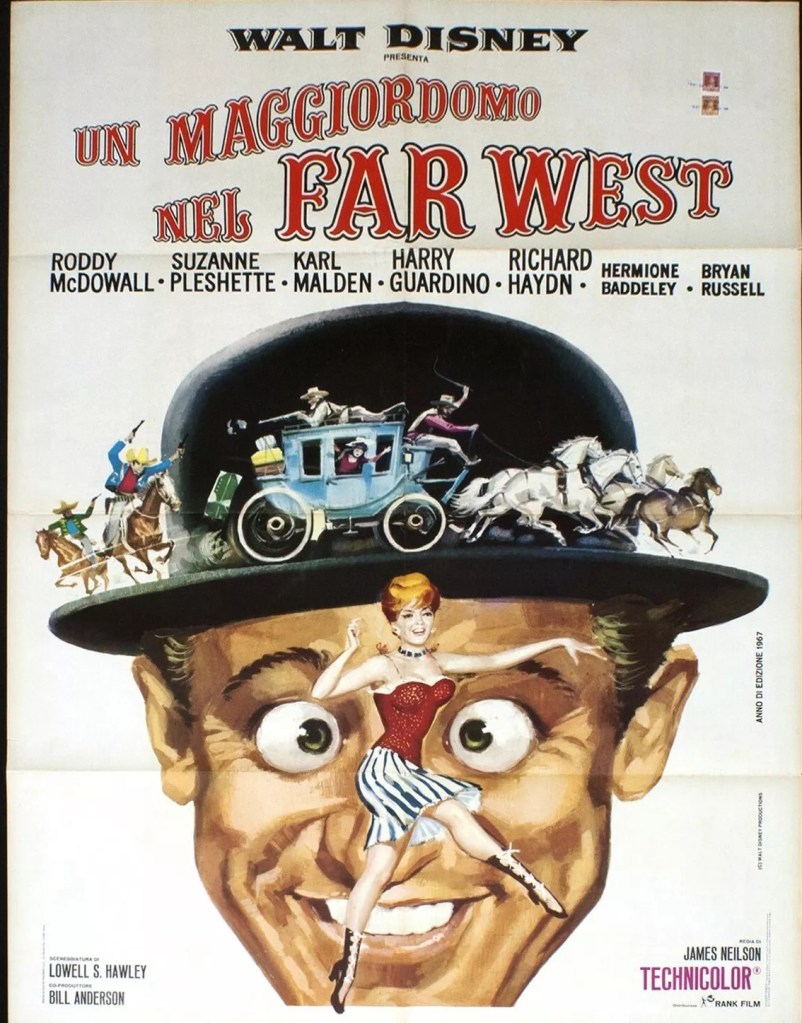
Here, the ploy is as old as the hills, a fish out of water, in this case an English butler. Disney had rung the changes on that particular sub-genre through the governess in Mary Poppins, steadfastly ignoring a trend towards more sinister servants as demonstrated by The Servant (1963) and The Nanny (1965). But Disney did have the ability to hook name actors for its child-friendly movies, here Roddy McDowall (Lord Love a Duck, 1966), Oscar-winner Karl Malden (Nevada Smith, 1966) and Suzanne Pleshette (A Rage to Live, 1965).   

If you are expecting whiplashing escapades of the Indiana Jones variety, you will be in for a disappointment. Eric Griffin (Roddy McDowall) is the aforementioned butler escorting a child Jack (Bryan Russell) on a treasure hunt through the gold fever American West. When his charge runs away, Griffin finds the boy stowing away on a ship. The ever-genteel Griffin has skills that see him through any situation, working as cook on the ship, setting up his stall as barber on the mainland, and occastionally employing a devastating right hook to knock seven bells out of giant bully Mountain Ox (Mike Mazurki).

The plot, such as it is, revolves around recovering a treasure map stolen by swindler Judge Higgins (Karl Malden) and eventually when the movie needs some zap the feisty Arabella Flagg (Suzanne Pleshette), Griffin’s bankrupt employer who as it happens fancies the bulter, turns up.

There’s enough action to keep the picture on a steady keel, a storm at sea, a stagecoach hold-up, prizefight and a climactic town-wrecking fire. There are, perhaps surprisingly, a few choice lines.

But there’s a misinterpretation at the center of the movie so it’s as well its made with kids in mind. The fish-out-of-water notion would play better if historically movies fielded idiot butlers rather than ones who tended to take command when things get tough, though it’s unliklely kids would be aware of previous entries in the sub-genre. So, theoretically, it’s a surprise when Griffin outfights the lummox and outwits the swindler.

If the kid isn’t cute enough there are compensations elsewhere, a decent support in Harry Guardino (The Pigeon That Took Rome, 1962) and Hermione Baddeley (Harlow, 1965). Roddy McDowall at least is in a movie that suits his screen persona and deceptively languid acting style while Suzanne Pleshette takes a feminist slant to the Wild West. Whether British comedian Tony Hancock – he was sacked during filming – would have added much to the proceedings is open to debate.

It’s worth remembering that, outside of Hayley Mills offerings, Disney comedies of this period revolved around adults coping with bizarre situation. This doesn’t quite have the gimmicks that drove Son of Flubber, The Ugly Dachshund (1966, also headlining Pleshette) and Lt Robin Crusoe U.S.N. (1966).

Adequately directed by James Neilson (Dr Syn Alias the Scarecrow, 1963) from a screenplay by Lowell S. Hawley (Swiss Family Robinson) drawn from the novel The Great Horn Spoon! by Sid Fleischmann.

I remember seeing this as a kid and feeling pretty content coming out of the cinema, so since it did what it says on the tin, I’m loathe from an adult perspective to take it to pieces.

A movie that says – lighten up!

Rome Adventure / Lovers Must Learn (1962) ***

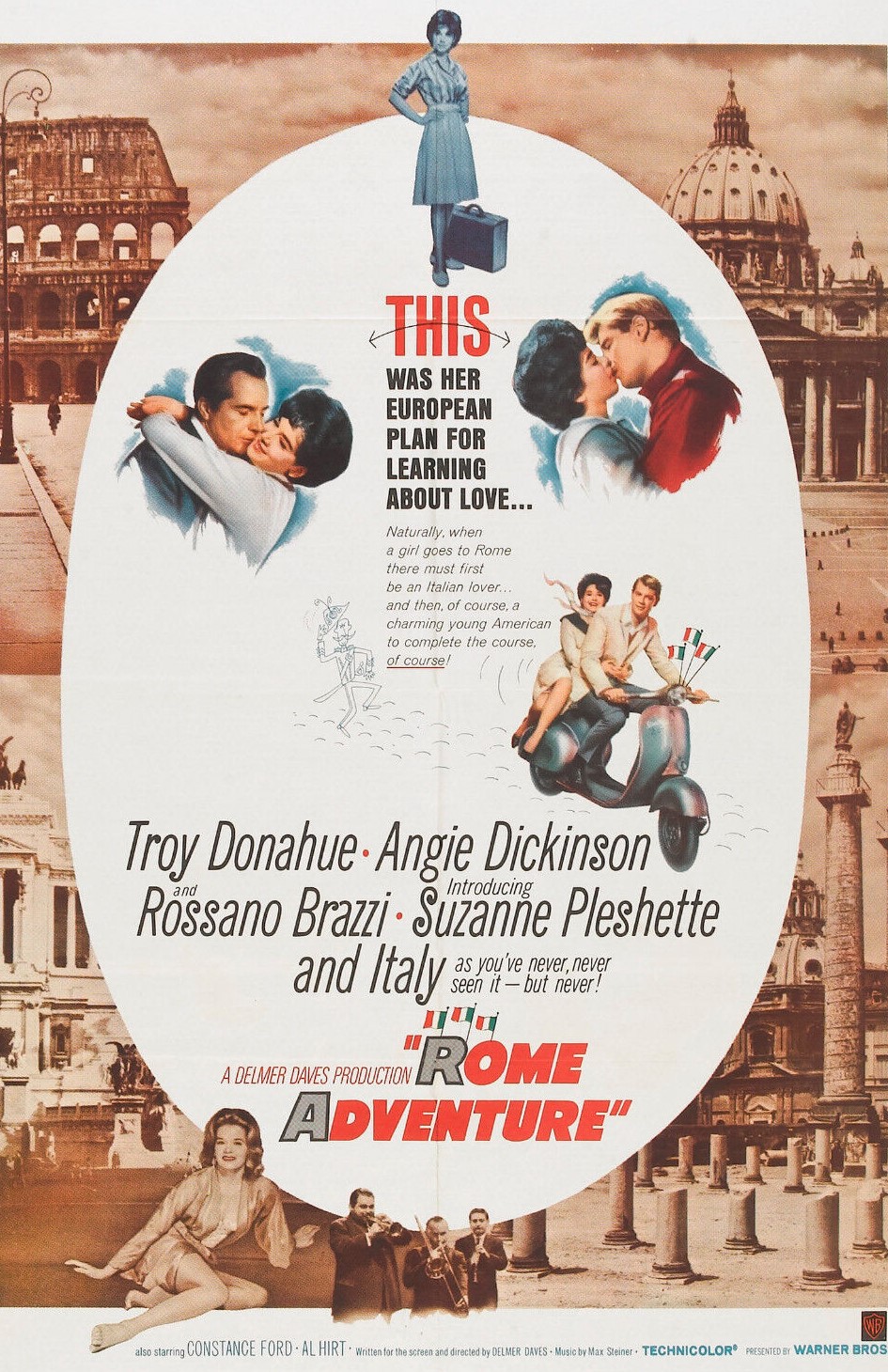
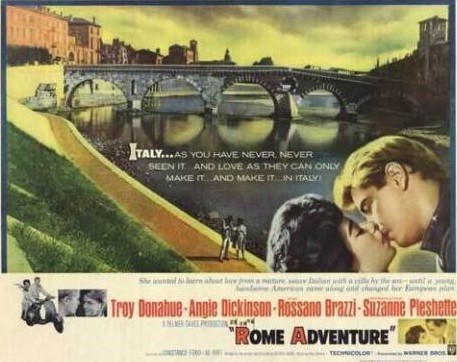
Angie Dickinson fans would be entitled to cry foul after the top-billed female star appears to be engaged in a bait-and-switch tactic. After a lengthy wait, when she finally does appear it’s only to high-tail it off to Switzerland leaving behind in Rome lover Troy Donohue. Her departure creates romantic opportunity, her return complication.

And is this the same Delmer Daves, you might ask, who made his name in a series of male-dominated westerns such as Broken Arrow (1950) and 3:10 to Yuma (1957)? Yes, it is, but once Daves had finished applying intense pressure to his male coterie, he did the same, in a different genre, to women.

Young teacher Prudence (Suzanne Pleshette) exerts her independence by quitting her job after being hauled over the coals in Small Town U.S.A. for teaching her pupils a controversial novel. On the boat to Rome she encounters Italian lothario Roberto (Rossano Brazzi), who holds the lofty sexist opinion that only a man can turn a girl into a woman, and the nerdy Albert (Hampton Fincher), both of whom come a-courting, the youngster’s diffidence ruling him out of serious contention.

Roberto is friends with student Don (Troy Donohue) but the minute he is introduced to Prudence he has to rush off to try to persuade artist Lyda (Angie Dickinson) not to leave. Roberto turns gracefully aside after Prudence denies him sex (put more subtly than that of course) and she, finding employment in an American bookshop (speaking the language no deterrent there),  embarks on romance with Don, fluent in Italian, who teaches her how to drink strega, takes her to jazz clubs and acts as tour guide.

A good chunk of the picture, it has to be said, is a travelogue, and when neither Roberto nor Don are on hand to point out this or that monument or embark on a potted history, suddenly she discovers an interior monologue to do the job. And at one point it turns into If It’s Tuesday It Must Be Pisa as the couple take off on a longer trip, bouncing from one tourist city to another, the route only complicated by some slight comedy over whether they should share a bed.

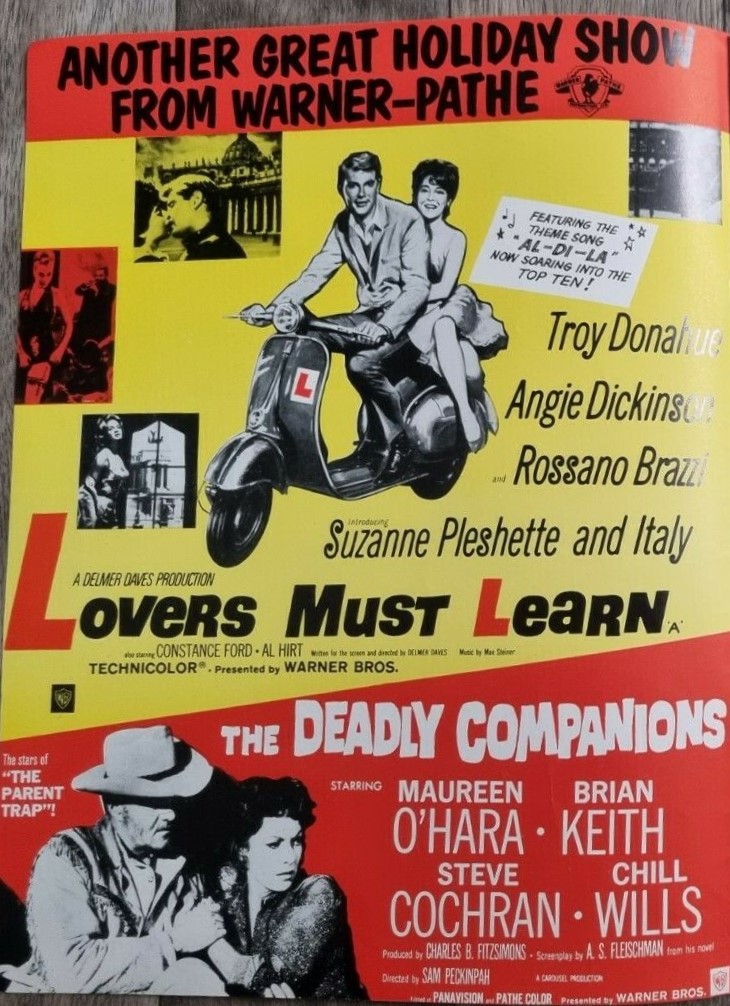
Re-titled in the U.K. and sent out with the most curious support.

Another decade and sex would most definitely be on the cards and the story would sink under an unplanned pregnancy or a fit of pique and scenes in a bedroom where they are separated by an open suitcase as one or other makes an effort to leave. But it’s the virginal aspects that makes this so sweet and for sure no director has managed to clear entire streets in usually heavily-congested tourist spots to deliver beautiful scenes in such scenic spots.

Actual drama might be light on the ground, but there’s no denying Delmer Daves knows how to apply pressure, this time on the woman, who can either treat romance as a  fleeting youthful episode or use it to launch big time into marriage and womanhood. Without a chaperone, unlike the hapless Albert, Prudence has only the example of her predatory employer who takes a male every season.

Just when the romance looks all set, back in Rome she catches Lyda and Don in a clinch and this sparks some good old verbal sparring between the two women as Lyda makes it very clear that Don is no virgin and that Prudence is out of her league.

You can guess how it will end. It’s as lightweight a confection as you will ever watch and yet it is worth watching because the director, close-up at the ready, scarcely gives Prudence a moment’s peace and if ever a director know how to gauge female intent and rely on eyes to express emotion it’s Daves.

Look beneath the façade of the travelogue and you find a woman trapped on the brink, that spark of independence misleading men into thinking she will surrender her virginity, and the woman not wanting to be another notch on a bedpost no matter if that fulfils the dual purpose of achieving womanhood. Daves’ name on the picture should be warning enough this isn’t quite your normal fluffy romance.

If you can ignore the sexism that dictates that a woman’s role is to “anchor” a man, turn his flightiness to one side and by some alchemy make him the best he can be, the narrative edges towards the independence of women, both Lyda and the bookshop owner pick and choose and sometimes abuse their men, and Prudence rejects romance on the rebound with Roberto.

But, of course, if that’s all you want, and you don’t want to hover near consequence, then writer-director Daves delivers a seamless concoction. If there’s an old-fashioned conceit to the whole thing, it’s perhaps because the source material, Lovers Must Learn, was written three decades before and preceded the likes of The Group in presenting a young woman as independent rather than merely yearning for marriage and motherhood.

It seems odd for Angie Dickinson to be relegated to the supporting cast but possibly having already done her Vespa-riding number in Jessica (1962) she preferred a stab at a more mature role, though she had already gone down that route in The Sins of Rachel Cade (1962). Maybe she upset someone in the studio. Maybe her role was bigger but ended up on the cutting room floor when Daves realized the talent he had uncovered in Suzanne Pleshette (A Rage To Live, 1965).

Daves worked again with Rossano Brazzi on the director’s final picture The Battle of the Villa Florita (1965) and Pleshette had a short-lived marriage with Troy Donohue.  

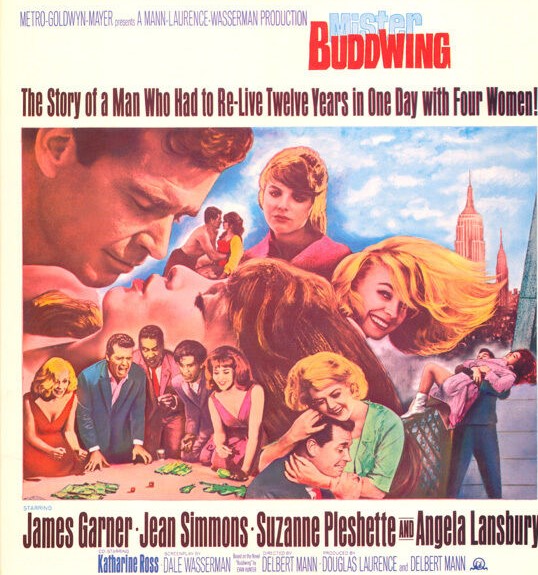
Mister Buddwing/Buddwing (1966) ****

Perhaps it was something in the ether that this very under-rated Kafkaesque examination of fractured identity emerged the same year as John Frankenheimer’s equally maligned Seconds and the year after the more successful Mirage. A superb opening sequence transports us to a world of alienation and discordance, often the only sound that of a man’s footsteps.

Face unseen, yet camera in his point of view, in the early morning a man (James Garner) examines the pockets of his suit, pulling out some pills and a piece of paper with a telephone number, pulls off a ring with the inscription “from G.Y.” He begins to walk, shakily, camera still in his POV until he arrives at an upscale New York hotel and sees himself in the mirror. That doesn’t help. He still doesn’t recognize himself. Using the lobby phone, he calls the telephone number.

It’s a woman called Gloria (Angela Lansbury). She calls him Sam. She gives him her address because that, too, has slipped his memory. Visual stimuli outside make him think his name is Buddwing. Sam Buddwing has a reassuring feel to it.

But when arrives at Gloria’s apartment, she doesn’t recognize him. Though married, she “puts out” so he could be a casual sexual acquaintance. When she pours him coffee, unable to remember how he takes it, he bursts into tears.

And so begins a disturbing odyssey, “a tug of war in his mind,” as he tries to piece together his memory and find his lost self.  Memory is triggered by the sight of a woman across the street getting into a cab. Instinct tells him this is Grace. He follows in another cab, encountering a disgruntled customer who tells him an odd tale about taking a drunken woman to Oyster Bay. She disappears inside Washington Square College. He thinks he might be the escaped mental patient Edward Volloch mentioned in a newspaper headline. Unasked, a man called Schwarz sits down at this table in a cafeteria and suggests he must be Jewish.

He finds “Grace” (Katharine Ross) on a park bench. Even though she fails to recognize him and tells him her name is Janet, he drifts back to his time with the real Grace who cuts his hair on a beach, runs from a downpour into a church. He tells her he wants to become a composer.

When Janet evades him he is confronted by a cop but, of course, has no proof of identity. The scene turns ugly and uglier still when chased by a vagrant  and he starts to see double.

And so it goes on. He finds two more versions of Grace. On hearing of his condition, the first, an actress (Suzanne Pleshette), encourages him to “be what you want to be” while Buddwing opines “we are all impersonating an identity.” The second, a drunk (Jean Simmons) appears to be the source of cab driver’s story

The actress attempts suicide after becoming pregnant, the drunken woman takes him to a crap game, where, taking turns rolling the dice, they win a heap of cash.   

All in all it’s a brilliant jigsaw, avoiding the sci-fi elements of Seconds and the thriller aspects of Mirage, but with the brooding atmosphere of both. But where the character in the Frankenheimer makes a deliberate decision to change identity and Gregory Peck in Mirage is able to put together the various pieces of his life, Buddwing simply stumbles along, totally unconvinced of his identity – at one point he is “nobody” – building up an idea of his life only as an adjunct to the mysterious Grace who keeps changing shape and personality until it seems completely incongruous that the first innocent Grace (Ross) could merge into the more blustery, sexually aggressive, Grace (Simmons).

Of course, when he does discover the truth, by random connection, that’s as shocking as anything else, shattering the somewhat idealized picture of the self he has contrived from the various jumbled meetings with the various disconnected women. Equally, the ending could be another illusion.

This might also play out as a metaphor for the screen life of James Garner (The Americanization of Emily, 1964) who had been trying to rid himself, not entirely successfully, of his previous persona as Maverick in the television series. His company, Cherokee, co-produced the picture, which smacks of the same determination to be taken more seriously as Rock Hudson with Seconds, a move that did not go down well for either with public or critics. But Garner is every bit as good as Hudson and he spends much of the film either in  hollow-eyed bafflement or in idyllic circumstance on the cusp of turning sour.

Once Angela Lansbury appears, you get the sense this is going to be episodic and that the female cast will appear in the reverse order of their billing. But Katharine Ross (Tell Them Willie Boy Is Here, 1969) apart, a newcomer, the other three more experienced actresses rip up their screen personas. Angela Lansbury (Harlow, 1965) is an addled woman of easy virtue.  Suzanne Pleshette (A Rage to Live, 1965) takes her character to suicidal levels while Jeans Simmons (A Rough Night in Jericho, 1968), especially notable, essays her inner dirty-mouthed drunken Elizabeth Taylor.

And this is hardly the stuff director Delbert Mann (Fitzwilly, 1967) is made of, despite an Oscar for Marty (1955) better known for light comedy. But he never takes the easy way out, sticking it to Buddwing as a man endlessly tormented by himself. Dale Wasserman (Quick Before It Melts, 1964) wrote the tantalizing script from the bestseller by Evan Hunter (Last Summer, 1969).

A mesmerizing watch and time it was given the same retrospective treatment as the cult Seconds.

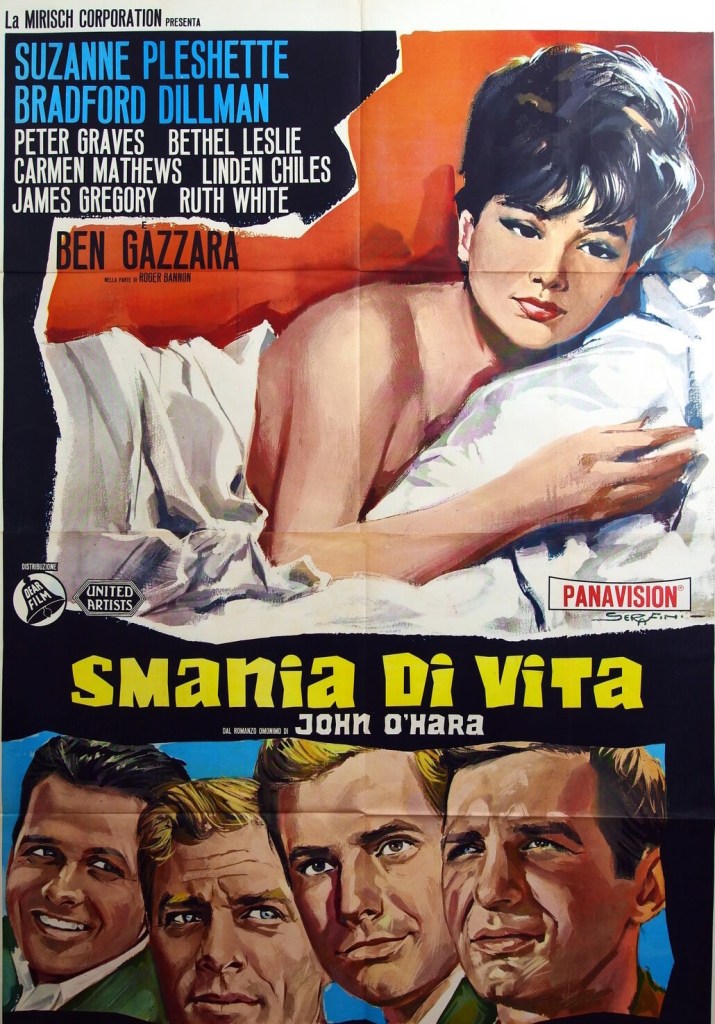
A Rage To Live (1965) ***

There was one in every town: a woman, rich (Sanctuary, 1961) or poor (Claudelle Inglish, 1961) or in between (Butterfield 8, 1960), with a predilection for sex. There were several men in every town, queuing up to take advantage. The woman was inevitably a shameful creature, the men the envy of their peers. You don’t have to look further than Frank Sinatra’s tom-catting in Come Blow Your Horn (1963) or Omar Sharif as the romantic star of the decade with two women in tow in Doctor Zhivago (1965) for an idea of the double standards in play. Welcome to hypocritical Hollywood.

Grace (Suzanne Pleshette), father dead and stuck with a domineering mother, finds escape and fulfilment in sex, and just to give hypocrisy a final tug discovers that while boyfriends are keen to help her explore such physical needs, they take the hump when they discover they might not be the first – or the only. Parents, naturally, are appalled, and discovery of Grace’s antics – and she’s not particularly particular, a passing waiter will do – leads her mother to collapse.

Having confessed to potential husband Sidney (Bradford Dillman) that he will not be marrying a virgin and almost bursting with gratitude that he is willing to overlook her behavior, Grace becomes a farmer’s wife and then a happy mother, until construction owner Roger (Ben Gazzara) comes on strong. She might well have been able to have her cake and eat it but Roger, having fallen in love,  reacts badly to being dumped and it’s only a matter of time before her world implodes.

Made a couple of years later, when the independent woman was being exalted, this would have been a different kettle of fish. Here, the boot on the other foot, the woman who picks and chooses her lovers seemed a step too far for that generation.

Before the big trouble begins, the movie does explore, though somewhat discreetly, the almost taboo notion that a woman might just enjoy sex for the sake of it. Sure, Grace likes being wanted and likes being held, but if she was around today, nobody would bat an eyelid if she just came out and expressed her preference.

Less discreetly, the subject of consensual sex comes up, but not as a question of debate, more as a matter of fact, that when Grace says no she actually means yes. There’s a very uncomfortable moment at the beginning when in a Straw Dogs-scene, though nothing like as violent, Grace appears to welcome a rape. Whether this is as bad as it sounds, or is just Hollywood hiding the blush that a woman would not seek out sex but could only discover its pleasures when forced upon her, is hard to say.

Nor is Grace a walking sex machine. She knows enough about men that she only has to put out feelers and any susceptible male will take the bait. And given the restrained times, she’s got no female pal with whom she can discuss her unseemly desires.

Of course, if this was a man, nobody would be batting an eyelid. Sure, once caught, he’d come up with all sorts of excuses, denials, begging for forgiveness, but an audience would give him a free pass. It’s only because this is a woman that it causes ructions. The movie just about gets close to what does make Grace happy and why she needs the thrill of extra marital sex but by that point the melodrama has taken over and there’s little time left for discussion, what with Roger intent on revenge and another lovelorn wife, mistakenly imagining her husband has fallen victim to Grace’s charms, also on the warpath.

Small town constraints play their part, too. Washing your dirty linen in public the worst of all offences. Author John O’Hara, on whose bestseller this is based – and whose other works Butterfield 8, Ten North Frederick (1958) and From the Terrace (1960) explored similar worlds  – knows only too well that while wealth brings freedom and privilege it comes with chains attached.

And there’s some interesting role reversal, an illicit lover falling in love with a married person normally a starting point for a movie to explore happiness and its opposite rather than being the one act Grace will not tolerate in a lover, she wants strings-free sex, not anything with encumbrance. While Grace would like to act like a man, and has the wealth to shield herself from the worst of the fall-out, as a mother she is extremely vulnerable, and in this particular era could risk losing her child if seen as maternally unfit.

While lacking the sexual combustibility of Elizabeth Taylor or Lana Turner or other Hollywood heartbreakers, Suzanne Pleshette (Nevada Smith, 1966) gives a decent enough performance especially when it comes to her straightforward attitude to sex, aware she might be causing upheaval, but finding it impossible to ignore desire, or imagine a life in which that does not play an impulsive part.

Bradford Dillman (Sanctuary) has less room for character maneuver and is mostly called upon to suck it up. He comes into his own in the movie’s latter stages when bewilderment at betrayal and public humiliation clashes with continued love for his wife. Ben Gazzara (The Bridge at Remagen, 1969), trademark leer and smug face kept in check, has a showier role especially when the violent aspects of his character explode.

Director Walter Grauman, while better known for war picture 633 Squadron (1963), had just come off another picture dealing with female trauma (Lady in a Cage, 1964) and does quite a decent job here, the camera intensely focusing on the leading actress and then as the tragic outcome unfolds drawing away from her. There’s one great piece of composition. He had used tree branches and the countryside to frame Grace and Sidney at the height of their love. And he does the same again when Grace is abandoned.

Asks some difficult questions without quite getting to grip with the real subject of female sexuality. There was a sense that Hollywood was just on the cusp of accepting the independence of women, but didn’t want to go the whole hog just yet, because, apart from anything else, where would it leave the guys?

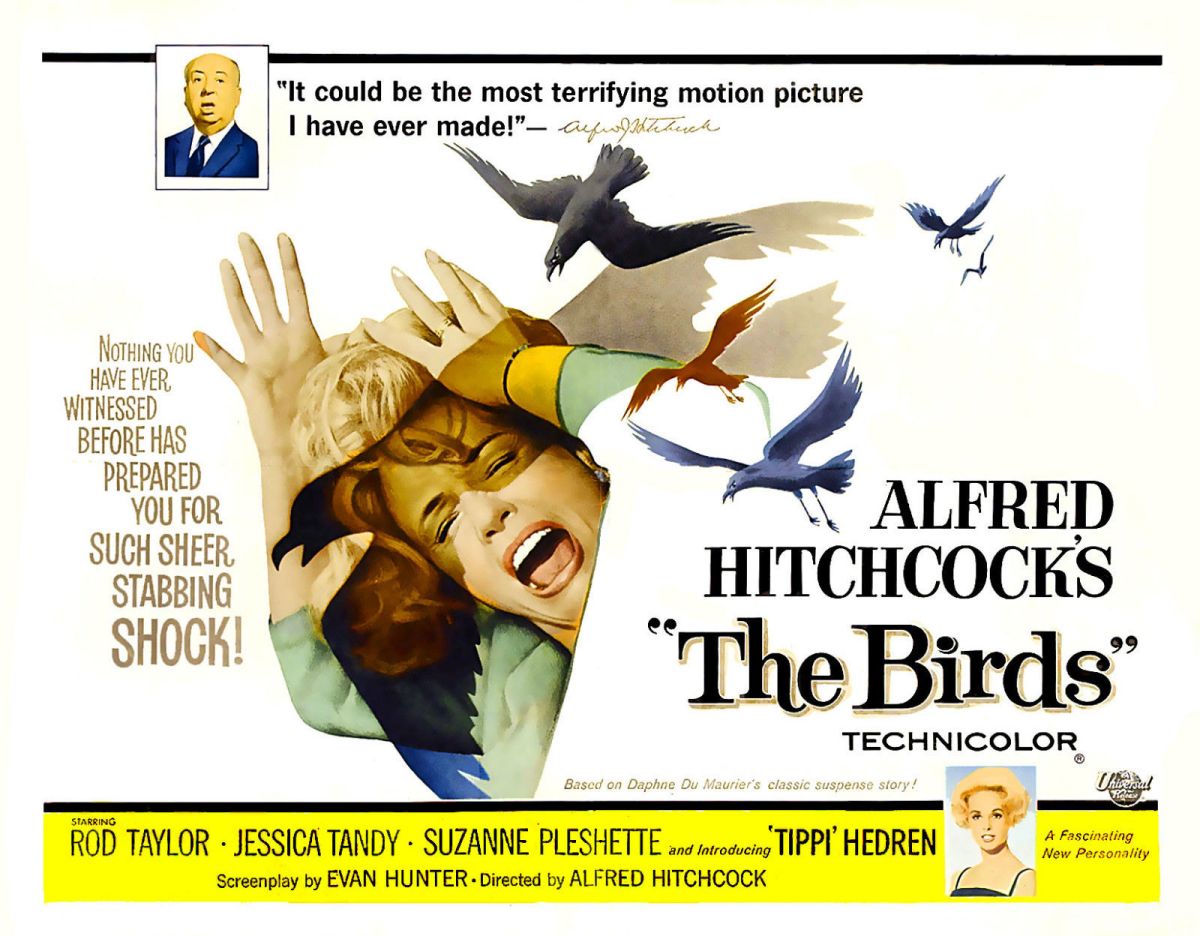
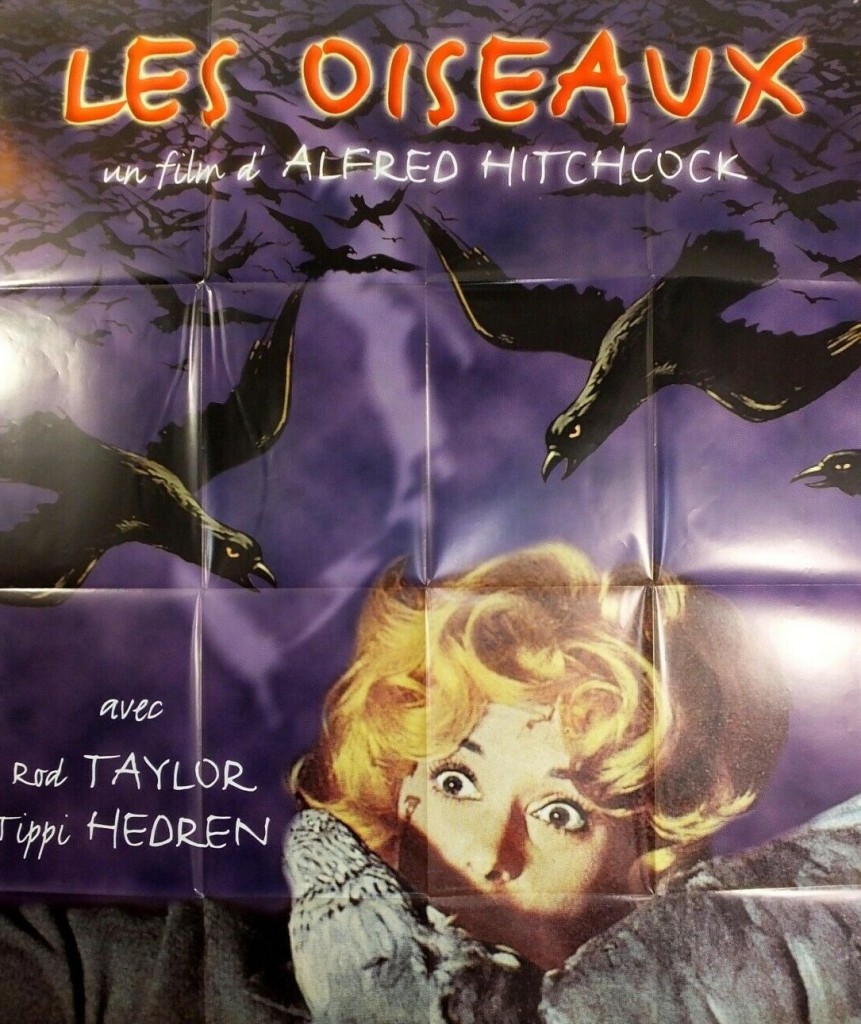
The Birds (1963) *****

Years ago I was asked to write a book on the six best Hitchcock films and from those choose the one I considered his very best. My choice was The Birds (1963). And it is for these reasons.

Firstly, unusually in the master’s work, there is a proper meet-cute. In most of his films, the couple are either already together (Rear Window, 1954; Torn Curtain, 1966) or when they get together it is for a hidden reason, one is on the run, or being pursued by the other, and the getting together is a convenient way of reaching an ulterior goal. When Melanie (Tippi Hedren) and Mitch (Rod Taylor) meet in the pet shop it is a certainly a precursor for the future and ensures that Mitch gets in a stickier jam he would otherwise likely have avoided but in the true sense it is the traditional Hollywood boy-meets-girl.

Secondly, and now cutting more to the chase, this is where the modern action film was invented. You might think that honour rested with Dr No (1962) or any other of the Bond pictures or even as late as Bullitt (1968) with its epochal car chase. But although the Bonds are filled with derring-do and escape, there is nothing to match the scene when the birds attack the town, wave after wave, as if they were World War Two bombers. There is even the point-of-view from the air which Hitchcock also invented and has been repeated in airplane war films ever since, most famously Pearl Harbor (2001).

But the way in which full-scale disaster, with everyone rendered helpless, unfolds is a true first. People in the café can see the river of petrol and the match about to be discarded and can only observe as the river of flame reaches the petrol tanker and in a perfectly ordinary town setting – rather than a military base – there is an almighty explosion. It is terror for the sake of it. And there is no escape, no one racing to the rescue, just pure devastation,

Lastly is the ending. It is apocalyptic. In every other Hitchcock when the hero/heroine escapes from dire peril, that is the end of the matter, there is no final twist as with a film like Carrie (1976). But although the birds are now silent and the couple can pick their way through their lines, you know full well this is not the end and that the birds will soon be as inexplicably massing somewhere else.  

That’s three reasons but there are many more. For a start, in other films where the hero/heroine is in danger, the peril is not relentless. And often it is the threat of danger or of being captured that provides the narrative spring. And if there is physical threat in that era it was not unrelenting. And it is with another character whom you can fight or at least attempt to outwit. Not just, later in this instance rather than sooner, realize that there is no way to defeat these marauding creatures, no way at all. So, compared to his other films, when attacks of one kind or another punctuate a film, here it is like a battery of machine-guns and not episodic but virtually non-stop for over 30 minutes.

The storyline since it is after all a meet-cute is excessively simple. Melanie and Mitch meet, trade remarks, she leaves him what would easily be interpreted as a love token, and they link up after she is attacked by a gull. Wherever they go now, there will be no escape. Gulls attack children playing outside. The same day sparrows invade Melanie’s home. There is another attack on children. In town the gulls swarm in wholesale, wreaking the devastation mentioned above. All his is just a prelude to the final overwhelming siege. Except in modern horror pictures where a body is dispatched every ten minutes or so, there is  nothing to match the unremitting attacks. It is as though Mitch and Melanie are in the front line of battle, under siege, Zulu (1964) with birds perhaps, but with no hope of salvation. Unlike Zulu, there is no sign that in raising the siege, the birds are hailing their bravery.

Unusually, too, for a Hitchcock film, there is considerable back story that informs current action. Mitch has an overbearing mother who seems to hover over his life attempting to scare off any woman who comes near. Annie has been left behind precisely because he needed to escape his mother. For her part, Melanie’s mother ran off with another man and she is a spoiled socialite with a habit of getting into trouble, possibly attention-seeking behaviour as a result of abandonment issues. Full to the brim with sophistication. Melanie is the least likely candidate for motherhood, yet her maternal feelings rush to the fore when she has to care for a terrified child.

Tippi Hedren’s career when south when she parted company with Hitchcock so we only have this and Marnie (1964) to consider her worth as a star. This is easily her best performance, shifting from icy cold to playful to romantic to maternal and of course no one has quite emoted such shock and terror. This is Rod Taylor (Dark of the Sun, 1968) coming into his stride as a leading man. He always had the charm and certainly the brawn, but rarely displayed both in the one picture. You would not have picked the Rod Taylor of Seven Seas to Calais to lead a squad of mercenaries in Dark of the Sun but he might well be first pick after this performance.

Hitchcock got so many of his effects by laying on the tension, a man or woman on the run, an innocent framed, a man displaying dubious morality (Rear Window, 1954, and Vertigo, 1958) nonetheless being presented as hero, the question in every instance being whether they will escape their fate. Here, the barrage of devilry is so intense it is almost inconceivable that anyone could get out alive. That they sneak out by the skin of their teeth, watched by their silent conquerors, for me was only the prelude to The Birds Part Two.  

Nevada Smith (1966) ****

Half breed Max Sand (Steve McQueen) has little truck with the notion that revenge is a dish best served cold. But he’s too young and raw, far from Lee Marvin’s callous killer in Point Blank (1969), to properly avenge the slaughter of his family by three outlaws.

This is a coming-of-age tale with a distinct difference. Max’s development includes, apart from initiation into sex of course, learning to read and write so he can make sense of signposts in order to track down the murderers and receiving tuition from gunsmith Jonas Cord (Brian Keith) so that he can at least loose off some shots without doing himself damage. Vengeance burns so deep that he even stages a bumbled robbery so he can be sent to the prison where the second of his targets is incarcerated. Now that’s dedication for you. And along the way he learns the most important lesson of all, how to live, and not destroy himself through vengeance.

Even so, all Cord’s tuition counts for nought when Max needs a knife to dispatch his first victim Coe (Martin Landau). And he’s not yet so slick with a weapon to avoid serious injury himself. Kiowa saloon girl Neesa (Janet Margolin) nurses him back to health at her tribe’s camp. They become lovers but he rejects the wisdom of the elders and the opportunity to make a life with her.

Unfortunately, Bowdre (Arthur Kennedy)  is a jailbird. And worse, held prisoner in a swamp. Probably the worst bank robbery ever committed sends Nevada there. Max enrols another woman, Cajun Pilar (Suzanne Pleshette) working in nearby rice fields – fraternisation between the jailbirds and these women permitted – to steal a boat to help him and Bowdre escape. Bowdre gets his and this time it’s Pilar who is the collateral damage.

A genuine outlaw now, Max has no trouble joining a band of robbers headed by Fitch (Karl Malden), the final prey. By now calling himself Nevada Smith, Max’s plans are thrown into confusion when it becomes apparent Fitch is aware of his true identity. A surprise ending is on the cards whichever way you cut it, and especially thrilling since it occurs during a well-planned gold bullion robbery.

It’s a film of two parts but divided into three if you like, the unusual swamp setting fitting in between two sections of more straightforward western. Though in the hands of director Henry Hathaway (True Grit, 1969), there is little that’s so straightforward given his mastery of the widescreen and his hallmark extreme long shot. He’s capable of moving from the extreme violence of the vicious murder and rape of Max’s mother to the son’s discovery of the bodies shown just through Max’s physical reaction. And there’s some irony at play, too: gold triggers slaughter and climax; mental dereliction not as feared as its physical counterpart.

Although Hathaway was a true veteran, he was not best known for westerns in the manner of John Ford, more at home with film noir (Kiss of Death, 1947), war (The Desert Fox, 1951) and big-budget pictures like Niagara (1954) with Marilyn Monroe and Legend of the Lost (1957) teaming John Wayne and Sophia Loren. In a 30-year career he had only made three westerns of note – The Trail of the Lonesome Pine (1936), Rawhide (1951) and Garden of Evil (1954). So it was something of a surprise that in the 1960s over half his output was in the western genre. And unlike Ford and Howard Hawks who stuck to the formula of action within a defined community, Hathaway tended towards films of adventure, where the main character, often of a somewhat shady disposition, wandered far and wide.

Steve McQueen (The Cincinnati Kid, 1965) carries the picture with some aplomb, moving deftly from the wet-behind-the-ears youngster to a clever and calculated killer and still retaining enough humanity to enjoy a romantic dalliance. There’s enough action here to satisfy McQueen’s fans spoiled by The Magnificent Seven (1960) and The Great Escape (1963) and for those who had come to appreciate his acting plenty to enjoy. This and The Cincinnati Kid, where perforce as a poker player, he had to do a great deal of brooding, solidified his screen persona, a star you can’t keep your eyes off, wondering what on earth is going on in his mind. As much as he’s playing a character finding his feet, this is McQueen at very nearly the top of his game.

Brian Keith (The Rare Breed, 1966) is the pick of the support, adding a little softness to his usual more hard-nosed screen characters. The villains – Karl Malden (The Cincinnati Kid), Martin Landau (The Hallelujah Trail, 1965) and Arthur Kennedy (Claudelle Inglish, 1961) – are all good in their own different ways, and in the hands of excellent actors, easily differentiated. Suzanne Pleshette (Fate is the Hunter, 1964) shines in a too-brief role.

The sterling supporting cast includes Janet Margolin (Bus Riley’s Back in Town, 1965), Pat Hingle (Sol Madrid, 1968) and Raf Vallone (The Secret Invasion, 1964). John Michael Hayes (Harlow, 1965) fashioned the screenplay from The Carpetbaggers by Harold Robbins. 

Although Hollywood had been prone to sequels – Father’s Little Dividend (1951) following Father of the Bride (1950), Return to Peyton Place (1961), Return of the Seven (1966) etc – there had been no perceived market for prequels, so this was something of a first, Alan Ladd having essayed an older and considerably more sophisticated Nevada Smith in the 1964 film of Harold Robbins bestseller. 

Discover WordPress

A daily selection of the best content published on WordPress, collected for you by humans who love to read.

The Atavist Magazine

by Brian Hannan

WordPress.com News

The latest news on WordPress.com and the WordPress community.