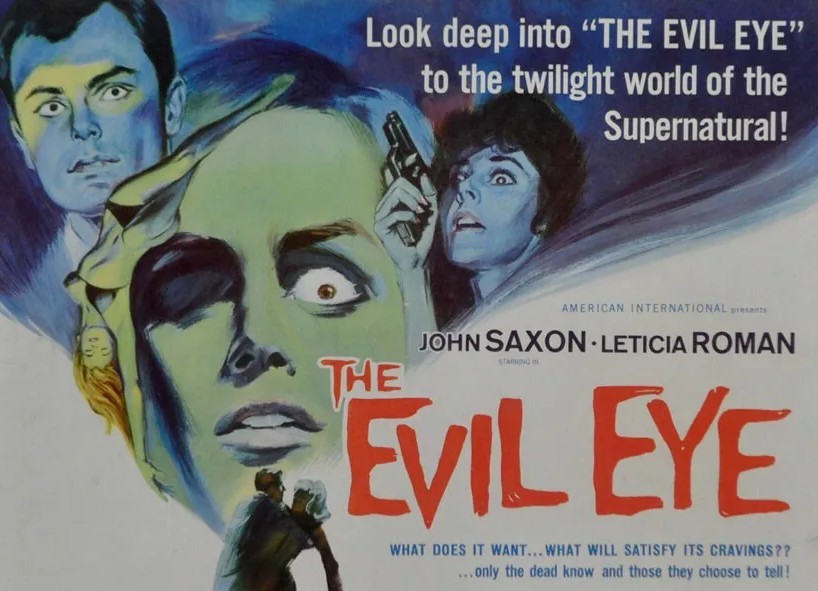
Don’t be taken in by claims that, since it was directed by Mario Bava, it kicked off the giallo sub-genre. More of the tropes come from mainstream horror – windows banging shut, locked doors, disembodied voices, stalkers, gaslighting, mysterious phone calls, premonition, retrocognition. And just for good measure, striking compositions that wouldn’t be out of place in an arthouse picture. But essentially it’s neo-noir – a woman can’t prove she’s witnessed a murder.
TheEvil Eye was the American title, which makes little sense, although eye-popping eyes were in fashion from movies like Village of the Damned (1960), but in fact the original title of The Girl Who Knew Too Much is much more appropriate. This film is about a female character and what she discovers that threatens her life. The American version was chopped about by the distributor but, apparently, copies of that have gone astray so if locate a copy of the picture what you are likely to see if the Italian original.
American tourist Nora (Leticia Roman) is knocked out by a robber in Rome. On waking up she sees a murderer sticking a knife into a woman’s back. Only problem is – there’s no corpse to be found. But, strangely, a murder was committed on that spot a decade ago. So she might be having a vision of the past. But the murderer Straccianeve was caught.
The victim was the sister of Laura (Valentina Cortese), a new friend, whose apartment Nora temporarily occupies. There, Laura discovers newspaper clippings relating to the “alphabet killer”, a serial murderer whose victims’ surnames began with A, B, and C. Once Nora begins her investigations, it looks like she’ll be next on the list since her surname begins with “D”. Meanwhile, she has struck a romantic vibe with Dr Marcello Bassi (John Saxon). But, of course, he might be not what he seems, sneaking off for assignations with strange women, following her.
Much of this is played out on deserted streets where the tourist sites acquire a dangerous veneer.
The finger points at journalist Landini (Dante DiPaulo), who has been following her. But he is as much a basket case as a potential murderer. He was instrumental in collecting the evidence that trapped the murderer but now believes Straccianeve was innocent.
In due course, after some more deaths, Nora traps the murderer, who comes out of left field, one of those where you think the writer has decided to pin the blame on the least likely suspect and come up with a spurious reason for the murders, so the twists pile up in helter skelter fashion at the end, including one which suggests Nora might well have the gift of seeing into the future.
Leticia Roman, in her debut, is mostly called upon to look baffled or frightened, there’s rather too much of the pop-eyes, and John Saxon (The Appaloosa, 1966) has the rare opportunity to play a hero. Valentina Cortese (Barabbas, 1961) drifts in and out of the tale. Written by future director Sergio Corbucci (Django, 1966), Oscar-winner Ennio De Concini (Divorce, Italian Style, 1963) and Eliana De Sabato (Marco Polo, 1962).
If it hadn’t been directed – and occasionally so stylishly – by Mario Bava (The Whip and the Body, 1963), it would have attracted considerably less contemporary attention. One of this main themes – the conflict between illusion and reality – is given a good airing. You can well believe that Nora is going mad. But it’s atmospheric enough and the director makes unusual use of the standard Rome tourist traps and this picture gives notice that he will move onto greater movies.
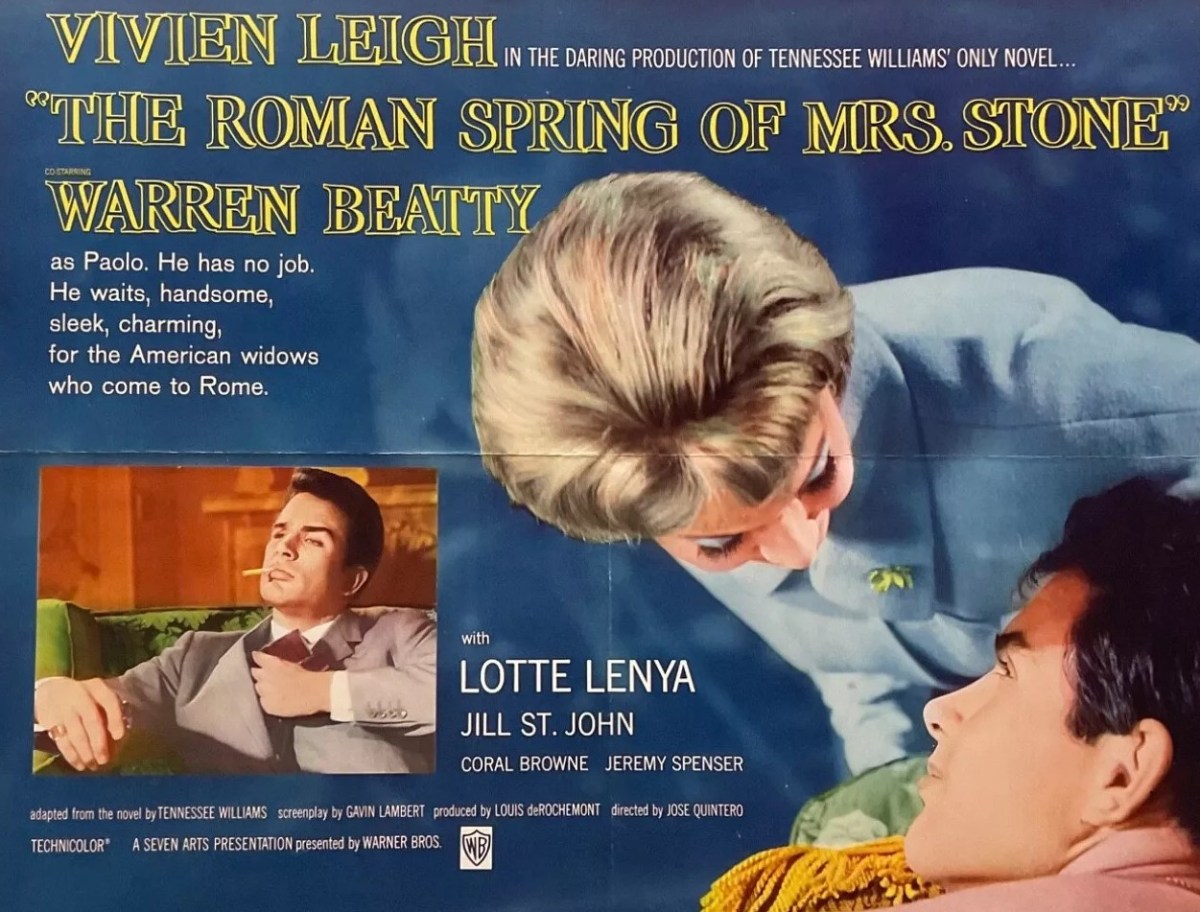
Dreary miscalculation. Ever since Tennessee Williams hit a home run with Cat on a Hot Tin Roof (1958), studios, directors and stars had clamored for his works, so much so that Hollywood had greenlit seven adaptations in five years. While box office was one consideration, the playwright was catnip to the Oscar, racking up 17 nominations with a hefty number in the Best Actress category.
However you dressed it up, his work contained a substantial number of portraits of sadness and malevolence and often teetered on the murky, so making them work at all depended not just on the acting and direction, but the initial story. Rather than being based on a play, this was sourced from his first novel, a bestseller.
But the tale never shifts out of first gear and it’s difficult to summon up sympathy never mind interest in any of the characters. The middle-aged romance had proved a cumbersome fix for studios, and since May-December numbers featuring ageing male and younger female had proved popular, Cary Grant set up with an endless supply of woman nearly half his age, it seemed only fair to give middle-aged actresses the opportunity to romance younger men.
Usually, however, this followed a more straightforward path, involving genuine feelings on both sides. But Hollywood was also digging into another cesspit, the female sex worker, somewhat dressed up in Butterfield 8 (1960) and Go Naked in the World (1961), treated more straightforwardly in Never on Sunday (1960) and Girl of the Night. So it only seemed fair to introduce the gigolo.
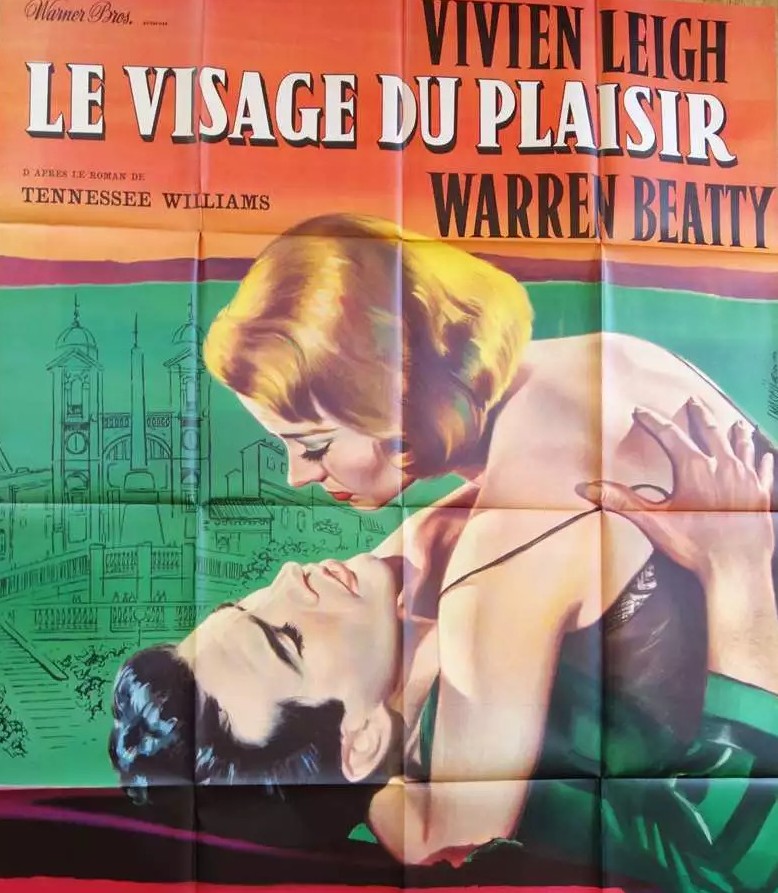
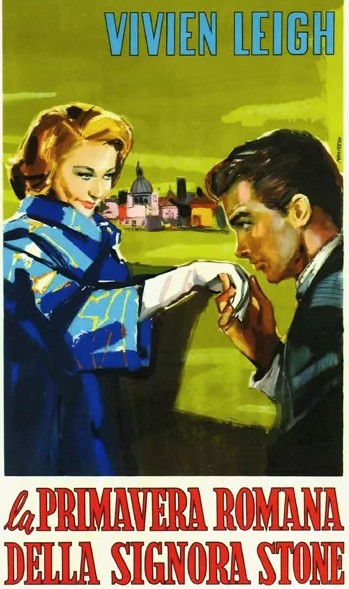
Stage actress Karen Stone (Vivien Leigh) heads for Rome with her wealthy husband to recover from the failure of her latest play, a Shakespearian outing. When her husband dies on the plane, Karen decides to hang on in the Italian capital, which, after a year, brings her into the orbit of gigolo Paulo (Warren Beatty) and his unscrupulous mentor/manager Contessa Magda (Lotte Lenya). While Karen isn’t entirely a dupe and quickly sees through Paulo, nonetheless a year of loneliness has taken its toll.
Plus she understands the attraction of the older lover, her husband being a good two decades older and willing to subsidize her theatrical and cinematic ambitions. Despite not falling for Paulo’s more obvious con tricks, Karen finds herself enmeshed in a one-sided romance, ignoring the warnings of friend Meg (Coral Brown) on the dangers of becoming the talk of the town with her lover clearly more attracted to rising movie star Barbara (Jill St John). Paulo quickly dumps the Contessa, leaving her free to pour bile into Karen’s ear.
Inevitably, the younger lover tires of the older, but generally such pairings work well enough because initially at least there is attraction on both sides. But when it’s as lop-sided as this no amount of long drawn-out close-ups of the disenchanted provide sufficient compensation for a story that overstays its welcome.
While there are hints of the decadence of La Dolce Vita (1960) that Fellini explored, here it’s more of a surface examination until the surprising ending, where you would think Karen is doing little more than willingly opening the door to a potential serial killer.
The only redeeming element, which might reverberate more easily today, is of the woman demonstrating her independence by being the one to choose, and to some extent discard, the man. While not for most of the movie a sexual predator, she may well have turned into one at the end.
Oscar-winner Vivien Leigh, in her first movie in six years, essays her role well but is compromised by portraying a character that fails to elicit sympathy. Warren Beatty (Promise Her Anything, 1966) avoids the trap of thickening his Italian accent and going wild with the gestures which lends his character more of a thoughtful personality but there’s not much here to write home about. Lotte Lenya (From Russia with Love, 1963) steals the show and was rewarded with an Oscar nomination. Jill St John (Tender Is the Night, 1962) plays the ingénue like an ingénue.
Unless you’re a student of theater I doubt if you’ll have come across Panamian director Jose Quintero. This was his only movie and he was more famous for staging some of Williams’ plays and for resurrecting Eugene O’Neill on Broadway. His inexperience shows in lingering on faces at the expense of creating drama. Gavin Lambert (Inside Daisy Clover, 1965) adapted the novel.
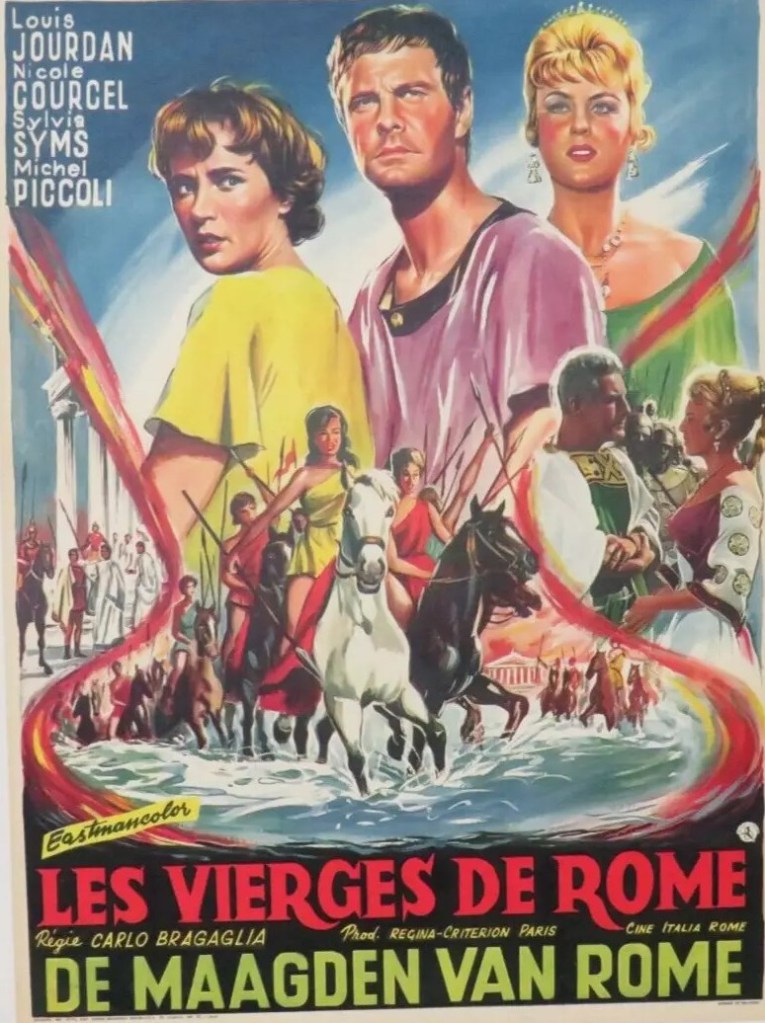
Starting with the cast and the intelligence of the narrative a pretty unusual addition to the peplum subgenre. While there was no shortage of foreign stars hoping to find marquee redemption in Italy, I was frankly astonished to find leads of the caliber of Frenchman Louis Jourdan, fresh from Twentieth Century Fox big budget musical Can Can (1960), and rising English star Sylvia Syms coming off her biggest Hollywood role to date albeit as second female lead in The World of Suzie Wong (1960).
At the time of release, Jourdan did not seem a good fit for a genre that relied more on musclemen than the kind of suave charmer that he essays here. Syms equally seemed an odd choice, better known for prim Englishwomen than action. In fact, you’d have been hard put to find any American or British actress who would sign up for such a role. Although Sophia Loren in El Cid and Jean Simmons in Spartacus had significant roles in historical mocvies, they weren’t called upon to buckle a sword.
Given they start out as sworn enemies, Drusco (Louis Jourdan), a barbarian laying siege to Rome, Cloelia (Sylvia Syms) a besieged inhabitant, it was going to take some considerable narrative sleight of hand to contrive a happy ending. How it’s done is entirely believable, pivoting on ideals of honor that are initially foreign to this vicious war full of scores to be settled, unbridled ambition, deviousness and ruthlessness.
The civilized Etruscans backed by a barbarian horde headed up by Drusco have dealt a killer blow to the Roman armies led by one-eyed Horatio (Ettore Mani). Never mind the lack of obvious muscle Drusco isn’t anyone’s idea of a warrior leader. We are introduced to him munching on a watermelon and then chomping down on an apple on the edge of the battlefield. While other Etruscans, namely Stavros (Renaud Mary), want to raze Rome to the ground Etruscan leader Porcena (Jean Chevrier) wants peace. But it comes at a price – tons of gold in tribute and a thousand hostages. But since Rome is short of able-bodied men to fulfill that part of the deal, the Etruscans make up the numbers with a battalion of untested female warriors led by Cloellia.
Adding spice to the mix is Lucilla (Nicole Courcel), now an aristocratic Roman married to a noble, but originally an Etruscan captive, married to Porcena, who wants revenge on the Romans for her original harsh treatment at their hands. She finds a willing ally in the devious Stavros.
initially merely amused by Cloelia and her warriors, impounded in a stockade outside the Etruscan camp, Drusco responds to their smarts. Devoid of weapons, the women find clever ways of stealing swords from their captors and secreting them in the stockade. However, when the scam is discovered, Cloelia volunteers to take whatever punishment is meted out. Porcena cedes choice of punishment to Lucilla who wants Cloelia to endure the same humiliation as was once handed out to her – to be whipped and then stripped naked in public.
But she hasn’t counted on Drusco’s cleverness. The minute one lash is administered, Drusco steps in, and pretty much on a technicality, announces that a “whipping” – number of strokes not specified – is complete. When Lucilla starts to strip Cloelia, he musters his soldiers to conceal this from the slavering Etruscans.
Cue some flirting but of course they are still on opposite sides. And in any case Lucilla puts paid to nascent romance, ensuring Drusco is chucked out of the camp for defying her. Infuriated, she sides with Stavros who has decided that mass rape will put the captives in their place.
His scheme is thwarted by Cloelia who sets fire to the compound, escaping with her army after bullocks stampede. Pursued by Etruscan cavalry, they are saved by the intercession of Drusco. Embarassed by their escape, Porcena is now persuaded to restart the war. Back in Rome, Cloelia disobeys orders not to get involved and leads her army out through the sewers to attack the Etruscan rearguard. Porcena, realizing he has been used, calls for a truce. Lucilla is reunited with her Roman husband and Drusco, made a freeman of Rome, is able to marry the enemy.
Porcena comes over as an enlightened ruler. An early advocate of the zero sum game, his guiding rule for peace is “no victor, no vanquished” and he draws the line at the kind of ruthlessness espoused by his cohorts and although still attracted to Lucilla finds her attitudes distasteful and arranges for her to bury the hatchet with her Roman husband rather than continuing to foment her anger. There’s a lot more interesting dialog than you’d expect in a picture like this.
But Louis Jourdan is what makes it special. His light comedic touches not only make his character much more human and attractive than the normal musclebound jerk, but also serve to underline his humanity. And since he’s so good anyway on the seductive side, the romantic elements catch fire rather than just limping along as was more normal in the genre. The only downside is he challenges George Hamilton in the over-tanned department.
Sylvia Syms, too, makes it all work. There’s no slacking in the action department and clearly no stand-in for the horse-riding, crossing of a river and a sewer on horseback. And without resorting to the athleticism of a Wonder Woman, the most recent example of the Amazon variety, and perhaps precisely because there’s no kowtowing to that, she is a believable heroine. No feminine wiles are required, either, just genuineness.
Lucilla’s deviousness reminded me of Ian Bannen in Suspect, that spirit trapped by humiliation, revenge the only release. And though Nicole Carcel isn’t in Bannen’s league, she manages to essay the dark side of her nature with ease.
There are plenty narrative plot holes – how do the women emerging soaking from the river manage to burn the Etrucan battering ram being the pick – but the spirit of the picture more than compensates.
The elements that made it stand out for all the wrong reasons back in the day are the very elements that make it so appealing to a contemporary audience.
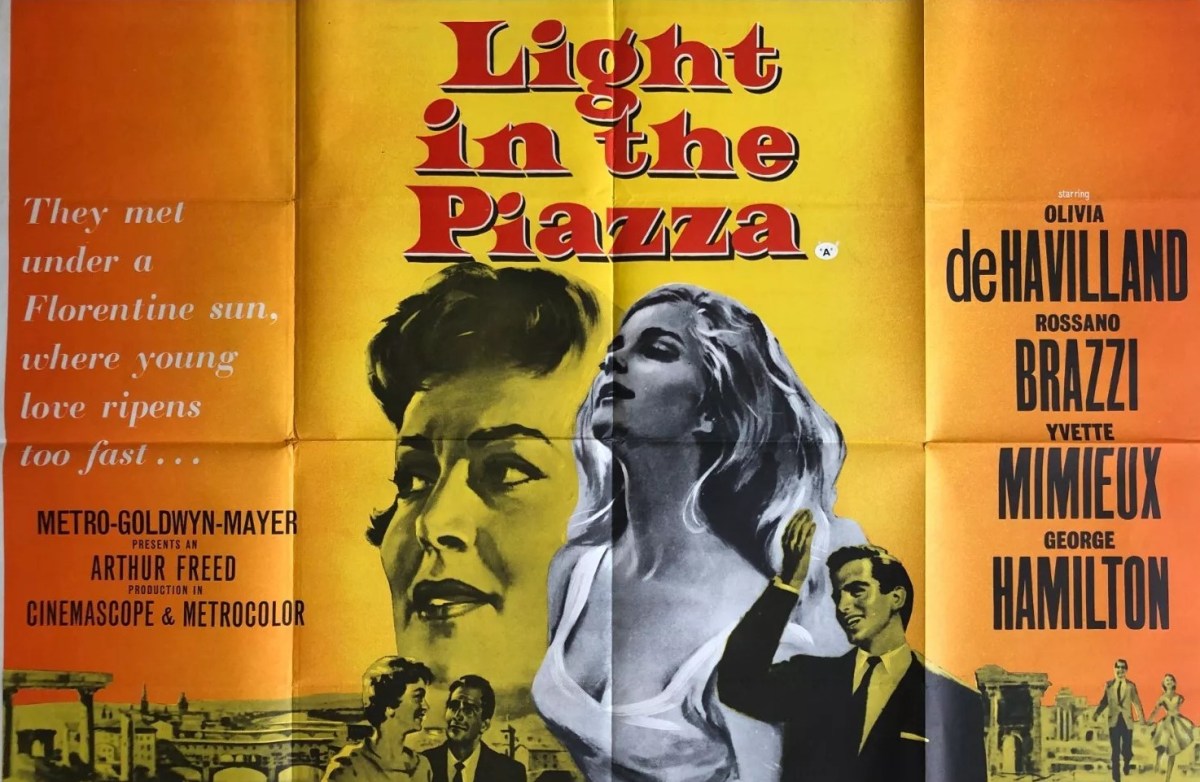
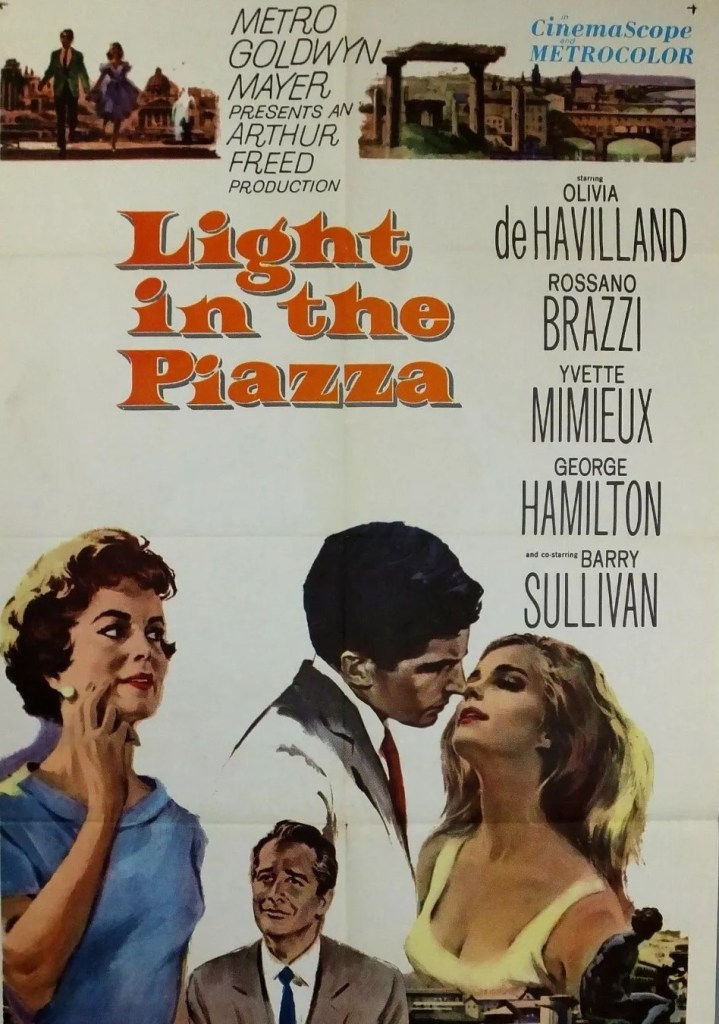
Will resonate more strongly today. Never intended as a light-hearted confection, despite the obvious premise of young love catching fire in Italy, this was a bold picture in its day and a more subtle examination of the wider impact of mental illness than those later movies set in institutions such as Lilith (1962) or Shock Treatment (1964). Bold, too, of Olivia de Havilland to take on a role that is so transparently maternal. Instead of her middle-aged character succumbing to romantic opportunity as the billing might suggest, to a holiday affair with a rich handsome Italian, she is first and foremost a mother.
Initially, standard romance meet-cute as young Italian Fabrizio (an unlikely George Hamilton) catches the runaway hat of young blonde Clara (Yvette Mimieux) in a piazza in Florence. His ardent pursuit is thwarted at every turn by Clara’s mother Meg (Olivia de Havilland). At first this appears to be for the most obvious of reasons. Who wants their naïve daughter to be swept away by a passionate Italian with heartbreak and possibly worse consequence (what mother does not immediately conjure up pregnancy?) to come.
Sure, Clara seems flighty and a tad over-exuberant and perhaps prone to tantrums but then back in the day this was possibly just an expression of entitlement by rich indulged young women. Turns out there’s a more worrying cause of her sometimes-infantile behavior. She was kicked in the head by a pony and has the mental age of a child of ten. If she is not protected, she might end up as prey to any charming young man.
Clara needs tucked up in bed with a stuffed toy, and her mother to check the room for ghosts and read her a bedtime story before she can go to sleep. Even when Fabrizio’s credentials check out – his father Signor Naccarelli (Rossano Brazzi) vouches for his good intentions, but, in the way of the passionate Italians, would not want to stand in the path of true love.
Clara’s father Noel (Barry Sullivan) is the one who spells out the reality. That pony didn’t just kick his daughter in the head it “kicked the life out of” his marriage. His wife lives in a dreamland, hoping for a miracle, and if that is not forthcoming quite happy to live with a daughter who never grows up. He wants to send her to “a school,” convincing himself it’s “more like a country club.”
Meg fights her own feelings that she knows better than her daughter and that love will not provide the cure, at the same time as batting away the affections of the elder Naccarelli. When she finally gives in to her daughter’s desire, wedding plans fall apart at the last minute when Naccarelli Snr discovers that his 20-year-old son is marrying not, as he imagined, a woman of roughly the same age or slightly younger, but actually someone six years older. Eventually, the wedding goes ahead. Meg convinces herself she did the right thing in permitting the marriage to go ahead.
But this is one of those happy ever afters that don’t quite wash and you might find yourself wondering exactly how it played out when the husband discovered exactly what kind of wife she had. Her instability isn’t genetic so no danger of a subsequent child encountering the same issue. And having to care for someone other than herself might well bring out the same level of maternity as her mother shows, but equally clearly Fabrizio is unaware of exactly what he’s taking on. How will he feel when asked to read her a bedtime story or scour the cupboards for imaginary monsters.
The movie didn’t do well enough to warrant a sequel – audiences expecting romantic confection were disappointed – and just hope Clara didn’t turn into the kind of inmate seen in Lilith and Shock Treatment.
Still, takes a very realistic approach to the problems of someone with such problems maturing into adulthood.
The Oscar-garlanded Olivia de Havilland (two times winner, three times nominee), in her first picture in three years, clearly didn’t want to see out her maturity in those May-December roles that others of her age fell prey to. She is excellent here, no attempt to dress herself up as a sex bomb, and refreshing to see her approach. Yvette Mimieux (Diamond Head, 1962) is excellent as the confused youngster. George Hamilton (The Power, 1968) lets the side down with his speaka-da-Italian Italian but Rossano Brazzi (The Battle of the Villa Fiorita, 1965), who is Italian, has no trouble with the lingo or with being a smooth seducer.
Director Guy Green (Diamond Head, 1962) adds in some unusual Florentine tourist color, but doesn’t shirk the difficult storyline. Julius J. Epstein (Casablanca, 1942) wrote the script.
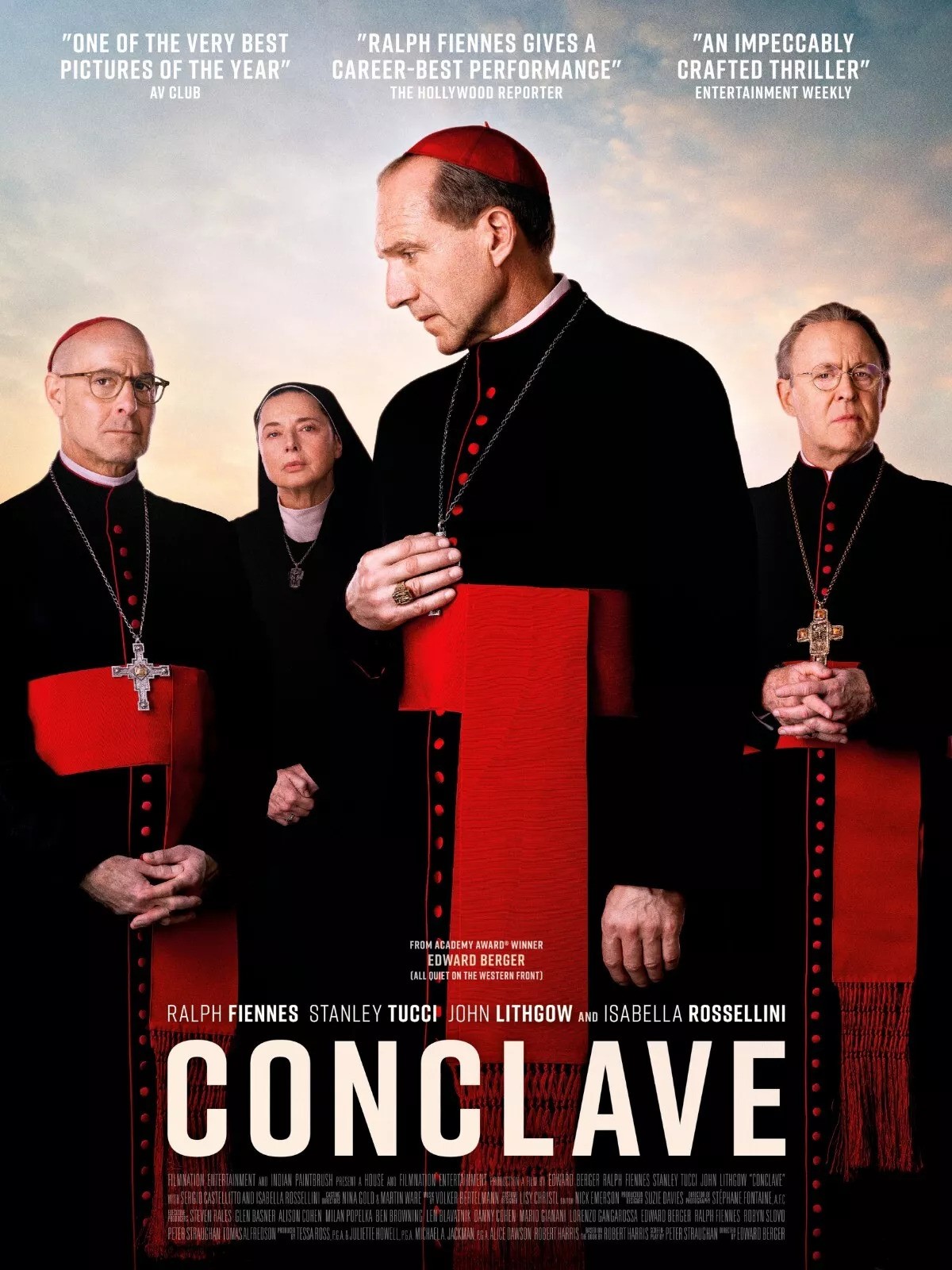
No great surprise that the political thriller has made a return – all subgenres resurface after a while. The surprise here is the context. The Catholic Church hardly seems a fitting setting, given it’s been wracked for decades by accusations of child molestation, Oscar-winning Spotlight (2015) taking it down over historic malfeasance in Boston, though that was more in the line of another subgenre, the fearless journalistic expose.
Nor would you expect the drama of the election by all the Cardinals of a new Pope to turn into a riveting thriller, with a stunner of a twist at the end which carries considerable contemporary heft. The last time the goings-on in the Catholic Church attracted the attention of Hollywood was in Otto Preminger’s The Cardinal (1963) and The Shoes of the Fisherman (1968), which were cut from a more traditional cloth. Except for some interesting procedural background and some argument about the future direction of the Church, the bulk of this picture concerns the horse-trading and corruption that threatens to envelop the election.
Our guide through the shenanigans is Lawrence (Ralph Fiennes), the dead Pope’s righthand man, who, although filled with his own doubts, is in charge of managing the actual election. He’s so self-effacing that it comes as something of a shock to him to discover that he’s one of the candidates. It’s a blind-voting system and continues until one person has secured 72 votes. As you might expect there’s wheeling-and-dealing with the liberal elements set against the more entrenched right-wing groups.
The main contenders are: Bellini (Stanley Tucci), favored by Lawrence, Tremblay (John Lithgow), Adeyemi (Lucian Msamati), a black African who would be a popular winner except for his stringent views on homosexuality, Tedesco (Sergio Castellito) who wants to cancel all the liberal developments of the Church in the last half century, and surprise packet Benitez (Carlos Diehz) from Afghanistan who represents the downtrodden that the rest of the high-living Cardinals appear to have forgotten.
You’re going to remember the twists more than any moral message. But it does allow time for debate of the major moral questions, mostly handled with subtlety. The Cardinals are all sequestered away from the outside world for the duration of the election. Turns out the deceased Pope was trying to rig the election to suit his own ends, conspiring against those Cardinals he felt were too ambitious, self-obsessed or had unsightly, but secret, stains on their characters.
For a holy fellow the dead Pope set some remarkable traps which leave Lawrence reeling. And as the election proceeds, Lawrence is revealed, on the one hand, to be quite a tough egg, like a good journalist determined to uncover the truth, but on the other hand given to bouts of crying as the weight of duty and expectation and, I guess, shock at the findings get to him.
This is quite an adult movie. Not in the sense that we’re dealing with a particularly controversial subject matter, but it’s a kind of courtroom drama in all but name, and except for the sprinkling of revelations, and the inherent tension of an election, apt to be slow moving, allowing characters time to breathe and to put various points across. The structure makes no concessions to the MCU generation. Nor to the traditional Hollywood approach which would have allocated a certain amount of time to tourist Rome. A couple of cheats – hidden documents, access to a computer when access to anything was denied – don’t get in the way.
I’m always worried when trailers concentrate on the number of Oscar winners or nominees involved because generally that suggests to me a weak narrative. But, in fact, two-time nominees Ralph Fiennes (No Time to Die, 2021) and John Lithgow (Interstellar, 2014), and one-time nominee Stanley Tucci (The Hunger Games, 2012) deliver terrific, largely understated performances, while director, also a nominee, Gerard Berger (All Quiet on the Western Front (2022) brings it together with a stately majesty.
He’s allowed himself a certain amount of self-indulgence. The overhead shot of the lines of Cardinals moving through the rain and carrying white umbrellas bears no narrative weight but is visually splendid. As if escaping from a more offbeat movie, turtles appear from time to time. The rigmarole of ritual is compelling.
Some scenes are conducted in Latin, with subtitles of course. Thank goodness, I know now what “in secula seculorum” now means. But you didn;t need to know back in the day. That was the point. It was like joining a secret society. The Catholic Church once had an unique ID that it threw away – the fact that all Masses were spoken in Latin, and therefore universally appreciated, and you could go to a Church in any country and understand what was going on, whereas now you’d need Google translate.
Screenwriter Peter Straughan (Tinker, Tailor, Soldier, Spy, 2011) is on something of a roll at the moment, his teleplay for Wolf Hall: The Mirror and the Light just out. Robert Harris, who’s not had much luck at the box office with the various movie interpretations of his bestsellers Enigma (2001), The Ghost Writer (2010), and An Officer and a Spy (2019) – banned pretty much everywhere because of Roman Polanski’s involvement – gets his just reward here for laying down such a superb template. The music by Volker Bertelmann was particularly striking. Oddly enough his Oscar win for All Quiet on the Western Front didn’t warrant a mention in the trailer.
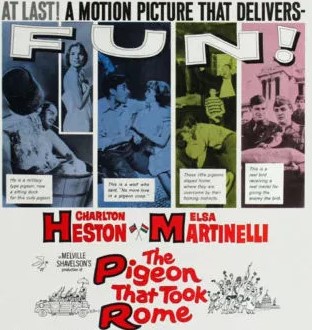
Netflix would know how to sell this. Append the “based on a true story” credit and you’ll attract a global audience. I’ve no idea how true this tale is though I assume that at certain points in war using a pigeon may have been the most efficient method of communication. If this had been under the Netflix aegis there would surely have been a scene to explain that you can’t just point the bird in any old direction but that it automatically returns to its home, that aspect being pivotal to the movie, the reason it was made in the first place.
That is, if you believe in the rather fanciful notion, as shown in what appears to be an official newsreel, of said pigeon being presented with a medal for its part in the Allied invasion of Rome in World War Two. Luckily, there’s more to this picture than the intricacies of homing pigeons.
Not much more, I hasten to add, because the other significant plot point, which I suspect has a more substantial basis in truth, is that passing American soldiers had a tendency to impregnate (and abandon) Italian women. If you were to argue that Elsa Martinelli (who had just put John Wayne in his place in Hatari!, 1962) is what saves the picture you wouldn’t be far wrong. But you can’t complain about Hollywood churning out lightweight movies in the 1960s since a chunk of the current output falls into that category.
For no apparent reason, no espionage experience for example, Yank soldiers Capt MacDougall (Charlton Heston) and Sgt Angelico (Harry Guardino) are delegated to sneak into Rome, disguised as priests, and spy on the Germans. They are put up in the household of Massimo (Salvatore Baccaloni), an underground figure, but his daughter Antonella (Elsa Martinelli) takes against the pair since they are extra mouths to feed and if only the Americans would hurry up and enter the city the populace wouldn’t be starving. However, she makes nice when her sister Rosalba (Gabriella Pallotta) reveals she is pregnant by a previous Yank (whether he was the espionage business, too, is never revealed) and is desperate need of a husband.
The sergeant is quite happy to romance the girl since a couple smooching in the park makes good cover for him transmitting messages by radio. And when that form of transmission becomes too dangerous, the Americans rely on pigeons. Soon Angelico realises his feelings for Rosalba are real and proposes to her, even after she reveals her condition. But that means celebration to announce their forthcoming nuptials.
Short of any food, Antonella slaughters the pigeons, convincing MacDougall that the meal consists of squab. To cover up, the Italians steal a bunch of pigeons from the Germans. Of course, as you’ll have guessed, that means the pigeons will return to the enemy. But once MacDougall works this out, he starts sending the Germans false messages that prove (apparently) pivotal to the Germans hightailing it out of the city (hence the medal awarding).
Pretty daft and inconsequential sauce to be sure, but Antonella keeps matters lively, knocking back MacDougall at every turn, taking every opportunity to condemn men for starting wars, and presenting herself as something of a conniver, possibly willing to lead on the Germans in return for food (MacDougall when burglarizing a German villa comes across her naked in the shower). Her occasional swipes give the picture a harder edge than you’d expect, but, her fiance killed in the war, she leads MacDougall a merry dance in the manner of the romantic comedies of the day. Otherwise, the comedy is for the most part lame, the old hitting your thumb with a hammer one such moment.
Despite co-starring with Wayne and here Heston and later Robert Mitchum (Rampage, 1963), Martinelli didn’t fit into the Hollywood pattern of taking European stars and slotting them into the female lead opposite a succession of top male stars. Think Sophia Loren with Heston in El Cid (1961), with Gregory Peck in Arabesque (1966) and with Marlon Brando in The Countess from Hong Kong (1967) and headlining a few pictures on her own. Gina Lollobrigida led Rock Hudson by the nose in Come September (1961) and Strange Bedfellows (1965) and Sean Connery a merry dance in Woman of Straw (1964).
Martinelli seemed to fade too quickly from the Hollywood mainstream which was a pity because she’s the glue here. Charlton Heston (Number One, 1969) spends most of the time looking as if he wondered how he managed to allow himself to be talked into this. You want to point the finger, then Melville Shavelson’s (Cast a Giant Shadow, 1966) your man – he wrote, produced and directed it.
When the Cannes Film Festival in 1969 gave The Appointment the honor of being the first film invited to compete it looked like an exercise in kudos. Quite how that turned into a humiliation that would deny the Sidney Lumet picture a U.S. release was one of the oddest stories of the decade.
Lumet, it has to be said, was not exactly flying high. After the double whammy in 1964 of The Pawnbroker and Fail Safe, his career had stalled, The Group (1966) not delivering the expected box office, fired from Funny Girl (1967) and The Deadly Affair (1967), Bye Bye Braverman (1968) and The Seagull (1968) all misfires. So it probably seemed like the ideal career fillip to recharge his creative batteries in Italy, with a movie starring Omar Sharif and Anouk Aimee, both Oscar-nominated and still bathing in the warm afterglow of worldwide successes via Doctor Zhivago (1965) and A Man and a Woman (1966), respectively.
Aimee had made the list of female stars dominating the box office along with the likes of Barbra Streisand, Faye Dunaway, Jane Fonda, Catherine Deneuve, Julie Christie, Mia Farrow, Julie Andrews and Joanne Woodward. Although producer Martin Poll had a spotty record – just rom-com Love Is a Ball (1963) and thriller Sylvia (1965) on his dance card – that would change with his most ambitious project to date, The Lion in Winter (1968) pairing Peter O’Toole and Katharine Hepburn.
In truth, Lumet thought the original screenplay by the distinctively offbeat James Salter – undergoing a highly productive period, Three (1969) and Downhill Racer (1969) also on the launch ramp – “a silly story” but one that “could be salvaged with careful creation of mood, texture and dialog.” But he was virtually the only American on the project, Sharif Egyptian, Aimee French while the rest of the cast (excepting Austrian Lotte Lenya) and crew was Italian.
Shooting began at the end of February 1968. Martin Poll had been already working for seven months on the project ensuring it didn’t suffer from the production mishaps that had blighted another, bigger, MGM production, The Shoes of the Fisherman (1968). Interiors were shot at the Palatino studios (now fully soundproofed) in Rome, with a key sequence filmed at Lake Bolsena 100km to the north, and Poll had gained permission to shoot in key locations in the capital including Via Condotti leading to the Spanish Steps.
But the lake proved a trial. High in the mountains, located in a crater, it was prone to sudden squalls. First day of shooting coincided with “maverick” winds on the lake. The 40ft boat hired to transport the crew three kilometres across the lake to the tiny island was wrecked. A helicopter flew in two smaller replacements, and helped ferry passengers across, but only if they signed disclaimers absolving Poll of any redress should there be an accident.
Contract never fulfilled although it formed part of Avco embassy’s 20-page advert in Box Office magazine in November 1968.
Poll had also granted the director a week’s rehearsal time with the full cast, the movie was filmed with direct sound, rather than the traditional Italian post-production synching. And he had been hard at work on a fashion promotion campaign, highlighting the 40 haute couture designs that designer Ghelardi had created for one sequence.
A fashion show was being programmed as part of the world premiere in Rome on April 2, 1969, with the expectation that newspaper and television coverage would drive up global media interest. Poll had also set up 26 openings worldwide as the first wave of an ambitious release program to start a few days later to capitalize on the Easter break. It was all looking good – the movie had even come in under budget and a week ahead of schedule.
But the world premiere and the global release pattern were cancelled when, out of the blue, the movie was invited to compete at Cannes. The showing there would constitute the world premiere. The existing strategy was shelved in the hope that victory at the festival would provide a bigger marketing hook. Cannes had already suffered controversy that year after Carl Foreman quit the jury following censorship in France of his big-budget Cinerama roadshow western Mackenna’s Gold (1969), incidentally also starring Sharif.
Nothing went according to plan at Cannes. Festival audiences booed and whistled and waved white handkerchiefs in a sign of their disapproval. Variety called it a “flimsy love story” while condemning Sharif’s performance as “laughable.” What should have been a triumph turned into a disaster. MGM pushed back release a year until further work was done on the film.
But even as MGM was considering what to do to produce a version that might satisfy U.S. exhibitors, audiences in other parts of the world had decided there wasn’t much wrong with the version shown at Cannes. In fall 1969, the movie registered “sensational grosses.” In Japan rentals topped $1 million, in Manila there was an “unusually long run” and it broke records in Buenos Aires. Even so, Stateside executives were dismissive, “abroad, speed doesn’t mean that much,” they declared and set about changing the movie.
Under the terms of Lumet’s contract his right to final cut should have prevented any tampering with the picture. Unfortunately, he had gone along with the general consensus that the Michel Legrand score, minimalist though it was, required changing. But substituting John Barry music took the movie past its agreed completion date, thus negating Lumet’s contract and allowing MGM free rein.
At first, following a “disappointing” sneak preview in the U.S. in 1969, Lumet was involved in the editing but the studio found it easier to move forward if the original director was not looking over its shoulder. A new editor, Margaret Booth, was called in. She sliced 25 per cent out of the picture and added stock Italian footage to give the movie what MGM guessed would pass for “authenticity”, a more sun-kissed version of the country. MGM’s assessment was that the new version was “much better, much faster, playable.”
Lumet disagreed, “The MGM version now makes no sense. Characters appear and disappear, plot elements emerge and then are dropped. It’s ridiculous.” Being enraged was as close as the director came to affecting the outcome. It wasn’t the only box office disappointment facing MGM at the time. Much of the $20 million invested in four pictures – The Appointment, Goodbye Mr Chips (1969), Zabriskie Point (1970) and Captain Nemo and the Underwater City (1969) – was lost.
A “disappointing” test date in April 1970 in San Francisco confirmed what the studio feared. The movie was unreleasable. It might have been a different story if the two stars had unassailable box office track records. But Omar Sharif’s career had dipped. Mayerling (1968) though a success abroad barely hit the million-dollar mark in the U.S., while Mackenna’s Gold , Che! (1969), The Last Valley (1970) and The Horsemen (1971) were all expensive flops.
Anouk Aimee had done little better, pulling out of The Mandarins with James Coburn, Fox’s big-budget Justine (1969) a spectacular flop, Jacques Demy’s The Model Shop (1969) – “a really bad movie” according to Vincent Canby of the New York Times – also tanking and Columbia failing to find a release slot for One Night A Train (1968).
Lumet remained in a commercial wilderness. He was touted in a two-page advertisement as lining up two features for Avco Embassy, but they never appeared, nor did The Confessions of Nat Turner and We Bombed in New Haven, based on the Joseph Heller play, while Last of the Mobile Hot Shots (1970) with James Coburn flopped. He only managed an unexpected return to form with hit crime caper The Anderson Tapes (1971).
The 100 prints made by MGM – half in the original version, half the recut version – sat on the shelf as new studio management pondered whether the film was worth any further investment in the advertising and marketing required to shape a launch or even worth wasting any more time. In the end, it took the easier option, and without permitting any more cinematic screenings, sold it to CBS for its Late Movie slot – “the film buff graveyard” – which played host to such other lost pictures as The Picasso Summer starring Albert Finney and John Frankenheimer’s The Extraordinary Seaman (1969) with Faye Dunaway.
Beyond the abortive sneak preview and the test showing, the first anyone in America caught glimpse of The Appointment was on July 20, 1972 – three years after its Cannes disaster – on the small-screen on CBS.
SOURCES: “Roman Settings for Appointment,” Variety, February 28, 1968, p25; “Appointment Has Quick Dates with Squall,” Variety, March 20, 1968, p28; “Elated Poll Completes Appointment,” Variety, June 2, 1968, p22; Advertisement, Variety, November 13, 1968, p54-55; Shelagh Graham, “Film Industry in New Garbo Epoch as Femme Stars Dominate B.O,” Variety, January 8, 1969, p1; “Anouk of the Scram,” Variety, January 29, 1969, p26; “Holdbacks Explained,” Variety, February 26, 1969, p21; “Set Appointment Preem in Rome,” Variety, February 26, 1969, p38; “MGM Cancels Italo Appointment So As To Qualify at Cannes,” Variety, March 19, 1969, p5; “Appointment in Cannes,” Variety, April 16, 1969, p13; “Booing of Metro’s Appointment,” Variety, May 28, 1969, p28; Review, Variety, May 28, 1969, p34; “Re-edit Appointment After Cannes Booing,” Variety, July 9, 1969, p5; “Lumet Ponders Slave Revolt,” Variety, September 3, 1969, p6; “Capsized in Cannes,” Variety, September 19, 1969, p5; “Appointment Does Big Biz O’Seas,” Variety, October 8, 1969, p5; “MGM Delayed Appointment Pic,” Variety, January 20, 1970, p5; “MGM Write-Downs,” Variety, April 22, 1970, p5; “Cannes-Jeered Pic,” Variety, July 19, 1972, p7.
Until a technological invention first used in Once a Thief (1965) it was impossible to shoot “day for night” without it appearing very obvious. So when director Vincente Minnelli aimed for as much verisimilitude as possible for the Rome-set drama it meant half the shoot took place at night. “Minnelli could sleep easily during the day,” recalled star Kirk Douglas (The Arrangement, 1969), “sometimes till six o’clock in the evening, but I couldn’t so there were three unpleasant weeks of night shooting and not much sleep.”
But the movie suffered, Douglas later complained, by studio interference at the editing stage. When the movie fell foul of the Production Code, change of MGM management vetoed the more salacious aspects of the movie – the worst aspects of “La Dolce Vita” including a sequence in a nightclub where guests watched an unseen sexual act. Fifteen minutes were cut including a scene that showed Cyd Charisse’s character in a more sympathetic light. In an ironic reflection of the film’s narrative, Minnelli played no part in the editing, not due to production deadlines as in the movie, but out of choice.
The actual producer John Houseman – producer of Douglas starrers The Bad and the Beautiful (1952) and Lust for Life (1956) though later best known as an actor in Rollerball (1975) etc – backed out of any tussle with MGM head honcho Joseph Vogel. Douglas implored Vogel and editor Margaret Booth, to no avail. Consequently, in Douglas’s opinion, the film was “emasculated.” He argued MGM had turned an “adult” picture into a “family” film. Quite how this could be squared with marketing that promised a “shocking intimate view of Rome’s international film set” (see below) was not mentioned.
Following the commercial and artistic success of Spartacus (1960), Douglas was at the peak of his career, though his last three pictures had been flops. After nabbing an Oscar for Gigi (1959), Minnelli also enjoyed a career high, and although best known for musicals like Meet Me in St Louis (1944) and An American in Paris (1951) was equally adept at drama like The Bad and the Beautiful, Lust for Life (1956) and Some Came Running (1958). But he, too, was running empty, his last three serious films – Home from the Hill (1960), All the Fine Young Cannibals (1961) and big-budget roadshow The Four Horsemen of the Apocalypse (1962) coming up short at the box office.
Douglas earned $500,000 and a percentage of the profits (though none were forthcoming – it made a loss of $3 million) and top-billing. Although co-star Edward G. Robinson (Seven Thieves, 1960) appeared above the title, Douglas refused to accord female lead Cyd Charisse (Maroc 7, 1967), on one-tenth of his salary, that concession.
Douglas recalled that he build up his acting skills through wrestling. A college wrestling champ, he barnstormed across the country in a carnival, playing the cocky person reputedly from the audience who challenged the giant resident wrestler. “My job was to make the audience think he was going to murder me,” Douglas told the Pressbook/Campaign Manual. “And the way to do this was by expressions on my face. To yell out in pain would seem cowardly. But I learned a hundred and one ways of showing it through use of my eyes and the muscles in my face.”
The actor escaped serious injury when lightning, preceding one of the worst thunderstorms in a decade, struck a 200-year-old clock on the top of the church in Santa Maria Square. Four huge iron numerals were torn off and crashed to the ground, one grazing Douglas’s head.
In fact, the movie’s authenticity owed much to being filmed on the streets of Rome rather than reconstructed on the studio lot. In particular, scenes utilizing the Via Veneto, two long blocks of sidewalk cafes where the movie industry socialized, created a realistic atmosphere, especially when a hundred or so of the extra employed were actually people who would naturally populate the location. So, for example, when the script called for an opera star among the extras, casting director Guidarino Guidi used Bostonian Ann English, an opera singer studying in Rome. Among those sitting in the background at café tables were a promising young painter, a poet and a librettist.
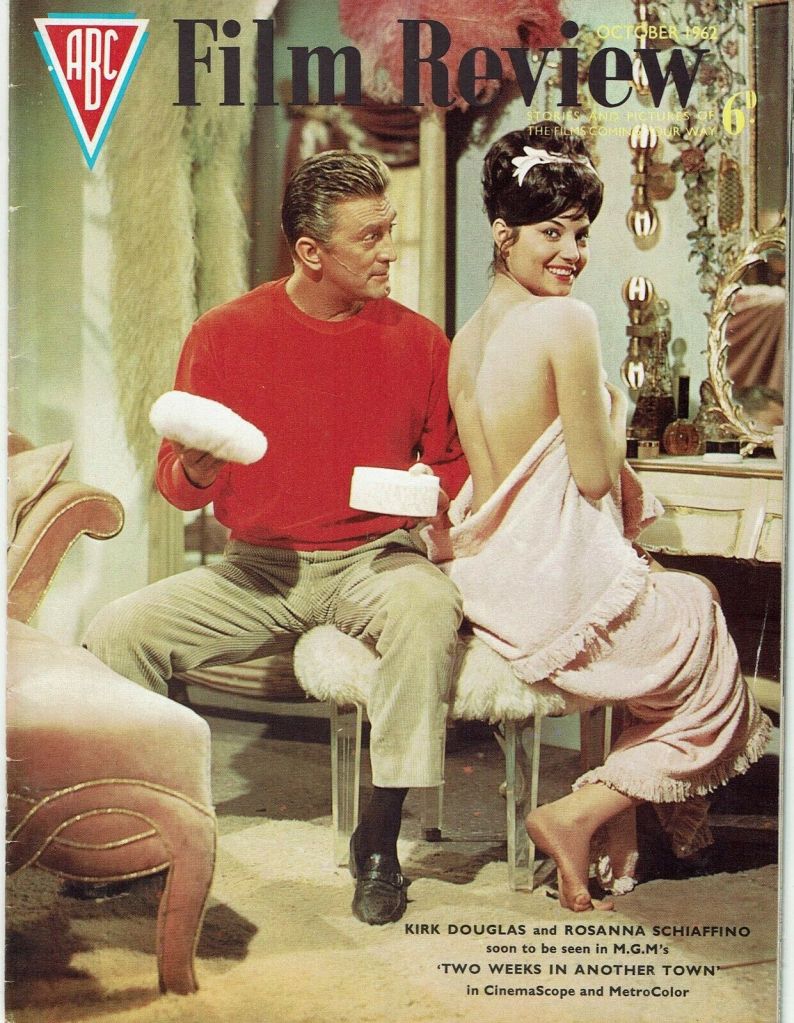
George Hamilton (Act One, 1963), who had worked in Home from the Hill and just finished Light in the Piazza (1962) also shot in Rome, reckoned he couldn’t have been more miscast given his role called for a “funky James-Dean type.” He got the role through the influence of Betty Spiegel, wife of producer Sam, and her friend Denise Gigante, the director’s current girlfriend (later wife). Hamilton drove around in a red Ferrari costing $18,000 (ten times that at today’s prices) and, as he put it, “Italians knew how to worship” Hollywood stars.
Hamilton reckoned part of the problem of the film was that Minnelli was so “besotted with Denise that he had lost his vision.” Jumping to the defence of Cyd Charisse against a tirade from journalist Oriana Fallaci at the Venice Film Festival won Hamilton, unexpectedly, the cover of Paris-Match.
Daliah Lavi owed her career break to Douglas. As a nine-year-old in Hiffa, Israel, she struck up a friendship with the actor when he was filming The Juggler there in 1952. The actor and other stars attended her birthday party, Douglas presenting her with a ballet dress. Later a dancer and then an actress, this was her Hollywood debut. Erich von Stroheim Jr, making his movie acting debut, had his head shaved to make him appear more like his famed director father. Originally employed as an assistant director on the picture, Minnelli decided he would make a good Ravinski, the “fast-talking press agent.”
Chauvinism reared its ugly head, especially when women had to apologise for being on the receiving end. “What goes on in the minds of beautiful women when they get slapped for the cameras?” mused the editor of the Pressbook/Campaign Manual. Rossano Schiaffino’s response regarding being whacked on the behind by Douglas: “He hits hard so charmingly I didn’t mind standing up for a day of two.”
The actress proved tougher than many of her colleagues. She turned down the offer of a double for a scene in which she jumped into a lake. That might not have been such an undertaking had the sequence been shot in the hot Italian sunshine at the height of summer. But the MGM studio tank on Lot 3 was a different – and much colder – proposition. “She shrugged off her stunt with the remark that heated pools are unknown where she comes from.”
Irwin Shaw, author of the best-selling source novel, wasn’t too upset at the way the movie turned out. “An author who wants complete control of his work on the screen is in something of a cleft stick,” he observed. “He can either go into production himself, which is often neither possible nor desirable, or he can refuse to sell his work to the movies. Minor deviations in screen conception don’t send me reeling back a stricken man. I think I’m sufficiently realistic to know that even in the most enlightened films there must be some compromise if they are to be a success. What does matter very strongly to me is that the theme of the novel…should come over on the screen.”
Music trivia: Kirk Douglas was the first big Hollywood star to perform “The Twist” on screen and the song “Don’t Blame Me” was reprised from The Bad and the Beautiful, sung here sung by Leslie Uggams and in the older film by Peggy King.
French designer Pierre Balmain created the dresses, allowing a marketing campaign to be built around those stores which supplied his clothes. TWA, which flew directly to Rome, was suggested to cinema owners as an ideal tie-in. Not only did New American Library issue a new movie tie-in paperback/soft cover but cinemas were encouraged to build a campaign around a director, many of whose films would be well-known to audiences. The marketeers also had material to tie in with stores retailing music, women’s sportswear, menswear, men’s sweaters, beauty and hair styling.
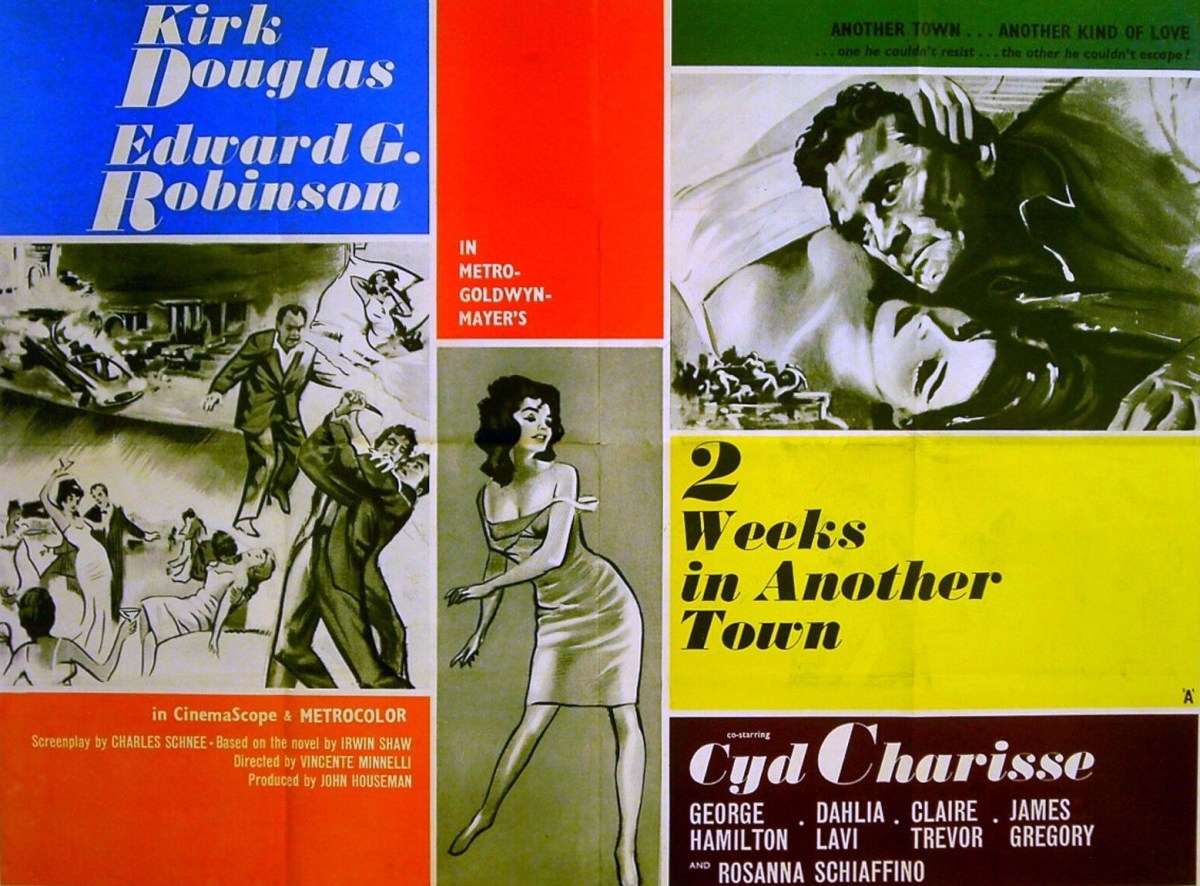
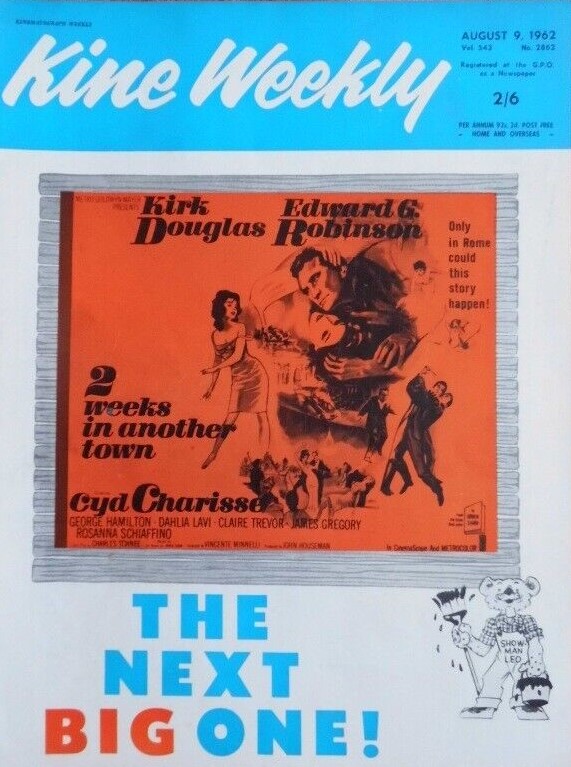
The 16-page A3 Pressbook/Campaign Manual offered a selection of advertisements and taglines. The key advert tagline ran “Another town…another kind of love…one he couldn’t resist…the other he couldn’t escape.” But there were alternatives: “Only in Rome could this story be filmed/Every town has women like Carlotta and Veronica and the kind of man they both want!/From Irwin Shaw’s great best seller.”
Or you could opt for: “Irwin Shaw’s shocking intimate view of Rome’s international film set. The world only sees the glamor. This is the drama behind it!.” Or: “Only in Rome could this story happen. Only in Rome could this story be filmed!”
SOURCES: Kirk Douglas, The Ragman’s Son (Simon and Schuster paperback, 2010) p342-344; George Hamilton, Don’t Mind If I Do (JR Book hardback 2009)pp 155-159; Pressbook/ Campaign Manual, Two Weeks in Another Town (MGM).
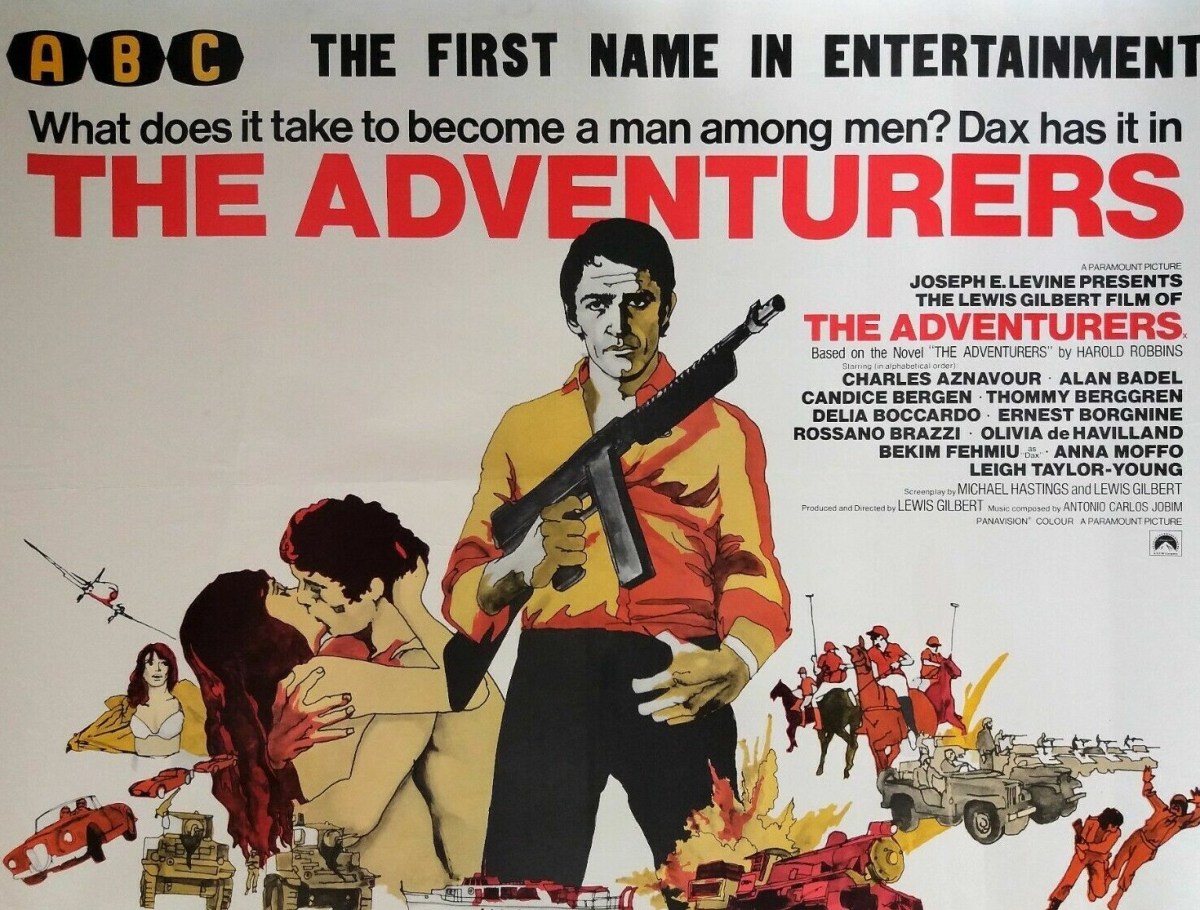
Class A Trash. Adaptation of Harold Robbins (Nevada Smith, 1966) bestseller goes straight to the top of the heap in the So-Bad- It’s-Good category. Only Alan Badel (Arabesque, 1966) as a double-dealing revolutionary comes out of this with any honors.
The likes of Candice Bergen (Soldier Blue, 1970), Rossano Brazzi (Rome Adventure/Lovers Must Learn, 1962), double Oscar-winner Olivia de Havilland (Hush, Hush, Sweet Charlotte, 1964), Leigh Taylor-Young (The Big Bounce, 1969) and Ernest Borgnine (The Wild Bunch, 1969) must have wondered how they were talked into this.
And director Lewis Gilbert (Loss of Innocence/The Greengage Summer, 1961) must have wondered how he talked himself into recruiting unknown Yugoslavian Bekim Fehmiu (The Deserter/The Devil’s Backbone, 1970), nobody’s idea of a suave lothario, for the lead.
One of the taglines was “Nothing has been left out” and that’s to the movie’s detriment because it’s overloaded with sex, violence, more sex, more violence, in among a narrative that races from South American revolution (in the fictional country of Corteguay) through the European jet set, fashion, polo, fast cars, orgies, and back again with revenge always high on the agenda. At close on three hours, it piles melodrama on top of melodrama with characters who infuriatingly fail to come to life.
Sensitivity is hardly going to be in order for Dax (Bekin Fehmiu) who, as a child after watching his family slaughtered and mother raped, makes his bones as a one-man firing squad, machine-gunning down the murderers. From there it’s a hop-skip-and-jump to life as the son of ambassador Jaime (Fernando Rey) in Rome where he belongs to an indulgent aristocracy who play polo, race cars along hairpin bends, swap girlfriends and, given the opportunity, make love at midnight beside the swimming pool.
His fortunes take a turn for the worse when his father backs the wrong horse, the rebel El Condor (Jorge Martinez de Hoyos) in Corteguay, and is killed by the dictator Rojo (Alan Badel). In between an affair with childhood sweetheart Amparo (Leigh Taylor Young), life as a gigolo and cynical marriage to millionairess Sue Ann (Candice Bergen), Dax takes up the rebel cause, initially foolish enough to fall for Rojo’s promises which results in the death of El Condor, and then to join the rebels.
But mostly it’s blood, sex, betrayal and revenge. Anyone Dax befriends is liable to face a death sentence. He only has to look at a woman and they are stripping off. It’s a heady mess. It might have worked if the audience could rustle up some sympathy for Dax, especially as he was entitled to feel vulnerable after his childhood experiences. But he just comes across as arrogant and the film-makers as even more arrogant in assuming that because women fall at his feet that must mean he had bucketloads of charm rather than that was what it said in the script. He’s fine as the thug but not convincing as a lover.
Excepting Badel, the best performances in a male-centric sexist movie come from women, those left in Dax’s wake, particularly Candice Bergen as the lovelorn wife and Olivia De Havilland as the wealthy older woman who funds his lifestyle, aware that at any moment he will leave her for a younger, richer, model. Lewis Gilbert is at his best when he lets female emotion take over, not necessarily wordy intense scenes, because Bergen and De Havilland can accomplish a great deal in a look.
The rest of it looks like someone has thrown millions at a B-picture and positioned every character so that they have nowhere else to go but the cliché.
By this point, Hollywood had played canny with Harold Robbins, toning down the writer’s worst excesses and employing name directors to turn dire material into solid entertainment. Edward Dmytryk (Mirage, 1965) had worked wonders with The Carpetbaggers (1964), whose inherent salaciousness was held in check by the censor and made believable by characters played by George Peppard (Pendulum, 1969), Alan Ladd (Shane, 1953) and Caroll Baker (Station Six Sahara, 1963). Bette Davis and Susan Hayward contrived to turn Where Love Has Gone (1964) into a decent drama. Even Stiletto (1969), in low-budget fashion, managed to toe the line between action and drama.
But here it feels as if all Harold Robbins hell has been let loose. Rather than reining in the writer, it’s as if exploitation was the only perspective. Blame Lewis Gilbert, director, and along with Michael Hastings (The Nightcomers, 1971) in his movie debut, also the screenwriter for the end result.
On the other hand, if you can leave your critical faculties at the door, you might well enjoy how utterly bad a glossy picture can be.
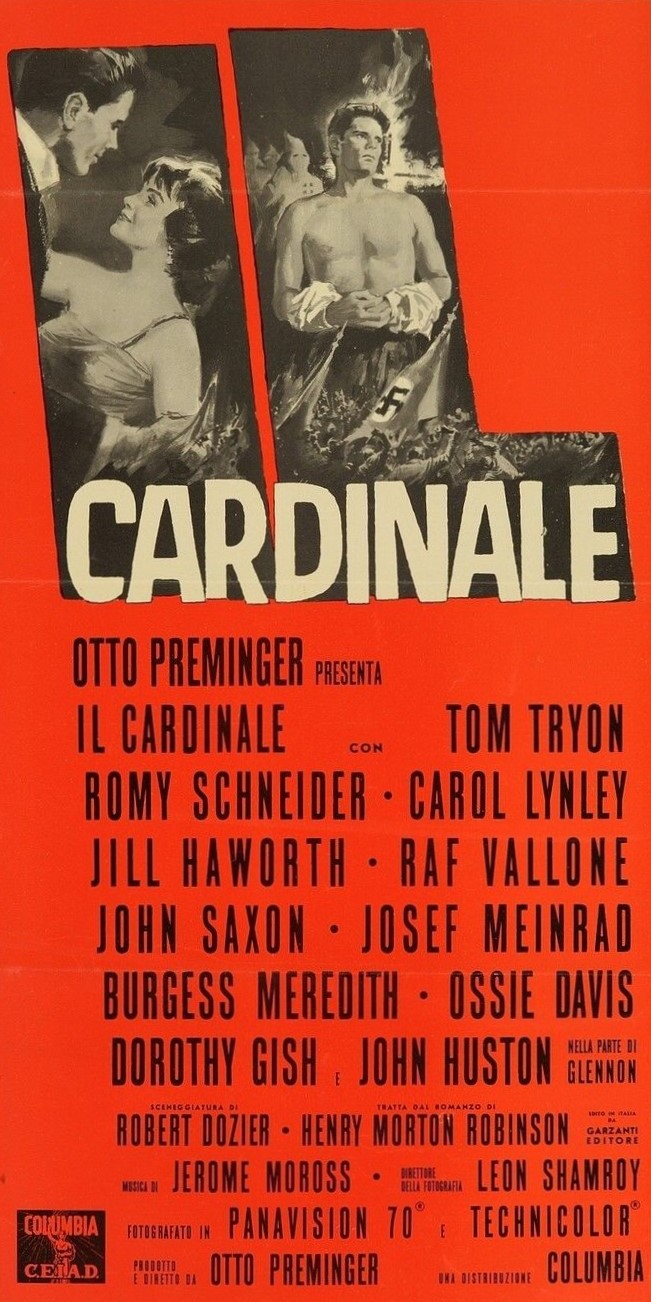
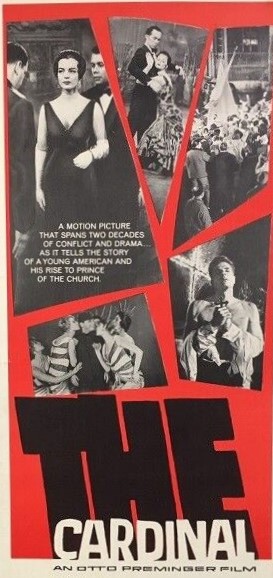
Otto Preminger was beaten to the punch on this one, the scandalous Henry Morton Robinson bestseller snapped up in 1955 by producer Louis de Rochemont (The Roman Spring of Mrs Stone, 1961) who had a tie-up with Columbia. Due to interference from the Catholic Church, de Rochemont dropped his option which Preminger picked up in 1961 while working on Advise and Consent (1962).
The last section of the novel, set in Austria during the Anschluss, reverberated with the director who was born in what was then the Austro-Hungarian Empire and although a Jew was well acquainted with Catholic society. One of his most significant changes to the book was introducing the Austrian cardinal who endorsed Hitler.
The first two screenwriters James Lee (Banning, 1967) and Daniel Taradash (Castle Keep, 1969) failed to whittle down the complex novel to cinematic proportions. So Preminger brought in Robert Dozier (The Big Bounce, 1969) and began working with him in summer 1962 making other alterations to heighten the drama. The incident involving the unborn child of the sister of Fr Fermoyle (Tom Tryon) acquires greater emotional power in the film, touching on the ambiguities inherent in any institution and provoking the priest’s guilt.
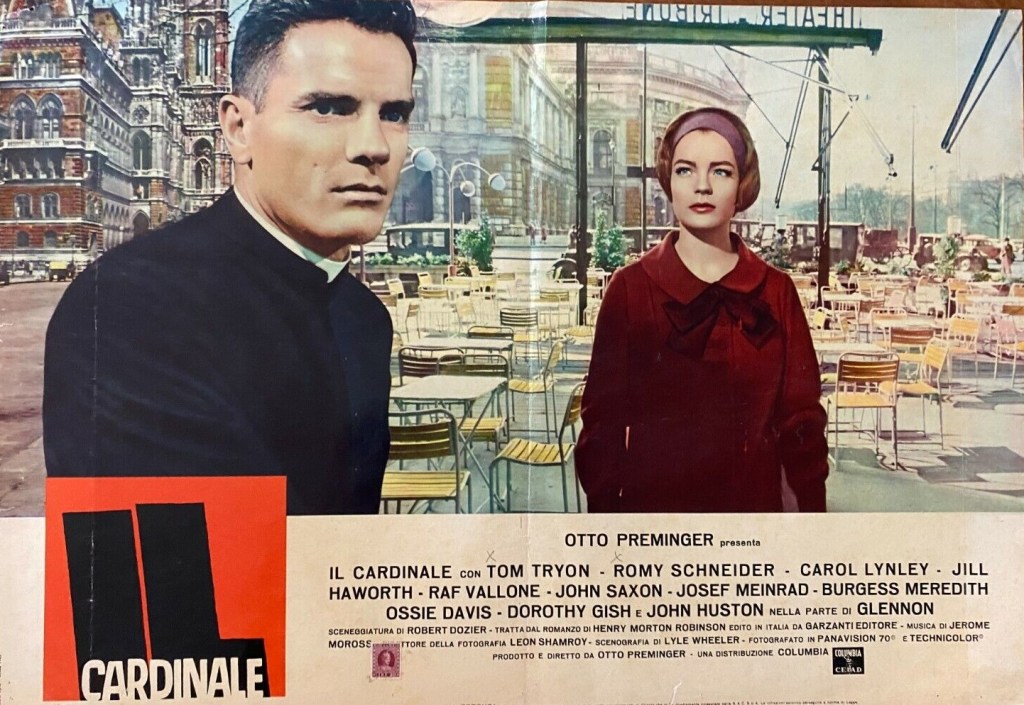
Gore Vidal (The Best Man, 1964) also worked on the script, swapping the novel’s Italian countess for the Viennese Annemarie (Romy Scheider) who, abandoned by the priest had married and was reunited with him prior to the Anschluss, and is sympathetic to Hitler until her husband’s faith endangers them both. Ring Lardner, who had satirized the Catholic church in a recent novel, was the final screenwriter added, his main task to rewrite scenes “to achieve what he (Preminger) wanted,” and, more importantly, to introduce the flashback structure. Ironically, both Vidal and Lardner were atheists.
Tom Tryon and Romy Scheider meet again in Vienna.
The director considered five actors for the leading role – Hugh O’Brian (Africa – Texas Style, 1967), Stuart Whitman (The Commancheros, 1961), Cliff Robertson (The Devil’s Brigade, 1968), Bradford Dillman (Circle of Deception, 1960) and Tom Tryon (In Harm’s Way, 1965), the latter three advancing to the screen-testing stage. The 34-year-old Tryon won the role and a five-picture contract he would later regret. Carol Lynley (Bunny Lake Is Missing, 1965) who plays the priest’s sister also pacted for five movies.
Romy Scheider’s (Triple Cross, 1966) part was enhanced by the work of cinematographer Leon Shamroy who “fell madly in love with her,” resulting in the actress virtually shimmering on screen, never before “looking as beautiful.” Held in warm regard by the director, she was exempt from his tirades.
It took considerable persuasion on the part of Preminger for John Huston to participate. Curd Jurgens, initially cast as the Austrian cardinal, pulled out and was replaced by character actor Josef Meinrad whose lack of English meant he had to learn his lines phonetically.
Tom Tryon described Preminger as “tyrant who ruled by terror.” He was fired on the first day and probably wished the director had not rescinded the decision, for thereafter the actor was tabbed “lazy…a fool…stupid and unprofessional.” Commented Tryon, “I was so frightened he was going to scream that…I (just) wanted the experience to end.”
One scene with John Huston took 78 takes because Tryon could not deliver what the director wanted. And at one point first assistant director Gerry O’Hara (later director of The Bitch, 1979) found the star in tears and refusing to return unless the director agreed not to shout at him. Eventually, during the Italian section of the shoot, Tryon collapsed from nervous exhaustion, and was prescribed two days rest, and after this incident Preminger let up on his demands of the actor.
Explained Preminger, “I probably chose him without deliberation because he is weak.” He felt than an ordinary person would not side with the Church against a family member in a predicament, and that only a person “with weakness in his character” would be believable in the role. The character “fails because when you become a priest you substitute your own judgement and your own feelings for the law of the Church…The big decisions are made for him.” (Quite why he never chose an actor who could portray such weakness is not known.)
Tryon admitted that he owed a brief let-up in the bullying to “Schneider’s benign presence.” He commented, “The only fun I ever had on The Cardinal was a (ballroom) scene I did with Romy.” Prior to turning the cameras, Prior called both over, appeared ready to issue instructions, but instead waved them away “you know what to do.”
Added Schneider, “Preminger taught me an important thing: work fast. It’s true that it greatly helps our acting. Each of his directions, whether of gesture or of intonation, is precise and correct. Even better, it’s the only one possible…Each phrase, each world, each syllable are minutely weighed.” That dexterity applied to his positioning of the camera. He made decisions immediately, never hesitating “over the placement of the camera and each time…it was the simplest, the most natural and, dramatically, the best.”
Ossie Davis (The Scalphunters, 1968), who professed to have enjoyed a marvellous relationship with the director, observed: “I met actors whom Otto liked, I met actors that had no relationship or feelings one way or the other and I met actors who were almost absolutely destroyed, almost literally in panic because of Otto Preminger (who) was always looking for a spark…whether you had the spark or not, he was going to find it and even put it in you.”
But Patrick O’Neal stood his ground. “I woiuld not take it from him.” And they became friends.
The unit shot for five weeks in New England before heading to Vienna, Preminger choosing to stay in the same suite in the Hotel Imperial as appropriated by Hitler when visiting the city. Permission to shoot in the National Library, “one of the most beautiful monuments in the city” was attacked by the current minister of education who wanted the Hitler era erased from memory. And he was barred from using other government buildings for spurious reasons.
After four and a half months in Austria, the unit shifted to Rome, locations including St Peter’s Square and inside St Peter’s Cathedral and the Santa Maria sopra Minerva church, with priests and monks hired as extras for the various ceremonies. The Georgia scenes were shot in Hollywood on the Universal back lot.
Although generally dismissed by the critics and given a hard time as you might expect from the Catholic Church, The Cardinal hit a chord with audiences, who turned it into Premigner’s second-biggest hit of the decade.











 The Magnificent 60s