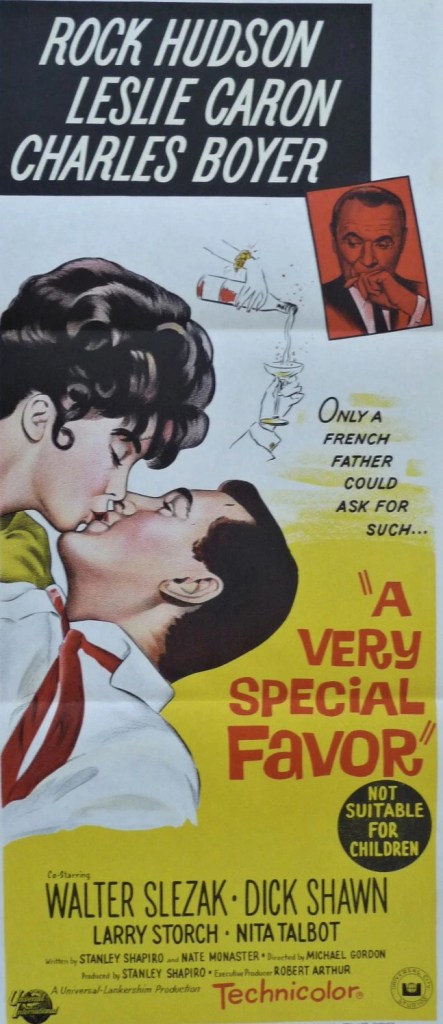
A Very Special Favor (1965) ****

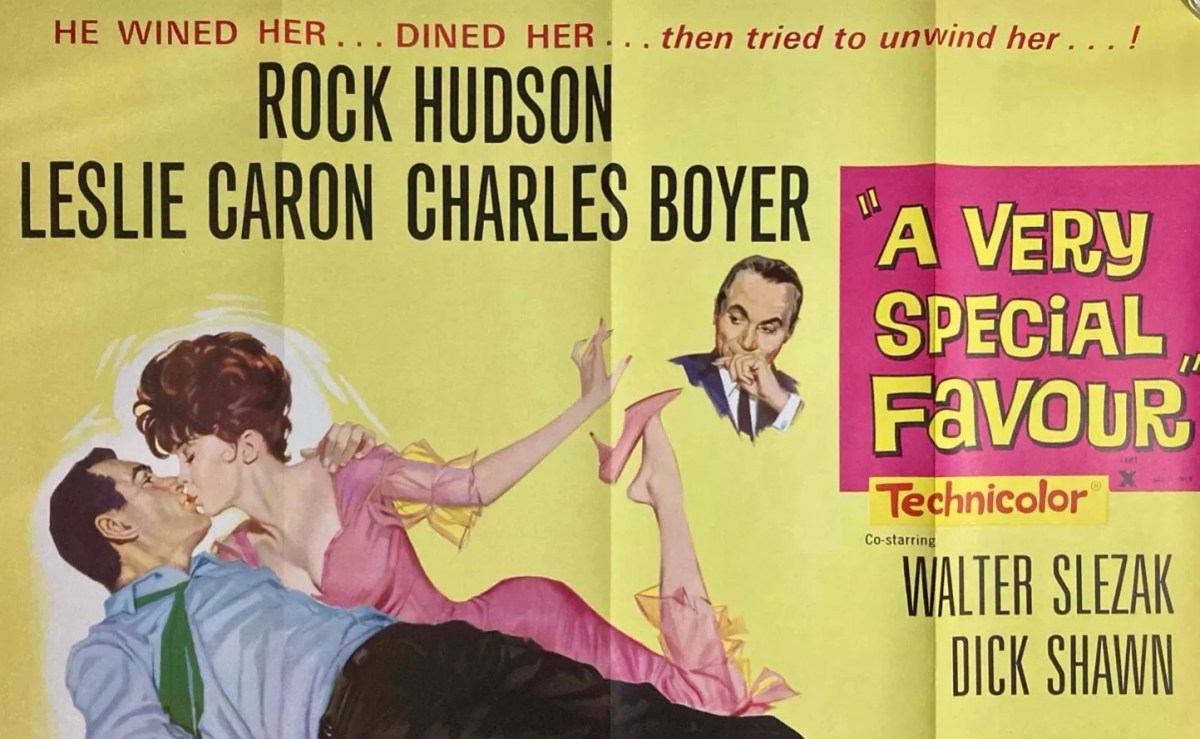
Surprisingly funny for a movie that’s long been out of favor. Starring a Rock Hudson (Seconds, 1966) who was just beginning to lose his grip on the marquee after an incredible run of box office success and Leslie Caron (Guns of Darkness, 1962) who had always seemed to just miss out on the top echelons of audience approval.

You can see why this had rapidly lost whatever appeal it originally possessed and that a contemporary crowd would turn its nose up at a man that has such success with the ladies that he has a whole stream of women carrying out his most basic chores. Except that the tale is really about him getting his come-uppance and everyone enjoys that kind of narrative.

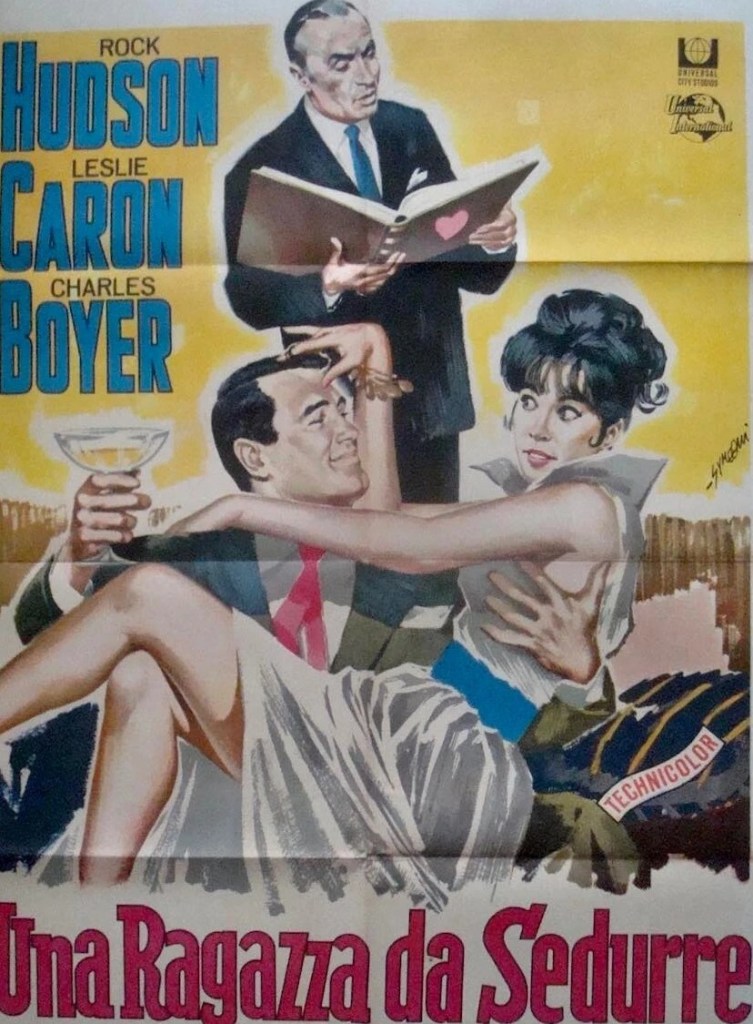
Paul (Rock Hudson) only has to look at a woman and she melts. His job, such as it is, though he is wealthy, is to use his charm to commercial advantage. We open with him in a French court winning a case it transpires because he has seduced the female judge. The opposing lawyer Charles (Charles Boyer) encounters Paul on the way home, observing the American batting back stewardesses with ease, and the Frenchman enlists him to seduce his daughter Lauren (Leslie Caron), so much of a career woman, a high-flying psychologist,  that her father fears she will turn into an old maid.

But Lauren already has a fiancé, Arnold (Dick Shawn) who, like Paul’s harem, is at her beck and call, carrying out the most basic tasks for her. Paul pretends to be a patient, his fake problem being his irresistibility which has caused a girlfriend to commit suicide. Lauren shows very little sign of falling for Paul’s charm. In order to prove that they are making progress, they go to a restaurant. To Paul’s astonishment, Lauren passes out from drinking too much champagne. He takes her back to her apartment and in the morning pretends that she has succumbed to his charms.

So now the twists come. Lauren is upset to discover that she has been seduced by a man she was determined to keep her distance. But when she finds out the truth, the tables are turned. She invents a Spanish lover which knocks Paul’s ego to hell. Plus she accuses him of impotence. Then he turns the tables again, and using one of his many fans – and a ploy that would prove somewhat ironic given Hudson was a closet gay – switchboard operator Mickey (Nita Talbot), makes Lauren so jealous that eventually he contrives to win her back and the two determined singletons, against all odds, get married.

There’s some marvellous stuff here, some slapstick at which Caron is surprisingly adept, but mostly it’s a tale of flustered feathers and vengeance for perceived humiliation, beginning with Boullard who is so annoyed that any of daughter of his is a stuck-up prude. Paul can’t believe Lauren isn’t falling at his feet and equally she is infuriated that Paul isn’t another male slave like her fiancée.

There’s a great turn from Dick Shawn as the slave and his mother (Norma Varden) who keeps on encountering Paul at his least winning. It’s a relief to see Rock Hudson not playing the stuffed shirt of previous comedies and for Leslie Caron not to be a hapless heroine. So it plays as a more effective modern comedy.

Not everyone was so keen on Caron, complaining about the lack of chemistry between the leads and that Paul would never get hooked by such a cold fish. But I disagree. Sure, it called for a lot more from the audience that the leading lady wasn’t the usual ultra-feminine model, but that made the initial romance more believable. Initially, Paul doesn’t fall for her and is seducing her as a “very special favour” to her father but once he sees the other side of her personality he changes his tune.

But I would hazard a guess that, mostly, people were annoyed with Caron because she wasn’t Doris Day and that, while this follows one formula, it steers clear of the Hudson-Day formula in making Caron a high-flying career woman. Dick Shawn (Penelope, 1966) leads an able supporting cast.

Directed by Michael Gordon (Texas Across the River, 1966) from a script by Stanley Shapiro (Bedtime Story, 1964) and Nate Monaster (That Touch of Mink, 1962).

Worth a look.

Come September (1961) ***

The quite superb concept that underpins the traditional unsettling of Rock Hudson is sabotaged by the inclusion of an unnecessary generation gap element and because one of the youngsters is singer Bobby Darin that throws a musical spanner into the works. The basic set-up is that Lisa (Gina Lollobrigida), the Italian lover of wealthy American Robert (Rock Hudson), is fed up with the part-time nature of their relationship. Although their affair dates back six years, it only lasts for the one month (September) he vacations each year in his luxurious villa on the Ligurian coast.

She’s so annoyed at his lack of commitment that she’s about to marry posh Englishman Spencer (Ronald Howard), that imminent event only put off by the unexpected earlier-than-usual arrival of Robert. Matters are further complicated because his enterprising Italian butler Maurice (Walter Slezak) hires out the villa to paying guests for the other eleven months. To explain the owner’s sudden arrival, Maurice persuades his guests to go along with the notion that Robert is a former owner fallen on hard times deluded into thinking he still possesses the property.

The guests are a gaggle of young women, including psychology major Sandy (Sandra Dee) who proceeds to analyze Robert, and they are herded around by formidable chaperone Margaret (Brenda de Banzie) who prevents Lisa sneaking into her lover’s bedroom.

So enough plot to be getting on with. You’d assume Spencer is going to turn up, maybe with his equally formidable sisters, to cause ructions at the villa. Lisa appears to enjoy making Robert wait the way he has kept her wait, so a gentle shift in power, and there’s going to be an inevitable bust-up so we expect a quick shift into the will-she-won’t-she scenario. Plus, there’s the whole issue of Robert claiming back his villa and dealing with the over-entrepreneurial Maurice.

Instead, the second act enters a whole new realm. Unless one of the girls was going to make a play for Robert, there’s not much reason for them to be there except for the nuisance value and to allow Margaret to flex her authority. An unwelcome quartet of young men, led by Tony (Bobby Darin), embark on the equally unwelcome task of wooing of the young ladies, Tony having his eyes on Sandy. Although various romantic entanglements are enacted, that’s not what takes center stage.

Instead, the bulk of the middle section scarcely involves the Robert-Lisa quandary and instead it’s devoted to an endless battle between Tony and Robert as the younger specimen attempts to prove he is mentally and physically superior. Now the one element that had made these Rock Hudson comedies work was his helplessness. He may occasionally be smart or wealthy but the whole point of these stories was for a woman to run rings around him or at the very least drag him way out of his comfort zone.

Seeing Robert best Tony – endlessly – takes the shine off the picture and it’s not until Robert is revealed as a sanctimonious hypocrite, living by a double standard, that the movie catches fire again as Lisa storms off in a huff and we can settle down to some good old-fashioned will-she-won’t-she.

This proves a very successful change of pace for Gina Lollobrigida, and she reveals herself to be such a splendid comedienne that it became part of her repertoire – reunited with Hudson for Strange Bedfellows (1965) and leading a pack of men a merry dance in Buona Sera Mrs Campbell (1968).

There’s nothing particularly wrong with Rock Hudson. He’s good comedy value, but the second act ruins it. Bobby Darin (Pressure Point, 1962) and Sandra Dee (A Man Could Get Killed, 1966) act as if they’re in a completely different movie, of the frothy beach variety. Walter Slezak (The Caper of the Golden Bulls, 1967) is an adept scene-stealer. Look out for Joel Grey (Cabaret, 1972) in an early role and Brenda de Banzie (I Thank a Fool, 1962).

Directed by Robert Mulligan (The Stalking Moon, 1969) with a screenplay by Oscar-winning Stanley Shapiro (Bedtime Story, 1964) and Maurice Richlin (All in a Night’s Work, 1961).

A hybrid that rocks the wrong boat.

The Last Sunset (1961) ***

Too many hidden secrets turn this into a Peyton Place of a western. When the final unexpected zinger strikes home the movie has nowhere to go and undercuts the climax. Director Robert Aldrich also lets Kirk Duglas off the leash so there’s too much of him festering to put the outcome in any doubt. Strangling a vicious dog with your bare hands is usually a sign of heroism but here it just undermines Douglas’s character.   

Wanted murderer O’Malley (Kirk Douglas) has skipped to Mexico away from the long arm of the American law. Nonetheless, lawman Stribling (Rock Hudson) is in pursuit, presumably hoping to kidnap him and drag him back over the Rio Grande into U.S. jurisdiction. The story, in a major narrative flaw, finds another way to head O’Malley north.

Anyways, O’Malley is in Mexico not just to escape, but for a more sentimental reason, he wants to hook up again with first love Belle (Dorothy Malone). The fact that she’s married to limping ex-Confederate soldier Breckenridge (Joseph Cotten) appears to make no difference. And when O’Malley strikes up a deal to help Breckenridge drive his herd of cattle to Crazy Horse, a town over the Rio Grande, he tells the husband of his romantic intent.  

This would usually spell trouble except the narrative conveniently disposes of the husband. However, by this point the lawman has also thrown his hat into the romantic ring, having signed up to become trail boss. You can see the logic in Stribling’s decision. If O’Malley’s heading in the right direction then it makes it easier for Stribling to get him over the border.

What doesn’t make any real sense is Breckenridge’s hiring of O’Malley in the first place, or the deal the outlaw negotiates. O’Malley would go along in any case for a meal of beans a day just to keep track of Belle who’s the appointed cook for the ride. Instead, and with no cattle herding skills in evidence, he manages to get Breckenridge to agree to give him one-fifth of the herd as a bonus in addition to the normal pay of a dollar a day. Although the audience has already guessed O’Malley’s romantic purpose, he spells it out to the rancher, “I want your wife” the rider to the deal.

O’Malley takes little notice of Belle’s diffidence. The man who was once an enticing prospect to an inexperienced young girl is now presented in a different light. “You carry your own storm wherever you go,” she tells him. She no longer has a hankering to end up just “a survivor,” not convinced by his plan to settle down with the money from the sale of his share of the herd.

As usual, the trail ride has sufficient incident – lightning storm, stampede, a brush with Native Americans, saloon gunfight, a trio of no-goods hitching a ride, a sighting of St Elmo’s Fire and that old trope quicksand – to keep the story moving without the love triangle and what actually turns out to be a revenge tale.

The story takes some unexpected turns. Stribling is a pretty efficient cowboy, seeped in western lore, knows how to keep a herd in shape. He heads off a marauding tribe by trading some of the herd, in compensation for the innocent man O’Malley instinctively shot dead. Belle needs to kill a man to defend herself. And O’Malley, romantic ambitions thwarted by Stribling, starts wooing Belle’s daughter Missy (Carol Lynley) who, no surprises there, reminds him of Belle at a younger age.

As the secrets come spilling out, it becomes apparent that O’Malley has seduced Stribling’s sister whom the outlaw disses as an easy lay – “your sister was a free drink on the house” – and more importantly that his sister has hung herself after O’Malley killed her lover. Double revenge, I guess, to steal Belle and take O’Malley back to face justice.

You might have wondered how Belle ended up with Breckenridge in the first place and it’s not the soldier-wounded-in-battle routine. It’s because he made an honest woman out of her after – or maybe before – Missy was born out of wedlock. And when Belle sees how serious Missy is about O’Malley she reveals that he’s the father. Leaving O’Malley to do the right thing and not load his pistol when he heads for his shoot-out with Stribling once they have crossed the Rio Grande.

The ending smacks of star redemption. Kirk Douglas can play a mean guy better than most and he’s got no problem being tagged an outlaw but to lose a shoot-out would render him the loser whereas noble sacrifice turns him into some kind of winner. That notion doesn’t take into account that Stribling was guaranteed to win the shoot-out anyway since O’Malley’s weapon of choice is the Derringer, ideal for shooting someone standing right next to you, not a lot of good in a shoot-out where your opponent is twenty feet away.

The narrative twists and turns enough to keep you interested but with every secret revealed the flaws are only too apparent. Rock Hudson (Seconds, 1966) wins the duel of the big stars, a wider range of emotions on show but as tough as his rival and with western skills to boot. We’ve seen this brooding Kirk Douglas (The Arrangement, 1969) too many times before. Dorothy Malone (who had partnered Hudson in Douglas Sirk number The Tarnished Angels, 1957) is good as the woman who knows her own mind. Joseph Cotten (The Oscar, 1966) probably signed up not for the chance to show off his limp but for the scene in the saloon where his myth of Civil War heroism is cruelly exposed. Carol Lynley (Bunny Lake Is Missing, 1965) convincingly transforms from dutiful daughter with a Disney-esque affinity with animals to woman.

Robert Aldrich (The Flight of the Phoenix, 1965) looks hamstrung by the Dalton Trumbo (The Fixer, 1968) script based on the novel Sundown at Crazy Horse by Howard Rigsby.

Too convoluted to fly.

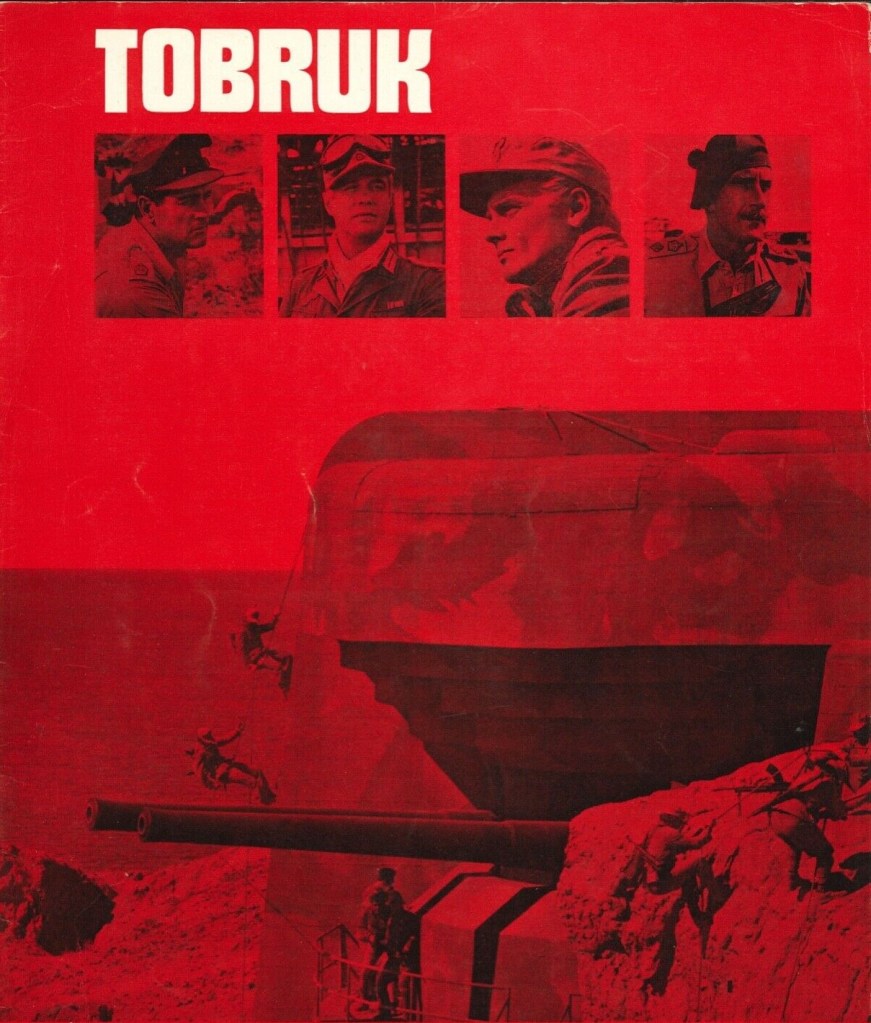
Tobruk (1967) ****

Occasionally ingenious action-packed men-on-a-mission picture that teams reluctant hero Major Craig (Rock Hudson) with Captain Bergman (George Peppard) who heads up a team of Jewish German commandos (i.e good guys). Arthur Hiller (Promise Her Anything, 1966) directs with some skill and to increase tension often utilizes silence in Hitchcockian fashion. He meshes innate antagonism between the two principals and stiff-upper-lip British Col Harker (Nigel Green), two subplots that have a bearing on the final outcome, and explosive battle scenes. In addition, in supporting roles is a Sgt Major (Jack Watson) unusually solicitous of his troops and a grunt (Norman Rossington) with a fund of one-liners.

Craig is liberated by frogmen from a prisoner ship and flown into the Sahara on the eve of the Battle of El Alamein to guide a strike force 800 miles across the desert to blow up Rommel’s underground fuel tanks in Tobruk, Bergman’s outfit providing the perfect cover as Germans escorting British prisoners. “It’s suicide,” protests Craig. “It’s orders,” retorts Harker.

Most action pictures get by on action and personality clashes against authority, but this is distinguished as well by clever ruses. First off, hemmed in by an Italian tank squadron on one side and the Germans on the other, they fire mortars into each, convincing the enemy units to open fire on one another. Craig, on whose topographical skills the unit depends, goes the desert version of off-piste, leading the group through a minefield, personally acting as sweeper with a bayonet as his rudimentary tool, his understanding of how the enemy lays its mines allowing him to virtually explode them all at one. But, ironically, their cover is so complete that they are strafed by a British plane, and equally ironically, have to shoot down one of their own.

Along the way they pick up a stranded father-and-daughter Henry (Liam Redmond) and Heidy Hunt (Cheryl Portman) who are on another mission entirely, to help create a Moslem uprising against the British in Egypt. Their arrival reveals the presence of a traitor in the camp. Naturally, this isn’t the only complication and problems mount as they approach Tobruk and, finding it vastly more populated with German troops than expected, they now, in addition to tackling the virtually impenetrable fuel dumps, have to knock out the city’s radio mast and neutralize the German big guns protecting the beaches.

So it’s basically one dicey situation after another, ingenuity solving problems where sheer force is not enough, and twists all the way to the end.

All the battles are particularly well done, pretty ferocious stuff, flamethrowers especially prominent, but they are also adept at hijacking tanks, and in another brilliant ruse capturing one without blowing it up. The screenplay by Leo Gordon (The Tower of London, 1962) supplies all the main characters with considerable depth. While Craig isn’t exactly a coward, he is not interested in laying down his life for a cause. Although Harker seems a typical officious British officer, he, too, has surprising depths. But it is Bergman who is given the weightiest part, not just a German seeking revenge against his own countrymen for the treatment of Jews but a man looking to a future when Jews will fight for their own homeland in Israel.  

Hudson had begun his career in action films, mostly of the western variety, before being seduced by the likes of Doris Day and Gina Lollobrigida in romantic comedies and this is a welcome return to tough guy form. George Peppard made it two Germans in a row after The Blue Max (1966) but this is far more nuanced performance. There are star turns from Nigel Green, Guy Stockwell (Beau Geste, 1966) as Peppard’s sidekick and the aforementioned Jack Watson (The Hill, 1965) and Norman Rossington.

This was pretty much dismissed on initial release as a straightforward gung-ho actioner and one that tipped Rock Hudson’s career in a downward spiral, but I found it both thoughtful and inventive and had much more of an on-the-ground feeling to it, with nothing going according to plan and alternatives quickly need to be found.

Under-rated and well worth a look.

Hornets Nest (1970) ****

Given exceedingly short shrift in its day. Viewed as in exceptionally poor taste. Marketed in some respects as Lord of the Flies Meets The Dirty Dozen. Audiences accepting of kids putting on a show or, the modern equivalent, making a movie, not so keen on youngsters going to war. In any case there’s an inbuilt repugnance as you get the distinct impression some of these kids would have been ideal recruits for Hitler Youth or the Mussolini version.  And Italy, one-time ally of Hitler, becoming suddenly heroic seemed to jibe. Not to mention Rock Hudson’s marquee value fading fast after a gigantic turkey called Darling Lili (1969). Despite some distinctly unsavory aspects, bordering on exploitation, this seems enormously underrated, not just as an actioner, but for a raw depiction of war, far more realistic than many in the genre that toplined on violence.

Sure, it’s an odd concept, Italian kids, in the absence of adults, turned into a fighting force by dint of letting loose their innate venality and savagery. But they’ve not been washed up, adult-free, on a desert island. This small bunch have been orphaned and bloodily. Germans on the hunt for local partisans execute an entire village and then, finding a quisling, proceed to massacre the local resistance and for good measure destroy a team of American parachutists dropped into the area to facilitate the Allied advance.

The kids come across the one survivor, Turner (Rock Hudson), hide him from the enemy and dupe German doctor Bianca (Sylva Koscina), sympathetic to the plight of the innocent, into caring for the wounded soldier. Rather than hang around and accept the ministrations of such a beauty and see out the war with a view to possible romance, Turner is intent on single-handedly completing his mission of blowing up a dam.

Given the kids have amassed a secret armory and are trigger-happy, desperate to avenge their parents, and getting down to the gung-ho aspects of war, Turner, with appalling disregard for their safety, decides to commandeer them for his own unit. Bianca objects and watches with horror and for most of the rest of the picture confines herself to the pair too young to be considered combatants and who reek of desolation or to find ways of killing Turner or betraying him to the Germans.

Meanwhile, the kids have their own ruthless leader, Aldo (Mark Colleano), one part John Wayne, one part the creepy Maggott (Telly Savalas in case you’ve forgotten) from The Dirty Dozen, who objects to taking orders. Training consists of little more than a bit of marching in file and learning how to quickly reload a machine gun. Turner’s clever plan is to use their perceived innocence to distract the Germans guarding the dam. The distraught Bianca, stepping out of line once too often, is raped for her trouble.

Oddly enough, Koscina does take a machine gun to the Germans, which you would have thought would be catnip to the marketeers, but that image is excluded from the poster.

Setting aside all audience misgivings about the premise and the sexual undertones, the mission is very well done, plenty tension, a workable plan, and the eventual dam-burst impressive on the budget.

But the misgivings are not glossed over. There’s a dicey moment when it looks as if the kids, crawling all over the nurse, tearing off her clothes, are about to embark on mass juvenile rape. And the bloodlust will only be slaked when, by dint of secreting the detonators essential to the plan, they force Turner to lead them on a raid on the Germans, tossing hand grenades into houses and opening fire from the back of a truck on the unsuspecting enemy.

Aldo, in particular, gets a taste for killing and in a later battle doesn’t hold back when one of his comrades inadvertently gets in his way.

Sold as a junior edition of a mission picture, the trailer would have probably been enough to put off large sections of the audience, uncomfortable with kids being employed in such mercenary fashion. Kids grow up in war but not that fast seemed to be the general reaction. Okay if they’re portrayed as victims, less acceptable as gun-happy butchers.

So, the best elements of the movie is in not avoiding such misgivings. It was soon clear from the American experience – though this is not specifically alluded to – that hordes of kids in Vietnam were going down this route. The point at which kids cross over into bloody adulthood and lose the essence of childhood is dealt with too. That scene on the face of it and in isolation appears maudlin but in the context of the picture works very well. But the violence or its aftermath are not the most striking images. Again and again, the camera returns to the dirty, clothes-tattered, Bianca clutching the two infants, the detritus of conflict.

Setting aside his moustachioed muscle, Rock Hudson (Seconds, 1966) gives a well-judged performance and Sylva Koscina (A Lovely Way To Die, 1968), shorn of glamor, holds the emotional center. Mark Colleano (The Boys of Paul St, 1968) gives a vicious impression of a young hood on the rise. Directed by sometime cult director Phil Karlson (A Time for Killing, 1967) from a script by S.S. Schweitzer (Change of Habit, 1969) and producer Stanley Colbert. Great score from Ennio Morricone.

It’s worth pointing out that the idea of kids taking up arms received positive critical approval when it was applied to such an arthouse darling as If… (1969) but of course they were public schoolboys forced into action by bad teachers and in reaction to “the establishment” and not after seeing their families slaughtered. Double standards, methinks.

Worth reassessment.

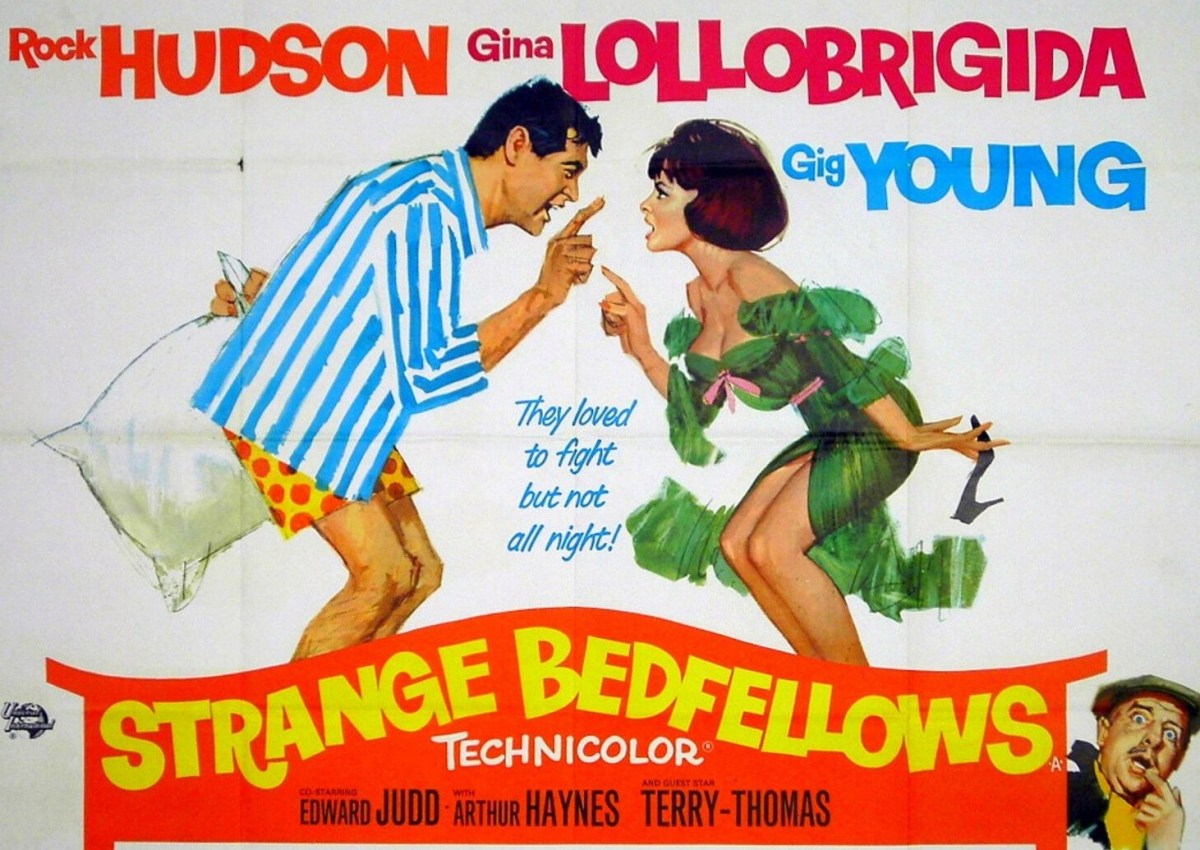
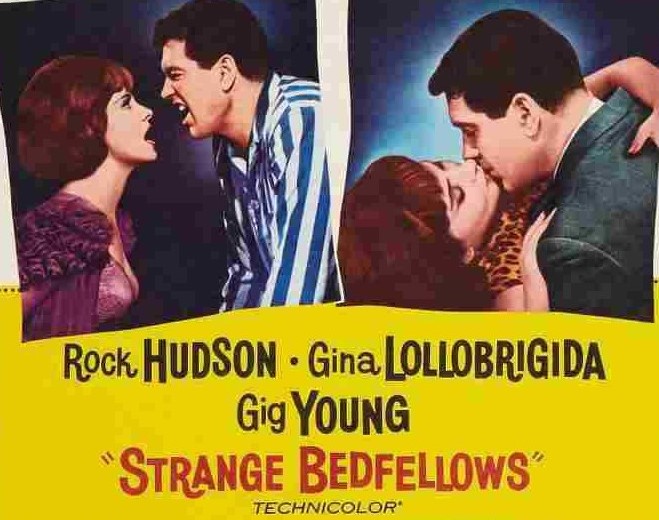
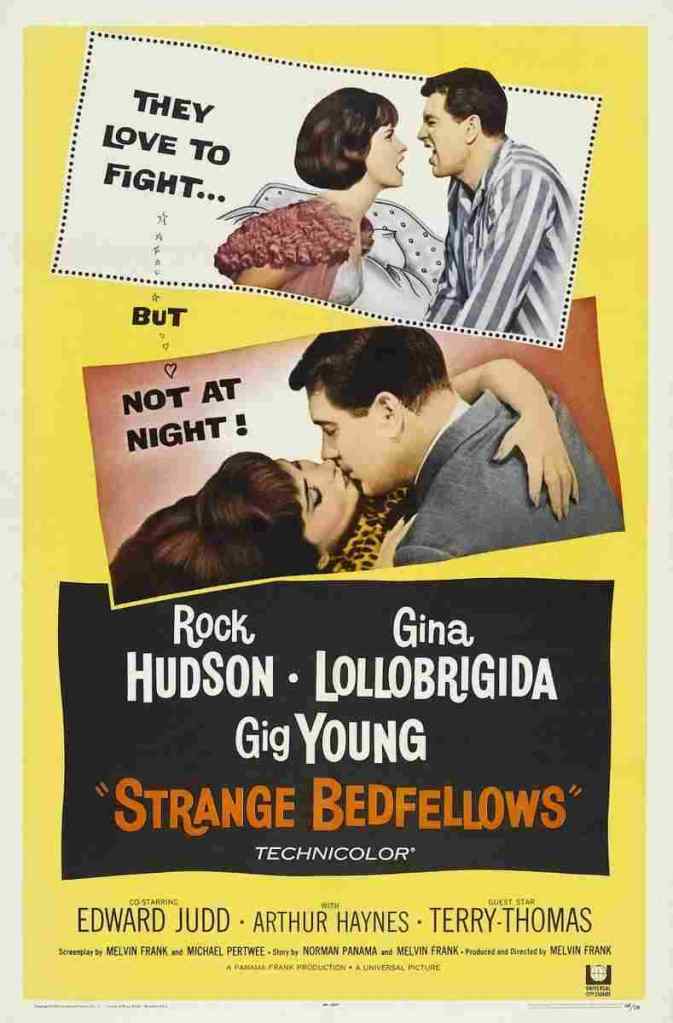
Strange Bedfellows (1963) ****

I had my first belly-laugh within seconds, a wonderful sight gag and was chortling all the way through this London-set battle-of-the-sexes comedy. Carter Harrison (Rock Hudson) is a high-flying businessman who needs to win back long-estranged wife Toni (Gina Lollobrigida) in order to gain promotion at a family-conscious oil company. Initially, Carter re-discovers the reasons he had first fallen in love with her but then, of course, only too bitterly, why they split. Hudson and La Lollo had previously teamed up for Come September (1963) and Hudson had spent most of the 1960s in romantic mishap with Doris Day so he could call on an extensive range of baffled and enraged expressions. Toni is an artist-cum-political-firebrand which sets up hilarious consequence. Richard Bramwell (Gig Young) is on hand to act as referee.

There’s some marvelous comic invention, a conversation between the two principals relayed through taxi controllers turns into a masterpiece of the misheard and misunderstood. Complications arise from Toni’s Lollobrigida’s fiancé Harry  (Edward Judd from First Men in the Moon, 1964), also an activist, but on the pompous side, and an Italian lothario. Taking advantage of the less than congenial London weather, there are jokes aplenty about umbrellas and in a nod to farce occasions for Carter to lose his trousers and share a bed with the fiancé. Smoldering sexual tension also kindles many laughs. By the time the film enters its stride it’s one comedic situation after another. It being England, naturally enough Lady Godiva is involved.

Hudson in suave mode trying to cope with the feisty Lollobrigida is an ideal comedy match. Costume designer Jean Louis has swathed the actress in a stunning array of outfits, some of which leave little to the imagination. When Doris Day got angry you tended to laugh, not quite believing this was anything more than a moderate hissy fit, but if you crossed Lollobrigida you were apt to get both barrels and it never looked like acting, she was a very convincing when she switched on the fury engine, plus, of course, whatever she threw added both to the comedy and her character’s conviction.   Both have terrific comic timing.

Writer-director Melvin Frank was something of a comedy specialist, a dab hand at suiting comedy to screen persona having previously set up Road to Hong Kong (1962) and Mr.  Blandings Builds a Dream House (1948). Terry-Thomas makes an appearance as a comic mortician and there are parts for English comedian Arthur Haynes and Dave King. Hudson and Lollobrigida exude screen charisma and while not in the class of Come September this delivers enough laughs to make you wonder why they don’t make them like that anymore.

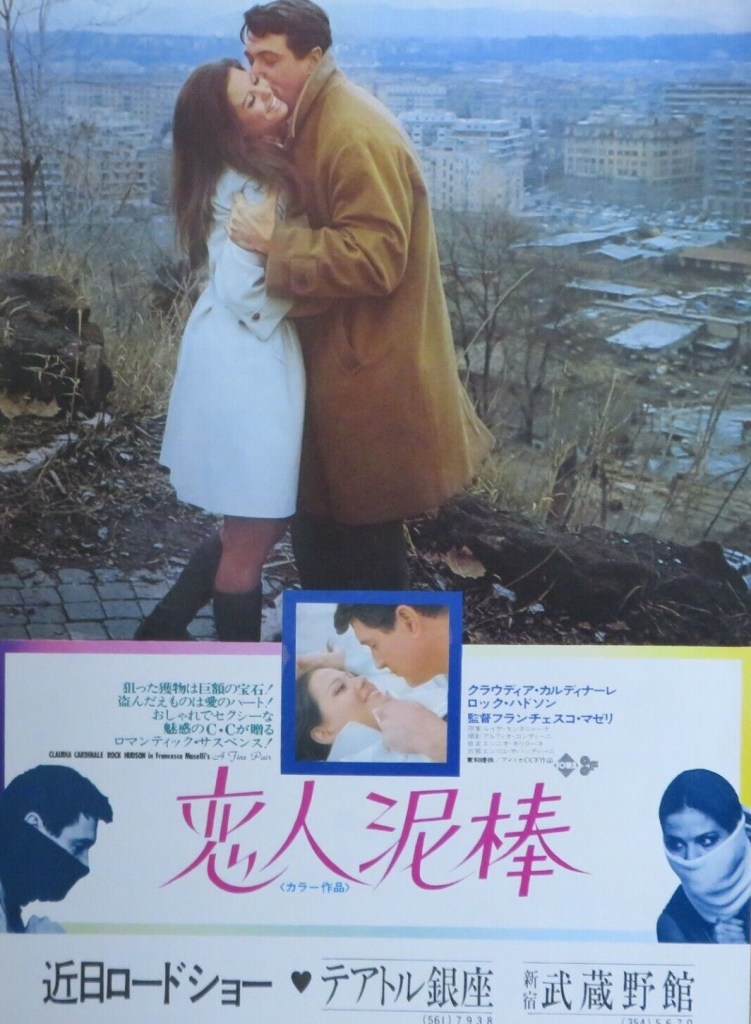
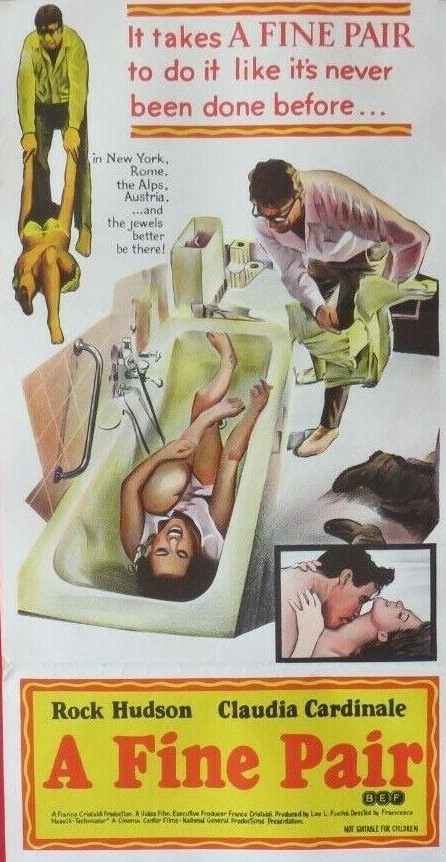
A Fine Pair (1968) ***

Essentially an Italian take on the slick glossy American thriller in the vein of Charade (1963), Arabesque (1966) and of course Blindfold (1966) which previously brought together Rock Hudson and Claudia Cardinale. Produced by Cardinale’s husband Franco Cristaldi, directed and co-written by Francesco Maselli (Time of Indifference, 1966), it is a cute variation on the heist picture. Fans accustomed to seeing the more sultry side of the Italian actress (as in The Professionals, 1966) might be surprised to see how effective she is in more playful mood apart from one scene where she strips down to bra and pants. The other major difference is that in her American-made films, Cardinale is usually the female lead, that is, not the one driving the story, but here she provides the narrative thrust virtually right up until the end.

The twist here (as in Pirates of the Caribbean nearly four decades later) is that the bad guy (in this case bad girl) wants to return treasure rather than steal it.  Esmeralda (Claudia Cardinale) arrives in New York to seek the help of Capt. Mike Harmon (Rock Hudson), an old family friend, a stuffy married American cop who even has a timer to tell him when to take his next cigarette. She has come into jewels stolen by an internationally famous thief and wishes to return them to a villa in the Alps before the owners discover the theft. The bait for Harmon is to try and apprehend the guilty party.

The audience will have guessed the twist, that she is not breaking in to return jewels, but once Harmon, through his police connections, has been shown the alarm systems, to deposit fakes and steal the real thing. So Harmon has to work out an ingenious method of beating three alarm systems, one of which is heat-sensitive, the whole place “one big safe.”

Most of the fun comes from the banter between the principals and the is-she-telling-truth element essential to these pictures. “I lied – and that’s the truth,” spouts Esmeralda at one point. I disagree with a common complaint of a lack of chemistry between Hudson and Cardinale. What the film lacks is not enough going wrong such as occurred in Man’s Favorite Sport (1962), which makes the audience warm to the otherwise rigid Hudson, or as seen in Gambit (1966) where Michael Caine played a similar stand-offish character. Cardinale is terrific in a Shirley MacLaine-type role, as the playful foil to the uptight cop, and who, like MacLaine in Gambit, knows far more than she is letting on.

What does let the film down is that it is at cross-cultural cross-purposes. As mentioned, this is an Italian film with Italian production values. The color is murky, way too many important scenes take place outside, but, more importantly, the actual heist lacks sufficient detail, and post-heist, although there a few more twists, the film takes too long to reach a conclusion. But for the first two-thirds it is a perfectly acceptable addition to the heist canon, the script has some very funny lines, Cardinale is light, charming and sexy.

The American title of this film was Steal from Your Neighbor, which is weak. A Fine Pair while colloquial enough in America has, however, an unfortunate meaning of the double-entendre kind in Britain.

Lack of films being released – these days due to the pandemic – is not new. A Fine Pair was made during a time of low production. But there was a sickening irony in the story of this film’s production. It was financed by the short-lived Cinema Center owned by the American television network CBS. When television was in its infancy, American studios had been barred by the Government from becoming involved in the new media. CBS got into movie production after studios had suffered from another governmental policy reversal.

In 1948 the Paramount Decree prohibited studios from owning cinemas, a move which led to the end of the studio system and decimated production. The most sacrosanct rule of American film regulations was that studios could not own movie houses. Everyone assumed that applied the other way until in the early 1960s cinema chain National General challenged the ruling.

By this point, production was so low that exhibitors were crying out for new product so the government relented, much to the fury of the studios. That opened the door for television networks like CBS and later ABC (Charly, 1968) to enter movie production. And now, of course, studios have re-entered the exhibition market as have, once again, television companies.

Entertaining enough and the pair have enough charisma to see it through.

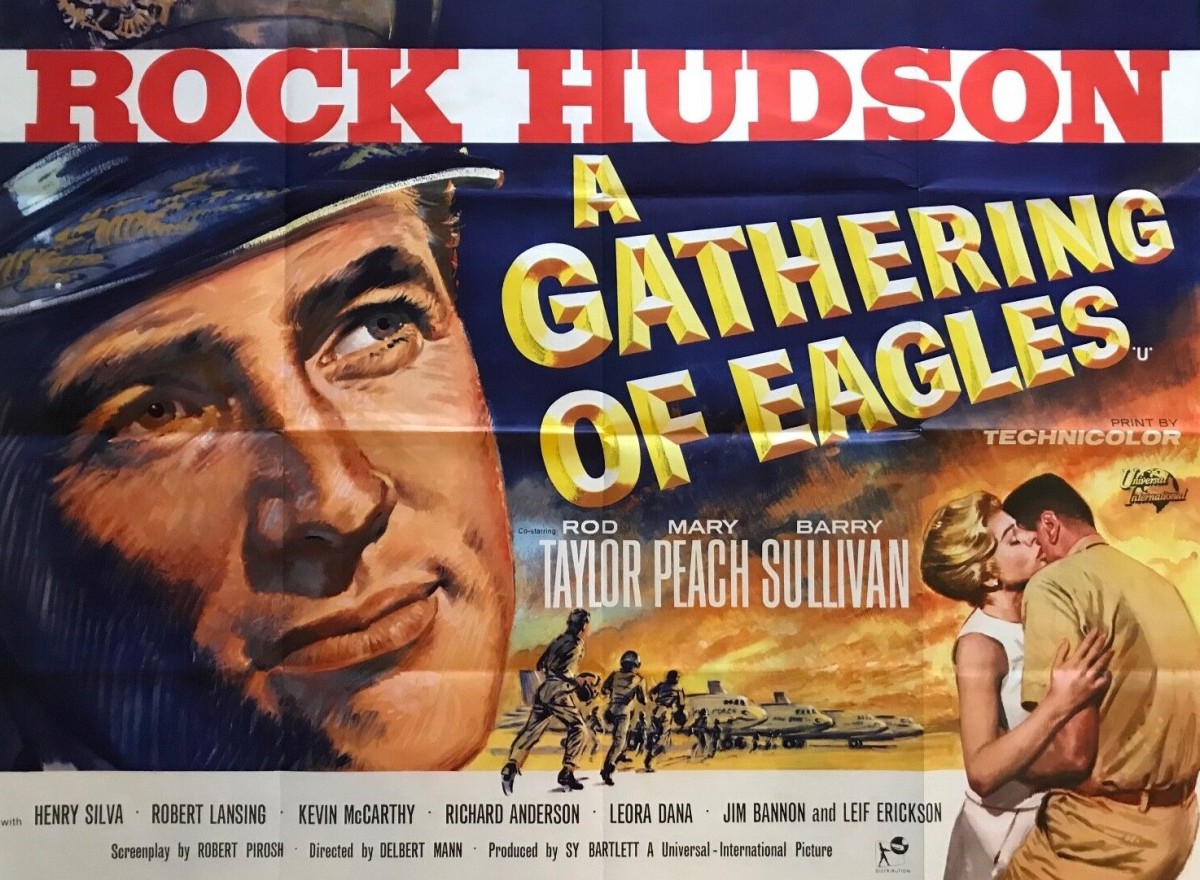
A Gathering of Eagles (1963) ***

Machines get in the way of this tale of men under pressure. Often viewed as a PR exercise for the Strategic Air Command to counter complaints about competence, and signally out of tune with a Hollywood faction that was beginning to view investment in nuclear weapons as a serious mistake, as epitomized by Fail Safe (1964), Dr Strangelove (1964) and The Bedford Incident (1965).

Not helped by action being under the auspices of simulation and not genuine war, filmmakers lacking the later bravura that just invented a side event, Top Gun, 1986, for example, to give audiences something to root for. Nor by a warehouse of info dumps.

That said, once it comes to the usual turf wars besetting any element of the military, the tension ponies up and there’s a real film underneath. There’s a surprising contemporary element to the narrative, two actually, firstly the arguments over leadership, and, secondly, the impact of PTSD, the endless deadline-based simulations as tough as being at war.

Hard-line efficiency expert Col Caldwell (Rock Hudson) is parachuted into a front-line B-52 Cold War command to toughen up sloppy procedure, bringing him into conflict with second-in-command Col Farr (Rod Taylor), a Korean War buddy. Caldwell rules by the book, Farr allows his men greater leeway. It comes down to the question of whether morale should be an issue or if men are expected to do their utmost even if they hate their leader. This debate about leadership style is prevalent today.

Caldwell is so tough he will sacrifice his buddy to get the job done better. And if people can’t handle the pressure they are better off out of the firing line. But since asking for a transfer to a less arduous berth would be viewed as a shameful admission of weakness, the only option for those who can’t cope is suicide. But since attempted suicide would not, as today, be viewed as a cry for help, anyone such attempt reduces the airman,, such as Col Fowler (Barry Sullivan) to a hospital bed where pity rains down on him.

The pressure comes in the shape of not just keeping on top of everything should the Russians suddenly decide to launch a missile attack, but dealing with intense simulations which appear out of the blue and require everyone to spring into battle stations. And in another prescient element, everyone is analysed to within an inch of their lives, marked down for the tiniest deviation from protocol, or not reaching the correct flight level or going too fast or too slow.

Caldwell is further hampered by English wife Victoria (Mary Peach) who fails to understand the pressure under which her husband, and all men in the base, operate, the kind of ground crew whose first question, on recovering from an operation, will not concern wife and kids but an airplane or a mission.

To add emotional heft, she is meant to have potentially fallen for Farr, and although rumors reach Caldwell’s superiors there’s no evidence of that. In the original script, the affair is spelled out, and such material was filmed, but it disappeared in the editing room. Perhaps because it proved that emotion was the Achilles heel of even the most efficient operation. In the actual movie, Victoria denies an affair and we believe her, but if an audience was shown her – and Farr – to be lying that casts a different complexion and at some level suggests betrayal.

In the air, despite assistance from the Strategic Air Command, the hardware is now out-dated, so of historical interest only, and while the movie fails to capture the tenor of the times, the situation of men under pressure has not changed.

Rock Hudson (Tobruk, 1967) is intensity on fire, Rod Taylor (Chuka, 1967) more laidback than in later films. Mary Peach (No Love For Johnnie, 1961) doesn’t have much of a filter between adoration and fury. Look out for Henry Silva (The Manchurian Candidate, 1962), Barry Sullivan (Harlow, 1965) and Kevin McCarthy (Hotel, 1967).

As you might expect, director Delbert Mann (Buddwing / Mister Buddwing, 1966) is more at home on the ground than in the air. Responsible for the screenplay were Sy Bartlett (Che!, 1969), also the producer, who had covered similar ground in Twelve O’Clock High (1949), and Robert Pirosh (Hell Is for Heroes, 1962)

The Top Gun of its day, bettered remembered now for the debate on leadership.

Behind the Scenes: “Man’s Favorite Sport” (1963)

Should have been, as you might have guessed, Cary Grant (Charade, 1963) in the lead. Should have featured, which you won’t have guessed, Ursula Andress (She, 1965). Should have run, which you’d be amazed to learn, for 145 minutes, almost as long as your standard epic. Should have appeared, like Hatari! (1962), under the Paramount banner.

In fact, the most likely studio destination was Columbia. Hawks’s agent Charles Feldman had  spent 16 months trying to thrash out a very good deal for his client. Feldman, who owned the rights to Casino Royale, was also keen on Hawks directing a James Bond picture. That got as far as discussing Cary Grant as the handsome spy and Hawks’ enlisting the aid of his favorite screenwriter Leigh Brackett (Hatari!).

But instead of moving studios, Hawks decided to stay put, sitting on a three-picture deal worth a hefty $200,000 plus a 50 per cent profit share. First item on the new agenda could have been reuniting Rio Bravo (1959) alumni John Wayne and Dean Martin for The Yukon Trail. But that was before Hawks expressed interest in a romantic short story, The Girl Who Almost Got Away, published in Cosmopolitan magazine, and an ideal fit for Cary Grant.

But Grant, something of the entrepreneur himself, would only sign up if Hawks in turn agreed to direct one of the actor’s pet projects, The Great Sebastian. But the director didn’t like the idea of being a gun for hire and Grant’s attention meanwhile had wandered in the direction of Charade. Rock Hudson, borrowed from Universal, was seen as an ideal replacement. For the female lead Hawks initially enthused about Joanna Moore (Walk on the Wild Side, 1962) until he chanced upon Paula Prentiss (Where the Boys Are, 1960), an MGM contract player.

Paramount balked at a relative unknown. Hawks balked at anyone balking at his choice and switched the project to Universal. While toying with Casino Royale, Hawks had a sneak preview of Dr No (1962) and espied a natural for the second female lead in Ursula Andress. But her management team reckoned the Bond movie would open bigger doors. Instead, Hawks plumped for Austrian blonde Maria Perschy (The Password Is Courage, 1962). Charlene Holt (If A Man Answers, 1962) made such an impression on Hawks that she not only won the part of Rock Hudson’s fiancée but the role of regular girlfriend to the director and parts in his next two pictures.

Leigh Brackett  was brought in to pep up the original script by John Fenton Murray (It’s Only Money, 1962) and Steve McNeil (Red Line 7000, 1965). Unusually, she was rewriting on the hoof, earning $1,000 a week to refashion the lines scene by scene as production unfolded. Everything except the opening scene set in San Francisco was shot on the Universal backlot. Even then, neither Hudson nor Prentiss was transported to San Francisco, their close-ups while driving cars filmed at the studio and inserted as process shots. Hawks didn’t leave the studio either, entrusting that initial footage to associate producer Paul Helmick and cinematographer Russell Harlan.

Like Otto Preminger, Hawks liked a lot of takes. Paula Prentiss didn’t, in part because she felt he was trying to mold her into a screwball comedy heroine of the past, and in part because every take not printed impinged on her confidence. Although Hawks lacked the reputation as a bully of the Otto Preminger variety, nonetheless the inexperienced Prentiss found herself in tears more than once. Cary Grant dropped by one time for a friendly chat. He was made welcome. Angie Dickinson, expecting a similar welcome, received a curt put-down, Hawks making it clear he preferred as a brunette.

While the credit sequence by photographer Don Ornitz was deemed sexist since it comprised 33 models in sports or beach gear, it was actually the opposite because the women were proving how superlative they could be at sports generally considered the preserve of men. But there was no doubt the reaction Hawks expected when he spent $20,000 on black scuba outfits for Prentiss and Perschy, using molds made from their bodies to achieve the skin-tight effect. Hawks was notoriously slow, the picture taking three and a half months.

The initial version of the film attracted at a sneak preview the most positive responses the studio had ever received. The only problem was – it ran 145 minutes, considered an impossible length for a light romantic comedy. Although the next version was shorter, the audience response was decidedly worse. Even so, Universal insisted on further cuts until the movie came in at the two-hour-mark.

Not everyone went along with the official Hawks version of events. Others remembered the response to the various cuts not being so different. The film wasn’t released until six months later and there is no evidence that Hawks fought hard to retain his edit. Although he would later complain that the movie was “sabotaged,” that may have been his automatic default position once the movie proved a relative commercial failure, with only $2.35 million in U.S. rentals

Leigh Brackett had more right to feel disgruntled. She was denied a credit by the Writers Guild of America who contended her work was a polish rather than an original contribution.

I have to say I’m out of step with some of the critical opinion. Molly Haskell reckoned the film was actually some kind of Adam and Eve deal with Hudson “a virgin who has written a how-to book on sex while harbouring a deep fastidious horror of it.” The Haskin critique allows that fish are phallic symbols, therefore giving sexual credence to the scene about learning to handle a fish.

It might just be more straightforward to say that, of course, this isn’t as good as Bringing Up Baby but then, nothing ever was, and just enjoy what Hawks did manage to conjure up with very likeable leads.

SOURCES: Todd McCarthy, Howard Hawks, The Grey Fox of Hollywood (Grove Press, 1997), p595-603; Joseph McBride (editor), Focus on Howard Hawks (Englewood Cliffs); Molly Haskell, “Howard Hawks: Masculine Feminine,” Film Comment, March-April 1974.  

Man’s Favorite Sport (1964) ****

Wow! From an academic/critical perspective this is veteran director Howard Hawks (Hatari!, 1962) taking the mickey out of his famed style, where women are always competing to enter the sacrosanct male world. But, shades of his earlier Bringing Up Baby (1938), a fast-talking assured sassy woman takes command of a hapless male. Sure, Rock Hudson and newcomer Paul Prentiss aren’t in the Cary Grant-Katharine Hepburn league but they make darned good substitutes. And there’s a big difference to the earlier picture. There, Grant was an accepted expert, and it’s not his knowledge that’s in question but here Hudson is a phoney and relies on the woman.

But fiddlesticks to academe and critics, this is just helluva good fun. Built on a brilliant premise, it just rolls along from one set-piece to another to fashion as daft a screwball comedy as you could imagine.  Maybe Rock Hudson left all the physical comedy in Send Me No Flowers (1964) to Doris Day because he was plumb tuckered out by his exertions on this one.

So, Roger Willoughby (Rock Hudson) is a fishing expert employed as a salesperson by Abercrombie & Fitch. When, in a public relations wheeze, Abigail Page (Paula Prentiss) invites him to participate in a competition, she uncovers his terrible secret. He’s never fished before in his life, he’s just a clever listener, passing on fishing lore from one customer to another. She agrees to help him out. But, of course, he’s an idiot and it’s not long before he’s upside down in a car that’s way too small for him, walking around with rubber buckets for shoes and upside down (again) in a lake trapped by inflatable waders.

There’s a marvellous meet-cute where they get off on the wrong foot because she steals his reserved parking spot and his first encounter with her dexterity with language should have warned him what he’s letting himself in for. The situation is complicated by, natch, Abigail falling in love with him, not to mention her buddy Easy (Maria Perschy) not unattracted either, and his fiancée Tex (Charlene Holt) about to appear any second.

So when Roger’s not tying himself in knots, he’s allowing himself to be persuaded to pretend to have a broken arm, which to make it realistic must be encased in plaster, which Abigail and Easy concoct.  The fact you know full well this is only the first step to major complication doesn’t make it any the less funny. Then there’s the problem of the zip in a sleeping bag. And the fiancée turning up at the wrong time.

I could have done without the fake Native American (Norman Alden), but the rest is top-notch. Any other director would have kept the wig gag going for ages, but here it’s dumped early on because the wearer, Roger’s boss Cadwalader (John McGivern), needs little excuse to stop wearing it.

You’d be hard put to find sexuality as cleverly dealt with as here, Abigail and Easy provided with good reason to swan around in skin-tight clothing and later prattling on fifteen to the dozen as pouring rain renders their shirts see-through much to the discomfort of Roger. While Roger might be a typical male, the trio of women are far from typical of the period with a streak of independence that allows little room for the notion of men as the superior species. Not only is Abigail as competent as any male in this type of sport, she far exceeds the capabilities of the supposed expert. Furthermore, Abigail is the antithesis of the scatter-brained Susan Vance from Bringing Up Baby. She knows exactly what she’s doing even if shifted slightly off kilter by the unexpected impact of love.

As the male coming unstuck outside of his comfort zone, Rock Hudson is excellent especially in the physical comedy but the real gem is Paula Prentiss, as effervescent a star as you would ever find. You only have to see her in The Parallax View (1974) to understand what a terrific character she has succeeded in creating. Never mind that she handles the script deftly, she virtually bursts off the screen.  

The general critical consensus is that Howard Hawks went downhill after Rio Bravo (1959), and that outside his final pair of westerns El Dorado (1966) and Rio Lobo (1971) was very much at the tail end of his career. Most critics seemed to have simply ignored that Man’s Favorite Sport took a different approach to the male-female dynamic or that, setting academia aside, this is just a very enjoyable romantic comedy.

Discover WordPress

A daily selection of the best content published on WordPress, collected for you by humans who love to read.

The Atavist Magazine

by Brian Hannan

WordPress.com News

The latest news on WordPress.com and the WordPress community.