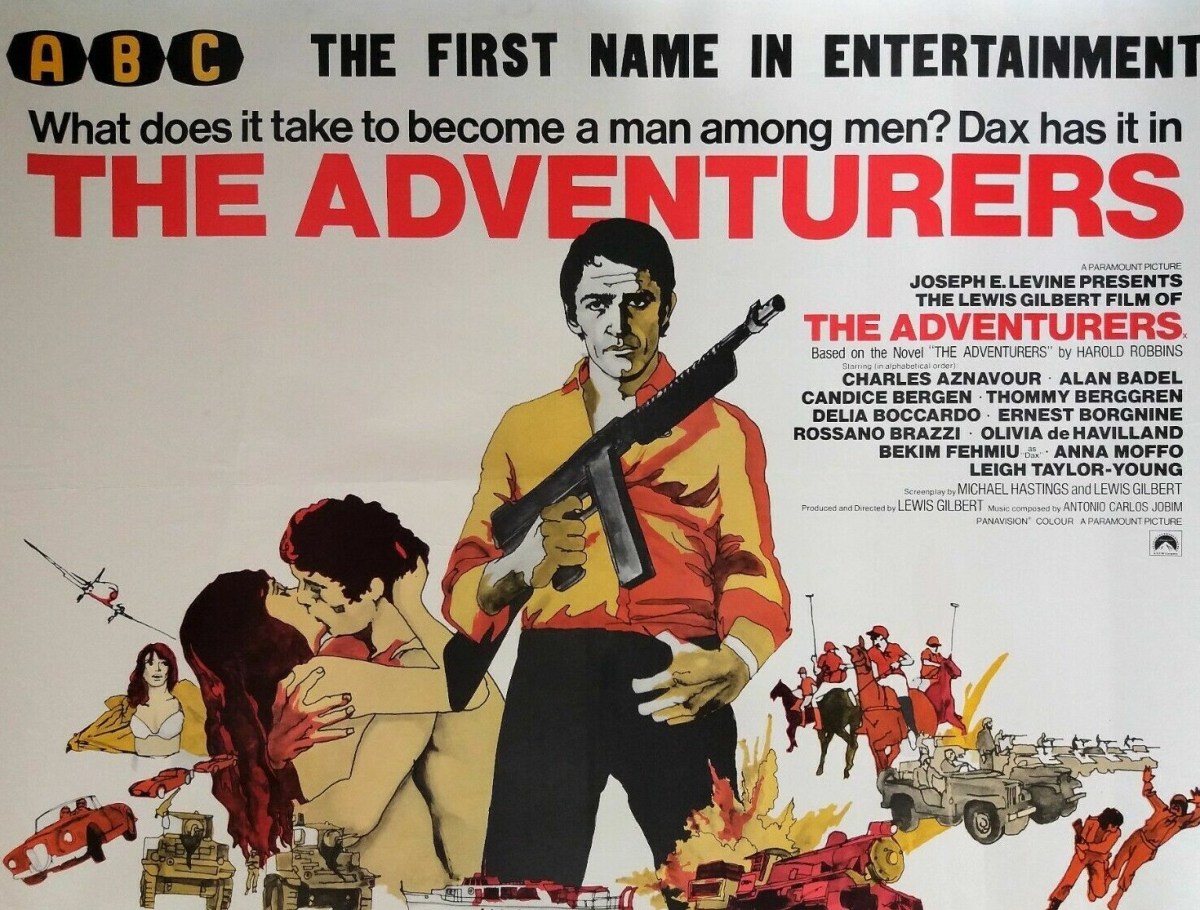
The Adventurers (1970) ***

Class A Trash. Adaptation of Harold Robbins (Nevada Smith, 1966) bestseller goes straight to the top of the heap in the So-Bad- It’s-Good category. Only Alan Badel (Arabesque, 1966) as a double-dealing revolutionary comes out of this with any honors.

The likes of Candice Bergen (Soldier Blue, 1970), Rossano Brazzi (Rome Adventure/Lovers Must Learn, 1962), double Oscar-winner Olivia de Havilland (Hush, Hush, Sweet Charlotte, 1964), Leigh Taylor-Young (The Big Bounce, 1969)  and Ernest Borgnine (The Wild Bunch, 1969) must have wondered how they were talked into this.

And director Lewis Gilbert (Loss of Innocence/The Greengage Summer, 1961) must have wondered how he talked himself into recruiting unknown Yugoslavian Bekim Fehmiu (The Deserter/The Devil’s Backbone, 1970), nobody’s idea of a suave lothario,  for the lead.

One of the taglines was “Nothing has been left out” and that’s to the movie’s detriment because it’s overloaded with sex, violence, more sex, more violence, in among a narrative that races from South American revolution (in the fictional  country of Corteguay) through the European jet set, fashion, polo, fast cars, orgies, and back again with revenge always high on the agenda. At close on three hours, it piles melodrama on top of melodrama with characters who infuriatingly fail to come to life.

Sensitivity is hardly going to be in order for Dax (Bekin Fehmiu) who, as a child after watching his family slaughtered and mother raped, makes his bones as a one-man firing squad, machine-gunning down the murderers. From there it’s a hop-skip-and-jump to life as the son of ambassador Jaime (Fernando Rey) in Rome where he belongs to an indulgent aristocracy who play polo, race cars along hairpin bends, swap girlfriends and, given the opportunity, make love at midnight beside the swimming pool.

His fortunes take a turn for the worse when his father backs the wrong horse, the rebel El Condor (Jorge Martinez de Hoyos)  in Corteguay, and is killed by the dictator Rojo (Alan Badel). In between an affair with childhood sweetheart Amparo (Leigh Taylor Young), life as a gigolo and cynical marriage to millionairess Sue Ann (Candice Bergen), Dax takes up the rebel cause, initially foolish enough to fall for Rojo’s promises which results in the death of El Condor, and then to join the rebels.

But mostly it’s blood, sex, betrayal and revenge. Anyone Dax befriends is liable to face a death sentence. He only has to look at a woman and they are stripping off. It’s a heady mess. It might have worked if the audience could rustle up some sympathy for Dax, especially as he was entitled to feel vulnerable after his childhood experiences. But he just comes across as arrogant and the film-makers as even more arrogant in assuming that because women fall at his feet that must mean he had bucketloads of charm rather than that was what it said in the script. He’s fine as the thug but not convincing as a lover.

Excepting Badel, the best performances  in a male-centric sexist movie come from women, those left in Dax’s wake, particularly Candice Bergen as the lovelorn wife and Olivia De Havilland as the wealthy older woman who funds his lifestyle, aware that at any moment he will leave her for a younger, richer, model. Lewis Gilbert is at his best when he lets female emotion take over, not necessarily wordy intense scenes, because Bergen and De Havilland can accomplish a great deal in a look.

The rest of it looks like someone has thrown millions at a B-picture and positioned every character so that they have nowhere else to go but the cliché.

By this point, Hollywood had played canny with Harold Robbins, toning down the writer’s worst excesses and employing name directors to turn dire material into solid entertainment. Edward Dmytryk (Mirage, 1965) had worked wonders with The Carpetbaggers (1964),  whose inherent salaciousness was held in check by the censor and made believable by characters played by George Peppard (Pendulum, 1969), Alan Ladd (Shane, 1953) and Caroll Baker (Station Six Sahara, 1963). Bette Davis and Susan Hayward contrived to turn Where Love Has Gone (1964) into a decent drama. Even Stiletto (1969), in low-budget fashion, managed to toe the line between action and drama.

But here it feels as if all Harold Robbins hell has been let loose. Rather than reining in the writer, it’s as if exploitation was the only perspective. Blame Lewis Gilbert, director,  and along with Michael Hastings (The Nightcomers, 1971) in his movie debut, also the screenwriter for the end result.

On the other hand, if you can leave your critical faculties at the door, you might well enjoy how utterly bad a glossy picture can be.

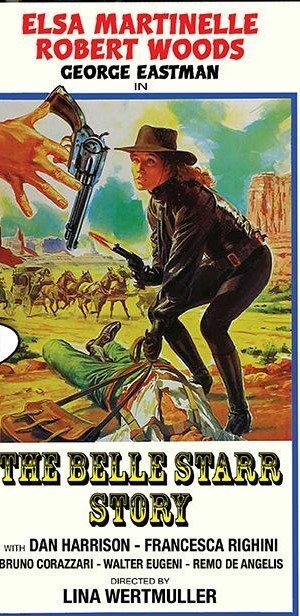
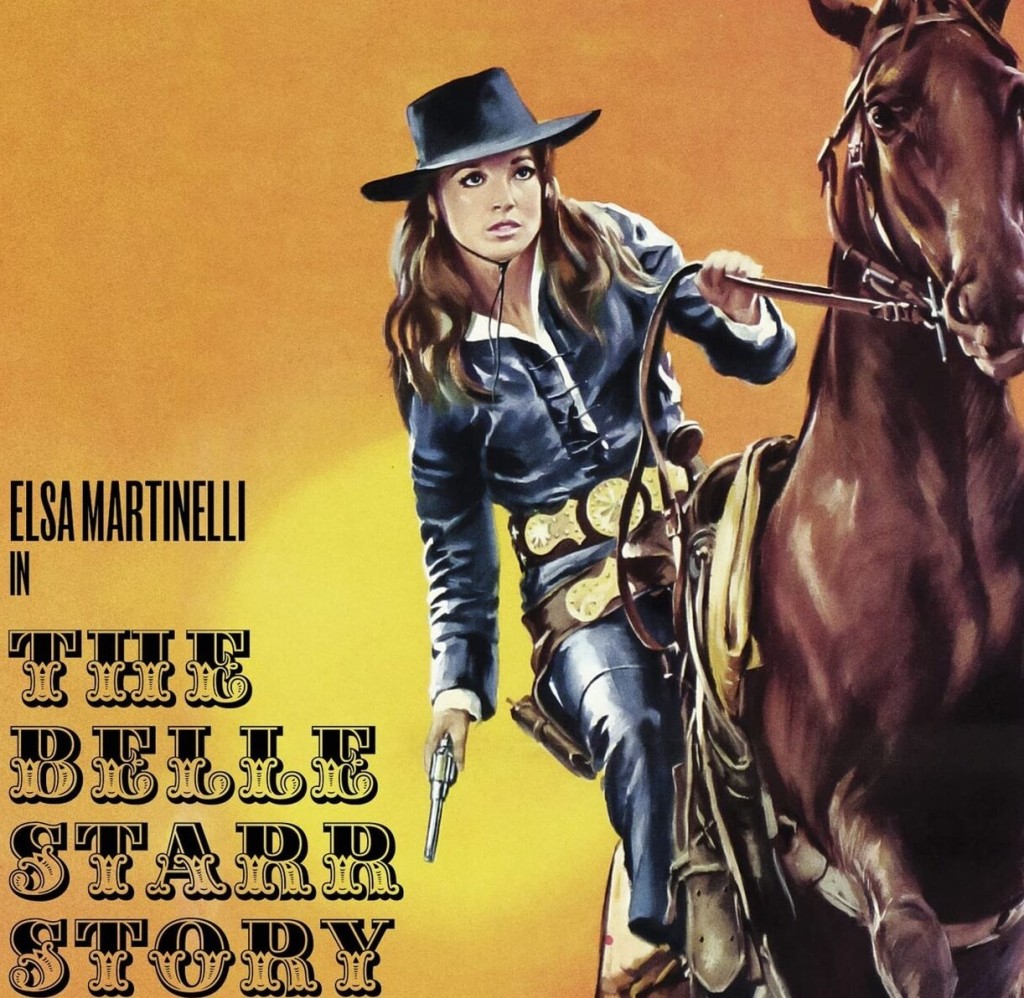
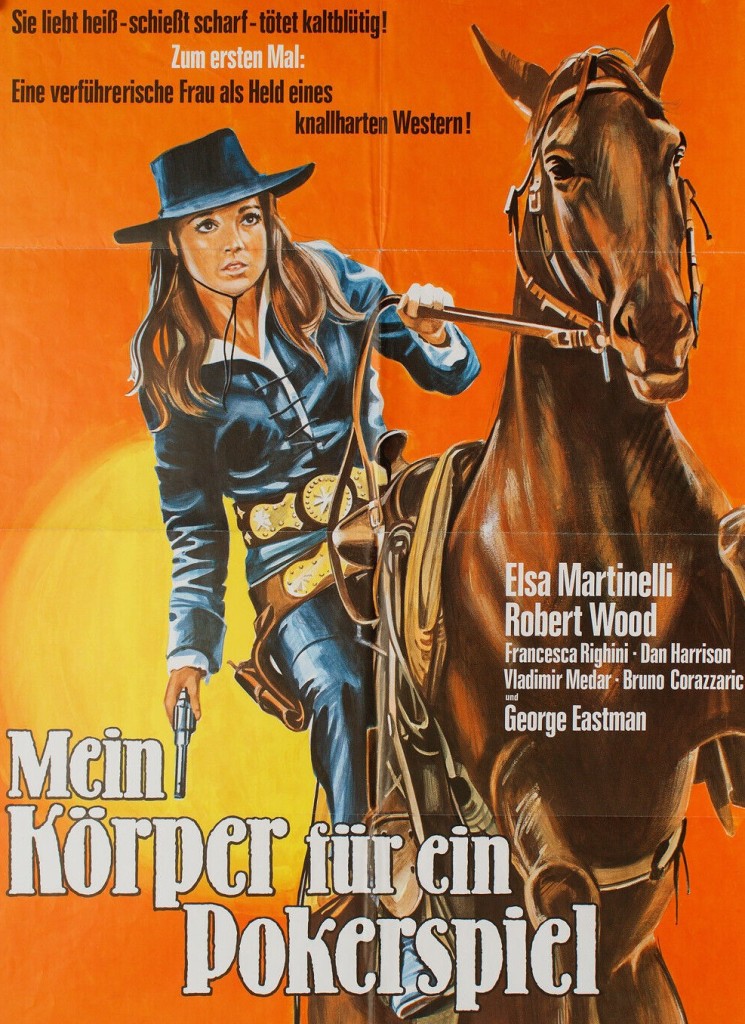
The Belle Starr Story (1968) ***

Only spaghetti western directed by a woman. Brings a distinctly feminist feel to that most sexist of the subgenres. You tend to forget that the sexy female Europeans imported to Hollywood as co-stars or to add spice further down the credits were actually top-billed stars in their natïve countries and demonstrated a greater range than the American industry allowed.

Not only do we have Elsa Martinelli (Maroc 7, 1967) as the leather-clad cigar-smoking titular gunslinger, whose watchword is female independence, but it was helmed by arthouse icon Lina Wertmuller (Swept Away, 1974).  There’s a thematic consistency lacking in most Italian-made westerns, for example predating Once Upon a Time in the West (1969) in its water imagery. But any potential for lyricism is undercut by the risk attached to being a lone woman. And there’s a Tracy-Hepburn tone to the endless bickering and battle for superiority in her niggling romance with outlaw Blackie (George Eastman).

And, unusually in that decade, a woman who throws caution to the wind and will even bet her body when the money runs out at the poker table, as twisty a meet-cute as a screenwriter could devise. But thereafter it’s a struggle for dominance between the pair. She won’t take orders from a man. He won’t accept female equality even when she shoots the wooden fence  he’s sitting on from under him, making him fall to the ground, and for good measure putting a bullet in his heels.

The first act builds up Belle Starr, cool at the poker table, even cooler in the bedroom, and demonstrating the gunplay that attracted her notoriety. The second act take an odd route, a lengthy flashback that digs deep into feminism, the orphaned Belle Starr running away after being sold into marriage by her uncle to an ugly old rich powerful man, traded, effectively, for political favor.

She returns to save a servant condemned to death for the crime of attacking the uncle when he tried to rape her. Sexual humiliation is a theme. Another outlaw Harvey (Robert Woods), who she regards as a platonic friend, steals her clothes as she swims in a lake, and then, having saved her from a posse, forcibly tries to take his reward.

The third act, like the duel between The Man With No Name and The Man in Black, is a case of double- and triple-cross. She refuses to join Blackie’s gang when he plans a million-dollar jewel heist, but hijacks the concept, recruiting her own gang to beat him to the robbery, and teach him a lesson.

But it backfires. Blackie is waiting. She has inadvertently hired his men. In the subsequence shoot-out he is captured. She rides to his rescue. But with their opposing ideas of a woman’s place in the world part on good terms.

The flashback was more subtly observed in Once Upon a Time in the West, and while she shared with Charles Bronson gunslinging skills he was not at any time viewed as a commodity or a piece of property or a candidate for rape. The flashback here fleshes out for the audience the powerlessness of women. But also the kind of camaraderie that is generally also usually only conferred on male characters.

We are pretty conversant with the notion that the gun rules the West. But less conscious of what happens when you are gun-less. Depriving someone of their fundamental weaponry makes them instantly impotent, as humiliating as denying someone water in a desert.

There are some nice directorial touches, blood dripping from a ceiling onto a dinner table, a saloon door opening to cast sudden light onto a corpse, waterfalls suggest sanctuary whereas open water attracts predatory males, and the finale, as they part, of Blackie, desperate to demonstrate his superiority, shooting off her hat from some distance.

Elsa Martinelli is a revelation as a star working to her own beat rather than playing second fiddle to some Hollywood marquee name. This wasn’t Lina Wertmuller’s first film and she had already made an impact with the Rita the Mosquito series, featuring another rebellious woman. Don’t be fooled by the co-directing credit, she replaced debut director Piero Cristofani after a few days.

It’s somewhat ironic that in a contemporary Hollywood attempt to create a female outlaw leader in Cat Ballou (1965), Jane Fonda was upstaged by Lee Marvin, and that in Bonnie and Clyde (1967), despite taking precedence in the title, Faye Dunaway was not the dominant one in the relationship.

By no means a great western but worth a look to see what Elsa Martinelli can achieve when not slotted in to the Hollywood co-star cliche and to get a preview of what Lina Wertmuller could offer.  

Decent print on YouTube.

Someone Behind the Door (1971) ****

Dvorak would be turning in his grave at the audacity of using his New World Symphony (Ridley Scott used it with more subtlety for the Hovis advert a couple of years later) as the score for a Charles Bronson picture. But you could argue this really isn’t a Charles Bronson movie. He’s not the tough guy. He doesn’t come out all guns blazing. He doesn’t slap people around.

This is probably the biggest reversal of screen persona in Bronson’s career (if you exclude The Sandpiper, 1965, where he plays an artist, and you could probably chalk it off anyway because he wasn’t a star at that point). This is so far from the Bronson you guess it must be a cruel hoax.

Here, Bronson is the dupe, the patsy, the stooge.

Come again?

He’s not even dignified with a name, just “The Stranger.” In fact, this could be a remake of Rider on the Rain (1970) with Bronson playing the bad guy not the mysterious cop.

The Stranger, found standing in the road and no idea how he got there, ends up the patient of neurosurgeon and psychoanalyst Laurence (Anthony Perkins). The Stranger is suffering from amnesia so being the good guy he is, and always interested in another scalp for his casebook, Laurence takes him home – in Folkestone on the English south coast, next to Dover – and helps him begin the process of unravelling his identity.

Laurence is a bit cross, it has to be said, because he’s discovered his wife Frances (Jill Ireland) is having an affair with a French journalist Paul Damien. Laurence brings in his brother-in-law to break her alibi of always staying with him.

From a suitcase found on the nearby beach, whose clothes fit The Stranger, it’s conceivable this might be the very same Paul. But he could as easily be an escaped madman. Or he could be the chap who’s raped and murdered a blonde on the beach.

The Stranger, mightily confused, begins to suspect, especially when he finds a photo of a naked Jill in his pocket, he might indeed be Paul. And to even things up, he has reason to be jealous. If he is Frances’s lover, it could very well be Paul Damien to blame.

Naturally, Laurence has arranged for there to be gun handy. And gradually he twists the facts and works inventively to convince The Stranger that he should be very hot and bothered should, as appears likely, at any moment Frances and Paul walk through the door, allowing Laurence to take revenge and get off scot-free.

Whether The Stranger is ill or not, he is clearly easily led and pretty much accepts the situation Laurence presents. Any time he queries anything, Laurence has a ready answer.

So what you have really is two parallel tales of cat-and-mouse. On the one hand you have Laurence snaring The Stranger in a spider’s web of possibility and drawing a tighter noose around his wife and her lover (whoever that may be). But you also have, in his debut, clever-dick Hungarian director Nicolas Gessner (The Little Girl Who Lived Down the Lane, 1976) playing with audience expectation. At any moment, in the first parallel tale, you expect The Stranger will come to his senses, memory recovered, and putting an end to the nasty plan. Equally, at any moment, you expect the real Charles Bronson to stand up, take control and blast everyone to hell.

But neither of these possibilities occurs. The Stranger looks lost for the most part, diminished, outwitted, twisted around like an impotent puppet. Rather than concealing the difference in height between the principals ( that a big star is never smaller than anyone else seems set in the Hollywood Bible of Audience Deception), Bronson always appears to be cowering in front of Perkins.

Not falling back on his screen persona, in fact staying as far away from it as is possible (beyond showing off his torso from time to time to placate his female fans), Bronson delivers a more than believable performance as the little boy lost. This may not be an Oscar-winning elements performance, but in the Bronson portfolio this may well be his finest.

Sure, there a couple of implausible moments, but that’s par for the course in this kind of thriller.

And the coup de grace is that when, finally, Bronson does break loose of his shackles, it’s to act in a way no fan would like to see, when he commits a heinous act.

Bronson was far from the big Hollywood star at this point. While French audiences had certainly taken to him, that wasn’t reciprocated much elsewhere and despite being tossed into films like You Can’t Win ‘Em All (1970) opposite Tony Curtis and an international cast in eastern-western Red Sun (1971) he was still some way short of the top of the Hollywood tree. It would take another year before stardom was validated by the double whammy of The Valachi Papers (1972) and The Mechanic (1972) and another couple of years before Death Wish crowned him a superstar.

So it was an incredibly bold move to make such a shift away from creating a tough-guy screen persona. More so, to pull off such diffidence and weakness.

Interestingly, this isn’t the Anthony Perkins of Psycho (1960) either. He’s not the tic-ridden jumpy quavery-voiced individual that had appeared to be his screen persona.

Very much worth a look. Unless of course you don’t want to disturb your image of Bronson.

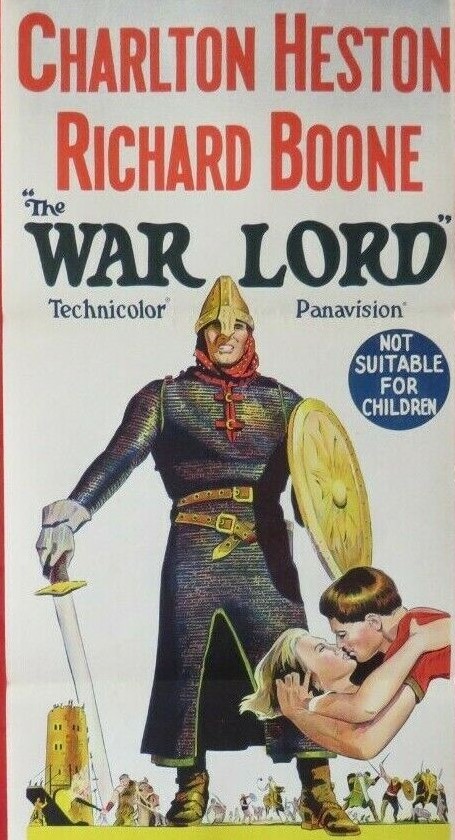
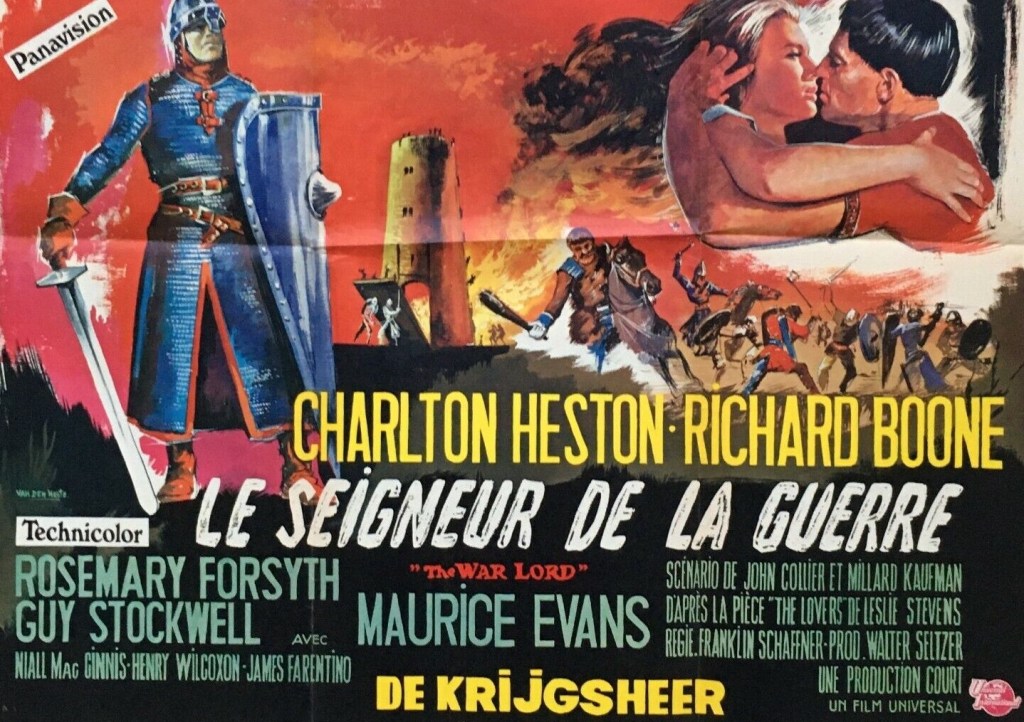
The War Lord (1965) ***

Contemporary audiences will gib at a narrative that relies on legalised rape. Audiences at the time had the same response but since then it has picked up considerable critical acclaim on account of its down-and-dirty portrayal of a medieval era far removed from the knight in shining armour. But it still pivots on the distasteful notion of “droit de seigneur”, the right of any noble to take the virginity of any female underling on their wedding night – it was motivation for William Wallace’s rebellion in Braveheart (1995).

The idea that this was pervasive or even occurred at all has been proven to be historically inaccurate. Logic tells you that any ruler wanting to keep his subjects in check would scarcely resort to wholesale rape that could spark disloyalty among his subjects. Or that any no one would be unaware of the dangers of inbreeding should the nobleman’s seed result in pregnancy.

What of course the movie does get right is that women were treated as chattels – “she’s mine” / “you’re mine” a recurrent refrain – or were makeweights in deals uniting the vested interests of kings or dukes.

As reward for years of service to the Duke of Ghent, Chrysagon (Charlton Heston) is handed a fiefdom in Normandy, prone to attack by Frisian raiders from the neighbouring Netherlands. In interrupting such an assault, Chrysagon captures the enemy chief’s son without being aware of it, prompting a later battle.

While the area boasts vestiges of normality, a priest and a strong tower, the inhabitants are inclined to the pagan rather than Christianity with rites (reminiscent of Game of Thrones) involving stone and trees while anyone using herbs for medicinal purposes is likely to be accused of witchcraft. Chrysagon takes a fancy to Bronwen (Rosemary Forsyth) already bethrothed to Marc (James Farentino). Egged on by his brother Draco (Guy Stockwell), Chrysagon decides to take up the option of droit de seigneur, but refuses to return the bride after the allotted time period (before dawn), incurring the wrath of the villagers who recruit the Frisians to their cause.

So it’s siege time although it seems unlikely that the attackers would be capable of producing such dangerous siege weapons in such a short time or that they wouldn’t simply resort to starving out the beseiged. Chrysagon’s  troops engage the attackers in time-honoured fashion from the top of the tower by arrow, boulders and boiling oil. Chysagon slides down a rope like Errol Flynn to prevent the raised drawbridge being lowered and uses a boat anchor to dislodge the siege tower. Battering rams and catapults soon enter the equation.

The only question-mark (unspoken) against Chrysagon’s employment of the “droit” privilege comes when the Duke demotes him and appoints Draco in his stead, prompting various endgame twists.

The battle is interesting enough, threat repeatedly countered, but there’s only so many times a director can cut to a soldier tumbling to his death. The ending is an anomaly, Chrysagon showing more respect to the son of his enemy than the wife of his villagers, and it seems odd that Draco is suddenly revealed as a bad guy, despite not being the one who triggered the conflict.

Chrysagon might have easily have fallen into the Martin Scorsese category of characters with “no redeeming features” – who are exempt apparently from the need for decency because of war – and it’s hard to summon up the necessary audience sympathy to make this picture work, especially given its starting point. Had Chrysagon merely fallen in love with Bronwen who reciprocated his feelings and that caused enmity among the villagers it would have been one thing but to start out from an historically inaccurate base is another.

One of the problems is that Bronwen doesn’t evolve. Her transition is from interesting to  passive. She has actually gone through a marriage ritual (of the Druid kind, but still binding as far as the villagers are concerned) and is therefore embarking on an adulterous relationship once the cock crows. It seems ludicrous, without allowing the woman dialog to express her feelings and acknowledge the peril of her actions, that she would believably take this route.  

So, if you like, accepting the droit de seigneur, in some ways it becomes a bolder picture, a major Hollywood star risking his reputation by playing a rapist, and in the way of all rapists justifying his action. And, like the characters in the recently-reviewed Play Dirty (1969) or Judith (1966), it becomes a question of individuals as pawns, the powerful taking advantage of position to abuse the weak. And it wouldn’t be the first time the innocent have suffered through a superior taking an indefensible approach.

Franklin Schaffner (Planet of the Apes, 1968) directed. Charlton Heston (Diamond Head) performs as if he’s the French equivalent of a Brit constantly biting on that stiff upper lip. Richard Boone (Rio Conchos, 1964) is wasted. Guy Stockwell (Tobruk, 1967) essays another weasel. It’s a picture of two halves for Rosemary Forsyth (Where It’s At, 1969) – while being wooed she’s good but then she’s pretty much dumped as far as the narrative goes.

Screenwriter John Collier, who later wrote the even creepier Some Call It Loving (1973) – an early Zalman King production – and Millard Kaufman (Raintree County, 1957) adapted the screenplay from an unusual source, a Broadway play by Leslie Stevens (Incubus, 1966) called The Lovers. The play had a different perspective, the bride ultimately committing suicide, while the War Lord and husband killed each other in a duel. Needless to say, there are no Frisians, so no siege, and no brother.

Before the arrival of Ridley Scott, this would been viewed as the best depiction of genuine medieval siege, so that part certainly still holds up. But the rest of it will only stand the test of time if you are willing to view it as an expression of the corruption of power.

Play Dirty (1969) ***

Heroism is a handicap in this grimly realistic, brutally cynical, ode to the futility of war. David Lean would have struggled to turn this stone-ridden desert into anything as romantic as his Lawrence of Arabia (1962) though he might have recognized the self-serving glory-hunting superior officers.

There’s a murkiness at the outset that is never quite clarified. You could easily assume that the long-range bunch of saboteurs led by Captain Leach (Nigel Davenport), with the peculiar habit of losing new officers, was involved in something more nefarious rather than doing its utmost to disrupt Rommel’s supply lines in North Africa during World War Two.

Brigadier Blore (Harry Andrews) appoints raw officer Captain Douglas (Michael Caine) to take charge of the next mission – a 400-mile trek to blow up a fuel dump.  Col Masters (Nigel Green), in overall charge of the commandos, bribes Leach to ensure Douglas comes back alive. Blore is using this small unit as a decoy before deploying a bigger outfit to complete the mission with the singular aim of snaffling the glory for himself.

Leach proves insolently disobedient, forcing Douglas at one point to draw his weapon on his crew. But when it comes down to a question of heroism vs survival, Leach takes control at knifepoint, preventing Douglas going to the aid of the larger outfit when ambushed by Germans.

It’s mostly a long trek, somewhat bogged down by mechanics of desert travel. You’ll be familiar with the process of rescuing jeeps buried in sand dunes and of personnel sheltering from sandstorms, so nothing much original there. What is innovative is the terrain. Stones aren’t conveniently grouped together, edges softened by time, as on a beach. They’re jagged- edged and less than a foot or so apart so as to more easily shred tires. So there’s a fair bit of waiting while tires are replaced.

Some decent tension is achieved through sequences dealing with mines – threat removed in different fashion from Tobruk (1967) or, for that matter, The English Patient (1996) – and in crawling under barbed wire.  But that’s undercut by the sheer brutality of the supposed British heroes slaughtering an Arab encampment and viewing a captured German nurse as an opportunity for rape.  

A couple of twists towards the end raise the excitement levels but it’s less an action picture than a study of the ordinary soldier at war. Captain Douglas, the only character worth rooting for, soon loses audience sympathy by foolish action and behavior as criminal as his charges.

A few inconsistencies detract. For a start, there’s no particular reason to assign Douglas to this patrol. Primarily a backroom boy, he’s put in charge because he was previously an oil executive. But it hardly takes specialist knowledge to lob bags of explosives at oil drums. And the ending seems particularly dumb. I can’t believe Douglas and especially the canny Leach, both dressed in German uniforms, would consider walking towards the arriving British forces waving a white flag rather than stripping off their uniforms and shouting in English to make themselves known to the trigger-happy British soldiers.

And a good chunk of tension is excised by the bribery. Why not leave the audience thinking that at any moment the bloody-minded Leach would dispatch an interfering officer rather than offering him a huge bounty (£75,000 at today’s prices) to prevent it?

It suffers from the same affliction as The Victors (1964) in that it sets out to make a point and sacrifices story and character to do so. That individuals will be pawns in pursuit of the greater good or glory is scarcely a novel notion.

Having said that, I thought Michael Caine (Gambit, 1966) was excellent in transitioning from law-abiding officer to someone happier to skirt any code of conduct. There’s no cheery Cockney here, more the kind of ruthlessness that would emerge more fully grown in Get Carter (1971). Nigel Davenport (Life at the Top, 1965) adds to his portfolio of sneaky, untrustworthy characters.  Equally, Harry Andrews (The Charge of the Light Brigade, 1968) has been here before, the kind of upper-class leader who behaves like a chess grandmaster.

In his first picture in half-a-decade Andre de Toth (The Mongols, 1961) produces a better result than you might expect from the material – screenplay courtesy of Melvyn Bragg (Isadora, 1968) and in her only known work Lotte Colin, mother-in-law of producer Harry Saltzman – and creates some exceptionally tense scenes and the occasional stunning image.

Anti-war campaigners line up here.

Rider on the Rain (1970) ****

This is not the Charles Bronson you think you know, the mean, truculent, monosyllabic persona who turned into a box office powerhouse later in the decade. It took the French to recognize the leading man qualities Hollywood determinedly ignored. God forbid, he is actually pretty charming, although his methods for squeezing information out of a suspect are, well, suspect. And he turns up pretty late in the picture, just when you think the focus is going to be on the suspect, Mellie (Marlene Jobert) and it’s going to be one of those pictures where an innocent woman is suspected of a crime and the man has to clear her name.

Except Mellie isn’t innocent. She’s killed a rapist who broke into her house and then dumped his body over the cliff. And she isn’t, officially at least, a suspect, local cop Inspector Toussaint (Jean Gaven) more interested in getting a loan from her husband, pilot Tony (Gabriele Tinti), to pay off gambling debts. Needless to say, any time the cop does knock on her door, she jumps out of her skin.

And she would have got away with the murder, except for the arrival of Dobbs (Charles Bronson). He turns up at a wedding, ensures she gets to see a newspaper headline of the murder, insinuates his way into her life, not too difficult once her husband heads off on another flight. She runs a bowling alley with her mother Juliette (Annie Cordy) who scarcely has a maternal bone in her body.

Rather than helping the cops solve the case, Dobbs is more interested in the red bag the rapist was carrying. But when she hands over the bag, it doesn’t contain the $60,000 Dobbs wants.  We never see what Dobbs gets up to when he’s not with Mellie. But we hear it. His investigations may be carried out off screen but he’s tailing her – knows she bought a ton of newspapers – and tells her what he’s found out by speaking to cops and neighbors. Even though she’s replaced the cartridges in the shotgun she used to kill the rapist, he knows the gun has been fired. When she claims she was aiming at rats in the cellar, he points to the marks on the wall, too high for even the most acrobatic rat.

Mellie is trapped in a claustrophobic world, assailed by her own guilt and a jealous husband with too much unexplained loose cash (drug smuggling is the implication), turns against her best friend, boutique owner Nicole (Jill) who had an affair with her husband, and against her mother whom as a child she caught in bed with another man, causing her father to dump the mother.

They started to get tricky with double bills in the 1970s, trying to suggest
the films were equally attractive, ignoring the fact that if they had been
such hits they wouldn’t have been paired in the first place.

Most of the tension is self-inflicted but Dobbs has thing about nuts and soon is whizzing shells across rooms, some trick where they break on impact with a window, but the noise is like a shot, too close to the blast of the shotgun.

Every twist ratchets up the tension. And by concentrating on the suspect the police are ignoring and making Dobbs, by default, the chief investigator, and nobody to turn to, Mellie is turned inside out by his mere presence, never mind, when exasperated, he employs his own interrogation method, akin to waterboarding, except the liquid is alcohol, forced down her throat until her lungs are full to bursting.

The last act is a bit murky, as the locale shifts to Paris, involving a brothel owner and a set of gangsters who are even more intent on humiliating Mellie. With echoes of Charade (1963) and Moment to Moment (1966), it’s superbly directed by Rene Clement (Is Paris Burning? 1965), who doles out clues and twists like he’s playing a hand at cards.

In spite of the concentration on tension, he takes the time to build up his characters. A series of emotional flashbacks show the fault-lines in Mellie’s character, no matter that she initially appears confident with fashionable short hairstyle and white outfits bound to attract attention. Dobbs’ obsession with suddenly chucking nut shells around maintains the tension and his cavalier tone, especially his jocular use of a nickname, suggests an interesting personality behind the tough guy pose.

Like his script for The Sleeping Car Murder (1965), screenwriter Sebastian Japrisot is as concerned with ordinary life as with the thriller elements.

Charles Bronson (Farewell, Friend / Adieu L’Ami, 1968)  delivers the best performance of his entire career, tough guy with a charming underbelly, kind of Cary Grant with muscle. Marlene Jobert (Catch Me a Spy, 1971) is excellent as the victim turned suspect, and even Jill Ireland, for whom a part was always found in husband Charlie’s movies, shows a different side to her screen persona.

A riveting watch.

Hurry Sundown (1967) *****

Otto Preminger’s drama was the first of a trio of heavyweight films in 1967 – the others being In the Heat of the Night and Guess Who’s Coming to Dinner – that took African American issues seriously. In post-war Georgia land-grabbing by ambitious Henry Warren (Michael Caine) pits him against World War Two vet Rod (John Philip Law) and African American farmer Reeve (Robert Hooks) who team up. Throw in a quintet of feisty women – Henry’s wife Julie Ann (Jane Fonda), Rod’s wife Lou (Faye Dunaway), schoolteacher Vivian (Diahann Carroll) – Reeve’s love interest – Henry’s lover Sukie (Donnie Banton) and Rod’s mother (Beah Richards) – and emotional confrontation comes thick and fast.

Preminger had spent most of the decade making films about big subjects – Exodus (1960), the politics behind the formation of Israel; Advise and Consent (1962), just politics; The Cardinal (1963), politics within the Roman Catholic Church; and In Harm’s Way (1965), Army politics and bluster around Pearl Harbor

Preminger is both economic and elegant. From opening dialogue to climactic court scene, the picture races along, and continuous use of tracking shots ensures the movie never gets bogged down. While there is no lynching, racist abuse, whether direct or indirect (through patronizing attitude) is never far from the surface. Corrupt Judge Purcell (Burgess Meredith) is by far the most vicious, his unrestrained language making you wince. But even those with more measured approaches have to play the game, Reeve gives a lift to Rod but has to let him off before they reach town in case anyone spots this, Rod forbidden, for example, to buy dynamite.

But the racists do not get it all their own way. Julie Ann stands up to the judge and her position in the community is so strong that others boycott the judge’s daughter’s wedding leading to the judge receiving a tongue-lashing from his wife. Weak Sheriff Coombs (George Kennedy) coming to arrest Rod is bamboozled by his female relatives while  Vivian charms her way past the judge.

The women are uniformly strong. Julia Ann goes from seductive wife to distraught mother, but in between capable of defrauding Rod’s mother, her childhood nanny, out of her inheritance. Lou resents her husband’s return after in his absence taking on a full-time job while running the farm and now resisting the idea of selling up to Henry. Rod’s mother, beholden to white men all her life, now turns against them. The judge’s daughter (Donnie Banton) makes no bones about the fact that she is marrying her “dull” fiancé for his money. This is no spoiler because you will have guessed some similar outcome but at the end it is Vivian who takes the initiative in her relationship with Rod and  marches into his house with her baggage, declaring she has come to stay.

Caine and Fonda.

And although the ruthless Henry is the bad guy, he, too, is afforded insight, soothing himself by playing a musical instrument, a man with talent who had “distracted” himself by pursuit of money. And there is another touching moment when he takes in a runaway child. Acting-wise, Michael Caine (Gambit, 1966) is a revelation. Gone is the trademark drawl and the laid- back physical characteristics. Here he talks snappily – and no quibbles with his Southern accent either – and strides quickly. That we can believe he is brutal, gentle, remorseful and ruthless is testament to his performance.

Similarly, this is a massive step forward in Jane Fonda’s (Cat Ballou, 1965) career, away from Hollywood comedies and sexed-up French dramas, and her internal conflict springs from being forced to choose between husband and son, between her innate sexiness that oozes out in every intimate scene and maternal longing to comfort her disturbed child. Her usual shrill delivery is tempered somewhat by the deeper emotions she is forced to bear. While her attempt to defraud Rod’s mother comes from a desire to keep her husband, her eyes tell you she knows that is no excuse.

What’s perhaps most surprising of all is the tenderness. There are wonderful, gentle love scenes between Caine and Fonda and Law and Dunaway.

Children, too, also unusually, play a central role. Henry’s callousness is no better demonstrated than in his earlier treatment of his son. Reeve’s eldest son also resents his father’s return and, viewing Henry as a more suitable adult, betrays his father. The Judge is obliged to drop one of the worst aspects of his racism in order to appease his daughter.  

The acting throughout is uniformly good. Dunaway’s debut won her a six-picture contract with Preminger. Singer Diahann Carroll’s role as a confident young woman led to a television series. Robert Hooks would also enjoy small-screen fame. The surprisingly effective John Philip Law would partner Fonda in sci-fi Barbarella (1968) and link up with Preminger again in the ill-fated Skidoo (1969). Horton Foote (To Kill a Mockingbird, 1962) and Thomas C. Ryan (The Heart Is A Lonely Hunter, 1968) wrote the screenplay based on the bestseller by K.B. Gilden.

Unfairly overlooked by Oscar votes, who preferred the other Poitier films, Hurry Sundown, despite the rawness of the language and the innate brutality meted out to African-Americans, has been vastly under-rated. It is worth another look because at its core is not just racism but big business which scarcely cares about the color of those it exploits. It is as much about the power shift in relationships and ambition.  

Playgirl After Dark / Too Hot to Handle (1960) ***

Passable British crime B-picture, mainlining on sleaze, plot as flimsy as the costumes of the dancers, rescued by, flipping her screen persona on its head, a heartfelt performance by Jayne Mansfield.  Career tumbling spectacularly after her Frank Tashlin heyday (The Girl Can’t Help It and Will Success Spoil Rock Hunter, both 1957) she was loaned out to any outfit that would have her. Director Terence Young’s (Dr No, 1962) career was also at a low ebb after Safari and Zarak (both 1956) while Carl Boehm (Peeping Tom, 1960) and future Carry On stalwart Barbara Windsor, minus trademark Cockney accent, were on the way up.

Ostensibly an expose of the Soho strip club business, invests too much time in cabaret, though Midnight Franklin’s (Jayne Mansfield) number is surprisingly well done. Parallel plots see journalist Robert (Carl Boehm) investigating the industry while rival night club owners Johnny Solo (Leo Genn) and Diamonds Dielli (Sheldon Lawrence) duke it out over the spoils.

As you might expect, such clubs are populated by seedy customers, some harmless like a Leipzig salesman falling for disinterested showgirl Lilliane (Danik Patisson), others on the creepier side like Mr Arpels (Martin Boddey) who tempts unwary girls with talk of setting them up in the movie business. Naturally, so many girls together, jealousies simmer and tensions flare, resulting, as you might expect, in a catfight. But that’s nothing compared to the beating handed out to Johnny by Diamonds’ thugs. Matters aren’t helped by Johnny’s manager Novak (Christopher Lee) being in the pay of the opposition.

Apart from wearing outfits that would give the censor of the time a heart attack, Midnight is really a sensible girl, hating violence, warning boyfriend Johnny to get out of the business before he ends up dead. She’s got few illusions left, hardly expecting Johnny to pop the question, but like Richard Widmark in yesterday’s Two Rode Together (1961) gradually becoming repelled by his actions.

For the most part she accepts that Johnny effectively pimps out his acts to wealthy customers like Arpels but recoils when he attempts to do so with Ponytail (Barbara Windsor) whom most people believe to be under-age. However, when Ponytail’s attempted rape turns into murder and the police turn up at the nightclub, Midnight, initially obeying the laws of omerta, turns on Johnny after she discovers his gun. But in a wonderful closing scene, she picks up the discarded flower he wore in his lapel and kisses it.

There’s some surprisingly potent dialogue and sharp one-liners – “that’s a very nice dress you nearly got on” / “I had a friend once but it didn’t take”/ “there’s not enough milk of human kindness around here to fill a baby’s bottle” / after a date with Arpels “some girls came back with promises…one came back with a baby.” A good bit more of such zingers and the movie would barrel along regardless of limp plot.

Energy is lost by focusing too long on the cabaret acts and on the growing romance between Robert and Lilliane. As glamorous fading nightclub star, Midnight provides the necessary oomph in more ways that one, but the movie would have benefitted by concentrating more on her ruefulness and self-awareness. Though besotted by Johnny, she knows he’s no lifetime ticket, tries to keep from herself as long as possible acknowledgement of his more sinister side, not so much knowing her place but aware which barriers not to cross. There’s a terrific scene in the middle of the night when she guesses he might be in trouble but hesitates over telephoning him in case this would be deemed over-familiar intrusion. Even she doesn’t know why she still hangs around a joint like this except “fish gotta swim, bird gotta fly.”

Bombastic on stage, she’s subtle off. You will come away believing Jayne Mansfield can actually act. But there’s nothing much to get excited about from the other performers, mostly in the stolid category, though it’s interesting to see what Barbara Windsor can do without  reverting to a Cockney accent. Oscar-nominated Leo Genn (55 Days at Peking, 1963) proves that even crooks can possess a stiff upper lip. At this point with only a couple of horror pictures to his name Christopher Lee (The Devil Rides Out, 1968) could still be found in dramatic fare, but this is no break-put role.

Herbert Kretzmer, credited with the screenplay along with Harry Lee (All That Heaven Allows, 1955), would go onto worldwide fame and enormous wealth for Anglicizing French hit musical Les Miserables. While posters boast of Eastman color, which would have added to enjoyment of the dance routines, you can pretty much only find this in black-and-white and with ten minutes lopped off.

Wanna feel sorry for Jayne Mansfield, this is for you.

Shalako (1968) ***

It’s a gripping and unusual opening. The jangling noise of metal beating upon metal. A trapped mountain lion surrounded by a posse of unkempt men. The beast driven into a killing zone. The camera ends up on a classy blonde in a top hat, Irina (Brigitte Bardot), drawing a bead on the animal. But as she shoots so does rugged cowboy Bosky (Stephen Boyd) and you can be sure his aim is more deadly. It wouldn’t do to have an upper-class European lady to be mauled to death by a vicious creature just because her ego got the better of her.

Except that’s not the opening. Instead, that’s sacrificed for a dumb theme tune and a few minutes over the credits watching titular hero Shalako (Sean Connery) doing what exactly? Nothing exciting that for sure. We see him riding I guess to prove he can sit as tall in the saddle as the stars of the genre like Alan Ladd, John Wayne, Gary Cooper, James Stewart, as if nobody expected James Bond to be able to complete such a transition. There’s a bit of waking up, more riding, drinking from a dirty stream, and more riding while composer Jim Dale struggles to find lyrics that rhyme with Shalako.

There’s a bit more exposition before Shalako does anything meaningful. We are introduced to a fistful of Europeans on a hunting party complete with butler (Eric Sykes) and guzzling champagne and escorted by a bunch of mean-looking cowboys looking on in envy though I doubt any would acquire a taste for champagne.

Then the real action starts. A bit’s been missed out explaining just why Irina took off on her own with just one man as escort to continue hunting and nobody thought fit to warn her this was Apache country. We know she’s in trouble because her escort is just about dead and Apaches are gathering. Enter Shalako to save the day. The first piece of dialogue between the most handsome man in the world and the screen’s most beautiful woman, a movie made just so Connery, at his Bond peak, and Bardot, in her most expensive picture, could strike sparks off each other,  is hardly something to treasure. It’s almost priceless for its mundanity. “You all right?” grunts Shalako. “Yes,” replies the breathless heroine.

But trust the British to bring that epitome of British moviemaking, the class war, to that most democratic of movie species, the western. It’s ironic that in the country where freedom is a given  – slavery long since abolished in the period this movie was set – members of the hunting party are fettered. Irina is little more than bait. You might as well have staked her out, hoping to snare German aristocrat von Hallstatt (Peter van Eyck). Marriage would cure the financial woes of her debt-ridden sister Lady Daggett (Honor Blackman) and husband Sir Charles (Jack Jawkins). Von Hallstatt doesn’t believe in making romantic overtures, it would be, like so many aristocratic marriages, a contract of convenience; he acquires beauty, she gets wealth.

To complicate matters Lady Daggett has a roving eye which has settled on Bosky, and to complicate matters even further, nobody should be firing rifles, even if only for sport, in Apache territory. It’s not long before the Apaches take umbrage and launch an attack. And it takes even less time for Bosky and his buddies to take off, leaving their charges poorly defended in a makeshift fort.

It takes way too long to sort out all these plot machinations and get to the meat of the story which is finding a way of putting Connery and Bardot together and when they are not the movie trundles along without much in the way of screen sparks. It could have done with an entirely different scenario. Something akin to Soldier Blue (1970) would have worked a treat, with roles reversed of course back to the traditional of experienced male tending the inexperienced female as they battle through enemy territory.

You needed to get this pair together – and quick – for the movie to find any steam at all. As it is, it’s somewhat laborious. While the action sequences are well done and Shalako scores in the western lore department, you wouldn’t have thought a mountaineering subplot could have produced so few thrills, its only purpose, plot-wise, to ensure that von Hallstatt acquires some credibility (he’s the mountaineer) and that the group can reach a plateau whose main attraction, as lovers of westerns will already be aware, is a pool where in the great Hollywood tradition a woman can disport herself half-naked. Shalako, in sneaking up on her, comes across like a bit of a peeping tom.

Sean Connery (The Hill, 1965) is convincing enough as a cowboy. He certainly doesn’t look out of place on a horse but it takes far too long for the expected romance to begin. Brigitte Bardot (Viva Maria!, 1965) is better than you might expect as a sharpshooter, but not quite in the fiery class of a Claudia Cardinale (The Professionals, 1966) or even Maureen O’Hara (The Rare Breed, 1965) and she’s not really given the dialog necessary to fully establish the independence of her character.

Director Edward Dmytryk (Mirage, 1965) does his best with an overly-complicated script and some cumbersome set-pieces and it would have worked far better if a few characters and reams of sub-plot had been chucked aside to bring the stars together quicker. While Connery does the riding and shooting well enough he lacks the grizzled lived-in face of his famed western predecessors and I get a sense of him trying too hard. And, as I said, it wouldn’t have taken much to pep up Bardot.

Having complained about the subsidiary characters, they are all well-drawn. Stephen Boyd (The Big Gamble, 1961) makes on helluva mean cowboy, Honor Blackman (Moment to Moment, 1966) is excellent as a predatory female. Aristocratic pair Peter van Eyck (Station Six Sahara, 1963) and Jack Hawkins (Masquerade, 1965) are the kind of actors who can denote fallen status with facial expression rather than requiring lumps of dialog. But Eric Sykes (The Plank, 1967) is really a British in-joke.

James Griffith and screenwriting partner Hal Hopper had previously worked on Russ Meyer epics like Lorna (1965). The original story came from  a novel by Louis L’Amour (Catlow, 1971).

Out-with his guise as James Bond, Connery – excepting Robin and Marian (1976) and Cuba (1979) – was not one of the screen’s great lovers so this would have been the perfect chance  to hone those particular credentials. But like the entire picture this was a missed opportunity. When the best scene is the brutal suffocation of Honor Blackman and not the two stars canoodling, you can see the target was missed by miles.

Genghis Khan (1965) ****

Hollywood was never reined in by the strictures of history, much preferring fiction to fact for dramatic effect, and that’s largely the case here, although the titular hero’s real life remains shrouded in myth.

If you do catch this surprisingly good feature, make sure it’s not one of the many pan-and-scan atrocities on the market. I watched this in the proper Panavision ratio which meant it occupied only one-third of my television screen, but in that format it’s terrific. It’s a bit of an anomaly for a decade that churned out high-class historical epics like El Cid (1961) because this clocks in about a hour short of other films in the genre and there’s no star actor or director to speak of and no Yakima Canutt to handle the second unit action scenes.

Omar Sharif’s marquee value at this point was so low that if you check out any of the original posters you’ll note that his name hardly rates a mention and he also comes at the very end of the opening screen credits. Although this is post-Lawrence of Arabia (1962), it’s pre-Doctor Zhivago (1965), suggesting nobody had a clue how to market his talents.

Director Henry Levin was a journeyman, fifty films under his belt, best known for not a great deal except for, following this, the second and third in the Matt Helm spy series. Given this film was critically ignored on release and since, and a flop to boot, it definitely falls into the “Worth a Look” category. Although there are few stand-out scenes of the artistic variety such as pepper Lawrence of Arabia or El Cid, this is still well put together and Levin shows an aptness for the widescreen.

The narrative breaks down into three parts – the first section describing enslavement of Genghis Khan (Omar Sharif) by nemesis Jamuga (Stephen Boyd – the picture’s star according to poster and screen credits) – before banding together rival tribes in revolt; the second part a long trek to China; and the third encompassing a final battle and hand-to-hand combat with Jamuga. For a two-hour picture it has tremendous sweep, not just the scenery and the battle scenes, but political intrigue, romance, a rape scene and even clever comedy. Genghis Khan  believes his glory is predestined, but he has very modern ideas about the role of women.

The best section, oddly enough, is set in China where Genghis engages in a duel of wits with the distinctively contradictory Emperor (Robert Morley), but that’s not to detract from the film’s other qualities, the action brilliantly handled, especially the chaos of battle, the romance touching, and the dialog intelligent and often epigrammatic.

Unlike James Mason (Age of Consent, 1969) who makes a calamitous attempt at a Chinese accent, Robert Morley (Some Girls Do, 1969), costume apart and looking as if he has just walked out of an English country house, but his plummy tones belie a very believable character. Stephen Boyd (Assignment K, 1968) shines as the villain of the piece. Telly Savalas (Battle of the Bulge, 1965) and Woody Strode (The Professionals, 1966) have decent parts as Khan’s s sidekicks, the former unexpectedly bearing the brunt of the film’s comedy. French actress Francoise Dorleac (Billion Dollar Brain, 1967) is effective as Sharif’s wife.

Hitchcock stole one of his most famous ideas from Genghis Khan. About the only scene in Torn Curtain (1966) to receive universal praise was a killing carried out to a soundtrack of nothing more than the grunts of assailant and victim. But, here, where the score by Yugoslavian composer Dusan Radic was extensively employed, the rape scene is silent and just as stunning. If the only prints widely available are of the pan-and-scan variety I’m not surprised the film has been for so long overlooked, but if you can get hold of one in the preferred format you will be in for a surprise.      

Discover WordPress

A daily selection of the best content published on WordPress, collected for you by humans who love to read.

The Atavist Magazine

by Brian Hannan

WordPress.com News

The latest news on WordPress.com and the WordPress community.