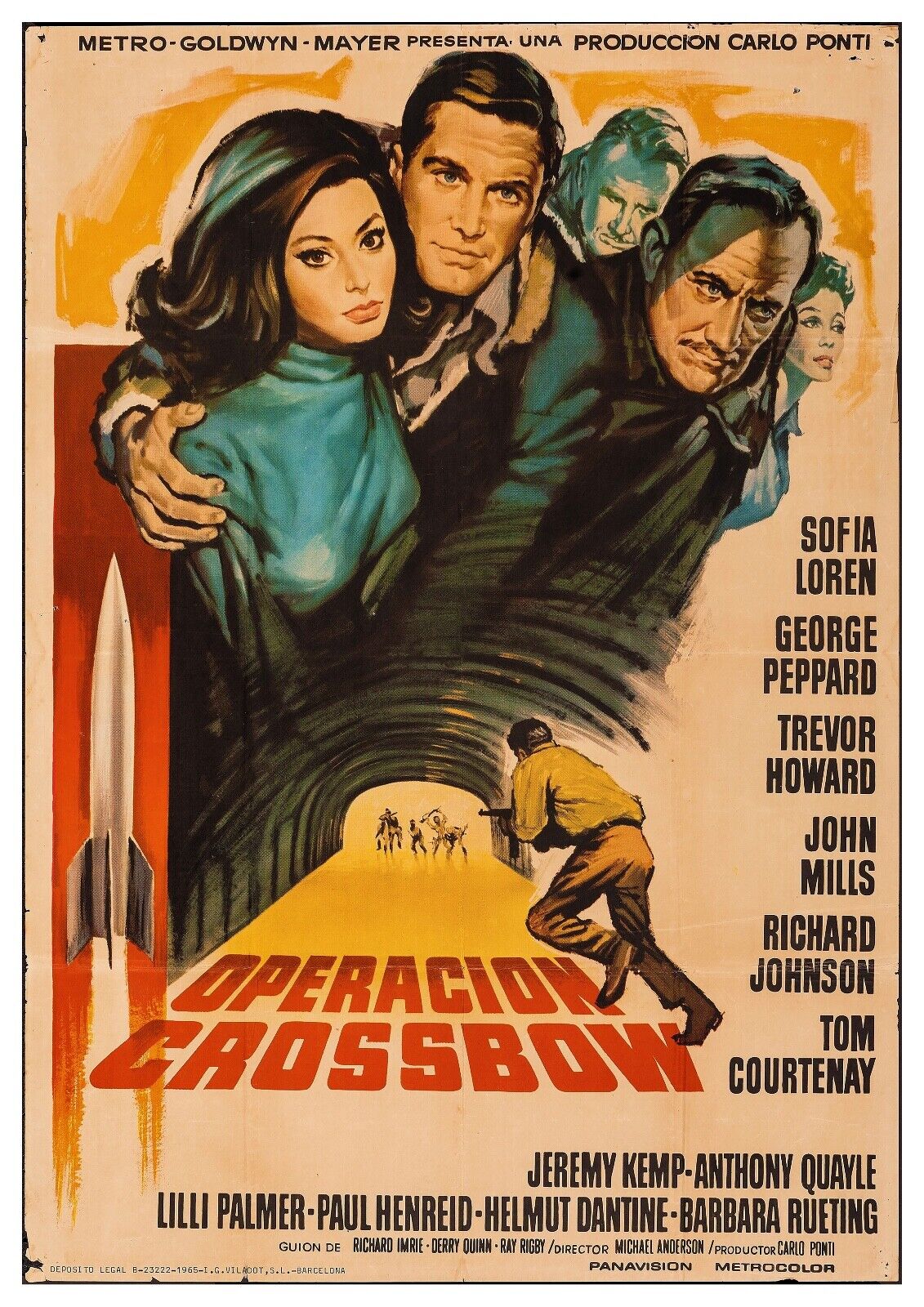
A clever mixture of detail and derring-do, World War Two picture Operation Crossbow (1965) – based on the true story of Allied infiltration of a German rocket factory – was a surprising hit at the British box office. The picture took a risk in keeping star George Peppard hidden from view for the first 28 minutes (top-billed Sophia Loren took nearly another 20 minutes to show up). Prior to their appearances the opening sequences were loaded up with a roll-call of British stars familiar with the genre in the vein of John Mills (Ice Cold in Alex, 1958), Trevor Howard (Cockleshell Heroes, 1955) and Richard Todd (The Dam Busters, 1955). Anthony Quayle, who puts in a later appearance, was also a war movie veteran after turns in Battle of the River Plate (1956), Ice Cold in Alex and The Guns of Navarone (1961).
Most war films relating to destroying a vital enemy base involved bombing (The Dam Busters, 633 Squadron, 1964), sinking (Sink the Bismarck!, 1962) or blowing things up (The Guns of Navarone, 1961). Operation Crossbow falls into the last-named category. The story breaks down into four sections: the discovery towards the end of the war by the British that the Germans are forging ahead with building V1 and V2 rockets; the recruitment and training of spies to parachute into Occupied France; a tense sequence abroad where complications arise; and, finally, attempts to obliterate the rocket plant.
Director Michael Anderson (The Dam Busters) switches through the genres from docu-drama to spy film to action adventure, further authenticity added by bold use (for a mainstream picture) of subtitles, all characters speaking in their native tongues. Various real-life characters are portrayed, among them photo reconnaissance expert Constance Babington Smith (Sylvia Sims), German aviatrix Hannah Reitsch (Barbara Rutting) and Duncan Sandys (Richard Johnson) who was on the British War Cabinet Committee.
Trevor Howard, at his irascible best, is the scientist pouring scorn on the idea of rockets – until they start raining down on London. Volunteers – Peppard, Tom Courtenay (Billy Liar, 1963) and Jeremy Kemp (who appeared with Peppard the same year in The Blue Max) – trained to spike the new weapon are recruited primarily on their language skills. Character is sketchy, Peppard designated a womaniser because he arrives in a taxi with two women.
But the operation has been assembled in such haste that not enough attention has been paid to the identities assumed by the agents. Courtenay’s character turns out to be wanted for murder. Peppard is accosted by his character’s divorced wife (Loren). So the mission faces immediate exposure. Although Loren’s role in terms of screen time amounts to little more than a cameo, she delivers a powerful emotional performance to a picture that could as easily have got by on tension alone. The harsh realities of war are shown in abundance. Twists come thick and fast in the second half, not least that Peppard’s face has become known, before the movie reaches a thrilling denouement.
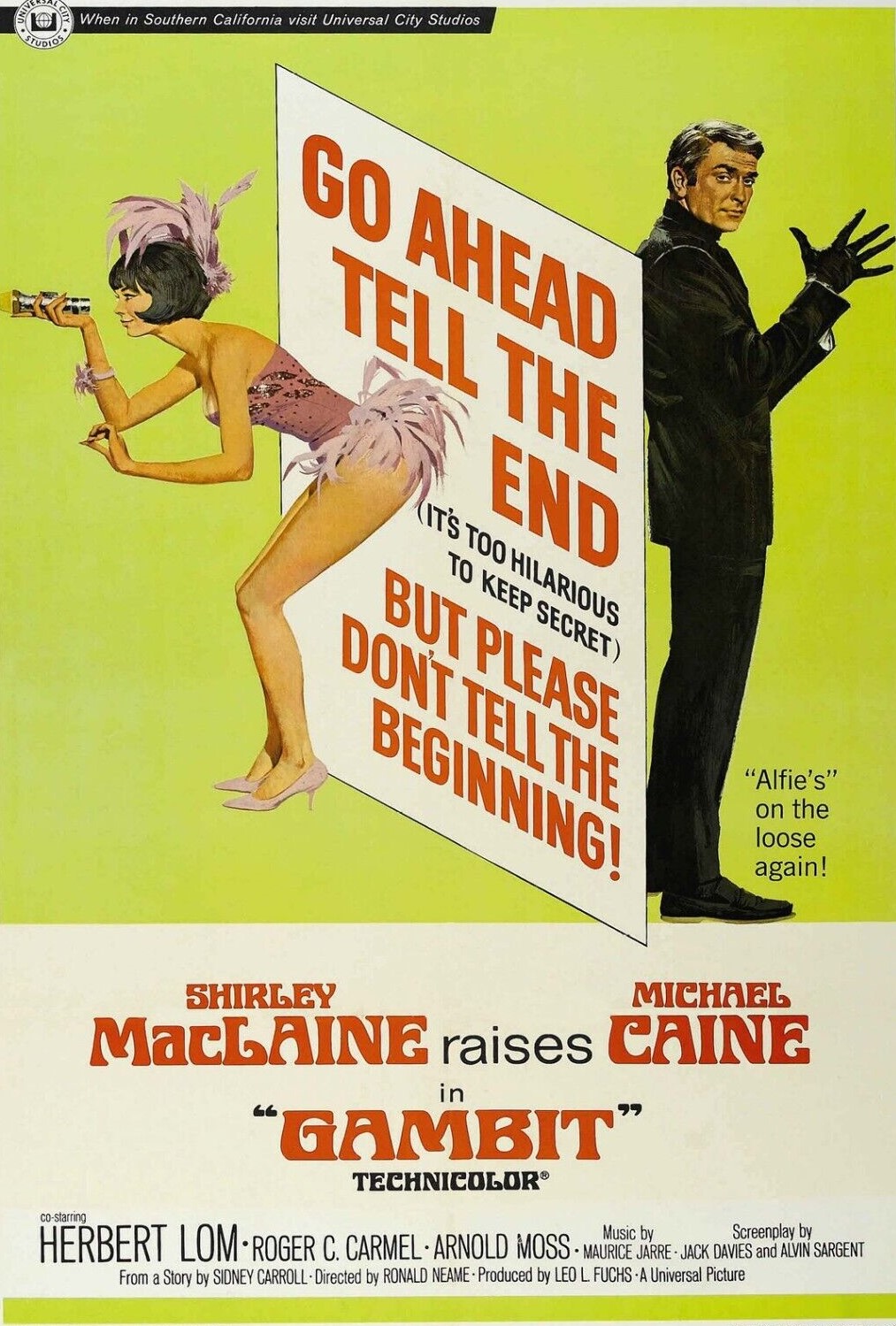
The heist movie – as epitomised by The Asphalt Jungle (1950), The Killing (1958) and Jules Dassin’s Rififi (1955) and Topkapi (1954) – had tended to be a relatively low-budget affair. Top-ranking stars steered clear because complicated plot often got in the way of character development In the highly polished and entertaining Gambit British director Ronald Neame’s riff on the genre involved a narrative shift worthy of Christopher Nolan, Quentin Tarantino and, of course, Akira Kurosawa who had with Rashomon (1950) single-handedly invented the complex point-of-view.
Neame brought another couple of other aces out of the deck. First of all, there was the fun of watching over-confident thief Michael Caine’s apparently foolproof plans come unstuck. Secondly, in a romantic dynamic in the vein of It Happened One Night (1934) the less accomplished female (Shirley MacLaine) proves more accomplished than the male.
Gambit was also a clear demonstration of the power of the female star not just in the plot complications but from the fact that Caine owed his big Hollywood break to MacLaine, the actress having the power of veto over the male lead and, equally, the contractual right to choose her co-star.
The movie had gone through an interesting development phase. The original script by director Bryan Forbes (King Rat, 1965) had Cary Grant in the central (i.e MacLaine) role. Rewritten by Jack Davies (Those Magnificent Men in Their Flying Machines, 1965) and in his movie debut Alvin Sargent (The Stalking Moon, 1968) the main character underwent a gender shift.
After Psycho (1960) audiences had become used to being messed around. Stars could be killed off halfway through or not appear (Operation Crossbow a classic example) until well into the movie. Neame was not quite so bold but what audiences made of the usually garrulous MacLaine being rendered mute during the early part of the picture was anybody’s guess, perhaps the dumb show was a joke in itself.
But lack of dialogue did not prevent MacLaine from stealing the show and proving what an adept comedienne she was, a barrage of submissive looks enough to send an audience into hysterics.
In essence, Caine plays two characters. In the opening segment he is the brash, cocky English gentleman-thief at the top of his game, bossing MacLaine around, gulling his mark (Herbert Lom) with an audacious plan to steal an expensive sculpture. In his version of events his plan goes off without a hitch. But when we switch to the MacLaine perspective, in which nothing goes according to plan, his cool demeanour is sorely tested and he turns into a frustrated idiot.
Watching the movie now, you can almost imagine that the MacLaine character, with a host of useless facts at her fingertips, was making fun of Caine’s well-known love of trivia, but that predated the actor’s acknowledgement of this aspect of his real-life character.
What makes the movie so much fun is that both parts of the film work and for the same reasons: believable characters; exciting heists and plenty of twists. The initial premise is that Caine recruits Hong Kong dancer MacLaine due to her startling resemblance to the late wife of Arab billionaire Herbert Lom as part of a ploy to relieve him of a priceless artefact.
While Lom is falling for MacLaine, Caine moves in for the kill with an ingenious heist. Mission accomplished he pays her off. But in the real version of the story, as seen through her eyes, Lom does not fall for the ridiculous scam, Caine’s plan fails to work until MacLaine comes to the rescue. Meanwhile, MacLaine has fallen for Caine, but does not want to be in love with a criminal. Although Caine initially resists his own emotions, he, too, takes the romantic plunge except that to win her he may have to lose what he prizes more.
As I mentioned it is awash with twists and the heists themselves are exceptionally well done but the screen chemistry between the two leads is terrific. Caine, who had otherwise been in control in his previous starring roles as the upper-class officer in Zulu (1963), spy Harry Palmer in The Ipcress File (1965) and the womanising Alfie (1966) – The Wrong Box (1966) was an ensemble item – was taking a chance in playing a character who would effectively play second fiddle to the star and in terms of the thief often appears out-of-control. MacLaine was more obviously in her safety zone. Hollywood spent a lot of time investing in screen partnerships, mostly failing, but this pairing certainly succeeded.
It’s the miracle of cinema. A supporting actor whom you might have glimpsed in a variety of roles over the preceding years suddenly appears as if by magic in a new screen persona and is hailed as a new star. One such was Walter Matthau. From the lecherous neighbor in Strangers When We Meet (1960), good guy in Lonely Are the Brave (1962), bad guy in Charade (1963) and Mirage (1965) and tetchy arrogant analyst in Fail Safe (1964), as if undergoing metamorphosis he creates the slimy, grouchy, crouchy, greedy lawyer duping his brother-in-law in Billy Wilder’s too-obvious satire The Fortune Cookie, beating the top-billed Jack Lemmon (How To Murder Your Wife, 1965) into a cocked hat.
It doesn’t help Lemmon that this most physical of actors is physically constrained for the bulk of the picture, trussed up within an inch of his life as the key ingredient in a million-dollar insurance scam. And Matthau makes the most of the opportunity, dominating the screen not just with his octopus-like arms, but with his facial expressions, his snarling and growling and snapping, as if this was in fact a one-man movie. He’s so dominant that you almost forget Lemmon, an unavoidable force in most of his movies, is there.
And it’s true that television cameraman Harry Hinkle (Jack Lemmon) is a patsy, duped by his adulterous wife Sandy (Judi West), conned by ambulance-chasing lawyer Willie Gringrich (Walter Matthau) into believing that exaggerating the injury he suffered from colliding with pro football player Boom Boom (Ron Rich) will bring her scurrying back. Never mind that while on the phone apparently going with her ex-husband’s fantasies, we can see her current boyfriend in the background lying abed or taking a shower.
But then Willie has everyone figured out. He can play highball or lowball, he knows every trick in the book and if you try to challenge him he can quote chapter and verse on every personal injury claim over the last century that would favor the victim. And he expects his opposite numbers to play dirty too, and uses to his own advantage the microphones and cameras they have planted in the apartment where Harry is purportedly recuperating.
There’s not much more to the picture than to enjoy Willie hoodwinking everybody in sight. But he’s such a performer to watch that you will be rooting for him rather than his sad sack brother-in-law who you know has paid-up membership of the Suckers Union.
Not for the first time, foreign distributors felt they were saddled with an unworkable title so in the UK it became Meet Whiplash Willie even though the idea of the con of the whiplash injuries in supposed car accidents was more prevalent in the US than Britain.
There’s some neat observations of the way law firms work, and the way medical experts refuse to commit in case they are later sued for a wrong diagnosis, and there’s some cute stuff about nuns with the gambling habit and seeing Boom Boom fall apart with guilt. But given the movie’s running time and the talent involved – script by Billy Wilder and I.A.L. Diamond (Some Like it Hot, 1959) and directed by the said Wilder – it’s not as funny as it could be and sometimes it feels like they’re scraping the barrel to squeeze out an unfunny joke.
But it hardly matters. This could be Fail Safe and with this Walter Matthau persona on the loose you wouldn’t care tuppence if the Russians bombed the hell out of everyone as long as Matthau was in the middle of the action, working out how to chisel a bigger piece for himself, and playing everyone for the dumb schmucks they are.
After this Walter Matthau – as unlikely a mainline star as Lee Marvin or Charles Bronson – never looked back. Unlike other major stars he never had to be completely trustworthy and was almost virtually responsible for bringing a severe dose of cynicism to the forefront of American acting. He could charm you if he set out to do so, but you better keep your wits about you because the chances are he would be robbing you blind.
If The Odd Couple (1967) set the seal on one of Hollywood’s greatest comedy partnerships, The Fortune Cookie was where it all began. Lemmon isn’t bad, just out-acted, and we’ve seen his whiny/forlorn/dumb act many times before. Judi West (A Man Called Gannon, 1968) has the other plum role as the blonde who is anything but dumb and would have proved an ideal partner for Gringrich except he would have seen through her too easily. Ron Rich (Chubasco, 1968) plays the only other character who isn’t spun out of a cliché.
Below par Wilder redeemed by heavenly performance by Matthau.
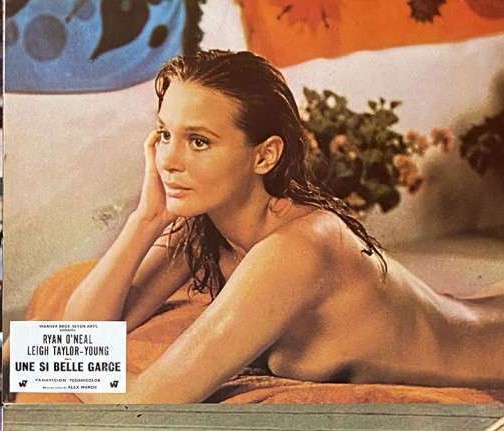
Femme fatale Nancy (Leigh Taylor-Young) makes a fair bid for the coveted Bunny Boiler of the Year Award. Had she chanced upon the right wrong guy who could channel her inherent viciousness she could have turned into Bonnie Parker. The only thing that holds her back from being a feminist icon, taking revenge for male betrayal, is her lack of independence.
Mistress to rich farmer Ray (James Daly), she teases the hell out of his head honcho Bob (Robert Webber), makes love in a graveyard, and fuels her amorality by going from breaking windows, attempted burglary and big-time heist to driving cars off the road and murder.
Temptation – Nancy-style.
Dupe is Vietnam vet Jack (Ryan O’Neal) who works as a hotel handyman and happily two-times her with single mother Joanne (Lee Grant).
Although easy with her charms, it’s sex that comes back to bite her when Ray explains that all this heady living comes at a price, pimping her out to a Senator he wants to impress. Whether that turns her against all men, including the dupe who she suspects of making out with Joanne, or whether she is plotting simple revenge against Ray isn’t made clear, but like the best femme fatales she has her eye on the loot that could bring her freedom and doesn’t much care what it costs to get it.
Nobody much cared for this picture, either, but I can’t see why. Sure, too much time is spent on Jack – he gets slung out of a job picking pickles for getting into a fight, and he lands on his feet with a friendly hotel owner Sam (Van Heflin) who buys him beers and even makes his breakfast, and pretty much could have the pick of any girl who walks into a bar. But that’s the usual narrative for film noir, pointing out, usually over and over, what an easy mark he is for a determined woman.
Unusual for the foreign title to be better than the original but this certainly captures the character better.
Nancy could have been less obvious, but she uses her perceived availability as a potent weapon – the scene where she holds her naked body just enough away from the panting Bob while probing him about his wife and children, is a classic – and she doesn’t make it easy for Jack either, although his reward is a drawn-out striptease. She’s the typical bored young woman looking for kicks, and like Pretty Poison (1968) you have to suspect that there’s considerable calculation behind what appear like spur-of-the-moment decisions, trying to work out just how far the dupe will go to retain her favors.
So while she races through the gears, Jack seems stuck on the starting grid, as his apparent good luck turns into confusion. And although he’s got the looks to attract women, he hasn’t the brains to understand them. He’s so dumb you just want Nancy to get away with it. If there’s a weak spot in the movie it’s that he just isn’t interesting enough to spend any screen time with. He boasts of having committed misdemeanours and he’s got a temper when roused but actually he’s your typical lost Sixties character looking for more stability in his life.
Unusually for a movie that’s drawn so much criticism, the supporting characters are quite appealing. Sam is also a very worldly Justice of the Peace. Ray, far from being an easy conquest, is a hardass, the scene where he deadpans a line that it would take him, oh, a week to replace her if she fails to sleep with the Senator is priceless. There’s also some decent stuff about war, how Jack never even saw the enemy he was killing. And Joanne is a great study, another woman endlessly drawn to the wrong men, who can keep her dangling while never committing.
And beyond the scene where Nancy poses as a naked statue in a graveyard that is obviously unforgettable, there’s a marvellous scene where Jack wakes up in a strange house to the sound of tapping. When, finally, he opens his eyes, he sees a small girl tapping her cup at the breakfast table; Joanne has a daughter she omitted to mention.
This was the first of Elmore Leonard’s crime novels to be adapted for the movies. But he wasn’t a Hollywood unknown. He supplied the source material for 3.10 to Yuma (1957) and Hombre (1967). And at this point he was keen on setting his stories in poorer areas, as well as pickle farming here, the Kentucky backwoods are the setting for The Moonshine War (1970) and melon farming for Mr Majestyk (1974). There’s not a million miles between Mr Majestyk reaching for his gun when threatened and Nancy for one when betrayed, but somehow he’s in the right and she’s in the wrong.
And while you’re at it you might as well reflect on the complexities of Hollywood. Leigh Taylor-Young (I Love You, Alice B. Toklas, 1968) carries this picture and despite what the posters show was top-billed. But she didn’t get one more starring role. Two flops in a row – this and The Games (1970) – and Ryan O’Neal gets Love Story (1971) and he’s king of the hill.
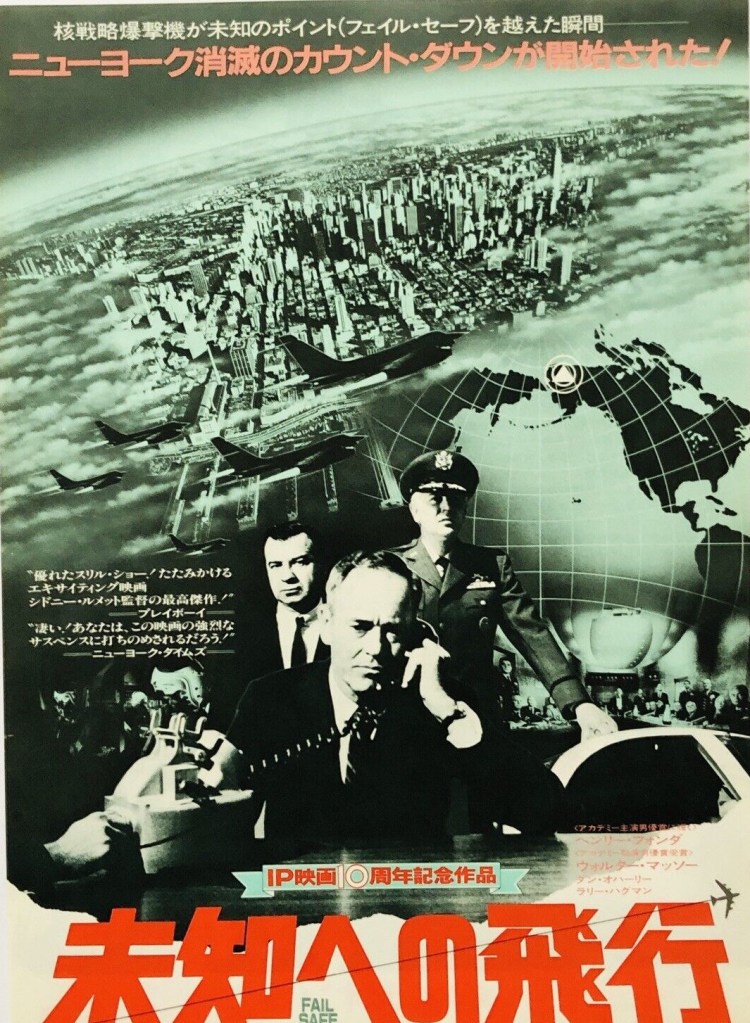
Given unexpected heft by current concerns over AI. Human error, it appears, is more simple to correct than computer malfunction. Once a course of action commences, machines have no way of checking it. And paranoia is the first casualty of truth. Bear in mind this was shockingly contemporary at the time it was made, the world in constant fear of nuclear war, the Cold War, that seemingly endless stalemate doing little to pacify terror.
Those whose job it ease the best outcome in the event of nuclear war were always inclined to rationalize staggering death tolls. So we begin with a late night discussion in which political analyst Dr Groeteschele (Walter Matthau) makes the argument that in the event of war, the country with the fewest casualties is the winner and in a nod to the ironic suggests the most likely survivors would be the worst type of convict, imprisoned underground, and office workers protected from the blast by being surrounded by filing cabinets crammed full of paper.
Just before the real drama begins there’s a neat scene where a women, turned on by a powerful man, makes a move on the doctor only to be slapped into place, sternly told by the prim analyst that he’s not of “her kind.” That’s not the only human element in the tale. the highest levels of secrecy may force top-level Army and Government executives to sacrifice families.
For no accountable reason, jets with nuclear warheads shift into an attacking position on the Russian border, the target if not stopped Moscow. The planes are unstoppable once they commence attack, unable to turn away from a strict sequence of pre-determined action. Not even the personal intervention by the President (Henry Fonda) of the United States can affect the outcome, the pilots already trained to ignore such an action on the grounds that the enemy could be imitating the President’s voice.
When the planes fail to turn back, the only option is for the Americans to blow their own planes out of the sky, an action that appears not just inconceivable to the Army personnel but treasonable. High-rankings officers ruthless trained for battle and to observe the protocol of obeying orders find this unconscionable.
Three dramas take place at once. On the ground the Army chiefs try to explore every option to avoid the unthinkable while battling with their own consciences at what appears to be the only way out. The President on the hotline to the Russian premier has to circumvent natural suspicion that this is a cunning ploy by the Yanks and then come to some agreement with the Russians on the assumption that Moscow may yet come under attack. We, the audience, are playing out the third element in our minds, a series of terrifying what if scenarios with indescribable consequence.
I’m not going to reveal the shock ending because it came as a hell of a shock to me, given I’d not seen the picture in decades.
It’s brilliantly-made with almost futuristic sets and noir lighting and the President effectively physically imprisoned, and not just by his conscience, stuck in a featureless cell presumably in the pits of the White House arguing the toss with the Russian chief, his only companion the translator (Larry Hagman) whose face seems to get greyer and greyer as he transmits worse and worse news.
Dr Groeteschele makes matters worse, at least to a pacifist left-wing viewer (though an opposite view would be taken by the hawks), by urging the President to take advantage of computer error and “first strike” and blow Russia to pieces, assuming that indulging in the attack option will result in fewer casualties in America, and thus, following his earlier projections, not just win the war but rid the word of the fear of nuclear war.
While the style is documentary, it’s a riveting watch. The tension is unbearable. Some like Col Cascio (Fritz Weaver) succumb to the pressure while the commanding General Black (Dan O’Herlihy) retains a stolid soldierly presence.
Sidney Lumet (The Pawnbroker, 1964) doesn’t put a foot wrong. Taking the line – rather than in The Bedford Incident (1965) of the wrong man with his finger on the button – of the right man trying to make the best of a botched job, he delivers a just superb picture. Walter Bernstein (The Magnificent Seven, 1960) does a terrific job in delivering a taut screenplay from a more meandering novel by Eugene Burdick and Harvey Wheeler.
There probably couldn’t be a more prescient movie for today.
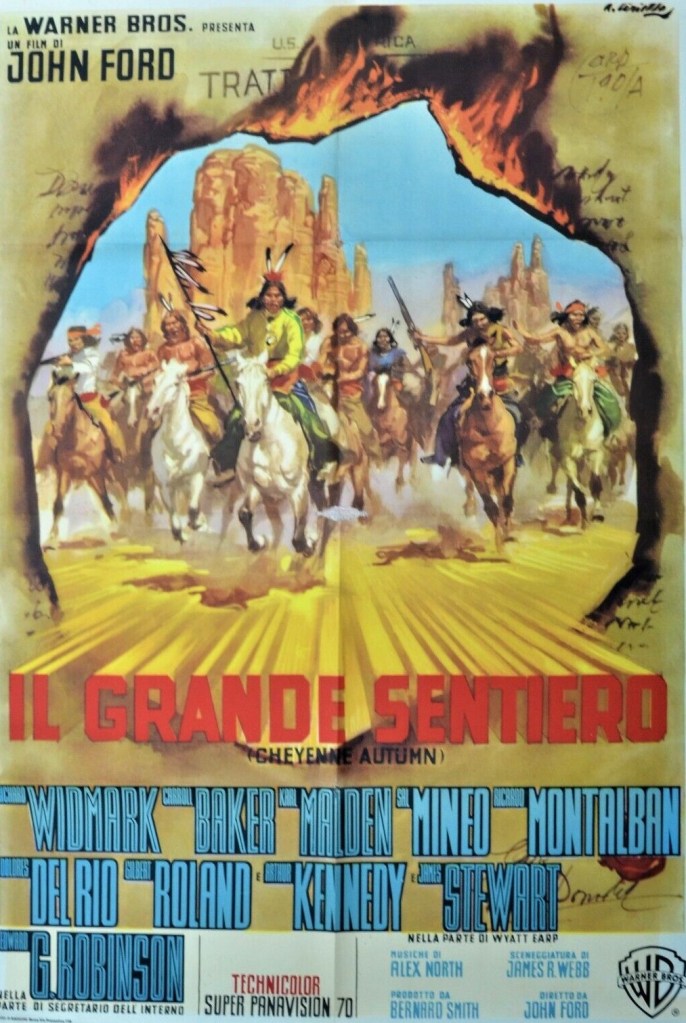
Lack of narrative energy and focus sabotages well-meaning atonement epic. John Ford’s final western, made half a decade before Dee Brown’s seminal Bury My Heart at Wounded Knee was published, is not the epitaph he might have envisioned. For a start, it’s just not rigorous enough. You might accept there’s no mention of the word “genocide” since until Vietnam the United States was hardly capable of mea culpa.
But that we learn very little about the Native Americans trekking 1500 miles from their Oklahoma reservation to their Wyoming homeland beyond that it’s an exhausting trek. Although the Native Americans are treated in a positive manner, and the U.S. Cavalry and Government are seen as inefficient and corrupt, little has been invested in the Native American characters.
The crux of their story is that the two brothers – Dull Knife (Gilbert Roland) and Little Wolf (Ricardo Montalban) leading the journey – eventually go their separate ways, and that a younger headstrong Native American steals one of the brother’s wives. Instead, more attention is paid to a young do-gooding Quaker teacher Deborah Wright (Carroll Baker) who opts to join them on their quest in order to look after the children attending her classes.
Caustic Captain Archer (Richard Widmark), either in person or through voice-over, is the most notable character, fighting his superiors to allow the wanderers unrestricted passage and eventually winning over Secretary of the Interior Carl Schurz (Edward G. Robinson) to ease the last stages of their journey.
The plot diverges from the Exodus-style mission for a totally irrelevant sequence set in Dodge City featuring a gambling Wyatt Earp (James Stewart) and Doc Holliday (Arthur Kennedy) and a spurious bunch of townspeople getting over-excited at the prospect of being attacked. More to the point, when Little Wolf splits from Dull Knife and heads for the sanctuary of Fort Robinson in Nebraska they are imprisoned by authoritative Captain Wessels (Karl Malden), gunning for promotion and in an echo of German apology for the Holocaust “only obeying orders,” with savage consequence.
The couple of action sequences show the fighting skills and tactical ability of the Native Americans but this is undermined by also showing them as sly and cunning, hiding weaponry under campfires and in baby’s clothing.
You might also be asking just how big is Monument Valley for it seems to be the location for about half the picture. Sure, it’s a terrific backdrop and possibly never been better utilized but it’s an example of the creative lethargy not to follow in more authentic manner the actual route of the Cheyenne. Adding to that disgruntlement you might also note the omission of any Native Americans in the leading roles, those parts being taken by Mexicans or dark-skinned Americans.
While John Ford clearly had his heart in the right place, his fans weren’t ready for this kind of revisionist approach – the movie, a 70mm roadshow, was a big flop at the box office – and the result just doesn’t do the subject justice. And in fact a corrective correlative to How the West Was Won (1962) perhaps entitled How the West Was Stolen has yet to be made.
For a long time Bury my Heart at Wounded Knee was considered the landmark historical work depicting the ruthless conquering of the Native Americans but the more recent The Earth Is Weeping by Peter Cozzens, which I read a couple of months back, offers a more authoritative look at the sorry saga, but, without, I hasten to add, a mention of the scary word “genocide.”
I wouldn’t normally be in favor of editing the work of a director as legendary as John Ford but the omission of the Dodge City sequence would have considerably shortened the movie and retained the focus and perhaps improved the picture.
As it stands, a valiant effort. None of the stars is provided with sufficient narrative to make their acting stand out and it feels like they have all stumbled into a documentary.
Contemporary audiences will find much to admire. Perhaps unintentionally, certainly unusual for the era in which it was made, this is driven by a strong feminist streak and the problems of fusing different new cultures – Chinese and Japanese – on an island already dominated by white immigrants. In some respects a companion piece to Diamond Head (1962), which also starred Charlton Heston, but in reality a sequel to epic roadshow Hawaii (1966).
Nyuk Tsin (Tina Chen) has been kidnapped from her village in China with the intention of selling her into a brothel in Honolulu. But when her gender is discovered on board the ship, captained by Whip Hoxworth (Charlton Heston), transporting Chinese laborers to Hawaii, a fight breaks out, her owner is killed and she is taken over by Mun Ki (Mako). He fully intends, on making land, to sell her and keep the money but at the docks Whip’s wife Purity (Geraldine Chaplin) intervenes and the couple are offered jobs as husband-and-wife.
“Hawaii” (1966) was not such a big box office hit abroad as it was in the United States hence the decision not to rely on the U.S. title “The Hawaiians” for the sequel. In fact, unlike the U.S. poster the novel is not so upfront.
Mun Ki’s entrepreneurial spirit is obvious from the minute she reaches Whip’s plantation, as she starts planting seeds in a tiny area in front of the hovel that is their dwelling. That turns into a vegetable garden and eventually she has a side business feeding laborers. Her gardening skills encourage Whip to entrust to her to grow the seed pineapple plants he has stolen from French Guiana, a continent away in South America.
When that proves successful, and Whip manages to find an artesian well through the lava bed, he embarks on a career as a pineapple farmer, and as a reward, deeds her land.
Meanwhile, Nyuk Tsin discovers she is wife only in terms of procreation. Mun Ki already has a wife back home, so Nyuk Sin can only officially become an aunt to the five children she bears him, each named after a continent (Asia, Africa etc) and who do, it must be said, come in handy for her farming business. She is wealthy enough that attempts are made, as much from envy and fury at her success as anything else, to steal her property.
While officially disbarred from the position of wife, her feelings for her husband are so strong that when he contracts leprosy she accompanies him to the island of Molokai and looks after him until rescued by Whip. Now with a prosperous farm, and remaining unmarried, she is rich enough, and clever enough, to send one son to America to train as a lawyer. Through her own endeavors and willpower she becomes not the slavish wife, dependent on her husband and his whims, but a strong independent wealthy woman, and leader of her expanding clan.
Theoretically, this is a subplot in the film, but in reality director Tom Gries (Number One, 1969) affords it as much time as the supposedly main narrative which, in contrast to Diamond Head, sees Whip as the black sheep of the family, disinherited and left only with land that is useless until the cultivation of pineapples makes it viable. His wife, while ostensibly weak, is also of a feminist disposition, abandoning her husband after the birth of her only son Noel (John Philip Law) to return to her Hawaiian roots.
When the Japanese arrive on the island Whip takes as a mistress the educated self-sufficient Fumiko (Miko Mayama). The circle of interbreeding and cultural infusion is complete when Noel marries Mei Lei (Virginia Lee), Nyuk Tsin’s only daughter.
It’s a lot more melodramatic than that, to be sure, Whip at odds with his family, Purity sending him bananas by denying him sex after Noel’s birth, and then withdrawing from his life. Various characters flit in and out, like the alcoholic well-digger Overpeck (Don Knight), and the tale embraces, like Diamond Head, the period when the United States annexed Hawaii.
Allotting so much screen time to Nyuk Tsin can’t have been accidental, maybe it was just visionary, but taking her as the focal point pivots more on her single-minded nature than the haphazard character of Whip, who achieves success through luck, theft and brutality. It’s remarkable that Nyuk Tsin has understood its importance of land ownership, the bedrock of any country’s institutional hierarchy, and strives so hard to achieve that footing and becomes in essence the family breadwinner. If the foreign title had been changed to Mistress of the Islands it would not have gone far wrong.
Fans of the second-billed John Philip Law (Hurry Sundown, 1967) will perhaps be disappointed that he appears so late in the proceedings, essentially to ensure the narrative can embrace the generations, but also to show how attitudes can change for the good from one generation to another.
I’m aware I’m asking you to watch the movie from a different perspective from that advertised but it’s far more rewarding.
Charlton Heston is good, especially when transitioning from commander of all he surveys while on board ship to a mere family footnote on dry land. He can rant with the best of them, for sure, but underneath the fury you can detect the pain, cast aside by family and wife. The scenes where he fails to reignite sexual relations with Purity reveal how great an actor he is. We more often associate Heston with the lower half of his face, the jutting jaw, the flashing teeth, the dominance of his words, rather than the upper half where his eyes are so revealing of inner torment. There’s a sea-change in the standard Heston performance that runs through Planet of the Apes, Number One and here of a powerful man drained by circumstance.
But Tina Chen (Three Days of the Condor, 1975) is the standout, moving from humiliation to pride, often called upon to mutely absorb pain, but fiercely protecting husband and brood, and clever enough to calmly negotiate her way past husband and Whip to potential success.
Tom Gries, in his third picture with Heston, manages to create an epic feel to a picture whose limited running time sabotages that aim. His sweeping tracking shots provide the bravura but that is underpinned in the more intimate moments by sensitivity to character emotion shown in a look rather than expressed in dialog.
Screenwriter James R. Webb (How the West Was Won, 1962) had the job of chiselling another cinematic chunk from James Michener’s door-stopper of a novel and turning this sub-plot into a gem.
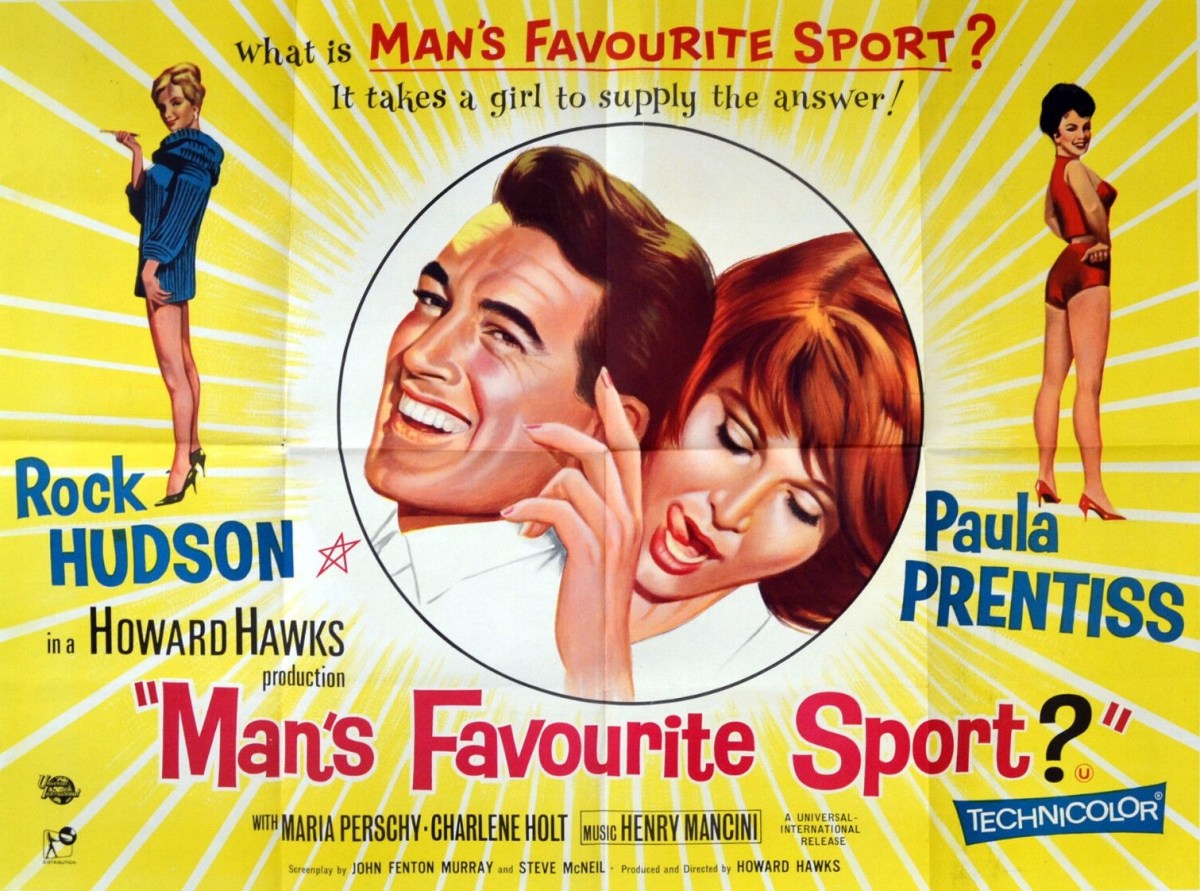
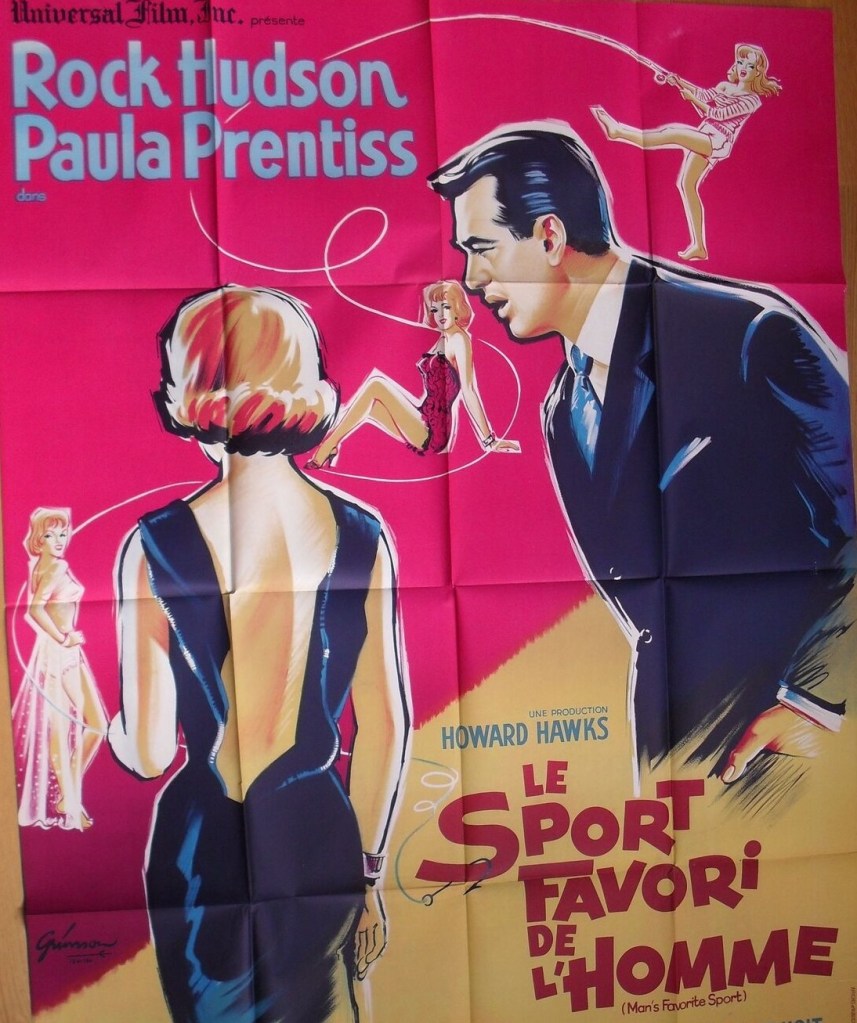
Wow! From an academic/critical perspective this is veteran director Howard Hawks (Hatari!, 1962) taking the mickey out of his famed style, where women are always competing to enter the sacrosanct male world. But, shades of his earlier Bringing Up Baby (1938), a fast-talking assured sassy woman takes command of a hapless male. Sure, Rock Hudson and newcomer Paul Prentiss aren’t in the Cary Grant-Katharine Hepburn league but they make darned good substitutes. And there’s a big difference to the earlier picture. There, Grant was an accepted expert, and it’s not his knowledge that’s in question but here Hudson is a phoney and relies on the woman.
But fiddlesticks to academe and critics, this is just helluva good fun. Built on a brilliant premise, it just rolls along from one set-piece to another to fashion as daft a screwball comedy as you could imagine. Maybe Rock Hudson left all the physical comedy in Send Me No Flowers (1964) to Doris Day because he was plumb tuckered out by his exertions on this one.
So, Roger Willoughby (Rock Hudson) is a fishing expert employed as a salesperson by Abercrombie & Fitch. When, in a public relations wheeze, Abigail Page (Paula Prentiss) invites him to participate in a competition, she uncovers his terrible secret. He’s never fished before in his life, he’s just a clever listener, passing on fishing lore from one customer to another. She agrees to help him out. But, of course, he’s an idiot and it’s not long before he’s upside down in a car that’s way too small for him, walking around with rubber buckets for shoes and upside down (again) in a lake trapped by inflatable waders.
There’s a marvellous meet-cute where they get off on the wrong foot because she steals his reserved parking spot and his first encounter with her dexterity with language should have warned him what he’s letting himself in for. The situation is complicated by, natch, Abigail falling in love with him, not to mention her buddy Easy (Maria Perschy) not unattracted either, and his fiancée Tex (Charlene Holt) about to appear any second.
So when Roger’s not tying himself in knots, he’s allowing himself to be persuaded to pretend to have a broken arm, which to make it realistic must be encased in plaster, which Abigail and Easy concoct. The fact you know full well this is only the first step to major complication doesn’t make it any the less funny. Then there’s the problem of the zip in a sleeping bag. And the fiancée turning up at the wrong time.
I could have done without the fake Native American (Norman Alden), but the rest is top-notch. Any other director would have kept the wig gag going for ages, but here it’s dumped early on because the wearer, Roger’s boss Cadwalader (John McGivern), needs little excuse to stop wearing it.
You’d be hard put to find sexuality as cleverly dealt with as here, Abigail and Easy provided with good reason to swan around in skin-tight clothing and later prattling on fifteen to the dozen as pouring rain renders their shirts see-through much to the discomfort of Roger. While Roger might be a typical male, the trio of women are far from typical of the period with a streak of independence that allows little room for the notion of men as the superior species. Not only is Abigail as competent as any male in this type of sport, she far exceeds the capabilities of the supposed expert. Furthermore, Abigail is the antithesis of the scatter-brained Susan Vance from Bringing Up Baby. She knows exactly what she’s doing even if shifted slightly off kilter by the unexpected impact of love.
As the male coming unstuck outside of his comfort zone, Rock Hudson is excellent especially in the physical comedy but the real gem is Paula Prentiss, as effervescent a star as you would ever find. You only have to see her in The Parallax View (1974) to understand what a terrific character she has succeeded in creating. Never mind that she handles the script deftly, she virtually bursts off the screen.
The general critical consensus is that Howard Hawks went downhill after Rio Bravo (1959), and that outside his final pair of westerns El Dorado (1966) and Rio Lobo (1971) was very much at the tail end of his career. Most critics seemed to have simply ignored that Man’s Favorite Sport took a different approach to the male-female dynamic or that, setting academia aside, this is just a very enjoyable romantic comedy.
When F.B.I. agents turn up at your door with a search warrant, surely your first instinct is to ask what the hell is going on? When that doesn’t transpire, an audience’s gut feeling is that you are hiding something. Or, this being America, it’s going to be a miscarriage of justice.
Whether it is that in the end would depend on your political point of view.
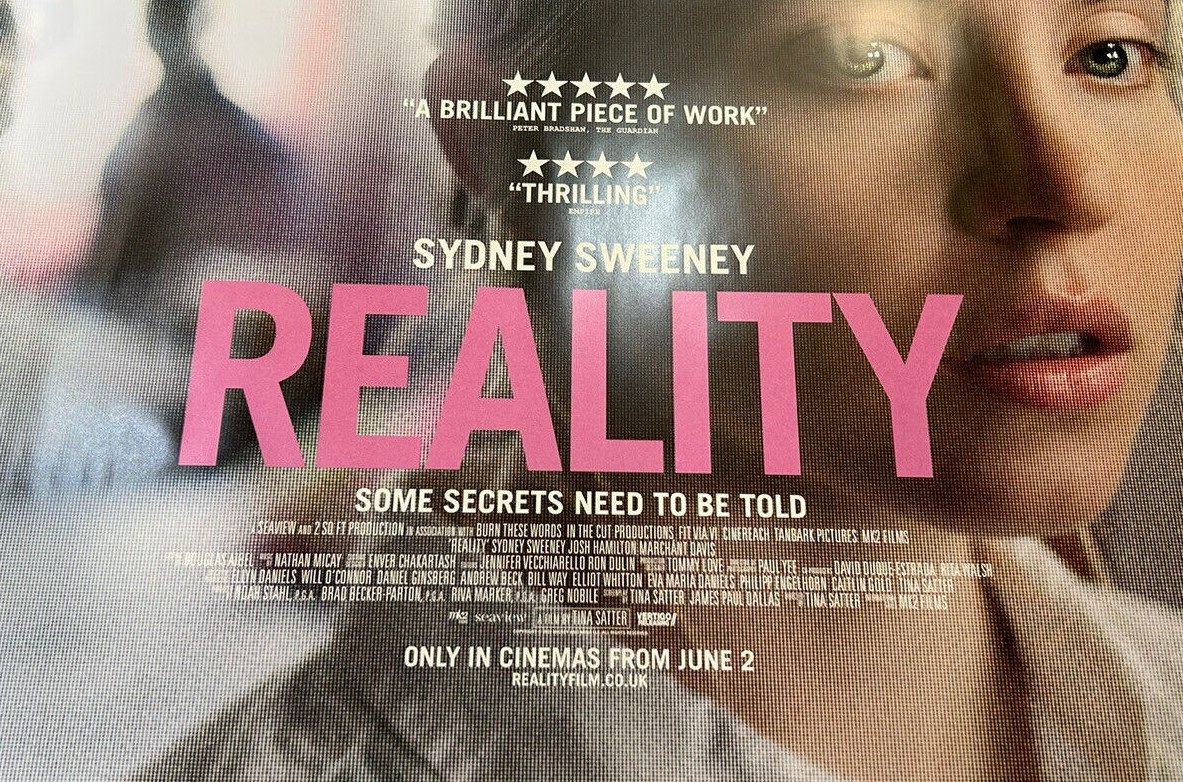
Keeping politics out of it for the moment this is a riveting piece of what used to be called cinema verite and now probably is labelled docu-drama. The title would be ironic except that this main character had the kind of parents who named her Reality (Sydney Sweeney).
Initially, it’s just two rather amiable non-threatening FBI officers, Agent Garrick (Josh Hamilton) and Agent Taylor (Marchant Davis), who turn up in 2017 at the aforesaid door. They are advance warning, if you like, for soon there’s a posse of agents tumbling out of the cliché black vehicles. There’s certainly no sense of menace though Reality is kept clear of touching her mobile phone and kept outside and possibly thinking from the continued amiable chat with Garrick that it’s all going to be a misunderstanding. But then, as luck would have it, she’s got a room in her house that could stand in for a jail cell any day of the week, no furniture, bleak, and a snail plodding along the window ledge. And it’s in this room that the interrogation takes place.
What’s superb I guess is that the dialog all comes from F.B.I. transcripts so instead of the waterboarding or good-guy-bad-guy routine or just beating up a suspect that we’ve been fed as the truth by umpteen Hollywood movies the actual interrogation is so low-key you think this has got to be a case of mistaken identity. Or that someone out of malice has pointed the finger at an innocent party.
Reality is a linguist – speaks fluent Farsi (an Iranian language) – with high-level clearance working for the National Security Agency. Oh, and she teaches yoga, competes in weightlifting competitions and if I got this right owns three guns including an automatic rifle.
So, the questioning is pretty much along the lines of the F.B.I. just wanting to clear up a few things. Did she, for example, by accident ever take out of the building something classified that should never have left the office? Sure enough, way back, by accident she had done so. But it soon becomes clear, if ironic, that someone engaged effectively in espionage is just as open to being spied upon as the country’s adversaries.
But as the tension mounts, the tone never changes. It’s Reality who looks more and more under pressure. From standing stock still and meeting their eyes, her attention is diverted by the antics of the snail and she starts moving around and eventually slides to the floor. Occasionally, Taylor will take a turn asking questions and both are equally adept at expressing surprise, especially convincing given it’s soon evident they know her every move.
These guys could be classic courtroom lawyers, because they make no wild assertions, just gently lead her on to admitting what they know is true. They make a point of telling her they don’t think she’s a big badass spy, and that she’s just someone who made a mistake, maybe in the heat of the moment, what with so much going in the U.S. Presidential Elections of 2016.
And you’d be amazed at how the guilty party commits herself on the slightest of details, a piece of paper folded over, for example. Turns out Reality has been a whistle-blower and getting her to admit makes the consequences easier, especially when all her answers have been recorded, for the prosecution.
It’s quite obvious where debut director Tina Satter’s political views lie but that doesn’t get in the way of a stunning piece of cinema. She’s had the sense to keep it short – it barely passes the 80-minute mark – and to limit editorial outrage to the end.
As it stands, setting aside the political element, it’s an engrossing watch. Sydney Sweeney, a name I’m unfamiliar with, is superb as the guilty party while Garrick and Taylor are equally good at tying her up in knots.
One to watch, regardless of which end of the political divide you favor. This is the kind of movie that a Sidney Lumet – it reminded me both of the dryness of The Offence (1973) and the courtroom spectacle of The Verdict (1982) – or a John Frankenheimer would have pumped out in their prime or the fly-on-the-wall documentaries of Frederick Wiseman (Basic Training, 1971).
A must-see.
* They’re releasing this in the UK and possibly the rest of the world in the cinema, but in the U.S. it’s appearing as an HBO Original so I’m not sure if that means it’s gone straight to streaming or doing the indie rounds first.
Priceless. Effortless comedy from the same director, Norman Jewison, as Send Me No Flowers (1964) but minus the box office powerhouses of Doris Day and Rock Hudson and perhaps it’s their absence that makes this work so much better. Or perhaps you get more comedic leeway in Paris. Although the scripts were written by different people, I sense a directorial insistence that the supporting characters are believable, not just there to oil the plot.
The story here is fraud, penniless artist Paul (Dick Van Dyke) faking his own death to give his paintings the necessary burst of publicity to make them hot items. Except he doesn’t fake his death. He dives into the Seine to save a drowning girl Nikki (Elke Sommer) and his buddy Casey (James Garner), a wannabe writer for whom Paul is a meal ticket, and who you would have to say was instrumental in suggesting such a scam, assumes he has committed suicide.
Paul goes along with the scheme for as long as it takes art dealer Zorgus (Roger C. Carmel) to make a killing (no pun intended) from his paintings. Nikki ends up a housemaid at a risqué nightclub (though it being Paris what other kind is there) run by Madame Coco (Ethel Merman) where, coincidentally, heavily disguised, Paul hides out. Meanwhile, in the final piece of the complication jigsaw, Paul’s fiancée Laurie (Angie Dickinson), turns up. A bit like the lecherous friend in Send Me no Flowers, Casey knows how to make the most of the opportunity to give a potential widow a shoulder to cry on. “How can you make a play for this girl?” he asks his reflection, but she’s too gorgeous for qualms.
You can pretty much guess where it will go from here.
It works so well because none of the principals is permitted to milk their roles (though Van Dyke can’t resist making a meal out of a sneeze) and the supporting cast drive it along with selfish action. Dick Van Dyke (Divorce American Style, 1967) has none of his usual zaniness or limbs that refuse to obey orders. James Garner, though in part cloning his character from The Americanization of Emily (1964), plays it as drama. Elke Sommer (The Venetian Affair, 1966) is the best I’ve seen her, no longer the pouting sexpot but a girl-next-door from the suburbs fallen on hard times. Angie Dickinson (Jessica, 1962), further down the billing than I’d expect, has to play it for drama, almost the foil for Casey’s seductive tendencies.
There are some superb running gags. Paul is furious to find a red-headed woman in the bed of flat-mate Casey. But, sight gag number one, it belongs to a mannequin. The wig, sight gag number two, is used to disguise Paul. Casey gets ride of the mannequin by stuffing it into a furnace only it doesn’t fit so he has to saw off its legs and is discovered from above by a waiter, sight gag number three, who naturally thinks he is sawing a woman in half. (I always think the beauty of a good comedy is that you can see the gag coming and you still laugh.) That gag has even more miles to run.
The supporting cast, as I said, are all given just delicious lines. Paul and Nikki, soaking wet, are saved by a passing barge. Paul hangs out her clothes to dry. When the naked woman in the wheelhouse calls for her clothes, the barge skipper, enjoying the prurient scene, implores, “Don’t give her her clothes back.” And when, after a row, that allows her to leave the barge, the skipper whines, “I told you not to give her her clothes back.”
. “I don’t want you to think I came for the rent you owe,” says Casey’s landlord. “What did you come for,” asks Casey. “The rent you owe, but I didn’t want you to think it.” The landlord’s wife comforts the grieving Casey (at this point he thinks Paul is actually dead) with some chicken soup. Casey admits the suicide was his idea. The woman snatches back her soup.
Having put Nikki on a bus, Paul, handing over few coins, asks the driver to keep an eye on her. Comes the reply, “I would whether you pay me or not.”
Sure, Ethel Merman (There’s No Business Like Show Business, 1954) gets to sing. Audiences expected that. But that’s understandable. What a voice. When you wonder why Ann-Margret wasn’t given more opportunity to sing in proper musicals, this is the answer. She lacks the voice of an Ethel Merman, Julie Andrews or Barbra Streisand.
The sly screenplay was concocted by Richard Alan Simmons (Della, 1965), William Sackheim (First Blood, 1982) and Carl Reiner, who had written for both Dick Van Dyke (his eponymous television show) and James Garner (The Thrill of It All, 1963).
The stars play proper roles, not just one-note characters driven by plot. Doesn’t take much to work out where it’s going all right but that doesn’t lessen the enjoyment of the journey.
I always wondered why, after making his name in comedy, Norman Jewison was selected for more serious works like The Cincinnati Kid (1965) or In the Heat of the Night (1967), but when you see the care he takes with each character, far more than standard directors in the fun genre, how he carefully builds the narrative, you do tend to agree he’s wasted in comedy.












 The Magnificent 60s