Ada (1961) ****

Oddly enough, this shares some elements with Killers of the Flower Moon. For a start Sylvester (Wilfrid Hyde-White), the political fixer, comes over as Robert DeNiro’s benign uncle, both so low-key, charming and persuasive you’d never believe them capable of  wicked manipulation. In the second place Bo (Dean Martin) is every bit as charming and baffled as Leonardo DiCaprio.

And just as the latter’s role is to worm his way into wealth and power via marriage, so too that’s the route taken by Ada (Susan Hayward), who would be euphemistically known in those days as a “good-time girl.”  

You’d figure this for a mild political satire except for the fact that stooges/buffoons have consistently made their way to the highest political office. As Ada pointedly points out, public appeal is the greatest qualification of any candidate, opportunism a close second.  Bizarre as it seems, Bo is a popular local guitar-playing-singer of the Hank Williams variety, a well-meaning dumb-as-they-come sort, whom Sylvester persuades to run for Governor. In the course of the campaign, as “a present in a back-room saloon,” he is served up Ada with whom he unexpectedly falls in love and marries.

His campaign path is smoothed when one of Sylvester’s hacks leaks news that his rival’s wife is an addict, the woman conveniently shooting her brains out. Naturally, Bo soon realizes he’s the sap, his only job to sign hundreds of legal documents every day, pieces of legislation that as it happens fill the pockets of Sylvester and his buddies.

When Bo’s long-time chum Ronnie (Frank Maxwell) threatens to expose the river of sleaze he is quickly eased out. That leaves an interesting vacancy for Ronnie was Lieutenant-Governor, Bo’s deputy. So, Ada, with a good bit more between the ears than her husband, throws her hat into the ring.

She’s to politics born, a particularly wily creature, able to bring into line the society dames who look down their nose on her, and keep tabs on Sylvester. What she doesn’t realise of course is that once you’ve got a very amenable deputy, that person becomes Acting Governor, and in effect Governor, should anything happen to the incumbent. And should she then decide she’s had enough of the sleaze, then a little poking around in her background should bring her to heel.

So, all the corruption you ever dreamt of, all the smart back-slappers ponying up thousands in campaign contributions in order to seek future reward, all that tax-payers money heading in the rich man’s pocket. Not a lot that’s new there.

What makes this stand out are the performances and the narrative arc. Wilfrid Hyde-White (The Liquidator, 1965) is a sensational casting coup. The British actor specialized in characters oozing wry charm, sometimes verging on the dotty, sometimes a tad idiotic, but never an outright swine. There are a couple of scenes where those mellifluous tones turn in an instant into a sharp crack, the avuncular replaced by the sinister.

And I’m not saying DeNiro copies his aging trick, you know the bit later on in Killers of the Flower Moon, when body no longer as sharp as the mind, the actor begins to drag his leg, and with no reference to that impairment. Well, here, similarly, the fit-as-a-fiddle Sylvester later on, still at the height of his mental powers, is seen being transported in a wheelchair.

The performance of Dean Martin (Rough Night in Jericho, 1967) was oddly dismissed at the time. And yet it was bold playing. He goes from ebullient star, enjoying being feted by all, lousy speeches lapped up by an adoring crowd, to withdrawing into himself as he realizes he has been duped. That doesn’t just take some acting skill, but considerable self-belief, to play a character who undergoes the wrong kind of transformation, not the general redemptive kind, nor sinking into some Oscar-worthy illness, but coming to terms with your own lack of ability.

Of course, Susan Hayward (Stolen Hours, 1963) delivers, as always, her screen wattage burns brighter than virtually any other female star of the period. You know the character expects her past to be exposed at any time, but she dives straight in, determined to tackle the sleaze. There’s a wonderful scene where, her background challenged by the hoity-toity society dames, she puts them in their place with a clever piece of political maneuvering.

Ada totally turns on its head the idea of the political do-gooder. She has none of the usual innocence, nor the ability to capture the crowd by seizing upon an ideal, but she’s more at home by dealing with the sleaze-merchants straight-on, taking apart their schemes in the comfort of the government’s back rooms where until now such deals have been dreamt up.

Director Daniel Mann (Judith, 1966) was known as a woman’s director. Under his direction in the Oscar stakes, Elizabeth Taylor had won for Butterfield 8 (1960), likewise both Anna Magnani for The Rose Tattoo (1955) and Shirley Booth for Come Back, Little Sheba (1953), while Hayward was nominated for I’ll Cry Tomorrow (1955). He not only chose grittier dramas but had the knack of encouraging actresses to let loose, without going overboard, on a part.  

Considerably overlooked and substantially under-rated, but not only prescient regarding future political candidates and the kind of corruption they got involved in (land deals ring a bell?) but elevated by the role of his career by Wilfrid Hyde-White, an unexpectedly good one from Dean Martin and Susan Hayward in top form.

https://amzn.to/3QGZoQC

Our Man in Marrakesh / Bang! Bang! You’re Dead! (1966) ***

All hail Senta Berger! Another from the Harry Alan Towers (Five Golden Dragons, 1967) portfolio, this is a spy-thriller mash-up with a bagful of mysteries and a clutch of corpses. At last given a decent leading role, Senta Berger (Istanbul Express, 1968) steals the show from the top-billed Tony Randall (as miscast as Robert Cummings in Five Golden Dragons) and a smorgasbord of European talent including Herbert Lom (The Frightened City, 1961), Terry-Thomas (Danger: Diabolik, 1968), Klaus Kinski (Five Golden Dragons), John Le Mesurier (The Moon-Spinners, 1964) and Wilfrid Hyde-White (Ada, 1961).

In this company, the glamorous Margaret Lee (Five Golden Dragons), as the villain’s  cynical lover (“you are never wrong, cherie, you told me so yourself,” she tells him) is an amuse-bouche. Six travellers – including architect passing himself off as oilman Andrew Jessel (Tony Randall), travel agent George Lilywhite (John Le Mesurier), salesman Arthur Fairbrother (Wilfrid Hyde-White) and tourist Kyra Sanovy (Senta Berger), meeting her fiancé – board a bus from Casablanca airport to Marrakesh. One is carrying $2 million as a bribe to ease through a vote in the United Nations, but the villainous Mr Casimir (Herbert Lom) doesn’t know which one it is.

When Kyra’s fiance’s corpse tumbles out of Andrew’s cupboard, the pair become entangled. Kyra is a born femme fatale, trumping the incompetent Andrew at every turn.  With no shortage of complications, the tale zips along, directed on occasion with considerable verve by Don Sharp (The Devil-Ship Pirates, 1964).

It’s lightweight but no less enjoyable for that and makes a change from the more serious espionage fare (The Spy Who Came in from the Cold, 1965, and The Quiller Memorandum, 1966) beginning to capture the public’s attention. It might make it sound better to say it’s a mixture of The Man Who Knew Too Much (1956) and North by Northwest (1959) and throws a homage bone to Our Man in Havana (1959), but while it plays around with those riffs, it doesn’t give two hoots about focusing on Hitchcockian thrills. It’s more about the fish-out-of-water Yank Andrew being led astray by the sexy Kyra.

There are some inventive double-plays – with a body in the boot Kyra and Andrew are stopped by a cop who tells them their boot is open. An excellent rooftop chase is matched by a car chase. And there’s a terrific shootout. Kinski is at his sinister best and Terry-Thomas a standout in an unusual role as a Berber.

The film was shot on location including the city’s souks, the ruined El Badi Palace and La Mamounia hotel (featured in The Man Who Knew Too Much, 1956).

But Senta Berger seamlessly holds the whole box of tricks together, at once glamorous and sinuous, practical and tough and exuding sympathy, and it’s a joy to see her for a large part of the picture leading Randall by the nose. Quite why this did not lead to bigger Hollywood roles than The Ambushers (1967) remains a mystery.

A blast.

https://amzn.to/46T68Ax

Robin Hood Double Bill: Sword for Sherwood Forest *** (1960) and A Challenge for Robin Hood ***(1967)

The last swashbuckler to cut a genuine dash was The Crimson Pirate (1952) with an athletic Burt Lancaster romancing Virginia Mayo in a big-budget Hollywood spectacular. The chance of Hollywood ponying up for further offerings of this caliber was remote once television began to cut the swashbuckler genre down to small-screen size. Britain’s ITV network churned out series based on Sir Lancelot, William Tell and The Count of Monte Cristo and 30-minute episodes (143 in all) of The Adventures of Robin Hood. So when Hammer decided to rework the series as Sword of Sherwood Forest their first port-of-call was series star Richard Greene.

And to encourage television viewers to follow the adventures of their hero on the big screen, Hammer sensibly dumped the small screen’s black-and-white photography in favour of widescreen color and then lit up the canvas at the outset with aerial tracking shots of the glorious bucolic greenery of the English countryside. Further temptation for staid television viewers came in the form of Maid Marian (Sarah Branch) bathing naked in a lake. Robin Hood is soon hooked. 

Two main plots run side-by-side. The first is obvious. The Sheriff of Nottingham (Peter Cushing) is quietly defrauding people through legal means. The second takes a while to come to fruition. Robin Hood is hired by for his archery skills by the Earl of Newark (Richard Pasco) – he shoots a pumpkin through a spinning wheel, a moving bell and a bullseye through a slit – before it becomes apparent he is being recruited as an assassin. Oliver Reed and Derren Nesbitt put in uncredited appearances and the usual suspects are played by Niall MacGinnis (as Friar Tuck) and Nigel Green (as Little John).

There is sufficient swordfighting to satisfy. Director Terence Fisher (The Gorgon, 1964), more at home with the Hammer horror portfolio, demonstrates a facility with action. Richard Greene (The Blood of Fu Manchu, 1968) makes a breezy hero and Peter Cushing (The Gorgon) resists the tmeptation to camp it up. Screenplay honors went to Alan Hackney (You Must Be Joking! 1965).

Six years on from Sword of Sherwood Forest, the challenge of reviving a moribund genre proved too much for A Challenge for Robin Hood but this second Hammer swashbuckler is a valiant and enjoyable attempt. More in the way of an origin story, this explains how a nobleman turned into an outlaw and how the merry band was formed. For in this tale Robin Hood (Barry Ingham) is a Norman nobleman framed for murder, Will Scarlet (Douglas Mitchell) and Little John (Leon Greene) are castle servants – also Normans – while Maid Marian (Gay Hamilton) is in disguise. Some liberties are taken with the traditional version – there is no fight with Little John, instead, as noted above, they are already acquainted.

There are a couple of excellent set pieces and although the swordfights are not in the athletic league of Errol Flynn they are more inventive than the previous Hammer outing and there is enough derring-do to keep the plot ticking along. Robin’s cousin Roger de Courtenay (Peter Blythe) is the prime villain this time round, the sheriff (John Arnatt), although involved up to the hilt at the end, content to offer acerbic comment from the sidelines.  

When Robin and Friar Tuck escape the castle by jumping into the moat, Will Scarlet is caught and later used as bait. Meanwhile Robin’s archery prowess and leadership skills have impressed the Saxon outlaws hiding in the forest and he takes over as their head. But there are clever ruses, jousting, Robin disguised as a masked monk, torture, and a pie fight.

Director C. M. Pennington-Richards had some swashbuckling form having helmed several episodes of The Buccaneers and Ivanhoe television series but his big screen experience was limited to routine films like Ladies Who Do (1963) with Peggy Mount. This was a departure for scriptwriter Peter Bryan, more used to churning out horror films like The Brides of Dracula (1960) and The Plague of the Zombies (1966), and he has invested the picture with more wittier lines and humorous situations than you might expect.

It’s certainly an escapist holiday treat and unless compared to the likes of the Pirates of the Caribbean or the classic Errol Flynn adventure it stands up very well on its own.

https://amzn.to/3MqhwLO

The 300 Spartans (1962) ****

Doomed for half a century to be seen as Saturday television matinee material and then purportedly put into the shade by the Zack Snyder’s stylish 300 (2006), The 300 Spartans is in sore need of re-evaluation.  Lacking the big budget of an El Cid (1961) or Lawrence of Arabia (1962) and released during an era when historical drama – Barabbas (1961), The Mongols (1961), Sword of the Conqueror (1961), The Trojan Horse (1961), and The Tartars (1961) – was at a peak, this is a stripped-down version of the famous Battle of Thermopylae in 480 B.C. and none the worse for it.

Clever camerawork suggests thousands of warriors involved and there is little sign of scrimping the wardrobe department, and there is more than enough action. But this is a surprising literate picture, with great lines for cynical politicians as much as for warriors and peasants. Themistocles (Ralph Richardson) comments: “Some day, I may enter religion myself. It’s better than politics. With the gods behind you, you can be more irresponsible.” 

Told that the invading Persian army has “arrows that will blot out the sun,” Spartan King Leonides (Richard Egan) retorts, “then we will fight in the shade.”  And there’s sexist banter typical of the period between a peasant couple: wife – “goats have more brains than men”; husband – “who can understand the ways of the gods, they create lovely girls and then turn them into wives.”

Quite how Leonides ends up fighting the massive army on its own is down to a mixture of politics and religion. Oracles foretell doom. The various Greek states refuse to join together, although Athens lends Sparta its fleet (“Athens’ wooden wall”). Even Sparta officially refuses to participate on the grounds that battle would interrupt a major religious festival. Leonides’ “army” of 300 men is comprised of his bodyguard.

A romantic subplot involving a young couple results in catastrophe. Just how ruthless is the opposition is shown when Persian king Xerxes (David Farrar) slaughters all his soldiers’ wives to make the men more determined to get to Greece where doubtless they will enslave the female population. When his archers fire, he doesn’t care if the arrows hit his own men.

What marks out the best historical action pictures is the intelligence behind the battle. Strategy is key. The first weapon, of course, surprise, so the Spartans sneak into the Persian camp from the sea and burn their tents. During battle, to counteract the Persian cavalry, the front row of the Spartan army lies down and allows the horses to jump over them, then rising up, trap the cavalry and drive them into the sea. (A ruse later employed by Richard Widmark in The Long Ships, 1964).

Other wily measures are used deal with the Persian crack infantry regiment, The Immortals. Even at the end, the Spartans continue to confound the enemy with clever ruses.

Richard Egan (Pollyanna, 1960) is effective as Leonides, Ralph Richardson (Woman of Straw, 1964) excellent as the crafty but honorable Themistocles while Alfred Hitchcock protégé Diane Baker (Mirage, 1965) – “glaringly miscast” according to Variety – has the female lead though Anne Wakefield (The Singing Nun, 1966) as a Persian queen the more interesting role. Former British matinee idol star David Farrar (Beat Girl / Wild for Kicks, 1960) Meet Sexton Blake, 1945), in his final movie, proves a handful as the intemperate Xerxes.

Five-time Oscar-nominated cinematographer Rudolf Mate delivers the directorial goods, his handling the dramatic scenes as confidently as the action and masking the holes in his budget by making clever use of trees as the invaders march, suggesting an army far bigger than he could afford to put on the screen. Color-coding the Spartans – they were in red – made the action clearer to follow. George St George (Invasion 1700, 1962), doubling up as producer, wrote the script with his usual collaborators Ugo Liberatore (A Minute to Pray, A Second to Die, 1967) and Remigio del Grosso (Wanted, 1967).

Originally titled The Lion of Sparta, the film could not have been made without the wholesale cooperation of the Greek army which supplied over 2,000 soldiers. Those playing Spartans had to be over six foot tall. Since the Greeks had no cavalry and few knew how to ride, around 200 were given a crash course. It was a bonanza for the soldiers – their normal wage of $2 was supplemented by $5.50.

Thermopylae no longer looked like the area immortalised by the battle, so the action was shot at Loutraki, near Corinth and 80 miles from Athens. 

Thoughtful drama with striking action deserves reassessment.

https://amzn.to/3QGWU4v

In the French Style (1963) ***

Short stories can be an excellent starting point for movies because usually they are lean and narrative driven, a screenwriter needing basically to fill out the characters and add a subplot. But short stories have one weakness. They require a pay-off,  a twist, something the reader doesn’t see coming. And short of a twist of the caliber of Jagged Edge (1985) or The Sixth Sense (1999), these don’t usually come off, the audience feeling duped.

This one falls down due to a twist. Two actually, because it comprises a pair of initially unconnected short stories, A Year to Learn the Language and In the French Style. Which is a shame because the movie itself  with its Parisian setting is in general charming and conveys the development of young American Christine (Jean Seberg) as she moves from innocent wannabe artist to promiscuous model while worrying she is throwing her life away on transient pleasures.

Writer Irwin Shaw (Two Weeks in Another Town, 1962), who doubles as producer, has used Christine as the link between two of this best-known short stories. So it’s – to dip into soccer parlance – a film of two halves and I’ll let you know right away co-star Stanley Baker (Sands of the Kalahari, 1965) is consigned to the second part, when he meets an older and perhaps more rueful Christine.

So, young, not exactly starving (an allowance from her father funds her lifestyle), artist meets a young Frenchman Guy (Phillipe Forquet) determined to be the antithesis of the standard Frenchman. He doesn’t drink because alcohol is ruining his country. He won’t kiss her in public because not all Frenchman are insanely romantic. He’s severely lacking it has to be said in the romantic gene. Seduction is abrupt. He’s got the key to a friend’s apartment. Let’s go. Is as much subtlety as he can summon up.

So no sex this time and she decides she’ll be the one doing the asking, which upsets his notion of the biddable girlfriend. Anyway, they end up touring Paris on his scooter looking for a suitable no-questions-asked hotel. Surprisingly, the city, according to Guy, isn’t full of them.

And end up in a freezing hotel room. He can’t open the champagne bottle. He insists she undress last, as apparently that’s the done thing. And then he springs his surprise. He’s not only a virgin, he’s not the 21-year-old he told her he was, but still at school and just 16.

If this had been done The Graduate-style, with his awkwardness to the fore, or if she had just been as clumsy, it would probably have worked. There would have been nothing illegal in their coupling, or cringe-worthy (she’s 19 after all), but it just makes her out to be an idiot, fooled because she effectively fell for the first handsome Frenchman to come her way. It just drops a bomb of the wrong kind halfway through the movie.

Cut to four years later and she’s much more the lady-about-town, independent or of questionable morals depending on your point of view, self-sufficient or relying on male companionship to see her through depending on your point of view. Having been dumped by Bill (Jack Hedley), she hooks up with itinerant flamboyant journalist Walter (Stanley Baker) but while he’s off on some important story she’s made hay with more sober American Dr John Haislip (James Leo Herlihy, yes that one, author of Midnight Cowboy) and chooses security over culture and fun.

The problem with this section is that the short story was originally written from Walter’s point of view, as he comes to realize that long-term commitment is not compatible with globe-trotting.

All told, a pretty odd concoction. That it works at all is largely due to Jean Seberg (Breathless, 1960). I’m not totally convinced by her transition. You get the impression that had she met a more worldly Frenchman in the first half she would have quickly shaken him off for another lover. As it is, her rootlessness is meant to be the result of being disappointed by a schoolboy lover. Hmmm!

Although there’s over-reliance on Paris atmosphere – jazz club, Arc de Triomphe, restaurants where waiters transport flambe dishes halfway across a room, a “happening” where the art crowd lets it all hang out – and we rely on other characters telling us about Christine’s personal situation, it remains an interesting view of the French capital from the point-of-view of an American ex-pat, who, less successfully than Hemingway perhaps, offers a different perspective on the city. Robert Parrish (Duffy, 1968) directed.

Worth it, though, to see Seberg transformed.

https://amzn.to/470agOY

https://amzn.to/49n6Xmv

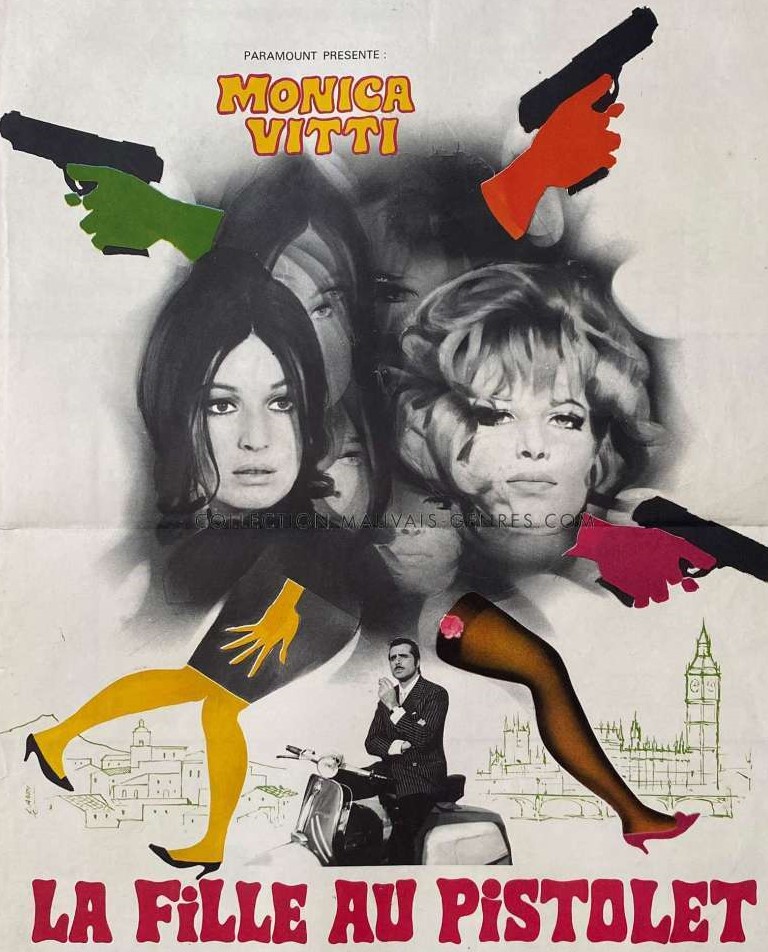
Kitten with a Whip (1964) ****

I’ll let you down gently. Ain’t no whip. What you have instead is one of the most under-rated, unseen and maligned mini-masterpieces you will ever come across marching to the film noir beat. Bewildering femme fatale and the kind of disenchanted anti-authority teenagers who would drive the “youthquake” that almost destroyed the industry half a decade later. And within this, one of the great tragedies of Hollywood, the performance of her career from Ann-Margret, buried because it wasn’t what the public, the critics or the industry expected from the young star.

Edgy score with soulful sax underwrites a picture brimfull of surprises and plays constantly with your expectations, the picture shifting gear so often you’d think you were in a tumble dryer. The doorbell plays like a loaded gun, every interruption racking up tension.

Stylish credits that hint of Hitchcock precede a brilliant opening as in full noir fashion a band of light catches the eyes in the darkness of a blonde (Ann-Margret) dressed in a nightgown cresting a hill.

She tries to jump on a moving goods wagon, eventually makes her way to a deserted house, untouched wrapped newspapers littering the lawn, clambering into a bed, clutching a teddy bear for comfort. You want mystery? This is just the start. In one of the best neat cuts, we jump from the eyes of a teddy bear to headlights. Owner returning home is budding politician David (John Forsythe), wife away due to marital issues.

Come morning, he discovers his guest, Jody. She recites a sad tale of fleeing sex abuse. But soon he realizes she’s got a story to fit every occasion and can turn the emotions on like a tap. Manipulation is in her DNA. But she’s a tough little number. “Hands off, buster,” she snaps at one point as she tries to physically hustle her out.

It’s unspoken that the idea of being caught, regardless of whether he’s entirely innocent, in illicit dalliance would mean  the end of his political ambitions, but she’s happy to spell it out. If the cops work her over, who knows what would spill out.

He buys her clothes, gives her money. Sayonara, baby! Except it’s not. He discovers she’s on the run from juvie, where she torched the home and stabbed the matron. Worse, she’s not left after all, but returned, the house filled with the noise of television cartoons, floor littered with teenager mess.

It’s unclear what exactly she wants. But she knows if she screams rape that’s curtains for him. And if Freud (1962) used a length of rope to show how a psychiatrist can’t escape his client, Jody’s version is a length of telephone cable, dragging her quarry to the floor when he’s talking to his wife.

And before you know it, it turns into home invasion. She’s called up some pals, younger  versions of the creeps in The Penthouse (1967) but with a similar set of philosophic ramblings (“the meanings of the meaningless”) from thug Ron (Peter Brown), not averse to sharing buddy’s docile girlfriend Vera (Patricia Barry). And now it’s blackmail. And violence, a cutthroat razor the weapon of choice, though thug Buck (Skip Ward) is handy with his fists, too.

The kids, drug peddlers, want driven over the border. So now we’re racing off in the dark. David is savvy enough to leave Buck entangled in barbed wire, manages to drop the wounded Ron off at a doctor’s surgery and now desperately tries to escape Jody, though, as you might expect she has other plans.

So the movie spins all the time on the twin axis of discovery that could end David’s career and the demonic damsel. While it steers clear of any sexual attraction by David for the young glamor girl, his interest is initially more paternal, and consequence-aware. Quite what she does want is unclear, beyond some kind of freedom, power even, “I call the shots, not you,” the upper hand over the males, marking him with her nails in the way she has been scarred.

But it races along, it’s impossible not to be dragged into the quandary, half the time you hoping that somehow she will escape her demons, while fully aware that she’s on the fast track to Hell and will take people with her.

This is Ann-Margret (The Swinger, 1966) as you’ve never seen her. It’s not that the sexiness is hidden, it’s a heck more subtle than that, and when she parades in some flimsy item it’s clearly more for approval than arousal. At one point she dances in a jokingly sensuous manner, but otherwise there’s no trademark singing and dancing. She’s a junior version of the more fully-fledged femme fatales of noir who’ve hooked some sap into crime. This gal hasn’t got that kind of criminal brain – or maybe not yet – she’s a victim of circumstance and, let’s face it, the powerful male.

There’s a terrific moment when Vera accepts that she means little more to her boyfriend than that she has a car, exhibiting the kind of impotence that came with the territory for young women of the era lacking confidence or a decent role model. Jody’s the opposite. She’s confident enough, but no idea what to do with it, beyond ensuring no man gets the better of her.

You’ve heard enough of Jody’s sob stories not to believe a word she says but still the power of Ann-Margret’s performance is that you feel the deeper, hidden, pain.

Writer-director Douglas Heyes (Beau Geste, 1966) directs with tremendous verve, keeping his foot down on the tension pedal. That the movie was generally seen as a low-point in the career of Heyes and Ann-Margret is one of those Hollywood anomalies, or ironies if you will, probably dumped on because it was perceived as flying too close to the Lolita (1962)/Baby Doll (1958) template, although in reality the character avoids going down the simpering child route except as a means of extracting sympathy.

John Forsythe (Topaz, 1969) begins on the rack and never gets free.

Nothing like would you expect – and certainly not from the title – and deserves full reassessment and all the critical accolades going especially from those who appreciate the noir canon.

Massive disservice to Ann-Margret, whose performance here should have opened up a career of more serious movies.

B-movie noir masterpiece.

https://amzn.to/3FP3WxL

https://amzn.to/46Xr0q4

The Running Man (1963) ****

Twisty Carol Reed thriller pivoting on emotional entanglement that keeps you guessing right up to the end. In revenge for losing his business after an insurance company failed to cough up for his crashed plane, entrepreneur Rex (Laurence Harvey) fakes his own death and flees to Malaga in Spain.

But when girlfriend Stella (Lee Remick) joins him she discovers he has assumed the identity of an Australian millionaire whose passport he has purloined and completed the transformation by changing his black hair to blond. Rex has a mind to repeat the experiment by killing off himself (under the new identity) and claiming the insurance. Stella, complicit in the original scam, not only balks at this idea but finds disconcerting his change of personality and clear attraction to the opposite sex.

Tensions mount when mild-mannered insurance investigator Stephen (Alan Bates) appears on the scene. Anyone watching the film now has to accept that in the days before social media every face was not instantly tracked and accept that Stephen is unaware of what Rex looks like.

The couple cannot run because they are awaiting a bank draft. Stephen immediately sets the tone for suspicion when he pronounces that their vehicle  “looks like a getaway car.”  Forced to follow “The Godfather” dictum of keeping your enemies closer, the pair befriend Stephen  with the intention of finding out what he knows and what are his intentions. Rex and Stella  have to pretend they have only just met, separate bedrooms et al, leaving the door open for Stephen to gently woo Stella, an action endorsed by Harvey. They are caught out in small lies. Rex’s Australian accent falters. Stephen keeps on making notations in a notebook. Rex  foils his pursuer’s attempts to photograph him.

The ensuing game of cat-and-mouse is complicated by Stephen’s romantic inclinations towards Stella. Is this as genuine as it appears? Or is he trying to get her on her own to admit complicity? Both Rex and Stella are, effectively, forced to adopt the new identities they have forged to dupe Stephen, with unforeseen results. There are red herrings aplenty, a race along mountainous roads, and some marvelous twists as the couple find the tale they have woven is turning too tight for comfort until murder appears the only solution.  

As with his international breakthrough The Third Man (1949), Carol Reed grounds the whole Hitchcockian enterprise in local culture – this being unspoiled Malaga prior to the tourist deluge – Spanish churches, a wedding, fiesta, the running of the bulls, with an occasional ironic twist – “gypsy” musicians watching ballroom dancing on television. Reed resists taking the material down a darker route – Hitchcock would undoubtedly have twisted the scenario in another direction until Stella came under threat from Rex – but instead allows it to play out as a menage a trois underwritten by menace.

The acting is sublime. Laurence Harvey (A Dandy in Aspic, 1968) wallows in his part, Remick (Days of Wine and Roses, 1962) quietly anxious scarcely coming to belief that she had played a part in the original crime, Alan Bates (The Fixer, 1969), his deceptively pleasant inquisitive demeanor the ideal foil to Harvey. Unusually, they all undergo change, Harvey uncovers a more ruthless side to his character, Remick responds to the gentler nature of Bates, while Bates shrugs off his schoolmasterly aspects to become an attractive companion.

A couple of footnotes – special mention to Maurice Binder for the opening credits and this was the final score of British composer William Alwyn (The Fallen Idol, 1948). John Mortimer (Bunny Lake Is Missing, 1965) wrote the screenplay based on the Shelley Smith novel.

Full throttle film noir.

https://amzn.to/45ZFynU

Downhill Racer (1969) ***

Robert Redford rarely took the easy option. Even his big romantic number, The Way We Were (1973), with Barbra Streisand had a serious center, Jeremiah Johnson (1972) focused on ecology and he used his star power to get studio backing for All the President’s Men (1976). Even starting out, and before Butch Cassidy and the Sundance Kid (1969) anointed him a star, when he could, or should according to some observers, have been capitalizing on his good looks he did not shrink from playing unlikeable characters.

Idealizing heroes is endemic. Most films which portray sport stars with feet of clay generally begin with an attractive personality who presses the self-destruct button through alcohol, sex or drugs (or all three) such as Number One (1969) with Charlton Heston. The general consensus is that this approach to the sports movie was not rescinded until the brutal boxer exposed in Scorsese’s Raging Bull (1980).

But it turns out Scorsese was not the first. In this ski drama Chappellet (Robert Redford) is a loner who cares for no-one but himself. Alienated from his father (Walter Stroud), his girlfriend at home little more than a sex object, the obsessed skier proves a constant source of friction for his national team manager Claire (Gene Hackman) and not above the kind of dirty tricks as typified in Slap Shot (1977). He sees nothing wrong with making no bones about the fact that he is in the game for fame.

Totally lacking in self-delusion, he’s a farm boy and few steps up from being illiterate. The world of the professional skier was hardly the obvious subject for a sports drama. There’s certainly an excitement in the action that couldn’t be captured on television, but the essential competitive element, the race against the clock, is not so riveting as the last-minute touchdown or winning home run.

Pretty much Chapellet’s only attractive feature is that he is played by Robert Redford, and the film plays upon the conceit that as handsome a man as this will at some point turn into a good guy.  There’s an interesting debate – and one that would last decades – about whether Redford’s looks got in the way of the characters he portrayed. Imagine Robert Duvall in the part, for instance, and relentless determination would not be called into question.

This leaves the film with only pity as a way to provide the character any sympathy, the sense that if he turns into a loser the audience will warm more to him than if he is a champion, but that arrives outside the competitive circle, and perhaps is even more touching, when his hopes of genuine romance with top-notch blonde Carole (Camilla Sparv) are dashed. 

Michael Ritchie (The Candidate, 1972), making his directing debut, opts for a documentary-style approach, so minimalist it’s almost perfunctory. This is a decent option given there’s very little going on beyond lonely hotel rooms, and an endless round of competitions and an occasional outburst from the manager. The skiing scenes, sensational at the time, are boosted by Blu Ray. Although it gained good reviews, audiences failed to respond although Redford was on a career high after Butch Cassidy and the Sundance Kid (1969).

While it was a brave choice for the actor, the script by James Salter (Three, 1969), based on the Oakley Hall bestseller, doesn’t bring enough insight, though you could argue it was intended to keep the character at arm’s length.  A novel can be engaging enough just by opening up an unusual world, but a movie needs to do more. This is pre-chuckle Gene Hackman (The Gypsy Moths, 1969)   and at this point you would probably have bet on him remaining a supporting player.

Redford, the thinking man’s actor, in embryo.

https://amzn.to/3MonLzM

Sons of the Desert (1933) *** – Seen at the Cinema

One of the joys of the current spate of one-day anniversary revivals is that it turns up a 90-year-old gem like this. I haven’t seen Laurel and Hardy on the big screen since I was a child, and that wasn’t even in the cinema, but at our local school in Cumbernauld, Scotland, where the local padre Fr Jaconelli (part of the famed ice-cream clan) ran an impromptu cinema show on Saturday mornings with a shaky 16mm projector.

Actually, I could catch the comedic duo once a week at a pub down the road where the local chapter of the “Sons of the Desert” fan club hosts a showing. “Sons of the Desert,” in case you didn’t know, is an international fan club with hundreds of affiliated clubs (or “tents” as they are known) and this film is the reason.

But the question, as ever, with comedians, is does their schtick stand the test of time. They are perhaps fortunate in that they don’t rely on witty one-liners. On the other hand, the set-ups are so straightforward they are almost prehistoric. And comedy double acts have more or less disappeared.

The movie follows the traditional Laurel and Hardy template, some barmy scheme dreamed up by Ollie, tripping over ever prop in sight, a variety of items to destroy, the pair bedraggled. In this case, Ollie’s wife Lottie (Mae Busch) opposed the idea of them attending the annual convention of the aforesaid desert gang in Chicago so he convinces her that he’s so ill the only way he’ll recover is by taking a trip to Honolulu. Naturally, the liner sinks and they are caught out in the lie.

Meanwhile, all mayhem breaks loose, drenched on the roof, battered at the convention, the target of practical jokes by conventioneer Charley (Charley Chase) who turns out to be Lottie’s long-lost brother. The plot’s pretty much irrelevant where this pair are concerned, just the starting point for a series of gags, whether it’s Stan eating wax fruit, landing Ollie in whatever water is handy, and both doing the wrong thing when the correct would have been simpler.

Sure, Ollie twiddles with his tie and harrumphs and marches his fingers across the table, Stan scratches his hair and looks about to burst into tears, but the combination remains irresistible. Few comic duos have come as close and then for not as long.

The program also included the short Dirty Work from the same year which sees them as chimneysweeps attending the household of a mad scientist who has discovering the secrets of rejuvenation. I’m not such a big fan that I could tell you where Sons of the Desert ranks in their pantheon, except that it was the inspiration for the fan club (which prefers, incidentally, to be known as a collection of “film buffs”) but it was fantastic just to see them on the big screen and imagine the laughter they have generated down the generations.

There was a big revival in the 1960s, when silent comedy was being rediscovered, and there was a cartoon series, and they made so many films you can probably see one anywhere anytime. These kind of gagsters never went out of fashion, Jim Carrey channeled much of their mirth, but few have matched their sense of timing.

I saw this as part of my self-appointed cinema triple bill on Monday. I’ve reviewed the films in reverse order of seeing them. It’s one of the beauties of my method of going to the cinema that I can compile a program from completely different genres – comedy, crime, horror – and go in with little expectation (I doubted even Laurel and Hardy would stand the test of time on the big screen) and come out thinking I had one of the best cinema outings in a long time.

https://amzn.to/3seQd06

Judgment at Nuremberg (1961) ****

Stanley Kramer never caught a decent academic/critical break. Subject matter worthy, execution poor, was the overall consensus. But Judgement at Nuremberg, with its long tracking shots, sometimes turning 360 degrees around a character, should have changed all that. But the kind of critics who would have appreciated such bravura technique weren’t around at the time and even when Antonioni’s The Passenger (1975) appeared nobody thought to reference Kramer, believing this was a new cinematic invention by the esteemed Italian maestro.

So, Judgement at Nuremberg is remembered, if at all, for the subject matter and elevated by the performances rather than the director’s input. Most people misremember what the movie’s about. The main concern here isn’t the war criminal, the men personally involved in running the ghettos. Instead, it’s about those behind the scenes who could, theoretically, have prevented the camps flourishing, or at least challenged their opening.

Those on trial were freedom fighters of a different sort. As judges, the top tier of the legal system, their job was not just to uphold law and order and individual freedoms, but to take government to task for illegal action. It’s a basic tenet of the democratic world that governments cannot act in autocratic fashion but work within public accord.

Should the legal guardians find fault with government activity, their job is to take the ruling body to task – the European Court of Human Rights was set up with exactly that principal in mind, and various British and American law agencies have over time called a halt or questioned government proposals.

Some of the judges were clearly ill-fit for the task, lick-spittle jobsworths, desperate to hold onto rank and privilege, many sharing the same anti-semitic views as Hitler. But the Allied forces, being democratic, have to proceed along proper lines, taking potential criminals to court and allowing them legal defence.

So the main target is Dr Ernst Janning (Burt Lancaster), German’s pre-eminent legal force, a quiet, dignified man, who refuses to fawn or react to the charges. On the attack is prosecutor Col Tad Lawson (Richard Widmark). Acting for the defence is the wily, emotional, Hans Rolfe (Maximilian Schell) who is not above comparing the Holocaust to the Americans dropping the atom bomb on Hiroshima, indiscriminate terror brought on innocent civilians the result of both actions. He also brings to the court’s attention the distasteful theories that once held sway in high American legal circles as promulgated by Oliver Wendell Holmes, a Supreme Court judge, whose views on eugenics aimed at withholding procreation rights from the mentally handicapped.   

As referee we have Dan Heywood (Spencer Tracy), the American chief judge, who didn’t want the job and was way down the pecking order of those best qualified. And he’s a bit of a detective on the side, trying to discover how much ordinary people –  such as the flirtatious Mrs Bertholdt, widow of an executed German general, as well as the housekeeper and butler looking after him in some style – knew about the atrocities as they were taking place.

In the background is an Allied command not wishing to stir up any more controversy, conscious of the rising power of the Communist bloc, seeing West Germany as a bulwark against Stalin, concerned that forcing the country’s inhabitants to wallow in the past will turn their political minds towards the east rather than the west.

In due course, a variety of witnesses are called, testifying to ill-treatment under the German government including the backward Rudolph Pedersen (Montgomery Clift) and Irene Hoffman (Judy Garland).

What makes this so different is that innocence or guilt is not what’s under scrutiny, but reason. Why did such high-minded legal experts like Dr Janning give in to Hitler. And when? And do they recognise their role in providing Hitler with credence to continue with his massacre of the Jews?

Individual conscience and, conversely, collective guilt, might have been the driving force then but they are more than relevant today when actions in war come under even greater scrutiny and politicians are held to account. Perhaps, it’s ironic how little judgement was passed in the end on those convicted in these trials. Nobody was hanged, nobody received even a life sentence. In fact, by the time the movie was released, all were free men.  

Stanely Kramer, the Scorsese or Nolan of his era regarding running time  (it clocks in a just shy of three hours), does a superb job with his even-handed approach. While his technical skills were perhaps under-appreciated, he certainly knows how to command an audience’s attention and draws terrific performances from his actors.

Maximilian Schell, who won the Oscar, is perceived as the standout, but for me the highpoints were Burt Lancaster (The Swimmer, 1968) and Montgomery Clift (Freud, 1962). Abby Mann’s (The Detective, 1968) screenplay was an expanded version of his teleplay of two years before.

Has more than enough humanity to keep you riveted.

https://amzn.to/3Mh4v7c

Discover WordPress

A daily selection of the best content published on WordPress, collected for you by humans who love to read.

The Atavist Magazine

by Brian Hannan

WordPress.com News

The latest news on WordPress.com and the WordPress community.