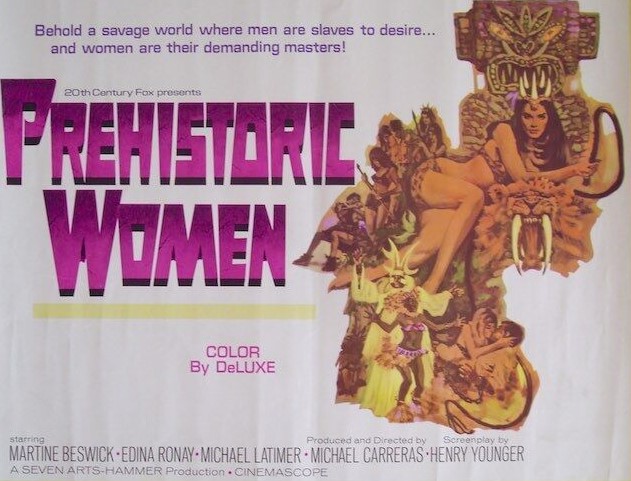
Prehistoric Women / Slave Girls (1967) ***

Can a dash of feminism rescue campy trash? Or even a genetics overload? Or is it enough to wonder what career hole Carol White (Never Let Go, 1960) found herself in to end up here? Or should we just sit back and watch the Pan’s People-style choreography and admire the astute re-use of all those bikinis left over from Hammer’s previous venture into this territory, the much more successful One Million Years B.C. (1966). Whatever, there’s no escaping the wooden acting and the one-note direction.

Dennis Wheatley (The Fabulous Valley, The Lost Continent, They Found Atlantis) and C.S. Lewis for that matter had the knack of transporting characters back in time or into other worlds. There’s usually some routine artefact, door or whatnot, that allows access to an amazing kingdom, or, in this case, queendom.
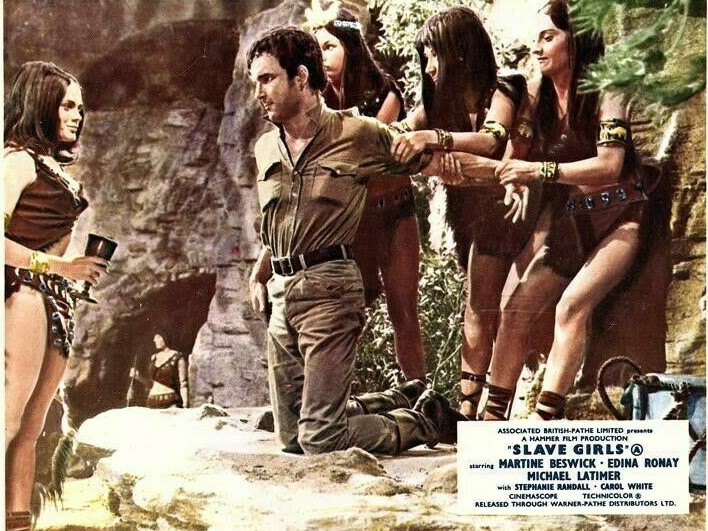
Here, big game hunter David (Michael Latimer), about to be sacrificed to some pagan African god, instead finds himself thrown back in time, chasing bewitching blonde Saria (Edina Romay), who, unfortunately is on the run, so when she is apprehended, so is he. Queen Kari (Martine Beswick) takes him as her lover. But he’s less keen, repulsed by her harsh rule. When one of her subjects rebels, the queen doesn’t delegate the task of bringing her into line but takes her on mano-a-mano. David, put to work with the other male prisoners, soon plots his escape.  

Setting aside the expected mumbo-jumbo – the tribe worships a mythical white rhino (phallic symbol anyone?) for example – if you want to extract anything more from this, there are fresh fields to plunder. For example, brunettes, such as Kari, are in control, but only after rebelling against the blondes who had subjugated the black-haired women in similar fashion as Kari. As well as having a female ruler, the movie makes a relatively pertinent point that gender scarcely comes into it when a dictator imposes such harsh conditions on their subject, Kari, for example, making the blondes eat off the dirt.

I’m not convinced the irony is deliberate. David, scion no doubt of Victorian nobility who made their pile from scarcely paying their downtrodden peasants a living wage, and who goes around shooting leopards, is hardly in a position to ask the queen to cool it. When she even considers giving him some equality – a big role reversal right there – he wants her to treat everyone in a nicer fashion.
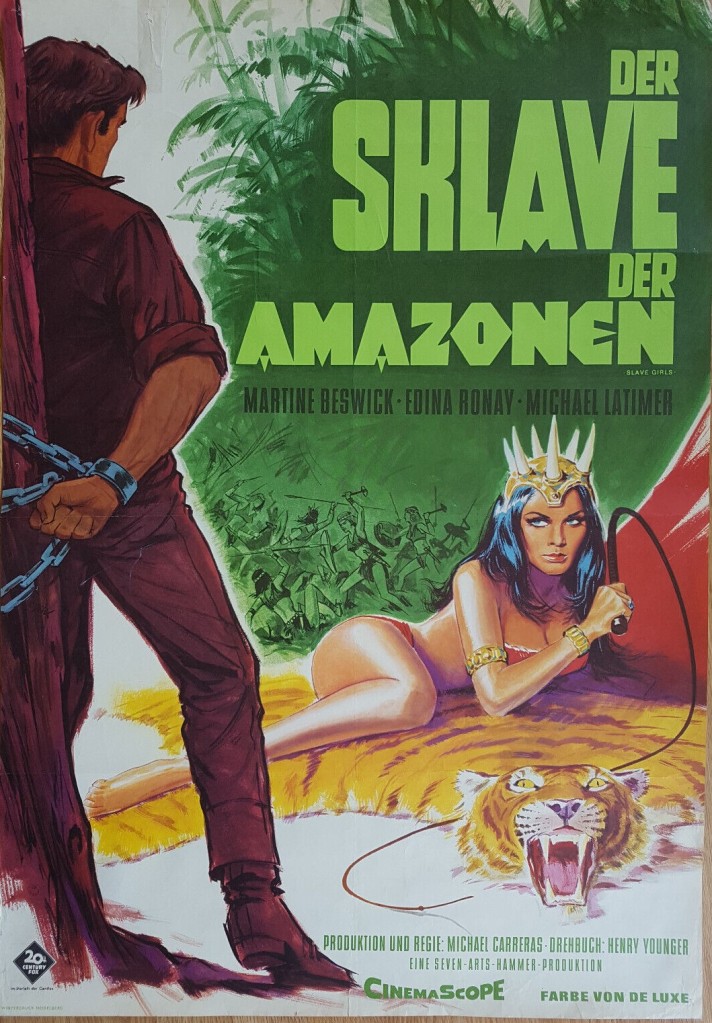
The movie had an unsual history. Made quickly after “One Million Years B.C.” it was released in the U.S. as “Prehistoric Women” in 1967 but flopped so it was heavily cut, re-titled “Slave Girls” and sent out in 1968 in the UK as the support to “The Devil Rides Out.” The new title is a bit of misnomer because her kingdom is as full of slave men. The girls refers to the blondes. It was released in the U.S. in February 1967 by Twentieth Century Fox and managed a tie-in in one city with Cara Nome perfume. Actually, U.S. grosses were not as bad as have been reported – a “good” $25,000 in first run in Detroit, second only to “Grand Prix” there for the week, and decent enough openings in Boston, Minneapolis and San Francisco.

And she has the insecurity of Napoleon, needs to be loved, and not in mercenary fashion, and willing to attempt some form of rudimentary seduction if that’s what it takes to tempt the suddenly high-principled David into her bed. There’s an element of upending the Gentlemen Prefer Blondes trope, as though brunettes have always hankered after putting those ditzy blondes in their place.

Hammer lost sight of the fact that One Million Years B.C. owed as much to Ray Harryhausen as the statuesque temptations of Raquel Welch in a fur bikini and in its haste to cash in on that film’s big box office rushed into production a movie minus the battling dinosaurs. Although, of course, they could merely be making historical amends, since everyone knows dinosaurs and man (never mind women in fur bikinis) did not co-exist. And possibly ignored the fact that the puny Michael Latimer was no substitute for the brawnier John Richardson of the previous picture.   

If you’re not so interested in gender politics, you can always enjoy the dancing, which appears to take up a disproportionate amount of time (well, all those bikinis, need to be used). I was disappointed to discover the choreography was not the work of Flick Colby of the legendary BBC TV Top of the Pops dance troupe, but by one Denys Palmer, an actor it appears, whose main claim to fame was appearing in a classic Dr Who episode.

This was triple-hyphenate job, so blame Michael Carreras (The Lost Continent, 1968) for the screenplay and the direction and for taking on the production duties, or praise him for seeding a campy knock-off with issues that register more strongly today.

This was intended to be a big step-up for Michael Latimer but he was so charisma-free that he didn’t score another movie credit until low-budget British B-picture Man of Violence (1970). Martin Beswick (The Penthouse, 1967) never got another shot at a top-billed role. Carol White did better, next up was Poor Cow (1967) and from there it weas a small step to Daddy’s Gone A-Hunting (1969), but she doesn’t stand out here the way she did in Never Let Go (1960). If anyone stole the show it was Edina Ronay, and much good it did her, her next outing was in the lamentable Three (1969).

A curiosity, half-rubbish, half-interesting.
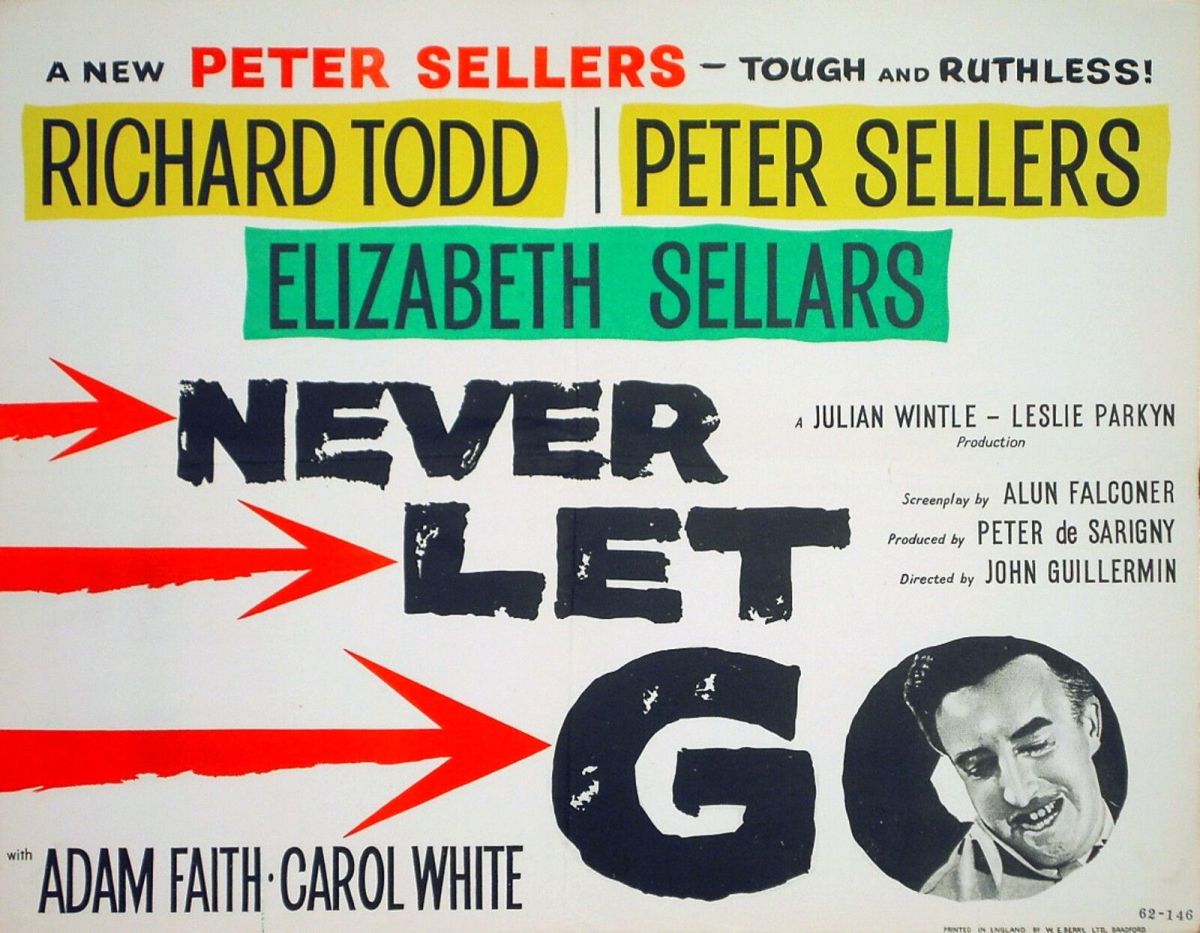
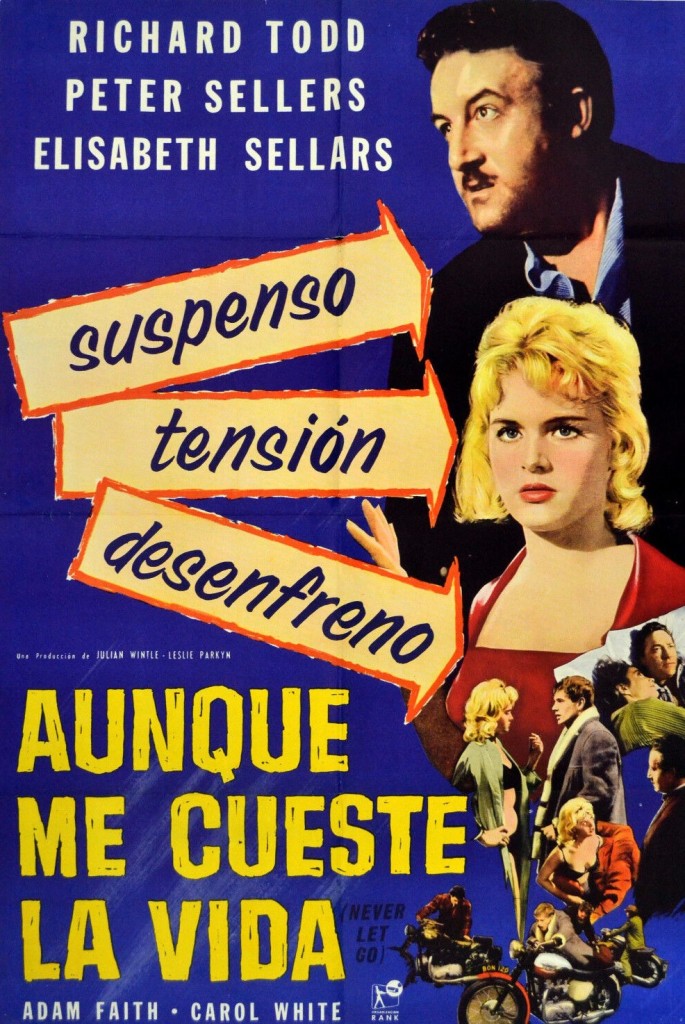
Never Let Go (1960) ****

Under-rated British film noir classic. All the principals playing against type. Comedian Peter Sellers (The Millionairess, 1960) as the villain, British hero Richard Todd (The Dam Busters, 1955) comes seriously unstuck, pop star Adam Faith (Beat Girl / Wild for Kicks, 1960) tosses away his cuddly image. One of the earliest scores by John (James Bond) Barry. First grown-up role for Carol White (Daddy’s Gone A-Hunting, 1969). As much savage violence as the censor would allow at the time.

Down-on-his-luck salesman John (Richard Todd) has his car stolen. It’s uninsured. Without it he can’t get to his appointments on time. The police aren’t interested. So he has to investigate. That leads first to dodgy Teddy Boy Tommy (Adam Faith) who steals cars to order for supposedly legitimate businessman Lionel (Peter Sellers) and makes a play for Lionel’s young mistress Jackie (Carol White).

The interest lies not so much in the investigation as how those involved deal with pressure. John, hardly able to support wife Anne (Elizabeth Sellars) and two kids, has a history of failure, squandering money on get-rich-quick schemes, and apt to blow his top at clients who complain when he fails to keep appointments.

Doesn’t take long for him to lose his job. But instead of knuckling down and finding another, he stubbornly refuses to abandon his investigation, upsetting Scotland Yard Inspector Thomas (Noel Willman) who has much bigger fish to fry.

Lionel is a cocky gangster not afraid to lash out. In fact, he seems to enjoy battering people with his fists, feet and broken bottle. He treats Jackie with contempt, reminding her she’d be a sex worker if it wasn’t for him. He’s got a nice little empire and has kept his nose clean. He pays off corrupt cops.

But the last thing he expects is to be pursued by a loser like John who’s not cut from the John Wick template. Not does he possess the very particular set of skills that appear to be the prerequisite of anyone embarking on a mission of revenge.

If director John Guillermin (El Condor, 1970) hadn’t been obliged to tag on a happy ending, this would have been a downbeat tour-de-force, with the good guy losing everything in order to win back his self-respect.

It just sizzles with tension. Lionel belongs to the generation that spawned the likes of Harold in The Long Good Friday (1980) or the Kray Twins, a simmering, stewing piece of work, all gloss on the outside, a tinderbox on the inside.  

There’s fabulous photography, eyes trapped in pools of light, overhead camera staking out victims, and seedy London picked out in detail. Newspaper vendor Alfie (Mervyn Johns), of pensionable age, the only witness to the crime, has his bedsit ransacked, the tiny terrapin he treasures crushed underfoot, when inadvertently he gives too much away.

Tearaway Tommy isn’t such a tough guy when Lionel comes battering on his door. Jackie is the only one who not so much stands up to Lionel as treats his idea of romance with disdain. Even when John fingers Lionel, Inspector Thomas bluntly tells him he’s too small fry and the cops aren’t interesting in chasing after his plebeian vehicle.

Lionel is the kind of gangster who is never going to realise he can’t always get away with it, that he might have to trim back his ambition until the coast is clearer. Instead, he batters on regardless, determined to terrify everyone into acquiescence.

As the movie progresses, the more you learn about John, the less you sympathise. His wife has stood by him through mostly thin, and will stick by him even if unemployed, but draws the line at antagonising a gangster who doesn’t know when to draw a line. John isn’t Gary Cooper in High Noon. He’s not a principled defender of the law. He’s almost as bad as the gangster, in that he doesn’t know when to stop, regardless of the danger this places his family.

Understandably, Peter Sellers attracted most of the critical plaudits, but this is the role of a lifetime for Richard Todd, who detonates his screen image, battered and bloodied almost beyond recognition, not hiding behind a stiff upper lip. Carol White, too, is superb as the mistress who just about recognises that this is not a good deal, and that she’s a chattel, not a loved one.

John Guillermin’s direction is superb. Coupled with the insistent, jazzy John Barry score, this is British film noir (admittedly, that’s not large pool to draw on) at its best.

https://amzn.to/3GoA77M

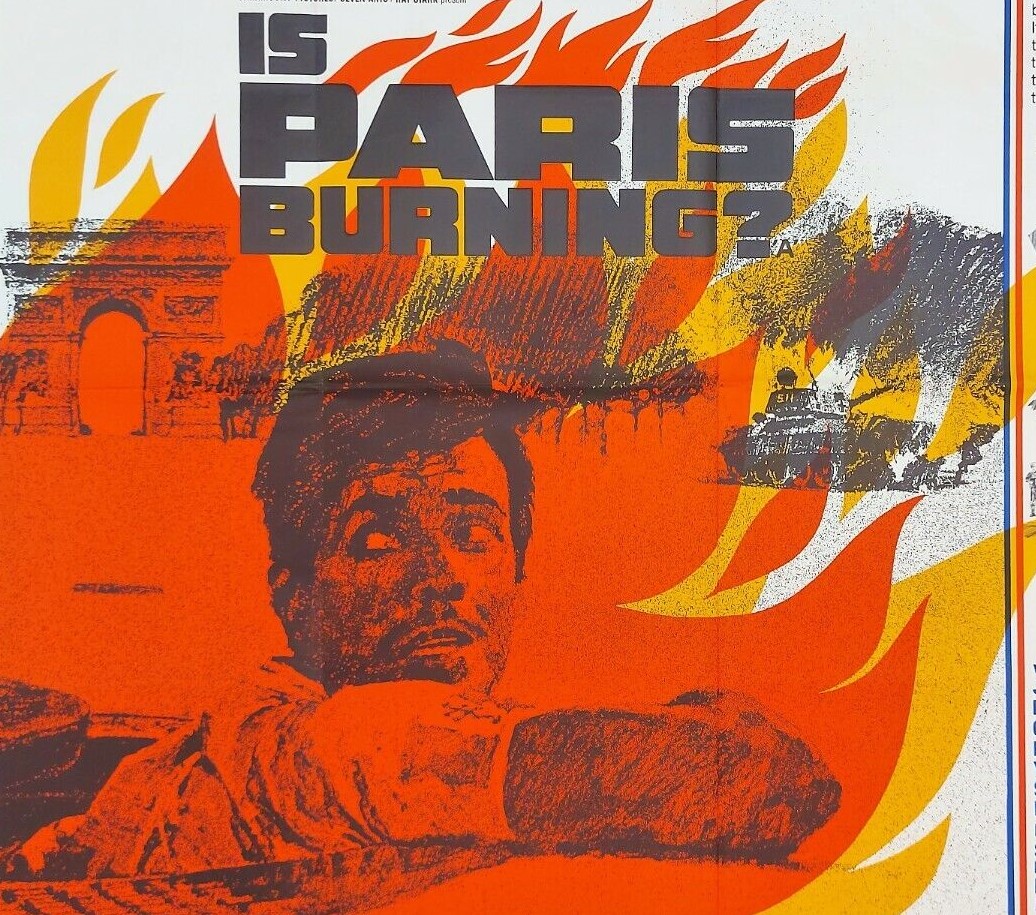
Is Paris Burning (1966) ****

Politics didn’t usually play a part in war films in the 1960s but’s it’s an essential ingredient to Rene Clement’s underrated documentary-style picture. Paris had no strategic importance and after the Normandy landings the Allies intended to bypass the French capital and head  straight for Berlin.

Meanwhile, Hitler, in particular vengeful mood after the attempt on his life, ordered the city destroyed. Resistance groups were splintered, out-numbered and lacking the weaponry to achieve an uprising. Followers of General De Gaulle, the French leader in exile, wanted to wait until the Allies sent in the troops, the Communists planned to seize control before British and American soldiers could arrive. 

When the Communists begin the fight, seizing public buildings, the Germans plant explosives on the Eiffel Tower, the Louvre, and other famous buildings and all the bridges across the River Seine.  The German commandant Von Choltitz (Gert Frobe), no stranger to slaughter having overseen the destruction of Rotterdam, holds off obeying his orders because he believes Hitler is insane and the war already lost.

The Gaullists despatch a messenger to persuade General Omar Bradley (Glenn Ford) to change his mind and send troops to relieve the city. Sorry for the plot-spoiler but as everyone knows the Germans did not destroy the city and the liberation of Paris provided famous newsreel and photographic footage.

Director Clement (Rider on the Rain, 1970) was also aware he could not extract much tension from the question of whether von Choltitz will press the destruct button, so he takes another route and documents in meticulous detail the political in-fighting and the actual street battles that ensued, German tanks and artillery against Molotov cocktails and mostly old-fashioned weaponry. The wide Parisian boulevards provide a fabulous backdrop for the fighting.

Shooting much of the action from above allows Clement to capture the action in vivid cinematic strokes. Like The Longest Day (1962), the film does not follow one individual but is in essence a vast tapestry. Scenes of the utmost brutality – resistance fighters thrown out of a lorry to be machine-gunned, the public are strafed when they venture out to welcome the Americans – contrast with moments of such gentleness they could almost be parody: a shepherd taking a herd through the fighting, an old lady covered in falling plaster watching as soldiers drop home-made bombs on tanks.

This is not a film about heroism but the sheer raw energy required to carry out dangerous duty and many times a character we just saw winning one sally against the enemy is shot the next. The French have to fight street-by-street, enemy-emplacement-by-enemy-emplacement, tank-by-tank.

And Clement allows as much time for humanity. Francophile Sgt Warren (Anthony Perkins), as an American grunt, spends all his time in the middle of the battle trying to determine the location of the sights he longs to see – before he is abruptly killed.  An unnamed café owner (Simone Signoret) helps soldiers phone their loved ones.

Like The Longest Day and In Harm’s Way (1965), the film was shot in black-and-white, but not, as with those movies for the simple reason of incorporating newsreel footage, but because De Gaulle, now the French president, objected to the sight of red swastika. Even so, it permitted the inclusion of newsreel footage, which on the small screen (where most people these days will watch it) appears seamless.

By Hollywood standards this was not an all-star cast, Glenn Ford (as Bradley), Kirk Douglas (General Patton) and Robert Stack (General Sibert) making fleeting glimpses.

But by French standards it was the all-star cast to beat all-star casts – Jean-Paul Belmondo (Breathless, 1960), Alain Delon (Lost Command, 1966), Yves Montand (Grand Prix, 1966), Charles Boyer (Gaslight, 1944), Leslie Caron (Gigi, 1958), Michel Piccoli (Masquerade, 1965), Simone Signoret (Room at the Top, 1959) and Jean-Louis Trintignant (A Man and a Woman, 1966).  Orson Welles, in subdued form, appeared as the Swedish ambassador.

Gore Vidal (The Best Man, 1964) and Francis Coppola (The Godfather, 1962) devised the screenplay based on the bestseller by Larry Collins and Dominic Lapierre

At $6 million, it was the most expensive French film ever made. It had a six-month shooting schedule and was shot on the streets of the city including famous locations like Etoile, Madeleine and the Louvre. It was a big hit in France but flopped in the United States, its box office so poor that Paramount refused to disclose it.

Gripping.

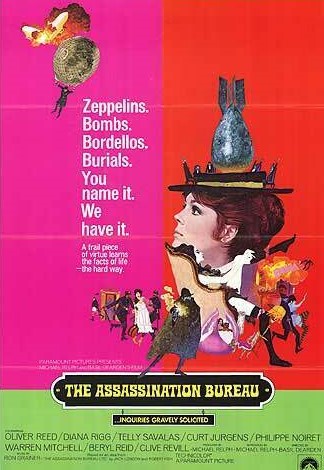
The Assassination Bureau (1969) ****

A couple of decades before “high concept” was invented came this high concept picture – a killer is hired to kill himself. Ivan Dragomiloff (Oliver Reed) is the assassin in question and Sonya Winter (Diana Rigg) the journalist doing the hiring. So Ivan challenges the other members of his murderous outfit to kill him before he despatches them. The odds are about ten to one. Initially involved in shadowing Ivan, Sonya becomes drawn to his aid when it transpires there is a bigger conspiracy afoot.

Set just before World War One, the action cuts a swathe through Europe’s glamor cities – London, Paris, Vienna, Venice – while stopping off for a bit of slapstick, some decent sight gags and a nod now and then to James Bond (gadgets) and The Pink Panther (exploding sausages).

Odd a mixture as it is, mostly it works, thanks to the intuitive partnership of director Basil Dearden and producer (and sometime writer and designer) Michael Relph, previously responsible this decade for League of Gentlemen (1960), Victim (1961), Masquerade (1965) and Khartoum (1966).

Playing mustachioed media magnate Lord Bostwick, Telly Savalas (The Scalphunters, 1968)  has a decent chomp at an upper-class British action. It’s easy to forget was one of the things that marked him out was his clear diction and he always had an air about him, so this was possibly less of a stretch.

Ramping up the fun is a multi-cultural melange in supporting roles:  Frenchman Phillipe Noiret (Night of the Generals, 1967), everyone’s favourite German Curt Jurgens (Psyche ’59, 1964) playing another general, Italian Annabella Contrera (The Ambushers, 1967) and Greek George Coulouris (Arabesque, 1966) plus British stalwarts Beryl Reid (The Killing of Sister George, 1969) as a brothel madam, television’s Warren Mitchell (Till Death Do Us Part), Kenneth Griffith and Clive Revill (Fathom, 1967).

The action flits between sudden danger and elaborate set pieces. When Ivan announces his proposal to his board he promptly fells a colleague with a gavel just as that man throws a knife. Apart from folderols in a Parisian brothel, we are treated to a Viennese waltz and malarkey in Venice. There are disguises aplenty, donned by our hero and his enemies. Lighters are turned into flame throwers.

And there is a lovely sly sense of humour, an Italian countess, wanting rid of her husband, does so under the pretext of Ivan gone rogue. Oliver Reed (Hannibal Brooks, 1969) and Diana Rigg (On Her Majesty’s Secret Service, 1970), adopting her best Julie Andrews impression, are in excellent form and strike sparks off each other. Their verbal duels are a joy to watch. Basil Dearden, in his second-last picture, invested the movie with considerable panache. It takes more skill to carry off this kind of movie, as much satire and spoof as anything else, than a straightforward action or crime picture.

Relph conjured up the screenplay based on an unfinished Jack London novel published posthumously in 1963 with the assistance of crime writer Robert L. Fish.

Shouldn’t work as well as it does. Surprisingly enjoyable.

https://amzn.to/49R8RMy

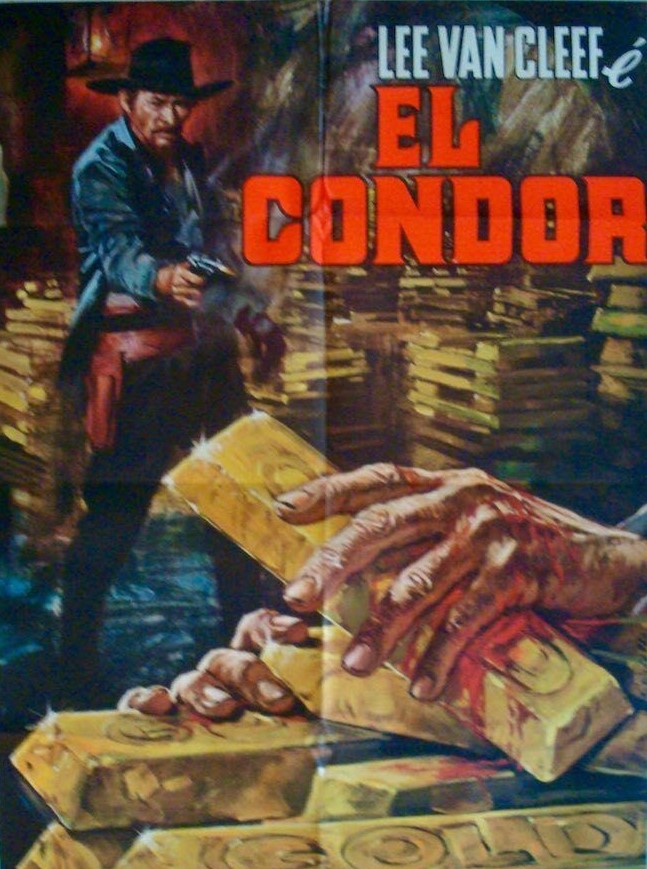
El Condor (1970) ****

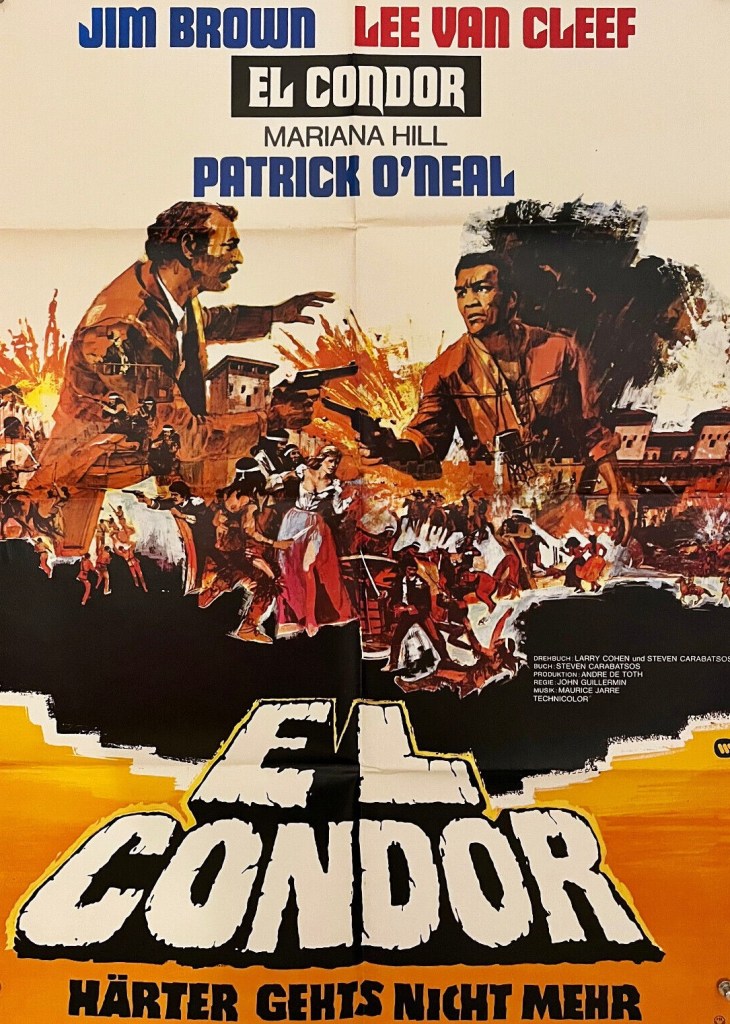
Highly under-rated western, directed with some style by a Britisher, bolsters Jim Brown’s marquee credentials and twists and turns every inch of the way. The basic story couldn’t be more cliché: outlaw Luke (Jim Brown), after escaping from a chain-gang, hooks up with gunslinger Jaroo (Lee Van Clef) and his gang of Apaches to steal the gold bullion hidden inside a Mexican fortress.

It just doesn’t work out that way. Any time a cliché rears its ugly head, director John Guillermin (The Blue Max, 1966) treats it as narrative obstacle and finds a neat way round it. Luke’s attitude doesn’t help either. Looking at a woman the wrong way, not showing Apaches sufficient respect, failing to rein in his larcenous partner, all lead to trouble. But at the right time and the right place, the pair show – almost show off – their respective skills, permitting escape when necessary and finding a way into the citadel.

Lee Van Cleef takes top billing in the Italian poster which adopts a more thematic approach than the normal action-oriented marketing.

Did I mention there was a bullfight with fort commander Chavez (Patrick O’Neal), wielding a saber, dancing around the animal on horseback, or that at one point Luke becomes the bull substitute. Or that, in the picture’s most notorious scene, shades of Raquel Welch taking an impromptu shower in 100 Rifles (1969), the invaders are helped by Chavez’s disgruntled mistress Claudine (Marianna Hill) distracting the defending soldiers by disrobing.

And, though minus such distractions, this is probably where the white walkers in Game of Thrones learned to scale a mighty wall. Even so, it’d be a pretty big ask to infiltrate a fortress almost medieval in its construct with an outer and an inner wall, so Luke evens the odds by subjecting the inmates to involuntary thirst, having destroyed their water tower and poisoned all nearby wells.

Given the heist involves gold, it’s no surprise that the weaselly Jaroo is overcome by greed, taking any opportunity to help himself to more than his fair share, encouraged of course by the even wilier Chavez who has the measure of the potential thief. Luke might have been cautioned about entering into a partnership with such a character after witnessing a couple of Jaroo’s schemes backfire. In one of them, in just about the cleverest and most audacious cut you will ever see, we go from Jaroo in a store stuffing illicit goods under his coat to the pair emerging tarred and feathered from a pond.

And this ain’t The Dirty Dozen, nobody appears to understand a command structure, or even stick to orders, Apache chief Santana (Iron Eyes Cody), left to his own devices, liable to attack a wagon train despite that giving due warning of their presence in the vicinity. But then Luke doesn’t show due respect either, resulting in the pair being staked to the ground in the boiling sun, and finding it impossible to dislodge an Apache clinging to his back.

As you might expect, it’s a bloody affair, but without dwelling on gore, none of the visceral exploding body parts of The Wild Bunch (1969). And there is a surprisingly touching moment when, shades of Charles Bronson in The Magnificent Seven (1960), the hard-nosed Jaroo bonds with a young boy on the grounds that they are both illegitimate and parts with one of his two precious gold nuggets to give the child a start in life.

Harsh reality intrudes. Unspoken racism on the part of Chavez sets him against Luke. And that women are prizes of war provides an uneasy undercurrent. Claudine is Chavez’s lover because he offers safe haven, a security not afforded other Mexican woman, forcibly parted from husbands to provide soldiers with sexual playthings.

Jim Brown (100 Rifles) and Lee Van Cleef (The Good, the Bad and the Ugly, 1967) are an inspired teaming, both playing against type, incurring more laughs than you might expect, and less inclined to play their previous stock characters, the former just a tough guy, the latter a ruthless professional. Patrick O’Neal (Stiletto, 1969) is a formidable opponent, perfectly capable of outwitting the more easily-duped Jaroo.

Despite, perhaps unfairly being remembered more for her nudity than her acting, Marianna Hill (Medium Cool, 1969) exhibits vulnerability as well as a tough core. Iron Eyes Cody (Nevada Smith, 1966) has a very refreshing take on an Apache war chief.  And you might spot British starlet Imogen Hassall (The Long Duel, 1967) and veteran Elisha Cook Jr (Welcome to Hard Times, 1967).

But this movie really belongs to director John Guillermin who takes a fairly routine western and turns it on its head, extracting reversals at every opportunity, and clearly delighting in the several twists in the tail. Larry Cohen (Daddy’s Gone A-Hunting, 1969) and in his movie debut Steven Carabatsos (The Revengers, 1972) wrote the screenplay and the presence in the producer’s chair of Andre de Toth (Play Dirty, 1968) might account for some of the movie’s subversiveness.

There’s a historical footnote to El Condor. In a revision of the certificates issued by the censor, the British Broad of Film Classification in 1970 introduced the “AA” certificate, permitting people aged over 14 to view material that would previously have been restricted to the X-certificate. Admission to that category was raised to 18. So for a whole generation of teenage boys, hormones going wild, the first glimpse they had of a naked woman was in El Condor. (In the US it was an “R”.)

Not only well worth seeing but free to view on YouTube.

And when that source dries up you can find it on the Warner Archive.

https://amzn.to/46FBZn8

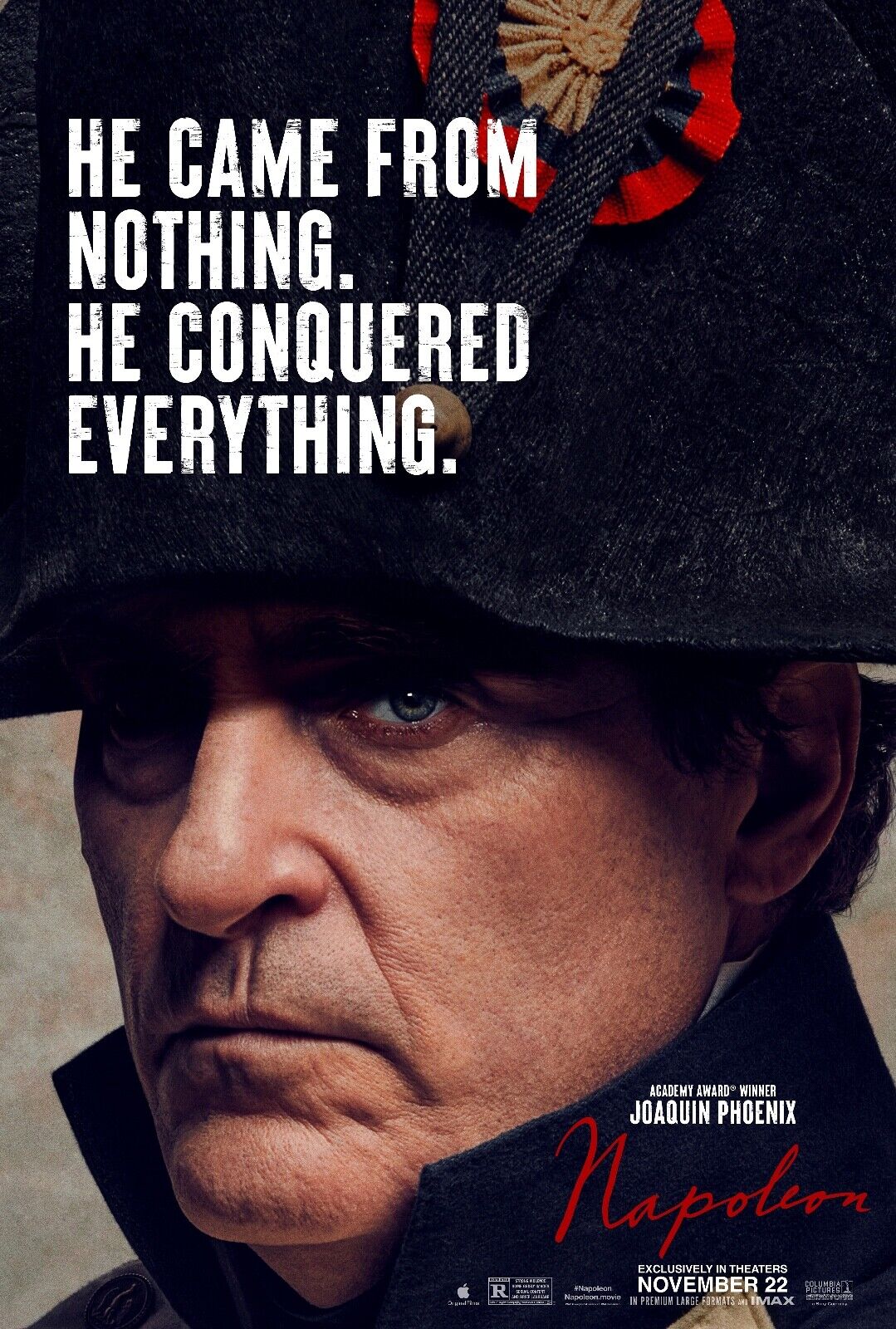
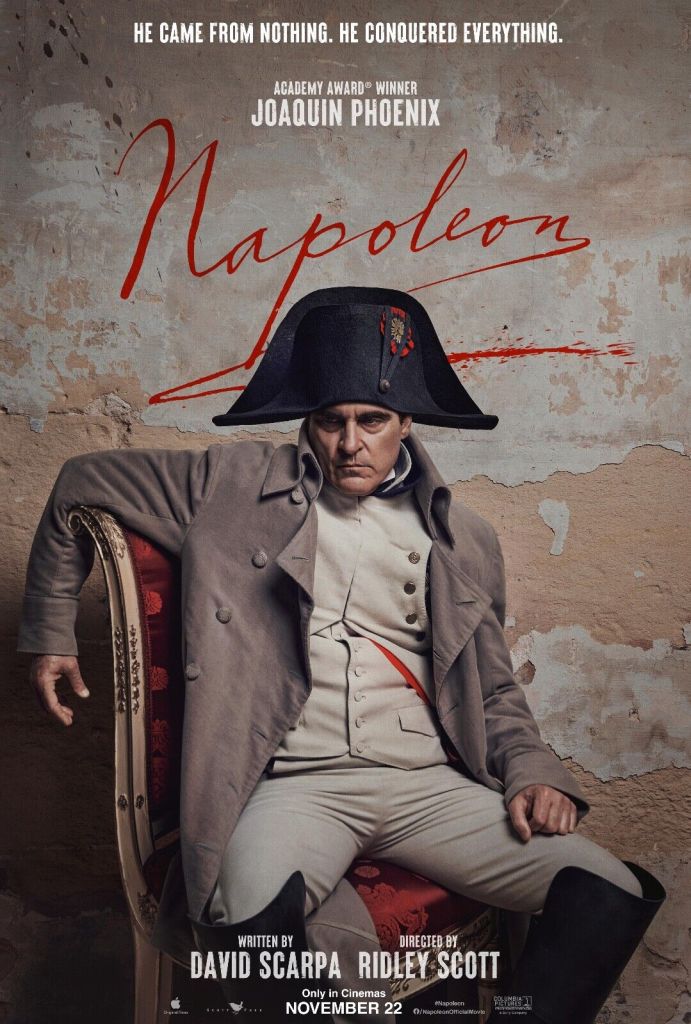
Napoleon (2023) ***

I come at this with a disadvantage since I’m all Napoleoned-out what the various Abel Gance projects and that of Stanley Kubrick. So I suffer from over-familiary with the subject matter. Most of the audience won;t have viewed a Napoleon movie in their lifetime, but I’ve already sat through six-seven hours of this material.

In the end length defeats them all, the magnitude of the task of encapsulating an extraordinary career ends up as a mad dash through history. Setting any deliberate distortions aside, those scenes fictionalized for dramatic effect providing directors with a free pass, it’s just too much to find a central thread on which to encompass the man. Here, Ridley Scott makes a good stab at using romance as that glue, but it’s hampered by the great emperor (Joaquin Phoenix) being such an oaf in terms of seduction. Although he is as ruthless as any dictator whose risen from poverty to the absolute heights.

On the other hand, Josephine (Vanessa Kirby) is shown as a more complex character in more complex times, effectively taking up with this oaf for mercenary reasons, her clever plan only coming adrift because she cannot provide him with an heir. I doubt if that many among the audience are looking for an actual history lesson, which is just as well, because it feels, in part because of length restrictions, that this is inevitably going to come up short.

Little is made of the political situation in a world terrified of the revolution that changed France seeping into the countries of Europe. Theoretically, Britain was a democracy, but in reality it was ruled by an elite land-owning cabal, with poverty as rife as in France. Every other country in Europe had an unelected monarch. So Napoleon didn’t so much intend to conquer Europe from power lust but prevent his country being attacked by those who feared an end to the status quo.

Of course, if you had included more history you would have to accommodate an endless stream on one-line characters trying to explain the situation. Scott makes more use of subtitles to provide the audience with its historical bearings but still isn’t afraid to simply fall back on the Austerlitz trick of using protocol to announce a new one-line character.

In terms of actors, this has more the feel of a mini-series than a movie. Hardly anyone of box office significance and being weighed down with British character actors, virtually nobody is on screen long enough to make a mark. Certainly, none command the screen the way the veterans of the old-style all-star cast like Ralph Richardson (Khartoum 1966) or John Gielgud (Becket, 1964), and I’m sorry but Rupert Everett as the Duke of Wellington is sorely miscast.

Anyway, you could go through this entire picture pulling it to pieces, instead of concentrating of what does work. Napoleon’s insecurities contrast nicely with his rampant ambition and arrogance and every now and then someone delivers a historical bon mot. As annoying as it is, I doubt if many males of the period gave any thought to female pleasure during sex, so Napoleon’s amateur love-making can be ignored.

Except for the verbal sparring with Josephine, it’s the military duels that bring this up to scratch at least within the Ridley Scott canon. The taking of Toulon, the bloody putting down of the royalist revolt and Austerlitz are the outstanding scenes, though anybody who has dared to sit through Abel Gance’s Austerlitz might not come out thinking the frozen ice splintering is quite as novel as it might appear.

I’m guessing that the four-hour version planned for streaming might fill in some of the holes, but I’m worried that, like Austerlitz, it will be more of the boring stuff, a potted history filled out with more balls and costume-heavy scenes. If this is all the insight into the life of Napoleon that $200 million buys, then it will take another streamer with even deeper pockets to make a serious dent at tackling the full story of Napoleon.

I usually go back to see a Ridley Scott film at least once – I saw The Martian (2015), Gladiator (2000) and American Gangster (2007) four times each in the cinema – but I’m not sure this holds the same attraction. The director’s cut of Kingdom of Heaven (2005) even with a miscast Orlando Bloom totally transformed that movie so I’m hoping the longer version here might achieve the same. But the latter had a marvellous score, which I had bought as a CD and was a virtual earworm for me, whereas the music here is an uneven as the picture.

I’d love to give this a better score, especially as it may be the director’s last cinematic outing, but it’s too disappointing.

Time – or lack of it – does not sit well here.

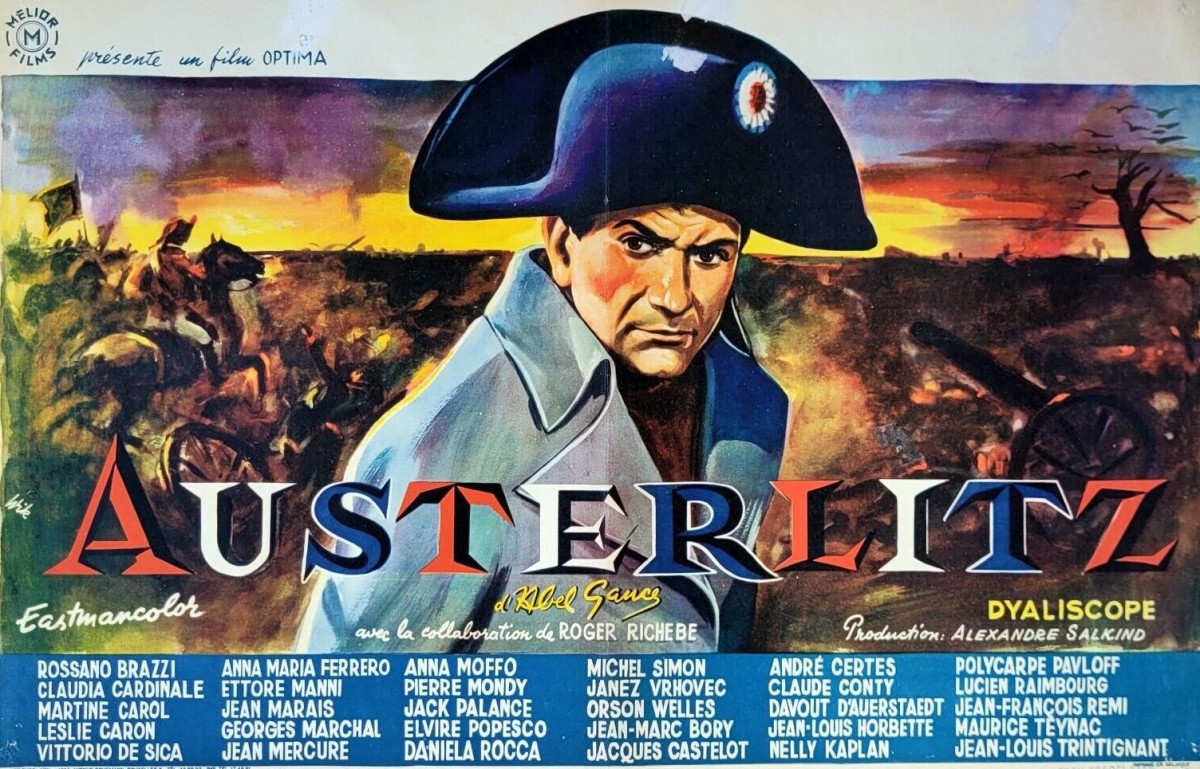
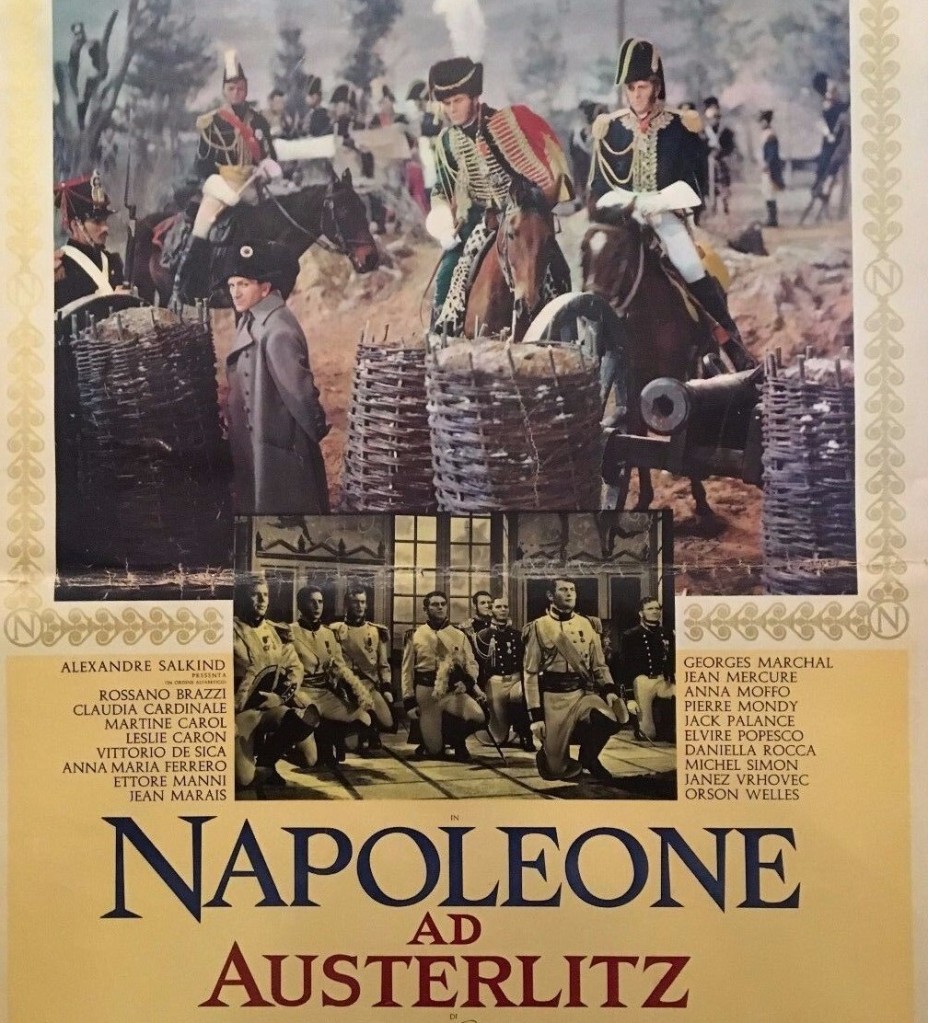
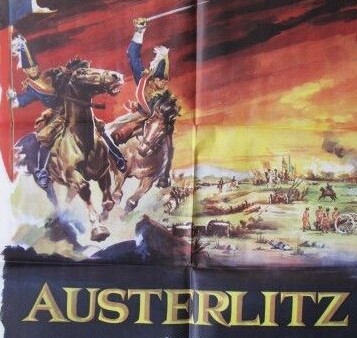
Austerlitz (1960) ***

If I’d seen this first, I might well have resisted the publicity tsunami that welcomed in 1981 the restoration reissue of Abel Gance’s silent epic Napoleon (1927). It’s the equivalent of John Ford following up The Searchers (1956) with something as clunky as Cannon for Cordoba (1970).

Oddly enough, the first few minutes are outstanding in telegraphing the French leader’s myriad insecurities. He forces a flunkey not only to break in his stiff new shoes – for fear the master of all he surveys be seen limping along – but also his new hat and then cheats when he undergoes the self-imposed ritual of being measured, pushing up on his toes to elevate his height by two inches from its genuine five foot two inches.

After that splurge of exquisite exposition, it goes not so much downhill as up and down ever narrative pathway possible. No wonder Ridley Scott felt that encompassing this particular life required at least four hours (the length of the planned streaming version) and that Steven Spielberg aims to devote seven hours to the subject when he revisits Stanley Kubrick’s script for HBO.

Mercifully, this part of the Napoleon legend is truncated to just three years, from the Treaty of Amiens in 1802, which purportedly brought peace to Europe, to the Battle of Austerlitz in 1805 when the French commander-in-chief demonstrated his military genius and shredded his opponents. But that battle is an almighty time coming.

In between, we have to put up with endless balls and endless characters shuttling through doors, although following the protocol of the time at least we have a clue who they are since they are announced by another flunkey in advance of their appearance. You would need Google open to check out who exactly they all are and what part they play.

Roughly, the story goes: Napoleon (Pierre Mondy) is attempting to achieve the “unification of Europe” (as would occur by more peaceful means over a century and a half later). The rest of Europe, naturally, isn’t in agreement so when foreign countries are not despatching assassins or reneging on treaties they’re lining up armies against him. Things are just as tough domestically. Even though, by overwhelming public vote, he has been named Consul for Life, he hankers after reviving the old title of Emperor, despite the last owner having his head chopped off.   

Plus, there are problems on the romantic front, wife Josephine (Martine Carole) has taken a lover and is jealous of the imminent arrival of his former Italian lover. All in all, it’s a pretty busy affair with countless sub plots, including an attempt to dupe the English into thinking he plans to invade their country via Ireland, and American inventor Robert Fulton (Orson Welles) trying to sell him on the notion of an ironclad steamship and submarine. Even when he gets to war, it’s nothing but chatter and subterfuge, various underlings almost rebelling at his, according to them, lack of military skill and troops disobeying orders.

The battle also lacks that essential ingredient, of the audience being told exactly what’s going on and understanding just how clever a maneuver might be, and although there are thundering horses aplenty it comes nowhere near the scale and grandeur he achieved with Napoleon, nor, it has to be said, the later Waterloo (1970), except for the horses and men disappearing under the frozen lake.

It was the fate of Abel Gance to be ruthless edited, his monster Napoleon chopped by two-thirds for original U.S. release, this one losing one-third of its running time, though I suspect what was cut out was no great loss, assuming it was just more rigmarole and costume drama set around his court, although it might have helped in working out what part his sister Pauline (Claudia Cardinale) and Mlle de Vaudey (Leslie Caron) play in the proceedings. Though we could have done with less of the Austrian General Weirother (Jack Palance with an execrable accent). Pauline has the best line in the whole endeavour, refusing to sit on a couch because its color clashes with her outfit.

Nestling among the all-star cast you’ll find – or not, depending on which version you view – names like Vittorio De Sica (The Shoes of the Fisherman, 1968), Rossano Brazzi (The Battle of the Villa Fiorita, 1965) and Jean-Louis Trintignant (Les Biches, 1968).

Nobody does much to earn their crust and Pierre Mondy (The Night of the Generals, 1967) just looks irritated beyond belief that he got mixed up in this.

Far from director Abel Gance’s finest moment. Little more than an elongated information dump.

https://amzn.to/47wvMeA

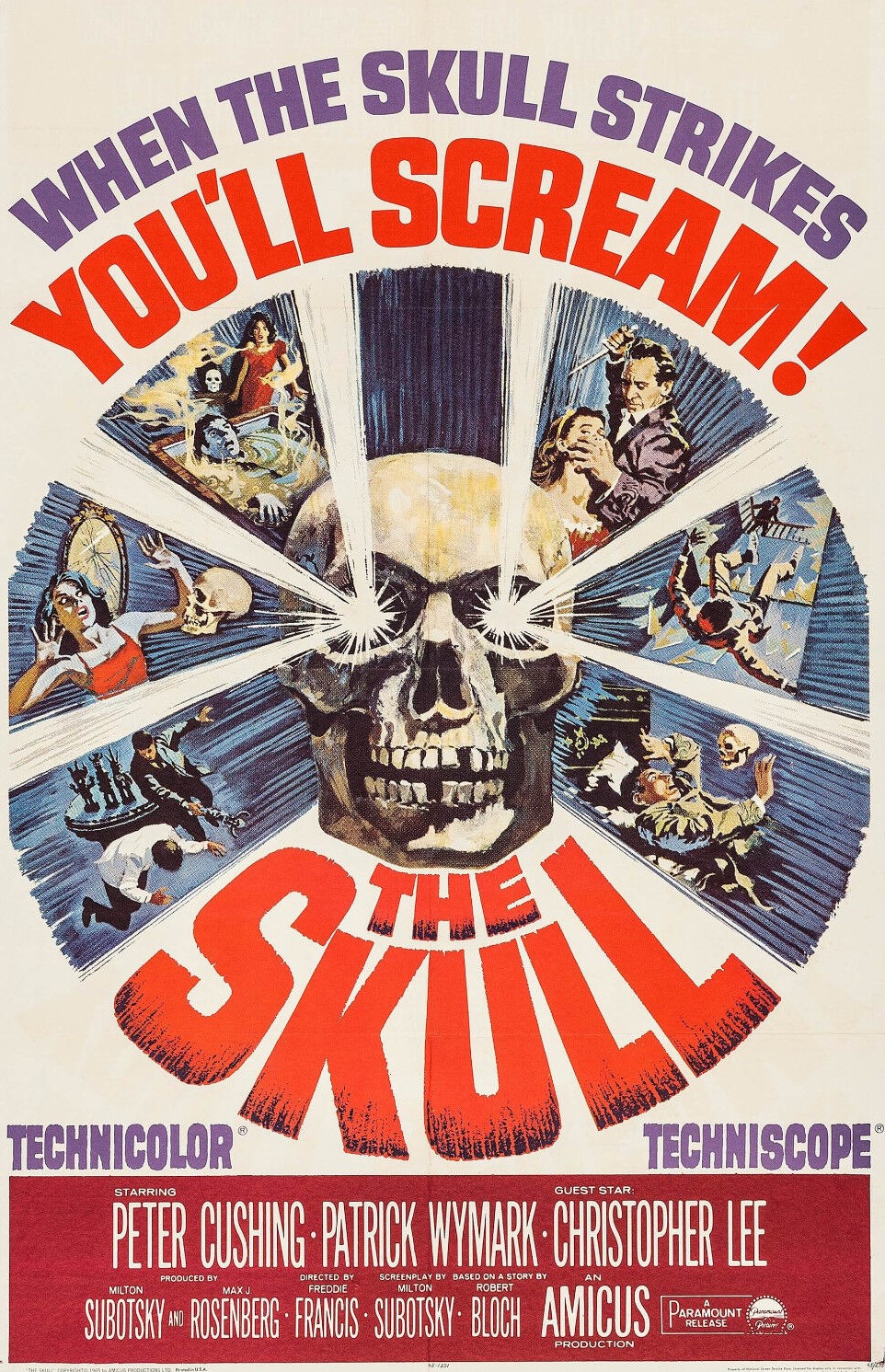
The Skull (1965) *****

I have no idea why this masterpiece has not been acclaimed. For virtually half the picture, there is no dialogue, the entire focus on camerawork and reaction. Even Stanley Kubrick in The Shining (1980) gave in to grand guignol and The Exorcist (1973) was filled with over-the-top scenes but here the psychological impact of possession remains confined.

Initially, it appears we are in familiar Hammer territory, a grave-robber detaching a skull from a corpse only to meet an untimely end. There is another flashback to the gothic where the presence of the skull drives an order man to murder. But this is an Amicus production and set in contemporary times where Christopher Lee and Peter Cushing are once again in opposition, but this time only in an auction house bidding for demonic artefacts.

Exposition is straightforward. Dealer Marco (Patrick Wymark) sells Maitland (Peter Cushing) a book about De Sade bound in human skin. Marco may be a con man. He claims to possess the skull of the Marquis de Sade but his attitude towards it, kissing its head, plucking its nose socket, and the fact that he willing to halve his asking price, suggest otherwise. Sir Matthew (Christopher Lee), who once owned the skull, warns Cushing against it.

The rest of the film covers Maitland’s possession of the skull and the skull’s possession of him. There is a notable Kafkaesque sequence where Maitland is arrested, taken before a judge and forced three times to play Russian roulette before ending up in the house of the dealer where he steals the skull. What is less often commented upon is that this nigh-on 15-minute sequence including a 90-second taxi ride is conducted in virtual silence, the camera mostly on Maitland’s face, that silence only broken by the feeding of bullets not the barrel of the gun and the barrel being rolled round. It is not long before Maitland commits his first murder.

There is a famous scene in the Last Tycoon (1976) in which Robert De Niro explains to a truculent word-obsessed British writer why dialogue is redundant in the movies. All you need is camera and reaction. That sets up The Skull’s greatest scene, a 17-minute dialogue-free climax, where Maitland is effectively preyed upon and consumed.

The skull itself appears to have a point-of-view, various shots of Maitland through the skull’s eyes. The actual special effects are limited to what is imminently achievable, the skulls glows, it moves through the air. The impact of its presence is shown on Maitland’s face and by his action. It is just hypnotic.

Various directors have been anointed for the way they move their camera – Antonioni’s 360-degree turn in The Passenger (1975) comes to mind, large chunks of 2001: A Space Odyssey (1968), the long wait for sunrise in Lawrence of Arabia (1962), the lengthy shots of James Stewart driving a car in Vertigo (1958). But I have never seen anything as innovative as the silent sequences in The Skull which would be a waste of innovation were the sequences not so effective, especially on the small screen. Freddie Francis (Nightmare, 1964) directed from a story by Robert Bloch (Psycho, 1960). Equally innovative is the jarring music by avant-garde composer Elizabeth Lutyens.

In the role of his career, Peter Cushing (Dr Who and the Daleks, 1965) turns on the style, his character virtually turning 360-degrees as he becomes enmeshed in diabolic terror.

A must-see.

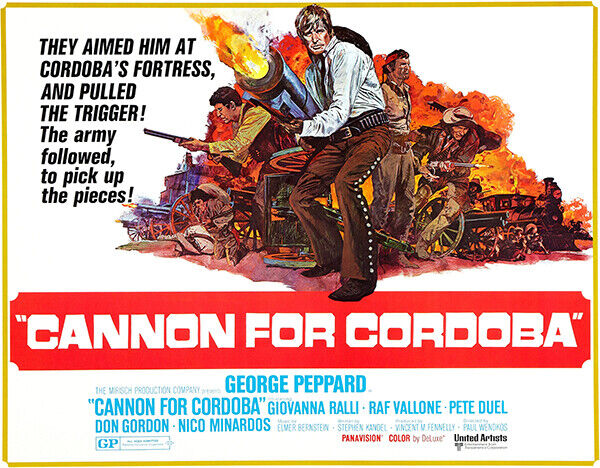
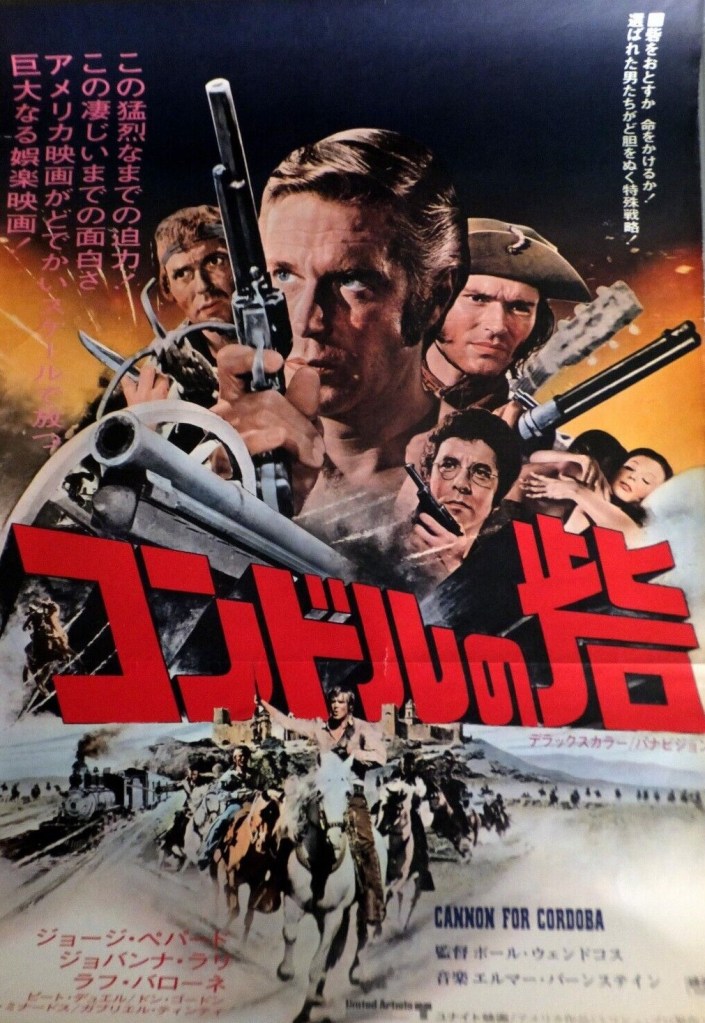
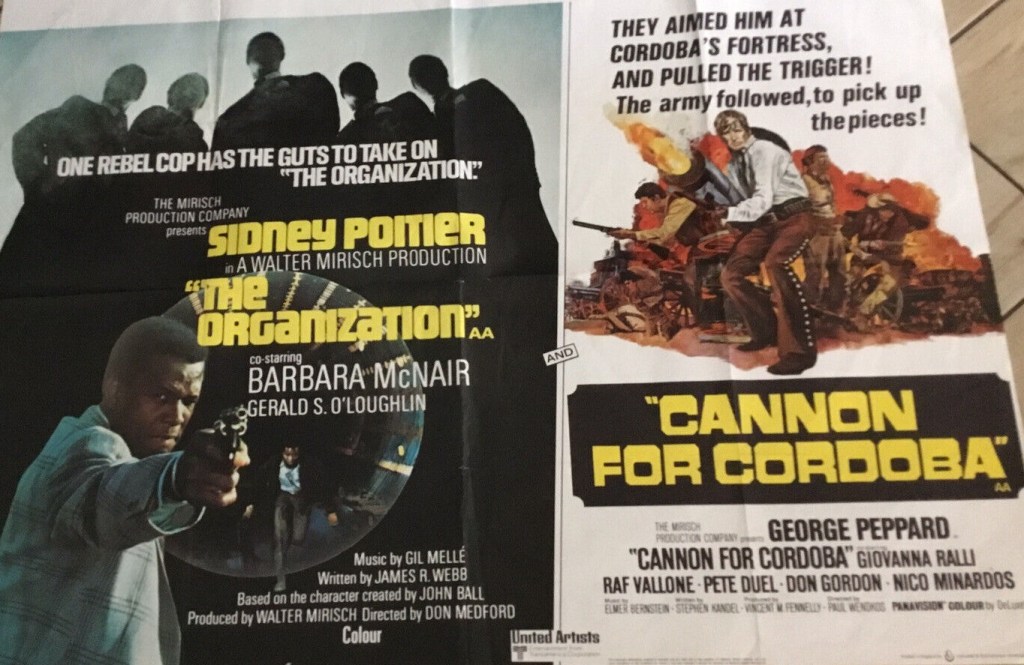
Cannon for Cordoba (1970) ***

Why settle for a measly Gatling Gun, as Mapache does in Sam Peckinpah’s gloriously violent The Wild Bunch (1969), when you can just as easily relieve government troops of serious artillery. It’s 1912 and the U.S. has sent General Pershing (John Russell) into Mexico with the titular weaponry in a bid to subdue Mexican rebels led by the titular Cordoba (Raf Vallone) raiding across the border and annoying powerful ranchers like Warner (John Larch).

Over-plotted to within an inch of its life and atmospherically indulgent – the natives are constantly whooping it up – and with star George Peppard trying out cigars for size for future enterprises like The A-Team (American television 1983-1987), this comes up short when compared to similar hard-nosed incursions into enemy territory like The Professionals (1966) and The Dirty Dozen (1967).

It’s a movie of many – too many – parts. First of all, we have rebellious U.S. soldier Capt Douglas (George Peppard), who gives superiors the finger, packed off with a small team to infiltrate the rebel army and find out what they’re up to. Not that that would require any infiltration. It’s pretty obvious with a prize plum like artillery suddenly arrived, the rebels are going to chance their arm and steal it.

Lo and behold that’s exactly what Douglas’s gang – which includes Jackson Harness (Don Gordon) quickly embittered because the good captain, in order to maintain his disguise, refuses to save one of his captured team being slowly roasted over a pit – does discover. But they don’t quite manage to get this information back to Pershing before those dashed clever Mexicans are blowing everything to hell and stealing the train containing the guns.

So now Douglas has to put together another team, the aforementioned Harkness augmented by Rice (Pete Duel) and Antonio (Gabriele Tinti), a Mexican who wants Cordoba brought to justice, and a few others, and infiltrate the Mexican stronghold. Along the way, they acquire the assistance of the beautiful Leonora (Giovanni Ralli) who is willing to use her body any which way (not going quite as far as Marianna Hill in El Condor out the same year) to gain revenge for Cordoba slaughtering her family and raping her. That last aspect seems a psychological stretch, but what the hell, how otherwise will the gang get close enough to the rebel leader.

Of course, just to sauce up the story, as if anything more is required, they are captured and need to bust out of jail and what with one thing and another it takes a goodly time before they can get close to achieving their objective. And that’s not to mention the betrayal that simmers in the background, Leonara having her own way of getting close to Cordoba, Warner not  quite as right-minded as he appears, and the aforementioned Harkness waiting for the right moment to blow away his leader.

Not too well received, the movie went out in the supporting role in a double bill.

Plenty explosions, plenty action, and plenty living it up, scantily-glad women appearing at every turn, firecrackers going off, dancing in the streets, but somehow too much of this scrambles the focus while subsidiary characters take center stage too briefly too often, as with rebel women in the 100 Rifles (1969)-Raquel Welch mold. It gets there in the end of course but you just wish it would hurry up or expend more of its running time on developing the main personnel.

George Peppard (The Groundstar Conspiracy, 1972) is having a ball, but that’s only because every other character is so reined-in and there’s little else character-wise for him to hold onto. It wouldn’t have taken that much for him to command center stage, for competition in the acting stakes he’s only got Raf Vallone (The Cardinal, 1963), in worldly-wise form, and Don Gordon (Bullitt, 1968), stewing away. Giovanni Ralli (Deadfall, 1968) arrives too late in the proceedings to make much impact. Pete Duel (Alias Smith and Jones, 1971-1973) looks cute but has little to do.

Diligently put together by Paul Wendkos (Guns of The Magnificent Seven, 1969) but coming across as trying too hard, from a screenplay by Stephen Kandel (Chamber of Horrors, 1970).

Enjoyable if you enjoy shoot-em-ups, and even more if you’ve been charting the career of George Peppard who here makes the switch from all those uptight characters of the previous few years to letting a whole lot more hang out.

https://amzn.to/49SXTGg

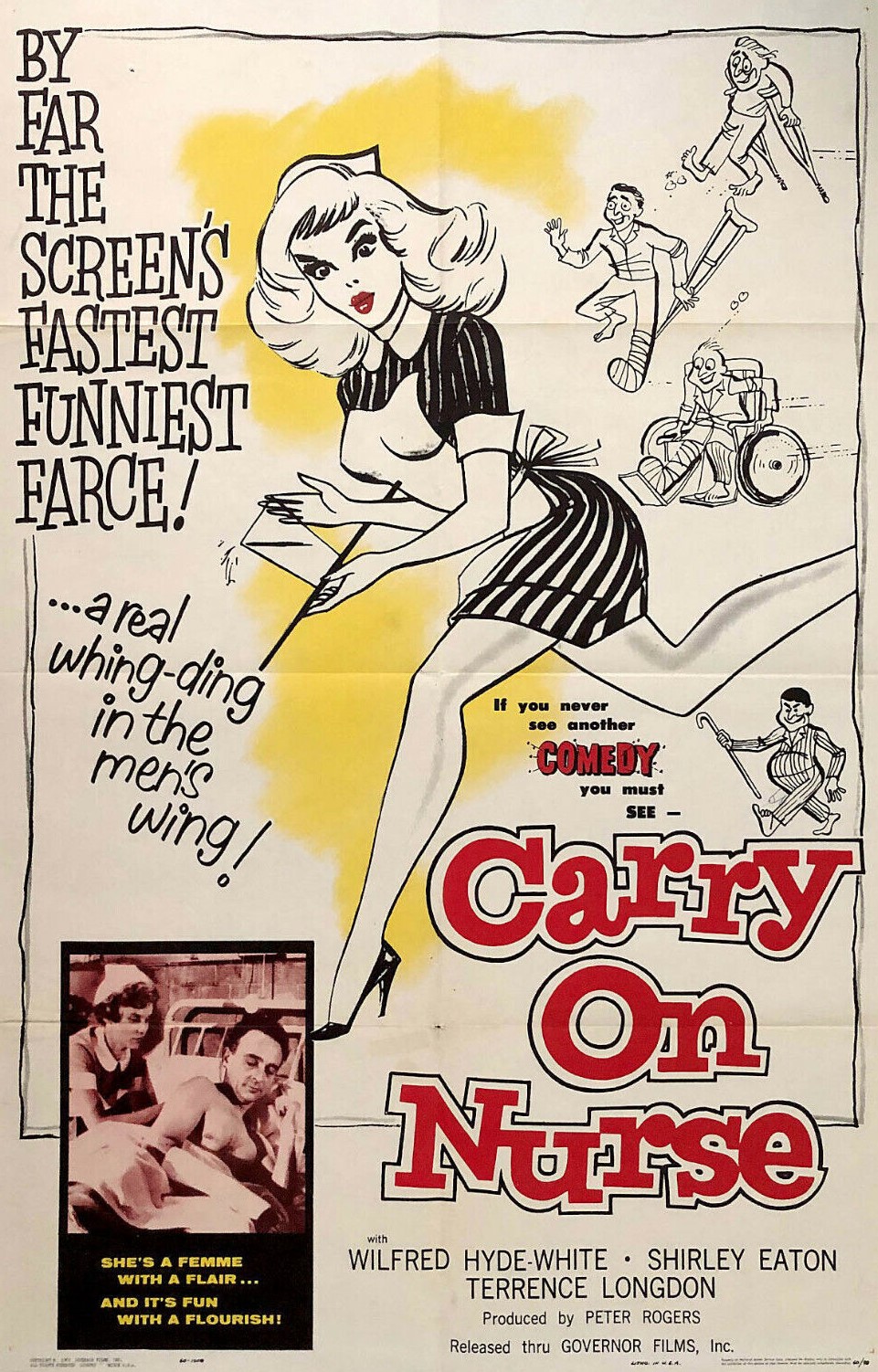
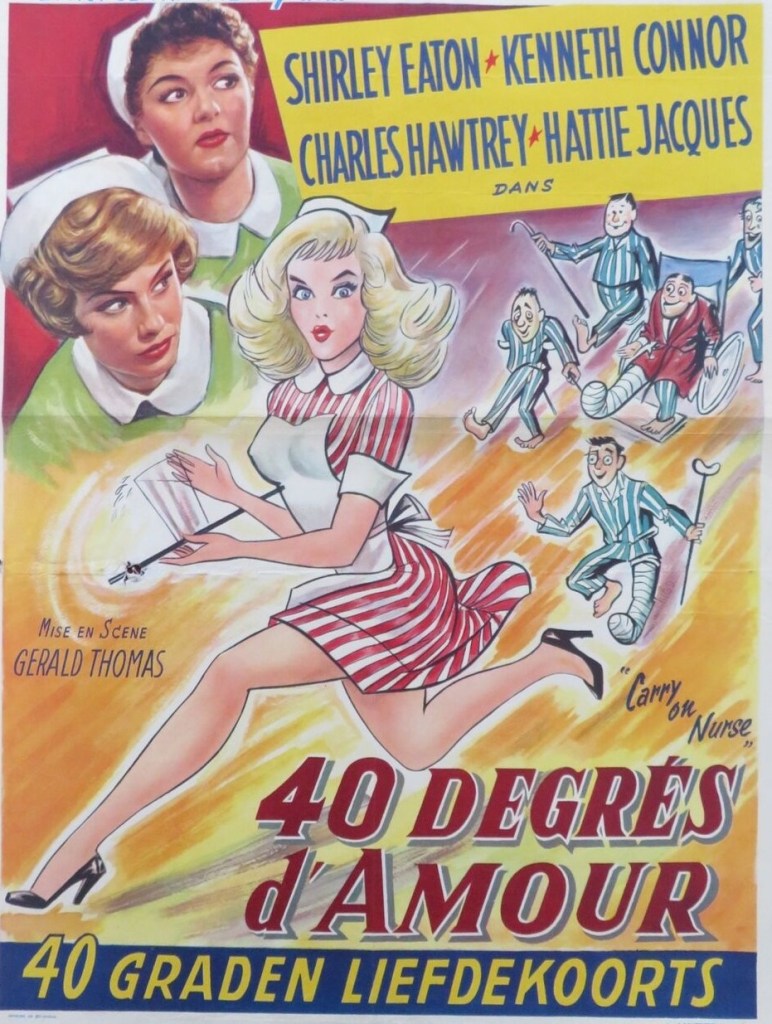
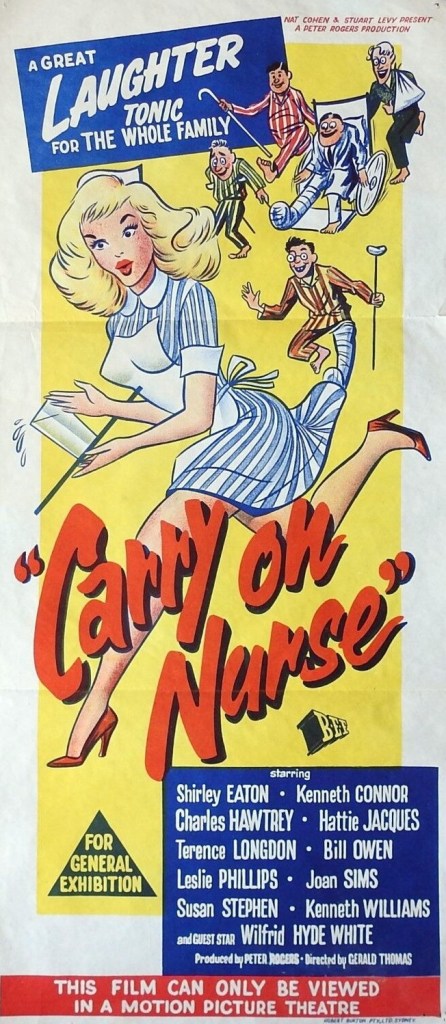
Carry On Nurse (1960) ***

There was no greater divide between audiences and critics in Britain than the long-running comedy “Carry On” series (outside of an occasional satirical bulls-eye like Carry On Up the Khyber, 1968). And a similar gulf existed between the type of audiences the movies attracted in Britain and those in America. In Britain they were vastly popular general releases while in America their usual habitat was the arthouse as if they were seen as the natural successors to the Ealing comedies. And there was a third chasm – between the endearing risqué early comedies and the more lascivious later versions.

Carry On Nurse fell into the endearing camp. The humor was gentle rather than forced, the emphasis on misunderstanding and innuendo and smooth seducers like Leslie Phillips rather than exposed female flesh and the grasping likes of the ever-chortling Sid James. Perhaps you could define this earlier film as pre-nasal Kenneth Williams, his peculiar type of delivery not yet at full throttle. Here there is innocence rather than lust and the males quake in fear not just of the indomitable Hattie Jacques in brusque matron mode but of the other efficient nurses led by Shirley Eaton who have the measure of their rather hapless patients, although student nurse Joan Sims – making her series debut – is an accident-prone soul.

And they say comedy doesn’t travel.

The action is mostly confined to a male ward. There are plenty of gags – alarms rung by mistake, boiling catheters burned to a turn, medication making a patient go wild, patients intoxicated by laughing gas and the famous replacement of a rectal thermometer by a daffodil. Wilfred Hyde-White as a constant complainer and obsessive radio listener Charles Hawtrey provide further ongoing amusement. 

But the thrust of the story is romance. Journalist Terence Longdon fancies Shirley Eaton but his initial advances are spurned as she is in love with a doctor. In a role far removed from his later brazen characters, Williams plays a shy intellectual who finally comes round to the charms of Jill Ireland (later wife of Charles Bronson). Although Leslie Phillips is his usual suave self, he makes no designs on the female staff since he has a girlfriend elsewhere and  his ailment – a bunion on the bum – makes him an unlikely candidate for a hospital liaison.  

Hattie Jacques is in imperious form, Shirley Eaton shows what she is capable of, Kenneth Williams playing against type is a revelation. 

British critics hated the “Carry On” films until late in the decade when Carry On Up the Khyber (1968) hit a satirical note. Critics felt the movies pandered to the lowest common denominator and were a poor substitute for the Ealing comedies which had given Britain an unexpected appreciation among American comedy fans.

It was a well-known fact the comedies did not always travel. Apart from Jacques Tati, the more vulgar French comedies featuring the likes of Fernandel were seen as arthouse fare. Unless they featured a sex angle or the promise of nudity, coarse Italians comedies struggled to find an international audience. The “Carry On” films were bawdy by inclination without being visually offensive

Carry On Sergeant (1958), the first in the series, had been a massive success in Britain. Distributor Anglo-Amalgamated was so convinced it would find a similar response in the U.S. that it was opened in New York at a first run arthouse. Although comedies were hardly standard arthouse fare, this was generally the route for low-budget British films.  The picture lasted only three weeks and taking that as proof of its dismal prospects other exhibitors ignored it. 

The follow-up Carry On Nurse (1959) took an entirely different route when launched in America in 1960. This time New York would be virtually the last leg of its exhibition tour.  Instead it opened on March 10 at the 750-seat Crest in Los Angeles. Away from the New York spotlight, the little movie attracted not just good notices but decent audiences.

Instead of being whipped off screens after a few weeks, it developed legs. In Chicago it ran for 16 weeks in first run before transferring to a further 50 theaters. Within a few months of opening it had been released in 48 cities. In Minneapolis it was booked as a “filler” at the World arthouse, expected to run a week and no more. Instead, it remained for six weeks and when it shifted out to the nabes out-grossed Billy Wilder’s big-budget comedy The Apartment (1960) with a stellar cast of Jack Lemmon and Shirley Maclaine.

In its fourth month at the 600-seat Fox Esquire in Denver where it opened in May, it set a new long-run record for a non-roadshow picture. It had been taking in a steady $4,000 a week since opening.

SOURCES: “How To Nurse a Foreign Pic That’s Neither Art nor Nudie: Skip N.Y.,” Variety, Aug 24, 1960, 3; “British Carry On Nurse A Sleeper in Mpls With Long Lopp Run, Nabe Biz,” Variety, Aug 24, 1960, 18;

Note: by and large this blog follows American release dates so although Carry On Nurse was shown in Britain in 1959 it did not reach America until 1960.

https://amzn.to/3G1h1Ei

Discover WordPress

A daily selection of the best content published on WordPress, collected for you by humans who love to read.

The Atavist Magazine

by Brian Hannan

WordPress.com News

The latest news on WordPress.com and the WordPress community.