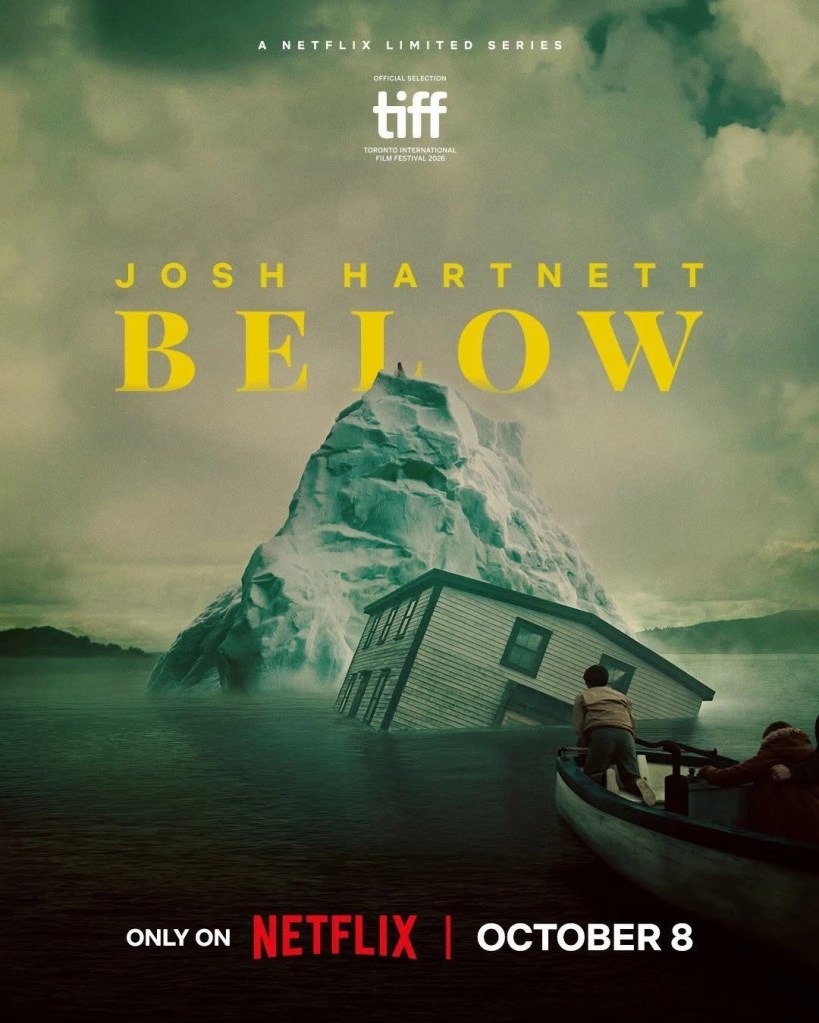
One of the most brilliant, almost surreal, openings in recent years, and probably the best to come from a streamer. A wooden house is being towed across the water by a very small boat. The image is just stunning. But it doesn’t last long because the house doesn’t last long. Something in the water triggers its collapse with a father inside. On the boat his small son Calvin has to frantically saw through the towing rope otherwise the entire family is going to be dragged under. So he’s left with the guilt of dooming his father.
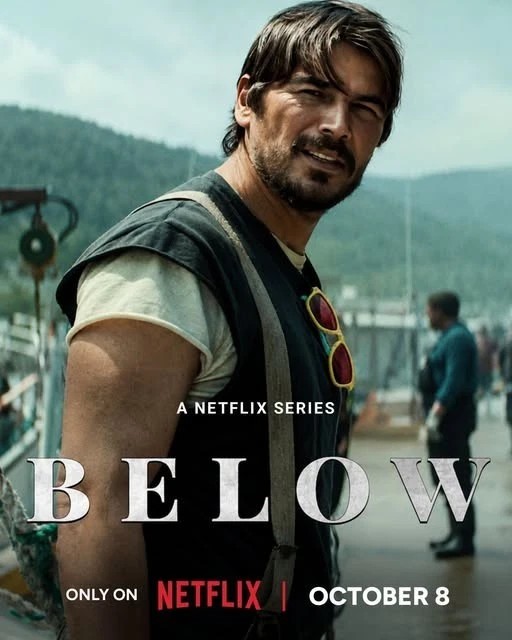
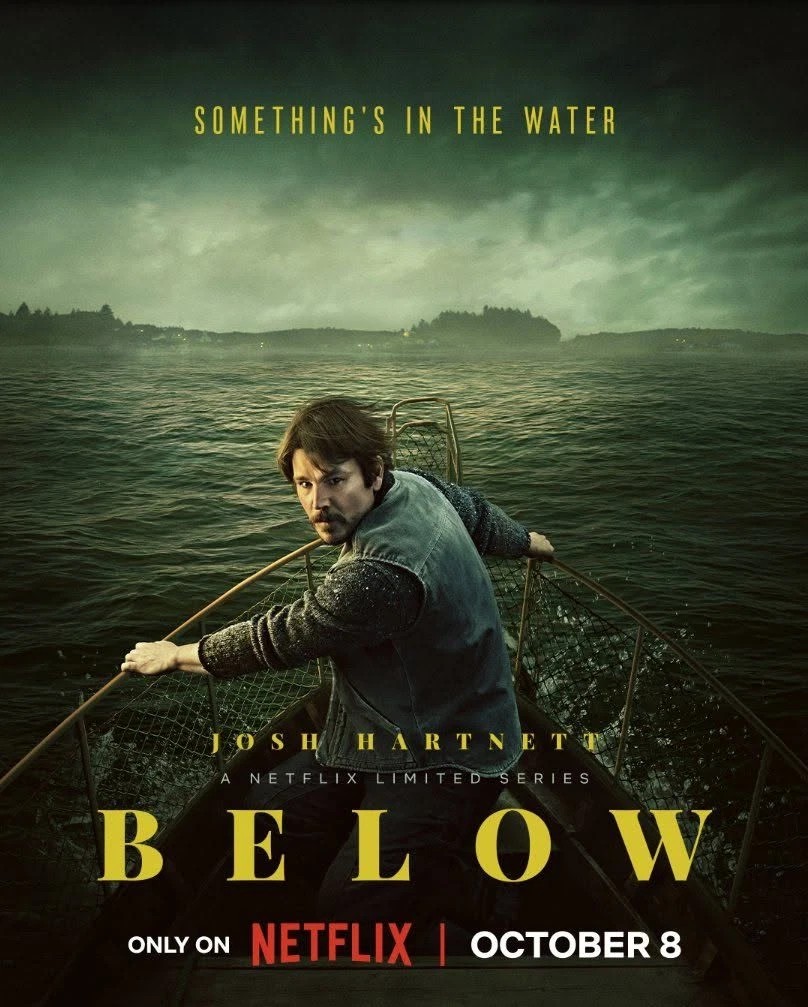
But that was 40 years ago and now the widowed Calvin (Josh Hartnett) is struggling to survive in a small fishing village which no longer has any fish to catch. Fisherman make a living hauling up ice. Quite why the undersea monster has waited four decades to put in another appearance is anyone’s guess and it’s a big niggardly with its presence, an eye glimpsed through dark waters, bits of bone washing up on the shores, a long arm like a whiplash dragging people to their doom, long arms clutching the bottom of, of all things, a big iceberg that’s washed up close to the village. Mostly, what you see is the aftermath or are told of havoc wreaked. .
But what makes this so enjoyable is that it avoids the quick-fire jump-scares of most of the genre and with six episodes to spare takes it time telling its story. You’re not going to encounter scream queens either or anyone screaming for that matter because this is the kind of hardy environment where men and women learn not to scream from an early age and hold tight onto their emotions.
So much of this is told with incredible restraint. Calvin has to turn his house into an airbnb to make ends meet and the only way you know the domestic pressure this creates is when you see family members sleeping on the floor to make way for visiting guests. And more to the point, nobody complains. This isn’t, as with other pictures, an opportunity to vent, show emotion and find a cheap way to cover the injustices of the past.
Calvin would like to be able to buy a proper fishing boat and looks to his grown-up kids to share the load and when they knock him back, all you need is the look in his eyes, and not even a close-up of the same, to fill in all the grief of the years.
There’s a marvellous scene when the youngest child Wade (Charlie Heaton), a nervous wreck since the premature death of his mother, watches with envy his father enjoying a hearty drink with his eldest son Jay (Rohan Campbell). And that’s the same again, a brief snapshot, no outpouring of emotion.
Nor is there incipient romance once Calvin has to call in scientist Dr Fonda Howander (Mackenzie Davis) to investigate a diseased load of ice. The ice is infectious, just breathing in the age-old ammonia-smelling stuff is enough to trigger tremendous thirst and hallucination. Again, it’s the visuals, not the verbals, that make this work. When Wade is suddenly compelled to swallow an entire gallon of water, nobody turns a hair or makes a connection.
Like Jaws, the community relies on the water and the traditionally quaint village to attract tourists so no one’s going to be broadcasting that there’s something in the water and the ice – two different threats as we shall soon see. But again the watchword is restraint. The audience knows that infected ice will result in madness but the inhabitants and visitors knocking back the melted ice in their drinks haven’t a clue.
So the build-up is incredibly well judged. Wade turns a bit crazy but he’s crazy already so nobody’s much bothered. The sub plots are interesting. Noah (Kaleb Horn), boyfriend of Calvin’s daughter Mary (Ruby Stokes), is mostly the awkward suitor trying to fit in with the man’s man dad. He does fit in, but you’ve have to be quick to spot him playing guitar with the saloon band. He’s planning to propose but has lost the ring.
The thief, I’d wager, is Jay who has the kind of money troubles you get beaten up for. But he’s also swiped right and landed the village’s sexiest woman Jan (Natasha Henstridge) who doesn’t take getting beaten up as a good enough excuse to stand her up.
It does take a wrong turn when Calvin, surviving a shipwreck, ends up on a remote uninhabited island only to discover it is inhabited but by the psychotic. The real purpose of this is to find a narrative trick to expose the big bad bosses, the ruling Crocker family, of whom Jan proves one, and with her own set of dastardly skills, who are trying to get everyone out of the village so they can extract its mineral wealth.
But that heavy-handed approach, involving bringing in the Army, backfires, as it allows Calvin and his family to regroup and bond again and sort everything out.
This is exemplary, from the undemonstrative direction to the controlled playing, and from the authentic atmosphere to the slow build-up of tension. And especially to not getting carried away with the monster and ruining the whole shebang. The various back stories and sub-plots, which appear initially too woke, finally gell and that adds an authenticity that’s rare in the genre, and sits well with other contemporary issues as well as homing in on what home is and the need to belong.
The backstory and subplots all add rather than detract. There is a relgious supernatural element, people who treat the monster as a god, a young woman attracted to Wade because of the tentacle marks on his back. The hysteria of the local epidemic recalls the pandeomium of the pandemic. And the solution is ecological. It’s not blowing up or bombing the monster. It’s helping it to get clear by towing the iceberg back to sea. (You wonder why Digger never thought of simply stopping its iceberg in its tracks and taking it back where it belonged.) And there’s a wonderful coda explaining that in the natural cycle of the pregnant squid she sacrifices herself for her children.
I’ve just watched Josh Hartnett in the excellent Verdict, but this is a more subdued, and winning, performance. Mackenzie Davis (Speak No Evil, 2024) is good as the nerdy awkward scientist. Charlie Heaton from Stranger Things (2016-2025) and Ruby Stokes (Jay Kelly, 2025) are also good. I’ve not seen Natasha Henstridge (Species, 1995) for quite a time so welcome back.
Kudos to series creator Jesse McKeown, a television writer and to the directors for following his unshowy vision.
It had me at Below and I binge-watched over two nights.
Great fun, but thoughtful, a difficult combination to achive.
Top of the class.

