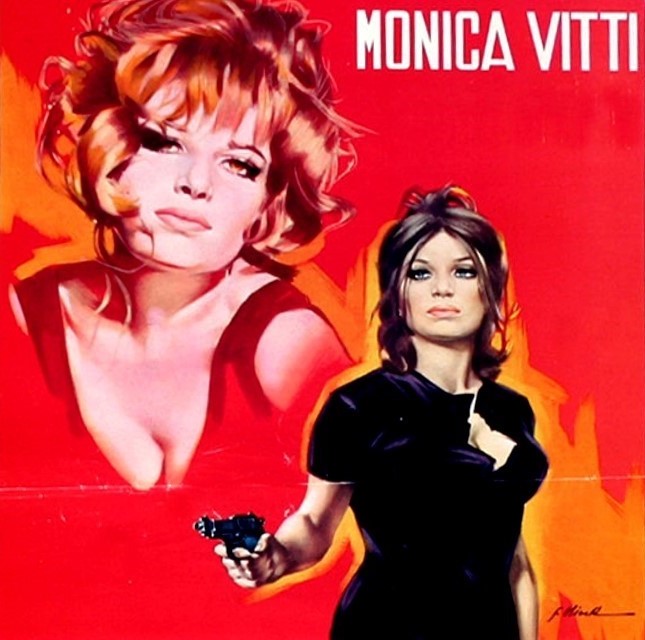
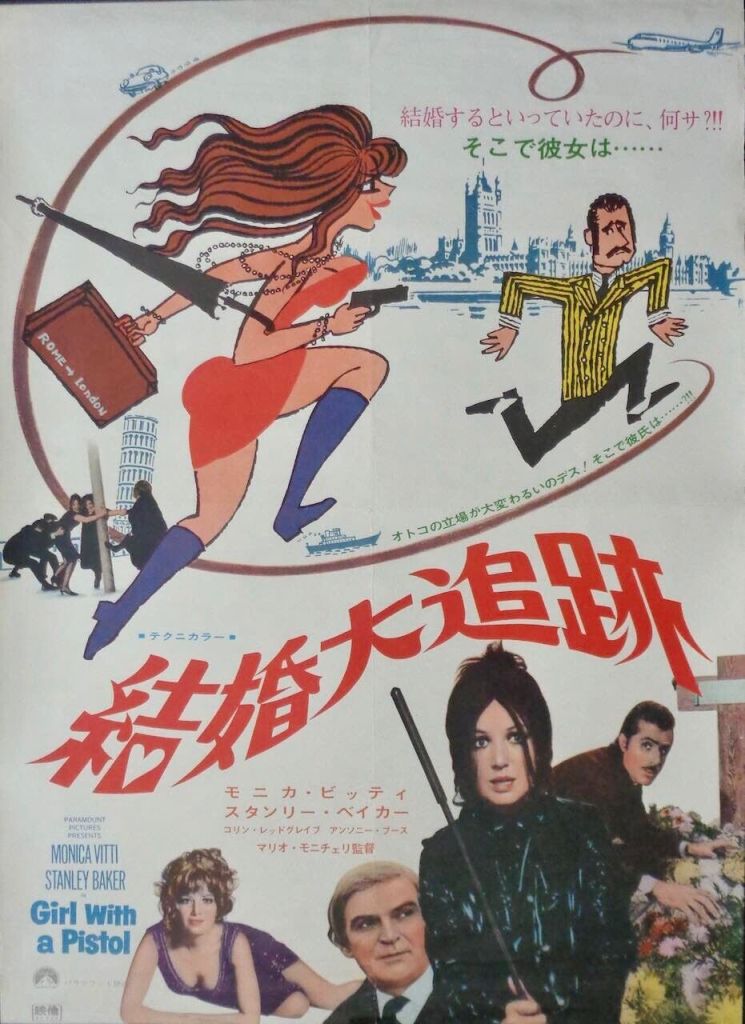
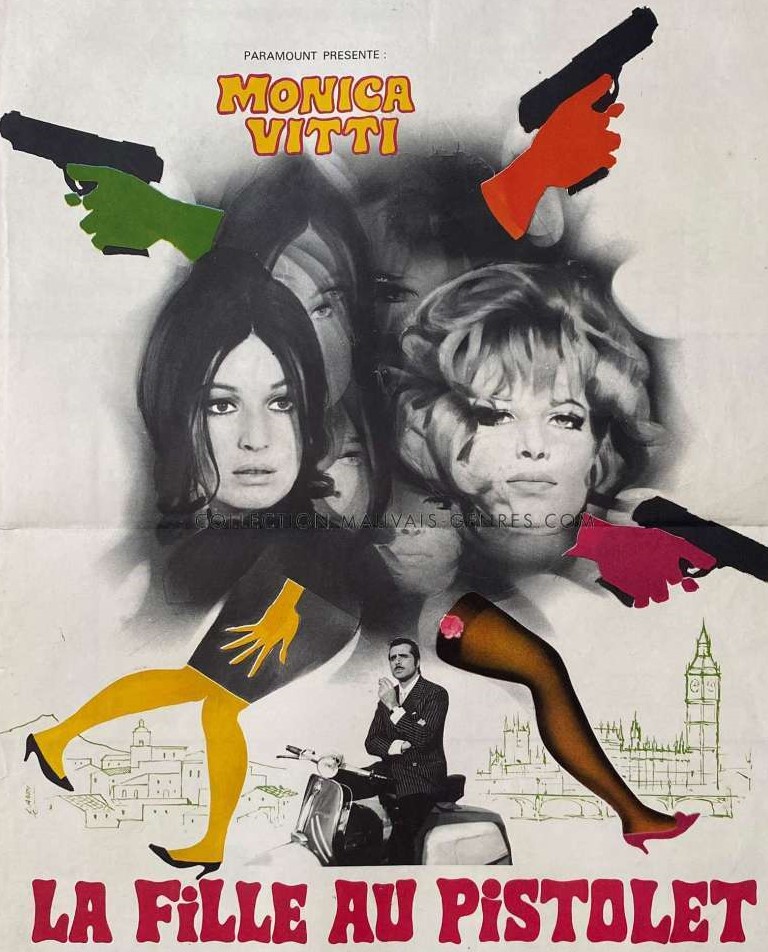
Off-beat Oscar-nominated comedy-drama that is both a marvelous piece of whimsy and a slice of social realism set in the kind of Britain the tourist boards forget, all drizzle and grime. It zips from Edinburgh to Sheffield to Bath to London to Brighton to Jersey as if the characters had been dumped from an If It’s Tuesday It Must Be Belgium sketch. If your idea of Italy was Fellini’s glorious decadence or Hollywood romance amid historic ruins and fabulous beaches, then the upbringing of Assunta (Monica Vitti) is the repressive opposite.
All women in her small town wear black. Men are not allowed to dance with women and must make do with each other. A man like Vincenzo (Carlo Giuffre) desiring sex must kidnap a woman, in this case Assunta, to which she will consent as long as he marries her. When instead he runs off to Scotland, she is dishonored and must kill him, armed with the titular pistol.
Pursuit first takes her to Edinburgh and a job as a maid, has a hilarious encounter with a Scottish drunk, and various other cross-cultural misinterpretations – in a bar she cools herself down with an ice-cube then puts it back in the bucket. Then it’s off to Sheffield where she falls in with car mechanic Anthony Booth (television’s Till Death Do Us Part) because he is wearing Italian shoes.
She can’t imagine he can watch sport for two hours. “You’re a man, I’m a woman, nobody in the house and you look at the television.” Although tormented by images of being attacked back home by a screaming mob of black-robed women, she begins to shed her inhibitions, wearing trendier clothes, although an umbrella is essential in rain-drenched Britain and given the Italian preference for shooting exteriors.
In between sightings of Vincenzo there are episodes with a suicidal gay man (Corin Redgrave) and a doctor (Stanley Baker). She becomes a nurse, then a part-time model, sings Italian songs in an Italian restaurant, drives a white mini, wears a red curly wig and more extravagant fashions. It turns out she can’t shoot straight. Gradually, the mad chorus of home gives way to feminist self-assertion as she becomes less dependent on men and a world run by chauvinists. It’s a startling mixture of laugh-out-loud humor and social observation. And while the narrative that at times verges on the bizarre, Assunta’s actions all appear logical given her frame of mind.
Vitti was Italian director Michelangelo Antonioni’s muse (and companion) through L’Avventura (1960), La Notte (1961) and L’Eclisse (1962) to Red Desert (1964). She had a brief fling with the more commercial, though still somewhat arty, movie world in Joseph Losey’s Modesty Blaise (1966) and the nothing-artistic-about-it comedy On the Way to the Crusades (aka The Chastity Belt, 1968) with Tony Curtis. Director Mario Monicello had two Oscar nominations for writing but was best-known for Big Deal on Madonna Street (1958) and Casanova ’70 (1965). Girl with a Pistol was nominated in the Best Foreign Language film category at the Oscars.
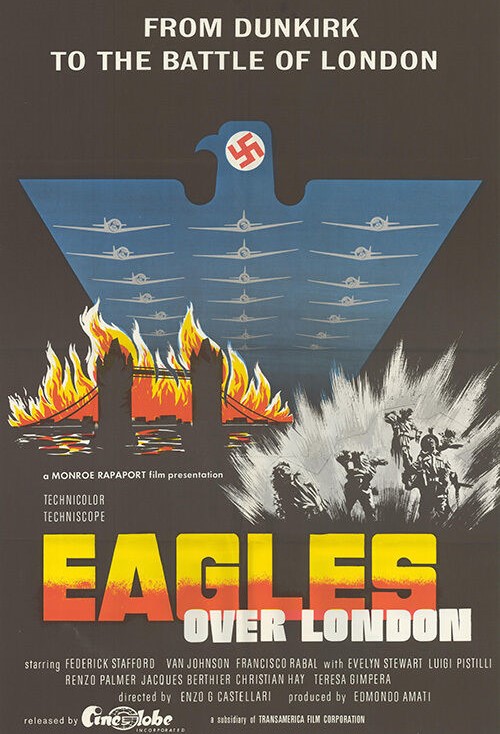
Presumably intended to capitalize on/rip-off the same year’s big-budget roadshow The Battle of Britain manages to cram in a pack of action beginning with a tank ambush in Normandy, the Dunkirk evacuation, the Battle of Britain, rooftop shoot-outs, ending up with an audacious attack of RAF High Command by a team of German saboteurs. As notable for technical achievement, split screen – sometimes split diagonally or quartered – in the manner of The Boston Strangler (1968) and The Thomas Crown Affair (1968), shots through various tiny holes, scenes filmed overhead, and a dazzling swirling camera sequence that would normally presage intimacy but here means death.
Somehow manages to squeeze a surprising number of dramatic moments focusing on relationships, a brief nod to homosexuality, and emulating Fraulein Doktor (1969) in giving the Germans credit for astute and effective espionage. Obvious use of stock footage for the air fight sequences, but you wonder what else has been cobbled out of the vaults given the preponderance of scenes requiring massive numbers of extras. Throw in Hollywood veteran Van Johnson (Divorce American Style, 1967) and a particularly good Cockney sergeant (Renzo Palmer) and it hardly lets up.
So, Captain Stevens (Frederick Stafford) heads up a unit delaying the German blitzkrieg in France in 1940. The Germans, led by Donovan (Francisco Rabal), meanwhile, are in disguise, assuming the identities of dead British soldiers with the intention of infiltrating Britain and destroying its radar installations. Inadvertently, Stevens saves Donovan’s life, thus giving the German accepted entry into British high command. Equally inadvertently Stevens allows the German access to his girlfriend Meg (Evelyn Stewart) who needs a shoulder to cry on. Donovan has his own girlfriend, Sheila (Teresa Gimpera) on tap, an undercover agent working as a barmaid, well-trained at collecting loose talk and seduction.
Elements of giallo keep popping up as the Germans need to embark on a murderous rampage to continue to acquire new identities to keep ahead of the pursuing investigation, one strangulation taking place in a gay sauna. Every now and then we pop into RAF High Command where Air Vice Marshal Taylor (Van Johnson) is helping thwart the German aerial attacks and in the end, since more bodies are required, elects to go into battle himself.
The small screen allows laughable moments – model airplanes crashing into the sea, cardboard radar installations toppling – to pass almost unnoticed since most of the rest of the action is well rendered, the rooftop scene especially, and the other various shoot-outs where – shock to the system – the British are constantly outwitted and outgunned.
Mostly, you’ll note how stylish a concoction this is given the low budget. Excellent sex scene against the background of exploding bombs, the duping of our hero by the enemy, and one terrific scene where Sheila is deemed surplus to requirements, calmly accepting her fate on condition that it’s her lover who pulls the trigger.
This would have been solid support material in English-speaking countries but most likely a main feature in its Italian homeland. Might have even done better if distributors waited until Afred Hitchcock’s Topaz (1969) appeared since he recruited Frederick Stafford as his leading man. Stafford was always under-rated but he keeps this afloat, though the Germans have the more interesting roles, especially Francisco Rabal and Teresa Gimpel. Evelyn Stewart (The Whip and the Body, 1964) has a smaller part.
Not content with introducing far more style and, shall we say, flamboyance, than the material might suggest director Enzo G. Castellari (Any Gun Can Play, 1967) has the audacity to end by using Winston Churchill’s “the few” speech to halt the traffic so the British lovers can catch up with each other.
A classic example of what an interesting director can do with what in other hands would be more mundane material. Not quite sure why it took five screenwriters.
Surprisingly fun watch overloaded with style.
REVIEWED PREVIOUSLY IN THE BLOG: Frederick Stafford in Topaz (1969), Evelyn Stewart in The Whip and the Body (1964), Van Johnson in Divorce American Style (1967).
Just about the barmiest idea ever. Just about works. Tony Randall (Bang! Bang! You’re Dead / Our Man in Marrakesh, 1966), a cross between David Niven’s younger brother and a distant relation of Inspector Clouseau, would be nobody’s notion of a perfect Hercule Poirot. But back in the day, Agatha Christie’s famed detective was not a hallowed concept.
In fact, in movie terms he was pretty much a nobody, not a single big screen appearance in three decades, the forgotten man of cinema sleuths, not a patch on Sherlock Holmes or Maigret who had enjoyed umpteen iterations. So that character, if you like, was there for the taking, up for grabs, not one so sacrosanct it was imprinted on audience minds.
You could do what you liked as long as he had a moustache, spoke with an exaggerated foreign accent and every now and then pointed to his head and mumbled something about little grey cells.
MGM had had some fun and box office success with Christie’s other famous criminal creation Miss Marple in a quartet of low-budget pictures in the light comedy vein starring Margaret Rutherford beginning with Murder, She Said (1961) and clearly believed the same recipe would work wonders with a character generally considered too stiff to work at all.
This is a chucklesome broth, some astute detective work mixed up with all sorts of sight gags. Frank Tashlin (The Glass Bottom Boat, 1966) is at the helm and the writing team of Jack Seddon and David Pursall who reimagined Miss Marple adapt the mystery.
It kicks off with the very contemporary trope of talking to the camera as real-life actor Tony Randall walks off an MGM set and transforms himself into Poirot. Hastings (Robert Morley), who in the novels is more an amiable companion, a kind of Dr Watson, is here portrayed as somebody high up in the British Secret Service trying to whisk Poirot out of the country. Mostly, he acts as a comedy foil.
After being attacked by a beautiful masseuse, Poirot finds himself on the trail of a serial killer who conveniently leaves an ABC London Guide at the scene of the crime and kills in alphabetical order (with a bent for alliteration) which would make the attempt on the detective’s life a bit of an aberration (that even Poirot doesn’t apparently notice). Anyway, the first victim is an Aquabatic, the second Betty Barnard (Grazine Frame). Poirot is on the case by the time the third likely victim Sir Carmichael Clarke (Cyril Luckham) hoves into view.
As luck would have it, a fourth contender Duncan Doncaster (Guy Rolfe) is both psychiatrist to chief suspect Amanda Beatrice Cross (Anita Ekberg) and lover of Clarke’s wife Diane (Sheila Allen). Inspector Japp (Maurice Denham) of Scotland Yard and Poirot are invariably at cross purposes.
The detective has a special set of skills, including cooking to restaurant standard, being able to vanish in a trice, horse-riding, and knocking down two sets of ten-pin bowling pins at the same time.
That the comedy works is mostly thanks to the likes of Airplane (1980) which has accustomed contemporary audiences to barmy, almost literal sight, gags, faces elongated via shaving mirrors, while a cop elucidates a clever plan we are only shown the back of the map he’s pointing to, a conversation takes place over the sleeping body of a snoring wife, a business card tossed nonchalantly onto a desk ends up in a coffee cup, Hastings is trapped in the trunk of a car with a comely wench
You still get your London tourist features – the docks, bus stops, military parade, horse riding in Hyde Park – but these are invariably set-ups for sight gags. A naked Hastings invades the parade, fog shrouds the docks, Poirot’s horse leaps over (wait for it!) a park bench.
This version of Poirot might be heresy to some, and too jaunty by half, but there’s too much serious detection – and some classic Poirot intuition – to dismiss it as entirely a spoof, and I spent too much time chortling to dismiss it as a waste, so it lands in an odd halfway house, but I suspect that’s very much where Tashlin intended it to land.
Worth a look if only to suspend your disbelief.
PREVIOUSLY REVIEWED IN THE BLOG: Frank Tashlin’s The Glass Bottom Boat (1966); Tony Randall in Let’s Make Love (1960), Lover Come Back (1961), Send Me No Flowers (1964), Bang! Bang! You’re Dead (1966); Anita Ekberg in 4 for Texas (1963); Robert Morley in Oscar Wilde (1960), Nine Hours to Rama (1963), Hot Enough for June (1964), Of Human Bondage (1964), Topkapi (1964), Genghis Khan (1965), The Loved One (1965), A Study in Terror (1965), Some Girls Do (1969).
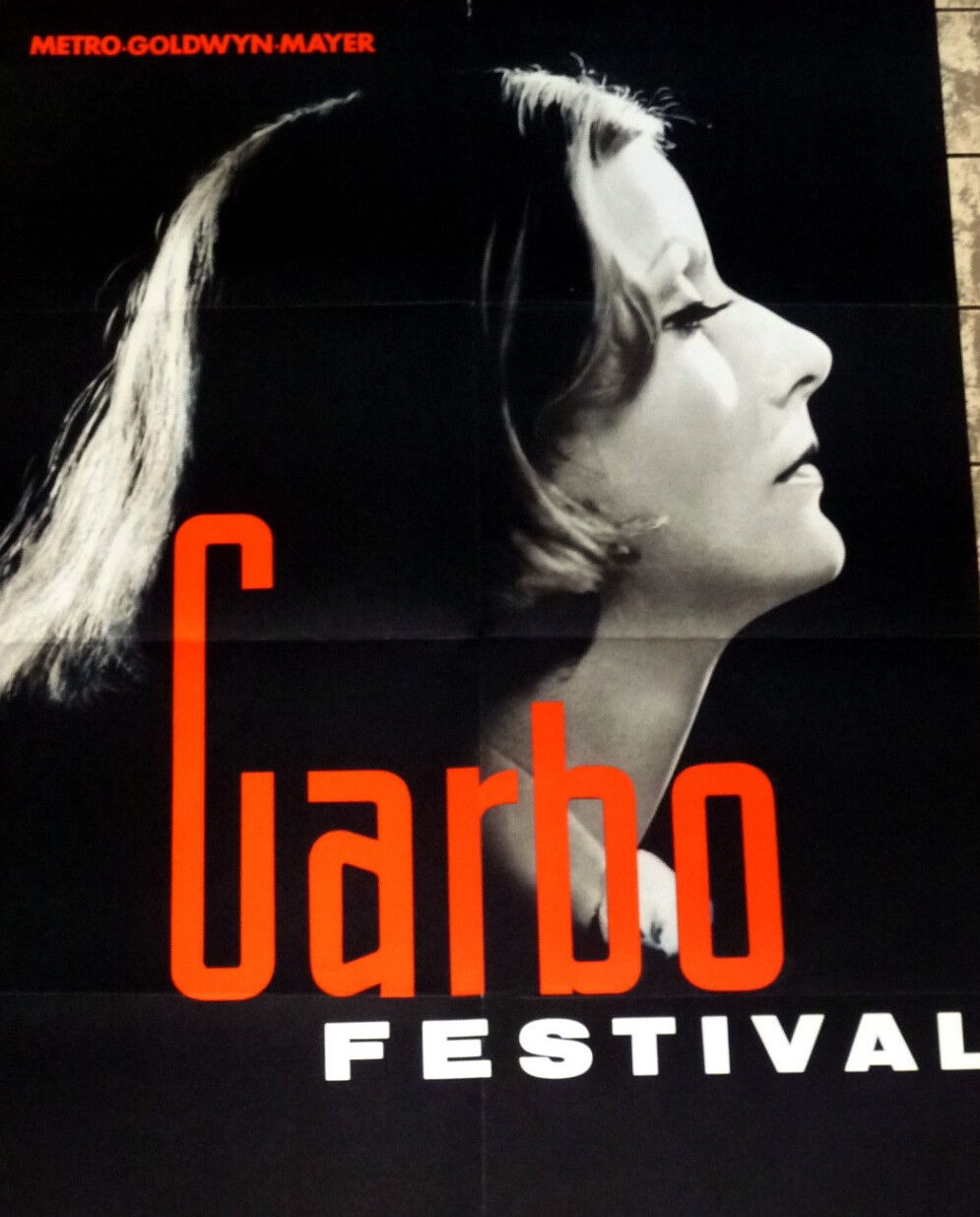
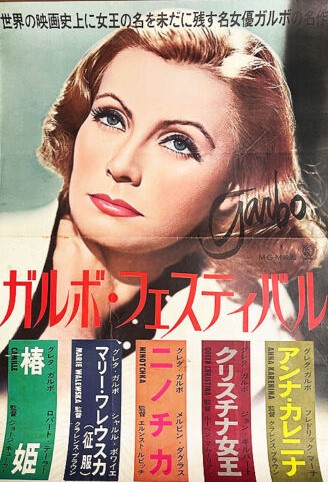
More than two decades after Greta Garbo abandoned acting she was the Queen of London’s West End in one of the most astonishing comebacks in Hollywood history.
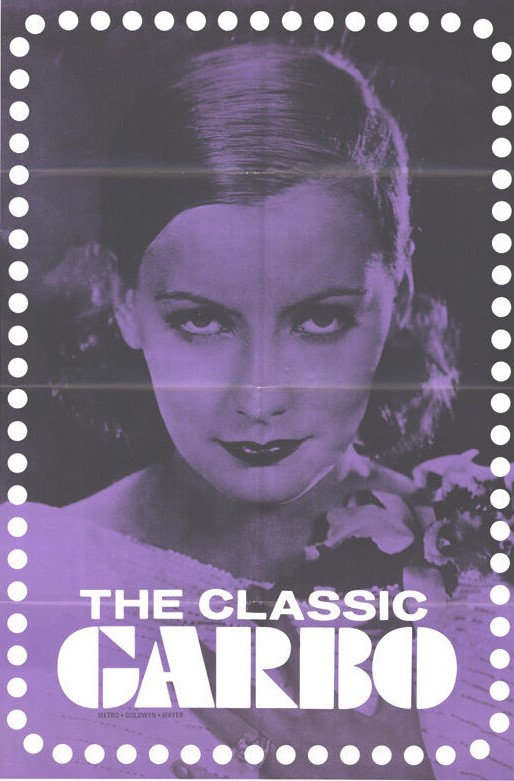
Although her Hollywood career was relatively short-lived, lasting only 15 years and ending voluntarily in 1941, and at one point the highest-paid actor (male or female) in Hollywood, the London experience made her a big star all over again in the 1960s – and later in the 1970s – when reissues of her most famous films filled holes in a global release system starved of product.
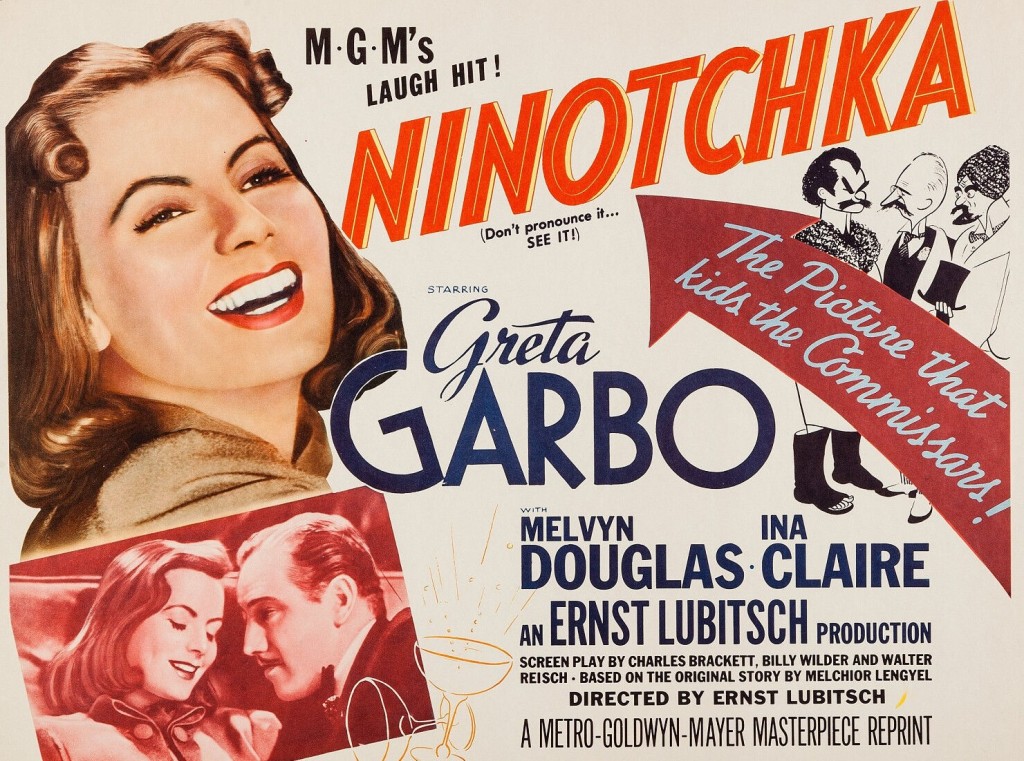
“Masterpiece Reprint” was cleaver ad-speak for getting round exhibitor phobia regarding the words “reissue” or “revival.”And it also suggested a new print since reissues were infamous for re-using long over-used old prints.
She’d first made an impact in the revival business in the U.S. reissue boom of 1948 in a double bill of San Francisco (1936) and Ninotchka (1939), a program so successful that shortly afterwards both were reissued again separately. The box office draw of pictures like these was such that some cinemas, for example, the State in Lubbock, Texas, re-launched themselves as “first run reissue” houses, the beginnings of the boom in repertory theaters.
But it wasn’t all gravy. Distribution didn’t just rely on old prints. Ninotchka, for example, not only had new prints but a new advertising campaign, campaign manual and accessories. However, apart from the first flush of revival, Ninotchka stumbled at the box office, too ambitious a level of release, quickly withdrawn after costing the studio $150,000.
The impetus for the 1960s Garbo Revival came from abroad. In the U.S., Garbo films had by this point been viewed as arthouse fare, running, as in the 1950s, on a repertory basis, rented out for a flat fee, cinemas cramming in as many as a dozen films over one week. While they were available to anyone who wanted them, they came without attendant publicity. Given, they had all been screened on U.S. television they were considered a poor bet for a more commercial revival campaign.
But British television companies, of which there were only two – BBC and ITV – were more niggardly in buying Hollywood pictures so the major studios simply refuse to sell pictures, such as those starring Garbo, at what they saw as, compared to U.S. networks, cut-price rates.
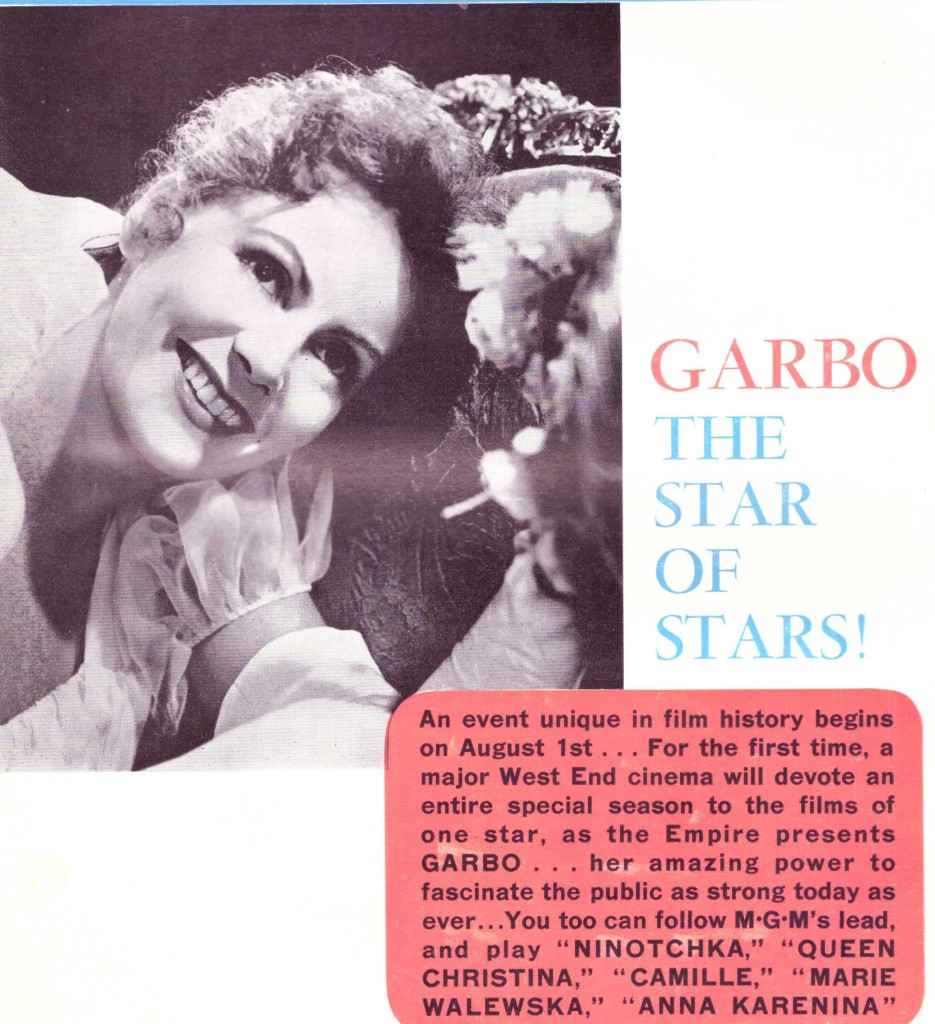
Even so, it was an act of incredible boldness for the Empire cinema in London’s West End, one of the top two theaters (the other being the Odeon Leicester Square) in Britain for movie launches, outside of roadshows, to decide to take a gamble on reviving her movies following audience response to a brief showing at the Royalty. It was the first time a major commercial house in such a heavily-competitive environment had devoted any time to what was in effect a retrospective, setting aside two months for a succession of Garbo pictures.
Two-Faced Woman (1941) – Garbo’s last picture – shored up $14,000 – equivalent to $140,000 now – in its first week. Queen Christina (1937) made a debut of $9,000 and Camille (1936) $11,000. In all, over this opening stint and a further season later on, the Empire screened eleven pictures – the others being Grand Hotel (1932), Anna Christie (1930), Mata Hari (1931), Ninotchka, AnnaKarenina (1935), Marie Walewska (aka Conquest, 1937), As You Desire Me (1932) and The Painted Veil (1934)
And there was more to come. The Empire was the release showcase for the entire ABC circuit, so anything screening there would be rolled out in the country’s biggest chain. Since ABC was decidedly not in the arthouse business, sending the movies out into the general mainstream seemed an even bigger risk. But such fears proved unfounded.
Garbo pictures were distributed throughout the country, and not just on the ABC circuit. In Glasgow, for example, the La Scala (owned by Caledonian Associated Cinemas) first-run house – rather than the city’s denoted arthouse the Cosmo – launched a three-week season comprising Ninochka, Queen Christina and Camille, two of the three going out as single bills.
Meanwhile, in the U.S. Garbo movies were being unfurled via the MGM Perpetual Product Plan, whereby classics (rented on a percentage basis) were screened for one day a week for a period of eight-to-ten weeks with audiences able to book a discounted ticket for the entire season. Abroad, there was more opportunity. Like Britain, countries like France revered the star and the movies were continually revived in Europe during the 1960s at commercial venues.
But by the end of the decade, the book should have been closed on Garbo. Because, in 1969, MGM, with the exception of perennials like Gone with the Wind (1939) and Doctor Zhivago (1965), pulled out of the reissue business. The studio withdrew from release its core library of around 100 vintage pictures because the operation was now losing money. Flat fee rentals of $100 (as opposed to the earlier percentage deals) for a three-day engagement failed to cover the costs of prints, distribution and advertising. The novelty of the one-day-a-week scheme had worn off.
MGM intended to try out the old “creating demand” tactic by keeping its oldies out of circulation for at least four years. But the studio was in severe financial straits at the start of the new decade and not in a position to resist an offer in 1970 from Erwin Lesser of Entertainment Events who proposed taking out a two-year lease on 65 pictures that had “made film buffs out of two generations.” Lesser drew up a package of 26 “Movie Incomparables.” Garbo was the main attraction. Included in the list were As You Desire Me, not seen for 30 years. Lesser returned to rentals based on percentages rather than a flat fee.
While Lesser made the movies available as single features and double bills and as support to new features, the main thrust of his marketing campaign was the “Garbo Festival,” an idea stolen from television which had taken to rewrapping old pictures as week-long events as a means of enticing viewers.
Although the Museum of Modern Arts in New York agreed to run a Garbo retrospective, that hardly produced the kind of box office juice that was required to kickstart a major revival. So Lesser bided his time, and in the end accepted a nine-day “filler engagement” in March 1971 for the 565-seat Murray Hill arthouse in New York. A “rousing” first week delivered $15,000 – $113,000 in today’s money – while the remaining two days hit a colossal $7,800.
Garbo was back – and in some style. Two months later the Garbo package returned to Murray Hill for a socko one-week $11,000 followed by a move-over to the 533-seat Paramount. And then it was game on.
One of the major elements of the Festival was its flexibility. It became an umbrella term. Exhibitors could decide whether to create a program out of single showings or double bills that could run for consecutive weeks or for an on-off event of single weeks interspersed over a longer period with other features.
In Chicago the double bill of Grand Hotel / Anna Christie romped home at the 505-seat Cinema with $8,500 in the first week and $7,500 – an amazingly low drop-off at the box office considering 40%-50% tumbles in the second week are the norm today – followed by Mata Hari / Ninotchka also on $7,500. In the same city Camille / Anna Karenina racked up $4,800 at the 598-seat Carnegie.
In Philadelphia a four-film package hoisted $19,000 running simultaneously at the 500-seat World and the 855-seat Bryn Mawr. The second week take dropped by just $1,500. Two more packages running each for a week brought in a total of $15,000. In Pittsburgh and Detroit the seasons also ran for three weeks.
But showings were not restricted to arthouses. In Cleveland the package played the 1,500-seat Beachcliff, in Dayton the 1,000-seat Cinema East and in Kansas City the 1,291-seat Midland.
Garbo’s name was kept alive all through the 1970s as revivals, either in one-week festivals, or shorter bookings, continued to bring in revenue across the USA and around the world, proving the continued box office potency of one of the industry’s greatest stars.
We’re still a few years away from the centenary of her Hollywood debut in MGM’s Torrent in 1926 so expect major reassessment then. Whether she breaks out of the arthouse confines and fuels new demand in the multiplexes might not be such a long shot. Release patterns for revivals have markedly changed, many now being promoted as “one-day-only” events (miss out at your own peril) rather than running over a week or longer. A major publicity campaign and the assistance of social media could change public perception of a star whose films embraced both the silent era and Hollywood’s Golden Age and who was never short of publicity.
In my opinion it’s always worth watching a Garbo film for one technical reason – the difference between male and female close-ups. Watch a Garbo picture and a close-up could last for minutes, the end of Queen Christina for example, as her eyes move through a variety of emotions. Male close-ups by comparison are over in a flash. With few exceptions the soul of a male actor is rarely revealed in close-up and even rarer is for expression to so dramatically change.
SOURCES: Brian Hannan, Coming Back to a Theater Near You, A History of Hollywood Reissues 1914-2014 (McFarland, 2016) pp 33, 55, 56, 58, 75, 128, 130, 133, 212, 223-225, 232 “Test Garbo Retrospective at Royalty in London,” Variety, June 23, 1963, p11; “Garbo Pic Sets London Record,” Variety, August 15, 1963, p2; “Click of Metro’s Garbo Pix in London’s Empire Cues More Runs,” Variety, August 21, 1963, p19; “British Provinces May Get Metro Garbo Films,” Variety, August 28, 1963, p23; “Metro Classic (Garbo, Marx Bros, Tuners) Withdrawn from Market,” Variety, August 27, 1969, p3; “MGM Leases 65 Pictures for Re-Releasing,” Variety, August 10, 1970, p3; “Picture Grosses,” Variety 1971 – March 31, April 7, May 11, May 25, June 9, June 23, June 30, August 18, November 22, December 8.
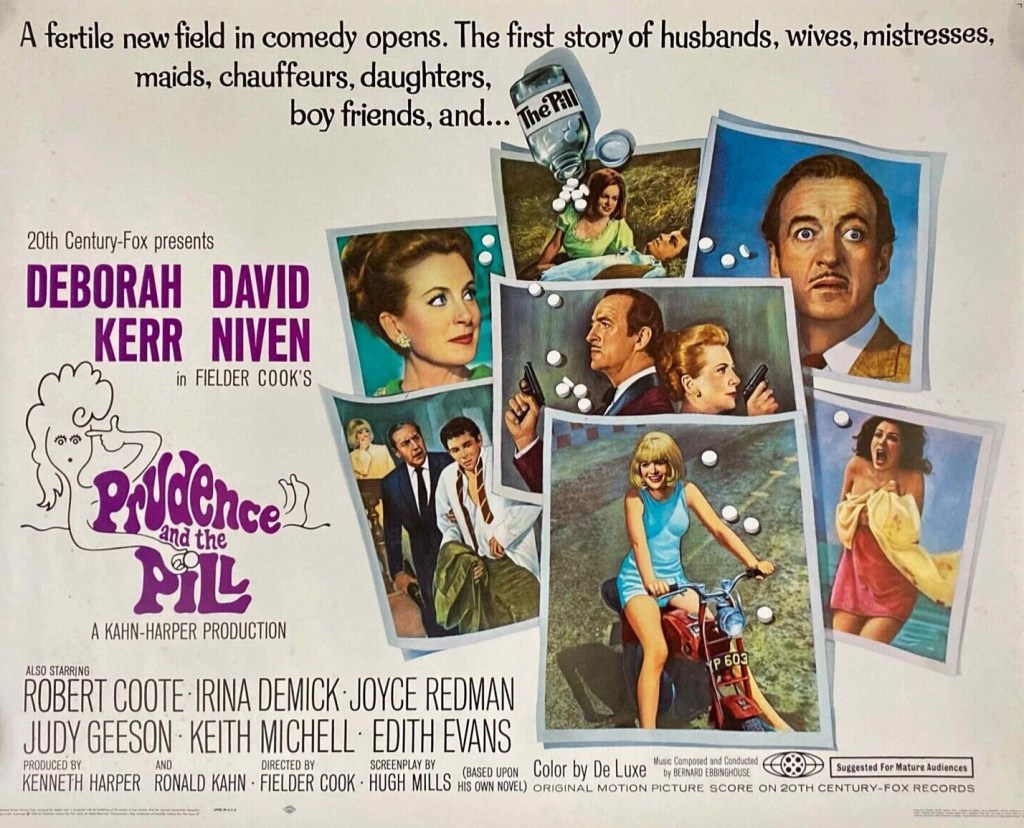
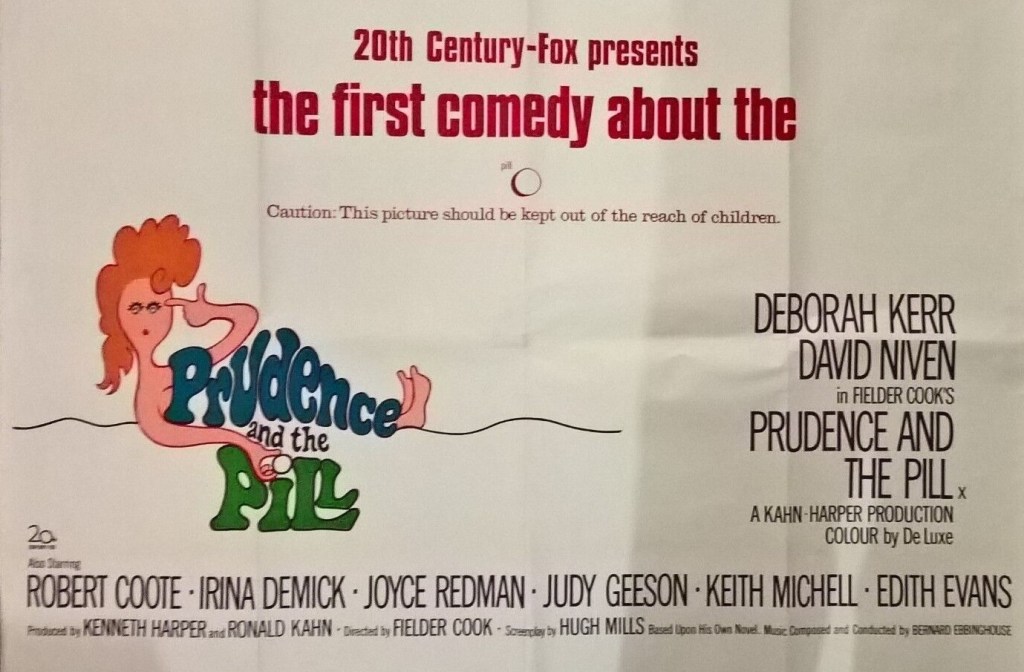
Cleverly calibrated chuckle-worthy comedy of manners. Far more enjoyable than the basic material might suggest, especially as you will easily guess where it all ends. Anchored by redemptive performances, after disappointing turns in The Eye of the Devil / 13 (1966), by Deborah Kerr and David Niven, playing a middle-aged upper-class childless couple whose marriage survives on civility alone, and a sparkling showing by Judy Geeson (Here We Go Round the Mulberry Bush, 1967).
It’s surprising what a fresh look at cliché can achieve. On the face of it, American director Fielder Cook (How to Save a Marriage and Ruin Your Life, 1968) is the last person to be tackling the upper classes, especially as there’s scarcely a hint of satire. It’s wonderfully pitched, no sexist jokes, no farce, no tourist or Swinging London, and avoids the temptation of aiming for the lowest common denominator (Carry On Up the Pill for example). But authority is constantly confounded, pomposity pricked, and, astonishingly for a movie about relationships in Britain – the home of the kitchen sink drama – in the late Sixties, everyone ends up happier ever after.
The titular drug in question, in case that term is no longer in common usage, is the contraceptive pill, here sold under the generic name of Thelon. The biggest shocks here might well be that mothers and fathers in middle-age still have sex. Although that is balanced by a contemporary vibe of having children late in life.
So the fun begins when Henry (Robert Cooote) and Grace (Joyce Redman) discover bubbly daughter Geraldine (Judy Geeson) in bed with Tony (David Dundas). Cue howls of anger from staid parents, who divide up the ticking-off, the mother tasked with warning daughter about the dangers of pregnancy – and with it the specter of single motherhood, a high society no-no – the father to whip the young rascal.
The mother is only mollified – though still affronted at such blatant expression of sexuality – when she discovers her daughter is on the Pill. But shocked to discover Geraldine has been pilfering her own supply. Father is taken aback to discover the lover is not only heir to a fortune but has already proposed.
Unlike most movies of the era, where sexuality remained a dirty word, and most illicit romances were conducted in secrecy and ended up in disaster, the vivacious Geraldine could be the poster girl for sex. She is delighted to have lost her virginity, and to expand her sex education, and stands up against her mother’s old-fashioned views.
However, the replacement of mother’s Pill with aspirin presents a dilemma. Robert and Grace are also enthusiastic lovers and the absence of contraception for so long points towards the possibility of a very embarrassing pregnancy.
Meanwhile, Henry’s brother, bored company chairman Gerald (David Niven), who lives in a mansion with servants and swans around in a chauffeur-driven Rolls-Royce, discovers, to his horror, that his wife Prudence (Deborah Kerr) has been taking the Pill, denying him his much-cherished desire to have children. So he swaps it for a vitamin pill. Unknown to him, his young maid Rose (Vickery Turner), warming to the amorous attentions of the chauffeur Ted (Hugh Armstrong), has taken a leaf out of Geraldine’s book and snaffled her mistress’s Pill.
You can see where this is headed. But there’s a complication. Assuming (as a man would) that their lack of children was due to his wife’s infertility, Gerald could have had children by his younger mistress Elizabeth (Irina Demick). But he refuses to seek a divorce (the scandal, don’t you know) and Elizabeth views him as a poor candidate for marriage (would he not just have another mistress) and fatherhood.
Prudence, it soon transpires, also has a lover, Dr Huart (Keith Michell). Equally resistant to divorce, for societal reasons and to prevent her husband marrying his mistress, Prudence soon warms to the thought of having a child, but abhors the prospect of having Gerald as its father.
In the best Hitchcock fashion, the audience is privy to information denied the characters who fluster around in their incompetence.
It should never work. The story is so obvious and, from a narrative perspective – given unplanned pregnancy does not lead to dark deeds, humiliation and abandonment – weak. That it is pretty much a triumph owes as much to the direction (witty use of musical cues, for example) as a script that feasts on reversals. The acting is first-class all round. David Niven and Deborah Kerr, in their final pairing, atone for the under- and over-acting, respectively, of Eye of the Devil. Judy Geeson is a standout as a marvellously gleeful liberated young woman. Edith Evans (The Chalk Garden, 1964) pops up for a delightful cameo.
Ann-Margret, at this point in her career, must have had a clause written in her contract that she gotta sing, gotta dance. And you can see the sense of that demand because, as in previous films, she proves she can shake her booty, that number more of a showstopper than her earlier crooning. But, honestly, she has taken a backward step in terms of billing. Here, she’s effectively the leading lady rather than the top-billed star, and really, beyond the dancing, little more than “the girl.”
The heist itself is niftily done, making use not just of such an old-fashioned notion as a magnet but also making a pitch for early recognition as one of the originators of solar power. (How that combination works out, I’ll leave to your imagination.) But, in a twist in the heist genre, the focus is largely on those trying to stop a major robbery from a casino in Beirut, the latest in a series of thefts from top casinos around the world. And it’s not a heist in the normal sense. Millions of dollars have gone missing, but no one can figure out how.
Naturally, your automatic port of call would be an alcoholic croupier, Jeff (Laurence Harvey), currently working at The Playboy Club in London because it’s about the only city where he’s not been blacklisted. Anyway, handed a ticket to Beirut and the prospect of some easy cash by Benson (Jose Calvo) who initially appears as a drunken apparition in the fog, Jeff decides it’s the easiest option.
Benson, it transpires, is not the shady character Jeff imagined, but some kind of investigator entrusted with finding out who is defrauding the casinos. Jeff makes the acquaintance of night club singer Laura (Ann-Margret), who soon develops a soft spot for him, but not enough to join him for a drink (or, presumably, sex) after work since that time is set aside for current squeeze Ghinis (Ivan Desny).
No sooner has Jeff worked out that a huge amount of cash is at stake than he carves himself a slice of it, $100,000, working for Benson. But, no sooner has he won that particular lottery than the bad guys make a counter-offer, the same amount but at least you’ll come out of the deal alive. Laura is clearly some kind of bait to keep him sweet, though she could be bait for hundreds of customers as she shakes her booty during her big number, “Take a Chance,” the lyrics, ironically enough, encouraging gambling.
This being the kind of European co-production that requires assistance from the authorities, we are treated to a tour of the sights of Beirut (there’s also a journey by motorbike earlier on from Highgate in London to Mayfair and by taking rather a detour manages to take in many of the capital’s finest tourist sites). The Beirut leg of the movie itinerary takes in a traditional concert in some first-class ruins, a bazaar, and for reasons that may be more to do with commercial concerns than tourist, an oil refinery.
There’s also a very irritating shrill American, Mrs Brown (Camilla Horn), who, constantly getting in Jeff’s way, appears to be there just for comic effect, intent as if she had a social media channel to film everything in view. Turns out her movie camera and the lady herself are there for another purpose entirely.
The heist, itself, is particularly well done, especially as it appears to be achieved by a bunch of proper strangers – that is people who seem to have no connection to each other at all rather than the old trope of strangers coming together for a robbery by the end of which they know far too much about each other.
Unfortunately, from the narrative perspective and for fans of Ann-Margret (The Swinger, 1966), she is less the femme fatale than the equivalent of the dumb blonde. But pretty much you could have advertised this as starring two Hollywood stars who had fallen from grace and were taking Italian coin because little else was on offer. Laurence Harvey (Life at the Top, 1965) is actually pretty good, when sober capable of dealing with good guys and bad guys and with still enough charm to make romance with Ann-Margret seem plausible. Except that this is not a great movie, though interesting enough in a double-cross kind of way and the heist is good, both actually acquit themselves well, Ann-Margret correct in her assumption that her dancing goes a long way to keep audiences sweet.
This was only the second film for director Nino Zanchin, and the fact that he only got to make one more tells its own story.
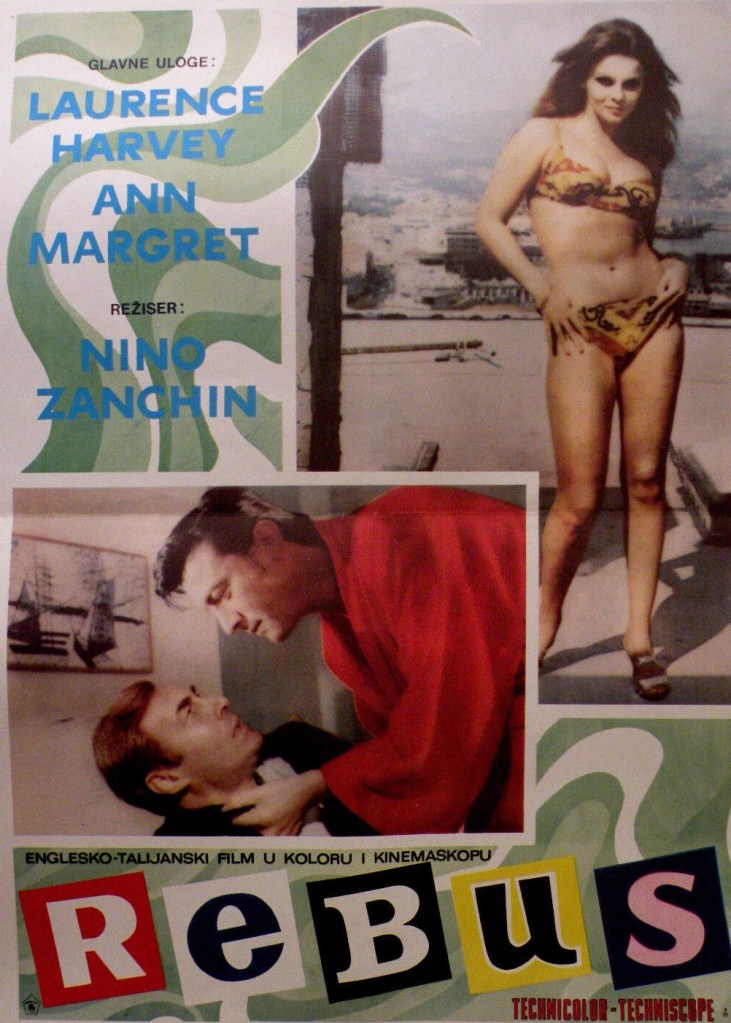
You may have been scratching your head, wondering when the hell “Rebus” is going to appear or perhaps imagine it’s some kind of code word or password. No amount of head-scratching by myself right to the end of the movie made any sense out of this title. That was the original title, but some distributors, fed up presumably with scratching their heads, opted for the more sensible Appointment in Beirut.
An okay watch, some decent twists and lifted I guess you would have to say by Ann-Margret’s dance number more than Laurence Harvey’s snippy performance
Movies can break all sorts of rules but they can’t cheat.
A film has to stick to an internal logic. For example, it can’t portray a photographer so obsessed with his calling that he even takes a camera with him to an antique shop and starts shooting off roll and after roll capturing the area’s rundown streets but then the one time he really could do with a camera – to prove there is a corpse at his feet – he is somewhat remiss. Especially when that the movie turns on that plot point.
Setting aside what’s a somewhat contrived snapshot of “Swinging London” there’s a lot to admire here. The absence of music for one thing. Most of the movie runs without musical accompaniment, a bold move since so often we rely on the soundtrack to provide guidance for a scene or an overlay for the entire film. Here, Michelangelo Antonioni (Zabriskie Point, 1970) makes us falls back on our own interpretation.
David Hemmings (The Charge of the Light Brigade, 1968), all mop-top and intense stare, is a high-flying high-living fashion photographer in the David Bailey mold (casual sex with wannabe models a perk) who turns investigator on being confronted in a park by Vanessa Redgrave (Hemmings’ adulterous love interest in The Charge of the Light Brigade) after taking snaps she wants back. Tension is sustained by her sudden appearance at his studio, willing to pay with her body for the return of the photos, and then by Hemmings’ careful, photo-by-photo blow-up-by-blow-up analysis that slowly comes closer to the truth.
Everything in his world is judged through a lens, as if he can capture elusive truths, and he has aspirations to being more than a mere fashion adjunct, having spent time taking portraits of down-and-outs. He judges Redgrave as he would a model, she has a good stance and sitting posture. Even by the standards of the permissive society, he is a bit of sexual predator, taking advantage of two giggly model wannabes – Jane Birkin (Wonderwall, 1968) and Gillian Hills (Three, 1969).
But the photography scenes are well done and Antonioni captures the intimacy between model and photographer that create the best images. If you want to see what a model brings to modeling check out real-life model Veruschka posing in an outfit held together by the thinnest of threads, bringing to life the much-touted notion that a model makes love to a camera. If you can get past the cheat and the deliberate obtuseness this creates – and the tsunami of artistic interpretations it inspired about the director’s intent – then it remains intriguing.
This isn’t Hemmings’ greatest work – Fragment of Fear is much better – but it certainly provided him with a marketable movie persona. Redgrave is excellent as the nervy woman willing to do what is required and the movie might have worked better had she had been allocated more screen time and their duel had continued through other scenes. But then that would have been Hitchcock and not Antonioni.
Sarah Miles (The Ceremony, 1963), Peter Bowles (The Charge of the Light Brigade) and John Castle (The Lion in Winter, 1968) have small parts. The film certainly captures the electricity of a photo shoot between a skilled photographer and pliant model, but it also works as an extended metaphor about the elusiveness of cinematic truth.
Despite my misgivings about the “cheat,” an intriguing and satisfying exploration of an artist seeking to jettison the fripperies of his art yet unable to avoid the temptation of enjoying the easy sexual benefits.
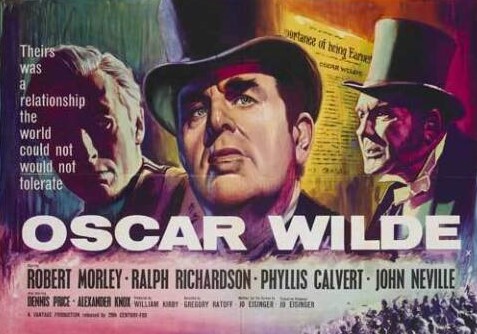
You might be surprised to learn there were two Oscar Wildes. Not the famed writer and a doppelganger of course but two films on the same subject that were released in the same month. This is the low-rent version, costing a fraction of the rival The Trials of Oscar Wilde directed by Ken Hughes. It’s easy to be disdainful of the cheaper effort, with little cash available for scenery and costumes, but somehow it rises above budget limitations. Structurally, both movies focus on the trial – or in the case of The Trials of Oscar Wilde the three trials he endured – but the glossier pictures it has to be said glosses over a great deal.
While I enjoyed it at the time, I now find that in trying to make a modern martyr out of Oscar Wilde, the Ken Hughes picture built him up so much that it was difficult to find any flaw in his character. We never find out what was the actual slur the Marquis of Queensbury made on Wilde, resulting the playwright taking him to court for libel. And that version begins with Wilde and Alfred Lord Douglas (“Bosie”), son of the Marquis, already deep into their affair.
On the other hand, Oscar Wilde, the final film of Hollywood veteran director Gregory Ratoff (Intermezzo, 1939), starts at the beginning of their relationship with greater emphasis on Wilde’s practicality rather than his wit and Bosie’s (John Neville) tortured relationship with his hypocritical father (Edward Chapman) who, while taking the moral high ground, keeps a mistress. On Wilde (Robert Morley) being described as a sodomite by the Marquis, Bosie’s desire to see his father humiliated in court verges on revenge. “You weren’t looking for a friend,” Wilde astutely tells his lover, “You were looking for a weapon.” Bosie is big on humiliation – he is the one to break the news of Wilde’s duplicity to the author’s wife (Phyllis Calvert). So determined is he on the court case that he fails to tell Wilde that his father has private detectives scouring London to find evidence.
While in court Wilde can keep the jury in stitches with his epigrams, he soon comes up against the Marquis’s formidable lawyer Sir Edward Carson (a quite stunning performance by Ralph Richardson). From Carson we learn a great deal more of Wilde’s practices, some of which nowadays would be termed grooming. Essentially, Carson paints a portrait of a predator, an older man (Wilde was 41) whose uses his wealth and wit to court many lovers, mostly aged around 20, but some as young as 16, barely the age of consent.. And when he felt his secret life was in danger of being exposed, he went so far as to pay for the passage to America of one of his lovers, Alfred Woods, to get him out of the way.
No matter that Wilde at the start can gloss over his promiscuity, complaining that Carson is misinterpreting innocent gestures of friendship, the cunning attorney soon has the author tied in knots as he wheels out one by one information regarding the various lovers.
It’s quite odd to realise that The Trials of Oscar Wilde in presenting the more accurate truth – that the author underwent three trials – fails to provide little more than a surface treatment of the man’s real-life affairs. Oscar Wilde perhaps delves too deeply for audiences brought up to consider the author a martyr who deserves the free pass allocated all writers of genius. I found Oscar Wilde the more riveting watch because, of course, I already knew the outcome, but the sight of the famed writer, encouraged by the vengeful Bosie, hung out to dry by his own hubris, and for a man of such wit to be outwitted in the courtroom by Carson was an exceptional watch.
Of course, the imprisonment of Wilde for the crime of being a homosexual is detestable. Even at the point this film was made homosexuality was a crime. So it’s fascinating to see how much The Trials of Oscar Wilde skirts round issues that Oscar Wilde had little problem in spelling out.
I was surprised how much I enjoyed Robert Morley’s performance. I may be wrong, but I think this was the only time he was accorded leading man status. Mostly, he was a supporting actor (The African Queen, 1951, say, or Genghis Khan, 1965) and often just playing a version of his self. Of course, he is outshone by a simply brilliant Ralph Richardson (Khartoum, 1966). John Neville (A Study in Terror, 1965) presents a more in-depth performance than in the rival picture. One-time British box office star Phyllis Calvert (The Golden Madonna, 1949) does well in a small but pivotal role. You might also spot Dennis Price (Tunes of Glory, 1960) and Alexander Knox (Mister Moses, 1965).
Lacking a budget to do much more, Gregory Ratoff sticks to the detail and draws out two superb performances, aided by a tight script by Jo Eisinger (Gilda, 1946; Cold Sweat, 1970) based on the play by Leslie and Sewell Stokes and the work of Frank Harris. As swansongs go, this is hard to beat.
Vastly underrated.
Catch it on YouTube.
NOTE: Oscar Wilde appeared in first run in Glasgow at the La Scala cinema in June 1960 one week ahead of The Trials of Oscar Wilde at the first run ABC Regal and ABC Coliseum.
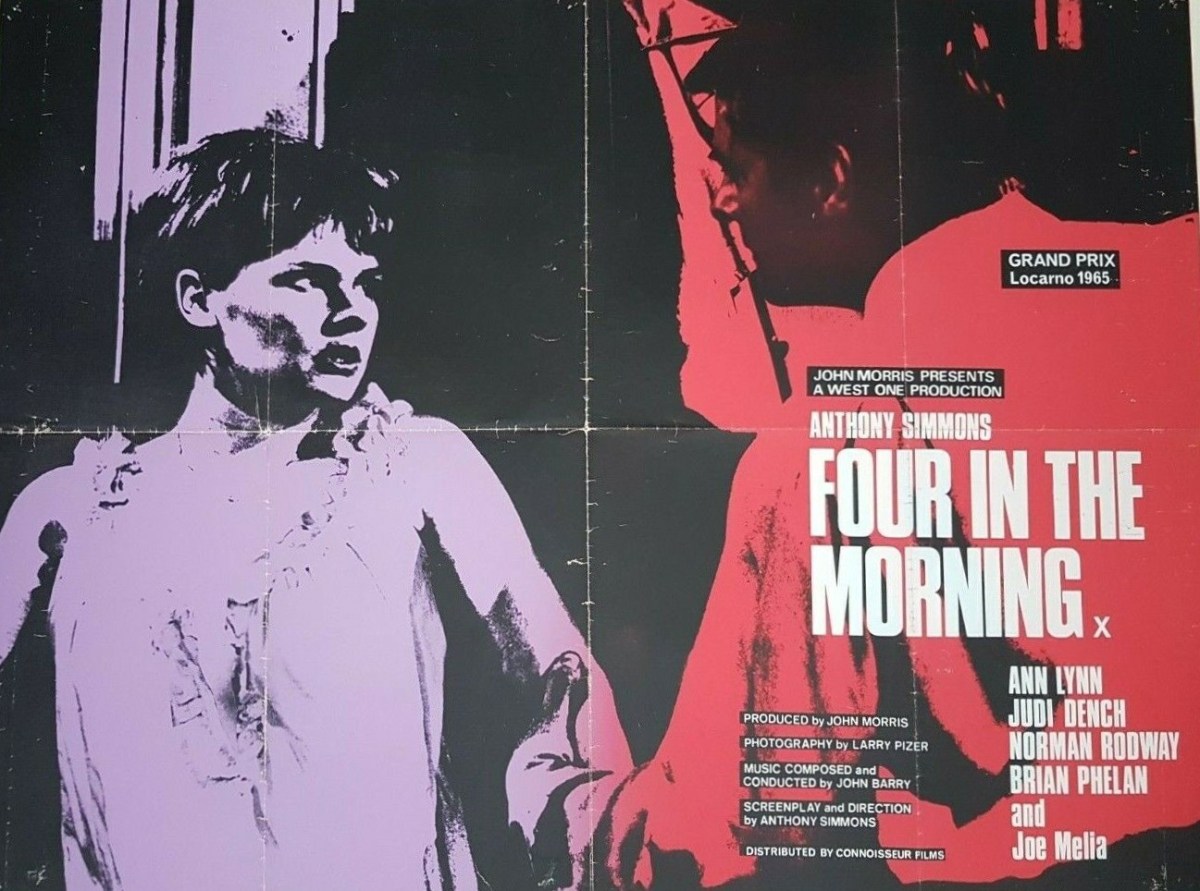
Directors learned this early that you only had to point the camera at Judi Dench (Oscar winner for Shakespeare in Love, 1998, but here in her first starring role) and even without the benefit of dialog she will always be compelling. And that’s just as well because this is one of those elliptical movies that were in fashion in the wake of Last Year in Marienbad (1960).
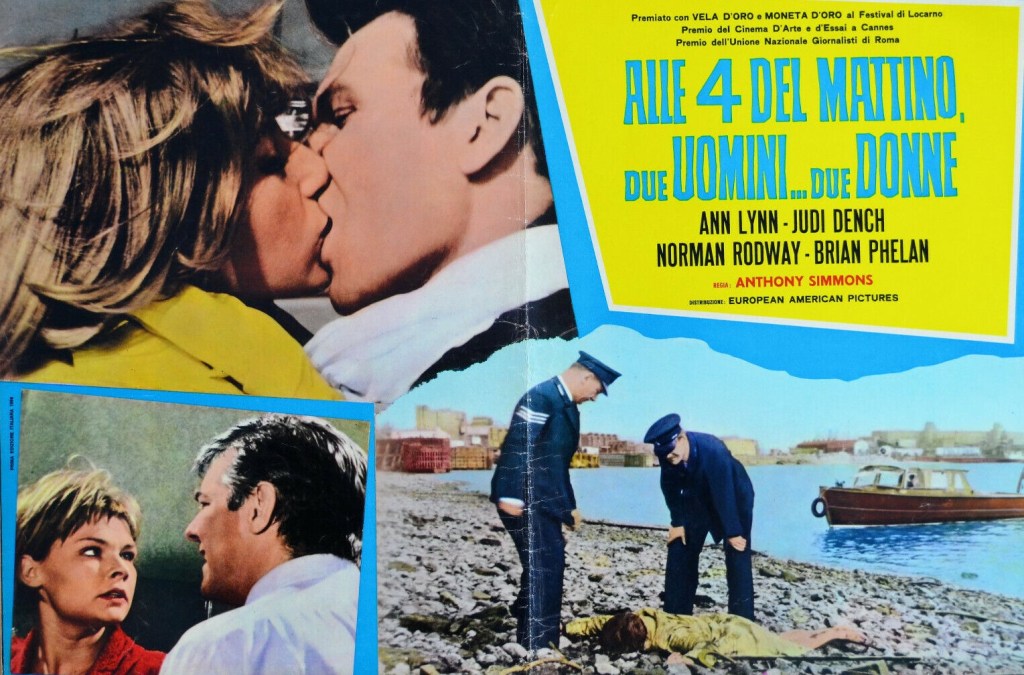
Less twisty and self-conscious for sure two apparently unconnected tales are conjoined by a mysterious drowning in the Thames. And this isn’t tourist London, either, but the working version, a city waking up, famed fruit and flower markets coming to life, ferryboat teaming with passengers, the skyline dominated by tiny dots setting off for the office.
In fact, the picture draws its power from three women, the aforementioned Dench as a young woman smothered by motherhood, marriage disintegrating, Ann Lynn (The System/The Girl-Getters, 1965) who breaks out of the supporting role cage where her character is generally fixed from the start to take advantage of a name-above-the-title role as a reticent lover to explore a gamut of emotions. Last of the trio is the drowned woman, whose callous treatment dominates the action.
If you ever wanted to find out what happens to a drownee here’s your chance. Unceremoniously dragged from the shore, transported to a mortuary in a coffin, head laid on a block of wood, clothes cut off, naked body sluiced with water, fingerprints taken, stored in a refrigerator, indignity run riot, it’s a harrowing sight.
As if to compound the movie’s arthouse sensibilities – and it won big at various film festivals – the characters remain anonymous. The wife (Judi Dench), stuck at home with a mewling teething infant, is disconcerted to find husband (Norman Rodway) has returned from a night on the town with buddy (Joe Melia) in tow. They want to continue partying, waking up wife and baby, resulting in non-stop argument.
Divorced manager of an upmarket bar (Ann Lynn) tries to put off a boyfriend (Brian Phelan) pestering her for a date. Eventually, she relents and they embark on an initially unsatisfying date before she finally comes alive when he steals a speedboat and they power upriver. Even when passion takes over she remains wary of commitment.
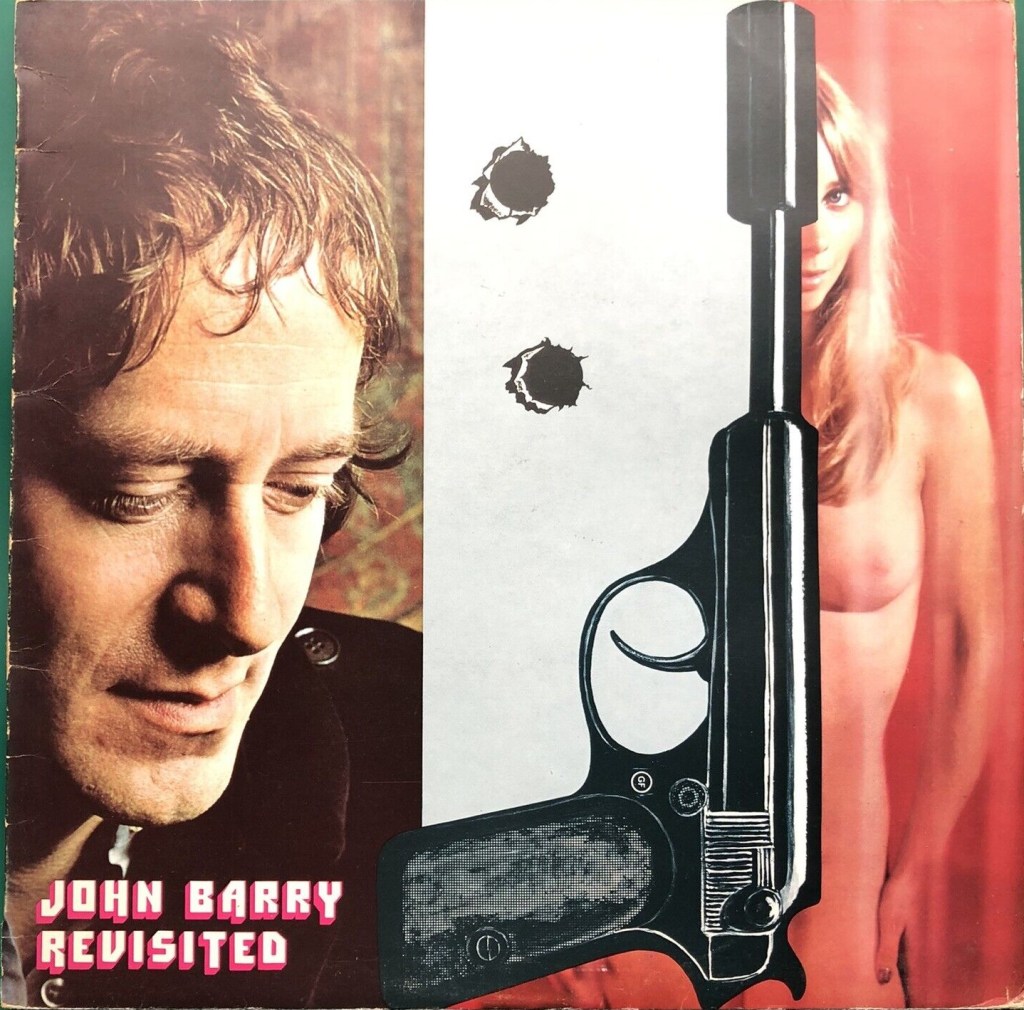
I chose this purely on the strength of the score. I first heard the theme on this album when I was in my teens. Fearing that my parents might veto the purchase because of the nudity on the cover – and since the record player was in the lounge – I showed suprising nous for a teenager, and stuck sticky tape over the offending bits. Of course, I then had to come up with a reason why there would be brown sticky tape on the album cover.
Beyond the to-and-fro of each couple’s situation, there’s little in the way of story, but the dialog is refreshing as it winds back and forth through a variety of emotions, including playfulness, a genuine sense that this is not about scoring points but exploring characters, each development the consequence of action however minimal. The mood is often bleak but always ruminative, a sense that emotions could tip at the touch of a switch, nothing quite defined, except that angst one way or another is going to hold sway.
Most British kitchen sink dramas of the period took place up north, not in the country’s capital, and the wife is too young to expect to be so hemmed in by motherhood, unable to grasp, what with the changing times, that she has still contracted, through marriage, to carry the burden of child-rearing.
The sting in the tale is that since the drowned woman is never identified that she turns out to be one or other of the women, my bet being on the wife, who seems at the end of her tether. This might have been more easily tagged as a couple of one-act plays except for the concentration on the drowning and the focus on girlfriend and suitor exploring various parts of the capital at its least tourist-y. But it’s almost a ghostly city, hardly the location for romance.
Judi Dench is superb – she won the Bafta that year as the Most Promising Newcomer – as she captures a character twisting and turning in a situation she never expected to be so depressing. But Ann Lynn, whose career did not have as much upward mobility, is equally expressive as she changes from morose to excited until heightened romance is sufficient to kill off any expectation of fulfilment. Norman Rodway (The Penthouse, 1967), Joe Melia (Modesty Blaise, 1966) and Brian Phelan (A High Wind in Jamaica, 1965) has less room for development, tending to be more focused on pleasure than emotion.
This didn’t open too many doors for writer-director Anthony Simmons (Your Money or Your Wife, 1960) and he didn’t get behind a camera for another eight years and only made four films in total. Quite why he was so ignored remains a mystery because this is a haunting piece of work, with an excellent script. John Barry (The Lion in Winter, 1968) wrote evocative score.
Succession as seen from the perspective of someone like the inadequate Tom (Matthew Macfadyen), who has married his way into big business and has an elevated idea of entitlement.
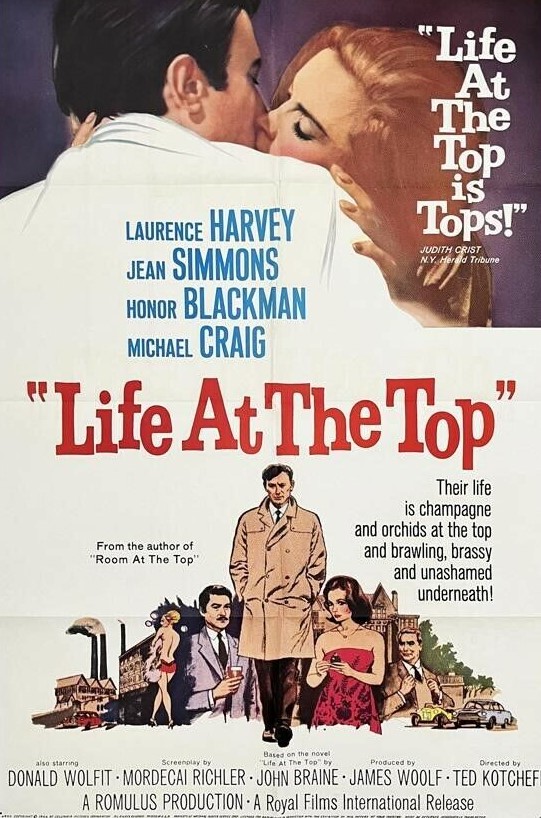
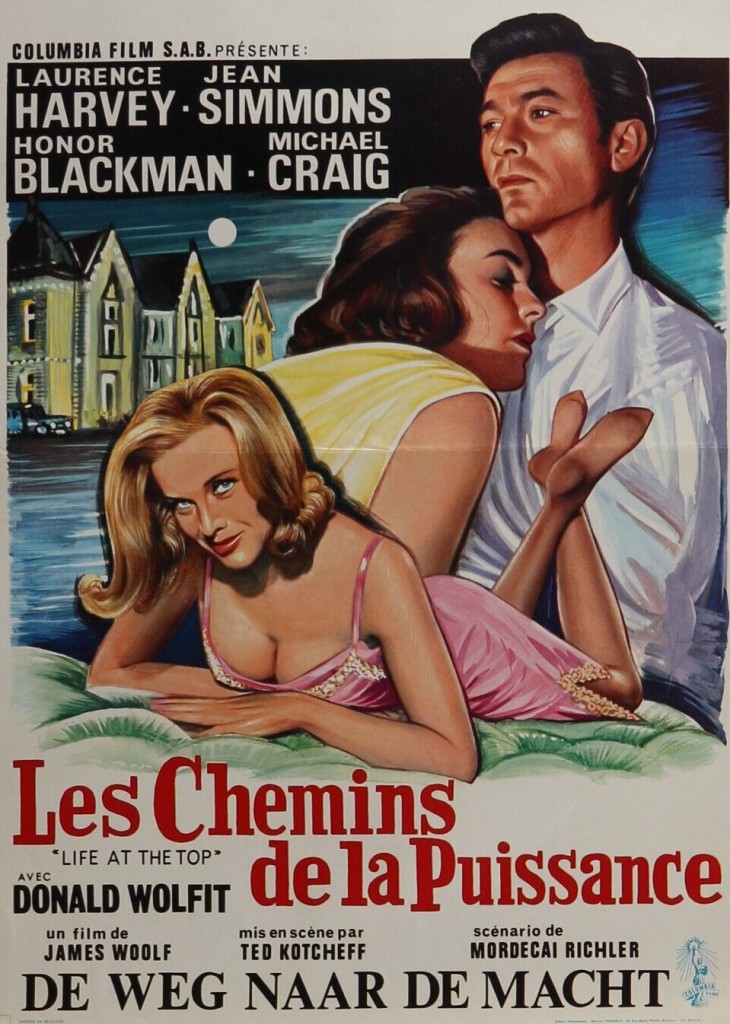
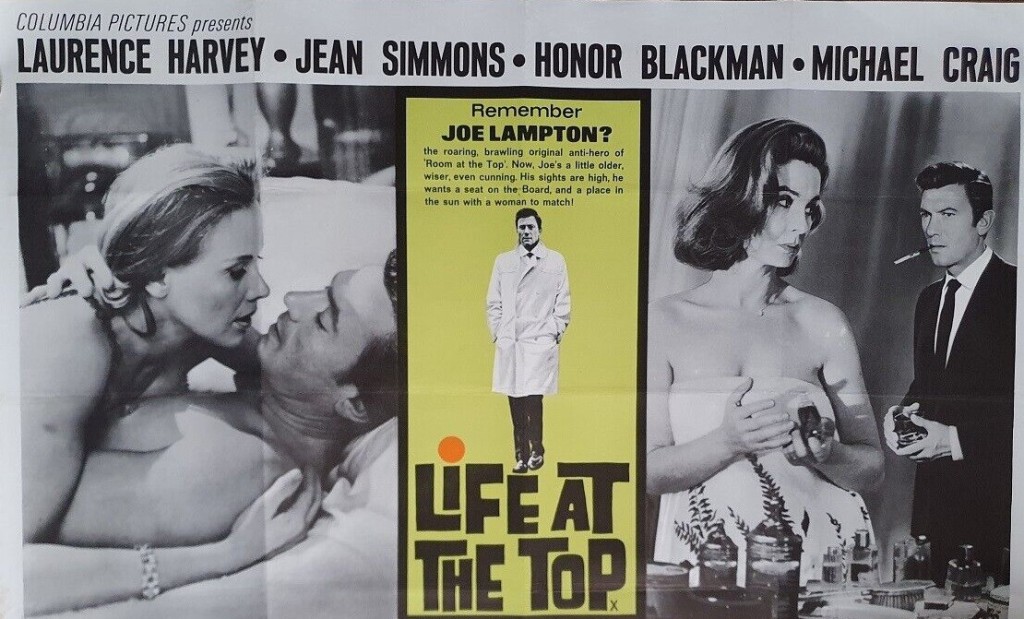
Joe Lampton (Laurence Harvey) was a genuine working-class hero of Room at the Top (1958) who connived his way into the marriage bed of businessman Abe Brown’s (Donald Wolfit) daughter Susan (Jean Simmons) and set himself up as the heir apparent. Several years on, it’s not quite worked out the way he planned, stuck in a loveless marriage, out of his depth among the Yorkshire elite, passed over for promotion, pinning hopes of personal happiness on an affair with television personality Norah (Honor Blackman).
The only problem is that screen-wise he’s a b*****d without an ounce of the dominating personality of Brian Cox, the ultimate b*****d’s b*****d. This plays out more The Tale of Two Spoiled Brats. So if you’re looking to see Lampton get his come-uppance on several fronts, you’ve come to the right place. Unfortunately, that means there’s isn’t a single likeable character in sight. It might be the way of the world among the high-rollers but it makes for rather dispirited watching.
On the other hand, Lampton was always such a louse it is enjoyable to see him not only being put in his place but ending up a few rungs further down the ladder than where he started. This might have scored some points for social commentary but it’s such a scattershot approach – racing pigeons, local government corruption (by Tories, who else), strip club, ballroom dancing (the original Come Dancing before that usurper Strictly Come Dancing came along), drinking a yard of ale, swimming in the canal, ruthless entrepreneurs, luvvies – it does little justice to any.
Perhaps the most surprising aspect is the independence of the women. Susan has a lover Mark (Michael Craig) and emasculates Joe by going behind his back to get whatever she wants, financially, from her father. Ambitious Norah refuses to give up her career for Joe and is likely to withdraw her favors should his ambition fails to match hers.
Even the cuckolded get in on the act, taunting those who had fallen for their partners’ adulterous ways. George Aisgill (Allan Cuthbertson) mocks Joe for falling (in the previous film) for his wife when she went after anything in trousers. Similarly, Mark’s wife ridicules Susan for just being the latest notch on Mark’s bed.
Naturally, Joe hasn’t the wit to see what a good deal he has and spends all his time in self-pitying mode. Poor Joe – he is stuck with driving a white Jag while Abe swans around in a Rolls-Royce. Poor Joe – his wife isn’t going to make do with hotel bedrooms for illicit assignations, but makes full use of the house. Poor Joe – his son doesn’t like him. Poor Joe – he trots out all his childhood deprivations at the slightest opportunity as if auditioning for a Monty Python sketch.
Poor Joe – he’s not even that good a businessman, so naïve that he doesn’t realise that many deals require sweeteners, backhanders, bribes, though smart enough enough to add on a little extra, when extracting such sums from the more worldly Abe, for himself. Poor Joe – he believes business blandishments. Poor Joe – Abe has no interest in the “Report” he’s slaved his guts over. Poor Joe – when he applies for another job, his lack of education marks him down.
The big problem is it’s impossible to feel any sympathy foe Joe. Your heart is more likely to go out to those he wounds with his atrocious behavior. The more he blames everyone else for his predicament, the more an idiot he looks, duped and a biter bit.
And Laurence Harvey (A Dandy in Aspic, 1968) whose screen person is one part arrogance, one part snarky, and one part well-groomed male is not capable of making you feel for his character. Jean Simmons (Rough Night in Jericho, 1967) reveals greater depths, vulnerable, passionate, seductive, practical. Honor Blackman (A Twist of Sand, 1968) gives a good account of herself as an ambitious woman with a conscience.
Few of the other characters are more than ciphers but there’s a decent supporting cast in Donald Wolfit (Becket, 1964), Michael Craig (Stolen Hours, 1963), Robert Morley (Deadlier than the Male, 1967), Allan Cuthbertson (The 7th Dawn, 1964) and Nigel Davenport (Sands of the Kalahari, 1965).
Canadian Ted Kotcheff (Tiara Tahiti, 1962) directed from a screenplay by fellow country man Mordecai Richler (Young and Willing, 1962) based on the John Braine bestseller. And it seems a bit mean to film it in black-and-white, presumably to emphasize the social aspects when in fact most of its takes place in glamorous settings.











 The Magnificent 60s