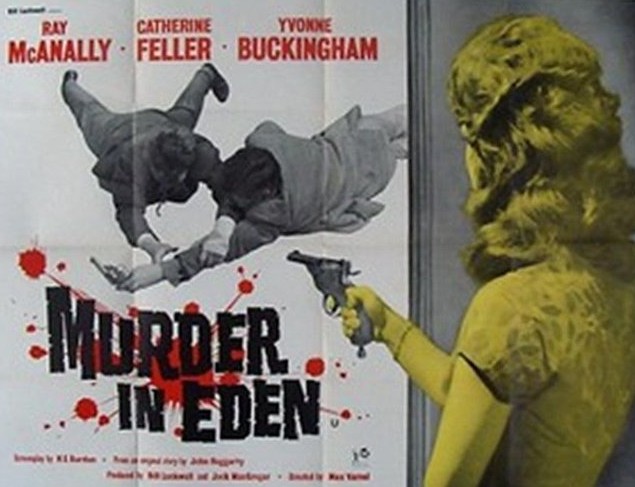
Murder in Eden (1961) ***

Had there been the budget to spare for more stylish cinematography and a director more inclined to tip the wink to the audience, this would have been recognized as a late addition to film noir. As it is, thanks to keeping the viewer largely in the dark, there’s an almighty twist at the end that aficionados of the unexpected climax would relish.

Although aficionados of another kind might have been happy to sit through a less-well-worked thriller for the sake of watching a “bubble car” in all its glory. In some eyes, the three-wheeler Italian-made Isetta should take center stage. Or you might consider an early appearance by Irish actor Ray McAnally (My Left Foot, 1990) an extra bonus.

The Isetta bubble car.

An investigation revolving round art forgery might seem initially less than an interesting starting point. But when the expert who pointed out the forgery is bumped off and Inspector Sharkey (Ray McAnally) is called in, the investigation seems to take second place to his budding romance with French journalist Genevieve (Catherine Feller) especially after a meet-cute where she, literally, falls into his arms.

Suspicion falls upon gallery owner Arnold Woolf (Mark Singleton), art dealer Bill Robson (Jack Aranson) and paintings restorer Michael Lucas (Norman Rodway). A fellow called Frenchman Jack (Noel Sheridan) might also have made it onto the suspect short list except he is murdered.

Sharkey isn’t much of an ace detective and the investigation plods along except to throw out the occasional red herring. Director Max Varnel (A Question of Suspense, 1961) spends most of the picture keeping his powder dry. Much of what we learn seems incidental.

So what if Arnold’s glamorous wife Vicky (Yvonne Buckingham) is having a fling with Lucas? So what if Genevieve seems a shade too industrious for a journalist working for a newspaper whose trademark is soft features about the rich, famous and glamorous? So what if this looks like a plan to stitch up and bankrupt Arnold? And what are we to make of what might these days be called a “panic room,” a secret part of a house hidden behind a two-way mirror?

When the denouement comes it looks like Varnel has sold us short, kept us out of the loop about what’s been going on behind the scenes when Genevieve is revealed not just as a femme fatale but a dupe herself. The last five minutes is a story all by itself, of betrayal, lust and revenge.

It’s one of these films where at the end you look back and think it was much better than you imagined and the director has been too slick for you.

Especially as there’s been a certain innocence about the proceedings. Although the background, as we eventually discover, is decidedly murky, this appears to take place in a world where upright cops don’t just jump into bed with seductive Frenchwomen but have to go about wooing her the old-fashioned way.

Ray McAnally, who in his later screen persona, was a much tougher character, comes over as a juvenile lead, a rising star in an era that was full of them. The gravitas that was later a significant part of his onscreen presence is nowhere in evidence and in stringing him along Catherine Feller (Waltz of the Toreadors, 1962) is not permitted to be as seductive as she is later revealed to be while the role of Yvonne Buckingham (The Christine Keeler Story, 1963) appears to have been edited down so as to not give the game away.

The bubble car looks like it’s been included as product placement. You enter it from the front, literally peeling back the entire front of the car, engine in the rear a la Volkswagen, and it can whiz into the tightest of parking spaces, never mind race along main road.

Written by John Haggarty (The Killer Likes Candy, 1968) and, in his sole screenplay, E.L. Burdon. Won’t take up much more than an hour of your time.

Another welcome contribution from the Renown B-picture crime portfolio which has found a home on Talking Pictures TV.
The Penthouse (1967) ****

Visceral home invasion thriller that ignited the genre and triggered later more controversial offerings like The Straw Dogs (1971) and A Clockwork Orange (1971). Made virtually on one set for the indescribably minute sum of £100,000, it is charged with Pinteresque dialog and aberrant philosophy. The genre splits into those pictures where the occupants have more than a good chance of avoiding their fate, the focus on the invaded pitting their wits against the invaders – classic examples being The Straw Dogs or more recently Panic Room (2002) – and those where the victims are mercilessly tormented, such as, in grueling detail, here.

As one of the perks of his job cocky married real estate agent Bruce (Terence Morgan) takes advantage of an expensive unoccupied apartment on his company’s books – “in the happy position to take advantage of my clients’ generosity in their absence” as he puts it – to enjoy an illicit tryst with mistress Barbara (Suzy Kendall). But when she answers to the door to two men coming to read the gas meter, their lives are turned upside down.

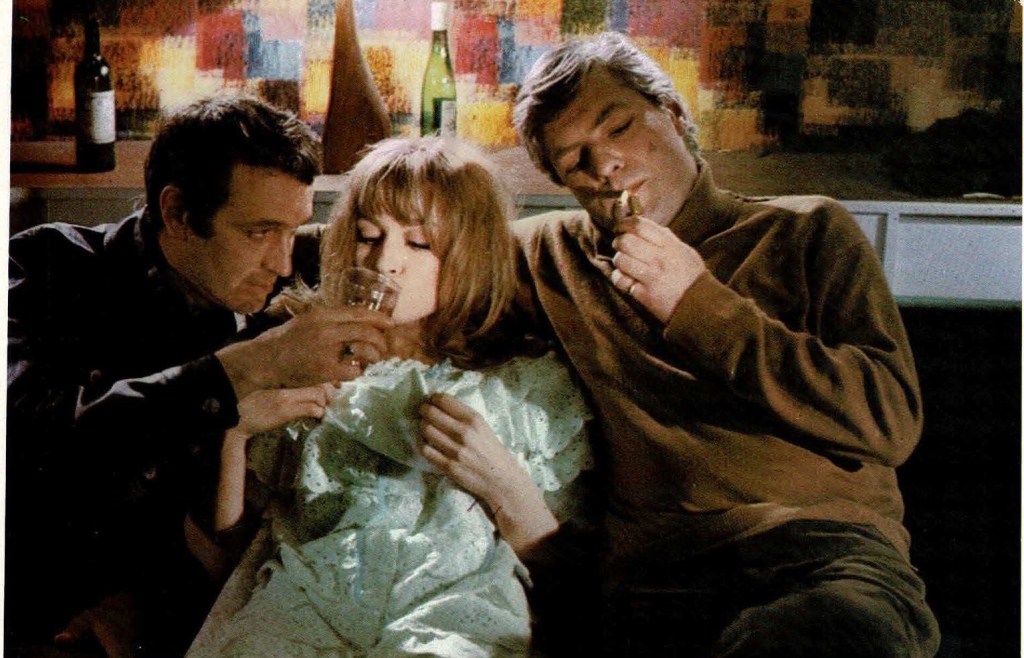
Tom (Tony Beckley) and Dick (Norman Rodway) are, of course, bogus and armed with a knife quickly take control, trying up Bruce and pouring alcohol down Barbara’s throat. As part of the overall creepiness, there is a sense that this is no casual visit, but that it has been planned, as if someone somewhere is familiar with the set-up, and there a debt, if only a moralistic one, to pay as a deterrent to the era’s permissiveness. Minus the knife, they would have passed as harmless. But never was their such difference between word and action, except for what they are capable of you could easily be persuaded that are in fact camp and bitchy.

The bound Bruce’s is spun round in a chair and can only watch as the men begin to strip Barbara. His only defence is verbal, trying to set the two men against each other, suggesting that Tom treats Dick as his assistant. But the relationship between the two criminals constantly shifts as if they were in passive-aggressive relationship. You don’t learn much about them until the end, so basically you have to rely on what they say about themselves, which is very little. They are prone to philosophic observation or interrogate Bruce about his possessions or extract from Barbara an unexpected ambition to be a painter.

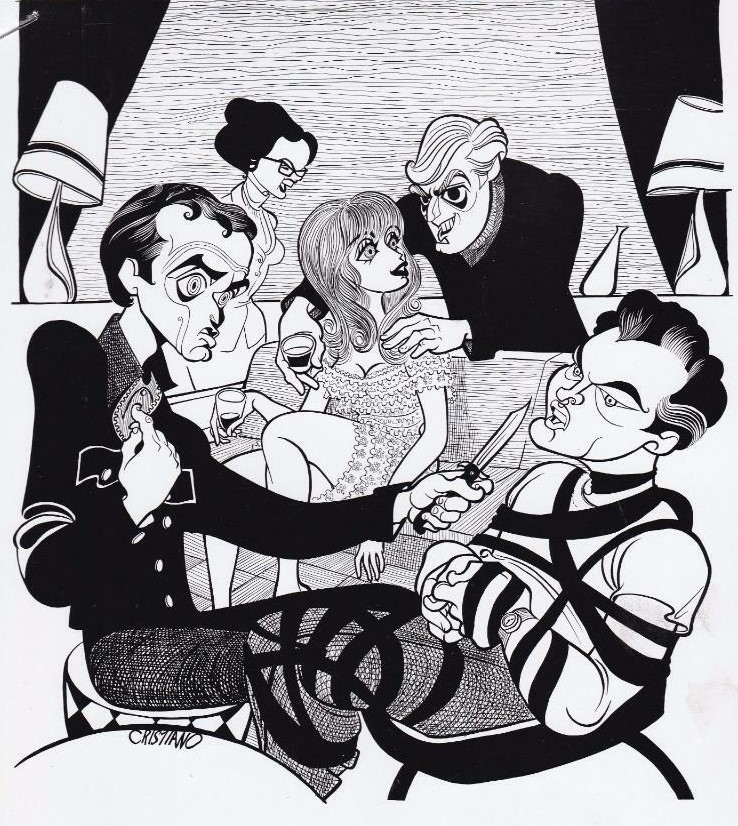
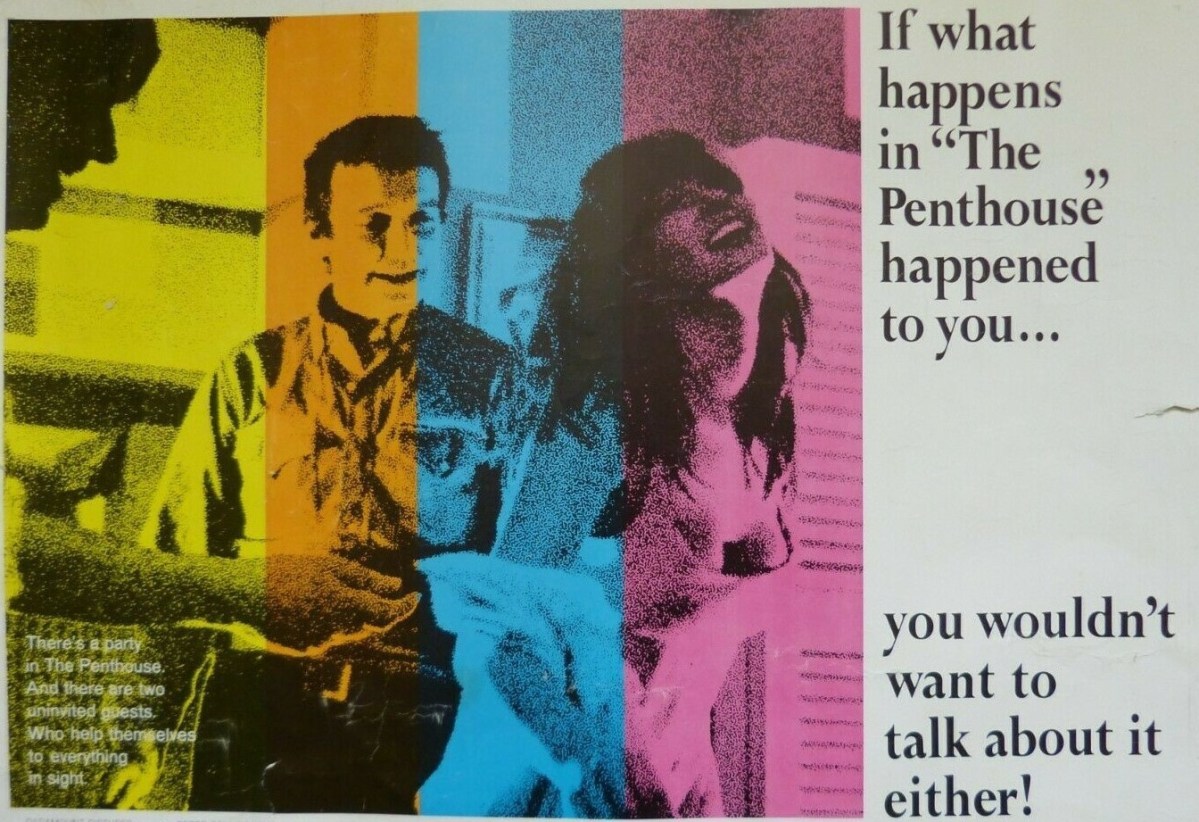
One of the oddest pieces of promotional material ever produced. Studios were keen on this kind of jokey cartoon in the hope that it would be picked up by newspaper editors who might be less inclined to run a still from the picture. But it is completely out of touch with the tone of the movie.

The men take it in turns to torment Bruce while the other is in the bedroom with Barbara. Where Bruce resists verbally, Barbara gives in almost right away, but there is never the sense that this is in any way consensual, just that she is too drunk to defend herself – the first drink is a full glass of whisky forced down her throat – and the men have a knife. The invaders make constant reference to a character called Harry. That person’s eventual appearance provides a whole new range of twists.

It’s a film full of menace. Sexual tension, mind games, claustrophobia and the threat of physical violence never dissipate. Because it is rationed out, the brutality is all the more shocking.  But it is brilliantly directed. In his debut British director Peter Collinson (The Italian Job, 1969) uses the camera to suggest we are in anything but an enclosed space. In one long sequence the camera does not move, in another scene it turns 360 degrees – Antonioni’s use of this device in The Passenger (1975) was credited as innovative – and at other times it twists and turns as if turning the characters inside out, suggesting some of the dizziness, the dramatic speed of change of feelings, that the stunned victims are enduring. At times it feels like an arthouse movie. At other times like a deranged B-picture.

The cast are all excellent. Tony Beckley (The Lost Continent, 1968) makes the best of a role of a lifetime, Norman Rodway (Four in the Morning, 1965) the more quietly psychotic sidekick. Terence Morgan (The Sea Pirate, 1966) has less to do but Suzy Kendall (Fraulein Doktor, 1969) is superb as the enigmatic girlfriend. Look out for Martine Beswick (Prehistoric Women, 1967) in a small part. Collinson wrote the screenplay based on a play The Meter Men by Scott Forbes.

Cultural note: “Tom, Dick and Harry” are considered such quintessentially British names that anyone familiar with this would understand immediately that they were a) pseudonyms and b) intended as a twisted kind of joke.

No sign of this being available on Amazon. Ebay is probably your best bet. There’s a copy on YouTube but it ain’t a good print.

Four in the Morning (1965) ****

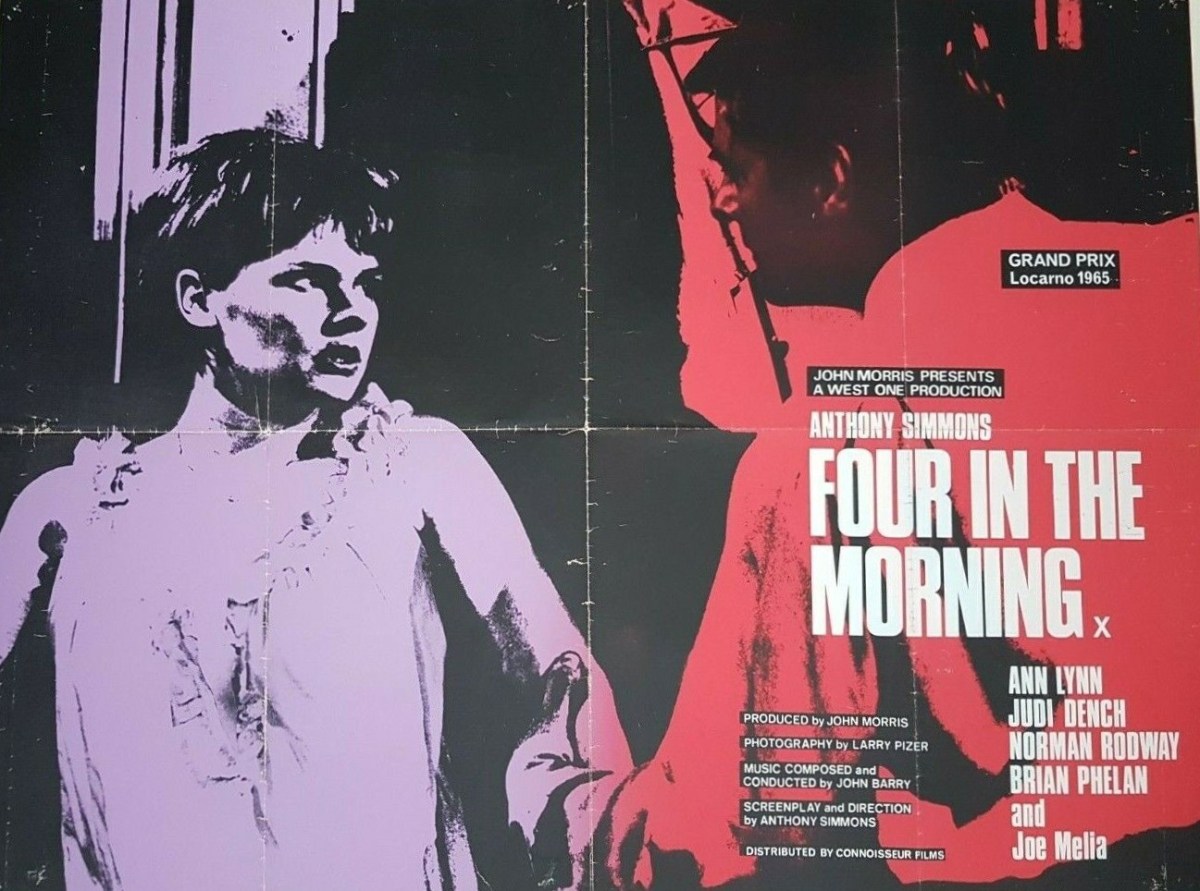
Directors learned this early that you only had to point the camera at Judi Dench (Oscar winner for Shakespeare in Love, 1998, but here in her first starring role) and even without the benefit of dialog she will always be compelling. And that’s just as well because this is one of those elliptical movies that were in fashion in the wake of Last Year in Marienbad (1960).

Less twisty and self-conscious for sure two apparently unconnected tales are conjoined by a mysterious drowning in the Thames. And this isn’t tourist London, either, but the working version, a city waking up, famed fruit and flower markets coming to life, ferryboat teaming with passengers, the skyline dominated by tiny dots setting off for the office.

In fact, the picture draws its power from three women, the aforementioned Dench as a young woman smothered by motherhood, marriage disintegrating, Ann Lynn (The System/The Girl-Getters, 1965) who breaks out of the supporting role cage where her character is generally fixed from the start to take advantage of a name-above-the-title role as a reticent lover to explore a gamut of emotions. Last of the trio is the drowned woman, whose callous treatment dominates the action.

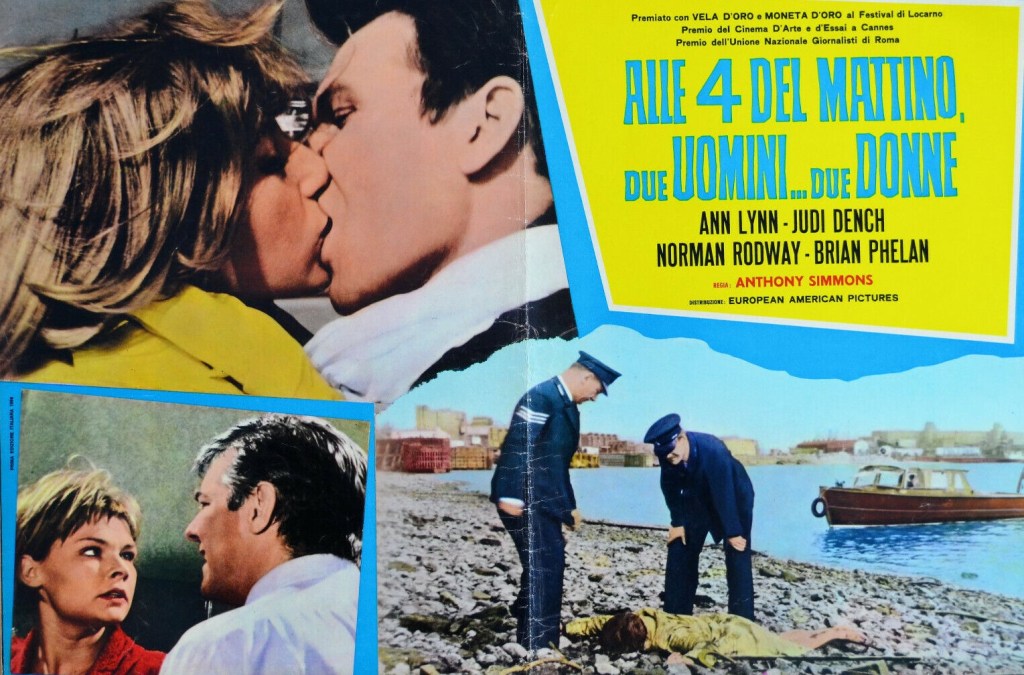
If you ever wanted to find out what happens to a drownee here’s your chance. Unceremoniously dragged from the shore, transported to a mortuary in a coffin, head laid on a block of wood, clothes cut off, naked body sluiced with water, fingerprints taken, stored in a refrigerator, indignity run riot, it’s a harrowing sight.

As if to compound the movie’s arthouse sensibilities – and it won big at various film festivals – the characters remain anonymous. The wife (Judi Dench), stuck at home with a mewling teething infant, is disconcerted to find husband (Norman Rodway) has returned from a night on the town with  buddy (Joe Melia) in tow. They want to continue partying, waking up wife and baby, resulting in non-stop argument.

Divorced manager of an upmarket bar (Ann Lynn) tries to put off a boyfriend (Brian Phelan) pestering her for a date. Eventually, she relents and they embark on an initially unsatisfying date before she finally comes alive when he steals a speedboat and they power upriver. Even when passion takes over she remains wary of commitment.

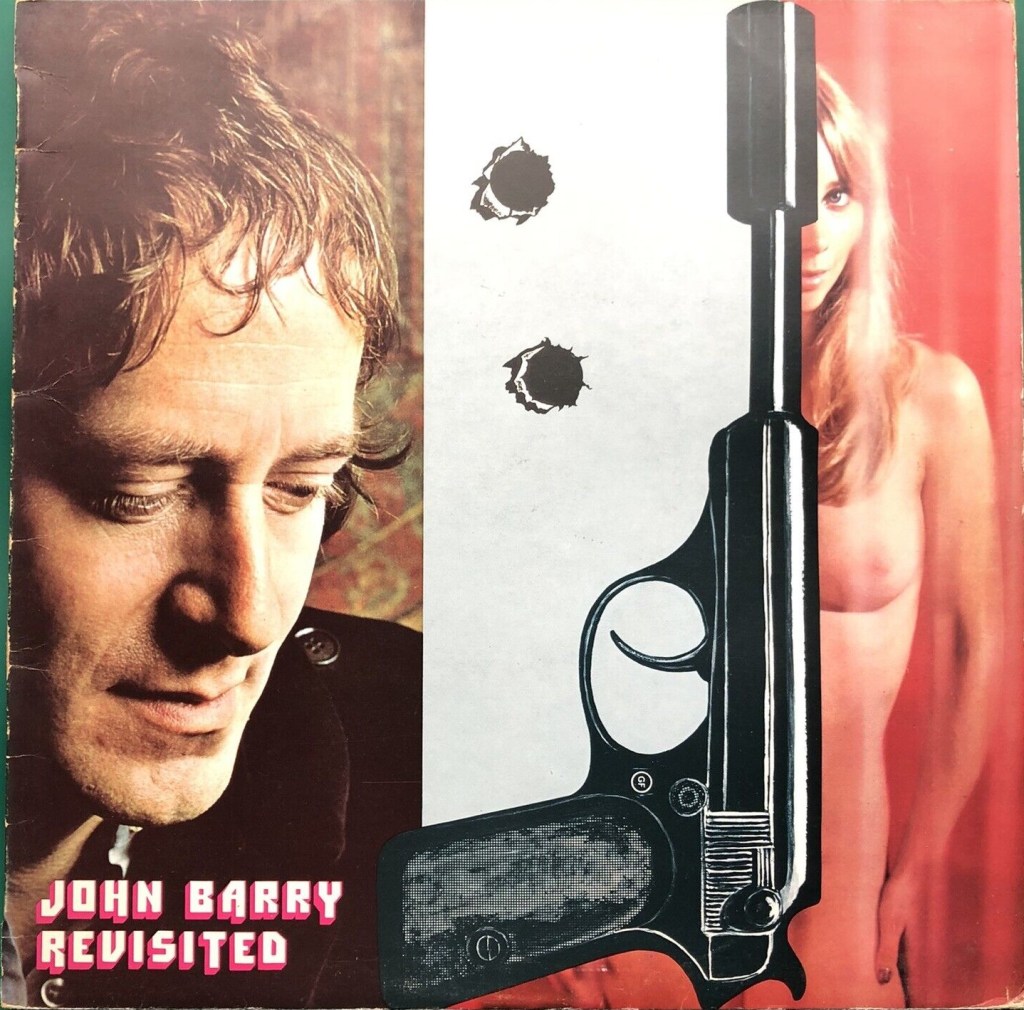
I chose this purely on the strength of the score. I first heard the theme on this album when I was in my teens. Fearing that my parents might veto the purchase because of the nudity on the cover – and since the record player was in the lounge – I showed suprising nous for a teenager, and stuck sticky tape over the offending bits. Of course, I then had to come up with a reason why there would be brown sticky tape on the album cover.

Beyond the to-and-fro of each couple’s situation, there’s little in the way of story, but the dialog is refreshing as it winds back and forth through a variety of emotions, including playfulness, a genuine sense that this is not about scoring points but exploring characters, each development the consequence of action however minimal. The mood is often bleak but always ruminative, a sense that emotions could tip at the touch of a switch, nothing quite defined, except that angst one way or another is going to hold sway.

Most British kitchen sink dramas of the period took place up north, not in the country’s capital, and the wife is too young to expect to be so hemmed in by motherhood, unable to grasp, what with the changing times, that she has still contracted, through marriage, to carry the burden of child-rearing.

The sting in the tale is that since the drowned woman is never identified that she turns out to be one or other of the women, my bet being on the wife, who seems at the end of her tether. This might have been more easily tagged as a couple of one-act plays except for the concentration on the drowning and the focus on girlfriend and suitor exploring various parts of the capital at its least tourist-y. But it’s almost a ghostly city, hardly the location for romance.

Judi Dench is superb – she won the Bafta that year as the Most Promising Newcomer – as she captures a character twisting and turning in a situation she never expected to be so depressing. But Ann Lynn, whose career did not have as much upward mobility, is equally expressive as she changes from morose to excited until heightened romance is sufficient to kill off any expectation of fulfilment. Norman Rodway (The Penthouse, 1967), Joe Melia (Modesty Blaise, 1966) and Brian Phelan (A High Wind in Jamaica, 1965) has less room for  development, tending to be more focused on pleasure than emotion.

This didn’t open too many doors for writer-director Anthony Simmons (Your Money or Your Wife, 1960) and he didn’t get behind a camera for another eight years and only made four films in total. Quite why he was so ignored remains a mystery because this is a haunting piece of work, with an excellent script. John Barry (The Lion in Winter, 1968) wrote evocative score.  

Worth seeing for Dench’s performance alone.

Discover WordPress

A daily selection of the best content published on WordPress, collected for you by humans who love to read.

The Atavist Magazine

by Brian Hannan

WordPress.com News

The latest news on WordPress.com and the WordPress community.