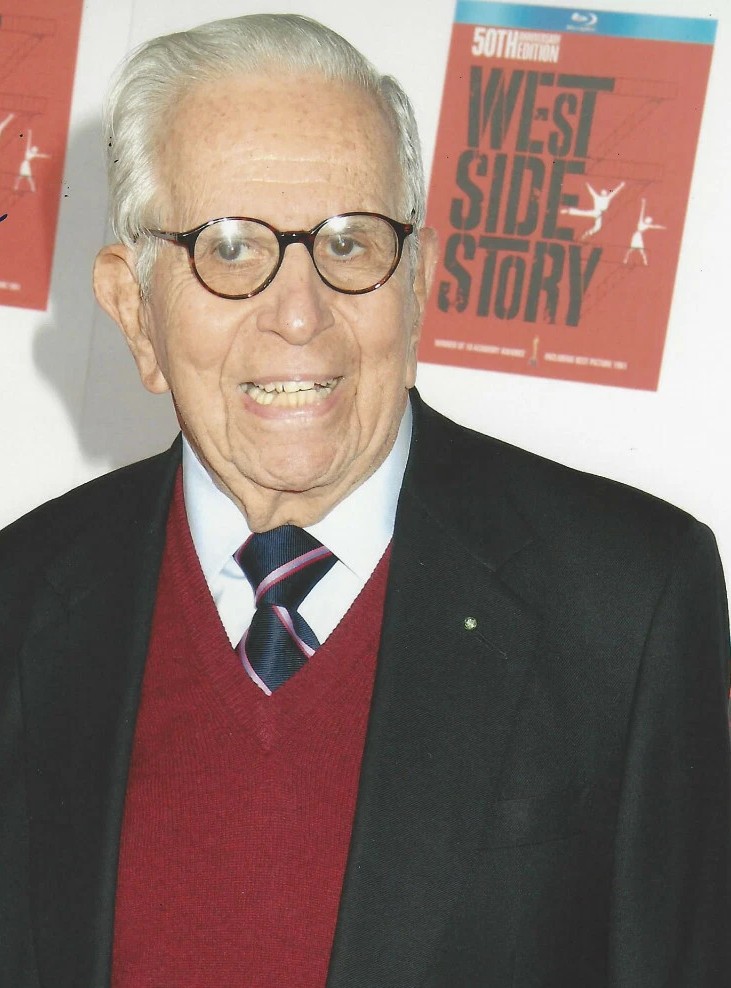
Behind the Scenes: Becoming a Producer, Part One – The Walter Mirisch Story

You don’t just waltz into Hollywood and start churning out classics like Some Like it Hot (1959), The Magnificent Seven (1960), West Side Story (1961) and The Great Escape (1963). Usually, there’s a long apprenticeship, especially for a producer. Walter Mirisch spent nearly a decade at the B-picture coalface. And before that  a year as a gofer, working his way up in the business, but on one of the smallest rungs of all, at Monogram.

Born in 1921, the of a Polish immigrant tailor specializing in custom-made garments, one of whose customers was George Skouras, owner of a cinema chain, Walter, not surprisingly in the Hollywood Golden Age, started out an even lower rung, as an usher in the State Theater in Jersey City, owned by Skouras, an hour’s commute from his home in the Bronx, earning 25 cents an hour. He was quickly promoted to ticket checker.
His older brother Harold was a film booker, receiving an education in negotiation, and then as a cinema manager in Milwaukee flexed his entrepreneurial muscles by starting a concession company. After the family moved to Milwaukee, Walter attended the University of  Wisconsin and then Harvard Business School. Physically unfit for active duty during the war, he worked for Lockheed in Los Angeles on its aircraft program in an administrative capacity.

While Harold was a highflyer at RKO, acting as chief buyer and then managing its cinema chain, Walter entered at a lower level in 1946 as a general assistant to Steve Broidy, boss of Monogram, maker of B-pictures of the series variety – Charlie Chan, The Bowery Boys, Joe Palooka, shot within eight days and at budgets under $100,000.

After badgering Broidy for a bigger opportunity, he was granted permission to hunt for a property he could produce. For $500 he found a Ring Lardner short story about a boxer, but Broidy felt the main character was unsympathetic. Stanley Kramer did not and snapped it up to make Champion (1949). 

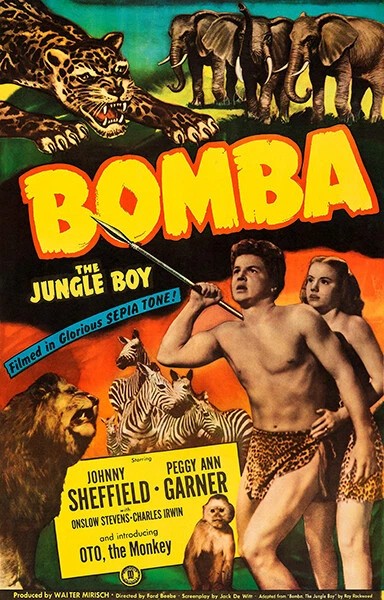
Walter’s first ventures were in film noir. Fall Guy (1947), based on a story by Cornell Woolrich,  made for $83,000, broke even. I Wouldn’t Be In Your Shoes (1948) followed, from a Woolrich novel but there was a drawback to being a producer. He was taken off the payroll and his $2,500 producer’s fee didn’t compensate for the loss of a $75 weekly salary. The answer was to invent his own series, ripping off the Tarzan pictures for Bomba the Jungle Boy (1949), starring Johnny Sheffield who had played Tarzan’s son and utilizing stock footage from Africa Speaks. Apart from his fee, Walter had a 50 per cent profit share.

For six years, these appeared at the rate of two a year, earning Walter a minimum of $5,000 and he soon branched out into other genres, sci fi like Flight to Mars (1951) and westerns such as Cavalry Scout (1951) and Fort Osage (1951), both starring B-movie stalwart Rod Cameron.

Monogram had decided to move upmarket with the introduction in 1951 of Allied Artists, its sales division run by Walter’s brother Harold, with Walter acting as an executive producer and other brother Marvin as treasurer, turning out solid B-picture-plus hits like Riot in Cell Block 11 (1954).
When the threat from television hit the B-picture market Allied went properly upscale, investing in William Wyler western Friendly Persuasion (1956) and Billy Wilder’s Love in the Afternoon (1957), both starring Gary Cooper. Their failure at the box office sent  Monogram back to basics.

But the Mirisches wanted more of the big time. The three brothers turned to United Artists and negotiated a  deal for that studio to finance four pictures a year, cover the brothers’ overhead and salaries and throw in a profit share. The Mirisch Company was born and their creative credit within the industry was so high – and the deals they offered, it has to be said,  so advantageous to their creative partners – that soon they were scooping up big names like Wilder (he made his next eight pictures for Mirisch), William Wyler, Gary Cooper, Tony Curtis, Doris Day, Audrey Hepburn and Lana Turner. One of the first pictures announced was a remake of King Kong (1933). Wilder planned My Sister and I with Hepburn. John Sturges was attached to 633 Squadron. Doris Day would star in Roar Like A Dove and there were two-picture deals with Alan Ladd and Audie Murphy.

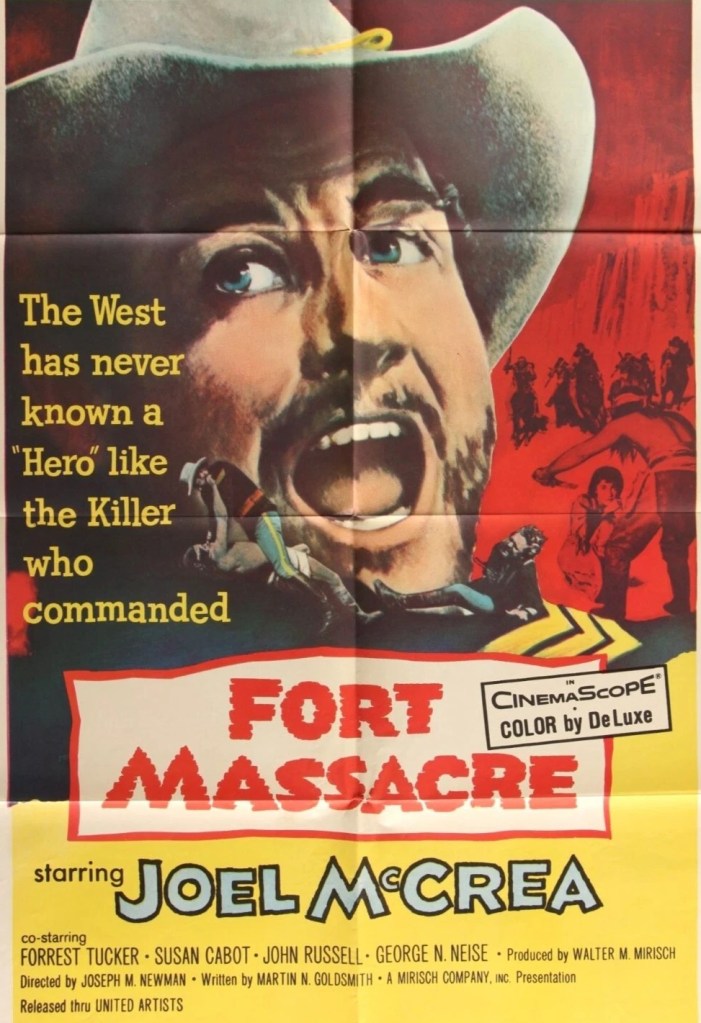
Their first two efforts didn’t break the budget bank, Fort Massacre (1958) starring Joel McCrea, and Man of the West (1958) headlined by Cooper, but neither were they hits. Hoping to provide ongoing financial sustenance, Walter turned to television, turning Wichita (1955) into the series Wichita Town (1959), and further television contributions were mooted for UA Playhouse but that and Peter Loves Mary and The Iron Horseman failed.

Movies proved a better bet and Walter struck gold with the third picture in the Mirisch-UA deal, Some Like it Hot (1959), costing $2.5 million, an enormous financial and critical success and tied down a triumvirate of top talent in John Wayne, William Holden and John Ford for western The Horse Soldiers (1959), the actors pulling down $750,000 apiece.

Such salaries sent the nascent company on a collision course with traditional Hollywood. The majors “screamed” that independents were overpaying the talent, hefty profit shares accompanying the salaries.

On top of that in 1959 in the space of two weeks Mirisch spent a record $600,000 pre-publication on James Michener blockbuster Hawaii and tied up a deal to film Broadway hit West Side Story. Within two years of setting up, Walter Mirisch announced a $34.5 million production slate, earning the company the tag of “mini-major,” as part of a shift in attitude to a “go for broke” policy. By the start of the new decade it was by far the biggest independent the industry had ever seen, handling $50 million worth of product, including The Magnificent Seven and The Apartment (1960). Average budgets had risen from $1.5 million to $3.5 million.

To outsiders, assuming the Mirisch venture was Walter’s first, it might look as if Walter had knocked the ball out of the park in a very short space of time, but, in reality, by the time he produced Some Like it Hot, he had been responsible for thirty-three pictures. Not bad for a “beginner.”

Explained Walter Mirisch, “Producing films is a chancy business. To produce a really fine film requires the confluence of a large number of elements, all combined in the exactly correct proportions. It’s very difficult and that’s why it happens so infrequently. It takes great attention to detail, the right instincts, the right combinations of talents and the heavens deciding to smile down on the enterprise. Timing is often critical.”

What would have happened to Allied Artists, for example, had Wilder made Some Like it Hot there instead of Love in the Afternoon?

Added Walter, “Where is the country’s or the world’s interest at that time? What is the audience looking for? Asking them won’t help because they themselves will tell you they don’t know what they’re looking for. They don’t know what it is until they’ve seen it. All the elements must come together at exactly the right time. So to say one embarks with great certainty on such an endeavor is an exaggeration.”

After 33 films Mirisch hit a home run with Some Like It Hot and continued to do so throughout the 1960s chalking up further critical and commercials hits like The Pink Panther (1964), In the Heat of the Night (1967) and The Thomas Crown Affair (1968) and vacuuming up a stack of Oscars.

SOURCES: Walter Mirisch, I Thought We Were Making Movies, Not History (University of Wisconsin, 2008); “Mirisch Freres Features Outlet Via United Artists,” Variety, August 7, 1957, p16; “3 Mirisch Bros Set Up Indie Co for 12 UA Films,” Variety, September 11, 1957, p7; “RKO vs Mirisch Kong,Variety, September 11, 1957, p7; Advertisement, “United Artists Welcomes The Mirisch Company,” Variety, November, 13, 1957, p13; “Brynner, Mirisch Pledge UA TV Tie,” Variety, January 1, 1958, p23; “Mirisch Freres 6 By Year-End,” Variety, March 19, 1958, p3; “Majors Originated Outrageous Wages,” Variety, December 10, 1958, p4; “UA-Mirisch’s  $600,000 For Michener’s Hawaii,Variety, August 26, 1959, p5; “Mirisch West Side Story,” Variety, September 2, 1959, p4; “Mirisch Takes on ‘Major’ Mantle With 2-Yr $34,500,000 Production Slate,” Variety, October 21, 1959, 21; “Mirisch Sets $50,000,000 14-Pic Slate; Biggest for Single Indie,” Variety, August 17, 1960, p7.
Hour of the Gun (1967) ****

The second version of the Gunfight at the O.K. Corral follows on from the Burt Lancaster-Kirk Douglas 1957 version also directed by John Sturges and precedes Doc (1971) reviewed yesterday. Good chance to compare the differing approaches.

Destroy a legend at your peril. Mythic western hero Wyatt Earp (James Garner) goes down’n’dirty after the death of his brother, spurning law and order to turn bounty hunter, which is legitimate, and then vigilante, which is not, in pursuit of Ike Clanton (Robert Ryan). A revisionist western, then, with director John Sturges substantially reimagining the image of Earp he had been instrumental in creating through Gunfight at the O.K. Corral (1957), a box office smash starring Lancaster as Earp and Douglas as sidekick Doc Holliday.

The first change is to keep Clanton alive, having been a casualty in the previous picture. The opening sequence sets the record straight. But corruption and the law acting in conjunction pull Earp and Holliday (Jason Robards) up on criminal charges though they are found innocent. When corrupt law fails to work, Clanton resorts to ambush, killing Earp’s brother. Clanton organises a posse of twenty men to kill Earp while the lawman sets up his own, smaller, team of bounty hunters.

It soon transpires Earp’s warrants are little more than “hunting licenses” and although marginally he errs on the side of fairness the odds, courtesy of his superior gunplay, remain substantially stacked in his favour and he picks off the villains one by one, pursuing Clanton into Mexico.

This is the story of Wyatt Earp in transition, shifting into lawlessness, at a time – 1881 – when the West itself was undergoing dramatic change, big business from the East forcing greater acceptance of the law (and using it for their own purposes), the growth of the cattle barons and the gradual elimination of the gunslinger, gunfighter and criminal gangs. There’s no room for romance as there was in O.K. Corral and The Magnificent Seven (1960) just pitiless determination to revenge. But there’s little of the all-male camaraderie that informed The Great Escape (1963). Earp and Holliday remain tight but the others in their gang have been somewhat forcefully enlisted.

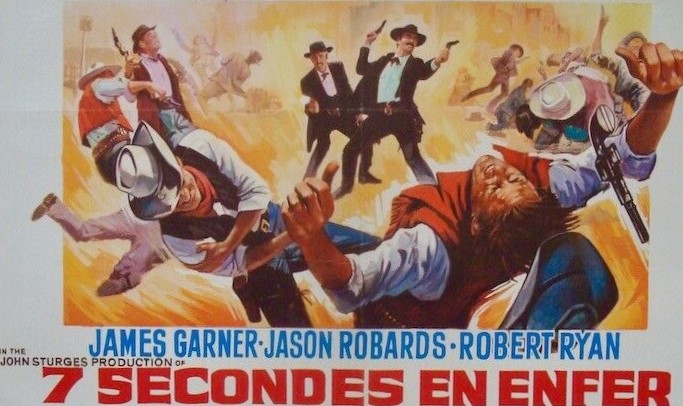
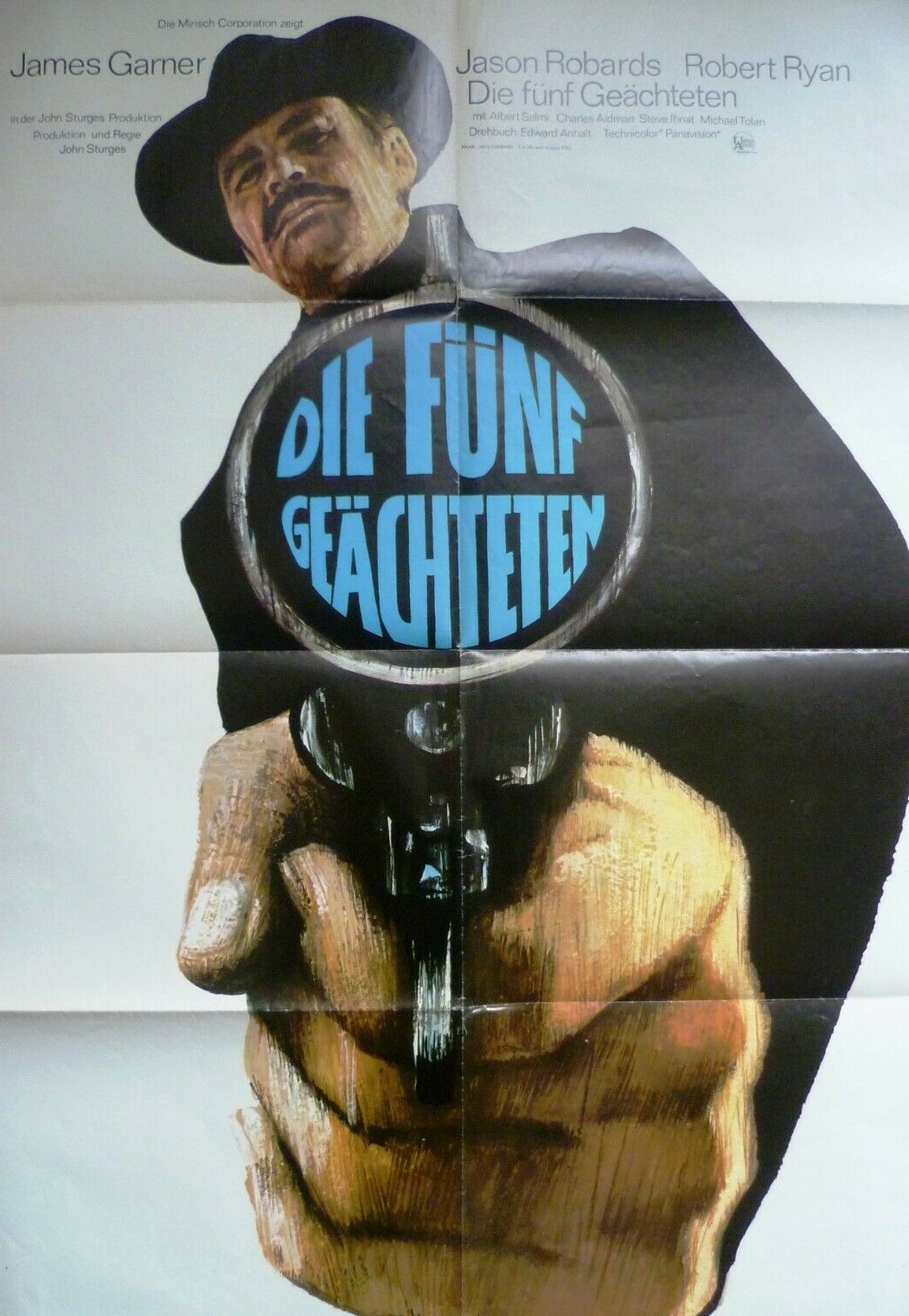
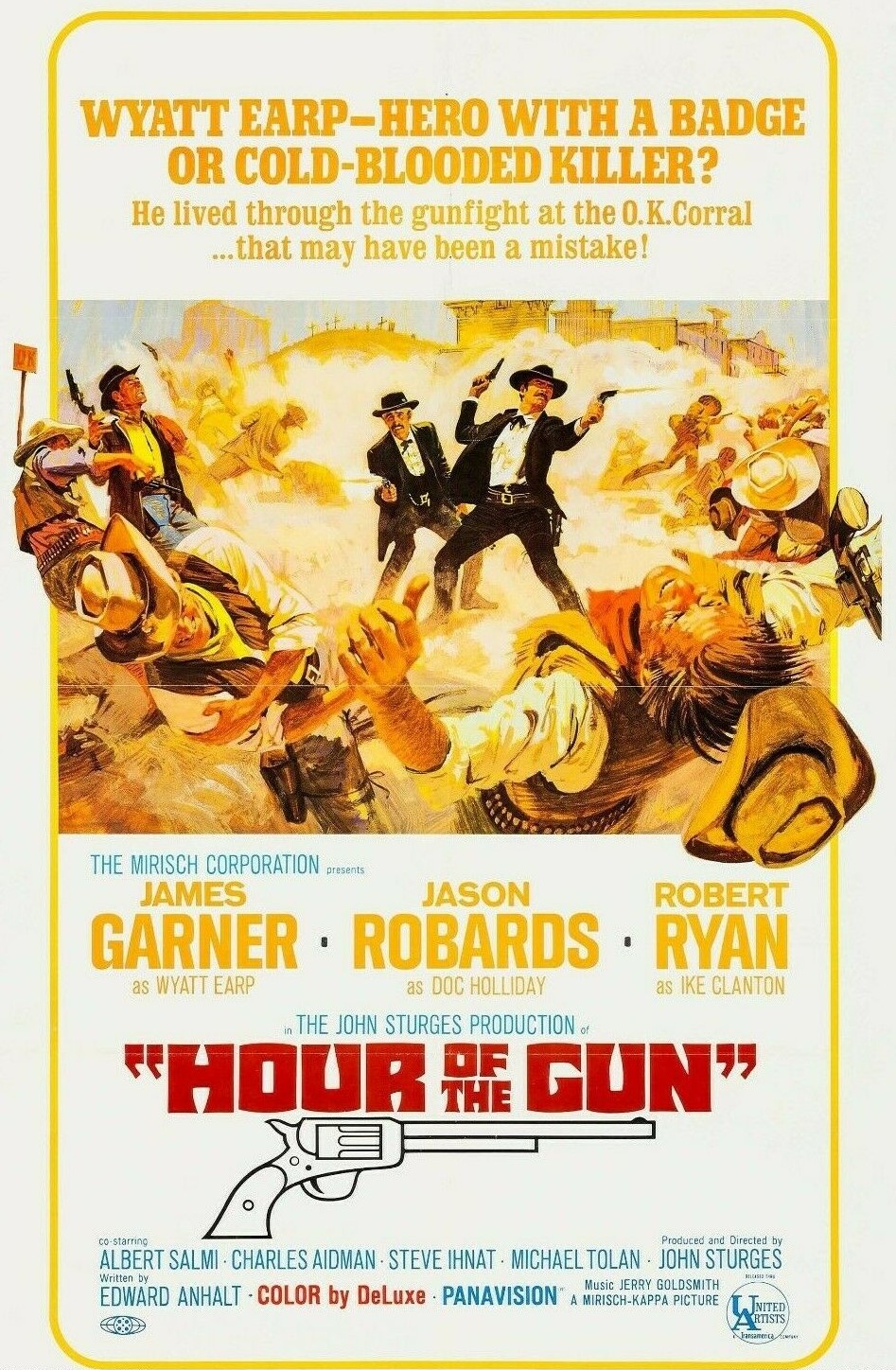
The poster is very misleading, giving the impression of an all-action
gun-toting movie rather than one of somber reflection.

The best scenes are the result of Earp conniving, revealing a streak Machiavelli would have envied, even duping Holliday, until it’s clear the Earp of legend has been vanquished. Sturges congratulates himself on telling the “truth.” But that’s the problem. The truth involves a lot of background that slows the picture down. And presenting Earp as transitioning is pretty much a blatant lie. Earp was clearly as ruthless killer at the O.K. Corral as he is now and no amount of pointing to corrupt law can eliminate the fact that the lawman prefers to kill villains rather than see them face justice. So there’s really no transition. Earp is a more civilized version of The Man With No Name. But at least he accepts it. There’s no hypocrisy involved.

The two principals are superb, shucking off the mannerisms that previously defined their screen personas. Gone is the trademark James Garner cheeky chap, the grin and even the slicked-back hairstyle. He is your father in a continually bad mood now rather than your favorite uncle full of japes. How much Sturges pinned back Robards’ capacity for over-acting can be seen by comparing this with the actor’s performance in Once Upon a Time in the West (1968).

Full marks for Sturges in trying to tell a complex, morally ambivalent, story, and he avoids the more grandiose approach to changes in the West as instanced in Once Upon a Time in the West. The early courtoom scenes slow down the narrative when a couple of lines of dialog could have done the same job. But it is exceptionally true in its depiction of Earp. There is not a bone of redemption in his body. He is going on a killing spree and he doesn’t care who knows it or how it damages his reputation, still high enough before the final episode of the revenge hunt for him to be touted as a future lawman-in-chief for Arizona.

Nor does Doc Holliday offer anything in the way of consolation. This isn’t like The Wild Bunch where a ruthless band of robbers convince themselves they have a code of honor and provide rough camaraderie as a way of filling in the emotional gaps in their lives. Holliday mistakenly sees Earp as man who could not exist outside the law without destroying himself, but that would only concern an Earp who was still interested in rules. Holliday, a self-confessed killer, over 20 deaths to his name, seeks redemption by saving Earp from himself. But in keeping with the raw truth, he is wasting his time. “I’m through with the law,” proclaims Earp, somewhat redundantly, once he dispatches his final victim.

It was a different kind of western at a time when in mainstream Hollywood there was no such thing. Although elegiac in tone, it cuts to the mean. And it was the forerunner of other, more critically acclaimed, westerns like Will Penny (1968), The Wild Bunch (1969) and Pat Garrett and Billy the Kid (1973) and in a sense it was precursor to Dirty Harry (1971) where in order to obtain justice Harry Callahan has to throw away his badge.

Many reasons have been advanced for the film’s commercial failure, most erroneously assuming that the genre had fallen into disrepair and was not revived until the glory year of 1969, but as I point out in my book The Gunslingers of ’69, that was far from the case. The same year as Hour of the Gun, John Wayne had ridden high on the box office hog with The War Wagon to follow the previous year’s El Dorado and Paul Newman as Hombre had been a big hit. The first two spaghetti westerns, only released in the U.S. in 1967, were also given as instrumental in the failure of Hour of the Gun, but neither was a massive box office hit. Revisionism had not quite hit the target with the public either as witness Cheyenne Autumn (1964).

The most likely reason was the fact that Sturges set out to dispel a myth that the public were happy with, that the movie was slow moving, and the characters essentially unlikeable. John Ford averred that when the legend became fact you printed the legend, but the opposite was patently not true here.  Edward Anhalt (The Satan Bug, 1965) wrote the screenplay based on the straight-shooting biography Tombstone’s Epitaph by Douglas D. Martin. who had previously written about the Earps.

It might be cold, and at times meandering, but it offers up a fascinating character study and although Earp’s transition could be construed as tragedy, the destruction of a good man, Sturges takes no refuge in such an idea. This is Sturges boldest, most courageous, picture and he does nothing to soften the killing. Where The Magnificent Seven, another bunch of killers, ride into Mexico on the back of a bombastic theme tune, this is a much leaner effort, and all the richer for it.

Marooned (1969) ****

The forgotten one. Left out in the cold by audiences and critics alike in the late 60s sci fi boom by the more audacious 2001: A Space Odyssey (1968), Barbarella (1968) and Planet of the Apes (1968). And that’s a shame because it’s by far the most realistic (to the nth degree) of the space movies. Audiences growing up with astronauts saving their own skins with ingenious maneuver – sling shot and whatnot – in Apollo 13 (1995) and The Martian (2015)  might be shocked by the harsh reality of space travel as evidenced here. Astronauts are little more than helpless creatures in a tiny box with ground control in obsessive control. It’s salutary that escape was the audience mindset even after the Challenger Space Shuttle disaster of 1986.

Nobody thought to tell audiences to buckle up because they were in for a hell of a ruthless ride back in the day, but this one really should come with a warning.

Casting makes this work – when it shouldn’t. It’s full of those kind of actors who scarcely move their lips and rarely engage in extraneous facial movement. You can hear director John Sturges issuing instructions: to Gregory Peck, keep those brows knitted; to David Janssen, keep your head lowered and keep with the muttering; to Richard Crenna, don’t move a muscle; to Gene Hackman, limit that trademark chuckle to just once. Why this shouldn’t work is because the big star isn’t in the goldfish bowl of the shuttle cockpit, and since there’s none of the get-to-know-the-crew backstory of The Right Stuff (1983) or Apollo 13 there’s nobody to really root for, especially as the crew is just siting there, doing (by instruction) nothing and awaiting their fate. Which, by the way, which is constantly spelled out, is to suffocate from lack of oxygen.

But there’s a reason Gregory Peck’s on the ground and not in space. Because he’s the one making the life-and-death decisions.

This is by far Gregory Peck’s toughest role. He pulled out of Ice Station Zebra (1968) because he didn’t like the slant of the character, and since then he’d been in typical upstanding heroic mode in The Stalking Moon (1968), Mackenna’s Gold (1969) and The Chairman (1969). Here he’s the king of data management and crisis control, the most ruthless, heartless sonofa you’d ever encounter, not willing to take a risk on greenlighting a rescue mission because the computer says no. The weaselling PR-speak that’s all about saving the space program and making allowance for collateral damage is nothing compared to his terrible delivery of news to one of the wives that her husband is dead. She collapses with emotion, he puts the phone down.

If you’re geek-minded, you’ll give this five stars because there’s information overload. “Go” and “Mark” are the most commonly used words. And in case you can’t judge from the visuals what’s going on, there’s usually some television commentator voice-over to help you out.

So, the Ironman One mission hits trouble when its retro rockets refuse to ignite for return to Earth after several months in space. They’ve got 40 hours or so to effect a rescue before the oxygen runs out for crew members Jim Pruett (Richard Crenna), Buzz Lloyd (Gene Hackman) and Clayton Stone (James Franciscus). The crew are forbidden to try any stunts themselves because any exertion will use up valuable oxygen.

Plan by chief astronaut Ted Dougherty (David Janssen) to mount a rescue operation via an untried spaceship XRV (smaller than a helicopter, by the way) is vetoed as too risky by NASA boss Charles Keith (Gregory Peck) until the President, terrified of public reaction, overrules him. With time running out the impending launch is hindered by an approaching hurricane. But then, in the only nod to ingenuity, someone suggests taking off in the eye of the hurricane, when wind force will be zero.

Meanwhile, up in space, the three stalwarts are slowly coming apart. Buzz, the toughest-looking of the trio, is worst affected, screaming his head off as the prospect of dying looms. Then they are faced with a terrible decision. With the rescue delayed, there’s not enough oxygen to see them through, so one has to sacrifice himself.

I told you it was brutal stuff. About the last 30 minutes are not about whether they can be saved, but who will die and how, the impact of asphyxia on the brain spelled out by resident boffin Clayton. By this point anything they do will almost certain sabotage any rescue and they’re in cloud cuckoo land as Keith tries to keep them in line.

While there’s certainly information overload and a few questionable scientific decisions (can you really open a hatch straight into space?), the reality of the drama more than holds the enterprise together. The realpolitik, the callous use of the wives to go along with the company line as they watch their husbands suffer before their very eyes, the management of potentially bad news, was perhaps a shock for audiences back in the day but would be accepted more easily by contemporary moviegoers.

The acting is first class. Gregory Peck never attempts to lighten his load, to make his character less unattractive and appease his following. David Janssen (Warning Shot, 1966) is as solid as ever. Gene Hackman (The Gypsy Moths, 1969) is the pick of the crew but Richard Crenna’s (Midas Run, 1969) less showy disintegration packs a punch. Lee Grant (The Big Bounce, 1969) is the standout among the wives.

Much as Sturges lets the computerspeak run away with itself, he doesn’t flinch when it comes to the really tough scenes. Written by Mayo Simon (I Could Go On Singing, 1963) from the Matt Caidin source novel.

Under-rated. Worth a look.

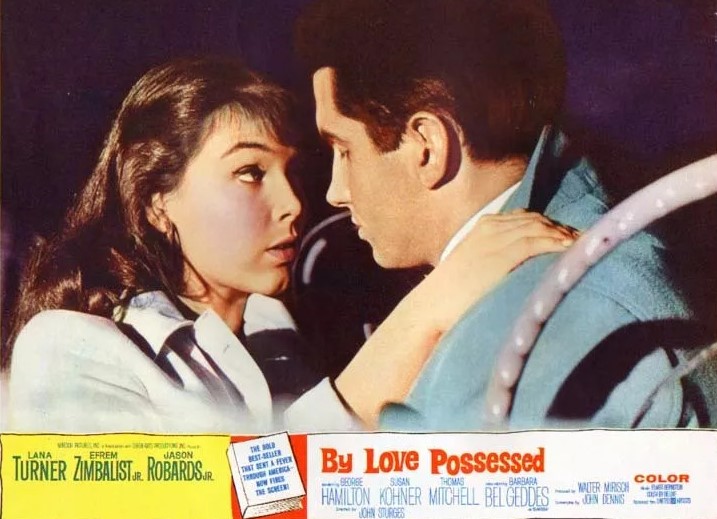
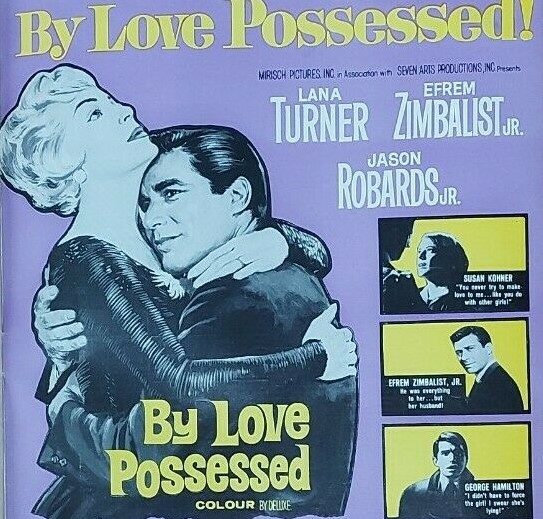
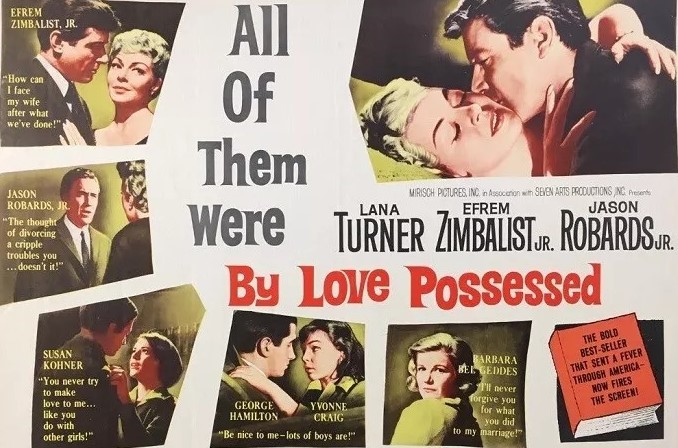
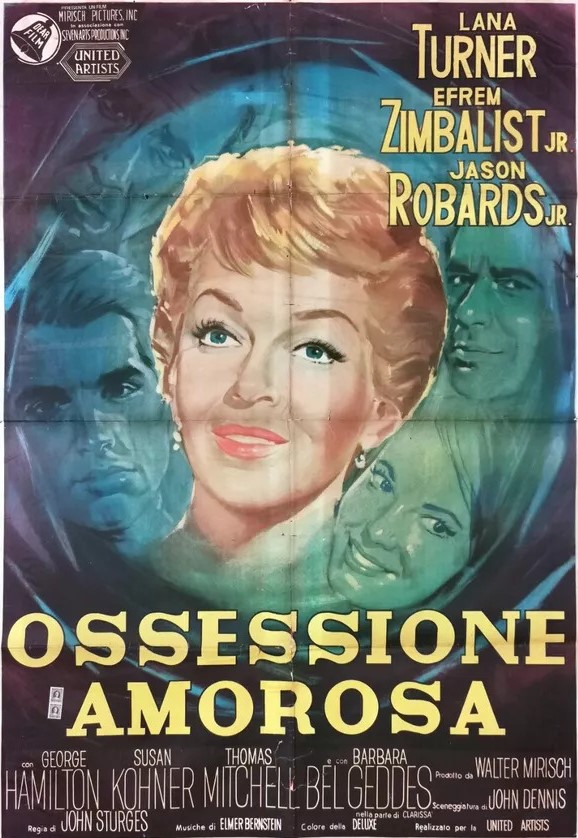
Behind the Scenes: “By Love Possessed” (1961)

Call it friendly persuasion. After The Magnificent Seven (1960), producer Walter Mirisch wanted to keep director John Sturges on-side. Other potential projects were falling by the wayside and Sturges needed, for financial reasons, to keep working while Mirisch wanted to ensure that when they finally licked the script for The Great Escape, still three years off as it happened, they would have a grateful director all set.

Especially, they did not want him to fall into the hands of rival producer Hal Wallis who was making a second attempt to set up The Sons of Katie Elder. Sturges had been the original director in 1955 with Alan Ladd in the leading role but a dodgy script. Although the script was in better shape, Wallis couldn’t get Paramount to bite (and wouldn’t until 1965). Another Sturges prospect was a remake of Vivacious Lady (1938) teaming Steve McQueen and Lee Remick in the Ginger Rogers-James Stewart roles, but that also fell through.

“I didn’t want John to go elsewhere and get tied up in another film,” admitted Mirisch. Partly as a means of finding a vehicle for Lana Turner, Mirisch had struck a deal with Seven Arts to make By Love Possessed by James Gould Cozzens, a 1957 bestseller for which producer Ray Stark had forked out $100,000 as a means of finessing his television-dependent company into the movies.  

Essentially, Mirisch picked up the picture on the rebound. Seven Arts had fallen out with United Artists which had financed the acquisition of three expensive properties: Broadway hits West Side Story and Two for the Seesaw and the novel By Love Possessed, all of which fell into the Mirisch lap. Mirisch enthused about the two stage productions, interesting Robert Wise in the musical and Billy Wilder, at least initially, in the romantic drama. Prior to The Magnificent Seven, Mirisch had tied Sturges down to a long-term deal and now handed him the script for By Love Possessed. “He read it and said he would like to do it.”

Lana Turner had revived her career with an Oscar-nominated turn in Peyton Place (1957), a huge hit, and had hit gold with remake Imitiation of Life (1959). She seemed the ideal candidate for another adaptation of a seamy besteller. At this point the Mirisch company was still trying to make it way in Hollywood. Its prime method of getting its foot in the door was to pay stars over the odds and allow them greater say in their movies, sometimes backing pet projects. The price of working with big marquee names was often a lot of grief.  

Like any other major producer, Walter Mirisch saw himself as a star-maker. Hiring talent on a long-term contract for a low fee was one way of ensuring he could ride on their inexpensive coat-tails in the future. Efrem Zimbalist Jr was the star of hit television series 77 Sunset Strip and the producer “hoped that casting him with Lana in our picture would make him a motion picture star.” He viewed the likes of Jason Robards and George Hamilton as merely supporting actors and not potential stars in their own right, although both would go on to have more stellar careers than Zimbalist.

Ketti Frings, Oscar-nominated for Come Back, Little Sheba (1952), had been paid $100,000 plus a percentage to write the screenplay of what was perceived as a difficult novel to adapt, given it was riddled with flashbacks and introspection. “If we told the book on the screen, we would be making an 18-hour picture,” said Sturges, derisively, as if blockbuster novels (From Here to Eternity etc) were not filetted all the time. Oscar-winner Charles Schnee (Red River, 1948) was drafted in for a rewrite – he had worked on Jeopardy (1953), though uncredited, a Sturges thriller starring Barbara Stanwyck.

Now the screenwriter was dogged with script changes demanded by Lana Turner. According to Mirisch, the actress “never let up” wanting script alterations. But Schnee’s work didn’t meet the director’s expectations and was doctored to such an extent the screenwriter removed his own name from the credits and substituted the pseudonym John Dennis. Mirisch initially brought in Isobel Lennart, who was adapting Two for the Seesaw, for a polish but eventually her version departed significantly from the Schnee original.

Novels could get away with a lot more blatant sexuality than books, though Peyton Place (1957) had made a very good stab at scorching the screen. But the finished script didn’t manage to match the novel’s carnality except in the character of Veronica (Yvonne Craig), the one-night stand who triggers the family downfall. Whatever the problems the script couldn’t nail, Sturges was clearly not the director to get round them with hot onscreen love scenes. Much as he admired strong women, couples getting it on were not his speciality.

The movie was filmed on the Columbia lot with a week on location.

“You get talked into it…or you need the money,” said Sturges. “I knew I had no business making that picture. Sure it was well-acted and staged …but I couldn’t care less about these people. I didn’t like ‘em, didn’t understand ‘em. And if you don’t understand people in a given situation, and you don’t like what’s happening, you shouldn’t try to make a movie out of it.”

Mirisch was as philosophical. “John Sturges was more at home with male-oriented, action pictures than soap opera. I was well aware of that, but I was guilty of ignoring my own misgivings and of wanting to keep him involved in one of our projects while we were doing the script preparation for The Great Escape.” The failure of the movie was, for Mirisch, “a psychological and emotional blow,” one that wasn’t softened by success at the box office.

SOURCES: Glenn Lovell, Escape Artist, The Life and Films of John Sturges (The University of Wisconsin Press, 2008) p218-220; Walter Mirisch, I Thought We Were Making Movies, Not History (The University of Wisconsin Press, 2008) p99, 114-116, 119-120;  

By Love Possessed (1961) ***

You couldn’t get further away from The Magnificent Seven (1960) than this buttoned-up –Peyton Place melodrama but director John Sturges, struggling to put together a more favored project, ended up here. It’s not that he didn’t have experience in this genre, having helmed Spencer Tracy legal drama The People Against O’Hara (1952) and June Allyson in The Girl in White (1952) but it was only when you turned to this field that you realized how much more freedom there was in a western.

There’s no shortage of pithy dialog courtesy of Charles Schnee (Butterfield 8, 1960). The marriage of Arthur Winner (Efrez Zimbalist Jr) and wife Clarissa (Barbara Bel Geddes) is more “merger” than romance. Opposing lawyers are “friendly enemies.” Arthur’s son Warren (George Hamilton) balks at a “smug career.”

There a couple of marvellous scenes and the characters are well-drawn, too well-drawn perhaps, audience constantly being reminded of personality defects, and it reeks of the formulaic, wealthy lives coming apart in Mansionworld. The biggest problem is there’s way too many characters that suffocate the life out of the picture. The heat the director clearly expected to generate is missing, hardly surprising in a world where duty dominates.

We’re pretty much nearly halfway through the picture before adultery crops up, bitter alcoholic wife Marjorie (Lana Turner) falling for Arthur, the business partner of her husband Julius (Jason Robards). Just around the same time Warren avails himself of a one-night stand with local “tramp” Veronica (Yvonne Craig) because he wouldn’t dare lay a hand on fiancee Helen (Susan Kohner), the town’s richest gal.

Simmering in the background is what today we might recognize as early onset dementia, which in those days was just treated as the frailties of old age, when Arthur discovers his boss  Noah (Thomas Mitchell) has been stealing from a client. So, as you can imagine, the whole set-up is all set to explode as characters rebel against self-imposed restraint.

First to crack in the bigger sense is Helen who commits suicide when a spurned Veronica accuses Warren of rape. Then you can take your pick of various other outcomes. And that’s a shame because there’s interesting material here, mostly left unexplored because we’re wrapped up in a game of consequences.

Ace Harvard law student Warren falls out with his father over the case, just discussed but never played out, of a young mother who has killed her baby. The woman, with a mental age of eight, believed her newborn was dead and so buried it. Warren argues his father should offer a plea of insanity, which Arthur rejects as a legal dodge. The question of how the pregnancy occurred is never discussed, but you can guess it could as easily be incest or at the very least someone taking advantage of an incapacitated youngster.

There’s a great scene – the Majorie A and Marjorie B sequence – where Julius explains how on the one hand his wife runs a great house and is a terrific social adjunct and on the other hand is wild, impulsive, demanding and it’s the second one he fell in love with and, although currently rejected, refuses to give a divorce. And it’s Julius again who has the best character defining scene, when he acknowledges that pity is “a dirty word.”

Some surprisingly raw language is used when it comes to the question of rape. “The law assumes a common tramp like Veronica can still be raped” and the question of consent carries a contemporary sting.

Perhaps the biggest issue is the unspoken. It’s not love the main characters are after, it’s sex. Julius is lame after an auto accident and that appears to hinder his activities in the marital bed.  Warren is too scared of Helen’s reaction to engage in the normal fumblings of youth.

The top-billed Lana Turner (who headlined the original Peyton Place, 1957) is kept at bay for too long as the other factors are brought into play and to be honest she is way out of the league of the likes of Efrem Zimbalist Jr (A Fever in the Blood, 1961). He would scarcely come up to scratch for a woman like her unless she was desperate. And perhaps she is. Turner steals every scene she’s in. The only character who shows screen spark is the vengeful Veronica who refers to herself in the third person – “nobody treats Veronica like a tramp but Veronica.”

George Hamilton (A Time for Killing, 1967) has some moments, but not enough. The same goes for Yvonne Craig (Batgirl in the Batman TV series 1966-1968). Jason Robards (A Big Hand for the Little Lady / Big Deal in Dodge City, 1966) takes an early stab at the simmering tense persona he would make his screen template. Charles Schnee was so annoyed with what happened to his original script, adapted from the James Gould Cozzens bestseller, that he insisted on using the pseudonym John Dennis.

A well turned-out potboiler.

Sergeants 3 (1962) ***

There’s a terrific western directed by John Sturges (The Magnificent Seven, 1960) inside this Rat Pack offering, the second of four in the series. On the plus side are plenty twists on traditional scenarios, Frank Sinatra and Dean Martin displaying a certain kind of easy screen charisma, and three exceptional and well-choreographed battle scenes. Sinatra, Martin and Peter Lawford play the eponymous sergeants, Lawford committing the cardinal sin of wanting to quit the regiment to get married, with Sammy Davis Jr. as a former slave, bugler (an important plot point) and horse-lover wanting to sign up, and Joey Bishop (television star and occasional movie actor) as their sergeant-major boss.

A fair bit of time is spent on the usual Rat Pack shenanigans, getting drunk, brawling, playing tricks on each other, and exploring odd comic notions such as playing poker with a blacksmith’s implements as chips. But when it gets down to proper western stuff, it fairly zings along, with a decent plot (a Native American uprising) and excellent action scenes. You could have had William Goldman writing the script for the number of reversals, where the picture keeps one step ahead of audience expectation.

For a start, rather than flushing out outlaws from a town, the troopers have to remove Native Americans who have taken it over. Instead of the cavalry pursuing Native Americans, it is mostly the other way round. It is the soldiers rather than the Native Americans who attack a wagon. Sinatra finds himself employing a bow-and-arrow and then a tomahawk rather than being on the receiving end of such weaponry.  Instead of dynamite, the good guys make do with fireworks. Where Native Americans are usually pinned down, this time it is Sinatra’s merry band. And when it comes to resorting to serious violence, that, too is usually the remit of the Native Americans, not as here, Sinatra chucking man off a cliff.

When it sticks to action, the picture is very well done and involving. When Sinatra has to take charge instead of larking about, the movie has focus. Both Sinatra and Martin were undertaking serious roles around this time, the former in The Manchurian Candidate (1962), the latter in political drama Ada (1961) so this might have appeared welcome relief. The comedy isn’t along the laugh-out-loud lines of Support Your Local Sheriff (1969) or Blazing Saddles (1973) and the action of so full-on you wonder why anybody thought this required comedy at all, although there is a pretty good punchline ending. Action aside, it’s almost the equivalent of easy listening. The Rat Pack was a particular 1960s institution, the members joining each other on stage in Las Vegas or featuring in television programs, but there’s no real modern correlative.

It was interesting to see how the Rat Pack concept developed. This movie chucked out the idea of including a few songs as with Oceans 11 (1960) while the next one in the series, 4 for Texas (1963) was more of a serious straight western. But the final picture Robin and the 7 Hoods (1964) went in the opposition direction and was a full-on musical as if by the time they came to making that picture everyone had realized the film would make more sense if it played to their inestimable talents. The series developed in other ways, too. Romance was minimal in Oceans 11, barely seen here, but was a major element of 4 for Texas – who would want to waste the talents of Ursula Andress and Anita Ekberg – but just as Andress is a smooth operator in 4 for Texas when it came to the last Rat Pack picture Barbara Rush was also a significant player for whom romance was merely a means to an end.

Behind the Scenes: “The Sons of Katie Elder” (1965)

The property had been bouncing around Hollywood for over decade. It had its origins in the true-life tale of the five Marlow brothers involving murder, revenge, and jailbreak, the story making national headlines when the case was heard at the U.S. Supreme Court in 1892. Based on the book The Fighting Marlows by Glenn Shirley,William H. Wright (Assignment in Brittany, 1943) shopped around a screenplay, jointly written with Talbot Jennings (Northwest Passage, 1940), that was purchased by Paramount in 1955.

Alan Ladd (Shane, 1953), who owed the studio a movie, was cast in the lead and the script went through rewrites by Frank Burt (The Man from Laramie, 1955) and Noel Langley (Knights of the Round Table, 1953) with shooting scheduled for 1956. John Sturges (The Magnificent Seven, 1960) was set to direct until Ladd quit, having bought his way out of his contract. Burt Lancaster (The Train, 1966) was brought in as his replacement.

When Lancaster dropped out, producer Hal Wallis took over the movie in 1959 and considered replacing him with James Stewart (Shenandoah, 1965) or Charlton Heston (The Hawaiians, 1970) with Dean Martin (Rio Bravo, 1959) as the second lead. But still the movie stalled for another five years before Wallis settled on John Wayne who signed on for $600,000 plus a one-third share of the profits and one-third ownership of the negative (a bounty that would continue to pay off through reissues and leasing to television). Henry Hathaway was paid a flat $200,000.

Wayne and Hathaway had history dating back to The Shepherd of the Hills (1941) based on the million-copy bestseller by Harold Bell Wright, and groundbreaking in its use of Technicolor, then in its infancy. They didn’t work again until desert treasure hunt Legend of the Lost (1957) which teamed Wayne with Sophia Loren. A few years later came North to Alaska (1960) followed by Circus World / The Magnificent Showman (1964).

Despite this long-term relationship, the most the director could offer about his star was that “Wayne is more particular about the pants he wears than anything in the world…unless he gets the thinnest kind of material it drives him crazy.”

When the script was finally knocked into shape, the Marlow siblings had been trimmed from five to four, and that family had been replaced by the Elders, a nod to western aficionados who would recognize the name Katie Elder (“Big Nose Kate”), occasional companion of Doc Holliday whose story Wallis had previously filmed as Gunfight at the O.K. Corral (1957). Even though Elder wasn’t dead enough – she lived till 1940 – to conform to this picture, it seemed an odd decision to choose that name unless resonance was expected.

But it was still far from a done deal because Wayne’s cancer threatened to scupper the picture. Start of shooting scheduled for October 20, 1964, was shuttered when the disease was diagnosed on September 13 following the completion of Otto Preminger WW2 epic In Harm’s Way (1965). Aware surgery might jeopardize the picture, Wayne suggested Wallis replace him with Kirk Douglas (Cast a Giant Shadow, 1966).   

Hathaway rejected the notion, but while neither star nor producer had any idea whether the operation would be successful, and whether Wayne would be even fit enough to work, or – God forbid, that the actor might already have made his last picture – Wallis took an optimistic approach and announced the picture would be delayed for a month and “even a little later.” Hathaway’s optimism was based on the fact that he had survived colon cancer a decade before.

At least the surgeon moved fast, operating four days after diagnosis, and again five days later. As well as fighting the damage surgery and pain had done to his body, Wayne found himself slipping into depression, convinced the operation would render him unemployable. “I’ll never work again if they find out how sick I am. If they think an actor is sick, they won’t hire him,” he said, a legitimate observation given the cost of shutting down a picture should the actor be unable to play his role.

Wallis’s business partner Joseph Hazen shared Wayne’s pessimism and urged the producer to recast with either William Holder (The 7th Dawn, 1964) or Robert Mitchum (The Way West, 1967). Paramount, too, fretted about insurance, the studio couldn’t risk hiring an uninsurable actor. Wallis refused to abandon Wayne and the studio finally agreed to tough conditions from the insurance company. So, on January 6, 1965, the principals gathered in Durango to commence the 46-day shoot on a production budgeted at $3.19 million.

The high elevations – 8,500 ft in places – were not conducive to someone recovering from a lung cancer operation and Wayne found it difficult to breathe. It didn’t help that on the fourth day of shooting Wayne was expected to jump into icy water for the sequence where the brothers were ambushed by the villains. It didn’t help, either, that Wayne was too big to wear a rubber suit to stave off the cold like his fellow actors.

Wayne never complained that Hathaway “worked me like a damn dog.” He realized that it “was the best thing ever happened to me. It meant I got no chance to walk around looking for sympathy.” The star put on a brave front, publicly acknowledging his battle with cancer as a way of giving hope to others while privately terrified not so much of dying but of being helpless. “I just couldn’t see myself lying in bed…no damn good to anybody.”

“He had to be the macho man,” commented Earl Holliman (The Power, 1968), a late substitute for original star Tommy Kirk (Swiss Family Robinson, 1960) who was sacked after being caught smoking marijuana, “he had to have more drinks than the next guy.” And despite the severity of his condition, and although publicly pretending he had given up tobacco, he continued smoking cigars.

Recalled Dean Martin (Rough Night in Jericho, 1967), “He’s two loud-speaking guys in one.” George Kennedy (Cool Hand Luke, 1967) asserted, “If you put him in a group with other movie stars, the eye went to him and that is the ultimate marker of respect. He was John Wayne. He was very real. It didn’t matter if he wasn’t Olivier; Olivier wasn’t John Wayne.”

But there were outward signs of the effect the illness had upon him. He was less sure of himself on a horse, riding with a shorter rein out of fear a horse would get away from under him, trying to minimize the chances of falling or being bucked from the animal. And as the film wore on, an oxygen inhaler was set up beside him on set.

Dennis Hopper (Easy Rider, 1969) was wary of working again with Hathaway after a difficult experience with him on From Hell to Texas (1958) starring Don Murray and Diane Varsi where the actor suffered the indignity of endless takes. Hopper quit three times and for good measure the director put the word around and virtually grounded the actor’s career. Hopper only made one movie in six years. In the interim he had married Brooke Hayward, daughter of actress Margaret Sullavan whom Hathaway respected, and peace was brokered.  

Although on his best behavior on the shoot, Hopper was no less impressed. “He was a primitive director, he rarely moved his camera, the movement came from the actors.”

“Westerns are art,” declared Wayne. “They’ve got simplicity and simplicity is art…There’s simplicity of conflict you can’t beat…Westerns are our folklore and folklore is international…In Europe they understand that better than we do over here. “

Whether it was public sympathy for an ailing star and his resolve to fight cancer, or audience delight that he was back in a western after a gap of a few years, The Sons of Katie Elder was a huge hit with $5 million in initial rentals (what studios were left with after cinemas had taken their share). It earned more later in reissues but that initial sum was enough for thirteenth spot in the annual box office rankings though beaten by both Shenandoah and Cat Ballou. Its foreign earning would probably match domestic, to make it one of Wayne’s biggest earners for the decade.

SOURCES: Scott Eyman, John Wayne: His Life and Legend (Simon and Schuster Paperbacks, 2014) p111, p387-396 ; Ronald L. Davis, Duke: The Life and Image of John Wayne (University of Oklahoma Press, 1998) p266; Hal Wallis Collection, Margaret Herrick Library; Hedda Hopper, “Ladd To Star in Film of Pioneers’ Reunion,” Chicago Daily Tribune, November 9, 1955, p16; Thomas M. Pryor, “Hecht-Lancaster Obtains 2 Novels,” New York Times, January 12, 1956, p22; Oscar Godbout, “TV Movies Extras Get Salary Rises,” New York Times, July 3, 1956, p17; John Wayne, “Me? I Feel Fine,” Los Angeles Times, January 18, 1965; James Bacon, “Wayne’s Biggest Bout vs. Killer Cancer,” Los Angeles Herald Examiner, March 14, 1965; Roderick Mann, “John Wayne – A Natural as The Shootist, Los Angeles Times, March 7, 1976.

Behind the Scenes: Sherlock Holmes and Other Stories, Thumbs Up or Thumbs Down, United Artists 1966 – Part Two

Although Billy Wilder had written a script based on The Life of Sherlock Holmes, he was not considered as its director. Mirisch was looking at a budget in the region of $2 million, which would rule out any big star. However, there were issues with the Conan Doyle Estate which was in the process of firing up other movies based on Sherlock Holmes, A Study in Terror (1965) being the most recent. That had been the brainchild of Henry Lester and perhaps to general astonishment these days Mirisch had  agreed Lester would be allowed to make more Sherlock Holmes pictures as long as they remained very low-budget, on the assumption, presumably, that the marketplace would treat them as programmers rather than genuine competition.

However, Mirisch and UA retained the upper hand as regards the Conan Doyle Estate and “could cut him (Lester) off at such time as we have made definite plans to proceed.”

There was another proviso to the deal. The Estate would agree to forbid any further television productions unless Mirisch decided it wished to go down the small screen route itself. It was odd that Mirisch had eased Billy Wilder out of the frame given the mini-major had enjoyed considerable success with the director on Some Like it Hot (1959) and The Apartment (1960), a commercial partnership that would extend to The Fortune Cookie (1966).

Instead, Mirisch lined up British director Bryan Forbes who would be contracted to write a screenplay based on the Wilder idea. The sum offered – $10,000 – was considered too low, but it was intended as enticement, to bring Forbes into the frame as director. If Forbes refused to bite, “the only other name suggested and agreed upon was that of John Schlesinger.”  Although David Lean was mooted, UA were not in favour. Mirisch didn’t want to risk paying for a screenplay before there was a director in position.

The offer of the Sherlock Holmes picture was seen as a sop to Forbes. At this meeting, Mirisch had canned The Egyptologists, a project which Forbes believed had been greenlit. And why would he not when he was being paid $100,000 for the screenplay. In bringing the project to an untimely close Mirisch hoped to limit its financial exposure to two-thirds of that  fee. Should Forbes balk at Sherlock Holmes, he was to be offered The Mutiny of Madame Yes, whose initial budget was set at $1.5 million, plus half a million for star Shirley Maclaine. Another Eady Plan project, this was aimed to go before the cameras the following year. If Forbes declined, then Mirisch would try Norman Jewison with Clive Donner and Guy Hamilton counted as “additional possibilities.”

As for Billy Wilder he had much bigger fish to fry. He was seeking a budget of $7.5 million to adapt into a film the Franz Lehar play The Count of Luxembourg to pair Walter Matthau and Brigitte Bardot. Should Matthau pass, Wilder would try for Cary Grant (whose retirement had not yet been announced) or Rex Harrison. Both sides played negotiation hardball. UA currently in the hole for $21 million for The Greatest Story Ever Told (1965) and Mirisch, having pumped $13 million into the yet-to-be-release Hawaii (1966), didn’t want to commit to another unwieldy expensive project. So Mirisch insisted the project advance on a “step basis” allowing UA to reject the project after seeing the screenplay. Wilder countered by insisting that if it went into turnaround he, rather than the studio, would have the right to hawk it elsewhere (generally, studios tried to recover their costs if a movie was picked up by another studio). But Wilder was also in placatory mood and even if UA rejected this idea he was willing to work with the studio on a Julie Andrews project called My Sister and I.

However, UA and Mirisch were all show. “After Billy left the meeting,” read the minutes, “it was agreed we would not proceed with The Count of Luxembourg since we did not want to give Billy the right to take it elsewhere if United Artists did not agree to proceed.” Harold Mirisch was detailed to give Billy the bad news, but use a different excuse.

Mirisch was also on the brink of severing links with Blake Edwards. Negotiations for a new multiple-picture deal were to be terminated, which would mean the director would only earn his previous fee of $225,000 for What Did You Do in the War Daddy? It was also sayonara for Hollywood agent Irving Swifty Lazar, whose current deal was not working out to the studio’s satisfaction.

Other long-term deals with directors were under discussion. While its previous John Sturges movie, The Hallelujah Trail (1965), had flopped, UA was still keen on the Mirisches pursuing a long-term deal with the director, feeling that he was a “good picture-maker with the right project.” To that end, it was suggested Mirisch reactivate Tombstone’s Epitaph, but emphasising Stuges had to bring the cost down.

At this point nobody knew Norman Jewison was embarking on all almighty box office roll – The Russians Are Coming, The Russians Are Coming set to hit the screens, In the Heat of the Night at screenplay stage, so Mirisch was prescient in trying to put together a long-term deal with the director. Wind on Fire and Garden of Cucumbers were seen as tentpoles for a multi-picture deal. Mirisch had already agreed a $50,000 producer’s fee for Wind of Fire, payment of one-third of which was triggered for supervising the screenplay.

The meeting also gave the greenlight to Death, Where Is Thy Sting-A-Ling, a project that would be later mired in controversy with shooting ultimately abandoned. The go-ahead was given with the proviso the Mirisches secured the services of Gregory Peck or an actor of his stature.  Budget, excepting Peck’s fee, was just over $3 million and it was another one hoping to take advantage of the Eady Plan.

This kind of production meeting was probably more typical than you would imagine, studios trying to keep talent sweet while not committing themselves to dodgy product. It’s perhaps salutary to note that of the projects under discussion, only a handful found their way onto cinema screens. Garden of Cucumbers (as Fitzwilly), How To Succeed in Business, having met budget restraints, and Tombstone’s Epitaph (as Hour of the Gun) with James Garner all surfaced in 1967 and Inspector Clouseau the following year. Neither of the Steve McQueen projects survived nor the pair proposed by Billy Wilder. High Citadel, Saddle and Ride, The Narrow Sea, The Great Japanese Train Robbery, and The Cruel Eagle failed to materialize. Billy Wilder eventually made The Private Life of Sherlock Holmes under the Mirisch auspices but not until 1970. 

Sergeants 3 (1962) ***

There’s a terrific western directed by John Sturges (The Magnificent Seven, 1960) inside this Rat Pack offering, the second of four in the series. On the plus side are plenty twists on traditional scenarios, Frank Sinatra and Dean Martin displaying a certain kind of easy screen charisma, and three exceptional and well-choreographed battle scenes.

Sinatra, Martin and Peter Lawford play the eponymous sergeants, Lawford committing the cardinal sin of wanting to quit the regiment to get married, with Sammy Davis Jr. as a former slave, bugler (an important plot point) and horse-lover wanting to sign up, and Joey Bishop (television star and occasional movie actor) as their sergeant-major boss.

A fair bit of time is spent on the usual Rat Pack shenanigans, getting drunk, brawling, playing tricks on each other, and exploring odd comic notions such as playing poker with a blacksmith’s implements as chips. But when it gets down to proper western stuff, it fairly zings along, with a decent plot (a Native American uprising) and excellent action scenes. You could have had William Goldman writing the script for the number of reversals involved as the picture keeps one step ahead of audience expectation.

For a start, rather than flushing out outlaws from a town, the troopers have to remove Native Americans who have taken it over. Instead of the cavalry pursuing Native Americans, it is mostly the other way round. It is the soldiers rather than the Native Americans who attack a wagon. Sinatra finds himself employing a bow-and-arrow and then a tomahawk rather than being on the receiving end of such weaponry.  Instead of dynamite, the good guys make do with fireworks. Where Native Americans are usually pinned down, this time it is Sinatra’s merry band. And when it comes to resorting to serious violence, that, too is usually the remit of the Native Americans, not as here, Sinatra chucking man off a cliff.

When it sticks to action, the picture is very well done and involving. When Sinatra has to take charge instead of larking about, the movie has focus. Both Sinatra and Martin were undertaking serious roles around this time, the former in The Manchurian Candidate (1962), the latter in political drama Ada (1961) so this might have appeared welcome relief.

The comedy isn’t along the laugh-out-loud lines of Support Your Local Sheriff (1969) or Blazing Saddles (1973) and the action of so full-on you wonder why anybody thought this required comedy at all, although there is a pretty good punchline ending. Action aside, It’s almost the equivalent of easy listening. The Rat Pack was a particular 1960s institution, the members joining each other on stage in Las Vegas or featuring in television programs, but there’s no real modern correlative.

It was interesting to see how the Rat Pack concept developed. This movie chucked out the idea of including a few songs as with Oceans 11 (1960) while the next one in the series, 4 for Texas (1963) was more of a serious straight western. But the final picture Robin and the 7 Hoods (1964) went in the opposition direction and was a full-on musical as if by the time they came to making that picture everyone had realized the film would make more sense if it played to their inestimable talents.

The series developed in other ways, too. Romance was minimal in Oceans 11, barely seen here, but was a major element of 4 for Texas – who would want to waste the talents of Ursula Andress and Anita Ekberg – but just as Andress is a smooth operator in 4 for Texas when it came to the last Rat Pack picture Barbara Rush was also a significant player for whom romance was merely a means to an end. You could also argue that the disappearance of Lawford and Bishop allowed the supporting roles to be played by actors who were not in on the joke.

CATCH-UP: the entire Rat Pack quartet has now been reviewed in the Blog with Oceans 11 (1960) and 4 for Texas (1963) also to be found here. Other Frank Sinatra films reviewed are Can-Can (1960), Cast a Giant Shadow (1966), The Naked Runner (1967) and The Detective (1968) while for Dean Martin the list, so far, comprises Texas Across the River (1966) and Rough Night in Jericho (1967).

Behind the Scenes – “Hour of the Gun” (1967)

Blame Robert Wise for falling behind on The Sand Pebbles (1966), otherwise John Sturges  would have pressed ahead with Steve McQueen pet project Day of the Champion (later resurrected as Le Mans, 1970, though minus Sturges). Needing another hit after the consecutive box office failures of The Satan Bug (1965) and The Hallelujah Trail (1965), Sturges fell back on an equally favoured project, The Law and Tombstone, a revisionist and darker look at the Wyatt Earp legend, with “a few liberties taken so it doesn’t become a documentary.” Despite the failings of the last two films, Mirisch had just re-signed Sturges, expanding his current deal from two to four pictures.

“It seemed like a first-rate idea,” recalled producer Walter Mirisch, who had worked with Sturges on The Magnificent Seven (1960) and The Great Escape (1963). In his memoir he said, “If there was still a market for Western pictures, John Sturges was certainly the ideal director to test it.” (Mirisch’s memory is a bit hazy here regarding the commercial prospects for westerns – 1966 had seen box office success for El Dorado, Nevada Smith, The Professionals and The Rare Breed while 1967 would usher in The War Wagon and Hombre among others). The initial idea was to re-team Burt Lancaster and Kirk Douglas from Gunfight at the O.K. Corral, to which this was a sequel, but Paramount, which had made the original picture, nixed the notion.

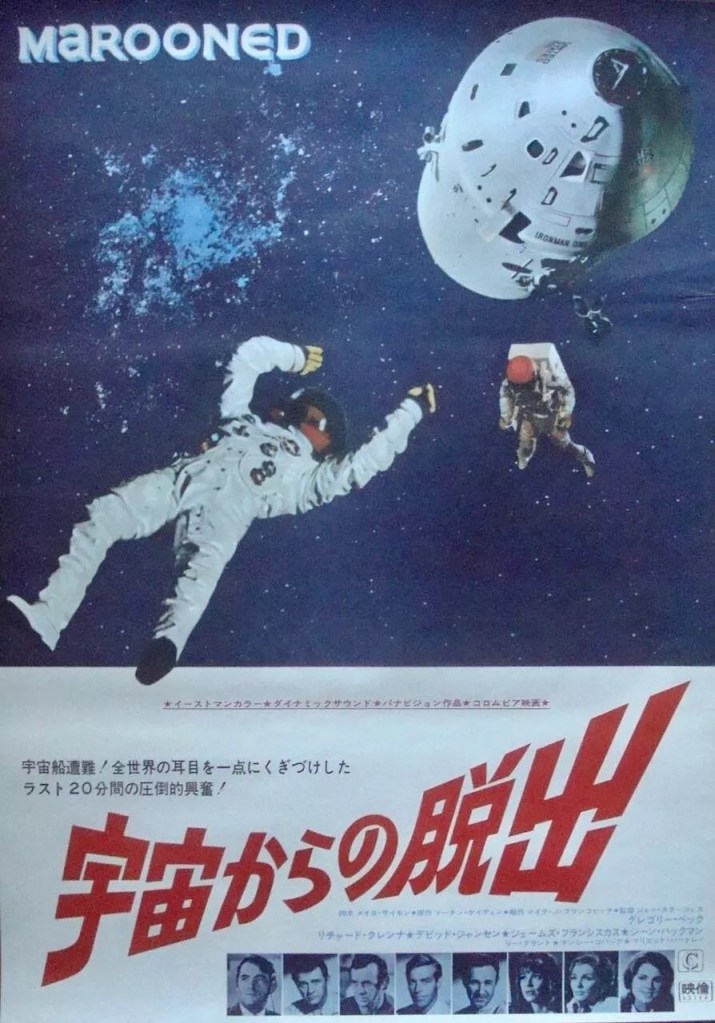
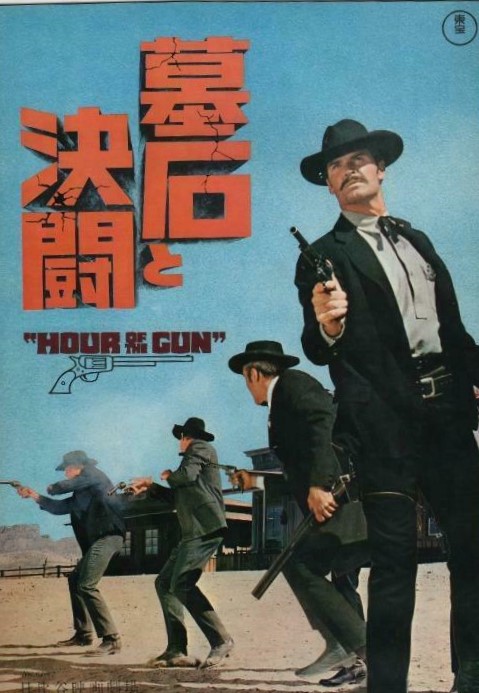
The image for the Japanese poster was taken from the initial shootout at the O.K. Corral that opened the picture.

James Garner came on board in the main because he still owed Mirisch, marking a decade in the business, a picture. He had originally worked for Mirisch in The Children’s Hour (1961). He was hired for “not much,” a straight salary, but credited Mirisch with kick-starting his career after his battle with Warner Brothers. Mirisch had also funded By Love Possessed (1962) in which Sturges had directed Jason Robards, “a brilliant actor though one with problems” (something of an understatement).

There was some surprise in Hollywood when Sturges returned to Mexico after the difficulties – censorship, threats to boycott the film, union issues – he had encountered shooting The Magnificent Seven there. Having vowed “never to make another picture” in that country, “one of the reasons we’re back here is because they’ve eased up on regulations.” Having expected to import most of the cast from Hollywood, the producers were delighted that “six of the ten other featured parts” went to Mexicans, as a result of extensive auditions. Although Lucien Ballard (The Wild Bunch, 1969) remained director of cinematography, a Mexican camera crew was hired with Jorge Stahl in charge.

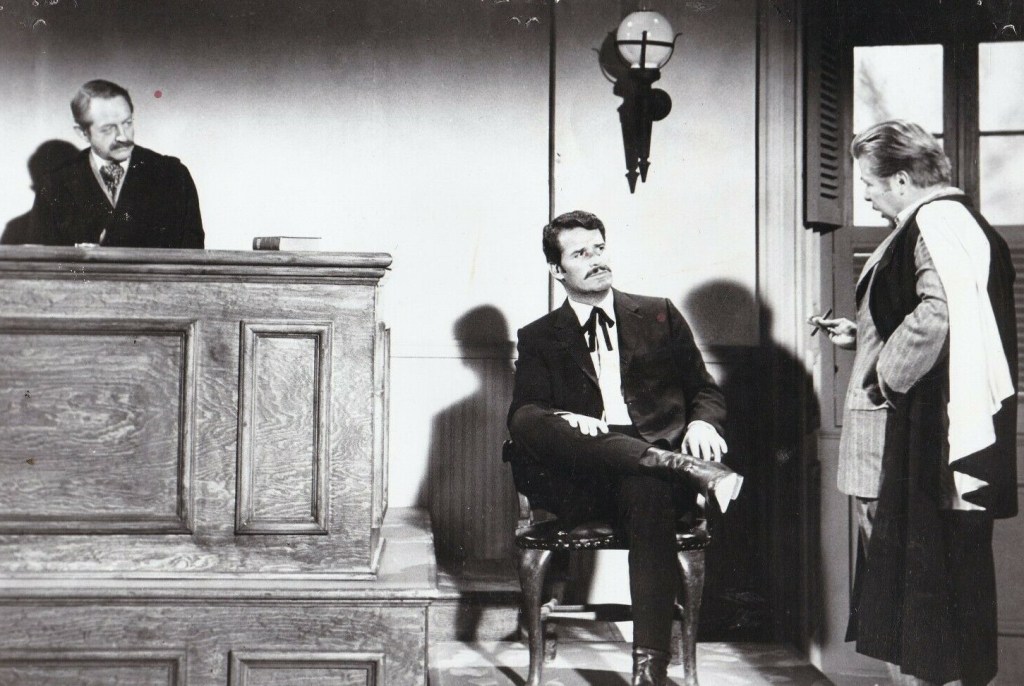
James Garner takes the stand in court defending himself against allegations of murder.

Shooting began on November 9, 1966, at Torreon, “a quiet little agricultural town with a single hotel and bar,” where a fake town had been built at a cost of $100,000. Filming shifted to Churusbusco Studios in Mexico City on December 20 and four weeks later production wrapped after exteriors at a hacienda near San Miguel de Allende for the face-off with Ike Clanton (Robert Ryan in the film).

James Garner (The Great Escape, 1963) was keen to be reunited with Sturges. “I was happy to play the character,” reminisced Garner, “because John always knew what he was doing. He would take five, six, seven factions in a story and bring them together.” Garner saw Earp as “a guy taken with his own power, who nobody could defy.” 

Jason Robards, as Doc Holliday, with a well-known wild side, was difficult to manage. Assistant directors were dispatched every morning to find out where, bar or brothel,  the actor had ended up the night before. Sturges rounded on him when Robards turned up at lunch for a scheduled 8am start. He was perfect after that. Unusually, Sturges would invite the cast to watch the dailies. Producers Mirisch were not happy with the title which was eventually changed to Hour of the Gun.

“My mistake,” rued Sturges, “was that I thought people would be fascinated by the real story about the quarrel between the Earps and the Clantons. You didn’t just shoot people, there were trials, lawyers, citizens’ committees…I got preview cards that said of all the stories told about Earp and Holliday this was the dullest. They (the audience) considered them fictional characters. They couldn’t have cared less that that’s the way it really was.”

As Variety pointed out in its review: “Probing too deeply into the character of folk heroes reveals them to be fallible human beings – which they are of course – but to mass audiences …such exposition is unsettling.”

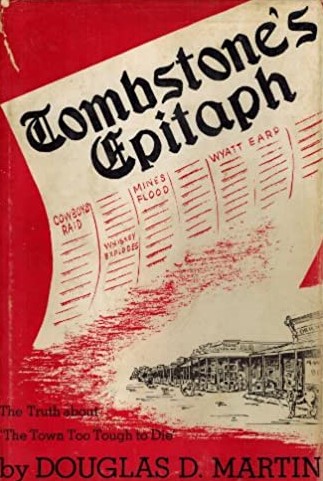
Edward Anhalt’s screenplay was based on this book published in the late 1950s.

There were clearly reservations about the project. Mirisch announced it was “ready for release” at the end of March 1967 but it did not see the light of day for another seven  months. Although the film was budgeted at just over $3 million – $1 million more than In the Heat of the Night (1967), another Mirisch project – and received tremendous support from the industry-wide “Fall Film Fair” promotional campaign (“commended…for excellence in entertainment”) it was a huge flop in the U.S. bringing in a miserable $900,000 in rentals (the amount studios receive once the cinemas have taken their share of the gross). It did better abroad with $1.5 million but the total was nowhere near enough to recoup the costs.

“Also playing a large role in the reaction to the picture was the continued loss of interest by audiences in Western pictures,” said Mirisch. “I was again guilty of thinking that this trend would reverse and that Westerns, led by a hit picture, would return to favour stronger than ever. I was wrong. As a new generation arose, their interest in westers had been satiated, probably by television, and they now embraced the so-called Easy Rider era of movie-making.”

This is another piece of faulty memory. The year after the release of Hour of the Gun   commercial success was enjoyed by Bandolero!, Hang ‘Em High and The Scalphunters to name a few and Will Penny and The Stalking Moon, both revisionist westerns, won critical favour. And, apologies for harping on about it, but, as I showed in my book The Gunslingers of ’69, that year proved a box office bonanza for westerns despite Easy Rider.

SOURCES: Glenn Lovell, Escape Artist (University of Wisconsin Press, 2008) p257-262; Walter Mirisch, I Thought We Were Making Movies, Not History (University of Wisconsin Press, 2008), p259-260; United Artists Archive, Appendix II, University of Wisconsin; “Mirisch, Sturges Revamp Pact for Two More Films,” Box Office, July 25, 1966, W-1; “James Garner Moves from Actor To Future Producer Status,” Variety,  October 5, 1966, 5; “Director John E. Sturges Returns to Mexico for Law and Tombstone,” Box Office, November 7, 1966, pW-2; “Mirisch Schedules Five Major Films,” Box Office, March 13, 1967, p10; “Film Title Changes,” Box Office, April 24, 1967, p18; Advert, Box Office, Aug 28, 1967, p4-5; Review, Variety, October 4, 1967, p16.

Discover WordPress

A daily selection of the best content published on WordPress, collected for you by humans who love to read.

The Atavist Magazine

by Brian Hannan

WordPress.com News

The latest news on WordPress.com and the WordPress community.