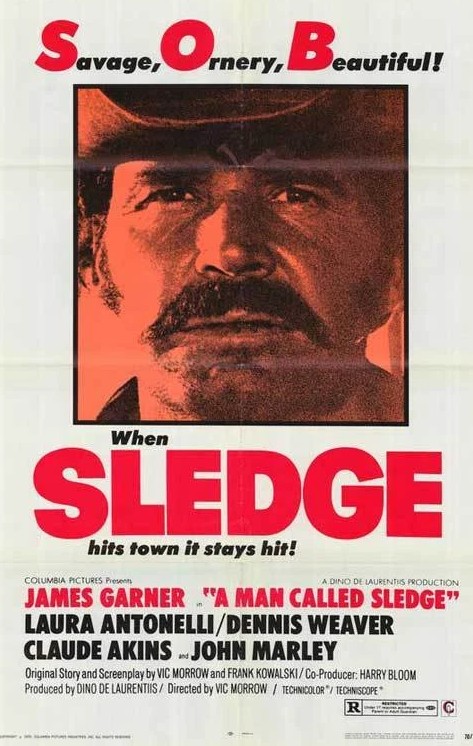
A Man Called Sledge (1970) ***

It’s a risky business for an established star to change their screen persona. The only reason they’ve achieved stardom is because there’s something appealing and even comforting about the persona they’ve adopted. Audiences queue up to see a screen favorite because they know what they’re getting. That still leaves room for chameleons like Dustin Hoffman, whose appeal is the exact opposite, moviegoers don’t know what they’re going to get from one movie to the next.

James Garner (Buddwing, 1966) had a curious screen persona. Sure, he was laid-back and his delivery involved a drawl but his persona, drawn from the scallywag Maverick (1957-1962), also included an element of the sneaky. He wasn’t always as straightforward or heroic (The Americanization of Emily, 1964) as you might expect, but that made him comfortably different.
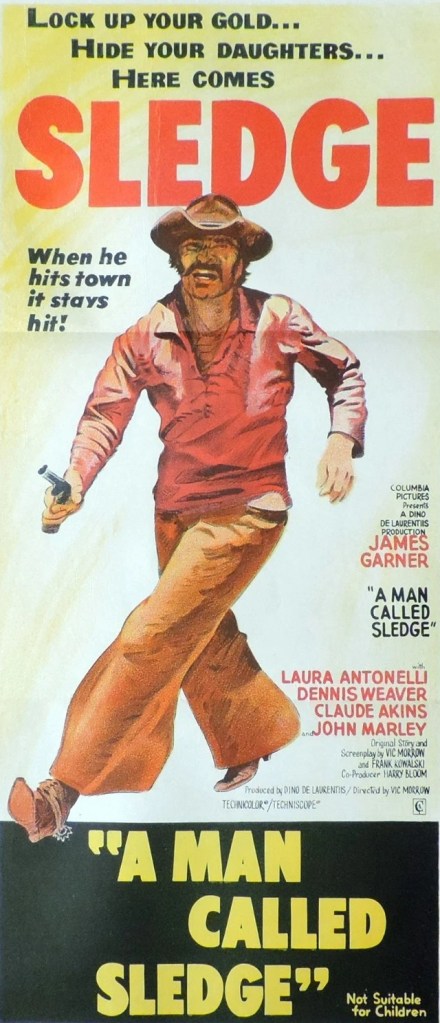
But it’s one thing to make minor changes to your screen persona, it’s another to dump it completely. Even his combed-back hairstyle is gone as well as the rest of his screen persona as he leans into the sneaky part. He’s an outlaw. And not charming like Butch Cassidy and the Sundance Kid (1969) and not hawking around a code of honor like The Wild Bunch (1969) and not a bad guy doing good for whatever reason. His only one redemptive feature is that he’s fallen in love.

On the other hand, if you’re going to play a villain, you better be a smart one, capable of shooting your way out of tricky situations, clever enough to outfox the authorities and able to come up with a plan to steal $300,000 in gold dust from the biggest and most secure safe ever build in the strongest stronghold you could find.

In short order, we are introduced to Luther Sledge (James Garner) robbing a stage, meeting up with girlfriend Ria (Laura Antonelli) and being ambushed in a saloon by gamblers who don’t like losing. Making good his escape, he comes across the Old Man (John Marley) who suggests the unthinkable, stealing the gold. The obvious method would be taking the gold when it’s being transported from the gold mine to the safe.

But it travels with a heck of a guard, more or less a small army, drilled to perfection, armed to the teeth. So, Sledge resorts to the inside job routine. Only problem is the stronghold is actually a prison with 500 prisoners and the safe is inside the maximum security section. Even so, the Old Man, whose done time there, reckons he has listened often enough to the tumblers on the safe being turned that they won’t need to resort to dynamite and the like.
Sledge gets his buddy Erwin Ward (Dennis Weaver) to act as sheriff taking him in as a prisoner, then once inside he plans to free all the prisoners to create a diversion and tie down the guards.

As you might expect this is achieved with a little hitch here and there to ratchet up the tension. But then when we expect an army of guards in hot pursuit and a massive shootout or Sledge to come up with some other clever way of escaping, it turns into The Treasure of the Sierra Madre (1948) and the tension just drains away, hampered by a cute unbelievable ending where Sledge chooses love over gold.

Somehow the third act robs it of what it had going for it, a tough guy devoid of sentimentality, in the vein of the Lee Marvin of Point Blank (1967). You might as well have inserted an old lady or a kid and be done with it as the reason for Sledge to change his ways and, unfortunately, it just kills off interest in the character. Redemption isn’t what we came for. You can get that any day of the week at the movies. But, ruthlessness, that’s a different story and you’d be surprised how well that can play.

Maybe there’s some unseen Hollywood code. If you’re a proper star, you can only be a tough guy if you don’t kill people (i.e. Butch Cassidy though not The Sundance Kid) or if your toughness is in pursuit of bad guys (True Grit, 1969).

There are some other interesting elements. There’s a second ambush, a street shoot-out, a la The Wild Bunch. There’s a banjo-playing deputy sheriff and a keen-eyed Sheriff (Wayde Preston) who can suss out a wrong ‘un. Dead men earn their keep, either on horseback providing cover or lying on the ground where their pistols come in handy. A small town is emptied by people attending a funeral, masked faces and all.  

And there’s a good bit of sense – a Derringer has such a short range that a prison guard with the necessary keys for escape has to be passed cell by cell down a row until he can come within shooting distance for the gun to achieve its threat.

James Garner is indeed excellent in his new disguise, drawl gone, hair flopping all over the place, not a quip in sight. There’s not much room for anyone else though Claude Akins (Return of the Seven, 1966) deserves a nod. Italian Laura Antonelli (The Innocent, 1976) as the hooker in love sparkles though I’m guessing she was dubbed. John Marley (The Godfather, 1972) is a scene-stealing role does his best to steal the movie from Garner.

Actor Victor Morrow directed this, his sophomore effort. He had a hand in the screenplay, too. He parlayed the fame he’s achieved from long-running television series Combat (1962-1967) in attempting to shift him from being cast as the bad guy on the big screen but, unfortunately, he’s best remembered not for this but for his tragic ending, when he died on the set of Twilight Zone: The Movie (1983).

Which is a shame because this is a decent enough effort.

Engaging enough when in heist mode, less so when it disappears down the Sierra Madre rabbit hole.
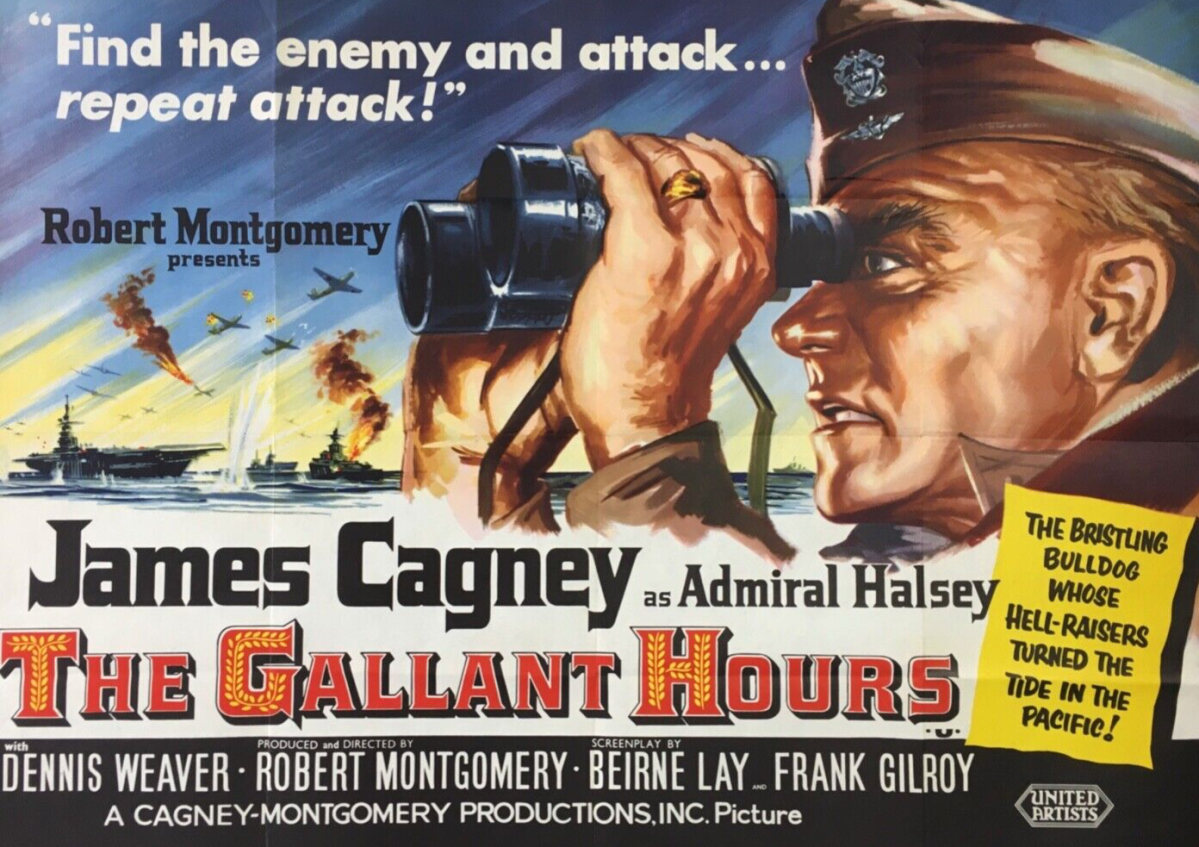
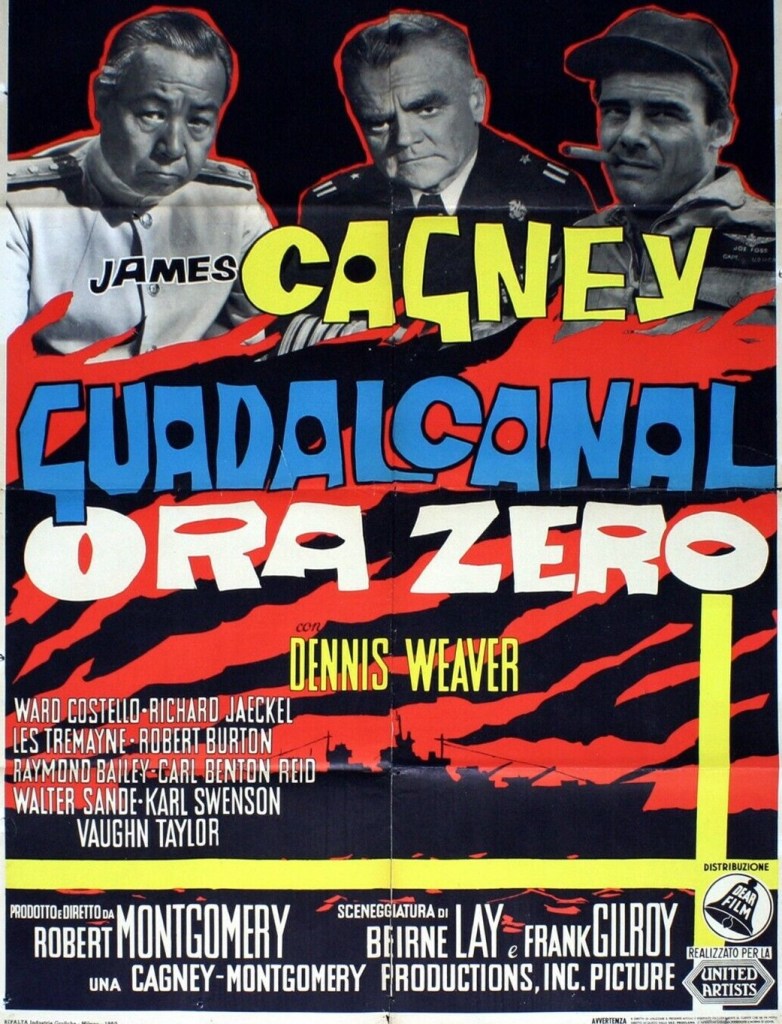
The Gallant Hours (1960) ***

A curiosity. Something of vanity project for star James Cagney (One, Two, Three, 1961) – in his penultimate leading role – who doubled up as producer. But more of a documentary than a war picture. Witness, no scenes of actual World War II combat for a start. And going down the same annoying route as The St Valentine’s Day Massacre (1967) where the voice-over pretty much tells you what everyone had for breakfast and in that vein goes on to tell you whether or not they survived the conflict and maybe became a relatively famous politician thereafter.

Basically recounts the turnaround in U.S. fortunes at the Battle of Guadalcanal in the South Pacific in 1942-1943. The Americans had invaded the island but were coming under increasing pressure from the Japanese. In case you don’t know your Second World War history, this was the first major American land offensive following Pearl Harbor. Though the Americans had thwarted the Japanese at The Battle of the Coral Sea and the Battle of Midway, these were nautical triumphs. Guadalcanal was the first objective in the American island-hopping strategy.

Here, I’m getting all information-overload myself, because all you really need to know is that the Americans parachuted in (actually, he landed by flying boat) Admiral “Bull” Halsey (James Cagney) at a critical moment to revitalize their operation and prevent the expected Japanese attack.  The Japanese were so convinced that victory was imminent that they had drawn up operational details of the surrender ceremony they planned to impose on the vanquished Americans.

The Yanks managed to intercept and decode Japanese radio transmissions and in the only real dramatic moment, after capturing the surrender document, Halsey pins it to a tree so his troops can read it and stiffen their resolve.

But mostly this is a bunch of guys in a bunch of rooms talking about what they were going to do and how difficult, what with lack of support and casualties and low morale, their challenge was going to be. There’s no shortage of detail but every time a scene starts to become dramatically interesting up pops our resident voiceover (director and co-star Robert Montgomery if you want to know) to provide us with some unnecessary detail about some character in the room.

On the debit side, this is pretty irritating. On the plus side, it’s fascinating, a potted history of various personnel without having to resort to the usual sub-plots, often inane in themselves, often of the romantic persuasion, that crop up in an otherwise intriguing war picture so as to provide the audience with people to root for. If you were American, you would recognise some of the characters depicted, some true-life heroes (ace pilots, courageous soldiers) who made their name on the field of battle or contributed to the victory off it.

Of course, if you’re from anywhere else you won’t have a clue who anybody is – and not that much interested either, preferring the old-fashioned approach of sub-plot and romance – but stick with it because, once you realize this is a determinedly novel approach for the genre, it does become pretty interesting especially as Cagney, despite his character being nicknamed “Bull,” dispenses with his usual acting tricks, the strangulated voice and the aggressive demeanor, in favor of a more rounded personality.

Nobody tends to hold up a critical mirror to battles that end in victory, unlike Pearl Harbor, so it’s never going to degenerate into verbal fisticuffs, and much of the pressure the audience might detect comes from the other side, the cocky Japanese, who are presented in a very even-handed manner, despite, or perhaps because, their leader Admiral Yamamoto (James T. Goto), who led the attack on Pearl Harbor, was highly respected by the Americans. This is where maybe Violent City (1970) got the idea of ignoring subtitles, but at least here we can rely on Mr Voiceover to keep us posted on what the Japanese were actual up to.

Cagney holds it all together and you might spot Dennis Weaver (Duel, 1971)  and Richard Jaeckal (The Dirty Dozen, 1967) among the supporting cast. Sixth and final directorial outing for star Robert Montgomery (though he limits his onscreen involvement here to just the narration) who had experimented with voiceover in Lady in the Lake (1945). Whether you fall in with his take on this one, he pretty much delivers what he intended, a semi-documentary account of leaders in battle. Screenplay by Beirne Lay Jr (The Young and the Brave, 1963) and Frank D. Gilroy (The Subject Was Roses, 1968).

Not compelling, but interesting enough.

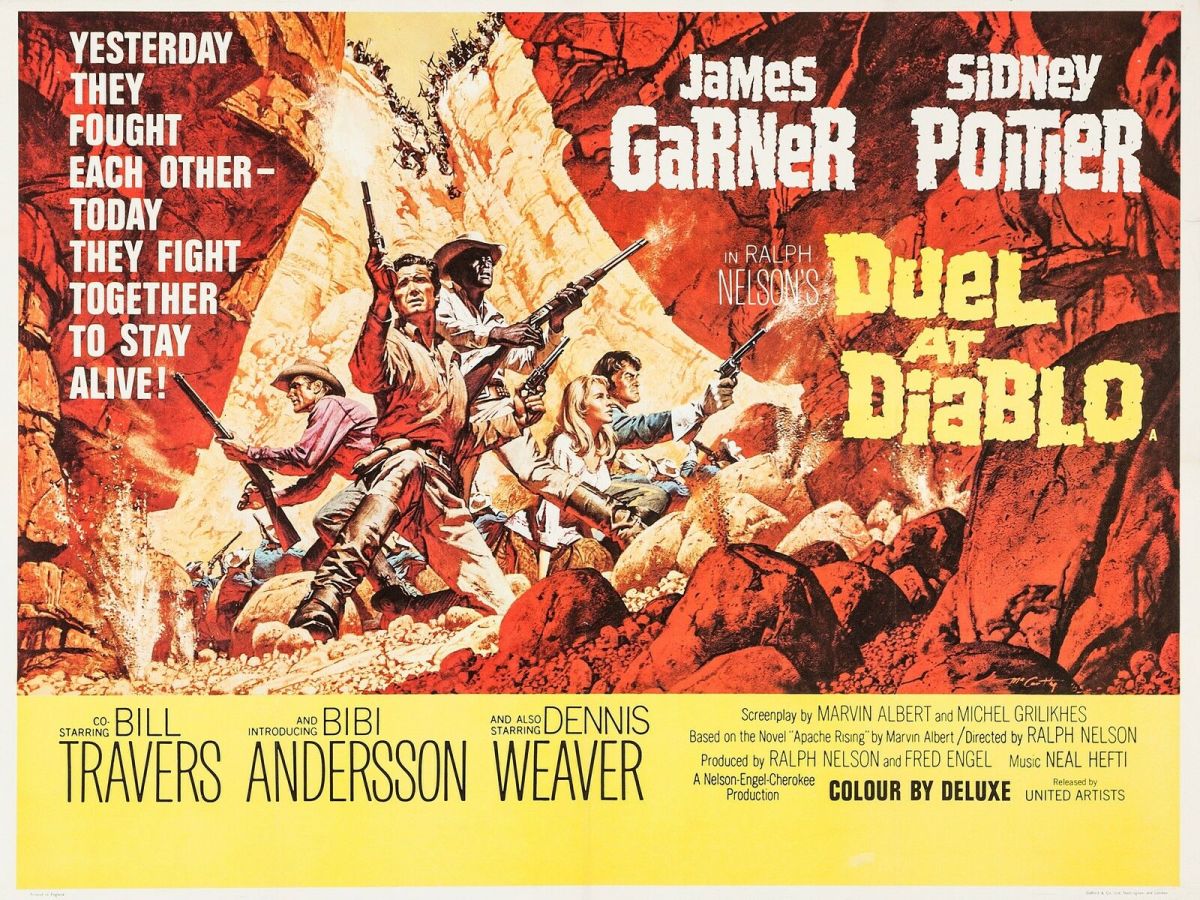
Duel at Diablo (1966) ****

Action-packed and plot-jammed revisionist western with fresh performances from James Garner and Sidney Poitier caught up in an Apache uprising. Tough-as-teak ex-cavalry scout Garner has dispensed with his glib smart-aleck persona in favor of world-weariness and Poitier is a revelation as a cocky cigar-smoking ex-cavalry sergeant horse-dealer. Racism here concerns hostility towards Indian squaw Bibi Andersson (Persona, 1966), Garner, who had married a Commanche (now dead) the only one to treat her with any decency.

Returned to “civilization,” Andersson wants nothing more than to escape, back to her baby it transpires. Her crime is staying alive after Apache capture when she should have done the “decent thing” and killed herself rather than living as a squaw. But prejudice is leavened by husband Dennis Weaver (minus trademark moustache) who retains tender feelings towards her and, eventually, her baby. Apache chief John Hoyt is equally redeemed by his care towards the baby.  

Director Ralph Nelson (Lilies of the Field, 1963) handles the action with aplomb but it is the Apaches who prove the masters of battlefield strategy, deftly maneuvering the cavalry into an ambush and cutting them to shreds. His biggest problem is delivering logical reasons for all the principals – Weaver is an arms dealer, Garner and Poitier no longer in the army – to join up with Bill Travers’ (Born Free, 1966) cavalry troop. However, rather than slowing the story down, the various complications add further tension.  

Nelson never reins in reality. The cavalry are raw recruits, hardly able to control their mounts. Garner and Poitier don’t buddy-up, there is no camaraderie, and Andersson is an outcast in both worlds. And the good guys are constantly out-smarted by the Apaches, Poitier’s mistake leading to initial ambush, the Apaches targeting water supplies to derail the enemy and resorting to bow-and-arrow in case a stray bullet ignites the ammunition wagons. But it is still a duel, Poitier, Garner and Travers each in turn coming up with brilliant ideas to retrieve what looks like a desperate position trapped in a box canyon.     

We might be more sympathetic towards the plight of the Apaches, shoved into a “hell-hole of a reservation,” had Nelson concentrated less on their brutality, the picture opening with the corpse of a mutilated man, the cavalry under siege at Diablo tortured by the screams in the night of a man being tortured, Andersson told that she will be buried alive. But when any Commanche woman can be killed and scalped just because she married a white man and Andersson viewed as fair game for rapists because she lived with Apaches, you can see how little regard the Native Americans have for their oppressors.

Garner and Poitier are superb and top marks for a rounded performance from John Hoyt, savage one minute, gentle the next. Scotsman Travers and Swede Andersson should have added to the authenticity since immigrants such as these provided the mass of settlers, but Travers seems quite out of place and Andersson never quite delivers the angst required of her situation.  William Redfield (One Flew over the Cuckoo’s Nest, 1975) can be spotted. Nelson has a cameo and if you look closely you will see a fleeting glimpse of Richard Farnsworth. Western specialist Marvin H. Albert (The Law and Jake Wade, 1958) co-wrote the screenplay from his novel.

You might be able to catch this for free on Sony Action Movies, but otherwise here’s a DVD link. You might get it on Amazon Prime but last time I posted a link for that, it didn’t work.

Discover WordPress

A daily selection of the best content published on WordPress, collected for you by humans who love to read.

The Atavist Magazine

by Brian Hannan

WordPress.com News

The latest news on WordPress.com and the WordPress community.