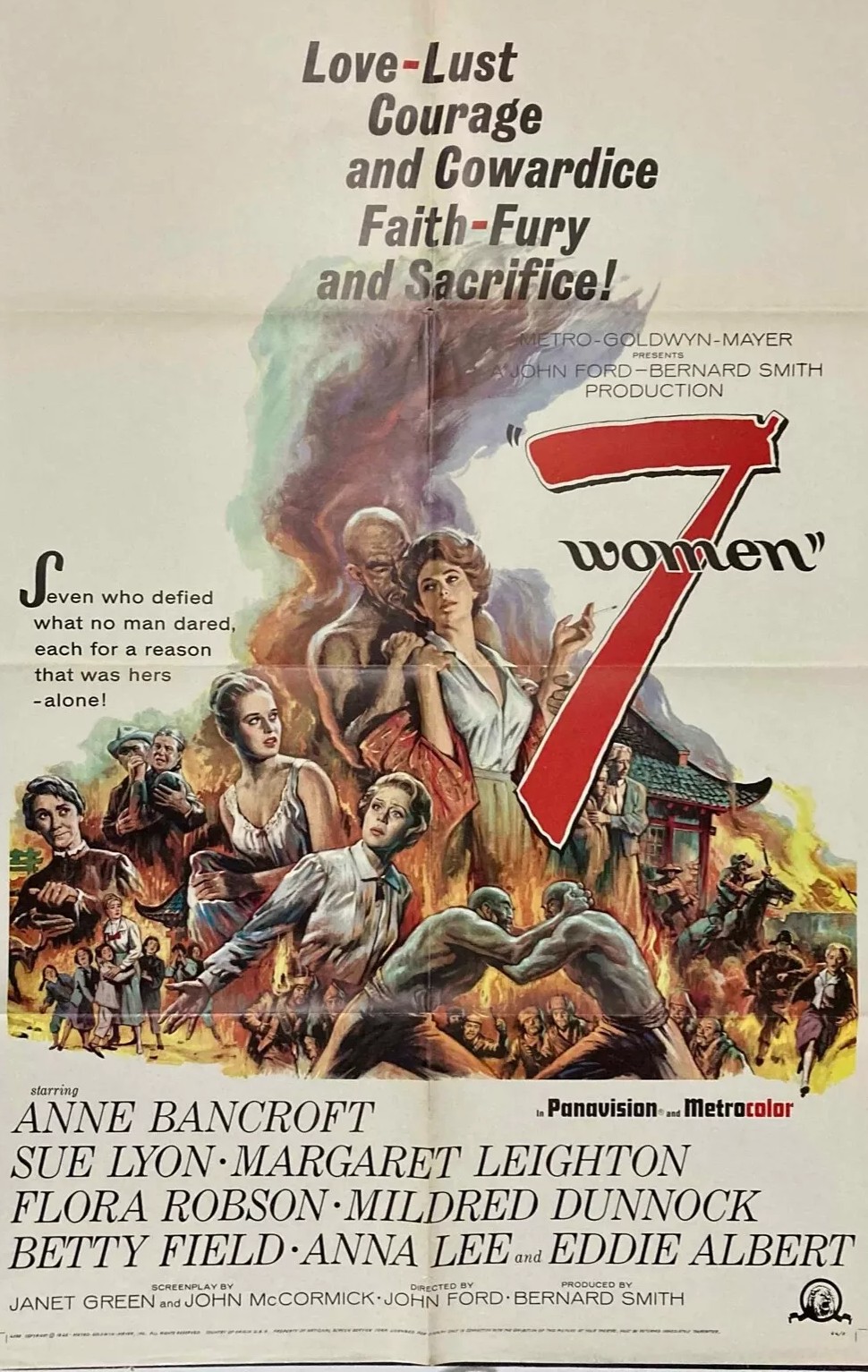
This is a very difficult review to write. John Ford has been one of my idols and to some extent when I first became interested in the movies I was force-fed the director, who was considered at the time to be a demi-god. While he has moved up and down in terms of critical acclaim, his westerns have stood the test of time, The Searchers (1956) still considered one of the best ever made and The Man Who Shot Liberty Valance (1962) fast challenging that dominance.
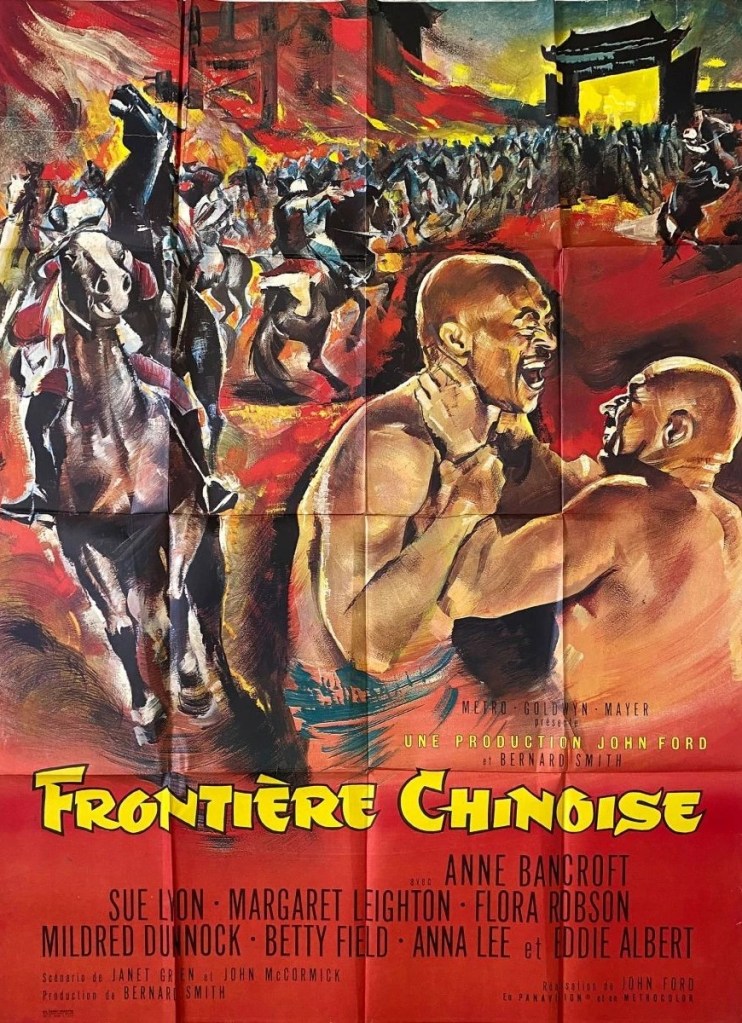
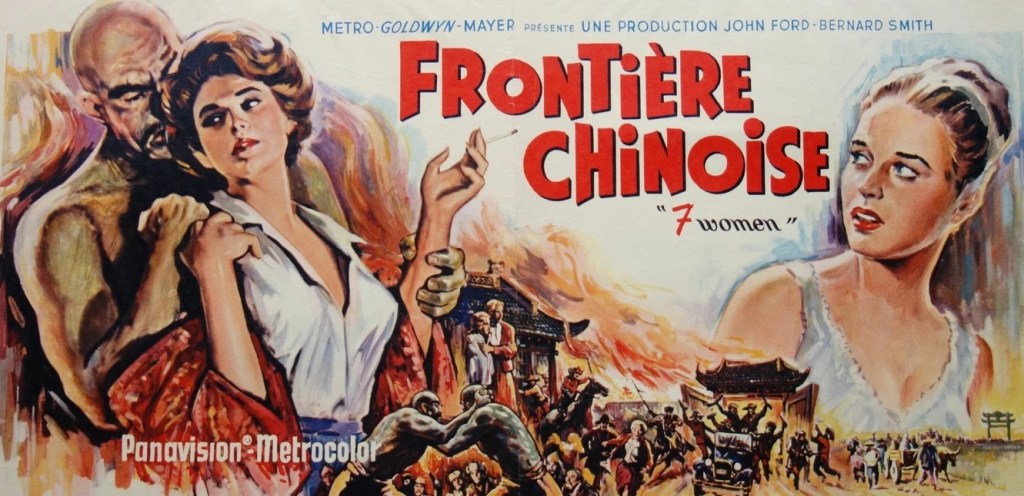
When he made westerns, he tended to be on safe ground. For other genres, acceptance was more fleeting. I can’t be the only one who was appalled by Gideon’s Day (1958) and found The Last Hurrah (1959) somewhat ho-hum and took Donovan’s Reef (1963) with a large pinch of salt. Even so, it’s with some regret that I have come to the conclusion that his final film, 7 Women, falls not just short of the high standards he set but is a poor picture.
You have to wonder if he was still on the redemption streak that fueled Cheyenne Autumn (1964) and wanted to make amends for by and large reducing women to also-rans in his movies. There are some plus-points. It takes a rawer view of the Chinese missionary movie, this one set in 1935, not just the notion that Chinese rebels would not dare attack Americans but also that such establishments major on the pious and the gentle.
But in turn the constant bitching between the virtually all-female cast turns this into a glorified soap opera. There’s a constant battle between incoming heavy drinking free thinker Dr Cartwright (Anne Bancroft) and prim mission chief Agatha Andrews (Margaret Leighton) whose management style errs on the dictatorial. Cartwright is upbraided for smoking at dinner, bringing booze to the table, not standing for Grace, and worse of all, it would appear, having had sex. While there were further penalty points for taking a married man as her lover, it’s the mere notion of anyone having sex that sets off the over-pious Andrews.
Setting a new bar in the entitlement stakes is pregnant Florrie Pether (Betty Field) who’s coming very late to motherhood – she’s 42 – and was so determined to have a baby it was conceived with two months of marriage to ineffectual second husband Charles (Eddie Albert) and takes to the extreme the idea of pregnancy stimulating odd food needs – in the middle of nowhere in the middle of China she demands melon.
Added into the mix is that standard trope of the Chinese missionary picture, an outbreak of cholera. Mrs Pether can’t come to grips with the notion that the good doctor might have to concentrate on saving patients from plague rather than come running every time the pregnant gal feels the foetus kick.
So while Andrews and Cartwright are scoring points off each other, with the doctor further accused of corrupting the innocent young Emma Clark (Sue Lyon), outside pressures, introduced during the credit sequence but then left alone for way too long, grow. Chinese bandits are on the rampage. Another mission of a rival denomination led by Miss Binns (Flora Robson) turns up seeking refuge and eventually the bandits charge into the compound and demand ransom.
Naturally, such an invasion is going to get in the way of imminent birth, and while Andrews falls to pieces at the thought of sex producing an actual “brat”, it’s left to Cartwright to negotiate with the bandits. In return for cooperation, bandit chief Tunga (Mike Mazurki) demands sex with Cartwright. While such sacrifice only triggers further contempt and denunciation from Andrews, it does provide the other women with free passage out.
Cartwright, left behind, poisons the bandit chief and commits suicide.
There’s a heck of a lot of talk, which seems rather alien to Ford, who directs as if he’s fashioning a stage play rather than a movie, characters arranged almost in a series of tableaux. And the lighting and general atmosphere would have you believe you were watching a western rather than something set thousands of miles away.
Anne Bancroft (The Slender Thread, 1965) looks as if she’s strolled in from a western or a film noir with her tough talking stance and cigarette perpetually dangling and all those slugs from a bottle. Margaret Leighton (The Best Man, 1964) overplays the nervous breakdown and Betty Field (Coogan’s Bluff, 1968) is too often in a lather, as if they are in a hysteria competition. Sue Lyon (The Night of the Iguana, 1964) isn’t given enough to do. The other women, since we’re counting, include a more self-aware Flora Robson (Young Cassidy, 1965), Mildred Dunnock (Sweet Bird of Youth, 1962) and Anna Lee (In Like Flint, 1967). Written by the team of Janet Green and John McCormick (Victim, 1961) from the Norah Lofts short story.
Given John Ford went to extremes to place the Native Americans who had so often played the bad guys in his movies in a better light in Cheyenne Autumn, it seems odd he has reverted to instinctive racism here. There’s no suggestion that the bandits might be trying to win their freedom and they are often referred to as degenerate and by that awful epithet regarding their supposed color of “yellow.”
And it’s about time that revisionism was applied to the notion that Christianity had any right to be invading a country that had its own long-established traditions of religion and worship.
Has more of the feel of a Tennessee Williams text gone badly wrong than a John Ford number. Not the swansong the director deserved.
Mirisch could easily lay claim to be the top independent production outfit of the 1960s generating hits like The Magnificent Seven (1960), West Side Story (1961), The Great Escape (1963), The Pink Panther (1964) and its sequel A Shot in the Dark (1964), The Russians Are Coming, Russians Are Coming (1966), In the Heat of the Night (1967) and The Thomas Crown Affair (1968) plus a shelf load of Oscars and Oscar nominations. But dependence on a partnership with Billy Wilder in the 1970s and a more lackluster performance at the box office – with the noted exception of Fiddler on the Roof (1971) – spelled the end of its 17-year relationship with United Artists, which was reeling from financial losses and under new management.
The company found a new partner in Universal which had a series of deals with other major producers like Alfred Hitchcock, Zanuck and Brown (Jaws, 1975) and George Seaton (Airport, 1970). Mirisch was not in any financial trouble, having severed ties with UA after Mr Majestyk (1974), a major success abroad, and recovered its development costs for Wheels, based on the Arthur Hailey novel but the script rejected by UA, from Universal which turned it into a mini-series.
The Universal deal was initially not as good as that enjoyed at UA. Universal charged a twenty-five per cent overhead whereas UA had charged nothing and Universal was now doing direct deals with directors rather than relying on the likes of Mirisch to tie up the talent.
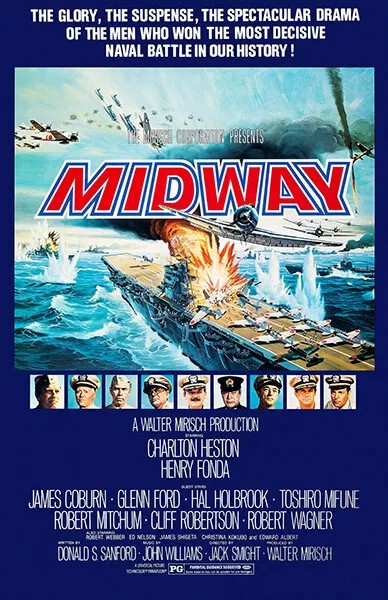
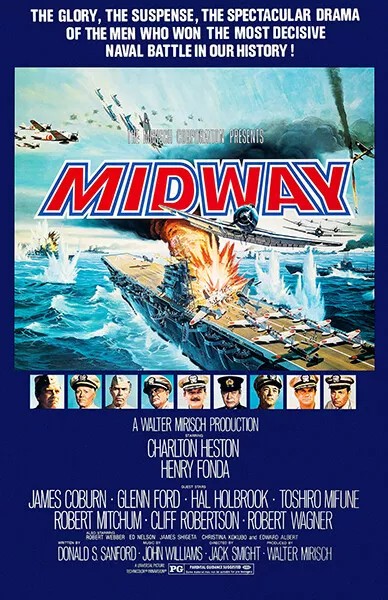
Many years before, Mirisch had commissioned a script on the Battle of Midway from Donald S. Sanford who specialized in war pictures but of the distinctly low-budget variety – Submarine X-1 (1968), The Thousand Plane Raid (1969) and Mosquito Squadron (1969), none of which had enjoyed any success.
Though all of the Mirisch war pictures had concentrated on Europe, Walter Mirisch, generally the creative driving force for the production company, in his previous incarnation with Allied Artists had some experience of the Pacific War, having produced Flat Top / Eagles of the Fleet (1952), set around an aircraft carrier during the Battle of Leyte Gulf, and was an avid reader of books about the Second World War.
John Ford and Louis de Rochmont had made documentaries about the Pacific naval battles. UA rejected the script twice, a shrewd move in the end because Tora! Tora! Tora! (1970) lost a packet for Twentieth Century Fox. The Sanford screenplay had initially taken more of a documentary approach but after gaining the interest of Charlton Heston, who had starred in Mirisch’s The Hawaiians (1970), the script was tweaked.
Programming a war picture was a risk for the studio. There hadn’t been a big-budget war picture in five years. And while Patton (1970) and Kelly’s Heroes (1970) ended up on the right sight of the ledger book, Tora!, Tora! Tora! and Too Late the Hero (1970) were stiffs.
Mirisch signed a two-picture deal with Universal, for Midway and Wild Card with a screenplay by Elmore Leonard (Mr Majestyk). Mirisch proposed to reduce costs by using footage from naval archives, converting the original 16mm film to 35mm. The producer also took footage from Japanese film Storm over the Pacific / I Bombed Pearl Harbor (1960) – the rights cost him $96,000. Footage of the Pearl Harbor attack in Tora! Tora! Tora! doubled for shots of the attack on Midway Island. A clip of the Dolittle raid on Tokyo from Thirty Secondsover Tokyo (1944) was used in the credit sequence after “subjecting it to a sepia bath.”
After the success of Earthquake (1975), Heston was back in the top ranks of box office stars and his involvement guaranteed the green light. The U.S. Navy offered its support, not surprising since Midway was considered its greatest success.
John Guillermin (The Towering Inferno, 1974) was hired to direct and Stirling Silliphant (In the Heat of the Night) signed up for a screenplay rewrite. Mirisch had determined to employ the all-star-cast device that had been an essential ingredient of many of the 1960s roadshow pictures, kicking off with Henry Fonda (The Boston Strangler, 1968), by now pretty much a spent force at the box office – he hadn’t made a picture in three years – but still a well-known name.
The amount of work involved for the other stars was minimal – mostly just one day – and, astutely, Mirisch called on stars who had worked for him in the past and who, like James Coburn (The Great Escape), Cliff Robertson (633 Squadron, 1964) and Christopher George (The Thousand Plane Raid) owed him something in terms of a career leg-up. Others included Robert Mitchum (The Sundowners, 1960), Robert Wagner (The Biggest Bundle of Them All, 1968) and Tom Selleck in an early role. Mitchum was the first of these stars to sign up, in March 1975, six weeks before the scheduled start date of April 27, followed two days later by Coburn.
Toshiro Mifune (Red Sun, 1971) headed up the Japanese cast and proved so meticulous in his preparations that he had his uniform made by Japanese tailors. The white gloves he wore had a finger shortened on the left hand because his character Admiral Yamamoto was missing a pinky. However, despite coaching in English by actress Miko Taka (Walk, Don’t Run, 1966), his dialog was revoiced by Paul Frees.
Guillermin demanded a bigger budget to accommodate more airplanes and equipment and a longer shooting period. Two months before filming was due to start, Mirisch put his foot down and told the director he couldn’t accommodate his requests as Universal had only provided funding on the basis of Mirisch’s original idea. Guillermin walked. As far as the public was concerned, the parting of the ways was due to a “conflict of schedules.” Jack Smight, who had directed Airport ’75 (1974), a box office success and also starring Heston, was his replacement.
The Navy lent aircraft carrier U.S.S. Lexington – the last remaining World War Two carrier – while it was at sea training pilots as long as the shoot didn’t interfere with those exercises. A limited number of World War Two vintage planes – in great condition having been cared for by their owners – were permitted on board. The Navy charged the crew for accommodation – Mirisch was housed in Admiral Strean’s quarters – and meals. “We had a detailed contract with the Navy,” recalled Mirisch, “in which we agreed to stay out of their way when asked.”
On board, the crew filmed scenes, some silent and others with dialog, and “made plates for rearview projection and aerial shots of our vintage planes so positioned that we could print them into flights of six or nine.” Charlton Heston, Glenn Ford (Rage, 1966) and Hal Holbrook (The Group, 1966) were aboard and the shoot went well. A scene involving Henry Fonda was shot at Pensacola. The Florida coast stood in for the Pacific. Additional exteriors were filmed in Los Angeles at Long Beach and Point Dune with interiors at Universal.
The construction of the interiors for the Japanese aircraft carriers was so authentic Mirisch was later asked to reassemble the set for the Smithsonian Institute for a presentation there. The interpolation of the old footage was crucial and it was planned in advance where such shots would appear. The old footage was precut and scenes were shot with actors with “scene missing” in those sequences into which the old footage could be dropped. Other devices were used to ensure the background in the old footage was more lively.
The final element was in cinematic presentation. Sensurround, a precursor of Imax, had been introduced with great success by Universal to Earthquake and this added greater realism to the battle scenes. While limited to those theaters which had installed the expensive equipment, and although the roadshow was long gone, it created an “event” aspect to those viewing it in that system. In his autobiography Mirisch suggested the addition of Sensurround was last minute and sparked by the success of Earthquake. But, in fact, Universal had announced a year in advance of opening that Battle of Midway would utilize Sensurround.
Some cinema owners were outraged at the stock footage, whose proposed inclusion had been kept from them when they went into the blind-bidding process at the start of the year. Mirisch countered that there was no alternative. “A great many aircraft,” he argued, “used in the battle no longer exist.” Universal’s terms were stiff – a minimum nine-week run starting at a 70/30 split for the first three weeks in the studio’s favor, a $75,000 advance guarantee from cinemas and 5% of the gross for use of Sensurround.
With the budget kept as low as a reported $4 million it was a massive hit, picking up $20.3 million in rentals (what the studio retains of the box office gross) – sixth in the annual box office league beaten only by Oscar-winner One Flew over the Cuckoo’s Nest, All the President’s Men with Robert Redford and Dustin Hoffman, demonic The Omen, Walter Matthau baseball comedy The Bad News Bears and Mel Brooks’ Silent Movie and just ahead of such offerings as Sidney Lumet’s Dog Day Afternoon with Al Pacino, and comedy Murder by Death but nearly doubling the take of the more critically-acclaimed Taxi Driver, Clint Eastwood western The Outlaw Josey Wales and thriller Marathon Man also starring Hoffman. The final domestic figure amounted to $21.8 million.
Foreign figures were astonishing, especially in Japan, where its gross exceeded $4 million. The benefits of the promotional tour undertaken by Heston in the Far East were soon obvious – in Manila it beat both Jaws and Earthquake. In the annual box office league there and Hong Kong, it ranked third. In Italy it proved a “big surprise”, coming in fourth behind King Kong, Taxi Driver and a local offering.
While a successful movie could expect to benefit from television viewings – this was before the video revolution – the movie had an unusual afterlife. NBC, which had bought the rights, wanted the film to be longer, so it could be shown over two nights, thus increasing advertising and setting it up as a more prestigious event. Largely by adding plotlines to the Heston character, the running time increased by nearly an hour, which proved a bonus for the future home screening revolution.
“Of all the films that I have made,” noted Mirisch, “it produced the greatest amount of profit.”
SOURCES: Walter Mirisch, I Thought We Were Making Movies Not History (University of Wisconsin Press, 2008) pp324-339; “Readying Midway,” Variety, February 5, 1975, p6; “Universal in New Shake,” Variety, July 23, 1975, p3; “Admiral Mitchum,” Variety, March 12, 1975, p18; ”Jap Feature Footage Inserted into Midway,” Variety, June 6, 1976, p7; “Midway Big in Manila,” Variety, August 11, 1976, p24; “Big Rental Films of 1976,” Variety, January 5, 1977, p14; “Jaws Led Bangkok,” Variety, February 9, 1977, p39; “International,” Variety, June 29, 1977, p35.
Charlton Heston was as hot as they come. He was coming off what would prove one of the biggest pictures of all time – and tucked away an Oscar as well – with Ben-Hur (1959) and followed it up with another hit El Cid (1961). He had no shortage of offers. He had pulled out of The Comancheros (1961), part of proposed three-picture deal with Twentieth Century Fox but with an unknown director rather than veteran Michael Curtiz who later helmed it with John Wayne. He had turned down Let’s Make Love (1960) with Marilyn Monroe and a remake of Beau Geste to co-star Dean Martin and Tony Curtis.
He entered into discussions with Nicholas Ray to film the bestseller The Tribe That Lost Its Head (never made) and The Road of the Snail (never made), rejected William the Conqueror (never made) and Cromwell (1970). He was turned down in turn by Otto Preminger for Advise and Consent (1961). “Zanuck’s man called from Paris,” he notes, “they have a new role for me in The Longest Day (1962).” That was another false lead.
In due course he signed up for Easter Dinner for producer Melville Shavelson (Cast a Giant Shadow, 1966) released as The Pigeon That Took Rome (1962). By this point he was being pursued by Samuel Bronston. “I had no idea how determined Sam was to have me follow El Cid with another film for him.” Bronston eventually got his wish. “No sooner had I turned down The Fall of the Roman Empire (1964) than they shoved it back a year on their schedule and began work on 55 Days at Peking (1963), converting the enormous and half-built set representing Rome into an equally enormous and even more beautiful set representing Peking.”
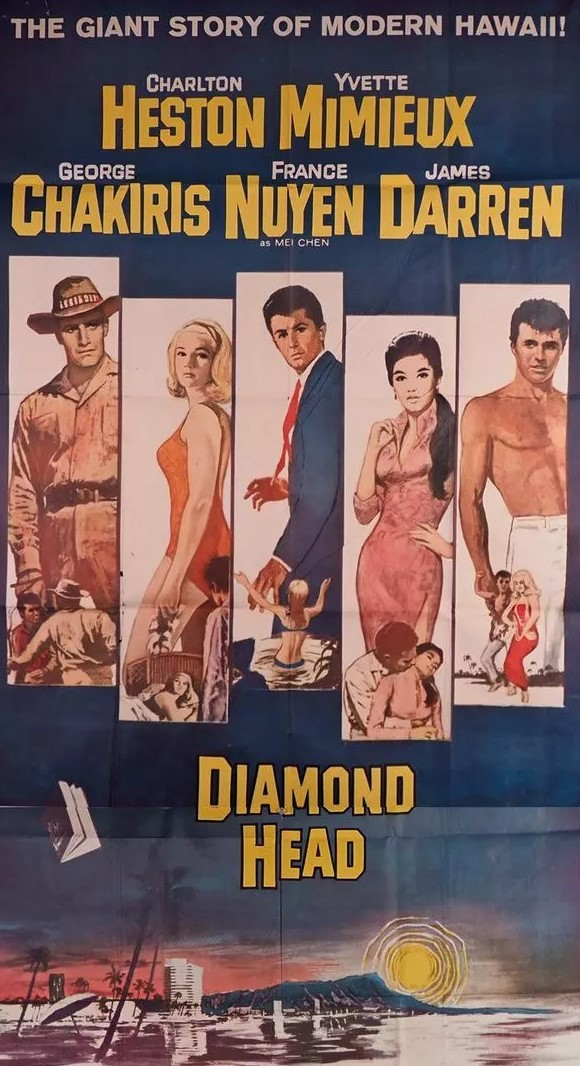
But that meant delay while the massive Bronston machine kicked into gear. In the meatime Heston was “attracted a bit by the opening pages” of Diamond Head with Columbia. “A good part in an overwritten and melodramatic script,” he observed, concluding, “If it’s treated with great care, it might work out all right.”
The project moved along apace. A couple of weeks after receiving the script in December 1961, he was in London meeting director Guy Green (Light in the Piazza, 1962) and producer Jerry Bresler, “an amiable man” though Sam Peckinpah might beg to differ after his experiences on Major Dundee, 1965. “He seems a very intelligent fellow,” Green observed, but queried, “how could a man refer with pride to the fact he had made a film called Gidget Goes Hawaiian?”
George Chakiris (hot after West Side Story, 1961) was already fixed as second male lead and Yvette Mimieux (Light in the Piazza) was being chased for female lead. She wasn’t available but Heston wasn’t keen on second choice Carroll Baker. Luckily, it turned out Mimieux could do the picture. “On the basis of what we saw in Light in the Piazza, she’s ideal for the part.”
But Heston reckoned the script needed work. He was also disgruntled with the costumes for Diamond Head, complaining, “Why is it designers like to costumes instead of clothes? It’s a grievous fault in a period film, but there’s no excuse in a modern story.”
By March, a few months after committing to the picture, he was out in Hawaii, on the island of Kauai, though the trip itself was not without incident, Heston “sick enough to call a doctor.” They were met with unseasonal rain. They were assured this was very unusual. But it wasn’t. In consequence, the first day’s filming was scrapped, filling the actor with the conviction “the whole project was doomed.” It was another three days before filming commenced – the shoot was plagued with rain.
While Heston was impressed enough with the director (“Guy Green works carefully and thoughtfully”) he was distracted by the lighting.
“Those brutes and reflectors loom larger in my mind…One of the banes of my career has been acting in exterior locations with arc lights and reflectors focused in my eyes, which are very light sensitive. (Dark-eyed actors have an unfair advantage, I’ve always felt.) Most people have no idea of the dimensions of this problem. They always ask you how you can remember the lines…they should wonder instead how you can concentrate on the scene when your every nerve is straining simply to keep your eyes open.” Negotiation with the cinematographer ameliorated the situation.
Similarly, Heston found the director responsive to his concerns. For a key scene with Mimieux, he believed “we can both do better” and taking this on board the director agreed on a reshoot the next day. “I have to project Howland’s need to be loved, though he conceals it. You can’t play this, of course, but it has to be in the scene, in the whole film, if we’re going to bring it off.”
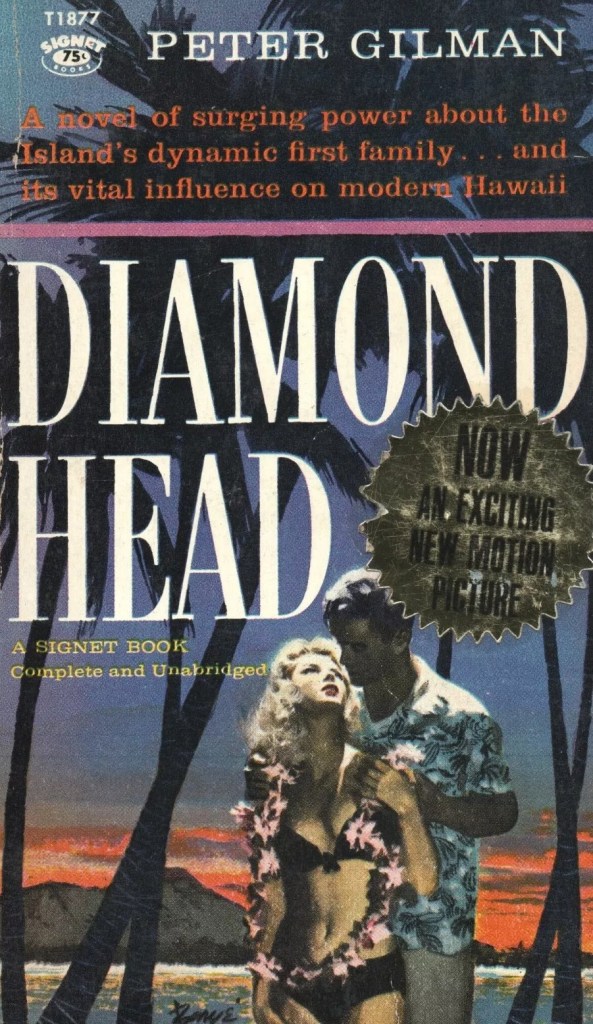
As well as a multitude of media – Hawaii at this stage still a rare location, public interest boosted by the publication of James Michener’s Hawaii in 1958, and to a lesser extent, Diamond Head, a more modest bestseller. Swelling the ranks of visitors to the set was John Ford, obliquely sounding Heston out for an unspecified film, possibly Young Cassidy (1965).
Another issue proved to be the horse-riding. While Heston was an accomplished rider, others were not. “Anxious horse-riding…makes for anxious acting.” Even so, Heston found his mount “harder to handle than I figured.”
Heston’s last day of work was May 18. “I waited round most of the day to do one piddling shot from the dream. No dialog, just my face looming up out of the fog. It’s hard to tell what I think now except that I’m still high on Green. He may have made a film that rises above the melodramatic qualities of the script. He didn’t push me as hard as I should be pushed, but he gave me a lot all the same.”
It was October before Heston viewed the completed picture. His verdict: “Diamond Head looks very slick, smooth, not terribly real, and as though there might be some money in it.” Ever the critic, he added, “I have acted better.”
I’ve mentioned in other Blogs the part played by foreign markets in a star’s appeal – Clint Eastwood and Charles Bronson both owed their breakthroughs to foreign box office. Turns out that Heston was in the same league, though an established name when first discovering the size of his fan club abroad.
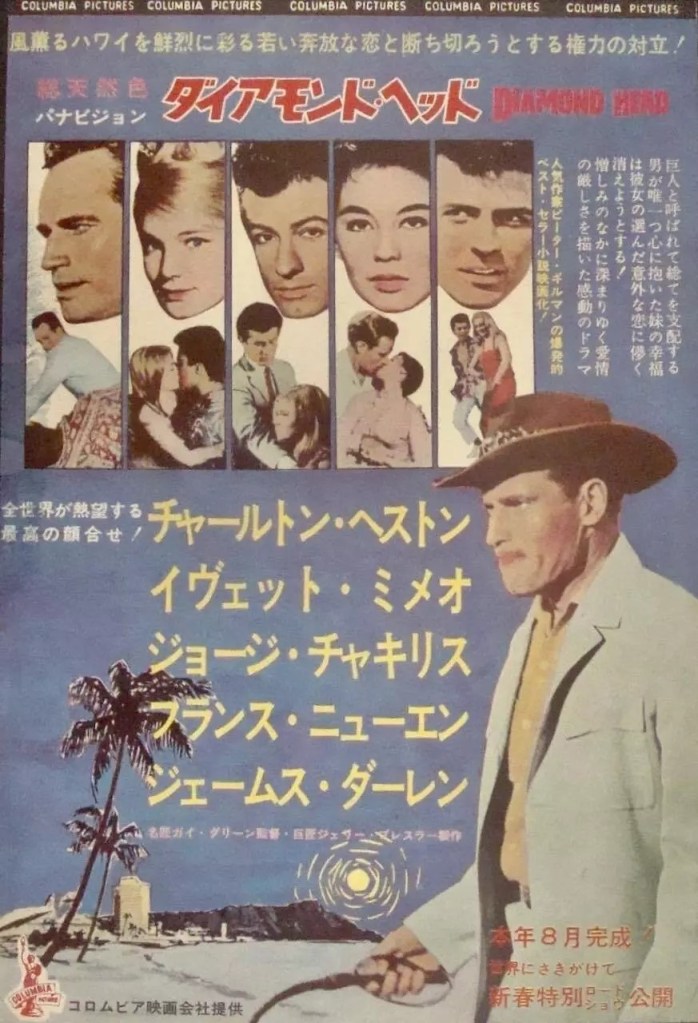
“My films did invariably well in the Far East and throughout Southeast Asia. Films that flopped elsewhere did fairly well, those that were hits elsewhere did incredibly. The fact that this pattern has continued unchanged accounts in no small degree for my continued viability in films.” Apparently, this was because he represented the Confucius virtues of responsibility , justice, courage and moderation. As if to emphasize his overseas appeal, Diamond Head opened first in Japan, in December 1962.
SOURCES: Charlton Heston, The Actor’s Life, Journals 1956-1978 (Penguin, 1980).
A mighty cast headed by John Wayne (True Grit, 1969), James Stewart (Shenandoah, 1965), Lee Marvin (The Dirty Dozen, 1967) and Vera Miles (Pyscho, 1960) with support from Edmond O’Brien (Seven Days in May, 1964) Woody Strode (The Professionals, 1966), Strother Martin (Cool Hand Luke, 1967) and Lee Van Cleef (The Good, the Bad and the Ugly, 1967) do justice to John Ford’s tightly-structured hymn to liberty and equality and reflection on the end of the Wild West. So tight is the picture that despite a love triangle there are no love scenes and no verbal protestations of love.
The thematic depth is astonishing: civilization’s erosion of lawlessness, big business vs. ordinary people and a democracy where “people are the boss.” Throw in a villain with a penchant for whipping and a lack of the standard brawls that often marred the director’s work and you have a western that snaps at the heels of Stagecoach (1939), Fort Apache (1948) and The Searchers (1956).
The story is told in flashback after Senator Ransom Stoddard (James Stewart) and wife Hallie (Vera Miles) turn up unexpectedly in the town of Shinbone for the funeral of a nobody, Tom Donovan (John Wayne), so poor the undertaker has filched his boots and gun belt to pay for the barest of bare coffins. Intrigued by his arrival, newspapermen descend, and Stoddard explains why he has returned.
Now we are in flashback as, arriving on stagecoach, novice lawyer Ransom is attacked, beaten and whipped by outlaw Liberty Valance (Lee Marvin). He is found by horse-trader Donovan (John Wayne) and taken to a local boarding- house-cum-restaurant where Hallie (Vera Miles) tends his wounds. With a young man’s full quotient of principle, Stoddard is astonished to discover that local marshal Link Appleyard (Andy Devine) has ducked out of responsibility for apprehending Valance on the dubious grounds that it is outside his jurisdiction and that Valance has so mean a reputation he has the town scared witless. When Valance turns up, he humiliates Stoddard and only Donovan stands up to him, rescuing an ungrateful Ransom, who detests violence and any threat of it.
Stoddard soon turns principle into action, setting up his shingle in the local newspaper office run by Dutton Peabody (Edmond O’Brien) and on learning that Hallie is illiterate establishing a school for all ages. In the background is politics, but the push for statehood is inhibited by big ranchers who employ Valance to intimidate. Despite his aversion to violence and insistence that due legal process will eliminate the law of the gun, Stoddard practices shooting. When Donovan gives him a lesson and, to point out his unsuitability to confront such a mean character as Valance, covers him in paint, Stoddard floors him with a punch.
That principle I mentioned has something in common with Rio Bravo (1959) – Howard Hawks’ riposte to High Noon (1952) – in that Stoddard, determined to fight his own battles, refuses to ask for help when targeted by Valance. The inevitable showdown is extraordinary, not least because it takes place at night and Ford, a la Rashomon (1951), tells it twice from different points of view.
Precisely because it retains focus throughout with no extraneous scenes, as was occasionally John Ford’s wont, the direction is superb. As in The Searchers, to suggest emotional state-of-mind, the director uses imagery relating to doors. This time the humor is not so broad and limited primarily to one incident. Both main male characters suffer reversals, in the case of Stoddard it is physical but in the instance of Donovan it is emotional. Either way, action is character. In the romantic stakes, they are equals, dancing around their true feelings.
Upfront there is one storyline, the upholding of law and order whether against an individual such as Valance or against the attempts of big business to thwart democracy. But underneath is a subtly told romance. Donovan and Stoddard are allies but in terms of Hallie they are rivals. Neither has an ounce of sense when it comes to women. Neither actually protests their love for Hallie. Although Donovan brings her cactus roses and is, unknown to her, building an extension to his house to accommodate what he hopes is his future bride, his idea of romance is to mutter, in patronizing manner, the old saw of “you look pretty when you’re angry.” He would have been wiser to have taken note of her spunk, because she can more than direct if need be.
Stoddard isn’t much better. Despite her growing feelings towards him being obvious to the audience, he assumes she prefers Donovan. Action drives the love element, the need to save or destroy.
All three principals are superb. This may seem like a typical Wayne performance, a dominant figure, comfortable with a gun and his abilities, but awkward in matters of the heart. But he shows as great depth as in The Searchers and the despair etched on his face at the possibility of losing Hallie eats into his soul. Stewart combines the man-of-the-people he essayed for Frank Capra with some of the toughness he showed in the Anthony Mann series of westerns. Vera Miles tempers genuine anger with tenderness and practicality. Unlike many Ford heroines she is not a trophy wife, but a worker, mostly seen running a kitchen. Lee Marvin cuts a sadistic figure, with an arrogance that sets him above the law, his tongue as sharp as his whip.
As well as Woody Strode, Strother Martin, Edmond O’Brien and Lee Van Cleef, you will spot various members of the John Ford stock company including Andy Devine (Two Rode Together, 1961) as the cowardly gluttonous marshal, John Carradine (Stagecoach), John Qualen (The Searchers) as the restaurant owner and Jeanette Nolan (Two Rode Together) as his wife.
Written by James Warner Bellah (X-15, 1961), Willis Goldbeck (Sergeant Rutledge, 1960) and Dorothy M. Johnson (A Man Called Horse, 1970).
SPOILER ALERT
Despite its five-star status, I am dubious about the famous “print the legend” conclusion and for two reasons. You could subtitle this picture The Good, the Bad and the Politician. In the first place, what Stoddart tells the newspapermen in the flashbacks is in fact a confession. He did not kill Liberty Valance. Donovan did. By this point in his life Stoddart has served two terms as a Senator, three terms as a governor and been the American Ambassador to Britain. And yet his career is based on bare-faced fraud. He took the glory for an action he did not commit. That is a huge scoop in anybody’s book. And I just can’t imagine a newspaperman turning a blind eye to it.
The second element is that Stoddart does not show the slightest sign of remorse. He built his entire career on this violent action, the antithesis of his supposed stance on the process of law. He takes all the plaudits and fails to acknowledge Donovan, except when it’s too late, and Donovan has died a pauper, his rootless life perhaps engendered as a result of losing Hallie. Hallie’s character, too, is besmirched. She chose Stoddart precisely because he was a man of principle who risked his life to tackle – and kill – Donovan. Those two elements are indistinguishable. Had she known Stoddart had failed and was only saved by the action of Donovan it is questionable whether she would have chosen the lawyer.
There are a couple of other quibbles, not so much about the picture itself, but about other quibblers, commonly known as critics. Alfred Hitchcock famously came under fire for the use of back projection, not just in Marnie (1964) but other later films. That spotlight never appeared to be turned on the at-the-time more famous John Ford. The train sequence at the end of the film uses back projection and the ambush at the beginning is so obviously a set.
Don’t let these put you off, however, this is one very fine western indeed.
I’m assuming MGM adjudged that a film about a playwright, no matter how famous, and even if directed by John Ford (Cheyenne Autumn, 1964), would not be enough to attract an audience. And that a better physical match for said writer would have been a weedy actor of a Tom Courtenay disposition. So, I came to this with no idea it was about world-famous Irish playwright Sean O’Casey since his name is never mentioned and the main character is called John Cassidy (Rod Taylor).
Which was just as well because I was wondering what kind of lad Cassidy was when despite his obvious brawn he was an inept labourer, requiring instruction on how to properly use a spade. That this working-class fellow has any inclination towards authorship is not obvious until halfway through the picture, by which time he has demonstrated qualities more appropriate for brawling, revolution and sex.
Technically, this was a John Ford film as he was the producer. The French chose not to point out he was not the director.
It probably says a lot about me that I was unaware of the significance of the title of O’Casey’s most famous play – The Plough and the Stars (1926 and, incidentally, filmed a decade later by Ford). By the time I was cogniscent of the country – early on, I assure you, as my grandfather was an Irish immigrant – the Irish flag was the tricolor made up of green, white and orange. I hadn’t known that the flag created by rebels two years before the Easter Uprising of 1916 was a representation of the plough and the stars, hence public outrage when O’Casey blithely adopted it as the title for his breakthrough play.
But you only need a vague idea of history to appreciate the movie. A couple of stunning scenes provide the background of dissent and poverty. The brutality of soldiers and police in quelling a riot is matched by striking transport workers tossing a scab into the river, his drowning ensured by the wagon that follows him in. Cassidy’s true position in the hierarchy is best shown when he is given a cheque rather than cash from a publisher. Lacking a bank account, not only does he fail to cash the cheque but is treated dismissively by clerks at the bank. His joy at rising above his station in receiving such a payment is immediately destroyed by feeling out of place and unwelcome in a bank.
Because, otherwise, Cassidy is quite the confident young fellow, winning over almost any young woman who falls within his compass, varying from upmarket prostitute Daisy (Julie Christie) to meek bookshop assistant Nora (Maggie Smith) and casual acquaintances.
Writing isn’t presented in the romantic manner of David Lean in Doctor Zhivago out the same year (with Julie Christie in a much bigger role), no stunning imagery and no close-up of soulful eyes, just Cassidy sitting at a table working through the night. But there is no indication as to why he chose plays as his metier, especially when the main theatre in Dublin, the Abbey, was the fiefdom of the middle- and upper-classes.
Ironically, Cassidy is tested more when his situation improves than as a downtrodden worker joining the revolutionary cause. As a worker his fists, brawn, brain and looks see him through. But once he steps up into the intellectual class, he is adrift, his new occupation driving a wedge through relationships.
Not aware that this was a biopic of a playwright, I had little need to question the narrative, and just took each incident as it came. I never had the impression of a condensed biopic, crammed full of cameos. More of an interesting story set against the background of rising Irish nationalism.
There’s a certain amount of “Oirishness” to contend with – the accents vary – the poverty is never as bleak as you might expect, and once the story heads out of Dublin you might think it’s going to go all the way to The Quiet Man country. But then you have to bear in mind that working-class poverty, as long there was employment available, was not quite of the slum kind, and that once you get out of Dublin you do indeed hit beautiful countryside.
Rod Taylor is good as the brawler-turned-playwright. In the duel of the rising stars, Maggie Smith (The Prime of Miss Jean Brodie, 1969) wins by a nose from Julie Christie, but then, though further down the credits, she has the bigger role. Michael Redgrave (Assignment K, 1968) as poet W.B. Yeats (responsible for the phrase “a terrible beauty is born”) makes the most of choice lines, Edith Evans (The Chalk Garden, 1964) is a quirky, mischievous Lady Gregory, co-founder of the Abbey. It’s top-heavy with talent including Sian Philips (Becket, 1964), Flora Robson (55 Days at Peking, 1963), Jack MacGowran (Age of Consent, 1969) and T.P. McKenna (Perfect Friday, 1970).
Turns out John Ford was too ill to direct more than few minutes and that role fell to Jack Cardiff (Dark of the Sun, 1968) and I would have to say he does an agreeable job. John Whiting (The Captain’s Table, 1959) drew from O’Casey’s autobiography to write an intelligent script.
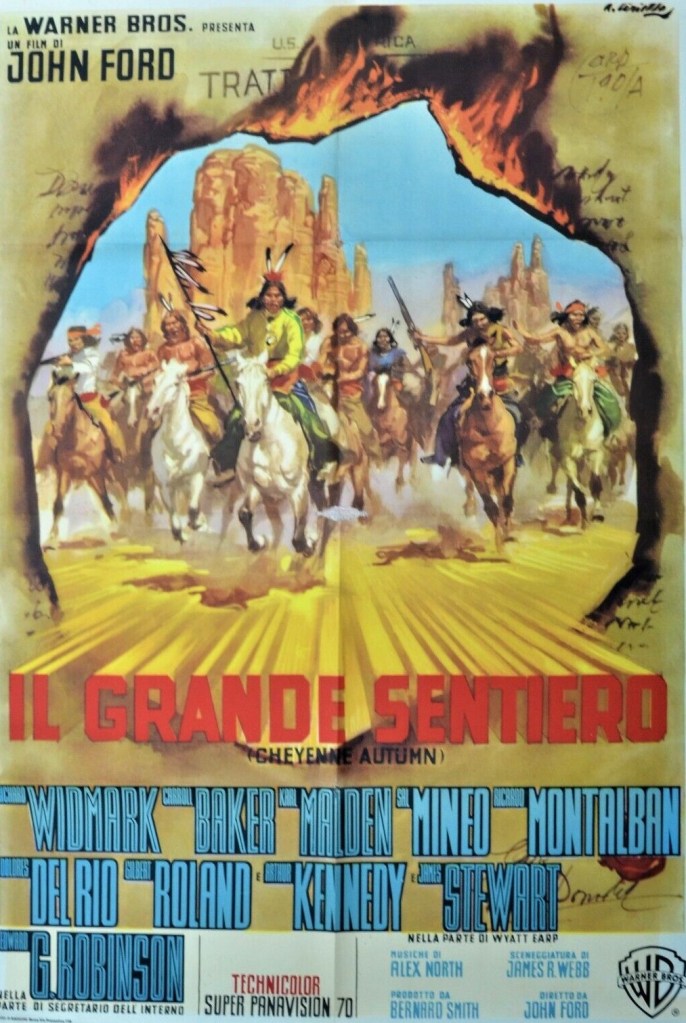
Lack of narrative energy and focus sabotages well-meaning atonement epic. John Ford’s final western, made half a decade before Dee Brown’s seminal Bury My Heart at Wounded Knee was published, is not the epitaph he might have envisioned. For a start, it’s just not rigorous enough. You might accept there’s no mention of the word “genocide” since until Vietnam the United States was hardly capable of mea culpa.
But that we learn very little about the Native Americans trekking 1500 miles from their Oklahoma reservation to their Wyoming homeland beyond that it’s an exhausting trek. Although the Native Americans are treated in a positive manner, and the U.S. Cavalry and Government are seen as inefficient and corrupt, little has been invested in the Native American characters.
The crux of their story is that the two brothers – Dull Knife (Gilbert Roland) and Little Wolf (Ricardo Montalban) leading the journey – eventually go their separate ways, and that a younger headstrong Native American steals one of the brother’s wives. Instead, more attention is paid to a young do-gooding Quaker teacher Deborah Wright (Carroll Baker) who opts to join them on their quest in order to look after the children attending her classes.
Caustic Captain Archer (Richard Widmark), either in person or through voice-over, is the most notable character, fighting his superiors to allow the wanderers unrestricted passage and eventually winning over Secretary of the Interior Carl Schurz (Edward G. Robinson) to ease the last stages of their journey.
The plot diverges from the Exodus-style mission for a totally irrelevant sequence set in Dodge City featuring a gambling Wyatt Earp (James Stewart) and Doc Holliday (Arthur Kennedy) and a spurious bunch of townspeople getting over-excited at the prospect of being attacked. More to the point, when Little Wolf splits from Dull Knife and heads for the sanctuary of Fort Robinson in Nebraska they are imprisoned by authoritative Captain Wessels (Karl Malden), gunning for promotion and in an echo of German apology for the Holocaust “only obeying orders,” with savage consequence.
The couple of action sequences show the fighting skills and tactical ability of the Native Americans but this is undermined by also showing them as sly and cunning, hiding weaponry under campfires and in baby’s clothing.
You might also be asking just how big is Monument Valley for it seems to be the location for about half the picture. Sure, it’s a terrific backdrop and possibly never been better utilized but it’s an example of the creative lethargy not to follow in more authentic manner the actual route of the Cheyenne. Adding to that disgruntlement you might also note the omission of any Native Americans in the leading roles, those parts being taken by Mexicans or dark-skinned Americans.
While John Ford clearly had his heart in the right place, his fans weren’t ready for this kind of revisionist approach – the movie, a 70mm roadshow, was a big flop at the box office – and the result just doesn’t do the subject justice. And in fact a corrective correlative to How the West Was Won (1962) perhaps entitled How the West Was Stolen has yet to be made.
For a long time Bury my Heart at Wounded Knee was considered the landmark historical work depicting the ruthless conquering of the Native Americans but the more recent The Earth Is Weeping by Peter Cozzens, which I read a couple of months back, offers a more authoritative look at the sorry saga, but, without, I hasten to add, a mention of the scary word “genocide.”
I wouldn’t normally be in favor of editing the work of a director as legendary as John Ford but the omission of the Dodge City sequence would have considerably shortened the movie and retained the focus and perhaps improved the picture.
As it stands, a valiant effort. None of the stars is provided with sufficient narrative to make their acting stand out and it feels like they have all stumbled into a documentary.
Never quite considered top drawer John Ford, yet it should rank alongside Stagecoach (1939), The Searchers (1956) and The Man Who Shot Liberty Valance (1962). I’ve been talking recently about a movie completed in a single take (Grenfell, 2023) and the power of a single scene (The Manchurian Candidate, 1962), and now I’m touching upon another piece of cinematic dexterity – the fixed-camera seqeunce.
This is a beauty and it lasts four minutes. Yep, for a four-minute medium-shot scene featuring the two major characters the camera doesn’t move. Lawman Guthrie McCabe (James Stewart) and Cavalry officer Jim Gary (Richard Widmark) take a break from the 40-mile journey back to the fort. You think this is where Gary is going to spring upon McCabe exactly why his presence is so necessary for Army business. But instead, the scene, driven by Gary, is set up to discover why McCabe is so agreeable to taking a temporary leave of absence from an exceptionally comfortable lifestyle back in his small town.
Sure, this scene boasts a bit of business, the waving about of cigars and some pointing and McCabe’s head bobbing around, but otherwise the camera just observes. First of all we discover that McCabe earns $20 a month more than the soldier – that is, when the officer is paid at all, three months since he saw any money – and that McCabe is on the mean side and sarcastic with it. McCabe starts puffing on a long cigar and has to be nudged to offer Gary one. “You can afford matches,” he notes when Gary produces a packet.
McCabe has temporarily upped sticks it transpires because he’s getting unwelcome heat from his hotel owning lover Belle (Annelle Hayes), on the sticky subject of marriage. The subject was brought up with a woman’s “animal cunning” when Belle asked why he was content with just taking 10 per cent of her income when, through entering into a partnership via marriage, he could receive 50 per cent. Gary is taken aback that his old pal is getting a slice off the top. And then somewhat shocked to learn that McCabe takes the same percentage from every business in town. McCabe is surprised to learn this comes as news to Gary. How else could the marshal support his lifestyle.
This mild interrogation is interrupted by a nugget about Belle. She has a stiletto strapped to her leg. That’s not news to Gary. McCabe is perturbed. How did he know. You just told me is the speedy retort. That takes a moment to sink in before McCabe’s suspicions are aroused and then allayed.
In other hands, this scene could have lasted a minute. Some speedy dialog would have got to the point faster. But that’s not the point. You can’t attempt this length of fixed camera scene unless you have two wonderful actors. It might appear indulgent but the director wants us to be sucked in by the affable McCabe.
Not sure where they got the image of the women in red being hanged – must be from another movie.
Because until now it has been all economy. The movie opens with a well-heeled fella dozing on a hotel veranda being woken up by a waiter bringing him beer and a cigar, candle at the ready to light the tobacco. The stage arrives. Two cowboys approach asking where they can get a decent drink. The man pulls back his jacket to reveal his badge. The mention of his name, Guthrie McCabe, is enough to make the pair reconsider staying.
A cavalry troop arrives with Gary at the head. Gary’s uniform is covered in dust, so thick you can hardly beat it off, so thick that unless accompanied by McCabe he would have been forbidden entry to the hotel by the owner. There’s snippy dialog here but it’s all delivered by Belle as she provides a series of sharp observations about men. Uninvited, she joins the pair as they sit down, Gary somewhat vague about his mission. Outside, we encounter McCabe’s dumb deputy, escorting a bunch of prisoners back to the jail because the judge was too drunk to appear in the courtroom – it’s that kind of town. McCabe, seeking re-election shortly for his position, sets them free and buys them a drink. Then we’re off on the 40-mile trip.
Still, we don’t know why McCabe’s presence at the fort is so important. John Ford doesn’t usually fall back on mystery as a narrative device unless it’s some personal secret hidden by a character. So McCabe is astonished to be hailed as a conquering hero, cheered by the people inhabiting an encampment outside the fort. One woman even says she can see his halo. What the…
Inside, it transpires Gary is merely doing his superior’s dirty work. And it’s cynical stuff at that. Major Frazer (John McIntyre) wants rid of the rabble who are giving him grief over their sons and daughters long ago kidnapped by the Commanche. Due to the current treaty, the Cavalry can’t just wade in and collect the kids, grown-up by now some of them. So he needs someone who is on nodding terms with the tribal chief (Henry Brandon) and negotiate their release.
McCabe’s first thought is how much he would be paid, given a cavalry officer’s salary would hardly keep him in cigars, reckoning it would be worth $500 a skull. “Whatever the market can bear,” insists McCabe. Both officers are appalled and even more so when McCabe reckons he’ll screw the money out of the distraught families. And that’s what he does. Affable has suddenly turned callous. The camera in this next scene focuses on Gary’s face, until he can take no more of his old buddy’s blatant greed.
Sucker punch number two. McCabe is as mercenary as the later Man With No Name. but he’s not the only one displaying cynicism. To appease his second wife Henry J. Ringle (Willis Bouchey) will cough up $1,000 if McCabe can bring back any child, not the actual one lost, because the kid was so young when kidnapped that his wife won’t know the difference and he has to get her off his back because it’s interfering with his business.
But there’s more sucker punches to come. McCabe won’t accept Gary’s leadership and won’t even agree to work out their approach together. But when it comes to action, it’s soon pretty clear that McCabe is the tougher character, can anticipate the enemy reaction. And he’s right to be cynical because when Elena (Linda Cristal) is returned to the fold, she is despised, all the fort wives want to know is how many Native American braves she slept with, and why she didn’t commit suicide instead.
There’s a sting in the tale for McCabe when he returns home and finds Belle has taken decisive action in his absence.
McCabe is a superb creation, none of that risking your life for nothing in his game plan, possibly the most realistic character in the Ford oeuvre, who doesn’t care a whit what people think about him, as long as he is paid what he feels is his due. Sure, he puts his life on the line, but you can be guaranteed that’s not much of a gamble, he is so accomplished with the gun and can outwit any foe. As corrupt as he is, he’s a lot more straightforward than the apparently high-principled wives and officers who treat Elena so abominably.
There’s a good bit more to this picture than I’ve described. I’ll pass over the usual punch-up to which Ford appears addicted. Gary’s romance with civilian Marty (Shirley Jones) is well done, she carrying the burden of surviving Indian attack when her younger brother was taken, and she is an accomplished pioneer, in another superb scene Gary congratulates her on pitching her tent out of the wind, far enough for the creek to escape mosquitoes and near a dead tree to get firewood.
And there’s another brilliant scene, revolving around a music box, that could have been a cliché but in another sucker punch takes a different, quite awful, direction.
This is so beautifully written and directed I’m just astonished it wasn’t met with acclaim at the time or since. The typical western has ever been so undercut nor typical action met with such dire consequence, the soft underbelly of life at the fort never so cruelly exposed.
You might think James Stewart was taking a chance in assuming the mantle of the man who killed Liberty Valance in order to advance his political career when in reality he did no such thing. But this character is light years away from that simple theft. His character in that Ford picture was exactly the high-principled guy you had come to expect from Stewart, even if, at the last instant, succumbing to a lie.
In the hands of another director McCabe would have been played by a sleazy Lee Marvin or another actor who could not rise above his bad-guy persona. This must be James Stewart’s finest hour, making an unattractive character appealing, so much so you almost appreciate his point of view in relation to the corruption and his antipathy to matrimony, and taking pains to conceal not the goodness underneath but his understanding of the harsher realities of Western life, at which he is more than adept at dealing.
Richard Widmark (The Secret Ways, 1961) also discards his normal screen persona, his job to act as observer to the Stewart character, to lead audience disapproval, and to be hoodwinked as much as McCabe by the cynical Major while enjoying none of the reward. He is gentler than usual, more resigned to his job, expecting little. Good supporting cast including Oscar-winner Shirley Jones (Bedtime Story, 1964), Linda Cristel (The Alamo, 1960) and especially, in her only movie, Annelle Hayes, as an extremely savvy character who gets the better of her slippery lover.
Brilliant film. And if like me you come to the four-minute scene you might just rewind once or twice to enjoy what Ford, Widmark and Stewart achieve. I was so taken with the entire film, which I’d never seen before, that I watched it again the next night.
These days fact-based magazine articles commonly spark movies – The Fast and the Furious (2001) was inspired by a piece in Vibe, A Beautiful Day in the Neighborhood (2019) started life in Esquire – but it was rare in the 1960s (see Note below).
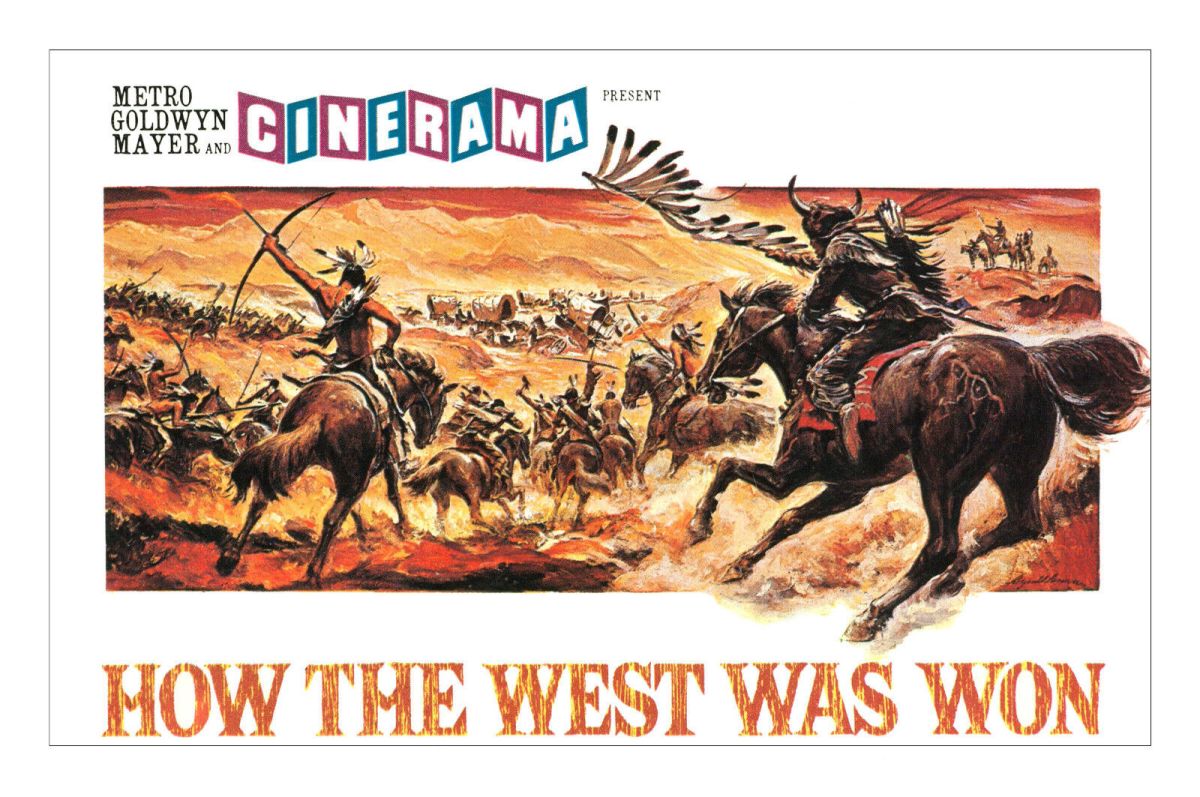
However, a series of seven lengthy historical articles in the multi-million-selling Life magazine in 1959 about the Wild West, extensively illustrated with material from the time, captured the attention of the nation. Bing Crosby acquired the rights, not as a potential movie, but for a double album recorded in July 1959 on a new label Project Records set up specifically for the purpose – two months after the series ended – and a proposed television special.
When the latter proved too expensive, the rights were sold to MGM which then linked up in a four-film pact with Cinerama to create the first dramatic picture in that format, the three-screen concept that had taken the public by storm in 1952 with This Is Cinerama. Since then, Cinerama had focused exclusively on travelogs and coined $115 million in grosses from just 47 theaters, including $9 million in seven years at the Hollywood theater in Los Angeles. Eight years in its sole London location had yielded $9.4 million gross from a quartet of pictures, Cinerama Holiday (1955) leading the way with (including reissue) a 120-week run, followed by 101 weeks of Seven Wonders of the World (1956), 86 for This Is Cinerama and 80 weeks for South Seas Adventure (1958).
Box office was supplemented with rentals of the projection equipment. But the novelty had worn off, lack of product denting consumer and industry interest, many of the theaters set up for the project returning the equipment, so that by the time of this venture there were only 15 U.S. theaters still showing Cinerama. The company went from surviving primarily on equipment royalties to becoming a producer-distributor-exhibitor. Ambitiously, the company believed it could generate $5,000 a week profit for each theater, and, assuming growth to 60 houses, that could bring in $15 million a year.
Crosby initially remained involved – crooning songs to connect various episodes – but that idea was soon abandoned. Director Henry Hathaway (North to Alaska, 1960), claimed he came up with the movie’s structure. “The original concept was mine,” he said, “The first step in the winning of the West was the opening of the canal, then came the covered wagon, next the Civil War which opened up Missouri and the mid-West then the railroads, and finally the West was won when the Law conquered it instead of the outlaw gangs; which was the theme I worked out for the picture.
“So I conceived the whole idea and then got writers to work on the five episodes. Each episode was about a song originally. Then I travelled all over the country to find locations.”
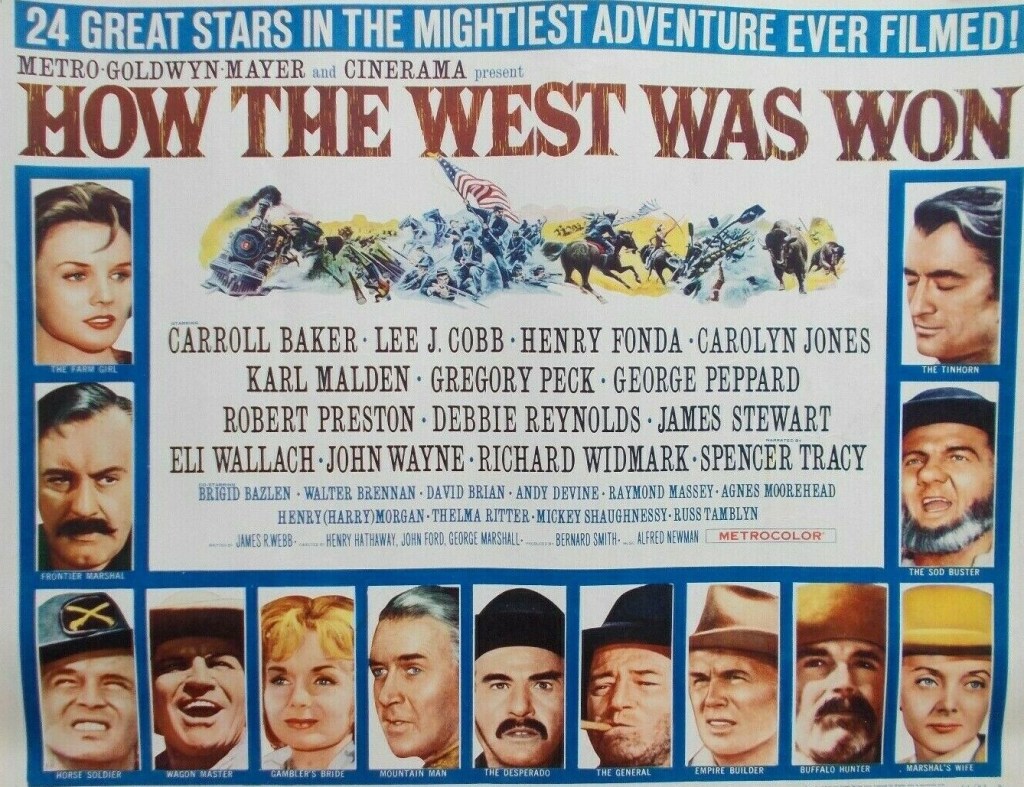
For once this was a genuine all-star cast headed up by actors with more than a passing acquaintance with the western: John Wayne (The Man Who Shot Liberty Valance, 1962), Oscar-winner Gregory Peck (The Big Country, 1958), James Stewart (Winchester ’73, 1950), Richard Widmark (The Alamo, 1960) and Henry Fonda (Fort Apache, 1948) with Spencer Tracy (Broken Lance, 1954) as narrator plus George Peppard (Breakfast at Tiffany’s, 1961) in his first western.
The two strongest female roles were given to actresses playing against type, Carroll Baker (Baby Doll, 1956), who normally essayed sexpots, as a homely pioneer and Debbie Reynolds (The Tender Trap, 1955), more at home in musicals and comedies, as her tough sister. The impressive supporting cast included Lee J. Cobb, Eli Wallach, Walter Brennan, Robert Preston, Carolyn Jones and Karl Malden.
Glenn Ford and Burt Lancaster were unavailable. Frank Sinatra entered initial negotiations but ultimately turned it down. Gary Cooper, also initially considered, died before the film got underway.
Initially under the title of The Winning of the West screenwriter James R. Webb (The Big Country, 1958) was entrusted with knocking the unwieldy non-fiction story into a coherent fictional narrative. In effect, it was an original screenplay at a time when Hollywood was turning its back on bestsellers, “the pre-sold theory less compelling.” His first draft accommodated various montages covering the journey from the Pilgrim Fathers to the building of the Erie Canal and the Civil War and it was only in subsequent drafts that the tale of Linus Rawlings (James Stewart) emerged with surprising focus on female pioneers.
Webb’s initial ending had involved a father-son conflict, presumably a fall-out between the Rawlings played by James Stewart and George Peppard, but that was rejected in order not to finish on a “note of bitterness” out of keeping with the spirit of the movie. Although he did not receive a credit, John Gay (The Happy Thieves, 1961) also contributed to the screenplay.
Given the film’s episodic structure it is amazing how well the various sequences fit together and the narrative thrust maintained. The story covers a 50-year stretch beginning in 1839 with the river sequence bringing together James Stewart and Carroll Baker. After Stewart is bushwhacked by river pirates, he marries Baker and they set up a homestead. The next section pairs singer Debbie Reynolds with gambler Gregory Peck whose wagon train is attacked by Indians on the way to San Francisco. Later, Stewart and son George Peppard enlist in the Civil War (featuring John Wayne as an unkempt General Sherman).
Stewart dies at the Battle of Shiloh. Peppard joins the cavalry and later as a marshal in Arizona meets Reynolds and prevents a robbery that results in a spectacular train wreck. It took a superb piece of screenwriting to pull the elements together, ensure the characters had just cause to meet and to create solid pace with a high drama and action quotient.
The undertaking was too much for one director. Initially, it was expected five would be required but this was truncated to three – John Ford (The Searchers, 1956), Henry Hathaway and George Marshall (The Sheepman, 1958) although Hathaway carried the biggest share of the burden and Richard Thorpe (Ivanhoe, 1952) handled some transitional historical sequences.
The directors broke new ground, technically. The Cinerama camera was actually three cameras in one, each set at a 48 degree to the next and when projected provided a 146-degree angle view. Each panel had its own vanishing point so the camera could, uniquely, see down both sides of a building.
But there were drawbacks. The cumbersome cameras required peculiar skills to achieve common shots. Directors lay on top of the camera to judge what a close-up looked like. Sets were built to take account of the way dimensions appeared through the lens, camera remaining static to prevent distortion. When projected, the picture was twice the size of 65mm and before the invention of the single-camera lens led to vertical lines running down the screen. Trees were built into compositions to hide these lines.
“You couldn’t move the camera much,” recalled Hathaway, “or the picture would distort. You have to shove everything right up to the camera. Actors worked two- and three-feet away from the camera. The opening dolly down the street to the wharf was the first time it had ever been done.
He added, “Over 50 per cent of the stuff on the train was made on the stage (i.e. a studio set) and 60 per cent of the stuff coming down the rapids. I never took a principal up north to the river, the principals never worked off the stage. We never photographed the scenes with transparencies in three cameras with Cinerama – we photographed them with one camera in 70mm and then split the negative.
“I wouldn’t shoot close-ups in Cinerama – I shot the close-ups in 70(mm) and then separated the negative because in Cinerama it distorted their arms. When (George) Stevens shot The Greatest Story Ever Told he used only 70mm and split it all. So from then on they never used the three cameras again. Now they’re actually shooting it in 35(mm).”
Rui Nogueira, “Henry Hathaway Interview,” Focus on Film, No 7, 1971, p19.
After a year spent in pre-production, an eight-month schedule due to start on May 28, 1961, and a completion date of Xmas 1961, MGM anticipated a 1962 launch, Independence Day pencilled in for the world premiere. The original $7 million budget mushroomed to $12 million and then to £14.4 million, $1 million of that ascribed to adverse weather conditions, hardly surprising given the extent of the location work. A total of $2.2 million went on the 10 stars and 13 co-stars, virtually talent on the cheap given the salaries many could command, transport cost $1 million and the same again in props including an 1840 vintage Erie canal boat.
Rain and overcast skies added $145,000 to the cost of shooting the rapids sequence in Oregon and another $218,000 was required when early snowfall scuppered one location and required traveling 1,000 miles distant. Nearly 13,000 extras were involved as well as 875 horses, 1,200 buffalo, 50 oxen and 160 mules. Thousands of period props were dispersed among the 77 sets. Over 2,000 pairs of period shoes and 1500 pairs of moccasins were fashioned as well as 107 wagons, many designed to break on cue.
Virtually 90 per cent of the picture was shot on location to satisfy Cinerama customers accustomed to seeing new vistas and to bring alive the illustrations from the original Life magazine articles. Backdrops included Ohio River Valley, Monument Valley, Cave-in-Rock State Park, Colorado Rockies, Black Hills of Dakota, Custer State Park and Mackenzie River in Oregon.
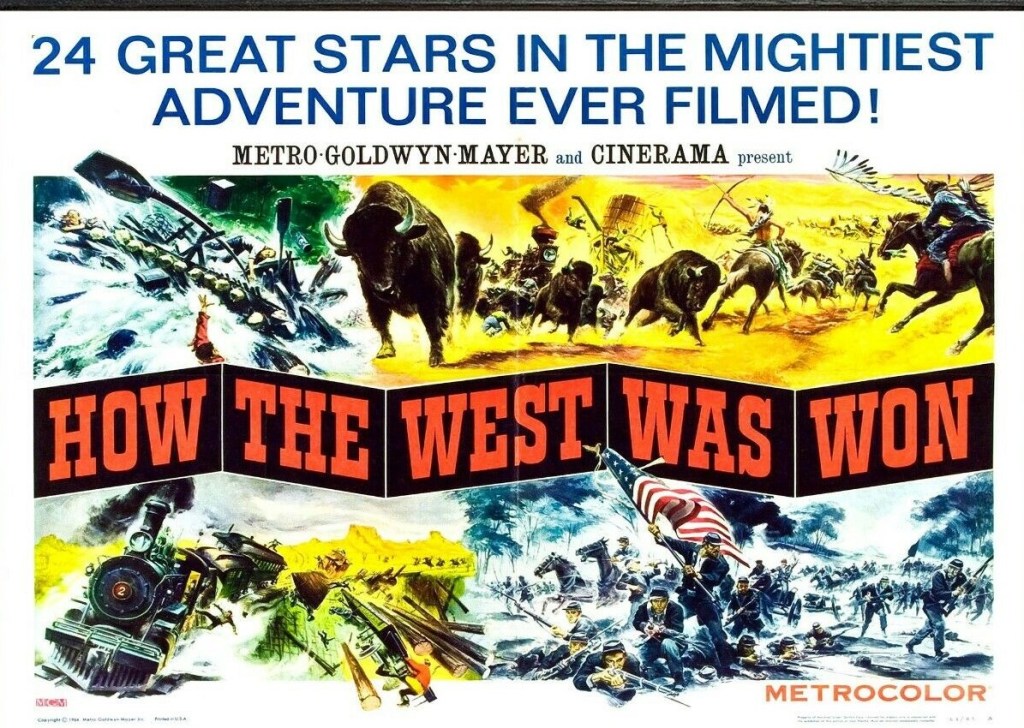
The picture, including narration, took over a year to make. Cinerama sensation was achieved by shooting the rapids, runaway locomotive, buffalo stampede, Indian attack, Civil War battle and cattle drive. Motion was central to Cinerama so journeys were undertaken by raft, wagon, pony express, railroad and boat, anything that could get up a head of steam.
Initially, too, the production team had been adamant – “rigid plans for running time will be met” – that the movie would clock in at 150-155 minutes (final running time was 165 minutes) and there was some doubt, at least initially, on the value of going down the roadshow route in the United States. Roadshow was definitely set for Europe, a 15-minute intermission being included in those prints, for a continent where both roadshow and westerns were more popular than in the States.
Big screen westerns in particular in Europe had not been affected by the advent of the small-screen variety. Some films received substantial boosts abroad. “The Magnificent Seven and Cimarron (both 1960) took giants steps forward once they made the transatlantic crossing.” British distributors also reported “striking” success with The Last Sunset (1961) and One-Eyed Jacks (1962) which had toiled to make a similar impression in the U.S.
In the end the decision was made to hold back the release in the U.S. in favor of another Cinerama project The Wonderful World of the Brothers Grimm, which had begun shooting later and ultimately cost $6 million, double its original budget. Rather than bunch up the release of both pictures, MGM opted to kick off its Cinerama U.S. launch with Grimm in 1962 and shifted How the West Was Won to the following year. MGM adopted the anticipation approach, holding the world premiere in London on November 1, 1962, and unleashing the picture in roadshow in Europe.
A record advance of $500,000 was banked for the London showing at the 1,155-seat Casino Cinerama (prices $1.20-$2.15) on roadshow separate performance release. Before the advertising campaign even began in October, a full month prior to the world premiere, over 62,000 reservations had been made via group bookings. Critics were enamored and audiences riveted. The cinema made “unusually large profits” and after two years had grossed $2.25 million from 1722 showings.
Dmitri Tiomkin (The Alamo, 1960) was hired to compose the music, but an eye condition prevented his participation though he later sued for $2.63 million after claiming he was fired before the assignment began. Alfred Newman (Nevada Smith, 1966) wrote the thundering score but uniquely for the time MGM shared the publishing rights with Bing Crosby. In the U.S. Bantam printed half a million copies of a paperback tie-in, sales of the soundtrack were huge and there was a massive rush to become involved by retailers and museums with educational establishments an easy target.
Audience response was overwhelming, a million customers in the first month, two million by the first 10 weeks at just 36 houses, some of which had only been showing it for half that time. But it failed to hit ambitious targets – predictions that it would regularly run for three years in some situations “based on the star roster and the fact the pic offers more natural U.S. vistas than anything yet done on the screen” proving wildly over-optimistic. Still, it had enjoyed 80 roadshow engagements including eight months at the Cinerama in New York and grossed $2.3 million in 92 weeks in L.A, $1.14 million after 88 weeks in Minneapolis and $1.5 million after one week fewer in Denver.
By 1965, as it began a general release 35mm roll-out with 3,000 bookings already taken, it had already passed the $9 million mark in rentals including a limited number of showcase breaks the previous year.
Nominated for a Best Picture Oscar, it won for screenplay, sound and editing. The movie became MGM’s biggest hit after Gone with the Wind and Ben-Hur. In my recent book The Magnificent ‘60s, The 100 Most Popular Films of a Revolutionary Decade I placed it twelfth on the chart of the decade’s top box office films.
It provided a popularity fillip for most of the big stars involved, none more so than James Stewart who, prior to shooting, had been on the verge of retirement. Box office appeal diminishing, work on his next picture Take Her, She’sMine postponed by the Actor’s Strike, after the death of his father he had “quietly begun to make plans to get out of his Fox contract, retire, and move his family out of Beverly Hills.” He had spent $500,000 on a 1,100-acre ranch and was already well set to quit acting having accumulated a large real estate portfolio in addition to oil well investments.
NOTE: Robert J. Landry (“Magazines a Prime Screen Source,” Variety, May 30, 1962, 11) pointed to Cosmopolitan as the original publication vehicle for To Catch a Thief (1955) by David Dodge in 1951 and Fannie Hurst’s Back Street (1932), serialized over six months from September 1930. Frank Rooney’s The Cyclist’s Raid – later filmed as The Wild One (1953) – first appeared in Harpers magazine. Movies as varied as Edna Ferber’s Ice Palace (1960) and The Executioners by John D. MacDonald, later filmed as Cape Fear (1962), were initially published in Ladies Home Journal. The Saturday EveningPost published Alan Le May’s The Avenging Texan, renamed The Searchers (1956), and Donald Hamilton’s Ambush at Blanco Canyon, renamed The Big Country (1958) as well as Christopher Landon’s Escape in the Desert which was picturized under the more imaginative Ice Cold in Alex (1958).
SOURCES: Brian Hannan, The Magnificent ‘60s, The 100 Most Popular Films of a Revolutionary Decade (McFarland, 2022) p168-170; Marc Eliot, James Stewart A Biography (Aurum Press, paperback, 2007) p350-351; Rui Nogueira, “Henry Hathaway Interview,” Focus on Film, No 7, 1971, p19; Sir Christopher Frayling, How the West Was Won, Cinema Retro, Vol 8, Issue 22, p25-29; Greg Kimble, “How the West Was Won – in Cinerama,” in70mm.com, October 1983; “Reisini Envisions Cinerama Leaving Travelog for Fiction Pix,” Variety, December 14, 1960, p17; “Metro in 4-Film Deal with Cinerama,” Variety, March 1, 1961, p22; “Cinerama Action Awaits Plot Tales,” Variety, March 8, 1961, p10; “Fat Bankroll for How West Was Won,” Variety, May 24, 1961, p3; “Return to Original Scripts,” Variety, June 28, 1961, p5;“MGM-Cinerama Set 3-Hour Limit For West Was Won,” Variety, August 23, 1961, p7; “Hoss Operas in O’Seas Gallop,” Variety, August 23, 1961, p7; “Coin Potential As To Cinerama,” Variety, September 20, 1961, p15; “Changing Economics on Cinerama,” Variety, October 11, 1961, p13; “Bantam’s 22 Paperback Tie-Ups in Hollywood,” Variety, October 25, 1961, p22; “How West Was Won for July 4 Premiere,” Box Office, December 11, 1961, p14; “Crosby Enterprises Holds West Cinerama Songs,” Variety, January 24, 1962, p1; “Grimm First in U.S. for Cinerama but Abroad West Gets Priority,” Variety, April 4, 1962, p13; “Cinerama Fiscalities,” Variety, April 11, 1962, p3; “Cinerama Story Pair Burst Budgets,” Variety, May 16, 1962, p3; “Tiomkin’s $2,630,000 Suit Vs MGM et al,” Variety, June 27, 1962, p39; “Hathaway a Pioneer,” Variety, July 25, 1962, p12; “Bernard Smith Clarifies Fiscal Facts,” Variety, August 8, 1962, p3; Review, Variety, November 7, 1962, p6; “London Critics Rave Over West,” Variety, November 7, 1962, p19; “Brilliant World Premiere in London for West,” Box Office, November 12, 1962, p12; “West in Cinerama the Big Ace,” Variety, November 14, 1962, p16; Feature Reviews, Box Office, November 26, 1962; Bosley Crowther, “Western Cliches; How West Was Won Opens in New York,” New York Times, March 28, 1963; “Big Book Aid for West,” Box Office, April 1, 1963, pA3; “West Was Won Seen By 2,000,000 in 10 Weeks,” Box Office, June 3, 1963, p15; “How West Was Won for 19 Showcase Theaters,” Box Office, June 15, 1964, pE1; “West End,” Variety, November 11, 1964, p27; “How West Was Won Ends Roadshowing,” December 9, 1964, p16; “3,000 Bookings Expected for How the West Was Won,” Box Office, May 3, 1965.
I’ve got Alfred Newman’s toe-tapping theme music in my head. In fact, every time I think of this music I get an earworm full of it. Not that I’m complaining. The score – almost a greatest hits of spiritual and traditional songs – is one of the best things about it. But then you’re struggling to find anything that isn’t good about it. But, for some reason, this western never seems to be given its due among the very best westerns.
Not only is it a rip-roaring picture featuring the all-star cast to end all-star casts it’s a very satisfying drama to boot and it follows an arc that goes from enterprise to consequence, pretty much the definition of all exploration.
Given it covers virtually a half-century – from 1839 to 1889 – and could easily have been a sprawling mess dotted by cameos, it is astonishingly clever in knowing when to drop characters and when to take them up again, and there’s very little of the maudlin. For every pioneer there’s a predator or hustler whether river pirates, gamblers or outlaws and even a country as big as the United States can’t get any peace with itself, the Civil War coming plumb in the middle of the narrative.
Some enterprising character has built the Erie Canal, making it much easier for families to head west by river. Mountain man fur trader Linus Rawlings (James Stewart) on meeting prospective pioneers the Prescotts has a hankering after the young Eve (Carroll Baker) but as a self-confessed sinner and valuing his freedom has no intention of settling down. But he is bushwhacked by river pirates headed by Jeb Hawkins (Walter Brennan) and left for dead, but after saving the Prescotts from the gang changes his mind about settling down and sets up a homesteading with Eve.
We have already been introduced to Eve’s sister Lilith (Debbie Reynolds) who has attracted the attention of huckster Cleve Van Valen (Gregory Peck) and they meet again in St Louis where she is a music hall turn and widow. Her physical attraction pales in comparison with the fact she has inherited a gold mine. He follows her, unwelcome, in a wagon train which survives attack by Cheyenne, but still she resists him, not falling for him until a third meeting on a riverboat.
Zeb Rawlings (George Peppard) wants to follow his father to fight in the Civil War. Linus dies there, but there’s no great drama about it, he’s just another casualty, and the death is in the passing. In probably the only section that feels squeezed in, following the Battle of Shiloh a disillusioned Zeb saves General Sherman (John Wayne) and Ulysses S. Grant (Harry Morgan) from an assassin.
Returning home to find Eve dead, Zeb hands over his share of the farm to his brother and heads west to join the U.S. Cavalry at a time when the Army is required to keep the peace with Native Americans enraged by railroad expansion. Zeb links up with buffalo hunter Jethro Stuart (Henry Fonda), who appeared at the beginning as a friend of his father.
Eve, a widow again, meets up in Arizona with family man and lawman Zeb who uncovers a plot by outlaw Charlie Gant (Eli Wallach) to hijack a train. Zeb turns rancher once again, looking after her farm.
But the drama is peppered throughout by the kind of vivid action required of the Cinerama format, all such sections filmed from the audience point-of-view. So the Prescotts are caught in thundering rapids, there’s a wagon train attack and buffalo stampede, and a speeding train heading to spectacular wreck. There’s plenty other conflict and not so many winsome moments.
Interestingly, in the first half it’s the women who drive the narrative, Eve taming Linus, Lilith constantly fending off Cleve. And there’s no shortage of exposing the weaknesses and greed of the explorers, the railroad barons and buffalo hunters and outlaws, and few of the characters are aloof from some version of that greed, whether it be to own land or a gold mine or even in an incipient version of the rampaging buffalo hunters to pick off enough to make a healthy living.
And here’s the kicker. Virtually all the all-star cast play against type. John Wayne (Circus World, 1964) reveals tremendous insecurity, Gregory Peck (Mirage, 1965) is an unscrupulous though charming renegade, the otherwise sassy Debbie Reynolds (My Six Loves, 1963) is as dumb as they come to fall for him, and for all the glimpses of the aw-shucks persona James Stewart (Shenandoah, 1965) plays a much meaner hard-drinking hard-whoring version of his mean cowboy. Carroll Baker (Station Six Sahara, 1963) is an innocent not her usual temptress while George Peppard (The Blue Max, 1966) who usually depends on charm gets no opportunity to use it. .
Also worth mentioning: Henry Fonda (Madigan, 1968), Lee J. Cobb (Coogan’s Bluff, 1968), Carolyn Jones (Morticia in The Addams Family, 1964-1966), Eli Wallach (The Moon-Spinners, 1964), Richard Widmark (Madigan), Karl Malden (Nevada Smith, 1966) and Robert Preston (The Music Man, 1962).
Though John Ford (The Man Who Shot Liberty Valance, 1962) had a hand in directing the picture, it was a small one (the short Civil War episode), and virtually all the credit belongs to Henry Hathaway (Circus World) who helmed three of the five sections with George Marshall (The Sheepman, 1958) taking up the slack for the railroad section.
And though you might balk at the idea of trying to cover such a lengthy period, there’s no doubting the skill of screenwriter James R. Webb (Alfred the Great, 1969) to mesh together so many strands, bring so many characters alive and write such good dialog. Bear in mind this was based on a series of non-fiction articles in Life magazine, not a novel, so events not characters had been to the forefront. Webb populated this with interesting people and built an excellent structure.
I’m still tapping my toe as I write this and I was tapping my toe big-style to be able to see this courtesy of the Bradford Widescreen Weekend on the giant Cinerama screen with an old print where the vertical lines occasionally showed up. Superlatives are superfluous.
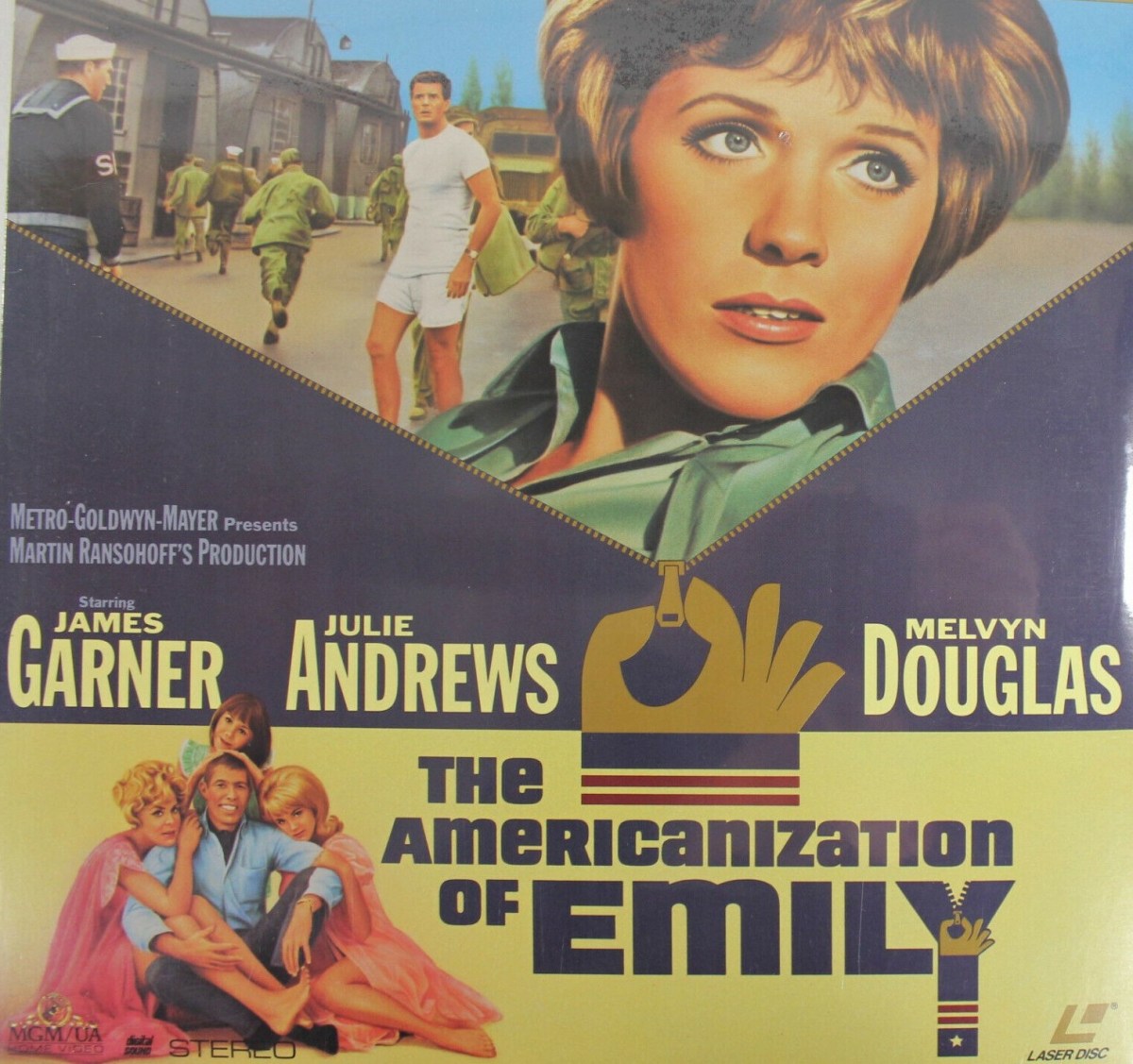
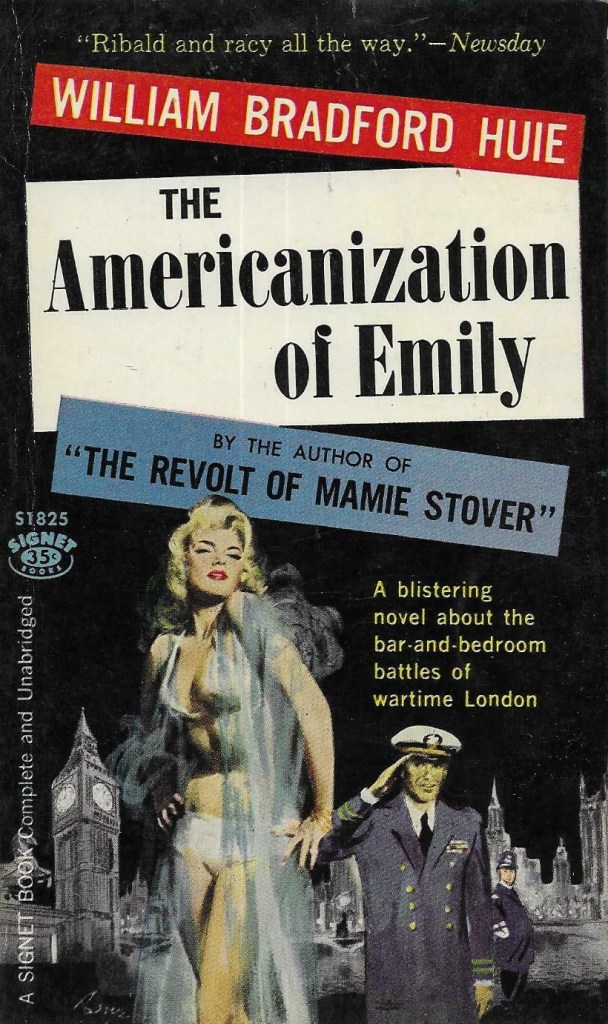
Author William Bradford Huie’s cry of outrage could be heard from one side of Hollywood to the other.
Not that anyone would commiserate. A bestselling writer dealt with the movie industry at his or her peril. If you succumbed to the lure of Hollywood gold you might as well kiss goodbye to any expectation they were actually going to film the book you had written.
In this case, screenwriter Paddy Chayefsky stuck to the plainest of knitting, the romance between oversexed Yank Lt Col Edison (James Garner) and English rose Emily (Julie Andrews). He kept in the “dog-robbing,”* Edison stashing away crates of steaks, whisky, nylons, chocolates, whatever will keep the admiral happy and at the same time smooth the path for whatever officer or politician he was trying to schmooze.
But Huie’s tale went down a different route that Chayefsky chose to ignore. Yes, D-Day played a part, forming the climax, and the author did intend to score a political point. In Huie’s version, Edison’s role in D-Day was merely to film some of the proceedings. Keen to highlight the risk to the common soldier, the hero was prone to film the sordid aspect of war, focusing as much on death and injury as heroism. He even opened with a prologue, a dedication to the three men who died in the making of the film.
But his film never saw the light of day. Or at least not his director’s cut. He was forced to eliminate all scenes of dead Americans. Dead Germans were okay, just not dead Americans. Especially irksome was a sequence showing bulldozers covering American corpses with sand. He only won one battle with his superiors, refusing to stick in the cliché of a chaplain praying over sailors before they embarked on the D-Day vessels, but only because there was no chaplain present and he refused to shoot such a scene.
Of course, since he didn’t die in Huie’s book, there was no reason to come back from the dead. In fact, post D-Day, he and Emily spend a good chunk of time together before he is despatched elsewhere on another task with the admiral and there is a happy ending, fourteen months later, a reunion as Emily turns up where he is now stationed.
So where did all the cowardice malarkey come from? The mind of Paddy Chayefsky is the simple answer. In the book, the hero, as much as the next man, does not want to die in the war, but his fears are the normal ones, he doesn’t go out of his way to avoid action, profess his cowardice and stand up for the rights of cowards everywhere. So the book isn’t larded with long speeches about the horrors of war.
What attracted a producer like Ransohoff to the picture was the film the hero wanted to make. Not one that glorified war. A film that refused to see heroism as a great and noble thing was, of course, the same as sticking up two fingers to all those who could only justify war if it provided the opportunity for heroism as a sop to the wives and children the dead left behind. It was a strong point to make. And, prior to filming, there was plenty Edison had to say on the subject. While the admiral saw the landing as a great success because the casualties were much lower than expected, Edison felt for every man killed.
There’s no need in the book for the admiral to be a loony because it would be quite plausible to film for documentary or PR purposes action on World War Two beaches – what were John Ford and other famous directors doing if not that? Lt Cummings (James Coburn) who comes up with the dastardly idea of killing off Edison does not come up with such a dastardly idea in the book. In fact, in the original novel he’s a relatively minor character. And the much-vaunted nudity, revolving in the main around Cummings, is not particularly obvious in the novel, though Huie is perfectly blunt about the role of the bulk of the women. The novel opens with the classic line: “Twelve Englishwomen, known as Sloane’s Sluts, served America during the Second World War.”
However, the said Sloane is eliminated from the film, in order to provide the immoral Edison with something of a moral tinge. In the movie, with so many women easily available, he doesn’t indulge beyond a bit of bottom slapping. But in the book, he has sex with said Sloane while romancing Emily and again at the end while separated from her.
The Chayefsky version is peppered with dialogue about war that is primarily, even though Edison’s life is at stake, in the aesthetic vein. Huie, on the other hand, provides a salutary commentary on the war, filling the reader in on aspects rarely covered, the kind of unfamiliar material that would later be the bedrock of the airport bestseller like, well, Arthur Hailey’s Airport.
* “A dog-robber is a personal attendant of a general or an admiral. To ensure his superior has the best food and lodging, a dog-robber is willing to rob not only troops, widows and orphans but even the goddam dog.” So runs Huie’s description, a little note at the bottom of a page just in case the reader did not quite work out to what depths this ultra-scrounger would go to satisfy his boss.





 The Magnificent 60s