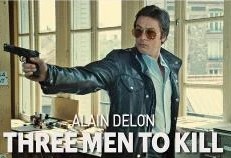
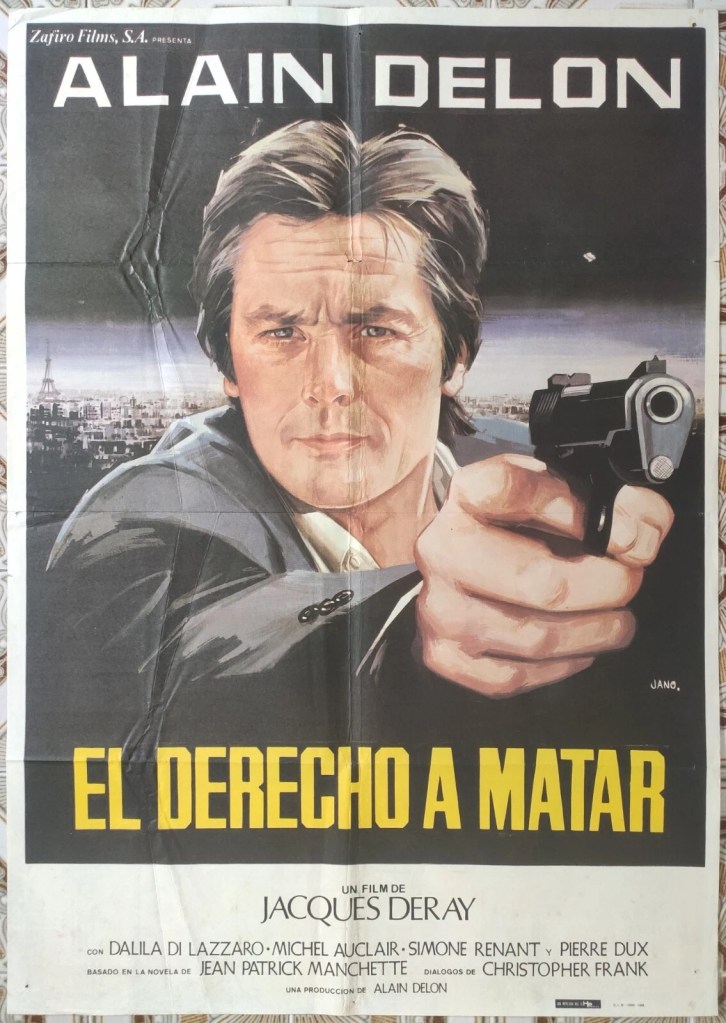
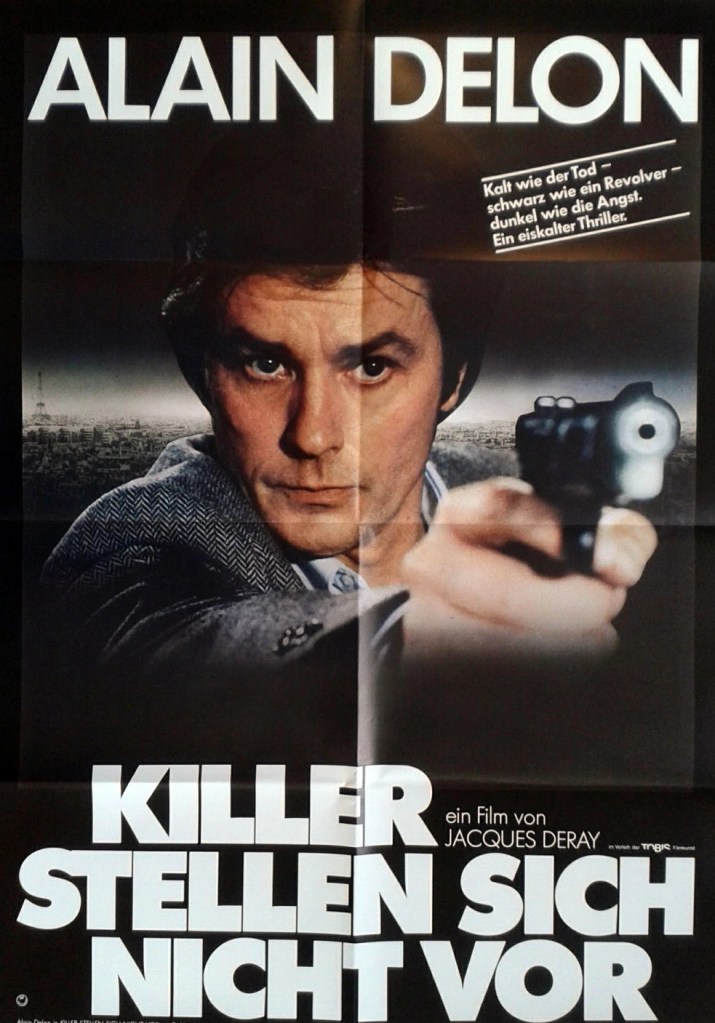
Three Men To Kill! (1980) ****

Every now and then British streamer Talking Pictures TV comes up with an absolute cracker. I’d never heard of this film and don’t think it gained either a British or American release at the time and there doesn’t appear to have been anything in the way of VHS/DVD activity except a belated 2021 DVD.

Alain Delon was that rare beast, flitting between the commercial world and the arthouse with commendable ease. Luchino Visconti had hired him twice for Rocco and His Brothers (1960) and The Leopard (1963) and with his amoral screen persona he was a shoo-in for the best of French noir – Purple Noon (1960), Le Samourai (1967), The Swimming Pool (1967) and The Sicilian Clan (1969). He dipped in and out of Hollywood – Once a Thief (1965), Red Sun (1971), Scorpio (1973) and even top-billed in The Concorde…Airport ’79 (1979).

Unusually, he was in charge of his career, picking up the producer credit on 40 of his pictures, including this one, a late fit into the paranoia/conspiracy cycle as epitomized by Three Days of the Condor (1975), The Conversation (1974) and The Parallax View (1975). Though those films drew the line at car chases, bullets into the eye delivered through a keyhole and drowning people in the sea.

Unlike that trio Michel Gerfault (Alain Delon) is not involved in the espionage, surveillance or investigative business, though, if you have poor opinion of professional gamblers given such activity always seems to take place in smoke-filled rooms, you might consider his profession somewhat on the shady side, especially when he later appears conversant with guns.
Outwardly, there’s nothing amoral here. Michel is taking model girlfriend Bea (Dalila Di Lazzaro), a bouncy character putting you in mind of Goldie Hawn, to see his mother in the seaside town of Trouville, a significant move in those days if marriage was on the horizon.

Unfortunately, Michel has turned Good Samaritan, transporting a car crash victim to hospital, unaware the man, who soon dies, is one of three characters, potential whistle-blowers, on the hit list of arms dealer Emmerich (Pierre Dux). On the assumption that Michel might have been told something incriminating, killers are put on his tail.

The thugs don’t care how they kill him, happy to drown him in full view of holidaymakers splashing around in the sea. When they fail to lure him into a trap, he turns the tables, and it’s full-on pedal-to-the-metal car chases through the streets of Paris and wreckage in abandon.

After a slow start to throw you off the scent, director Jacques Deray (The Swimming Pool) doesn’t waste much time catching up and isn’t going to lose available minutes from a lean running time by sticking in such clichés as kidnapping the girlfriend.

Just how well versed Michel is in the ways of the underworld is shown in how he tracks down Mr Big who tries to pay him off and offer him a job. If Emmerich knew what we knew about Michel he wouldn’t have bothered doing anything, just called off his dogs. All Michel wants is the quiet life of a successful poker player and is not the kind of fellow to go around alerting the authorities to high-level skulduggery.

It’s a surprise ending. Except it turns out not to be the ending and this film has more in common with the conspiracy sub-genre than we imagined. Michel is out strolling in the streets soon after when he is assassinated. Sorry to be such a spoiler but these films depend for their impact on a downbeat ending.

Delon was often compared to Steve McQueen for the rare mixture of toughness and genuine charm and that’s very much to the fore here. It makes a change for him to be neither amoral nor a criminal, but his previous outings in this genre lend the supposition that he might be either. I was unfamiliar with Dallila Di Larrazza but that only meant I hadn’t been paying much attention to Flesh for Frankenstein (1973) where she played the female of the monster species. Here’s, she’s refreshing, neither femme fatale nor weighted down by trauma.

Terrific.
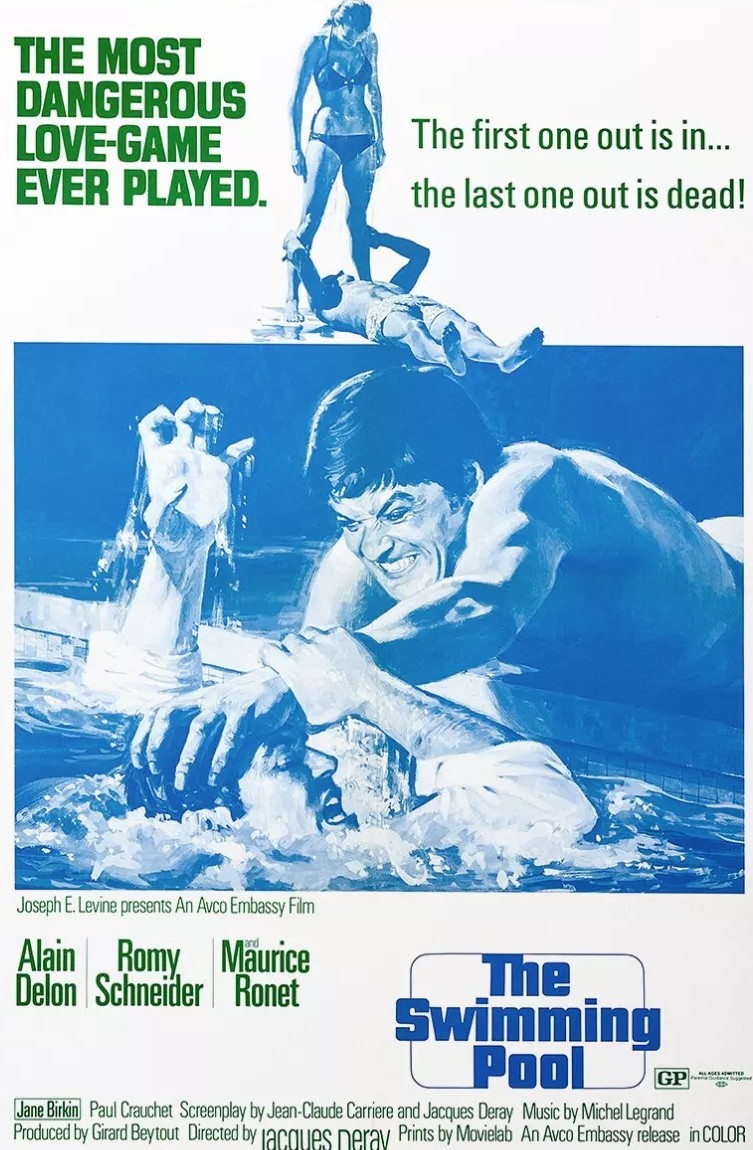
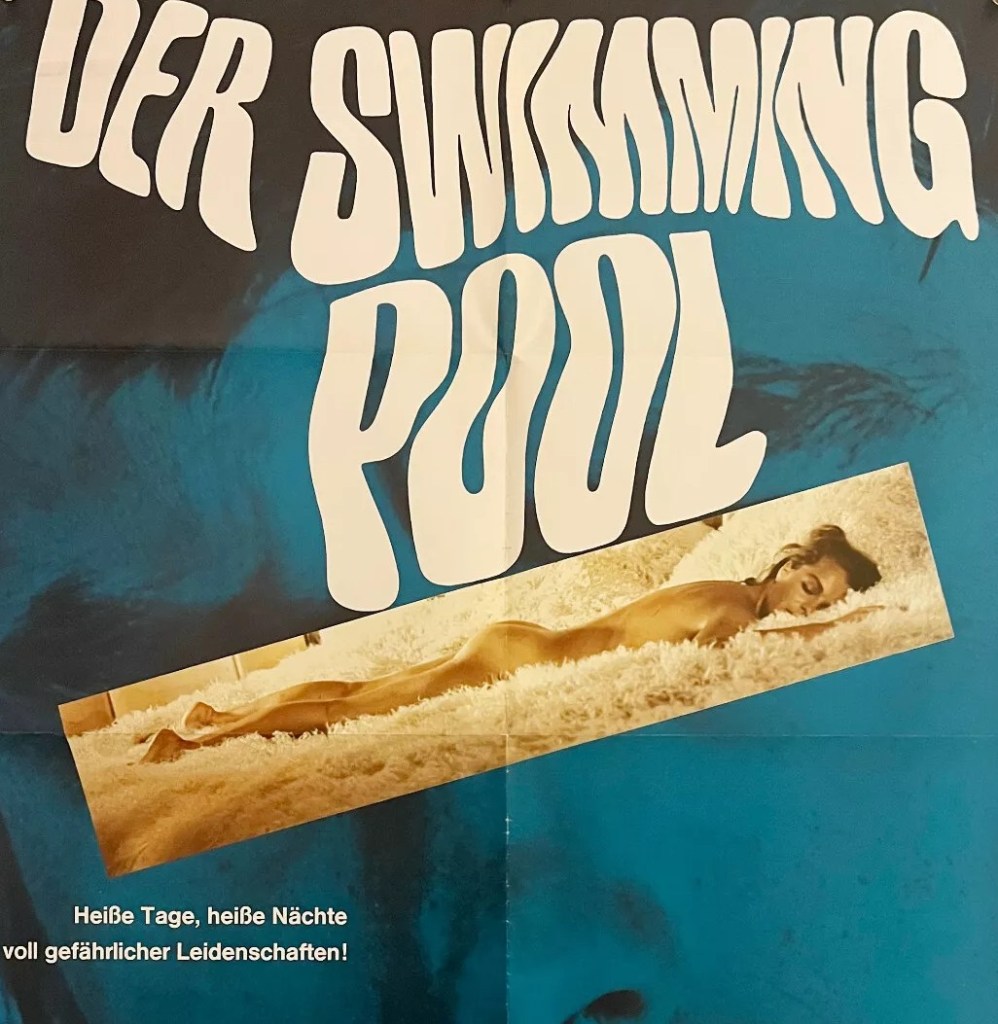
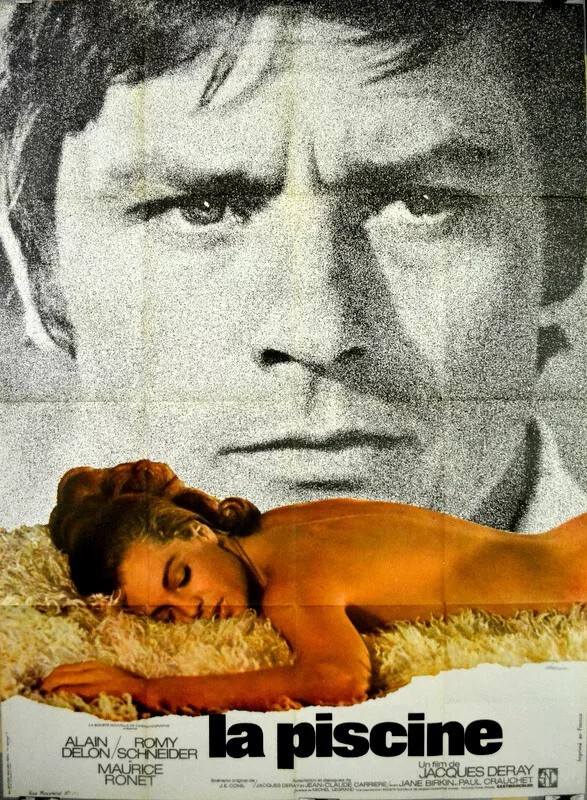
The Swimming Pool / La Piscine (1969) ****

A drunk falls into a swimming pool in the middle of the night and drowns. He has already crashed his car into the gate post of the villa. There’s no sign of foul play. No sign of the fact that his attempts to clamber out are hindered by someone holding his head down under the water until he loses consciousness.

The perfect murder? Well, no, actually, because in the aftermath of the murder, recovering alcoholic killer Jean-Paul (Alain Delon) does about the dumbest thing you’ve ever seen. And that significantly detracts from what otherwise is a superb examination of sexual tension and hidden secrets.

So instead of leaving the corpse of best friend Harry (Maurice Ronet) floating fully clothed in the titular pool, Jean-Paul decides it would look better if it appeared that Harry had foolishly gone for a late night swim. So he pulls the dead guy out, strips off his clothes and decks him out in swimming trunks and slides him back into the watery grave.

He hides the sodden clothes somewhere and at the side of the pool puts a small stack of fresh clothes stolen from Harry’s wardrobe – he was a guest at the villa. But for some reason in pulling off Harry’s shirt he omits to remove his expensive watch which isn’t waterproof. Inspector Leveque’s (Paul Crauchet) suspicions are aroused by that simple fact. Although, theoretically, Harry might have been too drunk to notice, even though, obviously, the watch strap and the bulky watch would have caught on his shirt sleeve as he was taking off the item of clothing.

So the cop, in examining the clothes, is mightily surprised to discover they are fresh, unworn, not a sign of sweat or crumpled-ness, which is odd given Harry had been out dancing and enjoying himself for hours.

Psychologically, most of the aftermath is not just whether the cold-blooded killer – the otherwise very handsome, relatively charming writer Jean-Paul – will get away with it  but whether his girlfriend Marianne (Romy Scheider), who has her own suspicions, will stand by him.

They have enjoyed a very intense sexual relationship and she clearly adores him. But she’s also the ex-lover of Harry and when Jean-Paul’s old pal, who is decidedly smooth with the ladies, turns up, the old sexual jealousy is rekindled. Either to get revenge or because he’s in any case that way inclined Jean-Paul has been making discreet moves on Harry’s eighteen-year-old daughter Penelope (Jane Birkin) who clearly despises her father.

We discover that Jean-Paul owes a great deal of his success to Harry who nurtured him through a severe depression that ended in attempted suicide. Rather than making Jean-Paul eternally grateful, it’s turned him into a spoiled brat, focused primarily on his own needs and without a loyal bone in his body when it comes to women.

For quite a while it looks like record producer Harry is going to steal away Marianne, if only for a brief affair, as Jean-Paul gives in to the sulks. But since Jean-Paul is already eyeing up Penelope, you would have thought any slip by Marianne would provide him with justification.

The murder is spur-of-the-moment. Jean-Paul has been drinking again and when Harry turns up drunk and launches into an attack on Jean-Paul’s character and hidden past, that’s when he ends up in the pool. Every time he tries to get out, Jean-Paul pushes him back in and eventually holds his head down underwater.

And he might have got away with the perfect murder except for stripping the body and forgetting about the watch, but when he decides to end his relationship with Marianne, the focus switches to whether she will betray him or not. There are a couple of twists on that score at the end.

So severely flawed psychological thriller. I’m guessing you could argue that anyone who kills someone out of the blue could easily be suffering from the kind of brain overload that prevents him thinking straight, but I didn’t fall for it. It would have been as easy to continue with the psychological stuff enough with Marianne maybe finding the wet clothes and facing the same choices that she eventually does.

What does elevate it are the performances. Austrian actress Romy Scheider (Otley, 1969), who had previously had an affair with Delon, is superb as a woman not sure if she has any principles given she is so easily in the thrall of attractive men. Although Alain Delon (Le Samourai, 1967) had played bad guys and immoral sorts before, this still feels like a fresh approach, the watchful, withdrawn calculating killer masquerading as something else.

Maurice Ronet (Lost Command, 1966) and Jane Birkin (Blow-Up, 1966) make significant contributions.

And director Jacques Deray (Borsalino, 1970) would have turned out another masterpiece had the movie not stumbled over the oddness of the murder. Written by the director, Alain Page (in his debut) and Jean-Claude Carriere  (Viva Maria!, 1965).

Excepting the murder mishmash, superb.

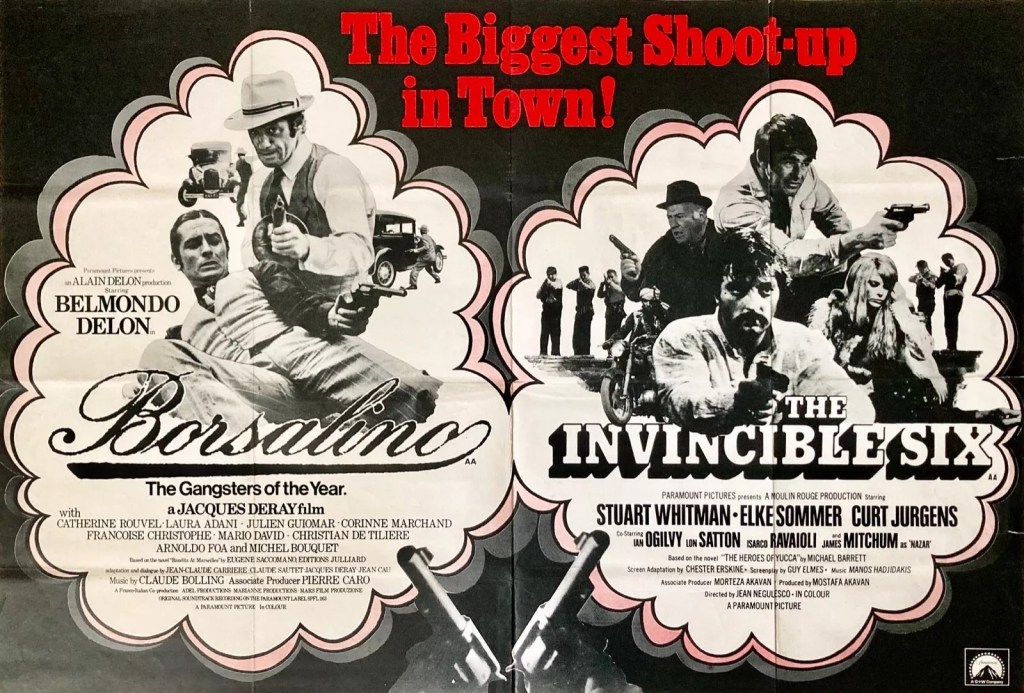
Borsalino (1970) ****

You wonder how much the unexpected success of this French gangster picture encouraged Paramount to invest in The Godfather (1972). The studio had gone down the Mafia route with The Brotherhood (1968) but to a significantly muted response. But where that film was heavy on family and drama, Borsalino went wild with charismatic performances and, as important, machine-gun-driven violence. And you couldn’t ignore the success the previous year of the French The Sicilian Clan (1969).

While Borsalino doesn’t go into the weighty issues and family sensibility that elevated The Godfather in the eyes of critics, its starting point owed more to Butch Cassidy and the Sundance Kid (1969) with two likeable hoods, even, initially at least, sparring over the same girl. The family element here concentrates on fraternity, brothers in crime, rather than the father-son dynamic that drove The Godfather. And it’s just so much goddam fun.  

Francois (Jean-Paul Belmondo) and Roch (Alain Delon) are petty crooks in Marseilles in the early 1930s working their way up to the top, initially just with scams like presenting a longshoreman who can’t speak a word of German as a German regional boxing champion, hijacking the favorite in a horse race, setting up a slot-machine business, disrupting the city’s fish market, until graduating to more serious crime and challenging Marello (Arnoldo Foa) and Poli (Andre Bollet), kingpins of the area’s organized crime. They set fire to an abattoir, establish their own fiefdoms, running legitimate businesses like casinos. But the higher they climb the closer they come to a devastating irony which cannot be ignored. Once they’ve eliminated everyone else, their only competition is with each other, and both realize that, inevitably, one will begin to want to become the undisputed top gangster.

Roch is the more thoughtful of the pair, the one looking ahead, sensing opportunity, the strategist, Francois more likely to indulge his playboy instincts, but both enjoy the high life, mixing with celebrities, politicians and archbishops. There’s plenty collateral damage. Try to steal a bigwig’s girlfriend away and you are virtually condemning her to death.   

Unexpectedly, for the genre, it’s huge fun, in part helped along by the genial earworm of a score by Claude Bolling, as evocative of the period as Scott Joplin’s rags were to The Sting (1973).  We don’t have to suffer any sanctimonious prig on the sidelines offering commentary or the gangsters making out that they’re better than they are because they don’t indulge in certain types of crime. But the biggest contributory factor is the teaming of Alain Delon (Once a Thief, 1965) and Jean-Paul Belmondo (Is Paris Burning?, 1966), the two biggest French male stars of the decade, the former enjoying substantially more success overseas than the latter.

Remember that Robert Redford was a not star when he made Butch Cassidy and the Sundance Kid so the pairing of two huge marquee names was not a regular feature anywhere in the world. It was Alain Delon, in his capacity as producer, who snared his rival, ceding top billing to achieve it.

This was the second of nine movies that Delon made with director Jacques Deray and could not have been more different from their previous outing La Piscine/The Swimming Pool (1969), a claustrophobic psychological thriller. Deray had history with Belmondo, too, Crime on a Summer Morning (1965). The characters were a great fit for their screen personas. And the photography, with some sepia tint, is distinctive.

Written by Jean-Claude Carriere (Viva Maria!, 1965), Claude Sautet (Nelly and Monsieur Arnaud, 1995), Jean Cau (Jeff, 1969) and the director, based on the book Bandits a Marseille by Eugene Saccomano.

Buddy movie breakout. Highly enjoyable.

Discover WordPress

A daily selection of the best content published on WordPress, collected for you by humans who love to read.

The Atavist Magazine

by Brian Hannan

WordPress.com News

The latest news on WordPress.com and the WordPress community.