Holiday in Spain / Scent of Mystery (1960) **

There were five our great reasons to see this picture. Firstly, it was in Cinerama. Secondly, it was the first attempt in that special format to tell a dramatic story rather than offer just a travelog. Though How the West Was Won (1962) was promoted at the first dramatic use of Cinerama, that was actually untrue. This came first. Third, there was a terrific gimmick – Smell-O-Vision – which allowed audiences to inhale around 30 fragrances at the same time as the onscreen characters. Fourthly, it was produced by Mike Todd Jr., son of the Oscar-winning producer of Around the World in 80 Days (1956) and second husband of Elizabeth Taylor who was instrumental in bringing Cinerama to the big screen in the first place., Lastly, it was the first top-billed appearance of rising British star Denholm Elliott.

Unfortunately, none of these hit the target and it remains a novelty in the Cinerama canon. For a start, there wasn’t much of a story – it’s a chase tale of sorts with crime novelist Oliver (Denholm Elliott) uncovering a plan to kill American heiress Sally Kennedy. In setting out to thwart it he travels all over Spain in the company of philosophic wise-cracking taxi driver Smiley (Peter Lorre). Cue travelog of scenic Spain including fiestas, dances and the running of the bulls, which appears not to have been specially staged but filmed documentary-style as it occurred with the bulls inflicting considerable damage on the humans foolish enough to think it’s a lark.

The hook is the mystery woman who can only be detected by her Schiaparelli perfume while the giveaway for the villain, hired assassin Baron saradin (Paul Lukas), is his tobacco. Cue an onslaught of scents. But the smells don’t just pop up when characters are involved. When a barrel of wine smashes, that produces another smell.

Astonishingly, the movie manages to bring in some of the Cinerama trademarks – the runaway element seen from the audience POV, not just the traditional vehicle but also  barrels of wine.

The smell gimmick worked well enough in cinemas set up for such technical aspects, but that amounted to very few screens, and outside of those the movie just seemed a random series of scenes with only panoramic views of Spain to lessen the boredom.

It did nothing for the career of Denholm Elliott and he did little for the movie. He lacked the edge or innocence required to make such a character come alive and mostly he looks as though he doesn’t know what to do. He didn’t make another movie for three years and on his return for Station Six Sahara (1963) he was no longer the star but quickly shifting into the character actor he would be for the rest of his screen career.

It was nearly the last hurrah for Peter Lorre. He suffered heart attack during filming so the real Peter Lorre is only seen in half the picture, for the other half it’s a stand-in.

The presence of Elizabeth Taylor (Butterfield 8, 1960) could conceivably have redeemed the picture but she puts in only a fleeting appearance, so speedy her distinctive features barely register. You see more of Diana Dors (Baby Love, 1969).

In the hands of Alfred Hitchcock (Psycho, 1960) or imitators like Stanley Donen (Charade, 1963) and with a more finely worked screenplay, reliant on neither visual nor olfactory gimmick, this might have worked. But it was in hands of Jack Cardiff (The Girl on a Motorcycle, 1968), famed cinematographer but only his third outing as a director, and he clearly didn’t know how to balance the various ingredients and so it limps home.

The minute the location of the source novel by Audrey Kelley and William Roos shifted  from New York to Spain and the number of investigators halved, the trouble started. The hunt for a woman whose existence is in question was a standard mystery trope and might very well have worked here minus the smells and Cinerama.

A curiosity.

The Lion (1962) ***

For such a harmless picture The Lion raises a couple of troubling issues. The first concerns the titular beast. Doubt if you’d get the authorities these days to greenlight a movie where a pre-pubescent girl was in such close proximity to a full-grown lion. Having as a safety measure two sharpshooters on the sidelines out of camera range, as director Jack Cardiff did here, might not cut it.

Secondly, we’ve got censor double standard. I remember my shocked parents forbidding me from seeing Zulu (1964), a massive hit in Britain, on account of the toplessness of the indigenous females. The censor didn’t slap an X-certificate on that sequence on the assumption that such nudity, in the context of tribal tradition, wouldn’t apparently incite the lewd male gaze. Had this been white breasts on show, in whatever tradition, the censor would not have been so lenient, signifying an inherent racism. Here, surprisingly, we’ve also got female toplessness, somewhat more discreet than Zulu, but coming as a surprise to your reviewer.

Perhaps the oddest feature of the picture is the contradictory message: Africa is wonderful but it’s not the place to bring up a young girl. Certainly not one who embraces the wildness with considerably more conviction than a passing wildlife tourist. As the imdb stub puts it: the young girl Tina (Pamela Franklin) must be brought “back to civilization.”

And there’s a distinctly old-fashioned tint to a storyline that demands the appearance of her father Robert (William Holden), long divorced from wife Christine (Capucine), as the firm male hand required to drag his estranged daughter back to said civilization. Christine’s current partner John (Trevor Howard), grizzled poacher-turned-gamekeeper, former big game hunter now eking out a living as a game warden, appears more sanguine about the girl’s lifestyle but less welcoming to the visitor. Tina has raised the wild lion King from a cub and as their bond is intense she is reluctant to give him up.

Disney would have taken a different approach, buffing up the cuter aspects. That the studio could show adult and child perspective in tandem is instanced by Pollyanna (1960) and in the later The Jungle Book (1967) solved the problem of a young boy becoming too involved with his wild playmates by having an intriguing young girl tempt him away. Or a touch of the Born Free (1966) playbook might have seen Tina simply mutate from childhood to an adult job in the animal preservation business

Instead, playing out in almost literal fashion, are two human male beasts battling it out (though not physically, unfortunately) over the mother with the needs of the child seemingly swept to one side as the love triangle takes hold.

The best scenes concern Robert and Tina, especially her early disinterest in his presence, and her later delight at leading him a wild dance through the jungle and seeing how his terror of her lion pal equates with her complete lack of fear. While John’s role is to keep a grip on poaching, he’s not so friendly to the animals, almost determined to torment them by running his jeep recklessly at or around them to elicit maddened response and alarm the visitor with their wildness rather than their apparent, at a distance, docility.

Perhaps the lack of a punch-up ensures this movie never catches fire. There’s quite a perplexing sub-plot that dictates the outcome. The son  of the local tribal chief has his eye on Tina and during the aforementioned tradition it’s clear the young girl wants to participate in the frenzied dance courtship ritual.

But this kind of tradition is at the polar opposite of civilization as is the tradition that an old man, succumbing to fatal illness, should be left out in the wild to die. Christine intervenes to save him. Meanwhile, believing his father dead, the son sets out to achieve manhood by killing the lion and in the ensuing tangle John kills both young man and lion. The tribal response to the death of their new chief goes unrecorded but Bullit’s action drives Tina towards her parents. With the lion dead, it’s a lot easier to winkle the girl away from Africa and back to civilization.

Plenty of wildlife for your buck, but plot and characters are not a patch on Hatari! (1962) or The Last Safari (1967). William Holden, whose yen for making movies as far away from the U.S. tax authorities as possible was destroying his career, is good value as the estranged father and if you are looking for smouldering then Trevor Howard (The Long Duel, 1967) is your man. Capucine would tee up with Holden – the pair had an affair – again in The 7th Dawn (1964) but she was more effective in the later picture than here.

Jack Cardiff (Girl on a Motorcycle, 1968) directs from a script by Irene and Louis Kamp (The Sandpiper, 1965) based on the bestseller by Joseph Kessel (L’Armee des Ombres/Army of Shadows, 1969).

Might have preferred the Disney version.

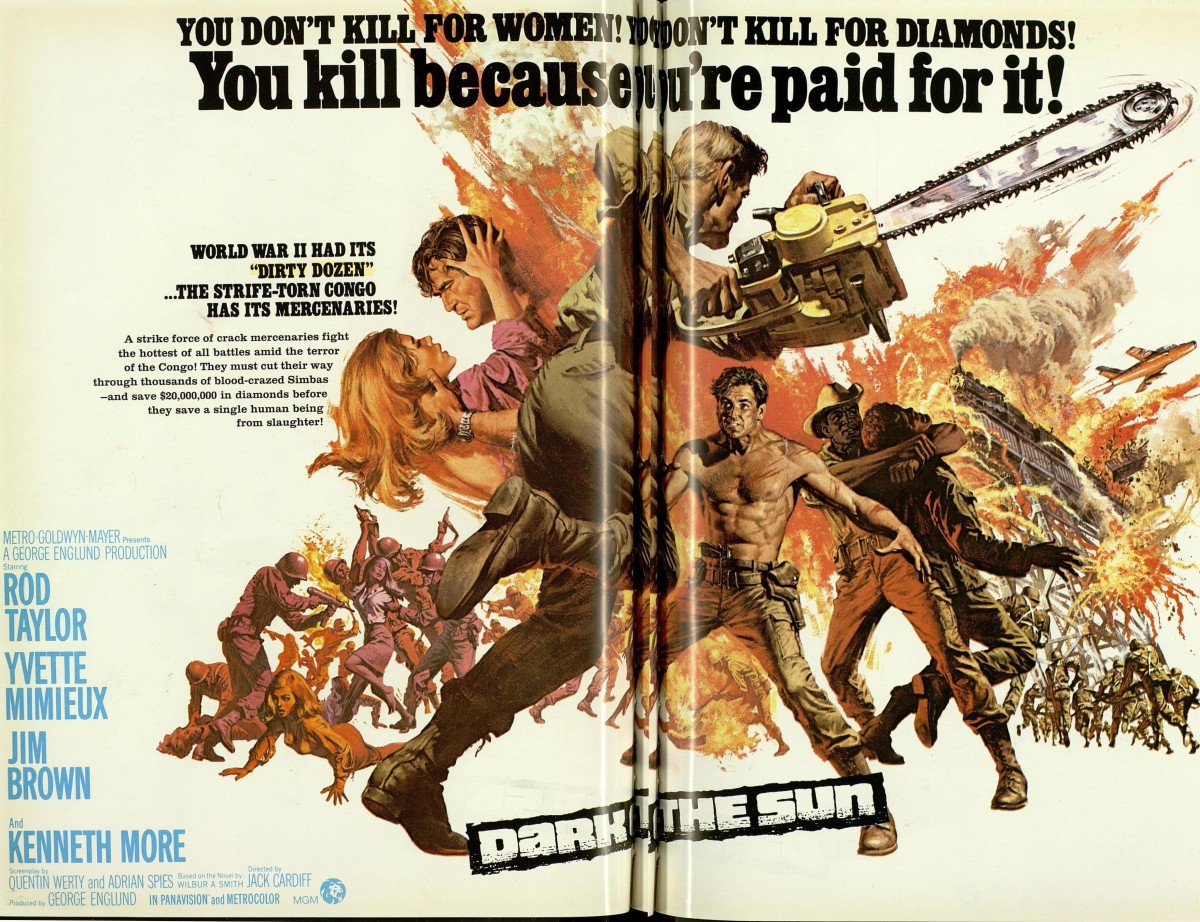
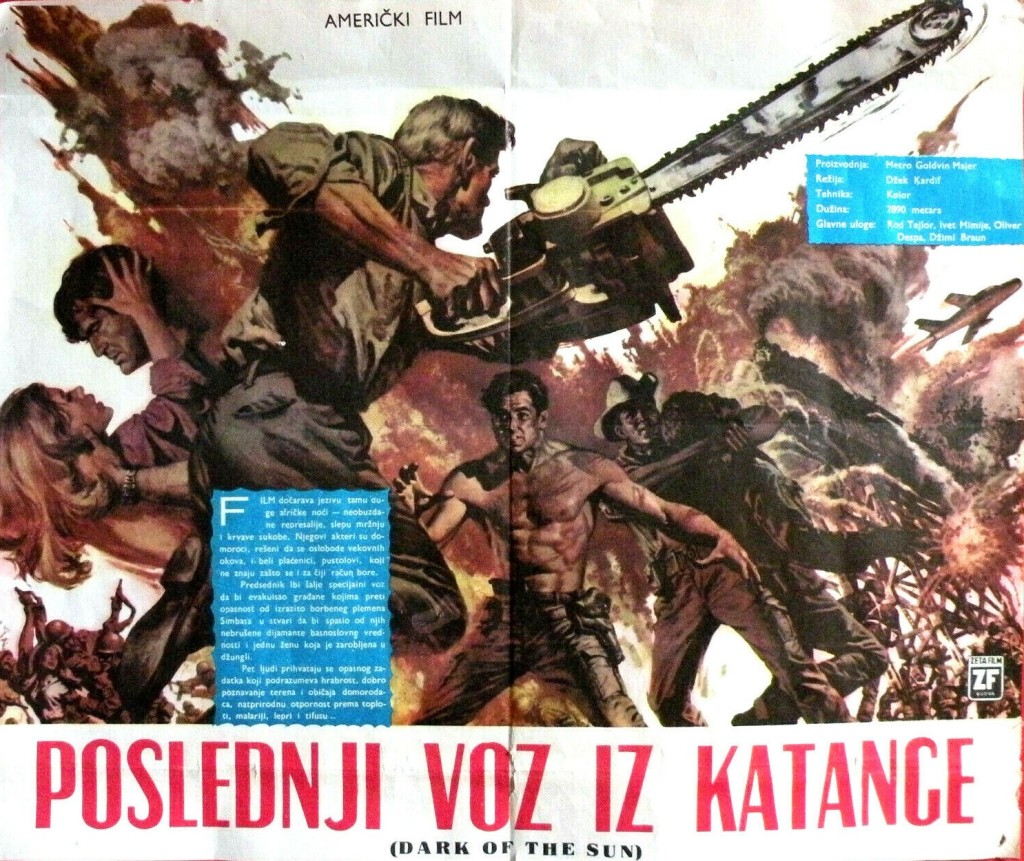
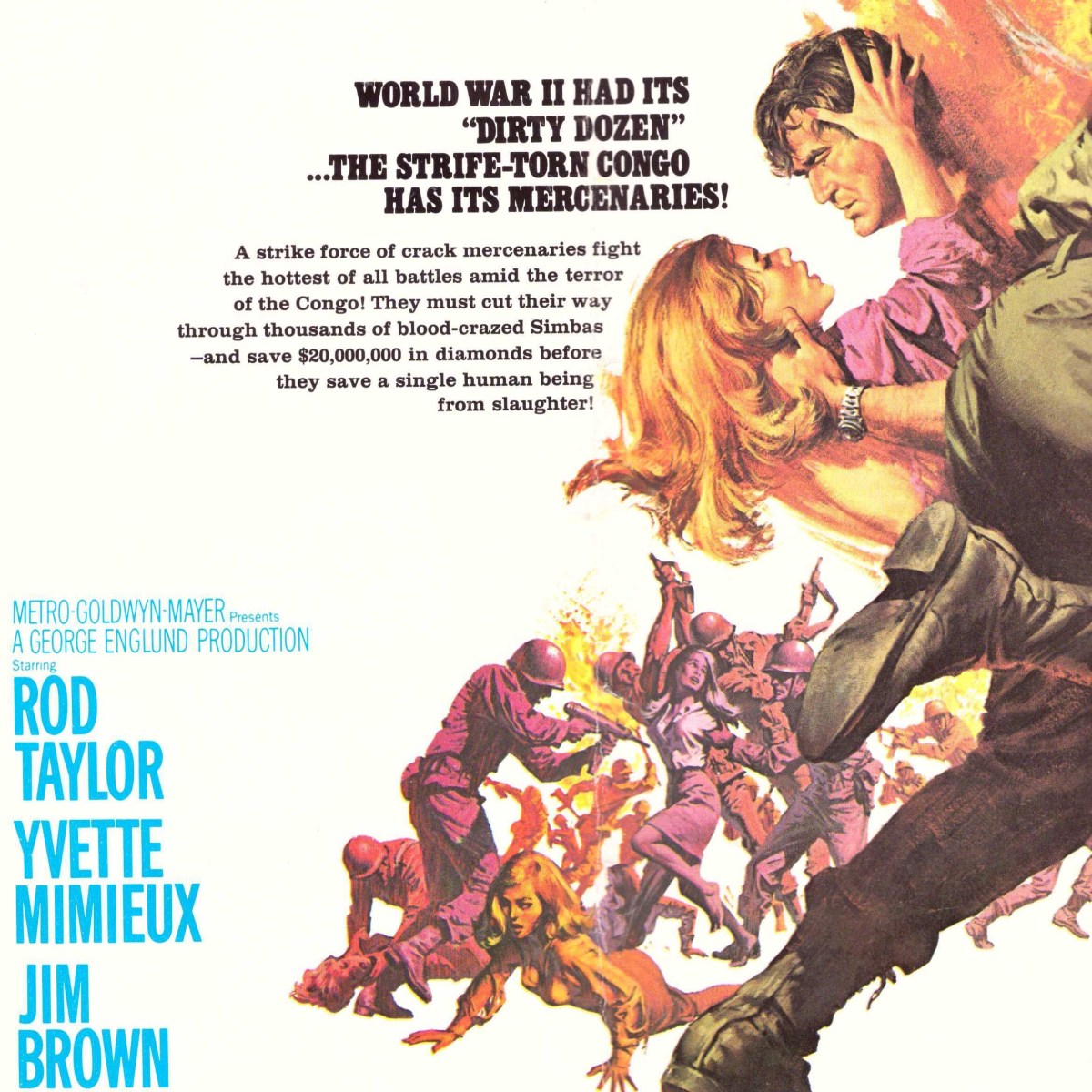
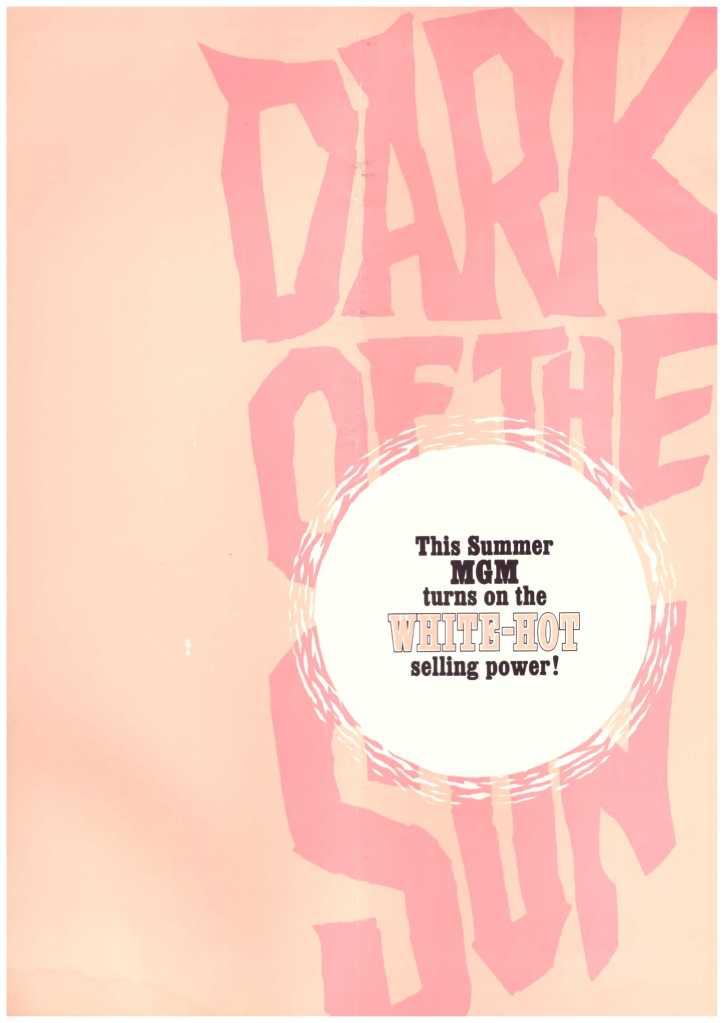
Dark of the Sun / The Mercenaries (1968) ****

Rod Taylor made a brisk transition to two-fisted action hero from his previous forte of drama (Hotel, 1967) and comedy foil to Doris Day (The Glass Bottom Boat, 1966) in this violent adventure set in the Congo in the early 1960s. As Captain Curry, assisted by sidekick Sgt Ruffo (Jim Brown) and 40-man local outfit Striker Blue Force, he leads an ostensibly humanitarian mission to rescue settlers cut off by the Simba rebels as a cover for collecting $50 million in diamonds. The loot is essential to save the toppling regime of President Ubi (Calvin Lockhart).  The only feasible transport is train. There is a three-day deadline.

Problems immediately ensue, not least a clash with Capt. Heinlein (Peter Carsten), former Nazi leader of Blue Force, who is even more ruthless than Curry, mowing down two native children who stray too close to the train, and apt to go into a fistfight with a chainsaw. The train is attacked by a United Nations plane and on reaching its destination Curry is forced to wait three hours until the time-controlled giant diamond vault can be opened, giving the rebels time to catch up. Then it’s an ongoing battle of one kind or another.

Although the worst of the violence is carried out by the rebels – rape, torture and massacre – a core element of the drama is how a lifetime of killing has affected Curry. Ruffo, a man of principle who grew up in a primitive tribe, acts as his conscience – and that of the audience – spelling out how violence is more than a money-making scheme and essential to upholding order in terrorist times. Curry has some redemptive features, saving widow Claire (Yvette Mimieux) from Heinlein, sending the alcoholic Doctor Wreid (Kenneth More) to help a woman give birth, and eventually acknowledging his strong bond with Ruffo. Although Curry would like to think he is the opposite of Heinlein, they are carved from the same stock and when the savage beast is loose blood lust takes over. 

Claie is more or less there as bait, tempting Heinlein and any rebels in the vicinity, but coming into her own in convincing Wreid, paralytic by this stage, to carry out a section on the pregnant woman, and as a reminder of civilization for Curry.

The action scenes are terrific, particularly the plane strafing the train, and there is a particularly good ruse, instigated by Ruffo, to outwit the enemy. Hollywood never managed to portray the terror of the native Vietnamese on being overrun by Viet Cong, and this film could easily be that substitute, especially when some of the rescued white settlers realize they will not escape.

This is not one of those films like Born Free (1966) or Out of Africa (1985) which are scenic odes to the continent, in part because the picture was shot in Jamaica, but in the main because director Jack Cardiff (Our Mother’s House, 1967) chooses to focus on the mechanics of the mission. And in so doing, he writes a love letter to a train. There had a mini-vogue for war movies set on trains – Von Ryan’s Express (1965) and The Train (1965) come to mind – but none reveal an adoration for the power and perhaps the beauty of the locomotive. Every move it makes (to steal an idea from pop group The Police) is noted on screen and on the soundtrack, the hissing, the belching smoke, the wheels, cabooses, engine, the coupling and uncoupling of links, the screech of brakes, and various tracking and crane shots as the train snakes its way through enemy terrain.

Rod Taylor is excellent in the kind of role he is made for. Jim Brown in a major step up the billing after The Dirty Dozen (1967) is surprisingly good in a part that calls as much for reflection as action. Peter Carsten is the all-time Nazi scum. Yvette Mimieux, who had partnered Taylor in The Time Machine (1960), is also in transition mode, her role a meatier dramatic departure from the likes of the innocuous Monkeys, Go Home! (1967). In what was essentially his last major role – even though it doesn’t amount to much in screen time – Kenneth More (Sink the Bismarck!, 1960) wavers considerably from his stiff-upper-lip default.

The score by Jacques Loussier is particularly good, as Quentin Tarantino attested when he incorporated elements of it for Inglorious Bastards, which was a boon for the composer since up till then he was best remembered for the music accompanying the advert for Hamlet cigars. You might get a laugh out of the screenplay credits. Quentin Werty (i.e. Qwerty, the first six letters on a typewriter) the pseudonym of Ranald McDougall, Oscar-nominated for Mildred Pierce (1945), co-wrote the screenplay, adapted from the novel by Wilbur Smith, with television writer Adrian Spies.

An outstanding example of the all-out action mission picture, its occasional outdated attitudes do not get in the way of the picture and half a century later from what we now know of how wars are fought the levels of violence will appear realistic rather than exploitative.    

Behind the Scenes: “The Long Duel” (1967)

Due some unexpected reverence after being chosen by Quentin Tarantino for his inaugural eponymous festival that kicked off at the Dobie theater in Austin, Texas, in 1996. I thought I’d throw that in since my opinion alone may not have swayed you as to this film’s merits. Ken Annakin (Battle of the Bulge, 1965) wasn’t first choice as director. It was initially on the slate of Jack Cardiff (The Girl on a Motorcycle, 1969) and should have also made waves as the first big British-Indian co-production. After his World War Two tank epic, Annakin’s career unexpectedly stalled.

He backed out of a project to make a Las Vegas version of Grand Hotel (1931), another, the $1.5 million The Fifth Coin, written by Francis Coppola and to star George Segal, got snarled up on the starting grid. He balked at Texas Across the River (1966) – when the females leads were going to be Shirley MacLaine and Catherine Deneuve – due to concerns about the schedule. He actually shot half of The Perils of Pauline (1967) with Terry-Thomas, Pat Boone and Pamela Austin, wife of super-agent Guy McIllwhaine, before being fired, for reasons that were unclear. Still, he remained in demand and was immediately off to Italy to shoot Raquel Welch heist picture The Biggest Bundle of Them All – not released until two years later as explained in my Behind the Scenes blog on that movie.

However, before jetting off to Italy, he had been sounded out by British producer Sydney Box who had a commitment from Yul Brynner and Trevor Howard to star in the $3 million The Long Duel being financed fifty-fifty by British studio Rank and fourteen Indian investors taking advantage of a tax-shelter deal. Annakin was in line for his biggest-ever fee. For Rank it was a brave new world. The British studio after years of relative inactivity was back on the production front foot, initially in co-production deals with American majors and British investment outfits like the National Film Corporation. It planned to invest $12 million in eight pictures. Initially, its stake in The Long Duel was limited to 60 per cent at a time when the movie was budgeted at $2.3 million. This was “particularly surprising because it came at a time when Britain was caught in a severe economic freeze” although the surprise success of the Bond pictures suggested the country’s movie industry was, in contrast, riding the crest of a wave.

Things turned sour on the location scouting trip to India. A “bottomless pit” of laborers was on standby to build a rope bridge across as soon as the money came through. Timber had been ordered to build a fort on a plateau with stunning views of snow-capped mountains, but nothing would arrive until money changed hands. While Rank had committed three-fifths of the finance with the rest coming from the release of blocked rupees guaranteed by a Maharajah, without any immediate cash and with the stars on pay-or-play contracts, there was no option but for Rank to pick up the entire cost and seek out alternative locations. That meant it was the single biggest British production financed domestically without a foreign partner.

Matters worsened when producer Sydney Box suffered a heart attack, triggering his departure from the business, in which he had been a mainstay for 33 years, movies ranging from The Seventh Veil (1945) to Accident (1966). In addition, Annakin was negotiating to make a permanent move to France while his wife was at home in England dealing with an adopted new-born baby. Annakin – acting also as producer for the first time – gambled on shifting the movie to Spain.

After the success of Doctor Zhivago (1965), Spain was fast being viewed as an ideal terrain, Custer of the West (1967), Camelot (1967), Fathom (1967) and The Bobo (1966) jostling for space. Having made a couple of movies there, Annakin assured the backers, the terrain was “not dissimilar” to the locations he had viewed in India. “I believe we can make Spain into India, so long as the crowds are dressed as Indians, which will cost quite a lot more because it means providing all the costumes whereas in India they already exist,” he explained. He had three weeks before the actors were due.

Yul Brynner and Trevor Howard would have seemed best buddies by now, having appeared in three films together over the past two years – Morituri (1965), The Poppy Is Also a Flower (1966) and Triple Cross (1966). Brynner’s career had revived thanks to Return of the Seven (1966). He was considered poor box office in the U.S. but made up for it with his global marquee appeal. Howard had been on an unexpected box office roll following Father Goose (1964), Operation Crossbow (1965), Von Ryan’s Express (1965) and The Liquidator (1965).

Annakin turned to the Sierra Nevadas to double as the Himalyas, located the rope bridge in a ravine near Ronda, the villages transplanted to the dusty Andalusian plains, and found sufficient horse-riding extras among the gypsies of Dacoit country. The Alhambra was called in to action for part of the Indian palace. A steam train of sufficient vintage was found.

Brynner supplied his own motor home, one of the most luxurious on the market, but required considerable assistance to move it around, especially on narrow country roads linking locations. Over 300 horses were required, with complications when the animals had to be moved in the dark. The major scenes required extensive lighting and nobody had taken into account the fierce winds which nearly blew everything away. The dancing bear was supplied by Chipperfield Zoo near Windsor, England. In the scene where Brynner returns to find his tribe massacred, the bear is also a victim. But, when the bear was knocked out by an injection, it didn’t wake up again. Cast and crew were so shocked that filming was abandoned for the day.

Howard’s alcoholism was another issue, liable to leave the actor so disoriented during the shooting of dangerous scenes that his close-ups were often shot at a later date, though, eventually informed of this accommodation, the veteran sobered up. If you felt when watching the movie that the female stars were out of place, you wouldn’t be far wrong. In the original tale there was no significant female role. But acceding to the demands of studio and distributor required various love interests. Suzanna Leigh (Subterfuge, 1968) turned down the lead, providing Charlotte Rampling (Three, 1969) with a worthy role.

Convinced it was onto a winner, Rank took out adverts in the trades claiming “all signs point to it being…among the greats” and it took the bold step of launching it in roadshow at the Odeon Marble Arch simultaneous with continuous performance at the Odeon Leicester Square in London’s West End.

SOURCES: Ken Annakin, So You Wanna Be a Director (Tomahawk Press, 2001) p186-189, 197-206; “Sydney Box $10-Mil Prod Program,” Variety, January 26, 1966, p14; “Rank Now Measuring Up,” Variety, July 27, 1966, p25; Advert, Variety, August 24, 1966, p27; “$3-Mil Rank Duel May Be Costliest British Film Ever,” Variety, October 26, 1966, p5; Advert, Variety, November 9, 1966, p27; “Sydney Box Quits Film Posts,” Variety, August 7, 1967, p2.

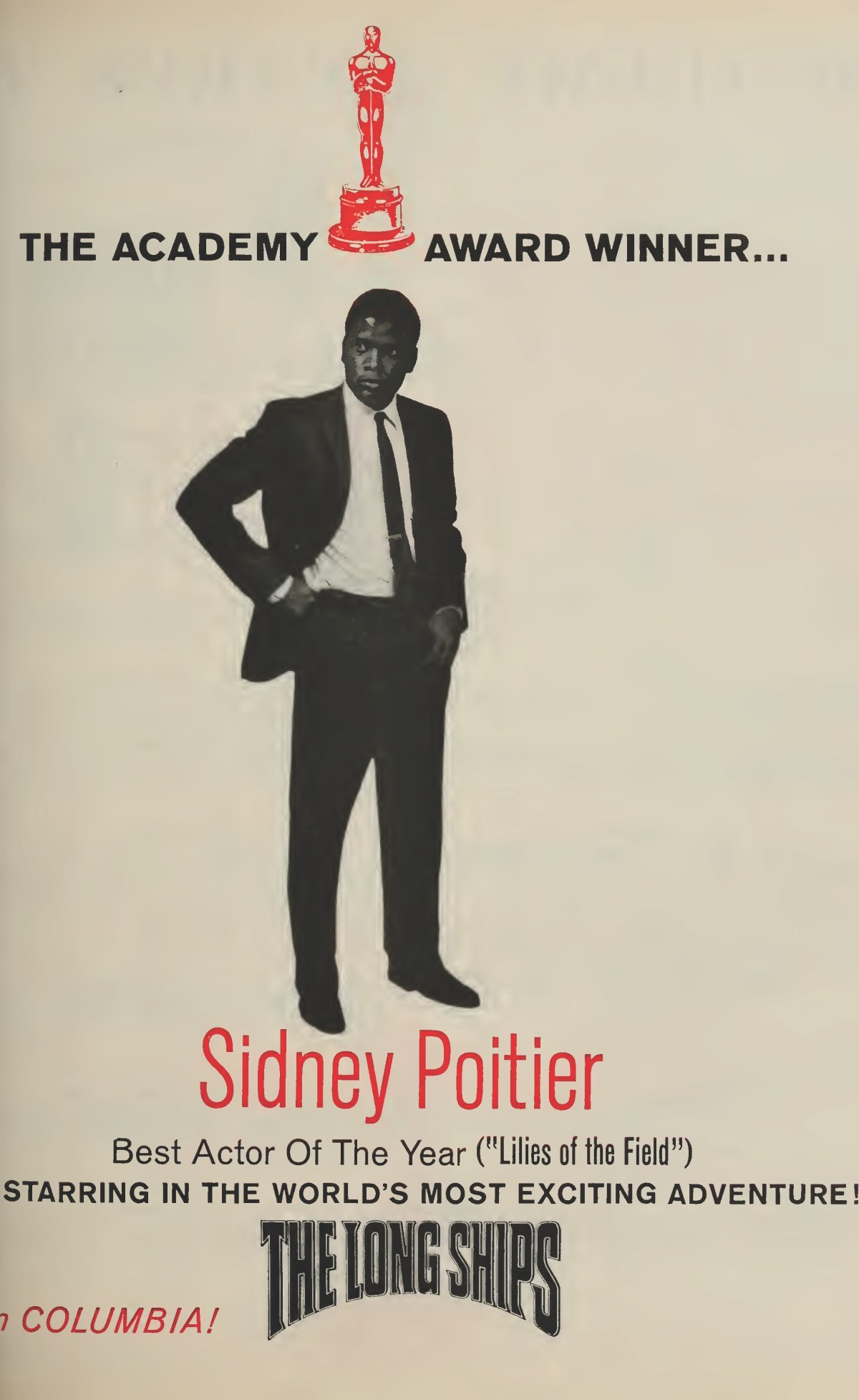
The Long Ships (1964) ***

Decent hokum sees Vikings ally with Moors to seek a mythical giant bell made of gold, “the mother of voices.” There are stunning set-pieces: a majestic long ship coming into port, superior battles, the Mare of Steel, the discovery of the bell itself, while a clever ruse triggers the climactic fight. There’s even a “Spartacus” moment – when the Vikings declare themselves willing to die should their leader be executed.

Rolfe (Richard Widmark) is the wily Viking, second cousin to a con man, demonstrating his physical prowess although he does appear to spend an inordinate amount of time swept up ashore after shipwreck. Moorish king Aly Mansuh (Sidney Poitier) is his rival for the legendary bell.  The diminutive Orm (Russ Tamblyn), Rolfe’s sidekick, appears to be in a constant athletic duel with the Viking.

Although handy with a sword, both are equally adept at employing seduction, Aly Mansuh making eyes at Viking princess Beba Loncar (in her Hollywood debut) while Rolfe targets Poitier’s neglected wife Rosanna Schiafffino (Two Weeks in Another Town, 1962). The story is occasionally put on hold to permit the Viking horde to pursue their two favorite pastimes – sex and violence – and they make the most of the opportunity to frolic with a harem.

One of the marks of the better historical films is the intelligence of the battle scenes. Here, faced with Muslim cavalry, the Vikings steal a trick from The 300 Spartans by lying down to let the horses pass then rising up to slaughter their riders. But there is also an unusual piece of intelligent thinking. Realising, as the battle wears on, that they are substantially outnumbered and have their backs to the sea, Widmark takes the sensible option of surrendering.

Richard Widmark (The Secret Ways, 1961) makes the most of an expansive role. Instead of seething with discontent or intent on harm as seemed to be his lot in most pictures, he heads for swashbuckler central, with a side helping of Valentino, gaily leaping from high windows and engaging in swordfights. Sidney Poitier (Duel at Diablo, 1966), laden down with pomp and circumstance rather than immersed in poverty as would he his norm, is less comfortable as the Islamic ruler. (Widmark and Poitier re-teamed in The Bedford Incident, 1965, also reviewed in the blog.)

The puckish Tamblyn (The Wonderful World of the Brothers Grimm, 1962) almost steals the show. Both Loncar and Schiaffino have decent parts.

Director Jack Cardiff, Oscar-nominated for Sons and Lovers (1960), brings to bear his experience of working on The Vikings (1958) for which he was cinematographer. He is clearly at home with the action and equally there is some fine composition. However, the story in places is over-complicated, and he fails to rein in the mugging of one of the industry’s great muggers Oscar Homolka (Joy in the Morning, 1965) and there is a complete disregard for accent discipline.  Edward Judd (The Day the Earth Caught Fire, 1961), Scotsman Gordon Jackson (The Great Escape, 1963) and Colin Blakely (The Private Life of Sherlock Holmes, 1970) have supporting roles.

Berkely Mather (Dr No, 1962), Beverly Cross (Jason and the Argonauts, 1963) and, in his sole movie credit, Frans G Bengtsson, collaborated on the screenplay.

Good fun and great to see Widmark and Poitier turning their screen personas upside down.

Young Cassidy (1965) ***

I’m assuming MGM adjudged that a film about a playwright, no matter how famous, and even if directed by John Ford (Cheyenne Autumn, 1964), would not be enough to attract an audience. And that a better physical match for said writer would have been a weedy actor of a Tom Courtenay  disposition. So, I came to this with no idea it was about world-famous Irish playwright Sean O’Casey since his name is never mentioned and the main character is called John Cassidy (Rod Taylor).

Which was just as well because I was wondering what kind of lad Cassidy was when despite his obvious brawn he was an inept labourer, requiring instruction on how to properly use a spade. That this working-class fellow has any inclination towards authorship is not obvious until halfway through the picture, by which time he has demonstrated qualities more appropriate for brawling, revolution and sex. 

Technically, this was a John Ford film as he was the producer.
The French chose not to point out he was not the director.

It probably says a lot about me that I was unaware of the significance of the title of O’Casey’s most famous play – The Plough and the Stars (1926 and, incidentally, filmed a decade later by Ford). By the time I was cogniscent of the country – early on, I assure you, as my grandfather was an Irish immigrant – the Irish flag was the tricolor made up of green, white and orange. I hadn’t known that the flag created by rebels two years before the Easter Uprising of 1916 was a representation of the plough and the stars, hence public outrage when O’Casey blithely adopted it as the title for his breakthrough play.

But you only need a vague idea of history to appreciate the movie. A couple of stunning scenes provide the background of dissent and poverty. The brutality of soldiers and police in quelling a riot is matched by striking transport workers tossing a scab into the river, his drowning ensured by the wagon that follows him in. Cassidy’s true position in the hierarchy is best shown when he is given a cheque rather than cash from a publisher. Lacking a bank account, not only does he fail to cash the cheque but is treated dismissively by clerks at the bank. His joy at rising above his station in receiving such a payment is immediately destroyed by feeling out of place and unwelcome in a bank.

Because, otherwise, Cassidy is quite the confident young fellow, winning over almost any young woman who falls within his compass, varying from upmarket prostitute Daisy (Julie Christie) to meek bookshop assistant Nora (Maggie Smith) and casual acquaintances.

Writing isn’t presented in the romantic manner of David Lean in Doctor Zhivago out the same year (with Julie Christie in a much bigger role), no stunning imagery and no close-up of soulful eyes, just Cassidy sitting at a table working through the night. But there is no indication as to why he chose plays as his metier, especially when the main theatre in Dublin, the Abbey, was the fiefdom of the middle- and upper-classes.

Ironically, Cassidy is tested more when his situation improves than as a downtrodden worker joining the revolutionary cause. As a worker his fists, brawn, brain and looks see him through. But once he steps up into the intellectual class, he is adrift, his new occupation driving a wedge through relationships.  

Not aware that this was a biopic of a playwright, I had little need to question the narrative, and just took each incident as it came. I never had the impression of a condensed biopic, crammed full of cameos. More of an interesting story set  against the background of rising Irish nationalism.

There’s a certain amount of “Oirishness” to contend with – the accents vary – the poverty is never as bleak as you might expect, and once the story heads out of Dublin you might think it’s going to go all the way to The Quiet Man country. But then you have to bear in mind that working-class poverty, as long there was employment available, was not quite of the slum kind, and that once you get out of Dublin you do indeed hit beautiful countryside.

Rod Taylor is good as the brawler-turned-playwright. In the duel of the rising stars, Maggie Smith (The Prime of Miss Jean Brodie, 1969) wins by a nose from Julie Christie, but then, though further down the credits, she has the bigger role. Michael Redgrave (Assignment K, 1968) as poet W.B. Yeats (responsible for the phrase “a terrible beauty is born”) makes the most of choice lines, Edith Evans (The Chalk Garden, 1964) is a quirky, mischievous  Lady Gregory, co-founder of the Abbey. It’s top-heavy with talent including Sian Philips (Becket, 1964), Flora Robson (55 Days at Peking, 1963), Jack MacGowran (Age of Consent, 1969) and T.P. McKenna (Perfect Friday, 1970).

Turns out John Ford was too ill to direct more than few minutes and that role fell to Jack Cardiff (Dark of the Sun, 1968) and I would have to say he does an agreeable job. John Whiting (The Captain’s Table, 1959) drew from O’Casey’s autobiography to write an intelligent script.

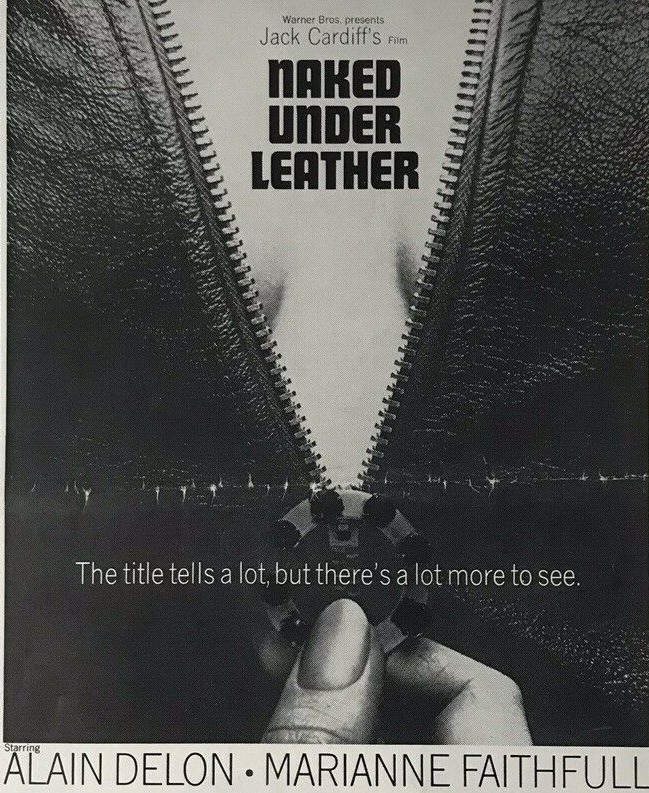
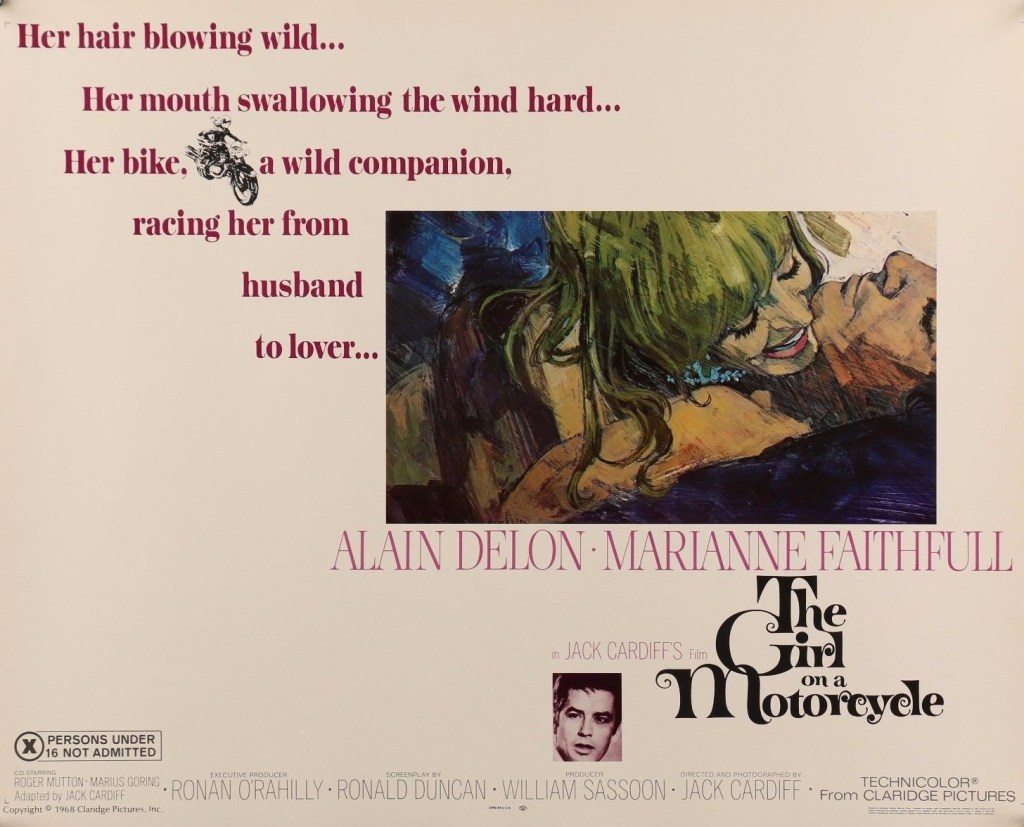
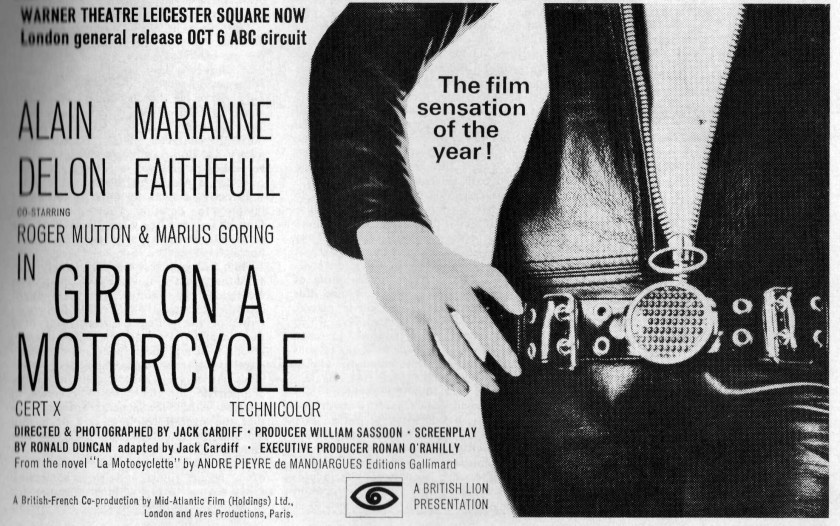
Behind the Scenes: “The Girl on a Motorcycle” / “Naked under Leather” (1968)

Although multi-country co-productions were very common in the 1960s, British-French co-productions were particularly thin on the ground, as if the cultural identities were so far apart there was nowhere they could ever meet. This was only the third such co-production in three years. British Lion, a long-established operation, had recently been overhauled with a new boss in John Boulting, a renowned filmmaker of Boulting Brothers (The Family Way, 1966) fame.

The film was based on a prestigious prize-winning French novel by Andre Pieyre de Manidargues. The budget was set at a modest $1.5 million with location shoots in Geneva, Heidelberg and Strasbourg with interiors shot at Shepperton. Director Jack Cardiff (Dark of the Sun, 1967) had originally hired a German actress, a Playboy centerfold,  for the leading role of the young girl who marries a timid young man while obsessed with a less conventional ex-lover. But the actress suffered a drug overdose and dropped out. Ironically, Marianne Faithful, her replacement, was also a drug addict and famed as a singer and as girlfriend of Mick Jagger.

Although her acting  experience was limited to television film Anna (1967) and a small part in Michael Winner’s I’ll Never Forget Whatsisname (1967), Cardiff was captivated by her sensuality which was ideal for her character. Bear in mind that Cardiff knew what a camera captured. He had made his name as a cinematographer and worked with great beauties like Ava Gardner (The Barefoot Contessa, 1954), Sophia Loren (Legend of the Lost, 1957) and Marilyn Monroe (The Prince and the Showgirl, 1957) so if he thought Faithfull fitted that category then there was no reason to doubt his assessment. He commented: “Never since I saw Marilyn Monroe through the camera lens have I seen such irresistible beauty. To focus on her is to focus the camera on your innermost heart.”  

Cardiff took advantage of a new trend to film movies in both English and French to open up distribution channels. Claude Chabrol’s The Road to Corinth (1967) was shot in this manner as was Farewell Friend / Adieu L’Ami (1968) with Charles Bronson and Alain Delon.   

Faithfull could not ride a motorbike so a stunt double was utilised for long shots. But instead of resorting to back projection, for medium shots and close-ups the actress was towed on a trailer behind a camera car. Not having to worry about the controls also meant that Faithfull could look dreamlike while driving and with Cardiff not having to think about the actress he could turn the camera in a 360-degree pan while she rode along.

Since Faithfull was going to be seen on a motorbike for long sections of the movie, Cardiff came up with a method of creating variety. One of the techniques employed was “solarization.” This was, in effect, a half-positive half-negative exposure, but it had only been used in the past in very small doses, nothing like what Cardiff had in mind. BBC boffin Laurie Atkin had invented a computer system that allowed solarization to be used more extensively. Footage shot during the day was taken immediately to the BBC lab at night where Cardiff could tinker about with creating his effects.   

One of the biggest beneficiaries of this technique were the sex scenes. Without the solarization which hid naked bodies under a psychedelic whirl the sex scenes would never have got past the censor.  There was an unfortunate downside, however. The Girl on a Motorcycle had been invited to the Cannes Film Festival. Critical approval there would have given the picture artistic momentum. Unfortunately, delays caused by the laboratory work meant the film missed its scheduled screening slot. Even so, French critics gave it the thumbs-up. British critics, on the other hand, gave it the thumbs-down. Lack of critical estimation did not appear to matter to British audiences who came out in their droves.

But it was a different story in the United States.

No wonder that to some extent this is one of the great lost pictures because Warner Brothers could not find a way to sell it in the U.S. Having paid a record $1.5 million advance, the studio (known at that time as Warner-Seven Arts) was hit by a double whammy. The picture was the first to receive an X-rating from the newly-established MPAA censorship system which replaced the previous Production Code. The new system was supposed to allow filmmakers greater latitude in terms of sex, violence and language.

Theoretically, that should have been a marketing bonus and the film should have ridden the “sex-art” wave and turned into an arthouse hit with the mainstream, captivated by solid grosses, to follow.  In reality, many exhibitors refused to touch it, regarding the X-rating as a separate category catering for the worst of the adults-only smut market. Newspapers refused to carry advertising for films so rated. Critics hated it, all the New York critics giving negative reviews.

Warners slotted it into a handful of arthouse houses before pulling all prints out of circulation in May 1970 and sending to back for re-editing with the intention of re-submitting it, shorn of some of the nudity, to the MPAA in a bid to win a more acceptable R-rating. In other words, to “re-gear the picture for the general market rather than the adult sex-art trade originally in mind.”  

To ensure that its reputation was not “soiled” the picture was re-titled Naked under Leather – if the content was tamer, the title was certainly not. Initially, that appeared to do the trick when it was re-released a full year later. It pulled in a “boff” $125,000 (worth around $864,000 now – a whopping $36,000 per-screen average) in 24 houses in wide release in Los Angeles, was “hot” in Denver and “tidy” in Chicago and found a few bookings elsewhere. But then it stalled and could not find the extra gear. In reality it did not do much better than on initial release. In the 1969 annual box office chart it featured at No 231 and for the corresponding 1970 chart it placed at number 253.

Sources: Jack Cardiff, Magic Hour, Faber and Faber, 1996, p242-243; “New British Lion Mgt. Gets Motorcyle Rights in UK,” Variety, October 18, 1967, 23; “Stylistic Dash Marks Cannes Films,” Variety, May 22, 1968, 26“British Lion Wraps Up Distribution Deal with W-7 for U.S., Towa for Japan,” Variety, August 28, 1968, 29, “Features Passing Through MPAA,” Variety, December 4, 1968, 20; “All Imports; N.Y. Critics All Bad,” Variety, December 4, 1968, 7; “Recall and Re-Edits W-7’s Motorcycle; X-Rating Now R,” Variety, January 29, 1969, 7; “Computer Tally of 729, 1968,” Variety,  May 7, 1969, 36; “Naked under Leather,” Variety, April 22, 1970, 4; “L.A. First Run Healthy,” Variety, May 13, 1970, 9; “Top 330 Pix in U.S. for 1970,” Variety, May 12, 1971, 37.

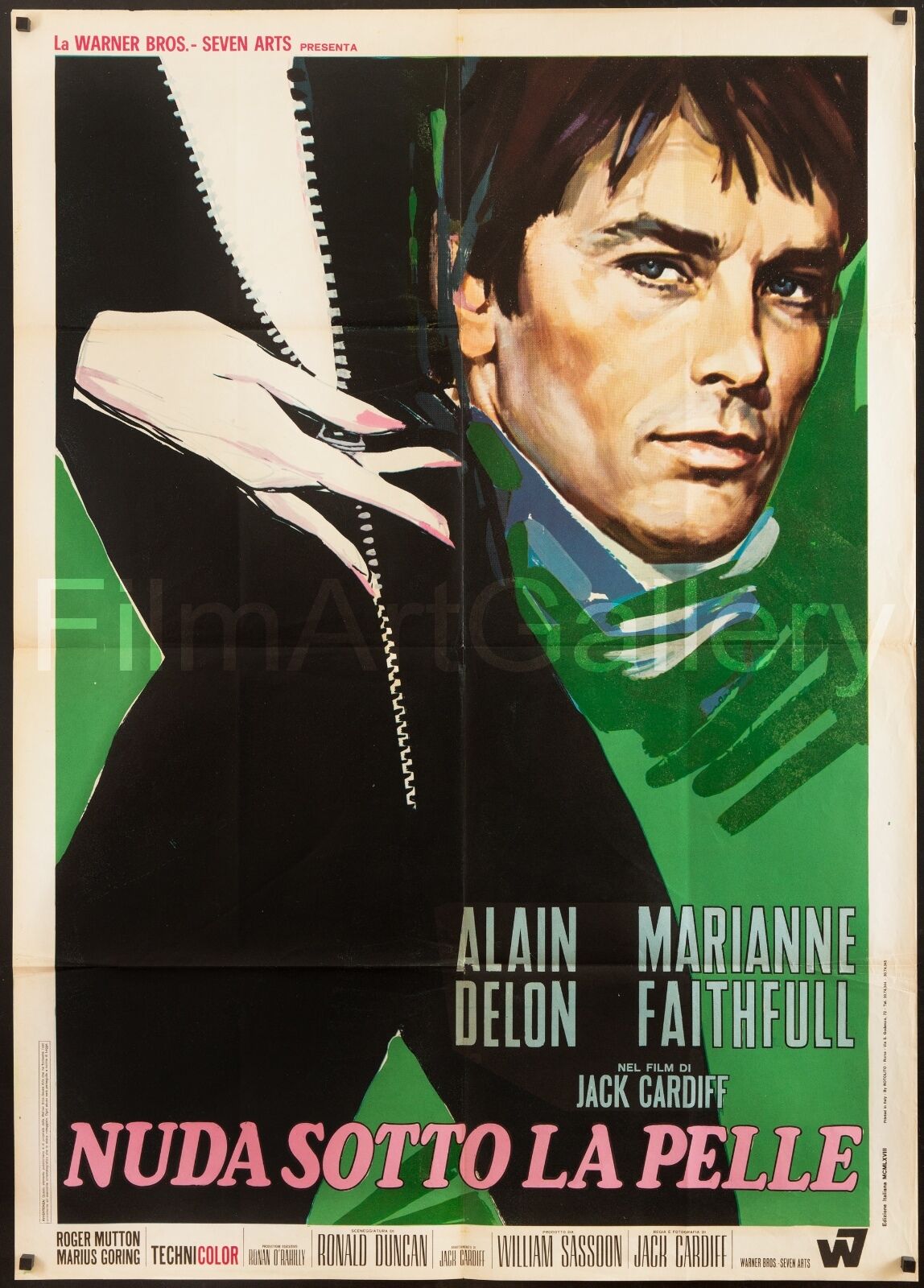
The Girl on a Motorcycle / Naked under Leather (1968) ***

An erotic charge deftly switched this picture from the Hell’s Angels default of violent biker pictures spun out cheaply by American International.  Where Easy Rider (1969) was powered by drugs, this gets its highs from sex. Rebecca (Marianne Faithful), gifted a Harley Davidson Electra Glide motorbike by lover Daniel (Alain Delon) two months before marriage to staid teacher Raymond (Roger Mutton), takes to the highways to find herself.

This ode to speed (of the mechanical kind) allows her to shake off her preconceptions and fully express her personality, beginning with the one-piece black leather outfit, whose zip, in one famous scene, Daniel pulls down with his teeth. The bike is masculine. “There he is,” she intones and there is a none-too-subtle succession of images where she clearly treats it as a male appendage.

She is both self-aware and lost. In some respects Raymond is an ideal partner since he respects her wild nature and gives her space, and she views marriage to him as a method of avoiding “becoming a tart.” In other words he represents respectability, just like her father (Marius Goring) who owns the bookshop where she works. But he is just too reasonable for her and, in reality, as she would inevitably discover that is just a cover for his weakness. The only scene in which she does not appear is given over to Raymond being tormented by young pupils who have him chasing round the class hunting for a transistor radio.

But Daniel is not quite up to scratch either. He believes in “free love”, i.e. sex without commitment and he is not inclined to romantic gestures and she knows she could just become another in a long line of discarded conquests should they continue. Raymond is a “protection against” Daniel and her ending up as an adulteress teenage bride and potential nymphomaniac. She seeks abandon not reality.

As well as sexy interludes with Daniel, her head is filled with sexual images, not to mention dabbling with masochism, in a dream her leather outfit being stripped off piece by piece by a whip-wielding Daniel, in a bar imagining taking off her clothes in front of the aged drinkers.

Jack Cardiff’s film is certainly an interesting meditation on freedom and sexual liberation at a time when such notions were beginning to take hold, but it suffers from over-reliance on internal monologue and Marianne Faithful’s lack of acting experience. Cardiff went straight into this from violent actioner Dark of the Sun (1968) and audiences remembering him from The Liquidator (1965) and The Long Ships (1964) would need reminded that he braced romance before in the touching and Oscar-nominated Sons and Lovers (1960). In that film he elicited an Oscar-nominated performance from Mary Ure, something that was unlikely here.

Pipe-smoking was generally the preserve of the old, or detectives, unless you were a young intellectual as Delon is here, but it does seem an odd conceit to force the actor into such a contrivance. Delon is accustomed to playing amoral characters, so this part is no great stretch, but, minus the pipe, he is, of course, one of the great male stars of the era and his charisma sees him through.

It was also interesting to compare Cardiff’s soundtrack to that of Easy Rider. Here, the music by Les Reed – making his movie debut but better known as a songwriter of classic singles like “Delilah” sung by Tom Jones – is strictly in the romantic vein rather than an energetic paeon to freedom such as “Born to Be Wild.” 

Cardiff’s skill as an acclaimed cinematographer (Oscar-winner for Black Narcissus, 1947) helps the picture along and clever use of the psychedelic helped some of the sexual scenes escape the British censor’s wrath, though not so in the U.S. where it was deemed an “X”. 

Dark of the Sun / The Mercenaries (1968) ****

Rod Taylor made a brisk transition to two-fisted action hero from his previous forte of drama (Hotel, 1967) and comedy foil to Doris Day (The Glass Bottom Boat, 1966) in this violent adventure set in the Congo in the early 1960s. As Captain Curry, assisted by sidekick Sgt Ruffo (Jim Brown) and 40-man local outfit Striker Blue Force, he leads an ostensibly humanitarian mission to rescue settlers cut off by the Simba rebels as a cover for collecting $50 million in diamonds. The loot is essential to save the toppling regime of President Ubi (Calvin Lockhart).  The only feasible transport is train. There is a three-day deadline.

Problems immediately ensue, not least a clash with Capt. Heinlein (Peter Carsten), former Nazi leader of Blue Force, who is even more ruthless than Curry, mowing down two native children who stray too close to the train, and apt to take a chainsaw into a fistfight. The train is attacked by a United Nations plane and on reaching its destination Curry is forced to wait three hours until the time-controlled giant diamond vault can be opened, giving the rebels time to catch up. Then it’s an ongoing battle of one kind or another.

Although the worst of the violence is carried out by the rebels – rape, torture and massacre – a core element of the drama is how a lifetime of killing has affected Curry. Ruffo, a man of principle who grew up in a primitive tribe, acts as his conscience – and that of the audience – spelling out how violence is more than a money-making scheme and essential to upholding order in terrorist times. Curry has some redemptive features, saving widow Claire (Yvette Mimieux) from the rebels and then from Heinlein, sending alcoholic Doctor Wreid (Kenneth More) to help a woman give birth, and eventually acknowledging his strong bond with Ruffo. Although Curry would like to think he is the opposite of Heinlein, they are carved from the same stock and when the savage beast is loose blood lust takes over.  

Mimieux is more or less there as bait, tempting Heinlein and any rebels in the vicinity, but coming into her own in convincing Wreid, paralytic by this stage, to carry out a section on the pregnant woman, and as a reminder of civilization for Curry.

The action scenes are terrific, especially the plane strafing the train, and there is a particularly good ruse, instigated by Ruffo, to outwit the enemy. Hollywood never managed to portray the terror of the native Vietnamese on being overrun by Viet Cong, and this film could easily be that substitute, especially when some of the rescued white settlers realize they will not escape.

This is not one of those films like Born Free (1966) or Out of Africa (1985) which are scenic odes to the continent, in part because the picture was shot in Jamaica, but in the main because director Jack Cardiff (The Long Ships, 1964) chooses to focus on the mechanics of the mission. And in so doing, he writes a love letter to a train. There had been a mini-vogue for war movies set on trains – Von Ryan’s Express (1965) and The Train (1965) come to mind – but none reveal an adoration for the power and perhaps the beauty of the locomotive. Every move it makes (to steal an idea from pop group The Police) is noted on screen and on the soundtrack, the hissing, the belching smoke, the wheels, cabooses, engine, the coupling and uncoupling of links, the screech of brakes, and various tracking and crane shots as the train snakes its way through enemy terrain.

Rod Taylor is excellent in the kind of role he is made for. Jim Brown in a major step up the billing after The Dirty Dozen (1967) is surprisingly good in a part that calls as much for reflection as action. Peter Carsten is the all-time Nazi scum. Yvette Mimieux, who had partnered Taylor in The Time Machine (1960), is also in transition mode, her role a meatier dramatic departure from the likes of the innocuous Monkeys, Go Home! (1967). In what was essentially his last major role – even though it doesn’t amount to much in screen time – Kenneth More wavers considerably from his stiff-upper-lip default.

The score by Jacques Loussier is particularly good, as Quentin Tarantino attested when he incorporated elements of it for Inglorious Bastards, which was a boon for the composer since up till then he was best remembered for the music accompanying the advert for Hamlet cigars. You might get a laugh out of the screenplay credits. Quentin Werty (i.e. Qwerty, the first six letters on a typewriter) the pseudonym of Ranald McDougall, Oscar-nominated for Mildred Pierce (1945), co-wrote the screenplay, adapted from the novel by Wilbur Smith, with television writer Adrian Spies.

An outstanding example of the all-out action mission picture, its occasional outdated attitudes do not get in the way of the picture and half a century later from what we now know of how wars are fought the levels of violence will appear realistic rather than exploitative.   

Catch-Up: This completes a Rod Taylor mini-season – previously features in the Blog are The Liquidator (1965), The Glass Bottom Boat (1966) and Hotel (1967).

Catch it on Amazon Prime.

The Liquidator (1965) ****

Brilliant premise, brilliant execution, brilliant acting. The best send-ups are driven by their own internal logic and this is no exception: spy boss, known simply as The Chief (Wilfred Hyde White), determines in most un-British fashion to get rid off a mole in the operation by eliminating all potential suspects. Bristling Colonel Mostyn (Trevor Howard) recruits Boysie Oakes (Rod Taylor) for the job, believing Oakes showed particular gallantry during World War Two, unaware this was pure accident. Oakes is given all the perks of a super spy – fast cars, fashionable apartment – and attracts women in a way that suggest this is also a perk and once realizing that being a killer is outside his comfort zone delegates the dirty work to another hit man Griffen (Eric Sykes).

The sweet life begins to unravel when Oakes takes a weekend abroad with Mostyn’s secretary Iris MacIntosh (Jill St John) and is kidnapped. Forced to battle for survival, another Oakes emerges, a proper killer.  Cue the final section which involves trapping the mole.

Where films featuring Matt Helm and Derek Flint imitated the grand-scale espionage they aimed to spoof, the laughs here come from small-scale observation and attacks on bureaucracy. According to regulations, Oakes’ liaison with MacIntosh is illicit. There is endless paperwork. Apart from an aversion to needless killing, Oakes has terrible fear of flying. Nobody can remember code names or passwords. Oakes’ automobile numberplate is BO 1 (the letters in those days being a standard acronym for “body odor”). It is all logical lunacy. And even when the story gets serious, it follows logic, a ruse, a dupe, a climax pitting resolve against human weakness.

Best of all, the parts appear custom-made for the players. Rod Taylor (The Birds, 1963), in his first venture into comedy, displays a knack for the genre without resorting to the slapstick and double takes requisite in the Doris Day pictures to follow. And he is a definite screen charmer.

By this point in his career the screen persona of Trevor Howard (Von Ryan’s Express, 1965) had been shorn of subtlety. He was generally one choleric snort away from a heart attack. Here, while the narrative pricks his pomposity, he remains otherwise ramrod certain. The audience is in on the joke, but nonetheless his genuine ability as a spy master is not in question. On the other hand Jill St John (Who’s Minding the Store, 1963) is allowed considerable leeway in the subtlety department, as a demure English rose rather than the sexier roles into which she was later typecast.  In some respects British television comedian Eric Sykes is miscast. It is a particular English joke to present him as a killer since on television (in shows unlikely to be shown in America) he was hapless.

And it is worth mentioning Akim Tamiroff whose villainous stock-in-trade is allowed greater depth. David Tomlinson (Mary Poppins, 1964) and Gabriella Licudi (You Must Be Joking!, 1965), have small parts. Aso watch out for future British television stars Derek Nimmo (Oh, Brother, 1968-1970) and John Le Mesurier (Dad’s Army, 1968-1977) as well as Jennifer Jayne (Hysteria,1965) and Betty McDowall (First Men in the Moon, 1964).

Director Jack Cardiff had tried his hand at comedy before with My Geisha (1962) starring Shirley Maclaine but was better known for Oscar-nominated drama Sons and Lovers (1960) and action picture The Long Ships (1964).  John Gardner, who wrote seven books in the Boysie Oakes series, later penned James Bond novels.

It is well worth considering whether The Liquidator would have punctured the success of both Our Man Flint (1966) and The Silencers (1966) and sent spy spoofery in a different direction. It had premiered in the U.K. prior to both but litigation held up its American launch  until long after that pair had gone on to hit box office heights.

Catch-Up: Previously reviewed in the Blog are Jack Cardiff’s The Long Ships, Rod Taylor in The Glass Bottom Boat (1966) and Hotel (1967) and Trevor Howard in Operation Crossbow (1965) and Von Ryan’s Express (1965).

Discover WordPress

A daily selection of the best content published on WordPress, collected for you by humans who love to read.

The Atavist Magazine

by Brian Hannan

WordPress.com News

The latest news on WordPress.com and the WordPress community.