Behind the Scenes: Cinemas Unshackled, The Long Run Beckons

In the 1960s the only way a movie could be guaranteed a long run at a city center cinema anywhere across the globe was if it fell into the roadshow category. Then the long run world was your oyster, runs of three months were standard, six months common, a year or more easily attainable. Outside of a handful of major cities of the size or prestige of New York and London, the same did not hold true of the general release. Most opened and closed in a city center theater within the week. A holdover extending a run to two weeks was rare and unless you were James Bond don’t think of a month.

That all changed in the 1970s, in part due to the gradual dearth of roadshows, in part due to the arrival of the duplex or triplex, in part due to the rise of the blockbuster and determination of studios to keep movies in the biggest and most expensive cinemas for longer to milk potential box office, and in part due to a sea change on the part of distributors. For my own entertainment I had, some time back, tracked on a weekly business all the cinemas in Glasgow so I can comment with some authority, using the many examples I had found, on the altered situation in the 1970s in that city, still, per capita, the biggest cinema-going city in Britain and, most likely, Europe.
The differences were not so obvious in the first two years of the new decade. Only seven movies in 1970 achieved runs of three weeks or more and the longest run – eight weeks – was for the roadshow Cromwell, the opening picture at the new Odeon 1. Next came a distinct outlier. Arthouse the Cosmo saw opportunity in the reissue double bill of The Graduate/The Thomas Crown Affair and held it over for seven weeks. Blockbuster Airport flew to six weeks at the Odeon 2. Butch Cassidy and the Sundance Kid ran for four weeks at, respectively, the ABC 1 and the La Scala. True Grit at the ABC1, Mash at the Odeon 2 and A Man Called Horse at the ABC1 held out for three weeks. (You’ll maybe note that the westerns were a bit late arriving in Glasgow given that in the U.S. they had been summer pictures in 1969. But distribution lags were still common in those days, little sign of global day-and-date.)

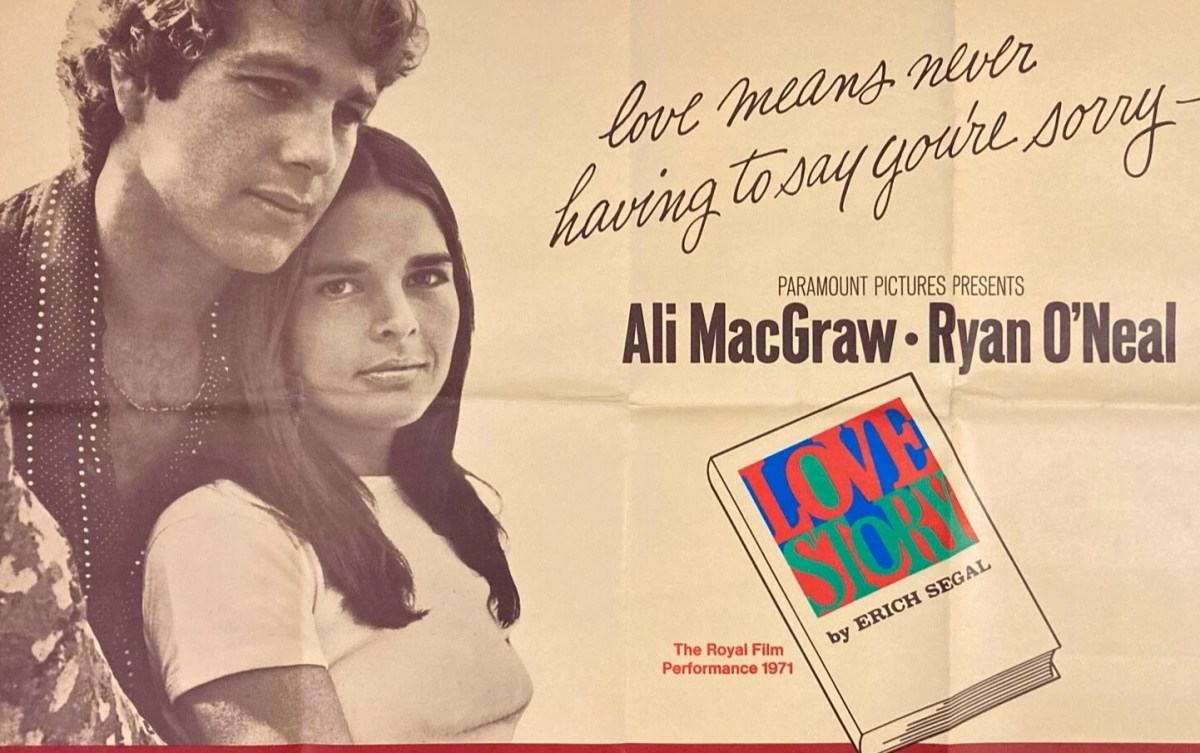
The next year saw a distinct improvement. Of the 12 movies I’ve noted, all ran for four weeks or more (rather than the three-week topline of 1969). One little film took the city by storm. Today, Love Story, without any notable stars, would be considered a sleeper hit. Such was its success Stateside that Paramount drove a hard bargain in Britain, demanding a bigger share of the spoils. So instead of landing at the ABC1 or ABC2, the normal home for the studio’s pictures, it went into the La Scala where it ran for an unprecedented 26 weeks.

One of the interesting aspects of concentrating on a particular city is that it reveals the individuality of its audience. Trends that are invariably deemed national tend in the U.K. to have a southern bias – Scotland, for example, accounts for less than 10 per cent of the British population. So, comparing the performance of pictures in Glasgow to the rest of the country throws up anomalies.
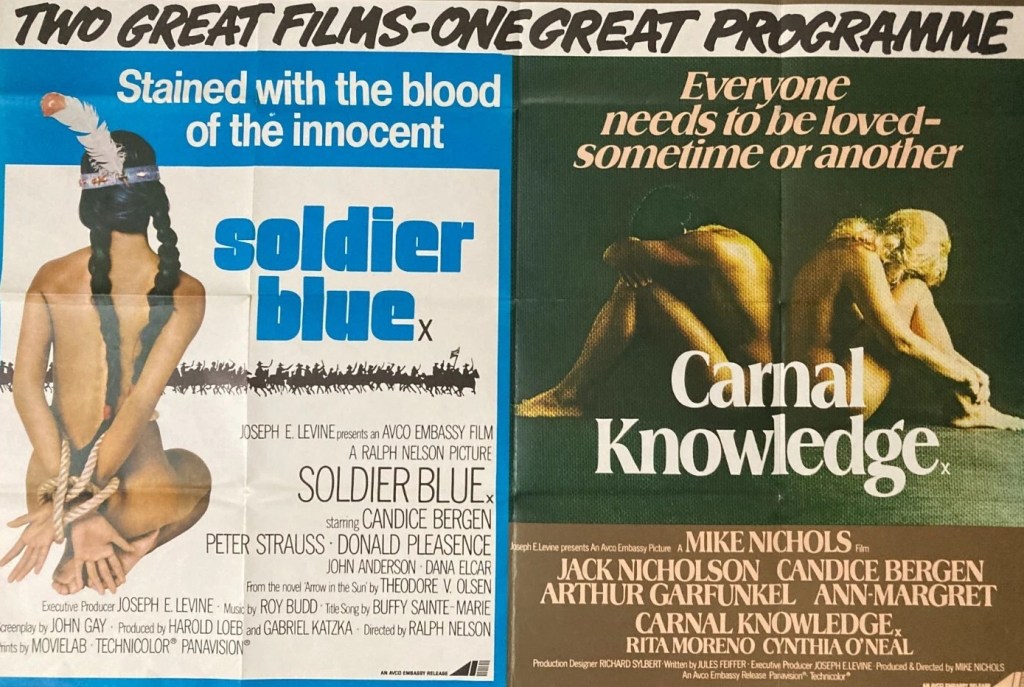
Glasgow’s next longest-runner – knocking up 10 weeks at the Odeon 2 plus three weeks at the smaller Odeon 3 – was bloody revisionist western Soldier Blue. Next came Barbra Streisand comedy The Owl and the Pussycat with seven weeks at Odeon 1. But that’s only if you’re sticking to the mainstream. Glasgow had also shown a predilection for the tawdry, not to say the exploitational. The Nun of Monza starring Anne Heywood and sex documentary Naughty also both managed seven weeks, the former at the Gaumont, the latter at the Odeon 3.

Sean Connery heist picture The Anderson Tapes snared five weeks at the Odeon 1. The La Scala held onto Woodstock for four weeks as did the ABC1 with Michael Caine thriller Get Carter, Dustin Hoffman as Little Big Man, another revisionist western, and Alistair MacLean’s Puppet on a Chain while at the Cosmo it was Tales of Beatrix Potter and The Anatomy of Love.

But it was the next year that brought the real explosion. You’ll remember it as the Year of The Godfather. But it didn’t have it all its own way in Glasgow. Though it ran for 14 weeks switching between the ABC1 and ABC2, that tally was matched by Clint Eastwood as Dirty Harry at the ABC1. Sean Connery’s return as James Bond in Diamonds Are Forever resulted in 11 weeks at the Odeon 1. The French Connection II logged six weeks at Odeon 2 while another sexploitation number I Am a Nymphomaniac did the same as Odeon 3. Barbra Streisand-Ryan O’Neal madcap comedy What’s Up, Doc? was good for five weeks at ABC1. Hitting the four week mark were Yul Brynner in western Catlow (in a double bill with The Jerusalem File) at Odeon 2 and Stanley Baker thriller Innocent Bystanders at Odeon 1. Glasgow audiences were less keen on Shaft and Straw Dogs, both just worth three weeks at the ABC1 and Odeon 2, respectively.

But by now the long run die had been well and truly cast. By 1973, movies were allowed to reach their full potential in Glasgow city center. There was a last hurrah for the roadshow when Norman Jewison’s musical Jesus Christ Superstar – without a marquee name in the cast -knocked up 17 weeks at the ABC2. But that only shaded Roger Moore’s first outing as James Bond in Live and Let Die with 16 weeks at Odeon 2. Another musical roadshow, The Great Waltz, headlined by unknowns, raced to 12 weeks at the ABC2.

There was a sense that the Odeon complex was playing it clever by booking the controversial Last Tango in Paris, headlining none other than Marlon Brando, huge again after The Godfather, in its smallest screen, the Odeon 3. The move paid off as the picture lasted 12 weeks.

Unsurprisingly, the first of the decade’s disaster pictures The Poseidon Adventure sailed along at the Odeon 2 for nine weeks. But few expected thriller Day of the Jackal, star Edward Fox hardly a marquee name, to run for equally as long at the ABC2.

Yet another roadshow, musical Lost Horizon, a remake of the non-musical original – with an all-star cast of Peter Finch, Liv Ullman, Michael York, George Kennedy and Olivia Hussey – held onto seven weeks at the Odeon 1. Stanley Kubrick’s controversial A Clockwork Orange (more than a year after its London launch) notched up six weeks at the ABC1 as did Clint Eastwood western High Plains Drifter. Sarah Miles as Lady Caroline Lamb went for six weeks at ABC2. Showing for four weeks were Lady Sings the Blues at the Coliseum, and reissues Cabaret and Mary Poppins at the Odeon 3 and Odeon 2, respectively.

Other reissues clocked up notable runs for oldies – three weeks apiece for Doctor Zhivago at the La Scala, The Ten Commandments at the Coliseum and the double bill of Soldier Blue/Carnal Knowledge at Odeon 3.

The Making of “The Godfather” (1972)

With the 50th anniversary imminent it’s no surprise to see a further addition to the already weighty library of works on The Godfather. What is surprising is just how good it is, wrapping up all previous research as well as adding copious new information about the making of the Mafia saga, in particular relationships between the filmmakers and the Cosa Nostra itself. A battle of egos as much as anything else with a budget that lay in tatters, quite how such a masterpiece emerged could have been a film in itself. Journalist Robert Seal has delivered a riveting book, replete with fascinating anecdotes, and with an insider’s knowledge of how a movie gets put together.

Some of the drama is certainly overplayed, the financial threats to Paramount at the end of the 1960s, the presence on the set of an auditor (hardly unusual with a director who had never handled such a big budget before), and the conflict with legendary producer Robert Evans who, after the event, claimed a greater share of the glory than he was entitled to. Evans at least had a track record – Rosemary’s Baby (1968), True Grit (1969) and Love Story (1970) among his successes during his tenure at the studio – compared to official producer Albert Ruddy with three flops to his name including Little Fauss and Big Halsy (1970) and best known for television hit Hogan’s Heroes. But Ruddy was known as a producer who could bring a project in under budget. As an indication of the kind of penny pinching that Evans expected, he made Ruddy buy his own copy of the novel.

Australian distributors took a different approach to advertising the movie.

Paramount had little interest in Mafia movies after the under-rated The Brotherhood (1968) – reviewed in the Blog – had flopped at the box office and Burt Lancaster was waiting in the wings ready to take the project off the studio’s hands. Compulsive gambler and impoverished author Mario Puzo had no screenwriting credits when brought in to work on the picture. And no idea how to write a screenplay. So he mostly played tennis. His biggest contribution when he was sitting in meetings with little to show for his efforts was to suggest Marlon Brando as star. A suggestion that met with complete silence because Brando was box office poison.

Francis Coppola – himself the creator of three flops and as impoverished as Puzo had once been – was hired as director in part because Paramount got the notion that the reason The Brotherhood had failed was lack of cultural assimilation, director Martin Ritt having no Italian heritage. Coppola was pushed as having an insider’s knowledge of Italians even though as Paramount executive Peter Bart pointed out that he “may have had pasta now and then but I don’t think their family is any more Italian than my family.”

Paramount took out an eight-page ad in “Variety” (March 29, 1972) to publicize the colossal initial gross and listed the receipts from every cinema where it had been playing for mostly three or five days.

As the makers of Succession have realised, there is a classic story to be told about business inheritance. Coppola wanted to make a movie that was about “more than guns and goons and sex and spaghetti.” He envisaged a “classic succession concerning a great king who had three sons, each of whom had a single element of what made the king great.” Prior to Coppola making his presentation to the studio, Ruddy told him to play up the low budget. Instead, the director gave “one of the great sales jobs of all time” convincing executives to at least give him a shot at doing it his way. He was hired for $175,000 and six per cent of the profits. “I had two kids, a pregnant wife, and no money. I was terrified,” said Coppola.

As well he should have been. Not only did he have mobsters knocking on his door complaining on the one hand about how the film could adversely present Italian Americans and on the other hand determined to land a role in the picture to the extent of paying for their own screen tests. So many talent schools charged $100 to shoot screen tests for any gullible schmuck that Paramount had to take out restraining orders. But made man Gianni Russo did land the role of Carlo Rizzi. Al Lettieri’s brother was involved in the business. Ex-wrestler Lenny Montana with no acting experience was picked out of a crowd watching the shooting to play hitman Luca Brasi.

Not the ideal balladeer to sing about the Mafia.

Although Frank Sinatra, Burt Lancaster, Ernest Borgnine, Laurence Olivier and Rod Steiger were among the stars pitched for the Brando role, Puzo had sent a handwritten letter to Brando imploring him to consider the role. The Brando test, with the star improvising his own make-up, was electric. But the greatest actor of his generation had to accept a pitiful deal – $50,000 for six weeks’ work – though, thankfully, a percentage had been tagged on.

Robert Evans wanted Robert Redford, Dustin Hoffman, Warren Beatty or Ryan O’Neal for Michael. “One of the reasons I got the job,” said Coppola, “was because they thought they could push me around.” He stuck to his guns, holding out for his dream team of James Caan, Al Pacino, Robert  Duvall and Diane Keaton, “eccentric and kind of weird in a way…to enliven the straight boring character” of Kay Adams.

But the casting was just the beginning of a momentous battle to keep Coppola’s vision intact. He came close to getting fired several times (“I was getting fired every other week,” recalled Coppola), especially as the budget, initially figured at $2 million, headed towards $6 million. The story of the shoot is told here in forensic detail. Come post-production, Evans wanted Henry Mancini to do the score so Coppola threatened to take his name off the picture unless the Nino Rota music was kept. 

Finally, when the film was ready it was met with – deafening silence. Paris premiere – silence. New York premiere – silence. When Albert Ruddy and Al Pacino watched it in an ordinary cinema with an ordinary audience the result was the same – silence. But the lines around the block indicated something else – a phenomenon.

The only area where author Seal gets it wrong is in his understanding of release strategy. “Its distribution was a revolution,” claimed Mark Seal. Only it wasn’t. I know because I wrote a book on the subject (In Theaters Everywhere if you’re interested) and there was nothing at all novel in releasing a movie in New York in 26 cinemas all at once.

But apart from that glitch, Seal has produced a brilliant, incredibly readable book, that covers the saga of the making of the film in as much detail as an aficionado would want. Drawing on the dozen other books written previously about the film and adding his own fulsome research, Seal has created a book that will be as much a monument to this film as the film is to Hollywood cinema in the 1970s.

For some reason the guy who created the best movie of the year wasn’t good enough to be named Best Director at the Oscars- that went to Bob Fosse for “Cabaret.”

In 1972, there was no such thing as a global wide release. Although it was shown in the U.S. in March that year, in Glasgow, Scotland, where I lived, The Godfather did not get its first showing until the end of August. It opened at the ABC 1 in Sauchiehall St in the city centre as well as over the River Clyde at the ABC Coliseum. It was competing with two roadshows, Young Winston and Mary, Queen of Scots at the Odeon 1 and Odeon 3, respectively, Robert Redford in heist picture How to Steal a Diamond at the Odeon 2 and What’s Up Doc? at the ABC 2. Western The Hired Hand was playing the arthouse Cosmo and the arty Made for Each Other at the gigantic Green’s Playhouse. The La Scala had the double bill of Dr No/Thunderball and the Regent was in the second week of Dirty Harry, somewhat unusual in that this was a second run house where pictures were rarely retained.

There were three performances a day for The Godfather but no advance booking – as would have been the case if it had gone into roadshow – so the queues outside both cinemas were huge. It had such an impact on me I saw it twice in the same day. When I moved to London I used to take regular advantage of the double bill The Godfather / The Godfather Part II when it used to play a cinema in Regent St on occasional Sundays, so I have no idea how many times I have seen both. Never enough, I would guess.

Where were you when you first saw The Godfather?

And where will I be on February 26 when The Godfather will be reissued in cinemas all over Britain (and possibly worldwide for all I know)? I leave it to you to guess.

To cash in on the 50th anniversary, cinemas all around the world are planning to screen all three parts of the trilogy. So watch out for them.

Discover WordPress

A daily selection of the best content published on WordPress, collected for you by humans who love to read.

The Atavist Magazine

by Brian Hannan

WordPress.com Blog

News, Tips & Website Tutorials