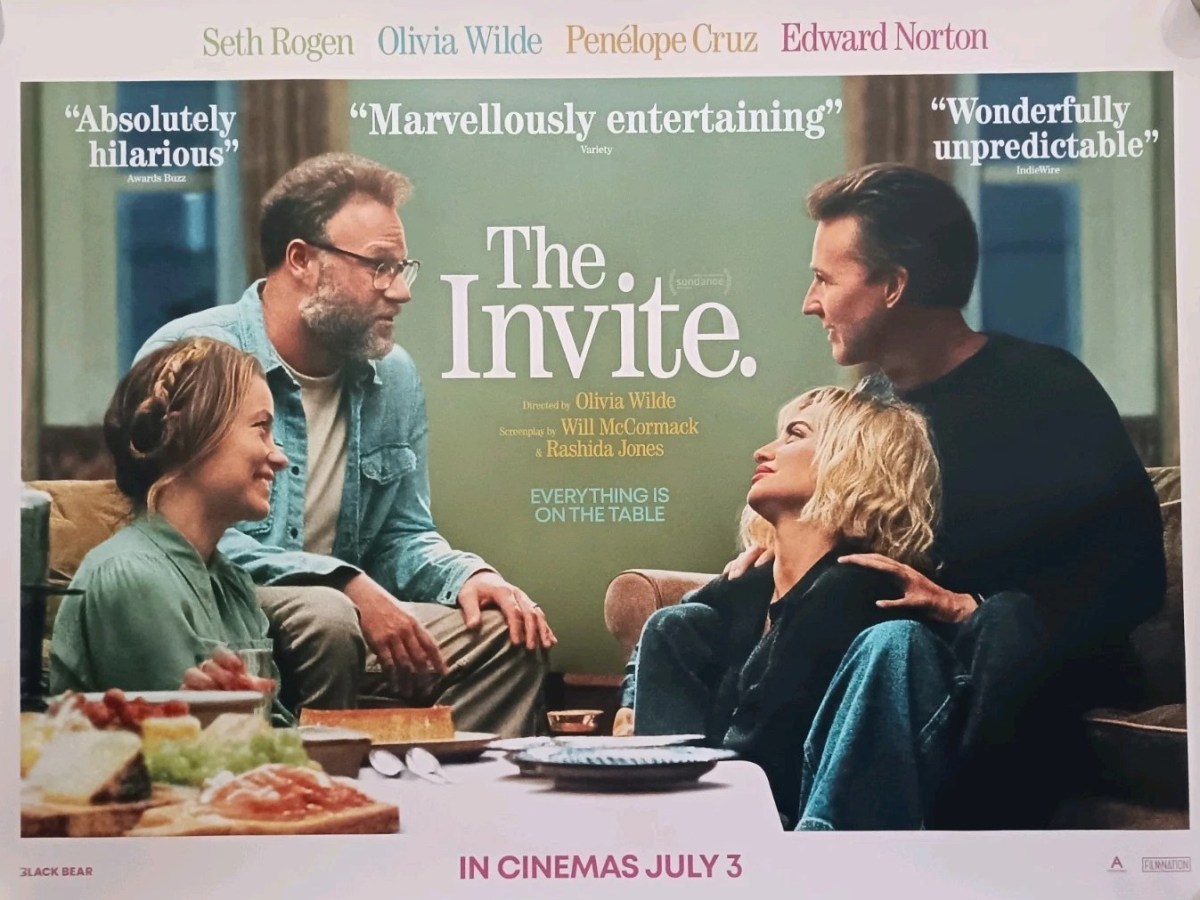
The Invite (2026) ** – Seen at the Cinema

Not so much a gabfest as an outbreak of verbal diarrhea. This exceedingly slim offering is what passes these days for the kind of movie that might be appreciated by an intelligent audience or served up as counter-programming to the onslaught of the summer blockbuster.

But it’s as if the idea of marriages in trouble is novel, never been properly examined until the current new wave came along – for some reason Alan Parker’s Shoot the Moon (1982) with Albert Finney and Diane Keaton as the warring couple came to mind as an example of how easily this subject had been dealt with in the past without the necessity for coming at it all coy.
Everyone rabbits on at forty words to the dozen, talking over each other, repeating themselves as if the notion of editing had never occurred to anyone so that it ends up as a stagey four-hander, not far I would imagine from the stage play on which it is based.

And it has one of the most infuriating scores I have ever come across. I’m sure it’s intended as post-ironic or some such. Instead of allowing the words to speak for themselves the dialog is heavily overlaid with ominous music whose intensity is heightened as emotions rise.

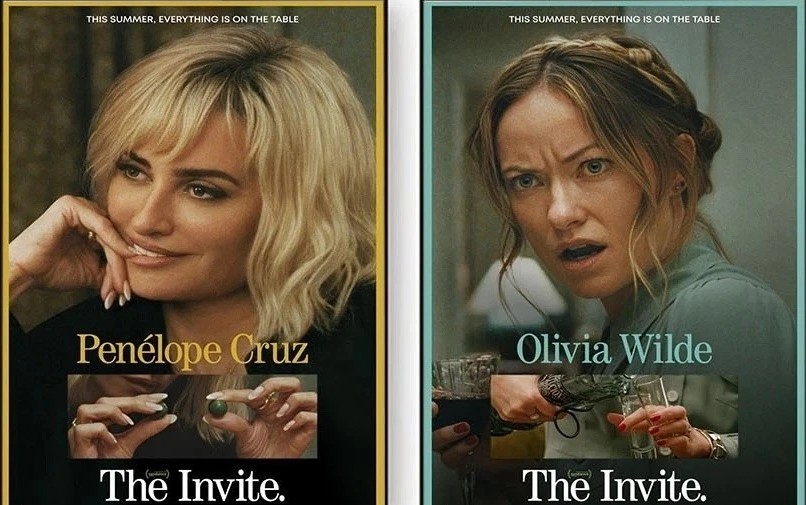
Worse, this is primarily a shaggy dog story and a good bit of bait-and-switch, allowing the characters (Shock! Horror!) to utter such words as “double penetration” and “pegging” (Google them) – all of which sexual preferences are laboriously explained to married apparent innocents Joe (Seth Rogan) and Angela (Olivia Wilde) by more worldly pair Pina (Penelope Cruz) and Hawk (Edward Norton).

The invite in question is to join in a sex party, to turn the stuffed shirts into swingers. Olivia is jealous of the orgasms she can hear from Pina who lives upstairs in a weird apartment block where despite each couple living above or below the other they can still, by quirk of narrative or architecture, see each other through the window (go figure) which comes in handy if one of the couples is a secret exhibitionist and the other a voyeur.
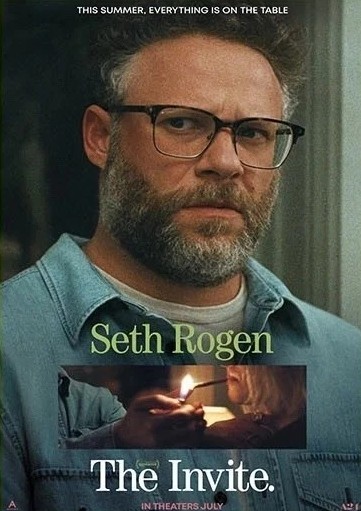
Our foursome represent little more than standard cliches – stoner Joe and his neurotic wife who has to tidy up the kitchen before embarking on sex, the supposed charmer Hawk and the more obviously sexy Pina who is not averse to bursting out of her cleavage. There are jokes about exhibitionism and about Hawk not being musclebound enough to be a firefighter.

There are about ten worthwhile minutes in the entire picture when the characters properly open up, though Joe revealing himself as a failure, Angela as a self-centered stay-at-home mum with artistic ambitions she cannot be bothered to properly explore, and Hawk as not as tough as he seems, is not enough to prop up the rest of the picture.

For a comedy, even a purportedly sophisticated one what with all this talk about sex, it’s remarkably light of the laff front and in any case any opportunity for the audience to even snigger is seriously jeopardized by having a director (Olivia Wilde) with no sense of comic timing, barely leaving a millisecond between lines that could elicit a laugh, guaranteeing that nothing has the opportunity to strike home.

I’m no big fan of Seth Rogen (Good Fortune, 2025) since as far as I can tell he always plays the same character but at least he’s not as mealy-mouthed as the others. But when you rely on tantrums to inject some life into a picture you’re on a hiding to nothing.

I can see why this has received generally good reviews. It’s the critics’ job to push in front of audiences a discerning movie or two, but, as often as not, they are so determined to prod the audience that they nudge them towards movies that barely deserve the praise.

Edward Norton (A Complete Unknown, 2024) has been confined to small parts of late so it’s good to see him last out a full film. Penelope Cruz (Ferrari, 2023) offers more emotion, sass and psychology than the others. Olivia Wilde (Babylon, 2022) overacts like crazy.

In her capacity as director, count this as another misfire for Olivia Wilde (Don’t Worry, Darling, 2022). Will McCormack (Toy Story 4, 2019) and Rashida Jones (On the Rocks, 2020) adapted the play by Cesca Gay.

This had an old-fashioned platform release in the U.S., which meant it could rack up decent averages by only being shown in a handful of cinemas, allowing marketeers to dupe the media into thinking it was a hit.

Steer clear.
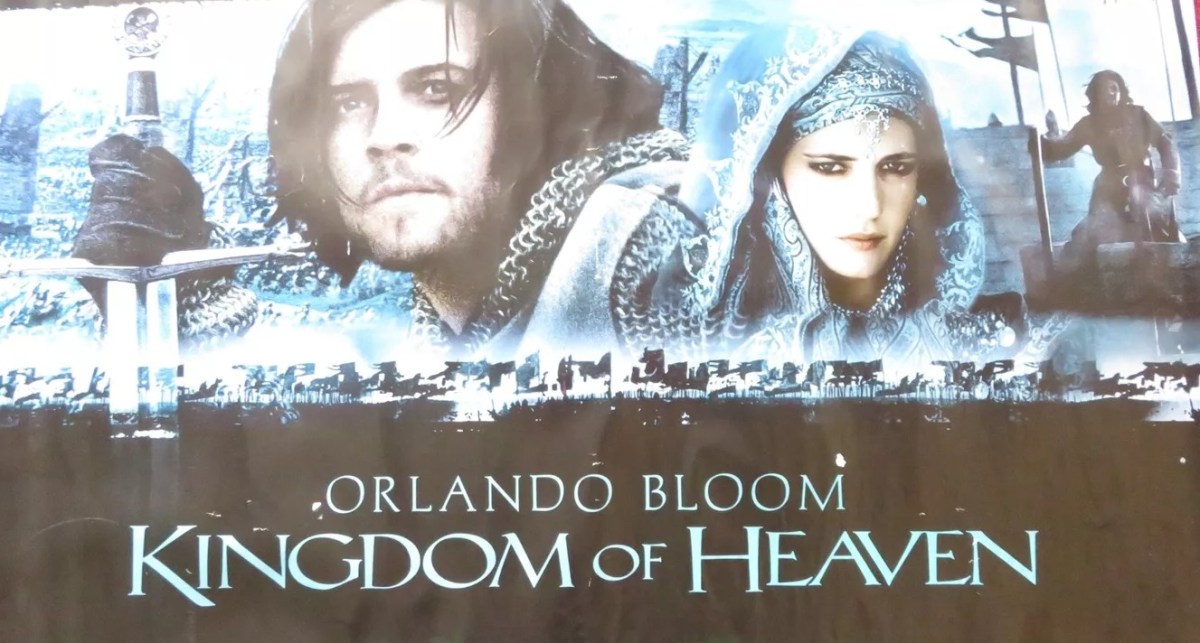
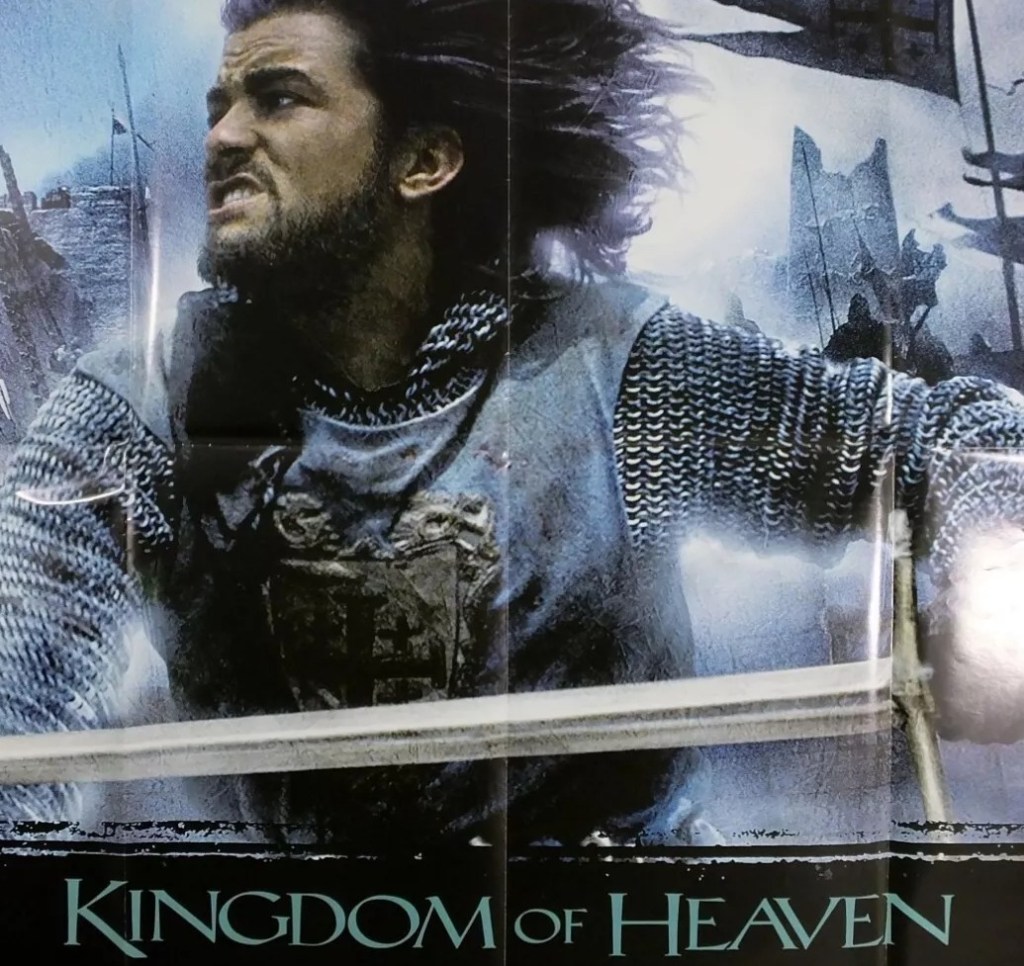
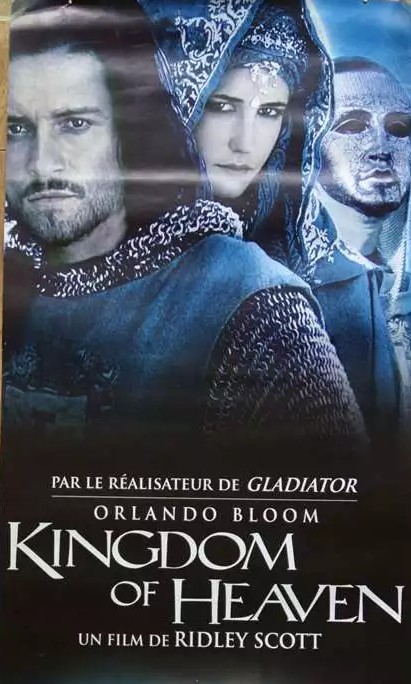
Kingdom of Heaven (2005) ***

I’m conscious of entering contentious waters especially as a new 4K DVD edition of the 195-minute Director’s Cut – expanded from the original 144-minute version – is being released by Twentieth Century Fox to coincide with today’s theatrical 20th anniversary theatrical release. Normally, that would have filled me with joy because I was a huge fan of the original Director’s Cut, which, it is true, added considerable depth to the film as initially screened.

But in watching the Director’s Cut as the first part of a proposed All-Time Top Ten double bill with Any Given Sunday (1999) I discovered to my horror it was not the film I remembered and had for many years championed. The flaws were all too obvious, it was extremely wordy, rammed full of characters and a narrative that ran all over the place trying to keep up with itself.

We should begin with the major flaw and that’s the casting of Orlando Bloom, fresh from his breakthrough role in Pirates of the Caribbean: Curse of the Black Pearl (2003), as Balian the blacksmith. The role was written for Russell Crowe but schedule clash prevented his involvement. Director Ridley Scott went ahead anyway and Bloom doesn’t remotely convince as a leader.

Though most of the picture is based on historical fact, the initial MacGuffin doesn’t make sense. For the purposes of the narrative we need to get blacksmith Balian to the Crusades. Balian’s wife (Nathalie Cox), seen briefly (and happily) in flashback, has committed suicide because of a miscarriage which seems a mighty odd reason, and we are never made privy to whatever other  mental problems afflicted her. In those days, if you committed suicide you could not be buried in sacred ground and furthermore your head was chopped off. Now, admittedly, the local priest (Michael Sheen), Balian’s half-brother, is a creepy character, but it hardly seems to justify Balian thrusting a sword through his heart and setting him on fire.

But, don’t you know it, if you run off to the Crusades you win a get-out-of-jail-free card rather than being hung for your crime. So Balian joins up with his dad Godfrey (Liam Neeson) who has returned briefly from the Crusades and initially been rejected by his son. They’re attacked by soldiers seeking to arrest Balian but, wouldn’t you know it, after a few lessons from his old man, Balian turns out to be an ace swordsman.

Eventually, after a few adventures and shipwreck and fortuitous encounter with Muslim Imad a-Din – remember the name because he later plays a critical role – he reaches Jerusalem and is confronted with a wordfest, a heavy distillation of philosophy, a narrative that flits around fragile peace between Christian and Muslim, and woman of intrigue Sibylla (Eva Green) whose husband Guy happens to be the leader of the anti-Muslim forces.

It might have helped if Godfrey hadn’t inconveniently died, of wounds while protecting his son, because Liam Neeson strikes you immediately as a leader and not the kind of actor like Bloom who is only a leader because the script says so. Anyways, before we can get down to any of the stirring and visually commanding action for which Ridley Scott is rightly acclaimed, Balian, who remember is a blacksmith, turns before our eyes into a wizard of an engineer and before you know it a parched piece of land is fully irrigated. It’s a lovely sequence, to be sure, and accompanied by my favorite piece of music (score by Harry Gregson-Smith) in the film, but not particularly believable.

Nor is the romance, Sibylla now deciding on adultery with her husband’s enemy. And, again, to be sure, much of the extra footage does fill out her character, but that still leaves a jumble of other characters fighting for political power – the dying masked King of Jerusalem, Baldwin IV (Edward Norton), a leper; City Marshal Tiberias (Jeremy Irons); the aforementioned Guy and his sidekick Raynald (Brendan Gleeson); assorted Knight Templars who are ferociously anti-Muslim; and parked outside the city gates Muslin chief Saladin (Ghassan Massoud).

The story, if you can still keep sight of it amongst all this intrigue, is that Guy and Raynald and the Knights Templar want to spark a Holy War, ending years of peace, restoring Jerusalem to sole ownership of the Christians, rather than being equally shared (though, noticeably, no Muslims on any of the ruling factions).

Anyway, eventually, after we’re done with philosophizing and Balian making hay with Sibylla, we get to the action and at last the movie takes flight, and though you no longer particularly believe in Balian as a leader of men he does show some tactical awareness. There’s a superb pitched battle against superior forces and a magnificent siege. Written by William Monahan (The Departed, 2006).

But watching the Director’s Cut again I came away wishing for the shorter version, though very little could compensate for the casting of Orlando Bloom.

I might change my mind if I get to see it in the cinema again but for the moment it’s lost its coveted place in my All-Time Top Ten.

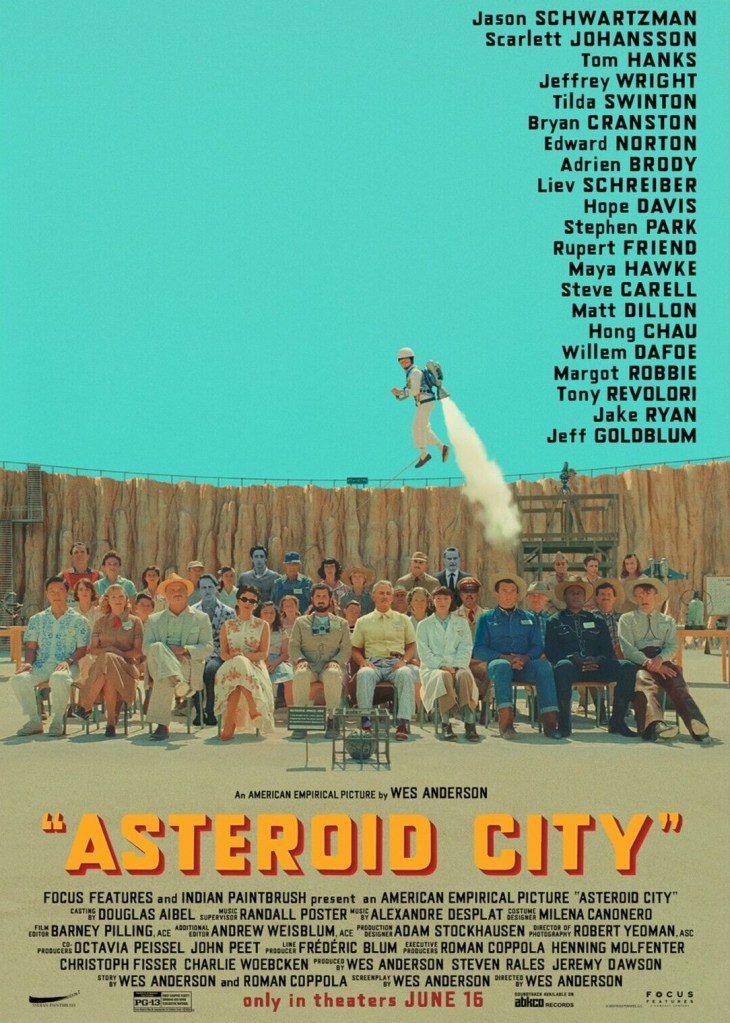
Asteroid City (2023) **** – Seen at the Cinema

“Up to his clavicle in whimsicality,” is the best I can do. While acknowledging that quote is not mine, I should also make clear it could apply to any Wes Anderson picture. He strikes me as critic-proof. With a hard core of fans, whether his movies enter box office heaven depends on the oldest and most elusive of marketing tricks: word-of-mouth.

I am going to be telling everyone to go-see without really being able to explain why they should. I might not be able to describe the plot without putting everyone off. I might get the plot wrong. Ostensibly, it’s about a bunch of disparate characters coming together in the titular city (pop: 87!!) to celebrate in the mid-1950s the gazillionth anniversary of the landing of an asteroid, a pock-marked rock about the size of a giant watermelon.

The motley crowd includes scientists, U.S. Army representatives, schoolkids taking part in a science competition, sightseers and some characters stranded there and, halfway through, an alien who commits the heist of the century, though unlike most caper pictures there’s none of the usual pre-robbery set-up.

While Anderson has a consistency of outlook that delights/bewilders/infuriates critics, he has a stunning sense of originality. He doesn’t repeat himself and reveals an astonishing freshness when it comes to the myriad methods employed to tell a story. At least here, the narrative is, roughly, straightforward not breaking off into various routes (or even cul de sacs) as in his previous outing The French Dispatch, which struggled in the old word-of-mouth department but which I adored.

To help me along here with what the film was all about I looked up the lead review in Imdb. Not only was it no help at all, it was pretty dispiriting. Poor old Wes Anderson gets walloped for lack of plot. I couldn’t care tuppence for plot as long as I’m entertained. And I went along quite happily with the ultra-post-ironic (post-something anyway) notion that we were watching the filmed version of a famous play or possibly the situation which inspired the play but cutting between both and the actors in the movie version not only playing characters but dropping into their genuine personalities – or perhaps not, maybe these were the characters from the play.

And here, the last thing I want to do is put you off. So, yeah, if you think narrative isn’t just watching a bunch of people who’ve never met before interact, a category into which I guess you would chuck movies as different as The Towering Inferno (1974) and Titanic (1997), and think they have to be gathered for a doomsday scenario, and ignore the likes of Bus Stop (1956) then just go ahead and talk yourself out of that rare sighting on the Hollywood hills, an adult movie with nary a superhero (discounting said alien of course, whose back story might include super-heroism for all I know) involved.

This might just be one long litany of jokes, but why would you complain about that? Anyway, for the sake of anyone who has come here for a proper review, here goes.

Grieving widower Augie (Jason Schwartzmann) is unexpectedly stuck in Asteroid City when his car goes into meltdown. His three young children think they are auditioning for Macbeth, constantly casting spells and intent on burying their mother’s ashes, contained in a Tupperware bowl, in the desert, and generally acting weird. His equally widowed father-in-law Stanley (Tom Hanks), dressed as if coming straight from the golf course, turns up to pretty much tell him how much he dislikes him. Augie has a short affair with movie star Midge (Scarlett Johansson) while her science-minded daughter gets to experience first love and proves a whiz at some extremely complicated memory game that I might have played when young but can’t remember the name of or which could equally be a Wes Anderson invention.

Please sir, that’s as much plot as I can remember. Various other characters appear, flitting in and out, and don’t behave as you might expect. Oh, some do, there’s a hotel owner selling plots of real estate, but there’s also the apparently straight from Central Casting General Gibson (Jeffrey Wright) whose speech sounds more like an elevator pitch for a novel. See, I told you, explaining it won’t help. You just gotta go see it.

You might spend the whole picture rubber-necking, spotting stars in cameo roles, but except for Edward Norton and to some extent Tilda Swinton none of them are doing what they are famous/infamous for. Maybe Wes Anderson has a constant queue of A-list applicants for small roles just because a) they get to play someone completely different from normal and/or b) they get to work with the great man.

Roman Coppola (Moonrise Kingdom, 2012) was drafted in to help write the screenplay maybe just so the director can get to share the blame if it’s a critical dog.

Go see.

Did I already say that?

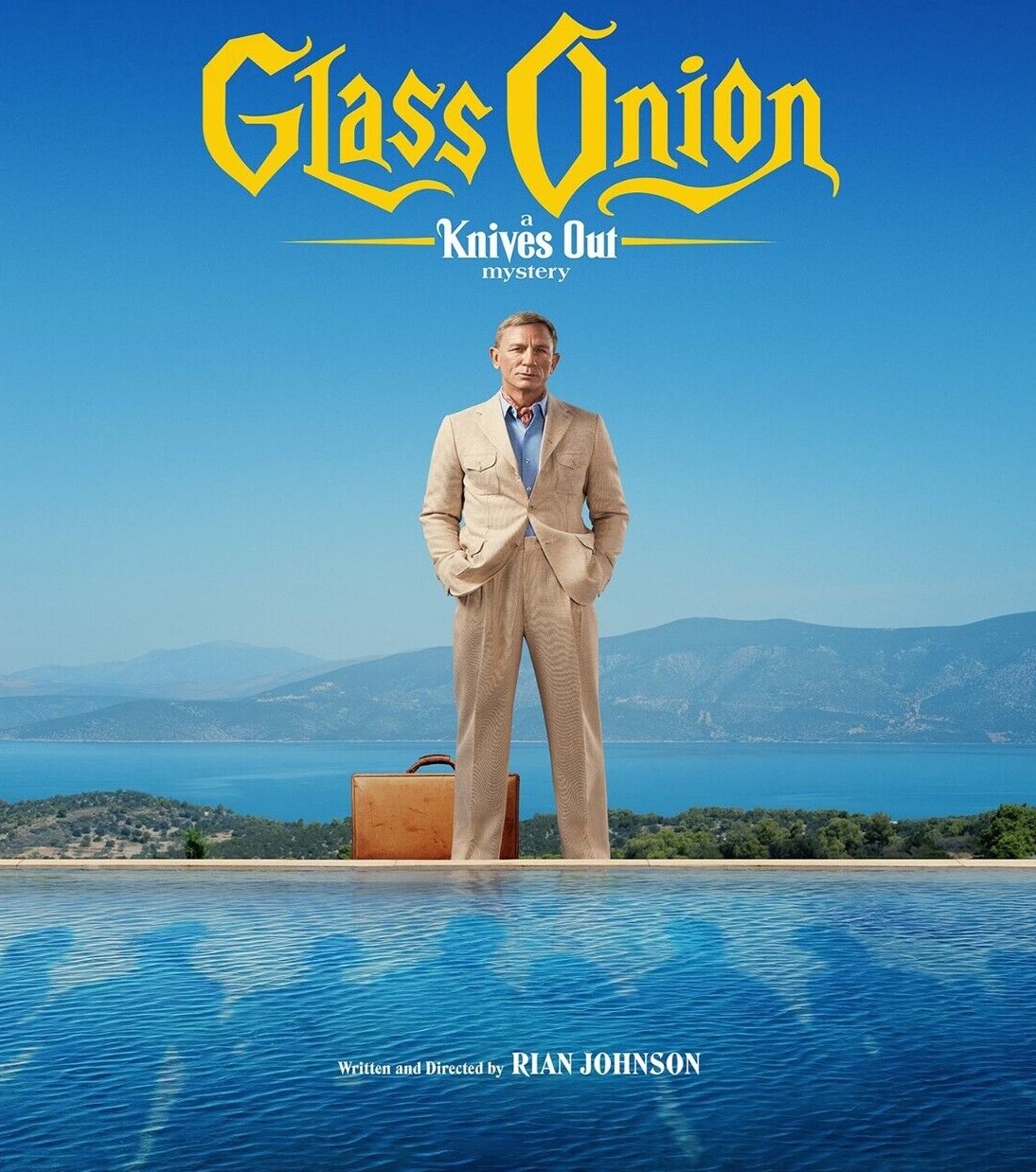
Glass Onion: A Knives Out Mystery (2022) **** – Seen at the Cinema

Another triumphant entry in the casebook of Benoit Blanc, self-style world’s greatest detective and easily the most flamboyant in the genre since Hercule Poirot. Writer-director Rian Johnson’s invention offered Daniel Craig an immediate opportunity to shed the typecasting curse of James Bond and the actor rises splendidly again to the occasion, some hints of his inner life offered, signs of depression and a cameo by Hugh Grant as flatmate, helpmate, whatmate.

But in the main it’s another twisty picture that plays with audience expectation even though, if only we were as clever as its creator, the truth is in plain sight, beginning with the title.

Victims – or suspects – assemble.

You have to peel through layer upon layer of an ordinary onion, but a glass onion you can see straight through. It would not occur to the audience, lured by mystery, arriving with a different sort of anticipation, counting on this glass onion to be a mere architectural folly atop a majestic building on a remote island off the cost of Greece, that everything could be actually straightforward and that the need for complicated crime is a figment of our own imagination.

There’s only one twist you may guess and the movie certainly takes a while to spark into life as we are introduced to a variety of unlikeable characters, ideal candidates you might think to be a victim, through the device of them all receiving an extremely puzzling puzzle in an apparently impenetrable wooden box.

Right from the get-go, the audience is sucked in. Are they the  type of people who are determined to solve the riddle, with endless patience, or in collaborative effort expend energy and time on a fiendish enigma that seems to change shape every few minutes, layer by layer like a veritable onion? Or do we just work out that a box made of wood ain’t going to have no defence against something as simple as a hammer?

Anyway, enough with the philosophizing and on with the show. During Covid a bunch of disparate characters with no connection except a link to billionaire Miles (Edward Norton) are invited for a murder mystery weekend to his island home. Miles, being the show-off to top all show-offs, has invited Benoit on the basis that his mystery will fox the detective, score one for an  uber-clever magnate.

He is so unbelievably wealthy and ridiculously endowed with genius from thinking outside the box that he has managed to secure a loan of the Mona Lisa painting from the Louvre in Paris, paid through the nose for it of course, taking advantage of the museum’s lack of income from the paying tourists, Covid having dried up that moneywell. The artwork will form the centerpiece of his cleverness as he presents to a posse of investors later on his newest invention, Klear, an idea that, however dangerous and untested, will solve the world’s energy supply problems.

Anyway, Benoit is way too smart for him and solves the murder mystery in a trice, only for there, as you might have expected, to be another real murder or two, leaving the private eye with the unusual accent a classic closed room mystery.

Under suspicion are Miles himself of course, plus one-time model turned fashion designer Birdie Jay (Kate Hudson), the dumbest cluck in the coop, aspiring politician Claire (Kathryn Hahn), Miles’ former business partner Andi (Janelle Monae), macho male Duke (Dave Bautista) and girlfriend Whiskey (Madeline Clyne), Miles’ sometime lover, scientist Lionel (Leslie Odom Jr) and Peg (Jessica Hanwick). What they share with Miles is vanity, an overweening sense of their own importance and entitlement.

Actually, one of them doesn’t qualify as a suspect because as you may have guessed that would be the victim. Two of them, since I’ve already kind of given away that there are two dead. Anyway, you’re not going to guess any of this since you’re all dupes to the infinite ingenuity of Rian Johnson.

Sure, the director takes pot-shots at the rich and the wannabe wealthy and the wannabes that trail along in their wake, but mostly he takes aim at the genre itself, turning the whole idea of the mystery picture on its head, that we expect something pretty intricate the moment we are presented with a movie puzzle, and motivation being the engine of all mystery start delving headlong into that morass without thinking the answer might be something a lot simpler.

Whatever Rian Johnson is doing he’s got the elan to carry it off. Sequels often disappoint. This won’t. Not quite the caliber of cast as Knives Out (2019) but that’s actually to the film’s advantage, no need for the star-stalking that afflicted the recent Death on the Nile (2022).

Thoroughly entertaining, ingenious and devious, what more could you ask for, apart from Netflix not having snapped up the golden goose, since this will be infinitely more enjoyable in the company of an audience responding en masse to the trickery, as I discovered when watching it on its brief foray to the cinema.

And there’s certainly a dichotomy here. What is the point of the Netflix sop to the movie theatre? Sure, it’s going to rack up a ton of reviews but they’re all going to be posted a month before the picture opens on Netflix rather than the weekend before. Anticipation may not last that long. Anyway, given all the turkeys Netflix has foisted on movie fans, this will be one Xmas when it delivers.

PS: Apologies for the goof on Behind the Scenes: “Bandolero.” That blog is coming on Saturday but I pressed the wrong button and sometimes when you press the wrong button there’s just no going back.

Discover WordPress

A daily selection of the best content published on WordPress, collected for you by humans who love to read.

The Atavist Magazine

by Brian Hannan

WordPress.com News

The latest news on WordPress.com and the WordPress community.