The Jules Verne express grinds to a halt in part because the promise of outer space adventure fails to materialize and in part because the treatment is comedic in the manner of The Great Race (1965). A series of sketches with a shifting array of characters rarely works. Occasionally it hits the mark in a laugh out loud fashion but too often the jokes are labored although as a tribute to a maze of inventive invention it’s a treat.
Unusually for such an all-star cast venture, we are, long before the titular action and a race (of sorts) commences, treated to the greatest hits from the book of all-time failures. So we have electricity setting on fire the first country house, belonging to the Duke of Barset (Dennis Price), to be so illuminated; a new-fangled suspension bridge, courtesy of Sir Charles Dillworthy (Lionel Jeffries), that collapses when Queen Victoria cuts the ribbon; and a new type of explosive invented by German von Bulow (Gert Frobe) that proves a tad overpowering. Meanwhile, making possible the idea of sending a man to the moon is the arrival in Britain of the diminutive General Tom Thumb (Jimmy Clitheroe) accompanied by the bombastic and greedy Phineas T. Barnum (Burl Ives).
Combining the various scientific advances of propulsion and engineering have the flaw of not being able to bring a manned rocket back home. And sinister forces are at work, spies and fraudsters.
As with all these all-star comedies you spend half the time wondering how your favorite star is going to be worked into the equation and, having been squeezed into the narrative, justify their ongoing involvement. Daliah Lavi (Old Shatterhand, 1964), not particulary known for her comic gifts, is a case in point. On her wedding day she (as Madelaine) jilts French groom Henri (Edward de Souza) in favor of balloonist Gaylord (Troy Donohue) who has, literally, appeared on the horizon. Henri trying to down said balloon triggers an awful joke about a shotgun wedding.
To gain revenge, Henri funds the project on the basis of Gaylord being the moon pilot, and, in anticipation of the craft’s failure, that he will regain his bride. Madelaine, having been sidelined by all the developments, suddenly rushes back to center stage when she uncovers the devious plot and is shipped off to a home for wayward girls, run by the very wayward Angelica (Hermione Gingold). But that requires she escape and find her way back to her beloved, that aspect complicated because she loves both men (it transpires).
As the script is in the invidious position of having to place the participants into similar frying pans in order to effect similar rescues it’s as much a game of ping-pong as a movie. But there are some nice gags, a rocket attached to a helmet, the ruination of a teleprinter and the criminally-inclined Washington-Smythe (Terry-Thomas) who rooks billiard players with a magnet. And there’s a very contemporary financial element in that large wagers are placed on failure rather than success, the equivalent of betting on stocks going down rather than up (short selling in the modern idiom)
The rocket is launched, with rather a different crew than originally anticipated following further skullduggery, and although it’s something of a cosmic joke that it only gets as far as Russia it’s rather a disappointing ending for fans of Verne who anticipated a more rigorous approach. Verne’s novel From the Earth to the Moon was surprisingly accurate in imagining how a projectile would achieve its aims. The novel had even more of a contemporary feel since it left the crew floating in space, a daringly artistically inconclusive climax, leaving the way open – again the contemporary flair – for sequel Around the Moon that explained their fate.
Oddly enough, Daliah Lavi, as the bride who can’t make up her mind, has one of the better parts, more fleshed out than most of the other flimsy characterizations. The likes of Troy Donohue, caught between heroism and doing nothing much at all, often looks flummoxed. Terry-Thomas (How To Murder Your Wife, 1965) in wily mode is the pick of the rest.
Director Don Sharp (The Brides of Fu Manchu, 1966) proves that comedy is not his metier. Screenplay by Dave Freeman (British TV sitcom writer making his movie debut) after Harry Alan Towers (Five Golden Dragons, 1967) altered the author’s original premise. While it could be skewered for taking such liberties with the august author, it is far better than you might expect, but not as good as it could, or should, be.
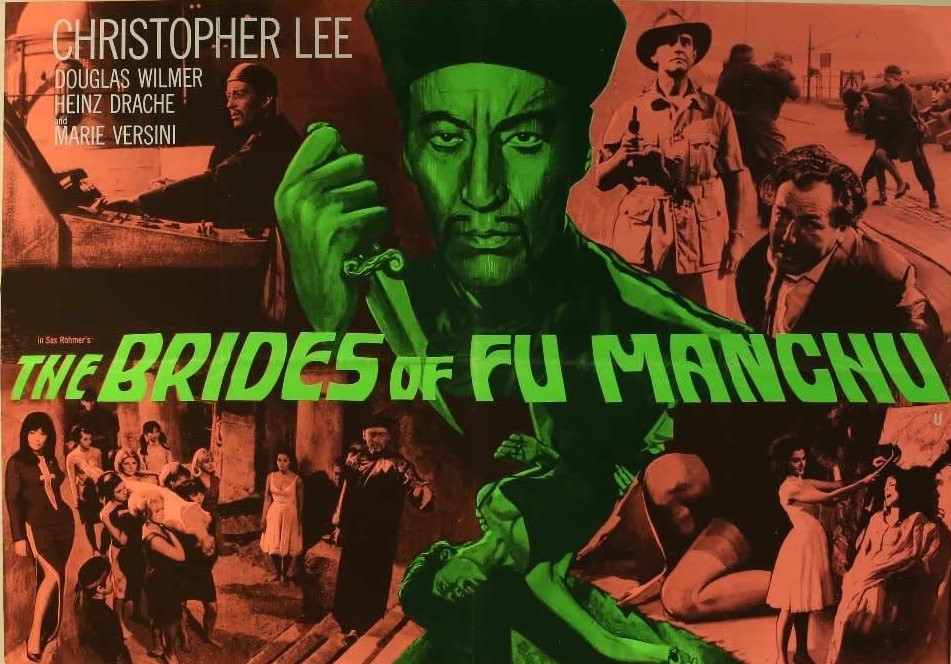
The 1960s was awash with movie megalomaniacs, most courtesy of the spy vogue. You could also count on secret agents for trailing in their wake bevies of beauties. So no surprise then that criminal mastermind Fu Manchu (Christopher Lee) has his own gang, his “brides,” although they are hardly volunteers, being the kidnapped daughters of top scientists. His plan for global domination this time consists of transmitting energy as sound waves, using miniaturization, a sonic death ray, with enough power to destroy a city.
The result is good hokum, a thriller set in the 1920s with a cracking pace, plenty of action, explosions, burgeoning romance, and a plot that gets more complicated by the minute as a tribe of worthies try out to outwit the evil genius. There is a terrific lair – where the disobedient end up in a snake pit – a passable laboratory, chases, truth serums (“the dust that loosens tongues”), hypnotism, bait-and-switch tricks and decent special effects. Three stories race along in a parallel pell-mell: Manchu needs one more kidnapping to complete his complement of daughters, while the good guys headed by Fu Manchu’s old adversary Nayland Smith (Douglas Wilmer) are trying to locate the bad guy’s secret location while at the same time attempting to find out where he will strike next.
While Fu Manchu is indestructible – supposed dead after the previous film – his henchmen (and henchwomen) are all too human. It takes three attempts to kidnap Manchu’s next victim. They are easily identifiable by their giveaway cummerbunds and bandanas and their method of assault is not kung fu but brawling so a good solid British punch of the old-school soon sorts them out. Manchu’s daughter Lin Tang (Tsai Chin) is a chip off the old block, delighted at any opportunity to torment the brides.
The brides, in diaphanous gowns that might have been a job-lot from the set of She, are far from compliant, even rebelling at one point, and employing vicious fight tactics. Fans of director Don Sharp will find him every bit as inventive as in The Devil-Ship Pirates (1964) and Bang, Bang, You’re Dead (1966) . It’s another Harry Alan Towers (written under his pseudonym Peter Welbeck) effort so that means an international cast.
Two television cops, British Rupert Davies (BBC’s Maigret) and German Heinz Drache (cop in a Francis Durbridge series), plus Francois Mitterand’s brother-in-law Roger Hanin, provide solid support. Not forgetting Burt Kwouk as a henchman. Brides of the year include French Marie Versini (German western Winnetou, 1963) and Rhodesian Carole Gray (Curse of the Fly, 1965). The film did not prove much of a jumping-off point for other brides such as Ulla Berglin, Danielle Defrere and Anje Langstraat, for whom this debut was as far as their careers went.
Christopher Lee, despite the dodgy moustache, is resplendent, exuding evil, and with a gift for rising again (just like Dracula) as he would do for another three films in the series.
All hail Senta Berger! Another from the Harry Alan Towers (Five Golden Dragons, 1967) portfolio, this is a spy-thriller mash-up with a bagful of mysteries and a clutch of corpses. At last given a decent leading role, Senta Berger (Istanbul Express, 1968) steals the show from the top-billed Tony Randall (as miscast as Robert Cummings in Five Golden Dragons) and a smorgasbord of European talent including Herbert Lom (The Frightened City, 1961), Terry-Thomas (Danger: Diabolik, 1968), Klaus Kinski (Five Golden Dragons), John Le Mesurier (The Moon-Spinners, 1964) and Wilfrid Hyde-White (Ada, 1961).
In this company, the glamorous Margaret Lee (Five Golden Dragons), as the villain’s cynical lover (“you are never wrong, cherie, you told me so yourself,” she tells him) is an amuse-bouche. Six travellers – including architect passing himself off as oilman Andrew Jessel (Tony Randall), travel agent George Lilywhite (John Le Mesurier), salesman Arthur Fairbrother (Wilfrid Hyde-White) and tourist Kyra Sanovy (Senta Berger), meeting her fiancé – board a bus from Casablanca airport to Marrakesh. One is carrying $2 million as a bribe to ease through a vote in the United Nations, but the villainous Mr Casimir (Herbert Lom) doesn’t know which one it is.
When Kyra’s fiance’s corpse tumbles out of Andrew’s cupboard, the pair become entangled. Kyra is a born femme fatale, trumping the incompetent Andrew at every turn. With no shortage of complications, the tale zips along, directed on occasion with considerable verve by Don Sharp (The Devil-Ship Pirates, 1964).
It’s lightweight but no less enjoyable for that and makes a change from the more serious espionage fare (The Spy Who Came in from the Cold, 1965, and The Quiller Memorandum, 1966) beginning to capture the public’s attention. It might make it sound better to say it’s a mixture of The Man Who Knew Too Much (1956) and North by Northwest (1959) and throws a homage bone to Our Man in Havana (1959), but while it plays around with those riffs, it doesn’t give two hoots about focusing on Hitchcockian thrills. It’s more about the fish-out-of-water Yank Andrew being led astray by the sexy Kyra.
There are some inventive double-plays – with a body in the boot Kyra and Andrew are stopped by a cop who tells them their boot is open. An excellent rooftop chase is matched by a car chase. And there’s a terrific shootout. Kinski is at his sinister best and Terry-Thomas a standout in an unusual role as a Berber.
The film was shot on location including the city’s souks, the ruined El Badi Palace and La Mamounia hotel (featured in The Man Who Knew Too Much, 1956).
But Senta Berger seamlessly holds the whole box of tricks together, at once glamorous and sinuous, practical and tough and exuding sympathy, and it’s a joy to see her for a large part of the picture leading Randall by the nose. Quite why this did not lead to bigger Hollywood roles than The Ambushers (1967) remains a mystery.
There was always money involved. For an author whose string of bestsellers made him a fortune, Alistair MacLean found it particularly hard, in part due to poor investment and advice, to hold on to his millions. Victimhood was his default position for he tended to view himself as underpaid, not to mention ripped-off, by filmmakers, especially when the likes of The Guns of Navarone (1961) and Where Eagles Dare (1968) scored so highly at the box office.
That Puppet on a Chain arrived in cinemas the way it did was the result of the financial complications inherent in the novelist’s life. He had been too busy to write a screenplay for When Eight Bells Toll (1971) mostly because he was consumed with unravelling his finances and setting up a more lucrative template for his movie ventures.
He planned to form a partnership whose sole aim was the production and exploitation of his books as vehicles for films. To this end, MacLean alighted on budding director Geoffrey Reeve, then merely a highly sought-after helmer of commercials and promotional films for industry.
You might accuse Reeve of a bit of double-dealing himself since at the time he met MacLean he was working for the author’s nemesis Carl Foreman, producer of The Guns of Navarone. Foreman had adapted that book for the screen, considerably altering the source material in the process. Excluding MacLean from the party, Foreman had his eyes set on a sequel with the dull and very un-MacLean title of After Navarone.
But the instigator of the Reeve-MacLean partnership came from an unusual source, London wine merchant Lewis Jenkins, who in alliance with the other two formed the equally un-MacLean-named Trio Productions.
Jenkins was more than a wine seller. He was a high-flier who moved with a grace the grumpy Scotsman envied in the kind of classy circles that were, despite his fame, closed off to a mere novelist. He had come across details in a trade paper of MacLean’s deal for Ice Station Zebra (1968) and felt the author was being underpaid and, in a letter, he said so.
You couldn’t get MacLean’s attention more easily than plugging into his sense of victimhood. But it wasn’t movie talk that first made Jenkins indispensable. Horrified at the state of the author’s financial affairs, Jenkins put MacLean in touch with international tax lawyer Dr John Heyting who in turn handed him over to David Bishop, one of whose first tasks was to upbraid Foreman about his temerity on jumping the gun on Navarone and excluding the author.
While the triumvirate’s first notion was of approaching Columbia to fund a sequel, soon they were dealing with a much bigger fish. As unlikely as it sounds, David Lean (Doctor Zhivago, 1965) had expressed considerable interest in turning the threesome into a foursome. But the tantalizing possibility of a Lean-MacLean movie fell at the first hurdle as the director was tied up in developing Ryan’s Daughter (1970)..
It cost MacLean £100,000 to extricate himself from a financial muddle in which his advisers raked in more money than the man they supposedly represented. But it wasn’t just money that was wreaking havoc with his life. Though married, MacLean had a complicated love life and was a very heavy drinker, so it was testament to his discipline that he got any writing done at all.
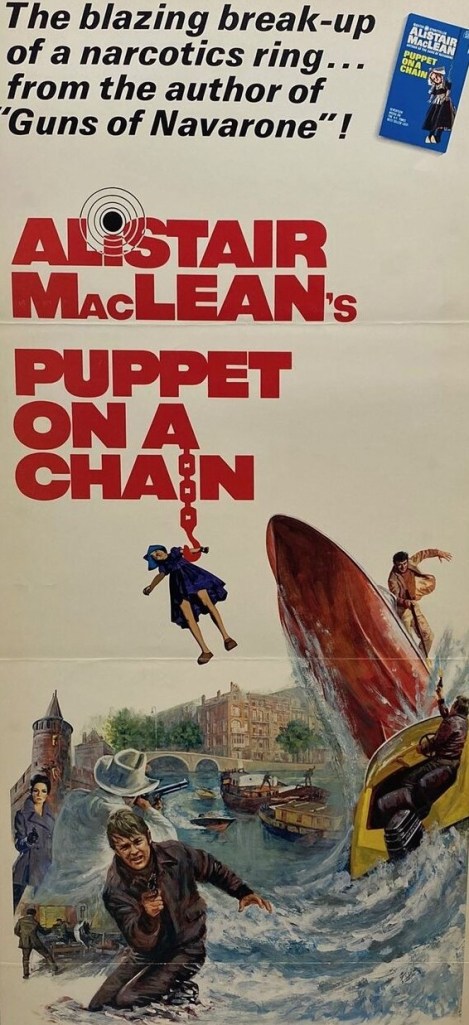
The idea for Puppet on a Chain originated from a trip to Amsterdam with Reeve, who had mooted the notion of a thriller with a drugs background, during which by chance MacLean alighted on the image that sparked the title. What the author saw was harmless enough, a puppet dangling like a toy from a warehouse in the docks, its purpose probably nothing more than advertising the goods inside. It took an imagination like MacLean’s to turn it into something more sinister.
Once MacLean had written Puppet on a Chain, published in 1969 to commercial and critical acclaim, he handed the rights over to Reeve to negotiate a deal with a major studio. And it says something for the solidity of their partnership that it hit the screens one year later, quicker than When Eight Bells Toll, published in 1966, which took five years to be turned into a film.
Although critics tended to argue that little altered from one book to another, most failed to comprehend that Puppet on a Chain represented a subtle evolution. “It was a change of style from the earlier books. If I went on writing the same stuff, I’d be guying myself,” he said.
But the New York Times noticed and in a lengthy review elevated him to stand comparison with Graham Greene and Eric Ambler, the doyens of the literary thriller. “It’s a top-drawer effort,” commented critic Thomas Lask “If you have any red corpuscles in your blood, you will find your heart pumping triple time…The writing is as crisp as a sunny winter morning and MacLean has provided a travelog for a part of Amsterdam the ordinary tourist is not likely to go.”
But to his intense disappointment, the author discovered that his name alone, while it opened doors, did not unlock sources of funding. One of the two top British studios, ABC, its film arm trading as the Associated British Picture Corporation, which also owned the country’s largest cinema circuit (a state of affairs outlawed in the U.S, since 1948), was interested. ABPC wasn’t entirely avowed of MacLean’s potential, having purchased his debut novel H.M.S. Ulysses but left the project on the shelf.
MacLean was so keen to get the green light he sold the project, including the screenplay and Reeve’s fee, for $60,000, a substantial drop from the $100,000 (plus significant profit share) he received for screenplay alone for Where Eagles Dare. There was a caveat. If the rushes didn’t appeal, ABPC could replace Reeve.
Since advertising scarcely qualified as filmmaking at all, the number of directors who made the jump from making commercials (itself in its infancy) to making movies was virtually nil. This was long before the Scott Brothers, Ridley (Blade Runner, 1982) and Tony (Top Gun, 1986), and Adrian Lyne (Fatal Attraction, 1987) established commercials as a feeder route for Hollywood,
Having purchased the script for a bargain basement price, ABPC’s Robert Clark sought to offset the costs by involving an American partner. After softening up MGM’s Maurice Silverstein over lunch about the prospects of a joint production, Clark sent him a rough script of Puppet on a Chain. Silverstein was not impressed. The plot was too familiar. “Thanks ever so much for letting us have a look at the script,” wrote Silverstein. But that was as far as he went. No enthusiasm, no money.
But the MacLean name was sufficient to interest independents. Israeli Kurt Unger, former United Artists European production chief, whose father had been a distinguished producer, was in the market for a prestigious production, having cut his teeth on Judith (1966) starring Sophia Loren and Jack Hawkins. His sophomore effort was less successful, The Best House in London (1969) starring David Hemmings, a feminist comedy set in a brothel.
But he set up the picture, albeit with a good bit less funding than had been available for Where Eagles Dare and unlikely to even approach the $1.85 million it cost to make When Eight Bells Toll.
Lack of finance limited the talent available. There was no question of approaching a Richard Burton, much less a Clint Eastwood. And it’s more likely that Swede Sven Bertil-Taube was approved as a name with European appeal and following The Buttercup Chain (1970) could easily be sold as the next big thing in America, bearing in mind that espionage had paved the way in the previous decade for stars like Sean Connery and James Coburn.
Barbara Parkins (Valley of the Dolls, 1967) would also help guarantee media attention in the U.S. You might be surprised to learn rising British star Suzanna Leigh (The Lost Continent, 1968) was also on board. Her part was cut from the final film. Supposedly, she played a villain, but it’s more likely she was hired for the role of Belinda, one of the hero’s sidekicks in the book.
While hardly a big name, Brit Patrick Allen (The Devil Rides Out, 1968) brought dependable support and was well-known enough in the home market. Pole Vladek Sheybal (Women in Love, 1969) was always good copy, having twice escaped concentration camps in World War Two. Another Pole, Ania Larson, was making her movie debut and is still working – you might have caught her in The Witcher (2021) mini-series. A maiden movie outing for Greek actress Penny Casdagli was also her last.
One of the names in the aforementioned David Bishop’s contact book was Piet Cleverings, Amsterdam’s police chief, so permission for use of locales and, more importantly, the city’s extensive canals, was readily granted. Unusually, and presumably due to his backing of the partnership, MacLean intended to spend time in Amsterdam observing the filming. He brought over quite a party including his brother and wife and publisher Ian Chapman and wife plus Bishop.
But any sense of triumph at his role in putting the picture together was dashed by the news that his protégé Reeve had been replaced. “It was Geoff Reeve’s first film on this scale,” reported Unger, “and there some things not right. We brought in Don Sharp as a second unit director responsible for such scenes as the motor-boat chases.”
Unger had already taken steps to re-shape the script, calling on television writer Paul Wheeler and Sharp to add an extra dimension. In the producer’s view, MacLean “was a good writer but he was not a screenwriter. And what he wrote as a screenplay for Puppet on a Chain, I’m afraid, had to be rewritten.”
Understandably, MacLean was incandescent with rage at this “rubbishy travesty of what I wrote.” You could almost feel his spleen dripping onto the page as he wrote to Unger, complaining about Wheeler’s involvement. “If he can improve on practically everything I write and is clearly of the opinion that he is so much the better writer, why is it I’ve never heard of him?”
He went on: “I feel like a doctor who has been called in after a group of myopic first-year medical students with hacksaws have completely misdiagnosed and performed major surgery on a previously healthy patient.”
It was a poor introduction to the role of co-producer, although clearly MacLean didn’t think he had to protect his screenplay in the way that someone like Foreman would. If surrendering the rights for a low price furnished him with any power, he didn’t know how to use it.
Sharp was an unusual addition. Rather than being a go-to second unit director he was an experienced director in his own right, a favorite of Hammer and independent producer Harry Alan Towers, for whom he had helmed such films as, respectively, The Devil-Ship Pirates (1964) and Our Man in Marrakesh / Bang! Bang! You’re Dead (1966).
Unfortunately, his movie career had turned turtle, film work drying up after The Violent Enemy (1967) – television (episodes of The Avengers and Champion in 1968) paid the bills – and again after the lackluster Taste of Excitement (1969). In fact, aside from Puppet on a Chain, he remained in movie limbo for another four years.
Sharp argued that the script for the boat chase was “not good enough,” especially if it was to be the highlight of the film. “I chose the location,” recalled Sharp, “I talked to the police, got the boats and worked with a wonderful bloke there called Wim Wagenaar, who ran a restaurant.” As well as driving one of the boats, Wagenaar orchestrated jumping the boats in the canal.
“We sketched out a whole sequence, and some of the things, other boatmen said you can’t do this. I wanted his boat to run up on to the back of another boat and push it along. They said it won’t… I said, all right, let’s try it. And it did work. And we ran into bridges and came spinning round the corner.
“One time we had to wait for a little while because I had broken, I think it was, four boat hulls and smashed about eight Mercury engines. And they couldn’t get another one, they had to fly them in from Canada. It got a bit expensive.”
Part of what made the chase so thrilling was the unusual manner in which it was shot. Rather than shooting it in small sections and then editing it all together, Sharp took the advice of his camera operator Skeets Kelly. “(He) said to me, don’t cut it into pieces if you can do it all in one. . . . I had considered doing it in a couple of cuts, and Skeets talked me out of it. He said no, there’s so much more impact if you don’t because the audiences are very intelligent these days, so au fait with cinema, that they will know . . . But to go and do it in the one [shot], it’s absolutely for real.
Four weeks had been allocated for the boat chase and once it was complete Sharp received another call from Unger who was dissatisfied with the Reeve version. Sharp met with Unger and Lenny Lane, who had provided American funding. His opinion was: “bit of a mess.” Unger was a bit more forthright. “We’ve either got to spend more money and fix it or we’ve got to cut our losses and not release it.”
Sharp’s response was: “It’s a great shame because the boat chase is good and there are some good things in it. So I said, first of all, give me a couple of days in the cutting room with it, to look at it and make some notes, then I’ll tell you whether I think you can save it.”
After spending time in the cutting room, Sharp drew up a list of amendments. Unger talked to the financiers, sorted out the extra cash and commissioned Sharp to reshoot certain sequences, alter the plot and change the ending. Working with a Moviola of the original footage, Sharp could ensure new footage matched whatever was in the can.
He noted that Reeve “didn’t have a story sense then, as a director…and each set-up…looked like part of a television commercial and wasn’t there for the drama of it or just to let the audience know what was going on.”
For example, Sharp had to re-edit and re-film parts of the nightclub sequence. “Seventy-five per cent of it was fine…I did have to go and reshoot it because to shoot a couple of really good, important, dialog lines to do with the plot (were shown) in a shot between the legs of a dancer… done for a visual effect” rather than to tell a story.
MacLean went off in the huff to the extent that he failed to show up for a press conference in Amsterdam only to be later found to be so inebriated that addressing the world’s media would have proved an embarrassment.
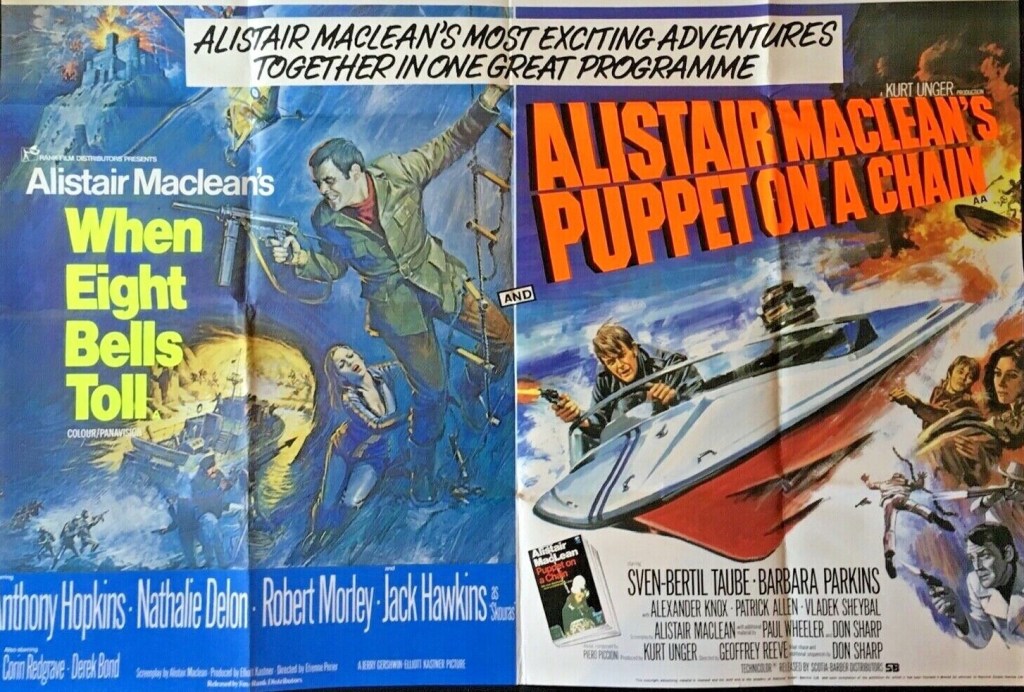
MacLean, however, had the last laugh. The movie was a huge hit in Britain on initial release, “making a mint of money,” an automatic candidate in 1973 for a reissue double bill with When Eight Bells Toll.
You couldn’t get higher praise that a James Bond producer finding inspiration in your picture. Added Sharp, “The funny thing was that, when it came out, Harry Saltzman and Cubby Broccoli, who knew Kurt Unger, said, how did you do that boat chase? Because they’d never thought of one, and from that they did Live and Let Die. And they spent on the boat chase in Live and Let Die more than we spent on the whole film, both units and the reshoot, on Puppet. They did it marvellously, there’s no doubt about it, but cut, cut, cut . . .”
SOURCES: Jack Webster, Alistair MacLean, A Life (Chapmans Publishers, paperback, 1992) p142-145, 152-157; Dean Brierley, “The Espionage Films of Alistair MacLean Part 2,” Cinema Retro, Issue 14, p36-38; Thomas Lask, “End Papers,” New York Times, November 4, 1969, p43; Barry Norman, “Alistair MacLean, Occupation: Storyteller,” Daily Mail, April 27, 1970; Eddy Darvas and Eddie Lawson, Don Sharp, The London History Project, November 1993; John Exshaw, “Don Sharp, Director, An Appreciation,” Cinema Retro, Issue 20.
The spy genre was dying on its feet, even James Bond slipping into spoof territory, and it was left to Alistair MacLean to revive the genre with believable heroes and settings not just chosen for their scenic potential, fitting somewhere between the gritty policiers of Bullitt (1968) and The French Connection (1971) and with an emphasis on violence that Sam Peckinpah would be proud of.
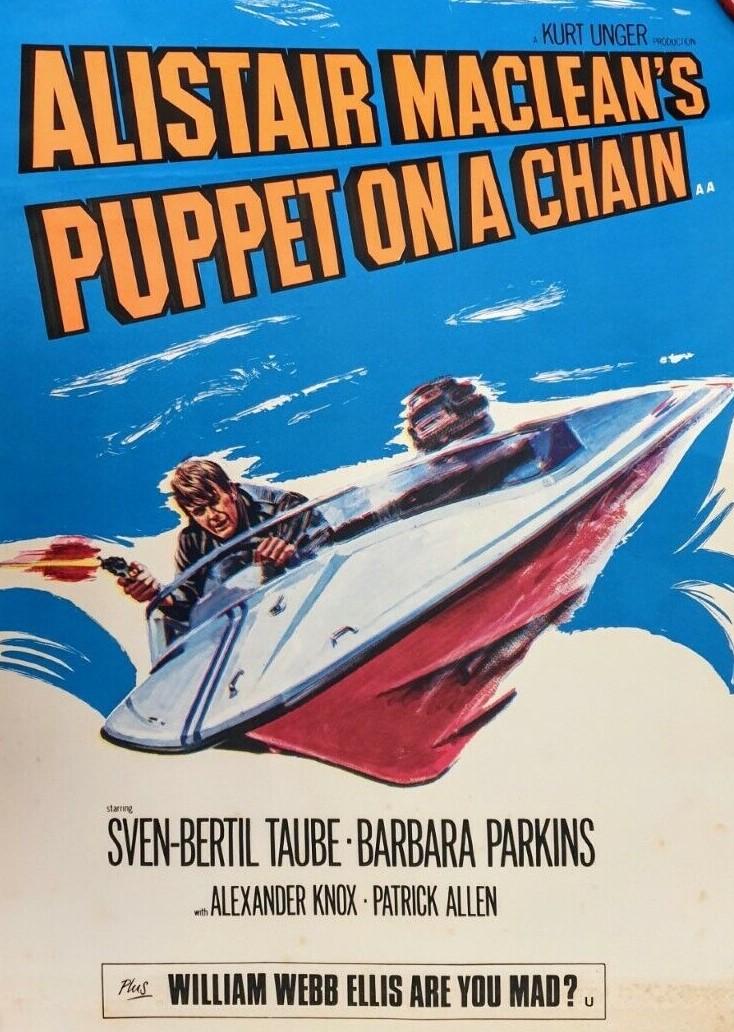
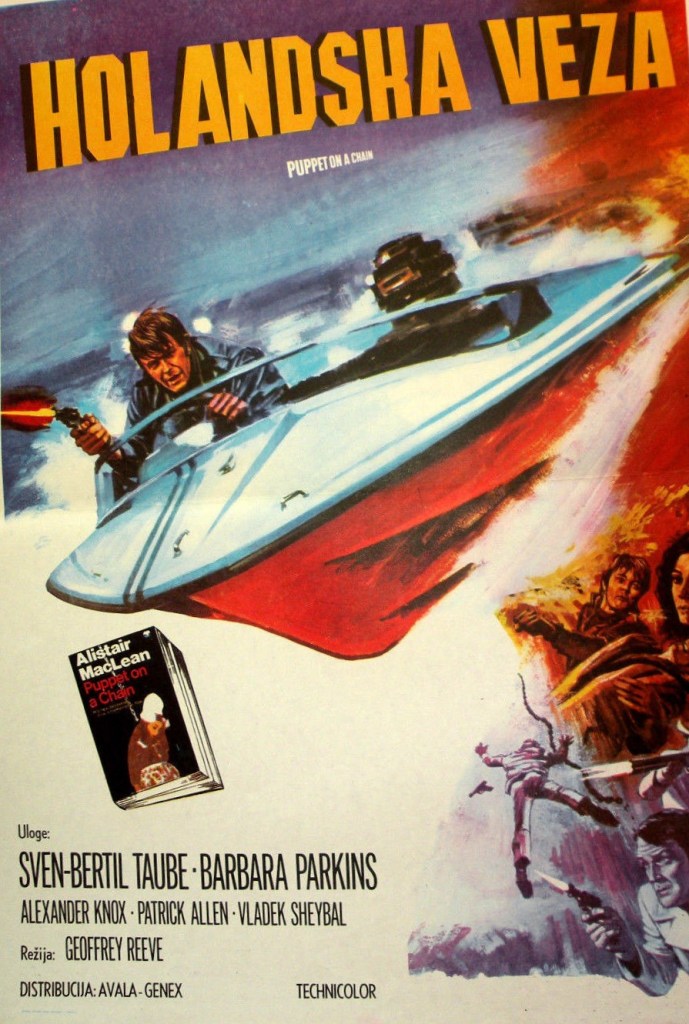
Stylish bullet-ridden opening, crackerjack climax. In between depicting Amsterdam scenery and depravity side by side comes betrayal, duplicity, drugs, heinous deaths, plenty action, and as much as Bullitt (1968) reinvented the car chase this did the same for speedboats.
Tracking point of view follows an assassin into a house where he kills three people and removes something from the pendulums of clocks. U.S. narcotics agent Sherman (Sven Bertil-Taube) flies in to Amsterdam but before he can collect vital information from colleague Duclos he is murdered.
Top Dutch cops Col De Graaf (Alexander Knox) and Inspector Van Gelder (Patrick Allen) are helpless to stop the growing heroin traffic. Van Gelder, with addicted niece Trudi (Penny Casdagli), knows only too well the personal cost.The police force is riddled with leaks, the heroin gang out to stop Sherman from the get-go.
But Sherman has his own nasty medicine to deal out, and hands out beatings and death to those who get in his way. Helped by colleague Maggie (Barbara Parkins) and, inadvertently by Duclos’s girlfriend Astrid (Ania Lemay), the trail leads to the Morgenstern warehouse, which stocks all sizes of puppets, and a church run by shady pastor Meegeren (Vladek Sheybal) which has re-purposed Bibles.
Sherman has no sooner escaped one attempt on his life than he encounters another, so the action never lets up. Meanwhile, clues lead him to a boat in the harbor and he discovers how the heroin is being shipped. Maggie, on hand to offer romantic consolation, shares his tough assignment and questions his methods.
Although revivals were usually sold on the weight of a star, but by this point MacLean was a box office commodity and, let’s face it, neither Hopkins nor Bertil-Taube had much of a calling card.
The trail isn’t that hard to follow but the obstacles are considerable. Meegeren and pals take hanging to the extreme, strangling victim on steel chains, dangling them high as a warning to others. So, mostly, leavened, depending on your point of view, by titillating views of the Dutch capital and a sexy dance troupe that would put Bob Fosse to shame, its fist- and gun-fights all the way.
Except for his dalliance with Maggie, a romance that has to be kept under wraps, Sherman fits the tough Alistair MacLean template with a ruthless streak wide enough to have won plaudits from Where Eagles Dare team He gets a good dousing in the sea and is an unwilling candidate for a brainwashing technique that combines tradition with a personalized version of the sonic boom.
But the highlight without doubt is the high-speed speedboat chase through Amsterdam, beginning in the wider Zuider Zee before racing through the narrow twisty Dutch canals.
For the Dutch Tourist Board it was a game of two halves, organ music aplenty, cobbles and canals, and people dressed in traditional garb promoting the city as a desirable destination but the unsightly addicts and the sex trade as likely to put overseas visitors off (although for many that may well be the icing on the cake).
It was rare at this point, in a polished Hollywood-style picture, to dig so deeply into the seamy side of a city, but his one pulls no punches, nitty-gritty winning out over gloss, and where Easy Rider (1969) and others of that ilk opted to canonize drugs this favored grim consequence.
It seems particularly difficult to get the casting right for an Alistair MacLean movie of the lone wolf variety – the all-star war pictures by contrast having no trouble attracting major players – and if you turned up your nose at Richard Widmark in The Secret Ways (1961), George Maharis in The Satan Bug (1965) and Barry Newman in Fear Is the Key (1972) you might quibble at Swede Sven Bertil-Taube (The Buttercup Chain, 1970). But he makes a fairly decent stab at the standard dour character.
Barbara Parkins (Valley of the Dolls, 1967), way out of her comfort zone, does well as the tough woman with a soft center. But, all told, you would say it benefits from largely casting unknowns as it prevents the audience arriving with preconceptions. In her only movie Penny Cadagli is the pick of the support, especially as her role in the movie is to play a role.
Although Geoffrey Reeve (Caravan to Vaccares, 1974) hogs the directing credit, the speedboat chase, other action scenes and the tightening up of the picture was the work of Don Sharp (Bang! Bang! You’re Dead, 1966). And Alistair MacLean didn’t, as he might have expected, receive sole screenwriting credit either, sharing it with Sharp and Paul Wheeler (Caravan to Vaccares, 1974).
Not only plenty of bang for your buck, but a riveting chase and one of the first sightings of heroin supply as the key driver of the narrative.
Must-see for all the wrong reasons. An epic of confusion, appalling acting and dodgy accents make this thriller a prime contender for the “So-Bad-It’s-Good” Hall of Fame. Director Don Sharp (The Devil-Ship Pirates, 1964) jibed at star Eva Renzi (Funeral in Berlin, 1966) when he should have concentrated on a script that is over-plotted to within an inch of its life. A couple of kidnaps, casino visit, a sniper, and a vertiginous cliff-top maneuver are thrown in before a truth serum lights up the climax in spectacularly hilarious fashion.
Promising material goes badly awry. English tourist Jane Kerrell (Eva Renzi), floating around the South of France, is being targeted for unknown reasons. A white Mercedes has tried to drive her off the road, mysterious phone calls and visions make her believe she is going mad, that prognosis helped along by handy psychiatrist Dr Forla (George Pravda). And before you can say Surete, Scotland Yard and NATO she is the chief suspect in the murder of a man called Chalker on the ferry to France. Assistance comes in the form of handsome artist David Headley (David Buck) – preposterously famous “I’m David Headley” “The painter?” – who nearly does what’s she’s been complaining everyone else is trying to do, namely knock her down with his car. He specialises in painting nude women and for no reason at all, given he is identified immediately as a lothario, he resists her attempts to take her to bed.
Turns out Jane is something of a boffin, as any self-respecting computer expert would be known in those days, and a millionaire businessman Beiber (Paul Hubschmid), one of Headley’s rich clients, enlists the painter to offer her a job. Of course, he has something else in mind. His company is being accused to shipping unnamed goods to the unnamed opposition, hence the involvement of NATO chap Breese (Francis Matthews).
But nobody is to be trusted, especially as the French police have dismissed her fears as nonsensical. Scotland Yard’s Inspector Malling (Peter Vaughan) throws flames on the fire by not coming to her rescue but planning to arrest her since she is the last person to see Chalker alive. Then it turns out Chalker must have given her a code or secret message before he died. The police take apart her red Mini Cooper in clinical French Connection style but find nothing. That just shows how dumb they are. It never occurred to them, as it does instantly to Headley, to check the carburretor.
By now you’ll have guessed consistency is not this movie’s strong point. You never even know who the sniper Gaudi (Peter Bowles) is targeting his aim is so appalling. There’s even a sinister secretary Miss Barrow (Kay Walsh) with a pronounced Scottish accent in the Jean Brodie class. Headley comes up with an idea to disguise her – by changing her hairstyle (that’ll fool them!! – and astonishingly, in keeping with the bizarre tone, it does).
For someone who is meant to be paranoid Jane is surprisingly trusting, toddling off with clearly-identified villains when fed a line.
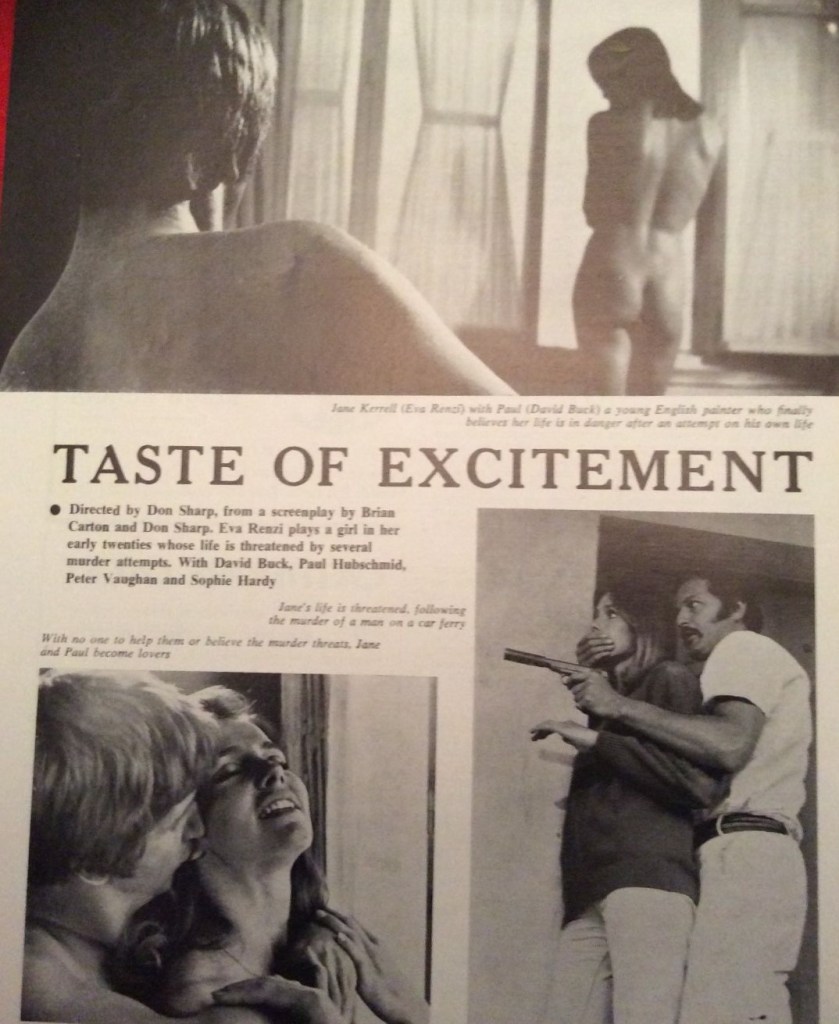
Most of the advertising, including this spread in “Films and Filming” magazine, made play of the sight of Eva Renzi’s naked derriere but ignored the unusual gender equality when it came to the nudity since in this scene David Buck gets out of bed and stands as equally starkers by the window.
You won’t be surprised when Jane ends up trussed and gagged, in her bikini naturally, in a fabulous house with an electrified fence. I can’t resist telling you about the truth serum. Before the evil psychiatrist has the chance to question her he is bopped on the head, Headley having sneaking in before (the dolts!) Gaudi thought to switch on the electric fence. (The electric fence is nullified by the police who just switch off all the electricity in the area.) But when she escapes, still full of the truth drug, when Gaudi calls out to find out where she is hiding, the serum forces her to give the correct answer. In the midst of the danger, Headley takes the opportunity to get an honest answer to the question of whether she loves him. And that’s not the best bit. The final line, given there hasn’t been a decent line all the way through, is a cracker. “Never believe a woman when she is telling you the truth” certainly gives you something to ponder.
So much is held back from the audience that there is never a chance, unlike Charade (1963), of genuine tension. Even the one gripping moment, taking a shortcut along a perilous cliff road, which is well done, is undercut by their pursuer beating them to their destination. The whole thing has an air of being improvised or being devised by someone who thought that twists counted more than characterisation, plot development or relationships.
The acting is so uniformly bad that Eva Renzi actually looks good. David Buck (Deadfall, 1968) is miscast in the slick Cary Grant role. While it is entertaining to see Peter Bowles (The Charge of the Light Brigade, 1968) drop his plummy English accent, his Italian accent fails to pass muster. Peter Vaughan (Alfred the Great, 1969), saddled with the bulk of the murky exposition, does his best. In a bit part, veteran Kay Walsh (A Study in Terror, 1965), holds the acting aces but she doesn’t have much competition.
Director Don Sharp also had a hand in the screenplay so it’s difficult to know who must take most blame, him or colleagues Brian Carton and Ben Healey. This was the alpha and omega of this pair’s movie career.
If you want to see how not to handle a potentially classy thriller tune in. Can’t make up my mind whether to give this two stars for being so bad or four stars for being so bad it’s good. You decide.
And you can do so for free on Flick Vault. Be warned that you have to get past some adverts first. And if you’re wondering what happened to the opening credits, there ain’t any.
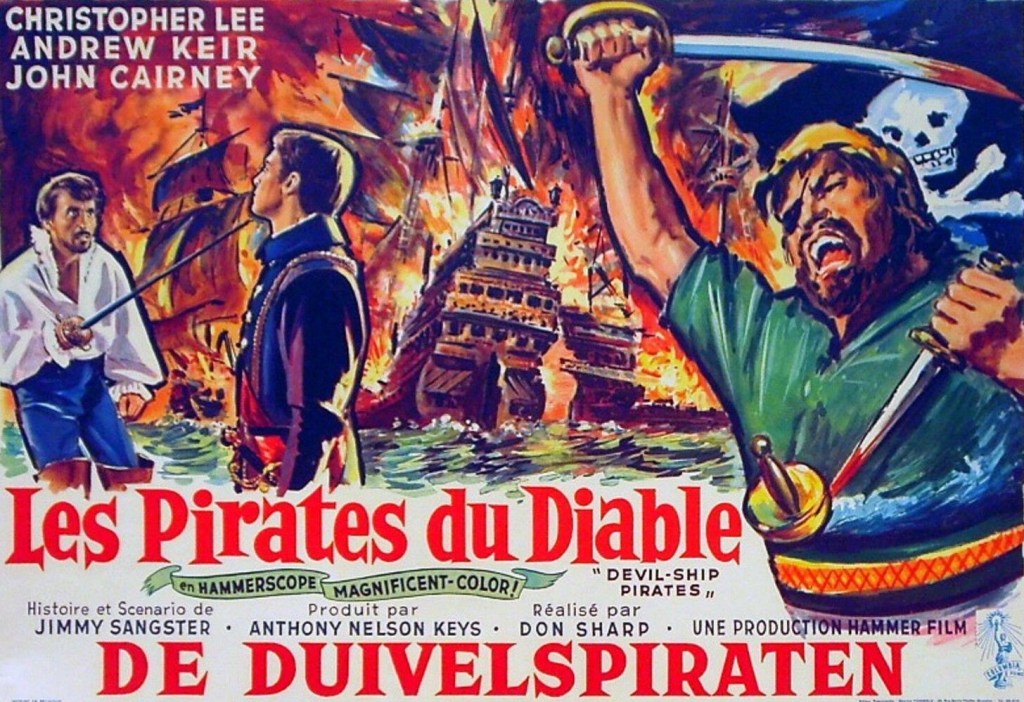
Despite the title and Hammer’s penchant for the unholy, there is nothing satanical about this picture. Christopher Lee (The Whip and the Body, 1963) less cadaverous than in his better-known incarnation as Dracula, plays the captain of ship called Diablo, part of the defeated Spanish Armada, who lands in 1588 on British shores and by convincing the locals that the British have been defeated imposes an occupation.
Writer (and later director) Jimmy Sangster’s clever premise works, the lord of the manor (Ernest Clark) immediately surrendering and befriending the invaders, most of the villagers succumbing, a few more doughty lads (Andrew Keir and son John Cairney to the fore) rebelling.
Running alongside its regular horror output, Hammer had a sideline in swashbucklers, the Men of Sherwood Forest (1954), Sword of Sherwood Forest (1960), The Pirates of Blood River (1962) and The Scarlet Blade (1963) – aka The Crimson Blade – preceding this, and all, interestingly, aimed at the general rather than adult market. Australian director Don Sharp, in the first of several teamings with Lee, does extraordinary well with a limited budget. Although the village square was a leftover from The Scarlet Blade, there is a full-size galleon, swamps, fog, floggings, a hanging, fire, chases, a massive explosion, and a number of better-than-average fencing scenes.
In other hands, more time could have been spent exploring the psychology of occupation, but despite that there is enough of a story to keep interest taut. Lee has a high-principled lieutenant who secretly subverts his master’s wishes. Tension is maintained by Lee’s ruthlessness, the efforts of captured women to escape, and attempts to seek outside help. While the intended audience meant toning down actual violence, Sharp creates a menacing atmosphere. The final scenes involving sabotage are tremendously well done.
A rare outing for Lee outside of the horror genre, he truly commands the screen, an excellent actor all too often under-rated who holds the picture together. Andrew Keir (The Viking Queen, 1967) and Ernest Clark (Masquerade, 1965) provide sterling support. Suzan Farmer (The Crimson Blade, 1963) plays the requisite damsel in distress. Director Don Sharp (Bang! Bang! You’re Dead!, 1966) was another horror regular responsible for, among others, Curse of the Fly (1965) and Rasputin: The Mad Monk (1966), the latter reuniting him with Lee.
I should acknowledge a vested interest as John Cairney was a distant relative and I do remember as a child being taken to see his previous outing Jason and the Argonauts (1963) but, strangely enough, this one was given a miss by my parents. I wonder if the title put them off.
CATCH-UP: Christopher Lee was so prolific I have only so far reviewed a fraction of his 1960s output: Beat Girl/Wild for Kicks (1960), Sherlock Holmes and the Deadly Necklace (1962), The Whip and the Body (1963), The Gorgon (1964), She (1965), The Skull (1965), The Brides of Fu Manchu (1966), Five Golden Dragons (1967). The Devil Rides Out (1968), The Curse of the Crimson Altar/The Crimson Cult (1968) and The Oblong Box (1969). Quite enough to be getting on with if want an idea of this fine actor’s range and ability.
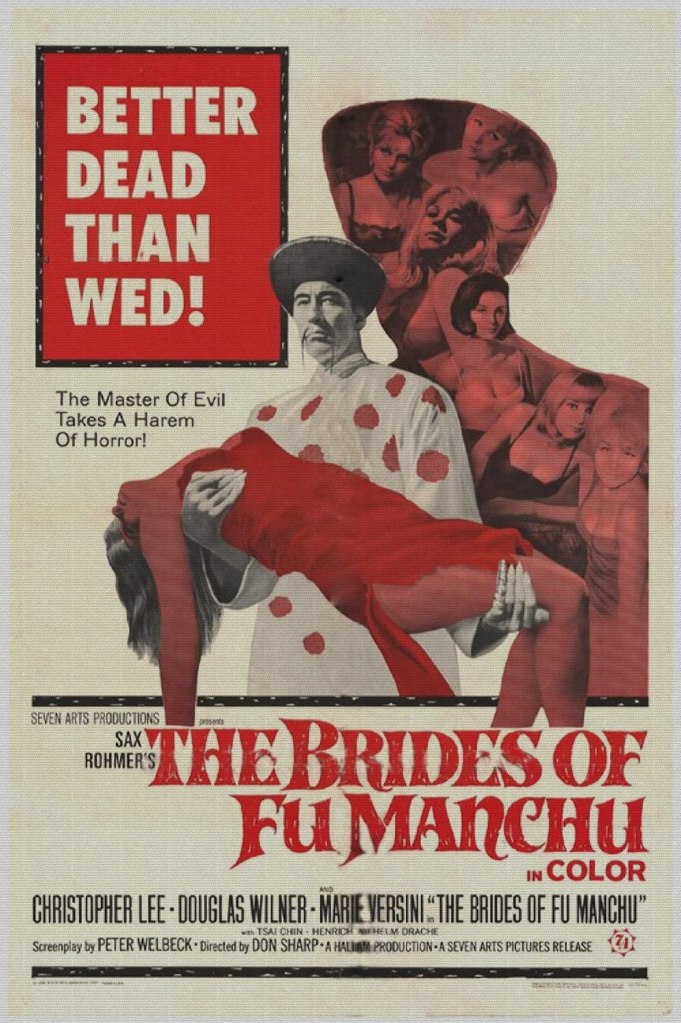
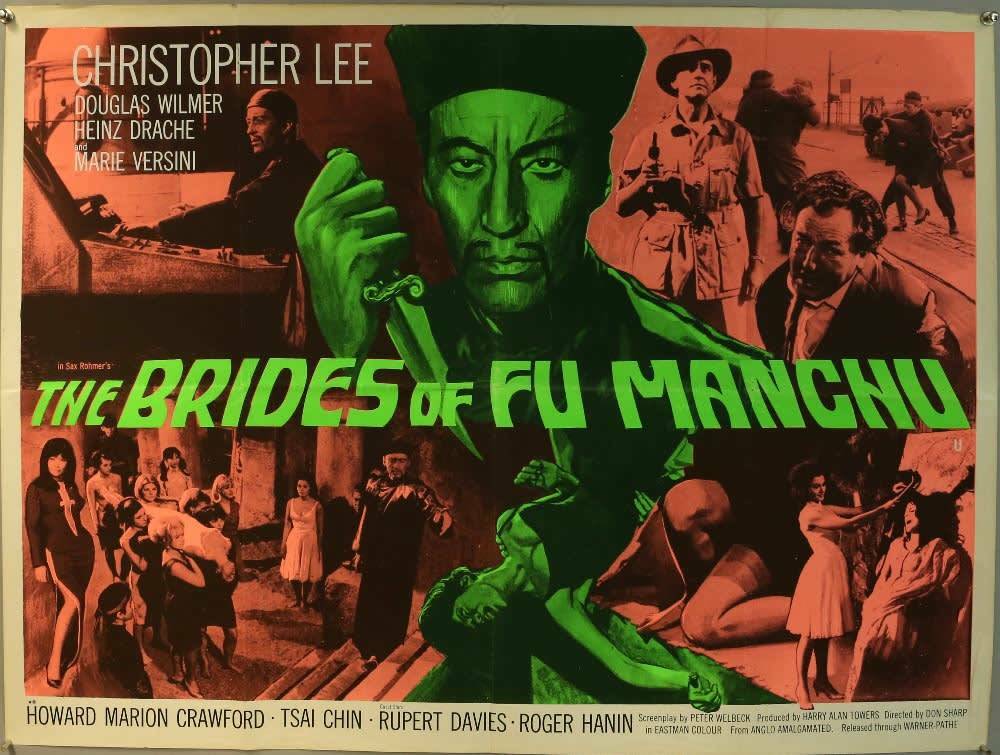
The 1960s was awash with movie megalomaniacs, most courtesy of the spy vogue. You could also count on secret agents for trailing in their wake bevies of beauties. So no surprise then that criminal mastermind Fu Manchu (Christopher Lee) has his own gang, his “brides,” although they are hardly volunteers, being the kidnapped daughters of top scientists. His plan for global domination this time consists of transmitting energy as sound waves, using miniaturization, a sonic death ray, with enough power to destroy a city.
The result is good hokum, a thriller set in the 1920s with a cracking pace, plenty of action, explosions, burgeoning romance, and plot that gets more complicated by the minute as a tribe of worthies try out to outwit the evil genius. There is a terrific lair – where the disobedient end up in a snake pit – a passable laboratory, chases, truth serums (“the dust that loosens tongues”), hypnotism, bait-and-switch tricks and decent special effects. Three stories race along in a parallel pell-mell: Manchu needs one more kidnapping to complete his complement of daughters; the good guys headed by Fu Manchu’s old adversary Nayland Smith (Douglas Wilmer) are trying to locate the bad guy’s secret location while at the same time attempting to find out where he will strike next.
While Fu Manchu is indestructible – supposed dead after the previous film – his henchmen (and henchwomen) are all too human. It takes three attempts to kidnap Manchu’s next victim. They are easily identifiable by their giveaway cummerbunds and bandannas and their method of assault is not kung fu but brawling so a good solid British punch of the old-school soon sorts them out. Manchu’s daughter Lin Tang (Tsai Chin) is a chip off the old block, delighted at any opportunity to torment the brides.
The brides wear diaphanous gowns that might have been a job-lot from the set of She, but are far from compliant, even rebelling at one point, and employing vicious fight tactics. Fans of director Don Sharp will find him every bit as inventive as in The Devil-Ship Pirates and Bang, Bang, You’re Dead. It’s another Harry Alan Towers (written under his pseudonym Peter Welbeck) production so that means an international cast. Two television cops, British Rupert Davies (BBC’s Maigret) and German Heinz Drache (cop in a Francis Durbridge series), plus Francois Mitterand’s brother-in-law Roger Hanin, provide solid support. Not forgetting Burt Kwouk as a henchman. Brides of the Year include French Marie Versini (German western Winnetou, 1963) and Rhodesian Carole Gray (Curse of the Fly, 1965). The film did not prove much of a jumping-off point for other brides such as Ulla Berglin, Danielle Defrere and Anje Langstraat, for whom this debut was as far as their careers went.
Christopher Lee, despite the dodgy moustache, is resplendent, exuding evil, and with a gift for rising again (just like Dracula) as he would do for another three films in the series.
Note: The Devil-Ship Pirates and Bang, Bang, You’re Dead are reviewed on this blog.
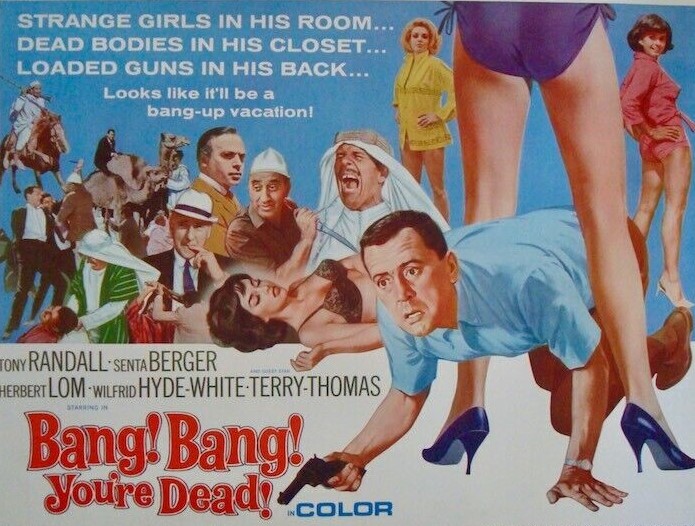
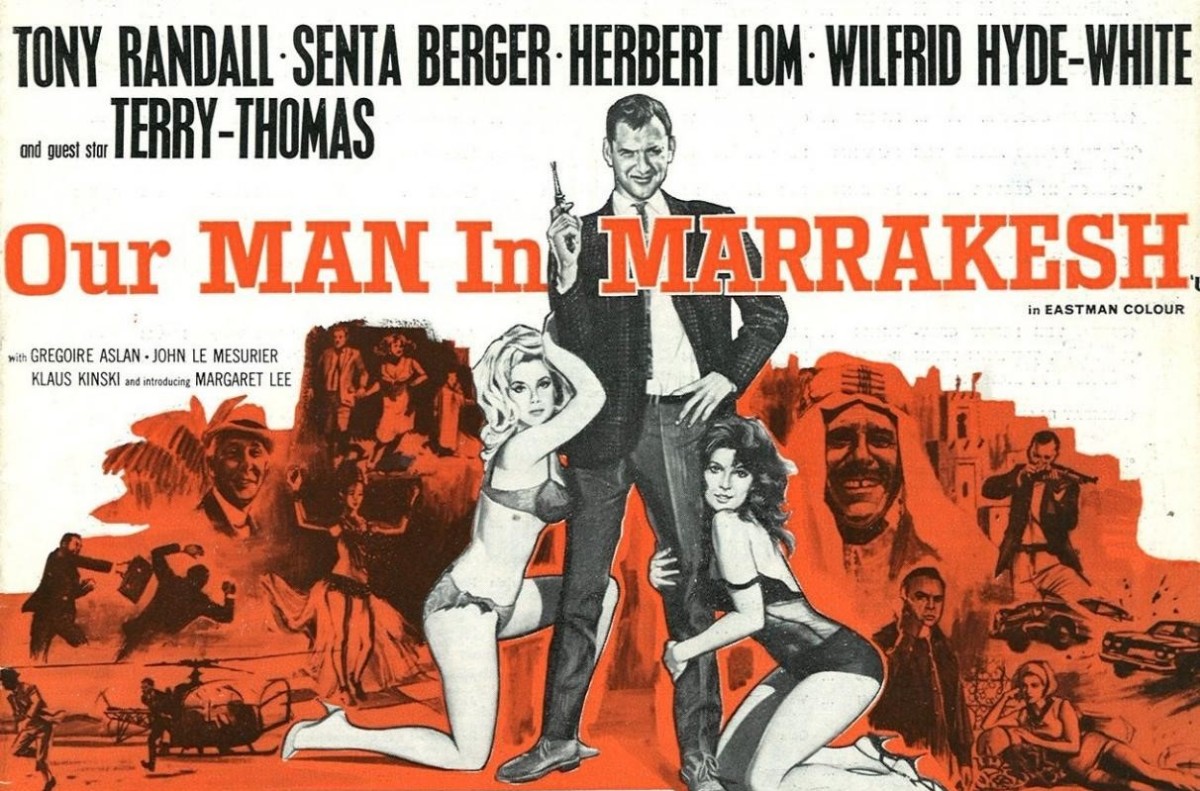
All hail Senta Berger! Another from the Harry Alan Towers (Five Golden Dragons, 1967) portfolio, this is a spy-thriller mash-up with a bagful of mysteries and a clutch of corpses. At last given a decent leading role, and although you wouldn’t guess it from either poster, Senta Berger steals the show from the top-billed Tony Randall (as miscast as Robert Cummings in Five Golden Dragons) and a smorgasbord of European talent including Herbert Lom (The Frightened City, 1961), Terry-Thomas, Klaus Kinski (Five Golden Dragons), John Le Mesurier and Wilfred Hyde-White (Carry On Nurse, 1959). In this company, the glamorous Margaret Lee (Five Golden Dragons), as Lom’s cynical lover (“you are never wrong, cherie, you told me so yourself,” she tells him) is an amuse-bouche.
A more comedic approach to the movie when it was re-titled for U.S. release. At least here it did not try to sell itself as a Bond-type picture.
Six travellers – including oilman Randall, travel agent Le Mesurier, salesman Hyde-White and tourist Berger, meeting her fiancé – board a bus from Casablanca airport to Marrakesh. One is carrying $2 million as a bribe to ease through a vote in the United Nations, but bad guy Lom doesn’t know which one it is. When Berger’s fiance’s corpse tumbles out of Randall’s cupboard, the pair become entangled. Berger is a marvellous femme fatale, trumping Randall at every turn.
With no shortage of complications, the tale zips along, directed on occasion with considerable verve by Don Sharp (The Devil-Ship Pirates, 1964). There are some inventive double-plays – with a body in the boot Berger and Randall are stopped by a cop who tells them their boot is open. An excellent rooftop chase is matched by a car chase. And there’s a terrific shootout. Kinski is at his sinister best and Terry-Thomas a standout in an unusual role as a Berber.
The film was shot on location including the city’s souks, the ruined El Badi Palace and La Mamounia hotel (featured in The Man Who Knew Too Much, 1956). But Berger seamlessly holds the whole box of tricks together, at once glamorous and sinuous, practical and tough and exuding sympathy, and it’s a joy to see her for a large part of the picture leading Randall by the nose. Quite why this did not lead to bigger Hollywood roles than The Ambushers (1967) remains a mystery.












 The Magnificent 60s