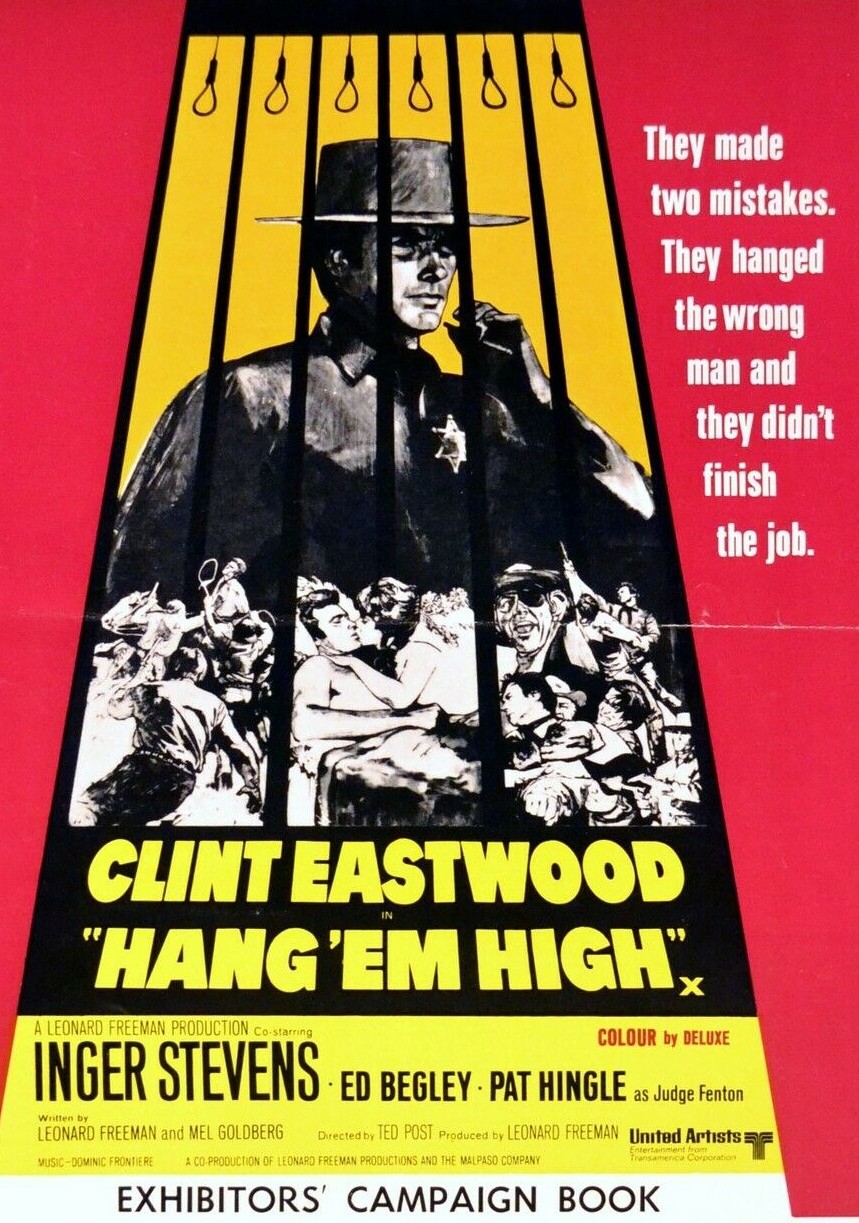
Hang ‘Em High (1968) ****

Clint Eastwood didn’t waste much time capitalizing on the unexpected success of the Dollars Trilogy. But the first was not released in the United States till 1967 and despite the success of the series across Europe was generally dismissed as a fluke, until American audiences suggested otherwise. The following year Eastwood appeared in three pictures, Hang ‘Em High, Coogan’s Bluff and Where Eagles Dare, which solidified his screen persona as portraying more with a twitch or a raised eyebrow than digging deep into the dialog.

Contrary to my expectations, Hang ‘Em High doesn’t quite fall into the trademark revenge mode of later westerns. It’s somewhat episodic, Jed (Clint Eastwood) often sent off on a tangent by Judge Fenton (Pat Hingle), allowing the lynch mob who failed to hang him in the first place a second chance at completing the job.

Following the success of the James Bond double bills,
United Artists spun out its Clint Eastwood portfolio at every opportunity.

And while the presence of the second-billed Inger Stevens (Firecreek, 1968) suggests heady romance that doesn’t kick in until the third act and it’s more tentative than anything and its purpose is more, in narrative terms, to provide Jed with a correlative with which to compare his own obsession, bringing to justice the nine men who attempted to kill him.

Just to confuse things, the middle section isn’t about revenge or romance, but about justice. Specifically, it’s about showing that justice will be done, that in the unruly West, with insufficient enforcers of law and order, that crimes will not go unpunished, a gallows on constant display to make the point.

Surprisingly, it’s Jed who argues that some of this justice is just too summarily executed. He tries in vain to prevent the execution of two young rustlers who fell in with one of his potential assassins, Miller (Bruce Dern), but who refuse to take advantage of the situation when Miller overpowers Jed while he’s bringing the trio in to face the judge. Admittedly, they don’t go to his aid either, but the fact they resist piling in allows Jed to escape. However, rustling is a hanging offence, so they cannot escape the noose, certainly not in Fenton’s town.

There’s a switch in the mentality of Jed. Before he’s co-opted by Fenton to return to his former profession of lawman, Jed is of the school of thought that decides to take the law into his own hands. Even wearing a badge, you are allowed to shoot a man stone dead if he’s trying to escape, even if such action is severely hampered by him already being badly wounded, as lawman Bliss (Ben Johnson) demonstrates. But Bliss isn’t as callous as he sounds. He’s a contradiction, too, racing to the aid of Jed dangling in a noose in a tree, freeing him so he can face justice, even if that will most likely result in hanging.

So Jed upholds the law, preventing other citizens from taking the law into their own hands, Miller a target of the family of the owners he slaughtered before making off with their cattle.  

We only see shop owner Rachel (Inger Stevens) fleetingly for most of the picture. She appears any time a new wagon load of criminals is jailed, scanning their faces for who knows what, though likely we’ve guessed it’ll be to find the killer of a loved one. Not only has her husband been killed by two strangers but while his corpse is lying on the ground beside her she’s raped. And although she eventually responds to Jed’s gentle moves, she still can’t let go of her “ghosts.”

Jed is put through the wringer. Not only an inch from death following the initial hanging but ambushed again by the same gang and nearly dying of pneumonia after being caught in a storm, the latter incidents permitting the kind of nursing that often fuels romance.

There’s an ironic ending. Captain Wilson (Ed Begley), leader of the gang, hangs himself rather than be shot by Jed.

The score by Dominic Frontiere (Number One, 1969) lurches. We go from heavy-handed villain-on-the-loose music to eminently hummable echoes of Ennio Morricone.

Clint Eastwood reinforces his marquee appeal, Inger Stevens delivers another of her wounded creatures, and Pat Hingle (The Gauntlet, 1977) is an effective foil. Bruce Dern (Castle Keep, 1969) does his best to steal every scene without realizing that over-playing never works in a movie featuring the master of under-playing.

Host of cameos include veterans Ben Johnson (The Undefeated, 1969), Charles McGraw (Pendulum, 1969) and L.Q. Jones (Major Dundee, 1965) plus two who had not lived up to their initial promise in Dennis Hopper (though he would revive his career the following year with Easy Rider) and James MacArthur (Battle of the Bulge, 1965).

Journeyman director Ted Post made a big enough impact for Eastwood to work with him again on Magnum Force (1973). Written by Leonard Freeman (Claudelle Inglish, 1961) and Mel Goldberg (Murder Inc., 1960).

More than satisfactory Hollywood debut for Eastwood and worth checking out to see that even at this early stage he had nailed down his screen persona.
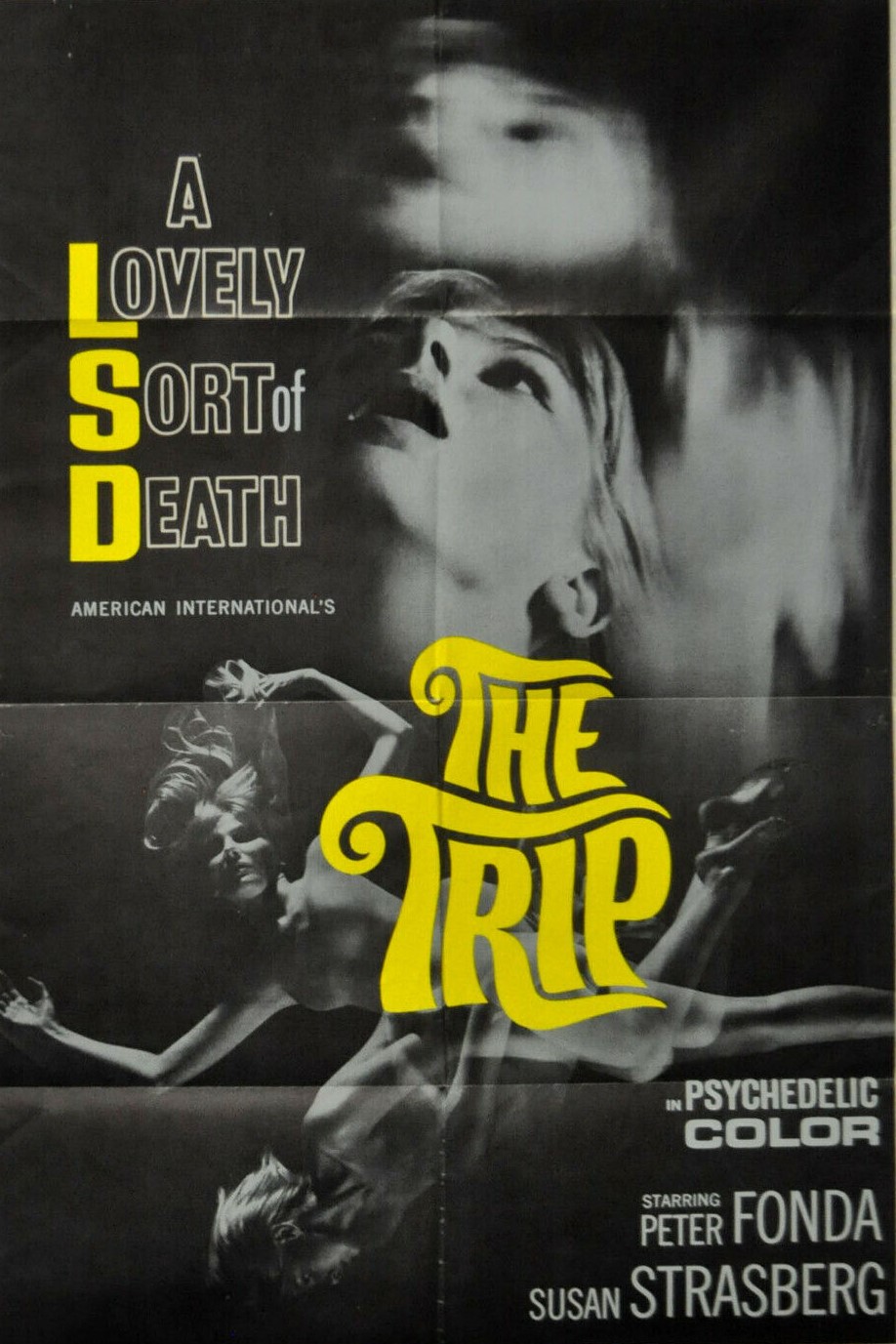
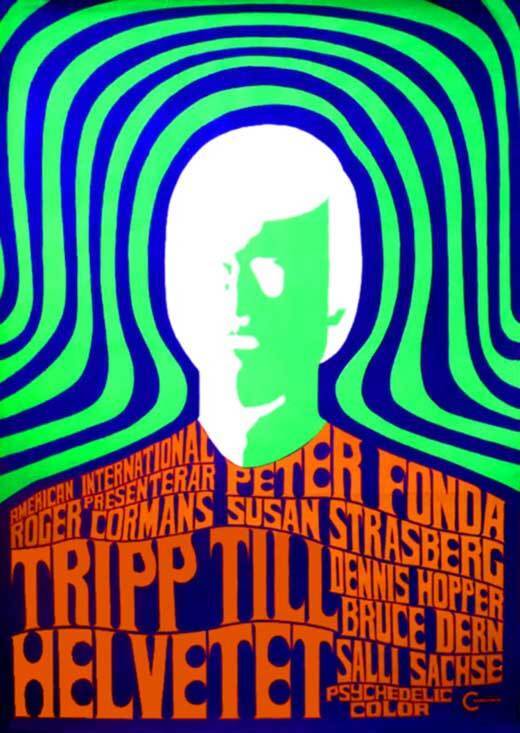
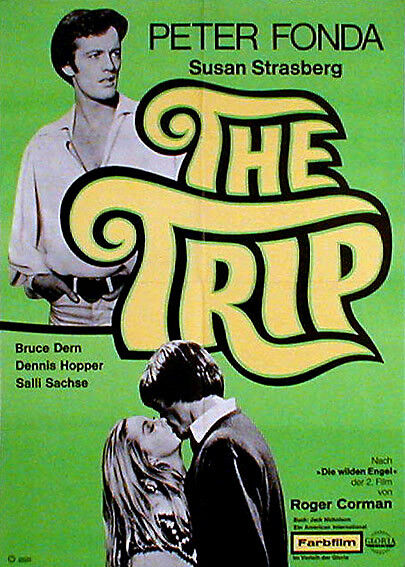
The Trip (1967) ***

Give any neophyte (word of the week!) independent film director a camera and a small budget ($100,000 in this case) and they might well have come up with something like this. Has the feel of being an advert for promoters of LSD who felt they had to play fair and show the potential downside. Meanwhile, they can jam in an absolute phantasmagoria of imagery and sit back and wait for Stanley Kubrick to rip off some of their ideas and give the whole head-spinning malarkey some credence for the conclusion of 2001: A Space Odyssey.

If there’s a story, it’s as thin as they come. Commercials director Paul (Peter Fonda), trying to understand himself better, and why, for example, wife Sally (Susan Strasberg) has left him for another man, enlists the help of self-help guru John (Bruce) to guide him through an LSD trip. The notion that there are drug guides comes as a surprise to me, and this feels like the kind of the warning you get on the side of cigarette packets, although quite what guidance anyone can expect while under the influence is anybody’s guess. If you’re high as a kite, it’s unlikely you’re on an even enough keel to do what you’re told.

Anyway, off we go. And lo and behold, before you can utter the words “groovy” or even “psychedelic,” suddenly the screen is invaded with all sorts of images, coming so quick and fast that even the ones that might makes sense – i.e. indicating paranoia – get little time to settle before the next appear. Some of the images look like they’re offcuts from an AIP horror picture, haunted houses, medieval backdrops, torture, people being mummified or hanged or drowned or all three (maybe all at once).

And from there it’s an easy step into being dazzled by headlights or climbing a cliff or running through a desert or being chased by masked men on horseback and hearing high-pitched giggling. Some of the images, while dreamlike, remain realistic, such as topless body-painted go-go dancers. And the oddest image of a woman in curlers eating a chicken leg in a laundromat feels easily like something out of a bizarre dream when in fact it isn’t.

Some stuff you might expect. Items like an orange are experienced with more intensity. And Paul is disembodied when he observes people making love. Sometimes you’re looking through a kaleidoscope, other times it’s with grim clarity. Strobe lights, hallucination, add to the dreamy expressionistic quality. Not sure the movie had much to say except drugs can be fun – or not. But, inevitably, the imagery, instead of assisting with characterization, gets in its way.

Looks strange to see so many hippies with short hair. Peter Fonda, Dennis Hopper and Jack Nicholson (here only in his capacity as the screenwriter) would come together with greater effect in Easy Rider (1969). This resembles nothing more than an audition for the later film but directed by someone (Hopper) with a bit more sense, adding a proper narrative and cutting the tripping down to the minimum.

Roger Corman (The Secret Invasion, 1964) directed but Susan Strasberg (The Sisters, 1969), Bruce Dern (Castle Keep, 1969)  and Dennis Hopper have such small parts they are almost only there to add marquee value. Not quite the ode to counter culture envisaged.

Shows how difficult it is to film the unfilmable.

https://amzn.to/3Rz1mCW

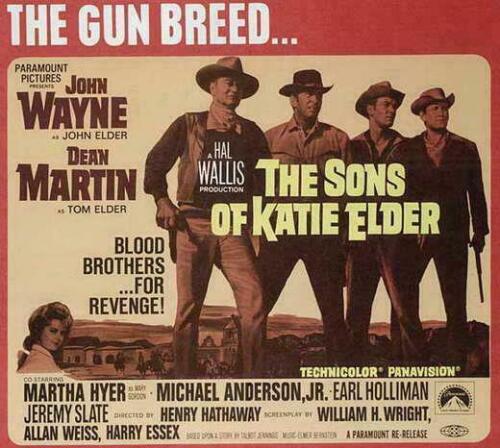
Behind the Scenes: “The Sons of Katie Elder” (1965)

The property had been bouncing around Hollywood for over decade. It had its origins in the true-life tale of the five Marlow brothers involving murder, revenge, and jailbreak, the story making national headlines when the case was heard at the U.S. Supreme Court in 1892. Based on the book The Fighting Marlows by Glenn Shirley,William H. Wright (Assignment in Brittany, 1943) shopped around a screenplay, jointly written with Talbot Jennings (Northwest Passage, 1940), that was purchased by Paramount in 1955.

Alan Ladd (Shane, 1953), who owed the studio a movie, was cast in the lead and the script went through rewrites by Frank Burt (The Man from Laramie, 1955) and Noel Langley (Knights of the Round Table, 1953) with shooting scheduled for 1956. John Sturges (The Magnificent Seven, 1960) was set to direct until Ladd quit, having bought his way out of his contract. Burt Lancaster (The Train, 1966) was brought in as his replacement.

When Lancaster dropped out, producer Hal Wallis took over the movie in 1959 and considered replacing him with James Stewart (Shenandoah, 1965) or Charlton Heston (The Hawaiians, 1970) with Dean Martin (Rio Bravo, 1959) as the second lead. But still the movie stalled for another five years before Wallis settled on John Wayne who signed on for $600,000 plus a one-third share of the profits and one-third ownership of the negative (a bounty that would continue to pay off through reissues and leasing to television). Henry Hathaway was paid a flat $200,000.

Wayne and Hathaway had history dating back to The Shepherd of the Hills (1941) based on the million-copy bestseller by Harold Bell Wright, and groundbreaking in its use of Technicolor, then in its infancy. They didn’t work again until desert treasure hunt Legend of the Lost (1957) which teamed Wayne with Sophia Loren. A few years later came North to Alaska (1960) followed by Circus World / The Magnificent Showman (1964).

Despite this long-term relationship, the most the director could offer about his star was that “Wayne is more particular about the pants he wears than anything in the world…unless he gets the thinnest kind of material it drives him crazy.”

When the script was finally knocked into shape, the Marlow siblings had been trimmed from five to four, and that family had been replaced by the Elders, a nod to western aficionados who would recognize the name Katie Elder (“Big Nose Kate”), occasional companion of Doc Holliday whose story Wallis had previously filmed as Gunfight at the O.K. Corral (1957). Even though Elder wasn’t dead enough – she lived till 1940 – to conform to this picture, it seemed an odd decision to choose that name unless resonance was expected.

But it was still far from a done deal because Wayne’s cancer threatened to scupper the picture. Start of shooting scheduled for October 20, 1964, was shuttered when the disease was diagnosed on September 13 following the completion of Otto Preminger WW2 epic In Harm’s Way (1965). Aware surgery might jeopardize the picture, Wayne suggested Wallis replace him with Kirk Douglas (Cast a Giant Shadow, 1966).   

Hathaway rejected the notion, but while neither star nor producer had any idea whether the operation would be successful, and whether Wayne would be even fit enough to work, or – God forbid, that the actor might already have made his last picture – Wallis took an optimistic approach and announced the picture would be delayed for a month and “even a little later.” Hathaway’s optimism was based on the fact that he had survived colon cancer a decade before.

At least the surgeon moved fast, operating four days after diagnosis, and again five days later. As well as fighting the damage surgery and pain had done to his body, Wayne found himself slipping into depression, convinced the operation would render him unemployable. “I’ll never work again if they find out how sick I am. If they think an actor is sick, they won’t hire him,” he said, a legitimate observation given the cost of shutting down a picture should the actor be unable to play his role.

Wallis’s business partner Joseph Hazen shared Wayne’s pessimism and urged the producer to recast with either William Holder (The 7th Dawn, 1964) or Robert Mitchum (The Way West, 1967). Paramount, too, fretted about insurance, the studio couldn’t risk hiring an uninsurable actor. Wallis refused to abandon Wayne and the studio finally agreed to tough conditions from the insurance company. So, on January 6, 1965, the principals gathered in Durango to commence the 46-day shoot on a production budgeted at $3.19 million.

The high elevations – 8,500 ft in places – were not conducive to someone recovering from a lung cancer operation and Wayne found it difficult to breathe. It didn’t help that on the fourth day of shooting Wayne was expected to jump into icy water for the sequence where the brothers were ambushed by the villains. It didn’t help, either, that Wayne was too big to wear a rubber suit to stave off the cold like his fellow actors.

Wayne never complained that Hathaway “worked me like a damn dog.” He realized that it “was the best thing ever happened to me. It meant I got no chance to walk around looking for sympathy.” The star put on a brave front, publicly acknowledging his battle with cancer as a way of giving hope to others while privately terrified not so much of dying but of being helpless. “I just couldn’t see myself lying in bed…no damn good to anybody.”

“He had to be the macho man,” commented Earl Holliman (The Power, 1968), a late substitute for original star Tommy Kirk (Swiss Family Robinson, 1960) who was sacked after being caught smoking marijuana, “he had to have more drinks than the next guy.” And despite the severity of his condition, and although publicly pretending he had given up tobacco, he continued smoking cigars.

Recalled Dean Martin (Rough Night in Jericho, 1967), “He’s two loud-speaking guys in one.” George Kennedy (Cool Hand Luke, 1967) asserted, “If you put him in a group with other movie stars, the eye went to him and that is the ultimate marker of respect. He was John Wayne. He was very real. It didn’t matter if he wasn’t Olivier; Olivier wasn’t John Wayne.”

But there were outward signs of the effect the illness had upon him. He was less sure of himself on a horse, riding with a shorter rein out of fear a horse would get away from under him, trying to minimize the chances of falling or being bucked from the animal. And as the film wore on, an oxygen inhaler was set up beside him on set.

Dennis Hopper (Easy Rider, 1969) was wary of working again with Hathaway after a difficult experience with him on From Hell to Texas (1958) starring Don Murray and Diane Varsi where the actor suffered the indignity of endless takes. Hopper quit three times and for good measure the director put the word around and virtually grounded the actor’s career. Hopper only made one movie in six years. In the interim he had married Brooke Hayward, daughter of actress Margaret Sullavan whom Hathaway respected, and peace was brokered.  

Although on his best behavior on the shoot, Hopper was no less impressed. “He was a primitive director, he rarely moved his camera, the movement came from the actors.”

“Westerns are art,” declared Wayne. “They’ve got simplicity and simplicity is art…There’s simplicity of conflict you can’t beat…Westerns are our folklore and folklore is international…In Europe they understand that better than we do over here. “

Whether it was public sympathy for an ailing star and his resolve to fight cancer, or audience delight that he was back in a western after a gap of a few years, The Sons of Katie Elder was a huge hit with $5 million in initial rentals (what studios were left with after cinemas had taken their share). It earned more later in reissues but that initial sum was enough for thirteenth spot in the annual box office rankings though beaten by both Shenandoah and Cat Ballou. Its foreign earning would probably match domestic, to make it one of Wayne’s biggest earners for the decade.

SOURCES: Scott Eyman, John Wayne: His Life and Legend (Simon and Schuster Paperbacks, 2014) p111, p387-396 ; Ronald L. Davis, Duke: The Life and Image of John Wayne (University of Oklahoma Press, 1998) p266; Hal Wallis Collection, Margaret Herrick Library; Hedda Hopper, “Ladd To Star in Film of Pioneers’ Reunion,” Chicago Daily Tribune, November 9, 1955, p16; Thomas M. Pryor, “Hecht-Lancaster Obtains 2 Novels,” New York Times, January 12, 1956, p22; Oscar Godbout, “TV Movies Extras Get Salary Rises,” New York Times, July 3, 1956, p17; John Wayne, “Me? I Feel Fine,” Los Angeles Times, January 18, 1965; James Bacon, “Wayne’s Biggest Bout vs. Killer Cancer,” Los Angeles Herald Examiner, March 14, 1965; Roderick Mann, “John Wayne – A Natural as The Shootist, Los Angeles Times, March 7, 1976.

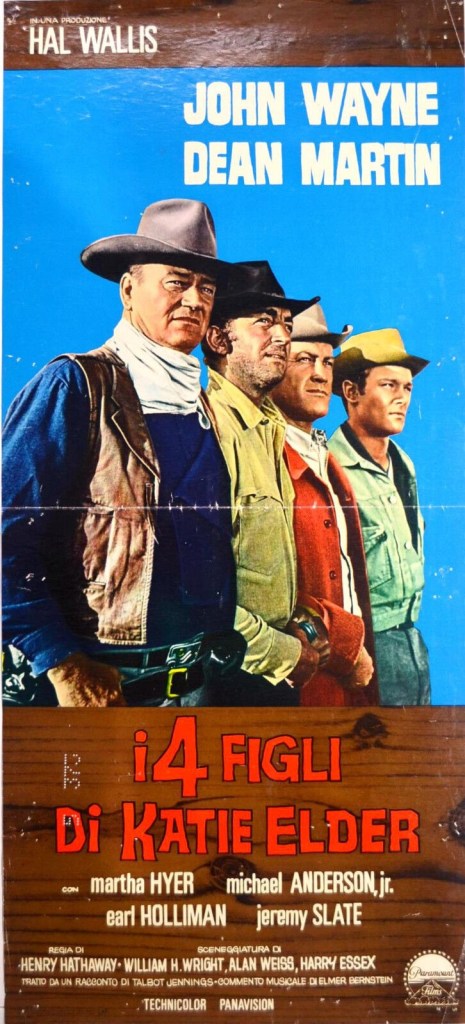
The Sons of Katie Elder (1965) ****

The rocking chair motif in this underrated film is ignored while the door opening and closing in The Searchers (1956) is hailed as one of cinema’s greatest images. Welcome to the world of director Henry Hathaway (Nevada Smith, 1966). Way down the pecking order when it comes to the makers of great westerns, below Sergio Leone (Once Upon a Time in the West, 1969) who only made four and Howard Hawks (Rio Bravo, 1959) only three.

Closer inspection, too, of The Wild Bunch (1969) might reveal cinematic ideas that turned up here first. Closer inspection of John Wayne (The Commancheros, 1961) might reveal a mighty fine, very touching, performance.

The genre was chock-full of vengeance, but here that is tempered by mystery over the death of their father, a drunken gambler, that has led to the loss of the family ranch, leaving the mother, for whose funeral the titular sons return, living hand-to-mouth, supplementing the usual sewing and mending with giving guitar lessons.

Hastings (James Gregory),  a businessman with big ideas, has taken over the ranch and pretty much the local town of Clearwater. And he’s just hired extra muscle, notorious gunslinger Curley (George Kennedy), to swell his already-growing army.

Only the youngest son, Bud (Michael Anderson Jr), a reluctant college student, is clear of the taint of wrong-doing. John Elder (John Wayne) has a reputation as a gunfighter but unlike shifty younger brother Tom (Dean Martin) doesn’t have a wanted poster following him around. The other son Matt (Earl Holliman) takes after John, some shady action but no legal consequence.

This is certainly not a great fraternal union. When they’re not engaged in low-level investigation or trying to prevent themselves being lynched, they’re bickering and fighting. The only thing that unites them, beyond love of the deceased woman, is determination to continue paying for Bud’s education.

Apart from the ranch, one of Hastings’ other lucrative investments is a firearms business, which allows him to tote around a telescopic rifle which, of course, ensures he can bump off those who get in his way from a distance, without fear of discovery. The easiest way to get rid of the brothers is to have them arrested for murder and to kill off the one man, Sheriff Wilson (Paul Fix), who might have the brains and experience to work out something fishy was going on.

John Wayne is more emotional here than in any picture since The Searchers, though, as you’ll be aware, his emotion is registered through his eyes or bits of business rather than a lengthy speech. And given double duty of looking after the youngest while holding back the more tempestuous Tom.

Dean Martin’s (Five Card Stud, 1968) charm runs thin, as is intended, no woman to gull, and no cliché alcoholism a la Rio Bravo to fall back on. It’s a part he plays completely against type, although you can sense he’s bursting out of those confines in the false eye con. He’s pretty much always brought to heel by Wayne. The one time he defies big brother ends in personal calamity. Imagine a marquee name as big as Dean Martin taking on a role where the part sets him up to be walking in the Duke’s shadow, despite his efforts to break loose.

In fact, unusually for a western, until Butch Cassidy and the Sundance Kid (1969) came long, it’s replete with reversals. Hathaway plays with expectations from the outset, the opening sequence of big beast of a train puffing through fabulous scenery doesn’t bring John, instead, unknown to the waiting brothers, Curley disembarks. Katie Elder’s friend Mary (Martha Hayer) cuts off at the pass any idea the audience might have of incipient romance when she gives John both barrels.

Thanks to the screenplay, Michael Anderson Jr.(Major Dundee, 1965) and Earl Holliman (The Power, 1968) are given more bite than their roles might suggest and James Gregory (The Manchurian Candidate, 1962) makes his villain meaty though you suspect the presence of George Kennedy (Cool Hand Luke, 1967) is another lure, creating audience expectation that is not fulfilled. Martha Hyer (The Chase, 1966) is more conscience than glamor,  spending most of the time on the sidelines.

You’d be surprised just how lean a production this is, and equally how deftly Hathaway avoids cliches. Just because there’s a kid you don’t need to teach him how to be a man. A huge herd of horses doesn’t need to stampede. Beautiful woman in the vicinity doesn’t necessarily call for a heated love affair. Ending up in jail doesn’t necessitate a bust-out. Villainous gunslinger doesn’t set up obligatory shootout in an empty street.

Hathaway’s unusual, too, in the way he anchors his pictures in reality. Here it’s a funeral director washing the wheels of his hearse, a blacksmith applying shackles.

You’d marvel, too, at just who was involved in fashioning the terrific screenplay: veteran William H. Wright, his first in two decades, Harry Essex (Creature from the Black Lagoon, 1954) in his first in eight years, and Allan Weiss whose six other movies were all Elvis Presley vehicles. Hardly the pedigree to produce one of the best westerns of the decade. This is the kind of screenplay where no line is wasted, not when a retort can be used to define  character.

Most people remember the rousing theme by Elmer Bernstein (The Scalphunters, 1968), but actually there are also some very innovative musical passages worth listening out for.

Curiously, it was Andrew Sarris,  hardly a John Wayne fan, who recognized the movie’s attributes, though in niggardly fashion, “The spectacle of people in Hollywood trying to do something different in a western at this late date is reassuring.”

It’s about time those differences and the picture’s excellence were recognized.

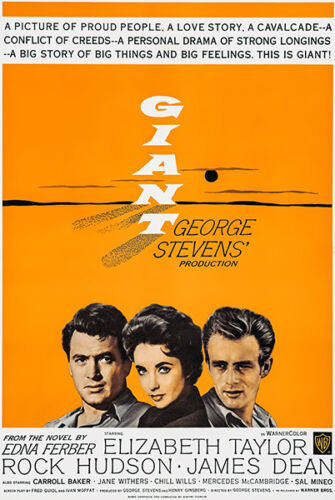
Giant (1956) ***** – Seen at the Cinema

Should James Cameron require any suggestions on how to structure a family saga featuring exclusion, rebellion, adolescence, revenge and racism without relying on repetitive action beats he could do worse than check out this towering epic. There’s a seamlessness to the screenplay that allows the director to move quickly along, drama and conflict that initially tear a family apart in the end bringing it back together.

The story charts the romance of Texan rancher Bick (Rock Hudson) to socialite Leslie (Elizabeth Taylor), their marital conflict as she exerts her personality in a male-dominated world, her battle with Bick’s older sister Luz (Mercedes McCambridge) for control of the household, and the infatuation of ranch hand Jett (James Dean) with Leslie.

First child Jordan (Dennis Hopper), pushed unwillingly into masculine pursuits by Bick,  bucks his father’s long-term plan by determining to become a doctor. Second child Judy rebels against the extravagant lifestyle and opts, along with husband Dace, for a small spread, the cattleman’s version of a mom-and-pop operation. Third offspring Luz the Second (Carroll Baker) romances the older Jett, now an oil millionaire, and Bick’s business rival.

Racism and exclusion form the core of the picture. Leslie is shocked to discover her father’s employees living in abject poverty, that he will not countenance the cost of improving living conditions, partly on racist grounds, partly on the American principle that it’s every man for himself, a race in which losers are left behind like sores to fester. Jordan marrying a Mexican brings these issues to the fore, especially when his grand heritage cannot protect her from humiliating racism. Bick and Leslie bicker, fall out, make up, are exploited by their children, who can always find one or the other to take their side in any dispute.

Sure there are some terrific lines but the best scenes are simply visually dramatic. Luz, furious at Leslie encroaching on her territory, lames her rival’s favorite horse by riding it with spurs digging into its flesh. A huge crowd welcomes home a white World War Two hero, a handful of people the Mexican equivalent, only when the train pulls away do we see the draped coffin. The introverted by now incoherent Jett unable to summon up the words to complete his proposal to Luz the Second. Terrified four-year-old Jordan atop a horse, not being able, or willing, to ride the worst sin in Bick’s world.

Bick, restraining himself from launching into a fistfight with Jett in the wine cellar of the oil man’s opulent hotel, throws an item at racks of bottles, only to see it topple back, the camera remaining on Bick’s face as we hear the successive toppling of rack upon rack upon rack. Jett, all the wealth he could ever want, wakens from drunken slumber to an empty banqueting room, guests long departed.

A tiny house, as grand as it is, sits in the distance on a massive plain. The passing of time is delineated in relation to horsepower. We are introduced to Bick staring out of a train window watching horses which almost match the speed of the train. Then it is a plane which outruns a car. Finally, when speed, as a demonstration of inherent power, is no longer of the essence the family, in a car, is happy to be overtaken by a speedster.  

The power of wealth, the power of power, its corrosive impact on those sharing in what it can bestow, the damage inflicted on those who get in the way, is the other great theme, spelled out not in dogma or speeches but in human cost. And no matter how powerful, someone is always bigger. The dominant Texan cattleman is easily overtaken in the wealth stakes by the oilman, whose political donations ensure tax exemption.

The vindictive Luz gains revenge on her brother by bequeathing Jett a small parcel of land, just enough to prevent the cattleman from owning everything as far as the eye can see and far beyond, just enough to cause irritation.    

And this is before we come to the performances. It’s hard to choose between the three principals. Elizabeth Taylor (The Comedians, 1967), fiery, humane, loving, submitting unwillingly to the superior male, arguing her corner, fighting for the rights of others, brings a superbly complex character to brilliant life. But Rock Hudson (Tobruk, 1967) , in a less showy part, is just as good, conflicted, stubborn, initially shy, forced to take on inherited stances, only at the end standing up against what he formerly believed. And you can hardly take your eyes off James Dean, hiding behind a Stetson or a bottle of whisky, inarticulate, lost, greedy, infatuated.

John Huston used to aver that in any given scene the camera did all the work, that with three or four people to choose from, all on screen at the one time, the strongest performer would attract audience attention. Here, that attention constantly flickered from Taylor to Hudson to Dean, as, almost without exerting an acting muscle, they battled for screen dominance.

Taylor was ignored come Oscar time, but Hudson and Dean split the vote allowing Yul Brynner to sneak in, Mercedes McCambridge nominated in the supporting category, Stevens winning his second Oscar. The supporting cast had tremendous depth: Carroll Baker (Station Six Sahara, 1963), Dennis Hopper (Easy Rider, 1969), Mercedes McCambridge (99 Women, 1969),  Sal Mineo (Escape from Zahrain, 1962), Rod Taylor (The Birds, 1963),  Jane Withers (Captain Newman M.D., 1963) and Chill Wills (The Alamo, 1960). Fred Guiol (Shane, 1953) and Ivan Moffat (The Heroes of Telemark, 1965) adapted the Edna Ferber bestseller.

I saw this on the big screen in a 4K restoration which means it’s probably heading for streaming and/or DVD but if your local arthouse chances to program this any effort to see it will be well worthwhile.

Easy Rider (1969) *****

Just goes to show what a little bit of reimagining can do. A companion piece to The Wild Angels (1966) but which takes the viewer in the opposite direction, turning the characters from perpetrators of violence to its victims, adding in a stonking soundtrack and a bit more philosophy, though holding on to the long tracking shots of motorbikes that defined the Roger Corman approach. From the bare bones of the Corman movie emerged a cinematic – and box office – miracle.

You could be forgiven for thinking that the movie’s main influences were the early Cinerama pictures that focused on extensive tracking shots of scenery (in this case, the open road) and unusual customs (ditto, alternative lifestyles, dope-taking etc) and Mike Nichol’s use of contemporary pop music in The Graduate (1967). But it also drew on the assumption, as did Hitchcock in Vertigo (1958) and Kubrick with 2001: A Space Odyssey a decade later, that a camera doing nothing can be hypnotic.

Message pictures were the remit of older directors like Stanley Kramer and Martin Ritt and films that had something to say about the human condition generally emanated from Europe and not low-budget efforts coming out of Hollywood. Easy Rider has a European sensibility, an almost random collection of unconnected episodes with no narrative connection to the main story, itself incredibly slight, of two mild-mannered dudes heading to New Orleans to see the Mardi Gras.

Road trips were not particularly unusual in American cinema but the form of previous locomotion was horse-related – westerns. The journey has been a central theme to movies. This is an 80-minute picture masquerading as a 95-minute one, a good fifteen minutes of screen time taken up with endless shots of Peter Fonda and Dennis Hopper on bikes passing through the landscape, with a contemporary soundtrack as comment.

Unusually, it’s also a hymn to ancient values, heads bowed in prayer at meals as different as you could get, the Mexican family and the commune, a marching band playing “When The Saints Go Marching In” and the recitation of prayers in the cemetery.

What marks the film out stylistically, perhaps enforced by the lean financing, is the sparing way it is told. The most dramatic scenes – the three murders – are filmed in shockingly simple fashion. There are often long pans along groups of characters. While innovative, the flash-cut flash-forward editing adds little to what is otherwise a very reflective film. Inspired use is made of natural sound, the muffled thumping of oil derricks at the cemetery, the soundtrack to one death is just the battering of unseen clubs by unseen assailants.

The dialogue could have been written by Tarantino, none of the confrontation or angst that drives most films, but odd musings that bring characters to life. At the beginning of the trip, Hopper and Fonda are welcomed wherever they travel, but towards the end resented, treated as though a pair of itinerant aliens. They entrance young girls but are vilified by authority, jailed for no reason except the threat to traditional values they apparently represent.

Elements not discussed at the time of release make this more rounded than you would imagine. The excitable Hopper, a nerd in hippie costume, is driven by the American dream of making money. The more reflective Fonda, developing a character trait he revealed in The Wild Angels, senses something is not only missing from his life but has been lost forever. He has the rare stillness of a top actor, face reflecting unspoken inner turmoil. As revelatory is the performance of Jack Nicholson, here effectively making a bid for stardom in a part that would snare an Oscar nomination.

It remains an extraordinary film, a series of accumulated incidentals holding up a mirror to an America nobody wanted to acknowledge and the brutal climax no less powerful now. 


Easy Rider (1969) *****

You could be forgiven for thinking that the movie’s main influences were the early Cinerama pictures that focused on extensive tracking shots of scenery (in this case, the open road) and unusual customs (ditto, alternative lifestyles, dope-taking etc) and Mike Nichol’s use of contemporary pop music in The Graduate (1967). But it also drew on the assumption, as did Hitchcock in Vertigo (1958) and Kubrick with 2001: A Space Odyssey a decade later, that a camera doing nothing can be hypnotic.

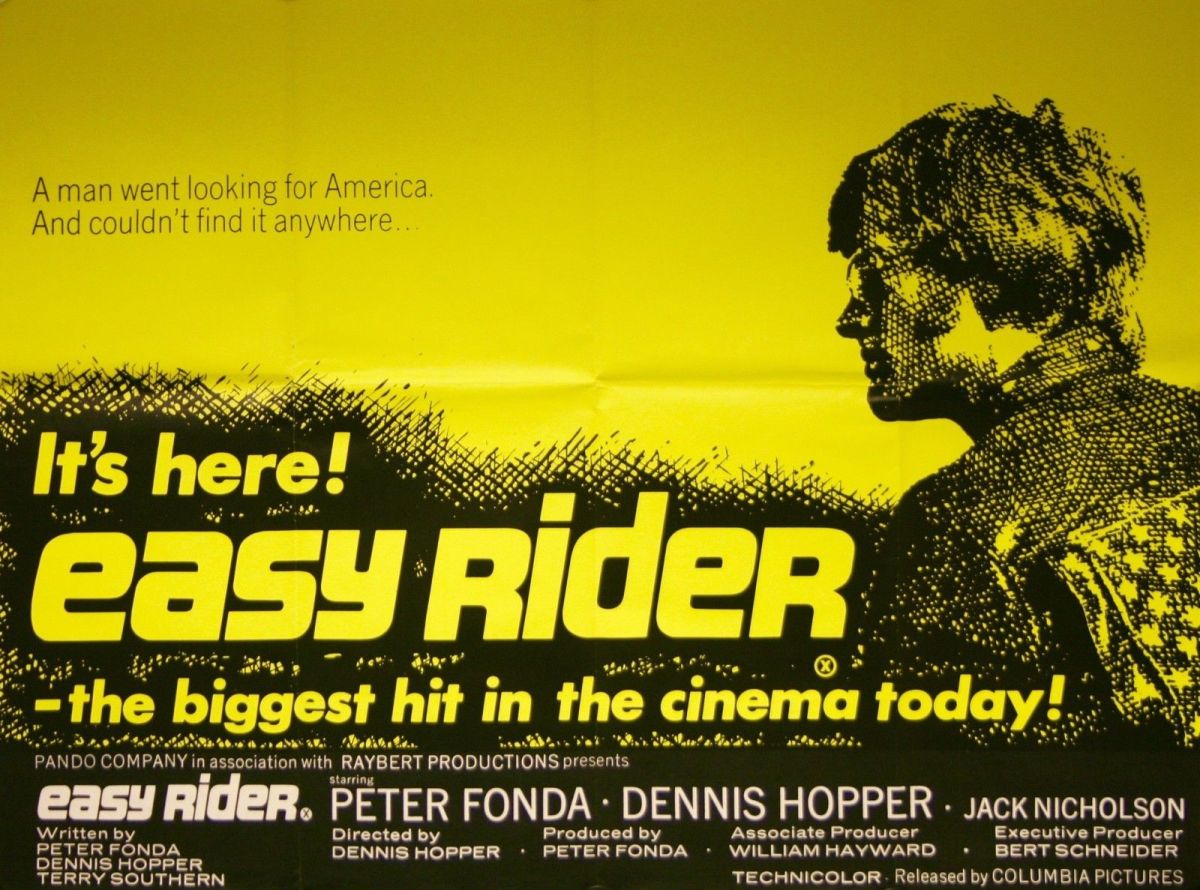
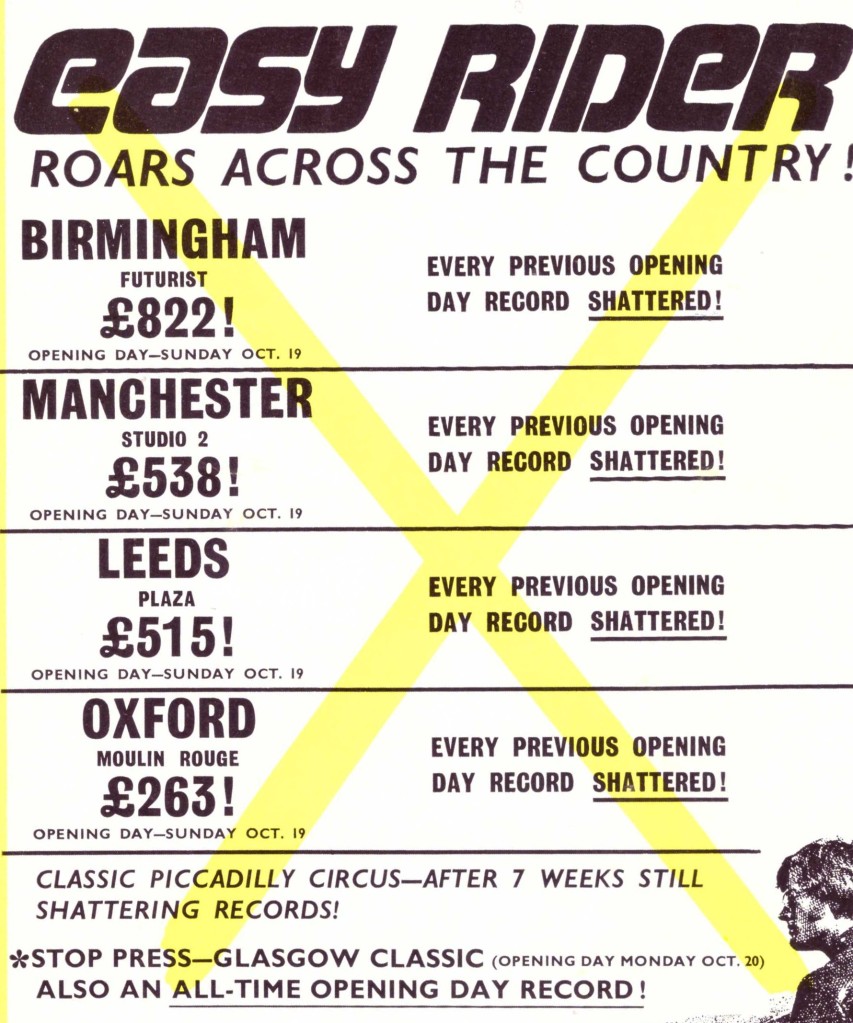
Selling a picture to the public and selling it to cinemas were two separate marketing skills. The easiest way to guarantee bookings for any film was to promote the box office figures through the trade press – as here in the British “Kine Weekly.” Columbia had cleverly booked the movie into one of the smallest cinemas in London’s West End where it was almost certainly guaranteed to break the box office record. But even the studio must have been taken aback by the way Easy Rider pulverized the previous record.

Message pictures were the remit of older directors like Stanley Kramer and Martin Ritt and films that had something to say about the human condition generally emanated from Europe and not low-budget efforts coming out of Hollywood. Easy Rider has a European sensibility, an almost random collection of unconnected episodes with no narrative connection to the main story, itself incredibly slight, of two mild-mannered dudes heading to New Orleans to see the Mardi Gras.

Road trips were not particularly unusual in American cinema but the form of previous locomotion was horse-related – westerns. The journey has been a central theme to movies. This is an 80-minute picture masquerading as a 95-minute one, a good fifteen minutes of screen time taken up with endless shots of Peter Fonda and Dennis Hopper on bikes passing through the landscape, with a contemporary soundtrack as comment.

Unusually, it’s also a hymn to ancient values, heads bowed in prayer at meals as different as you could get, the Mexican family and the commune, a marching band playing “When the Saints Go Marching In” and the recitation of prayers in the cemetery.

Success in London was no guarantee that a movie would perform as well all over the country. Columbia continued to book it into smaller venues in the hope it would repeat the London experience of breaking box office records. When it did the studio took out another advert in Kine Weekly to let exhibitors know.

What marks the film out stylistically, perhaps enforced by the lean financing, is the sparing way it is told. The most dramatic scenes – the three murders – are filmed in shockingly simple fashion. There are often long pans along groups of characters. While innovative, the flash-cut flash-forward editing adds little to what is otherwise a very reflective film. Inspired use is made of natural sound, the muffled thumping of oil derricks at the cemetery, the soundtrack to one death is just the battering of unseen clubs by unseen assailants.

The dialogue could have been written by Tarantino, none of the confrontation or angst that drives most films, but odd musings that bring characters to life. At the beginning of the trip, Hopper and Fonda are welcomed wherever they travel, but towards the end resented, treated as though a pair of itinerant aliens. They entrance young girls but are vilified by authority, jailed for no reason except the threat to traditional values they apparently represent.

Elements not discussed at the time of release make this more rounded than you would imagine. The excitable Hopper, a nerd in hippie costume, is driven by the American dream of making money. The more reflective Fonda senses something is not only missing from his life but has been lost forever. He has the rare stillness of a top actor, face reflecting unspoken inner turmoil.

It remains an extraordinary film, a series of accumulated incidentals holding up a mirror to an America nobody wanted to acknowledge and the brutal climax no less powerful now.   

Of course, the Easy Rider soundtrack itself summons up memories of the era and it is worth listening to just by itself and you might even want to go all the way and listen to it in the original vinyl.

Below is a link for the DVD.

   https://www.amazon.co.uk/Easy-Rider-DVD-Peter-Fonda/dp/B00LTK2Z44/ref=sr_1_1?crid=YSG6SCL8QQF9&dchild=1&keywords=easy+rider+dvd&qid=1596660339&s=dvd&sprefix=easy+rider%2Caps%2C153&sr=1-1

Discover WordPress

A daily selection of the best content published on WordPress, collected for you by humans who love to read.

The Atavist Magazine

by Brian Hannan

WordPress.com News

The latest news on WordPress.com and the WordPress community.