There were five our great reasons to see this picture. Firstly, it was in Cinerama. Secondly, it was the first attempt in that special format to tell a dramatic story rather than offer just a travelog. Though How the West Was Won (1962) was promoted at the first dramatic use of Cinerama, that was actually untrue. This came first. Third, there was a terrific gimmick – Smell-O-Vision – which allowed audiences to inhale around 30 fragrances at the same time as the onscreen characters. Fourthly, it was produced by Mike Todd Jr., son of the Oscar-winning producer of Around the World in 80 Days (1956) and second husband of Elizabeth Taylor who was instrumental in bringing Cinerama to the big screen in the first place., Lastly, it was the first top-billed appearance of rising British star Denholm Elliott.
Unfortunately, none of these hit the target and it remains a novelty in the Cinerama canon. For a start, there wasn’t much of a story – it’s a chase tale of sorts with crime novelist Oliver (Denholm Elliott) uncovering a plan to kill American heiress Sally Kennedy. In setting out to thwart it he travels all over Spain in the company of philosophic wise-cracking taxi driver Smiley (Peter Lorre). Cue travelog of scenic Spain including fiestas, dances and the running of the bulls, which appears not to have been specially staged but filmed documentary-style as it occurred with the bulls inflicting considerable damage on the humans foolish enough to think it’s a lark.
The hook is the mystery woman who can only be detected by her Schiaparelli perfume while the giveaway for the villain, hired assassin Baron saradin (Paul Lukas), is his tobacco. Cue an onslaught of scents. But the smells don’t just pop up when characters are involved. When a barrel of wine smashes, that produces another smell.
Astonishingly, the movie manages to bring in some of the Cinerama trademarks – the runaway element seen from the audience POV, not just the traditional vehicle but also barrels of wine.
The smell gimmick worked well enough in cinemas set up for such technical aspects, but that amounted to very few screens, and outside of those the movie just seemed a random series of scenes with only panoramic views of Spain to lessen the boredom.
It did nothing for the career of Denholm Elliott and he did little for the movie. He lacked the edge or innocence required to make such a character come alive and mostly he looks as though he doesn’t know what to do. He didn’t make another movie for three years and on his return for Station Six Sahara (1963) he was no longer the star but quickly shifting into the character actor he would be for the rest of his screen career.
It was nearly the last hurrah for Peter Lorre. He suffered heart attack during filming so the real Peter Lorre is only seen in half the picture, for the other half it’s a stand-in.
The presence of Elizabeth Taylor (Butterfield 8, 1960) could conceivably have redeemed the picture but she puts in only a fleeting appearance, so speedy her distinctive features barely register. You see more of Diana Dors (Baby Love, 1969).
In the hands of Alfred Hitchcock (Psycho, 1960) or imitators like Stanley Donen (Charade, 1963) and with a more finely worked screenplay, reliant on neither visual nor olfactory gimmick, this might have worked. But it was in hands of Jack Cardiff (The Girl on a Motorcycle, 1968), famed cinematographer but only his third outing as a director, and he clearly didn’t know how to balance the various ingredients and so it limps home.
The minute the location of the source novel by Audrey Kelley and William Roos shifted from New York to Spain and the number of investigators halved, the trouble started. The hunt for a woman whose existence is in question was a standard mystery trope and might very well have worked here minus the smells and Cinerama.
Given I’m on my annual Cinerama binge, it’s interesting to see how current giant-screen format Imax developed from the previous king of the giant screens, Cinerama.
Quiz question: what connects King Kong (1933) to Cinerama? Follow-up quiz question: what connects Lawrence of Arabia (the man not the film) to Cinerama? Tie-breaker: what connects Cinerama, which had its heyday in the 1960s, to the current Imax.
Merian Cooper, the producer behind King Kong, and Lowell Thomas, the broadcaster whose fame was built on the dramatic footage he took of Lawrence of Arabia during World War One, were both vital to the development of the new screen sensation Cinerama, which made its debut two years before Twentieth Century Fox unveiled Cinemascope.
Both Cinerama and Imax began as vehicles for documentaries, the cinematography they involved initially considered too cumbersome for Hollywood directors to use. Initially, also, both formats were presented in cinemas specifically designed for showing films made in the process.
But, effectively, both Cinerama and Imax followed the same business model, one that Hollywood only too readily appreciated. They were premium priced products. Whereas most items you buy are the same price wherever you make the purchase, movies followed an extended version of the way publishers sold books. Readers had to pay extra to be first in the queue for a favorite author’s latest work, the hardback version of a novel appearing about a year in advance of the cheaper hardback.
In the silent era, Paramount instituted a food chain for movie presentation. Pictures opened first in the big city center theaters at top dollar prices ($2 – the equivalent to $35 now – not unusual in the 1920s) before working their way down a dozen different pricing levels until they reached the cheapest cinemas. As the business developed, although the U.S. cinema capacity grew to around 20,000 outlets, Hollywood reckoned that 70 per cent of a movie’s income came from a fraction of those houses, primarily from the more expensive first- or second-run cinemas.
Treatment of audiences is more democratic now. All tickets cost the same and the food chain is long gone, but in the 1950s and 1960s when Hollywood was battling the beast of television it appeared that audiences could be wooed back to the movies by giving them something bigger and better – and they were happy to pay the price. Imax follows the same pricing strategy.
Cinerama was not just the ultimate in widescreen but it offered visceral thrills. Given camera point-of-view audiences raced down a rollercoaster in This Is Cinerama (1952) and were astonished to see different global vistas presented in their full glory rather than as mere backdrops to actors. And while audience response was astonishing even by industry standards, and receipts tumbled in hand over fist, the concept soon lost popularity as audiences moved on to the more dramatically-accessible Cinemascope and its imitators and by the 1960s the format was more or less dependent on the company spinning out its back catalog in endless reissues.
Hence, the move towards dramatic storylines as instanced by How the West Was Won (1962) and The Wonderful World of the Brothers Grimm (1962), both initially presented in the premium-priced roadshow, separate performance, format. In quick fashion, too, Cinerama dispensed with the cumbersome three-lens camera and invented a single-lens alternative which made it much easier for directors.
During the 1960s Cinerama presented another eleven big Hollywood pictures ranging from It’s a Mad, Mad, Mad, Mad, World (1963) and Grand Prix (1966) to Ice Station Zebra (1968) and Krakatoa, East of Java (1969). But as the industry hit the financial buffers at the end of the decade, the writing was on the wall, and although Cinerama invested in 35mm movies like Straw Dogs (1971) the game was over for the format by 1972.
Imax was pretty soon positioned as its natural successor, unveiled in 1970 in Japan with Tiger Child, the first purpose-built cinema opening in Toronto in 1971 with North of Superior. The screen was much bigger than anything Cinerama or 70mm had offered. It was over three times the size of Cinerama. But it was of different dimensions; where Cinerama went wider, Imax went taller.
But again, the camera was an obstacle for Hollywood use. And like Cinerama, the format’s attraction was sheer spectacle. All the initial output was documentary-based, often with an educational purpose, though soon progressing to what was termed “entertainment” (Everest, 1998) and the movies were short by Hollywood standards, often less than an hour, which permitted Imax theater operators to present a greater number of daily screenings than an ordinary cinema.
Initially, they were not specifically premium-priced, but potentially more profitable because of the number of daily showings. Theaters typically kept 80 per cent of the box office which limited entrepreneurial interest since budgets for these movies were in the $6 million-$12 million range, not low enough to easily turn a profit. The movies could run for months, but there was the same problem as before – shortage of new product.
By 1990 Imax had largely pulled out of exhibition, ownership limited to nine theaters, and out of production.
Oddly enough, it was reissue that revived Imax. Disney planned a reworked version of its classic Fantasia (1940) as a method of generating more money from a picture that had already grossed $184 million on video. Traditionally, Fantasia got its best results from limited release, its previous revival outing shown in a maximum of 500 houses. Nor did Disney agree to the usual financial terms, demanding a 50 per cent share of the box office, rather than the normal 20 per cent.
Fantasia 2000 (2000) was released in 54 cinemas willing to commit to an 18-week run. While every Imax record was smashed, the picture, at a cost of $90 million, didn’t break even. But it did usher in Imax as a reissue vehicle. Disney used Imax for the 10th anniversary relaunch of Beauty and the Beast (1992), bringing in an extra $25 million in rentals. Two years later The Lion King (1994) in Imax brought in $15.6 million and Apollo 13 (1995) $1.7 million.
Naturally enough, Disney recognized the potential for Imax for new films and made Treasure Planet (2002) in an Imax version. But the big boost came with The Matrix sequels. Both The Matrix Reloaded (2003) and The Matrix Revolutions (2003) were digitally remastered for Imax, the latter the first to be shown simultaneously with the ordinary print.
Nowadays, Imax is part of the release mix, bringing a hefty chunk of premium-priced box office to the overall gross and also, as witness the current Interstellar (2014) a hyped-up reissue vehicle.
SOURCES: Brian Hannan, Coming Back to a Theater Near You, A History of Hollywood Reissues (McFarland, 2016) p5, 10, 12, 295, 297-298; Kim R. Holston, Movie Roadshows (McFarland, 2013 )p 112-113; James B. Stewart, Disneywar (Simon and Schuster, 2008), p346-347; “A Decade of Limited Release,” Variety, February 18, 1998, p23; “Eric J. Olson, “Fantasia Signs Up Increase,” Variety, May 24, 1999, p32; Joseph Horowitz, “A Fantasia for the MTV Generation,” New York Times, January 2, 2000; “Fantasia Hits Imax Record,” Variety, January 4, 2000, p7; “Top 125 Worldwide,” Variety, January 15, 2001, p24; “The Top 250 Worldwide,” Variety, January 6, 2003, p26.
I should mention the George Lucas connection right away because, for some, that is the movie’s main contemporary connection.
Mackenna’s Gold was originally intended as a three-hour movie[i] for roadshow release to be shot in early 1966 for Columbia Pictures by writer-producer Carl Foreman (Guns of Navarone, 1961) who would also be in the director’s chair.[ii] But outside of How the West Was Won (1962) westerns had foundered in roadshow. The Alamo (1960), John Ford’s Cheyenne Autumn (1964) and John Sturges The Hallelujah Trail (1965) were surprising roadshow flops. Foreman persuaded Columbia to increase the budget to $5 million – and then beyond – and film the movie in Cinerama, (over 25 percent of the budget was allocated to Cinerama to license the name and use the equipment – $1.35 million in total of initial negative costs[iii]).
In January 1967 Columbia launched the marketing campaign with full page advertisements in the trade papers promoting the fact that the movie would be filmed on location in the USA in Cinerama and that it would bring together the “creators of The Guns of Navarone,” meaning, at this point, Foreman and director J. Lee Thompson. The advertisement also highlighted author Will Henry, on whose novel the film was based (as the “author of San Juan Hill and From Where the Sun Now Stands”) and plugged the book as “a novel of Apache gold and Apache revenge based on the search for the fabulous Lost Adams Diggings.” By the following year, Foreman’s star was in the ascendant after the Parisian revival of High Noon[iv] and Columbia had another two major roadshows planned for the 1968-1969 season: Barbra Streisand’s movie debut in William Wyler’s Funny Girl also starring Omar Sharif and Carol Reed’s Oliver![v]
By this time, Columbia had reshaped its marketing effort to provide the specialist support required for promoting roadshows. In early 1967, it had poached sales guru Leo Greenfield from Buena Vista with the express aim of setting up an effective unit to market hard-ticket product – “first assignment Mackenna’s Gold, Oliver! and Funny Girl”[vi] – to the record number of Cinerama theaters[vii] and those desperate to accommodate roadshow. By the end of 1968, both Cinerama and Columbia had reported record revenues and profits, the former turning a $290,000 loss into a $679,000 profit,[viii] the latter on an unprecedented streak of success with a gross profit of $9.3 million profit on a gross income of $239 million.[ix] Columbia soon added another roadshow prospect to its slate, Sydney Pollack’s World War Two drama Castle Keep starring Burt Lancaster, and was so confident about the two non-musicals, for example, that it expected the western and the war picture to run consecutively from late spring 1969 well into the following year at Loews Hollywood in Los Angeles.[x]Funny Girl hit $550,000 in advance sales – $80,000 was the usual figure.[xi]Mackennas’s Gold’s was scheduled to premiere in Phoenix, Arizona, on February 15, 1969, with the roadshow launch set for the DeMille theater in New York five days later.
Within the next month, however, the world premiere was called off, work began on editing down the near-three-hour running time, and plans, two years in the making, for an ambitious roadshow release were quietly dropped. Public reaction to The Stalking Moon – also starring Gregory Peck – was one reason. Two other Cinerama movies, Custer of the West (1967) and Krakatoa – East of Java (1968) had also flopped. If Mackenna’s Gold was to be marketed as a drama in a western setting rather than a shoot-out in the tradition of 100 Rifles, then Columbia looked worryingly at Isadora, boasting a 177-minutes running time, whose roadshow run in Los Angeles was swiftly truncated, and the movie butchered in a bid to find an audience.[xii]
The studio took a different tack. The world premiere shifted to Munich, West Germany, in March[xiii] with most of the rest of the European capitals holding gala premieres (and running it as roadshow or at least 70mm) before the picture made its U.S. debut in Phoenix on May 10. But the picture unveiled in Phoenix was a ghost of the original. The running time technically came in at 128 minutes, but, in effect, was under two hours long, the introductory narration lasting eight minutes and the end credits accounting for further time. However, what was oddest of all was the 18-month gap between completion and world premiere. Filming had begun on May 16, 1967 and wrapped on September 29. Columbia had shelved one of its biggest budgeted movies for nearly 15 months.
The movie had a troubled history. For a start, Foreman didn’t own the rights to the Will Henry source novel. Dmitri Tiomkin, after a debilitating eye condition restricting his composing career, had in 1964 purchased the rights. Tiomkin agreed to sell the rights to Foreman in April 1965 in return not just for a fee and an agreement to compose the music[xiv] but also the vital producer’s credit necessary to launch him on a new career.[xv] Foreman was initially keen on filming the movie in Spain to take advantage of generous government subsidies.[xvi] But Foreman was demoted from director. His last picture as writer-producer-director The Victors (1964) had flopped. The studio did not want to offer the producer any distraction from the complex logistics of a location shoot where much of the time the crew would be 50 miles from the nearest town and where, despite the desert environment, could be subject to storms and flash floods. Instead, J. Lee Thompson (The Guns of Navarone) came on board as director. (Thompson was also at this point lined up to direct Charlton Heston in Planet of the Apes, whose rights he co-owned.)
However, the Thompson-Foreman relationship did not run smoothly. Foreman recalled: ‘I was not very happy with the work of J. Lee Thompson on that film and entirely apart from that we still got into trouble in terms of scheduling and so forth and our relationship was always a problem.’[xvii] Logistics were always going to be an issue on a picture of this scale, shot almost exclusively on some of the most inhospitable places on Earth. The buzzard section was filmed in Monument Valley on the Arizona/Utah border, and other scenic wildernesses included the Glen Canyon of Utah, Spider Rock in Canon de Schelly in Arizona, Kanab Valley, Sink Valley, the Panguitch Fish Hatchery in Utah, and Medford in Oregon.
Gregory Peck was not first choice for the titular role in Mackenna’s Gold. He only got the part after Steve McQueen and then Clint Eastwood had turned it down[xviii] and even then Peck wavered, only agreeing after pressure from Foreman, and in recognition of their work together on The Guns of Navarone.[xix] Depending on your point of view, Omar Sharif was miscast or cast against type, a matinee idol whose character, in ruthless pursuit of gold, eschewed any element of romance. By the time the movie appeared, Sharif’s marquee appeal had taken a tumble. MGM’s Mayerling and Twentieth Century Fox’s Che had flopped, The Appointment (1969) shelved and Funny Girl’s success rightly attributed to Streisand.
Over the past few years, Telly Savalas had discovered the harsh reality of Hollywood. An Oscar nomination for Best Supporting Actor in The Birdman of Alcatraz (1962) had done less for his career than the odious Maggott in The Dirty Dozen (1967) after which he was promptly promoted to third billing on Sol Madrid (1968), western The Scalphunters (1968) and The Assassination Bureau (1968). Although he retained that billing on Mackenna’s Gold, he did not appear until halfway through, suggesting that his role as Sgt Tibbs had been a casualty of the editing needed to reduce the running length. Camilla Sparv had been leading lady in Dead Heat on a Merry-Go-Round (1966), Assignment K (1968), and Nobody Runs Forever (1968). Newmar, a decade older, was best known for playing “Catwoman” in the television series Batman (1966-1967). Foreman had given her the leading female role opposite Zero Mostel in Monsieur Lecoq (1967) but the movie was unfinished, although Newmar still attracted attention after stills from the picture appeared in Playboy magazine. Mackenna’s Gold aimed to set a new standard in the quality of actors in supporting roles – the by now requisite roadshow all-star cast including Edward G. Robinson (The Biggest Bundle of Them All, 1968), twice-Oscar-nominated Lee J. Cobb (Coogan’s Bluff, 1968), Burgess Meredith (Skidoo, 1968), Anthony Quayle (The Guns of Navarone), Oscar nominee Raymond Massey (Abe Lincoln in Illinois, 1941), Keenan Wynn (How the West Was Won) and Ted Cassidy (“Lurch” in The Addams Family television series, 1964-1966).
The George Lucas Connection
In some respects, the involvement of George Lucas (Star Wars) in Mackenna’s Gold has overshadowed that of director J. Lee Thompson. Committed to bringing through a new generation of talent, Foreman had established an internship for the picture. Lucas was one of four winners and his entry was the first version of THX 1138 (1971). The internship funded the winners to shoot a short film on the location. Foreman became immediately a fan because of the quality of Lucas’s effort. Foreman explained: “He did the shortest one of the lot and the most technically accomplished. It ran only one minute and 47 seconds and it had no title – he gave it a date – and then we agreed we’d call it A Desert Poem because he went out on the desert and did a lot of stop-action photography. George really knew his camera and he played with his camera and it was around and about the film – he was doing the desert more than anything else but in the desert was the film company with its parasols and all that shimmering in the distance and he played around with little things where the sun was shining and the film company was working. And then it began to rain, and it rained like hell, and then the sun came out again. It was awfully good. He did a lot of trick stuff with his camera and that’s what the boys resented, that he could just go out by himself and do that.”[xx]
The “boys” resented Lucas for more than his technical accomplishment but Foreman’s admiration for the neophyte director increased after seeing a display of professionalism that put the other professionals to shame. “We were…in a very difficult location…near the place where we had painted in this great seam of gold…We got to the big scene, the scene where they (the actors) all discovered it (the gold), and they all started running towards it…But it (the location) was in a kind of ravine and there was a problem about the light – you could only shoot it…at that time of year when the sun was more or less directly overhead or had just begun to go down or had just passed the meridian…(but when Foreman arrived on location) the entire company was just sitting there. Lucas therefore pointed out in an indirect manner that the scene had not been rehearsed because J. Lee Thompson was waiting for the sun to rehearse it during the precious moments when the sun was there instead of being ready for when the sun was there.”[xxi]
Reception
Trade magazine Variety came out in overall favor of Mackenna’s Gold: “splendid western, stars plus special effects and grandeur should insure box office success.”[xxii]Hollywood Reporter predicted, “Audiences should queue up,” and Film Daily proclaimed “a fine, exciting western adventure.”[xxiii] However, Vincent Canby in the New York Times called it a “truly stunning absurdity,” The New York News, while generally positive, nonetheless complained it was “sprawling” and “pretentious.” New York magazine and the Washington Post were among the nay-sayers.[xxiv] Perhaps, Peck’s own opinion was the most damning: “Mackenna’s Gold was a terrible western, just wretched.”[xxv]
Star fatigue did not occur in the days of the studio system, when releases were carefully spaced out to give the public a breathing space between each release. Actor independence meant timing of releases was removed from studio control – Gregory Peck’s movies in 1969 came from three different studios, Universal (The Stalking Moon), Twentieth Century Fox (The Chairman) and Columbia (Mackenna’s Gold), and Omar Sharif was in the same position with MGM for Mayerling, Twentieth Century Fox for Che and the western from Columbia. As you might expect, releases were not coordinated, studios did not sit down around a table and discuss how to avoid each other’s movies clashing. So in the first six months of 1969 audiences were treated to three pictures apiece from the stars, the earlier ones flops though Mayerlingr was a big hit overseas.[xxvi] Whatever the reason, Mackenna’s Gold did not race out of the gate. Its final rentals tally of $3.1 million – 42nd spot in the annual chart,[xxvii] ahead of The Stalking Moon and Once Upon a Time in the West, but well below the much less expensive Support Your Local Sheriff and 100 Rifles. In budget terms it was close to a disaster. However, it was a huge hit in India, setting a record in Madras for the best showing for a foreign picture.[xxviii]
SOURCES:
This is an edited version of a much longer chapter from my book, The Gunslingers of ’69: Western Movies’ Greatest Year.
[i] Sheldon Hall has argued that the movie was never intended to be three hours long and that judging from a screenplay of 145 pages the film would have been roughly two-and-half-hours long. He identified a major sequence that was filmed but edited out – of another battle between the Apaches and the gold-seekers (“Film in Focus, Mackenna’s Gold,” Cinema Retro, Issue 43, 40.)
[ii] “Foreman to Start Gold, Delays Churchill Pic,” Variety, September 8, 1965, 4. The Churchill project would eventually become Young Winston made in 1972 for Columbia. The movie was originally postponed due to political unrest in the chosen movie locations.
[iii] Filmmakers licensing the Cinerama name had to pay $500,000 upfront and Foreman was committed to spend $875,000 for Cinerama camera equipment. The cost might escalate because Columbia also had to agree to pay Cinerama 10 percent of the gross (“C’rama Sets Major Int’l Expansion As More Pix, More Theaters Use Process,” Variety, November 15, 1967, 25).
[iv] “Junket for Noon Sparks Nostalgia,” Variety, April 24, 1968, 31. Not only was the revival a critical success but it was a box office hit all over again in Paris.
[v] “Leo Greenfield’s Chore,” Variety, May 31, 1967, 8. Wyler, of course, was the king of the roadshow, having directed Ben Hur. Reed had directed The Agony and the Ecstasy (1965) after an initial chastening experience with roadshow having pulled out of MGM’s Mutiny on the Bounty (1962) after clashing with star Marlon Brando.
[xii] “Switching of Isadora,,” Variety. The film, which had opened on December 18, was set to close on February 8 and go straight into continuous performance.
[xiii] “Col Bows Gold in Munich to Spark Lagging Box Office,” Variety, March 26, 1969, 41; “Mackenna’s Gold Launching Pattern,” Variety, March 5, 1969, 28. While it was true the studios were concerned about falling box office in Europe, the true reason for launching the picture in Europe ahead of America was because Foreman was so much better known there courtesy of his major marketing blitz for The Guns of Navarone and The Victors. It opened in Paris and Rome in March and in April in London.
[xiv] By the time the movie came out, Tiomkin had given up composing and the score was done by Quincy Jones.
[xv] “Tiomkin-Foreman Partners for Col,” Variety, April 21, 1965, 19.
[xvii]The Carl Foreman Tapes, Transcripts of Tapes between Sidney Cohn and Carl Foreman, Carl Foreman Collection, ITM – 4408, (Tape V – A, December 20, 1977, British Film Institute, Reubens Library, London).
[xviii] Avery, Kevin ed, Conversations with Clint, Paul Nelson’s Lost Interviews with Clint Eastwood, 35 ; Neibaur, James L, The Clint Eastwood Westerns, 44.
[xix] Fishgall, Gary, Gregory Peck, A Biography (Scribner, New York, 2002), 264.
The Treasure of the Sierra Madre (1948) set in the West – men driven mad by gold fever. Straightforward plot, however, complicated by an avalanche of characters. And for a two-hour running time it seemed perverse to waste the first six minutes on scenery, narration – explaining the Apache legend of a fabulous hidden seam of gold – and theme song.
The real film begins with a shoot-out between Marshall Mackenna (Gregory Peck and an Indian. “You will wish you never saw this map,” says the Indian before he dies, but Mackenna burns the map. That doesn’t go down well with villain Colorado (Omar Sharif), whose gang has taken Inga (Camilla Sparv) hostage. Convinced the lawman has memorized the map, Colorado adds Mackenna to his hostage quotient.
At Colorado’s hideout Hesh-Ke (Julie Newmar) has a hostile reaction to Mackenna. Like Colorado, they have history. Mackenna and Inga bond when he fends off an Indian intent on raping her. As if this isn’t a pretty straightforward set-up, old foes reunited, potential romance brewing, a treasure hunt, further complications arise in the shape of a posse led by Ben Baker (Eli Wallach), not hunting renegades but also chasing gold. As if that wasn’t already a complication too far now we have a Cavalry troop, who confuse the posse with outlaws thus mostly eliminating a complication before it gets too complicated – the pursuing Apaches finish them off.
And in a nearby pool, we get a deadly twist on the naked attraction, as Hesh-Ke, first trying to lure Mackenna then trying to drown the woman she views as her romantic rival. When the Cavalry reappear, they have turned rogue, led by Sgt Tibbs (Telly Savalas). So now we’ve got the narrative ironed out it’s three separate groups – outlaws, Cavalry and Apaches – searching for gold with various individual old scores to be settled. And, just in time, they’ve arrived at Shaking Rock, the tall pillar visualized in the poster, and a sunrise worth waiting for. It is a glorious scene.
After a close-up of the rising sun and the pillar, and the screen changing color, the shadow of the pillar creeps across the canyon floor and points to a crack in the canyon wall. The crack is a tunnel entrance and on the other side the sun is shining on a seam of bright gold. And that leaves only the various denouements to be played out. And some surprises – straightlaced Inga succumbing to gold fever, the supposedly barbarous Apaches revealed as good guys – treating pillar (and gold) with reverence – and (would you believe it) an earthquake.
The earthquake might just have been too big a temptation given this was filmed in Cinerama. But it’s the least effective use of the process. A fairly standard western trope, crossing a dodgy bridge, is heightened in Cinerama but it’s still a cliché. Much better is the river crossing, the camera’s dizzying effect echoing the rollercoaster ride in This Is Cinerama and the rapids and runaway train of How the West Was Won (1962), audiences pitched headlong into camera point-of-view, racing water, oncoming rapids, thundering waterfall. The final section is triggered by the Cinerama camera racing for two minutes down the twisting track leading to the gold. So, in Cinerama terms, the audience got its money’s worth.
And there should have been enough conflict to keep the narrative on track – Mackenna vs. Colorado, Hesh-Ke vs. Inga, Inga vs Colorado, Calvary vs. outlaws vs. Apaches, plus various fist, gun, knife and belt fights. The individual conflicts, Inga’s genuine fear over her fate, the romantic triangle and especially ruthless Colorado revealed (ditto Butch Cassidy) as a dreamer, imagining life in faraway lands (swap Butch’s Bolivia and Australia for Colorado’s Paris) were more than enough to be going on with without being drowned out by a simplistic message about greed. This is nothing more – or nothing worse – than a decent western wrapped up in the bloated shadow of a roadshow.
Gregory Peck (Arabesque, 1966) and Omar Sharif (Mayerling, 1969) are both pretty good in roles that play against type, both female roles are well-written and well played by Camilla Sparv (Downhill Racer, 1969) and Julie Newmar (The Maltese Bippy, 1969) but the film is overloaded with way too many cameos. As he had proven in The Guns of Navarone (1961) J. Lee Thompson was excellent at handling large casts especially in scenes featuring a host of characters and his visual and aural skills are superb but not so good at putting writer-producer Carl Foreman in his place.
Take away the Cinerama effects and the roadshow elements, and trim another 20 minutes off the picture, and you would have had a tight character-driven picture.
It took this Norwegian interloper to show Cinerama the dramatic potential of its innovative widescreen process. A “windjammer” is a sailing ship and in this case training vessel Christian Radich embarking on a 239-day 17,000-mile round trip.
Although following primarily a documentary format, very close to the travelog style of Cinerama, the process that projected film on three synchronized 35mm projectors onto a curved 146-degree screen. It was much wider than the later Cinemascope and, like Imax, very much viewed as “event cinema,” the movies shown in roadshow to audiences astounded by the size of the images.
By the time Windjammer appeared, Cinerama had released six movies – This Is Cinerama (1952), Cinerama Holiday (1955), Seven Wonders of the World (1956), Search for Paradise (1957) and South Sea Adventure (1958). But the process was then mothballed as the producers worked out how to develop dramatic storylines. And, in some respects, you could argue, Windjammer showed them the way. Cinemiracle was almost identical to Cinerama except for being projected on a 120-degree curved screen. Louis De Rochemont and his son Louis De Rochemont III, producer and director respectively of Windjammer, had worked on Cinerama Holiday.
Windjammer showed the potential for more dramatic use of the wide screen beyond the obvious mountains and valleys and speedy point-of-view sequences for which Cinerama was famous. While the bulk of the film concentrates on just the one vessel, except for an occasional encounter with another sailing ship, when the Christian Radich is welcomed by a healthy contingent of the U.S. navy and bounded on either side by aircraft carrier, submarine and destroyers and with helicopter and airplane above, the compositional opportunities afforded are genuinely thrilling.
Couple that with a director who has the audacity to stick a camera on top of a submarine and capture what occurs when it submerges and surfaces – that sequence acclaimed by no less a widescreen authority than David Lean (Lawrence of Arabia, 1962) as the greatest single image he had ever seen – and you can see its potential.
The film is mostly narrated by one of the 70-odd young Norwegian volunteers, but is peppered by scenes with dialogue. And although none of these sections is as dramatic as the shots of the ship at sea or being battered by a storm or the incomparable submarine sequence, they do offer an element of human involvement missing from Cinerama, whose viewpoint was largely objective.
The arrival of a sailing ship in any port along the north and central American coast in 1956 was cue for celebration. Whether the public relations opportunity helped things along is unclear, but tourist boards over the world united to put on a spectacle. Our boys were serenaded by a King, various dignitaries, a marching band, calypso band, were invited to garden parties and introduced to limbo dancers. They also took part in a Fire Brigade simulation exercise involving jumping out of a three-story window, climbed out undersea of the hatch of submarine and swam along the seabed – without the benefit of wetsuit or anything else to keep out the cold – to recover a dummy missile. I’m not sure who was responsible for laying on a concert by cellist Pablo Casals or a separate concert on the deck of the ship with Arthur Fiedler conducting the Boston Pops Orchestra.
There was even the traditional downhill POV sequence. In Madeira this consisted of following a traditional passenger-carrying wicker basket toboggan as it tore down steep cobbles and in the U.S. chasing fire engines as they raced through city streets to a genuine fire. The two best scenes were absent dialogue. When nothing is explained and you watch a couple of teenagers climb out of the hatch of a sunken submarine, your heart is in your mouth. And, presumably chucked in to promote local tourism, there is nonetheless a quite astonishing sequence of a Norwegian farming family bringing in the harvest.
Norwegian harvest doesn’t involve piling the hay into stacks or ricks but arranging it in fences along the ground. Then it’s pitchforked into oxen-driven wagons before being transported down the fjords by zipwire and from there it makes its journey by rowing bost past spectacular waterfalls.
And just in case you think this is a glorified travelog there was a grim reminder of the dangers of sailing. Another sailing training ship, the Palmir, which reconnoitred briefly with the Christian Radich, later capsized in a storm with the loss of the entire crew except six sailors.
Windjammer was later absorbed into Cinerama and the version I saw was a restoration using the Smilebox curved screen system.
It was Hollywood’s worst nightmare. Two major studios – Columbia and Warner Brothers – were competing to make films about the Battle of the Bulge, one of the most famous episodes of the Second World War. Rival movies on similar or the same subject – classic examples You Only Live Twice (1967) vs Casino Royale (1967) or Deep Impact (1998) vs. Armageddon (1998) – risk cannibalising each other, each entry eating into the prospective audience of the opposition.
At first it seemed like the Columbia entry had the upper hand. Writer-producer Anthony Lazzarino had spent four years preparing The 16th of December: The Story of the Battle of the Bulge (the date referring to the start of the battle). Lazzarino’s project was endorsed by the U.S. Department of Defense which offered exclusive cooperation. Advisors were of the top rank – General Omar Bradley, General Hasso E. von Manteufel who had commanded the Panzers during the battle, British generals Sir Francis de Guingard and Robert Hasbrouck and Colonel John Eisenhower plus the cooperation of Eisenhower himself and Field Marshal Montgomery.
With a budget in the $6 million – $8.4 million range, and shooting was set to start in winter 1965, William Holden was lined up to play General Eisenhower and Kirk Douglas for General Hasso. Although initially intending to film in the Ardennes and Canada, ultimately the producers settled for the cheaper option of Camp Drum, one of the largest military installations in the U.S, a remote area in upper New York where the buildings could stand in for Bastogne, around which much of the real battle revolved, production there feasible because the Camp closed for winter. .
But that meant it would already be behind the eight-ball since Battle of the Bulge intended opening at Xmas 1965. Richard Fleischer (The Boston Strangler, 1968) was originally signed to direct. But he had become embroiled in a lawsuit with producer Samuel Bronston (El Cid, 1961, The Fall of the Roman Empire, 1964) whose production outfit had gone bust, killing off a deal for Fleischer to make The Night Runners of Bengal. The director was seeking g $910,000 in compensation.
Warner Brothers had enlisted Cinerama as co-producer, the studio’s first involvement in the stunning widescreen process and the first time war was considered a subject. The process had been utilised in other Hollywood pictures most notably MGM How the West Was Won (1962), but that has been as a supplier of the equipment, and taking a small share of the profits. But now Cinerama planned to enter the production business and had contracted with WB to shoot the film in the single-lens process instead of the more complicated three-camera approach which had led to vertical lies on screens.
Neither company was in great shape. Cinerama had posted a $17.9 million loss in 1964, WB $3.8 million. But whereas WB had My Fair Lady on the horizon, Cinerama was less reaons for optimism. Its income stream relied on sales of its equipment, either for filming or projection, and a levy from every cinema using the process. Expansion was seen as key to renewal. With only 67 cinemas equipped to show Cinerama in the U.S. and only 59 overseas, a major program was underway to reach 230 by 1967. Setting up a production division would ensure there were enough films to feed into Cinerama houses, and since such films were intended as roadshows, they would keep the cinemas product-secure for months on end.
Cinerama planned to spend $30 million on five films – John Sturges western The Hallelujah Trail (1965) budgeted at $5 million, Battle of the Bulge ($.75 million) while $6.5 million had been allocated to an adaptation of James Michener bestseller Caravans, $6 million for Beyond the Stars which became 2001: A Space Odyssey (1968) and $7 million for Grand Prix (1966). Added to the list was epic William the Conqueror, due to film in England in early 1966 with Robert Shaw taking top billing.
The WB-Cinerama project, which had taken a year to negotiate, was to be filmed in Spain under the aegis of producer Philip Yordan, one time associate of Bronston who had built a mini-Hollywood there. Yordan, Bronston’s chief scriptwriter, had written the screenplay along with his co-producer Milton Sperling. Instead of seeking official support or reproduce the battle in documentary detail, Yordan and Sperling aimed for a fictional account that took in the main incidents. The cast would include “ten important stars.”
Just what constituted an “all-star cast,” one of the key ingredients of the roadshow phenomenon of the 1960s, was open to question. While The Longest Day (1962) boasted stars of the pedigree of John Wayne, Robert Mitchum, Richard Burton and Sean Connery, it was also liberally sprinkled with actors of no marquee value. David Lean in Lawrence of Arabia (1962) had loaded his film with the likes of Oscar winners Alec Guinness, Anthony Quinn and Jose Ferrer to offset unknowns Peter O’Toole and Omar Sharif as the leads. While The Great Race (1965) could boast Jack Lemmon, Tony Curtis and Natalie Wood, It’s A Mad, Mad, Mad, Mad World (1963) only had Spencer Tracy amid a host of television comedians.
But none of the stars of Those Magnificent Men in Their Flying Machines (1964) had successfully opened a major picture. Of the Battle of the Bulge contingent only Henry Fonda could truly be called a current star, although his box office star had considerable dimmed since the days of The Grapes of Wrath (1939) and Fort Apache (1948). Former stars Robert Ryan and Dana Andrews were now supporting actors, Ty Hardin was best known for television, Charles Bronson (The Great Escape, 1963) had not achieved top billing and while James MacArthur had done so that was in youth-oriented movies. Initially, Italian prospect Pier Angeli (Sodom and Gomorrah, 1962) was announced as “the only principal female role” – playing a Frenchwoman – for a touching scene showing the effect of war on innocent women caught up in the conflict.
Just before filming was about to start, Fleischer pulled out, citing differences of opinion with the producers. Yordan turned to British director Ken Annakin, who had helmed the British sequences in The Longest Day and Those Magnificent Men in Their Flying Machines. There was soon a double whammy. Realizing he was losing ground, and hoping to sabotage its progress, Larrazino sued WB for $1 million, claiming that “another film, less accurate, would be confused with his picture.” Just as filming of the Battle of the Bulge got underway in January 1965, it was hit by a temporary restraining order. While failing to shut down the production, it imposed a marketing blockade. WB was prevented from publicising its picture, a potentially major blow given how dependent big budget roadshows were on advance bookings which could only be generated by advance publicity.
Annakin’s immediate response to the opportunity was delight. He commented that he had a “lot of toys to play with.” He found inspiration for his approach from an unusual source, the Daleks (“an apparently irrevocable onslaught of metal monsters”) from the BBC television series Dr Who. He decided he would use Cinerama as “a kind of 3D, shooting in such a way that the tanks would loom up as monsters against humans whom I would make small and puny.”
Although he had no influence in the casting, Annakin was already familiar with some of the actors, James MacArthur from Swiss Family Robinson (1960) and Werner Peters and Hans Christian Blech from The Longest Day. He did not receive such a warm welcome from Robert Shaw whom he had rejected for a role in The Informer.
He found Fonda “a remarkable professional…always on time, patient, eager to get to work, and always knew his lines.” He confessed to being a reluctant movie actor, preferring the stage, and had not been a big office draw since his work with John Ford in the 1930s and 1940s. Even critical successes like Twelve Angry Men (1957) had lost money, some of it the actor’s own, and prestige movies like The Best Man (1964) and Fail Safe (1964) failed to attract sufficient audiences. “In the theatre,” he said, “the actor achieves fulfilment from beginning to end. But on a picture you create a minute here and a minute there over a twelve-week period. When it’s finished there’s no recollection of what you did…Films are a director’s medium.” Battle of the Bulge was his 59th picture, after completing a supporting role in Otto Preminger’s In Harm’s Way (1965) and taking second billing to Glenn Ford in modern western The Rounders (1965).
There was a stand-off with Bronson on his first day after the actor kept the crew waiting while fiddling too long with his costume. Ty Hardin (television’s Bronco, 1958-1962) was accident-prone, tumbling into a frozen river in full kit, and whacking the director’s wife in the face with his helmet. Dana Andrews had a drink problem so that in some scenes Fonda and Ryan would be surreptitiously holding him up. But such veteran actors could improvise their way round scenes and “give me hints and lead me into changes.”
Andrews was enjoying career resurgence. His movie career was at a standstill, a ong way from a peak like Laura (1944). But his last significant top-billed parts were over a decade gone. “I was starting to get nothing for a while but offers came swarming in when I told my agent to go ahead and try from Walter Huston parts.” After only televisions roles in the four years since Madison Avenue (1961), Battle of the Bulge would mark his eighth role in 1965, including The Satan Bug and In Harm’s Way.
Winter in Spain was cold which meant it provided the ideal backdrop for the WB version. The chosen location, 4,500ft high in the mountains of Segovia provided identical conditions to the actual battle. Spain had provided 80 tanks including Tigers mounted with 90mm guns and Shermans. Half of the 20-week shoot would be spent in Segovia with interiors filmed at studios in Seville and the Roma facility in Madrid. The WB adviser was General Meinrad von Lauchert, a divisional tank commander during the battle. He hoped the picture would show the German solider “as he was, brave and good” rather than clichéd presentation and not give the “impression that the American Army had nothing to do but walk into Germany.”
He wanted the film to reflect the truth that the “Americans had to pay a high price for every yard.
Extras were drawn from the Spanish village of El Molar, with a population of just 2,400, which specialised in that supply. Locals could earn 200 pesetas a day. A pair of tavern owners had established this lucrative side-line, demand so high at this point that “they can play Russian World War One Deserters for Doctor Zhivago (1965) one day and shipped to World War Two the next for Battle of the Bulge.” Whenever Annakin found himself in trouble with the script he turned to the senior actors, Fonda, Ryan and Andrews who could improvise their way round scenes and “give me hints and lead me into changes.”
For the first scene, a week’s worth of white marble dust, representing snow, had been spread over the ground before 40 tanks emerged from a pine forest. But just as the cameras begun to turn, unexpectedly, against all weather forecasts, it began to snow. While initially a boon, when it continued to fall for five weeks the snow turned into a liability. Nobody was prepared for snow, not to the extent of snowploughs or even salt and it was a three-mile hike uphill to reach the tank location until army vehicles could be used to transport the crew. The tanks churned up so much mud that three or four cameras were required to catch the action.
“It was a director’s feast,” recalled Annakin, salivating about the prospect of a “vast panoramic” employing the entire array of tanks. To speed production, he had two units one hundred yards apart and jumped from one to the other, thus achieving 30-40 set-ups a day while the effects team exploded tubes and burned rubber tyres to create a fog of black battle smoke. A small town, already wrecked and shelled from the Spanish Civil War, added an air of realism when standing in for Bastogne.
Midway through shooting the producers realised the movie lacked a theme and from then on Annakin was faced with daily rewrites as new scenes were added to bring out the humanity implicit in war. Then Cinerama boss William Foreman arrived and demanded the insertion of the type of shot he believed his audiences were expecting, the equivalent of the runaway train and the ride through the rapids in How the West Was Won. He angled for a jeep racing downhill or a plane spinning and diving and happy to stump up any extra costs.
Such a request was more easily accommodated than his insistence that a role be found for his girlfriend Barbara Werle. a bit part actress Tickle Me (1965). While Yordan, wearing his producer’s hat, was willing to keep one of his main funders happy, the director and Robert Shaw were not. Shaw refused to do the scene until Foreman pleaded with both, explaining that in a vulnerable period of his personal life – when, in fact, he had been imprisoned – Werle had helped him out and he owed her a favour.
In Annakin’s opinion Werle was “willing but completely dumb…as though you had picked a girl straight from the cash desk of a supermarket.” Her one scene, as a courtesan offered to Robert Shaw by a grateful superior, was used to mark out the German commander as a man of honour when he rejection such temptation out of hand.
To overcome problems of matching earlier Panzer footage with the climactic battle to be shot on the rolling hills of Campo – in the earlier shots the ground was covered in snow, but now it was summer and the ground was scorched by the sun – Annakin relied on aerial shots, shooting downwards, “keeping as close as possible so as not to reveal what the terrain actually looked like” while on the ground two units shot close-ups of the action. The action was augmented by 30 model shots with miniature explosions.
When shooting was completed, there was a race to get the movie ready for its schedule launch, on December 16, 1965, the 21st anniversary of the start of the battle. There were ten weeks left to do post-production. Four editors had already been working on the material but Yordan asked Annakin, who had not been near a moviola for two decades, to personally edit the climactic battle scene. The director found the experience exhilarating: “matching my location footage with miniature shots; a four-foot helicopter (i.e. aerial) shot cut with a couple of feet of a U.S tank rounding rocks to face a Panzer; a shot of Telly Savalas at his gun site yelling ‘Fire’ intercut with a miniature tank blowing up.” But all his intricate work never made it into the final cut. Another editor fiddled around with the material and since no one had thought to make a dupe of Annakin’s original it was lost.
Although the challenge from Lazzarino had died away, the Pentagon was unhappy with the amount of time allocated to the German perspective. Yordan had the perfect riposte, pointing the finger at Annakin and saying “see what happens when you get a limey director.”
Werle had the last laugh. She was billed sixth in the credits (Angeli came fifth) but in the same typeface as Fonda, Shaw, Ryan and Andrews, and above the likes of Bronson, MacArthur and Hardin who not only all had substantially greater screen experience but had a bigger impact in the movie.
With the smallest part of all the listed stars, nonetheless she managed to turn the experience to her advantage, introduced to the press part of the marketing campaign and attending the world premiere at the Pacific Cinerama on December 16, 1965 in Los Angeles and the New York premiere the following day, brought forward four days, at the Warner Cinerama. In Los Angeles she arrived in true style at the head of a marching brigade of 100 service men.
SOURCES: Ken Annakin, So You Wanna Be A Director (Tomahawk, 2001) p167-181; “Du Pont, Bronston, Co-Defendants,” Variety, July 22, 1964, p4; “Schenck-Rhodes Roll Battle of Bulge at Camp Drum in U.S.” Variety, July 22, 1964, p42; “German Military Sensitivity,” Variety, September 23, 1964, p32; “Columbia Will Distribute Battle of Bulge Film,” Box Office, September 28, 1964, p18; “Plan Battle of Bulge As Cinerama Film,” Box Office, November 23, 1964, p4; “Tony Lazzarino To Produce The 16th of December,” Box Office, December 16, 1964, p4; “Rival Battles of Bulge; Bill Holden Up for Ike in Lazzarino Version,” Variety, December 16, 1964, p5; “Warner Reports Loss of £3,861,00,” Variety, December 23, 1964, p5; “L.A. Court Has Its Battle of Bulge Hearing, 27th,” Box Office, January 25, 1965, pW-2; “Dana Andrews Strategy: Regain Momentum,” Variety, March 10, 1965, p3; “Battle of Bulge Now Being Lensed in Spain,” Box Office, March 15, 1965, pNE2; “Winter in Spain Cold But Correct for Bulge Pic,” Variety, March 17, 1965, p10; “Cinerama Plans Five Films to Cost $30 Mil,” Box Office, April 19, 1965, p13; “For Actor Satisfying Legit Still Beats Pix, Reports Henry Fonda,” Variety, May 3, 1965, p2; “London Report,” Box Office, May 3, 1965, p8; “One Girl in WB Bulge,” Variety, May 5, 1965, p20; “Battle of Bulge Pic May Roll Next Winter,” Variety, May 5, 1965, p29; “El Molar, Spain’s Village of Extras,” Variety, May 12, 1965, p126; “Cinerama Report Loss,” Variety, May 13, 1965, p15; Advert, Box Office, July 12, 1965, p22; “WB To Film Cinerama Epic in England,” Box Office, October 11, 1965, p11; “Introduce Barbara Werle,” Box Office, October 18, 1965, pE3; “Battle of Bulge Opens N.Y. Now Dec 21,” Box Office, October 18, 1965, p10; “Actress To Attend Bows of Bulge in L.A., N.Y.,” Box Office, December 6, 1965, pW4.
When two pictures made in the Cinerama process – Custer of the West (1967) and Krakatoa East of Java (1968) – didn’t make it onto the U.S. roadshow circuit, the industry was in shock.
There were two reasons for the unexpected decision – distribution logjam and cash flow. For a start you needed deep pockets not just to launch a movie in roadshow but to keep it there bearing in mind the ongoing outlay in interest costs for the production and the longer advertising schedule. That is, if you could find enough available cinemas.
Although there was still a production shortage as far as the general cinema marketplace went, that was not the case for first run. By 1967, studios were not dependent on roadshow for hits. In 1966, only one roadshow featured in the box office top ten. In 1967, the number rose to three. But that still meant the vast majority of first run movie theaters never ran short of product, especially when, should all the regular roadshow houses be already taken, they might be called upon to host a roadshow for a month or two.
Some movies – The Blue Max (1966), for example – which had not been made with roadshow in mind, were launched in a handful of cinemas as roadshow for prestige purposes. Conversely, other movies, produced with the express aim of being released in the roadshow format, skipped that element of the distribution chain and went straight into general release. The Great Race (1965) was shown in hard-ticket only in the Pantages in Los Angeles, but first run general release elsewhere. In Harm’s Way (1965) lasted just one day in roadshow.
But neither had been made in Cinerama which was considered the bedrock of the advance-booking separate-performance high-ticket-priced roadshow. There were two problems with that format and that company. The first was that cinemas equipped to show Cinerama were far fewer than those who could accommodate roadshow, so if they were full to capacity with existing pictures, opportunities to open elsewhere were not only limited but undesirable.
The second was that while in the past major studios had lined up to use the Cinerama format for their movies – Warner Brothers for Battle of the Bulge (1965), MGM for Grand Prix (1966), for example – now Cinerama had decided the company was best served by it taking control of output rather than sharing potential profit with anyone else.
Rather than simply licensing its film-making and projection equipment to studios and cinemas, respectively, and taking a small percentage of picture grosses and a fee for every ticket sold, Cinerama embarked on a bolder strategy. It would turn into a major production outfit – the dozen movies in its first tranche included, as well as the two roadshows, Charly, Shalako, The High Commissioner/Nobody Runs Forever, Candy and Stiletto. It also aimed to virtually double the number of cinemas equipped to show Cinerama, so there would be no shortage of roadshow outlets for its most prestigious pictures productions, and set up its own global distribution system.
But since Cinerama no longer had alliances with major studios, and in fact was now hellbent on competing with them, it lost those studios’ relationships with the big roadshow cinemas in New York and Los Angeles. There were only two houses in New York equipped with Cinerama, and Warner owned one and MGM had an almost symbiotic partnership with the other – Loews. That meant no place initially for Custer of the West.
But there was another option. Open it overseas. Roadshows often played for longer in European capitals than they did in New York or Los Angeles and those cities were often inclined, when demand was at its highest, to switch a big first run house into a roadshow theater.
And there was precedent. MGM had opened How the West Was Won (1962) in the Casino Cinerama in London ahead of its Stateside roadshow release. The Cinerama western had cleaned up, record takings, a massive run into the bargain, all serving to heighten expectation across the Atlantic. So, Cinerama opened Custer of the West in that cinema with top seats costing $3.50 and separate performances (two a day, three at the weekend) and to initial public and critical success.
The much-touted “record” opening week disguised the fact that the only record it took down, and then only by $200, was that of How the West Was Won five years previously; Battle of the Bulge’s opening salvo of $41,608 remaining intact. In any case ticket sales soon tailed off and Cinerama had second thoughts about the cost and wisdom of opening it in roadshow in the U.S. especially when the lack of theaters would produce further delay.
So it took another strategic, possibly perilous, route in deciding to miss out New York and Los Angeles – and Boston and Chicago for that matter – from its initial roadshow roll-out. The assumption was that big box office elsewhere would soon have New York and LA houses queuing up. The film’s U.S. premiere took place in Dallas and Houston on January 24 and it managed another 15 roadshow bookings in the months following.
Except for a “big” $15,000 in Detroit, the other opening week results were so soft – “fairish” $8,500 in Cincinnati, “just okay” $7,000 in Kansas City, $4,000 in Portland which was less than the previous week’s run-of-the-mill picture – the studio called for a rethink. “Due to spotty out of town dates thus far it seems an unlikely bet for New York roadshowing,” opined Variety. And so it proved. Cinerama promoted its general release as “direct from reserved-seat engagements” but it fared little better, a “thin” $171,000 from 34 houses in its first New York salvo.
With none of its ambitious slate beyond Charly striking box office gold, Cinerama tore up the rule book for Krakatoa East of Java. In some respects it followed the launch template of Custer of the West with the movie being seen first overseas, world premiere this time in Japan, six months ahead of the May 1969 U.S. opening. But the London launch, at the Astoria – where it ran for nearly six months – came after, on July 31, not before.
But there was clearly an unwillingness to risk all in roadshow. So, Cinerama came up with a clever compromise. While not strictly speaking entering roadshow in that it abandoned advance booking and high ticket prices, it stuck to separate performances but, to compensate for potential loss in box office receipts, operated on four performances daily rather than two. Cinerama called this “scheduled performances” and it was somewhere between roadshow and general release. But it was initially screened in Cinerama in those houses equipped with the projection equipment and only after those semi-hard-ticket bookings were complete did it enter general release.
Even without roadshow, the movie exploded onto screens on opening weeks – a “big” $60,000 in New York (and $55,000 in the second week), a record-breaking $31,764 (and $36,345 in week three) at the Pacific Cinerama Dome in Los Angeles, a “giant” $50,000 in Cleveland, “hotsy” in Detroit with $36,000, $22,000 in Denver and a “mighty” $18,000 in Washington.
Between the Dome (a genuine roadshow with 14 performances a week) in Los Angeles and the Broadway Cinerama (the hybrid with double the performances per week) in New York it grossed $1.2 million. Overall, the various hard-ticket strands kept the movie on screens for most of the summer and into the autumn before a general release targeted for Thanksgiving and Xmas kept up the box office heat.
The studio put an unusually hefty marketing push behind the general release. Having gone round the houses, literally, once with promotional ideas, the company rejigged the best ideas and brought in new suggestions. But, basically, the word to new exhibitors was to learn from successful strategies used in the semi-hard-ticket release. “Rather than rest on its laurels,” the studio packaged the best ideas into a six-page A4 advert and stuck in in Box Office magazine. It knew what worked and just wanted to repeat and expand the process.
One of the marketing coups for the New York launch had been a giant outdoor sign in Times Square, at 265ft long and 62ft high the largest ever designed. The film’s artwork employed in this fashion attracted the attention of thousands of passers-by and served as an example of how the marketing material could work, even if on a smaller scale.
Exhibitors were instructed to target department or chain stores. The launch had found ready cooperation not just from Macy’s but discount store White Front, specially chosen to promote the “price reduction” idea, of a big movie at low prices. It was standard practice for roadshows going into general release to be advertised as “now at regular prices” but the idea of harnessing the mindset of a discount chain, associated with low prices, set a precedent.
There were the obvious routes – tie-ups with record stores and bookshops for the soundtrack and the Signet paperback – but the studio had also made available a reprint of an article on the Krakatoa eruption from Reader’s Digest magazine in 1946, and provided a Teacher’s Guide for schools. Educational avenues were heavily explored, and what teacher would not have an eager audience of young kids to be taught a lesson about volcanoes.
Where the semi-hard-ticket launch had secured the presence of Miss Java, it was suggested that local exhibitors should try and find someone of Indonesian origin, perhaps an exchange student at a local college, to participate in the local screenings. Pearls and balloons, intricate parts of the movie’s narrative, had been used in a big way for the launch, but still lent themselves to simpler exploitation, fake pearls could be given away and colorful balloons if a weather balloon could not be located nearby. The extra effort that went into the general release paid off.
The New York showcase popped a “smash” $430,000 from 31 houses. The company reissued Krakatoa East of Java and Custer of the West in a giant “East Meets West” double bill in 1971 in advance of the television prmeiere of the former two years later.
Overall, while Custer of the West was considered a flop in the U.S., Krakatoa East of Java qualified as a hit of modest proportions, and both movies did well globally. But by 1969, setting aside the $18 million it cost to turn Cinerama into a genuine studio with its own distribution arm, the company had turned a financial corner, and in 1970 income had soared to $46 million – up from $12 million – and there was at last a profit ($3.2 million) instead of a loss ($660,000).
Exactly how much Custer of the West and Krakatoa East of Java contributed to the overall turnaround is impossible to determine because for some arcane reason the studio refused to reveal rental figures even though it had been happy to supply them for other movies which had contributed to the uplift such as Candy, Charly and The Killing of Sister George.
Most film historians point to the flop of several big-budget pictures as the reason for the demise of the roadshow, but just as likely was the move by Cinerama to shift away from the roadshow format in favor of its hybrid, which retained some of the “special event” aspects of the roadshow release while pushing ahead on the more commercial approach of lower prices matched by more daily performances, effectively attempting to bring in revenue at a faster speed, which would be the determined aim of studios in the following decade. The Godfather (1972) might be considered the classic imitator.
SOURCES: Kim R. Holston, Movie Roadshows, A History and Filmography of Reserved-Seat Limited Showings 1911-1973 (McFarland, 2013) p266-267; “Custer Pulls a Record $33,245 in London Bow,” Variety, November 22, 1967, p13; “Cinerama Sanguine on Custer After London; Gets U.S. Roadshowing,” Variety, November 22, 1967, p13; “New York Sound Track,” Variety, February 14, 1968, p18; “N.Y. Roadshow Problem for This & Next Season with Theater Map Torn Apart,” Variety, March 29, 1968, p5; Advert, Box Office, April 29, 1968, p1; “Krakatoa – 3-Site Premiere in Tokyo,” Box Office, January 20, 1969, pE1; “Krakatoa in Paris,” Variety, January 29, 1969, p4; Advert, Variety, May 21, 1969, p35; Advert, Variety, June 11, 1969, p31; “Krakatoa Shuns Roadshow,” Variety, July 9, 1969, p15; “Krakatoa London Bow,” Variety, July 2, 1969, p34; “Picture Grosses,” Variety, July 2-16, 1969; “General Release Set for CRC’s Krakatoa,” Box Office, November 3, 1969, p9; “Merchandising The Picture, ” Box Office, November 17, 1969, p13-18; “New York Showcases,” Variety, December 3, 1969, p9; “West End,” Kine Weekly, January 3, 1970, p9;“Cinerama’s Big Year,” Variety, March 25, 1970, p4.
Far grittier than I expected for a portrayal of one of America’s greatest, if flawed, western heroes. Far darker, with a two-fisted take on the endemic corruption at the highest level that fuelled the Indian Wars. Revisionism with a punch. And bold enough to turn Cinerama tropes on their head.
We should deal with the last first because that reveals the extent of the bitterness that seeps through a biopic in which a soldier’s great skills are put to unwarranted use. You may recall that from its earliest days, Cinerama relied on thrills of a specific nature, one that like 3D put viewers in the driver’s seat, only to scare the pants off them. You were always racing towards danger, whether that be down the rapids in How the West Was Won (1962) or downhill along twisting roads in The Battle of the Bulge (1965). There always seemed a runaway train to hand. Whatever, it was just a thrill ride, occupants escaping unhurt.
Not so here. The men on the runaway wagon have been tied to it. It careens downhill all right, at one point from an upside down point-of-view, but it ends up over the cliff, no escape for the men. A soldier rides a log river to escape Native Americans. He manages that but is killed on dry land by an arrow all the same. A runaway train falls into a burning bridge. The normal thrills, then, with a realistic edge.
The reward for the great hero, Custer (Robert Shaw), gallant leader of sixty dashing cavalry charges during the Civil War, is a commission with the 7th Cavalry in the Dakotas on a mission described by General Sheridan (Lawrence Tierney) as “plain robbery,” the blatant theft of land from Native Americans.
That’s virtually the first scene, a brutal analysis on the American West, greedy land-guzzling settlers requiring protection, a soldier in obeying orders tacitly agreeing to wage an unholy crusade, not a justified war against slavery.
And Custer doesn’t inherit your John Ford cavalry unit, where every drunk has redeeming features, if only to provide some comedy. His second-in-command, Major Reno (Ty Hardin) is an alcoholic, nearly an entire battalion of malingerers on sick parade. Although later spouting chivalrous nonsense about hating machines, it’s the cannon Custer brings to bear on the enemy that provides initial victory, permitting the boast that 255 men conquered the Cheyenne nation. But, of course, such triumphalism proves premature, the Cheyenne and Sioux taking revenge on defenceless towns.
Custer is presented with ambivalence, but granted something of a free pass given his intolerance of alcohol, antipathy to the war and whistleblowing that points the finger at government officials and corrupt businessmen. On the other hand he is the chief marketeer of his own image, vainglorious, not least in his determination to win the Battle of the Little Big Horn on his own, arriving a day ahead of other assigned forces.
He is both ruthless and comforting. Instead of upbraiding a mutinous soldier for stealing water during a trip over the desert, he tells him to wait till sundown when his thirst will be quenched. But, despite repeated broken treaties, he lacks sympathy for Native American chief Dull Knife (Kieron Moore) for failing to comprehend that a superior power will always win. There’s a bit too much crammed into a relatively short running time. A Russian appears to point out that the United States is negotiating to buy Alaska. Railroads enter the equation and an early version of a tank. An anonymous prospector has gold teeth because he likes “the taste of gold.” Robert Ryan makes a cameo appearance as a deserter.
All that is redundant when the venality confronting Custer is dealt with in one brilliant scene when gold prospectors start digging up the fort in the hope of finding the precious mineral.
I’m no expert on the historical accuracy but by and large whether this portrayal of the life and times of General Custer is actually true it certainly rings true.
British actor Robert Shaw (Battle of the Bulge), with his mean shifty eyes and trademark tight-lipped side-of-the-mouth delivery, doesn’t quite bring enough shade to the characterisation, but possibly that’s the fault of the screenplay, which has cast him, outside of the final calamitous engagement, as even more heroic in the political arena than on the battlefield. As his wife, Mary Ure (Where Eagles Dare, 1968) appears only fitfully and has little to do. Lawrence Tierney (Reservoir Dogs, 1992) is excellent as the self-serving Sheridan. Just like the later Cinerama epic Krakatoa East of Java (1968) this suffers from lack of recognizable stars.
Director Robert Siodmak (The Crimson Pirate, 1952) creates a literate, revisionist, western that ensures intelligence is not swamped by action. Bernard Gordon (Krakatoa East of Java) and Julian Zimet (Circus World/The Magnificent Showman, 1964) are credited with the screenplay.
A worthy attempt to use a legend to explore the greater issues of the day.
These days fact-based magazine articles commonly spark movies – The Fast and the Furious (2001) was inspired by a piece in Vibe, A Beautiful Day in the Neighborhood (2019) started life in Esquire – but it was rare in the 1960s (see Note below).
However, a series of seven lengthy historical articles in the multi-million-selling Life magazine in 1959 about the Wild West, extensively illustrated with material from the time, captured the attention of the nation. Bing Crosby acquired the rights, not as a potential movie, but for a double album recorded in July 1959 on a new label Project Records set up specifically for the purpose – two months after the series ended – and a proposed television special.
When the latter proved too expensive, the rights were sold to MGM which then linked up in a four-film pact with Cinerama to create the first dramatic picture in that format, the three-screen concept that had taken the public by storm in 1952 with This Is Cinerama. Since then, Cinerama had focused exclusively on travelogs and coined $115 million in grosses from just 47 theaters, including $9 million in seven years at the Hollywood theater in Los Angeles. Eight years in its sole London location had yielded $9.4 million gross from a quartet of pictures, Cinerama Holiday (1955) leading the way with (including reissue) a 120-week run, followed by 101 weeks of Seven Wonders of the World (1956), 86 for This Is Cinerama and 80 weeks for South Seas Adventure (1958).
Box office was supplemented with rentals of the projection equipment. But the novelty had worn off, lack of product denting consumer and industry interest, many of the theaters set up for the project returning the equipment, so that by the time of this venture there were only 15 U.S. theaters still showing Cinerama. The company went from surviving primarily on equipment royalties to becoming a producer-distributor-exhibitor. Ambitiously, the company believed it could generate $5,000 a week profit for each theater, and, assuming growth to 60 houses, that could bring in $15 million a year.
Crosby initially remained involved – crooning songs to connect various episodes – but that idea was soon abandoned. Director Henry Hathaway (North to Alaska, 1960), claimed he came up with the movie’s structure. “The original concept was mine,” he said, “The first step in the winning of the West was the opening of the canal, then came the covered wagon, next the Civil War which opened up Missouri and the mid-West then the railroads, and finally the West was won when the Law conquered it instead of the outlaw gangs; which was the theme I worked out for the picture.
“So I conceived the whole idea and then got writers to work on the five episodes. Each episode was about a song originally. Then I travelled all over the country to find locations.”
For once this was a genuine all-star cast headed up by actors with more than a passing acquaintance with the western: John Wayne (The Man Who Shot Liberty Valance, 1962), Oscar-winner Gregory Peck (The Big Country, 1958), James Stewart (Winchester ’73, 1950), Richard Widmark (The Alamo, 1960) and Henry Fonda (Fort Apache, 1948) with Spencer Tracy (Broken Lance, 1954) as narrator plus George Peppard (Breakfast at Tiffany’s, 1961) in his first western.
The two strongest female roles were given to actresses playing against type, Carroll Baker (Baby Doll, 1956), who normally essayed sexpots, as a homely pioneer and Debbie Reynolds (The Tender Trap, 1955), more at home in musicals and comedies, as her tough sister. The impressive supporting cast included Lee J. Cobb, Eli Wallach, Walter Brennan, Robert Preston, Carolyn Jones and Karl Malden.
Glenn Ford and Burt Lancaster were unavailable. Frank Sinatra entered initial negotiations but ultimately turned it down. Gary Cooper, also initially considered, died before the film got underway.
Initially under the title of The Winning of the West screenwriter James R. Webb (The Big Country, 1958) was entrusted with knocking the unwieldy non-fiction story into a coherent fictional narrative. In effect, it was an original screenplay at a time when Hollywood was turning its back on bestsellers, “the pre-sold theory less compelling.” His first draft accommodated various montages covering the journey from the Pilgrim Fathers to the building of the Erie Canal and the Civil War and it was only in subsequent drafts that the tale of Linus Rawlings (James Stewart) emerged with surprising focus on female pioneers.
Webb’s initial ending had involved a father-son conflict, presumably a fall-out between the Rawlings played by James Stewart and George Peppard, but that was rejected in order not to finish on a “note of bitterness” out of keeping with the spirit of the movie. Although he did not receive a credit, John Gay (The Happy Thieves, 1961) also contributed to the screenplay.
Given the film’s episodic structure it is amazing how well the various sequences fit together and the narrative thrust maintained. The story covers a 50-year stretch beginning in 1839 with the river sequence bringing together James Stewart and Carroll Baker. After Stewart is bushwhacked by river pirates, he marries Baker and they set up a homestead. The next section pairs singer Debbie Reynolds with gambler Gregory Peck whose wagon train is attacked by Indians on the way to San Francisco. Later, Stewart and son George Peppard enlist in the Civil War (featuring John Wayne as an unkempt General Sherman).
Stewart dies at the Battle of Shiloh. Peppard joins the cavalry and later as a marshal in Arizona meets Reynolds and prevents a robbery that results in a spectacular train wreck. It took a superb piece of screenwriting to pull the elements together, ensure the characters had just cause to meet and to create solid pace with a high drama and action quotient.
The undertaking was too much for one director. Initially, it was expected five would be required but this was truncated to three – John Ford (The Searchers, 1956), Henry Hathaway and George Marshall (The Sheepman, 1958) although Hathaway carried the biggest share of the burden and Richard Thorpe (Ivanhoe, 1952) handled some transitional historical sequences.
The directors broke new ground, technically. The Cinerama camera was actually three cameras in one, each set at a 48 degree to the next and when projected provided a 146-degree angle view. Each panel had its own vanishing point so the camera could, uniquely, see down both sides of a building.
But there were drawbacks. The cumbersome cameras required peculiar skills to achieve common shots. Directors lay on top of the camera to judge what a close-up looked like. Sets were built to take account of the way dimensions appeared through the lens, camera remaining static to prevent distortion. When projected, the picture was twice the size of 65mm and before the invention of the single-camera lens led to vertical lines running down the screen. Trees were built into compositions to hide these lines.
“You couldn’t move the camera much,” recalled Hathaway, “or the picture would distort. You have to shove everything right up to the camera. Actors worked two- and three-feet away from the camera. The opening dolly down the street to the wharf was the first time it had ever been done.
He added, “Over 50 per cent of the stuff on the train was made on the stage (i.e. a studio set) and 60 per cent of the stuff coming down the rapids. I never took a principal up north to the river, the principals never worked off the stage. We never photographed the scenes with transparencies in three cameras with Cinerama – we photographed them with one camera in 70mm and then split the negative.
“I wouldn’t shoot close-ups in Cinerama – I shot the close-ups in 70(mm) and then separated the negative because in Cinerama it distorted their arms. When (George) Stevens shot The Greatest Story Ever Told he used only 70mm and split it all. So from then on they never used the three cameras again. Now they’re actually shooting it in 35(mm).”
Rui Nogueira, “Henry Hathaway Interview,” Focus on Film, No 7, 1971, p19.
After a year spent in pre-production, an eight-month schedule due to start on May 28, 1961, and a completion date of Xmas 1961, MGM anticipated a 1962 launch, Independence Day pencilled in for the world premiere. The original $7 million budget mushroomed to $12 million and then to £14.4 million, $1 million of that ascribed to adverse weather conditions, hardly surprising given the extent of the location work. A total of $2.2 million went on the 10 stars and 13 co-stars, virtually talent on the cheap given the salaries many could command, transport cost $1 million and the same again in props including an 1840 vintage Erie canal boat.
Rain and overcast skies added $145,000 to the cost of shooting the rapids sequence in Oregon and another $218,000 was required when early snowfall scuppered one location and required traveling 1,000 miles distant. Nearly 13,000 extras were involved as well as 875 horses, 1,200 buffalo, 50 oxen and 160 mules. Thousands of period props were dispersed among the 77 sets. Over 2,000 pairs of period shoes and 1500 pairs of moccasins were fashioned as well as 107 wagons, many designed to break on cue.
Virtually 90 per cent of the picture was shot on location to satisfy Cinerama customers accustomed to seeing new vistas and to bring alive the illustrations from the original Life magazine articles. Backdrops included Ohio River Valley, Monument Valley, Cave-in-Rock State Park, Colorado Rockies, Black Hills of Dakota, Custer State Park and Mackenzie River in Oregon.
The picture, including narration, took over a year to make. Cinerama sensation was achieved by shooting the rapids, runaway locomotive, buffalo stampede, Indian attack, Civil War battle and cattle drive. Motion was central to Cinerama so journeys were undertaken by raft, wagon, pony express, railroad and boat, anything that could get up a head of steam.
Initially, too, the production team had been adamant – “rigid plans for running time will be met” – that the movie would clock in at 150-155 minutes (final running time was 165 minutes) and there was some doubt, at least initially, on the value of going down the roadshow route in the United States. Roadshow was definitely set for Europe, a 15-minute intermission being included in those prints, for a continent where both roadshow and westerns were more popular than in the States.
Big screen westerns in particular in Europe had not been affected by the advent of the small-screen variety. Some films received substantial boosts abroad. “The Magnificent Seven and Cimarron (both 1960) took giants steps forward once they made the transatlantic crossing.” British distributors also reported “striking” success with The Last Sunset (1961) and One-Eyed Jacks (1962) which had toiled to make a similar impression in the U.S.
In the end the decision was made to hold back the release in the U.S. in favor of another Cinerama project The Wonderful World of the Brothers Grimm, which had begun shooting later and ultimately cost $6 million, double its original budget. Rather than bunch up the release of both pictures, MGM opted to kick off its Cinerama U.S. launch with Grimm in 1962 and shifted How the West Was Won to the following year. MGM adopted the anticipation approach, holding the world premiere in London on November 1, 1962, and unleashing the picture in roadshow in Europe.
A record advance of $500,000 was banked for the London showing at the 1,155-seat Casino Cinerama (prices $1.20-$2.15) on roadshow separate performance release. Before the advertising campaign even began in October, a full month prior to the world premiere, over 62,000 reservations had been made via group bookings. Critics were enamored and audiences riveted. The cinema made “unusually large profits” and after two years had grossed $2.25 million from 1722 showings.
Dmitri Tiomkin (The Alamo, 1960) was hired to compose the music, but an eye condition prevented his participation though he later sued for $2.63 million after claiming he was fired before the assignment began. Alfred Newman (Nevada Smith, 1966) wrote the thundering score but uniquely for the time MGM shared the publishing rights with Bing Crosby. In the U.S. Bantam printed half a million copies of a paperback tie-in, sales of the soundtrack were huge and there was a massive rush to become involved by retailers and museums with educational establishments an easy target.
Audience response was overwhelming, a million customers in the first month, two million by the first 10 weeks at just 36 houses, some of which had only been showing it for half that time. But it failed to hit ambitious targets – predictions that it would regularly run for three years in some situations “based on the star roster and the fact the pic offers more natural U.S. vistas than anything yet done on the screen” proving wildly over-optimistic. Still, it had enjoyed 80 roadshow engagements including eight months at the Cinerama in New York and grossed $2.3 million in 92 weeks in L.A, $1.14 million after 88 weeks in Minneapolis and $1.5 million after one week fewer in Denver.
By 1965, as it began a general release 35mm roll-out with 3,000 bookings already taken, it had already passed the $9 million mark in rentals including a limited number of showcase breaks the previous year.
Nominated for a Best Picture Oscar, it won for screenplay, sound and editing. The movie became MGM’s biggest hit after Gone with the Wind and Ben-Hur. In my recent book The Magnificent ‘60s, The 100 Most Popular Films of a Revolutionary Decade I placed it twelfth on the chart of the decade’s top box office films.
It provided a popularity fillip for most of the big stars involved, none more so than James Stewart who, prior to shooting, had been on the verge of retirement. Box office appeal diminishing, work on his next picture Take Her, She’sMine postponed by the Actor’s Strike, after the death of his father he had “quietly begun to make plans to get out of his Fox contract, retire, and move his family out of Beverly Hills.” He had spent $500,000 on a 1,100-acre ranch and was already well set to quit acting having accumulated a large real estate portfolio in addition to oil well investments.
NOTE: Robert J. Landry (“Magazines a Prime Screen Source,” Variety, May 30, 1962, 11) pointed to Cosmopolitan as the original publication vehicle for To Catch a Thief (1955) by David Dodge in 1951 and Fannie Hurst’s Back Street (1932), serialized over six months from September 1930. Frank Rooney’s The Cyclist’s Raid – later filmed as The Wild One (1953) – first appeared in Harpers magazine. Movies as varied as Edna Ferber’s Ice Palace (1960) and The Executioners by John D. MacDonald, later filmed as Cape Fear (1962), were initially published in Ladies Home Journal. The Saturday EveningPost published Alan Le May’s The Avenging Texan, renamed The Searchers (1956), and Donald Hamilton’s Ambush at Blanco Canyon, renamed The Big Country (1958) as well as Christopher Landon’s Escape in the Desert which was picturized under the more imaginative Ice Cold in Alex (1958).
SOURCES: Brian Hannan, The Magnificent ‘60s, The 100 Most Popular Films of a Revolutionary Decade (McFarland, 2022) p168-170; Marc Eliot, James Stewart A Biography (Aurum Press, paperback, 2007) p350-351; Rui Nogueira, “Henry Hathaway Interview,” Focus on Film, No 7, 1971, p19; Sir Christopher Frayling, How the West Was Won, Cinema Retro, Vol 8, Issue 22, p25-29; Greg Kimble, “How the West Was Won – in Cinerama,” in70mm.com, October 1983; “Reisini Envisions Cinerama Leaving Travelog for Fiction Pix,” Variety, December 14, 1960, p17; “Metro in 4-Film Deal with Cinerama,” Variety, March 1, 1961, p22; “Cinerama Action Awaits Plot Tales,” Variety, March 8, 1961, p10; “Fat Bankroll for How West Was Won,” Variety, May 24, 1961, p3; “Return to Original Scripts,” Variety, June 28, 1961, p5;“MGM-Cinerama Set 3-Hour Limit For West Was Won,” Variety, August 23, 1961, p7; “Hoss Operas in O’Seas Gallop,” Variety, August 23, 1961, p7; “Coin Potential As To Cinerama,” Variety, September 20, 1961, p15; “Changing Economics on Cinerama,” Variety, October 11, 1961, p13; “Bantam’s 22 Paperback Tie-Ups in Hollywood,” Variety, October 25, 1961, p22; “How West Was Won for July 4 Premiere,” Box Office, December 11, 1961, p14; “Crosby Enterprises Holds West Cinerama Songs,” Variety, January 24, 1962, p1; “Grimm First in U.S. for Cinerama but Abroad West Gets Priority,” Variety, April 4, 1962, p13; “Cinerama Fiscalities,” Variety, April 11, 1962, p3; “Cinerama Story Pair Burst Budgets,” Variety, May 16, 1962, p3; “Tiomkin’s $2,630,000 Suit Vs MGM et al,” Variety, June 27, 1962, p39; “Hathaway a Pioneer,” Variety, July 25, 1962, p12; “Bernard Smith Clarifies Fiscal Facts,” Variety, August 8, 1962, p3; Review, Variety, November 7, 1962, p6; “London Critics Rave Over West,” Variety, November 7, 1962, p19; “Brilliant World Premiere in London for West,” Box Office, November 12, 1962, p12; “West in Cinerama the Big Ace,” Variety, November 14, 1962, p16; Feature Reviews, Box Office, November 26, 1962; Bosley Crowther, “Western Cliches; How West Was Won Opens in New York,” New York Times, March 28, 1963; “Big Book Aid for West,” Box Office, April 1, 1963, pA3; “West Was Won Seen By 2,000,000 in 10 Weeks,” Box Office, June 3, 1963, p15; “How West Was Won for 19 Showcase Theaters,” Box Office, June 15, 1964, pE1; “West End,” Variety, November 11, 1964, p27; “How West Was Won Ends Roadshowing,” December 9, 1964, p16; “3,000 Bookings Expected for How the West Was Won,” Box Office, May 3, 1965.
I’ve got Alfred Newman’s toe-tapping theme music in my head. In fact, every time I think of this music I get an earworm full of it. Not that I’m complaining. The score – almost a greatest hits of spiritual and traditional songs – is one of the best things about it. But then you’re struggling to find anything that isn’t good about it. But, for some reason, this western never seems to be given its due among the very best westerns.
Not only is it a rip-roaring picture featuring the all-star cast to end all-star casts it’s a very satisfying drama to boot and it follows an arc that goes from enterprise to consequence, pretty much the definition of all exploration.
Given it covers virtually a half-century – from 1839 to 1889 – and could easily have been a sprawling mess dotted by cameos, it is astonishingly clever in knowing when to drop characters and when to take them up again, and there’s very little of the maudlin. For every pioneer there’s a predator or hustler whether river pirates, gamblers or outlaws and even a country as big as the United States can’t get any peace with itself, the Civil War coming plumb in the middle of the narrative.
Some enterprising character has built the Erie Canal, making it much easier for families to head west by river. Mountain man fur trader Linus Rawlings (James Stewart) on meeting prospective pioneers the Prescotts has a hankering after the young Eve (Carroll Baker) but as a self-confessed sinner and valuing his freedom has no intention of settling down. But he is bushwhacked by river pirates headed by Jeb Hawkins (Walter Brennan) and left for dead, but after saving the Prescotts from the gang changes his mind about settling down and sets up a homesteading with Eve.
We have already been introduced to Eve’s sister Lilith (Debbie Reynolds) who has attracted the attention of huckster Cleve Van Valen (Gregory Peck) and they meet again in St Louis where she is a music hall turn and widow. Her physical attraction pales in comparison with the fact she has inherited a gold mine. He follows her, unwelcome, in a wagon train which survives attack by Cheyenne, but still she resists him, not falling for him until a third meeting on a riverboat.
Zeb Rawlings (George Peppard) wants to follow his father to fight in the Civil War. Linus dies there, but there’s no great drama about it, he’s just another casualty, and the death is in the passing. In probably the only section that feels squeezed in, following the Battle of Shiloh a disillusioned Zeb saves General Sherman (John Wayne) and Ulysses S. Grant (Harry Morgan) from an assassin.
Returning home to find Eve dead, Zeb hands over his share of the farm to his brother and heads west to join the U.S. Cavalry at a time when the Army is required to keep the peace with Native Americans enraged by railroad expansion. Zeb links up with buffalo hunter Jethro Stuart (Henry Fonda), who appeared at the beginning as a friend of his father.
Eve, a widow again, meets up in Arizona with family man and lawman Zeb who uncovers a plot by outlaw Charlie Gant (Eli Wallach) to hijack a train. Zeb turns rancher once again, looking after her farm.
But the drama is peppered throughout by the kind of vivid action required of the Cinerama format, all such sections filmed from the audience point-of-view. So the Prescotts are caught in thundering rapids, there’s a wagon train attack and buffalo stampede, and a speeding train heading to spectacular wreck. There’s plenty other conflict and not so many winsome moments.
Interestingly, in the first half it’s the women who drive the narrative, Eve taming Linus, Lilith constantly fending off Cleve. And there’s no shortage of exposing the weaknesses and greed of the explorers, the railroad barons and buffalo hunters and outlaws, and few of the characters are aloof from some version of that greed, whether it be to own land or a gold mine or even in an incipient version of the rampaging buffalo hunters to pick off enough to make a healthy living.
And here’s the kicker. Virtually all the all-star cast play against type. John Wayne (Circus World, 1964) reveals tremendous insecurity, Gregory Peck (Mirage, 1965) is an unscrupulous though charming renegade, the otherwise sassy Debbie Reynolds (My Six Loves, 1963) is as dumb as they come to fall for him, and for all the glimpses of the aw-shucks persona James Stewart (Shenandoah, 1965) plays a much meaner hard-drinking hard-whoring version of his mean cowboy. Carroll Baker (Station Six Sahara, 1963) is an innocent not her usual temptress while George Peppard (The Blue Max, 1966) who usually depends on charm gets no opportunity to use it. .
Also worth mentioning: Henry Fonda (Madigan, 1968), Lee J. Cobb (Coogan’s Bluff, 1968), Carolyn Jones (Morticia in The Addams Family, 1964-1966), Eli Wallach (The Moon-Spinners, 1964), Richard Widmark (Madigan), Karl Malden (Nevada Smith, 1966) and Robert Preston (The Music Man, 1962).
Though John Ford (The Man Who Shot Liberty Valance, 1962) had a hand in directing the picture, it was a small one (the short Civil War episode), and virtually all the credit belongs to Henry Hathaway (Circus World) who helmed three of the five sections with George Marshall (The Sheepman, 1958) taking up the slack for the railroad section.
And though you might balk at the idea of trying to cover such a lengthy period, there’s no doubting the skill of screenwriter James R. Webb (Alfred the Great, 1969) to mesh together so many strands, bring so many characters alive and write such good dialog. Bear in mind this was based on a series of non-fiction articles in Life magazine, not a novel, so events not characters had been to the forefront. Webb populated this with interesting people and built an excellent structure.
I’m still tapping my toe as I write this and I was tapping my toe big-style to be able to see this courtesy of the Bradford Widescreen Weekend on the giant Cinerama screen with an old print where the vertical lines occasionally showed up. Superlatives are superfluous.


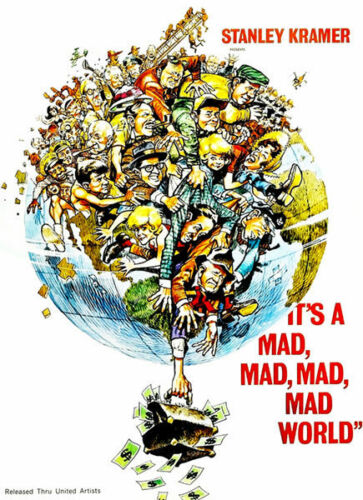
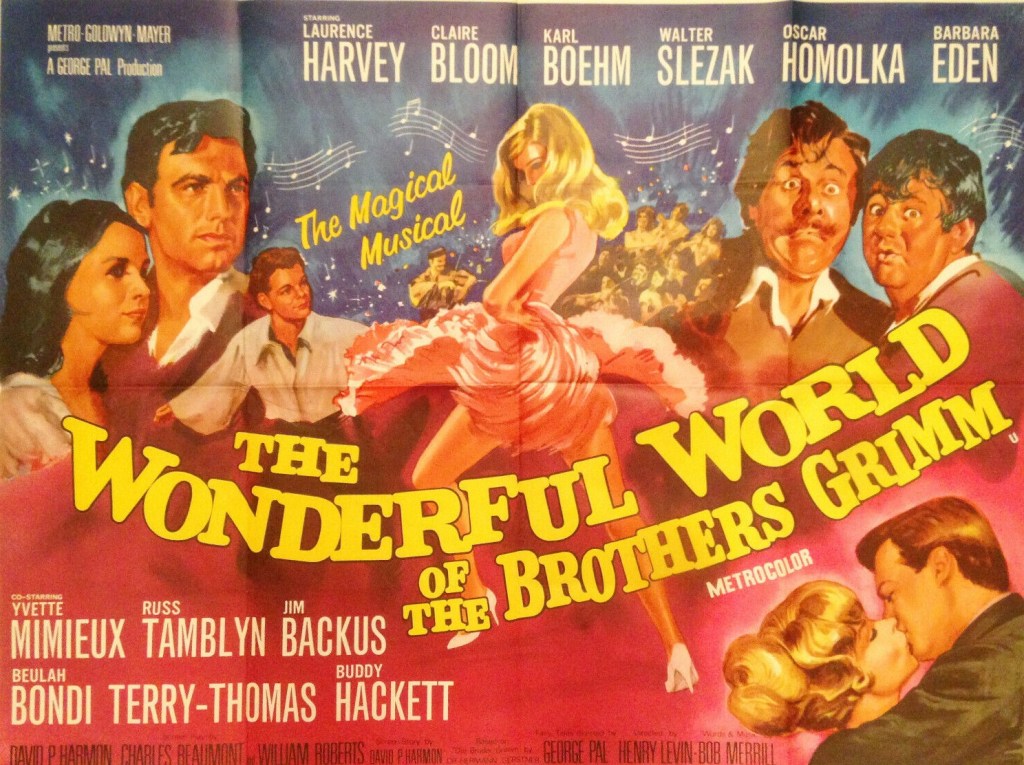

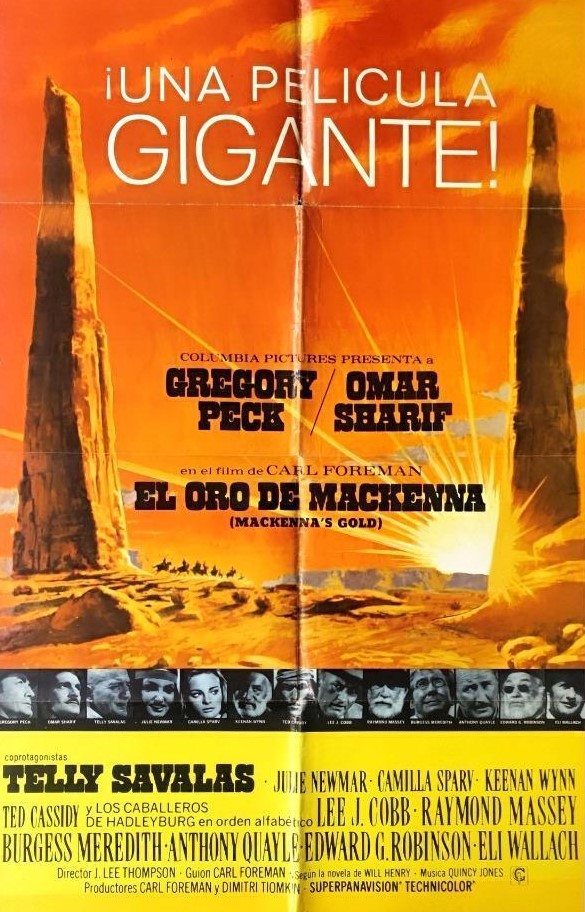


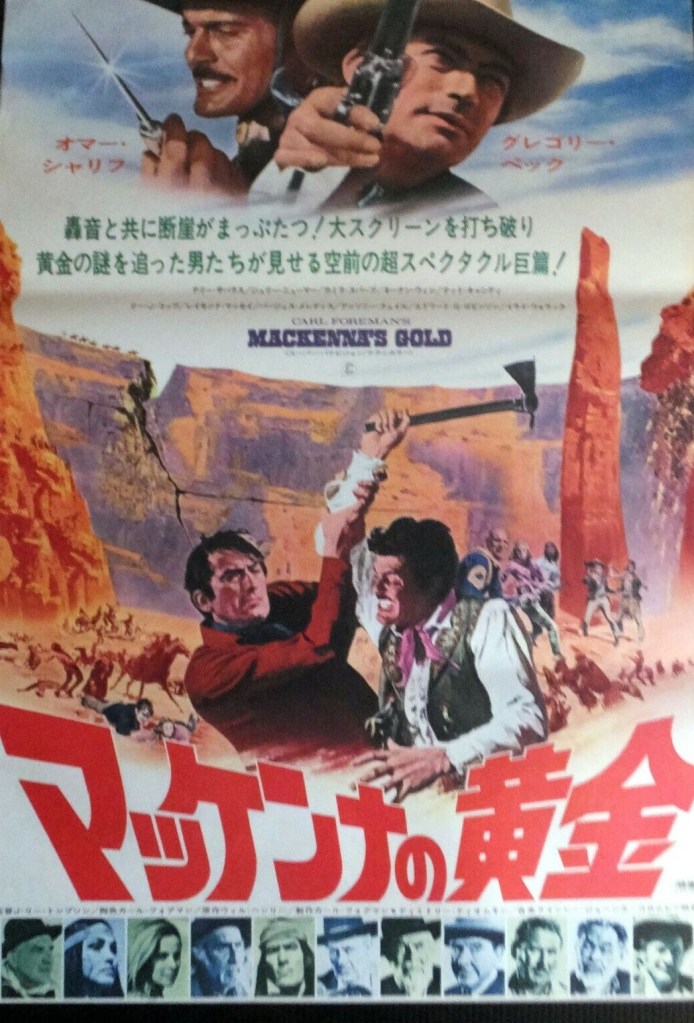
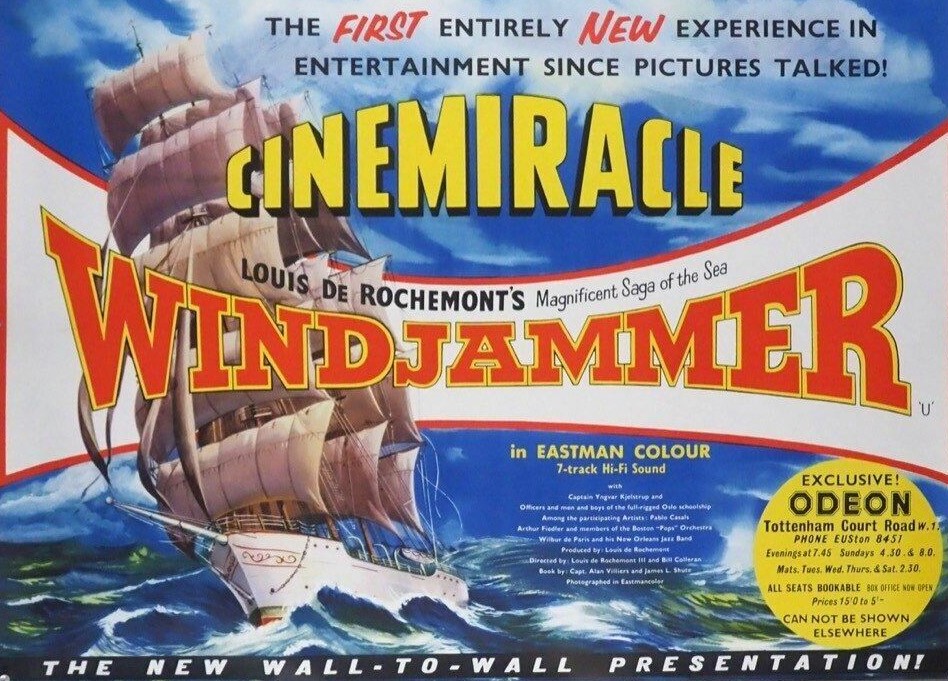
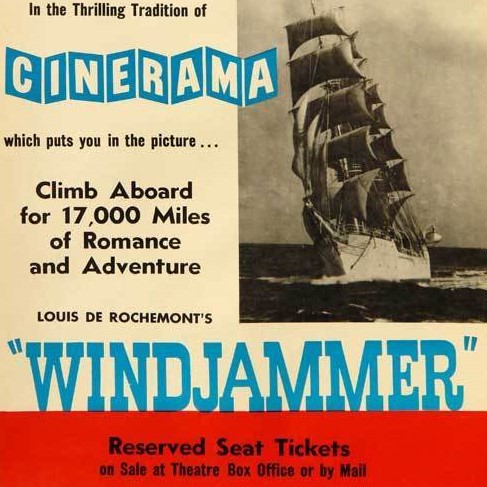
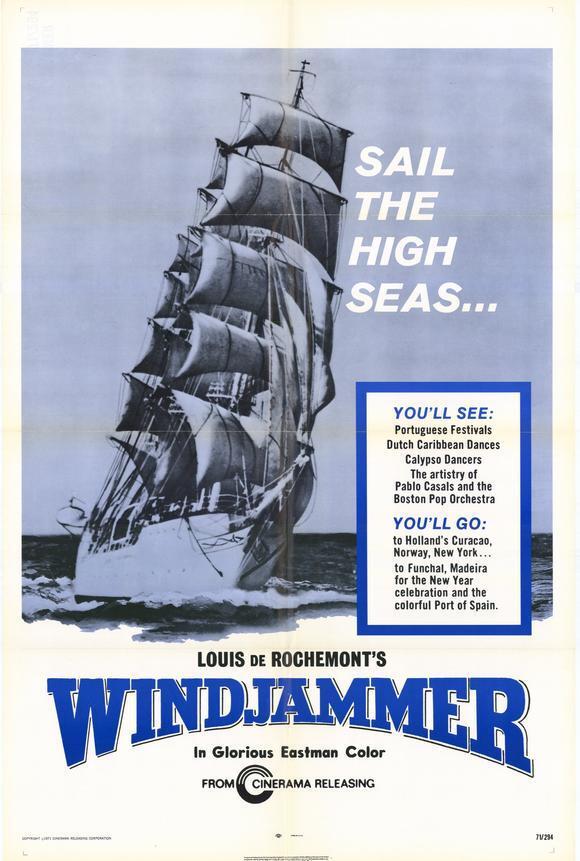


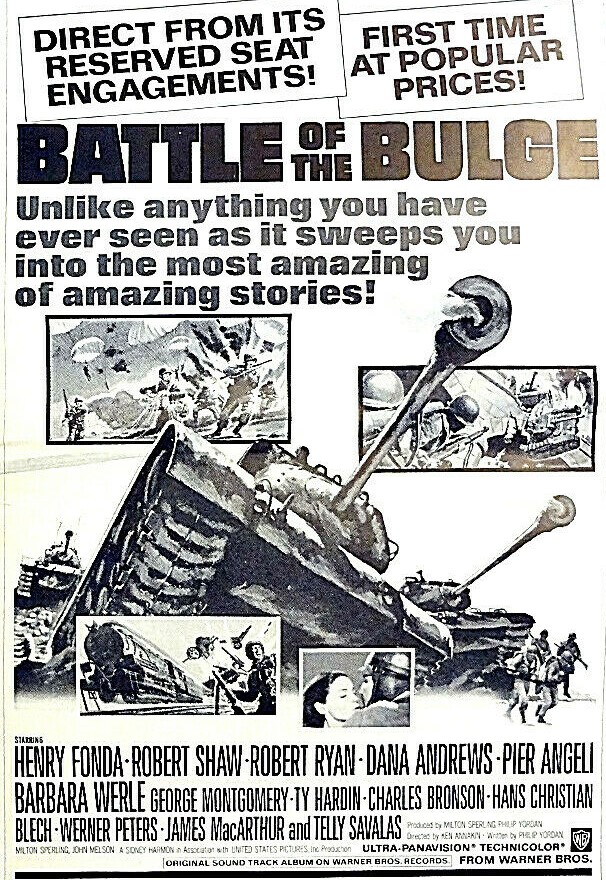
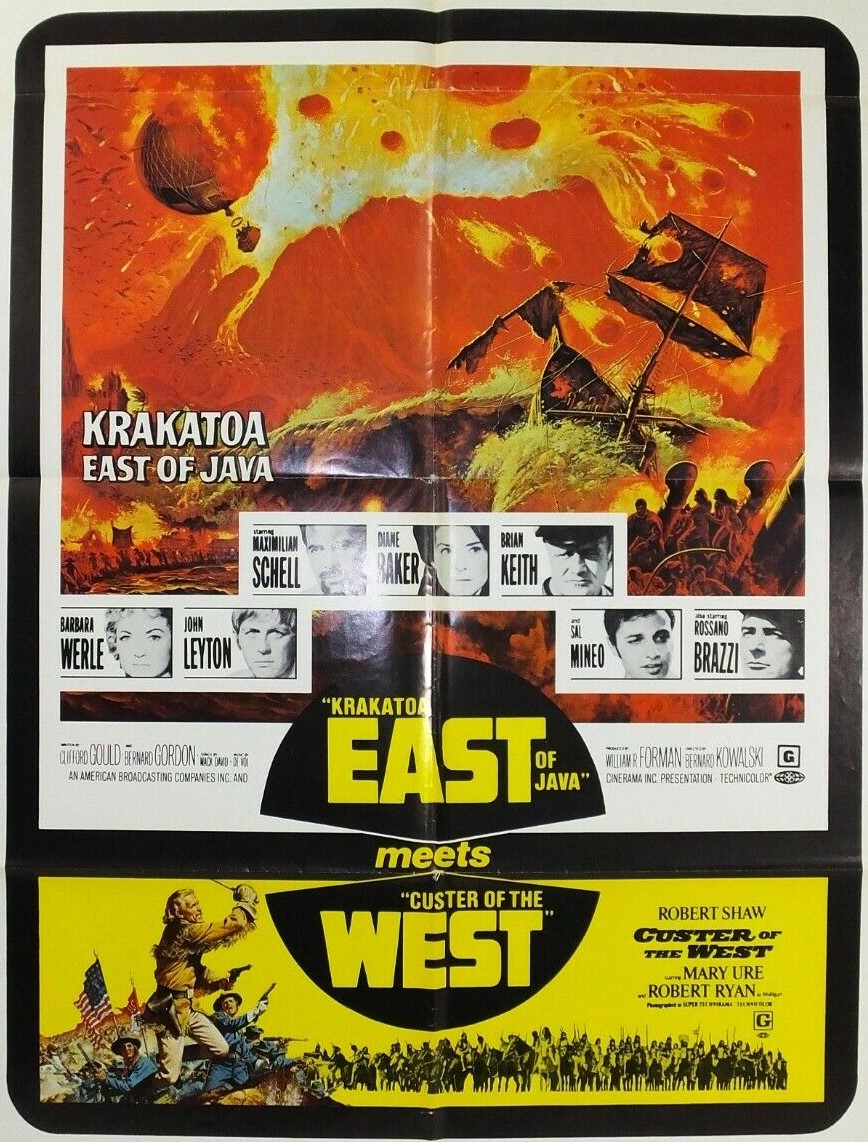
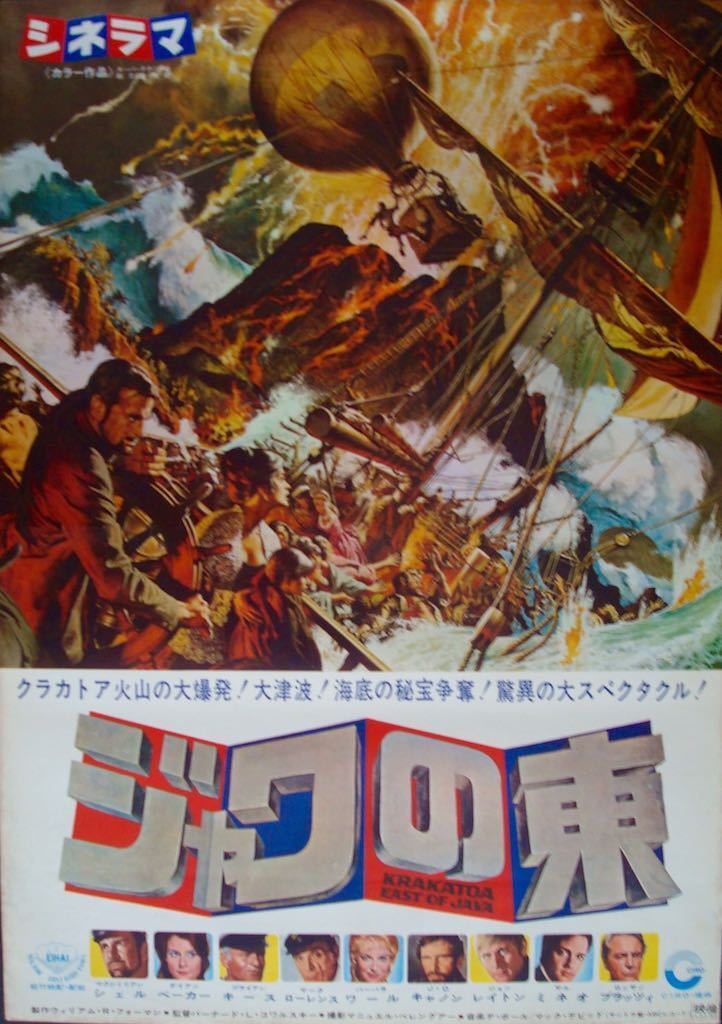
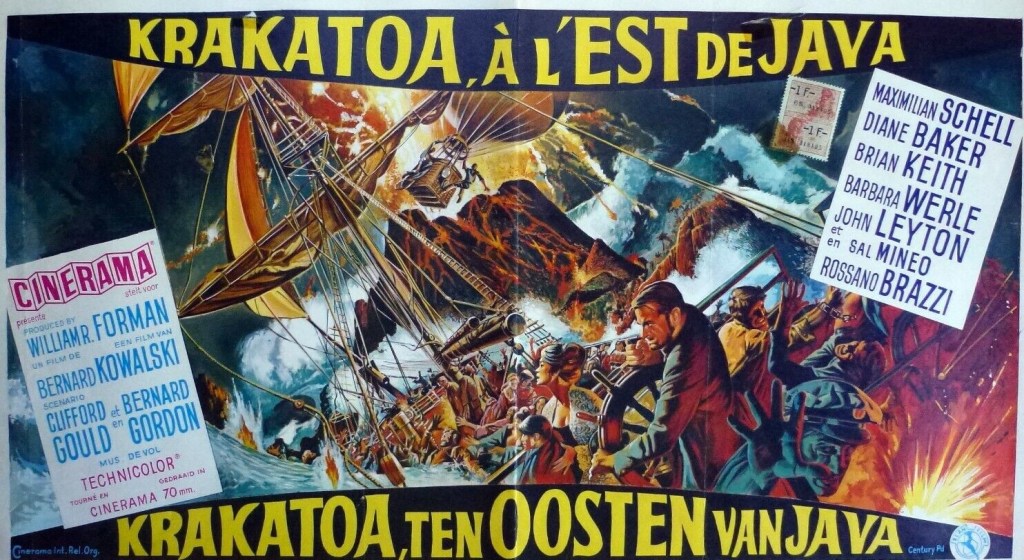


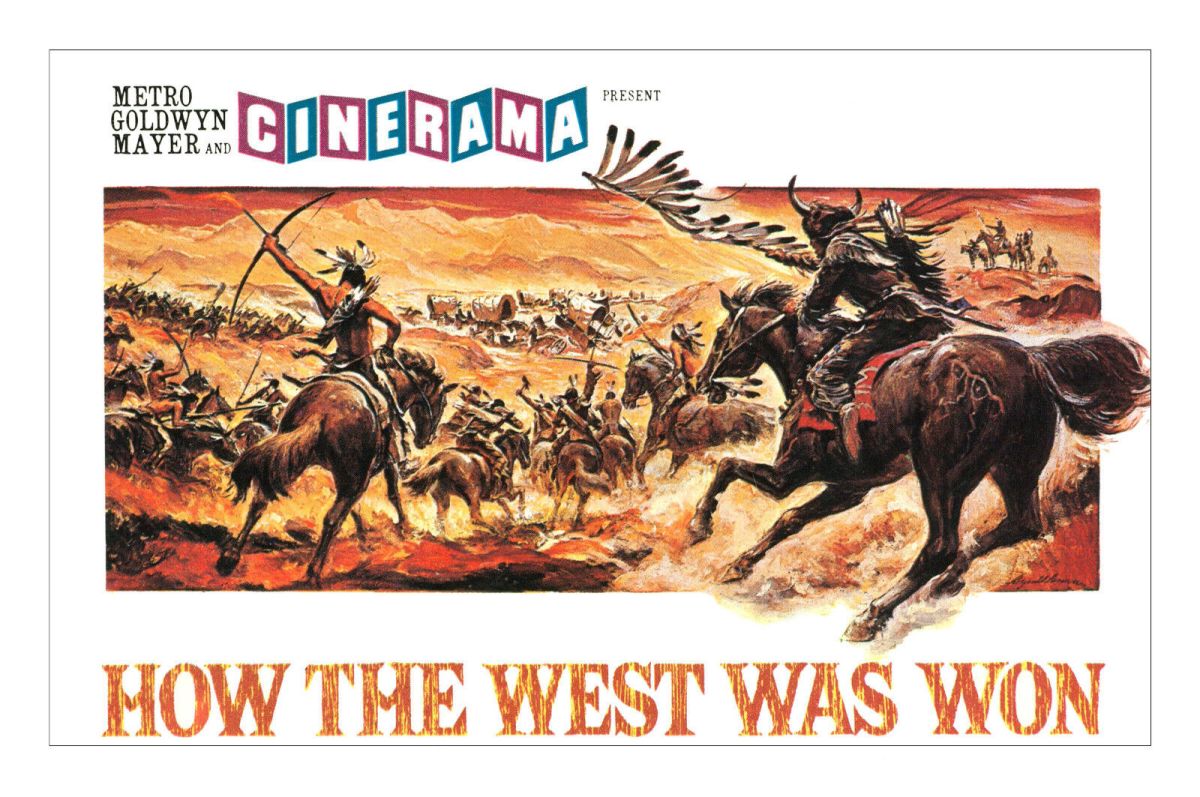
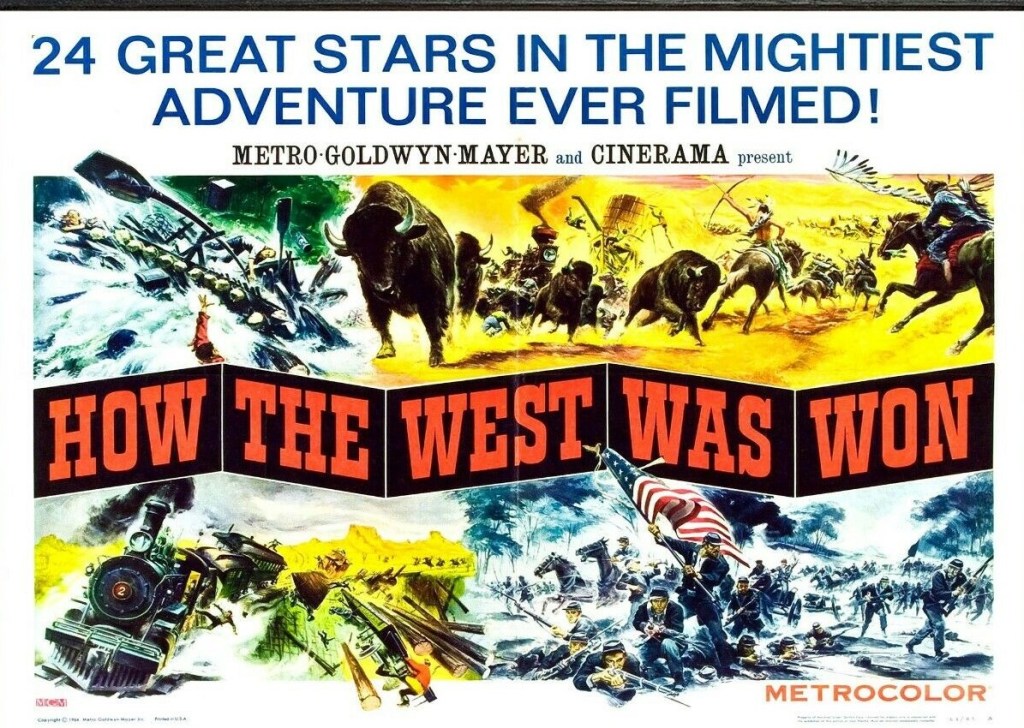
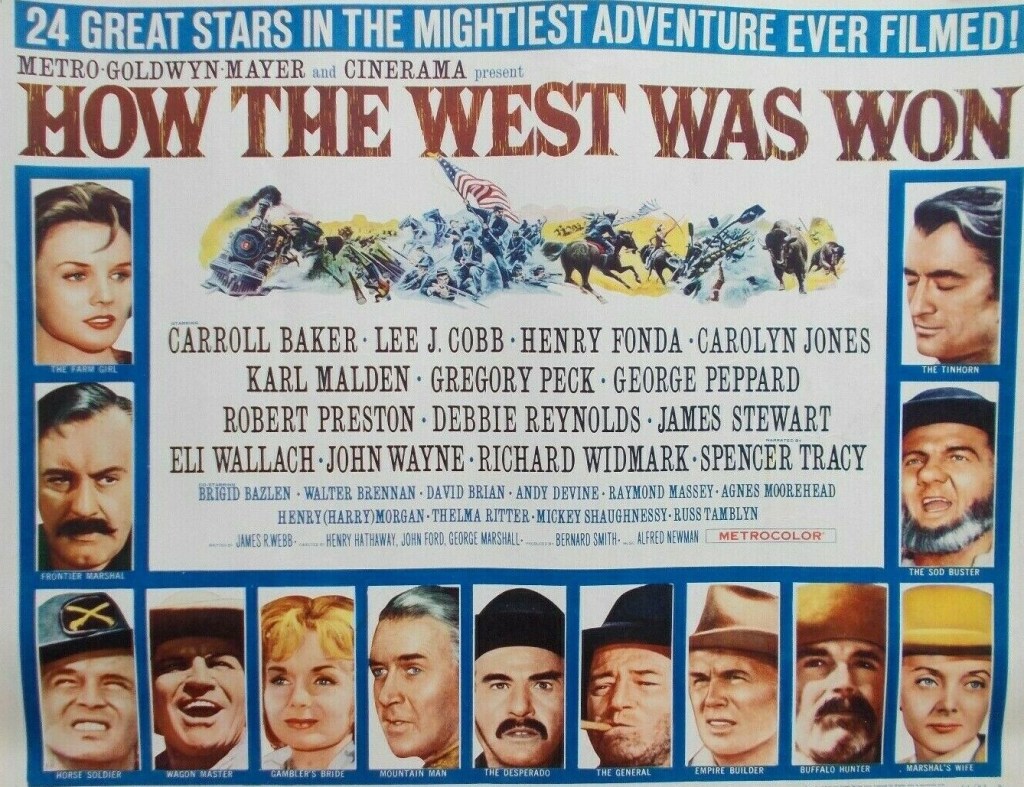
 The Magnificent 60s