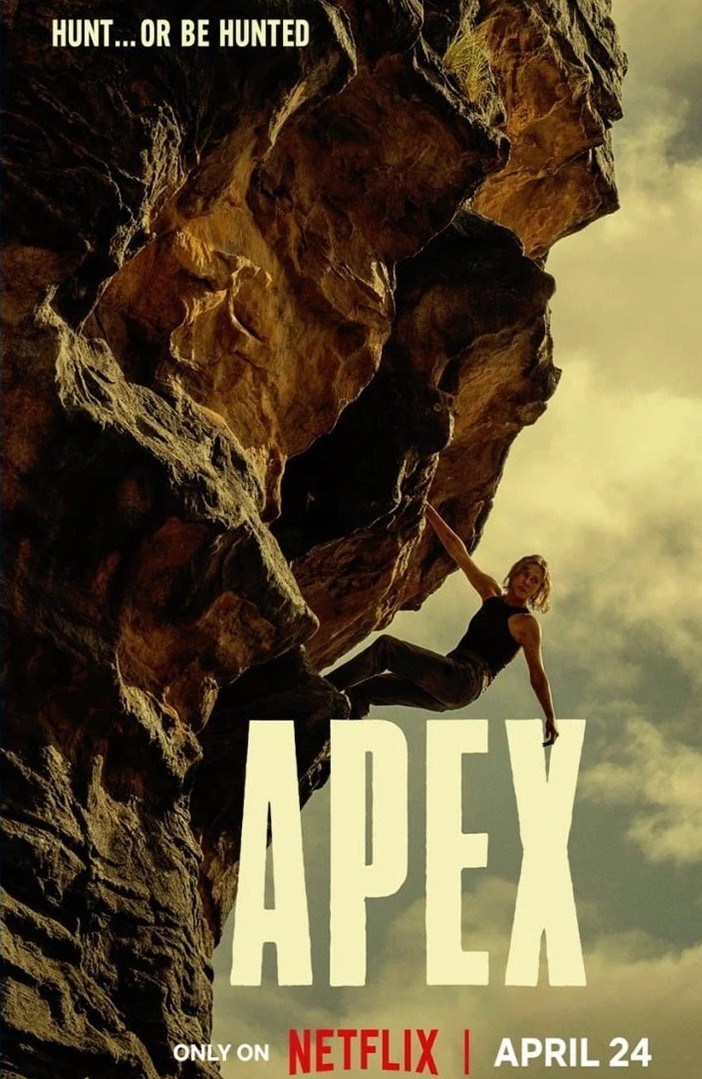
Apex (2026) ** – Seen on Netflix

Deliverance meets The Silence of the Lambs and that wouldn’t be an altogether bad elevator pitch except for constant interruptions from the Australian Tourist Board flogging adventure holidays. Takes forever to get going – and it’s only 95 minutes to begin with – and after a tight ten minutes somewhere around the one-hour work when it works up a bit of speed it then takes such a loopy turn that any narrative buoyancy gained suddenly evaporates.

Alternatively, it might work as Oscar-bait. You know, those kind of movies where the star goes through such physical trauma that the Academy voters seemed obliged to provide peer reward. And someone was given a drone for Xmas and every time you think the sensible approach is a close-up the camera goes flying back into the sky as if trying to set a record for the longest longshot.

What’s the story? Well you might ask. Bereft mountaineer Sasha (Charlize Theron), recovering from the death of boyfriend tommy (Eric Bana) on a Norwegian peak, heads for the Australian outback for a trip down the rapids. For whatever reason, she’s chosen a spot where dozens of people have gone missing – an event that appears to have received no media coverage whatsoever. For a moment you think we’re going to full-tilt-boogie into the Deliverance backwoods when in very mild fashion she beats back the overtures of a couple of rough Aussies. For about 20 minutes it’s nothing but travelog, Sasha racing through rapids, camping, walking.

Then she meets another Aussie, Ben (Taron Egerton), who seems straight out of Jeremiah Johnson, living off the land, finding some kind of liquid in trees, that kind of fella. However, he’s got the Deliverance bug and soon produces an archery device, this time a crossbow, and before long she’s on the run, pursued through even more scenic areas – of the adventure kind, but still distinctly tourist. Any time there’s any chance of tension, in comes Mr Drone to spoil things by pulling the camera back.

Eventually, as you might have guessed, she does get captured and is dragged into a hidden cave where Ben has hung up all his previous victims, tenderizing them before eating them with his perfectly sharpened teeth. There’s some nonsense about ritual that’s meant to add some meaning. Eventually, she escapes. Cue more scenic tourist stuff though you might just be wondering actually how long can people hold their breath underwater.
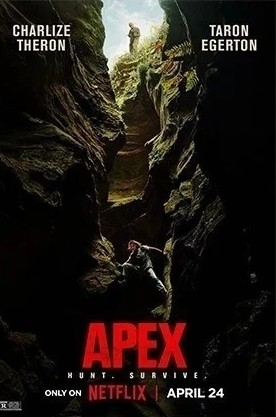
Eventually, she gets the upper hand. And then the plot goes loopy. She is handcuffed and tied to him by a long piece of rope. But he has a broken leg that in the heat is going to get infected as a bunch of flies starting dipping into the tasty morsels of bloodied flesh. So she does the obvious. She starts tugging on the rope – obviously he’d be hopping about in agony and toppling over every minutes – and drags him into the water and drowns him.

Nope, we’re barely past the hour mark, so a lot of time still to fill. She’s got a better idea. Why don’t we climb out of the canyon? She being the mountaineer would lead the way and she’d promise not to let him go halfway up. Apex predator that he is, he thinks, yes, why don’t I trust my enemy and put my life in her hands, the one I’ve been torturing and trying to kill all this while? But guess what? He’s the sucker. She drops him off the cliff.

This is advertised as running for 95 minutes but actually it’s closer to 88-89 minutes. It could have taken a swerve into proper horror what with all the cadavers strung up and Ben displaying his sharp teeth or if someone had applied a bit if elbow grease it could have turned into a decent thriller. Instead, it’s not much of anything.

Actually, this might have worked better in the cinema where the action sequences would have had more impact. But there’s just no tension.

Charlize Theron (Fast X, 2023) had six stunt doubles so she didn’t get as physical as I thought. Taron Egerton’s (Rocketman, 2019) teeth are presumably fake, too.

Directed by Baltasar Kormakur (Everest, 2015). Written by Jeremy Robbins (The Purge series, 2018-2019).

Netflix’s previous DTS (direct-to-streaming) offering Thrash at least had the compensation of accepting it was pure trash and making the most of it. This looks like someone thought there was something serious going on here.

Honestly, there isn’t.

The Heroes of Telemark (1965) ****

Stellar World War Two mission picture, replete with tension and thrilling ski chases, told with some style, and with a conscience, probing the issue of civilian collateral damage.  Sensibilities were not so inflamed at the time when the US, as demonstrated in Oppenheimer (2023), dropped the atomic bomb on Japan, causing the deaths of hundreds of thousands of non-military personnel. Here, at stake are the 6,000 townspeople who live around the plant housing the German experiments into heavy water, the alternative method for building an atom bomb.

When the safety of the entire world is in the balance, and death is doled out by remote bombers, thousands of feet up, with no close-up of the carnage, it appears far more acceptable than when you are planting a bomb on a ferry boat, knowing you are possibly consigning all the passengers to drowning.

That’s the climax of this well-plotted and well-constructed quite thrilling last picture from director Anthony Mann (The Fall of the Roman Empire, 1964) – he died during the making of A Dandy in Aspic (1967) so that cannot be fully ascribed to him and in any case this is a much better send-off.

Probably old-school British and Hollywood pictures were to blame for depicting scientists as stuffy individuals, allowing work to overrule romance. But as Oppenheimer demonstrated, that was not always the case and here we are introduced to top Norwegian egghead Rolf (Kirk Douglas) when he is stealing an illicit fumble with an employee in the darkroom.

The Germans are racking up production of heavy water, aiming to produce – drip by endless drip – 10,000lb of the stuff in double quick time. Norwegian saboteurs led by Knut (Richard Harris) hitch a ride by boat to Britain to inform the Allies of the danger. The obvious solution is to bomb the hell out of the factory, despite the impact on the civilian population.

But that fails. Plan B, dropping 50 highly-trained British commandos, into snow-covered Norway, comes a cropper when the plane crashes. A beautifully-filmed sequence, by the way, in extreme long shot, with one character at the front to provide perspective, a burst of flame at the far end of the white landscape.

So the saboteurs have to do it for themselves, the reluctant Rolf forced into action since he’s the only one, purportedly, who knows where to place the plastic explosive around the tanks holding the heavy water. The Norwegians shoot themselves in the foot by, in limiting the potential civilian casualties, only aiming to blow up the water tanks not the entire factory. Turns out the clever Germans have their own Plan B, other tanks already assembled which can be quickly fitted in the event of such sabotage.

Now with the plant more heavily guarded, access is impossible, and the only chance to stop the consignment of heavy water reaching Germany is to stop it getting there, by blowing up the train carrying the materiel as it crosses the fjord by ferry. Had this sabotage taken place in Germany, nobody would have given two hoots about the passengers, collateral damage be hanged. But this being Norwegians, Rolf feels duty bound to remain on board rather than escape, and formulate a plan to minimize the casualties.

I’m not sure how true that aspect is, it feels like something intended to present the main characters in a less ruthless light, although in reality the bombs were positioned and timed to help make survival easier.

Although told in semi-documentary style a la the same year’s Operation Crossbow, In Harm’s Way and Battle of the Bulge, with the aforementioned sensibilities to the fore, and the re-firing of romance between Rolf and divorced wife Anna (Ulla Jacobsen), the ruthless Nazi habit of executing hostages any time one of their soldiers is killed or even attacked, a traitor in the camp, open hostility between Rolf and Knut and stunning ski sequences that are the equal of anything in the James Bond canon, this is a riveting watch.

Must have been one of the cheapest music scores and screenplays on record given how often the director dispensed with both dialog and music during the lengthy sabotage scenes. When dialog was permitted, it was often sharp or humorous.

There was no stiffer upper lip in Hollywood than that of Kirk Douglas (The Brotherhood, 1968) though his hard-nosed demeanor is alleviated by romance and his efforts to minimise civilian casualties. Richard Harris (This Sporting Life, 1963) always seemed ready to explode. Ulla Jacobsen (Zulu, 1964) and Michael Redgrave (Assignment K, 1964) bring some class to the supporting roles.

Tremendous piece of direction by Anthony Mann, as adept at the action and building tension as handling the personality clashes between the principals and the intimacy of romance. Ivan Moffat (Tender Is the Night, 1962) and Ben Barzman (The Blue Max, 1966) wrote the screenplay based on a memoir by Knut Haueklid and the novel But for These Men by John Drummond.

A fitting last hurrah for Anthony Mann.

https://amzn.to/3Rz0azh

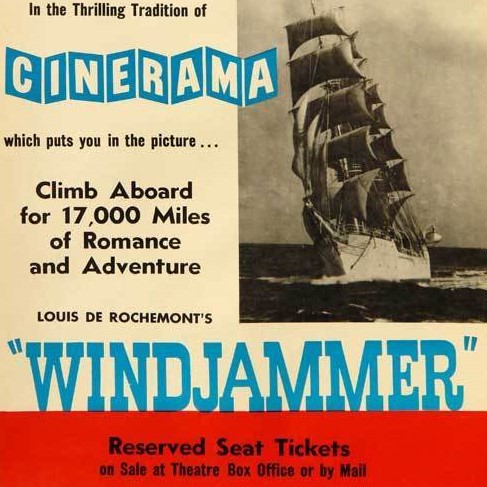
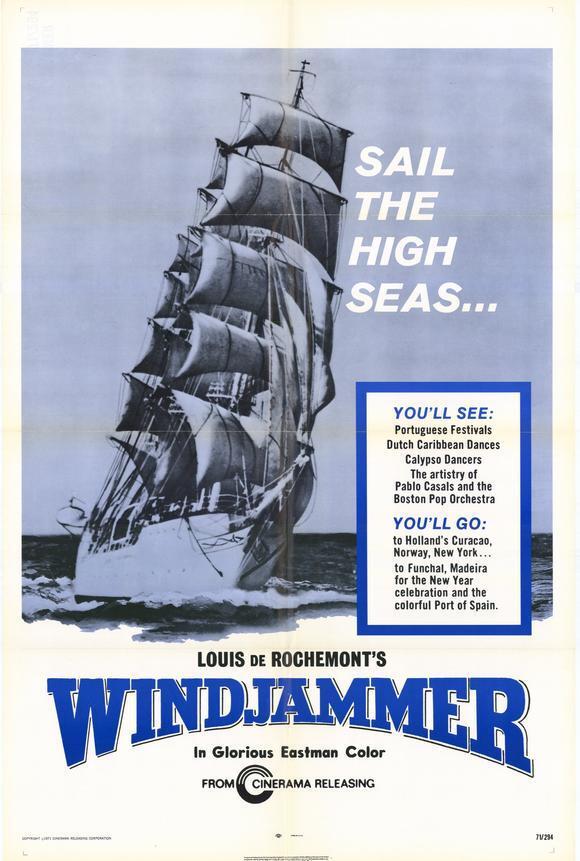
Windjammer (1958) **** – Seen in Cinerama at the Bradford Widescreen Weekend

It took this Norwegian interloper to show Cinerama the dramatic potential of its innovative widescreen process. A “windjammer” is a sailing ship and in this case training vessel Christian Radich embarking on a 239-day 17,000-mile round trip.

Although following primarily a documentary format, very close to the travelog style of Cinerama, the process that projected film on three synchronized 35mm projectors onto a curved 146-degree screen. It was much wider than the later Cinemascope and, like Imax, very much viewed as “event cinema,” the movies shown in roadshow to audiences astounded by the size of the images.

By the time Windjammer appeared, Cinerama had released six movies – This Is Cinerama (1952), Cinerama Holiday (1955), Seven Wonders of the World (1956), Search for Paradise (1957) and South Sea Adventure (1958). But the process was then mothballed as the producers worked out how to develop dramatic storylines. And, in some respects, you could argue, Windjammer showed them the way. Cinemiracle was almost identical to Cinerama except for being projected on a 120-degree curved screen. Louis De Rochemont and his son Louis De Rochemont III, producer and director respectively of Windjammer, had worked on Cinerama Holiday.

Windjammer showed the potential for more dramatic use of the wide screen beyond the obvious mountains and valleys and speedy point-of-view sequences for which Cinerama was famous. While the bulk of the film concentrates on just the one vessel, except for an occasional encounter with another sailing ship, when the Christian Radich is welcomed by a healthy contingent of the U.S. navy and bounded on either side by aircraft carrier, submarine and destroyers and with helicopter and airplane above, the compositional opportunities afforded are genuinely thrilling.

Couple that with a director who has the audacity to stick a camera on top of a submarine and capture what occurs when it submerges and surfaces – that sequence acclaimed by no less a widescreen authority than David Lean (Lawrence of Arabia, 1962) as the greatest single image he had ever seen – and you can see its potential.

The film is mostly narrated by one of the 70-odd young Norwegian volunteers, but is peppered by scenes with dialogue. And although none of these sections is as dramatic as the shots of the ship at sea or being battered by a storm or the incomparable submarine sequence, they do offer an element of human involvement missing from Cinerama, whose viewpoint was largely objective.

The arrival of a sailing ship in any port along the north and central American coast in 1956 was cue for celebration. Whether the public relations opportunity helped things along is unclear, but tourist boards over the world united to put on a spectacle. Our boys were serenaded by a King, various dignitaries, a marching band, calypso band, were invited to garden parties and introduced to limbo dancers. They also took part in a Fire Brigade simulation exercise involving jumping out of a three-story window, climbed out undersea of the hatch of submarine and swam along the seabed – without the benefit of wetsuit or anything else to keep out the cold – to recover a dummy missile. I’m not sure who was responsible for laying on a concert by cellist Pablo Casals or a separate concert on the deck of the ship with Arthur Fiedler conducting the Boston Pops Orchestra.

There was even the traditional downhill POV sequence. In Madeira this consisted of following a traditional passenger-carrying wicker basket toboggan as it tore down steep cobbles and in the U.S. chasing fire engines as they raced through city streets to a genuine fire. The two best scenes were absent dialogue. When nothing is explained and you watch a couple of teenagers climb out of the hatch of a sunken submarine, your heart is in your mouth. And, presumably chucked in to promote local tourism, there is nonetheless a quite astonishing sequence of a Norwegian farming family bringing in the harvest.

Norwegian harvest doesn’t involve piling the hay into stacks or ricks but arranging it in fences along the ground. Then it’s pitchforked into oxen-driven wagons before being transported down the fjords by zipwire and from there it makes its journey by rowing bost past spectacular waterfalls.

And just in case you think this is a glorified travelog there was a grim reminder of the dangers of sailing. Another sailing training ship, the Palmir, which reconnoitred briefly with the Christian Radich, later capsized in a storm with the loss of the entire crew except six sailors.

Windjammer was later absorbed into Cinerama and the version I saw was a restoration using the Smilebox curved screen system.

Stunning viewing.

Black Widow (2021) **** – Seen at the Cinema

Like Skyfall, that rarity, an action film with a solid emotional core. Take away the action and you would still have an absorbing story of a loss, family tension, bickering siblings and an ego-driven pompous father. The action brings family together, initially the two girls, Natasha (Scarlett Johansson) and Yelena (Florence Pugh) rescuing papa Alexei (David Horsburgh) from a Russian maximum-security prison then with the addition of brainy mum Melina (Rachel Weisz) tackling criminal mastermind Dreykov (Ray Winstone) in an exceptionally clever secret location.

If you’ve come looking for simple action, this is the wrong movie for you. Family complication, on a par perhaps with the criminal clan of The Godfather and imbued with the darker hues of Christopher Nolan’s Batman, adds far more depth than normal for a superhero picture. And even for Dreykov, the issue is family. He is the repairer-in-chief, on the one hand putting back together as well as he can his own familial loss, and on the other giving a home for countless orphans worldwide, albeit to suit his own plans.

Natasha has run the gamut of raw emotion. Orphaned twice, forcibly ejected from the one place she called home, i.e. The Avengers family, her feelings about being reunited with  adoptive Romanoff parents are noticeably negative.  Yelena is more willing to embrace the errant parents. Never mind that this is the one superhero picture in The Avengers catalogue where the superhero, as fit and agile as Natasha is, has no demonstrable superhero powers. And even those powers are mocked by Yelena who makes fun of the pose we have so often seen Natasha adopt. Nearly stealing the show is the self-pitying Alexei, the over-ripe overweight over-emotional father who would always be embarrassing you, inflated with his own self-importance, as bereft now as his daughters, having been stripped of his own superhero status as the Red Guardian. Whenever any of his family are in danger you can be sure his ego will get in the way.

The story is simple enough. By accident, Yelena, a member of the Dreykov army of female orphans, accidentally discovers she is enslaved, teams up, but only after a knock-down scrap Jason Bourne would have been proud of, with on-the-run Natasha, and eventually her parents. The action is terrific, especially the jailbreak, which has time to steal the central riff from Force Majeure (2014) just to ramp up the tension. And there are plenty surprises along the way, especially apt reward for Natasha’s ruthlessness as a do-gooder.

This is an entire family up for redemption, forced to confront their pasts, and for once it is not action that provides the solution. In some respects it is the family that clings together that stays together. The Avengers aspect is mostly redundant here, so what’s left is a more solid action-fueled thriller with superb characters, each, including villain, with their own emotional story arc. And it’s not always dark either, the family scenario studded with comedy nuggets.   

Visually stunning, as you might expect, this is a welcome big-budget showcase for Cate Shortland (Berlin Syndrome, 2017) who brings emotional intelligence to bear on a genre in which that is often in short supply. Eric Pearson (Godzilla vs Kong, 2021) was the wordsmith.

Johansson (Marriage Story, 2019) has rarely been better and it says a lot for the performance of Florence Pugh (Little Women, 2019) that in their scenes together she is rarely overshadowed. Hopefully, this is the breakout picture for David Harbour (No Sudden Move, 2021), and maybe even the MCU team might recognize the comedic opportunities in a stand-alone based on his character, so effortlessly has it been constructed. And it’s a welcome return for Rachel Weisz, absent from the big screen since The Favourite (2018).  William Hurt (Avengers: Endgame, 2019) makes an expected appearance and Olga Kurylenko (The Courier, 2019) a surprise one and The Handmaid’s Tale’s O-T Fagbenie provides an interesting cameo.

This is definitely not going to work as well on the small-screen so if you’ve got the chance to see it in the cinema – where I saw it on my weekly Monday night outing – grab it while you can.

Discover WordPress

A daily selection of the best content published on WordPress, collected for you by humans who love to read.

The Atavist Magazine

by Brian Hannan

WordPress.com News

The latest news on WordPress.com and the WordPress community.