Deadlier than the Male (1967) ****

For a movie intended to set up a series character in the vein of James Bond, it was ironic that it was the women who stole the show, not just from their tendency to turn up in bikinis but for their outrageous villainy. Irma (Elke Sommer) and Penelope (Sylva Koscina) are the seductive assassins in the hire of Carl Petersen (Nigel Green) who has designs on an Arab oil empire. On her own Irma dispatches mogul Henry Keller (Dervis Ward) then the pair – emerging from the sea like a pair of latter-day Ursula Andresses – harpoon his colleague Wyngarde (John Stone).  

Soon Hugh Drummond (Richard Johnson), investigating the death of Stone, becomes a target  and that sets him off, with nephew Robert (Steve Carlson) in tow,  to the Mediterranean and the yacht of oil-rich King Fedra (Zia Mohyeddin) where, of course, the girls lie in wait.

Dispensing with the gadgets – except for one item employed by the villainesses – and gimmicks of Bond, but retaining the quips, this is a fun ride with a more down-to-earth leading man – like the early Bonds – smarter girls, a more old-fashioned mystery, hefty thug Chang (Milton Reid)  in the Oddjob mold, a castle doubling as the villain’s lair, a suave master criminal, some detective work, and a super scene involving giant robotic chess men.

The bickering between Irma and Penelope, not just a tad sadistic but a kleptomaniac especially as far as her partner is concerned, coupled with their overweening confidence, makes them much more human than any Bond Girl and the character traits explored have a pay-off at the climax. Equally interesting are the mind games, Drummond vs. Peterson but also Drummond vs. Irma. And that the female baddies see it as points on their scoreboard to seduce Drummond rather than the other way round.

Drummond is every bit as capable a seducer as Bond and equally ruthless, stripping one suspect naked. Petersen is also a clever character, faking his own death and running a very smooth operation, and certainly his recruitment techniques are second to none.

Some ideas were certainly ahead of their time, the chess men are the equivalent of a modern computer game while the human bomb has, unfortunately, entered the modern lexicon and there are enough female serial killers around to prevent anyone believing they are always (to use a sexist phrase) the gentle sex. However, in the middle 1960s, the concept that women would be partial to murder and torture not to mention repeatedly seducing males went so much against the grain of the male authority figures that the British censor slapped an X-certificate on the movie.

Shakespearian actor Richard Johnson was at one time an MGM contract player, but his only previous top-billed outing was the Italian-made The Witch (1966) but he certainly made a splash with this character, investing it with a great deal more gravitas than Derek Flint or Matt Helm. The Teutonic Elke Sommer (The Venetian Affair, 1966) is brilliant as one half of the assassin tag-team with a batch of one-liners for every occasion. Sylva Koscina (A Lovely Way To Die, 1968), nose always put out of joint, almost steals the show.  Nigel Green (Tobruk, 1967), while his usual sardonic self, has the playfulness of the rich and powerful.

Steve Carlsen, in his movie debut, doesn’t make much of an impact in a largely lame role. Zia Mohyeddin has a more interesting role as the oil kingpin wanting to help his people. As you can expect in a spy picture there are a host of beautiful women – Suzanna Leigh (The Lost Continent, 1968) a defector, Virginia North, also making her debut, Justine Lord (Night after Night after Night, 1969), and Didi Sydow in her only screen appearance.

The light comedy experience of director Ralph Thomas (Doctor in Distress, 1963) comes in very handy, as his sense of comic timing is excellent, but, perhaps learning from his previous brush with espionage in Hot Enough for June / Agent 8¾ (1964) brings a bigger punch to the action scenes. And it’s a bold ploy to start with an action sequence revolving around Irma and Penelope rather than our star man.

The screenplay was a team effort – Jimmy Sangster (The Devil-Ship Pirates, 1964), taking a break from Hammer duties, David D. Osborn (Maroc 7, 1967) and Liz Charles-Williams, making her screen debut  – all involved.  This was familiar territory for composer Malcolm Lockyer (Five Golden Men, 1967). British pop act The Walker Brothers had a hit with the theme tune.

This is more fun than camp, not a send-up of the genre like Derek Flint and Matt Helm, but a spy picture with a believable leading men and excellent villains. But the plot is more centered on filthy lucre rather than global control and there is a genuine understanding of how businesses work – takeovers, mergers, dirty dealings – though small wonder Petersen would like to be shot of pedantic boardroom nuisances like Bridgenorth (Leonard Rossiter) – wouldn’t we all?

Bulldog Drummond was an international crime-buster invented by “Sapper,” the pen-name of H.C. McNeile. Bulldog Drummond had been a Hollywood mainstay for over four decades, the twenty-plus pictures attracting stars like Ronald Colman (Bulldog Drummond, 1929, and Bulldog Drummond Strikes Back, 1934), Ray Milland (Bulldog Drummond Escapes, 1937), Walter Pidgeon (Calling Bulldog Drummond, 1951) and a young Ralph Richardson (The Return of Bulldog Drummond, 1934). But the notion, in the Swinging Sixties, of tagging any leading man by the moniker of ‘Bulldog’ did not seem like a good idea, so the character underwent wholesale reinvention, and his nickname is never mentioned. 

The title comes from a line in a poem by Rudyard Kipling, The Female of the Species. That was the original title of the film and also of a Sapper book.

The Roman Spring of Mrs Stone (1961) **

Dreary miscalculation. Ever since Tennessee Williams hit a home run with Cat on a Hot Tin Roof (1958), studios, directors and stars had clamored for his works, so much so that Hollywood had greenlit seven adaptations in five years. While box office was one consideration, the playwright was catnip to the Oscar, racking up 17 nominations with a hefty number in the Best Actress category.

However you dressed it up, his work contained a substantial number of portraits of sadness and malevolence and often teetered on the murky, so making them work at all depended not just on the acting and direction, but the initial story. Rather than being based on a play, this was sourced from his first novel, a bestseller.

But the tale never shifts out of first gear and it’s difficult to summon up sympathy never mind interest in any of the characters. The middle-aged romance had proved a cumbersome fix for studios, and since May-December numbers featuring ageing male and younger female had proved popular, Cary Grant set up with an endless supply of woman nearly half his age, it seemed only fair to give middle-aged actresses the opportunity to romance younger men.

Usually, however, this followed a more straightforward path, involving genuine feelings on both sides. But Hollywood was also digging into another cesspit, the female sex worker, somewhat dressed up in Butterfield 8 (1960) and Go Naked in the World (1961), treated more straightforwardly in Never on Sunday (1960) and Girl of the Night. So it only seemed fair to introduce the gigolo.

Stage actress Karen Stone (Vivien Leigh) heads for Rome with her wealthy husband to recover from the failure of her latest play, a Shakespearian outing. When her husband dies on the plane, Karen decides to hang on in the Italian capital, which, after a year, brings her into the orbit of gigolo Paulo (Warren Beatty) and his unscrupulous mentor/manager Contessa Magda (Lotte Lenya). While Karen isn’t entirely a dupe and quickly sees through Paulo, nonetheless a year of loneliness has taken its toll.

Plus she understands the attraction of the older lover, her husband being a good two decades older and willing to subsidize her theatrical and cinematic ambitions. Despite not falling for Paulo’s more obvious con tricks, Karen finds herself enmeshed in a one-sided romance, ignoring the warnings of friend Meg (Coral Brown) on the dangers of becoming the talk of the town with her lover clearly more attracted to rising movie star Barbara (Jill St John). Paulo quickly dumps the Contessa, leaving her free to pour bile into Karen’s ear.

Inevitably, the younger lover tires of the older, but generally such pairings work well enough because initially at least there is attraction on both sides. But when it’s as lop-sided as this no amount of long drawn-out close-ups of the disenchanted provide sufficient compensation for a story that overstays its welcome.

While there are hints of the decadence of La Dolce Vita (1960) that Fellini explored, here it’s more of a surface examination until the surprising ending, where you would think Karen is doing little more than willingly opening the door to a potential serial killer.

The only redeeming element, which might reverberate more easily today, is of the woman demonstrating her independence by being the one to choose, and to some extent discard, the man. While not for most of the movie a sexual predator, she may well have turned into one at the end.

Oscar-winner Vivien Leigh, in her first movie in six years, essays her role well but is compromised by portraying a character that fails to elicit sympathy. Warren Beatty (Promise Her Anything, 1966) avoids the trap of thickening his Italian accent and going wild with the gestures which lends his character more of a thoughtful personality but there’s not much here to write home about. Lotte Lenya (From Russia with Love, 1963) steals the show and was rewarded with an Oscar nomination. Jill St John (Tender Is the Night, 1962) plays the ingénue like an ingénue.

Unless you’re a student of theater I doubt if you’ll have come across Panamian director Jose Quintero. This was his only movie and he was more famous for staging some of Williams’ plays and for resurrecting Eugene O’Neill on Broadway. His inexperience shows in lingering on faces at the expense of creating drama. Gavin Lambert (Inside Daisy Clover, 1965) adapted the novel.

Disappointment.

They Came from Beyond Space (1967) ***

If you’re familiar with the Amicus output from its portmanteau horror movies this excursion into sci fi might come as a surprise. On the other hand, should you be a fan of Dr Who you might well be acquainted with Amicus’s two excursions into this genre – Dr Who and the Daleks (1965) and Daleks’ Invasion Earth 2015 A.D. (1966). In fact, the outfit’s production at this point was evenly split between sci fi and horror and had They Came from Beyond Space and stablemate The Terrornauts (1967) done better the company might have persevered with the genre.

That these two were originally intended to go out as a double bill – they did in the U.S. but not in Britain – is somewhat surprising given they have similar themes of some kind of dying alien species using Earth for survival. And with a bigger budget, They Came from Beyond Space might have made a bigger dent into the box office, instead of heading beyond the realms of cult into oblivion.

There are some neat touches. Meteorites fall on Earth. Nothing odd in that, certainly not in the world of cinematic sci fi. What’s strange is how they land – in a perfect V-formation. What’s more their source is the Moon. You won’t be at all surprised to learn, however, that the aliens bear no resemblance to the amazonian-type women promoted in the poster.

Also peculiar, for the time, is that the scientists sent to investigate are led by a woman, Lee (Jennifer Jayne), her boss and lover Dr Temple (Robert Hutton) left behind because he has a silver plate in his head as the result of an automobile accident. The meteorites exert a strange power and soon Lee and her confederates are organizing some massive scientific project to send a mission to the Moon, funding procured from a million-pound loan from a hypnotized bank manager and the local community falling victim to a strange plague which renders them obedient.

Eventually, alarm raised by Lee commandeering so much expensive equipment, Dr Temple does go to investigate and is baffled by the construction of a military compound complete with armed guards and electrified fence housing a vast underground laboratory and a rocket ready for launch.

He manages to kidnap Lee, possessed by an alien force, and with buddy Farge (Zia Mohyeddin) comes up with a variation on the kind of common-cold weapon employed to defeat aliens – in this case the use of silver to block the alien rays, you always knew that silver plate in his head would have narrative purpose. Realizing her situation, Lee now pretends to be an alien and the trio sneak aboard a rocket and after a fantastically speedy journey land on the Moon where they are confronted by the Master of the Moon (Michael Gough).

Quite why female sacrifice was a common theme between this and The Terrornauts is anyone’s guess but soon enough the aliens have Lee staked out. And that silver plate has to be surgically removed from Dr Temple’s head so the aliens can get a good look at his brain.

Like The Terrornauts, there are no physical aliens, just some kind of energy source. And like E.T. some decades later they just want to go home. Farge leads the enslaved in revolt and normally that would trigger some violent finale but here, instead, there’s a curious – and welcoming – climax.

A kind of “why didn’t you say so, old chap” ending where the Earthlings agree to help the aliens return to their planet, no collateral damage necessary. This is probably the most unexpected thinking person’s twist that you could ever conceive – a variation on the idea of foes finding common cause. It certainly didn’t fit into the genre and my guess is most audiences were baffled at the outbreak of peace. It just didn’t go with the territory.

None of the acting is anything to write home about, but the picture is generally well done, the special effects more than passable given the budget, and enough in the narrative tank to keep you going.

Robert Hutton (The Vulture, 1966) was coming to the end of a B-picture career. Jennifer Jayne’s (The Liquidator, 1965) hardly really took off. Zia Mohyeddin (Deadlier Than the Male, 1967) had a decent run in supporting roles. Everyone is no more than adequate in roles that demand no depth.

Freddie Francis (The Skull, 1965) does his best with a script by producer Milton Subotsky (The Skull) adapting the novel by Joseph Millard.

Undemanding but holds the interest.

Negatives (1968) ***

Role play wasn’t the sub-culture it is now. Though fashion had injected more of a sense of dressing up what with Russian furs courtesy of Doctor Zhivago (1965) and snazzy berets from Bonnie and Clyde (1967), the idea of people living out their lives in costume had not taken hold. So consider this a precursor – and maybe a warning – as to what can go wrong if taken too far.

Obscurity to the point of obfuscation was an arthouse default especially prevalent in more commercial ventures like Blow-Up (1966) and In Search of Gregory (1969) so no need to bother yourself with hunting out motivation or background.

The erotic subtext – voyeurism too – here takes on a disturbing quality as it touches on the notion of male justified in using violence in response to female provocation.  Drama centers on a clash of role model sensibilities with a weak male shifting from interpreting a murderous villain to imitating a heroic pilot.

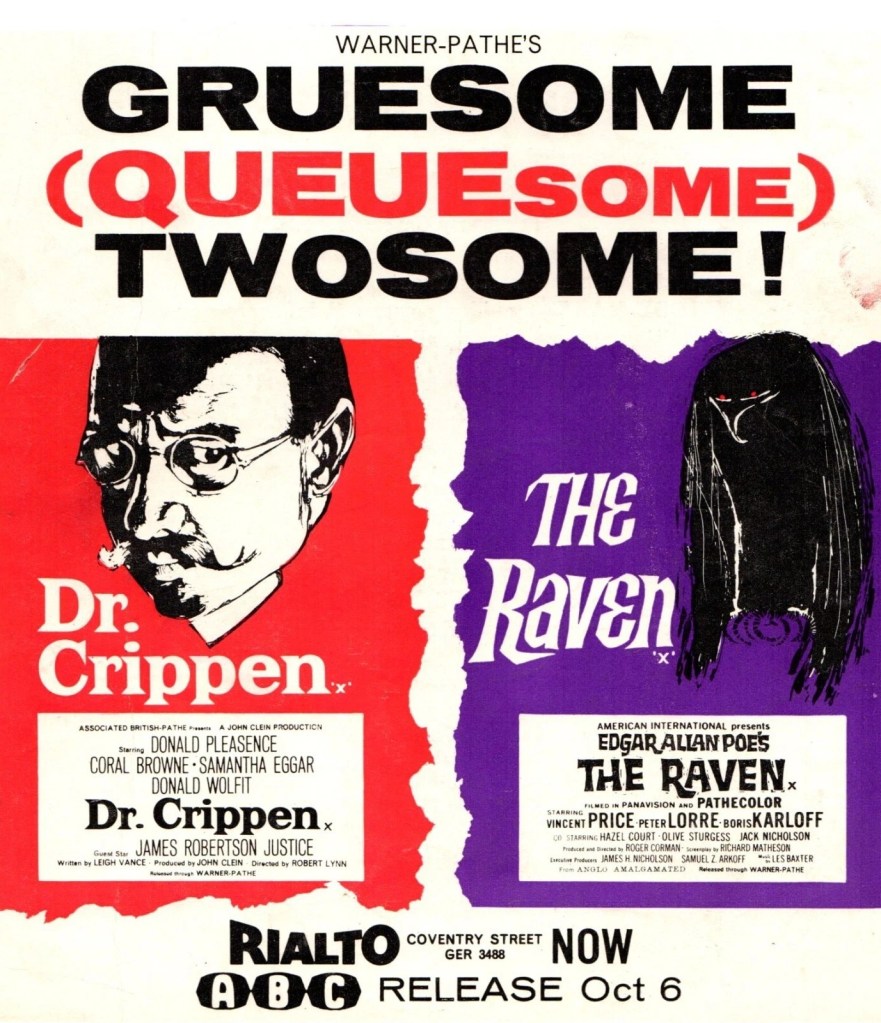
Antiques dealer Theo (Peter McEnery) spices up his stale marriage to Vivien (Glenda Jackson) by dressing up as serial killer Dr Crippen. She invests in the role of his complaisant lover Ethel. Play-acting, at her behest it appears, doesn’t prevent her verbally tearing into him. Into this unconventional nest arrives German photographer Reingard (Diane Cilento) who has been spying on him for several weeks. She has her own fantasy and soon has him rigged out as World War One flying ace Baron von Richtofen, complete with ancient biplane. He responds to the militaristic characteristics of the pilot, entering more into the spirit of the game than the famed killer.

Naturally, Vivien doesn’t take kindly to this intrusion, not least because she realizes she isn’t the only one who can manipulate her malleable husband and violence and tragedy ensue. It’s not entirely clear why either female character indulges in such fantasies and does give rise to the cliche notion, and redolent of the times, of the female wishing to give in to the dominant male, even when the man shows little sign of being a dominant personality.

Apart from Theo visiting his father (Maurice Denham) who appears to be dying in hospital, the picture doesn’t shift much from its three-cornered narrative. The idea of the ongoing masquerade is emphasized by a sequence set in Madame Tussaud’s. Given the censorship of the times, the eroticism is largely of the discreet variety, rather than going down the full-blown sexual fantasy of The Girl on a Motorcycle (1969).

Glenda Jackson both plays a character right up her street and brings far more to the role than either Peter McEnery (The Moonspinners, 1964) or Diane Cilento (The Third Secret, 1964) who give the appearance of slumming it in a low-budget production in the hope it might bring career kudos.

Unwilling to dig any deeper into the characters, director Peter Medak (The Ruling Class, 1972), in his debut,  merely toys with technique, elaborate shots following a character round a room or unusual compositions.

With the trendy crowd parading down King’s Road with all the latest hip gear including military uniforms and Victorian garb, this might have seemed to fit right in, except that the main characters have little in common with the “Youthquake” of the era.

On the one hand a true oddity with McEnery and Cilento well out of their comfort zones, on the other proof of what Jackson and Medak had to offer.

Might appeal to the role-playing crowd, more likely to those interested in early Glenda Jackson.

The Limbo Line (1968) ***

Should have been  a classic. The bleakest espionage tale of the decade ends up, unfortunately, in the wrong hands. Betrayal – personal and professional – underlines a sturdy enough narrative of defection, kidnap and rescue, infected with a spread of interesting characters far from the genre cliché.

We open with blonde Russian femme fatale Ludmilla (Moira Redmond), as sleek as they come, killing off her lover once she discovers his true intent. She works for the “Limbo Line,” an organization headed by Oleg (Vladek Sheybal) which whisks Russian defectors back to their home country. In romantic fashion, she inveigles herself into the lives of those who may be, for personal gain, about to take a wrong turn in the service of their country.

Richard Manston (Craig Stevens), meanwhile, is an operative of an undetermined secret unit, getting cosy with Russian ballerina Irina (Kate O’Mara), a defector, in the hope that she will become the next target for Oleg and thus lead him to his quarry. Responding to his amorous advances, she has no concept of this ulterior motives.

But he’s not the only one in the two-timing racket. Oleg lives high on the hog, a lifestyle financed by holding back remuneration due his operatives, who not only want better paid for the risks they are taking, but draw the line at murder. Ludmilla, meanwhile, uses intimacy with Oleg as a way of keeping tabs on him for her superiors.

Everyone, however, is operating under a new code of restraint. Arms limitation talks between the Superpowers currently taking place mean that neither side wants to be publicly seen to be working in the shadows. Hence, the no-holds-barred methods of both Manston and Oleg are frowned upon. Manston and Ludmilla have more in common than one would normally find in the spy movies of the period, the end justifying the means taking precedence over any personal interest in a lover.

The dangerous romantic elements would have been better dealt with in the hands of a more accomplished director. As it is, Samuel Gallu (Theatre of Death, 1967) has his hands full keeping track of a fast-moving tale as Irina is whisked by boat, bus and petrol tanker to Germany, hidden in such confined spaces the more cautious operatives fear she will die.

Nor, despite his fists, is Manston as good as you would expect from a heroic spy, battered to bits by his opposite number, himself imprisoned in the tanker, becoming a pawn to be sold to the highest bidder.

It’s in the tanker that Irina realizes her lover is deceitful, only using her as bait. Similarly, Oleg doesn’t realize he is every bit as dispensable to the ruthless Ludmilla who wishes to avoid public exposure and is only interesting in taking Irina back to Russia where she will be “re-educated.” Chivers (Norman Bird) looks like the nicer sidekick for Manston, the type to demonstrate fair play, except when he has to drown a suspect in a bath. He has the best line in the film, an ironic one at the climax.

The action, while overly complicated, is well done, none of the over-orchestrated fistfights taking place in odd locations. Chivers has a knack of turning up in the nick of time, but he’s the cleverer of the two.

An actress of greater skill than Kate O’Mara (Corruption, 1968) would have brought greater depth to the betrayed lover, but she does well enough to stay alert during the helter-skelter action. Craig Stevens (Gunn, 1967) was never going to be the right fit for a character required to show considerable remorse at his own actions.

The hard core of political reality, the constant betrayal of both innocent and guilty, the shifting sands of romance sit only on the surface and a better director would have brought them more into the foreground, eliciting better performances for deception incurred in the line of duty at the expense of the personal life.

It’s never a good sign when the bad guys are the more interesting characters and while you might expect Vladek Sheybal (Puppet on a Chain, 1970) to steal the show, he is usurped by Moira Redmond (Nightmare, 1964). A bigger budget would have also offered better reward, but even so Gallu comes up with more interesting camera angles than you might expect.  Based on the bestseller by Victor Canning (Masquerade, 1965), he was helped in the screenwriting department by television writer Donald James.

You watch this thinking what might have been.

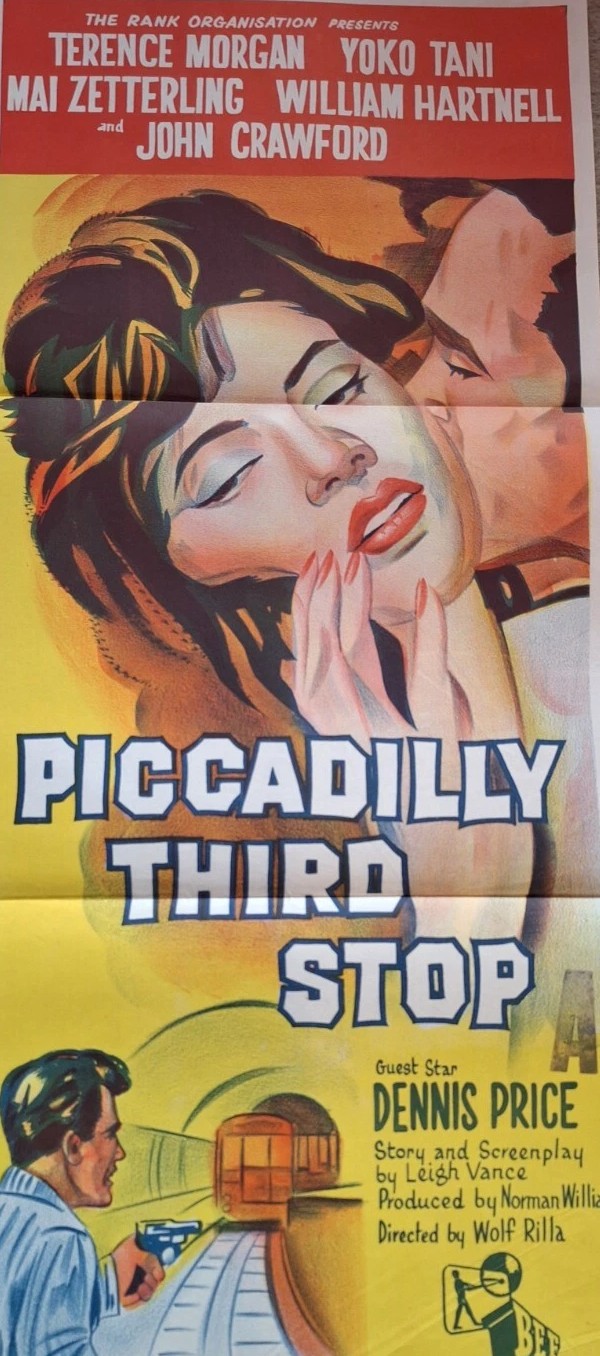
Pussycat Alley / The World Ten Times Over (1963) ***

Sold as sexploitation fare, this is more of a chamber piece as flatmates Billa (Sylvia Syms) and Ginnie (June Ritchie) face up to crises in their lives. For two-thirds of the picture we steer clear of their place of occupation, a Soho nighclub, and only go there for a scene of unsurpassed male humiliation. Unusually, since the expectation would be that the two girls, supplementing their official income with some part-time sex working (implicit rather than explicit), would be treated as victims of wealthy males, in reality they serve up several plates of juicy revenge, but in accordance with their characters rather than as noir femme fatales.

In a very drab London, shorn of tourist hallmarks and red buses and royal insignia, Ginnie sets the tone, furious at lover Bob (Edward Judd), pampered son of a wealthy industrialist, for bringing mention of “love” into what she views as either (or both) an expression of pure pleasure or financial transaction. Bob is the old cliche, the client fallen in love with the girl. Attracted as she is by the pampering and the fact that she can twist him round her little finger, she values her independence too much to commit to such a weak man. In addition, she is so used to getting her way and so wilful that she delights in running rings around him, humiliating him in front of his entire office. 

A contemporary picture like Anora (2024) would find space to excuse or explain her choice of employment, but here, beyond the fact that she left school aged 15 and has no qualifications, we are given nothing to work on, except that her predilection for doing exactly what she wants to do most of the time means she she might find steady employment a drain on her spritely personality.

Billa’s problem is she’s pregnant with no idea who the father might be and becomes infuriated by her widowed teacher  father  (William Hartnell) who can’t let go of his childlike notions of his beloved daughter. Thankfully, no  notions of abuse, but just a dad not coming to terms with a grown-up daughter, shocked that she can knock back the whisky, and whose idea of a treat is taking her to one of the most difficult of the Shakespeare plays. Eventually, suspicions aroused, he tracks her down to the nightclub where she takes great delight in behaving disgracefully, refusing to leave at his presence, parental authority cut stone dead, the staff treating the father like any other punter, even setting him up with a girl (though on the house and he doesn’t take them up on the offer). 

Meanwhile, the over-entitled Bob, failing to get his father to offer Ginnie a job except as an escort for the company’s clients, decides to leave his wife, books plane tickets for an exotic holiday only to be spurned. Ginnie recognizes more easily than him what a disaster marriage would be. She enjoys the fancy restaurants and fast cars but draws the line at commitment. She’s at her best when prancing around, indulging her whims, and yet there is a price to pay for her lifestyle as we discover in more sober fashion at the end.

Billa is sober pretty much all the way through, thoughtful, withdrawn, unable to connect with her father, her biggest emotional support being Ginnie. Despite her failure to go along with her father’s vision of her as an innocent child, her apartment is bedecked with childish paraphernalia, teddy bears, dolls etc. 

Not quite a harder-nosed version of Of Human Bondage, and not far off as far as the males are concerned, but more of a character study of the two women.

Although she has the less showy part, Sylvia Syms is the peach here, and if you consider her portfolio from The World of Suzie Wong (1960) through to East of Sudan (1964) this shows the actress at the peak of her ability. June Ritchie (A Kind of Loving, 1962) is excellent as the flighty piece and Edward Judd (The Day the Earth Caught Fire, 1961) steps away from his normal more heroic screen persona. This was William Hartnell’s last movie before embarking on his time travels for Doctor Who and it’s a moving portrait of an old man whose illusions are shattered.

Directed by Wolf Rilla (Village of the Damned, 1960) from his own screenplay.

Low-life never looked so glam and so shoddy at the same time.

Crooks Anonymous (1962) ***

Charm was in short supply in the 1960s. sure, for a period you still had Cary Grant but David Niven was as often to be found in an action picture (The Guns of Navarone, 1961) or a drama, and others of the ilk, like Tony Curtis, veered more towards outright comedy. Britain had something of what would today be called a “national treasure,” admittedly a term more likely to be accorded females of the standing of Maggie Smith or Judi Dench; maybe a space might be found for the idiosyncratic Ralph Richardson. Dare I put Leslie Phillips into contention for such an honor?

Once into his mellifluous stride and with his trademark appreciation of female beauty, “Ding dong!” a more welcome remark than the more common “Cor!” or “Strewth” or sheer inuendo, Leslie Phillips, not so well known perhaps in the USA and foreign parts, would fit that definition. He had charm in spades.

Unfortunately, you could split his career into those roles where “ding dong” entered the equation and those it did not. This is one of those, and I have to confess I’m both disappointed and delighted. Dissatisfied because the charm appeared part of his screen persona, but pleased whenever I found out he wasn’t tied down to it and could essay other characters just as well.

Here, here’s shifty criminal Dandy, whose only redeeming feature is that somehow he has acquired a beautiful girlfriend, stripper Babette (Julie Christie), who, despite her profession

appears to have steered cleared of seediness and insists he goes straight before she consents to marriage. And that would be fine, except what can Dandy do when faced with such obvious temptation and jewels left idly on a counter in a jewellery?

When she catches him out, he is sent to the criminal version of Alcoholics Anonymous where he is at the mercy of a particularly sadistic “guardian angel” Widdowes (Stanley Baxter – in a variety of disguises). He is locked in a cell full of safes. Food, cigarettes etc are hidden inside the safes, so to eat and satisfy his smoking habit, he must open them. The logic, presumably, is that he will grow sick and tired of opening so many safes for so little reward.

Maybe it’s the hidden punishments – a touch of electrocution and various other booby traps – that do the trick. Or, it could be the glee of Widdowes. When Dandy finds cigarettes, they come without any means of lighting them. He pleads with Widdowes to point him in the direction of a safe containing means of ignition.Replies the “angel”, “I’m glad you asked that because I’m not going to tell you.”

There’s a whole raft of comedy skits revolving around temptation, mostly involving Widdowes in one guise or another. And when the movie stays with Widdowes and a bunch of other reformed criminals, it fairly zips along. But once Dandy is released and plot rears its ugly head it falls back on more cliché elements.

Dandy manages to go straight, employed as a Santa Clause in a department store, while Babette decides to give up her job so both can start afresh. Unfortunately, temptation raises its ugly head to the tune of a quarter of a million pounds and all those goody-two-shoes reformed criminals line up to take a crack at it. The twist, which you’ll already have guessed, is that they have to break into the vault again to return the money they have stolen.

Scottish comedian Stanley Baxter was going through a phase of attempting to become a movie star and was given a fair old crack at it – The Fast Lady (1962) and Father Came Too (1964) followed, the former with both Philips and Christie, the latter with just him.

But what was obvious from Crooks Anonymous was that Baxter was better in disguise – and the more the merrier – than served up straight. He steals the show here where in the other movies his character is more of an irritant.

A well-meaning Leslie Phillips somehow snuffs out the charm and there’s not enough going on between him and Babette when he’s full-on straightlaced. Heretical though it might be, there’s not enough going on with Julie Christie either to suggest she might be Oscar bait. Here’s she’s just another ingenue.

Wilfrid Hyde-White (P.J. / New Face in Hell, 1967), another who generally traded on his charm (in a supporting category of course), is also in the disguise business, so he steals a few scenes, too. James Robertson Justice (Father Came Too) would have stolen the picture from under the noses of Baxter and Phillips had he been given more scenes.

Directed by Ken Annakin (Battle of the Bulge, 1965) from a screenplay by Jack Davies and Henry Blyth (Father Came Too).

I might have preferred Phillips in “ding dong” persona, but this works out okay, especially in the scenes set in the criminal reform school.

Ding dong-ish.

Missing You (2025) ***

A well-off good-looking couple trying to adopt a puppy are challenged by po-faced bureaucrat over the name they have chosen for said animal. Their purported good deed ends in disaster when he shows them a photo of the woman caught in a clinch with another man. We never see the couple again. But the prissy fella, Titus (Steve Pemberton) turns up. He’s some kind of farmer. But he runs a strange kind of operation. In his barn we catch a glimpse of a lot of guys in orange prison-style outfits kept in stalls and handcuffed to the ceiling.

And that would be wow and double wow except the algorithms have gone crazy and none of this gripping stuff occurs until episode two by which time you are bored to death by the insane amount of time devoted to Detective Kat Donovan’s (Rosalind Eleazar) woeful love life and her decade-old grieving for murdered cop father Clint (Lenny Henry).

We know more about Clint than anyone else for about every give minutes she gets all doe-eyed and we cut to flashbacks of the wonderful old dad all huggy and fun. And if that’s not enough every two minutes a colleague or relative or friend interrupts her doe-eyed contemplation to tell her to give up trying to find out why her father was murdered.

As to her love life, I can give you chapter and verse. After Josh (Ashley Walters) skipped out on her eons ago, she’s given up on commitment. She uses men for sex, pretending to be an air hostess in case the idea of dating a cop puts them off. She’s pulled up for the lack of commitment by buddy Jessica (Stacey Embalo) and various others, the same ones giving her grief about her extended grieving. But when Josh comes back into her life, albeit on a dating app, she goes all doe-eyed again – wouldn’t it be such fun to hook up again with that two-timing rat?

Luckily, Jessica is a private detective specializing in the honeytrap to expose errant husbands and even more fortunately one of her grateful clients is a prison guard who can sneak Kat into the prison where her father’s killer, doing life for two other murders, is dying. Although the killer was caught, Kat has driven herself crazy wanting to know why her father was fingered. And, luckily, there’s a prison nurse to hand who will dope up the killer with scopolamine – the old truth drug you might remember from The Guns of Navarone – so he will cough up about the murder, although we have already guessed, as our intrepid cop has not, that he didn’t kill her father just took the rap because he was already facing life for the other two killings.

In the old days, the chief cop either had no love life worth mentioning or had a different blonde/blond on his/her arm in every episode or was going through some hellish break-up, and audiences didn’t have to suffer having to empathize with the poor detective’s awry sex life. But in the old days all love life would have been shoved onto the back burner only popping up at a critical moment as some sort of narrative relief to the question in hand which was solving some horrendous case. Here, it’s the other way round, said case only pops up as a brief intermission to Kat’s awry love life and grief.

This is a Harlan Coban Netflix number but it seems very Coban-lite, a far cry from Tell No One (2006). I was a big fan of the books which seemed set in very realistic worlds with authentic plots and double-edged characters you could root for despite their failings. And mystery was the watchword. But proper mystery, a character caught up in some malfeasance, or the past coming back to haunt them, and rarely were his novels police procedurals.

The quality tailed off after a while but even then Coban knew how to hook the reader and generally the plots, though increasingly far-fetched, had sufficient spice to grip.

You are probably wondering when am I going to get to the juicy part – the case Kat is working on. Well, you see, I was wondering the same. When the heck are we going to get past all the personal angst and devote some time to the case of the missing bloke? He’s the guy who fell off a horse while riding in the lush countryside and after stumbling over said lush countryside is rescued by a fella in a tractor who stabs him with a taser.

As I said, it’s not until episode two that bad guy Titus turns up with his home-made prison and extortion racket but even then it’s hard to drag Kat away from her love life and her grieving.

Golly gosh, I just can’t wait to find out what happened with Josh and whether she will give him another chance. But is that what is meant to keep me going for the next three episodes?

Algorithms go home.

Sinful Davey (1969) **

Major disappointment from a director of the caliber of John Huston. Granted, the quality of his output during the decade had been variable but this marked a new low and the suspicion lingers that he only took on the gig to spend time in Ireland – the movie was filmed there – where he had set up a home in the grand manner of a country squire. Equally odd is James Webb as screenwriter. Having chronicled  the American West via How the West Was Won (1962) and Cheyenne Autumn (1964), Webb had turned his attention to British history, beginning with Alfred the Great (1968).

But where that had at least historical reality to guide the narrative, here Webb relies on the dubious autobiography of the titular subject, resulting in an episodic, picaresque, sub-Tom Jones (1963) and even sub-Where’s Jack? (1969) tale set in the Scottish Highlands.   And much as John Hurt later achieved considerable recognition for his acting, the role, as played, could have been handled just as easily by any number of rising male stars, since, beyond being able to affect two accents – broad Scots and upper-class English – little is required.

In fact, the director clearly couldn’t distinguish between the Irish and the Scottish accent as among the  joblot of accents, none more than serviceable, there is many an Irish lilt.  As if to make the point that he couldn’t care less, you will also discern on the soundtrack a refrain from “Danny Boy.”

Beyond that it made a good scene, quite why Davey Haggart (John Hurt) decided to announce his desertion from the British Army in such ostentatious manner is difficult to understand. He’s a drummer, marching along, banging said drum, when he takes it into his head to jump off the nearest bridge into the nearest river, complete with drum, only to find himself headed for a mill. In possibly the best line in the script, seeing the mill wheel blocking his escape, he mutters, “Who put that there?”

From here on it’s a tale of pursuit – two actually. Lawman Richardson (Nigel Davenport) leads the merry chase but he’s also got childhood sweetheart Annie (Pamela Franklin) on his tail to ease him out of scrapes in the hope that he’ll reform. Beginning as a pickpocket, he  switches to highway robbery and piracy, rarely with particular success. Loaded down with booty on the carriage he has stolen, for example, he loses control of the horses and is left at the side of the road, as poor as when he started. 

He’s certainly inventive but contemporary audiences will recoil from the notion of using the head a height-challenged man aloft another’s shoulders to test the rotting rafters inside a jail, leading not to escape but to a home-made pleasure parlor, since it provides entry to the female jail above where our hero establishes himself as a pimp.

But that’s as inventive as this picture gets and in the manner of Cat Ballou and Where’s Jack? you know that whenever a hero heads towards the gallows you can be sure the hanging will be thwarted. The period setting – the 1820s – offers little assistance, as the picture could be set any time before the invention of steam, and could as easily have taken place in a galaxy far far away long long ago called Brigadoon for all the period authenticity shown.

This didn’t lead to instant stardom for John Hurt and possibly just as well as he’d have been wasted in a series of ingenue roles. Pamela Franklin (And Soon the Darkness, 1970) doesn’t have much to do beyond trying to master a Scottish accent. Nigel Davenport (Play Dirty, 1968) was in his element playing yet another frosty authoritarian figure.

John Huston (Night of the Iguana, 1964) did prove one thing – that he lacked the knack for comedy.

Suspect / The Risk (1960) ****

Marvellous long-forgotten character-driven espionage drama exploring the twin themes of guilt and duty. It would appear to be stolen by two supporting actors, Ian Bannen and Thorley Walters, but in fact both play roles that have significant bearing not only on the narrative but on our understanding of the most important characters. Not only do we have the main plot, but we also have two well-worked sub-plots, one concerning disability and the other of more sinister relevance – a 1984 Big Brother theme.

Basic tale concerns a laboratory that has discovered a bacteria that can cure plague. Hopes of  a celebratory drink all-round and academic kudos on publishing his paper for top boffin Professor Sewell (Peter Cushing) are dashed when the Government in the shape of the pompous Sir George Gatling (Raymond Huntly) steps in, steals the discovery and makes the staff sign the Official Secrets Act.

Romance No 1 – Virginia Maskell and Tony Britton in the lab.

While the revered professor takes it on the chin, colleague Bob Marriott (Tony Britton) is outraged so vocally in public that he attracts the attention of the shady Brown (Donald Pleasance) who suggests to the dupe that there is a way of getting the information out to the wider scientific community, especially to plague-ridden countries.

However, don’t let Sir George’s pomposity fool you. He doesn’t trust this bunch an inch and puts the Secret Service on their tail to assess “the risk” and we dip into the dark kind of web (not that kind of dark web) and the mundane business of deception and betrayal shortly to be explored by the likes of John Le Carre (The Spy Who Came in from the Cold, published in 1963) and Len Deighton (The Ipcress File, published a year earlier).

Rather than this outfit being headed by a version of the prim George Smiley, Mr Prince (Thorley Waters) has a lot more in common with the unkempt Jackson Lamb of the Slow Horses series. His incompetence is an act to make visitors to his shambles of an office under-estimate him.  But he’s got that Columbo knack of asking the most important question just when an interviewee thinks the interview is over.

Also in the background, coming more increasingly into the foreground, is an unusual love triangle between colleagues Bob and Lucy Byrne (Virginia Maskell), who kiss and hold hands in the cinema, and Lucy’s flatmate, the disabled war vet Alan Andrews (Ian Bannen). The fact that Lucy and Alan live together at a time when such a relationship was frowned upon and would be career death in certain circles and that they were once engaged to be married gives it an edge. That Alan has lost an arm and a hand so needs to be cared for – fed (as in food spooned into his mouth),  washed (you can guess that aspect), cigarette lit and removed between puffs, dressed – suggests significant intimacy for an adult.

Obviously, she’s the kind of lass who couldn’t abandon him to the welfare system, and he’s the kind of man who broke off their engagement so she wouldn’t feel tied to him for the rest of her life. But he also hates what he’s become, his desperate reliance on her, what he’s lost, and that’s turned him into not just a bitter individual but a particularly cunning one, who has developed the trick of torpedoing any nascent romance. “You can’t compete,” he gloats to Bob, “because you can’t make her feel good.”

Romance No 2 – Ian Bannen and Virginia Maskell.

But when that doesn’t work, he befriends Bob and surreptitiously eggs him on to betray his country and in so doing, hopefully, kill off the romance.

Mr Prince is a delight. Accorded the best lines, he makes great use of them. When his subordinate Slater (Sam Kydd) abrasively brings Dr Shole (Kenneth Griffith) in for questioning, he reprimands him with the rather coy, “Oh, you haven’t been rough again.” To Dr Shole (Kenneth Griffith), the most susceptible of the professor’s acolytes, he warns, “Tell him (Sewell) not to be a fool or you’ll smack him on the backside.”  Though Dr Shole has a superb retort, “We’re not exactly on those terms.”

Professor Sewell appears mostly on the back foot. While quietly seething at being denied his professional day in the sun, he accepts duty. Even so, he’s smart enough to outwit Prince when the traitor is caught.

The background of the wheels-within-wheels of Government, the silent overseeing of ordinary lives, the authorized level of spying, comes as something of a shock, since despite George Orwell’s best efforts Big Brother was seen as a clever fiction that could not occur in this most democratic and upright of countries where “fair play” was the rule. Visually, this is well done, we see eavesdroppers in mirrors in pubs and, as I said, Prince seems the least effective of operatives but with the kind of personality that you could easily have built a series around.

Disability from war was a constant of post-war British pictures, most often demonstrated by a character with a limp, as with general dogsbody Arthur (Spike Milligan) here. The Oscar-winning The Best Years of Our Lives (1946) was the most effective at dealing with the physical after-effects of the Second World War. But there, the worst-affected soldier, had prosthetic hands. Here, Alan does not, so the scenes of him being tended to by Lucy are emotionally more powerful.

She tends to his emotions, too, and will embrace him and kiss him on the mouth though he’s not dumb enough to read true romantic commitment into those demonstrations of affection. Clearly, there is emotional residue from their engagement, from which you guess she will ultimately be unable to entangle herself, unless he can find a more brutal way of helping her out of the dilemma.

The lab aspect is surprisingly well done. We don’t get any real information on the scientific breakthrough. Mostly, what we view is the grunt work, the laborious checking of thousands of samples for another experiment. At one point Bob thrusts his arm into a contraption packed with buzzing flies as if he was a competitor in I’m a Celebrity, Get Me Out of Here.

Ian Bannen (The Flight of the Phoenix, 1965) is the standout but character actor Thorley Waters (Sherlock Holmes and the Deadly Necklace, 1962) runs him close. Tony Britton (better known later for television comedy) has the least interesting role, but Virginia Maskell (Interlude, 1968) has too much to do without dialog to demonstrate her dilemma. Peter Cushing (The Skull, 1965) is solid as always and Spike Milligan provides light relief.

Joint direction by the Boulting Brothers (The Family Way, 1967), Roy and John. Screenplay by Nigel Balchin (Circle of Deception, 1960) based on his own novel.  

Exceptionally solid stuff. I was very much taken by the unusual approach, the themes and the acting.

Worth a look.

Discover WordPress

A daily selection of the best content published on WordPress, collected for you by humans who love to read.

The Atavist Magazine

by Brian Hannan

WordPress.com News

The latest news on WordPress.com and the WordPress community.