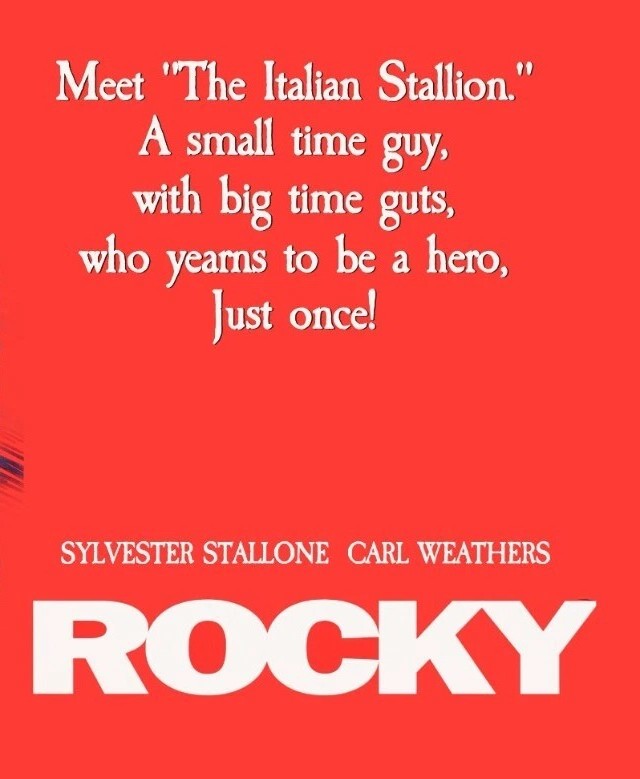
You’re probably unaware of this but I’ve got a regular correspondent who has sent me over the years a stack of Behind the Scenes material that you’ll only ever come across if you check out the comments section underneath my reviews. I know him as “mlang1247.” He’s been kind enough to send me an extensive Behind the Scenes on “Rocky” so I thought I would co-opt him as a guest contributor.
According to a Nov 1976 interview with Stallone in the New York Times, the 1975 championship fight between Chuck Wepner and then reigning World Heavyweight Champion Muhammad Ali inspired him to write the Rocky screenplay. Stallone noted that as he watched the fight, he thought about “stifled ambition and broken dreams.”
After ruminating for several months, Stallone wrote a rough first draft of the screenplay in three and a half days. This was followed by two other drafts. Stallone, whose only leading role before Rocky was in the 1974 low-budget film The Lords of Flatbush, was determined to play the title role.
According to a Nov 1976 Los Angeles Herald-Examiner news item, although United Artists and several other companies were interested in the script, offering Stallone up to $275,000 for the rights, Stallone refused to sell unless he could play the lead. In a Nov 1996 Los Angeles Times article, producer Irwin Winkler recalled that he and his producing partner, Robert Chartoff, tried to convince UA to allow Stallone to star in the picture, but the company insisted that either Ryan O’Neal, James Caan or Burt Reynolds be given the role. An April 2001 Variety news item added that Robert Redford was also considered for the part. In November 1979 the New York Times reported that Bette Midler had turned down the role of “Adrian.”
According to a January 2006 Los Angeles Times news item, Los Angeles sportscaster and actor Gil Stratton, who was initially to play the “fight commentator,” instead took the role of a television reporter, but his scene was cut from the final film. Stallone’s brother, Frank Stallone, Jr., appeared in the film, as did his father, Frank, Sr. Although Hollywood Reporter production charts added George Jordan, Jack Gregory, Ben Freeman, Ronald McQueen and Dick Lane to the cast, their appearance in the final film has not been confirmed.
In the Los Angeles Times interview, Winkler said that in order to make the film with Stallone, he and Chartoff, who at the time had an exclusive producing deal at UA, then decided to exercise a provision in their contract allowing them to make any movie of their choice costing up to $1,500,000. UA then proposed a $2,000,000 budget for the film, which would allow the company to circumvent the producers’ deal and consequently make the film with a star of its own choosing.
In a heated meeting with Mike Medavoy, at the time the head of production at UA, Winkler and Chartoff agreed to make the picture for $1,000,000, while also guaranteeing its completion, thus assuring their complete control over the project. An October 1976 article in Women’s Wear Daily added that Stallone was awarded one percent of the gross for writing the film and two percent of the gross for acting in it.
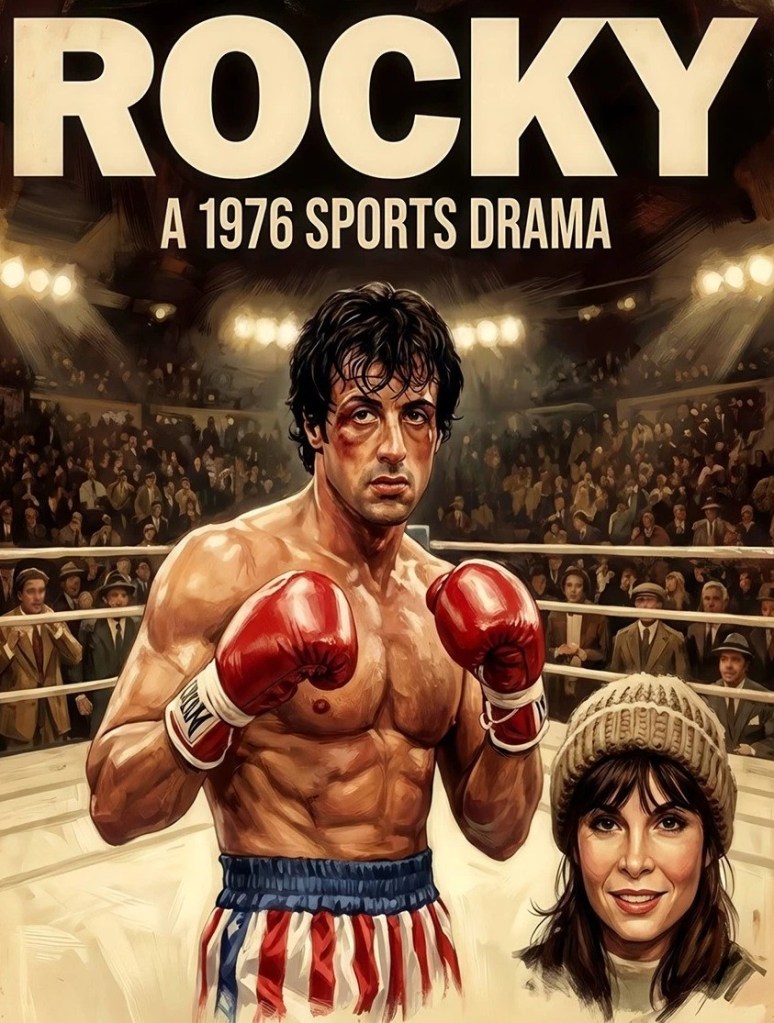
In a March 1977 New York Times profile of director Avildsen, he explained that he was hired to direct Rocky because he had a good record for keeping low-budget films on track, agreed to the producers’ stipulations that Stallone star in the picture, and would hold the picture’s budget at $1,000,000 on a 28-day production schedule. Filming began on 9 January 1976 and the picture remained on Hollywood Reporter production charts until 5 March 1976. In order to adhere to the schedule, Avildsen staged numerous rehearsals and choreographed many of the scenes.
During the four weeks before the start of principal photography, Stallone and Carl Weathers, who played “Apollo Creed,” a character loosely based on Muhammed Ali, rehearsed the final fight while Avildsen shot Super 8 footage of them so that they could see their weak points. A March 1977 Los Angeles Times article noted that to prepare for his role in Rocky, Stallone trained with Jimmy Gambina every day for about five months before shooting the picture.
To economize, according to the New York Times article, Avildsen asked Stallone to change a scene in the original screenplay in which Rocky takes Adrian to a busy skating rink. To avoid spending money to hire the extras required for the scene, Avildsen decided that the skating rink would be closed, thus eliminating the need for extras, and creating one of the film’s most memorable scenes.
Garrett Brown, who is credited with special camera effects for Rocky, employed one of the first feature-film-length uses of Steadicam, a stabilization equipment system that allows a photographer to walk around while using a hand-held movie or video camera.
Studio publicity material contained in the film’s production file at the AMPAS Library added that the Steadicam was hand-carried during the film’s climactic boxing sequence filmed at the Los Angeles Sports Arena. According to an April 1977 New York Times article, Brown was granted a patent for the Steadicam process in 1977.
In the original ending of Rocky, the boxing arena is empty when Rocky walks out. After receiving a word of consolation from a fellow fighter, Rocky takes Adrian’s hand and the two walk down the hallway together. According to an interview with Rocky’s editor, Richard Halsey, in the September 1977 issue of Millimeter magazine, after filming was completed, it was decided that the ending was too downbeat and needed to be reshot. To save money, Avildsen filmed the revised finale, in which Rocky yells for Adrian to join him in the ring, in close shots, with just a few extras around them.
“Gonna Fly,” more popularly referred to as “Gonna Fly Now,” the Rocky theme composed by Bill Conti, not only occupied the number one spot in Billboard magazine charts, but has been recorded by many artists, including Maynard Ferguson, James Darren, Steve Lawrence and Shirley Bassey. In an undated Hollywood Reporter article, Conti said that he used trumpets in the film’s opening sequences to get the audience’s attention and that the fight scenes were scored like a “Bachian” fugue.
A March 1977 article in Soundtrack magazine noted that lyricists Ayn Robbins and Carol Connors were unknown at the time Conti commissioned them to write the song’s lyrics. Before production was to begin, however, UA decided to use its own staff songwriters to write the lyrics. Conti interceded by suggesting that all the names be removed from the music submitted for the film so that the producers could listen impartially and pick the best. Connors and Robbins won the competition, and subsequently “Gonna Fly” won an ASCAP award and was nominated for an Academy Award for Best Music, Original Song. Since Rocky’s release, “Gonna Fly” has been used as a theme for many sports and inspirational events.
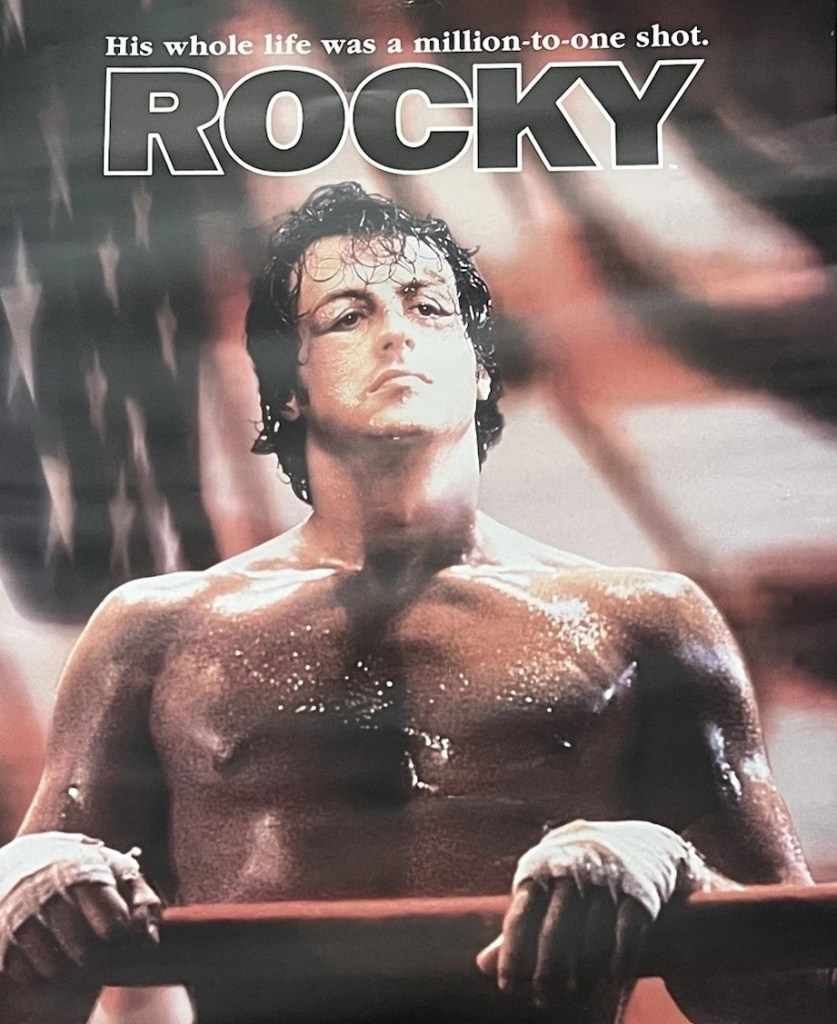
Once Rocky was completed, UA launched an extensive publicity campaign to promote the film, including key art featuring Rocky partially wrapped in an American flag, as he appears at the end of the fight with Creed. Daily Variety (16 November 1976) noted that “Rocky has virtually been declared a film classic even though it is still several days from opening” and a highly orchestrated media campaign had assured that articles would be placed in prominent magazines depicting the film as a “Cinderella story” by emphasizing Stallone’s refusal to sell the script, despite lucrative offers, unless he could play the lead.
The film’s executive producer Gene Kirkwood noted that sneak preview screenings were for “the right people,” such as “one well-known Hollywood gray eminence (Saturday Review critic Arthur Knight] who saw it without the final fight sequence but became a valuable public relations asset by calling the picture ‘the sleeper of the year’ in front of numerous lecture audiences.”
After Rocky was screened for the staff of New West magazine, the resultant cover story sung its praises, assuring that the article would then be picked up by the magazine’s sister publication New York. Kirkwood also noted that Rocky was perceived as a “Frank Capra-type tale.”
The Variety reviewer commented on the underdog theme of Rocky, noting that “the very best way to enjoy [the film] was to simply relax and roll with the Walter Mitty…notion that the least of us still stands a chance of making it big.” An opposite view was expressed by Vincent Canby in the New York Times which described Rocky as an “absurdly oversold…sentimental little slum movie.”
The picture went on to become a huge hit, becoming the second highest-grossing film of 1977 (after Star Wars), and by December 2006, according to Hollywood Reporter, had grossed $225,000,000 worldwide and over $117,000,000 domestically. Rocky attained such acclaim that when Stallone donated a life-size statue of Rocky Balboa to the city of Philadelphia, where most of the film was shot, the statue was placed on a site near the steps of the Philadelphia Museum of Art, the steps Rocky ran up while in training, one of the film’s most iconographic scenes. The steps became a popular tourist attraction for Rocky fans, many of whom would run to the top to imitate the boxer’s triumphant pose.
In 2007 Rocky was ranked 57th on AFI’s 100 Years…100 Movies–10th Anniversary Edition list of the greatest American films, moving up from the 78th position it occupied on AFI’s 1997 list. In addition, the film ranked 4th in 2006 on AFI’s 100 Years–100 Cheers list; the character of Rocky was ranked 7th on AFI’s 100 Heroes and Villains list and Rocky’s memorable “Yo, Adrian!” line was included on AFI’s 100 Years–100 Quotes list.
Rocky, which at the time of its release was considered a longshot to win any Academy Awards, won for Best Director, Best Film Editing and Best Picture, and was nominated in the following categories: Best Actor in a Leading Role (Stallone), Best Writing, Screenplay Written Directly for the Screen (Stallone), Best Actor in a Supporting Role (Burgess Meredith and Burt Young), Best Actress in Leading Role (Talia Shire), Best Sound and Best Song. Rocky garnered the following Golden Globe nominations: Best Motion Picture Actor-Drama, Best Motion Picture Actress-Drama, Best Director, Best Original Score and Best Screenplay.
The picture also won the DGA Award for Outstanding Directorial Achievement in Motion Pictures and was awarded a Golden Globe by the Hollywood Foreign Press Association for Best Motion Picture-Drama. Stallone was nominated for the Writers Guild Award for Best Drama Written Directly for the Screen, and Shire won the New York Critics’ and National Board of Review’s awards for Best Supporting Actress.
Following Rocky’s release, several lawsuits were filed against the film. In an undated Hollywood Reporter news item, local attorneys Herb Dowdell and Howard Rosoff, who owned twenty-five percent of the New Picture Co., filed a $19,000,000 lawsuit against Kirkwood, on the grounds that producers Chartoff and Winkler contracted with New Picture Co. and not Kirkwood for their services on the picture.
In response, Kirkwood claimed that in 1972, Dowdell, the founder of New Picture, gave the firm to him in exchange for twenty percent of the company’s stock, and that the company was defunct when he took it over. The outcome of that suit is unknown.
In 1977, John Roach and Ron Suppa, producers of Force Ten Productions, filed a $30,000,000 suit against Winkler and Chartoff, (Hollywood Reporter, April 1977) claiming it owned an exclusive option with Stallone to write and star in a film titled Hell’s Kitchen, which the company claimed was based on a theme about a “club prize fighter who would build a reputation…until a climactic fight which he would lose.”
Force Ten charged that Rocky was an outgrowth of Hell’s Kitchen, which had a working title of Paradise Alley. An Despite the suit, Universal financed Hell’s Kitchen, which was released in 1978 as Paradise Alley.
Former heavyweight boxer Chuck Wepner sued Stallone in 2003 for a share of the profits from the Rocky movies, claiming that the first in the series was based on Wepner’s life. In 2006 he settled for an undisclosed amount.
In the wake of Rocky’s success, A Party at Kitty and Stud’s, a soft-core porn film in which Stallone appeared in 1970, was released on videocassette under the title The Italian Stallion and promoted as “Sylvester Stallone Star of Rocky Goes X Rated.” Stallone (Variety, 21 June 1977) said that, to his knowledge, the film was never released theatrically, and he deplored the video release’s exploitation of him and Rocky.
Rocky spawned five sequels, even though, at the end of Rocky, Creed and Rocky agree not to have a re-match: Rocky II (1979) (in which Rocky defeats Apollo), Rocky III (1982) and Rocky IV (1985); all were directed and written by Stallone and featured the principal cast from Rocky. Rocky V, written by Stallone and directed by Avildsen, eliminated the character of Apollo, who died in Rocky IV, and added Sage Stallone, the son of Sylvester Stallone, as Rocky’s son “Rocky, Jr.” In Rocky Balboa (2006) written by Stallone and directed by Avildsen, Adrian has died, making Rocky a widower

