Mind-games and unreliable narrators give this considerable contemporary appeal. Throw in Anthony Quinn back in Zorba the Greek (1964) territory and Michael Caine as a lothario in the Alfie (1965) mold plus Candice Bergen (Soldier Blue, 1970) in preppy mode and you have nothing short of ideal casting.
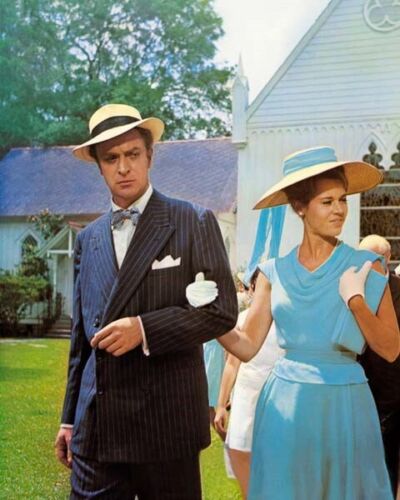
Nicholas (Michael Caine), escaping a failed romance with Anne (Anna Karina) by teaching English at the Lord Byron School on a Greek island, becomes entangled with millionaire Conchis (Anthony Quinn). The action primarily takes place on Conchis’s fabulous villa stuffed full of art treasures. Conchis initially presents himself as a psychic who can summon up the past, namely in the shape of Lily (Candice Bergen) who talks and dresses like the young girl Conchis previously loved.
But every time Nicholas rumbles a ruse he is presented with a different version of Conchis’s self. These include a psychiatrist, conjurerer-up of the mythic past and Second World War collaborator. All of these identities carry sufficient personal truth for Nicholas to doubt his doubts.
Is he the victim of some elaborate game, one which caused the mysterious death of his predecessor? Is he smart enough to expose the millionaire as a dangerous fantasist? Is Lily genuinely falling in love with him and will this be yet another romance which makes him feel trapped? Is he actually put on trial in front of the entire village or is that all a dream? Is Conchis intent on stripping him of his core identity? And if so, why?
It should have been a cracking film but somehow misses the target. In theory, this is because Michael Caine is miscast. Caine is usually in charge and here is anything but. But actually, flipping over an actor’s screen persona, especially this cocky one, works. You might keep on wishing the real Michael Caine would stand up, and the fact that he doesn’t gives the film its strength.
Anthony Quinn initially overdoes the flamboyance to the point of being hammy – what magician is not – but you can see the point of that when he turns into the sober mayor forced to deal with invading Germans during World War Two and faced with making life-or-death decisions. The general consensus is Candice Bergen is the weak link, but I’d challenge that too since she is playing a role, that of an easily-duped actress.
The main problem is the picture is loaded down with flashbacks. And all to do with the various reinventions of Conchis’s life. In keeping with the film’s style you are never sure how much of this is true. Caine’s character has little to do except ask questions. (A modern film would have him chasing after physical clues to uncover a riddle.) So it becomes very stagey, with Conchis like a frustrated teacher with an aberrant pupil.
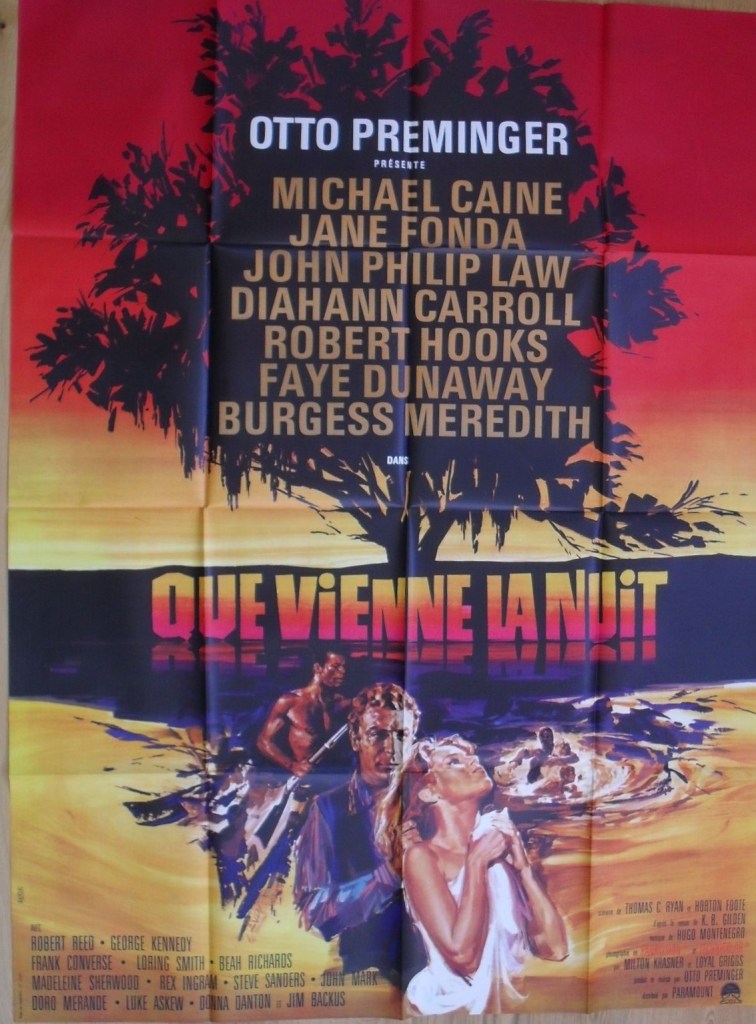
Of all the misleading ads! This lost a fortune for Fox.
John Fowles adapted his 300,000-word cult novel, removing the bulk of the philosophizing, but not realizing that what works in a book, especially in the hands of a gifted narrator, is not so easily translated onto the screen. For the adaptation of his previous bestseller The Collector (1965), director William Wyler brought in screenwriters to make the book work as a film.
Either screenwriters balked at the problems of dealing with a masterpiece or Fowles insisted on writing the screen version or director Guy Green (Pretty Polly/A Matter of Innocence, 1967) believed him the best person to reconstitute his work. Quinn, rather than Caine, has the movie’s pivotal sequence, forced into an action on a par with Sophie’s Choice (1982) and it might have helped if that element had been brought in sooner.
As it is, the movie is no more than interesting when it should have been fascinating.
Implausibility was not much of a deterrent for the Hollywood screenwriter. It might even prove beneficial when it came to romantic plot ramifications. Suffice to say that this most charming of fey comedies entailing a gang of butlers engaged in a larcenous spree stretches credibility, not least because their intentions are a twist on Robin Hood, stealing from the rich to give to the rich, namely to ensure a dotty old lady maintains her wealthy lifestyle.
The big plus is not the series of heists, which fall into the over-egged pudding category, but the performance of Dick Van Dyke (Chitty Chitty Bang Bang, 1968). It’s somewhat refreshing to see him not falling back on twisting his vowels or his body and looking like an accident waiting to happen. This is Dick Van Dyke – actor.
Edith Evans explaining her brilliant concept. although I’m surprised to see her leave in the “D” in Sandwich which is the most common error.
Fitzwilliam – nicknamed Fitzwilly – is the adored and highly-educated head butler in a gigantic New York mansion owned by the eccentric Victoria Woodworth (Edith Evans) who is working on the daftest notion imaginable, writing a dictionary for people who can’t spell. That’s not even the most bizarre element.
While leaving the entire running of the house, and the management of her money, to Fitzwilly, Miss Woodworth goes against this by off her own bat hiring a secretary Juliet (Barbara Feldon) who can’t spell. This is despite Juliet having a degree from a top university and having a professor for a father. But, aha! There’s method in the old bird’s madness. She requires a semi-illiterate to practise her dictionary notions upon.
Having upset Fitzwilly by sneaking in like a cuckoo to his well-oiled nest, Juliet complicates matters firstly by spotting some of the thieving and secondly by falling in love with the butler. It’s something of a shame, really, that the initial scheme of clever crooks on the make, using wealth as a disguise – who is going to challenge an exceptionally well-spoken butler when he walks off in plain sight with a Steinway piano – is turned on its head when we realise the hoods stand to make no personal benefit. Their largesse merely avoids revealing to Miss Woodworth than she is actually broke.
The two stars getting up close and personal. There are a ton of under-stated elements of Van Dyke’s performance. In this scene, he delicately explains to a young, inexperienced waiter how to properly pour wine.
Some of the heists are more of the over-egged con variety, too complicated for their own good, but the final robbery – on Xmas Eve – sits fairly and squarely in Marx Bros territory, providing a host of genuine laffs. Though you might wonder at the susceptibility of big-name department stores to smooth-talking criminals.
The romance is gently old-fashioned, and though Barbara Feldon (Agent 99 from Get Smart!, 1965-1970) does possess comedic timing, in hairstyle and delivery resembles Jane Fonda. It could have done with more time spent on her challenging or outwitting the butler, as she does at the start, to build up her character rather than lamely surrender to the romantic urge
Dick Van Dyke and Edith Evans effortless carry the picture. But while you’d expect nothing less of the renowned British actress, Oscar-nominated the previous year for The Whisperers, the biggest stretch in the entire picture is Van Dyke reversing his screen persona to turn into a believable leading actor not dependent on pratfalls, dodgy accents, singing and those limbs that seem to have a life of their own. He exudes charm and class and his character, without the distraction of being so devoted to his boss, could have pursued a highly profitable life of crime with himself as the sole beneficiary, which might have opened the door for his underwritten confederates – including John McGiver (My Six Loves, 1963), Oscar nominee Cecil Kellaway (Guess Who’s Coming to Dinner, 1967), Norman Fell (Sgt Ryker, 1968) and in his debut Sam Waterston (Three, 1969) – to play a larger part in the dramatic proceedings.
But hey, if audiences were primed to fall for every Doris Day comedy built on a dumb premise and had lined up in the millions for It’s a Mad, Mad, Mad, Mad World (1963), then it’s kind of hard to question the narrative underpinning this picture. Isobel Lennart (Funny Girl, 1968) whipped up the screenplay from the novel A Garden of Cucumbers by Poyntz Tyler.
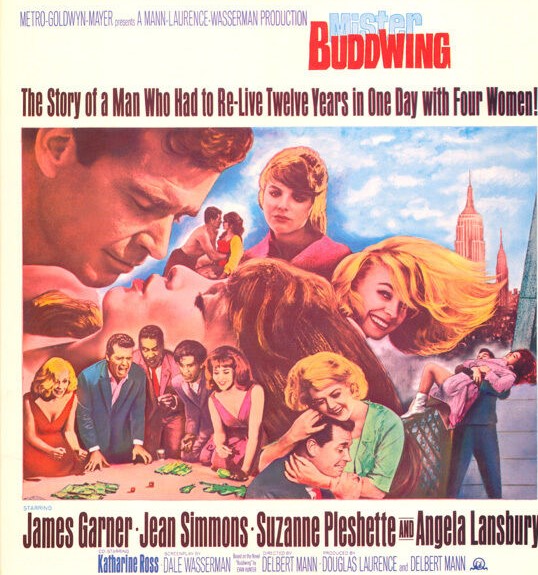
Once you get over the initial over-egging it’s soon apparent that Delbert Mann (Buddwing, 1966) has stitched together quite successfully a jigsaw of improbability.
Worth seeing for a Dick Van Dyke you never knew existed and another imperial turn from Edith Evans.
An unexpected gender equality twist as fiancée Marjory (Nancy Kwan) decides to embark on the equivalent of a stag party after seeing the state it left potential husband in. Although the full-scale Hen Party was a few decades away, Britain had given way to the Permissive Society, so, theoretically at least, a young lass on the brink of marriage could have a wild fling and with her last day at work coinciding with the office Xmas party she does her best.
Predatory men, of course, have a sixth sense regarding available women so there’s no shortage of suitors and she is egged-on by an alter-ego she calls Sandra who tut-tuts at her in the mirror when she fails to let herself go. Meanwhile, boyfriend Andy (Donald Churchill) has decided she will be bored silly at the party and plans to whisk her away for Xmas shopping.
The roster of potential lady-killers is headed by boss Godfrey (Terry-Thomas) forever maneuvring her into the confines of his office. Scottish salesman Craig (Jimmy Logan) wines and dines her in a private room. The company’s in-house designer Quentin (Victor Spinetti) tries to seduce by spouting poetry by D.H. Lawrence.
An office party being the kind of occasion where emotions run wild, tempers fray and home truths spill out, we discover Marjory is not the only one with romance in mind. An older secretary Mavis (Betty Marsden), lip perpetually a-quiver, more or less announces that Godfrey is the love of her life, ignoring, at least for the moment, that he has already embarked on an affair with model Monica (Joyce Blair).
Marjory switches from staid housewife-to-be (she has to quit her job on getting married, as was standard at that time) to exploring her inner Sandra, submitting to a make-over by Quentin that turns her into a vamp. With clothes by Mary Quant and a bob from Vidal Sassoon, she would have been quite the eye-catching catch had she remained still long enough for anyone to catch her. However, this being a comedy, and Marjory/Sandra an innocent among wolves much of the running time is spent getting her out of situations of her own making.
But although humor is to the fore, you get the sense this is a ground-breaking film desperate to break out into something more serious. Marjory challenges the notion that marriage ended careers, that women had to make do with sitting at home doing housework waiting for husband to return, in a life devoid of excitement or development.
If this is her idea of beginning married life, you certainly get the idea that her marriage will have a more feminist tinge than Andy might be expecting. The Sandra alter-ego, initially expressed as a flighty piece, soon develops into inner doubt, channeling a potential rebel. In some respects, this is standard stuff, middle-class girl sensing opportunity only to be taken advantage of and certainly this particular year appeared to be filled with characters on the cusp of change and/or consequence – Four in the Morning (1965), The Pleasure Girls (1965), The Hallelujah Trail (1965), Georgy Girl (1965), and you might even include Doctor Zhivago (1965). Female characters later in the decade would have fewer qualms.
So it has a time capsule feel, full of surreptitious suggestion. You get the impression that when Marjory quashes Sandra it’s only a temporary solution and that questions that remain unanswered will pop up at a later stage.
The ploy of the alter-ego in the mirror allows writer-director John Krish (Unearthly Stranger, 1963) to seed the comedy with more serious elements and ask questions that might be uppermost in the female mind. He throws in the occasional surreal moment such as the husband being trapped in a phone booth by a drunk (Frank Finlay) or an innovative way to stifle rising chaotic emotions. But some scenes could do with editing, namely the makeover scene which relies overmuch on reaction shots.
Nancy Kwan at last fulfils the potential shown in The World of Suzie Wong (1960), portraying a more complex character than the free-spirited Tamahine (1963). Terry-Thomas (Arabella, 1967) does too much mugging and his well of double-takes runs dry for this to be considered one of his better works. Joyce Blair (Be My Guest, 1965) makes the most of a man-eater role.
Silent American film superstar Bessie Love puts in an appearance and Scottish comedian Jimmy Logan is convincing in a dramatic part. Frank Finlay (A Study in Terror, 1965) is an inspired drunk and English comic Bud Flanagan has a bit part. Krish based the script on a novel by William Samsom. If you want to learn more about “The Permissive Society,” check out a course run by the University of York, which dates it starting in 1957.
Strictly matinee material until you notice the undertones.
Succession as seen from the perspective of someone like the inadequate Tom (Matthew Macfadyen), who has married his way into big business and has an elevated idea of entitlement.
Joe Lampton (Laurence Harvey) was a genuine working-class hero of Room at the Top (1958) who connived his way into the marriage bed of businessman Abe Brown’s (Donald Wolfit) daughter Susan (Jean Simmons) and set himself up as the heir apparent. Several years on, it’s not quite worked out the way he planned, stuck in a loveless marriage, out of his depth among the Yorkshire elite, passed over for promotion, pinning hopes of personal happiness on an affair with television personality Norah (Honor Blackman).
The only problem is that screen-wise he’s a b*****d without an ounce of the dominating personality of Brian Cox, the ultimate b*****d’s b*****d. This plays out more The Tale of Two Spoiled Brats. So if you’re looking to see Lampton get his come-uppance on several fronts, you’ve come to the right place. Unfortunately, that means there’s isn’t a single likeable character in sight. It might be the way of the world among the high-rollers but it makes for rather dispirited watching.
On the other hand, Lampton was always such a louse it is enjoyable to see him not only being put in his place but ending up a few rungs further down the ladder than where he started. This might have scored some points for social commentary but it’s such a scattershot approach – racing pigeons, local government corruption (by Tories, who else), strip club, ballroom dancing (the original Come Dancing before that usurper Strictly Come Dancing came along), drinking a yard of ale, swimming in the canal, ruthless entrepreneurs, luvvies – it does little justice to any.
Perhaps the most surprising aspect is the independence of the women. Susan has a lover Mark (Michael Craig) and emasculates Joe by going behind his back to get whatever she wants, financially, from her father. Ambitious Norah refuses to give up her career for Joe and is likely to withdraw her favors should his ambition fails to match hers.
Even the cuckolded get in on the act, taunting those who had fallen for their partners’ adulterous ways. George Aisgill (Allan Cuthbertson) mocks Joe for falling (in the previous film) for his wife when she went after anything in trousers. Similarly, Mark’s wife ridicules Susan for just being the latest notch on Mark’s bed.
Naturally, Joe hasn’t the wit to see what a good deal he has and spends all his time in self-pitying mode. Poor Joe – he is stuck with driving a white Jag while Abe swans around in a Rolls-Royce. Poor Joe – his wife isn’t going to make do with hotel bedrooms for illicit assignations, but makes full use of the house. Poor Joe – his son doesn’t like him. Poor Joe – he trots out all his childhood deprivations at the slightest opportunity as if auditioning for a Monty Python sketch.
Poor Joe – he’s not even that good a businessman, so naïve that he doesn’t realise that many deals require sweeteners, backhanders, bribes, though smart enough enough to add on a little extra, when extracting such sums from the more worldly Abe, for himself. Poor Joe – he believes business blandishments. Poor Joe – Abe has no interest in the “Report” he’s slaved his guts over. Poor Joe – when he applies for another job, his lack of education marks him down.
The big problem is it’s impossible to feel any sympathy foe Joe. Your heart is more likely to go out to those he wounds with his atrocious behavior. The more he blames everyone else for his predicament, the more an idiot he looks, duped and a biter bit.
And Laurence Harvey (A Dandy in Aspic, 1968) whose screen person is one part arrogance, one part snarky, and one part well-groomed male is not capable of making you feel for his character. Jean Simmons (Rough Night in Jericho, 1967) reveals greater depths, vulnerable, passionate, seductive, practical. Honor Blackman (A Twist of Sand, 1968) gives a good account of herself as an ambitious woman with a conscience.
Few of the other characters are more than ciphers but there’s a decent supporting cast in Donald Wolfit (Becket, 1964), Michael Craig (Stolen Hours, 1963), Robert Morley (Deadlier than the Male, 1967), Allan Cuthbertson (The 7th Dawn, 1964) and Nigel Davenport (Sands of the Kalahari, 1965).
Canadian Ted Kotcheff (Tiara Tahiti, 1962) directed from a screenplay by fellow country man Mordecai Richler (Young and Willing, 1962) based on the John Braine bestseller. And it seems a bit mean to film it in black-and-white, presumably to emphasize the social aspects when in fact most of its takes place in glamorous settings.
The American Civil War is often slotted into the wrong genre. It is not a western. It is a war, with all the inherent wrongheadedness, viciousness and atrocity. We begin with senseless execution and end on a note of humiliating barbarity. Along the way we witness easily the greatest performances in the careers of George Hamilton (The Power, 1968) – a wonder after this how he was ever associated with playboy characters – and Inger Stevens (Firecreek, 1968).
At the tail end of the war in a Confederate POW camp, the disciplinarian commander orders raw recruits to execute an escapee. When they fail to find to the target Major Wolcott (Glenn Ford), witnessed by appalled missionary fiancée Emily (Inger Stevens), steps in to finish the job. In the wake of this Wolcott sends Emily away under escort.
POW leader Captain Bentley (George Hamilton), fully aware the war might end in days, but determined to escape to Mexico and continue the fight, organises a breakout. Instead of sneaking out quietly, in revenge he turns the Union cannons on his captors. And despite being better informed how close the war is to an end, the dutiful Wolcott sets off in pursuit.
Bentley ambushes Emily’s escort, killing the soldiers and stealing their mounts, but promising Emily that as befits a Southern gentleman he will respect her honor. She’s not so innocent of war, anyway, begging Bentley to kill a fatally wounded Union soldier rather than leaving him to the buzzards or, one assumes, marauding Apaches.
Unfortunately, his comrades don’t share that sentiment and when Emily makes the mistake of unloosing her blouse to wet her neck at a stream it inflames their lust. Equally, unfortunately, Emily doesn’t keep to her part of the deal and in attempting to escape hits Bentley a humiliating blow with his own saber.
While unfamiliar with the territory, Wolcott is a pretty good soldier, taking a shortcut over the mountains to cut off their retreat. “How come he knew what we were gonna do before we done it,” wails a Confederate soldier. “Before you even thought it,” snaps the over-confident Emily.
A few miles from the border, the Confederates hole up in a bordello where Bennett finds a despatch announcing the war is over. Ignoring the fact that for the ordinary soldier you couldn’t find a better place to celebrate peace than in a whorehouse, and determined to continue the war, Bennett conceals the information.
In revenge for losing face in front of his soldiers, he (luckily off camera) rapes the half-stripped and bloodied Emily. In the manner of every savage taking advantage of wartime conditions, Bennett tells her, “You think nothing like this can ever happen to you. But you’re lucky because your humiliation will be over soon. You and your major are going to know I won.”
Rape, as currently in the Ukraine and as in many previous conflicts, used as a weapon.
When Wolcott arrives, it’s obvious what has happened and while holding a lid on his own emotions (a Glenn Ford hallmark), once he has proof the war is over, he refuses to give chase. Brutally, he tells her, “I can see (witness) men die for their country but I can’t see them die for your honor.” It’s Bennett who, oddly, comes to her rescue, opening fire on the Union soldiers, compelling Wolcott, in breach of the rules of war, to cross the border into Mexico in pursuit.
This isn’t a typical Glenn Ford (The Pistolero of Red River/The Last Challenge, 1967) picture where he plays the central character and is scarcely off screen. Here, he disappears for long stretches as the camera focuses on George Hamilton, his squabbling gang and the growing tension between him and Inger Stevens. If you’ve only seen Hamilton in his screen playboy persona, this is a revelation as honor and misguided duty turn into repulsive action.
And this is by far the best performance by Inger Stevens. What she achieved here launched her career, although admittedly as a female lead rather than top-billed star. The emotion her face portrays without the benefit of dialog is quite astonishing. Expecting to be an innocent bystander, unexpectedly thrown into the tumult, physically abused, and then, contrary to her Christian beliefs, she goes from stalwart to victim to, against her Christian principles, showing no sign of turning the other cheek but in full Old Testament mode urging revenge.
The scene when Emily enters a room full of soldiers, attempting to retain some dignity in the face of torn clothes and bloodied face, while acknowledging her humiliation, is stunning. The only scene that comes close to matching its power is at the end, the sequence shot from above, light streaming into a darkened cellar, when, having killed Bennett, Wolcott abandons his potential bride.
Phil Karlson (The Secret Ways, 1961), a stand-in for original director Roger Corman, does an excellent job of focusing on the brutalities of war, not just the rape and violence, but the recruits, as dumb as they come on both sides, who fail to cope with the pressures. You would have to be fast to spot Harrison Ford (billed as Harrison J. Ford) making his screen debut, but Harry Dean Stanton (Cool Hand Luke, 1967) has a bigger role. Halstead Welles (The Hell with Heroes, 1968) wrote the screenplay based on the novel The Southern Blade by Nelson and Shirley Wolford.
A couple of later westerns might have raided this picture for ideas: continuing the fight in Mexico was the focus of The Undefeated (1969); a constantly carping pair who delight in slaughter evidenced in The Wild Bunch (1969); relentless pursuit a constant theme of 1969 westerns as diverse as Butch Cassidy and the Sundance Kid, True Grit, The Wild Bunch, Mackenna’s Gold and Once Upon a Time in the West.
Regard this as a western and you will be disappointed. Take it more seriously as a war picture and it offers far more. I’m probably being a tad generous in giving it four stars but I was knocked out by the performances of Hamilton and Stevens and a number of excellent scenes, the two in particular mentioned above for example, and the dialogue.
Nihilism was at a peak in the 1960s. The threat of nuclear war and/or the fallout from radiation was as genuine a fear as the leak of a man-made disease is today. This was a precursor, though initially ignored, of the spate of nuke movies like Fail Safe (1964), Dr Strangelove (1964) and The Bedford Incident (1965) which made the argument not to leave nuclear accessibility in the hands of trigger-happy politicians, scientists and the military.
The idea that scientists for experimental reasons might welcome radiation was not a notion easily embraced. The Damned (not to be confused with the earlier Village of the Damned, 1960, and later Children of the Damned, 1964, or, for that matter, Luchino Visconti’s The Damned in 1969) presents a more ruthless scientific approach than audiences might expect.
Three tales eventually dovetail. In a very contemporary nod to English society, tearaways known as “teddy boys” terrorise a seaside town. Led by the snappily-dressed umbrella-wielding King (Oliver Reed) when not causing general mayhem they take pleasure in beating up any male who happens to be enticed by his glamorous sister Joan (Shirley Anne Field). One such unfortunate is Simon (MacDonald Carey), an American tired of the rat race. Joan decides she has had enough of being used as sexual bait and boards Simon’s yacht to apologise, at which point unlikely romance ensues. Not that romantic initially, as Simon assumes she is easy pickings, and comes on a shade too strong. Her thwarted brother sends his gang to spy on the couple.
Scientist Bernard (Alexander Knox) welcomes the arrival of his sculptor girlfriend Freya (Viveca Lindfors) who has a studio in a cottage on the cliffs. Underneath the cliffs is a secret project involving a group of obedient 11-year-old children who appear to have lived there from birth, with whom Bernard communicates via closed circuit television.
Joan and Simon enjoy an evening idyll in the empty cottage until chased out by the gang. Escape leads them down the cliffside where the children offer them a hiding place. The kids think Joan and Simon are their parents coming to the rescue. They believe they are on a spaceship headed to planets unknown. They are as baffled that the incomers have warm skin as the escapees that they have cold skin. Eventually, they are joined by King, rescued from drowning by one of the children.
Eventually, too, all are trapped by Bernard and his men. King, with his violent skills honed, is able to take on the guards and fashion an escape. Bernard allows the couple to leave on Simon’s yacht, knowing they will die of radiation poisoning before too long, a helicopter hovering overhead should they decide to land anywhere.
When Freya discovers the truth, Bernard kills her. The children lived through a radiation leak and are being groomed by Bernard to survive the inevitable future nuclear war in the hope, presumably, that they might breed and create a generation invulnerable to radiation. All that upsets the scientist of this incident is that the children now know they are prisoners.
Small wonder Hammer didn’t know what to do with such downbeat fare. Ruthless scientists like Bernard were usually put in their place by intrepid civilians like Simon and Joan or outsiders like King. The imprisoned always escaped. Humans, never mind children, were not treated as lab rats. A more cynical contemporary audience would not be remotely surprised at the conspiracies of scientists and governments.
If you think The Wicker Man (1973) took an age to achieve cultdom, this took forever, in part because of the later artistic recognition of director Joseph Losey, this scarcely fitting into an oeuvre that contained The Servant (1964) and The Go-Between (1971). Recognition was negated by poor initial distribution, the American version heavily edited, and it wasn’t really until this century that its worth was vindicated.
It’s a brilliantly bold construct, especially as, in retrospect, other characters are imprisoned one way or another. King scarcely lets Joan out of his sight, and while forcing her to strut her stuff to entice men that he can mug is revulsed at the notion of her embracing another man. Freya, too, although she doesn’t realise it, can only enjoy a relationship with Bernard in which he has complete control. The teddy boys, who think they can wreak havoc, are easy pickings for the might of the military.
Some scenes are just superb. Joan picking up Simon. King’s relish of violence. Bernard in avuncular tones addressing the children, who could all be in the running for cute Disney roles. Joan’s shock at the coldness of the children. The children’s innate obedience turning to rebellion at their betrayal. A camera tracking a room to the sound of heavy footsteps, those revealed to belong to a man in a Hazchem outfit. Bernard’s cold-blooded elimination of his lover. Finally, the cries of the children too distant to be heard by tourists on a beach.
Oliver Reed (Hannibal Brooks, 1968), working hard on his steely stare and his breathless tones, is the pick here, but Alexander Knox (Accident, 1967) runs him close. Sultry-eyed Shirley Anne Field (Saturday Night and Sunday Morning, 1960) does better than B-film regular MacDonald Carey who appears out of his acting depth.
Breaking the fourth wall has become a common conceit these days, especially in television, so you might be surprised to learn it was the key artistic element of this otherwise straightforward British coming of age drama.
Our teenage guide Jamie (Barry Evans), a delivery boy, spends most of his time lusting after any women he meets. Like a junior version of 10 (1979) women are rated according to their physical attributes. Most, of course, are well out of his league, especially as he lacks for what counts as the smooth patter which his cocky pal Spike (Christopher Timothy) has in abundance.
Essentially a series of episodes with the opposite sex as Jamie tries to lose his virginity. But mostly, it’s just Jamie yakking on about how he’s not lost his virginity and what’s up with all those women that they can’t see what a great catch he is. He’s so determined to have sex he will even go out with the dumbest of dumb blondes, Linda (Adrienne Posta).
Naturally, since reality is too cruel, he succumbs to fantasy with a number of scenarios that seem, inexplicably, torn from silent movies, and nothing approaching the imagination of Hieronymus Merkin. For no particular reason, he strikes lucky with the adventurous Mary (Judy Geeson), whose boyfriends usually run to sports cars, but that liaison is nearly interrupted by a wet dog and Jamie’s inexperience.
Apart from the lusting, there’s little else going on, a couple of women in a fish-and-chip shop complain they are fed up with chicken and beef, his younger brother shows more spark, and his home life is pitifully dull. You can’t really blame the movie for lacking the rebelliousness that was potent at the time, there’s no political awareness and no sign Jamie is going to grow up into one of the Angry Young Man so familiar at the beginning of the decade. It’s a quaint version of American Pie.(1999).
But it’s just boring. While Barry Evans (Alfred the Great, 1969) is personable enough he doesn’t have enough in the wit department to keep you hooked for the duration, most of the humor teetering on the side of inuendo..
Unable to recognise the inherent weakness of the script, and assuming that breaking artistic boundaries with the fourth wall is enough, director Clive Donner (Alfred the Great) spends most of his time trying to visually brush everything up, with little success.
That this was a big British hit at the time might have been more to do with the soundtrack – performed and written by Steve Winwood and Traffic – and the fleeting sight of Judy Geeson (Two into Three Won’t Go, 1969) in the buff. The British censor didn’t take too kindly to the actress revealing all, so in fact audiences were treated to very little, but for teenagers at the time very little was more than usually came their way unless willing to sit through a turgid arthouse picture.
About the only thing to commend it is Geeson’s class, she stands head and shoulders above everyone else in terms of screen charisma, and that there’s a roll call of rising British stars. As well as Christopher Timothy who would achieve fame on television in the original All Creatures Great and Small, the supporting cast includes Vanessa Howard (Corruption, 1968), Angela Scoular (On Her Majesty’s Secret Service, 1969), Diane Keen (The Sex Thief, 1973) and Adrienne Posta (Some Girls Do, 1969) and, to show them all how to do it, Denholm Elliot (Maroc 7, 1967) briefly pops up.
Clive Donner (Alfred the Great) directs. Hunter Davies, making his screen debut, wrote the screenplay based on his bestseller. Generally, any film that scores two stars does so out of incompetence. This is well-enough made but never seems to shift into gear.
There was enough controversy surrounding the launch of this picture without even invoking the behavior of director Sam Peckinpah. For a start its production heralded a revolution in exhibition. Cinema owners were intent on breaking the industry’s one sacrosanct law.
Since 1948 and the Paramount Decree which forced studios to shed their cinemas, it had been forbidden for a studio to operate as an exibitor and vice-versa. But the financial tsumani that hit the business at the end of the 1950s resulted in a shortfall of new releases and left exhibitors scratching around for product.
Taking the view that the situation was so dire that studios could not resolve it and imagining that the government would not look unkindly on the idea, exhibitors set up a company called Motion Pictures Investment Inc. Initially, the outfit was not so confrontational. The plan was simply to repackage old movies and send them out as reissues. There was no law against that since the exhibitors were not acting as production companies.
It was ambitious scheme, calling in 1958 for $25 million to be raised to fund a whole stream of old movies, sending them into reissue achieving the double aim of filling release gaps and preventing them from falling into the maw of television – Twentieth Century Fox in the process of selling 50 pictures dating from 1950-1955 to television for $10 million.
The Actors’ Strike of 1960 halved production, making a dire situation intolerable. MPI bought the rights to Gary Cooper western Friendly Persuasion (1957) and put together a hefty marketing campaign to get that picture back on the market. Recognising that studios were likely to prevent their gems from being reissued when they could be sold so easily to television, MPI bit the bullet and moved into production. Pathe-America was the vehicle, “a production-distribution-exhibition project predicated on the theory that exhibitors can sense better than anybody what the pubic want on the screens.”
First film on the agenda – The Deadly Companions.
The driving force behind that picture was a female star intent on a bit of revolution of her own – Maureen O’Hara. The flame-haired actress – a star for over two decades, as comfortable in westerns like Rio Grande (1950) as dramas (The Quiet Man, 1952) and swashbucklers (The Spanish Main, 1945) had decided her career was in need of a rejig. Demand for her services was slowing down – only four movies in the second half of the 1950s compared to 14 in the first half.
In reality, her career was sinking fast and it felt like panic to imagine she could reconfigure herself at this late stage as a singer, signing a contract for an album first with RCA Victor in 1958 and then CBS in 1960 and starring in the Broadway musical Christine in 1960, a flop despite her “good singing voice and assured stage presence.”
But a bigger measure of her fall was that she ended up in television, spurred on initially by her brother, Charles B. Fitzsimons, who thought he could help better manage her career. Initially an actor, he had segued into production via independent producer Edward L. Alperson but without particular distinction.
They set up Tarafilm in 1958 with the aim of co-producing a series Women In the Case with CBS, profits to be evenly split. But that never surfaced and instead she was an actress for hire and at modest fees at that for, even for bigger stars, the small screen did not pay fees comparable with the movies. For the first time in her career a year passed without a single movie. In 1960 only television beckoned – Open Window, The Scarlet Pimpernel, Mrs Miniver and the DuPont Show of the Month. And there was something plaintive when O’Hara, who had espoused the freelance approach to her career, advised young stars to take a studio contracts if offered.
But Fitzsimons was feverishly working behind the scenes, trying to raise money for their Carousel movie production shingle, even going so far as applying to the U.S. Government’s Small Business Loan scheme. Without exhibitors determined to break the law, it’s doubtful they would have sourced the funding for The Deadly Companions. MPI put up nearly half the $390,000 budget for The Deadly Companions after Fitzsimons had commissioned a screenplay from novelist A.S. Fleischman.
Brian Keith was available because the television series The Westerner (1960) that had made him temporarily a star was cancelled after not even lasting a season. He came cheap – a steal even for a low-budget picture – at $30,000. Sam Peckinpah, who had originated The Westerner, was primarily a television writer and director thirsting for an opportunity to make his mark on the big screen. So, also out of work after The Westerner was canned, he came cheap too, earning half Keith’s salary.
Peckinpah later complained about script problems, but that was par for the course with the director; if a movie failed it was someone else’s fault. O’Hara, who had worked with the best including Hitchcock and Ford, and like most top stars knew a fair bit about how and where to point a camera, later complained that Peckinpah was out of his depth. But that, too, was par for the course. Her autobiography Tis Herself was almost a litany of complaints.
The problem for O’Hara was more financial. While Peckinpah was guaranteed payment, she was not. As producer, she would be working for a fraction of her normal fee of $150,000, expecting to make that back – and more – when the movie went into profit. There was no reason to assume it would not make a decent sum, low-budget westerns having a habit of making money.
The movie was filmed on location in Arizona. The picture’s Gila City, where the bank robbery took place, was based on the Tucson of a hundred years before. Seeking authenticity, the set was constructed following artist drawings culled from the early 1860s. Props were also authentic – the doctor’s chair was from the period, the surgical instruments remnants from the era and even the apothecary jars had come from an early pharmacist shop.
Extras were genuine cowboys or Native Americans. Apaches and Papagos were hired as Native Americans. At a casting call at the Ramada Inn, producer Fitzsimons found the genuine cowboy article in the in the lobby “their Stetsons stained by sweat and faded by the sun and most of them wore working jeans and multi-colored shirts that had been washed but not ironed…leathery-faced men…speaking in low voices of how bum the cattle business was from all this drought and how fine it was a man could pick up a few dollars riding with the movie company.” Even the cactus was authentic, the director favoring scenes which featured the giant Sauaro species.
The cave for one scene was also genuine, not a stage set, the result of an earthquake fault, 50-foot high and 40-foot across at the opening, spiralling hundreds of feet into the mountain. The roof, made up of boulders, was particularly precarious as any rumble could send it tumbling to the ground. Only essential crew were permitted for the scene which saw O’Hara firing a shotgun at an Apache. Fearing the sound of detonation might affect the roof, flash powder was used instead of cartridges.
Stunts involved included overturning a stagecoach and falling 35-feet. Stuntman Chuck Hayward nearly died during rehearsal when the horse bolted and the stagecoach struck a tree. He was married to Ellen Hayward, daughter of Joan Blondell and Dick Powell.
Perhaps the most immediately unusual aspect of the movie was the score. Among instruments used by composer Marlin Skiles were a toy trumpet, xylophone, vibraphone, kettle drum and cracked belt.
To help promote the picture the screenplay was novelized and went on to sell half a million copies, though it went out under the title Yellowleg and was not noticeably a movie tie-in.
The movie received good reviews. Box Office, which might be expected to back any exhibitor initiative, deemed it a “well above average western” with “superb performances” and “exacting direction.” Variety, which sided more with studios than exhibitors, nonetheless was mostly positive, except for “lapses and weaknesses” finding it “fairly engrossing” with O’Hara’s performance “one of her best for some time.”
As you might expect, exhibitors, too, got behind the picture. There was double “Gala World Premiere” in Tucson and Phoenix, on June 6 for the former the following night for the latter, attended by the stars. Surprisingly, given it was a target for saturation (i.e. multiple release region-by-region) and a low-budget number, it was shown in some major houses, in Detroit the 5,000-seater Fox, in Pittsburgh the 3,700-seater Stanley, a 3,600-seater in St Louis, in Buffalo the 3,000-eater Lafayette, in Cleveland the 2,739-seater Palace and in Seattle the 2,200-seater Music Hall. But bookings were scattered between June and September 1961.
But giving a movie a helping hand would not necessarily translate into decent box office. Takings were poor – the best result a “good” $15,000 in Detroit. Cleveland produced a “fair” $9,000, St Louis a “fair” $10,000, Pittsburgh a “drab” $8,500, Buffalo a “thin” $5,000 and there was but $2,500 in Seattle. No major first run theaters signed up in Los Angeles or Kansas City, in each location going out in small multiple release, edging a “dim” $8,5000 from three cinemas in the former and a “moderate” $15,000 from three in Kansas City. Nor did first run line up to host it in New York and by the time it reached Portland it was playing on the lower half of a double bill.
In an attempt to recover some of its $60,000 loss, MPI changed the title in 1962 to Trigger Happy, altered the poster to focus on action rather than sex, and programmed it in a double bill with its second production The Checkered Flag. That proved a failure and MPI was wound up.
Buoyed by the unexpected success of The Parent Trap (1961), O’Hara’s career recovered and she was paired with James Stewart in Mr Hobbs Takes a Vacation (1962) and reunited with John Wayne for McLintock (1963). Brian Keith never became a major star but still had a very decent career toplining smaller-budgeted films and in supporting roles. Charles B. Fitzsimons made a success of production, though mainly in television. We all know what happened to Sam Peckinpah.
SOURCES: Brian Hannan, Coming Back to a Theater Near You, A History of Hollywood Reissues 1914-2014 (McFarland, 2016) p117-120; Pressbook, The Deadly Companions; “Maureen O’Hara As Disker,” Variety, May 7, 1958, p59; “Maureen O’Hara Bagged for Series,” Variety, August 27, 1958, p27; “Christine Gives Columbia 3 On Showtime Shelf,” Variety, March 23, 1960, p45; Review, Christine, Variety, May 4, 1960, p56; “Longplay Shorts,” Variety, September 28, 1960, p58; “Family Classics,” Variety, November 2, 1960, p27; “MP Investment Trust Puts Coin into Pathe America Release,” Variety, January 25, 1961, p5; “Pathe America’s First Star: Maureen O’Hara,” Variety, November 9, 1960, p4; “Pathe Companions into Saturation Playoff,” Variety, June 7, 1961, p5; Review, Variety, June 10, 1961, p10; Review, Box Office, Jun 12, 1961, pA11; “Gala World Premiere for Deadly Companions,” Box Office, June 12, 1961, p10; “Don’t Do As I Do,” Variety, August 2, 1961, p4; “Fitzsimons Switches Pitch,” Variety, August 29, 1962, p16; “Motion Pic Investors Draws Criticism for Faltering Achievement,” Variety, December 12, 1962, p3; “Missouri-Made Feature in Second Round,” Variety, June 5, 1963, p18. Box office results: “Picture Grosses,” Variety – June 14 and 28, July 19, August 16 and 23, September 6, 13 and 20.
There was one in every town: a woman, rich (Sanctuary, 1961) or poor (Claudelle Inglish, 1961) or in between (Butterfield 8, 1960), with a predilection for sex. There were several men in every town, queuing up to take advantage. The woman was inevitably a shameful creature, the men the envy of their peers. You don’t have to look further than Frank Sinatra’s tom-catting in Come Blow Your Horn (1963) or Omar Sharif as the romantic star of the decade with two women in tow in Doctor Zhivago (1965) for an idea of the double standards in play. Welcome to hypocritical Hollywood.
Grace (Suzanne Pleshette), father dead and stuck with a domineering mother, finds escape and fulfilment in sex, and just to give hypocrisy a final tug discovers that while boyfriends are keen to help her explore such physical needs, they take the hump when they discover they might not be the first – or the only. Parents, naturally, are appalled, and discovery of Grace’s antics – and she’s not particularly particular, a passing waiter will do – leads her mother to collapse.
Having confessed to potential husband Sidney (Bradford Dillman) that he will not be marrying a virgin and almost bursting with gratitude that he is willing to overlook her behavior, Grace becomes a farmer’s wife and then a happy mother, until construction owner Roger (Ben Gazzara) comes on strong. She might well have been able to have her cake and eat it but Roger, having fallen in love, reacts badly to being dumped and it’s only a matter of time before her world implodes.
Made a couple of years later, when the independent woman was being exalted, this would have been a different kettle of fish. Here, the boot on the other foot, the woman who picks and chooses her lovers seemed a step too far for that generation.
Before the big trouble begins, the movie does explore, though somewhat discreetly, the almost taboo notion that a woman might just enjoy sex for the sake of it. Sure, Grace likes being wanted and likes being held, but if she was around today, nobody would bat an eyelid if she just came out and expressed her preference.
Less discreetly, the subject of consensual sex comes up, but not as a question of debate, more as a matter of fact, that when Grace says no she actually means yes. There’s a very uncomfortable moment at the beginning when in a Straw Dogs-scene, though nothing like as violent, Grace appears to welcome a rape. Whether this is as bad as it sounds, or is just Hollywood hiding the blush that a woman would not seek out sex but could only discover its pleasures when forced upon her, is hard to say.
Nor is Grace a walking sex machine. She knows enough about men that she only has to put out feelers and any susceptible male will take the bait. And given the restrained times, she’s got no female pal with whom she can discuss her unseemly desires.
Of course, if this was a man, nobody would be batting an eyelid. Sure, once caught, he’d come up with all sorts of excuses, denials, begging for forgiveness, but an audience would give him a free pass. It’s only because this is a woman that it causes ructions. The movie just about gets close to what does make Grace happy and why she needs the thrill of extra marital sex but by that point the melodrama has taken over and there’s little time left for discussion, what with Roger intent on revenge and another lovelorn wife, mistakenly imagining her husband has fallen victim to Grace’s charms, also on the warpath.
Small town constraints play their part, too. Washing your dirty linen in public the worst of all offences. Author John O’Hara, on whose bestseller this is based – and whose other works Butterfield 8, Ten North Frederick (1958) and From the Terrace (1960) explored similar worlds – knows only too well that while wealth brings freedom and privilege it comes with chains attached.
And there’s some interesting role reversal, an illicit lover falling in love with a married person normally a starting point for a movie to explore happiness and its opposite rather than being the one act Grace will not tolerate in a lover, she wants strings-free sex, not anything with encumbrance. While Grace would like to act like a man, and has the wealth to shield herself from the worst of the fall-out, as a mother she is extremely vulnerable, and in this particular era could risk losing her child if seen as maternally unfit.
While lacking the sexual combustibility of Elizabeth Taylor or Lana Turner or other Hollywood heartbreakers, Suzanne Pleshette (Nevada Smith, 1966) gives a decent enough performance especially when it comes to her straightforward attitude to sex, aware she might be causing upheaval, but finding it impossible to ignore desire, or imagine a life in which that does not play an impulsive part.
Bradford Dillman (Sanctuary) has less room for character maneuver and is mostly called upon to suck it up. He comes into his own in the movie’s latter stages when bewilderment at betrayal and public humiliation clashes with continued love for his wife. Ben Gazzara (The Bridge at Remagen, 1969), trademark leer and smug face kept in check, has a showier role especially when the violent aspects of his character explode.
Director Walter Grauman, while better known for war picture 633 Squadron (1963), had just come off another picture dealing with female trauma (Lady in a Cage, 1964) and does quite a decent job here, the camera intensely focusing on the leading actress and then as the tragic outcome unfolds drawing away from her. There’s one great piece of composition. He had used tree branches and the countryside to frame Grace and Sidney at the height of their love. And he does the same again when Grace is abandoned.
Asks some difficult questions without quite getting to grip with the real subject of female sexuality. There was a sense that Hollywood was just on the cusp of accepting the independence of women, but didn’t want to go the whole hog just yet, because, apart from anything else, where would it leave the guys?
Highly under-rated. Mostly because star Frank Sinatra has the audacity at the age of 65 to play an older cop as an older guy, with none of the wisecracking or physical zap of his previous crime movies like Tony Rome (1967) and The Detective (1968). Deliberately downbeat and surprisingly compassionate with a gallery of unusual and realistic supporting characters.
Sure, we start off with a cliché, cop Delaney (Frank Sinatra) about to retire sniffs out a serial killer operating across New York. But that’s about as far as the cliches go. His boss (Anthony Zerbe) is highly territorial and doesn’t want Delaney doing work that might benefit any precinct other than his own. On top of that an operation on artist wife Barbara (Faye Dunaway) has gone seriously wrong and now she’s hooked up to all sorts of machines in hospital, Delaney sitting by her bedside reading from a book.
Unable to use the department’s facilities, Delaney is forced back on improvisation and enlists a museum curator Langley (Martin Gabel), an expert on weaponry, to find the specific type of tool the assailant is using to crack open heads. Langley is old, too, lacking in either wisecracks or physical zap, likely to doze off at inopportune moments.
Delaney isn’t above taking the law into his own hands, gaining admittance by devious means to the apartment of suspect Daniel (David Dukes) only to be told in no uncertain terms that not only has he no just cause to arrest Daniel, a high-flying executive with legal connections, but that any judge would immediately throw out the case thanks to the cop’s law-breaking.
So the movie settles into two parallel stories, both, if you like about observation. Delaney follows the suspect and he watches his wife die, in both instances unable to intervene, not able to prevent the murderer killing again unless he should happen to catch him in the act and as far as the hospital is concerned having to listen to a doctor (George Coe) tell him that doctors aren’t infallible and often get it wrong. Even his only ally, forensic expert Dr Ferguson (James Whitmore), is warning him off.
And where you might expect in another film a bit of romance between Delaney and witness Monica (Brenda Vaccaro) that doesn’t go anywhere either because he is a faithful husband and doesn’t need any distractions from a dying wife and she’s not the kind of woman that often turns up in crime pictures to form an adulterous relationship. If anything, she turns her attention to mothering Langley.
So this isn’t a fast action tough-talking crime picture of the kind audiences had been familiar with from the late 1960s/early 1970s, there’s no car chase to add entertainment heft. In fact, Delaney is an old-fashioned cop, I don’t think you even see him in a vehicle, he’s mostly pounding a beat of one kind or another.
And it’s oddly compassionate. There’s a lot of cross-cutting between the two narrative strands, and it soon becomes pretty clear that this is a different kind of killer, not one carefully planning his next murder, or taking sexual delight from the agony he inflicts, and he isn’t into abduction either, nobody corralled away in a basement or attic, night-time providing murky cover for his activities.
What we’re actually witnessing, it turns out, is a killer’s meltdown, as he hunkers naked in a bath or hides under bedclothes in a closet. And Delaney recognizes that insanity and that this is someone who needs treatment rather than being locked up in a prison. Daniel justifies his acts as a kind of purity. His victims are “all living inside me, I love them and they love me.”
The idea of sacrifice is embedded in the initial image of a neon-lit cross hanging above a street, the crucifix cross-referenced in several other scenes, and Xmas wet and miserable rather than Hollywoodized snow and ho-ho-ho.
So get your downbeat boots on and join the trudge and don’t start complaining this is lazy acting from Sinatra when actually he is delivering one of his finest performances. Nobody complained that Tom Hanks was lazy when he acted old in A Man Called Otto, where sorrow is similarly repressed, or that Hanks had a shade too much zest for a man his age. Faye Dunaway (Three Days of the Condor, 1975) has made an equally bold decision to play a woman who never gets out of bed and she makes no attempt, as an actress, to invoke your sympathy, there’s none of the cuteness you might expect from doomed romance. Critics, in general, have been put off by the fact that she plays a dying woman as if she is actually dying rather than about to spring into a song-and-dance.
You might be surprised to learn that director Brian G. Hutton (Where Eagles Dare, 1968) came out of a self-imposed seven-year retirement to make this picture, in some respects a companion piece to the equally down beat Night Watch (1973). And he makes a terrific virtue out of keeping characters realistic. Add Martin Gabel to the principals for playing old and slow when age dictates he’s old and slow. Screenplay by Mann Rubin (The Warning Shot, 1967) from the Lawrence Sanders bestseller.
Thoughtful, brooding picture, fitting finale to Sinatra’s career. This is the last hurrah without any forced Hollywoodized hurrah.
“It won’t be the same without you,” says the reception desk cop as Delaney hands in is papers. “It’s always the same,” retorts the world-weary cop.
But please go into it with your eyes open and not in expectation of the more typical 1970s crime movies.
Incidentally, I had thought this one of the lost movies, out of circulation due to legal shenanigans, so was pleasantly surprised when it popped up on YouTube.