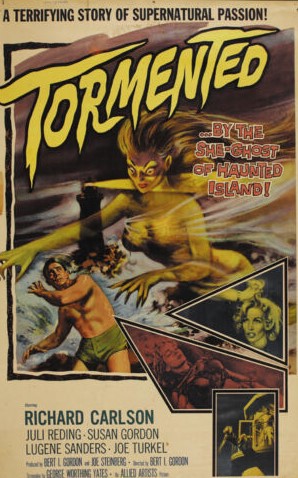
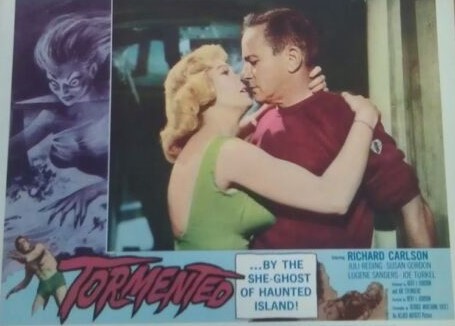
Effective island-based thriller. The marriage plans of jazz piano “genius” Tom (Richard Carlson) are thrown into disarray by the sudden arrival of old flame Vi (Juli Reding). A tryst atop an abandoned lighthouse ends in disaster when Vi tumbles over a railing and Tom refuses to rescue her. Fishing her corpse out of the water the next day he finds instead he is holding wet seaweed.
Cue all sorts of strange events: footprints on the beach, a lingering smell of perfume, a vinyl platter recorded by Vi playing all on its own, missing wedding ring, wilting flowers, wedding dress is covered in seaweed, ghostly apparitions of the dead woman.
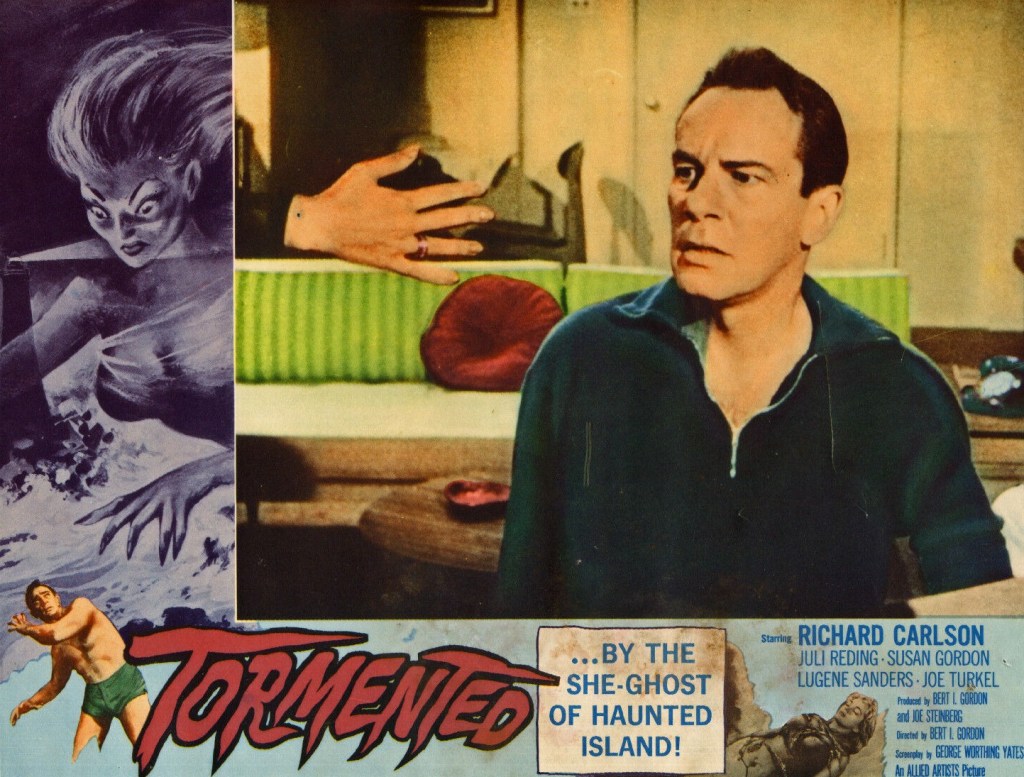
Richard Carlson and the disembodied.
Initially denying his guilt, Tom soon finds himself consumed by it. Blind Mrs Ellis (Lillian Adams) suspects the supernatural. Fiancee Meg (Lugene Sanders) is soon on red alert, the situation exacerbated by her younger sister Sandy (Susan Hubbard) who develops an unhealthy crush on Tom and has a creepy hold over him.
Tension is racked up by the arrival of boatman Nick (Joe Turkel) intent on blackmailing Tom ahead of the imminent wedding. It doesn’t end the way you’d expect, but Tom proves a darker character. This kind of thriller you’d expect a final twist but you’d have to be very savvy to guess this one.
It’s a bold enterprise for a B-picture. Director Bert I. Gordon had made his name on special-effects-driven pictures like The Amazing Colossal Man (1957) but here that element is underplayed, the main focus on the gradual disintegration of Tom as he succumbs to guilt and the voices and sights he imagines. Some images are clearly inside his head, but Mrs Ellis and Meg detect the perfume scent, the flowers wilt in full view of everyone, and Sandy is present when the ring vanishes. Gordon employs the Hitchcockian technique of having subsidiary characters propose various unsettling possibilities to the guilty party. The jazz soundtrack is not the cool music you might expect but a more jangly score. And any time there’s a quiet moment you can hear thundering surf in the background.
B-picture and sci-fi veteran Richard Carlson (The Power, 1968) isn’t quite able to suggest sufficient internal anguish, you’d need a James Stewart in Vertigo mode to manage the kind of obsession required. But Carlsen goes neatly enough from composed epitome of “cool” to nervous wreck, likely to land himself in trouble from reacting too violently to the unreal.
And there’s enough peripheral tension, Meg’s wealthy father (Harry Fleer) opposes the wedding, believing a jazz musician a poor candidate for his daughter’s hand. Mrs Ellis probing a little too close to the bone, the innocent Sandy unwittingly endangers herself. Virgin Meg is oblivious to the fact the man she is marrying is scarcely in the same category.
It’s a chamber piece, a few characters rattling round each other, uneasiness emanating from Tom visualizing phantoms. And it’s short, barely 75 minutes, classic length for a supporting feature, and it’s to the director’s credit he makes no attempt to puff it out. One twist after another and specters everywhere, all the template you need. It set some sort of record for killing off careers. It was the last movie for Juli Reding, Susan Gordon and Lugene Sanders but you might recall Joe Turkel from The Shining (1980).
Very good example of what you can do with a low budget, an edgy script and a director who doesn’t lean too heavily on the special effects.
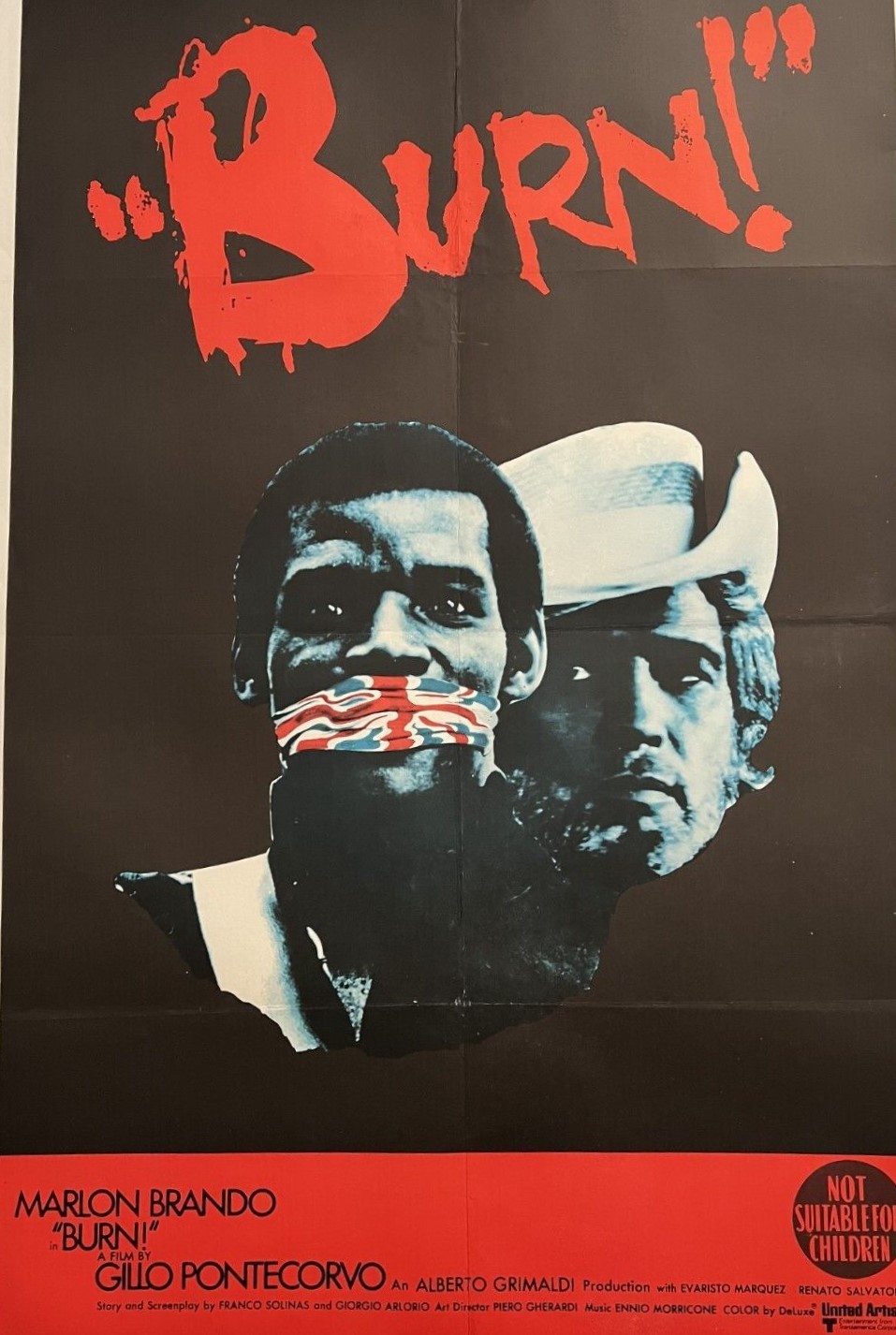
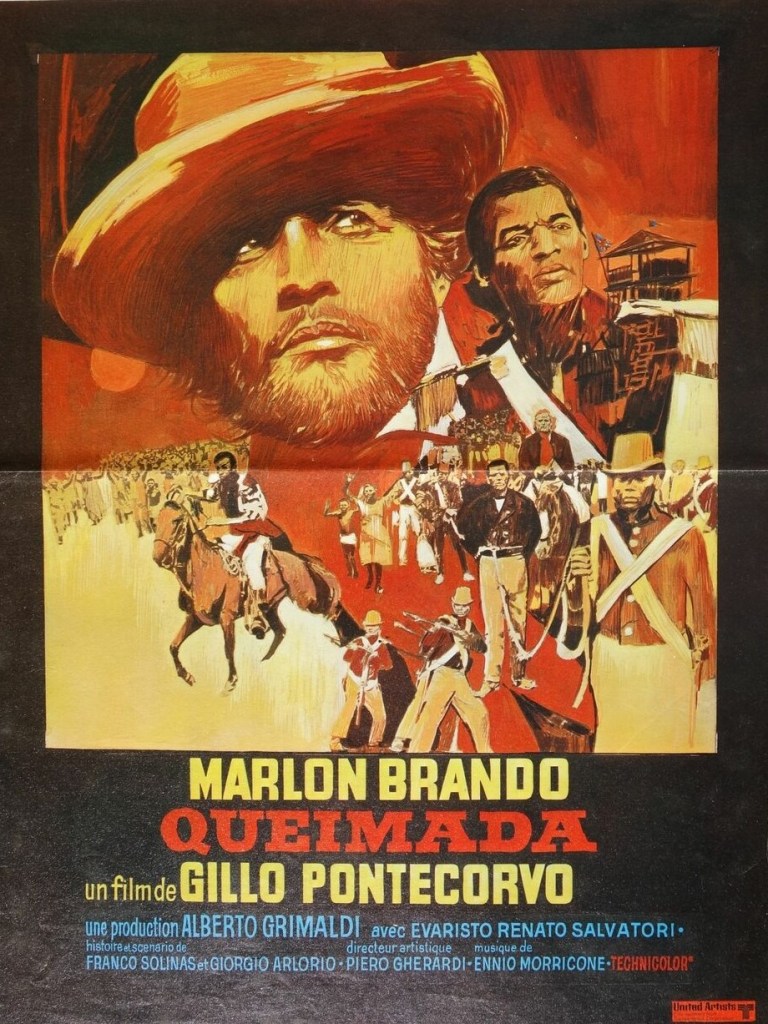
May have lost its allegorical power now that Vietnam is no longer a cause but even more compelling for standing as a generic condemnation of imperialism. The Vietnam connection is invoked immediately as Englishman Sir William Walker (Marlon Brando) on arrival is told that the Portuguese conquered the island hundreds of years before simply by setting fire to it until all the natives had perished or fled and restocking it with slaves from elsewhere. For a 1960s audience, that summoned up images of U.S. military use of napalm and carpet bombing.
The idea must have stuck in Walker’s head because that’s exactly the strategy he devises towards the end of the movie. Beyond his title, and the fact that he looks and talks like an upper-class Englishman of the mid 1800s, Walker is one of these shady characters you often found in the Colonies doing shady work for the British government. While this island is ruled by the Portuguese rather than the British, that’s about to change since the British find Portuguese attitudes to free trade too restrictive.
So Walker sets about creating the spark for an explosion. Having earmarked the local bank for an easy heist, he recruits Jose Dolores (Evaristo Marquez) to head a team of locals. Of course, such a large-scale robbery ensures pursuit. Capture is evaded when Walker produces a cache of rifles aware that in defending themselves the natives will trigger revolution. Walker then goes to work on the upper-classes, explaining how much better off they would be if they could side with the rebellion and overthrow the Portuguese.
Mission accomplished, he scoots off home, only to return when corruption has so destroyed the island, now a British colony, that Jose Dolores is back creating rebellion. Old friend becomes foe and is ruthlessly hunted down.
You can’t help but admire Walker’s guile. To create a large enough distraction to pull off the robbery he simply gets the entire town population drunk on free booze, giving soldiers more than enough rioting to cope with. To provide the circumstances to assassinate the President, he takes advantage of the costuming for a festival, allowing people to sneak past guards in any disguise. But when cunning doesn’t work, it’s down to brute force. The group with the biggest army, more weapons and the greater degree of ruthlessness will always win.
This isn’t one of those movies that sets out to idolise a rebel leader or where a small band of outlaws outwit the ruling power with clever ruses or filled with duels or ambushes or full-on battles. This is about the puppeteers, the men who use violence for their own commercial ends.
Like General Custer, Walker is a man with a job to do, even while he might despise it and certainly is filled with disgust at the ruling party. He claims he is not the author of either group’s misfortune but merely “the instrument.” On his return, he argues, “I didn’t start it; when I arrived you were already butchering each other.” In other words, blameless, just following the orders of either government or employer. But he takes pride in doing his job “well,” no matter the cost.
Every action has consequence. Even attempting to save Jose Dolores’s life, it is with consequence in mind. Let him live and set him free elsewhere and he will be viewed as a traitor. Kill him and he will be seen as a martyr, the most dangerous currency for incipient rebellion.
He knows exactly what buttons to press. In order to convince the ruling band of natives to support revolution in the first place, he makes a comparison with prostitution. You hire a sex worker by the hour to fulfil a need, you are not required, as with a wife, to dress her and feed her and look after her for her entire life. Should the employers free their slaves, that would eliminate the need for a lifetime of care (no matter how little) but could hire them as required.
The brutality is not dwelt upon, no TheWild Bunch-style bloody carnage, just a growing number of corpses on either side depending which group has the upper hand. The difference between the brutal Portuguese and the sedate English is in their approach to execution. The Portuguese rely on the garotte, by which a steel band fixed round the neck is slowly twisted until life is extinguished. The English prefer the speed of the gallows.
Marlon Brando considered this one of his finest performances and I am inclined to agree. There is no showboating either way, neither inflating a character nor deflating him, as the actor was apt to do when playing a loser. Instead, Walker never loses a grip on his emotions, no temper, no tears, just saying whatever someone wanted to hear, guiding with a hidden hand, a man who might have invented the term “results-based.” It is the calmest you will ever see Brando, and you might catch elements of this portrayal in his Godfather pushing pawns into place. But you won’t see here a single explosion of anger. For a non-actor, Evaristo Marquez gives a superb performance, though mostly he is also restrained, as if he was learning from a master.
Director Gillo Pontecorvo (The Battle of Algiers, 1966) takes a semi-documentary approach to the subject, concentrating on the machinations, no attempt to pull audience heartstrings with images of poverty. The garotte death does the work of explaining the brutality to come.
But there are three brilliant scenes that showcase the unstoppable character of war. In the best, the rebels, trying to escape an island ablaze, seek shelter on the higher ground. But this arid region is also exposed, no jungle here to provide cover, and scrambling up the naked slopes they are picked off, in long shot, one by one.
In the second example, the closest Walker comes to emotion is waking up one morning to the sound of a gallows being built. He takes a moment, listening, aware perhaps, though unwilling to admit it, that the harvest of a seed sown is about to be reaped. Brando is such a good actor that sadness only appears as a flicker of regret that the rebellion he began took a wrong turn once it was taken over by the wrong hands.
And, technically, his hands are clean. He is never seen firing a weapon. In the last of this trio of scenes, the English introduce hanging to the island. But since no one possesses the expertise to make a noose strong enough to support a head, Walker shows how.
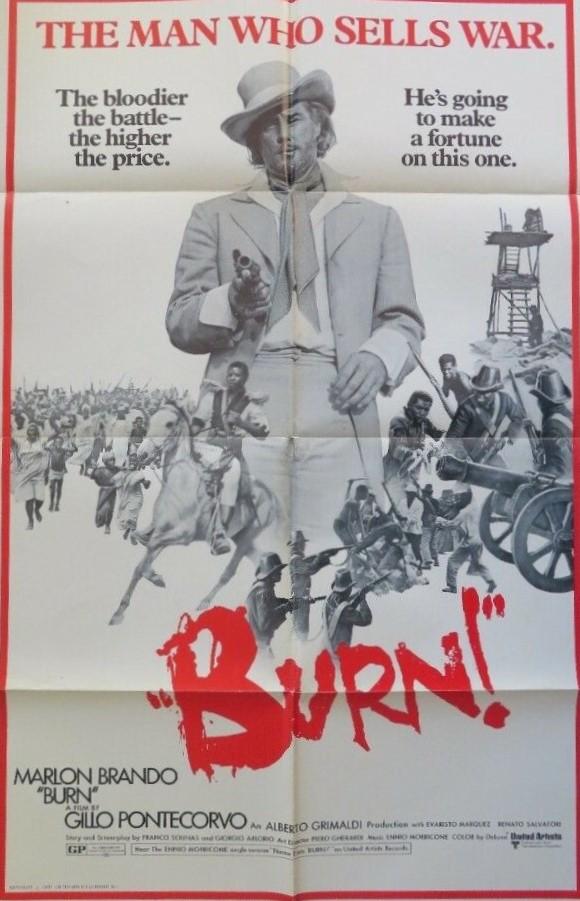
There are two versions of this movie. It was filmed as Quiemada and this version is 17 minutes longer than the one released as Burn! I would urge you to see the far more atmospheric former. Editing down the picture, the distributors took out much of the background material. As a plus, there is a score by Ennio Morricone.
One of the best films ever made about the politics of war and the destructive force of commerce.
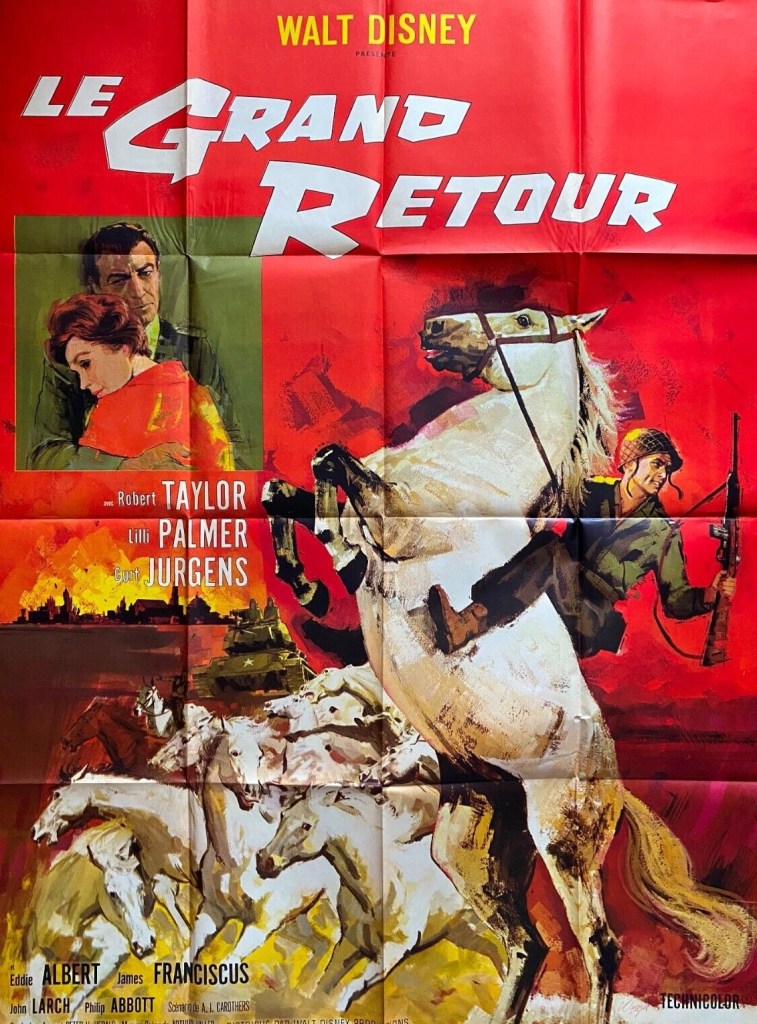
You wouldn’t look to Walt Disney in the 1960s to provide a tyro director with a calling card when so much of that studio’s output was saccharine. But this beautifully-mounted World War Two drama showed there was a new kid in town worth watching, name of Arthur Hiller. And if you always wondered why the later biopic of General Patton showed him in riding gear, that penchant is more clearly explained here.
You might balk, however, at the idea of a bunch of horses being considered in the same category as an art treasure worth protecting from the worst predations of war. And just as with the Von Trapp family, Austrians, despite welcoming the annexation of their country by Hitler in 1938, are given a free pass here.
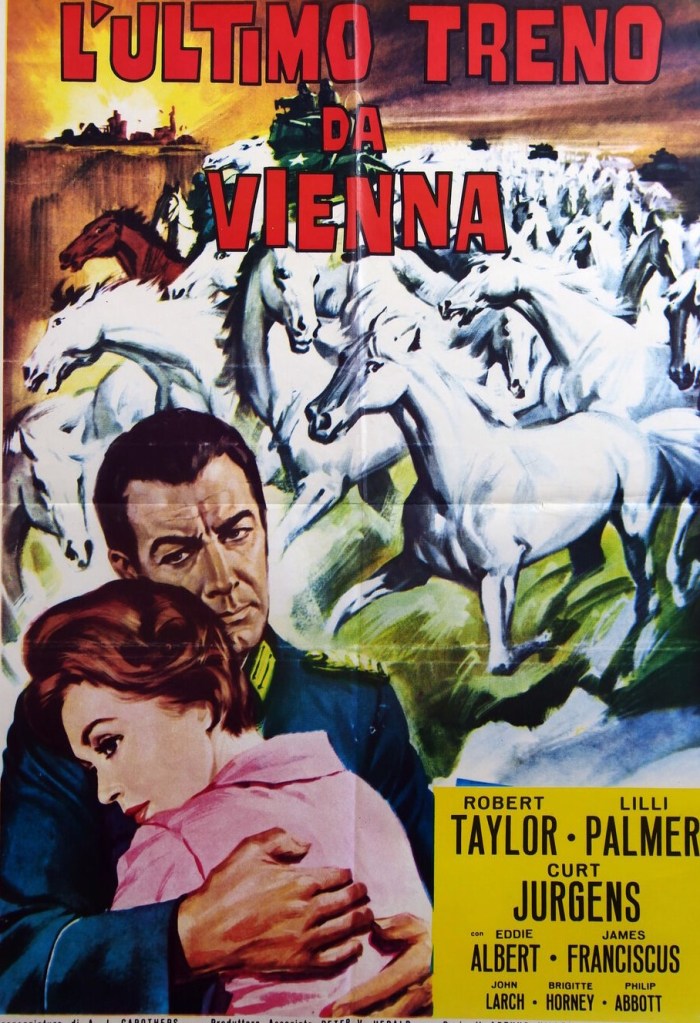
In case you’re unfamiliar with the subject matter, the Spanish Riding School in Vienna was a celebrated nearly 200-year-old institution in which the famed Lipizzaner white “dancing” horses were put through their paces. With the Second World War coming to a close it was threatened on three fronts: the German Army poached its instructors to man the front line, the invading Russians wanted to appropriate the horses and starving refugees focused on the potential horse meat.
School chief Col Alois Podhajsky (Robert Taylor) and wife Pedena (Lili Palmer) organise an evacuation under the guise of using the horses to draw cartloads of legitimate art treasures. They hole up in the castle of Countess Arco-Valley (Brigitte Horney) but the mares are stolen by the Russians and hidden in Czechoslovakia. (Only the stallions perform, but without the females as breeding stock, the line would become extinct.)
The colonel ditches his German uniform on the arrival of American forces and puts on a performance in a makeshift arena in an attempt to convince Patton (John Larch) to mount a rescue of the captured horses. Patton, we learn here, is a renowned horseman, competed in the equestrian section of the 1912 Olympic Games, and if anyone considers a fabulous horse more valuable than a work of art it’s him. As it happens, there are prisoners to be freed in Czechoslovakia so the horses are included in that mission.
What’s unusual about this animal tale, given Disney’s predilection for anthropomorphising animals, is that it’s not told from the point-of-view of the horses. Nor, as you might have expected, given the studio’s plethora of young talent, turned into the story of a young girl or boy attached to the horses. Instead, the focal point is the impact of the creatures on those around them.
Of course the colonel is bound to be obsessed. But for the ordinary soldiers, who might never appreciate a work of art, they represent a kind of majesty, a grandeur, rising above the horror of war, something well worth the effort of rescue.
What’s even more unusual in saccharine-town is the script’s recognition of the effect of war on humanity. At one point Pedena laments that men are asked to possess “the strength and fury of giants…and then be again the men they were before.” And in some respects acknowledging the beauty of the horses is a step in the right direction. The Yanks are neither celebrated as brave nor foolhardy, in fact mostly they are just working grunts, cleaning out the castle, fixing up the arena, cracking jokes.
Hiller is the big find here. There’s a brilliant scene, all of 40 seconds long (I timed it) that would have been cut out of any other Disney picture. In a chiaroscuro of light, the colonel walks from one end of the deserted Vienna riding hall to the other and his wife, entering the frame, goes to join him. Nothing more is needed to indicate loss. Hiller clearly recognised opportunity and while the film itself is no masterpiece every single frame reveals a talented mind at work, his use of colors and costume, movement within the frame, employing Pedena and the Countess to comment on the action, allowing the inbuilt tension to carry the story without extraneous drama.
You’re mostly likely to remember the performing horses, the balletic choreographed movements, the “airs above the ground,” and indeed Hiller wisely devotes a good 15 minutes to this, but without his input this would either be overly sentimental, saccharine or little more than a documentary. This is a very grown-up picture for Disney.
Robert Taylor (A House Is Not A Home, 1964) was at the tag-end of his career, his first film in four years, but he still has the charisma to carry the film and the gravitas to see it over the line. Lili Palmer (The Counterfeit Traitor, 1962) is well cast as a voice of reason and offering commentary on humanity. Curt Jurgens (Pysche ’59, 1964) has an interesting role, lamenting, as he picks out a classical tune at the piano, how Hitler outlawed famous composers.
There’s a stronger supporting cast than you might expect: Eddie Albert (Captain Newman M.D., 1963) , James Franciscus (Valley of Gwangi, 1969) and German actress Brigitte Horney (The Trygon Factor, 1966).
Somebody certainly took notice of Hiller’s talent because his next films were The Wheeler Dealers (1963) with Lee Remick and James Garner and The Americanization of Emily (1964) with Julie Andrews and Garner. A.J. Carothers (The Happiest Millionaire, 1967) based the screenplay on the book by Alois Podhajsky.
Under-rated comedy, set in 1928 Italy, had me chuckling all the way through. An episodic structure sees Arabella (Virna Lisi) duping an Italian hotel manager, British general and an Italian Duke (all played by Terry-Thomas) out of their cash in order to pay off the mounting tax debts of her grandmother Princess Ilaria (Margaret Rutherford) while trying to avoid the attentions of the mysterious Giorgio (James Fox).
Her scams are quite ingenious, beginning with arranging for a public urinal to be erected outside a five-star hotel and, pretending to be the lover of Benito Mussolini, convincing the manager that, for a price, she could arrange its removal. There’s nothing particularly original about faking a breakdown to attract the attention of the general, a royal flunkey, but the blackmail trap she sets is elaborate.
But just as you think you know here this is going, it sprints off in another direction altogether, Arabella being the mark, and it’s one twist after another. She is rooked by Giorgio with whom she falls in love. The Duke, whom she sees as easy meat, instead uses her. Her grandmother’s ploy to burn down her mansion and claim the insurance money is foiled by a cat.
All sorts of sly observations come into play. The hotel manager and his pals siphon off a large chunk of the cash they have taken from the safe to pay her off. The general, operating incognito, has his cover blown by a piece of music. The Duke turns the tables on his domineering wife and his son has an exceptionally clever ploy to keep mama sweet while enjoying his sexual independence. And it appears that every time Arabella gives in to entreaty, she is exploited. In other words, show weakness, give a loser an inch and they’ll take you for all you’ve got.
Terry-Thomas as a bumptious hotel manager with James Fox looking mysterious.
There’s no desperate reason for it to be set in the 1920s and, beyond the Charleston and costumes, it makes little attempt to evoke the era except perhaps to make the point that the world was not full of submissive women. And you might find inappropriate the trope about using a sexy woman to turn a gay man straight. It’s a sex comedy in the Italian style where just about anything goes and the act, rarely consummated, instead involves humiliation.
But Virna Lisi (How To Murder Your Wife, 1965) certainly commands the screen, carrying the show, fashionably stylish rather than overtly sexual, a born comedienne. Terry-Thomas (How To Murder Your Wife), while initially appearing under his trademark persona, completes a transition for the Duke, almost another twist if you like, audiences expecting a similar duffer to his previous parts. Lisi and Terry-Thomas clearly have rapport, almost a synergy, not the charisma of a screen couple, as in romantic pairing, but work very well with each other.
Margaret Rutherford (Murder Ahoy!, 1964) and James Fox (The Chase, 1966) let the side down with such insipid portrayals you wonder why they signed up. It’s almost as if they couldn’t be bothered working on their characterisations. Cigar smoking and general ditziness is as far as Rutherford, in her final role, goes. Fox just looks fey and the one flaw in the narrative is why Arabella could look at him twice. As the Duke’s son, duping his mother, a pre-gaunt Giancarlo Giannini (The Sisters, 1969) is very entertaining.
To enjoy this you have to suspend your ideas about comedy based on the British and Hollywood tradition. It aims for farce, no attempt to make larger comment on life.
Mauro Bolognini (He and She, 1969) hangs this together in a decent enough fashion, confident enough of his material to lead the audience into a bait-and-switch. In his debut Giorgio Alorio (Burn!/Queimada, 1969) and Adriano Baracco (Danger: Diabolik, 1968) wrote the screenplay with British playwright Alan Hackney (Sword of Sherwood Forest, 1960) spicing up the English dialog. Ennio Morricone provided the score.
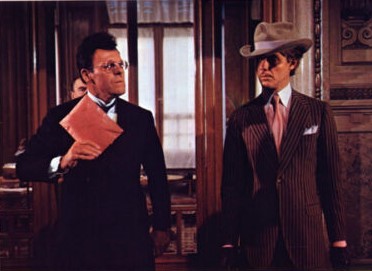
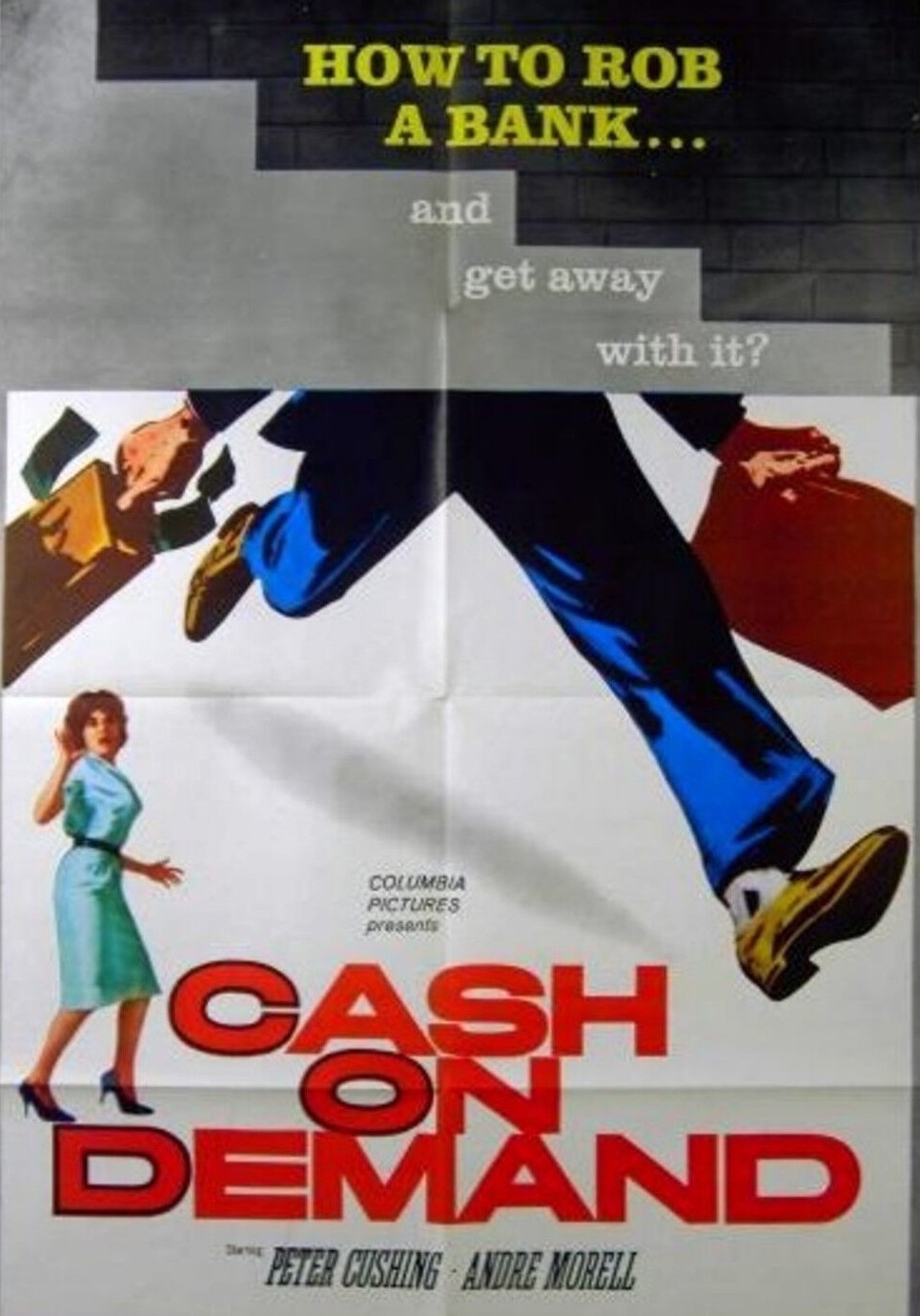
Ideal crime B-picture. No femme fatale, but a tight one-location two-hander. Set a couple of days before Xmas in a rural English market town, while possessing sufficient twists to see it through, in the main it is a battle of wills between urbane thief Col Gore Hepburn (Andre Morell) and his victim, stuffed-shirt bank manager Harry Fordyce (Peter Cushing). Combines slick heist with An Inspector Calls mentality where the morally superior are taken down a peg.
Fordyce is the kind of martinet who makes his staff remove Xmas cards from display, nit-picks about the state of nibs (in the days when pens were dipped in ink) and threatens to sack chief clerk Pearson (Harry Vernon) over a minor error that he has worked up into potential embezzlement. So unpopular, he is not invited to the staff party.
Under the guise of carrying out a security inspection Hepburn sets up a robbery, tying Fordyce in moral knots, his unwilling collaboration ensured by threatening to stick electrodes to the bank manager’s wife’s head. Hepburn has done his research, aware of all aspects of security, but, more importantly, knows his man, how to exert pressure, how to keep Fordyce on edge. Hepburn reeks of self-assurance, Fordyce of insecurity, a friendless man who bullies his staff, living a life suffused with discipline and bereft of enjoyment.
Though there are a couple of red herrings, and an unexpected incident, what mostly endangers Hepburn’s bitingly clever plan is the unforeseen, that the cold-hearted bank manager will come apart under pressure.
Underlying the action is class conflict. But not the usual working- class vs upper class. Instead it is aspiring middle class vs assured well-educated upper class. Hepburn is the kind of well-dressed smoothie who could talk his way into any company and out of any situation. He puts everyone at their ease, knows how to enjoy himself, would make any party go with a swing, could flirt convincingly with your grandmother, and you would trust within an inch of your life. Fordyce, on the other hand, is one of life’s scrapers, everything by the book, creeping into management painfully slowly, and once acquiring a position of authority letting everyone know who is boss and terrified of losing his standing in society. It’s “class” of another kind too, that of the winning personality versus the eternal loser.
Peter Cushing as the bank manager.
This plays against expectation. Normally, in a heist scenario, there’s one employee who’s trying to beat the baddies, some clever device or trick up their sleeve. That’s not the case here. Instead, we’re served up a character study, the supposedly upright pillar of the community revealed as a coward and moral bankrupt.
And the unexpected also comes in the casting. Both Peter Cushing and Andre Morell play against type. At this point they were best known as Sherlock Holmes and Dr Watson in The Hound of the Baskervilles (1959), an upright team on the side of the angels. Cushing, while often tight-lipped, generally exhibited a morally superior screen persona. Here, that trademark persona rapidly vanishes under pressure.
Quentin Lawrence (The Secret of Blood Island, 1965) directs within a very tight timeframe.
The movie had unusual origins. It was expanded from a short-lived series called Theatre 70 on British ITV, the number relating to time, the program running for 70 minutes rather than the usual hour. And it had just as unusual a release. Perhaps for copyright reasons, it didn’t see the inside of a cinema in the UK until December 1963 when it went out as the support to musical Bye Bye Birdie (1963) on the Odeon circuit. But it had already been released by Columbia in the US in 1961 as the support to Twist Around the Clock (1961).
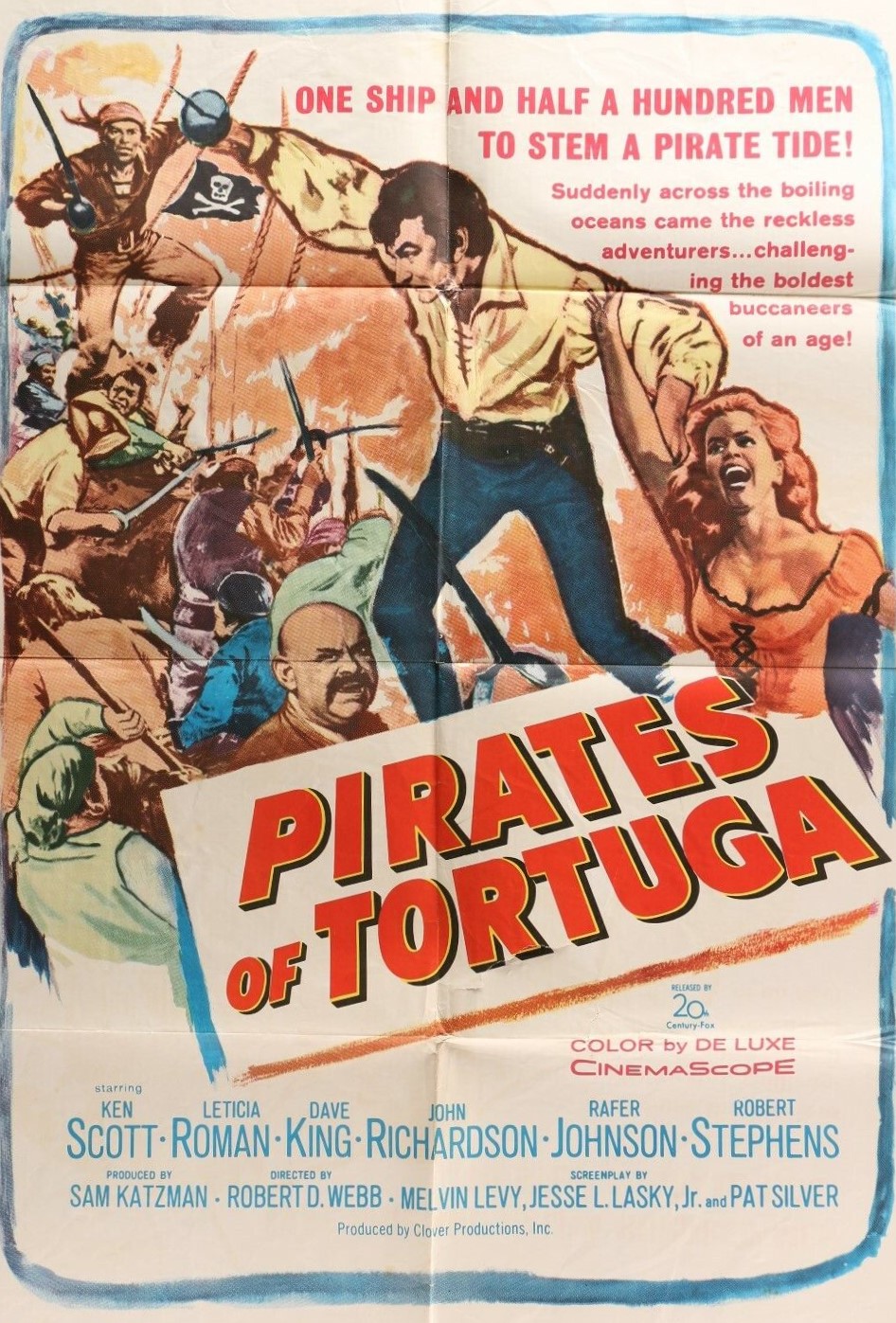
In the absence of A-list swashbuckling talent like Errol Flynn (Captain Blood, 1935), Tyrone Power (The Black Swan, 1942) and Burt Lancaster (The Crimson Pirate, 1952) or spitfires in the mold of Maureen O’Hara (The Black Swan) and Jean Peters (Anne of the Indies, 1951) this sidesteps casting issues and in the kind of reversal that sent Pirates of the Caribbean on its merry way for the most part takes the comedic route of putting pirate moll Mg (Leticia Roman) center stage and twisting the usual blockade narrative so that it’s Privateer of the Century Henry Morgan (Robert Stephens) controlling the high seas.
Charge with stopping the pirate is sea captain Bart (Ken Scott). But most of the running in the first half is made by Meg, a thief turned stowaway, whose efforts to acquire the standing of a lady are initially mocked by the crew until they soften towards her, in part with seduction in mind and in part out of pity. But after landing in Jamaica, and mistaken for a Lady, she steps up to the plate, and manages to catch the romantic eye of the Governor before readjusting her sights and snaring Bart.
Bart and his crew infiltrate the buccaneer kingdom and spy out its flaws before arranging for a full-out attack. Boldly rewriting history, something of a surprise since Morgan the Pirate had appeared a year earlier, this Morgan is a shifty alcoholic. Once the action gets going, including a clever ambush of one pirate ship, it has enough swordfights to keep a regular swashbuckling enthusiast happy. There are some nice touches, Pee Wee (Dave King), the de facto fencing instructor, is lefthanded and wears a black glove whose use is historically accurate. The ships in full sail are impressive, the locations work well and it makes good use of Cinemascope color while Meg remains larcenous throughout rather than the good moll of previous entertainments. Though you might not be so impressed by the bear wrestling.
Ken Scott makes the best of a thin script, ignoring Meg’s wiles, and outwitting Morgan. Apart from Roman, who steals the show, British comedian Dave King (Strange Bedfellows, 1965), in his movie debut, is the pick, a jocular personality with lechery a stock-in-trade. I better point out you can spot John Richardson (One Million Years B.C, 1965) otherwise he is so insignificant a performer you would scarcely know he is there. Robert Stephens (The Prime of Miss Jean Brodie, 1969) turns Morgan into a scallywag rather than a threatening villain.
Worth noting was just how long it took a graduate of the Twentieth Century Fox talent school to graduate – at the end of a five-year contract Ken Scott (Desire in the Dust, 1960) finally achieved leading man status. Leticia Roman (The Spy in the Green Hat, 1967) was a bit more savvy and turned down a Fox contract in favor of Hal B. Wallis who cast her instead in G.I. Blues (1960). Technically belonging to the European import category of actress so popular during the decade, she never worked in her homeland before being scouted by Wallis. Though she was born in Italy her father, a costume designer, had moved to the U.S. in the late 1950s.
Producer Sam Katzman, who had just signed a four-picture deal with Fox, made 239 films in every genre, including Tim McCoy westerns, the Leo Gorcey Bowery Boys series, Bela Lugosi as The Ape Man (1943), Jungle Jim (1948), Paul Henreid in Last of the Buccaneers (1950), Mysterious Island (1951), 3D Fort Ti (1953) and Rock Around the Clock (1956) as well as a slew of 1960s Presley musicals.
On a miserly budget of just $675,000, the sea scenes were shot in the Fox water tank. Robert D. Webb (The Cape Town Affair, 1967) directed.
A harmless trifle with decent action and Leticia Roman turning upside-down the genre female lead.
No need to fork out on a DVD. You can catch this on YouTube.
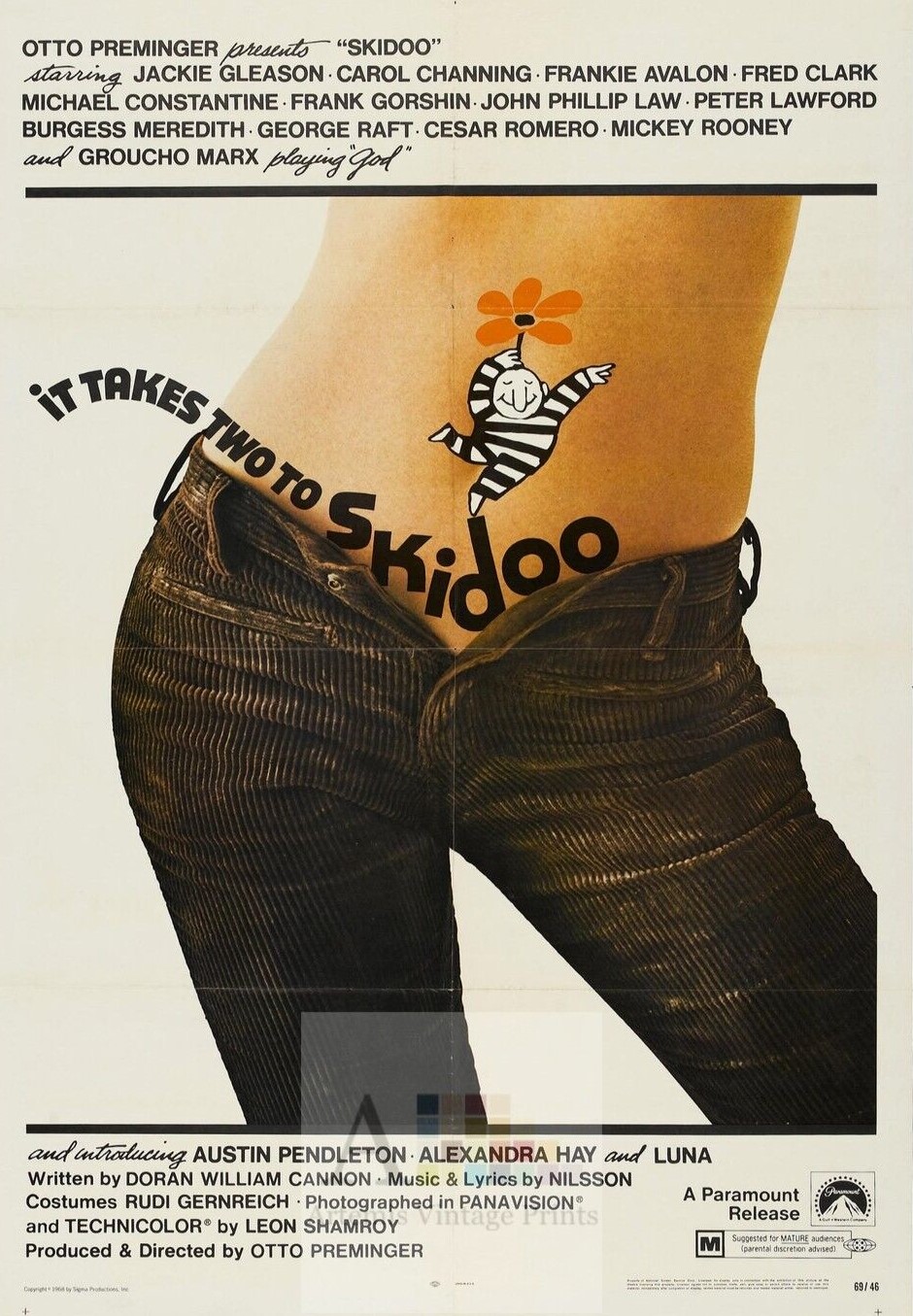
Hubris can only get you so far. Unfortunately, it’s all downhill. Whatever possessed Otto Preminger (In Harms Way, 1965) to believe he could deliver a contemporary satirical comedy beats me. And it beat him, too.
Despite the comedic input of Jackie Gleason (The Hustler, 1962) and Groucho Marx there’s nary a single laugh, except, sadly, at the director’s expense as he attempts to shine a coruscating light on social mores and instead ends up fluffing his lines. The highlights (!!) are gangster Tony Banks (Jackie Gleason) having a bad trip, his daughter Darlene (Alexandra Hay) falling in with a bunch of hippies and having her body painted, his wife Flo (Carol Channing) trying to seduce another gangster Angie (Frankie Avalon) and some attempted gags at the expense of technology.
There’s even the old one of kids making out beside a parking meter and when busted complaining they are not getting their allotted time. And there’s an ongoing “joke” of Flo tussling with various men for control of the television set through rival remote controls.
The story, if you can call it that, has Tony infiltrating a prison in order to bump off inmate Packard (Mickey Rooney) who plays the stock market, complete with ticker tape, inside. Flo and Darlene, trying to find his whereabouts, end up at Angie’s hi-tech pad. Then all the hippies go back to the family house where Flo washes their hair.
You can imagine where hippies come into all this, making with the hip talk, and trying to set up an alternative world to the Establishment.
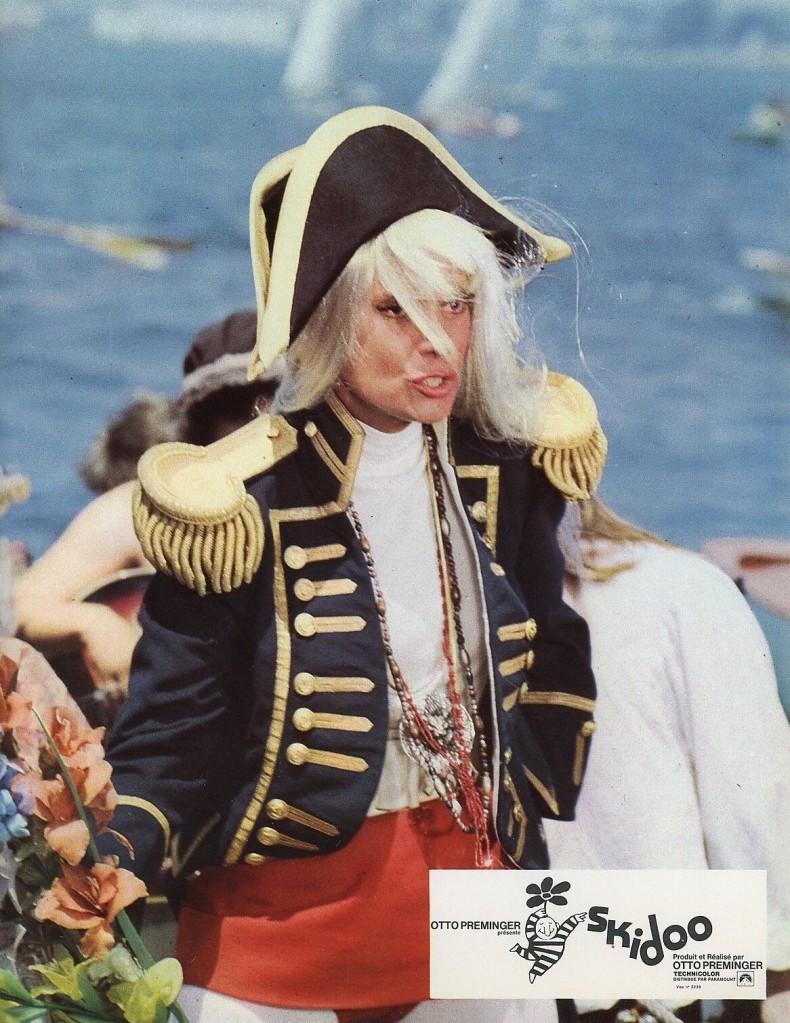
Carol Channing makes her feelings known by donning pirate garb.
In the style of It’s A Mad, Mad, Mad, Mad World (1963) the main attraction are the cameos, Peter Lawford (Ocean’s 11, 1960), John Philip Law (Hurry Sundown, 1967), Burgess Meredith (Rocky, 1976), George Raft (Five Golden Dragons, 1967), Mickey Rooney (24 Hours to Kill, 1965) and Frankie Avalon (The Million Eyes of Sumuru, 1967). But they will all cringe at their participation.
Channing, only just Oscar-nominated for Thoroughly Modern Millie (1967) makes the worst career choice of her life, Alexandra Hay (Model Shop, 1969) not far behind, though with less marquee value to play around with.
Every acclaimed director has an off day, taking on a project through poor judgement or, more likely, financial necessity. But Preminger was still a Hollywood high-roller and this just looked like a dose of career suicide.
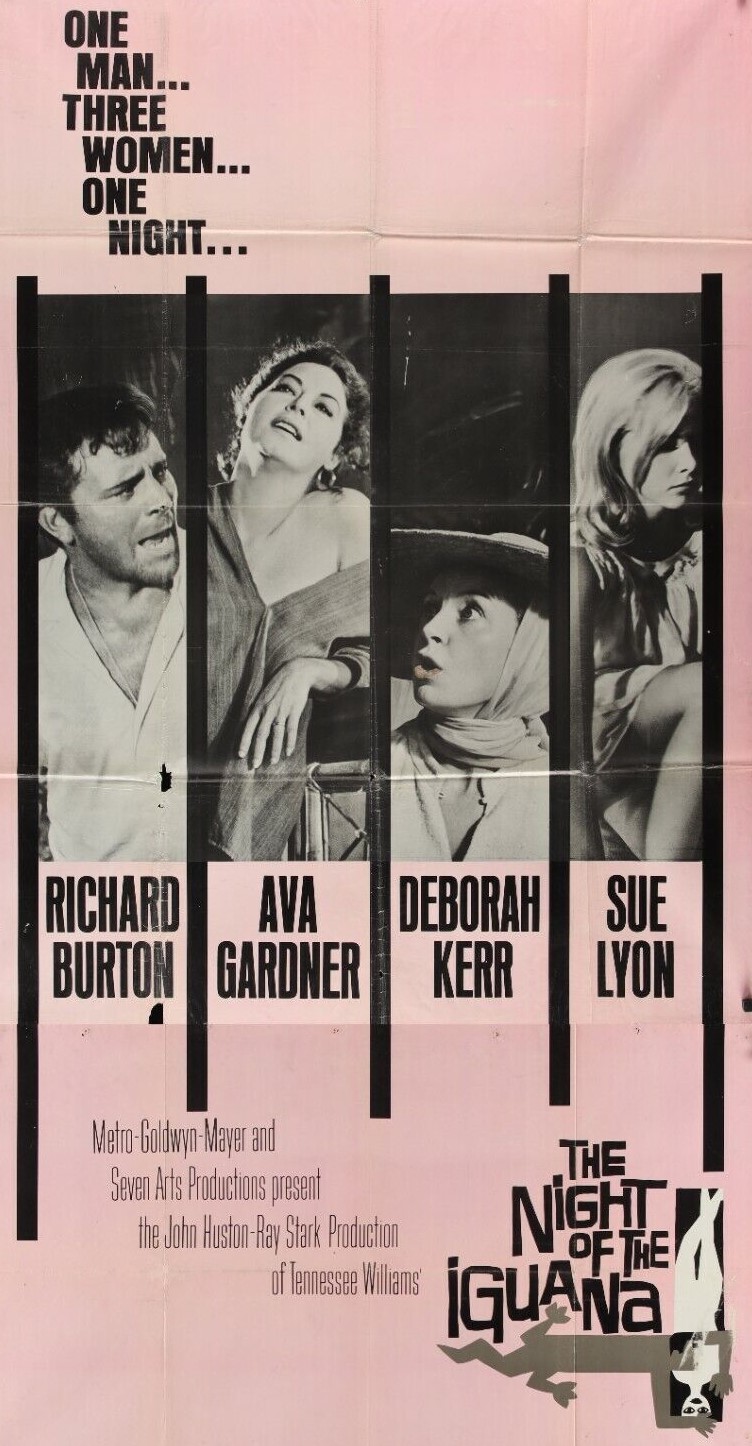
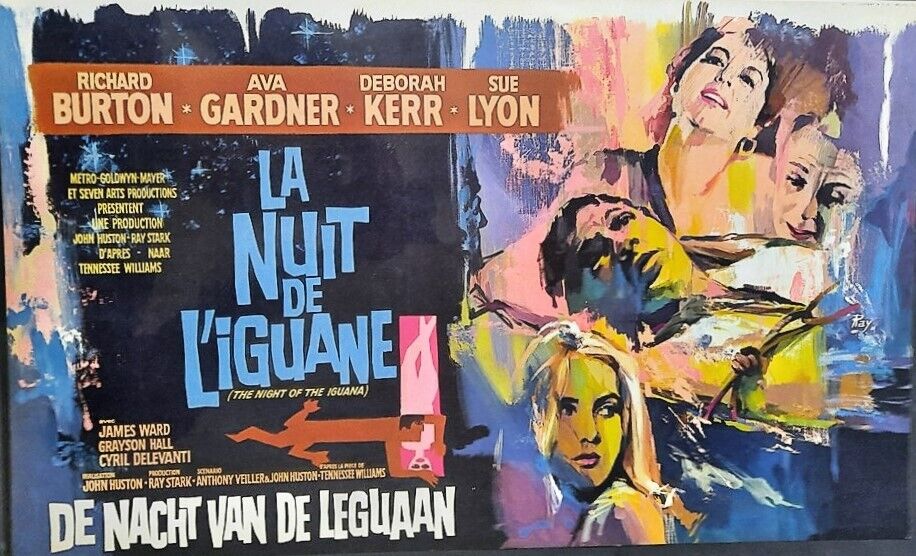
The eponymous reptile is a rather obvious metaphor for characters trapped by quixotic decisions. Regardless of the Rev Dr. T Lawrence Shannon (Richard Burton) being a defrocked priest, he was always going to lead a dissolute life, alcohol the least of his temptations. This heady drama begins with comedy about a man with ideas above his station ending up as an incompetent tourist guide.
And if his behaviour is not scandalous enough for current coach party, middle-aged Baptist ladies, he leads them to a hotel in Mexico run by former lover Maxine (Ava Gardner) who has two younger lovers on the go. And as is the way with author Tennessee Williams there’s a posse of fascinating characters, led by spinster Hannah (Deborah Kerr) who ekes out an itinerant living selling paintings while her aged grandfather (Cyril Devalanti) recites poetry. Raising the moral stakes is under-age Charlotte (Sue Lyon) who has taken a fancy to Shannon, partly in rebellion against her frosty chaperone Judith (Grayson Hall).
For a movie with no great narrative drive, there’s no shortage of drama, whether it’s the Reverend under constant attack from his charges, Charlotte making advances, Shannon succumbing or trying to fight his addictions, Maxine succumbing then rejecting his advances, and Hannah on the sidelines trying to work out why her entire life has been lived in the shadows.
A simple dramatic fuse has been lit, disparate group with secrets set to explode, and you just sit back and enjoy the ride. Exceptionally daring, even if in discreet fashion, for the time, not just the Lolita-style Charlotte, but the middle-aged Maxine cavorting with not one but two men young enough to be her sons, so effectively a Cougar (before the term was invented) in a threesome, a woman in full command on her sex life not at the whim of a male. There’s as overt a gay woman as you would find in this era. And that’s before we come to Hannah, one of whose two sexual experiences involved averting her eyes while her male companion masturbated on a piece of her clothing. That was taking it way beyond the limits of acceptable on-screen behaviour of the day.
Characters are either engulfed by their passions or weaknesses or trying to come to terms with them, sometimes both. Over everything hangs poignancy at the self-deception practised, redemption scarcely a possibility, communication a minefield, acceptance the best anyone can hope for. Quality acting prevents this disappearing down a sinkhole of self-pity.
Richard Burton (Becket, 1964) was on a roll, one brilliant performance after another either with or without Elizabeth Taylor, essaying a wide range of characters. This is one of his best. You should despise the sham he has become, relying on charm to dig himself out of a hole, relying far too much on the kindness of strangers whose sympathy is exhausted. Yet the loss of the only position, a clergyman, for which he was possibly suited, thrown out for committing unforgiveable sin while preaching sanctity, makes him a very relatable human being. This isn’t Days of Wine and Roses reborn, but someone trying to win the pinch of oxygen required to keep his soul alive, and stir the energy inside. And he would be furious if you ever made the mistake of feeling sorry for him.
Ava Gardner (Mayerling, 1968) is superb, staring age in the face, unrepentant, sex an acceptable substitute for love, underlying sadness admirably restrained. But Deborah Kerr (The Chalk Garden, 1964), brings a refreshing dash to her introspective character, a woman with practical solutions except to her own emotional emptiness. Sue Lyon (Lolita, 1962) is only briefly scandalous and the movie’s conclusion suggests she is capable of settling down and not giving into the base desires that afflict all the others.
Just as with The Misfits (1961), director John Huston allows his characters to breathe. It would have been very easy to allow Shannon to have a more heroic or stoic stature, instead of someone stumbling around. Tinges of comedy and wit lighten the load. Huston and Anthony Veiller (The List of Adrian Messenger, 1963) wrote the screenplay from the Tennessee Williams play.
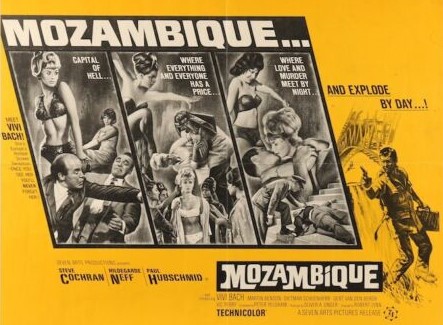
Here’s a great idea for a movie. A pair of nubile young girls sign on for a yacht trip with a renowned Hollywood lothario. A couple of days in the star dies. Neither of the girls knows anything about sailing. The boat drifts. If this was a Hollywood movie there would be circling sharks and at least a squall. But it’s not, the girls are picked up 10 days later complete with festering corpse. Witness the sad end of Steve Cochran.
He never made it as a big star, Sometime top-billed in B-movies, but mostly supporting roles, so it was somehow ironic that producer Harry Alan Towers, on the look-out for any kind of name who didn’t mind spending a couple of weeks on location in a remote African spot, gave him his first starring role in six years as down-on-his-luck pilot Brad sent to infiltrate a smuggling gang in the eponymous country.
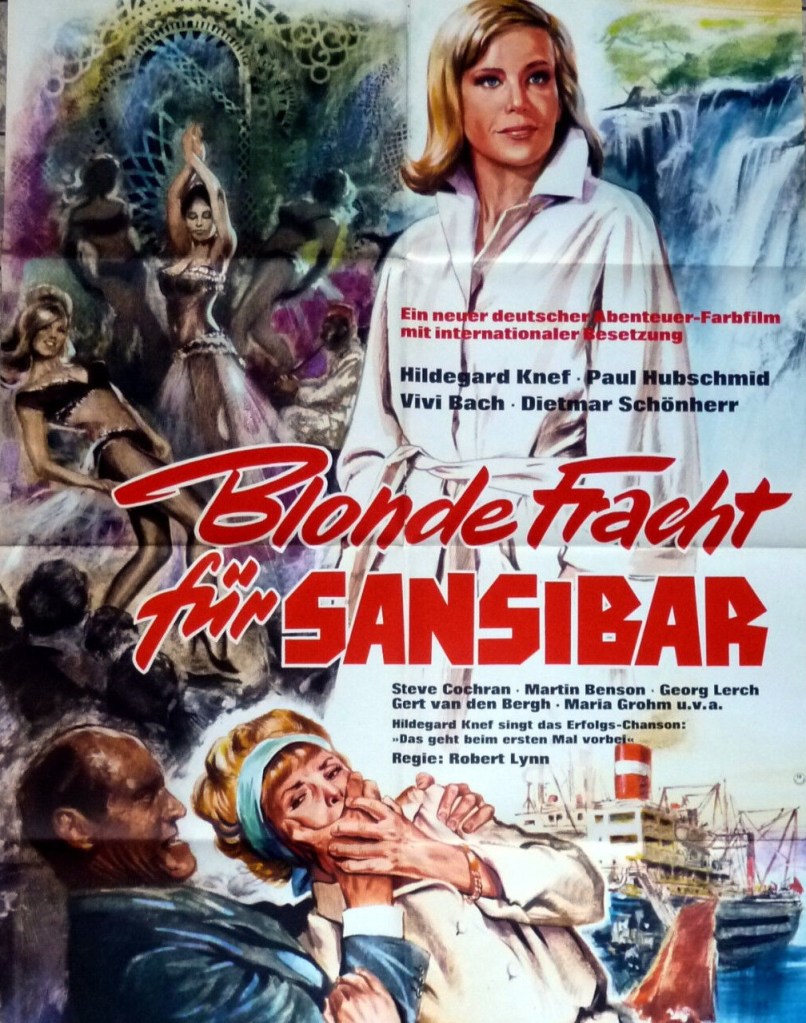
In the German market, the Germans were the stars, Steve Cochran relegated below the title.
And this would have been a fitting send-off because, in among the sleaze, there’s a decent story and some pretty good lines. But it really needed the dry delivery of a Rod Taylor to give those lines the zest they required.
There’s a sudden contemporary feel courtesy of former kickboxing champ and influencer Andrew Tate, arrested in Romania for alleged human trafficking, because the underlying story here is white slave trade. Or, put another way, the one-way ticket. The prospect of a job, any job, anywhere, is sometimes enough, no time, or need, to think how you will get back home. Here, a place of dreams for those running out of anything else that might fit the bill, might become home.
Christine (Vivi Bach) is one such dreamer, a singer. What she doesn’t realise is that in the club where she is employed the girls are part of the deal, a commodity. Her one-way ticket is destination human trafficking. What used to be called in those sensationalist times as the “white” slave trade, as if any other type of slave trade was acceptable or less worrisome. She is sold to an Arab sheik (Gert can den Bergh), to form part of his harem.
Luckily for Christine, Brad has taken a shine to her so when the Arab appears on his smuggling radar their paths converge. But trafficking is a sub-plot. Brad has been hired as a pilot for Col Valdez but he has died intestate so his wife Ilona (Hildegarde Knef), in this corrupt country, is also up for grabs and has to (literally) sing for her supper before segueing from black widow to femme fatale. Standing in Ilona’s way are her husband’s associate Da Silva (Martin Benson) and his one-time business rival Henderson (Dietmar Schonherr) and quickly those two guys are in Brad’s way too.
So it’s a solid old-fashioned tale, Brad digging up the dirt, pausing for a bit of romance, chasing the villains. Smashing the human trafficking isn’t part of his brief, so that’s put to one side, but a missing will, which could rescue Ilona from her impoverished situation, runs parallel to the plot.
The exotic locale was typical Harry Alan Towers. But this has a better plot than most of the ones reviewed so far in the Blog, it’s not rammed with cameos (Five Golden Dragons, 1967) or a star out of his depth (Bang! Bang! You’re Dead!, 1966) or a story that takes forever to come to the boil (24 Hours to Kill, 1965).
And, discounting the tribal dancers shaking their booty in a nightclub, it displays some finesse and comedic touches. Stonewalled by Da Silva on arrival, Brad insists on seeing his employer only to be led into a funeral parlor. A waiter knocks back unfinished drinks. “Nobody’s seen her since last night,” is followed by “then, we’d better stop looking for her, hadn’t we?” And did I mention the snake on the plane?
But Towers always got his money’s worth. Although making a (plot) point, there was another reason for Ilona singing. Knef had relaunched her career in the early 1960s as a singer, so her voice was a welcome interlude, and an improvement on that of Vivi Bach, married to Dieter Schonherr, so perhaps hired as a package.
Steve Cochran (The Deadly Companions, 1961) really only requires masculinity to see this through, though has a way with throwaway lines. Hildegard Knef (The Lost Continent, 1968) adds a touch of class but Vivi Bach (Assignment K, 1968) is merely competent.
Robert Lynn (Dr Crippen, 1963) directed from a script by Peter Yeldham (The Liquidator, 1965).
More topical than most Towers’ pictures and in fact one of his best.
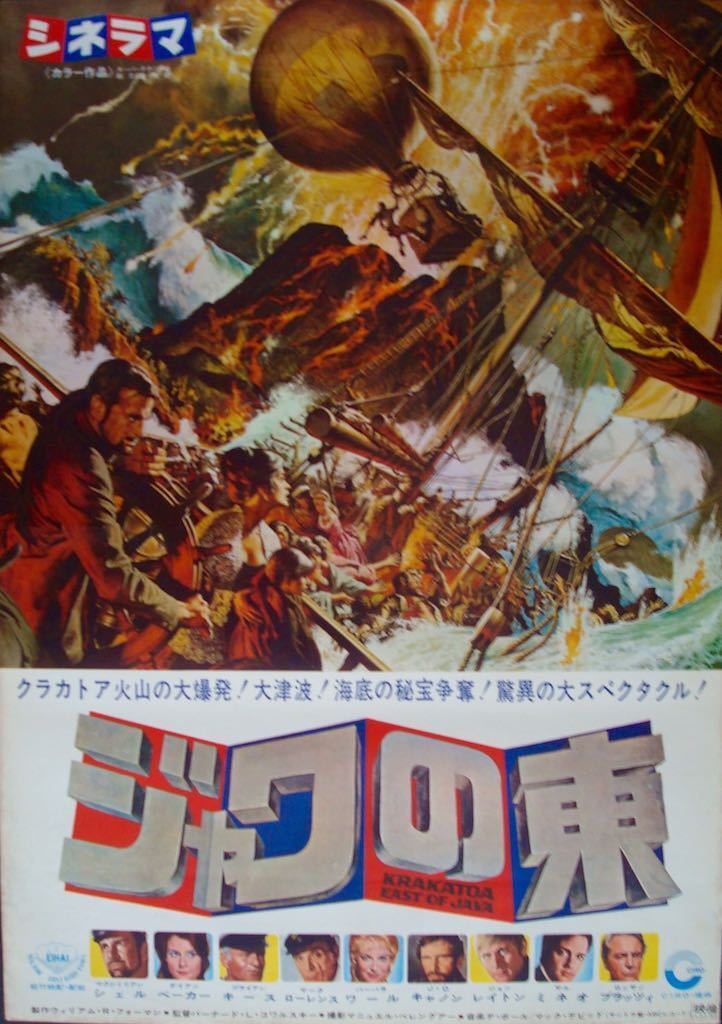
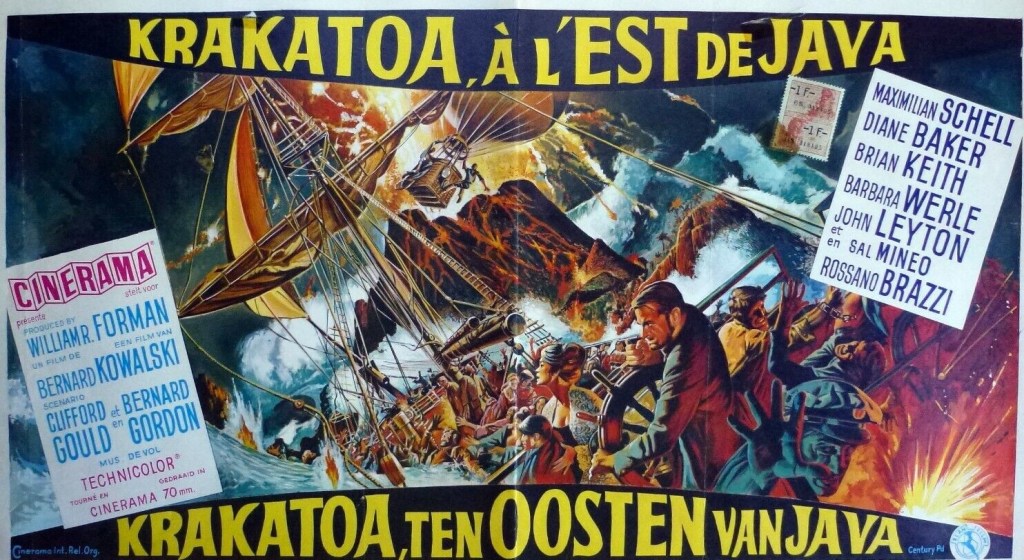
When two pictures made in the Cinerama process – Custer of the West (1967) and Krakatoa East of Java (1968) – didn’t make it onto the U.S. roadshow circuit, the industry was in shock.
There were two reasons for the unexpected decision – distribution logjam and cash flow. For a start you needed deep pockets not just to launch a movie in roadshow but to keep it there bearing in mind the ongoing outlay in interest costs for the production and the longer advertising schedule. That is, if you could find enough available cinemas.
Although there was still a production shortage as far as the general cinema marketplace went, that was not the case for first run. By 1967, studios were not dependent on roadshow for hits. In 1966, only one roadshow featured in the box office top ten. In 1967, the number rose to three. But that still meant the vast majority of first run movie theaters never ran short of product, especially when, should all the regular roadshow houses be already taken, they might be called upon to host a roadshow for a month or two.
Some movies – The Blue Max (1966), for example – which had not been made with roadshow in mind, were launched in a handful of cinemas as roadshow for prestige purposes. Conversely, other movies, produced with the express aim of being released in the roadshow format, skipped that element of the distribution chain and went straight into general release. The Great Race (1965) was shown in hard-ticket only in the Pantages in Los Angeles, but first run general release elsewhere. In Harm’s Way (1965) lasted just one day in roadshow.
But neither had been made in Cinerama which was considered the bedrock of the advance-booking separate-performance high-ticket-priced roadshow. There were two problems with that format and that company. The first was that cinemas equipped to show Cinerama were far fewer than those who could accommodate roadshow, so if they were full to capacity with existing pictures, opportunities to open elsewhere were not only limited but undesirable.
The second was that while in the past major studios had lined up to use the Cinerama format for their movies – Warner Brothers for Battle of the Bulge (1965), MGM for Grand Prix (1966), for example – now Cinerama had decided the company was best served by it taking control of output rather than sharing potential profit with anyone else.
Rather than simply licensing its film-making and projection equipment to studios and cinemas, respectively, and taking a small percentage of picture grosses and a fee for every ticket sold, Cinerama embarked on a bolder strategy. It would turn into a major production outfit – the dozen movies in its first tranche included, as well as the two roadshows, Charly, Shalako, The High Commissioner/Nobody Runs Forever, Candy and Stiletto. It also aimed to virtually double the number of cinemas equipped to show Cinerama, so there would be no shortage of roadshow outlets for its most prestigious pictures productions, and set up its own global distribution system.
But since Cinerama no longer had alliances with major studios, and in fact was now hellbent on competing with them, it lost those studios’ relationships with the big roadshow cinemas in New York and Los Angeles. There were only two houses in New York equipped with Cinerama, and Warner owned one and MGM had an almost symbiotic partnership with the other – Loews. That meant no place initially for Custer of the West.
But there was another option. Open it overseas. Roadshows often played for longer in European capitals than they did in New York or Los Angeles and those cities were often inclined, when demand was at its highest, to switch a big first run house into a roadshow theater.
And there was precedent. MGM had opened How the West Was Won (1962) in the Casino Cinerama in London ahead of its Stateside roadshow release. The Cinerama western had cleaned up, record takings, a massive run into the bargain, all serving to heighten expectation across the Atlantic. So, Cinerama opened Custer of the West in that cinema with top seats costing $3.50 and separate performances (two a day, three at the weekend) and to initial public and critical success.
The much-touted “record” opening week disguised the fact that the only record it took down, and then only by $200, was that of How the West Was Won five years previously; Battle of the Bulge’s opening salvo of $41,608 remaining intact. In any case ticket sales soon tailed off and Cinerama had second thoughts about the cost and wisdom of opening it in roadshow in the U.S. especially when the lack of theaters would produce further delay.
So it took another strategic, possibly perilous, route in deciding to miss out New York and Los Angeles – and Boston and Chicago for that matter – from its initial roadshow roll-out. The assumption was that big box office elsewhere would soon have New York and LA houses queuing up. The film’s U.S. premiere took place in Dallas and Houston on January 24 and it managed another 15 roadshow bookings in the months following.
Except for a “big” $15,000 in Detroit, the other opening week results were so soft – “fairish” $8,500 in Cincinnati, “just okay” $7,000 in Kansas City, $4,000 in Portland which was less than the previous week’s run-of-the-mill picture – the studio called for a rethink. “Due to spotty out of town dates thus far it seems an unlikely bet for New York roadshowing,” opined Variety. And so it proved. Cinerama promoted its general release as “direct from reserved-seat engagements” but it fared little better, a “thin” $171,000 from 34 houses in its first New York salvo.
With none of its ambitious slate beyond Charly striking box office gold, Cinerama tore up the rule book for Krakatoa East of Java. In some respects it followed the launch template of Custer of the West with the movie being seen first overseas, world premiere this time in Japan, six months ahead of the May 1969 U.S. opening. But the London launch, at the Astoria – where it ran for nearly six months – came after, on July 31, not before.
But there was clearly an unwillingness to risk all in roadshow. So, Cinerama came up with a clever compromise. While not strictly speaking entering roadshow in that it abandoned advance booking and high ticket prices, it stuck to separate performances but, to compensate for potential loss in box office receipts, operated on four performances daily rather than two. Cinerama called this “scheduled performances” and it was somewhere between roadshow and general release. But it was initially screened in Cinerama in those houses equipped with the projection equipment and only after those semi-hard-ticket bookings were complete did it enter general release.
Even without roadshow, the movie exploded onto screens on opening weeks – a “big” $60,000 in New York (and $55,000 in the second week), a record-breaking $31,764 (and $36,345 in week three) at the Pacific Cinerama Dome in Los Angeles, a “giant” $50,000 in Cleveland, “hotsy” in Detroit with $36,000, $22,000 in Denver and a “mighty” $18,000 in Washington.
Between the Dome (a genuine roadshow with 14 performances a week) in Los Angeles and the Broadway Cinerama (the hybrid with double the performances per week) in New York it grossed $1.2 million. Overall, the various hard-ticket strands kept the movie on screens for most of the summer and into the autumn before a general release targeted for Thanksgiving and Xmas kept up the box office heat.
The studio put an unusually hefty marketing push behind the general release. Having gone round the houses, literally, once with promotional ideas, the company rejigged the best ideas and brought in new suggestions. But, basically, the word to new exhibitors was to learn from successful strategies used in the semi-hard-ticket release. “Rather than rest on its laurels,” the studio packaged the best ideas into a six-page A4 advert and stuck in in Box Office magazine. It knew what worked and just wanted to repeat and expand the process.
One of the marketing coups for the New York launch had been a giant outdoor sign in Times Square, at 265ft long and 62ft high the largest ever designed. The film’s artwork employed in this fashion attracted the attention of thousands of passers-by and served as an example of how the marketing material could work, even if on a smaller scale.
Exhibitors were instructed to target department or chain stores. The launch had found ready cooperation not just from Macy’s but discount store White Front, specially chosen to promote the “price reduction” idea, of a big movie at low prices. It was standard practice for roadshows going into general release to be advertised as “now at regular prices” but the idea of harnessing the mindset of a discount chain, associated with low prices, set a precedent.
There were the obvious routes – tie-ups with record stores and bookshops for the soundtrack and the Signet paperback – but the studio had also made available a reprint of an article on the Krakatoa eruption from Reader’s Digest magazine in 1946, and provided a Teacher’s Guide for schools. Educational avenues were heavily explored, and what teacher would not have an eager audience of young kids to be taught a lesson about volcanoes.
Where the semi-hard-ticket launch had secured the presence of Miss Java, it was suggested that local exhibitors should try and find someone of Indonesian origin, perhaps an exchange student at a local college, to participate in the local screenings. Pearls and balloons, intricate parts of the movie’s narrative, had been used in a big way for the launch, but still lent themselves to simpler exploitation, fake pearls could be given away and colorful balloons if a weather balloon could not be located nearby. The extra effort that went into the general release paid off.
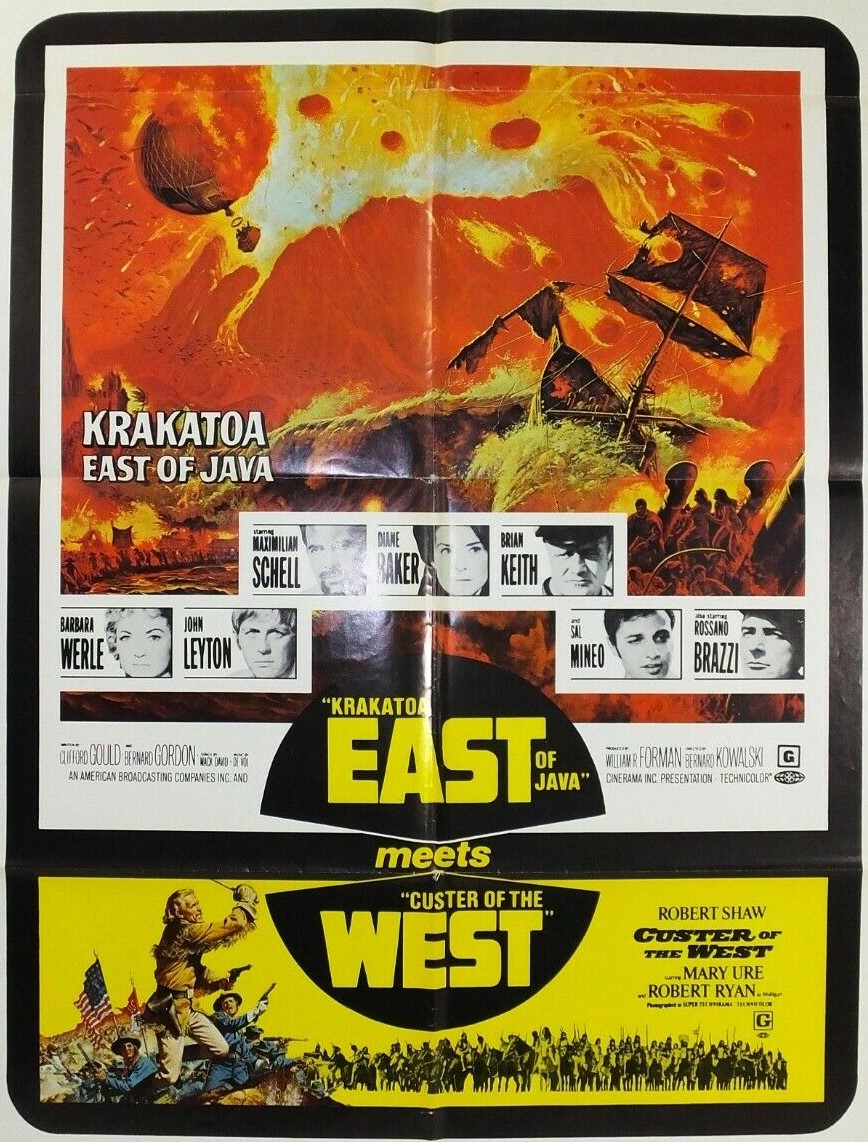
The New York showcase popped a “smash” $430,000 from 31 houses. The company reissued Krakatoa East of Java and Custer of the West in a giant “East Meets West” double bill in 1971 in advance of the television prmeiere of the former two years later.
Overall, while Custer of the West was considered a flop in the U.S., Krakatoa East of Java qualified as a hit of modest proportions, and both movies did well globally. But by 1969, setting aside the $18 million it cost to turn Cinerama into a genuine studio with its own distribution arm, the company had turned a financial corner, and in 1970 income had soared to $46 million – up from $12 million – and there was at last a profit ($3.2 million) instead of a loss ($660,000).
Exactly how much Custer of the West and Krakatoa East of Java contributed to the overall turnaround is impossible to determine because for some arcane reason the studio refused to reveal rental figures even though it had been happy to supply them for other movies which had contributed to the uplift such as Candy, Charly and The Killing of Sister George.
Most film historians point to the flop of several big-budget pictures as the reason for the demise of the roadshow, but just as likely was the move by Cinerama to shift away from the roadshow format in favor of its hybrid, which retained some of the “special event” aspects of the roadshow release while pushing ahead on the more commercial approach of lower prices matched by more daily performances, effectively attempting to bring in revenue at a faster speed, which would be the determined aim of studios in the following decade. The Godfather (1972) might be considered the classic imitator.
SOURCES: Kim R. Holston, Movie Roadshows, A History and Filmography of Reserved-Seat Limited Showings 1911-1973 (McFarland, 2013) p266-267; “Custer Pulls a Record $33,245 in London Bow,” Variety, November 22, 1967, p13; “Cinerama Sanguine on Custer After London; Gets U.S. Roadshowing,” Variety, November 22, 1967, p13; “New York Sound Track,” Variety, February 14, 1968, p18; “N.Y. Roadshow Problem for This & Next Season with Theater Map Torn Apart,” Variety, March 29, 1968, p5; Advert, Box Office, April 29, 1968, p1; “Krakatoa – 3-Site Premiere in Tokyo,” Box Office, January 20, 1969, pE1; “Krakatoa in Paris,” Variety, January 29, 1969, p4; Advert, Variety, May 21, 1969, p35; Advert, Variety, June 11, 1969, p31; “Krakatoa Shuns Roadshow,” Variety, July 9, 1969, p15; “Krakatoa London Bow,” Variety, July 2, 1969, p34; “Picture Grosses,” Variety, July 2-16, 1969; “General Release Set for CRC’s Krakatoa,” Box Office, November 3, 1969, p9; “Merchandising The Picture, ” Box Office, November 17, 1969, p13-18; “New York Showcases,” Variety, December 3, 1969, p9; “West End,” Kine Weekly, January 3, 1970, p9;“Cinerama’s Big Year,” Variety, March 25, 1970, p4.








 The Magnificent 60s