The Hawaiians / Master of the Islands (1970) ****

Contemporary audiences will find much to admire. Perhaps unintentionally, certainly unusual for the era in which it was made, this is driven by a strong feminist streak and the problems of  fusing different new cultures – Chinese and Japanese – on an island already dominated by white immigrants. In some respects a companion piece to Diamond Head (1962), which also starred Charlton Heston, but in reality a sequel to epic roadshow Hawaii (1966).

Nyuk Tsin (Tina Chen) has been kidnapped from her village in China with the intention of selling her into a brothel in Honolulu. But when her gender is discovered on board the ship, captained by Whip Hoxworth (Charlton Heston), transporting Chinese laborers to Hawaii, a fight breaks out, her owner is killed and she is taken over by Mun Ki (Mako). He fully intends, on making land, to sell her and keep the money but at the docks Whip’s wife Purity (Geraldine Chaplin) intervenes and the couple are offered jobs as husband-and-wife.

“Hawaii” (1966) was not such a big box office hit abroad as it was in the United States
hence the decision not to rely on the U.S. title “The Hawaiians” for the sequel.
In fact, unlike the U.S. poster the novel is not so upfront.

Mun Ki’s entrepreneurial spirit is obvious from the minute she reaches Whip’s plantation, as she starts planting seeds in a tiny area in front of the hovel that is their dwelling. That turns into a vegetable garden and eventually she has a side business feeding laborers. Her gardening skills encourage Whip to entrust to her to grow the seed pineapple plants he has stolen from French Guiana, a continent away in South America.

When that proves successful, and Whip manages to find an artesian well through the lava bed, he embarks on a career as a pineapple farmer, and as a reward, deeds her land.

Meanwhile, Nyuk Tsin discovers she is wife only in terms of procreation. Mun Ki already has a wife back home, so Nyuk Sin can only officially become an aunt to the five children she bears him, each named after a continent (Asia, Africa etc) and who do, it must be said, come in handy for her farming business. She is wealthy enough that attempts are made, as much from envy and fury at her success as anything else, to steal her property.

While officially disbarred from the position of wife, her feelings for her husband are so strong that when he contracts leprosy she accompanies him to the island of Molokai and looks after him until rescued by Whip. Now with a prosperous farm, and remaining unmarried, she is rich enough, and clever enough, to send one son to America to train as a lawyer. Through her own endeavors and willpower she becomes not the slavish wife, dependent on her husband and his whims, but a strong independent wealthy woman, and leader of her expanding clan.

Theoretically, this is a subplot in the film, but in reality director Tom Gries (Number One, 1969) affords it as much time as the supposedly main narrative which, in contrast to Diamond Head, sees Whip as the black sheep of the family, disinherited and left only with land that is useless until the cultivation of pineapples makes it viable. His wife, while ostensibly weak, is also of a feminist disposition, abandoning her husband after the birth of her only son Noel (John Philip Law) to return to her Hawaiian roots.

When the Japanese arrive on the island Whip takes as a mistress the educated self-sufficient Fumiko (Miko Mayama). The circle of interbreeding and cultural infusion is complete when Noel marries Mei Lei (Virginia Lee), Nyuk Tsin’s only daughter.  

It’s a lot more melodramatic than that, to be sure, Whip at odds with his family, Purity sending him bananas by denying him sex after Noel’s birth, and then withdrawing from his life. Various characters flit in and out, like the alcoholic well-digger Overpeck (Don Knight), and the tale embraces, like Diamond Head, the period when the United States annexed Hawaii.

Allotting so much screen time to Nyuk Tsin can’t have been accidental, maybe it was just visionary, but taking her as the focal point pivots more on her single-minded nature than the haphazard character of Whip, who achieves success through luck, theft and brutality. It’s remarkable that Nyuk Tsin has understood its importance of land ownership, the bedrock of any country’s institutional hierarchy, and strives so hard to achieve that footing and becomes in essence the family breadwinner. If the foreign title had been changed to Mistress of the Islands it would not have gone far wrong.

Fans of the second-billed John Philip Law (Hurry Sundown, 1967) will perhaps be disappointed that he appears so late in the proceedings, essentially to ensure the narrative can embrace the generations, but also to show how attitudes can change for the good from one generation to another.

I’m aware I’m asking you to watch the movie from a different perspective from that advertised but it’s far more rewarding.

Charlton Heston is good, especially when transitioning from commander of all he surveys while on board ship to a mere family footnote on dry land. He can rant with the best of them, for sure, but underneath the fury you can detect the pain, cast aside by family and wife. The scenes where he fails to reignite sexual relations with Purity reveal how great an actor he is. We more often associate Heston with the lower half of his face, the jutting jaw, the flashing teeth, the dominance of his words, rather than the upper half where his eyes are so revealing of inner torment. There’s a sea-change in the standard Heston performance that runs through Planet of the Apes, Number One and here of a powerful man drained by circumstance.

But Tina Chen (Three Days of the Condor, 1975) is the standout, moving from humiliation to pride, often called upon to mutely absorb pain, but fiercely protecting husband and brood, and clever enough to calmly negotiate her way past husband and Whip to potential success.

Tom Gries, in his third picture with Heston, manages to create an epic feel to a picture whose limited running time sabotages that aim. His sweeping tracking shots provide the bravura but that is underpinned in the more intimate moments by sensitivity to character emotion shown in a look rather than expressed in dialog.

Screenwriter James R. Webb (How the West Was Won, 1962) had the job of chiselling another cinematic chunk from James Michener’s door-stopper of a novel and turning this  sub-plot into a gem.

Well worth a look.

Behind the Scenes: “Man’s Favorite Sport” (1963)

Should have been, as you might have guessed, Cary Grant (Charade, 1963) in the lead. Should have featured, which you won’t have guessed, Ursula Andress (She, 1965). Should have run, which you’d be amazed to learn, for 145 minutes, almost as long as your standard epic. Should have appeared, like Hatari! (1962), under the Paramount banner.

In fact, the most likely studio destination was Columbia. Hawks’s agent Charles Feldman had  spent 16 months trying to thrash out a very good deal for his client. Feldman, who owned the rights to Casino Royale, was also keen on Hawks directing a James Bond picture. That got as far as discussing Cary Grant as the handsome spy and Hawks’ enlisting the aid of his favorite screenwriter Leigh Brackett (Hatari!).

But instead of moving studios, Hawks decided to stay put, sitting on a three-picture deal worth a hefty $200,000 plus a 50 per cent profit share. First item on the new agenda could have been reuniting Rio Bravo (1959) alumni John Wayne and Dean Martin for The Yukon Trail. But that was before Hawks expressed interest in a romantic short story, The Girl Who Almost Got Away, published in Cosmopolitan magazine, and an ideal fit for Cary Grant.

But Grant, something of the entrepreneur himself, would only sign up if Hawks in turn agreed to direct one of the actor’s pet projects, The Great Sebastian. But the director didn’t like the idea of being a gun for hire and Grant’s attention meanwhile had wandered in the direction of Charade. Rock Hudson, borrowed from Universal, was seen as an ideal replacement. For the female lead Hawks initially enthused about Joanna Moore (Walk on the Wild Side, 1962) until he chanced upon Paula Prentiss (Where the Boys Are, 1960), an MGM contract player.

Paramount balked at a relative unknown. Hawks balked at anyone balking at his choice and switched the project to Universal. While toying with Casino Royale, Hawks had a sneak preview of Dr No (1962) and espied a natural for the second female lead in Ursula Andress. But her management team reckoned the Bond movie would open bigger doors. Instead, Hawks plumped for Austrian blonde Maria Perschy (The Password Is Courage, 1962). Charlene Holt (If A Man Answers, 1962) made such an impression on Hawks that she not only won the part of Rock Hudson’s fiancée but the role of regular girlfriend to the director and parts in his next two pictures.

Leigh Brackett  was brought in to pep up the original script by John Fenton Murray (It’s Only Money, 1962) and Steve McNeil (Red Line 7000, 1965). Unusually, she was rewriting on the hoof, earning $1,000 a week to refashion the lines scene by scene as production unfolded. Everything except the opening scene set in San Francisco was shot on the Universal backlot. Even then, neither Hudson nor Prentiss was transported to San Francisco, their close-ups while driving cars filmed at the studio and inserted as process shots. Hawks didn’t leave the studio either, entrusting that initial footage to associate producer Paul Helmick and cinematographer Russell Harlan.

Like Otto Preminger, Hawks liked a lot of takes. Paula Prentiss didn’t, in part because she felt he was trying to mold her into a screwball comedy heroine of the past, and in part because every take not printed impinged on her confidence. Although Hawks lacked the reputation as a bully of the Otto Preminger variety, nonetheless the inexperienced Prentiss found herself in tears more than once. Cary Grant dropped by one time for a friendly chat. He was made welcome. Angie Dickinson, expecting a similar welcome, received a curt put-down, Hawks making it clear he preferred as a brunette.

While the credit sequence by photographer Don Ornitz was deemed sexist since it comprised 33 models in sports or beach gear, it was actually the opposite because the women were proving how superlative they could be at sports generally considered the preserve of men. But there was no doubt the reaction Hawks expected when he spent $20,000 on black scuba outfits for Prentiss and Perschy, using molds made from their bodies to achieve the skin-tight effect. Hawks was notoriously slow, the picture taking three and a half months.

The initial version of the film attracted at a sneak preview the most positive responses the studio had ever received. The only problem was – it ran 145 minutes, considered an impossible length for a light romantic comedy. Although the next version was shorter, the audience response was decidedly worse. Even so, Universal insisted on further cuts until the movie came in at the two-hour-mark.

Not everyone went along with the official Hawks version of events. Others remembered the response to the various cuts not being so different. The film wasn’t released until six months later and there is no evidence that Hawks fought hard to retain his edit. Although he would later complain that the movie was “sabotaged,” that may have been his automatic default position once the movie proved a relative commercial failure, with only $2.35 million in U.S. rentals

Leigh Brackett had more right to feel disgruntled. She was denied a credit by the Writers Guild of America who contended her work was a polish rather than an original contribution.

I have to say I’m out of step with some of the critical opinion. Molly Haskell reckoned the film was actually some kind of Adam and Eve deal with Hudson “a virgin who has written a how-to book on sex while harbouring a deep fastidious horror of it.” The Haskin critique allows that fish are phallic symbols, therefore giving sexual credence to the scene about learning to handle a fish.

It might just be more straightforward to say that, of course, this isn’t as good as Bringing Up Baby but then, nothing ever was, and just enjoy what Hawks did manage to conjure up with very likeable leads.

SOURCES: Todd McCarthy, Howard Hawks, The Grey Fox of Hollywood (Grove Press, 1997), p595-603; Joseph McBride (editor), Focus on Howard Hawks (Englewood Cliffs); Molly Haskell, “Howard Hawks: Masculine Feminine,” Film Comment, March-April 1974.  

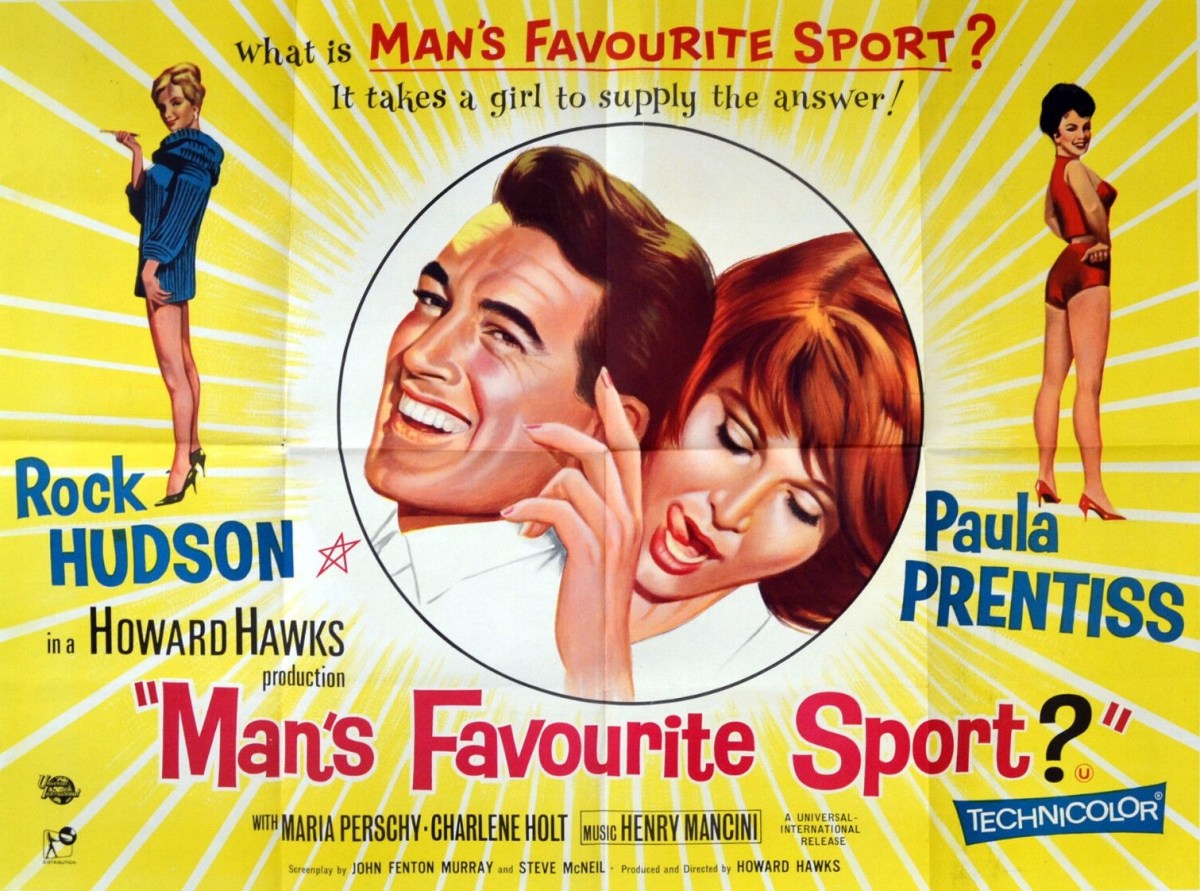
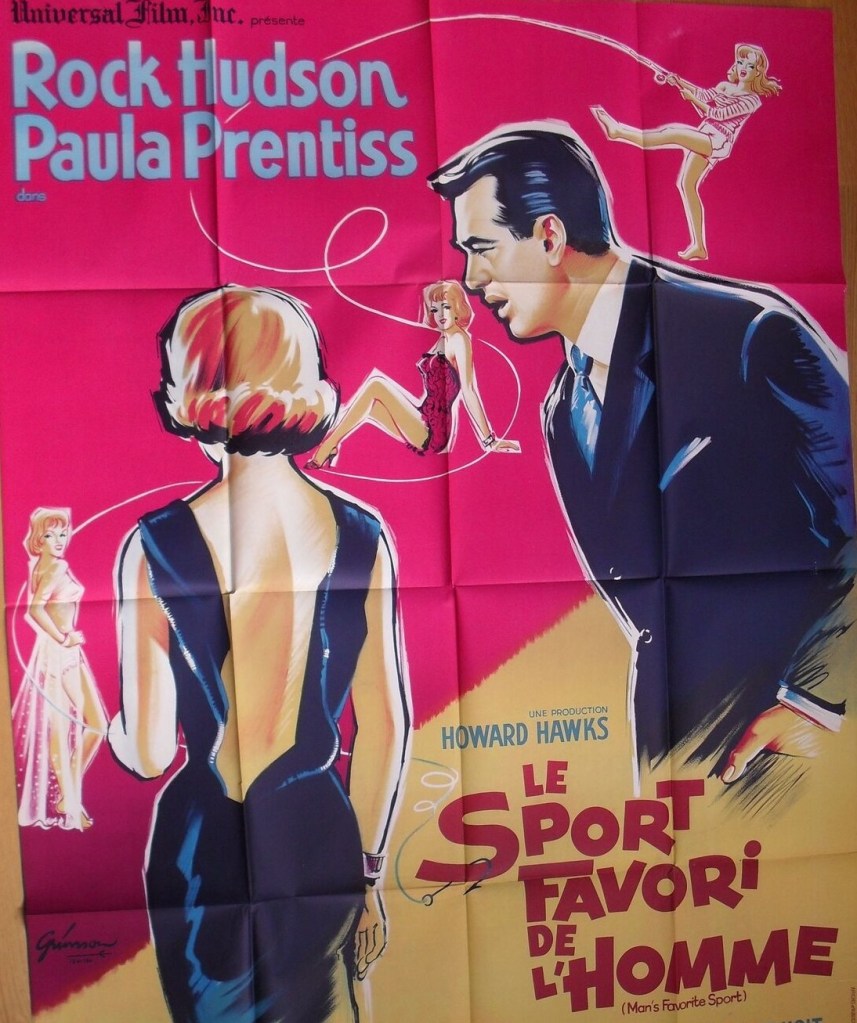
Man’s Favorite Sport (1964) ****

Wow! From an academic/critical perspective this is veteran director Howard Hawks (Hatari!, 1962) taking the mickey out of his famed style, where women are always competing to enter the sacrosanct male world. But, shades of his earlier Bringing Up Baby (1938), a fast-talking assured sassy woman takes command of a hapless male. Sure, Rock Hudson and newcomer Paul Prentiss aren’t in the Cary Grant-Katharine Hepburn league but they make darned good substitutes. And there’s a big difference to the earlier picture. There, Grant was an accepted expert, and it’s not his knowledge that’s in question but here Hudson is a phoney and relies on the woman.

But fiddlesticks to academe and critics, this is just helluva good fun. Built on a brilliant premise, it just rolls along from one set-piece to another to fashion as daft a screwball comedy as you could imagine.  Maybe Rock Hudson left all the physical comedy in Send Me No Flowers (1964) to Doris Day because he was plumb tuckered out by his exertions on this one.

So, Roger Willoughby (Rock Hudson) is a fishing expert employed as a salesperson by Abercrombie & Fitch. When, in a public relations wheeze, Abigail Page (Paula Prentiss) invites him to participate in a competition, she uncovers his terrible secret. He’s never fished before in his life, he’s just a clever listener, passing on fishing lore from one customer to another. She agrees to help him out. But, of course, he’s an idiot and it’s not long before he’s upside down in a car that’s way too small for him, walking around with rubber buckets for shoes and upside down (again) in a lake trapped by inflatable waders.

There’s a marvellous meet-cute where they get off on the wrong foot because she steals his reserved parking spot and his first encounter with her dexterity with language should have warned him what he’s letting himself in for. The situation is complicated by, natch, Abigail falling in love with him, not to mention her buddy Easy (Maria Perschy) not unattracted either, and his fiancée Tex (Charlene Holt) about to appear any second.

So when Roger’s not tying himself in knots, he’s allowing himself to be persuaded to pretend to have a broken arm, which to make it realistic must be encased in plaster, which Abigail and Easy concoct.  The fact you know full well this is only the first step to major complication doesn’t make it any the less funny. Then there’s the problem of the zip in a sleeping bag. And the fiancée turning up at the wrong time.

I could have done without the fake Native American (Norman Alden), but the rest is top-notch. Any other director would have kept the wig gag going for ages, but here it’s dumped early on because the wearer, Roger’s boss Cadwalader (John McGivern), needs little excuse to stop wearing it.

You’d be hard put to find sexuality as cleverly dealt with as here, Abigail and Easy provided with good reason to swan around in skin-tight clothing and later prattling on fifteen to the dozen as pouring rain renders their shirts see-through much to the discomfort of Roger. While Roger might be a typical male, the trio of women are far from typical of the period with a streak of independence that allows little room for the notion of men as the superior species. Not only is Abigail as competent as any male in this type of sport, she far exceeds the capabilities of the supposed expert. Furthermore, Abigail is the antithesis of the scatter-brained Susan Vance from Bringing Up Baby. She knows exactly what she’s doing even if shifted slightly off kilter by the unexpected impact of love.

As the male coming unstuck outside of his comfort zone, Rock Hudson is excellent especially in the physical comedy but the real gem is Paula Prentiss, as effervescent a star as you would ever find. You only have to see her in The Parallax View (1974) to understand what a terrific character she has succeeded in creating. Never mind that she handles the script deftly, she virtually bursts off the screen.  

The general critical consensus is that Howard Hawks went downhill after Rio Bravo (1959), and that outside his final pair of westerns El Dorado (1966) and Rio Lobo (1971) was very much at the tail end of his career. Most critics seemed to have simply ignored that Man’s Favorite Sport took a different approach to the male-female dynamic or that, setting academia aside, this is just a very enjoyable romantic comedy.

The Art of Love (1965) ****

Priceless. Effortless comedy from the same director, Norman Jewison, as Send Me No Flowers (1964) but minus the box office powerhouses of Doris Day and Rock Hudson and perhaps it’s their absence that makes this work so much better. Or perhaps you get more comedic leeway in Paris. Although the scripts were written by different people, I sense a directorial insistence that the supporting characters are believable, not just there to oil the plot.

The story here is fraud, penniless artist Paul (Dick Van Dyke) faking his own death to give his paintings the necessary burst of publicity to make them hot items. Except he doesn’t fake his death. He dives into the Seine to save a drowning girl Nikki (Elke Sommer) and his buddy Casey (James Garner), a wannabe writer for whom Paul is a meal ticket, and who you would have to say was instrumental in suggesting such a scam, assumes he has committed suicide.

Paul goes along with the scheme for as long as it takes art dealer Zorgus (Roger C. Carmel) to make a killing (no pun intended) from his paintings. Nikki ends up a housemaid at a risqué nightclub (though it being Paris what other kind is there) run by Madame Coco (Ethel Merman) where, coincidentally, heavily disguised, Paul hides out. Meanwhile, in the final piece of the complication jigsaw, Paul’s fiancée Laurie (Angie Dickinson), turns up. A bit like the lecherous friend in Send Me no Flowers, Casey knows how to make the most of the opportunity to give a potential widow a shoulder to cry on. “How can you make a play for this girl?” he asks his reflection, but she’s too gorgeous for qualms.

You can pretty much guess where it will go from here.

It works so well because none of the principals is permitted to milk their roles (though Van Dyke can’t resist making a meal out of a sneeze) and the supporting cast drive it along with selfish action. Dick Van Dyke (Divorce American Style, 1967) has none of his usual zaniness or limbs that refuse to obey orders. James Garner, though in part cloning his character from The Americanization of Emily (1964), plays it as drama. Elke Sommer (The Venetian Affair, 1966) is the best I’ve seen her, no longer the pouting sexpot but a girl-next-door from the suburbs fallen on hard times. Angie Dickinson (Jessica, 1962), further down the billing than I’d expect, has to play it for drama, almost the foil for Casey’s seductive tendencies.

There are some superb running gags. Paul is furious to find a red-headed woman in the bed of flat-mate Casey. But, sight gag number one, it belongs to a mannequin. The wig, sight gag number two, is used to disguise Paul. Casey gets ride of the mannequin by stuffing it into a furnace only it doesn’t fit so he has to saw off its legs and is discovered from above by a waiter, sight gag number three, who naturally thinks he is sawing a woman in half. (I always think the beauty of a good comedy is that you can see the gag coming and you still laugh.) That gag has even more miles to run.

The supporting cast, as I said, are all given just delicious lines. Paul and Nikki, soaking wet, are saved by a passing barge. Paul hangs out her clothes to dry. When the naked woman in the wheelhouse calls for her clothes, the barge skipper, enjoying the prurient scene, implores,  “Don’t give her her clothes back.” And when, after a row, that allows her to leave the barge, the skipper whines, “I told you not to give her her clothes back.”

. “I don’t want you to think I came for the rent you owe,” says Casey’s landlord. “What did you come for,” asks Casey. “The rent you owe, but I didn’t want you to think it.” The landlord’s wife comforts the grieving Casey (at this point he thinks Paul is actually dead) with some chicken soup. Casey admits the suicide was his idea. The woman snatches back her soup.

Having put Nikki on a bus, Paul, handing over few coins, asks the driver to keep an eye on her. Comes the reply, “I would whether you pay me or not.”

Sure, Ethel Merman (There’s No Business Like Show Business, 1954) gets to sing. Audiences expected that. But that’s understandable. What a voice. When you wonder why Ann-Margret wasn’t given more opportunity to sing in proper musicals, this is the answer. She lacks the voice of an Ethel Merman, Julie Andrews or Barbra Streisand.

The sly screenplay was concocted by Richard Alan Simmons (Della, 1965), William Sackheim (First Blood, 1982) and Carl Reiner, who had written for both Dick Van Dyke (his eponymous television show) and James Garner (The Thrill of It All, 1963).

The stars play proper roles, not just one-note characters driven by plot. Doesn’t take much to work out where it’s going all right but that doesn’t lessen the enjoyment of the journey.

I always wondered why, after making his name in comedy, Norman Jewison was selected for more serious works like The Cincinnati Kid (1965) or In the Heat of the Night (1967), but when you see the care he takes with each character, far more than standard directors in the fun genre, how he carefully builds the narrative, you do tend to agree he’s wasted in comedy.

A pure delight.

Rider on the Rain (1970) ****

This is not the Charles Bronson you think you know, the mean, truculent, monosyllabic persona who turned into a box office powerhouse later in the decade. It took the French to recognize the leading man qualities Hollywood determinedly ignored. God forbid, he is actually pretty charming, although his methods for squeezing information out of a suspect are, well, suspect. And he turns up pretty late in the picture, just when you think the focus is going to be on the suspect, Mellie (Marlene Jobert) and it’s going to be one of those pictures where an innocent woman is suspected of a crime and the man has to clear her name.

Except Mellie isn’t innocent. She’s killed a rapist who broke into her house and then dumped his body over the cliff. And she isn’t, officially at least, a suspect, local cop Inspector Toussaint (Jean Gaven) more interested in getting a loan from her husband, pilot Tony (Gabriele Tinti), to pay off gambling debts. Needless to say, any time the cop does knock on her door, she jumps out of her skin.

And she would have got away with the murder, except for the arrival of Dobbs (Charles Bronson). He turns up at a wedding, ensures she gets to see a newspaper headline of the murder, insinuates his way into her life, not too difficult once her husband heads off on another flight. She runs a bowling alley with her mother Juliette (Annie Cordy) who scarcely has a maternal bone in her body.

Rather than helping the cops solve the case, Dobbs is more interested in the red bag the rapist was carrying. But when she hands over the bag, it doesn’t contain the $60,000 Dobbs wants.  We never see what Dobbs gets up to when he’s not with Mellie. But we hear it. His investigations may be carried out off screen but he’s tailing her – knows she bought a ton of newspapers – and tells her what he’s found out by speaking to cops and neighbors. Even though she’s replaced the cartridges in the shotgun she used to kill the rapist, he knows the gun has been fired. When she claims she was aiming at rats in the cellar, he points to the marks on the wall, too high for even the most acrobatic rat.

Mellie is trapped in a claustrophobic world, assailed by her own guilt and a jealous husband with too much unexplained loose cash (drug smuggling is the implication), turns against her best friend, boutique owner Nicole (Jill) who had an affair with her husband, and against her mother whom as a child she caught in bed with another man, causing her father to dump the mother.

They started to get tricky with double bills in the 1970s, trying to suggest
the films were equally attractive, ignoring the fact that if they had been
such hits they wouldn’t have been paired in the first place.

Most of the tension is self-inflicted but Dobbs has thing about nuts and soon is whizzing shells across rooms, some trick where they break on impact with a window, but the noise is like a shot, too close to the blast of the shotgun.

Every twist ratchets up the tension. And by concentrating on the suspect the police are ignoring and making Dobbs, by default, the chief investigator, and nobody to turn to, Mellie is turned inside out by his mere presence, never mind, when exasperated, he employs his own interrogation method, akin to waterboarding, except the liquid is alcohol, forced down her throat until her lungs are full to bursting.

The last act is a bit murky, as the locale shifts to Paris, involving a brothel owner and a set of gangsters who are even more intent on humiliating Mellie. With echoes of Charade (1963) and Moment to Moment (1966), it’s superbly directed by Rene Clement (Is Paris Burning? 1965), who doles out clues and twists like he’s playing a hand at cards.

In spite of the concentration on tension, he takes the time to build up his characters. A series of emotional flashbacks show the fault-lines in Mellie’s character, no matter that she initially appears confident with fashionable short hairstyle and white outfits bound to attract attention. Dobbs’ obsession with suddenly chucking nut shells around maintains the tension and his cavalier tone, especially his jocular use of a nickname, suggests an interesting personality behind the tough guy pose.

Like his script for The Sleeping Car Murder (1965), screenwriter Sebastian Japrisot is as concerned with ordinary life as with the thriller elements.

Charles Bronson (Farewell, Friend / Adieu L’Ami, 1968)  delivers the best performance of his entire career, tough guy with a charming underbelly, kind of Cary Grant with muscle. Marlene Jobert (Catch Me a Spy, 1971) is excellent as the victim turned suspect, and even Jill Ireland, for whom a part was always found in husband Charlie’s movies, shows a different side to her screen persona.

A riveting watch.

Send Me No Flowers (1964) ***

Doris Day (With Six You Get Eggroll, 1968) is such a whiz at physical comedy you wonder why it is ever rationed, as it appears to be here, limited to a fabulous sequence where her coat is caught in the door while collecting supplies from the milkman and a  shorter one where she loses control of her golf cart. And until the relevant misunderstandings kick in, this slightly limps along on the tale of hypochondriac George (Rock Hudson) believing he has only a few weeks to live and determining to make provision for his wife Judy (Doris Day) once he is dead.

Unfortunately, he confesses to his neighbor Arnold (Tony Randall) who is overcome with grief, even writing an eulogy along the lines of “when they wanted a good sport in Heaven they called on George Kimble.” Into the misunderstanding mix are innocent Dr Morrissey  (Edward Andrews), Bert (Clint Walker), Judy’s college sweetheart, and lecherous bachelor Winston (Hal March) who preys on women with marital issues.

The fun only really starts when Judy, on discovering George kissing a woman in a cloakroom, believes he is having an affair and discovers that he is being more of a hypochondriac than usual in assuming early mortality. And that’s when we come to Doris Day’s other priceless (rather under-rated ) asset – her range of expressions, not just the expected outrage at deception, but the look in her eye that tells you she is planning revenge.

Most of the supporting characters are well-drawn. Dr Morissey, endlessly envious of colleagues making a killing in one speciality or another, is the kind of man who has a ring of white atop his tanned face indicating where he has kept his hat on when out fishing in hot weather. The predatory Winston demonstrates his talents for picking up vulnerable women. The undertaker is ridiculously jolly. And Bert acts as if Judy made a big mistake in throwing him over. For that matter, Judy seems unable to resist his romantic arm around her shoulder.

It’s not until the complications mount up in that Rock Hudson (Seconds, 1966) comes into his own – an excellent scene sharing Tony Randall’s bed when kicked out by Judy during which his neighbor revises the eulogy downwards, and a cracker of a sequence where, taking his neighbor’s advice, he has to invent a lover in order to confess an affair to his wife in the hope of speedy forgiveness.

It’s all effortless fluff but you do wonder how well it would have worked in other hands. You often don’t appreciate the skill of actors at this kind of light-hearted comedy, creating highly believable characters and at the same time leaving themselves open to be ridiculed by the script. The narrative skips through three arcs. First we focus on the hypochondriac, then the “good sport” trying to ensure that his wife is so well looked after following his death that he buys his own burial plot and attempts to find her a second husband, and it’s only in the third act that the engineered complications kick in.

I was surprised to find Norman Jewison’s hand on this particular wheel, having associated him with more serious pictures like The Cincinnati Kid (1965) and In the Heat of the Night (1967) while even The Russians Are Coming, The Russians Are Coming (1966) fits more the category of satire. But comedy was very much his forte in his initial foray in Hollywood.

Of course, you could argue that the Rock Hudson-Doris Day cavalcade needed little steering, the two principals pretty capable of making the whole enterprise run smoothly, so I’m assuming the attention he paid to the supporting cast was where his effort was most noticeable. And, also, given this was based on a short-lived Broadway play, he does an excellent job of widening it out, so that it rarely feels stage-bound. Although maybe that credit should go to screenwriter Julius J. Epstein (Return from the Ashes, 1965) who adapted the play by Norman Barasch and Carroll Moore.

Nothing to exert you here, just sit back and enjoy the fun.

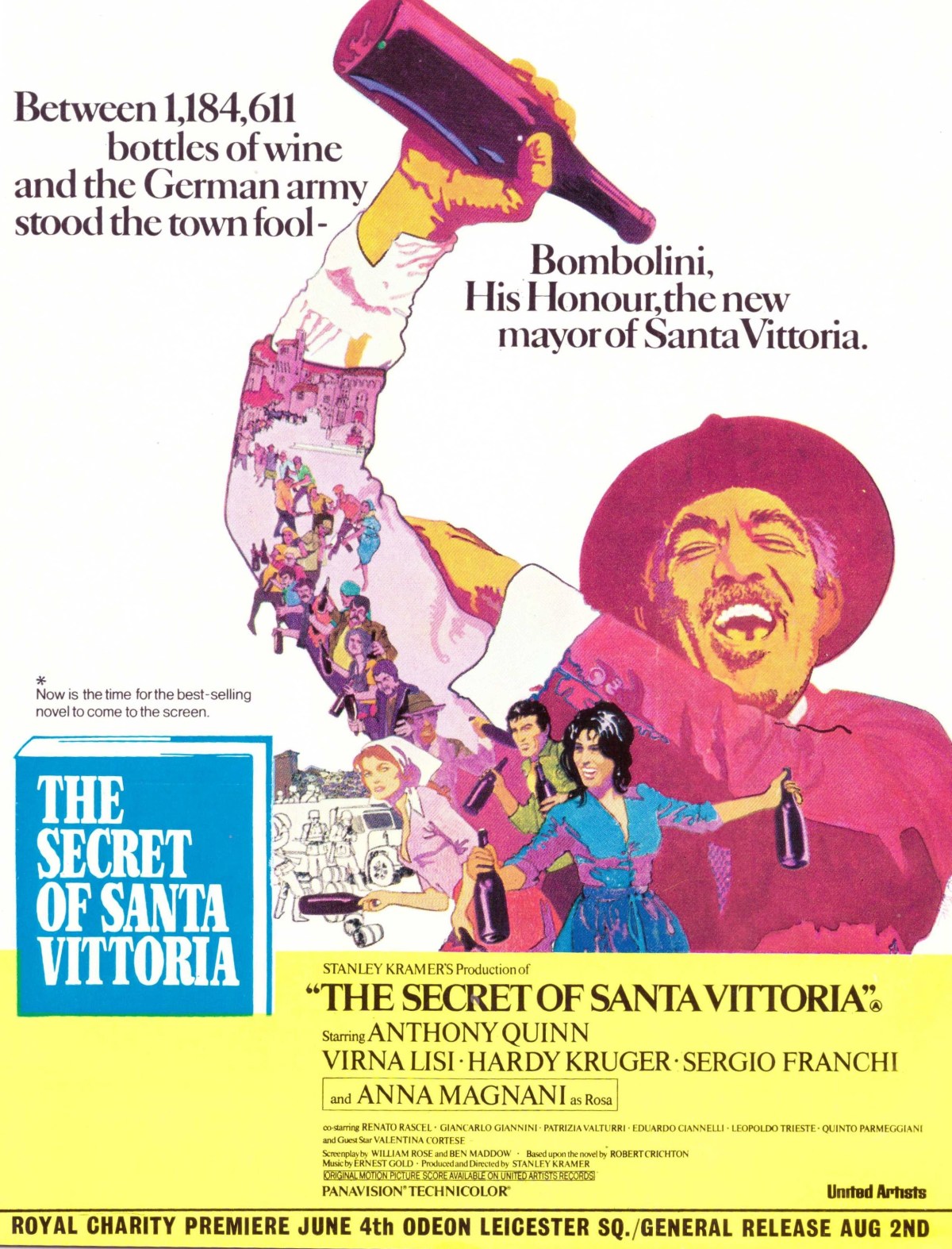
The Secret of Santa Vittoria (1969) ***

Sounds like a treasure hunt picture, contemporary buccaneers or thieves in search of missing gold. But there’s nothing in the way of maps waiting to be discovered, no clues, no character unhinged by its pursuit. In fact, the valuable commodity here is wine, over a million bottles of it. Everyone in the hilltop town of Santa Vittoria is in on the secret. Because they hid it from prying Germans who have taken over the place after the death of Italian dictator Mussolini. And that element of the story, once we finally embark on it, doesn’t begin until halfway through.

Meanwhile, we are treated to the browbeaten drunk Bombolini (Anthony Quinn), too dumb to realize that being elected mayor – the previous incumbent kicked out for being a Fascist – is a poisoned chalice. However, taking a few tips from Machiavelli he works out that his survival depends on bringing together a council of more sensible heads. His new position cuts no ice with disgruntled wife Rosa (Anna Magnani) whose weapons of choice, vicious tongue apart, include copper pans and an elongated rolling pin.

But if you were desperate to know how to bury treasure, here’s your chance. A good quarter of an hour is spent on that element. I’m not entirely sure what fascinated director Stanley Kramer (Guess Who’s Coming to Dinner, 1967) about this. Because, clever though the scheme is of vanishing into thin air more than a million bottles, it takes little more than lining up the populace in rows close enough together so they can pass a bottle onto their neighbor, until the total amount – minus 300,000 bottles left behind to fool the Germans – is hidden in tunnels in the caves below the village.

Assuming of course the Germans fail to prod the stones concealing the tunnels and discover the cement is too fresh to be ancient. But Bombolini is in luck because German leader Captain von Prum is a “good German,” inclined to take things easy, coming down hard of any of his soldiers who pester female villagers, allowing the mayor to negotiate to retain some of the supply being handed over to the invaders, half his mind on the local Countess Caterina (Virna Lisi) with whom he fancies his chances, but in gentlemanly fashion of course, aiming to seduce her over dinner rather than resorting to force.

That matter is complicates because the widowed countess already has a lover, a wounded soldier Tufa (Sergio Franchi) whom she nursed. It’s only when the captain realizes that he has been duped by the apparent buffoon of a mayor and by the countess that things start ugly and soon you can hear cries of the torture echoing out over the piazza.

The odd mixture of comedy and reality fails to gel. Anna Magnani (The Fugitive Kind, 1960) doesn’t look as if she’s acting in showing her distaste of Anthony Quinn (Lost Command, 1966) possibly because he is over-acting, cowing and whimpering and using his hands to express every single word he speaks. But it looks authentic enough. Either Kramer has rounded up every aged extra left over from Once Upon a Time in the West (1969) or he has recruited scores of ordinary peasants to play the villagers.

Kramer’s usual earnestness has disappeared, and although his first movie was a comedy, and Guess Who’s Coming to Dinner, his previous picture, played on the comedic elements of the situation, his feeling for comedy is rusty at best, non-existent at worst. It’s hard to feel any particular sympathy, as would be the point, in the villagers outwitting the Germans and in the fact that they have changed from ostensible World War Two conquerors to the conquered once their erstwhile allies turned on them.  

You might consider this a feminist twist on The Taming of the Shrew, Rosa not only being a shrew who would never be tamed, not even by Germans, but actually the family breadwinner. While, until his election, her husband is a nonentity. And it might be viewed as a choice role for Anthony Quinn, a dramatic shift away from the heroic roles with which he was more often associated. Anna Magnani mostly looks as if wondering why she agreed to participate.

The best acting comes from Virna Lisi (How to Murder Your Wife, 1965), a widow realistic about the lack of true love in what sounds like an arranged marriage, and faced with having to keep the amorous captain sweet, and possibly doing whatever that takes in order to protect the townspeople. Hardy Kruger (The Red Tent, 1969) has also abandoned his normal arrogance, is uncomfortable with being a despot, wanting to maintain friendly relations with the villagers, and seeking solace in gentlemanly fashion from the countess. He has the best scenes, the look of superiority as he outwits, he thinks, Bombolini, and the look on horror on his face as he discovers the countess’s lover.

Based on the bestseller by Robert Crichton with a screenplay by William Rose (Guess Who’s Coming to Dinner) and Ben Maddow (The Way West, 1967)  it’s the kind of movie that raises a lot of questions without bothering to answer any of them.  

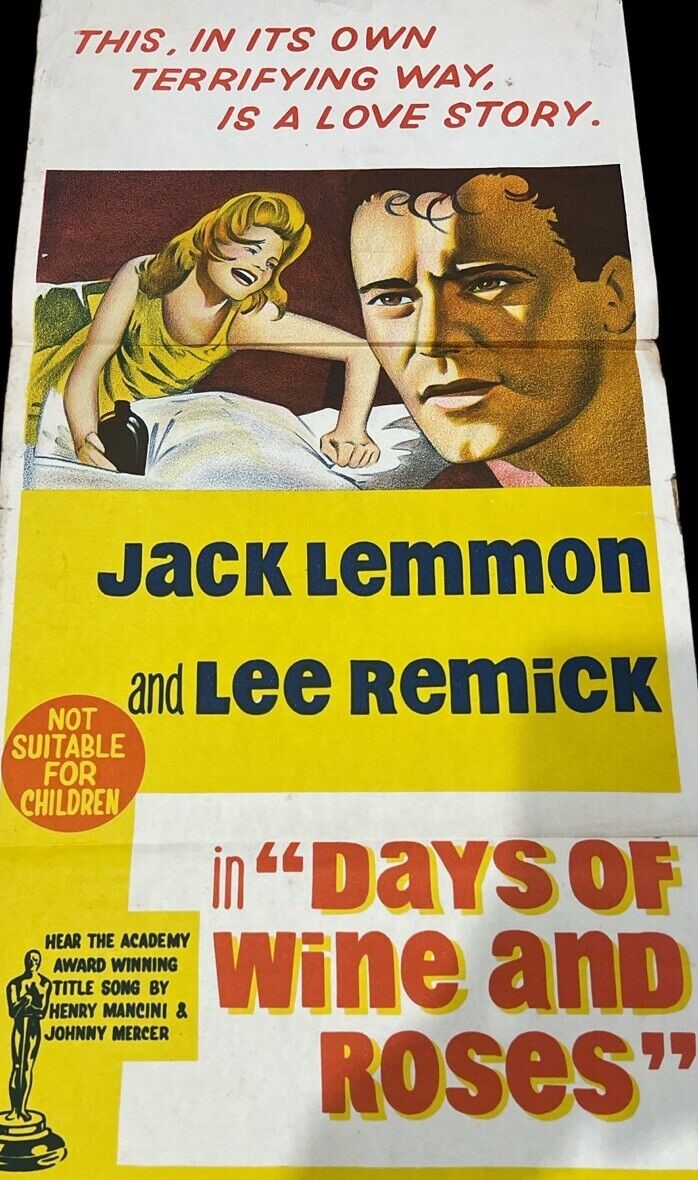
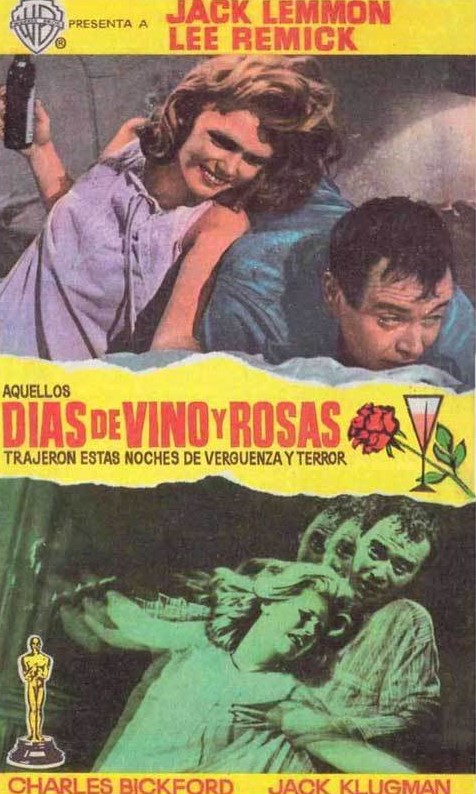
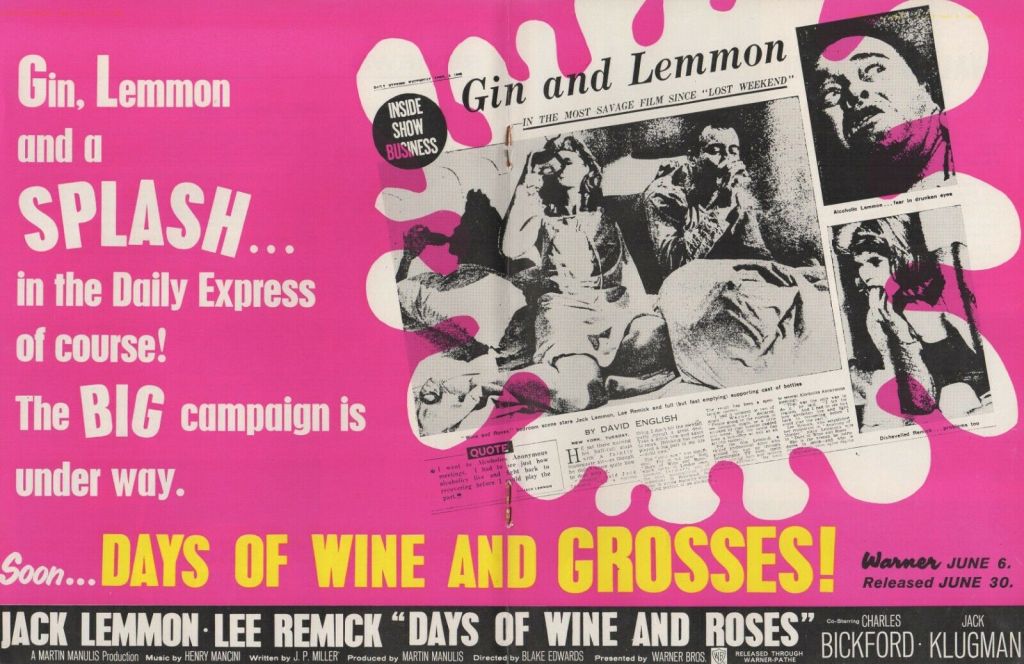
Days of Wine and Roses (1962) *****

A touch of Mad Men satire adds a contemporary bite to tale of the destructive power of alcohol. Not since Billy Wilder let loose on The Lost Weekend (1945) did Hollywood finance a no-holds-barred examination of alcohol addiction.  

But let’s start with the amoral world of advertising or, in this case, public relations. When we are introduced to executive Joe (Jack Lemmon) he’s little more than a pimp for his client, rounding up a plethora of blondes who can be salivated over by wealthy men on a big yacht. When we first meet Kirsten (Lee Remick) she is initially mistaken by Joe as a blonde worth salivating over only to learn that actually she is the prim, though pretty, secretary of his client to whom the idea of a potential pawing on a big yacht has no appeal, regardless of how wealthy the pawing hands might be.

Romance should never have got off the ground as they insult each other in turn, but in the way of such tales, one of his barbed comments strikes home and she consents to be taken to dinner. Astonished to discover she doesn’t drink, he alights upon her weakness for chocolate as a way of getting her to sample Brandy Alexander (as stiff with chocolate as alcohol). That’s all it takes. While she begins to lose her inhibitions, he, ironically, adopts a principled stance towards the aforesaid pimping and is moved to another account.

After they marry, she stays off the sauce once a baby arrives, he, petulant at taking second place to the baby, gets deeper into the stuff. Eventually, he wears her down, and they have a whale of a time getting drunk and ignoring the child. Meanwhile, he is sliding lower down the company pyramid thanks to his drinking. Matters come to a head when she sets the apartment on fire.

Eventually, jobless, Joe throws himself on the mercy of Kirsten’s stern father Ellis (Charles Bickford) and they manage a good few months on the wagon until in a drunken spree he manages to destroy a greenhouse at his father-in-law’s landscaping business.  Joe ends up with the DTs, committed to a sanatorium and determines to mend his ways. But that means admitting his addiction and joining Alcoholics Anonymous. Kirsten, meanwhile, is not such a softie, refusing the believe she is an alcoholic.

Their bright future darkens by the minute as squalidness and selfishness take over. In some senses, this is a case study of the alcoholic, the one who can fight the demons and the one who can’t be bothered to fight anything since the bottle is the easiest cure.

Made at a time when Hollywood was not predisposed to this kind of sharp shock of reality, not even with attractive stars to make the tale more palatable, this is easily the highlight of director Blake Edwards’ career, the comedies and even the romanticised Breakfast at Tiffany’s (1961) seeming like so much fluff in comparison. He manages to avoid being either sentimental or sanctimonious and possibly the only time he holds back is when the fire takes place off-screen. Otherwise, it’s light years ahead of The Lost Weekend, whose protagonist seems more easily than humanly possibly to beat the addiction.

If you think Jack Lemmon (How To Murder Your Wife, 1965) is usually a hyperactive character anyway on screen, wait till you see what’s he’s like with a drink in him, just as if he doesn’t know when to stop, consequence never entering his consciousness, as like any drunken maniac he’s living in a fantasy world. But because she starts out on a different dramatic plane, and her slide into incoherence is more sobering, Lee Remick  (No Way to Treat a Lady, 1968) beats him to the critical kudos. Terrific performances from both and from those tasked with keeping them in line, Charles Bickford (The Unforgiven, 1960) and Jack Klugman (Goodbye, Columbus, 1969) as the recovering alcoholic trying to get Joe to face up to his condition.

In all the literature devoted to twentieth century humanitarians, you’ll find few busting a gut to highlight the work of Bill Wilson (better known as Bill W), the founding father of Alcoholics Anonymous. But this self-funded organisation that created a community for the addicted probably did more in the last century to cure a terrible disease than any scientist inventing a drug. Incidentally, James Garner played Bill in a television biopic My Name Is Bill W (1989).

Sometimes I think actors take on roles aiming to enhance their reputation by playing difficult unsympathetic characters. But I imagine Lemmon and especially Remick got the shock of their lives on seeing the completed movie because their character disintegration is so total it would have required teams of public relations executives to put a good spin on a picture that shows human beings in such a depressing light, almost disempowered by their addictions. First appearing as teleplay in 1958, writer JP Miller (The Young Savages, 1961), while adding more gloss for the movie adaptation, nevertheless does not shrink of the unpalatable truths.

Superb all-round effort.

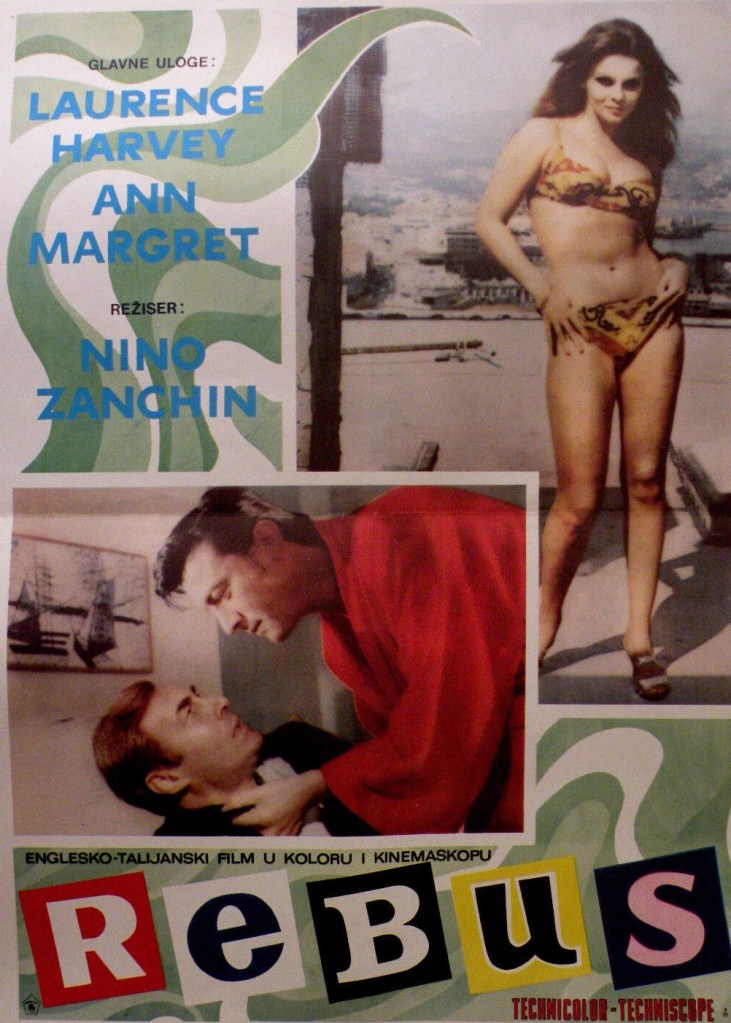
Rebus / Appointment in Beirut (1968) ***

Ann-Margret, at this point in her career, must have had a clause written in her contract that she gotta sing, gotta dance. And you can see the sense of that demand because, as in previous films, she proves she can shake her booty, that number more of a showstopper than her earlier crooning. But, honestly, she has taken a backward step in terms of billing. Here, she’s effectively the leading lady rather than the top-billed star, and really, beyond the dancing, little more than “the girl.”

The heist itself is niftily done, making use not just of such an old-fashioned notion as a magnet but also making a pitch for early recognition as one of the originators of solar power. (How that combination works out, I’ll leave to your imagination.) But, in a twist in the heist genre, the focus is largely on those trying to stop a major robbery from a casino in Beirut, the latest in a series of thefts from top casinos around the world. And it’s not a heist in the normal sense. Millions of dollars have gone missing, but no one can figure out how.

Naturally, your automatic port of call would be an alcoholic croupier, Jeff (Laurence Harvey), currently working at The Playboy Club in London because it’s about the only city where he’s not been blacklisted. Anyway, handed a ticket to Beirut and the prospect of some easy cash by Benson (Jose Calvo) who initially appears as a drunken apparition in the fog, Jeff decides it’s the easiest option.

Benson, it transpires, is not the shady character Jeff imagined, but some kind of investigator entrusted with finding out who is defrauding the casinos. Jeff makes the acquaintance of night club singer Laura (Ann-Margret), who soon develops a soft spot for him, but not enough to join him for a drink (or, presumably, sex) after work since that time is set aside for current squeeze Ghinis (Ivan Desny).

No sooner has Jeff worked out that a huge amount of cash is at stake than he carves himself  a slice of it, $100,000, working for Benson. But, no sooner has he won that particular lottery than the bad guys make a counter-offer, the same amount but at least you’ll come out of the deal alive. Laura is clearly some kind of bait to keep him sweet, though she could be bait for hundreds of customers as she shakes her booty during her big number, “Take a Chance,” the lyrics, ironically enough, encouraging gambling.

This being the kind of European co-production that requires assistance from the authorities, we are treated to a tour of the sights of Beirut (there’s also a journey by motorbike earlier on from Highgate in London to Mayfair and by taking rather a detour manages to take in many of the capital’s finest tourist sites). The Beirut leg of the movie itinerary takes in a traditional concert in some first-class ruins, a bazaar, and for reasons that may be more to do with commercial concerns than tourist, an oil refinery.

There’s also a very irritating shrill American, Mrs Brown (Camilla Horn), who, constantly getting in Jeff’s way, appears to be there just for comic effect, intent as if she had a social media channel to film everything in view. Turns out her movie camera and the lady herself are there for another purpose entirely.

The heist, itself, is particularly well done, especially as it appears to be achieved by a bunch of proper strangers – that is people who seem to have no connection to each other at all rather than the old trope of strangers coming together for a robbery by the end of which they know far too much about each other.  

Unfortunately, from the narrative perspective and for fans of Ann-Margret (The Swinger, 1966), she is less the femme fatale than the equivalent of the dumb blonde. But pretty much you could have advertised this as starring two Hollywood stars who had fallen from grace and were taking Italian coin because little else was on offer. Laurence Harvey (Life at the Top, 1965) is actually pretty good, when sober capable of dealing with good guys and bad guys and with still enough charm to make romance with Ann-Margret seem plausible. Except that this is not a great movie, though interesting enough in a double-cross kind of way and the heist is good, both actually acquit themselves well, Ann-Margret correct in her assumption that her dancing goes a long way to keep audiences sweet.

This was only the second film for director Nino Zanchin, and the fact that he only got to make one more tells its own story.

You may have been scratching your head, wondering when the hell “Rebus” is going to appear or perhaps imagine it’s some kind of code word or password. No amount of head-scratching by myself right to the end of the movie made any sense out of this title. That was the original title, but some distributors, fed up presumably with scratching their heads, opted for the more sensible Appointment in Beirut.

An okay watch, some decent twists and lifted I guess you would have to say by Ann-Margret’s dance number more than Laurence Harvey’s snippy performance

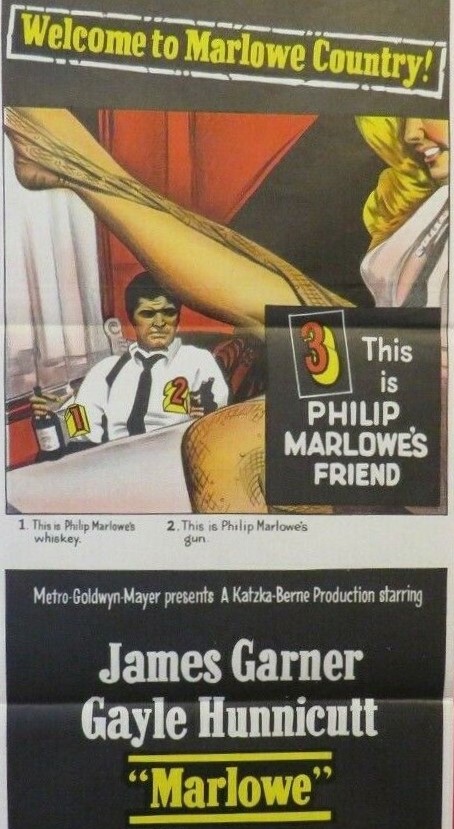
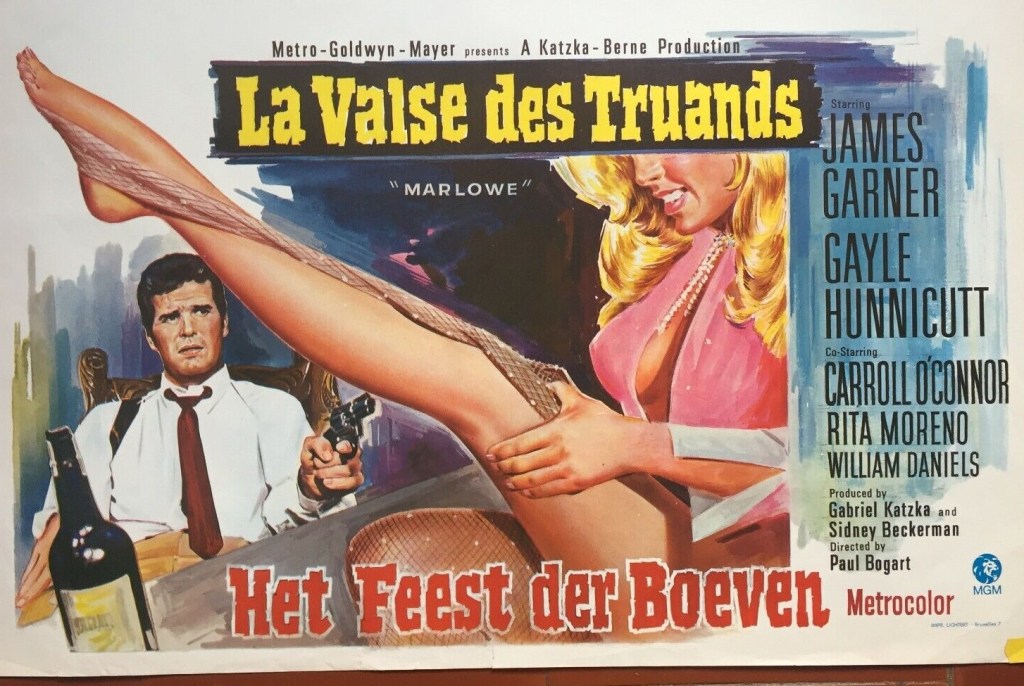
Marlowe (1969) ***

Anyone breaking into the private eye market in the late 1960s had to content not only with the ghost of Humphrey Bogart but a heavyweight slugger name of Harper (1966) whom Paul Newman had fashioned into the most likely contender for the Bogart crown. Ironically, it was growing interest in Bogart that spurred on an imitator. His movies, screened two hundred times a year on television, created an initial cult following, his persona maximized to the full by the reissue on the tenth anniversary of his death of 45 of his pictures plus the half-dozen biographies that appeared in a three-month stretch.

As it happened a couple of Raymond Chandler novels, The Little Sister and The Long Goodbye never before filmed and theoretically at least avoiding comparison with the past, were up for grabs. The Little Sister was the chosen vehicle. But, anyone chancing their arm in the role of Philip Marlowe was likely to be met with jibes of “he’s no Humphrey Bogart.”

That’s not the only problem here. The story is awfully convoluted, it’s been updated to a modern Los Angeles complete with hippies and gym work-outs and screenwriter Stirling Silliphant has chucked away the bulk of the original dialog. So, little remains of what made the character compulsive viewing in the first place.

Marlowe (James Garner) is investigating the disappearance of the brother of Orfamay Quest (Sharon Farrell), a young woman from Kansas, when he stumbles upon a couple of ice-pick murders and a pack of incriminating photos that depict television sit-com star Mavis Weld (Gayle Hunnicutt) – no slouch herself at knocking people out – in a compromising situation with top-line gangster Sonny Steelgrave (H.M. Wynant) whose speciality had been killing people with an ice-pick. So it’s a murder/blackmail double whammy.

The plot thickens when Winslow Wong (Bruce Lee) tries to pay him off and when that fails wrecks his office by demonstrating the kung fu skills that would later make that actor a star.  Detective Lt French (Carroll O’Connor) is the typical dumb cop that Marlowe runs rings round. Also entering the fray is exotic dancer Dolores (Rita Moreno), a friend of Mavis, and to liven things up for the gumshoe a girlfriend Julie (Corinne Camacho) who has some nifty one-liners when Ofamay attempts to seduce her boyfriend. And there’s any number of Steelgrave’s thugs who make any number of attempts to scare Marlow off.

Eventually, after being drugged by Dr Vincent Lagardie, Marlowe finds the missing brother, Orrin, who, while dying, attempts to kill the detective with an ice-pick. Assuming that clears up both cases, Marlowe then discovers that Orrin, Mavis and Orfamay are siblings.

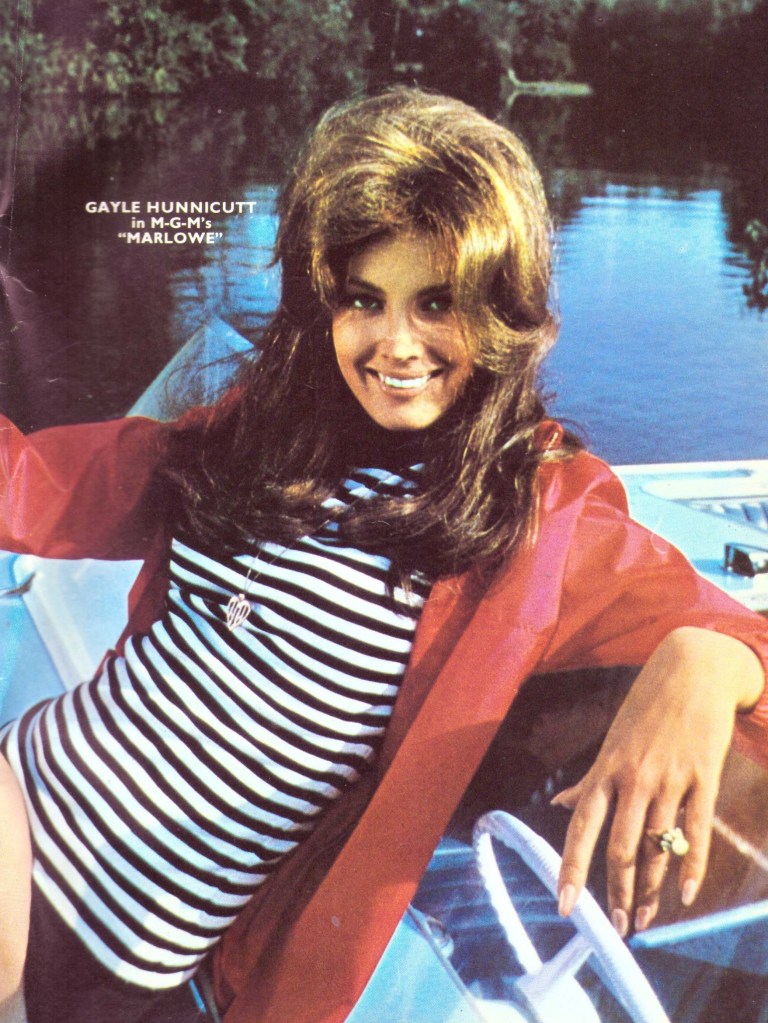
Hunnicutt is given the pin-up treatment in ABC Film Review.

But the tale still has some way to go, uncovering a hornet’s nest of spite and revenge among the warring siblings. There’s way too cute an ending though whether that was Silliphant’s invention or the tack taken by Chandler I have little interest in finding out, exhausted as I am by a seemingly endless series of twists and turns.

I’m not exactly sure what’s missing from this except a femme fatale – Mavis makes no moves on Marlowe, though her sister, who hardly qualifies as a femme fatale, does. It’s unfair in a sense to complain that it’s not following the Chandler template when so much effort has gone in to trying to initiate something new. If it had been called anything else, or the name Marlowe substituted by Smith, then we wouldn’t be thinking so much of the source material or the imitable Bogart.

Confusingly, there is a Bogart involved, director Paul Bogart (The Three Sisters, 1966 – from the Checkov play and no relation to The Little Sister) and although he keeps the plot ticking along – who wouldn’t with so much plot to tick – that’s pretty much all he does, in the cold light of Los Angeles hardly able to emulate the film noir setting.

So, effectively, it’s up to James Garner (Mister Buddwing, 1966) to pull the whole movie together, or put another way, keep it from falling apart. Audiences, much taken with the actor’s reinvention of his screen persona in his previous picture, comedy western Support Your Local Sherrif (1969), didn’t bring sufficient box office support. Garner is okay but sorry to say he’s no Bogart.

Rita Moreno (Night of the Following Day, 1969) is the pick of the supporting cast. Gayle Hunnicutt (Eye of the Cat, 1969), given the type of billing that elevated Lauren Bacall to super-stardom, doesn’t do enough to achieve the same.  Interestingly, both Garner and Hunnicutt went down the shamus route in television in the future, the former in The Rockford Files (1974-1980), the latter in an episode of Philip Marlowe, Private Eye (1983).

If you’re a fan of Garner a reasonable watch. If you’re a fan of Chandler or Bogart you’d be inclined to give it a miss.

Discover WordPress

A daily selection of the best content published on WordPress, collected for you by humans who love to read.

The Atavist Magazine

by Brian Hannan

WordPress.com News

The latest news on WordPress.com and the WordPress community.