A post-WW2 operation to save a handful of Japanese adrift at sea in a storm is endangered when three members of the U.S. Air Force Air Rescue Service confront conflicts from their past. Despite tense rescue action, this is basically a three-hander about guilt and how men deal – or fail to deal – with emotions. Extended flashbacks illuminate the tangled relationships between Sgt Takashima (Yul Brynner), Lt Col Stevenson (Richard Widmark) and Second Lieut Gregg (George Chakiris). Unusually, for the period, tough guys actually emote.
So really it’s like one of those portmanteau films that are occasionally popular – like Trio (1950) made up of Somerset Maugham short stories or similar to something like the Oscar-winning Crash (2004) where characters interconnect after an accident. While each of the episodes stands up in its own right, the thrust of the narrative revolves around actions taken in the past having a direct bearing on the present situation.
Gregg is haunted by causing an avalanche after flying his helicopter too close to a mountain and, as a result, by having to leave behind many of the victims, due to restricted capacity on board, and now he is terrified of flying solo. As a consequence Stevenson has no faith in abilities as a pilot.
Stevenson also has an abiding hatred of Japanese – colleague Takashima of Japanese ancestry also bears his wrath – because his ill wife Caroline (Shirley Knight) and child died in a Japanese prisoner-of-war camp because medical supplies were reserved only for the Japanese. Faced with rescuing Japanese, he is enraged.
For his part, Takashima, a paratrooper during the war, inadvertently caused the death of his Algerian girlfriend Leila (Daniele Gaubert). It’s not so much an examination of tough guys under pressure as about their inability to deal with the consequences of action. There’s certainly a sense that the only way men like these have of dealing with trauma is to throw themselves into dangerous action.
Yul Brynner (The Double Man, 1967) gives a more thoughtful performance than you might expect while Richard Widmark (The Secret Ways, 1961), himself dabbling in production elsewhere, was good value. Goerge Chakiris (The Young Girls of Rochefort, 1967) was a weaker link. The presence of Suzy Parker (Circle of Deception, 1960) and especially Daniele Gaubert (The Golden Claws of the Cat Girl, 1968) strengthen the film.
Unusually, at a time when product was in short supply and for a film boasting a strong cast, the picture was shelved for two years after completion. Presumably explained by the demise of Harold Hecht’s production company after he split with Burt Lancaster. Michael Anderson (The Shoes of the Fisherman, 1968) directed from a screenplay by Waldo Salt (Midnight Cowboy, 1969) based on the novel by Elliot Arnold (Kings of the Sun, 1963).
The title’s a bit of a misnomer, suggesting someone is trying to escape from Ashiya when, in fact, that is just the name of the air base where the rescue team are located.
Critics complained it was neither one thing nor the other, but in fact I found it a perfectly satisfactory combination of action and drama, especially as it dealt with rarely-recognized male emotions.
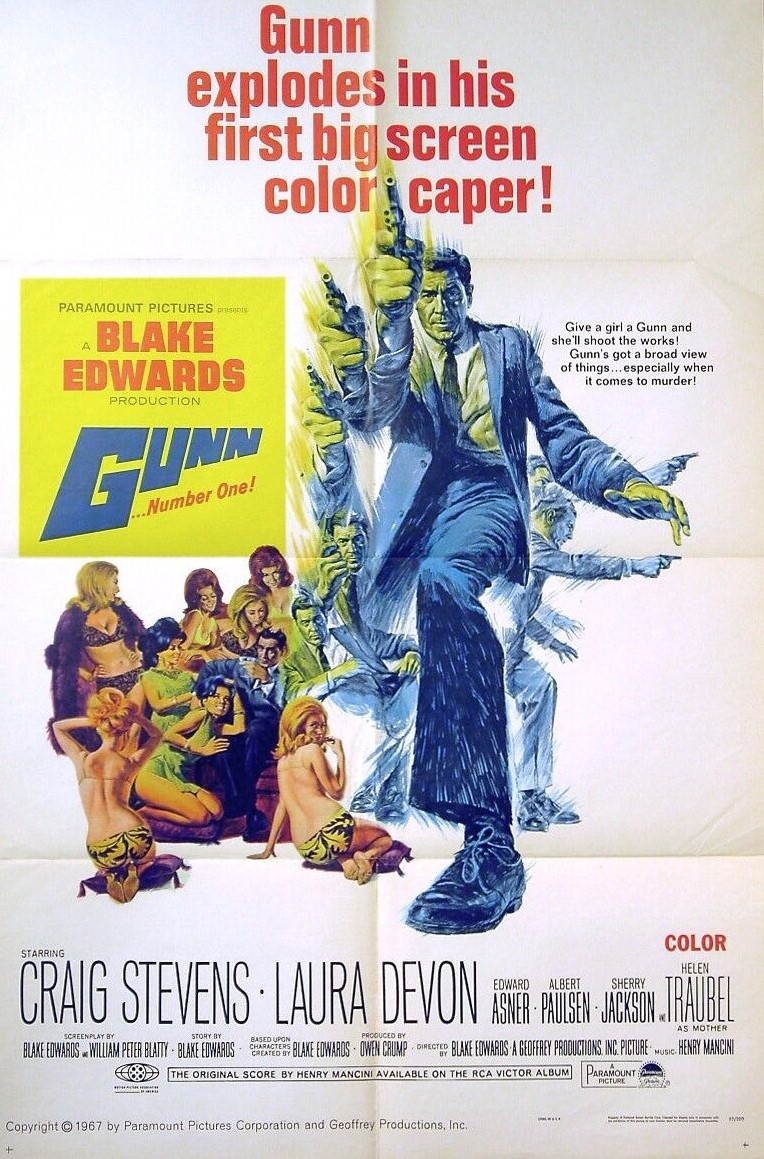
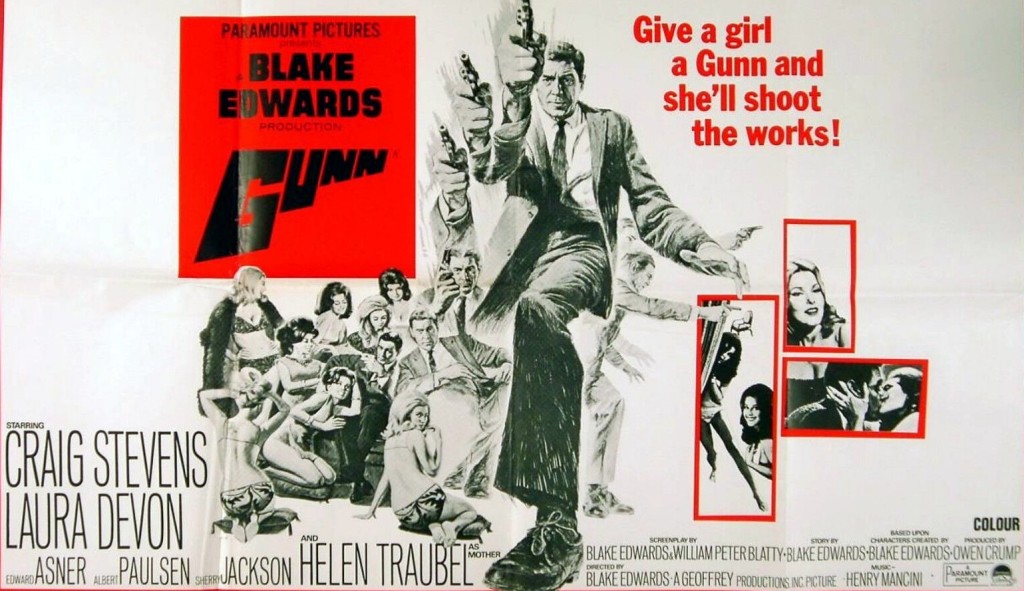
Director Blake Edwards was so confident that he could repeat on the big screen the small screen success of Peter Gunn (1958-1961) that the movie was promoted as the first in a series. He couldn’t have been more wrong.
Although the private eye genre had been given a fillip by Paul Newman’s shamus Harper (1966) the bulk of screen investigation has been subsumed wholesale by spies. And the amount of time that had passed between the demise of the original television series and the movie revival – only six years – was hardly enough for nostalgia to kick in. Nor did star Craig Stevens have any box office appeal – this was his first picture in nearly a decade.
A James-Bond-rip off credit sequence with girls dancing to a psychedelic background sets up a more contemporary picture than the one unveiled which is as old-fashioned as they come and, except for an increased budget, betrays its television origins. A few characters, Gunn’s girlfriend Edie (Helen Traubel), a nightclub singer, Mother (Laura Devon), the owner of the eponymous nightclub, and Lt Jacoby (Edward Asner) are reprised from the series although played by different actors.
The dialogue is sometimes slick (“Call me Samantha” – “Samantha” – “You called”) and sometimes corny as when prior to an explosion that knocks the hero sideways is the line “may God strike me down.”
Gunn is hired by a nightclub owner Mother to find out who killed a gangster who had once saved the detective’s life. Fingers point at another gangster, Nick (Alberto Paulsen), somewhat protected from the law by his corruption, but it soon becomes clear that the obvious may not be correct. Naturally, Gunn gets in the way of Lt Jacoby, while women fall at his feet.
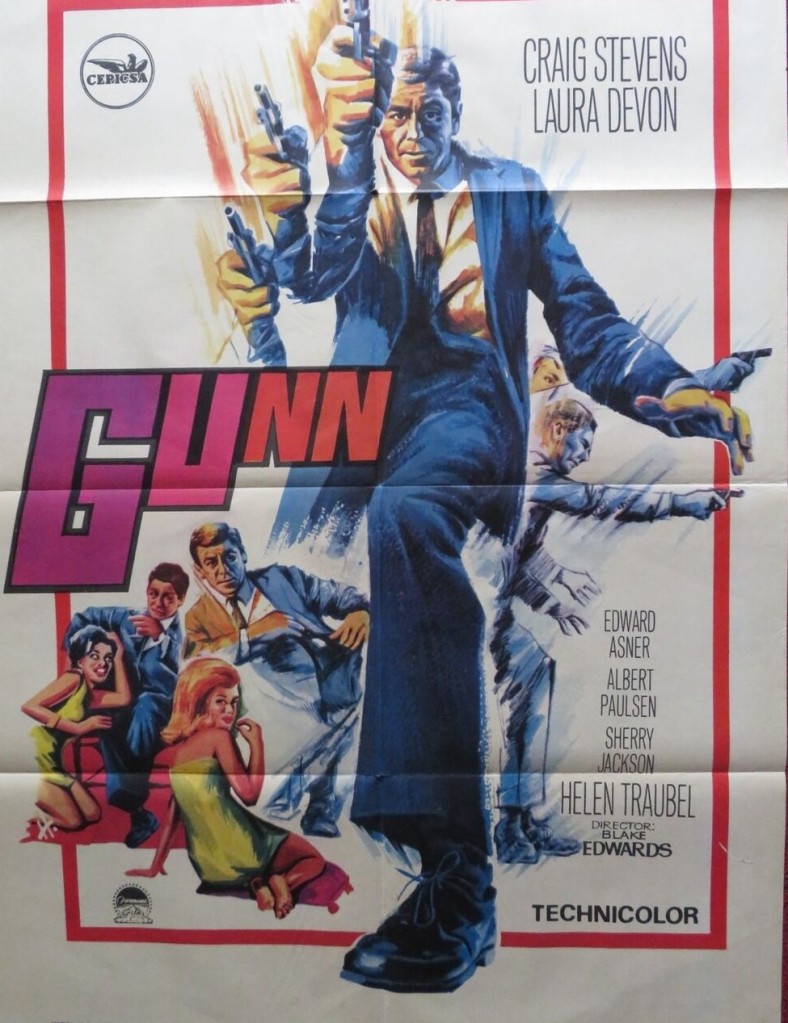
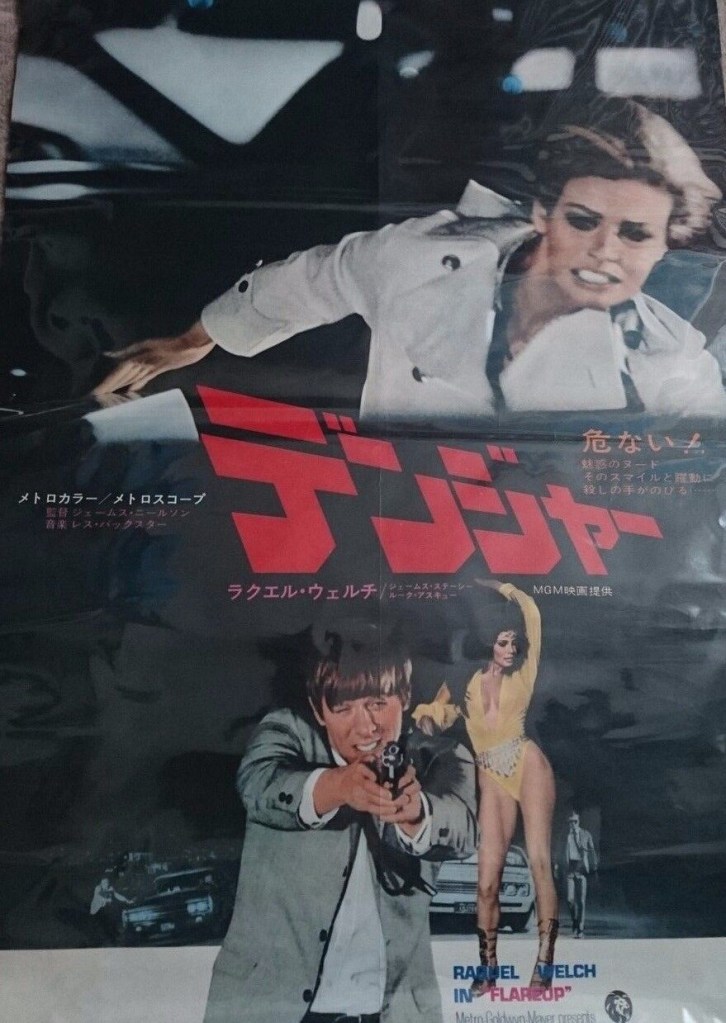
Somewhat unusually, in this foreign poster the women are covered up.
Making the biggest impression is Sherry Jackson (The Mini-Skirt Mob, 1968) as the aforementioned Samantha who turns up unannounced in Gunn’s flat. You can catch Edward Asner (The Satan Bug, 1965) in an early role. Plus there’s the Henry Mancini (Breakfast at Tiffany’s, 1961) score, already a big hit. The only element that makes it contemporary is some gender-confusion but otherwise it’s a fairly flat story and relies far too much on its television origins.
Rather than go to the trouble of reinventing the character for more contemporary times, Blake Edwards (The Grip of Fear / Experiment in Terror, 1967), wearing two hats, simply rewrites the small screen’s first episode, adding some violence to attract a cinematic audience.
It might have been better had William Friedkin not turned it down, but given how poorly that director served The Night They Raided Minsky’s / The Night They Invented Striptease (1968) it could well have had the same outcome.
Strictly for fans of nostalgia.
You can catch the original TV series on DVD or check out the movie version for free on YouTube.
Even the biggest stars have to start somewhere. Julie Christie in embryo, however endearing, is a long way from the finished article in Doctor Zhivago (1965). And, to be honest, this is more of a reminder of the scale of the journey undertaken for here she’s really no more than an adornment. Though, possibly, as rich man’s daughter Claire, she’s acting her socks off given her main role is to fall in love with gormless civil servant Murdoch (Stanley Baxter) after imagining him dressed in a kilt spouting Burns.
And at this point in cinematic development, cars were viewed more as sources of comedy than thrills, anyone suggesting that vehicles could be pushed to their limits in the breakneck manner of Bullitt (1968) and The French Connection (1970) would have their heads examined.
This poster and the one below bear all the hallmarks of a quick reissue to take advantage of Christie’s post-Zhivago fame.
Cashing in on audience love of the antique auto as demonstrated in Genevieve (1953), and with a surprisingly contemporary nod to the ongoing battle between cyclists and drivers, this mainlines mostly on a long-lost innocent charm even as car salesman Freddie (Leslie “Ding Dong” Phillips) injects as much innuendo (though not on the Carry On level) as possible.
After coming off worst in a collision with aforesaid rich fellow Charles (James Robertson Justice), cyclist Murdoch decides to buy an old Bentley Red Label 3-liter (the titular “Fast Lady”) sports car as a means of wooing speed-mad Claire. As you might expect, the path to true love is littered with obstacles, not least the overbearing father’s objections and the small matter of Murdoch not being able to drive. Cue jokes about driving lessons and tests and a mistaken arrest for drunk driving. There’s endless opportunity for protagonists to end up in the mud or the water.
Legally, in the credits, her name had to be smaller than the top-billed stars. But there was nothing to prevent distributors from making her face the focus of attention.
Feels miscast somehow, the top-billed Leslie Phillips (Maroc 7, 1967) has misplaced his normal charm, coming across as little more than an upper-class spiv. And you can’t help feeling Norman Wisdom would have been better suited as Murdoch rather than snarky Scottish comedian Stanley Baxter (Father Came Too, 1964) while James Robertson Justice (Mayerling, 1968) never leaves his comfort zone.
On the plus side are too many treats to mention. Apart from Christie and a glimpse of Stanley Baxter before he dominated the British light entertainment television scene, in bits parts are such comedy legends as Dick Emery, Frankie Howerd and Clive Dunn (and singer Kenneth McKellar on television) plus a smattering of racing idols like Graham Hill and John Surtees and a cameo from BBC motoring correspondent Raymond Baxter.
Ken Annakin (Battle of the Bulge, 1965) isn’t much stretched though keeping the script by Jack Davies (Those Magnificent Men in their Flying Machines, 1965) and Henry Blyth (A Stitch in Time, 1963), based on the book by Keble Howard, on the straight-and-narrow may well have been his most difficult task.
May be heresy but for some viewers Julie Christie will take second place to the array of vehicles.
Although a truly innocent movie about young love, wrapped up in a sunken treasure scenario, the marketeers then and now could not resist trying to inject elements of sexuality, the poster for the original movie highlighting what would be Hayley Mills’ second screen kiss (following a smacker from Peter McEnery in The Moon-Spinners the year before), the poster for the DVD sticking the star in a bikini that she does not wear in the film.
The film was based on the 1921 novel Satan: A Romance of the Bahamas (filmed as Satan’s Sister in 1925 with Betty Balfour) by Henry de Vere Stacpoole, who had previously dallied with young love in The Blue Lagoon. Despite the title, there was a complete absence of the demonic. In the book, she is sailing with her brother. That character was eliminated in favour of a father.
The 1960s teen movie that could as easily morph into angst (Splendor in the Grass, 1961), blackmail (Kitten with a Whip, 1964) or madness (Lilith, 1964) was generally more at home with innocence. The beach party movies and series like Gidget rarely involved more than a stolen kiss, the characters all clearly virgins, and certainly did not go down the brazen sexuality route that would mark the second half of the decade.
Hayley Mills is on charming form as tomboy Spring Tyler (hence the title) sailing the Caribbean as mate to her conman father Tommy (played by her real-life father John Mills). Their idyllic life is heading for the rocks since the father didn’t “figure on the little girl growing up.” With one eye on providing a suitor for his daughter, the skipper takes on board a Harvard Law School graduate William (James MacArthur) ostensibly to give him experience of fishing.
True love takes its time since the girl has no intention of growing up and prefers a life of independence. Initially, they are sparring partners – she mocks the fact that he wears pyjamas. But once the story kicks off, they find they have more in common.
The sunken treasure element, while slim, is enlivened by some over-the-top acting by Jose (Lionel Jeffries) and Judd (Harry Andrews). The three leads are actually quite good, John Mills (Tunes of Glory, 1960) totally convincing as a effectively a spiv on the high seas with Hayley Mills (The Family Way, 1966) as the independent woman (“I’m me so don’t expect anything else”) and the confident sailor becoming entangled in unexpected emotions.
Surprisingly, James MacArthur, also a graduate from the Disney acting school, though a decade older than Hayley Mills, shows unexpected subtlety, and this would be a springboard to more demanding roles in cold war thriller The Bedford Incident (1965) and WW2 epic Battle of the Bulge (1965). Cocky and rich, he is quickly brought down earth when she proves a faster swimmer and plays tricks on him. But he soon proves his worth.
Director Richard Thorpe’s career was winding down after four decades in the business and this was a far cry from MGM spectaculars Ivanhoe (1952) and Knights of the Round Table (1953) and even Jailhouse Rock (1957) but he keeps a tight rein on the narrative, makes good use of the scenery (Spain doubling for the Caribbean) and walks the delicate line of allowing the adolescents to explore their feelings with tipping over into anything more overt.
He was a better director than the material deserved, but then so was writer James Lee Barrett who the same year would receive screen credit for The Greatest Story Ever Told and western Shenandoah. However, their involvement made it an accomplished little picture and gave audiences a taste of what Hayley Mills could do in a film that did not tether her to child star mode.
The New York Times second-string reviewer Howard Thompson, in tagging the star “this delectable miss, now all of 18” opined (review, June 17, 1965) that the “two young people are the most winning advertisement for young love in a long time.”
Says everything about Raquel Welch’s position in the global box office firmament that she was chosen to head up the launch of a new production company formed by J. Ronald Getty, son of the billionaire oil tycoon. Given she was a lot more affordable than the likes of John Wayne, Paul Newman and Doris Day, nonetheless in terms of audience recognition and fanboy delight, Welch was, thanks to endless magazine spreads, just about the best-known star on the planet, with a popularity among editors that came close to emulating Elizabeth Taylor at her Cleopatra-controversy height. While still the most popular cover star of the popular magazine, she also featured in a 10-page spread in Vogue.
Welch was at a box office peak. The success of One Million Years B.C. (1966) and Fantastic Voyage (1966) had catapulted her into the marquee stratosphere. Bandolero (1968), Lady in Cement (1969) and 100 Rifles (1969) consolidated her position and her involvement guaranteed her films opening in countries that weren’t so keen on private eye capers or even Frank Sinatra for that matter.
Not more artistic license! Suffice to say, Welch doesn’t don this outfit.
She was high on the wanted list for major studios – 20th Century Fox had signed her up for Myra Breckenridge (1970) and Columbia for Dubious Patriots (renamed You Can’t Win ‘EmAll, 1970, but minus her presence). Italian producer Franco Cristaldi had her in mind for An Average Man (not made either after she dropped out) with Karl Malden and Peter Falk.
Commonwealth United, another major start-up, had joined forces with her husband Patrick Curtis to make Tilda, based on the novel by Elizabeth Kate (Patch of Blue, 1965). And Curtwel, the Welch-Curtis production arm, had also set her to star in Laurie Lee in Movies, “a vicious Hollywood love story” to be directed by actor Robert Culp (Bob and Carol and Ted and Alice, 1969).
It didn’t seem odd at the time for someone more familiar with the oil business to be jumping into the Hollywood nest of vipers. The takeover splurge of the 1960s had seen traditional conglomerates such as Gulf & Western enter the movie business. In fact, Getty was viewed as representative of “one of the most significant developments in the current trend of investment by leading industrial and financial figures.”
Getty (aged 34) teamed up with accountant Richard McDonald and veteran producer Leon Fromkess (57) to form GMF. Best known for Edgar Ulmer film noir Detour (1945), from an industry perspective Fromkess, a former production executive for Eagle Lion and Samuel Goldwyn, was admired for turning out low-budget numbers like Ramar of the Jungle (1952). Getty was determined not to plough a huge chunk of money into risky ventures.
“We intend to become a dominant factor in the industry,” he proclaimed. And like many outsiders considered Hollywood too bloated for its own good. “Sound business practices are equally applicable everywhere. Small hard-hitting outfits with a short chain of command can run rings round (the) major complex studio structures.”
Fromkess averred, “We are convinced that there is always a marketplace for films which are made independently, economically and in tune with today’s entertainment requirements.”
Welch and GMF turned out to be well-suited. The actress wanted to move away from the cheesecake roles on which her fame was based. And while the majors would have rejected the idea of Welch not spending an entire film in skimpy costume, or rolling around in bed with a co-star, or otherwise exuding sex by the inch, a newcomer would be more likely to allow concessions.
A budget of just $1.3 million, a substantial chunk of which ended up in her pocket, did not extend to providing her with a name co-star, so she was happy to be reunited with James Stacy, leading actor in her debut picture A Swingin’ Summer (1965), whose laid-back persona made a change from the testosterone heavy Jim Brown and Burt Reynolds and Hollywood veterans like James Stewart and Frank Sinatra.
In this film she would not be viewed as an adornment, and in fact was able to exert her authority, demanding that the company change the ending so that she drives away on her own rather than end up as prospective wife. A woman who had just dispatched the villain by dousing him in petrol and setting him alight was hardly going to settle for hearth and home. (The cliché ending, it has to be said, was what made it into the final picture. But the finale chosen by the producers, rather than the one Welch assumed had been agreed, was an expression of male dominance. Originally, the boyfriend had agreed to accompany her to Mexico but when he got cold feet she drove off. And I have to agree that seemed an apposite end. Except, for no reason at all, she turns back.)
The film was shot on location in Las Vegas and Palm Springs with interiors at the Goldwyn Studios. The zoo, focus of a womanhunt, was the original Los Angeles Zoo which had closed in 1966. Although the soundtrack suggested some animals had been left behind, that was a construct. The Los Angeles go-go club featured had been a favorite talent-scouting spot for soft porn king Russ Meyer.
GMF aimed to be self-funding, turning to the majors only for their distribution know-how. It says everything about Raquel Welch’s box office prowess that MGM ponied up for global distribution rights just four months after Flareup began shooting, the studio, at that time, not known for pick-ups. With the tiny budget, that probably spelled immediate profit.
Despite its poor box office in the United States – only one week on the Showcase circuit in New York, with Elvis vehicle The Trouble with Girls (1969) in support – her face on the poster guaranteed the movie opened globally. MGM wasted no time sticking it out on the reissue circuit as a support and it was heavily promoted in the 1972 television feature film season.
While it may have not achieved its aims at the box office, her performance was noted more favorably by critics than ever before. Box Office opined it “proved her dramatic ability,” Kine Weekly maintained that “Raquel Welch who normally is not asked to rely on anything but her looks adds some acting to her performance” and even Variety agreed she did “a good job.”
GMF soon had five more movies set to go – cop drama Brutes in Brass (later retitled Not Yet a Widow), comedy drama Charlie Olive, World War One adventures Zeppelin and Lion of Africa, and Sheila to star Brenda Sykes. In keeping with its lean operation, budgets remained modest. Just $1.2 million was set aside for Charlie Olive, $1.25 million for Sheila. Recreating World War One was perceived as more tricky financially, Zeppelin budgeted at $1.7 million but topping out at $2 million and Lion of Africa with $2.5 million. Warner Brothers had come on board as distributor.
While only two pictures – Zeppelin (1971) and Honky (1971, the former Sheila) of the initial five announced by GMF – went into production, Getty remained in the movie business, the company slimmed down to Getty & Fromkess for George C. Scott vehicle Rage (1972) and just to Getty Pictures for Jack Cardiff horror picture The Mutations (1974).
I thought I’d be taking one for the team in tracking down this much-maligned Raquel Welch number. Instead, I was pleasantly surprised. Oh, the movie’s nothing to write home about, desultory home invasion thriller that fails to come close to Kitten with a Whip (1964), Wait until Dark (1967) or The Penthouse (1967). But La Welch is something of a revelation.
Forget the Las Vegas go-go dancer come-on, this is more of a gentle romance. While attractive, Welch dispenses with the bra-busting outfits and overt sexiness, settling for a girl-next-door persona. In fact, you could have dumped the entire murder plot and had a more interesting picture, along the lines of Fade In (1969) where the normal hot-to-trot Burt Reynolds plays a gentler character.
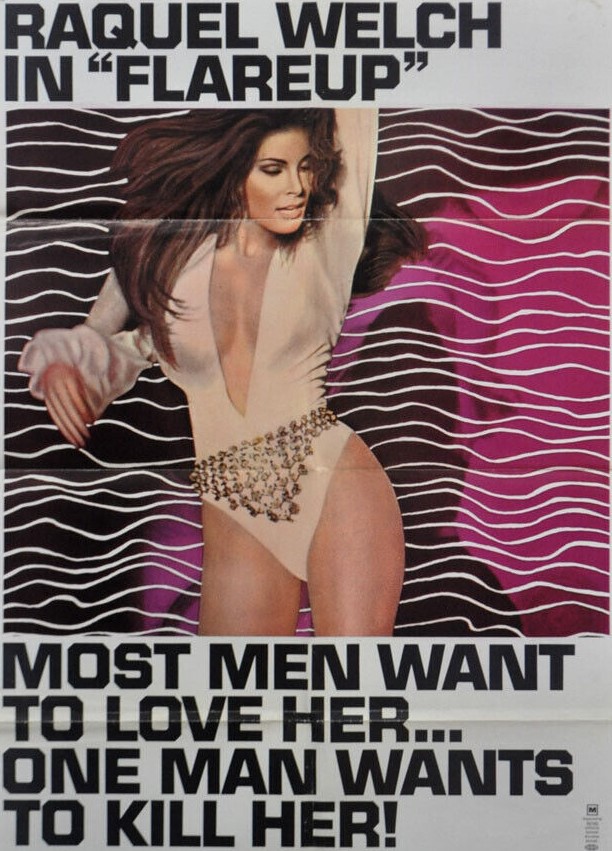
Artistic license taken to an extreme. Raquel Welch is a brunette not a redhead.
Since, (spoiler alert) in her sole dance number Welch keeps her attributes well-hidden, the producers felt obliged to stick in some topless dancers (quite how Welch is permitted to keep her clothes on in a topless go-go bar is never explained) which gives the picture a sleazy feel that runs counter to the tone of the romance.
So, Michele (Raquel Welch) is on the run from nutjob killer Alan (Luke Askew) who has bumped off his ex- Nikki (Sandra Giles) and her friend Iris (Pat Delaney). But why Michele is in the killer’s sights is never satisfactorily explained, except that she purportedly turned Nikki against him. Michele swaps Las Vegas for Los Angeles, finding work in another go-go bar and romance with Joe (James Stacy) whose interest in bull-fighting might have scared her off. But that’s tempered by his enthusiasm for flying model airplanes (an important plot point it transpires).
Cops are on the killer’s trail but not before he bumps off a guy who gave him a lift. Michele’s not hard to find, a drug addict employee of the Las Vegas operation points him in the right direction. There’s some desultory car chase footage and for no reason at all a chase on foot through an old zoo (presumably a genuine old zoo).
I had half-expected there might have been a lion or snake left behind to ramp up the thrill-quotient, but no such luck. What we do get, however, is a rarity in the chase department – exhaustion. Most people being chased on foot manage to drum up an insane amount of energy. Michele, on the other hand, is on the point of collapse.
But she’s not dumb. She might be rootless, not the questing soul of Easy Rider, but driven away by parental issues and, in gaining independence not keen on surrendering it to any passing male. And come the climax, she’s got a nasty weapon up her sleeve.
Essentially, she’s a sweet gal. Not the kind of character you’d expect La Welch to be playing, and perhaps that’s what attracted her to the script. It gives the actress the opportunity to escape from her sexy persona, and, while the tale is hardly weighty, the chance to prove she can do more than hide behind her particulars. Innocence isn’t something you’d associate with Raquel Welch, but here she exudes more of that than earthiness or sex appeal.
James Stacy (star of Welch’s debut picture A Swingin’ Summer, 1965) is a likeable boyfriend, not the kind trying to hustle her into bed. Luke Askew (The Devil’s Brigade, 1968) doesn’t do much except play mean.
James Neilson (The Moon-Spinners, 1964), while not able to jazz up a rancid plot, allows, as he did with Hayley Mills (an odd comparison indeed), Welch the chance to grow up on screen, defusing her sexuality but allowing her space to create a character so far removed from anything previously seen. But the tempo sags with over-reliance on dancing sequences, the Las Vegas backdrop and too much chasing that goes nowhere. Mark Rodgers (Let’s Kill Uncle, 1966) dreamt this up.
One perhaps for completionists. Lack of sexy scenes might be off-putting but, equally, you might want to see what Welch can do when playing against type.
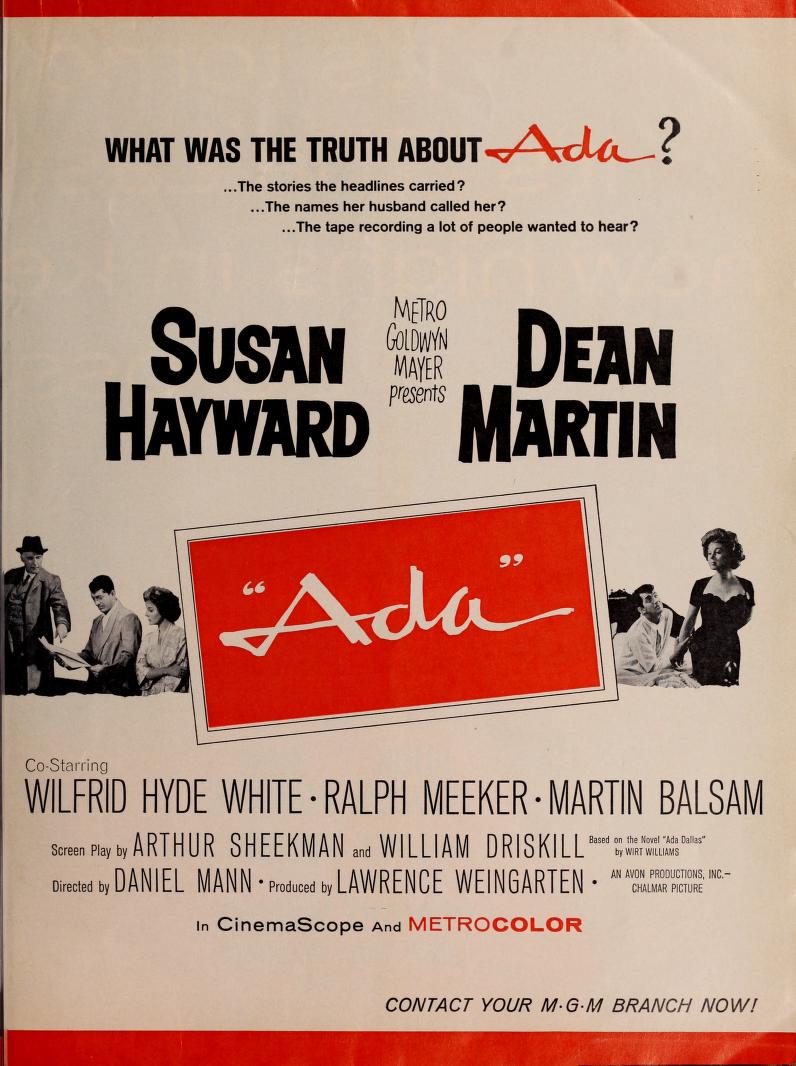
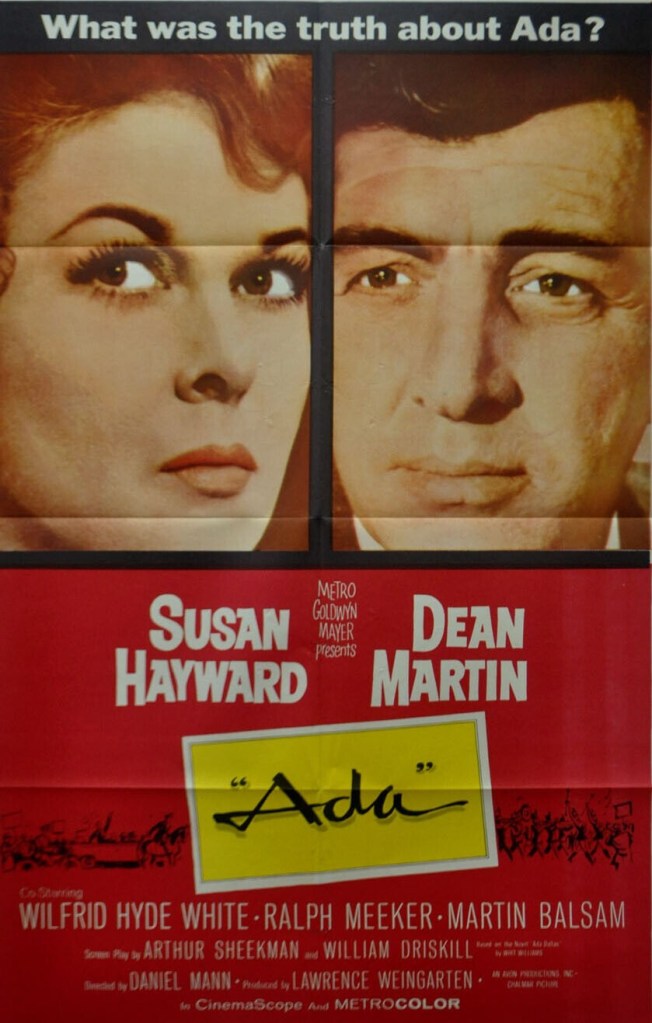
Oddly enough, this shares some elements with Killers of the Flower Moon. For a start Sylvester (Wilfrid Hyde-White), the political fixer, comes over as Robert DeNiro’s benign uncle, both so low-key, charming and persuasive you’d never believe them capable of wicked manipulation. In the second place Bo (Dean Martin) is every bit as charming and baffled as Leonardo DiCaprio.
And just as the latter’s role is to worm his way into wealth and power via marriage, so too that’s the route taken by Ada (Susan Hayward), who would be euphemistically known in those days as a “good-time girl.”
You’d figure this for a mild political satire except for the fact that stooges/buffoons have consistently made their way to the highest political office. As Ada pointedly points out, public appeal is the greatest qualification of any candidate, opportunism a close second. Bizarre as it seems, Bo is a popular local guitar-playing-singer of the Hank Williams variety, a well-meaning dumb-as-they-come sort, whom Sylvester persuades to run for Governor. In the course of the campaign, as “a present in a back-room saloon,” he is served up Ada with whom he unexpectedly falls in love and marries.
His campaign path is smoothed when one of Sylvester’s hacks leaks news that his rival’s wife is an addict, the woman conveniently shooting her brains out. Naturally, Bo soon realizes he’s the sap, his only job to sign hundreds of legal documents every day, pieces of legislation that as it happens fill the pockets of Sylvester and his buddies.
When Bo’s long-time chum Ronnie (Frank Maxwell) threatens to expose the river of sleaze he is quickly eased out. That leaves an interesting vacancy for Ronnie was Lieutenant-Governor, Bo’s deputy. So, Ada, with a good bit more between the ears than her husband, throws her hat into the ring.
She’s to politics born, a particularly wily creature, able to bring into line the society dames who look down their nose on her, and keep tabs on Sylvester. What she doesn’t realise of course is that once you’ve got a very amenable deputy, that person becomes Acting Governor, and in effect Governor, should anything happen to the incumbent. And should she then decide she’s had enough of the sleaze, then a little poking around in her background should bring her to heel.
So, all the corruption you ever dreamt of, all the smart back-slappers ponying up thousands in campaign contributions in order to seek future reward, all that tax-payers money heading in the rich man’s pocket. Not a lot that’s new there.
What makes this stand out are the performances and the narrative arc. Wilfrid Hyde-White (The Liquidator, 1965) is a sensational casting coup. The British actor specialized in characters oozing wry charm, sometimes verging on the dotty, sometimes a tad idiotic, but never an outright swine. There are a couple of scenes where those mellifluous tones turn in an instant into a sharp crack, the avuncular replaced by the sinister.
And I’m not saying DeNiro copies his aging trick, you know the bit later on in Killers of the Flower Moon, when body no longer as sharp as the mind, the actor begins to drag his leg, and with no reference to that impairment. Well, here, similarly, the fit-as-a-fiddle Sylvester later on, still at the height of his mental powers, is seen being transported in a wheelchair.
The performance of Dean Martin (Rough Night in Jericho, 1967) was oddly dismissed at the time. And yet it was bold playing. He goes from ebullient star, enjoying being feted by all, lousy speeches lapped up by an adoring crowd, to withdrawing into himself as he realizes he has been duped. That doesn’t just take some acting skill, but considerable self-belief, to play a character who undergoes the wrong kind of transformation, not the general redemptive kind, nor sinking into some Oscar-worthy illness, but coming to terms with your own lack of ability.
Of course, Susan Hayward (Stolen Hours, 1963) delivers, as always, her screen wattage burns brighter than virtually any other female star of the period. You know the character expects her past to be exposed at any time, but she dives straight in, determined to tackle the sleaze. There’s a wonderful scene where, her background challenged by the hoity-toity society dames, she puts them in their place with a clever piece of political maneuvering.
Ada totally turns on its head the idea of the political do-gooder. She has none of the usual innocence, nor the ability to capture the crowd by seizing upon an ideal, but she’s more at home by dealing with the sleaze-merchants straight-on, taking apart their schemes in the comfort of the government’s back rooms where until now such deals have been dreamt up.
Director Daniel Mann (Judith, 1966) was known as a woman’s director. Under his direction in the Oscar stakes, Elizabeth Taylor had won for Butterfield 8 (1960), likewise both Anna Magnani for The Rose Tattoo (1955) and Shirley Booth for Come Back, Little Sheba (1953), while Hayward was nominated for I’ll Cry Tomorrow (1955). He not only chose grittier dramas but had the knack of encouraging actresses to let loose, without going overboard, on a part.
Considerably overlooked and substantially under-rated, but not only prescient regarding future political candidates and the kind of corruption they got involved in (land deals ring a bell?) but elevated by the role of his career by Wilfrid Hyde-White, an unexpectedly good one from Dean Martin and Susan Hayward in top form.
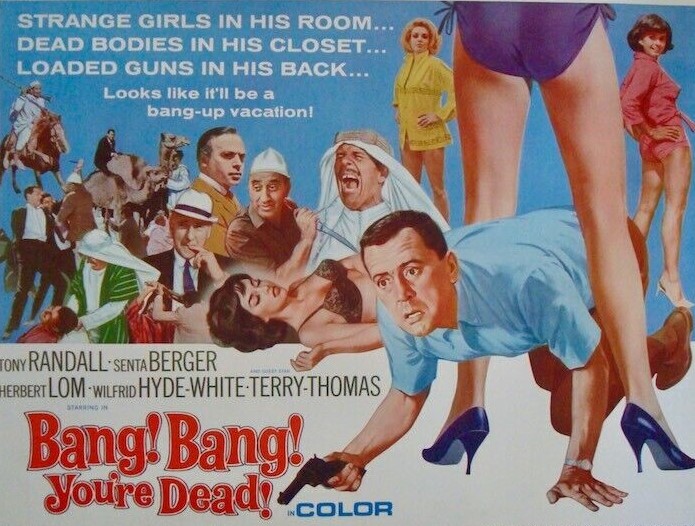
All hail Senta Berger! Another from the Harry Alan Towers (Five Golden Dragons, 1967) portfolio, this is a spy-thriller mash-up with a bagful of mysteries and a clutch of corpses. At last given a decent leading role, Senta Berger (Istanbul Express, 1968) steals the show from the top-billed Tony Randall (as miscast as Robert Cummings in Five Golden Dragons) and a smorgasbord of European talent including Herbert Lom (The Frightened City, 1961), Terry-Thomas (Danger: Diabolik, 1968), Klaus Kinski (Five Golden Dragons), John Le Mesurier (The Moon-Spinners, 1964) and Wilfrid Hyde-White (Ada, 1961).
In this company, the glamorous Margaret Lee (Five Golden Dragons), as the villain’s cynical lover (“you are never wrong, cherie, you told me so yourself,” she tells him) is an amuse-bouche. Six travellers – including architect passing himself off as oilman Andrew Jessel (Tony Randall), travel agent George Lilywhite (John Le Mesurier), salesman Arthur Fairbrother (Wilfrid Hyde-White) and tourist Kyra Sanovy (Senta Berger), meeting her fiancé – board a bus from Casablanca airport to Marrakesh. One is carrying $2 million as a bribe to ease through a vote in the United Nations, but the villainous Mr Casimir (Herbert Lom) doesn’t know which one it is.
When Kyra’s fiance’s corpse tumbles out of Andrew’s cupboard, the pair become entangled. Kyra is a born femme fatale, trumping the incompetent Andrew at every turn. With no shortage of complications, the tale zips along, directed on occasion with considerable verve by Don Sharp (The Devil-Ship Pirates, 1964).
It’s lightweight but no less enjoyable for that and makes a change from the more serious espionage fare (The Spy Who Came in from the Cold, 1965, and The Quiller Memorandum, 1966) beginning to capture the public’s attention. It might make it sound better to say it’s a mixture of The Man Who Knew Too Much (1956) and North by Northwest (1959) and throws a homage bone to Our Man in Havana (1959), but while it plays around with those riffs, it doesn’t give two hoots about focusing on Hitchcockian thrills. It’s more about the fish-out-of-water Yank Andrew being led astray by the sexy Kyra.
There are some inventive double-plays – with a body in the boot Kyra and Andrew are stopped by a cop who tells them their boot is open. An excellent rooftop chase is matched by a car chase. And there’s a terrific shootout. Kinski is at his sinister best and Terry-Thomas a standout in an unusual role as a Berber.
The film was shot on location including the city’s souks, the ruined El Badi Palace and La Mamounia hotel (featured in The Man Who Knew Too Much, 1956).
But Senta Berger seamlessly holds the whole box of tricks together, at once glamorous and sinuous, practical and tough and exuding sympathy, and it’s a joy to see her for a large part of the picture leading Randall by the nose. Quite why this did not lead to bigger Hollywood roles than The Ambushers (1967) remains a mystery.
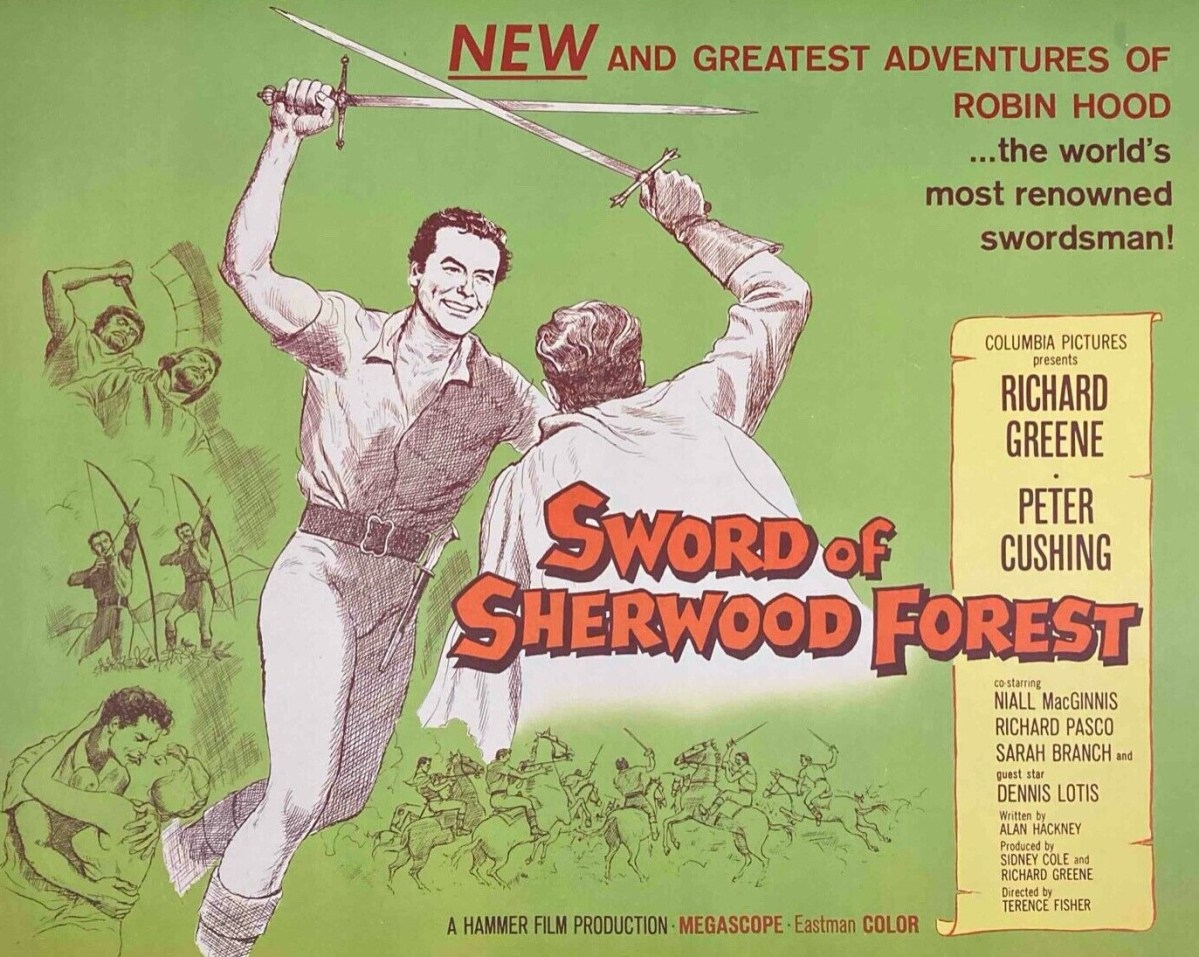
The last swashbuckler to cut a genuine dash was The Crimson Pirate (1952) with an athletic Burt Lancaster romancing Virginia Mayo in a big-budget Hollywood spectacular. The chance of Hollywood ponying up for further offerings of this caliber was remote once television began to cut the swashbuckler genre down to small-screen size. Britain’s ITV network churned out series based on Sir Lancelot, William Tell and The Count of Monte Cristo and 30-minute episodes (143 in all) of The Adventures of Robin Hood. So when Hammer decided to rework the series as Sword of Sherwood Forest their first port-of-call was series star Richard Greene.
And to encourage television viewers to follow the adventures of their hero on the big screen, Hammer sensibly dumped the small screen’s black-and-white photography in favour of widescreen color and then lit up the canvas at the outset with aerial tracking shots of the glorious bucolic greenery of the English countryside. Further temptation for staid television viewers came in the form of Maid Marian (Sarah Branch) bathing naked in a lake. Robin Hood is soon hooked.
Two main plots run side-by-side. The first is obvious. The Sheriff of Nottingham (Peter Cushing) is quietly defrauding people through legal means. The second takes a while to come to fruition. Robin Hood is hired by for his archery skills by the Earl of Newark (Richard Pasco) – he shoots a pumpkin through a spinning wheel, a moving bell and a bullseye through a slit – before it becomes apparent he is being recruited as an assassin. Oliver Reed and Derren Nesbitt put in uncredited appearances and the usual suspects are played by Niall MacGinnis (as Friar Tuck) and Nigel Green (as Little John).
There is sufficient swordfighting to satisfy. Director Terence Fisher (The Gorgon, 1964), more at home with the Hammer horror portfolio, demonstrates a facility with action. Richard Greene (The Blood of Fu Manchu, 1968) makes a breezy hero and Peter Cushing (The Gorgon) resists the tmeptation to camp it up. Screenplay honors went to Alan Hackney (You Must Be Joking! 1965).
Six years on from Sword of Sherwood Forest, the challenge of reviving a moribund genre proved too much for A Challenge for Robin Hood but this second Hammer swashbuckler is a valiant and enjoyable attempt. More in the way of an origin story, this explains how a nobleman turned into an outlaw and how the merry band was formed. For in this tale Robin Hood (Barry Ingham) is a Norman nobleman framed for murder, Will Scarlet (Douglas Mitchell) and Little John (Leon Greene) are castle servants – also Normans – while Maid Marian (Gay Hamilton) is in disguise. Some liberties are taken with the traditional version – there is no fight with Little John, instead, as noted above, they are already acquainted.
There are a couple of excellent set pieces and although the swordfights are not in the athletic league of Errol Flynn they are more inventive than the previous Hammer outing and there is enough derring-do to keep the plot ticking along. Robin’s cousin Roger de Courtenay (Peter Blythe) is the prime villain this time round, the sheriff (John Arnatt), although involved up to the hilt at the end, content to offer acerbic comment from the sidelines.
When Robin and Friar Tuck escape the castle by jumping into the moat, Will Scarlet is caught and later used as bait. Meanwhile Robin’s archery prowess and leadership skills have impressed the Saxon outlaws hiding in the forest and he takes over as their head. But there are clever ruses, jousting, Robin disguised as a masked monk, torture, and a pie fight.
Director C. M. Pennington-Richards had some swashbuckling form having helmed several episodes of The Buccaneers and Ivanhoe television series but his big screen experience was limited to routine films like Ladies Who Do (1963) with Peggy Mount. This was a departure for scriptwriter Peter Bryan, more used to churning out horror films like The Brides of Dracula (1960) and The Plague of the Zombies (1966), and he has invested the picture with more wittier lines and humorous situations than you might expect.
It’s certainly an escapist holiday treat and unless compared to the likes of the Pirates of the Caribbean or the classic Errol Flynn adventure it stands up very well on its own.
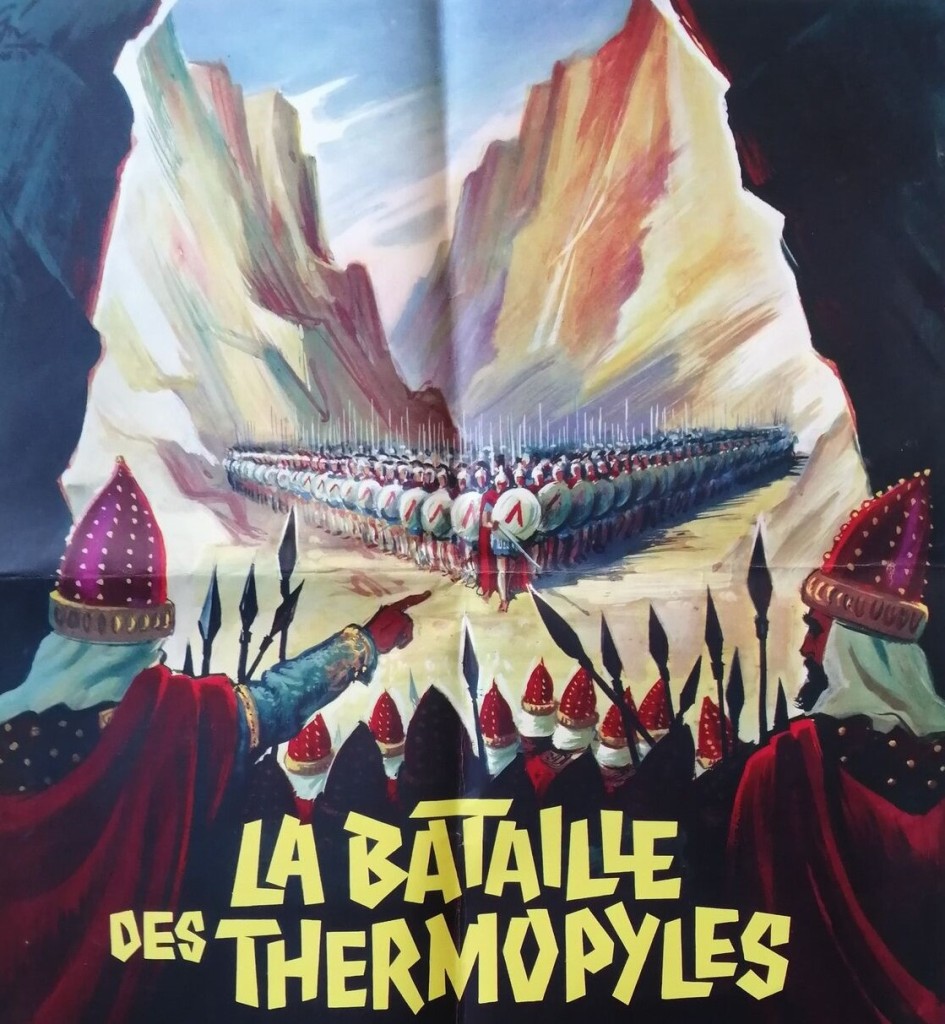
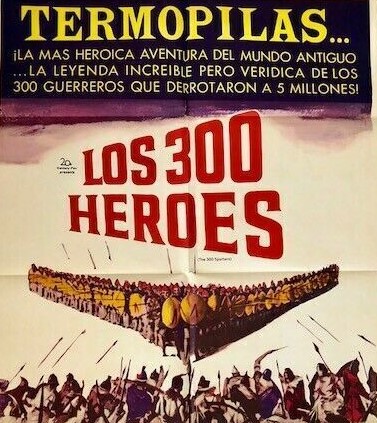
Doomed for half a century to be seen as Saturday television matinee material and then purportedly put into the shade by the Zack Snyder’s stylish 300 (2006), The 300 Spartans is in sore need of re-evaluation. Lacking the big budget of an El Cid (1961) or Lawrence of Arabia (1962) and released during an era when historical drama – Barabbas (1961), The Mongols (1961), Sword of the Conqueror (1961), The Trojan Horse (1961), and The Tartars (1961) – was at a peak, this is a stripped-down version of the famous Battle of Thermopylae in 480 B.C. and none the worse for it.
Clever camerawork suggests thousands of warriors involved and there is little sign of scrimping the wardrobe department, and there is more than enough action. But this is a surprising literate picture, with great lines for cynical politicians as much as for warriors and peasants. Themistocles (Ralph Richardson) comments: “Some day, I may enter religion myself. It’s better than politics. With the gods behind you, you can be more irresponsible.”
Told that the invading Persian army has “arrows that will blot out the sun,” Spartan King Leonides (Richard Egan) retorts, “then we will fight in the shade.” And there’s sexist banter typical of the period between a peasant couple: wife – “goats have more brains than men”; husband – “who can understand the ways of the gods, they create lovely girls and then turn them into wives.”
Quite how Leonides ends up fighting the massive army on its own is down to a mixture of politics and religion. Oracles foretell doom. The various Greek states refuse to join together, although Athens lends Sparta its fleet (“Athens’ wooden wall”). Even Sparta officially refuses to participate on the grounds that battle would interrupt a major religious festival. Leonides’ “army” of 300 men is comprised of his bodyguard.
A romantic subplot involving a young couple results in catastrophe. Just how ruthless is the opposition is shown when Persian king Xerxes (David Farrar) slaughters all his soldiers’ wives to make the men more determined to get to Greece where doubtless they will enslave the female population. When his archers fire, he doesn’t care if the arrows hit his own men.
What marks out the best historical action pictures is the intelligence behind the battle. Strategy is key. The first weapon, of course, surprise, so the Spartans sneak into the Persian camp from the sea and burn their tents. During battle, to counteract the Persian cavalry, the front row of the Spartan army lies down and allows the horses to jump over them, then rising up, trap the cavalry and drive them into the sea. (A ruse later employed by Richard Widmark in The Long Ships, 1964).
Other wily measures are used deal with the Persian crack infantry regiment, The Immortals. Even at the end, the Spartans continue to confound the enemy with clever ruses.
Richard Egan (Pollyanna, 1960) is effective as Leonides, Ralph Richardson (Woman of Straw, 1964) excellent as the crafty but honorable Themistocles while Alfred Hitchcock protégé Diane Baker (Mirage, 1965) – “glaringly miscast” according to Variety – has the female lead though Anne Wakefield (The Singing Nun, 1966) as a Persian queen the more interesting role. Former British matinee idol star David Farrar (Beat Girl / Wild for Kicks, 1960) Meet Sexton Blake, 1945), in his final movie, proves a handful as the intemperate Xerxes.
Five-time Oscar-nominated cinematographer Rudolf Mate delivers the directorial goods, his handling the dramatic scenes as confidently as the action and masking the holes in his budget by making clever use of trees as the invaders march, suggesting an army far bigger than he could afford to put on the screen. Color-coding the Spartans – they were in red – made the action clearer to follow. George St George (Invasion 1700, 1962), doubling up as producer, wrote the script with his usual collaborators Ugo Liberatore (A Minute to Pray, A Second to Die, 1967) and Remigio del Grosso (Wanted, 1967).
Originally titled The Lion of Sparta, the film could not have been made without the wholesale cooperation of the Greek army which supplied over 2,000 soldiers. Those playing Spartans had to be over six foot tall. Since the Greeks had no cavalry and few knew how to ride, around 200 were given a crash course. It was a bonanza for the soldiers – their normal wage of $2 was supplemented by $5.50.
Thermopylae no longer looked like the area immortalised by the battle, so the action was shot at Loutraki, near Corinth and 80 miles from Athens.
Thoughtful drama with striking action deserves reassessment.