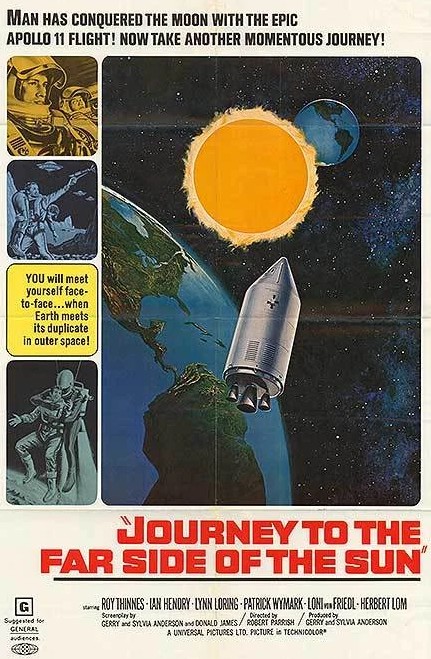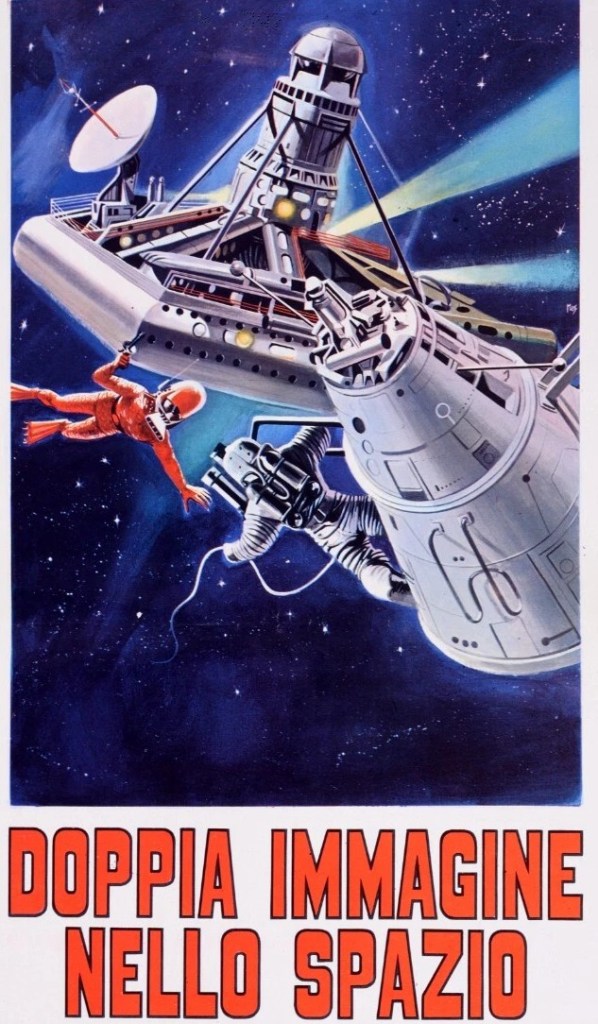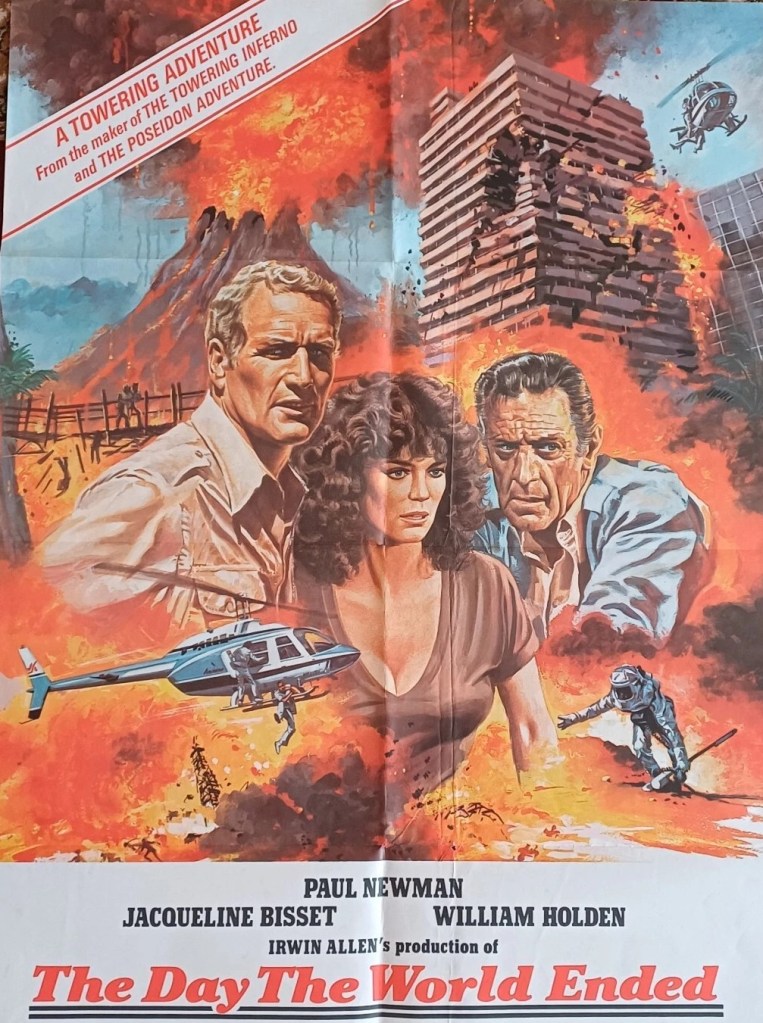
The Day the World Ended / In the Year 2889 (1967) ***

Come the apocalypse, you’d want  someone like Capt Ramsay (Neil Fletcher) in your corner. He’s not the kind to be surprised by the sudden onset of a nuclear holocaust. He’s prime boy scout – always prepared. Not only has he got three months of supplies put by and his own generator but he’s picked a spot where it’s more likely he’ll survive. I wish I could show his scale model that demonstrates just how far-sighted he’s been.

His house is in a valley surrounded by cliffs full of lead ore which will remain immune to radiation. Apart from a separate source of fresh water, the lake on his doorstep is heated from underground which creates an updraft to keep away radiated clouds.

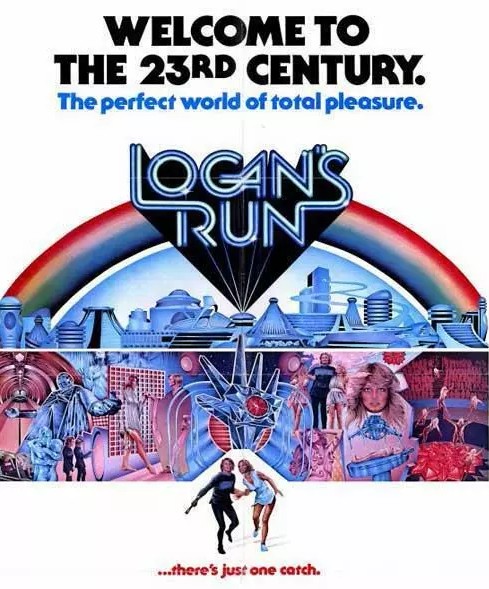
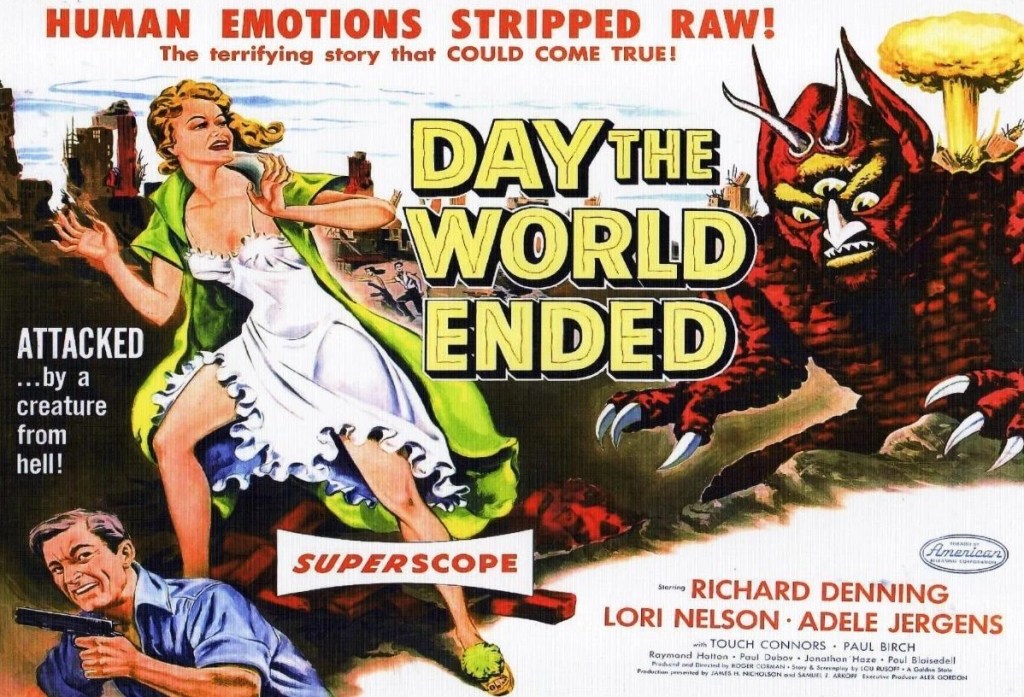
The original from 1955.

Only three things nibble away at his confidence: he’s planned on safeguarding three people – himself, daughter Joanna (Charla Doherty) and her fiancé Larry – so any unforeseen arrivals could deplete supplies; rain which could be contaminated; and mutants.

Larry hasn’t survived but five others have – Steve (Paul Petersen) and his already radiated brother Granger (Max W Anderson), small-time hood Mickey (Hugh Feagin) and his exotic dancer girlfriend Jada (Quinn O’Hara), and alcoholic rancher Tim (Bill Thurman). Plus whatever else is on the prowl out there. Granger doesn’t appear an immediate threat though he’s received levels of radiation that should have killed him. On the plus side, he can go weeks without eating or drinking. On the minus side, he’s got a hankering for fresh raw meat, but luckily not badly enough to resort to cannibalism.

Now that the absent Larry has upset his plans for the continuation of the human race, Capt Ramsay decides his daughter should pair up with geologist Steve. She’s certainly drawn to him but keeps on hearing a strange voice which she imagines to be Larry. But Mickey determines that if there’s any procreation to be done, it’ll be with him and Joanna and even though, theoretically, she’s out of his league, he works out that if he bumps everyone else off she won’t have a choice.

Meanwhile, something’s prowling out there in the dark. Luckily, it’s always dark when the creature goes prowling so we make do with barely a glimpse of whatever the director can come up with monster-wise on a tiny budget. We get a better idea of the possible mutant outcomes because the good captain was in charge of a ship carrying animals out of an H-Bomb test site and took the opportunity to make illustrations of what he saw, which was mostly emaciated bodies with sharp teeth and claws.

Mostly, we’re waiting for rain or for Mickey to begin slaughtering everyone. It’s just as well that mutants keep their distance because then tension can play out via sexual jealousy, the stern captain brooking no dissent – he also knocks on the head lewd dancing and the drinking of illicit liquor – and the gradual accumulation of the fearful.

The biggest disaster this later Irwin Allen effort faced was at the box office. I reviewed it some time ago.

Had it gone down the more straightforward slasher route, Joanna would be the ideal final girl with Jada more likely to be an early victim courtesy of her profession. In fact, both make perfect foils. Joanna stands up to her father who’s inclined to prevent, by force if necessary, any visitors from entering the house while Jada tries to make her boyfriend stick to a lovers’ code of honor.

Scottish actress Quinn O’Hara (A Swingin’ Summer, 1965) should have stolen the picture given her juicy role but it’s Hugh Feagin (in his debut), all razor cheekbones and slits for eyes, and Charla Doherty (Take Her She’s Mine, 1963) who snatch what little kudos there is going.

Larry Buchanan (The Naked Witch, 1961) directs this remake of the 1955 movie from a screenplay by Harold Hoffman (The Black Cat, 1966) and Lou Rusoff (Panic in the Year Zero, 1962).

While there’s not a huge amount to recommend it, it is interesting enough given the director has to concentrate more on character than gore.

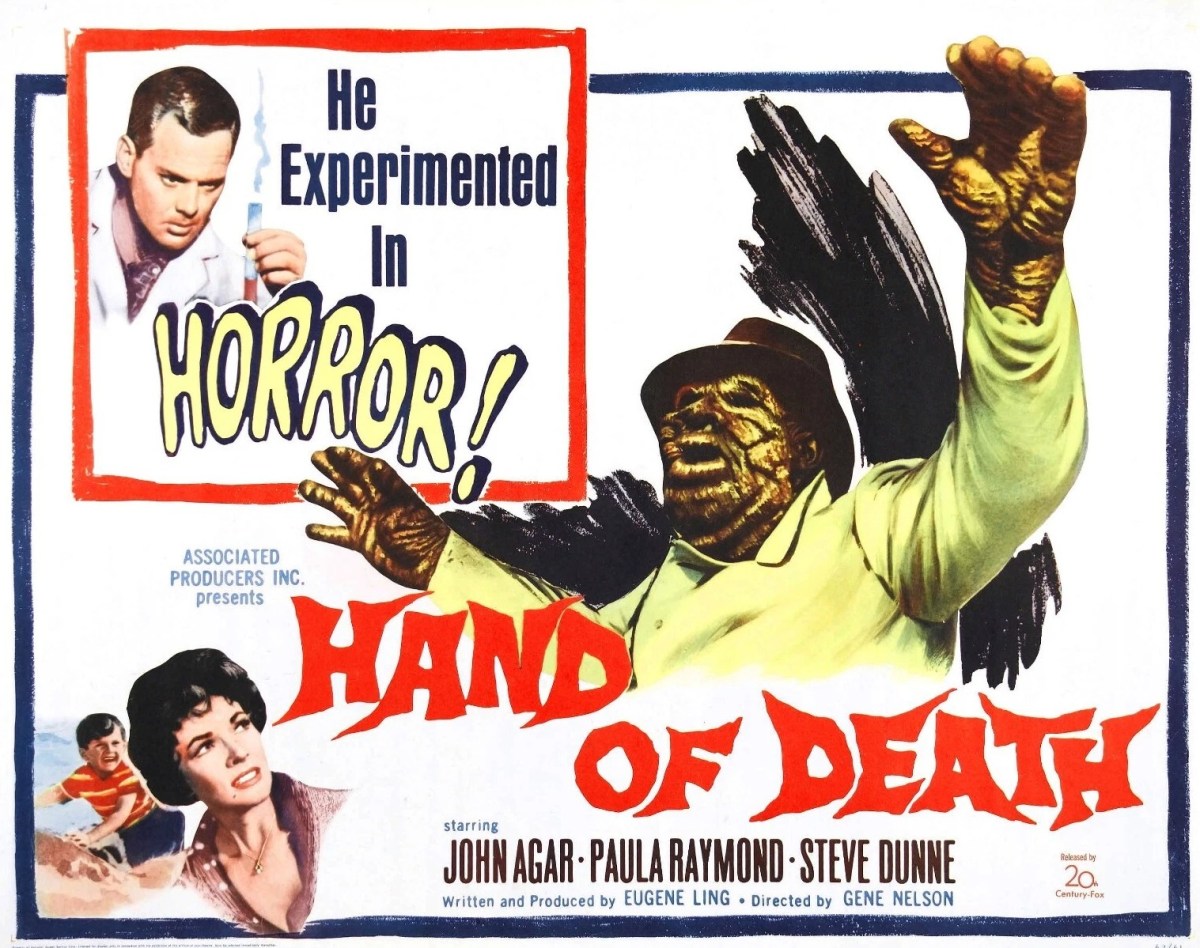
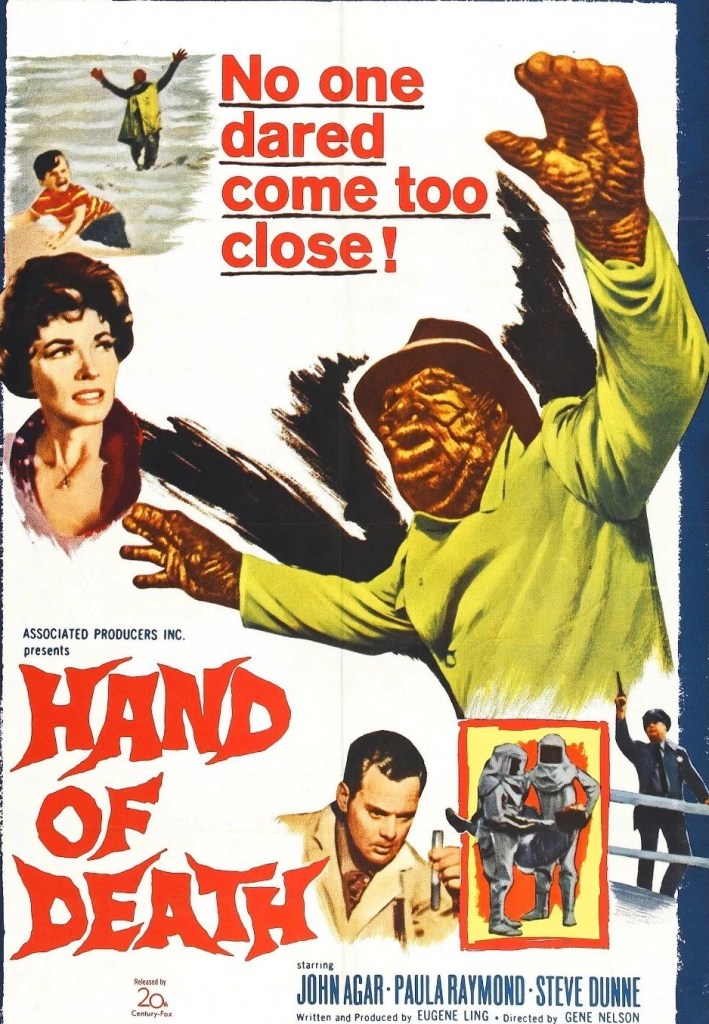
Hand of Death (1962) ***

Unless you go by the name of Dr Jekyll, you don’t want to become a guinea pig for your own scientific experiments. Niftily done, memorable opening and finale, minimum expenditure on special effects ensures the shock value is limited until it counts as our hero/villain goes on accidental rampage.

In an echo of Village of the Damned (1960), a mailman, drawing up in front of some gates, falls to the ground. The camera pulls back revealing some senseless sheep. Two guys in Hazchem suits rush out of a building which turns out to be a laboratory. It’s not even a top secret lab although it’s buried in the desert. Dr Alex Marsh (John Agar) is supposed to be engaged on harmless experiments on cacti. Instead, he’s stumbled upon a nerve gas with military potential.

Our mailman and the sheep aren’t dead only unconscious so, through happenstance, Marsh has successfully conducted both animal and human tests, such results an improvement on what went before when the subjects died.

Marsh can’t wait to tell boss Dr Ramsay (Roy Gordon) and his girlfriend Carol (Paula Raymond) the good news. All scientists are mad scientists given the right circumstances. So Marsh has gone from anodyne to dangerous. In Army hands, the nerve gas can not only immobilize the enemy but when they wake up they are under hypnotic influence and will do what the victors tell them thus nullifying the risk of rebellion.

James Bond villains would be queuing at his door. Leaving Ramsay to drum up financial support from legitimate sources, Marsh returns to the lab to further develop the prototype, except too much leaks out and he’s not as immune to its effects as he originally believed. And beyond being cursed by a nightmare, it doesn’t look, initially, as if Marsh is in danger. Just everyone else. Touch him and you’re fried.

While he doesn’t mean to kill anyone, nonetheless heading for the morgue are a colleague and a gas pump attendant. He hides out in Ramsay’s house where serums are concocted to cure him. They fail. Marsh moves from not wanting to hurt anybody to threatening violence. And it’s soon clear he’s not at all immune. Contemporary audiences might enjoy the transformation as he turns into a cross between Hulk and The Thing from The Fantastic Four, with the addition of the kind of raincoat for which Columbo later expressed a preference and Frank Sinatra’s hat.

And you might be giggling at the look except that strange things begin to happen. You pity him. He’s not some monster lurching around terrorizing the populace. He’s lurching all right but in the kind of bent-over fashion where you think he’s going to topple over any minute. He turns up at  Carol’s beach house but so do the cops. He heads towards the water but when he turns back at Carol’s call the police interpret that as threat and shoot him dead.

There are some other nice touches, reaction shots from the supporting cast, some sparkling bit parts, a small child who is within seconds of touching him out of curiosity, and an incentive for his other colleague Tom (Stephen Dunne) to win over Carol should he fail to come up with the serum.

John Agar (The St Valentine’s Day Massacre, 1967) was never going to get within a mile of an Oscar but his playing of the monster triggers pity. Paula Raymond (The Flight That Disappeared, 1961) adds some depth to a thankless role.

Directed by Gene Nelson (Kissin’ Cousins, 1964) from a screenplay by producer Eugene Ling in his final work.

I came at this with one big advantage. I hadn’t seen the poster so I had no idea what the monster looked like. Which is just as well because otherwise I might have not bothered.

Tight, short, occasionally clever, surprisingly moving.

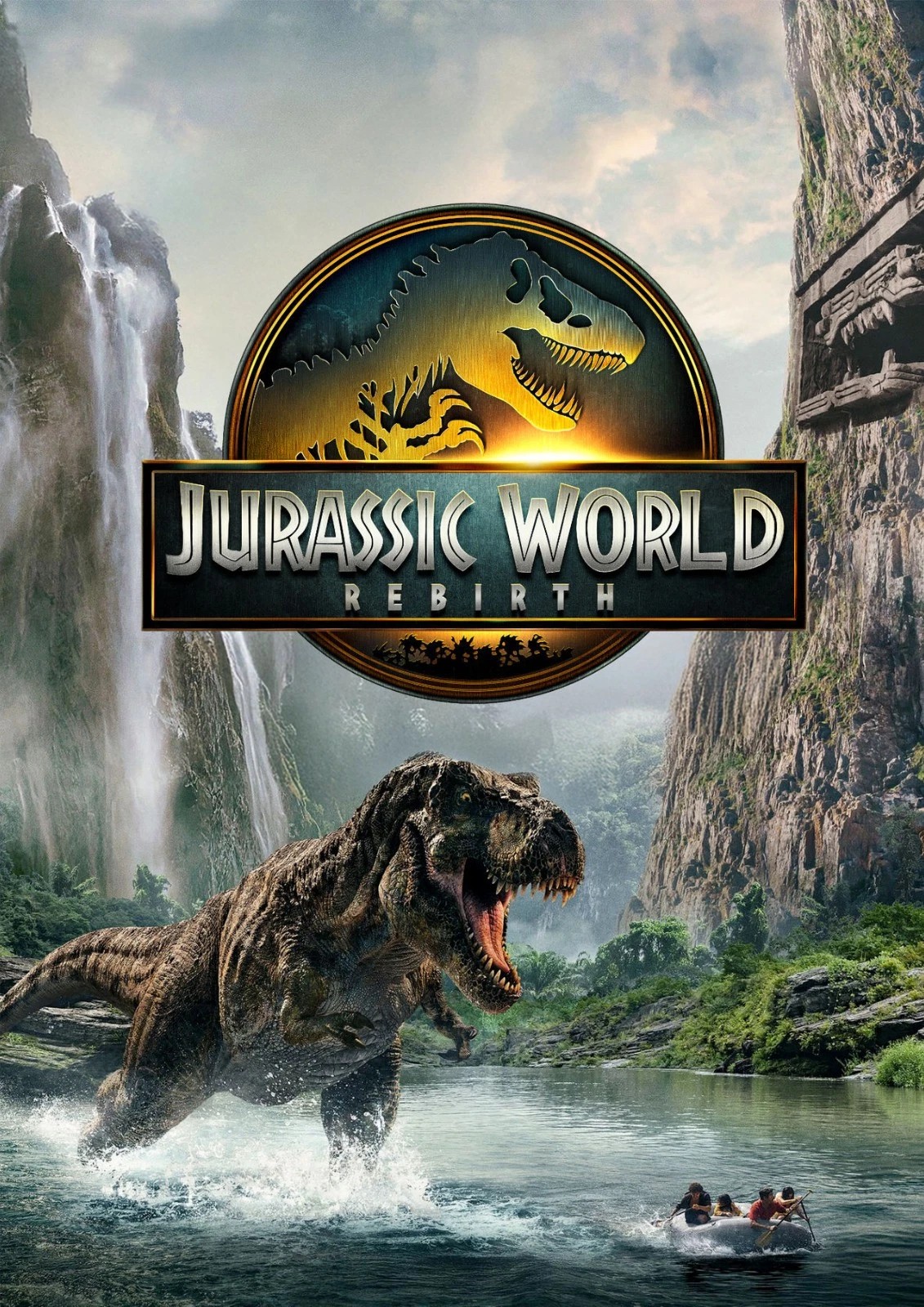
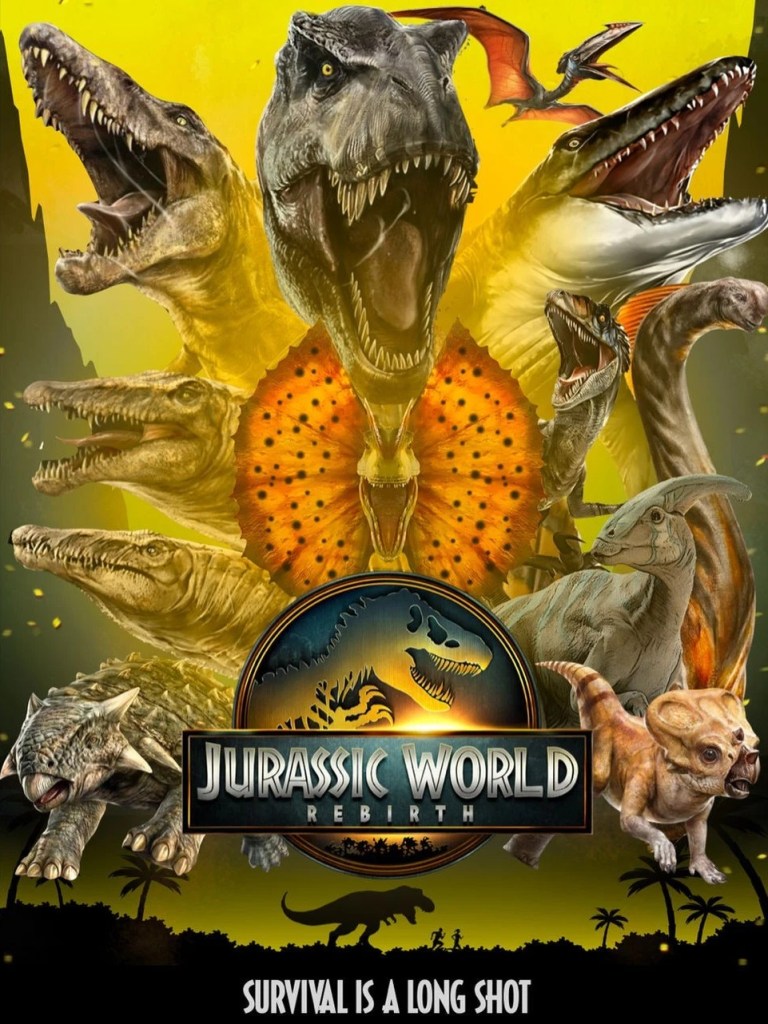
Jurassic World: Rebirth (2025) ** – Seen at the Cinema

Director Gareth Edwards (The Creator, 2023) and screenwriter David Koepp (Jurassic Park, 1993) have gone so far back to basics that they’ve skipped some fundamentals. It doesn’t matter how big your monsters are or how fearsome, the audience needs to care about those put in jeopardy and that has to amount to a lot more than a licorice-munching cute kid with a penchant for collecting cute baby dinosaurs.

Audiences are not likely to have forgotten the wealth of characterizations served up as the series kicked off  – jovial misguided philanthropist Richard Attenborough, child-hating scientist Sam Neill who grows to like kids, annoying scientist Jeff  Goldblum who chats up Sam Neill’s squeeze, annoying smartass child Joseph Mazzello, even cheapskate thief Wayne Knight.

Come the reboot we had a latter-day Indiana Jones bad boy in Chris Pratt trying to get on the good side of careerist Bryce Dallas Howard who was stumbling around on high heels and a kicker of a final line where they decide to stick together “for survival.”

The most interesting person in the latest reboot is way down the billing, the pot-smoking laid-back Xavier (David Iacono). Setting Scarlett Johansson up as a rooting-tooting mercenary with a soft heart (boohoo she didn’t make it to her mother’s funeral because presumably she was rooting-tooting for cold hard cash) who decides to set aside her $20 million payday comes across like one of the old-school Miss World contenders determined to help achieve “world peace.” Everyone else has been rounded up from Dullsville and apart from a few pontificating woke speeches nobody else has much to do except duck and dive to escape monsters.

For narrative purposes various rooting-tooting guns-for-hire have to locate a waterosauraus, a flyingosaurus and a walkingosaurus at the same time as trying to avoid a new version of the hybrid beastie that turned up in Jurassic World (2015).

Not only are there no characters to root for, but the movie is mighty low on tension, no attempt to create the Spielbergian trembling water cup or the cracking glass or the motorbike chase and runaway pterodactyls from Jurassic World though there is the standard hiding under a car routine.

There are some groundbreaking effects but they’re not what you think. They’re aural rather than visual. We’ve got a scene when Dr Loomis crunches very loudly on some kind of mint. That’s the soundtrack – Dr Loomis crunching excessively loudly on a mint. Good job they didn’t utilize Imax for this one or it would have blown your eardrums off. Candies/sweets hog a good part of the center stage. Apart from the ear-blasting mints and the cute kid feeding strips of licorice to the cute dinosaur, the Maguffin comes in the unlikely shape of a wrapper from a bar of Snickers which somehow manages to fuse an entire laboratory and cause it to be completely abandoned (17 years before the present time I should add).  

Given the build-up which I accept as an essential part of promoting the reboot, this lands with a thud and the title, unfortunately, lends itself to all sorts of puns. As you know I’m a sucker for monster movies, but this just seems to be a very careless endeavor, like they are trying to squeeze the last juices. Regardless of how dumb the ideas the first Jurassic World trilogy ultimately became, the narrative was underpinned by unlikely romance and likeable characters. Unless, as I suspect, Scarlett Johanssen and Dr Loomis (Jonathan Bailey), the best of the bad guys, are going to embark on a more interesting sequel and develop some personality this could as aptly be called Jurassic World RIP.

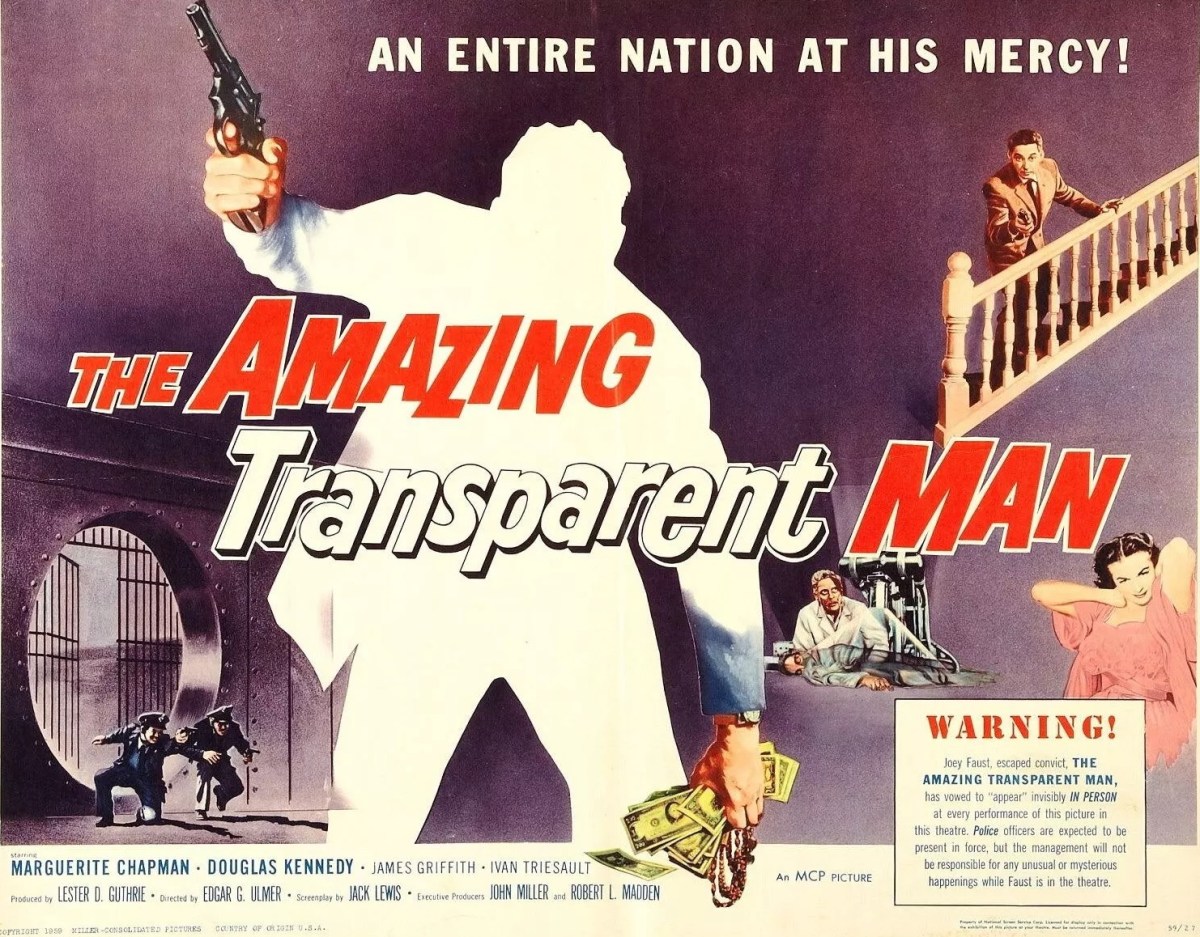
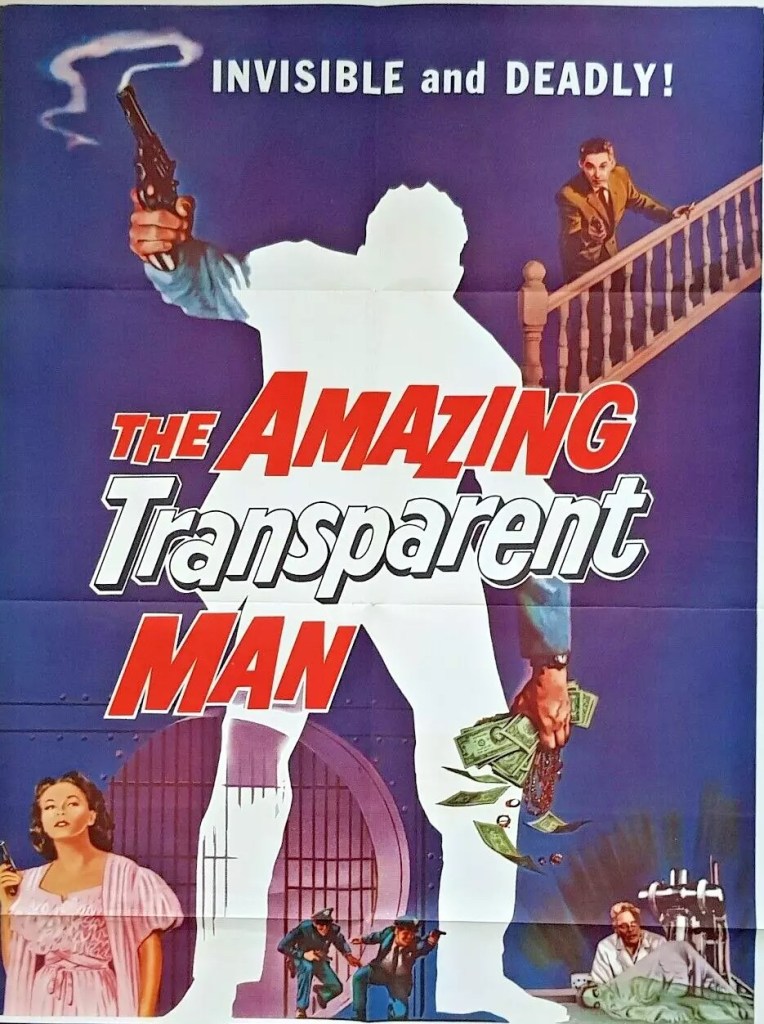
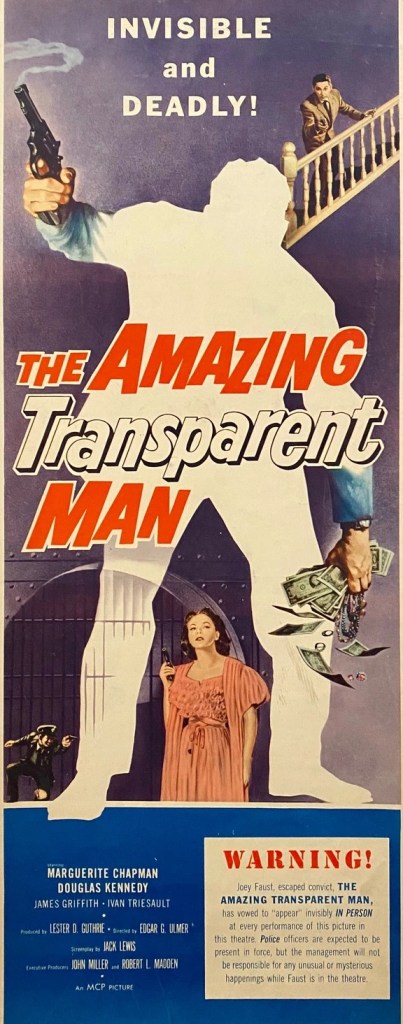
The Amazing Transplant Man (1960) ***

Sci fi film noir. Anything that involves cult director Edgar G. Ulmer (Hannibal, 1960) tends to put an unusual twist on a tale and here he takes the kind of mad scientist who would be perfectly at home in the MCU and turns him inside out. In fact, Major Krenner (James Griffith) is pretty close in intent to Valentina Allegra de Fontaine (Julia Louis-Dreyfuss) in the asterisk version of Thunderbolts (2025) in wanting to build an indestructible army.

His is going to be invisible. (Presumably, this would have been called The Invisible Man had Universal been more obliging.)

It was quite the thing as we have seen from I Aim at the Stars out the same year for the U.S. after World War Two to purloin German scientists, and here Krenner is one step ahead of the Government by snaffling Dr Ulof (Ivan Triesault).

The good doctor is given something of a free pass here because he’s been coerced into working for the major on account of his daughter being held hostage. And because he accidentally killed his wife during one of his experiments. But given he was working for the Germans in a concentration camp and his experiments, had they been successful, would have resulted in the creation of an invisible army for the enemy, maybe we shouldn’t be so lenient.

Ulmer isn’t so lenient with the rest of the bunch and there’s double cross all the way. Safecracker Joey (Douglas Kennedy) doesn’t show the gratitude you’d expect after being sprung from jail by Krenner and his moll Laura (Marguerite Chapman). Being amply rewarded for being a guinea pig isn’t enough and he reckons that if he can walk unnoticed into a government facility and steal nuclear materials, then he could just as well walk into a bank unnoticed and make off with the kind of cash that would fund retirement.

Laura begins to warm to the notion of sharing her bed with a hunky action man rather than a weedy pedant and even more to the idea of sharing the loot and the retirement. There’s also a resident thug Julian (Boyd Morgan) who’s been duped by the major into adding muscle to the operation.

Clever publicity stunt. Joey is going to appear invisibly in person at every performance.

So instead of the usual set-up of good guy, and a girl he met on the way (or vice-versa), intent on stopping the mad scientist, you’ve got the complete opposite, bad guy and hook-up planning to keep on being bad.

There’s a heap of good old-fashioned fun with the invisibility. Some trick photography to make Joey disappear but it’s more fun to watch the other actors throw themselves around to simulate being punched in the face or stroke an empty space and pretend they are touching a real human being, and to see vault doors miraculously open, or onlookers agape at watching a bag of loot hovering in midair. Or even better to see parts of Joey’s body unexpectedly materialize in the middle of a robbery.

You can’t build tension in normal heist fashion. You don’t need to endlessly go over an elaborate plan or hold your breath to see if a guard or some such is going to appear at an awkward moment or another obstacle get in the way, not when you can just walk in and walk out and nobody even know you’re there. So Ulmer doesn’t bother with that aspect, concentrating more on the personalities involved, each as mean and calculating as the others.

Even free pass Ulof, who could sabotage the project at any opportunity, decides it would be better if a hunky action man rather than another weedy individual took on that task. So he lets on to Joey that just as invisibility wears off so does his lifespan courtesy of the radiation which is slowly poisoning him. So it’s Joey who does the needful, not out of a hero’s ambition to save mankind, but out of pure revenge.

Thanks to the characters involved this is never corny. Old-fashioned maybe in an enjoyable old-fashioned way before it cost the world to create special effects.

It says a lot about the marquee quality of the stars that Marguerite Chapman (The Seven Year Itch, 1955) as the femme fatale is top-billed when she hadn’t been in a movie in half a decade and wouldn’t be in another one ever again. Douglas Kennedy (The Destructors, 1968) was a bit-part player and this was as close as he’d get to playing a leading man. Ditto James Griffith (Heaven with a Gun, 1969). But since mostly what they’ve got to show is malevolence nobody is being asked to step outside their comfort zone.

Ulmer filmed this back-to-back with Beyond the Time Barrier, with the two films forming a double bill.

Good fun.

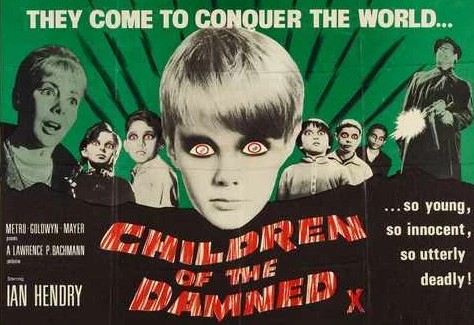
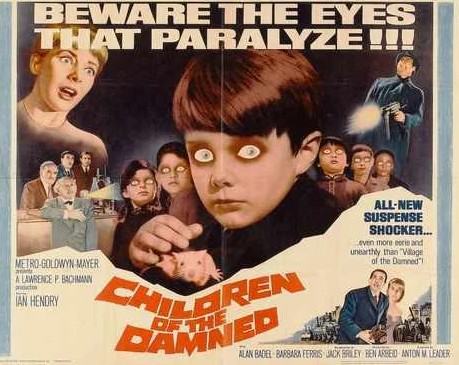
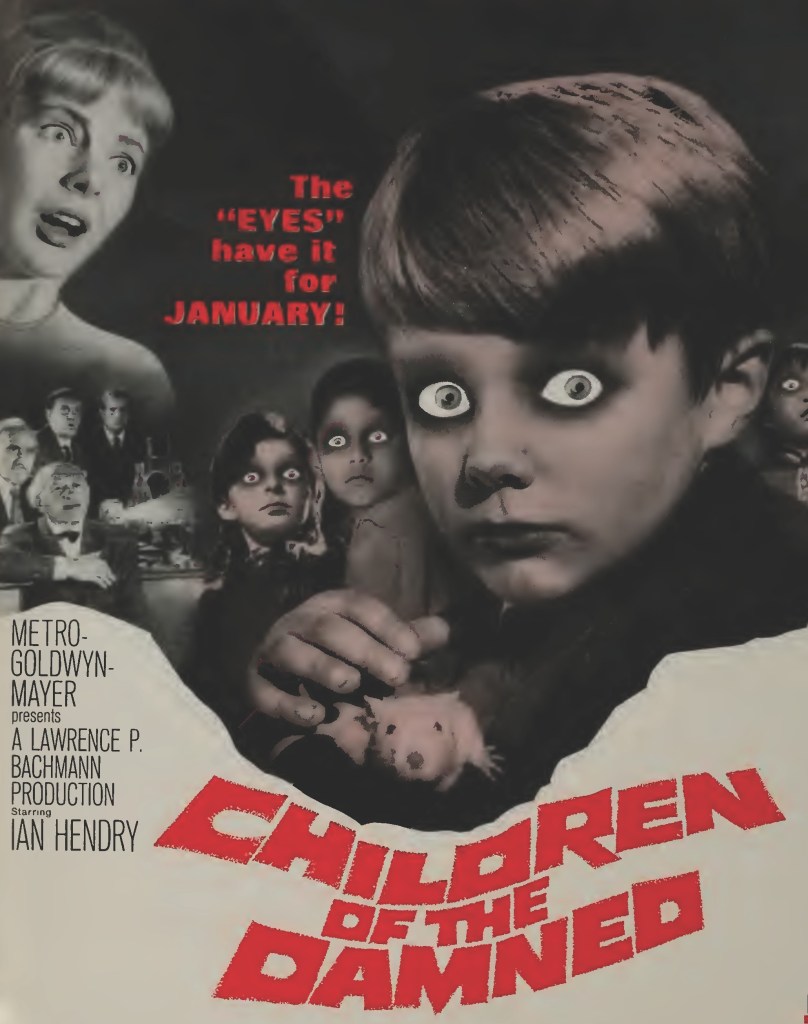
Children of the Damned (1964) ***

I wasn’t aware that celebrated sci fi author John Wyndham had written a sequel to his iconic novel The Midwich Cuckoos, filmed as Village of the Damned (1960). And it turned out he didn’t (he did make an attempt but abandoned it after a few chapters).  So he had nothing to do with the sequel. But the original had proved such a hit MGM couldn’t resist going for second helpings.

And there was nothing the writer could do about it, it being standard procedure that when you sold your novel to Hollywood the studio retained all the rights and could commission a remake, sequel, turn it into a television series, without consulting you.

The only drawback for a potential sequel was that main adult character Professor Zellaby (George Sander) and all the kids had died in the original, though the final image of eyes flying out of the burning house might have suggested the children had actually survived. And, as we know these days, just when your main character dies it doesn’t prevent him miraculously returning to life should box office dictate.

So screenwriter John Briley (Oscar-winner for Gandhi, 1982) was handed the sequel. And what we get is a lot of atmosphere, a chunk of running around in empty London streets (the result not of mass evacuation but filming in early morning when roads are clear), a very slinky turn from Alan Badel (Bitter Harvest, 1963) showing what he can do when hero not villain, and a twist on the previous problem – how to vanquish the kids – which is whether to  weaponize them. Mostly, we are reminded of how better telekinesis was dealt with in the original picture and how poorly this compares to the likes of Brian De Palma’s later Carrie (1976) and even his The Fury (1978).

Apart from the title, there’s barely a nod to the previous incarnation, except that discerning the children’s paternity proves impossible. An United Nations project has tracked down six kids with incredible intellects. Like Professor Zellaby, British psychologist Dr Tom Llewellyn (Ian Hendry) and geneticist Dr David Neville (Alan Badel) want to study the kids while the more shadowy figure of Colin Webster (Alfred Burke) appears to have more sinister purpose in mind.

In any case none of the three achieve their goals because the kids escape and take refuge in an abandoned church, defending themselves against the authorities and the military by their brain controlling abilities and by the devising of a sonic weapon. Immediately under their thumb is the aunt, Susan (Barbara Ferris), of the young boy Paul (Clive Powell) who initially excited the interest of the British scientists.

Opinion varies as to whether the children are a genetic freak of nature, aliens or an advanced human race. The authorities can’t decide whether they are a threat or a wonder and decide to eliminate them, then change their mind, while the children decide to fight back then change their minds. The ending is quite a surprise.

Although the kids still have the fearful eyes, they are generally a lot less effective a scare than when the small gang of them stood side by side in the previous picture and stared at adults until they did the childrens’ bidding or killed themselves. There’s way too much discussion among adults. In the previous picture, those kinds of conversations had more emotional impact, since it was the villagers who were left distraught. Here, you couldn’t care less about the adults.

Interestingly enough, the standout isn’t any of the kids at all, but Alan Badel, who comes over as the libidinous sort, but very charming, and views any woman as fair game, but it’s fascinating to see how his usual screen persona here makes him a hero whereas in most other films exhibiting much the same characteristics he comes across as shifty, mean or downright villainous.

Ian Hendry (The Hill, 1965) was a rising British star but isn’t given much to get his teeth into. Barbara Ferris (Interlude, 1968) has a vital role.

Directed by television veteran Anton M. Leader (The Cockeyed Cowboys of Calico County, 1970) who makes his screen debut.

Not a patch on the original.

Village of the Damned (1960) ****

Superb chiller that, unusually, takes time to develop several strands over a longer time frame than is normal for a genre where the immediate takes preference. Opens a new dimension of terror, too, with the brain control sub-genre that would spill over into brainwashing. You could also, if you were of a mind, point to the genuine growing social power of the young as emphasized later in the decade with movies about hippies. It might not be too much of a stretch to point to the “Youthquake” at the end of the 1960s when pandering to a youthful audience nearly destroyed Hollywood.  

Terrific opening sequence of everyone in the small village of Midwich dropping to the ground, the immobilized driver of a bus crashing off the road, the driver of a tractor hitting a tree, taps left running, telephone calls cut off, all manner of accidents ensue. You think everyone’s dead, as do the military, called in to investigate. They cordon off the area, employ canaries and then humans to discover how far the danger spreads. But when a soldier who is dragged out unconscious from the forbidden zone wakes up, they soon realize the population is merely unconscious.

Childless couple Professor Gordon Zellaby (George Sanders) and younger wife Anthea (Barbara Shelley) are among those affected, apparently suffering no side effects for having been knocked out for around four hours. A couple of months later Anthea is delighted to report she’s pregnant. She’s not alone. But for many of the villagers what would be a cause for celebration causes untold grief. One husband returns home after a year away to find his wife is pregnant. In the days when pre-marital sex was frowned-upon, virgins, similarly affected, are shamed.

The pregnancies don’t run to the normal period either, and fully-grown children are born within a few months. What’s more, they all look as if they have inherited the same genes. Their blonde hair and striking eyes suggest they share the same father. Soon it transpires they can not only read minds but control them, causing at least two people to commit suicide.

Turns out this is a global problem, several other communities afflicted with the same condition, the Russians so concerned at the prospect that they bomb one village to oblivion, other cultures simply murdering the children.  Here, being English, where fair play still rules regardless of potential threat, the children are taken under the wing of Professor Zellaby, though the military, having sealed off the area, wait in the wings, itching to wipe out the troublemakers.

Quickly, it becomes a duel for power, the children will do anything to protect their species, Professor Zellaby at first wanting just to study the kids and understand them but soon recognizing the threat.

In between bouts of action, most of which is discreetly handled, none of the deliberately shocking scenes that might have emanated from an exploitationer, the authorities have plenty of time to ponder their existence. A leap in genetic mutation, or extraterrestrial origins, are among the options considered.

Eventually the villagers react like terrified Transylvanians confronting Dracula and attempt to set fire to the building where the children are housed but reckon without the brain control that can be exerted. In the end Professor Zellaby comes up with a self-destructive solution.

This is formidable stuff, all the more so, because in the days when most monsters grew fangs or claws or developed huge bodies and were otherwise physically frightening, the worst these kids get up to is to have a striking glow in their eyes, a startling contrast to their blonde hair, calm demeanor and neat uniform clothing.

Tremendously well done and it helps to have cast mainstream actors like George Sanders (Warning Shot, 1967) and Barbara Shelley (only later did she become a Scream Queen) and others who don’t carry the tinge of the horror genre.

Very well paced by German director Wolf Rilla (The World Ten Times Over, 1963) who resists the temptation to overplay his hand, achieving much more by leaving it to your imagination. Stirling Silliphant (The Slender Thread, 1965), George Barclay (Devil Doll, 1964) and the director adapted the groundbreaking novel The Midwich Cuckoos by John Wyndham. Horror maestro John Carpenter remade this in 1995, which only wnent to show how more successful the restraint of the original was.

Top notch.

Battle Beneath the Earth (1967) ***

Aliens, would be your first guess these days should you happen upon strange disturbances emanating from underneath the earth’s surface, citing the examples of War of the Worlds or an iteration of Transformers, whereby creatures from outer space had remained dormant buried in our habitat for millions of years, like inveterate moles, waiting to spring into action. But this is the 1960s and domination of the Universe is not on the cards. Instead, it’s mere global domination. And as James Bond and others in the espionage game have persuaded us if it’s not some supervillain we’re under threat from it’s the Russians or Chinese.

Even if you detected odd goings-on there was more chance of you being stuck in a mental institution, as is the fate of seismologist Arnold Kramer (Peter Arne), who makes the mistake of causing a “listening disturbance,” arrested lying down on the streets of Las Vegas with his ear pressed to the ground.

Navy Commander Jonathan Shaw (Kerwin Mathews) is on an equally sticky wicket, his latest undersea project resulting in the death of 27 men. However, his assistant Susan (Norma West) prevails upon Shaw to take a look at her brother Arnold. But he isn’t impressed. Until he hears about a mining disaster in Oregon, the deepest mine in the USA, and recalls that Kramer had mentioned discovering unusual activity underground in Oregon.

So off Shaw goes to investigate and finds a laser-drilled tunnel and a lair with missiles. There’s a vehicle with some kind of death ray and before your mind jumps to the notion that this is alien-induced we’re in the command post of Chinese General Chan Lu (Martin Benson) who, as well as planning whatever devilish destruction he aims to visit upon the Americans, has also been in the business of mining gold and growing plants packed with vitamins.

Turns out there’s more than one tunnel – they run from China underwater across the Pacific and underground through America – and although Chan Lu’s stock of nuclear warheads is depleted after being defused by the Yanks he’s still got enough left in the tank to turn America in a desert and kill 100 million people. And there’s not much time to waste – the Chinese plan to strike in 48 hours.

Meanwhile, to buff up the story, Shaw’s team adds volcanologist Tila Yung (Viviane Ventura), providing the opportunity for extra peril and a touch of incipient romance. The Yanks plan to locate the Chinese in a tunnel under the Pacific  and detonate a 10-megaton atom bomb. But things don’t go according to plan. One of the team is hypnotized and Shaw and crew are ambushed and imprisoned.

Chan Lu is far from the lunatic villain and invites Shaw post-conflagration to team up to help to peacefully reconstruct the broken world. Being a pragmatic sort, the General is somewhat surprised to be turned down. Naturally, Shaw’s gang break out of the cell, Arnold the one with the clever idea, and sabotage the Chinese bombs, so it doesn’t end well for the villain, while our hero has the beginnings of a romance.

This was the final movie for director Montgomery Tully (The Terrornauts, 1967, Fog for a Killer, 1962, The Third Alibi, 1961) and he brings some of the pacing he demonstrated in the B-film crime thrillers to the material so it rattles along. The background is well handled and the two male leads are unusually damaged for a sci-fi romp. Audiences might have felt duped that Viviane Ventura (A High Wind in Jamaica, 1965) doesn’t appear until about halfway through. Kerwin Mathews (Maniac, 1963) leads with his chin but the movie’s not expecting much else. Written by L.Z. Hargreaves (Devil Doll, 1964) aka Charles Vetter, the film’s producer.

Decent hokum.

The Yesterday Machine (1965) ***

Some big-name director, especially these days, would have seen the potential, injected some action and jeopardy, a good dose of awe and maybe more of a hint of a romance. You can’t help but feel this would be exactly the kind of enterprise that might get a more favourable hearing from a contemporary audience that’s sucked up even worse baloney in the multiverse and beyond.

Despite you might thinking concentration camps should not be used for superpower fiction, they were essential to the Magneto narrative in the X-Men Files, a set-up which also involved Captain America and Wolverine. So you can’t really show revulsion at attempts by a low-budget sci-fi B-picture to shoehorn in a concentration camp element. This doesn’t have the budget to “show” and must rely simply on “tell” to get over the essential story element. But we’re also bouncing around the time universe to the extent of the American Civil War and the French Revolution.

When the car of college kids Ellison (Jay Ramsay) and drum majorette Margie (Linda Jenkins) breaks down on a dirt road on the way to a football match, they end up confronting soldiers from the Civil War. The boy is shot and taken to hospital, but the girl disappears, plain vanishing, sniffer dogs finding the trail suddenly stops.

In the absence of another poster of the movie reviewed I’ve opted for something with the word “machine.” This at least concerns time travel.

Journalist Jim (James Britton), investigating, discovers the Civil War link because Ellison has been shot by a bullet from that war and the uniform of the Civil War soldiers couldn’t be mere replicas worn by historical re-enactors because the uniform manufacturer went out of business in 1869. Jim hooks up with Margie’s sister, nightclub singer Sandy (Ann Pellegrino). Soon, thanks to a cop, they are on the trail of a time machine created by Professor Von Hauser (Jack Herman) who experimented on inmates in concentration camps, ageing young people and the reverse.

Jim and Sandy fall into the time machine’s orbit and are teleported to Von Hauser’s lab. The professor, a contemporary of Einstein, aims to go back in time and prevent his hero, Adolf Hitler, from committing suicide. Jim and Sandy are imprisoned until freed by an Egyptian serving girl, also teleported from a couple of millennia back, and the professor’s heinous plan is scuppered.

Occasionally, writer-director Russ Marker (Night Fright, 1967) allows himself a bit of visual leeway, a jackboot appears in the undergrowth to stamp out a cigarette, Jim and Sandy running down a hill vanish only to reappear seconds later in a different time zone, Margie practizing her moves while the car is being fixed.

But mostly, it’s dogged detective work, Jim helped along by people who favor the odd interpretation of events, a doctor who collects Civil War memorabilia, the cop whose outfit liberated the camp with the time machine. There’s enough mystery to keep you hooked and if you imagine the likes of Tom Hanks in Da Vinci Code mode uncovering this bizarre collection of facts you’d be far more inclined to go along with the presentation rather than treating it as the kind of baloney that had “cult” written all over it.

See above but no time travel.

I’m not sure I agree with the “dreary pace” – while progress was stately to say the least, it took that length of time to establish the groundwork – and the second half is enlivened not so much by the professor defending Hitler as the look on his face when Jim delivers a coruscating critique on the Fuhrer. I’m always partial to scientists explaining their barmy notions and jargon – nobody balked at James Cameron’s “unobtainium” in Avatar (2009).

This is what comes of trawling YouTube in an idle moment.

Sure, it really is nothing more than two-star material but I enjoyed it more than I expected, and, these days, worse notions have been served up to unsuspecting audiences.

Dr Who and the Daleks (1965) ***

The maiden voyage of the time-travelling Tardis is triggered by some unexpected pratfall comedy. On board are the venerable doctor (Peter Cushing), his intrepid great-granddaughter Susan (Roberta Tovey) and a fearful pair, granddaughter Barbara (Jennie Linden) and accident-prone Ian (Roy Castle). They land on a petrified planet ruled by the robotic Daleks with menacing electronic voices.

The malfunctioning Tardis forces them to investigate an abandoned city but they are quickly imprisoned, the steel robots determined to discover why the earthlings should be immune to the radiation that has consumed this planet after nuclear war. Meanwhile, the planet’s remaining inhabitants, the Thals, are planning an uprising.

Budget restrictions ensure that menace is limited, even as the characters endure a heap of traditional obstacles such as swamp and rocky outcrop. Adults who did not grow up in the 1960s when the BBC television series took Britain by storm and apt to come at this without the benefit of nostalgia will certainly look askance at the sets and costumes. And it doesn’t possess the so-bad-it’s-good quality of some 1950s sci-fi pictures. But since it was primarily made for children, then perhaps it’s better to watch it with a younger person and gauge their response – of course, that may be equally harsh from someone brought up on the modern version of the series or already immersed in superheroes.

On the plus side, it does move along at a clip. Roberta Tovey (A High Wind in Jamaica, 1965) charms rather than annoys as the plucky grand-daughter even if her grandfather has mutated from the sterner figure of the television series into an eccentric inventor. Peter Cushing (The Skull, 1965) is only required to ground the production which he does adequately. The innate comic timing of comedian Roy Castle, in his leading man debut, brings a light touch to proceedings as the bumbling boyfriend and generates some decent laughs. Jennie Linden (Women in Love, 1969) has little to do except look scared.

Oddly enough, it was American Milton Subotsky who, in opportunistic fashion, brought the project to the big screen, although the BBC had a track record of providing product that might make such a leap, The Quatermass Experiment in the 1950s the leading example. He wrote the screenplay and acted as producer and had previously worked with Cushing on Dr Terror’s House of Horrors (1965) and was about to embark on horror masterpiece The Skull the same year. He has approached the material with some reverence and the fact that the budget allowed for hordes of Daleks rather than being seen one or two at a time as on the television probably made some child’s day.

Scottish director Gordon Flemyng (The Split, 1968) would make the leap to Hollywood on the back of this picture and its sequel the following year and you can see what made studios have faith in his ability – he deals with multiple characters, works quickly on a low budget and delivers an attractive picture that was a box office hit.

I suspect that audiences will divide into those who watch the film with nostalgia-colored spectacles, those who think it only as good as a bad episode of Star Trek and those who adore any low-budget sci-fi movie.

Companion (2025) **** – Seen at the Cinema

Body Heat meets I, Robot in a film noir high-concept sci fi female revenge thriller. Such a contagion of ideas should skid off the rails but it works a treat as debut director Drew Hancock offers a highly intelligent adult movie. And might have been ideal Valentine’s Day counter-programming fodder to the more lightweight Bridget Jones: No More Please except that Captain America: Brave New World has already snapped up the counter-programming slot. Hopefully, this will pull in a deservedly wide audience that it’s still around to cause the other franchise operations some grief.

In my eyes sci fi and horror have to follow an internal logic, in other words create a world that can’t be twisted to suit an inconvenient obstacle. This is filled with them, but the best is when our heroine Iris (Sophie Thatcher) has discovered she’s a robot programmed to fulfil the needs of her owner but gains control of herself and plays around with her personality only to discover that the electric car in which she is trying to escape won’t respond to her new voice.

This is just so brilliantly done that when you get one twist after another following in logical fashion you don’t recognize these as twists but rather logic played out to the ultimate degree.

Three couples meet for an idyllic weekend in the country in a fancy pad beside a lake, owned by dodgy Russian multi-millionaire Sergey (Rupert Friend) who has brought along docile trophy mistress Kat (Megan Suri). Joining them are robot owner Josh (Jack Quaid) and Iris and gay couple Eli (Harvey Guillen) and Patrick (Lukas Gage), who, also, it transpires, is a robot.

The robots are programmed with highly believable meet-cutes, one involving a fancy dress party, the other the clumsy up-tipping of a stack of oranges in a supermarket. The robots are programmed to a) have sex at the drop of a hat; b) love their owners; c) be unable to tell a lie  and d) follow the first rule of robotic development, as laid down by Isaac Asimov, of being unable to kill a human.

The last commandment ain’t quite so hard and fast and it turns out an owner, for nefarious purpose, can actually turn on the aggression control. As much as Sergey is probably, thanks to his wealth and perceived status as a thug, programmed to assume any woman is there for the taking, so a robot, aggressive instincts sharpened, can respond violently to attempted rape.

So, first of all, this looks like it’s going to be a tale of how do the other members of the holiday gang deal with Sergey’s murder and the more philosophical question of whether a robot can be held responsible for a crime or whether blame would lie with the owner for dickering around with the controls or for the inventor for allowing such a possibility.

You could have had a fair old time exploring any of these possibilities, and a fairly satisfying picture, given the detail of the programing and the examination of female dependency (Kat is as much under the thumb of Sergey as Iris of Josh) and male control and in low-key fashion the kind of guy who would otherwise most likely be an unwilling celibate. The movie poses another question that it doesn’t really go into, which is how our view of an otherwise unattractive male character changes when he has a beautiful woman on his arm, Hollywood the first to perpetuate such fictions.

Anyway, the story goes in a different direction. Turns out Josh is quite the sneaky conspirator. He has programmed Iris to take the rap for Sergey’s death while he and Kat make off with the $12 million the Russian keeps in his safe. But, like any heist picture, the theft is the easy part, the thieves inclined to fall out, and with a robot distraught at discovering she’s a robot and that her life is a fiction (and Josh’s to boot) then it’s only going to get murky.

But that’s without taking into account more logic. As the story develops, Patrick takes a programmed shine to Josh, acting as his protector, Josh discovers the makers of the robots have built in some safeguards, and Iris finds that the acquisition of greater intelligence (with little more than, ironically, a swipe right) more than makes up for losing the love ideals for which she is constructed and which constitutes the center of her understanding of her life’s purpose. Like M3GAN (2022), this is sitting up and begging for a sequel.

Top marks to Drew Hancock, who doubled up as writer, for exploring so many avenues and in contriving an interesting plot without cocking it up with easy solutions. Sophie Thatcher (Heretic, 2024) is the standout, but Jack Quaid (Oppenheimer, 2023), latest in the acting dynasty, essays well a difficult part, turning from clumsy charmer to needy controller. Lukas Gage (Smile 2, 2024), too, shifting up the gears from adorable to deadly.

Certainly, one of the most intelligent sci fi thrillers in a long time.

Discover WordPress

A daily selection of the best content published on WordPress, collected for you by humans who love to read.

The Atavist Magazine

by Brian Hannan

WordPress.com News

The latest news on WordPress.com and the WordPress community.