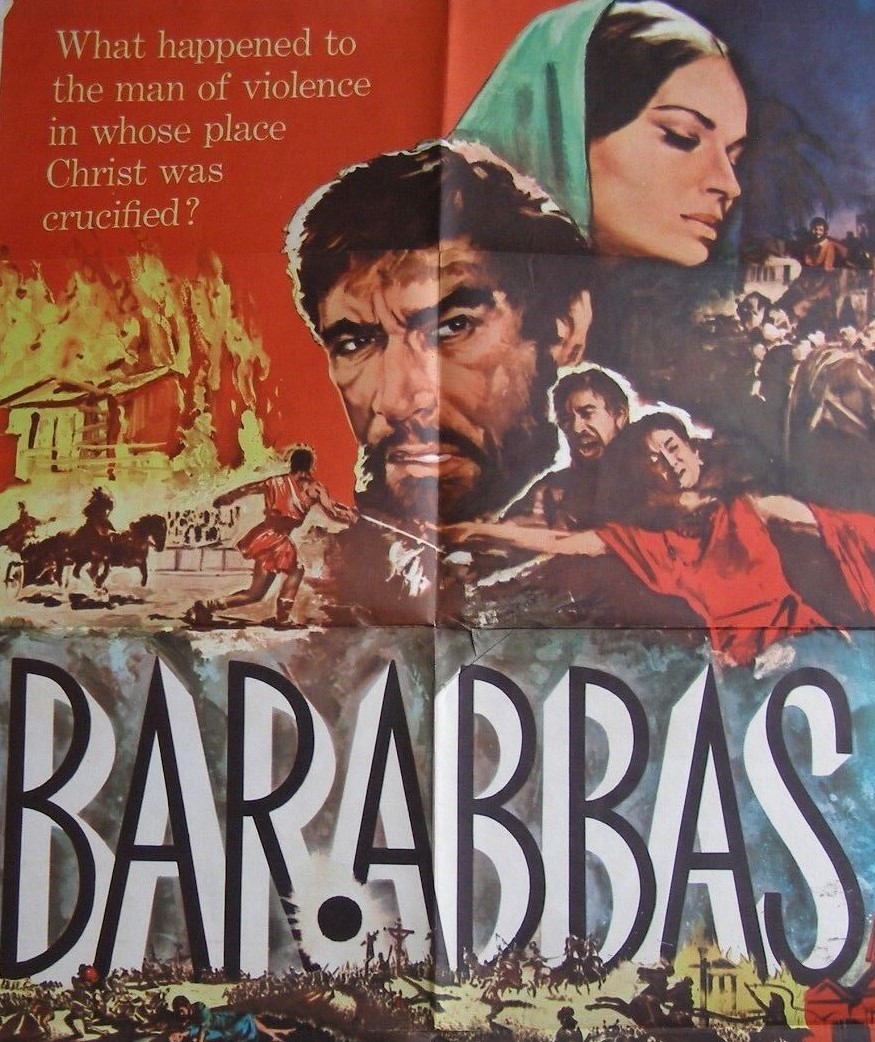
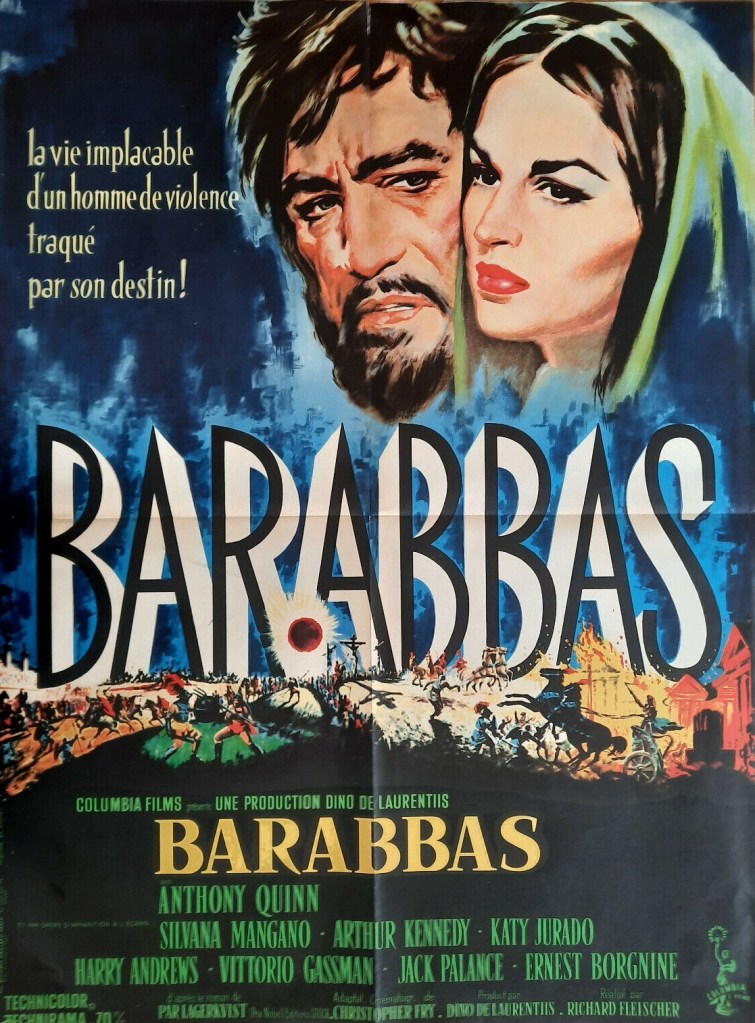
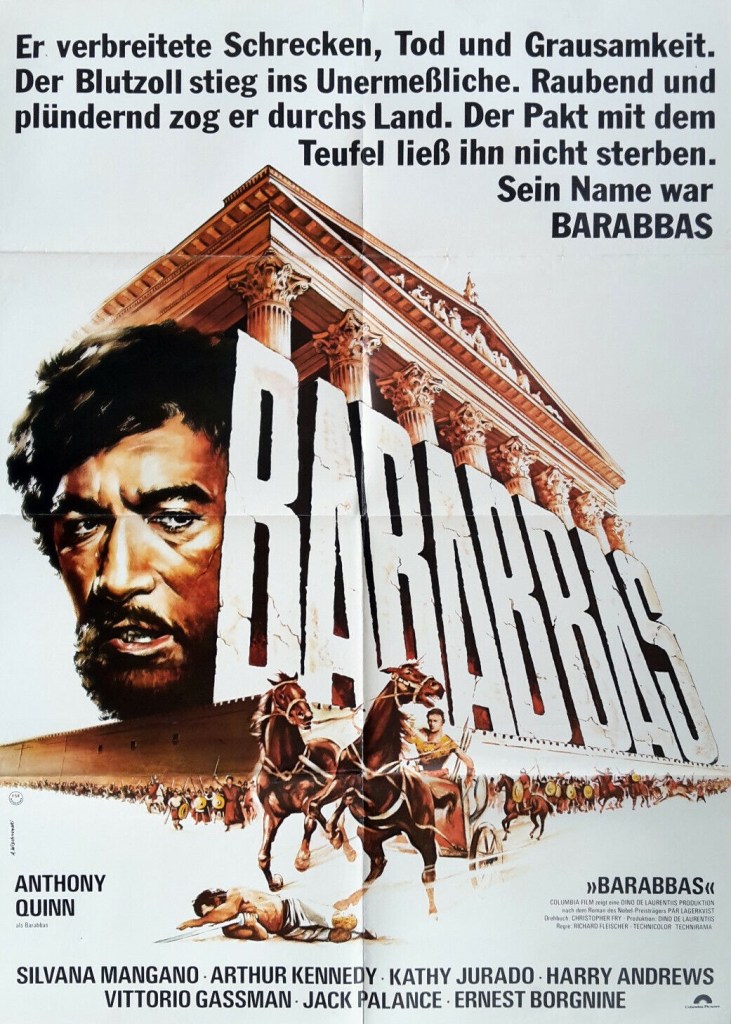
Barabbas (1961) ****

Brutally ironic ending adds a final twist to this religious epic that sheds a murky rather than heavenly light on the early days of Christianity. Barabbas (Anthony Quinn), in case you are unaware, is the criminal who, in a public vote, is spared crucifixion instead of Jesus Christ. Intent on returning to his lusty life, instead he finds himself drawn to the teachings of the Son of God despite his feverish attempts to deny it. Death might have been preferable to two decades spent imprisoned in the sulphur mines followed by a stint as gladiator only, finally refusing to deny his conversion, he ends up on a cross.

The fate of Barabbas in the Bible is undetermined, only meriting a few lines, but in the imagination of Swedish novelist Par Laverkvist he lived quite an extraordinary life, a criminal vagabond coming to believe in what he originally despised.  The religious element is almost an excuse to investigate life at the edge of a pauper’s existence, a world in which faith is possibly the only way to get through the day. It’s an episodic tale with Barabbas as a Job-like peasant on whom constant indignity and humiliation is heaped.

A witness at times to the most exalted elements of Christianity – the eclipse surrounding the crucifixion, the stone rolled away from the tomb – he also sees lover Rachel (Silvana Mangano), a Christian convert, stoned to death. It’s a miracle he survives imprisonment in the mines and that when, thanks to an earthquake, he escapes it’s almost bitter irony that he ends up in gladiator school, facing the demonically sadistic Torvald (Jack Palance). Even when pardoned, he is again arrested for, believing the end of the world is nigh as described in the Christian teachings, helping burn Rome to the ground. Arrest this time sends him back to where he started, heading for crucifixion, though this time willingly.

Anthony Quinn (Guns for San Sebastian, 1968) is excellent as the dumb, mostly mystified peasant, only occasionally rising to the occasion, mostly defeated, or captured, and failing to defend those he should protect. Not entirely cowardly, witness his battle in the arena, but self-serving, and in a sense cursed by events outside his control.

Others are only briefly in the spotlight, Silvana Mangano (Five Branded Women, 1960) good as the converted Christian accepting her fate, ditto Vittorio Gassman (Ghosts of Rome, 1961) as an enemy prisoner in the mines, and Jack Palance (Once a Thief, 1965) over-the-top as the kingpin gladiator. In cameo roles – not exactly the promised all-star cast – you can find Ernest Borgnine (Chuka, 1967), Arthur Kennedy (Claudelle Inglish, 1961), Katy Jurado (A Covenant with Death, 1967), Valentina Cortese (The Visit, 1964) and Harry Andrews  (The Charge of the Light Brigade, 1968).

Director Richard Fleischer (The Big Gamble, 1961) does a brilliant job of keeping reverence at bay, turning the potential awe of the eclipse into a moment of personal terror, ensuring that current persecution rather than potential eternal life remains foremost, focusing on the human not the ethereal. He presents Barabbas as constantly mystified at his escape, guilt-ridden that he has done nothing with his life, thwarted in virtually every attempt at redemption.

The big scenes are well-handled, the sulphur mines a pit of Hell, the arena far more realistic than Spartacus (1960), the burning of Rome that initially represents freedom turning into a trap. Filmed in Technirama 70mm, Fleischer makes the most of the widescreen and the historical detail.

In some respects this makes more sense if viewed alongside the director’s crime triptych of Compulsion (1959), The Boston Strangler (1968) and 10 Rillington Place (1970) which concentrate on outsiders coming to national attention through illicit activity.

Far from the usual stodgy religious offerings of the period, more in keeping with a Pasolini-like vision, with a keener eye on history than creed, it’s been rather overlooked and deserves reappraisal.

Christopher Fry (The Bible…in the Beginning, 1966) was credited with the screenplay from the book by the Nobel prize-winning novelist Par Laverkvist.

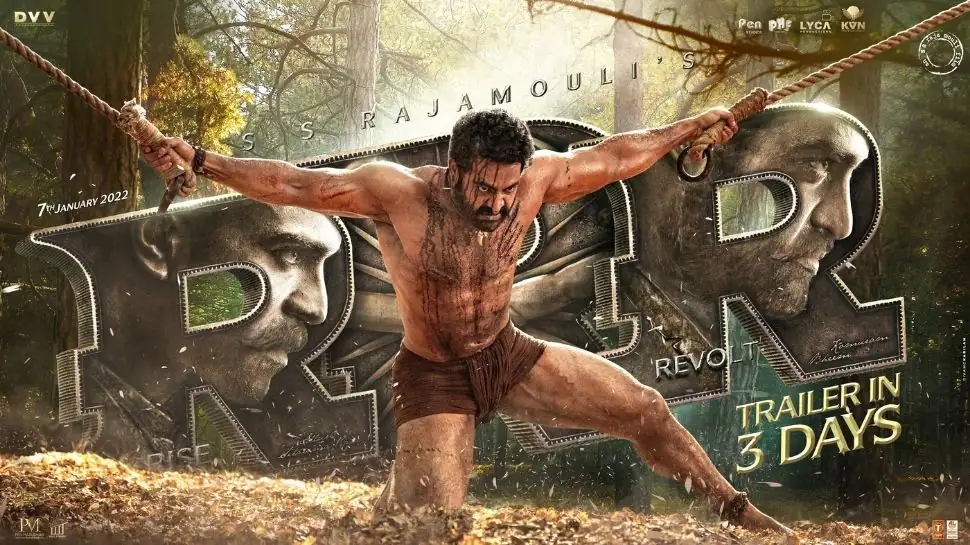
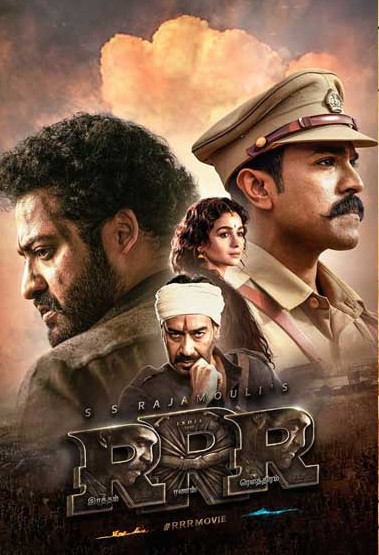
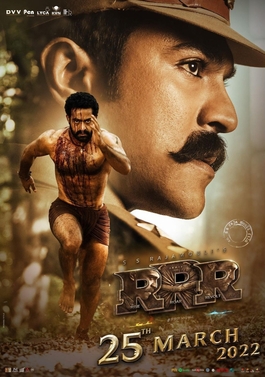
RRR (2022) *****

It’s unusual for the esteemed New York Film Critics Circle to be taking a lead from me. But, happening upon this, my first encounter with Bollywood, on an otherwise quiet Monday cinema outing, I have been championing it ever since, though not always to an appreciative audience.  So I was somewhat astonished – and rather delighted – to discover that the New York Film Critics has just bestowed its annual Best Director Award to S.S. Rajamouli for R.R.R.

In honor of that achievement I am reprinted my original review below.

Easily the most extraordinary epic I have seen in a long time. Hitting every action beat imaginable, a stunning tour de force that ranks alongside the best Michael Bay or Steven Spielberg can offer. As if Rambo or John Wick had turned up a century ago. If films could go from 0 to 100 in ten seconds, this would be the prime contender. Astonishing sequences include a cop taking on a mob single-handed with only a stick for a weapon, a villager acting as bait for a tiger, wild animals leading an attack on a fort, a savage beating with a nail-studded whip, and the unforgettable image of one man mounted on another spraying bullets with two rifles. 

Following the virtual abduction of a native girl Milla, two friends are on a collision course in the oppressive British regime in India in 1920. Technically, it doesn’t count as a kidnapping because British Governor Scott Buxton (Ray Stevenson) hasn’t, in his eyes, committed a  crime, merely taking the child as a gift for his wife (Alison Doody). Villager Bheem (N.T. Rama Rao Jr.) is tasked with bringing the girl back, ambitious undercover cop Raju (Ram Charam) with stopping him. The two men, befriending each other in Delhi, are unaware of the other’s plan. That both are immensely likeable, if quite opposite, characters, creates terrific charisma, and their bromance is entirely believable.

Everything in this picture is big and bold except when it is intimate and small. There is a beautifully-observed romance between Bheema and a kind British woman Jenny (Olivia Morris), the development of which, faced with the obstacle of neither understanding the other’s language, with Raju acting as matchmaker, could have been a film on its own. There are two brilliant pieces of screenwriting, phrases repeated throughout that acquire deeper meaning as the story unfolds. The British continually kill by brutal means rather than waste an expensive bullet; “Load. Aim. Shoot,” is a mantra taught the young Raju by his revolutionary father; both come into play at the climax.

The British are horrific. The Bheema-Jenny meet-cute occurs when the native is beaten for inadvertently embarrassing a British soldier. Lady Buxton is a sadist, determined to see a man whipped till he bleeds to death. By contrast, the two heroes are often far from heroic, Bheema unable to find the girl, Raju forced into terrible violence as a consequence of ambition. And in the midst of all this ramped-up violence perhaps the best scene of all, albeit one of conflict, is an energetic dance-off between the two men and the scions of the British upper class, the fantastic “Naatu Naatu” sequence.

Director S.S. Rajamouli (Baahubali: The Beginning, 2015) makes as bold a use of narrative structure as Tarantino in Pulp Fiction, withholding until the last third of the movie a flashback which tilts the story in a completely different direction. But there is nothing lumbering about this epic, it has an incredible drive, an energy to set your head spinning. Even so, Rajamouli utilises a classic three-part structure and the three-hour-plus running time is anything but sprawling. In among a host of character-driven scenes he knows how to build a sequence, as the heroes successively triumph and fail with every passing minute, and among the introductory sequences for both main characters are some inspired images. Cleverly seeding the story creates a variety of twists, turns and reversals.

I was expecting not to like the traditional dancing sequences, which you would thought ill-fitting in a picture of this scope, but the “Naatu Naatu” sequence is treated as virtually a rebellion with tremendous dramatic impact. Although the two leads are muscular in the Schwarzenegger/Stallone mold it does not prevent them channelling their inner Gene Kelly.

Except that it is set a century ago, this has all the bravura hallmarks of MCU, an exceptional adventure told at top speed that does not put a foot wrong. 

N.T. Rama Rao Jr  (Janatha Garage, 2016) has the more difficult role, in that he switches from full-on action hero to romantic klutz. But the intensity of Ram Charam (Vinaya Vidheya Rama, 2019) should have Hollywood calling. The characters played by Ray Stevenson (Accident Man, 2018) and Alison Doody (Indiana Jones and the Last Crusade, 1989) are more one-dimensional but no less terrifying for that.

On energy and cinematic imagination alone, this would more than pass muster but S.S. Rajamouli has also created a brilliant piece of entertainment with greater depths than you might imagine.

This movie cries out to be seen on the big screen and maybe, in light of the NYFCC Award, your local arthouse might see fit to re-book it. Otherwise you will cn catch it on Netflix.

Amsterdam (2022) **** – Seen at the Cinema

Shaggy dog story wrapped up in paranoia thriller. A shade overlong, with too many characters and too much plot but such flaws should not detract from that rare cinematic animal, a truly original movie. Brilliant screenplay, believable characters and superb acting prove an irresistible combination.

Though you can see why this sank like a stone at the box office, the all-star cast generally acting against type, idiosyncratic director given vast sums to play with, a tale that goes in too many directions at once, and the unconstitutional events of January 6, 2021, bringing this too close to home for fractured American audiences.

You don’t get this kind of writing much anymore. When individuals come together on a project – to save the world the most likely reason these days – their individuality is usually subsumed to the plot. Here, instead, the reactions of the characters remain distinct and no matter what is going on there is always time for individuality. And some of the invention is just deliciously insane, the nonsense songs for example.

Touching on the World War One aftermath of recovering from mental and physical wounds plus profiteering glee, a sense of a country racked by the Depression on the brink, mind-inducing experimentation of the political and pharmaceutical kind. A trio of war veterans, soldiers Burt (Christian Bale) and Harold (John Davidson Washington) and nurse Valerie (Margot Robbie) investigate a mysterious death, an illegal autopsy uncovering poison, only to find themselves framed for murder.

Burt is not a prime-time player according to wife Beatrice (Andrea Riseborough), and her wealthy family had dispatched him to the war in the hope he would return with bankable glory, but generally treat him as an unwanted black sheep. Valerie now makes art out of war debris, bullet shells and shrapnel, her charming brother Tom (Rami Malek) and his wife Libby (Anya Taylor-Joy) embedded in malevolence. Harold is a lawyer, for whom racism is a constant.

American and British secret service operatives, Norcross (Michael Shannon) and Canterbury (Mike Myers), float in and out. The moneyed business elite, despising White House incumbent Roosevelt, cast envious eyes at the dictatorial economic miracle of Mussolini in Italy.

On everyone’s dance card is General Dillenbeck (Robert De Niro), sought out by our intrepid trio and a mysterious cabal. All he has to do is make a speech at a veteran’s dinner. Make the right kind of speech and the trio are vindicated. Make the wrong kind and he could be assassinated.   

Like Chinatown (1974), Amsterdam is representative, a state of mind, but of freedom rather than endemic corruption. This is an intricate piece and a bit slow for today’s fast-paced generation and with more dialog than might sit well with a modern audience and flights of fancy that are far more original than anything you would find in the MCU. But it’s a hell of an intelligent thriller driven by a bunch of deadbeats.

It never goes down the obvious route. Instead of a love triangle – Valerie and Harold a pair – it’s an evocation of friendship. You don’t need umpteen clues to find the villains, they’re upfront, and they don’t think they are baddies, but cleverer people coming to the aid of the dumb masses putting too much blind faith in democracy. While this is based on a true story, in reality it’s based on the constant of the rich trying to get richer and the wealthy believing they are the best, even if unelected, candidates to run the world.

All that political stuff could have been a big turn-off if it had gone down the preachy route, but it doesn’t, instead it’s almost a miracle that it arrives at any conclusion given in whose hands the narrative has been placed. The Three Stooges would have done a better job of getting there quicker, but then you wouldn’t have had so much fun.

Not only are all the stars on their A-game but acting-wise it delivers some career-reviving turns not least from Christian Bale (Ford v Ferrari, 2019), devoid of a lifetime’s acquisition of irritating tics, John David Washington (Tenet, 2020) called upon to develop a character rather than an action-driven hero. I had to check the end credits to find out it was Mike Myers (Bohemian Rhapsody, 2018) playing the understated Canterbury and hogging the screen with none of the acting pyrotechnics that dogged previous attempts at mainstream work. Ditto Robert De Niro (The Irishman, 2019) and Rami Malek (Bohemian Rhapsody), no grandstanding this time round – don’t worry I recognized both from the off – and Anya Taylor-Joy finally delivering on the promise of The Queen’s Gambit (2020).

Margot Robbie (The Suicide Squad, 2021) is already on the rise and this will add to her growing portfolio of fascinating characters. And if you’re fed up watching any of these stars in brilliant form, there are other distractions in the form of Chris Rock (Spiral, 2021), Taylor Swift (Cats, 2019), Andrea Riseborough (The Electrical Life of Louis Wain, 2021) and Alessandro Nivolo (The Many Saints of Newark, 2021).

You often hear the term “visionary director” thrown about with indiscriminate regard, but this is the right kind of visionary, director David O. Russell (Joy, 2015) with his own way of seeing the world, and delivering it in distinctive fashion, with less of an eye on camera movement and more on dialog and motivation and staying true to a coterie of original individuals.  

I guess the money was spent on atmosphere, this is 1930s USA regurgitated in enormous detail. But you’ll forget the background, the costumes and sets, and be dazzled instead by the script and the acting, and the enveloping tale of friendship.   

Guns for San Sebastian (1968) ****

Pre-Stagecoach (1939) Hollywood used to differentiate between historical adventure pictures and westerns. Given it’s set in 1746, before there was such a thing as a revolver or repeater rifle, so a complete absence of gunslingers, this falls squarely into the former camp though its format displays western credentials. A tad top-heavy with religious allegory, “miracles,” peasant piety and an Ennio Morricone score mainlining on the celestial, nonetheless it manages to achieve a character-driven narrative and some powerful action sequences.  

However, it’s a lengthy set-up. Outlaw Leon (Anthony Quinn), on the run from Mexican troops, takes refuge in a church. As punishment for giving him sanctuary Fr Joseph (Sam Jaffe) is expelled to the abandoned church of San Sebastian in an equally abandoned village. Ringing the bell to attract parishioners only alerts bandits who kill him. Donning his garb, Leon is mistaken for a priest by Yaqui leader Teclo (Charles Bronson) and strung up crucifixion style. But he’s rescued by villagers who almost elevate him to sainthood courtesy of a couple of accidental “miracles.”

Enjoying his newfound status, but still attracted to peasant Kinita (Anjanette Comer), he directs the parishioners to build a dam to flood the fields to assist in corn-growing. Teclo objects to challenges to his authority and burns down the village. The villagers turn against Leon, and although initially intending to vanish, he decides instead to blackmail his mistress, the wife of the local governor (Fernard Gravey) who agrees to supply him with weapons. Leon builds a fortress to withstand the expected attack setting up a very engaging climax in which the dam plays a critical role.

A modern audience might expect a sturdier narrative rather than one that seems to shift at whim, not helped by Leon’s indecision. And it’s too slight a vehicle to carry the political points, the state of Mexico at the time, the settlers vs. original occupants (i.e. Native Indians) scenario, the problems facing half-breeds (Leon and Teclo both), but it’s better at exploring the power of the church, the worship bestowed on any priest who turns up, regardless of how ill-suited he appears.  The occasional comic sequence, banter with an architect, negotiation with a Mexican colonel, seems out of place.

On the other hand there is a truly mesmerizing performance from Anthony Quinn (Lost Command, 1966) as a womanizing low-life who happens upon redemption, so deep does his impersonation of a priest go that he can’t bring himself to touch the compliant Kinita, who is aware of his true identity. Switching between shiftiness and godliness at the drop of a hat and deriding villagers for their lack of character his turning point comes when he realizes he has fallen into the same trap. That he emerges as a wily man of conscience is no mean feat.

The other big bonus is to see someone at last recognize Charles Bronson (Once upon a Time in the West, 1969). Here he is given cinematic status, camera pitched up at his face, and allowed to eliminate the growl and monosyllabic delivery that has been his wont in lesser roles. He’s a rather decent villain at the end.

There are a couple of inconsistencies. Teclo wants villagers to take to the hills but on the other hand somehow to spend enough time tending the corn that come harvest time he can steal. And it’s a bit too neat how he falls into the dam trap.

All in all, enjoyable and very under-rated primarily, i suspect, because people come at it expecting a western rather than a historical film in the adventure vein. But it’s elevated by the intriguing narrative, the questionable hero, Quinn’s performance and the introduction to a new-look Bronson.

Frenchman Henri Verneuil (The Sicilian Clan, 1969) does well to probe so many issues for an audience probably expecting something more straightforward. James Webb (Alfred the Great, 1969) wrote the screenplay based on novel by a William Faherty, a Jesuit priest. In the book, the hero was a soldier who became a priest rather than an atheist opportunistic outlaw.

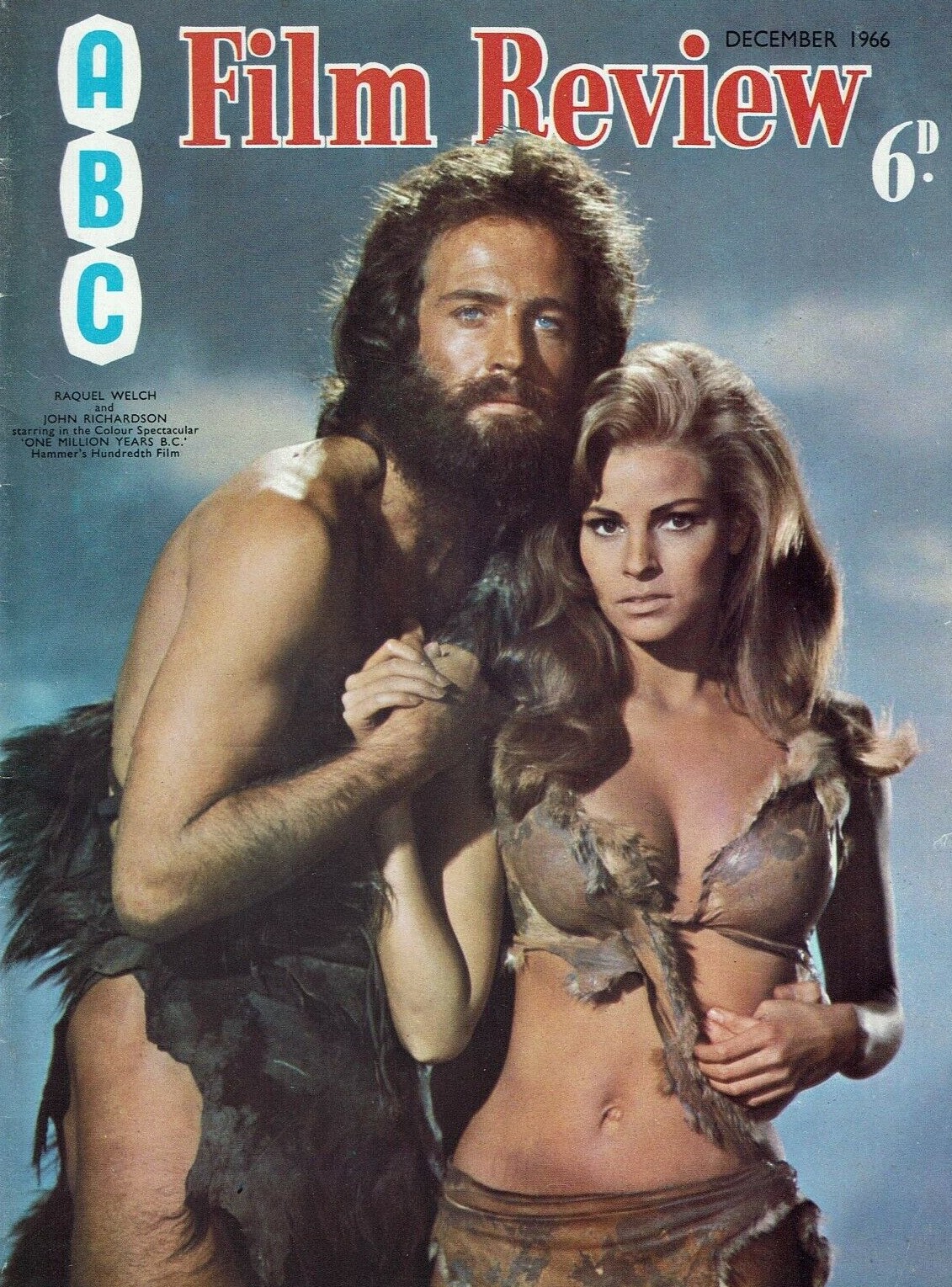
One Million Years B.C. (1966) ****

The three ages of man: child watches this film for the dinosaurs, teenager for Raquel Welch, mature male for the dinosaurs now he knows who Ray Harruhausen is.

Guilty pleasures multiplied. Add the Mario Nascimbene (The Vengeance of She, 1968) score to the delights of Raquel Welch in a fur bikini and Ray Harryhausen’s sensational stop-motion animation.  Generally dismissed as high-level hokum, it features an intriguing gender role reversal, and is virtually, not to be too academic about it, a throwback to silent cinema, minus the title cards that helped audiences a century ago work out what was going on. Everything relies on facial expression and gesticulation.

Luckily, there’s not too much in the way of narrative complication. Tumak (John Richardson), the son of the chief of the Rock Tribe, is chucked out into the wilderness for standing up to his father. He probably wouldn’t be crying too much about that, given the strong rule over the weak, old men are left behind to die, and the feeble are last in line for food.  Plus, his brother Sakana (Percy Herbert) is prone to stabbing people in the back.

Unusually, the picture went straight out into U.S. wide release (saturation). It was an 80-theater break. Twentieth Centry Fox mounted a huge advertising campaign based on the fur bikini image, but by this point she wasn’t an unknown star, already seen in “Fantastic Voyage.” The New York Times might be wincing now at its “monument to womankind” now.

Reaching a distant shore, Tumak is rescued by Loana (Raquel Welch) of the Shell Tribe who takes an instant fancy to him, helping protect him from a huge marauding creature. But his aggressive temperament doesn’t sit too well among this peace-loving democratic group either, despite him saving some kids from another marauding creature. But when he’s chucked out this time, Loana goes with him.

But you know that any journey pretty much takes them into the heart of dinosaur heaven, and Tumak makes the mistake of retuning to his own tribe, where Loana is made unwelcome by Nupondi (Martine Beswick), Tumak’s previous squeeze. It’s power politics all over again until marauding creatures and a convenient volcano intervene and matters can be settled.

All eyes are on Loana and her miraculous bikini until a dinosaur appears, which occurs at frequent intervals. Then you can’t take your eyes off Ray Harryhausen’s creativity, at first expecting the match between humans and his wizardry to be so obvious the illusion will be shattered, but once you realize that is not going to be the case you just sit back in wonder.

Spoof newspaper from the Pressbook.

Harryhausen has made dramatic improvements in his techniques since previous highpoint Jason and the Argonauts (1963). Cleverly, he builds anticipation by matte work to present scenes of live creatures. The first, the warthog, is of normal proportions, and its capture suggests man’s domination over beast. But that proves a false assumption. Anything later is just gigantic – iguana, turtle and tarantula. In normal circumstances only the giant spider might appear a threat but in the distant past it would appear any creature bigger than man looked upon humans as an easy meal.

And that’s before the allosaurus rampages into sight and a pteranodon swoops out of the sky snaring Loana and then has to battle a rhamphorhynchus over its prey, almost as if Harryhausen was determined to animate the most difficult creatures possible in order to prove his innate skill.

Sure, hostility is much easier to telegraph than other emotions and a fair bit of the picture is people getting cross with each other, but meet-cute between Loana and Tumak involves little as significant, glances and eye contact the core of communication. It’s pure cinema. Stripped of any meaningful dialog, the camera captures everything we need to know. It’s a brutal world, dog eat dog, man eat warthog, dinosaur eat woman, every living thing is a snack of one kind or another and when they’re not killing for food they’re battering each other out of power lust, rivalry or jealousy.

And although nobody could have guessed the impact Ms Welch would have on the male pulse, Hammer had previous in the department of introducing a stunning female into a tale, and it may be pure coincidence that both Loana and Ayesha in She (1965) were woman of power, rather than mere playthings of men. Ayesha is introduced in stunning fashion, her presence pre-empted, most of the picture prior to her appearance serving merely to build her up. Obviously, Ursula Andress did not disappoint but she was introduced in majestic fashion rather than catching fish at the seashore. Albeit Loana sported a bikini, so did all the other fisherwomen and director Don Chaffey resisted the temptation to present her in more statuesque fashion, regardless of the image presented on the poster.

Just as it’s hard to underestimate the iconic impact of Raquel Welch in a fur bikini, so, too, is the work of Harryhausen. And I would also add the innovative score of Nascimbene, with sounds Ennio Morricone would have been proud of.

Despite myth to the contrary, it’s rare for an unknown to emerge from a movie a real star, but Raquel Welch certainly did, though her image on a million posters might have had something to do with her sudden success.

As he did with Jason and the Argonauts, Don Chaffey keeps the story spinning along, makes the best of the lunar landscape and raw actors like Welch and John Richardson (She). Michael Carreras (The Lost Continent, 1968) based his screenplay on One Million B.C. (1940).

The problems of creating believable dinosaurs were so evident that nobody really tackled pre-history until Steven Spielberg waded in with Jurassic Park (1993). It’s a measure of how successful this effort is that the director eschews the cute kids that seemed endemic to the later genre and had his characters facing up to the monsters rather than running away like crazy or expecting that somehow man could control them.

Much more entertaining than I expected, high class special effects, strong narrative, and more than enough to wonder at.

The Charge of the Light Brigade (1968) ****

It’s worth remembering that Britain, led by roughly the same type of commander lampooned here, won the Crimean War and that initially this particular engagement, despite the deaths, was celebrated for its valour by poet Lord Tennyson, in much the same way as famous defeats like Dunkirk and The Alamo somehow managed to achieve the status of some kind of victory in the public perception. It’s also worth noting that the documentary-style realisation of Dunkirk, (2017) and to that extent Coppola’s Apocalypse Now (1979) owe much to Tony Richardson’s approach, both films more interested in the bigger picture than individual acts of heroism.

And our conscience here, dashing cavalry officer Nolan (David Hemmings), is not quite saintly, engaged in an affair with the wife Clarissa (Vanessa Redgrave) of a friend. Despite the director’s rush to judgement, his approach displays a refreshing change to a genre where acts of selfless courage were the norm. Setting aside the occasional self-reverential artistic lapse, it’s an excellent depiction of class-ridden Britain at war in 1854, an era when military advancement was purchased without any consideration to the leadership skills such high-ranking officers required. I’m never sure if John Ford invented the camaraderie of his Cavalry in westerns, where at dances  the officers mixed with the ordinary soldiers, but here the two classes are kept apart.

And while Richardson clearly wants to blame the class system for the military calamity, the outcome is a no-holds-barred ultra-realistic portrayal of war in in all its sordid glory. At its heart are the machinations of senior commanders jostling for position and control and, much as with Field Marshal Montgomery and General Patton in World War Two, allowing personal enmity to affect decisions.

The two biggest culprits are Lord Cardigan (Trevor Howard) and brother-in-law Lord Lucan (Harry Andrews) in charge of the ill-fated charge who openly spout bile at each other, remain deliberately obtuse, and are, nonetheless, a joy to watch. Cardigan is irascible to the point of apoplexy, incredibly brave, vainglorious, a vindictive sex-mad peacock, with an odd selection of principles (refuses to deal with spies, for example). Nothing can beat a quite marvellous spat between the pair over how to pitch tents. Both, however, are a vast improvement on the ineffectual commander-in-chief Lord Raglan (John Gielgud) whose idea of tactics is to “form the infantry nicely” and another commander who refuses to let the simple matter of being under attack ruin his breakfast.

At the other end of the scale are the poor recruits, drawn from the lower classes, so ill-educated they don’t know their left foot from their right (something of a necessity in obeying orders in the field), lured by the promise of glory and a job, and find themselves turned into horsemen in the most brutal fashion.

In the middle is the effete Nolan, initially introduced as the good guy, who believes horses should be treated with kindness and stands up to Cardigan. His romance with Clarissa is a masterpiece of nuance, all furtive glances, hardly a word spoken. And he has a pivotal role in sending the cavalry in the wrong direction at the Battle of Balaclava, causing the fatal charge.

It’s episodic in structure, characters bobbing in and out, some for comedic purposes, and without the battle it’s doubtful the picture would have been made for, excepting the high-level squabbling, there’s little inherently dramatic. And possibly that’s to the movie’s benefit for it clears the way to concentrate on how an army operates and goes to war, the focus, unlike most war or historical pictures, being as much on what goes wrong as goes right. So the horses dying during the voyage and callously dumped overboard and the men marching through Crimean heat and afflicted by cholera take centre stage rather than lavish sequences of soldiers on splendid parade.

On the downside, you have to accept the director’s version of the war’s causes, British imperialism don’t you know, rather than Russian aggression as a result of religious conflict in the Middle East. And there’s narrative indecision, various characters permitted interior monologue for no particular reason except artistic impulse. Mrs Duberley (Jill Bennett) wife of the paymaster (Peter Bowles) is permitted to accompany the expedition for the sole purpose it would appear of being shagged by Cardigan.

The detail of what exactly went wrong on the battlefield is obscured by the fact that Nolan, who hand-delivered the famous order to attack, itself unclear, died in battle, so it’s like one of those Netflix documentaries about unsolved murders, fascinating but ultimately annoying. If incompetence is measured in casualties, apart from this one charge the British came out better than the other participants, 40,000 dead compared to three times as many among their French allies and more than ten times as many among the Russian enemy.

The acting is of a very high quality, David Hemmings (Alfred the Great, 1968) as good as I’ve ever seen him, Vanessa Redgrave (Blow-Up, 1966), except for her deception a Stepford Wife Victorian-style, Trevor Howard (Von Ryan’s Express, 1965) brilliantly outrageous and John Gielgud (Sebastian, 1968) who turns befuddlement into a high art.

Tony Richardson (Tom Jones, 1963) makes some bold choices, not least in what is included and what is left out, the battle of the tents, fake news (from The Times!), soldiers facing the lash, the dashing charge and its terrible aftermath, the animated sequences, and his revolutionary soundtrack. Sergio Leone might have claimed the artistic high ground with the buzzing fly at the start of Once Upon a Time in the West (1969) but there’s little in film music of the time – beyond Bernard Herrmann’s Psycho score – to compare with the sound of a fly playing over the end credits or its inclusion during the march when men are literally dropping like flies. This is a very different kind of curate’s egg, absolutely brilliant in parts, and never dull.

Unfortunately, there’s a topical parallel, Crimea having been invaded several years back by Russia and now the whole region aflame.

This was the first home-grown excursion into the all-star-cast business – other British movies in that ilk, originating from these shores, previously headlined by a Hollywood star like Gregory Peck (The Guns of Navarone, 1961),  Kirk Douglas (The Heroes of Telemark, 1965) or George Peppard (The Blue Max, 1966). And I can see why the new box office stars David Hemmings and Vanessa Redgrave, repeating their Blow-Up (1966) teaming, would have, in the narrative sense, occupied center stage. But given nobody knew for certain what caused the disastrous charge and that it would taken place anyway in the picture, the far more entertaining approach would be to concentrate entirely on the likes of the feuding Cardigan and Lucan, two characters who leapt off the screen. Outside of the battle itself, Nolan’s sole purpose, it would seem, was to point out that the army treated its horses badly, a point the audience would have easily picked up without Nolan’s display of alternative horsemanship. Still, all told, at the risk of repeating myself, an excellent watch.

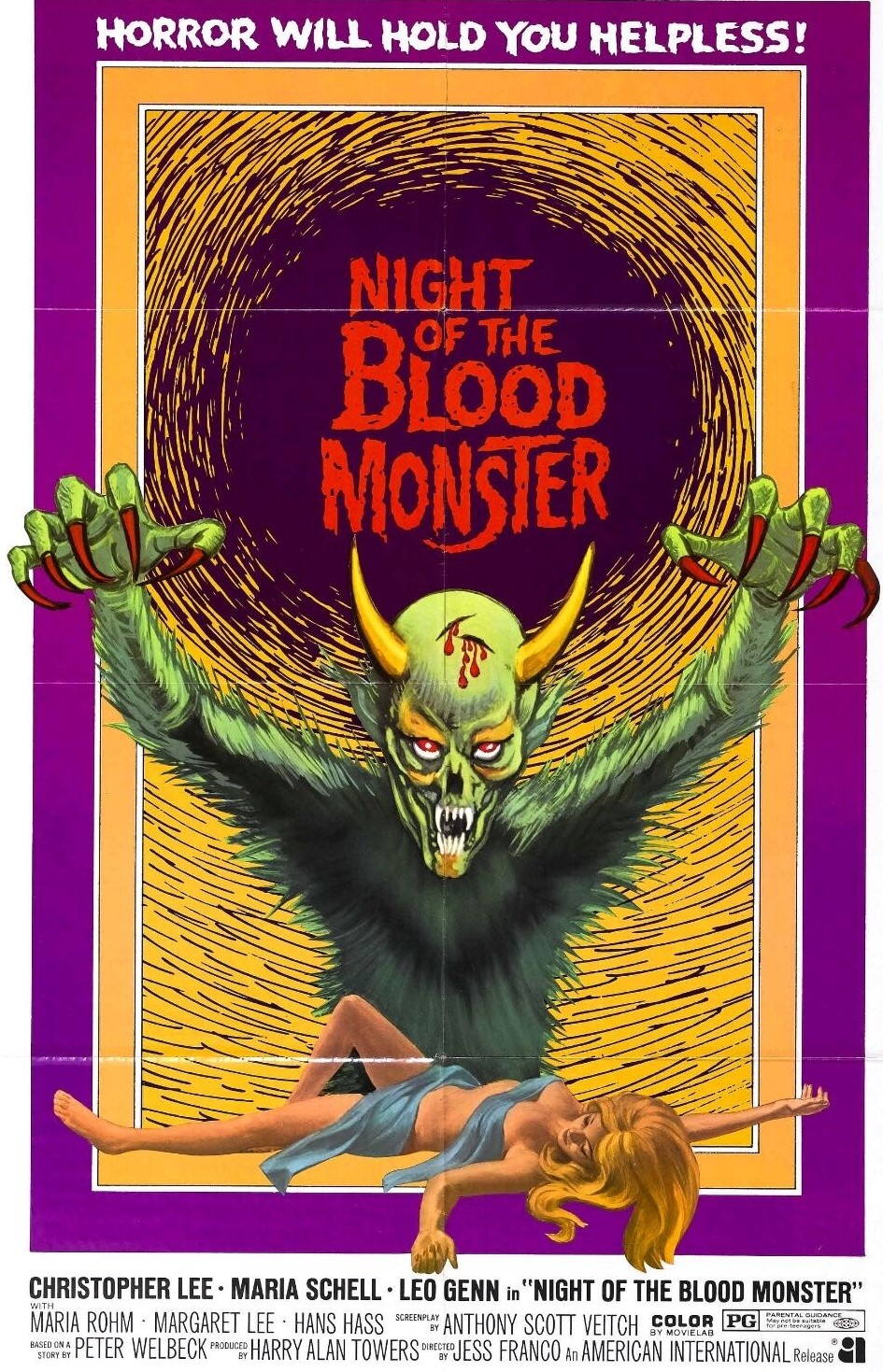
Night of the Blood Monster / The Bloody Judge (1969) ***

Handsomely mounted historical drama set in 17th century England on the brink of revolution  meets Son of Witchfinder General. An uprising headed by the Duke of Monmouth in the south-west threatens to overthrow King James II. Involved in the plot are Harry Selton (Hans Hass), son of suspected agitator Lord Wessex (Leo Genn), whose beloved Mary Gray (Maria Rohm) is in the sights of Judge Jeffreys (Christopher Lee) after he has condemned her sister Alicia (Margaret Lee) to be burned as a witch.

The minute witchcraft enters the equation the narrative thrust is constantly interrupted by scenes of nudity, blood and torture, mostly involving women, but actually the film does attempt to cover the rebellion and its notorious aftermath when hundreds of rebels were executed, the “Bloody Assizes” with “Bloody Judge” Jeffreys to the fore. Conflating witchcraft with a genuine historical episode does not work very well and unlike Witchfinder General (1968), the murder of innocent women is more of a sideshow, despite the brutality involved, and you get the impression the story has been hijacked to accommodate supposed witch Mary in the interests of adding titillation.

Even as the story of the rebellion unfolds, the threat to the crown spelled out, the origins of the revolt mostly made clear (Monmouth being the illegitimate son of Charles II, and nephew to James II) although the sectarianism behind the rebellion is ignored, the narrative keeps jumping back to the witch element. Jeffreys connects the parallel narratives, hunting down rebels and witches, while handling most of the exposition. Given the budget, there’s a surprisingly good battle sequence, cavalry charging cannon. Given his later reputation, Jeffreys also reflects on the meaning of justice.

And while there are some camp moments – Jeffreys playing the organ while attired in grand robes, dancing girls sticking pins in his effigy – the twists and turns (Mary captured and rescued, captured again)  are effective enough. Despite the copious nudity, there a couple of low-key love scenes and, oddly enough, a touching moment when Mary licks the blood from a dead prisoner. And for all the blood, that is effect rather than cause, nothing too gory.

But with the powerful all-mighty, and investigators able to plant evidence, and the innocent forced into immoral acts to save their loved ones, lawlessness is apparently next to godliness. But in reality the wicked did not get away with their crimes so various villains get their come-uppance.

Most peculiar sight is Christopher Lee in a love scene where he is not about to sink his incisors into a neck. Occasionally, the film bursts into German with English subtitles – as if various versions were pillaged to produce this copy – or has lines like “you turn me on.”

However, fans of Spanish cult director Jess Franco (The Girl from Rio) who expected something more along the lines of 99 Women (1969) and Venus in Furs (1969) may be disappointed that he spends so much time on the historical elements and less on the random T&A. You might not be surprised to learn of the involvement of ubiquitous producer Harry Alan Towers (Five Golden Dragons, 1967).

Hannibal (1960) ***

Inconvenient truth never bothered Hollywood scriptwriters when it came to history and here the prospect of solving the “Great Hannibal Mystery” proved irresistible. For in 218 B.C. this invader from Carthage (modern-day Tunisia) had crossed the Alps, battered the Roman army into submission and had Rome at his mercy. But one of the greatest generals of all time did not attack Rome. Why? Love was the answer, according to the filmmakers, following the Romeo and Juliet template.  

I have to admit I didn’t have that on my mind. I was seduced by the poster, the involvement of cult director Edgar G. Ulmer (The Black Cat, 1934), the prospect of an action-packed adventure with marauding elephants and the fact that although familiar with the name Hannibal I had no idea who he was and why he crossed the Alps when surely it would have easier to take a ship from Tunisia to Italy. But I guess star Victor Mature (Samson and Delilah, 1949) was also duped into thinking that if an American nobody like Steve Reeves (Hercules, 1958) could make it big in Italy then so could surely the original Hollywood Mr. Muscles. Mixing the new-look sword-and-sandals genre with the old-style historical epic appeared a potential winner. But I should have guessed that the lean running time of 103 minutes meant an “epic” was out of the question.

The British Trade Descriptions Act would have a field day with the way the posters promoted the elephants. The much-vaunted “army” is scarcely seen in battle and the great beasts looked more cuddly than anything, striding along linked trunk-to-tail.

The picture does take a good while to warm up although the movie begins with a sense of the epic, otherwise how to explain the 15 minutes before Hannibal hoves into view, the preceding period of invaders crossing the Alps short of dramatic incident beyond a couple of men falling to their deaths and the elephants becoming a bit restive. Endless lines of soldiers, in this case stretching into the snowbound horizon, almost becomes a motif, too much valuable time wasted on too many marches.  

Hannibal turns out to be a clever commander, wanting to conquer Rome more by fear than battle, reckoning that if the Italians believed he possessed an unstoppable force they would rush to the negotiating table rather than engage in open battle and risk the destruction of their cities. He sends the captured niece Sylvia (Rita Gam) of Senator Fabius (Gabriele Ferzetti) back to her uncle with frightening tales. This doesn’t fool Fabius who views the woman as a traitor and realizes the pitfalls of surrender. Hannibal and Sylvia getting it together causes discord not just in Rome but in the Carthaginian camp, the delay in attacking the city put down to their romantic dalliance.   

The initial battle scenes come up short, presented primarily in montage, little snippets of fighting here and there, rather than opposing forces facing each other, no sign either of elephants striking terror into the hearts of their opponents. But the later battle more than recompenses. One of the greatest assets of historical and war pictures is the detail given over to strategy. And if filmed properly, you can see plans executed. Hannibal demonstrates his genius by drawing the main Roman phalanxes into a trap, attacking them from both sides and forcing them back towards a river from which there is no escape. Superbly filmed, it’s a bloody conflict (for movies of the period), arms hacked off, faces and bodies weeping with blood. There’s a tragic end to the romance.

Oh, and by the way, Hannibal loses an eye – but it’s not in battle but from conjunctivitis.

I should point out, having done my own digging, but there was a sounder reason than love for Hannibal not advancing on Rome. Simply put, he lacked the machinery to do it. The only way to conquer a city was by siege and to achieve that you needed siege machines which Hannibal lacked. But no matter how much he later tried to draw the Roman armies into the open, he was denied that opportunity by the wily Fabius who, instead, waged a war of attrition.

Hannibal was, in fact, an irritant to Rome for a decade, so this tale is heavily truncated. Although the tale of the strong man brought to his knees by passion is a Hollywood trope – look no further than Samson and Delilah – the lovers fail to strike the necessary sparks, in part because initially Hannibal views Sylvia merely as a tool to achieve a political end and in part because their time together is too limited. This is no grand passion in the vein of Doctor Zhivago (1965).

And that’s a shame because despite (or perhaps because of) his muscles, Victor Mature was no slouch in the romantic sweepstakes, having dallied in the past with the like of Janet Leigh (Safari, 1956), Susan Hayward (Demetrius and the Gladiators, 1954) and Jane Russell (Las Vegas Story, 1952). Here, Mature is better as a leader than a lover. The svelte Rita Gam (The Thief, 1952) – first wife of director Sidney Lumet –  was the opposite of the more voluptuous Italian screen queens of the Sophia Loren/Gina Lollobrigida variety and her career had not really taken off, only eight films prior to Hannibal and only two in the next decade. Paradoxically, she is better battling her uncle and accepting her fate than a woman in the grip of passion.

Gabriele Ferzetti (Once Upon a Time in the West, 1968) makes the most of a complex character. Look out for Rik Battaglia (Sodom and Gomorrah, 1962) as Hannibal’s brother and, as Fabius’s son, Terence Hill (God Forgives…I Don’t, 1967) and in a smaller role his future sidekick Bud Spencer.   

Directorial credit was split between Ulmer and Carlo Ludovico Bragaglia  (Amazons of Rome, 1961) with Mortimer Braus (The Son of Dr Jekyll, 1951), Sandro Continenza (The Inglorious Bastards, 1978) and Ottavia Poggi (Queen of the Nile, 1961) involved in the screenplay.

The Amorous Adventures of Moll Flanders (1965) ***

The Husband-Hunting Adventures of Moll Flanders” might have been a more accurate title and if you were seeking a template for a multi-character eighteenth-century Olde English picturing majoring on sexual shenanigans here would be a very good place to start, rather than the shambolic recently-reviewed Lock Up Your Daughters (1969). Of course, Tom Jones (1963) was the precursor but told the story from the male perspective and here it is from the more vulnerable female point-of-view. Despite the hilarity and the sexual proclivities on show, it remains abundantly clear that marriage remains a refuge, where the un-titled can gain either security or status, but also a contract, a means of further enrichment for the already wealthy.

So orphan housemaid Moll Flanders (Kim Novak) has a difficult time of persuading the elder brother (Daniel Massey) of her wealthy employer to marry her. Instead, he takes her as his mistress, leaving her no option but to marry the drunken fool of a younger brother (Derren Nesbitt) and instantly regret her decision. When he drowns, you would have thought that would solve her problems. But this was the eighteenth century and a widow with no fortune (and therefore power) of her own can easily be tossed out penniless.

A widowed banker (George Sanders) might be a prospect especially as she has the wits to prevent him being entirely robbed by highwayman Jemmy (Richard Johnson). Plans to marry him thwarted, she takes a job for food and lodgings with Lady Blystone (Angela Lansbury) and her husband, an impoverished Count (Vittorio De Sica), who are constantly pursued by debt collectors. Meanwhile Jemmy has taken the decision to marry a rich woman and become a kept man.

But this set of characters becomes enmeshed, rather than going off in sundry directions as with Lock Up Your Daughters, so the tale unfolds in classic fashion. Assuming Moll to be moneyed, Jemmy masquerades as the owner of three ships. Nothing, of course, works out for anybody, certainly not those pretending to be something they are not while aspiring to wealth beyond their reach, but it all concludes in propitious fashion as the actions of the various principals become embroiled.

While certainly having an inclination towards the amorous, Moll wishes for that within the context of true love, rather than selling her physical wares to the highest bidder. So for a picture sold on immorality – the “rollicking ribaldry” of the poster – there is an unsung moral standpoint. Finding safe passage into affluence proves very tricky indeed. And what appears at first glance to be merely a picaresque episodic tale turns out to be very well structured indeed. And those looking for cleavage will find it here in abundance, as if some kind of rationing had been imposed on clothing, or that it was matters of economy that dictated that the area around the bosom be left unclothed. Being the lusted-after heroine it falls to Moll Flanders to shed even more of her attire from time to time.

You are more likely to laugh out loud at the moments of offbeat humour – a flotilla of ducks heading in Moll’s direction when she cries for help in a lake, the Count while acting as a butler demanding a tip – but it is more of a gentle satire. There is some of the expected bedroom farce but, mercifully, no recourse to a food fight. It is handsomely-mounted and meets the highest expectations of the costume drama.

Kim Novak (Of Human Bondage, 1964) easily passed the English-accent-test and carries the picture with ease. Richard Johnson (Deadlier than the Male, 1967) reveals a rakish side so far hidden in his more dramatic works to date. And there is a fine supporting cast including George Sanders (The Quiller Memorandum, 1966), Angela Lansbury (Harlow, 1965), Vittorio De Sica (The Shoes of the Fisherman, 1968), Lili Palmer (The Counterfeit Traitor, 1962) as Jemmy’s mistress, Leo McKern (Assignment K, 1968) as Jemmy’s sidekick going by the name of Squint, Daniel Massey (Star!, 1968) and Derren Nesbitt (Nobody Runs Forever/The High Commissioner, 1968). In bit parts looks out for Cecil Parker (Guns at Batasi, 1964), Dandy Nichols later of Till Death Us Do Part television fame and Carry On regular Peter Butterworth.

All directed with some style by Terence Young (Mayerling, 1968) and adapted from the lengthy Daniel Defoe novel by Denis Cannan (A High Wind in Jamaica, 1965) and Roland Kibbee (Valdez Is Coming, 1971).

An old-fashioned romp with, if you can bothered to look, a moral center. You catch this on Amazon Prime. I’m not sure why they have chosen a black-and-white illustration since the film is shot in glorious color.

Lock Up Your Daughters (1969) **

Worth seeing for all the wrong reasons prime example being Christopher Plummer with a false nose and almost unrecognisable as an eighteenth century periwigged English dandy in a pure squalor of a coastal town. The best reason is the very realistic background, all mud, missing teeth, drunkenness, cockfighting, poverty, debtors strung up in baskets – not the usual bucolic image of Olde England. But everything gets bogged down in an indecipherable plot. Robert Altman mastered the multi-character narrative in such gems as Nashville (1975) but here debut director Peter Coe most demonstrably did not.

This started life as a modestly successful London West End stage musical and probably for budgetary reasons the songs were discarded. All that’s left is plot. And plot and plot. All to do with sex as it happens. Husbands exist only to be cuckolded. Cleavage is obligatory for women. Young women lusting after sex have been brought up in contradictory fashion to view it as dirty. And no eighteenth century tale is complete without a regimen of long-lost daughters and sons.

Guess who?

It starts promisingly enough in early morning with a town crier (Arthur Mullard) filling us in on the predilections and problems of various prominent citizens, most notably Lord Foppington (Christopher Plummer), the foppest of the fops, gearing up for an arranged marriage to Hoyden (Vanessa Howard). As a virgin not wanting to come to his wedding night bereft of the necessary skills, he employs strumpet Nell (Georgia Brown) to bring him up to speed.

Meanwhile, it’s “lock up your daughters” time as a ship’s crew, at sea for ten months, given two days leave, start charging through the town, fondling and kissing any woman of any age who happens to stand still for a moment. Among this randy bunch are Ramble (Ian Bannen), Shaftoe (Tom Bell) and Lusty (Jim Dale). Ramble is given the eye by married Lady Eager (Fenella Fielding), Shaftoe takes a fancy to Hilaret (Susannah York) while old flame Nell is targeted by Lusty (Jim Dale). Mrs Squeezum (Glynis Johns) seeks sex anywhere and there’s maid Cloris (Elaine Taylor) also seeking physical fulfilment.

Of course, the whole purpose of the narrative is to thwart true and illicit love, husbands and fathers returning at inconvenient times. And had the storyline stuck to the tried-and-tested formula devised very successfully for Tom Jones (1963) and The Amorous Adventures of Moll Flanders (1965) it might well have worked. But the instinct to make meaningful comment by way of satire takes the story in very unlikely directions, an extended court scene with a barmy judge the worst of such excesses, though a food fight comes close.

It’s meant to play as a farce, the men climbing (literally) in and out of bedrooms, the town’s apparently only ladder put to continuous use. But what would work on stage sadly falls down here, and not just because the occasional song might have come as light relief. There is an element of the female confusion over sex, natural instinct going against education, and so ill-informed that at the slightest chaste kiss they are likely to cry rape, but that’s as close as the movie gets to anything that makes sense.  A movie that needed a sense of pace just becomes one scene tumbling into another.

Christopher Plummer (Nobody Runs Forever/The High Commissioner, 1968) makes by far his worst screen choice. He’s so concealed in his clothing that movement is inhibited and most of his acting relies on overworked eyeballs. Susannah York (Sands of the Kalahari, 1965) is pretty much lost in the shuffle. Ian Bannen (Penelope, 1966) is the pick, largely because he is required not to play villain, grump or idiot, and his Scottish charm and confidence works very well. Tom Bell (The Long Day’s Dying, 1967) is not cut out for comedy whereas Jim Dale (Carry On Doctor, 1967) who very much is does not get enough.  

The movie wastes the talents of a terrific supporting cast headed by former British box office queen Glynis Johns (The Chapman Report, 1962) plus Roy Dotrice (A Twist of Sand, 1968), Vanessa Howard (Some Girls Do, 1969), Elaine Taylor (Casino Royale, 1967), Roy Kinnear (The Three Musketeers, 1973), Kathleen Harrison (Operation Snafu, 1961), Fenella Fielding (Arrivedeci, Baby, 1966) and singer Georgia Brown (A Study in Terror, 1965).

Keith Waterhouse and Willis Hall (Billy Liar, 1963) wrote the screenplay based on, as well as the original musical, a number of sources drawn from the works of Henry Fielding (author of Tom Jones) and John Vanbrugh. Peter Coe never directed another movie.

Hard to find so Ebay will be the best bet.

Discover WordPress

A daily selection of the best content published on WordPress, collected for you by humans who love to read.

The Atavist Magazine

by Brian Hannan

WordPress.com News

The latest news on WordPress.com and the WordPress community.