Machine Gun McCain (1969) ***

Armed robbers lack the finesse of a jewel thief or burglar when it comes to pulling off a major heist. Rather than resorting to the weaponry of the title, they are more inclined, as John Cassavetes does here, to plant bombs, both as a diversionary tactic and within the target building, in this case a Las Vegas casino.

Although boasting Hollywood leads in Cassavetes and Peter Falk and rising Swedish leading lady Britt Ekland (The Double Man, 1967) and wife of star Peter Sellers, this was an Italian-made gangster thriller with the usual abundance of location work. Without the romantic complications of A Fine Pair (1968) it concentrates on the machinations of the central characters.

And it is a pretty lean machine. The robbery takes place against the background of warring Mafia chieftains, West coast boss Charlie Adamo (Peter Falk) trying to muscle in on a Vegas casino without being aware it is controlled by the New York hierarchy. Hank McCain (John Cassavetes) does not realize the robbery has been set up by his naïve son Jack (Pierluigi Apra) on behalf of Adamo. Irene Tucker (Britt Ekland) is on board as a kind of mostly mute magician’s assistant, helping out Hank.

Little dialogue comes Cassavetes’ way, either, which plays to his strength, that glowering intense unpredictable weasel-face, whose reactions are less likely to be emotional than violent. Falk gets the dialog and little help it does him, his goose is cooked when he has the temerity to shout at the New York kingpin. 

Yet this slimmed-down documentary-style hard-nosed picture in the vein of Point Blank (1967) manages several touching moments, even more effective for completely lacking sentimentality. When Hank’s son is knifed in the back, the gangster finishes him off with a burst from the titular machine gun rather than see him suffer. His old flame Rosemary (Gene Rowlands), making too brief an appearance, has a wall covered in newspaper headlines of herself with Hank celebrating her life as his moll and she accepts without enmity the new woman in his life and she proves the toughest moll of all when confronted with Mafia gunslingers.. 

The planning of the heist is well done, no explanatory dialog, just action on screen; there’s a car chase; and the gangster dragnet is unexpectedly powerful. Gabriele Ferzetti (the railroad baron in Once Upon a Time in the West, 1968) is excellent as the calm authoritative New York boss, Falk a bit too excitable, and Florinda Balkan (The Last Valley, 1971), in her third screen role, has a small part as a traitorous moll. Ekland is surprisingly good with not much to play with, a couple of lines here and there but still emoting with her face.

Cassavetes, who always claimed he was only acting to fill in the time between directing  (Faces, 1968), and as a means of financing them, was at a career peak, Oscar-nominated for The Dirty Dozen (1967) and male lead in Rosemary’s Baby (1968). He had just appeared in another Italian gangster movie Bandits in Rome (1968). Cassavetes and Falk would go on to have a fruitful partnership over another five films. Falk and Ekland had played opposite each other in Too Many Thieves (1967). Falk also had an Oscar nod behind him for Murder Inc. (1961) but his career was about to go in a different direction after the TV movie Presciption: Murder (1968) that introduced Columbo.

Trivia trackers might also note a score by Ennio Morricone. Though not one of his best, a few years later he would deliver one of his most memorable themes for Sacco and Vanzetti (1971) for the same director Giuliano Montaldo.

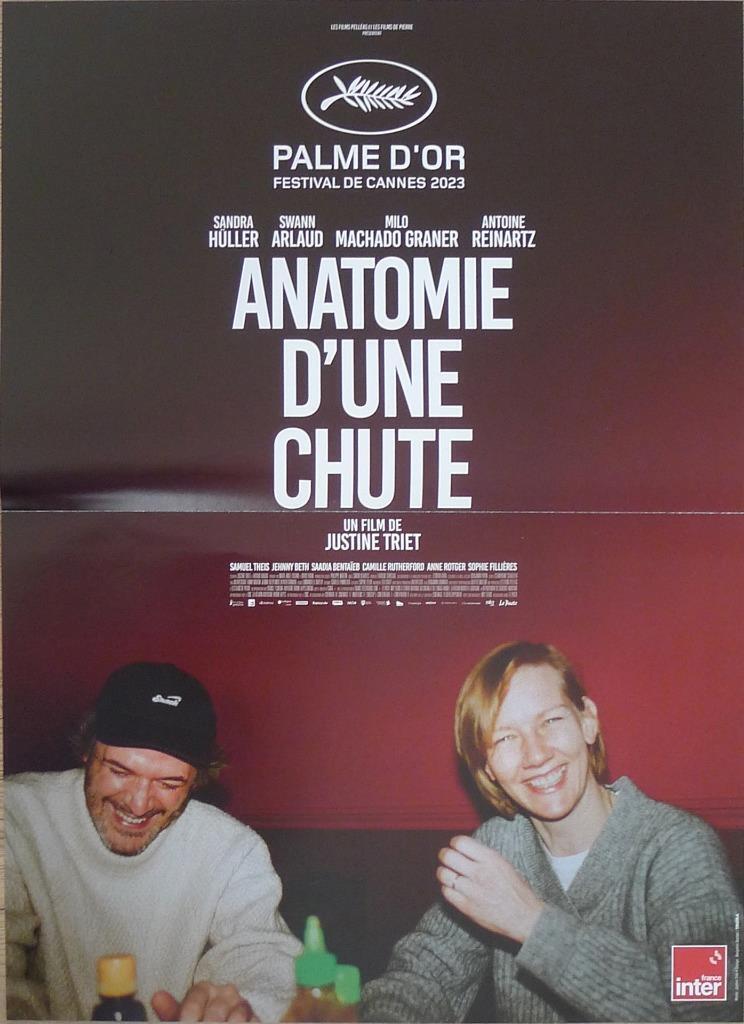
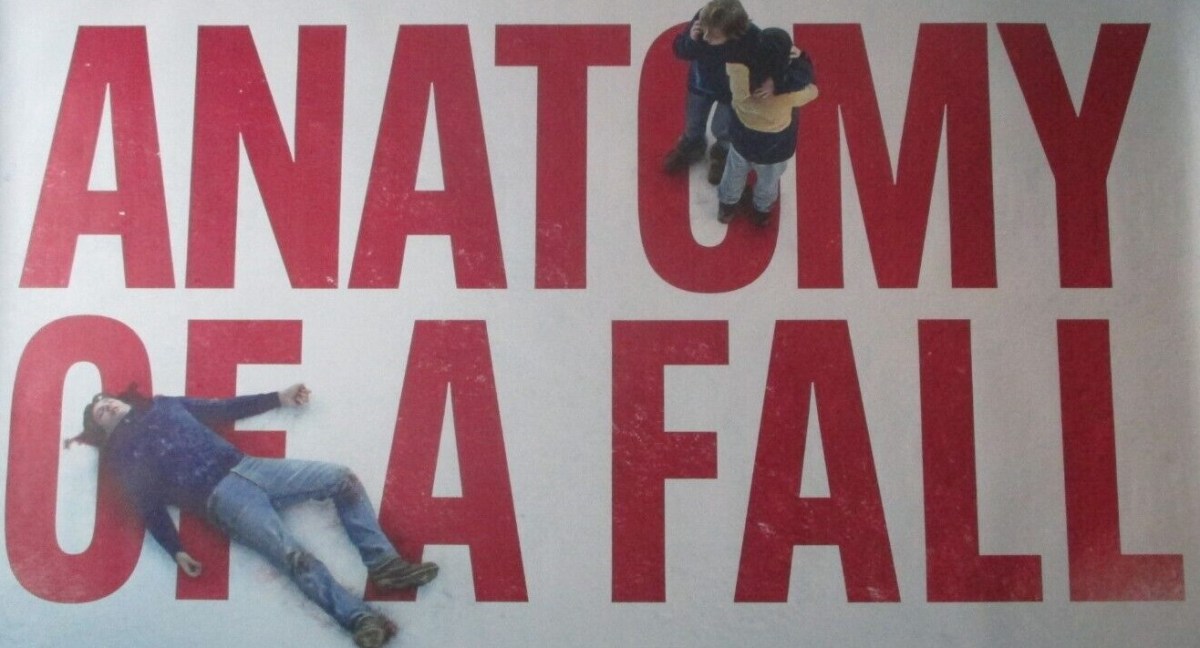
Anatomy of a Fall (2023) ***

I hate it when a mystery movie so blatantly cheats. Sure, we expect some sleight of hand, some vital piece of evidence retained, for the purposes of maintaining high tension, till the very end. Or a twist, a la Jagged Edge (1985), when a murderer, having got off scot-free, is revealed as the killer after all.

And while the central performances of accused, bisexual respected author and mother Sandra (Sandra Hueller), and accuser, smug unnamed prosecutor (Antoine Reinartz), are excellent and the exposition of the psychology of a marriage is well done, still the omission of the kind of critical forensic evidence that a modern audience would require works against the end result. Because otherwise, it plays like a 1940s courtroom drama, where the emphasis is solely on character rather than the weight of evidence.

So, here’s my complaint. The dead man has fallen from a window. Did he jump or was he pushed? Using forensics, the prosecution maintains he was hit by a heavy blow and some of the blood spatters down below were consistent with him losing blood when he was falling rather than when he hit the ground.

So we spend a great deal of time on examining how the body might fall and accounting for the blood, all of which appears to go against the accused, who is revealed as a not-so-nice person, possibly a sexual predator, possibly controlling, certainly a cheat – taking lovers while married and a heinous spot of plagiarism from her unpublished wannabe writer husband.

Only at the very end, when the half-blind child enters the loft space from which the father fell, do we realize that it would be impossible for this to be murder unless there was more evidence pointing to that eventuality. If the movie – prosecution and defence equally guilty of overlooking the obvious –  had spent a couple of minutes on the loft space both would have come to the conclusion not so much that murder could be counted out but that there would be clear evidence of it.  

The window is pretty small and an odd shape. But there was no evidence of a struggle, no scratches on the wood or glass, no tiny shred of material, and for the questionable spatters to end up where they did, the victim had to fall out backwards. So that means he needs to be pushed from the front and make no effort to save himself. The more obvious means of disposing of him – being thumped on the head from the back – was not consistent with the way he fell. And in any case, the space available for the wife to hit him with some heavy object would have meant leaving some evidence of that.

So, while it was certainly overlong, and could do with losing a good 15-30 minutes, I was happy to go along with the tale, held together as it was by the superlative performances and the usual courtoom duelling, though taking the last-minute evidence presented by the young boy as conclusive proof the father committed suicide seemed a step too far.

As a dissection of a marriage, of expectations of roles, and especially of the propensity for a failure to blame everyone else for their failings, it gets top marks. But it wears out its arthouse credentials by ignoring the forensic obvious.

I can’t also be the only one really annoyed that this Oscar-nominated performance basically skipped cinematic release. As far as I can work out, it was shown for one week in an arthouse in my neck of the woods way back last year and despite the Oscar nomination didn’t resurface except for a money-grab one-day showing two days (i.e. last night) before the Oscar ceremony. Like Maestro, it’s taken the streaming dollar and run, rather than allowed cinematic word-of-mouth to do what cinematic word-of-mouth is meant to do and build a groundswell of positive opinion prior to the awards.

So, yes, watch it for the psychology and the Oscar-worthy performance but don’t expect a contemporary approach to the mystery.

The Happy Thieves (1961) ****

A triumvirate of art thieves are blackmailed into stealing a famous Goya painting from the Prada museum in Madrid. Jimmy Bourne (Rex Harrison) is the actual thief, Eve Lewis (Rita Hayworth) smuggles the artworks out of the country and Jean-Marie (Joseph Wiseman, soon to be more famous as Dr No, 1962) creates the forgeries that replace the stolen masterpieces. Hayworth is the least reliable of the trio, her drinking (she had a problem in real life) jeopardizes their slick operation. Not only has the painting they have stolen slipped through their hands but the thief, Dr Victor Munoz (Gregoire Aslan), is not above a bit of murder on the side

Bourne is always one-step-ahead but  never overbearing, and the thefts are carried out with military precision. Even when let down by colleagues, who are inclined to scarper when threatened, he takes it all in his stride, the calm center of any potential storm. His marriage proposal is just as cool, coming by way of dictation, “the new Mrs Bourne.”

Bourne is the archetypal gentleman thief (“there is a touch of larceny in all successful men”) and Eve does her earnest best to keep up (“I want so much to be a first-class crook for you, I’m trying to be dishonest, honestly I am.”). But there is never the remotest chance of them being confused with real gangsters. “I thought that stealing was the only honest way Jimmy could live with himself,” says Eve.  In truth, their characters set the template for better-known later heist pictures like How to Steal a Million (1966), Gambit (1966) and A Fine Pair (1968) which couple one determined thief with one less so.   

Of course, heist pictures rely for much of their success on the actual heist. And Bourne’s plan for the Prada is brilliantly simple and carried out, as mentioned, with military precision. The get-out clause, which, of course, is how such films reach their conclusion, is more realistic and human than the other movies I have mentioned.

What’s more, there are number of excellent sight gags and great throwaway lines, while Jean-Marie and Dr Munoz are well-written, the villain’s motivation is particularly good. Other incidentals lend weight – their apartment is opposite a prison, the security guards at the Prada are caring rather than the idiots of How to Steal a Million, and a sub-plot involving a bullfighter (Virgilio Teixeira, Return of the Seven, 1966) also sheds light on Bourne.  There is a jaunty whistling theme tune by Mario Nascimbene (One Million Years B.C., 1966) which maintains levity throughout.

The movie does tilt from the gentleman thievery of the initial section into something much darker, but, so too, do the two principals and, unusually, rather than in the usual contrived fashion, Bourne and Eve undergo personal transition by the end.

Rex Harrison (Midnight Lace, 1960) and Hayworth are a delightful pairing. Hayworth has abandoned the sultry in favor of the winsome, Harrison shifted from sarcasm to dry wit. And there is genuine chemistry between them though his character’s matter-of-fact attitude tends to undercut the kind of passionate romance that moviegoers came to expect from top-class players thus paired. It would have been tempting for Hayworth to act as the ditzy blonde (brunette, actually) but instead she plays it straight, which is more effecting.

I found the whole exercise highly enjoyable. It’s very under-rated. My only quibbles are that it is shot in black-and-white, which seems bizarre when Spain is such a colorful location. The title, too, is an oddity. This was the only picture produced by Hayworth in partnership with husband James Hill. They split up before the picture was released which might explain its poor initial box office. 

Hill was an experienced producer, part of Hill-Hecht-Lancaster (The Unforgiven, 1960), but this proved his final film. Hayworth, too, had previously worn the producer’s hat for The Loves of Carmen (1948), Affair in Trinidad (1952) and Salome (1953). Hayworth was still a marquee attraction at this point, taking top billing here, and second billing to John Wayne in Circus World/The Magnificent Showman (1963). But this is quite a different performance to her all-out-passionate persona or the slinky deviousness of Gilda (1946).   

Director George Marshall (Advance to the Rear, 1964) knew how to stay out of the way and let his stars deliver the fireworks. John Gay (Soldier Blue, 1970) wrote the screenplay from the novel by Richard Condon (The Manchurian Candidate, 1962).

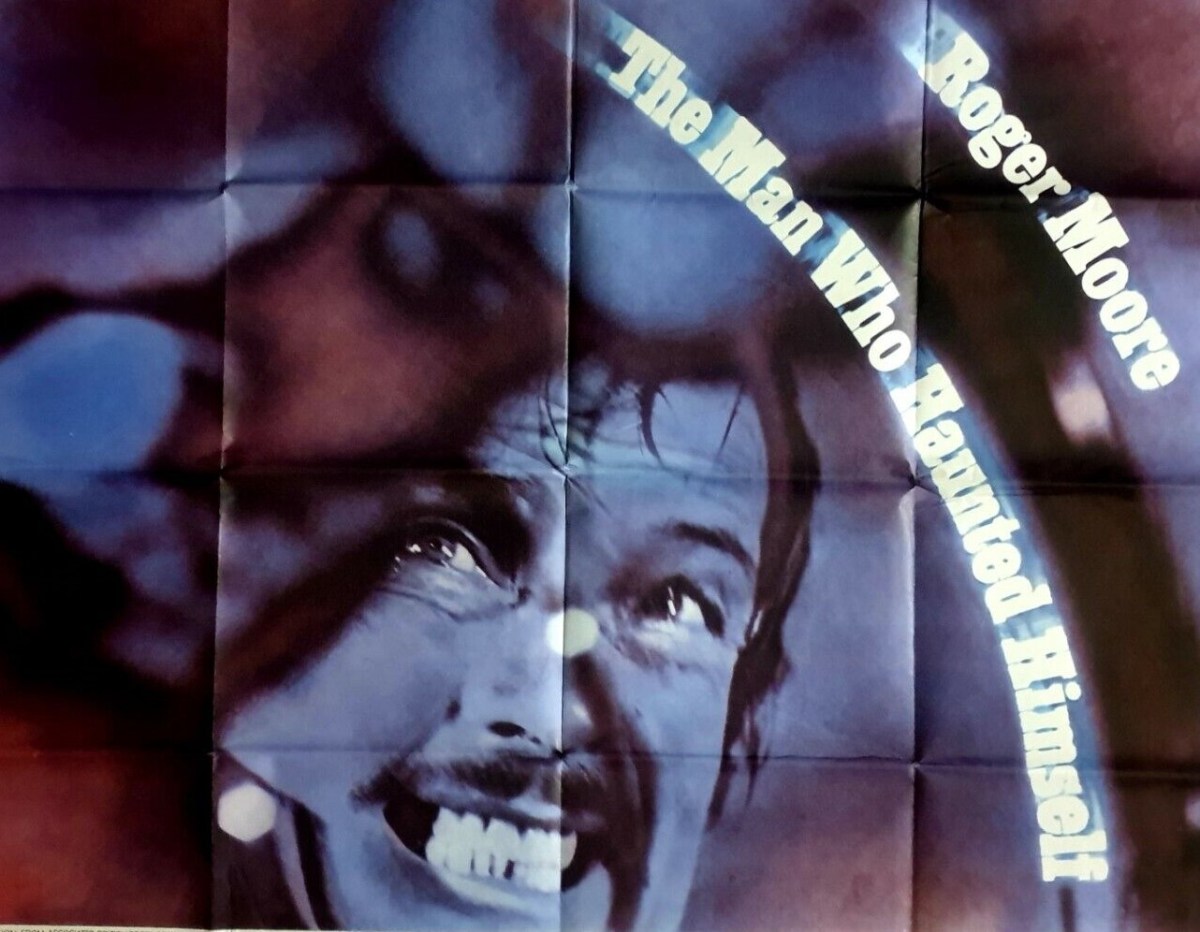
The Man Who Haunted Himself (1970) ****

I grant you, not many movies pivot on a broken matchstick. Nor, for that matter, play around with the screen persona of the imperturbable Roger Moore (Vendetta for the Saint, 1968) or call upon him to do more than raise an occasional eyebrow. No doubt I’m committing heresy in comparing this to The Wicker Man (1973) but there’s a certain similarity in the innocent being dragged into deep waters and, as in that picture, instead of our hero triumphing against sinister forces, ending up a victim.   

While the main narrative thrust is a doppelganger, the initial plot concerns murky business dealings, boardroom betrayal, and corporate espionage set against the backdrop of high living, upscale car, trophy wife, a spot of fun in a casino. The final film of Basil Dearden (The Assassination Bureau, 1969), who died prematurely aged 60, deals with the shattering of the life of strait-laced Pelham (Roger Moore).

He is fastening his car seat-belt a full decade before that was mandatory in Britain, punctuality his mantra, keeps to the speed limit, an immaculate dresser, and while hard work has taken its toll on his marriage he’s not the kind to have a mistress stashed away. But he crashes his car when, against all odds, he seems possessed by the desire to race along at 100mph, overtaking like crazy. For a moment, in surgery, his body registers two heartbeats.

Then people start reminding him of out-of-character activities, thrashing everyone at the club at snooker (and for money stakes), hitting the casino, receiving a nod-and-wink for under-the-table business dealings, while fashion photographer Julie (Olga Georges-Picot) makes sexual demands.

And outside his house his wife Eve (Hildegard Neil) spies a very swanky sports car and begins to suspect her husband is having an affair. Naturally, the upstanding Pelham tries to track down this imposter who has the habit of marking his territory with a broken matchstick. Some occurrences are downright weird. On meeting colleague Alexander (Anton Rogers) for a drink, he discovers he’s already had a drink. There’s the question of a piece of jewellery for Julie that he doesn’t recall buying. An astonished barber wonders why his client would need his hair cut two days in a row. And is someone stealing his shirts and ties?

This is the kind of picture where the normal resolution would be some kind of gas lighting, or tip into film noir with wife and/or the femme fatale involved in conspiracy, or at least some reasonable explanation for the dodgy goings-on.

Britain was going through a doppelganger mini-epidemic, Doppleganger/ Journey to the Far Side of the Sun appearing the year before, but that was a more straightforward sci-fi, being set in the future. And, of course, sci-fi was going through a new cycle what with 2001: A Space Odyssey (1968), Barbarella (1968) and Planet of the Apes (1968).

But it would be a tough call to place this in the same straightforward sci-fi category. The better fit, as I suggested, is The Wicker Man, the background one of a character upset by a different version of normality rather than inhabiting another world or discovering things have changed in the future. And there’s a psychological twist too, the sense of man losing grip on reality, battling  a madness he cannot escape, and while it could have done with dwelling on that aspect a while longer, nonetheless Dearden still achieves his result.

Roger Moore is excellent in twin roles, Hildegard Neil makes an interesting debut and Olga-Georges Picot (Farewell, Friend / Adieu L’Ami, 1968) brings surprising depth to her limited role.

The twisty stuff was written by Michael Relph (The Assassination Bureau) and Dearden based on the bestseller The Strange Case of Mr Pelham by Anthony Armstrong.

Violent City /Family (1970) ****

Of all the lazy, incompetent streamers this has to take the biscuit. Not content with branding as new films made over half a century ago, now we have films being screened which clearly nobody has bothered to watch even once. Otherwise, how to explain a picture where the language lapses into Italian at critical moments without the benefit of sub-titles.

Which is a big shame because, confusing through the movie is, it takes an unique approach to the femme fatale angle and serves up a noted screen tough guy as one whose heart is genuinely broken – suck that up, pale imitators going by the name of Stallone, Schwarzenner, Willis et al.

Post-Bullitt (1968) but pre-The French Connection (1971) we open with a dazzling car chase where the pursued race up stairs rather than down as is the current trope and batter their way through closely-packed streets in the Virgin Islands. That’s before wannabe retired assassin Jeff (Charles Bronson) is gunned down, although he’s still capable of diving under a burning car to escape immediate detection.

Jeff is on the lam with lover Vanessa (Jill Ireland). Dumped in jail with time to repent (no, strike that), mull over his circumstances, in the meantime dodging a tarantula (a real one!) crawling over his body, and coming to the conclusion that the moll has set him up and has returned to her previous lover, ace racing driver Coogan (no idea who plays him, imdb doesn’t know either). Despite having abandoned his profession, Jeff, not getting the hang of the broken-hearted moping malarkey, decides he’ll come out of retirement for the usual one last job, this time laying waste to Coogan.

But someone spots him and he’s blackmailed by Mafia chief Weber (Telly Savalas) into continuing his murderous ways. But here’s a sting in the tail – a wonderful twist to end all twists: Weber is Vanessa’s husband. She’s not a femme fatale at all just a sexual butterfly who dances from one lover to the next with Weber’s tacit approval.

But, in fact, in another twist, she is, after all, the femme fatale to end all femme fatales, setting up Jeff to bump off Weber so that she and attorney lover (what, another one) Steve (Umberto Orsini), Jeff’s best buddy, can take over her husband’s organization now that it has gone legit. And in the final twist to end all twists this ends with Jeff’s broken heart turning him suicidal (beat that Schwarzenneger, Stallone, Willis et al).

This is a very down’n’dirty Italian thriller, dashing from deadbeat locale to Southern Belle balls, from rusting riverboats to swampland, from factories to fashion shoots, the confusion factor infused further by the sudden incursions into Italian, often in mid-scene, as if this was some kind of artistic coup, determined to leave the viewer baffled.

Despite going the whole nine yards in the broken-heareted department, Jeff isn’t quite the full-blown romantic, an attempted rape of Vanessa in New Orleans only interrupted by (wait for it) three thugs beating another character to death. Naturally, Jeff isn’t the kind of good bad guy who intervenes, and these characters, even more naturally, have nothing to do with the plot (except as Jeff points out it’s a violent city after all). But what the hell, it’s that kind of film.

I’ve cutting Amazon Prime a big break here with my rating, because despite the language problems, it’s a cut above your normal thriller, and Charles Bronson (Red Sun, 1971) before being typecast by Death Wish (1974) gives a very good account of himself, certainly a lot more to do than just grimace, and, heck, you even feel sorry for him twisted inside out by emotion. Telly Savalas (A Town Called Hell, 1971) is a bit more polished and emotionally aware than his usual villain.

You might be tempted to call Jill Ireland (Rider on the Rain, 1970) the stand-out. She still can’t act for toffee, but she is well suited to playing this kind of jinxed minx, whose beauty snags dupes well below her league. And (spoiler alert) she does let it all hang out, indulging in copious nudity.

Directed with some flair by Sergio Sollima (The Big Gundown, 1967) and extra marks for coaxing unusual performances from the three principals. Six screenwriters (can’t you tell) put this together including Lina Wertmuller (The Belle Starr Story, 1968). Great score by Ennio Morricone.

Given I couldn’t understand half of what was going on thanks to streamer disinterest in sub-titles, I was still very impressed. Worth a watch.

NOTE: Amazon Prime has this under the title Family but once the credits roll it switches to original title Violent City.

Youtube has the trailer.

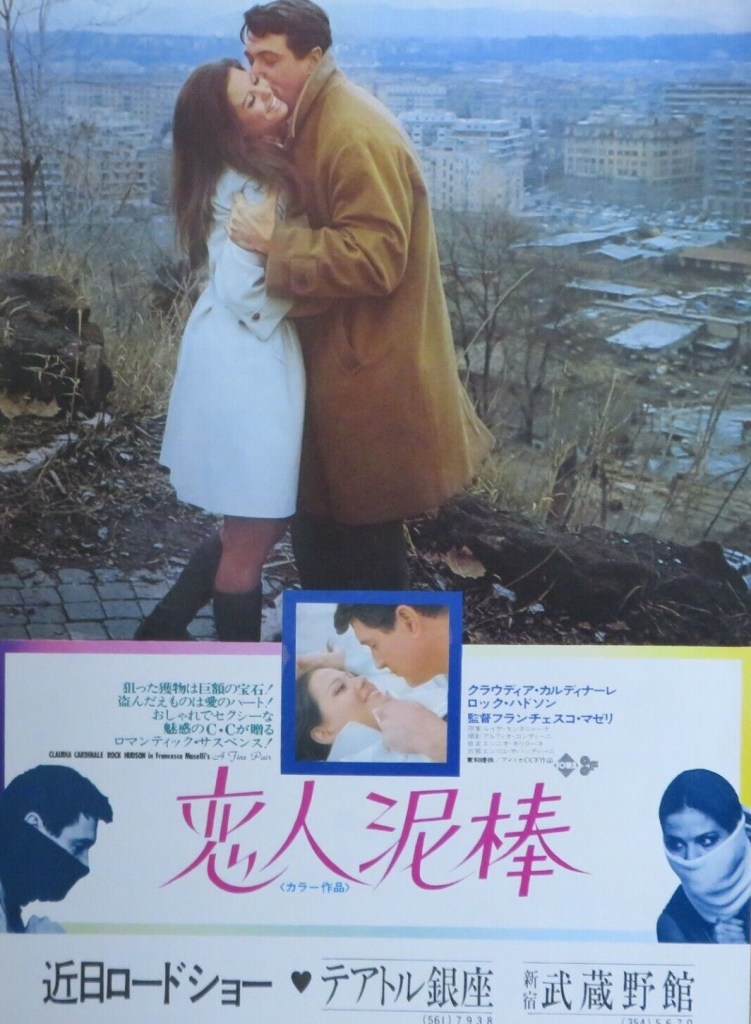
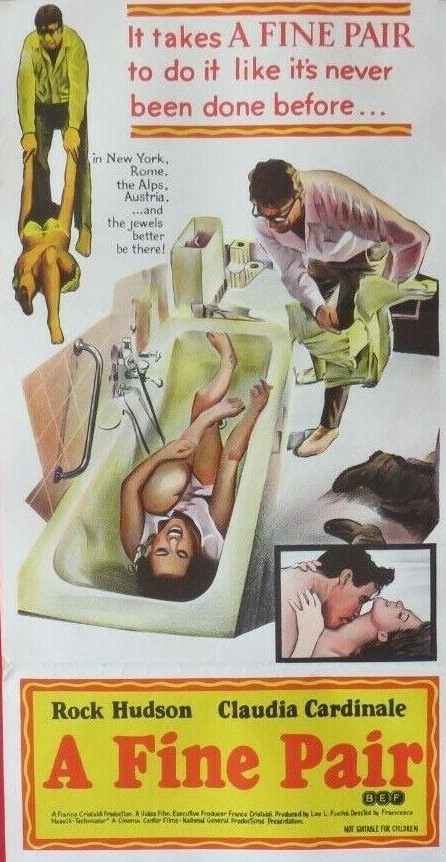
A Fine Pair (1968) ***

Essentially an Italian take on the slick glossy American thriller in the vein of Charade (1963), Arabesque (1966) and of course Blindfold (1966) which previously brought together Rock Hudson and Claudia Cardinale. Produced by Cardinale’s husband Franco Cristaldi, directed and co-written by Francesco Maselli (Time of Indifference, 1966), it is a cute variation on the heist picture. Fans accustomed to seeing the more sultry side of the Italian actress (as in The Professionals, 1966) might be surprised to see how effective she is in more playful mood apart from one scene where she strips down to bra and pants. The other major difference is that in her American-made films, Cardinale is usually the female lead, that is, not the one driving the story, but here she provides the narrative thrust virtually right up until the end.

The twist here (as in Pirates of the Caribbean nearly four decades later) is that the bad guy (in this case bad girl) wants to return treasure rather than steal it.  Esmeralda (Claudia Cardinale) arrives in New York to seek the help of Capt. Mike Harmon (Rock Hudson), an old family friend, a stuffy married American cop who even has a timer to tell him when to take his next cigarette. She has come into jewels stolen by an internationally famous thief and wishes to return them to a villa in the Alps before the owners discover the theft. The bait for Harmon is to try and apprehend the guilty party.

The audience will have guessed the twist, that she is not breaking in to return jewels, but once Harmon, through his police connections, has been shown the alarm systems, to deposit fakes and steal the real thing. So Harmon has to work out an ingenious method of beating three alarm systems, one of which is heat-sensitive, the whole place “one big safe.”

Most of the fun comes from the banter between the principals and the is-she-telling-truth element essential to these pictures. “I lied – and that’s the truth,” spouts Esmeralda at one point. I disagree with a common complaint of a lack of chemistry between Hudson and Cardinale. What the film lacks is not enough going wrong such as occurred in Man’s Favorite Sport (1962), which makes the audience warm to the otherwise rigid Hudson, or as seen in Gambit (1966) where Michael Caine played a similar stand-offish character. Cardinale is terrific in a Shirley MacLaine-type role, as the playful foil to the uptight cop, and who, like MacLaine in Gambit, knows far more than she is letting on.

What does let the film down is that it is at cross-cultural cross-purposes. As mentioned, this is an Italian film with Italian production values. The color is murky, way too many important scenes take place outside, but, more importantly, the actual heist lacks sufficient detail, and post-heist, although there a few more twists, the film takes too long to reach a conclusion. But for the first two-thirds it is a perfectly acceptable addition to the heist canon, the script has some very funny lines, Cardinale is light, charming and sexy.

The American title of this film was Steal from Your Neighbor, which is weak. A Fine Pair while colloquial enough in America has, however, an unfortunate meaning of the double-entendre kind in Britain.

Lack of films being released – these days due to the pandemic – is not new. A Fine Pair was made during a time of low production. But there was a sickening irony in the story of this film’s production. It was financed by the short-lived Cinema Center owned by the American television network CBS. When television was in its infancy, American studios had been barred by the Government from becoming involved in the new media. CBS got into movie production after studios had suffered from another governmental policy reversal.

In 1948 the Paramount Decree prohibited studios from owning cinemas, a move which led to the end of the studio system and decimated production. The most sacrosanct rule of American film regulations was that studios could not own movie houses. Everyone assumed that applied the other way until in the early 1960s cinema chain National General challenged the ruling.

By this point, production was so low that exhibitors were crying out for new product so the government relented, much to the fury of the studios. That opened the door for television networks like CBS and later ABC (Charly, 1968) to enter movie production. And now, of course, studios have re-entered the exhibition market as have, once again, television companies.

Entertaining enough and the pair have enough charisma to see it through.

Johnny Cool (1963) ****

The one-man-wrecking-crew activities of the likes of John Wick or your friendly neighborhood beekeeper not to mention that Point Blank (1968) has a similar downbeat ending and the flurry of interest in retro noir should have set the reassessment alarm bells ringing. Audiences and critics have been frankly dismissive, not even wondering how a mere television director managed to hook the likes of Rat Pack dudes Sammy Davis Jr. and Peter Lawford and get an exceptionally dramatic performance from eternally cute Disneyesque Bewitched star Elizabeth Montgomery.

Perhaps it’s because star Henry Silva (The Secret Invasion, 1964) never broke out of a cycle of  B-films or small supporting role in bigger pictures or that director William Asher threw away any kudos he might have earned here by turning to Muscle Beach Party (1964) and How to Stuff a Wild Bikini (1965) and the like. Or perhaps that the makers of the aforementioned John Wick and The Beekeeper learned to leaven the innate violence of the character and render him more audience-friendly by giving him sentimental attachment to pet dogs and old ladies or some old guy robbed of his pension.

Johnny Cool (Henry Silva) has better reason than either to get mad with the world, given that as a child during World War Two he saved his mother from rape from one German soldier only to witness her killed by another. Orphaned, he was taken in by the local Resistance which later reverted back to its Mafia origins. He’s got the murder cojones, for sure, interrupting a wedding to kill off the groom.

Anyway, he’s hired by Mafia bigwig Johnny Colini (Marc Lawrence) to embark on a transatlantic sojourn and wipe out the main men of the U.S. Syndicate. Along the way, he dallies with non-combatant Dare (Elizabeth Montgomery) who later becomes complicit and then, as if this was a 1940s gangster picture seeking to avoid the wrath of the Production code, suffused by guilt turns him in.

Meanwhile, he’s on the slaughter trail. In part the gangsters are easy pickings, because they have all grown fat and in turning legitimate are out of reach of the law and in part because, just like Point Blank, nobody saw him coming or guessed anyone would have such audacity. He’s not in the do-not-disturb category of John Wick or The Beekeeper.

But he does cross a particular line that audience and critics back in the day were generally averse to. His violence is indiscriminate. He kills cops and would have inadvertently killed kids, too, if they had got in the way. There was no shortage of corrupt cops in Hollywood policiers in the 60s and 70s, but generally they weren’t executed.

He’s one step ahead of everyone and even without a standard weapon is a dab hand at improvisation. Colini has preyed upon his lack of parentage, suggesting that Cool will become a surrogate son once he has completed his mission. When that ploy is exposed and Cool realizes he is the worst kind of patsy, the movie takes a sharp right turn into the modern idiom by allowing him not to turn back and get revenge on the Italian godfather but to continue the killing spree to satisfy his own honor.

Few bad guys were as cool or charming as Johnny Cool. While his face can turn rigid and his personality entombed by inner demons, he is an adept ladies man and has the kind of easy-going manner that on the surface ensures access to dangerous area. Most tough guys, who found ways of justifying their killing, or had a soft spot for some dame, couldn’t manage the pretence for long and away from a sympathetic female so completely conceal their true identities.

Henry Silva is just terrific. This is the hit man with more style than redeeming features. And director Willam Asher plays the noir game, clever use of shadows, and a surprising quotient of aerial shots. And the ending is classic. So I won’t spoil that for you, but maybe the best twist ever in a crime picture.

Given contemporary audience and critical antipathy for Elizabeth Montgomery, this should have buried her career, but, as luck would have it, she fell in love with Asher and he handed her the leading role in his next television show – I should have mentioned he was something of a TV whizz-kid – Bewitched (1964-1972). Although she might never have met Asher at all if her first prospective female leading role had come off – she was the replacement for Debbie Reynolds in the $3.5m version of Alistair MacLean’s Night without End directed by George Seaton and a Paramount release. It was scheduled for release in 1962 but was never made.

Asher did move in Rat Pack circles, hence the involvement of Peter Lawford, in a production capacity, and Joey Bishop and Sammy Davis Jr. in small roles, with the latter lending his tonsils to the title tune.  Look out for Brad Dexter (The Magnificent Seven, 1960), Richard Anderson (Seconds, 1966), Telly Savalas (The Scalphunters, 1968) and Wanda Hendrix (The Prince of Foxes, 1949).

The pitiless avenger being in such contemporary vogue, this is worth a look.

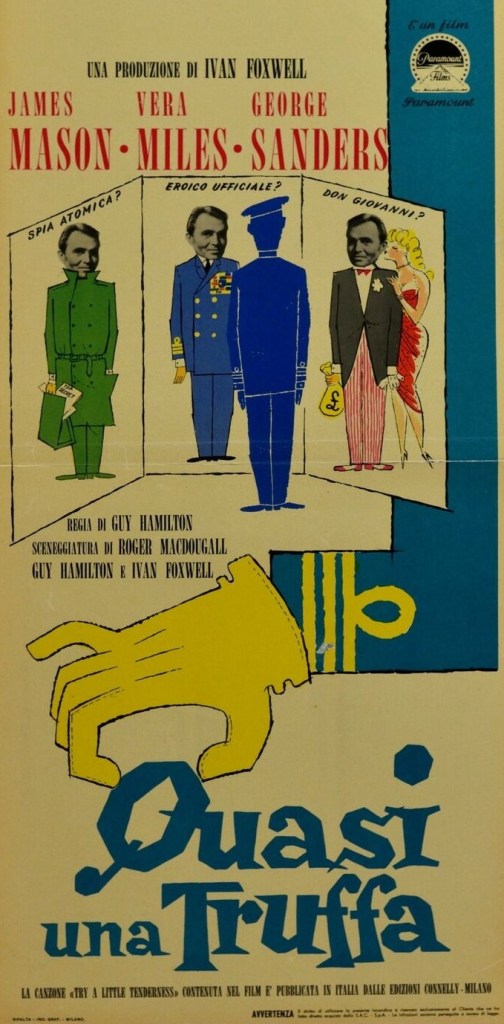
A Touch of Larceny (1960) ****

Magically fits into the “lost” film category that I’ve been banging on about recently, films, for a variety of reasons, denied cinematic release. Or at least that’s according to Rotten Tomatoes which declares “there are no featured reviews…because the movie has not (been) released yet” despite the fact that it was a big hit in cinemas over six decades ago.

Happening upon this nugget of information in a casual trawl of RT I thought I’d see if this “lost” movie was as good as The Appointment (1969) perhaps or Fade In (1969) or whether it should never be seen.

Imagine my surprise to find a highly entertaining picture best described as a one-man caper that takes aim at the Establishment and the Media, wrapped in a very witty rom-com, and helped along by the kind of Whitehall characters making a meal out of doing nothing as lampooned in BBC TV series Yes, Minister

The central conceit sounds so lame from the outset that you think this confection is going to collapse the minute it is put into practice, but, in fact, a good few twists inflate the idea until it floats along quite merrily towards a happy conclusion. And if you only remember James Mason from dour turns in The Deadly Affair (1967) or as the smarmy villain in North by Northwest (1959), you’re in for a treat.

For this is the actor at his most winning, so charming he almost edges into the adorable class, and this while playing a rake, the seducer’s seducer, but with the quickest of quick wits to get him out of any scrape. We begin and end with a demonstration of such speedy thinking.

Surprised by the return of his latest conquest’s husband, Commander Max “Rammer” (the nickname nothing to do with sexual prowess) Easton simply dons his naval uniform, whisks up the woman’s dog, his presence explained as delivering a poor creature lost in the street. As easy as pie.

His life is one of ease. When he says he works at the Admiralty, “working” might be a stretch, although “lolling about” would hardly be in the job description, the sole purpose of his desk somewhere to lay his feet, and has an airy dismissal at hand for any Whitehall buffoon inclined to pepper their language with Civil Service gobbledegook.

Bumping into an old war chum Sir Charles Holland (George Sanders), now an ambassador,  they were submarine commanders in World War Two, allows him brief acquaintance with American widow Virgina (Vera Miles). Naturally, he snaffles one of her gloves so as to have an excuse to return it. Realizing his game, she bats him back with effortless repartee, saving for the last the fact that she is engaged to be married to Sir Charles.

Given he is so practised at this game, he manages to inveigle his way into her life – Sir Charles away on urgent business – determines that her fiance’s main attraction is his dosh, and comes up with a barmy scheme to put himself in the wealthy category. His notion is to pretend to be a spy, drop a top secret document down behind a filing cabinet, vanish to a remote Scottish island, wait for his colleagues to raise the alarm, someone discover the document is missing, and the newspapers to brand him a traitor, at which point he will pop back up and sue the media for libel, and become rich enough to suit Virginia.

Yep, it seems a crazy notion, especially as Virginia, though clearly enjoying his company, has kept him at a decided arm’s length. Unfortunately, once the hue-and-cry is raised, Virginia makes the mistake of telling her husband it’s all a big con. But that puts Sir Charles in a bind, because to fess up might put his fiancé, and by extension himself, in a difficult position.

So they do nothing. Meanwhile, on his deserted tiny island off the coast of Scotland, Easton is living it up, dining off his ample supplies, occasionally catching a fish or a lobster, certainly enough booze to keep up his spirits, tuning into the radio to keep up with the news, waving half-heartedly at any passing ship, rehearsing his lines for when he is rescued. He’s even brought along a canister of petrol so he will have no trouble lighting damp driftwood and seaweed to make the bonfire he will require to attract attention.

So far, so barmy. But now the first twist. He chucks into the sea all evidence of his high living. He slips on a rock, falls into the water and the precious fuel sinks to the bottom. Now, he is a genuine castaway, soaked, starving, freezing. Second twist, the passengers on the boat that turns up to rescue him greet him by name.

So now we’re in for a devilish third act, the cops tipped the nod without getting the full story, Virginia the obvious culprit, Easton, back to the wall, requiring some fiendish ingenuity to get himself out of the mess. After a bundle of twists coming quick and fast, the romantic entanglement is disentangled, Easton still set to be rich by selling his tale (“the real true story” i.e. fictional hogwash) to the media who no doubt toss in a sweetener in gratitude for not being sued.

Not only is it delivered in effortless style by director Guy Hamilton (The Battle of Britain, 1969), and Mason at the top of his game, matched by Vera Miles (Psycho, 1960), but it is very short, clocking in at just over 90 minutes.  Roger MacDougall (The Man in the White Suit, 1951), Ivan Foxwell (Tiara Tahiti, 1962) and the director concocted the screenplay from the novel by Paul Somers.

Great fun, the repartee and the final third an absolute treat while poking gentle fun at the Establishment.

Rather than belonging to the “lost” category, it sits comfortably in the “they don’t make ‘em like that anymore” section.

Marnie (1964) *****

Arguably Alfred Hitchcock’s most difficult film and with some attitudes that will not sit well with today’s audiences nonetheless this is an assured work and the completion of an unofficial trilogy that tries to explain the unexplainable. The director had not been making what might be termed traditional Hitchcock pictures for well over half a decade if you take North by Northwest (1959) as the anomaly in a sequence that began with the obsessive Vertigo (1958). You could argue that Hitchcock had turned a bit “north by northwest” himself, the “hero” of Psycho (1960) a mother-obsessed serial killer, the “bad guys” in The Birds (1963) the titular rapacious creatures who besiege the leading characters and set the world on an apocalyptical course.  

Attempts are made in both Psycho and The Birds to explain the actions of the predators, but such explanations are external, remote, and with Marnie Hitchcock takes the bold step of attempting to explain what makes such a devious, compulsive, frigid liar tick. Hitchcock called the movie a “sex mystery” but it was unclear whether he was just once again trying to tantalize his audience or whether he believed it was film about the mystery of sex, what causes attraction between two people while others steadfastly refuse to consider the concept.  To embellish his thesis he chose one of the world’s most beautiful actresses (Tippi Hedren) and the actor (Sean Connery) who could easily lay claim to being the world’s sexiest man (as he was later anointed in various polls).

It seemed almost an indecent proposal to deny the bed-hopper-par-excellence – as viewed from the James Bond perspective. And it certainly took all the charm Connery could muster to prevent audiences baulking at the almost perverse scientific aspects of his character, an amateur zoologist who welcomed a known criminal into his world for the chance to examine her at close quarters.  The audience is constantly kept at one remove. In the first section we watch enthralled as Hedren carries out her bold thefts, as if she is capable of wrapping the entire male population around her little finger by the simple device of adjusting her skirt.

But in the middle section, it is Connery who is in control and the trapped Hedren who is twisting and turning searching for an escape route. In the final section, when it is clear that is the lover, not the scientist, in Connery that tries to find a way round the problem, the tension is at its height because we have no idea whether she will run true to form and manage to steal and lie her way out or whether Connery’s patience will snap and he will throw her to the wolves who are certainly by this point circling.

The central device on which Hitchcock hooked an audience was the moviegoer demand for a happy ending. He duped cinemagoers in Psycho, slaughtering the heroine halfway through. In The Birds Rod Taylor and Tippi Hedren underwent a harrowing physical assault and while clearly romantically involved by the end Hedren was a wreck. Here, the assaults are mental. There is none of the romantic banter that defines the greatest of his traditional works. Hedren and Connery are together because he has forced the issue and loving though his blackmail is it is still an unequal relationship and one from which she will seek to escape at every opportunity. Hedren’s compulsive character is a mystery that appears insoluble as she resists every attempt to break down the wall she has erected to protect herself from her past.

The story is straightforward with few of the twists of other pictures. We meet Hedren as she escapes with nearly $10,000 stolen from her employers. We learn quickly that she is a master of disguise, has several social security cards up her sleeve, can turn from brunette to blonde, and is so practiced in her deception that she can convince an employer to take her on without references. As the employer is spelling out his predicament to the police, an amused Sean Connery, a customer of her employer, appears. Hedren runs off to a bolt-hole, an upmarket hotel, close to the stables where she keeps a horse, Forio.

Shifting back to Hedren we find her visiting her mother in a tawdry street near the docks. The artifice of confidence is shredded away. She is jealous of the attention her mother gives a little girl whom she looks after. She wants love that her mother is unable to give. When she lays her head on her mother’s lap waiting for the soothing stroke of a hand all she receives is rebuke for leaning too heavily on her mother’s sore leg. The mother in North by Northwest was played for comedy, in Psycho an occasion for murder, and here a means of control. Here, too, we witness the color red sparking an inexplicable and frightening experience.

When Hedren applies for a new job it is at Connery’s firm, where he is the coming man. He watches amused as she is interviewed, intervenes to ensure she is hired. They have in common that they are widowed. Hedren is already planning her next big score, discovering that the combination to the safe is kept in a drawer to which her employer’s secretary has the key.

But he is ready for her and it seems almost perverse that he does not let her know he is aware of her true identity. Instead, under the guise of asking her to work overtime, he gives her an academic paper to type. The subject is predators, “the criminals of the animal world” in which females feature. His gentle pressure is almost sadistic and she is saved by a sudden storm which triggers another bad subconscious reaction.  

Her theft of money from the office is a classic Hitchcock scene. It begins in complete silence. The screen is divided in two, the office and the corridor. Seeing a cleaner appear, Hedren removes her shoes to make her getaway. Almost as she reaches the safety of the stairs, a shoe falls out of her pocket and clatters on the floor. The cleaner does not look up. She is very hard of hearing.

But Connery is again prepared and when she disappears tracks her to her bolt-hole, confronts her, questioning her again and again until he thinks he is close to the truth. He can’t turn her in because he has fallen in love. The choice is stark – him or the police. Soon they are married. But the honeymoon, despite his patience, is a disaster, she cannot “bear to be handled” and they return home further apart than ever.

Meanwhile, figures from her past begin to appear. Lil (Diane Baker) who lusts after Connery brings peril to their door. Connery persists with trying to get Hedren to open up.

Eventually, there is a break in her compulsive syndrome, brought on by love, and we head back to her mother’s to get to the root of the problem. Even when the problem is solved her mother remains distant, still won’t stroke her hair. If there is a happy ending it is like that of The Birds, an immediate problem solved but who knows when or if the crows will return, and there is a similar resolution here, Hedren learns the source of her nightmares but it would be a very blind person who did not see terrible ramifications for the future.

There are certainly a few jarring moments, Hitchcock’s insistence on back projection for a start, but then you didn’t really think in North by Northwest that the director was allowed to film in front of the United Nations. Rather than a technical flaw, the back projection seems to fit another purpose, a device to make the audience stop and examine what is going on for much of it occurs when Hedren is in her fantasy world. And you would have to take exception to Coonery’s actions in the bedroom on honeymoon, no matter how gentle his caresses at other times. And certainly, the psychological assumptions ring hollow given our current knowledge of such conditions, but despite that make for tense viewing.

But the meat of the movie is self-deception. Hedren is convinced she can get away with a series of thefts. Connery is convinced her can cure her. His constant interrogation is what passes for lovers’ banter. In aligning himself as her moral guardian and perhaps her savior, “dying to play doctor,” Connery has entered a nightmare of his own making. Only an arrogant man would believe all women would fall at his feet and Hitchcock clearly makes a connection with Connery’s ongoing incarnation as James Bond where that is exactly the case. Connery is every bit as flawed, as obsessive, as Scottie in Vertigo, determined to shape a woman into perfect form, and that, yes, expecting to eradicate the imperfect past.

Connery emanated such ease, such amazing grace, on the screen that it backfired. Critics often didn’t believe he was putting much into his acting when in reality he was acting his socks off. This is a tremendously difficult part, walking the tightrope between looking a deluded fool and retaining audience empathy and coming across badly when he pushed a vulnerable woman too hard. This is a very rounded character, a gentle adoring lover in the main, but not one to be crossed. His interrogations are intense and yet still you can see that it will kill him if he is double-crossed. The casual amusement with which he greeted her appearance at his office is replaced by fear at her sudden departure.

Hedren, too, whose acting ability was often called into question, carries on where she left off from in The Birds. By the end of that picture her nerves had been shredded. Here, her emotions, which she cannot as easily control as the rest of her life, too often fly off into a high pitch. Half the time she is the cool collected customer of The Birds, the rest of the time she is demented.  Except in The Birds she was self-confident around men. Any self-assurance she has now is skin deep. There was always a fragility about Hedren, hidden behind the glossy exterior and fashionable outfits, and here it is exposed. The touching scenes with her mother, the mouth tightened in jealousy over the little girl, are perfectly played. A little girl lost in wolf’s clothing. And trapped, she is almost snarling at her captor, the submissive dialog concealing the mind hard at work looking for an exit.

The interrogative scenes between Connery and Hedren are extremely difficult to pull off. It would have been easier if Connery was not in love with her, and to some extent pulled his punches. It would be easier for her if he was an out-and-out predator who could be paid in kind to shut up and go away. Instead, they both have to walk a verbal tightrope and only actors of some excellence can pull off that trick without losing the audience.

A Lovely Way To Go / A Lovely Way To Die (1968) ****

Woefully neglected detective thriller with a sparkling script and sexy leading stars exuding screen charisma. Like the celebrated William Goldman-scripted opening to Paul Newman private eye picture Harper (1966), the credit sequence here is at least as innovative in that it appears to be little short of a trailer, a highlights reel showing the audience what lies in store.

Schuyler (Kirk Douglas) is a womanizing cop too handy with his fists, half his arrests making an unexpected detour to hospital. Rena (Sylva Koscina) is the bored young wife of an older millionaire whose idea of fun is to chuck an expensive scarf out of a speeding car forcing her husband to pull up and go back and fetch. When her husband is shot, suspicion falls on Rena, inclined  to dress in revealing outfits for the media, and her playboy boyfriend.

At the behest of attorney Fredericks (Eli Wallach) sporting a rich Southern accent and a with knack for speaking in parables, Schuyler, having resigned from the force one step ahead of being fired, is sent in to provide security and find out whether her alibi stacks up. He soon finds out it doesn’t but by this time he has fallen under her spell. Witnesses disappear, intruders are dealt with, attempts are made on the detective’s life, and the twists come thick and fast. Rena is the arch femme fatale who is a past master in the twisting department – twisting every male within a 50-mile radius round her little finger.

Harper was a throwback to The Maltese Falcon/The Big Sleep but A Lovely Way To Die knocks that shamus tradition on the head. For a start, Schuyler is a high-living high-rolling  character who doesn’t take prisoners. The second time we meet him he has dumped the girl he took to the races for someone he has met when picking up his winnings.  Seducing gorgeous women and dumping them is second nature. This is Douglas as a glorious charmer, a part of his screen persona lost after a glut of more serious pictures like Seven Days in May (1964) and Cast a Giant Shadow (1966). Yugoslavian actress Koscina, often little more than eye candy for most of the decade, had vaulted into the higher echelons after a turn as Paul Newman’s squeeze in The Secret War of Harry Frigg (1968).

An inherent part of the attraction of this picture is how deftly Rena keeps Schuyler at bay. Scriptwriter A. J. Russell (Stiletto, 1969) and director David Lowell Rich (Madame X, 1966) deliver the goods in maintaining the tension in their relationship. There is a wonderful scene where the expectant Schuyler follows her up the stairs of her fabulous mansion and three times he ignores the import of her unmistakable “Goodnight,” his uber-confidence taking him to her door – which she shuts in his face.  

Sure, in some ways it is slick, but it is also taut and realistic, Schuyler does not win all his fights and he eats with the rest of the help at the mansion. And he does some terrific detection so it doesn’t fall short in that department. He is definitely helped by some choice lines – “police methods are sometimes difficult for an amateur to understand” he tells Rena after he brutally deals with an intruder.

Koscina is in her element as the sexy, wealthy suspect, and especially in her banter with Douglas – her main aim to disarm his cockiness. Eli Wallach (The Moon-Spinners, 1964) is also superb, given just enough ham to hang himself, but matching Douglas in arrogance and outgunning the D.A. with his courtroom gymnastics. A couple of the subsidiary characters are well-drawn, a housekeeper who plays the markets.      

For some reason this sank like a stone on its initial outing, audiences perhaps being more attuned to the Bogart-style sleuth, but I found it highly enjoyable and this could be seen as a  taster for anyone familiar with the antics of the star’s son Michael Douglas who found himself in similar territory in Basic Instinct (1992).

Complex tale high on intrigue and sex, well worth a watch.

REVIEWED PREVIOUSLY IN THE BLOG: Kirk Douglas in Strangers When We Meet (1960), Lonely Are the Brave (1962), Two Weeks in Another Town (1962), For Love or Money (1963), Seven Days in May (1964), In Harm’s Way (1965), The Heroes of Telemark (1965), Cast a Giant Shadow (1966), Is Paris Burning? (1966), The Way West (1967), The Brotherhood (1968), The Arrangement (1969); Sylva Koscina in Jessica (1962), Hot Enough for June (1963), Deadlier than the Male (1967), The Secret War of Harry Frigg (1968); Eli Wallach in Seven Thieves (1960), The Misfits (1961), Act One (1963), The Moon-spinners (1964), Kisses for My President (1965), Lord Jim (1965), Genghis Khan (1965), How to Steal a Million (1966).

Discover WordPress

A daily selection of the best content published on WordPress, collected for you by humans who love to read.

The Atavist Magazine

by Brian Hannan

WordPress.com News

The latest news on WordPress.com and the WordPress community.