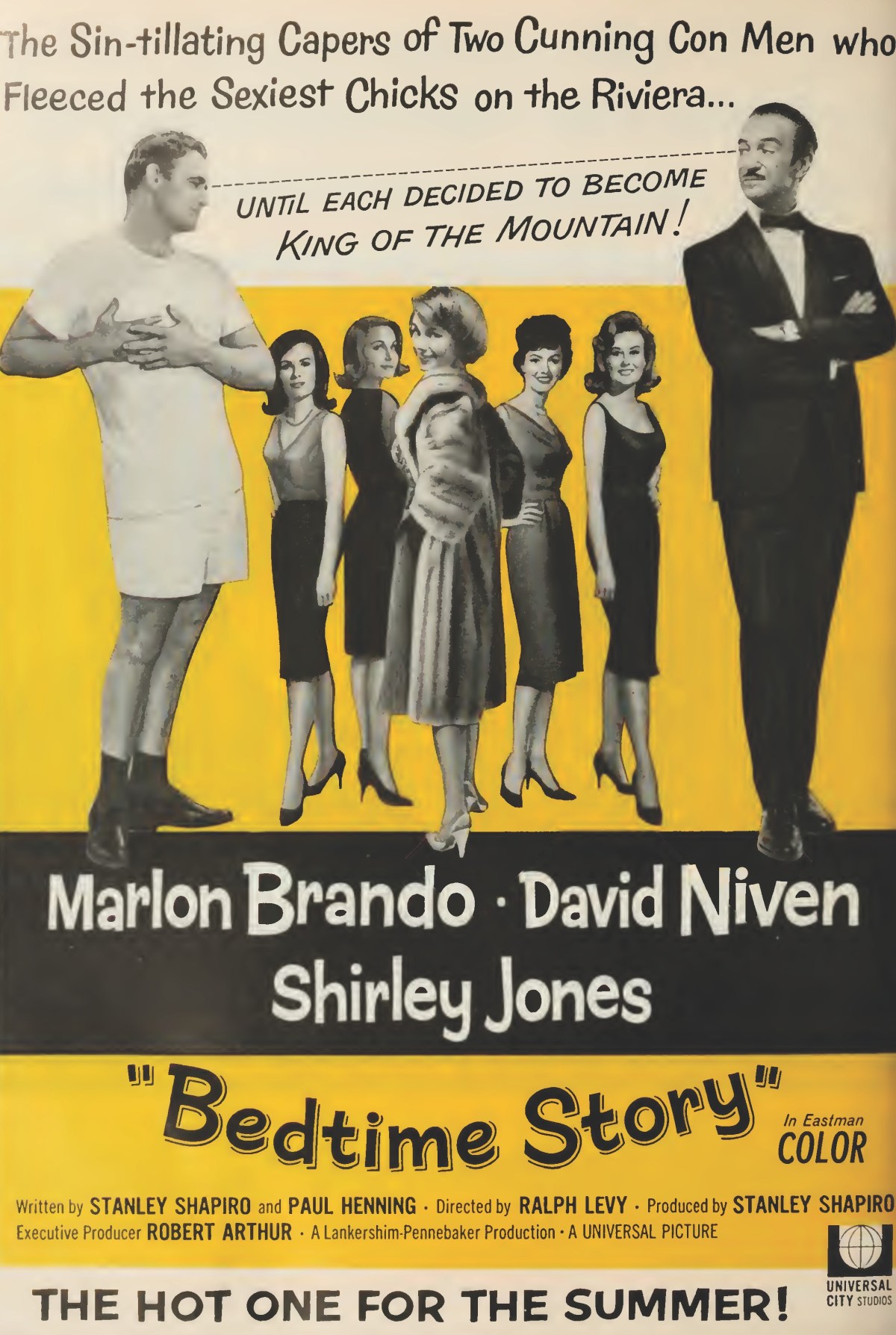
Bedtime Story (1964) ***

Con men at opposite ends of the grifter divide face off in a duel over territoriality in the French Riviera. Freddy Benson (Marlon Brando) is a low-level scam artist who is happy to scrounge a meal or talk his way into an innocent damsel’s bed. Lawrence Jameson (David Niven) is his polar opposite, posing as an impoverished aristocrat to relieve gullible women of their wealth, seduction an added extra.

Initially, Jameson gets the better of their encounters until Benson realizes just what a killing the Englishman is making. Initially, too, Benson is happy to pair up with Jameson, although that involves demeaning himself as a supposed mad brother kept in a dungeon, until the Englishman dupes him out of his share. Eventually, they agree a winner-take-all battle. Whoever can swindle heiress Janet Walker (Shirley Jones) out of $25,000 shall inherit the shyster kingdom.

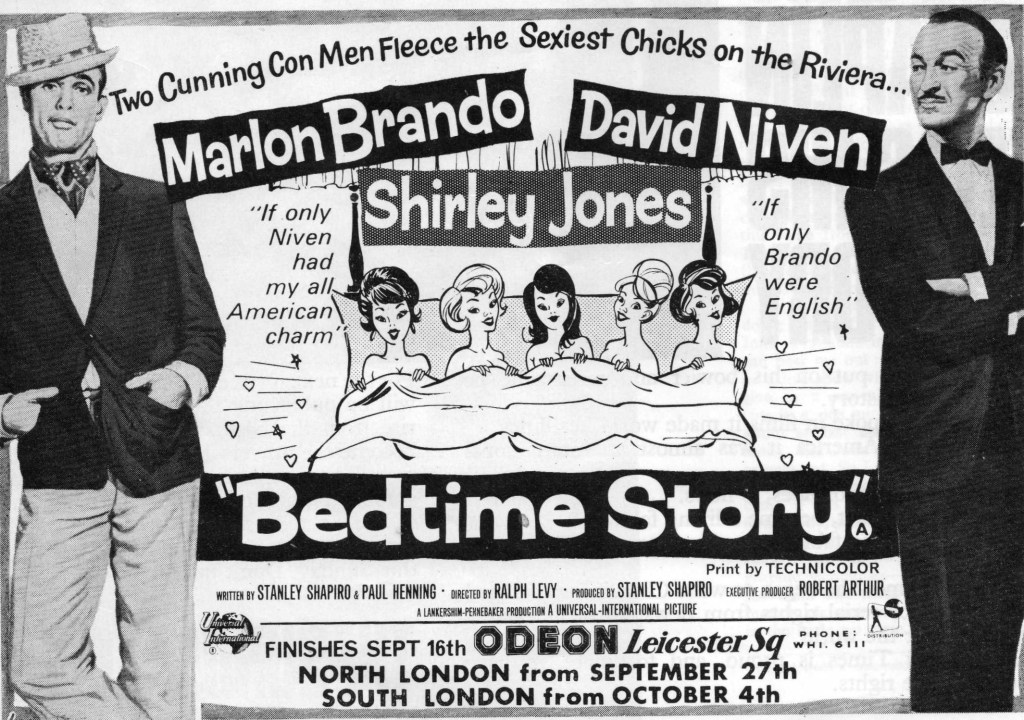
An example of the older style of British movie distribution. The prints started off in one section of London the first week and switched to another sector the following week. Even if the film was a big hit, it could not be retained since the prints were already promised elsewhere. Only after it had played London, would general release follow in the provinces. There was no point watching West End release dates for an idea of when a new movie would play in your local city, it would not be anywhere near you until it had completed the North and South London runs.

Benson takes the sympathy route to the woman’s heart, turning up in a wheelchair, while James adopts a psychological approach, persuading Ms Walker that Benson’s illness is psychosomatic for which he has the cure for the small consideration of $25,000. And then it’s one devious twist after another as the pair attempt to out-maneuver, out-think and generally embarrass the other. Both have a despicable attitude towards women, whom they view as dupes, but it is a woman who proves their undoing.

Most comedies rely on familiar tropes and you can usually see the twists coming, but this is in a different imaginative league and once the pair are in their stride I defy you to work out what they will come up with next. It is full of clever quips and a small dash of slapstick and because neither actor chases the laughs but plays their roles straight proves a very effective and entertaining morsel.

Director Ralph Levy in his movie debut knows more than where to just point a camera since he had decades of experience extracting laughs in television with top comedians like Jack Benny and Bob Newhart. Brando (Mutiny on the Bounty, 1962), free of the shackles of the angst he normally incorporated into his dramatic performances, looks as if he is having a ball and while teetering occasionally on the edge of mugging never quite overplays his hand. This was a conscious effort by Brando, whose company Pennebaker was involved on the production side, to shift his screen persona.

David Niven (The Pink Panther, 1963) was born with a stiff upper lip in his mouth and while this kind of aristocratic character is a doddle for an actor of his stature the portrayal here is much more like the sharpest tool in the box. While oozing charm, Niven exhibits deadly spite. Screenwriters Stanley Shapiro and Paul Henning had previously collaborated on Lover Come Back (1961) and Shapiro particularly made his bones on the Doris Day-Cary Grant-Rock Hudson axis so it is interesting to see him shift away from the romantic comedy cocoon into something with considerably more edge.

Enjoyable and original with excellent performances from the two principals and great support from Shirley Jones (The Music Man, 1962) as the mark and Egyptian Aram Stephan (55 Days at Peking, 1963) as an only too congenial French policeman.

Originally, it was lined up with a quite a different cast – Gregory Peck, Tony Curtis and Tippi Hedren. It was remade as Dirty Rotten Scoundrels (1988) with Steve Martin and Michael Caine.

CATCH-UP: The Blog has previously featured Brando in more dramatic vein in The Chase (1966) and The Appaloosa (1966) and also the dramatic side of David Niven in The Guns of Navarone (1961), Guns of Darkness (1962) and 55 Days at Peking (1963).

4 for Texas (1963) ****

To my mind the best of the Frank Sinatra-Dean Martin collaborations, outside of the more straightforwardly dramatic Some Came Running (1958), and for the simple reason that they are rivals rather than buddies. The banter of previous “Rat Pack” outings is given a harder edge and it is shorn of extraneous songs.

I came at this picture with some trepidation, since it did not receive kind reviews, “stinks to high heaven” being a sample. But I thought it worked tremendously well, a delightful surprise, the ongoing intrigue intercut with occasional outright dramatic moments and a few good laughs.

It’s unfair to term it a comedy western since for a contemporary audience that invariably means a spoof of some kind, rather than a movie that dips into a variety of genres. In some respects it defies pigeonholing. For example, it begins with a dramatic shoot-out, stagecoach passengers Zack Thomson (Frank Sinatra), a crack shot with a rifle, and pistolero Joe Jarrett (Dean Martin) out-shooting an outlaw gang headed by Matson (Charles Bronson). When director Robert Aldrich (Sodom and Gomorrah, 1962) has the cojones to kill off legendary villain Jack Elam in the opening section you know you are in for something different.

After out-foxing Matson, Jarrett attempts to steal the $100,000 the stagecoach has been carrying from its owner Thomas. Jarrett looks to be getting away with it until he realizes he is still in range of Thomas’s rifle. Then Thomas looks to have secured the money until Jarrett produces a pistol from his hat. And that sets the template for the movie, Thomas trying to outsmart Jarrett, the thief always one step ahead, and the pair of them locking horns with corrupt banker Harvey Burden (Victor Buono), in whose employ is Matson.

The movie is full of clever twists, cunning ruses, scams, double-crosses, reversals and sparkling dialog. Whenever Jarrett and Thomas are heading for a showdown, something or someone (such as Matson) gets in the way. While Thomas has the perfect domestic life, fawned over by buxom maids and girlfriend Elya (Anita Ekberg), Jarrett encounters much tougher widow Maxine (Ursula Andress) who greets his attempts to invest in her riverboat casino by shooting at him.  

Take away the comedic elements and you would have a plot worthy of Wall Street and ruthless financiers. The story is occasionally complicated without being complex and the characters, as illustrated by their devious intent, are all perfectly believable.

It’s a great mix of action and comedy – with some extra spice added by The Three Stooges in a laugh-out-loud sequence – and it’s a quintessential example of the Sinatra-Martin schtick, one of the great screen partnerships, illuminated by sharp exchanges neither lazily scripted nor delivered. Even the blatant sexism is played for laughs.

Sinatra and Martin, especially, are at the top of their game. Forget all you’ve read about Aldrich and Sinatra not getting on. Sinatra never got on with any director. But an actor and director not getting on does not spell a poor picture. Sinatra brings enough to the table to make it work, especially as he is playing against type, essentially a dodgy businessman who is taken to the cleaners by both Martin and Buono.

The only flaw is that Ursula Andress (Dr No, 1962) does not turn up sooner. She has a great role, mixing seductiveness and maternal instinct with a stiff shot of ruthlessness, not someone to be fooled with at all, qualities that would resonate more in the career-making She (1965).  Anita Ekberg (La Dolce Vita, 1960) on the other hand is all bosom and not much else. Charles Bronson (The Magnificent Seven, 1960) demonstrates a surprising grasp of the essentials of comedy for someone so often categorized as the tough guy’s tough guy.

The biggest bonus for the picture overall is the absence of the other clan members – Sammy Davis Jr, Peter Lawford and Joey Bishop – who appeared in previous Rat Pack endeavors Oceans 11 (1960) and Sergeants 3 (1963). Without having to laboriously fit all these other characters in, this film seems to fly along much better. As I mentioned, the fact that Sinatra and Martin play deadly enemies provides greater dramatic intensity.

Robert Aldrich was a versatile director, by this point having turned out westerns (Vera Cruz, 1954), thrillers (Kiss Me Deadly, 1955), war pictures (The Angry Hills, 1959), Biblical epic Sodom and Gomorrah (1962) and horror picture Whatever Happened to Baby Jane? (1962). But 4 for Texas called for even greater versatility, combining action with quickfire dialog, a bit of slapstick and romance and shepherding the whole thing with some visual flair.

If you are a fan of Oceans 11 and Sergeants 3 you will probably like this. If you are not, it’s worth giving this a go since it takes on such a different dynamic to those two pictures.

Catch-Up: Previously reviewed in the Blog: Oceans 11 and Sergeants 3; Frank Sinatra in The Naked Runner (1967); and Ursula Andress in The Blue Max (1966) and The Southern Star (1969).

Divorce American Style (1967) ***

Not so much a comedy about a failing marriage as a guide to the American divorce laws,  a cynical hard-boiled and frightening shape of things to come in a world where the everyman is represented not by the likes of James Stewart or at a stretch Glenn Ford but Dick Van Dyke. It’s possibly only the fact that Van Dyke lacks dramatic chops without the innate vitriol of a Rod Steiger or Lee Marvin that keeps the movie from drifting into devastating black comedy. That, or the filmmakers’ determination to find a happy ending.

When the ever-squabbling Harmons, Richard (Dick Van Dyke) and Barbara (Debbie Reynolds), break up after 17 years and two kids, the chips seem to fall heavily against the husband, the wife walking off with all assets, the husband landed with all the bills and little more than 80 bucks a week to get by on. Such is the supposed injustice of the American divorce laws at a time when most wives did not go out to work and so relied on their husband, married or otherwise, for support.

The only way out of this unhappy financial state for Richard is for his wife to get married again, so a second husband can pick up the tab for her upkeep.  Another divorced couple, the Downes, Nelson (Jason Robards) and Nancy (Jean Simmons), are in the same pickle so Nelson spends his time acting as some kind of pimp for his ex-wife, serving up potential suitors, such as Richard, on a platter. But since Richard is impoverished a helping hand is needed to even things up, so Nelson arranges for Barbara to fall into the arms of rich and single used car dealer Al Yearling (Van Johnson).

There is a big male-female divide, for the most part the guys concentrating on material things like money and what money can buy, the gals leaning more towards emotion, conversation, genuine intimacy.  Richard has given his wife everything she wants, so why can’t he have a few things his own way. Or as Barbara succinctly puts it, it’s a case of supply and demand, the women are in good supply while the men demand. Even after separation, while from the Richard and Nelson perspective the wives are living in the lap of luxury and the men understanding the meaning of penury, female thoughts turn to questions of loneliness, commitment and (not again!) emotion.

While there are moments of observational comedy – an excellent montage of Richard and Barbara opening and closing all sorts of doors while preparing for bed, cleaning out bank accounts before the other can get to them, the problems of accommodating the blended/hybrid family that divorce or multiple divorce can entail – there are not many laugh-out-loud moments.

And probably just as well because without the drama-lite presences of Van Dyke (who still can’t shake off those double takes and involuntary limb functions) and Reynolds, it would have been a much tougher watch. Reynolds is capable of expressing her feelings verbally because, as a female, she is used to expressing feelings verbally, so we know that Al Yearling does not quite hit the spot. But Van Dyke, without resort to the verbal, has his best scenes of emotional loss when he takes his kids to the ball game only to discover that his wife’s new suitor has more treats to offer.

Van Dyke (Lt. Robin Crusoe, U.S.N.) and Reynolds (The Singing Nun, 1966) do a decent job without plumbing any dramatic depths, but Robards (Any Wednesday, 1966) and Simmons (Spartacus, 1960) have more to offer as the conspiring couple, while one-time MGM golden boy Van Johnson (Battleground, 1949) proves that his four-year absence from pictures was premature Hollywood retirement. More a cautionary tale than an outright laffer, this Norman Lear (Come Blow Your Horn, 1963) screenplay without missing many targets provides a more palatable dissection of modern marriage than something as full-blooded and expletive-ridden as the previous year’s Who’s Afraid of Virginia Woolf.  Director Bud Yorkin (Come Blow Your Horn, also) shows a nice grasp of building up situations until they go out of  control.

While, certainly, many of the attitudes are out of date you can be sure that male self-pity is not one of them.

Move Over, Darling (1963) ***

Doris Day never quite replaced Cary Grant or Rock Hudson in her romantic comedy ventures. This is her second outing with James Garner – The Thrill of It All had appeared earlier the same year. Ironically, it’s based on a Cary Grant film, My Favorite Wife (1940) with Irene Dunne. Having been lost at sea for the requisite five years, this version kicks off with Day being pronounced legally dead in court to pave the way for Garner to marry Polly Bergen (Cape Fear, 1962). Naturally, she turns up on the day of their wedding and the first part of the movie is Garner trying to keep the women apart. Cue comic pratfalls, double takes, diving in an out of bedrooms, but Day and Bergen seem to be trying to out-screech each other. The idea of bigamy, scandalous at the time, has lost its power to shock.

While Day spent much of the picture in hysterics, I didn’t, and wished they had moved quicker to the complication which was that she had shared her desert island with a hunk (Chuck Connors). The pace picks up a bit after that as Day has to pretend that it was nerd (Don Knotts) with whom she was stranded while Garner knows the truth. There is some good reversal, her kids, who naturally don’t recognize her, complaining about her singing. A number of set pieces save the day – two court scenes with an exasperated judge (Edgar Buchanan), Day disguised as a Swedish masseuse giving Bergen a savage work-over and Day trapped in car wash.

Michael Gordon had helmed Pillow Talk (1959) but missed the mark here. Don Knotts, prior to his incarnation as The Incredible Mr Limpet (1964) show his potential as the shoe salesman recruited by Day to impersonate Connors. Accomplished comedienne Thelma Ritter holds back on the comedy instead playing a straight role as the meddling mother-in-law. Fred Clark as the alternately bemused and suspicious hotel manager gets the best of the double takes. Garner, unfortunately, has little opportunity to exhibit his sly sense of humor or the laid-style that worked a treat in Support Your Local Sheriff (1969).

Hal Kanter, who worked on the George Gobel and Milton Berle television shows and scripted Blue Hawaii (1961) fashioned the screenplay along with the more versatile and sometime director Jack Sher (Paris Blues, 1961).

When it was known as Something’s Got to Give, George Cukor was set to direct a cast that included Marilyn Monroe, Dean Martin, Cyd Charisse, Tom Tryon and Phil Silvers from a script by Nunnally Johnson and Walter Bernstein. Monroe had nixed working with Garner and Knotts. When Monroe was fired, Kim Novak and Shirley Maclaine refused offers to replace her. Dean Martin refused to continue without Monroe and although re-hired she died before production recommenced.

Ocean’s 11 (1960) ***

Heist pictures break down into planning, execution and reprisal. Here the planning stage moves at a leisurely pace, a bit of recruitment, and setting up bitebacks that will cripple the military-precision plan by ex-army buddies to rob five Las Vegas casinos of millions of dollars on New Year’s Eve. There’s a bit of reversal, Mr Big (Akim Tamiroff) is a collection of nervous tics, Jimmy Foster (Peter Lawford) a rich guy seeking financial independence from a possessive mother, Sam Harmon (Dean Martin) having second thoughts about the operation, and Danny Ocean (Frank Sinatra) trying to win back estranged wife Beatrice (Angie Dickinson) who surmises he prefers danger to intimacy. Mostly, it’s repartee between Harmon and Ocean while Foster makes a chump out of his mother’s next potential husband Duke Santos (Cesar Romero).

There’s not much hi-tech about the audacious plan, knocking out the electricity supply to the casinos, the switch to auxiliary power allowing the gang access to the inner sanctum where the cash is held, finding their way in and out of the darkness by nothing more sophisticated than luminous spray paint, and with a clever ruse to get the money out once all hell breaks loose.

The fun starts when one of the team (Richard Conte) drops dead post-raid and it transpires Santos is a big-shot underworld figure who investigates the robbery on behalf of the casinos and starts tracking the gang down, leading to a pay-off you don’t see coming.

Given the comedy element, there’s no great tension but it’s a pleasant enough diversion and Sinatra and Martin display an easy camaraderie that lights up the screen. It could have been funded by the Las Vegas Tourist Bureau so much attention is given to the wonder of the casinos, at a time when gambling was still only otherwise legal on racetracks, and with snippets of floorshows and the deluxe atmosphere. Add in a couple of numbers delivered a couple of times by Dean Martin (“Ain’t That a Kick in the Head”), legitimately since he is a cocktail bar singer, and Sammy Davis Jr. (“Eee-O-11”), somewhat shoehorned-in given he is a truck driver.

There’s a couple of neat reversals: Ocean’s dumped girlfriend Adele (Patrice Wymore) gets short shrift from Beatrice when she reveals the affair; casino bosses offered a double-or-quits gamble refuse to consider such a dangerous notion. Red Skelton and George Raft have credited cameos, Shirley MacLaine does not. As well as Richard Conte, Henry Silva (The Secret Invasion, 1964) has a small part as does Norman Fell (The Graduate, 1967).

Although there are on occasion outdated sexist attitudes, there is also a strong anti-racist statement in the hiring of Sammy Davis Jr., showcasing his talents in a big-budget picture, and clearly making the point that he has been welcomed by stars as big as Sinatra and Martin.  

And it’s worth also considering the picture in terms of early-onset brand management.  The “Rat Pack” was a loose group of entertainers which not only became a well-known stand-alone entity in its own right that celebrated what was considered “hip” at the time (assuming you excluded Elvis and his ilk), but as individuals supported each other on television and in live performance. They would make another two pictures as a team and another dozen or so where two or more of the players appeared. The principals were all major attractions at the nascent Las Vegas so they were also promoting their home patch. During the day they made the movie, at night they wove in and out of each others’ acts, creating an entertainment sensation. On top of that, Sinatra had his own record label Reprise – among the early acts Dean Martin and Sammy Davis Jr. So, in a sense, all this cross-promotion was money in their pockets.

Also of note are the opening and closing, the former for the credits devised by Saul Bass, the latter for the famous shot later appropriated by Quentin Tarantino for Reservoir Dogs. Ironically, Lewis Milestone, who devised the original shot, and long before that won two Best Director Oscars, is less well regarded these days than Tarantino.

The Night They Raided Minsky’s (1968) **

This affectionate homage to 1920s vaudeville goes awfully astray under the heavy-handed direction of William Friedkin. Never mind the sexist approach, there’s an epidemic of over-acting apart from a delightful turn from Britt Ekland as the innocent star-struck Amish who accidentally invents striptease and former British music hall star Norman Wisdom who knows what he’s doing on the stage. The plot is minimal – burlesque theater manager (Elliott Gould) needs to save theater from going bust in a few days’ time. That’s it – honest!

The rest of the story looks tacked on – the overbearing leering other half (Jason Robards) of the Norman Wisdom double act tries to bed anything that moves, Amish father (Harry Andrews) in pursuit of his daughter, vice squad official (Denholm Elliott) determined to shut the theater down.

The saving grace of this debacle is Ekland’s performance which carries off a difficult part. Could anyone really be so dumb? She is endearing in a murky world but still capable of interpreting the Bible to her own ends (there is dance in the Good Book, for example) and she has confidence that the Lord will give her the go-ahead to have sex. Her innocence appears to transcend reality and since she doesn’t know a showbiz shark when she sees one she carries on as if life is just wonderful. Somehow this should never work but Ekland is so convincing that it does.

What might have been another saving grace is the documentary feel of much of the background, black-and-white pictures of the epoch transmuting into color, but too often the movie simply cuts to that without any real purpose. Equally, the various song-and-dance acts, chorus lines and comic turns provide an insight into burlesque reality but, again, all too often, that goes nowhere. There are plenty of people trying to be funny without much in the way of decent laughs. There’s altogether too much of everything else and not enough of the ingredients you might have considered essential.

This scarcely sounds like William Friedkin material given that although this preceded The French Connection and The Exorcist, by this point he had already made his mark with an adaptation of Harold Pinter play The Birthday Party (1968). In fact, his original cut was re-edited once he had departed the picture. Might it have worked better with Tony Curtis in the Jason Robards role as originally planned – he certainly had more charm than the jaundiced Robards. Regardless of who was cast what it needed most was a better story and less in the way of stock characters. And since in American theater folklore Minsky’s is synonymous with the invention of the striptease it meant that quite a few of the audience were there just to see how much skin would be revealed – which is not really the basis for a good mainstream picture.

The Wackiest Ship in the Army (1960) ***

A more misleading title would be hard to find – and that goes for the posters too. This is a misfit movie – a bunch of raw recruits knocked into shape by an unwilling captain tasked with sailing a ship into a South Pacific war zone in WWII. Admittedly, Jack Lemmon is in exasperated double-take default in the opening section, but it quickly shifts from comedy to drama as Lemmon shepherds his inexperienced crew into a more compact team. Screenwriter Frank Murphy has an exceptionally good portfolio – Panic in the Streets (1950), The Desert Rats (1953), Broken Lance (1954) and Compulsion (1959) – but brings less to the table as a director, this only his second – and final – outing in that capacity. But given he is directing from his own screenplay, he must take the blame for the incongruous hybrid. Add in an unnecessary tune from Ricky Nelson and the briefest of brief romances and no wonder it’s hard to make head or tail of the movie until it does eventually head out to sea.

Once Lemmon is given more to do than shake or scratch his head the picture movies into more satisfactory territory. Instead of dismissing the crew as idiots, he takes command and shows dramatic chops that are a hint of things to come (Days of Wine and Roses just two pictures away) when he sloughed off comedy for more serious undertakings. Reason for Lemmon being assigned this motorised sailing ship rather than something more obviously U.S. Navy is that he is in the last chance saloon. Once under sail, setting aside some dodgy process work, and it becomes clear they are heading into harm’s way rather than simply delivering the boat to General MacArthur in more harmless waters, the story switches into perilous wartime perilous adventure with decent battle, a couple of twists and some dramatic confrontation.

Lemmon is always watchable and I always thought he could have done with more self-belief when it came to tackling more dramatic parts. When he goes ramrod-stiff and starts barking out orders and has to out-maneuver superiors and enemy, he is entirely convincing, as, too,  safeguarding or rescuing or leading his men in battle. Setting aside the need for Ricky Nelson to register his credentials as a singer, he is not bad either, as an ensign making his way, an ingenue role that suits this ingenue. Veteran John Lund (My Friend Irma) appears as a crusty admiral and Chips Rafferty, the only Australian actor anybody had ever heard of at that point outside of Rod Taylor, has a cameo. Irishwoman Patricia O’Driscoll manages a passable Aussie accent as the brief romance, her role mostly confined to looks of longing while Lemmon is at sea. Raspy-voiced Mike Kellin as an out-of-his-depth chief mate turned up in the television series based on the picture. If ever there was a film of two halves (well, one-third and two-thirds) it’s this, but the second section passes muster.

Strange Bedfellows (1963) ****

I had my first belly-laugh within seconds, a wonderful sight gag, and was chortling all the way through this London-set battle-of-the-sexes comedy. Rock Hudson is a high-flying businessman who needs to win back long-estranged wife Gina Lollobrigida in order to gain promotion in a family-conscious oil company. Initially, Hudson re-discovers the reasons he had first fallen in love with her but then, of course, only too bitterly, why they split. Hudson and La Lollo had previously teamed up for Come September (1963) and Hudson had spent most of the early 1960s in romantic mishap with Doris Day so he could call on an extensive range of baffled and enraged expressions. Lollobrigida is an artist-cum-political-firebrand which sets up hilarious consequence. Gig Young is on hand to act as referee.

There’s some marvelous comic invention,  a conversation between the two principals relayed through taxi controllers turns into a masterpiece of the misheard and misunderstood. Complications arise from Lollobrigida’s fiance Edward Judd (First Men on the Moon, 1964), also an activist, but on the pompous side, and an Italian lothario. Taking advantage of the less than congenial London weather, there are jokes aplenty about umbrellas and in a nod to farce occasions for Hudson to lose his trousers and share a bed with the fiance. Smoldering sexual tension also kindles many laughs. By the time the film enters its stride it’s one comedic situation after another. It being England, naturally enough Lady Godiva is involved.

Hudson in suave mode trying to cope with the feisty Lollobrigida is an ideal comedy match. Costume designer Jean Louis has swathed the actress in a stunning array of outfits, some of which leave little to the imagination. When Doris Day got angry you tended to laugh, not quite believing this was anything more than a moderate hissy fit, but if you crossed Lollobrigida you were apt to get both barrels and it never looked like acting, she was a very convincing when she switched on the fury engine, plus, of course, whatever she threw added both to the comedy and her character’s conviction.   Both have terrific comic timing.

Writer-director Melvin Frank was something of a comedy specialist, a dab hand at suiting comedy to screen persona having previously set up Road to Hong Kong (1962) and Mr.  Blandings Builds a Dream House (1948). Terry-Thomas makes an appearance as a comic mortician and there are parts for English comedian Arthur Haynes and Dave King. Hudson and Lollobrigida exude screen charisma and while not in the class of Come September this delivers enough laughs to make you wonder why they don’t make them like that anymore.

You should find this in Amazon Prime.

Sergeants 3 (1962)***

There’s a terrific western directed by John Sturges (The Magnificent Seven, 1960) inside this Rat Pack offering, the second of four in the series. On the plus side are plenty twists on traditional scenarios, Frank Sinatra and Dean Martin displaying a certain kind of easy screen charisma, and three exceptional and well-choreographed battle scenes. Sinatra, Martin and Peter Lawford play the eponymous sergeants, Lawford committing the cardinal sin of wanting to quit the regiment to get married, with Sammy Davis Jr. as a former slave, bugler (an important plot point) and horse-lover wanting to sign up, and Joey Bishop (television star and occasional movie actor) as their sergeant-major boss.

A fair bit of time is spent on the usual Rat Pack shenanigans, getting drunk, brawling, playing tricks on each other, and exploring odd comic notions such as playing poker with a blacksmith’s implements as chips. But when it gets down to proper western stuff, it fairly zings along, with a decent plot (a Native American uprising) and excellent action scenes. You could have had William Goldman writing the script for the number of reversals, where the picture keeps one step ahead of audience expectation. For a start, rather than flushing out outlaws from a town, the troopers have to remove Native Americans who have taken it over. Instead of the cavalry pursuing Native Americans, it is mostly the other way round. It is the soldiers rather than the Native Americans who attack a wagon. Sinatra finds himself employing a bow-and-arrow and then a tomahawk rather than being on the receiving end of such weaponry.  Instead of dynamite, the good guys make do with fireworks. Where Native Americans are usually pinned down, this time it is Sinatra’s merry band. And when it comes to resorting to serious violence, that, too is usually the remit of the Native Americans, not as here, Sinatra chucking man off a cliff.

When it sticks to action, the picture is very well done and involving. When Sinatra has to take charge instead of larking about, the movie has focus. Both Sinatra and Martin were undertaking serious roles around this time, the former in The Manchurian Candidate (1962), the latter in political drama Ada (1961) so this might have appeared welcome relief. The comedy isn’t along the laugh-out-loud lines of Support Your Local Sheriff (1969) or Blazing Saddles (1973) and when the action is so full-on you wonder why anybody thought this required comedy at all, although there is a pretty good punchline ending. Action aside, it’s almost the equivalent of easy listening. The Rat Pack was a particular 1960s institution, the members joining each other on stage in Las Vegas or featuring in television programs, but there’s no real modern correlative.

The Girl with a Pistol (1968) ****

Off-beat Oscar-nominated comedy-drama that is both a marvelous piece of whimsy and a slice of social realism set in the kind of Britain the tourist boards forget, all drizzle and grime. It zips from Edinburgh to Sheffield to Bath to London to Brighton to Jersey as if the characters had been dumped from an  If It’s Tuesday It Must Be Belgium sketch. If your idea of Italy was Fellini’s glorious decadence or Hollywood romance amid historic ruins and fabulous beaches, then the upbringing of Assunta (Monica Vitti) is the repressive opposite. All women in her small Sicilian town wear black. Men are not allowed to dance with women and must make do with each other. A man like Vincenzo (Carlo Giuffre) desiring sex must kidnap a woman, in this case Assunta, to which she will consent as long as he marries her. When instead he runs off to Scotland, she is dishonored and must kill him, armed with the titular pistol.

Pursuit first takes her to Edinburgh and a job as a maid, has a hilarious encounter with a Scottish drunk, and various other cross-cultural misinterpretations – in a bar she cools herself down with an ice-cube then puts it back in the bucket. Then it’s off   to Sheffield where she falls in with car mechanic Anthony Booth (television’s Till Death Do Us Part) because he is wearing Italian shoes. She can’t imagine he can watch sport for two hours. “You’re a man, I’m a woman, nobody in the house and you look at the television.” Although tormented by images of being attacked back home by a screaming mob of black-robed women, she begins to shed her inhibitions, wearing trendier clothes, although an umbrella is essential in rain-drenched Britain and given the Italian preference for shooting exteriors.  

In between sightings of Vincenzo there are episodes with a suicidal gay man (Corin Redgrave) and a doctor (Stanley Baker). She becomes a nurse, then a part-time model, sings Italian songs in an Italian restaurant, drives a white mini, wears a red curly wig and more extravagant fashions. It turns out she can’t shoot straight. Gradually, the mad chorus of home gives way to feminist self-assertion as she becomes less dependent on men and a world run by chauvinists. It’s a starling mixture of laugh out loud humour and social observation. And while the narrative at times verges on the bizarre, Assunta’s actions all appear logical given her frame of mind.

Vitti was Italian director Michelangelo Antonioni’s muse (and companion) through  L’Avventura (1960), La Notte (1961) and L’Eclisse (1962) to Red Desert (1964). She had a brief fling with the more commercial, though still somewhat arty, movie world in Joseph Losey’s Modesty Blaise and the nothing-artistic-about-it comedy On the Way to the Crusades (aka The Chastity Belt, 1968) with Tony Curtis. Director Mario Monicello had two Oscar nominations for writing but was best-known for Big Deal on Madonna Street (1958) and Casanova ’70 (1965). The Girl with a Pistol was nominated in the Best Foreign Language film category at the Oscars.

Discover WordPress

A daily selection of the best content published on WordPress, collected for you by humans who love to read.

The Atavist Magazine

by Brian Hannan

WordPress.com News

The latest news on WordPress.com and the WordPress community.