55 Days at Peking (1963) ***

Imperialism is hard to stomach these days but at the start of the twentieth century it was rampant and not restricted to the main culprit, the British. China was Imperialism Central, round about a dozen nations including the USA and Russia claiming control of sections of the country or its produce. So they had all set up diplomatic shop in Peking. And the film begins with an early morning roll call of national anthems before this domination by outside interests is shattered by rebellion.

Just as hard to stomach, of course, was the movie mainstream notion in those days that all rebellions must perforce be put down regardless of how put-upon the peasant classes were. Audiences had to rally round people in other circumstances they would naturally hate. So one of the problems of 55 Days at Peking is to cast the rebels (known as Boxers) and the complicit Chinese government in a bad light while ensuring that those under siege are not seen as cast-iron saints. There’s no getting round the fact that the rebels are shown as prone to butchery and slaughter while the Chinese rulers are considered ineffective and traitorous.

So it’s left to the likes of Major Mark Lewis (Charlton Heston) heading up the U.S. Marines stationed in the city to bring some balance to proceedings. “Don’t get the idea you’re better than these people because they can’t speak English,” he expounds. British Consul Sir David Robertson (David Niven) tries to keep this particular league of nations onside while negotiating with one hand tied behind his back – “we must play this game by Chinese rules” – with the Chinese Dowager Empress Tzu-Hsi (Flora Robson) while knowingly endangering his wife Lady Sarah (Elizabeth Sellars) and two children. Unscrupulous Russian baroness Natalie Ivanoff (Ava Gardner) exhibits little loyalty to her home country.

The picture is one-part action, one-part politics and one-part domesticity, if you include in the last section the major’s romance with the baroness, the consul’s guilt when his son is wounded in an attack and Lewis’s conflict over a young native girl fathered by one of his own men who is then killed. Two of the best scenes are these men coping with parental obligation, Sir Arthur managing a wounded son, Lewis finding it impossible to offer succor to the child.

The action is extremely well-handled. The siege goes on longer than expected when the expected troops fail to arrive, tension rising as casualties mount and supplies fall low. As with the best battle pictures, clever maneuvers save the day. Two sections are outstanding. The first has Lewis marshalling artillery to prevent the Chinese gaining the high ground. The second is a daring raid – Sir Arthur’s idea, actually – through the city’s sewers to the enemy’s ammunition dump. Personal heroism is limited – Lewis volunteers to go 70 miles through enemy territory to get help but has to turn back when his men are wounded or killed.

There’s a fair bit of stiff upper lip but while Lewis, in familiar chest-baring mode, has the baroness to distract him, Sir Arthur is both clever, constantly having to outwit the opposition and hold the other diplomats together, and humane, drawn into desperation at the prospect of his comatose son dying without ever having visited England.  The baroness  moves from seducer to sly traitorous devil to angel of mercy, wapping glamorous outfits for a nurse’s uniform, at the same time as changing her outlook from selfish to unselfish.

Charlton Heston (Diamond Head, 1962), David Niven (Eye of the Devil, 1966) and Ava Gardner (The Angel Wore Red, 1960) acquit themselves well as does Flora Robson (Eye of the Devil) in a thankless role. In supporting roles are John Ireland (The Swiss Conspiracy, 1976), Harry Andrews (The Charge of the Light Brigade, 1968) and Leo Genn (Ten Little Indians, 1965).

This was the third of maverick producer Samuel Bronston’s big-budget epics after King of Kings (1961) and El Cid (1961) with a script as usual from Philip Yordan – sharing the credit with Robert Hamer (Kind Hearts and Coronets, 1949) and Bernard Gordon (Custer of the West, 1967) – and directed by Nicholas Ray (King of Kings) who also had assistance from Guy Green (Diamond Head).and Andrew Marton  (Africa: Texas Style, 1967)

All in all it is a decent film and does not get bogged down in politics and the characters do come alive but at the back of your mind you can’t help thinking this is the wrong mindset, in retrospect, for the basis of a picture.
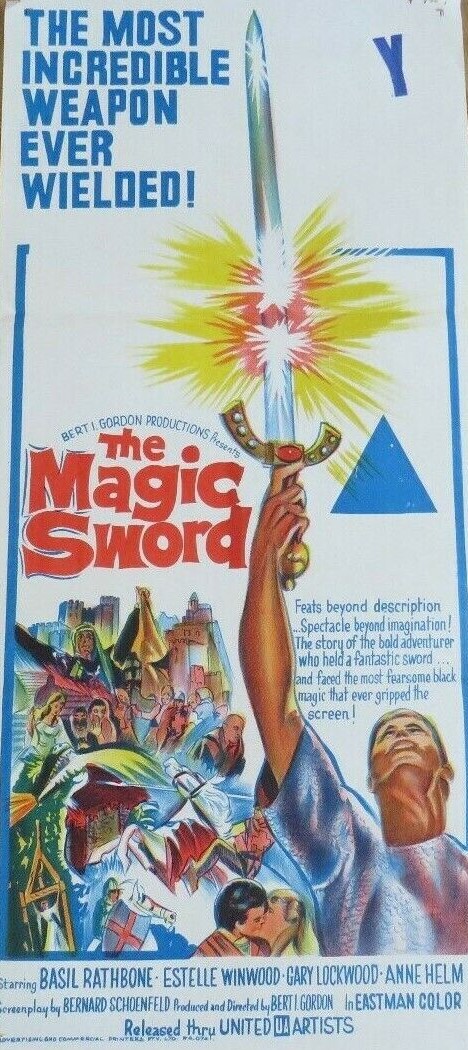
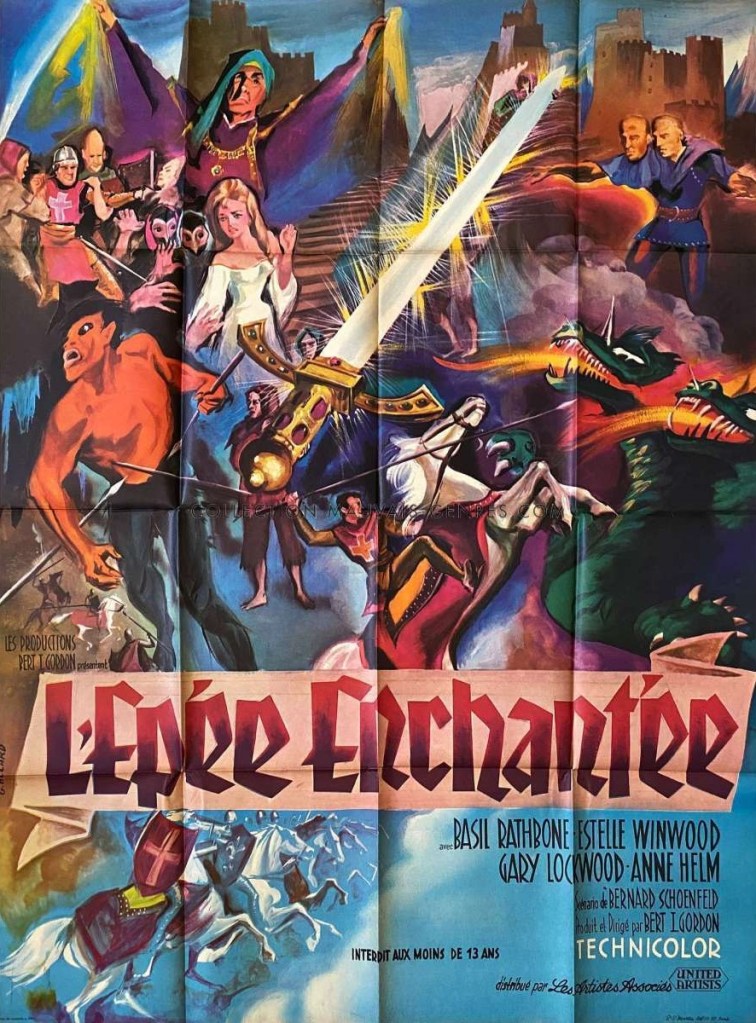
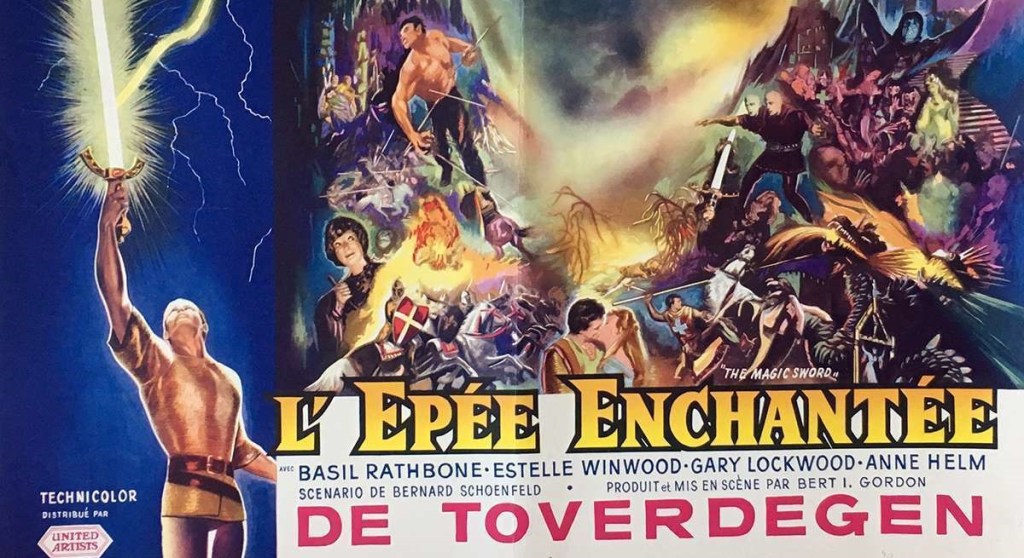
The Magic Sword (1962) ***

Where’s Ray Harryhausen when you need him? Not much wrong in this fun low-budget adventure that a few doses of Dynamation wouldn’t fix. While it means the monsters don’t cut it – man in mask with a dodgy perm playing an ogre, two-headed dragon whose flames appear superimposed – the rest of it is as up to scratch as you might expect from a genre that relies on exploiting old myths.

And we do get a look at Gary Lockwood (The Model Shop, 1969) in embryo and Basil Rathbone (The Comedy of Terrors, 1963) having a whale of a time as a villain who somehow (point plot not explained) has lost his magic ring. That means he’s going to strike a deal with loathsome knight Sir Branton (Liam Sullivan) – who happened across it (plot point unexplained) – to kidnap Princess Helene (Anne Helm). He’s somewhat hindered in explaining his plans because his voice is often drowned out by the thunder he can summon just by lifting his arms.

But it’s magic vs. magic as the pair come up against sorceress Sybil’s (Estelle Winwood) adopted son Sir George (Gary Lockwood) who’s stolen a set of enchanted artefacts including the titular sword, armor, a shield and the fastest horse in the world and heads off to rescue fair maiden from the castle of Lodac (Basil Rathbone) where the aforementioned dragon is on a steady diet of consuming a human being (or two, if twins or sisters are to hand) once a week.

Sybil, who seems to exist in some kind of darkroom, constantly lit by red, is a hoot, when not turning herself into a cat, unable to recall spells, not surprising since her memory has to span 300 years. Her coterie includes a chimp who does nothing (what’s the point of that, you might wonder, though perhaps magic is involved in just getting it to sit still) and a two-headed man, both faces speaking the same words at the same time.

There’s a tilt at a magnificent seven scenario as Sir George brings to life six sidekicks, a multi-cultural melange if ever, or a stab at attracting audiences from six different countries if you like. You need to be mob-handed at this game because the bunch, assisted or sabotaged by the accompanying Sir Branton, need to overcome The Seven Curses of Ladoc (the film’s alternative title in various parts), including the ogre and a malodorous swamp, and sure enough those dangers soon cut the motley band down to size.

Meanwhile, the imprisoned princess has watched the dragon eat, and is tormented by dwarves (though the caged elves turn out to be friendlier). There’s going to be two showdowns, not one, since Lodac has no intention of allowing Sir Branton the glory of rescuing said princess and therefore winning her hand in marriage. He is hell-bent on revenge, since the king’s father had burned his sister at the stake as a witch.

The meet-cute if you like is princess and potential rescuer facing each other across a dungeon while tethered by rope to stakes. Sybil does try to help but damned if she can remember the final words of her spell.

Gary Lockwood, in his first leading role, takes the whole thing seriously, and only made two more films before something in this role and It Happened at the World’s Fair (1963) and Firecreek (1967) tipped off Stanley Kubrick that here was a star in the making for 2001: A Space Odyssey (1968). So it does show that no part, however preposterous, is worth turning down.

Basil Rathbone would steal the show – as he should being top-billed – were it not for the fun-loving Estelle Winwood (Games, 1967) as the dotty aunt kind of sorceress. What Hollywood dictat I wonder determined that leading actresses often made their entrance swimming naked in a pool. Anne Helm (The Interns, 1962) doesn’t have much to do except look scared. You might spot Danielle De Metz (The Scorpio Letters, 1967).

With Sybil to dupe, all the curses to overcome and deal with the duplicitous Sir Branton, the pace never lets up. And it’s short (just 80 minutes) so no time for dawdling.

Director Bert I. Gordon (The Amazing Colossal Man, 1957) has been here before with the special effects that appear dodgy to the contemporary eye but were ground-breaking at the time when SFX did not command multi-million-dollar budgets. Screenplay by Gordon and Oscar-nominated Bernard C. Schoenfeld (13 West Street, 1962).

While Harryhausen tales were always redeemed by the special effects, this is perfectly acceptable late-night entertainment when the critical guard is down.

The Pink Jungle (1968) ***

Near miss rather than the spectacular crash dive the poor box office returns suggested. Though it’s scarcely surfaced in five decades. Espionage adventure-cum-treasure hunt is slightly undone by knowing winks to the camera and it won’t take an eagle eye to spot that most of the action doesn’t take place in the jungle at all, although the title is explained in a clever twist at the end.

Shame the script goes AWOL and you might be left lamenting what might have been had it been a hit and the boost it could have given the careers of George Kennedy (Cool Hand Luke, 1967), playing ebulliently against type, and Eva Renzi (A Taste of Excitement, 1967) who proved to have lot more screen charisma than her ensuing roles suggested. Not to mention James Garner (Duel at Diablo, 1966), marquee value taking a hit after a string of flops.   

However, if you can accept James Garner as a fashion photographer, and a gag that sees all three male principals decked in out varying shades of lipstick, and shut out the noise of Garner’s character offering commentary on what is about to happen, it’s a pleasant, non-demanding ride, with a believable central romance.

And I learned diamond arithmetic: five carats equals one gram, 28 grams is one ounce so you’re talking a phenomenal amount for a diamond weighing a few ounces never mind a 20lb haul which is where the endless MacGuffins lead. And if Ann-Margret can elect to shoot a fashion spread against the backdrop of motocross (C.C. and Company, 1970), choosing the South American jungle as the ideal spot for a lipstick advert is scarcely a stretch.

The long-winded tale begins with photographer Ben (James Garner) having his consignment of lipstick confiscated by police chief Ortega (Michael Ansara) who suspects they conceal hidden microfilm from the C.I.A. for rebel insurgents. When model Alison (Eva Renzi) arrives by helicopter that’s promptly stolen by South African illegal diamond dealer Ryderbeit (George Kennedy). The stranded couple repair to the nearest town, followed by the cops and by a pair of thugs, where Ryderbeit connects them to Englishman Capt Stopes (George Rose) who boasts a map leading to the lost diamond haul.

There’s no great reason for Ben to get involved, and the script offers nothing compelling, but let’s go for the ride, so suitably prepared (cigars and whisky essentials apparently) they set off with mules into the desert (yep, no jungle) where the model demonstrates her rodeo skills. There, they encounter Australian McClune (Nigel Green), the supposed deceased partner of Stopes, but he dupes them, leaving them stranded without water or mules, in the desert and heads off to find the loot himself. Of course, that does mean he has to come back the same way so the inevitable shootout, compounded by villains and cops, ensues.

Though determinedly sluggish in parts and the introduction of McClune adding little to the scenario, for the most part, although treading a thin line between cliches, it’s enjoyable enough. Ben is surprisingly handy with his fists, Alison has unusual depths and Ryderbeit is an engaging conman.

For a time there’s a bit of a tussle over Alison, as she’s clearly at times more attracted to the “masterful” adventurer Ryderbeit, a cool dude especially when he demonstrates his dance moves, than the cynical Ben. McClune takes a more predatory interest in Alison. But the growing romance between Ben and Alison is gentle stuff and almost required acting of the highest caliber given that the two actors hated each other according to the scuttlebutt.

Guilty of over-plotting and trying hard not to take the scenario seriously enough, even when it’s clear it won’t work unless that does occur, and that as a previous Garner episode proved, as in A Man Could Get Killed (1966), you can easily skirt around dense narrative and espionage malarkey without getting too bogged down. Over-populated, though, with characters and accents vary.

I’m used to Garner’s schtick by now, but Eva Renzi and George Kennedy were revelations, as was Nigel Green (Fraulein Doktor, 1969) also having a ball as a duplicitous character far removed from his usual ramrod-straight persona.

Oscar-winning director Delbert Mann (Mister Buddwing / Buddwing, 1966) does his best but he could have moved it on a bit for the pace seriously slackens at times. Charles Williams (Joy House, 1964) contributed the screenplay based on the novel by namesake Alan Williams.

Far more enjoyable than I expected and worth it for Renzi and Kennedy.

PREVIOUSLY REVIEWED IN THE BLOG: James Garner in Cash McCall (1960), The Wheeler Dealers (1963), Move Over, Darling (1963), The Americanization of Emily (1964), 36 Hours (1965), The Art of Love (1965), A Man Could Get Killed (1966), Duel at Diablo (1966), Buddwing/Mister Buddwing (1966), Grand Prix (1967), Hour of the Gun (1967), Marlowe (1969); Eva Renzi in Taste of Excitement (1969); George Kennedy in Lonely Are the Brave (1962); Charade (1963), In Harm’s Way (1965), Mirage (1965), Shenandoah (1965), The Sons of Katie Elder (1965), The Flight of the Phoenix (1965), Hurry Sundown (1967), Cool Hand Luke (1967), Bandolero! (1968), Guns of the Magnificent Seven (1969); Delbert Mann directed A Gathering of Eagles (1963), Buddwing/Mister Buddwing (1966), Fitzwilly/Fitzwilly Strikes Back (1967).

The Light at the Edge of the World (1971) ***

Had me at pirates! Unfortunately, I feel suckered. These scumbags, even with a dandified Yul Brynner (The Double Man, 1967) at the helm, give the traditional swashbuckler a bad name. That said, it’s a decent Rambo-esque adventure, derived from a Jules Verne novel, that sees Kirk Douglas (A Lovely Way To Die, 1968) single-handedly take on the venomous pirate crew, with Samantha Eggar (The Collector, 1963) thrown in as lure.

Ex-gold-miner Denton (Kirk Douglas) runs the southernmost lighthouse off the perilous coast of Argentina leading to the dreaded Cape Horn passage, the only route round South America prior to the opening of the Panama Canal. Helping him out are veteran seaman Capt Mortiz (Fernando Rey), who constantly upbraids Denton for his lack of naval lore, and young lad Virgilio (Jean Claude Drouot) and his pet monkey. When a ship hoves into view and anchors off-shore, Mortiz and Virgilio head up the welcome party only to be ruthlessly – and gleefully – cut down as they climb on board.

Pirate chief Kongre (Yul Brynner) has come up with a neat scam. Switch off the whale-oil-fuelled lights in the lighthouse, wait for unsuspecting ships to be wrecked and pocket the proceeds. After being tormented and humiliated, Denton manages to escape and hide out in the caves, but only for as long as Kongre, bored with idleness, decides to hunt him down astride his white horse armed with a unicorn-like sword, the lighthouse keeper only avoiding capture by diving into the sea, where he is presumed drowned.

But when the first victim of Kongre’s scheme breaks asunder, Denton rescues Montefiore (Renato Salvatore) from the ensuing sadistic massacre. The only other person saved, at Kongre’s behest, is the beautiful Arabella (Samantha Eggar), for whom the captain goes through an almost courtly charade before, espying photographs in the lighthouse cottage, deciding that since his captive bears some resemblance to Denton’s former lover he could inflict further torment to Denton by parading the woman, hoping to use her as lure to bring his enemy out from his hiding place.

While Denton has escaped capture and is carrying out guerrilla warfare against the invaders he’s not particularly successful, given he lacks any decent weaponry, is heavily outnumbered and Kongre is pretty cunning. Denton’s innate decency sees him attempting to rescue the girl only, in a stunning twist, to be knocked back as he has little to offer except hiding out in caves and the captain has been treating her royally. Unfortunately for her, when his ruse fails, Kongre tosses her to the sharks in the shape of the lusty crew who proceed to commit mass rape. Meanwhile, Montefiore has been captured, strung up in the rigging and is being flayed alive, slices of skin torn from his body to the delight of his captors.

As it happens, the pirates, to reinforce defence of the island should they themselves come under attack from the British or Argentinian Navy, have brought their ship’s cannons ashore. As it happens, not only are they trained on the ship, but Denton, despite no experience at all, proves an ace artillery commander. As the ship burns and sinks, he turns his attention to Kongre, conveniently swanning around in the lighthouse rather than the cottage, and in a piece of savage irony sets fire to the building with whale oil.

Could do with shaving 20 minutes off the running time, and certainly have to suspend disbelief at other points, but otherwise it’s a pretty early edition of the Rambo-style revenge, the one-man army that can wipe out a superior force. Despite my desire for a decent swashbuckler, the pirates are probably more realistic than anything served up by Errol Flynn or Johnny Depp, and their cruelty seems consistent with their profession. The scenes with Denton being pursued relentlessly by the mounted Kongre are especially effective as is the rejection of Denton by the snooty girl.

Kevin Billington (Interlude, 1968) directed from a screenplay by wife Rachel and Tom Rowe (The Green Slime, 1968).

Long-lost film that deserves an audience.

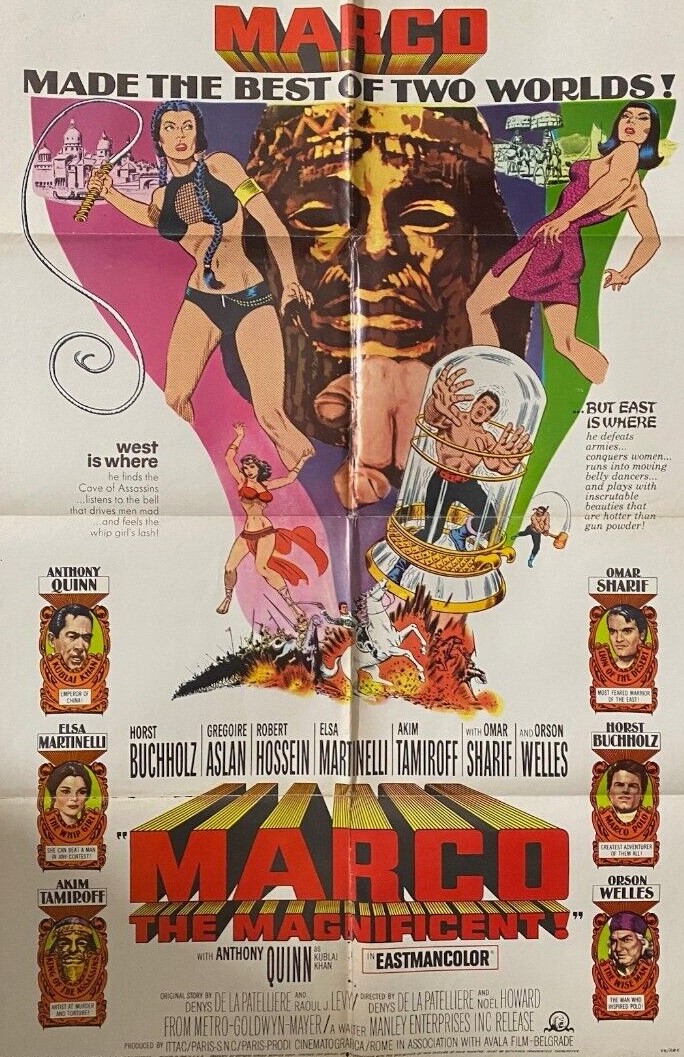
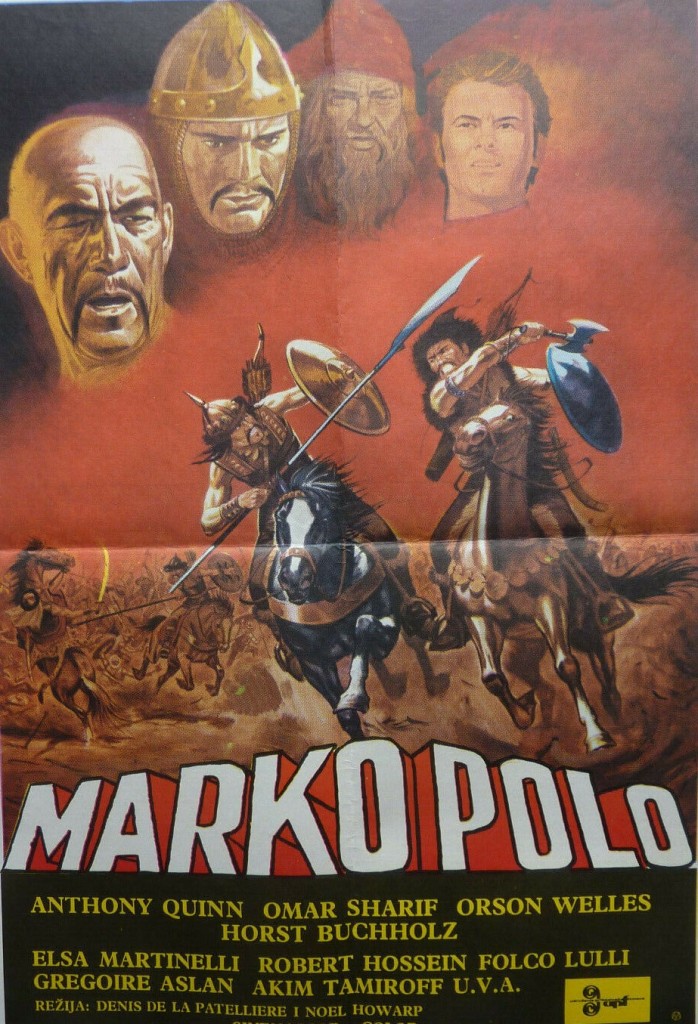
Marco the Magnificent (1965) **

Small wonder this flopped even with the requisite all-star cast of Omar Sharif (Doctor Zhivago, 1965), Anthony Quinn (Zorba the Greek, 1964), Orson Welles (Austerlitz, 1960),  Horst Buchholz (Nine Hours to Rama, 1963) and Elsa Martinelli (Hatari! 1962). Oddly enough, Quinn comes close to saving it. Although initially laughable, presented as a cross between Yul Brynner’s long-lost brother and Ming the Merciless, he tones down the trademark rasp and growl to deliver a powerful performance.

Of course, we also have to take the word of Marco Polos (Horst Buchholz) that he had all these adventures and that he did encounter The Old Man of the Mountains (Akim Tamiroff) and The Lady with the Whip (Elsa Martinelli). The former wore a mask of gold and if you ever saw his face that meant you were in for the chop. And he had a nice line in sonic torture. The latter chooses love above betrayal.

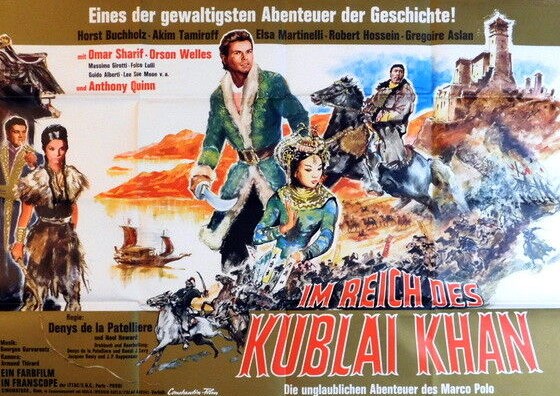
The name of Marco Polo either meant so little to German audiences or the title change was due to the producers hoping to capitalize on the success of “Genghis Khan.”

Love – or sex I guess – is a consistent theme. Marco is chosen for this adventure – whose main aim is to get a message to Mongol overlord Kublai Khan, now the ruler of China, that Italy, the dominant western power at the time, wants peace – in part because he is so handsome. He has no other pedigree that I can see. At the age of 20, he’s best described as an idler. But his father Nicolo (Massimo Girotto) is a renowned trader and has ventured along the Silk road to Samarkand.

But, would you believe it, following that old western genre trope where there’s always someone wanting to sabotage relations between Native Americans and soldiers, the idea of peace doesn’t sit well with everyone. Spies report on Marco’s every move and attempt to stop him completing his mission and when he reaches China discovers that another Mongol warlord Prince Nayam (Robert Hossein) prefers the traditional method of conquest, with the raping and pillaging that goes with it, rather than growing the economy through peaceful means.

Just as well Marco is so good-looking because whenever he is in a tight spot he is rescued by a beautiful woman, including the aforementioned Lady with the Whip, and, would you believe it, Princess Gogatine (Lynne Sue Moon), who has been chosen as a potential wife for Kublai Khan (Anthony Quinn). Multiple romance is the name of the game here – Arab chieftain Emir Alaou (Omar Sharif) has twenty-six wives, one of whom has the temerity to complain at his expanding harem.

Mostly, it’s a travelog – with a bucket of travel cliches thrown in such as Russian dancing – punctuated by occasional peril. But beyond looking handsome and putting his seductive powers to the test, there’s not much else for Marco to do.

The screenplay is so limited and haphazard you get the impression it must have been heavily truncated, that there was a three-hour roadshow covering the ground in a more sensible manner, but that appears not to have been the case. Producer Raoul Levy (who wrote and produced And God Created Woman, 1956, and wrote, produced and directed The Defector, 1966) ) spent so much assembling the cast he scrimped on a workable screenplay and was so intent on ramming it with oddly-named characters (Old Man of the Mountains and Lady with the Whip) that he took his eye off the narrative ball.

The final section with Kublai Khan trying to integrate through his own marriage the conquering Mongols and the conquered Chinese and dispensing with war in favor of peace makes more sense but by then you are so exhausted by the multiplicity of star names contributing nothing and the meandering plot that you have just about given up.

And it wasn’t as if Levy didn’t have time to get a screenplay in place. He’d been working on this since 1962 when an earlier version starring Alain Delon (Once a Thief, 1965) was abandoned when finance ran out. One of the most expensive French movies ever made, and extensively funded by Levy, it proved such a flop, it wiped him out financially and contributed to his suicide.

The inconsistency may have been caused by having three directors – Levy, Denys de la Patellier (Caroline Cherie, 1968)  and Noel Howard (D’Ou Viens-Tu, Johnny, 1963).

All-star cast wasted, promise unfulfilled.

https://m.media-amazon.com/images/I/6161DUBcazL._AC_SY445_.jpg

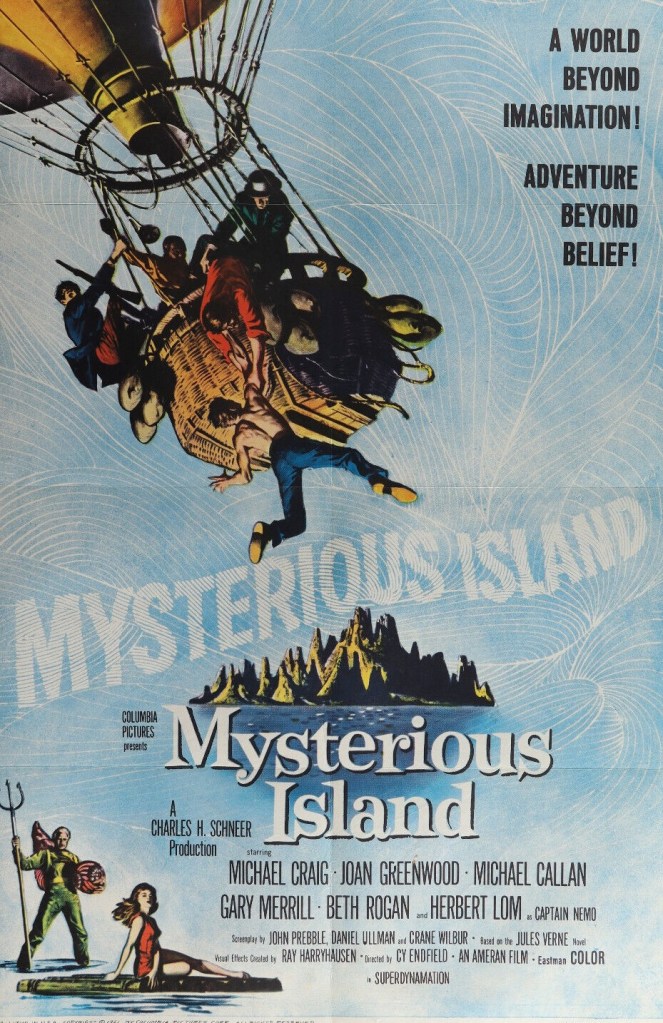
Mysterious Island (1961) ****

It’s the Ray Harryhausen Show. You’re not here for the story, surely, or the characters. You’re just waiting patiently for the monsters to appear. The only element that’s ever wrong with this kind of picture is that in-built delay. The need to set up the story and establish the oddities of the world before the behemoths trundle into view.

Doesn’t matter whether the creatures already live in an accommodating  global ecosystem like Jason and the Argonauts (1963) or One Million Years B.C. (1966). Or whether you are  going to come across them by the simple device, most famously, of dropping through a rabbit hole (Alice in Wonderland) or via a cupboard door (The Lion, the Witch and the Wardrobe) or a  rockface cracking open (Prehistoric Women / Slave Girls, 1967) or a time warp (Wonder Woman, 2017).

Here, it’s a bunch U.S. Civil War soldiers who need to break out of their prison and commandeer a handy hot-air balloon that can fly thousands of miles to the uninhabited volcanic island occupied by giant beasts. So we’ve got a monstrous crab, giant bees, chicken, gigantic octopus. And the success or failure of the picture relies not so much on whether our heroes can overcome these than that they look realistic.

And, boy, they are just brilliant. This is fairly early on the Harryhausen catalogue but if his stop-motion animation was still going through an experimental stage it’s hardly noticeable. Enhanced claws and beaks are just dandy for trapping humans, having them wriggling madly to avoid being split open with one snap. And the bee is pretty cunning, filling in the hole the invading humans have created in the massive honeycomb.

And should, perchance, your mind be wandering director Cy Endfield (Zulu, 1964) has a bout of sequel-itis, throwing in Captain Nemo from author Jules Verne’s 20,000 Leagues under the Sea (1954), and prequel-itis – the pirates from his In Search of the Castaways (1962) – plus, to add the romantic touch, a couple of shipwrecked damsels and, for the climax, volcanic eruption.

No doubt you’re dying to know about the characters you couldn’t really care less about who are encountering this legion of beings. So, we’ve got the grizzled Capt. Harding (Michael Craig), young Herbert (Michael Callan) who will express his romantic side, Sgt. Pencroft (Percy Herbert), Corporal Nugent (Dan Jackson) and Gideon (Gary Merrill). There are joined by posh English lady Mary Fairchild (Joan Greenwood), who happily buckles to and is handy with a rifle, and her niece Elena (Beth Rogan) who decides laziness is the better option when she’s not canoodling with Herbert.

Their job is to squabble, beat off the monsters, adapt a local geyser for cooking purposes, set to building a boat to escape, and await the next monster/person who’s going to upset their plans.

Captain Nemo certainly makes an impression, his ship, the Nautilus, stranded under the volcano and the man himself taking a break from the world since he doesn’t believe he is such a good fit. Turning up out of the waves in an improvised aqualung isn’t quite an entrance on a par with Ursula Andress in Dr No (1962), but it runs it close, though bikini tops rubber-suit all the time.

The pirates are just a menace and I wouldn’t be surprised if you came away with the notion that they are rammed into the tale just so their sunken ship, scuttled by Nemo, can miraculously rise from the waves thanks to the sailor’s ingenuity.

Time has been kind to Harryhausen. What was once viewed as appealing only to children and the childish wondrous aspects of adults has now become cult viewing. And no wonder. In the age of CGI, it’s quite astonishing what he has managed to achieve with what appears the most rudimentary of techniques.

Of the actors, British star Michael Craig (Doctor in Love, 1960) has his hands full to stop the picture being stolen by rising American actor Michael Callan (The Interns, 1962), a grumpy Gary Merrill (A Girl Named Tamiko, 1962), an almost avuncular Herbert Lom (The Frightened City, 1961) and a delightful turn by plummy-voiced Joan Greenwood (The Moon-Spinners, 1964).

You wouldn’t think this was the ideal movie to set you up for Zulu, but Cy Endfield does a good job of keeping the story moving and keeping out of the way during the Harryhausen sections. Screenplay by John Prebble (Zulu), Daniel B. Ullman (the television writer’s only movie of the decade) and veteran Crane Wilbur (The George Raft Story, 1962).

Huge fun. All hail King Ray.

https://amzn.to/3Rmb76d

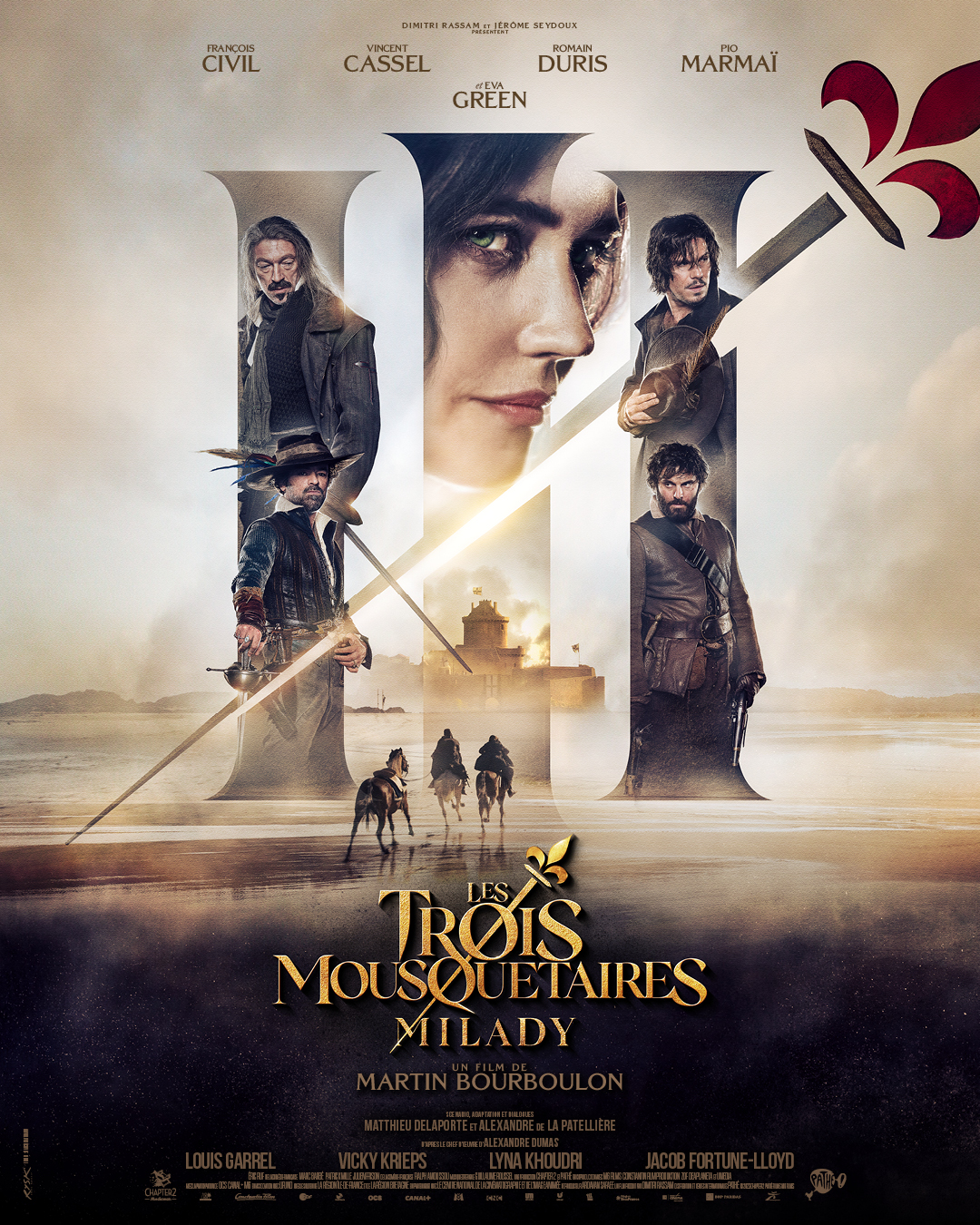
Remake Double Bill – The Three Musketeers: Milady, or Part Deux if you prefer (2023) *** / Godzilla Minus One (2023) ***

The Three Musketeers

Cherchez la femme, as they say in French. Here, because everyone is doubling up (or doubling down, I never get that right, and it is of course a sequel), the narrative has our heroes (and these being four musketeers if you include D’Artagnan and not three) chasing all over France in pursuit of two women.

If you recall from episode one (and it doesn’t matter if you don’t because this starts with a neat re-cap), D’Artagnan’s (Francois Civil) girlfriend Constance (Lyna Khoudri) has been abducted after overhearing details of a plot to kill King Louis XIII (Louis Garrel), so he’s trying to find her. Meanwhile, everyone’s after Milady (Eva Green), the double-crosser’s double-crosser. In fact, to complicate matters, the movie begins with her being rescued by D’Artagnan.

As it turns out, that’s one of the easiest complications because unless you’ve got a PhD in French history, you won’t have a clue what’s going on, what with imminent English invasion, traitors inside the palace, eternal bad guy Cardinal Richelieu (Eric Ruf) and the French laying siege to their own port of La Rochelle. I’m guessing, because it’s not exactly plain, that the background is Catholic vs Protestant enmity.

I’d forgotten of course that our heroes are called musketeers for a reason and it’s not because they are swashbucklers, though they are pretty nifty with the sword, but the name indicates a certain dexterity with muskets. So, there’s rather a lot more guns being fired and buckles being swashed.

The 1932 version.

And you could be forgiven for thinking this is some kind of riposte to Downton Abbey because everywhere our heroes go there is sure to be some fabulous chateau or castle and all kinds of pomp and circumstance. It’s a tad overladen with characters and not all stand out enough. D’Artagnan doesn’t quite command the screen and of other trio it’s lusty Porthos (Pio Marmai) who steals the show, always ready with a chat-up line or falling down unconscious from alcoholic intake.

Milady is by the far the most interesting character, tying all the males in knots, escaping every type of peril, dodging the hangman’s noose and an inferno and setting up Part III with a clever climax. Although the period wasn’t rife with feminism, she is the poster girl, not just adept with any weapon (including teeth), but detailing what it’s like to be eternally molested by men.

Constance, on the other hand, is as dumb as they come. The scene that allows D’Artagnan to wallow in pathos, you can’t help howling with laughter because the stupid girl has brought on herself a pitiless fate.

Sets quite a pace, but sometimes it’s hard to keep up with the politics and who is romancing who, and why someone who has been helpful in the past now has to be bumped off.

I hope this has earned its big budget back in France because I doubt if it will do well anywhere else.

Feels like director Martin Bourboulon (Eiffel, 2021) has bitten off more than anybody can chew.

Godzilla Minus One

Not just a remake but, as it turns out, a prequel. It’s nipped in early, ahead of the next vehicle in the recycle business Kong vs Godzilla due out next year.

In this Japanese version, made by Toho Studios which was responsible for the 1954 original, the timeline is 1945-1947. It kicks off at the end of World War Two with cowardly Japanese kamikaze pilot Skikishima (Ryonusuke Kamiki) unable to pull the trigger as the monster emerges from the depths. Fast forward to U.S. nuclear tests on the Bikini Atholl, and the creature now mutates with devastating impact on the mainland.

By this point, Skikishima has acquired an orphaned baby and takes on a job on a minesweeper (his trigger finger now put to good use) destroying the thousands of mines left behind after the war so he’s in the front line when the monster re-emerges with an atomic heat-ray in its arsenal, never find those stomping feet and destructive tail.

There’s some clever scientific ruses to destroy Godzilla involving Freon tanks (whatever they are) and some jiggery-pokery to lower the water’s buoyancy (what now?) but basically as you might expect it’s mostly our favorite monster decimating cities and taking on every warship and airplane that the country can throw at it.

It’s pretty good fun but you might find it hard to sympathize with a kamikaze pilot.

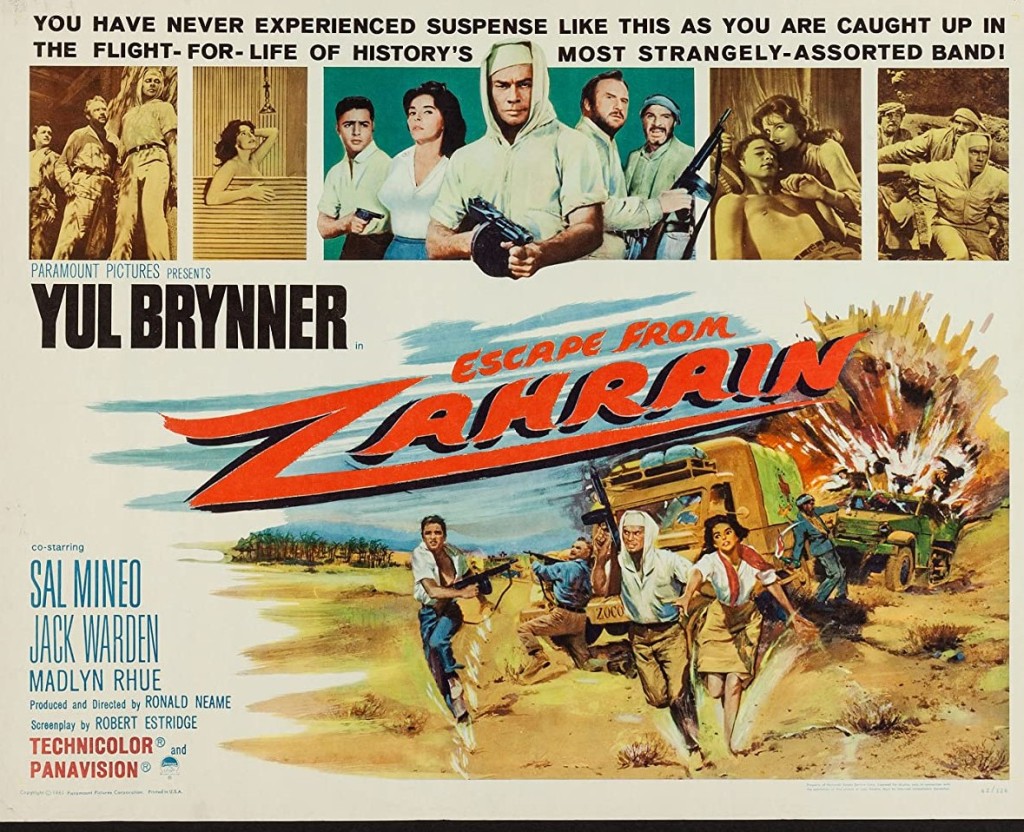
Escape from Zahrain (1962) ***

After being attacked by armored cars and strafed by airplanes, stranded in the desert, and overcome various tensions within the small group of escapees, there is still considerable life left in this picture at the end as Jack Warden, making his departure, comes up with a classic last line: “We must do this again sometime.”

In truth, the picture has far more going for it than a mere outline would suggest. In rescuing rebel leader Sharif (Yul Brynner) from a lorry bound for jail, the escapees led by Ahmed (Sal Mineo (Exodus, 1960) in a stolen ambulance also scoop up three convicts including American fraudster and loudmouth Huston (Jack Warden) and all-purpose thug Tahar (Anthony Caruso) plus nurse Laila (Madhlyn Rhue) as a hostage. Like most stranded-in-the-desert films, the storyline is on who will survive and how.

Action is one constant. The threat of failure is another. Supplies are rationed and, of course, someone steals more than their fair share. The members regularly switch allegiance. At various points someone is about to give up Sharif. Their gas tank is punctured so, thanks to Huston’s engineering skills, they just make it to a remote pumping station where they encounter maintenance man (James Mason in an uncredited cameo). Their numbers diminish and despite his recalcitrance Huston’s engineering skills save them again when they reach an oasis.

What makes the film different is that the characters all change. In a country where “half the wealth is stolen by Europeans and half by corruption,” Sharif is the altruistic leader whose ideals are shattered. Laila,  a Muslim, drinks alcohol and questions the number of deaths necessary for a revolution but declines to leave when the opportunity arises. Ahmed who thinks “women should be as free as men” reacts badly when Laila enjoys such freedom. Huston, who has embezzled $200,000, and has loyalty to no one stands by the shambolic crew.

I had always believed Brynner had enjoyed a rare case of beginner’s luck when he won the Oscar for his debut in The King and I (1956) and that once Hollywood became wise to his acting schtick he would never be nominated again – as proved the case. But after watching Brynner in The Magnificent Seven (1960) and its sequel and Invitation to a Gunfighter (1964) and Flight to Ashiya (1964) I have become convinced he is under-rated as an actor. He acts with his eyes and his delivery is far more varied than I had supposed. Here, clothed in Arab costume, there is no bald pate to distract. 

Sal Mineo (Exodus, 1960) can’t compete in the acting stakes with the canny Jack Warden (Blindfold, 1966). Anthony Caruso (a television regular) is lost in the mix but Madhlyn Rhue (A Majority of One, 1961) certainly looked a good prospect.

British director Ronald Neame (Tunes of Glory, 1960) holds the enterprise together, keeping to a tidy pace but allowing tension and character to emerge. Screenplay was courtesy of Robin Estridge (Eye of the Devil, 1966) based on the Michael Barrat novel and with an injection somewhere along the line by Dudley Nichols (Heller in Pink Tights, 1960).

Tight script, taut direction.

https://amzn.to/3Td6m1d

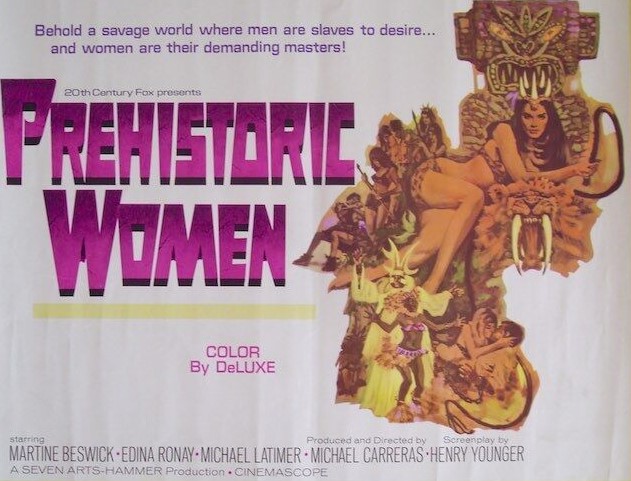
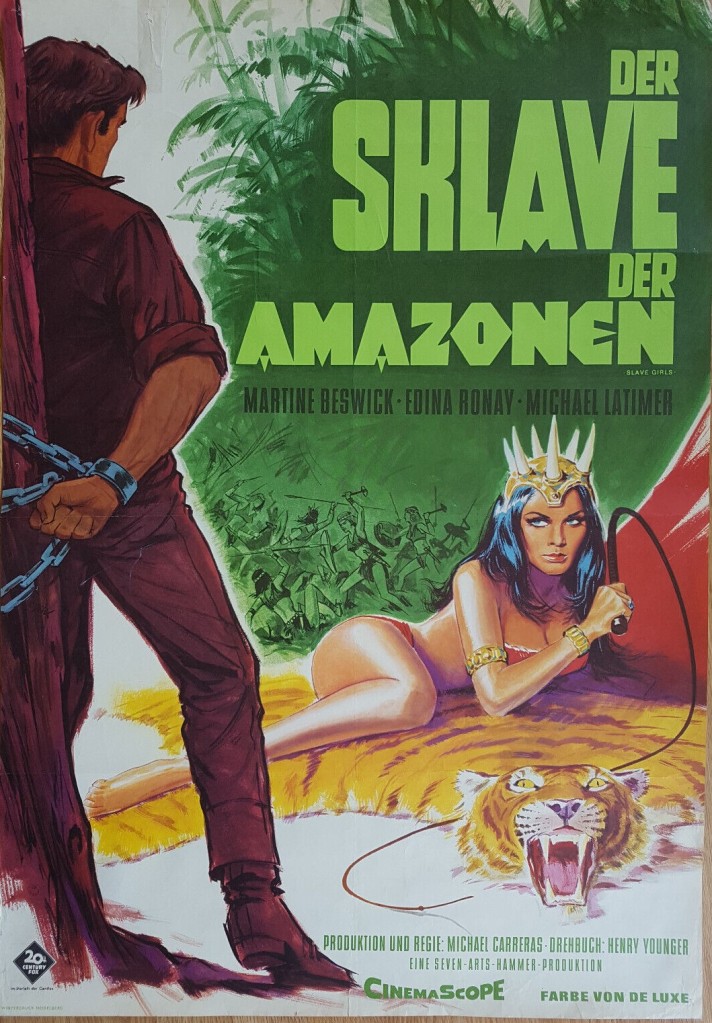
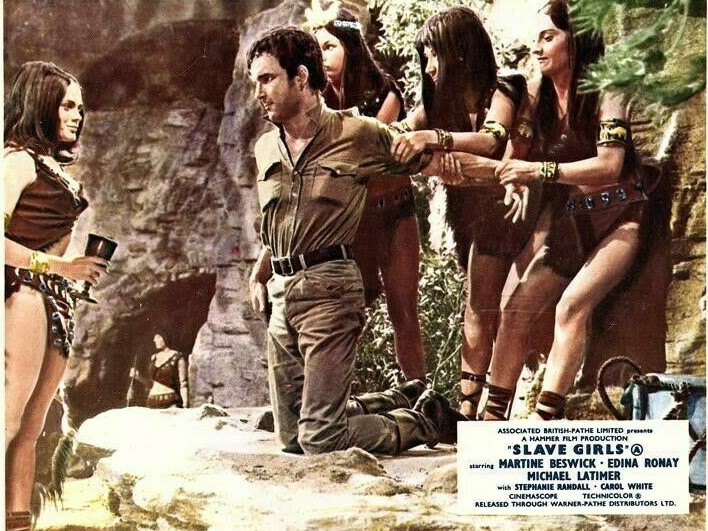
Prehistoric Women / Slave Girls (1967) ***

Can a dash of feminism rescue campy trash? Or even a genetics overload? Or is it enough to wonder what career hole Carol White (Never Let Go, 1960) found herself in to end up here? Or should we just sit back and watch the Pan’s People-style choreography and admire the astute re-use of all those bikinis left over from Hammer’s previous venture into this territory, the much more successful One Million Years B.C. (1966). Whatever, there’s no escaping the wooden acting and the one-note direction.

Dennis Wheatley (The Fabulous Valley, The Lost Continent, They Found Atlantis) and C.S. Lewis for that matter had the knack of transporting characters back in time or into other worlds. There’s usually some routine artefact, door or whatnot, that allows access to an amazing kingdom, or, in this case, queendom.

Here, big game hunter David (Michael Latimer), about to be sacrificed to some pagan African god, instead finds himself thrown back in time, chasing bewitching blonde Saria (Edina Romay), who, unfortunately is on the run, so when she is apprehended, so is he. Queen Kari (Martine Beswick) takes him as her lover. But he’s less keen, repulsed by her harsh rule. When one of her subjects rebels, the queen doesn’t delegate the task of bringing her into line but takes her on mano-a-mano. David, put to work with the other male prisoners, soon plots his escape.  

Setting aside the expected mumbo-jumbo – the tribe worships a mythical white rhino (phallic symbol anyone?) for example – if you want to extract anything more from this, there are fresh fields to plunder. For example, brunettes, such as Kari, are in control, but only after rebelling against the blondes who had subjugated the black-haired women in similar fashion as Kari. As well as having a female ruler, the movie makes a relatively pertinent point that gender scarcely comes into it when a dictator imposes such harsh conditions on their subject, Kari, for example, making the blondes eat off the dirt.

I’m not convinced the irony is deliberate. David, scion no doubt of Victorian nobility who made their pile from scarcely paying their downtrodden peasants a living wage, and who goes around shooting leopards, is hardly in a position to ask the queen to cool it. When she even considers giving him some equality – a big role reversal right there – he wants her to treat everyone in a nicer fashion.

The movie had an unsual history. Made quickly after “One Million Years B.C.” it was released in the U.S. as “Prehistoric Women” in 1967 but flopped so it was heavily cut, re-titled “Slave Girls” and sent out in 1968 in the UK as the support to “The Devil Rides Out.” The new title is a bit of misnomer because her kingdom is as full of slave men. The girls refers to the blondes. It was released in the U.S. in February 1967 by Twentieth Century Fox and managed a tie-in in one city with Cara Nome perfume. Actually, U.S. grosses were not as bad as have been reported – a “good” $25,000 in first run in Detroit, second only to “Grand Prix” there for the week, and decent enough openings in Boston, Minneapolis and San Francisco.

And she has the insecurity of Napoleon, needs to be loved, and not in mercenary fashion, and willing to attempt some form of rudimentary seduction if that’s what it takes to tempt the suddenly high-principled David into her bed. There’s an element of upending the Gentlemen Prefer Blondes trope, as though brunettes have always hankered after putting those ditzy blondes in their place.

Hammer lost sight of the fact that One Million Years B.C. owed as much to Ray Harryhausen as the statuesque temptations of Raquel Welch in a fur bikini and in its haste to cash in on that film’s big box office rushed into production a movie minus the battling dinosaurs. Although, of course, they could merely be making historical amends, since everyone knows dinosaurs and man (never mind women in fur bikinis) did not co-exist. And possibly ignored the fact that the puny Michael Latimer was no substitute for the brawnier John Richardson of the previous picture.   

If you’re not so interested in gender politics, you can always enjoy the dancing, which appears to take up a disproportionate amount of time (well, all those bikinis, need to be used). I was disappointed to discover the choreography was not the work of Flick Colby of the legendary BBC TV Top of the Pops dance troupe, but by one Denys Palmer, an actor it appears, whose main claim to fame was appearing in a classic Dr Who episode.

This was triple-hyphenate job, so blame Michael Carreras (The Lost Continent, 1968) for the screenplay and the direction and for taking on the production duties, or praise him for seeding a campy knock-off with issues that register more strongly today.

This was intended to be a big step-up for Michael Latimer but he was so charisma-free that he didn’t score another movie credit until low-budget British B-picture Man of Violence (1970). Martin Beswick (The Penthouse, 1967) never got another shot at a top-billed role. Carol White did better, next up was Poor Cow (1967) and from there it weas a small step to Daddy’s Gone A-Hunting (1969), but she doesn’t stand out here the way she did in Never Let Go (1960). If anyone stole the show it was Edina Ronay, and much good it did her, her next outing was in the lamentable Three (1969).

A curiosity, half-rubbish, half-interesting.

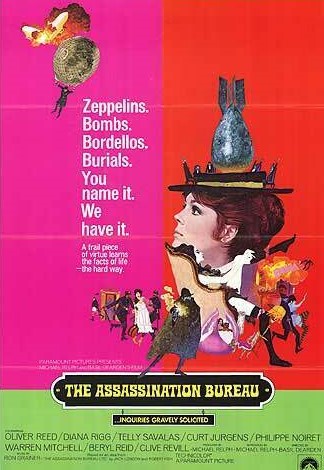
The Assassination Bureau (1969) ****

A couple of decades before “high concept” was invented came this high concept picture – a killer is hired to kill himself. Ivan Dragomiloff (Oliver Reed) is the assassin in question and Sonya Winter (Diana Rigg) the journalist doing the hiring. So Ivan challenges the other members of his murderous outfit to kill him before he despatches them. The odds are about ten to one. Initially involved in shadowing Ivan, Sonya becomes drawn to his aid when it transpires there is a bigger conspiracy afoot.

Set just before World War One, the action cuts a swathe through Europe’s glamor cities – London, Paris, Vienna, Venice – while stopping off for a bit of slapstick, some decent sight gags and a nod now and then to James Bond (gadgets) and The Pink Panther (exploding sausages).

Odd a mixture as it is, mostly it works, thanks to the intuitive partnership of director Basil Dearden and producer (and sometime writer and designer) Michael Relph, previously responsible this decade for League of Gentlemen (1960), Victim (1961), Masquerade (1965) and Khartoum (1966).

Playing mustachioed media magnate Lord Bostwick, Telly Savalas (The Scalphunters, 1968)  has a decent chomp at an upper-class British action. It’s easy to forget was one of the things that marked him out was his clear diction and he always had an air about him, so this was possibly less of a stretch.

Ramping up the fun is a multi-cultural melange in supporting roles:  Frenchman Phillipe Noiret (Night of the Generals, 1967), everyone’s favourite German Curt Jurgens (Psyche ’59, 1964) playing another general, Italian Annabella Contrera (The Ambushers, 1967) and Greek George Coulouris (Arabesque, 1966) plus British stalwarts Beryl Reid (The Killing of Sister George, 1969) as a brothel madam, television’s Warren Mitchell (Till Death Do Us Part), Kenneth Griffith and Clive Revill (Fathom, 1967).

The action flits between sudden danger and elaborate set pieces. When Ivan announces his proposal to his board he promptly fells a colleague with a gavel just as that man throws a knife. Apart from folderols in a Parisian brothel, we are treated to a Viennese waltz and malarkey in Venice. There are disguises aplenty, donned by our hero and his enemies. Lighters are turned into flame throwers.

And there is a lovely sly sense of humour, an Italian countess, wanting rid of her husband, does so under the pretext of Ivan gone rogue. Oliver Reed (Hannibal Brooks, 1969) and Diana Rigg (On Her Majesty’s Secret Service, 1970), adopting her best Julie Andrews impression, are in excellent form and strike sparks off each other. Their verbal duels are a joy to watch. Basil Dearden, in his second-last picture, invested the movie with considerable panache. It takes more skill to carry off this kind of movie, as much satire and spoof as anything else, than a straightforward action or crime picture.

Relph conjured up the screenplay based on an unfinished Jack London novel published posthumously in 1963 with the assistance of crime writer Robert L. Fish.

Shouldn’t work as well as it does. Surprisingly enjoyable.

https://amzn.to/49R8RMy

Discover WordPress

A daily selection of the best content published on WordPress, collected for you by humans who love to read.

The Atavist Magazine

by Brian Hannan

WordPress.com News

The latest news on WordPress.com and the WordPress community.