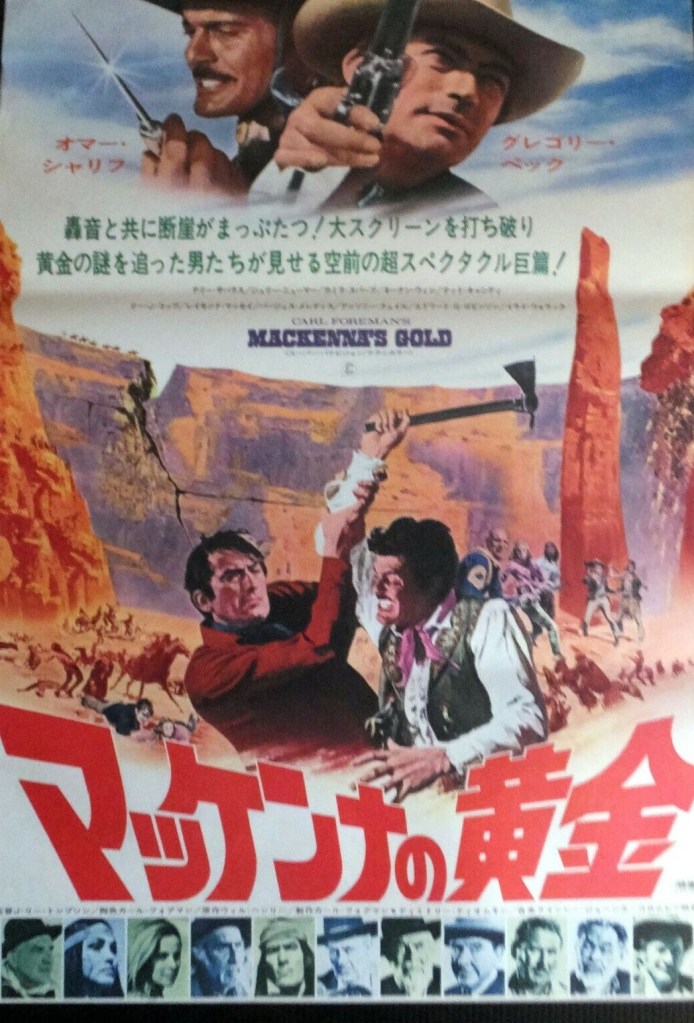
Mackenna’s Gold (1969) ***

The Treasure of the Sierra Madre (1948) set in the West – men driven mad by gold fever. Straightforward plot, however, complicated by an avalanche of characters. And  for a two-hour running time it seemed perverse to waste the first six minutes on scenery, narration – explaining the Apache legend of a fabulous hidden seam of gold – and theme song.

The real film begins with a shoot-out between Marshall Mackenna (Gregory Peck and an Indian. “You will wish you never saw this map,” says the Indian before he dies, but Mackenna burns the map. That doesn’t go down well with villain Colorado (Omar Sharif), whose gang has taken Inga (Camilla Sparv) hostage. Convinced the lawman has memorized the map, Colorado adds Mackenna to his hostage quotient.

At Colorado’s hideout Hesh-Ke (Julie Newmar) has a hostile reaction to Mackenna. Like Colorado, they have history. Mackenna and Inga bond when he fends off an Indian intent on raping her. As if this isn’t a pretty straightforward set-up, old foes reunited, potential romance brewing, a treasure hunt, further complications arise in the shape of a posse led by Ben Baker (Eli Wallach), not hunting renegades but also chasing gold. As if that wasn’t already a complication too far now we have a Cavalry troop, who confuse the posse with outlaws thus mostly eliminating a complication before it gets too complicated – the pursuing Apaches finish them off.  

And in a nearby pool, we get a deadly twist on the naked attraction, as Hesh-Ke, first trying to lure Mackenna then trying to drown the woman she views as her romantic rival. When the Cavalry reappear, they have turned rogue, led by Sgt Tibbs (Telly Savalas). So now we’ve got the narrative ironed out it’s three separate groups – outlaws, Cavalry and Apaches – searching for gold with various individual old scores to be settled. And, just in time, they’ve arrived at Shaking Rock, the tall pillar visualized in the poster, and a sunrise worth waiting for. It is a glorious scene.

After a close-up of the rising sun and the pillar, and the screen changing color, the shadow of the pillar creeps across the canyon floor and points to a crack in the canyon wall. The crack is a tunnel entrance and on the other side the sun is shining on a seam of bright gold. And that leaves only the various denouements to be played out. And some surprises – straightlaced Inga succumbing to gold fever, the supposedly barbarous Apaches revealed as good guys –  treating pillar (and gold) with reverence – and (would you believe it) an earthquake.
The earthquake might just have been too big a temptation given this was filmed in Cinerama. But it’s the least effective use of the process. A fairly standard western trope, crossing a dodgy bridge, is heightened in Cinerama but it’s still a cliché. Much better is the river crossing, the camera’s dizzying effect echoing the rollercoaster ride in This Is Cinerama and the rapids and runaway train of How the West Was Won (1962), audiences pitched headlong into camera point-of-view, racing water, oncoming rapids, thundering waterfall. The final section is triggered by the Cinerama camera racing for two minutes down the  twisting track leading to the gold. So, in Cinerama terms, the audience got its money’s worth.

And there should have been enough conflict to keep the narrative on track – Mackenna vs. Colorado, Hesh-Ke vs. Inga, Inga vs Colorado, Calvary vs. outlaws vs. Apaches, plus various fist, gun, knife and belt fights. The individual conflicts, Inga’s genuine fear over her fate, the romantic triangle and especially ruthless Colorado revealed (ditto Butch Cassidy) as a dreamer, imagining life in faraway lands (swap Butch’s Bolivia and Australia for Colorado’s Paris) were more than enough to be going on with without being drowned out by a simplistic message about greed. This is nothing more – or nothing worse – than a decent western wrapped up in the bloated shadow of a roadshow.

Gregory Peck (Arabesque, 1966) and Omar Sharif (Mayerling, 1969) are both pretty good in roles that play against type, both female roles are well-written and well played by Camilla Sparv (Downhill Racer, 1969) and Julie Newmar (The Maltese Bippy, 1969) but the film is overloaded with way too many cameos. As he had proven in The Guns of Navarone (1961) J. Lee Thompson was excellent at handling large casts especially in scenes featuring a host of characters and his visual and aural skills are superb but not so good at putting writer-producer Carl Foreman in his place.

Take away the Cinerama effects and the roadshow elements, and trim another 20 minutes off the picture, and you would have had a tight character-driven picture.
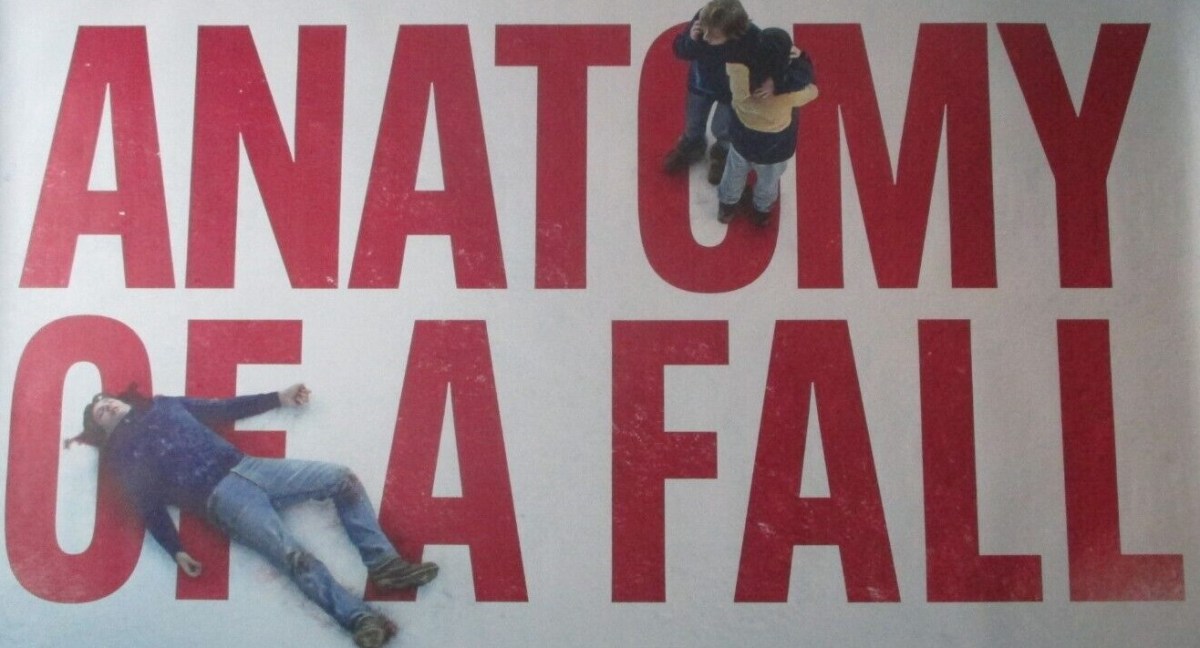
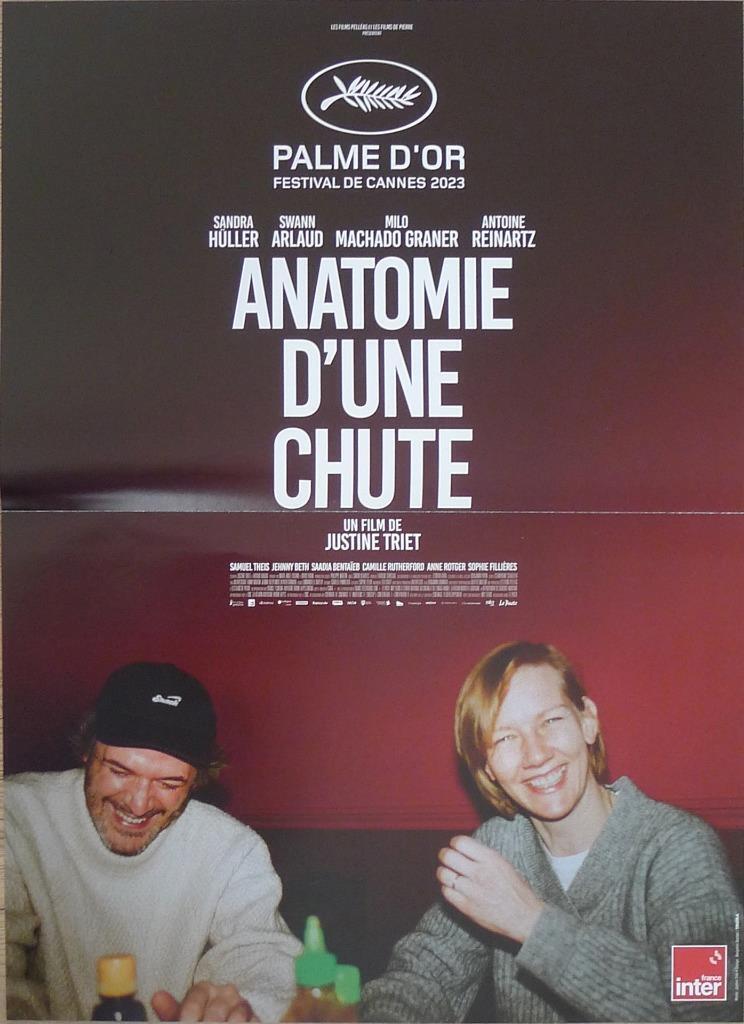
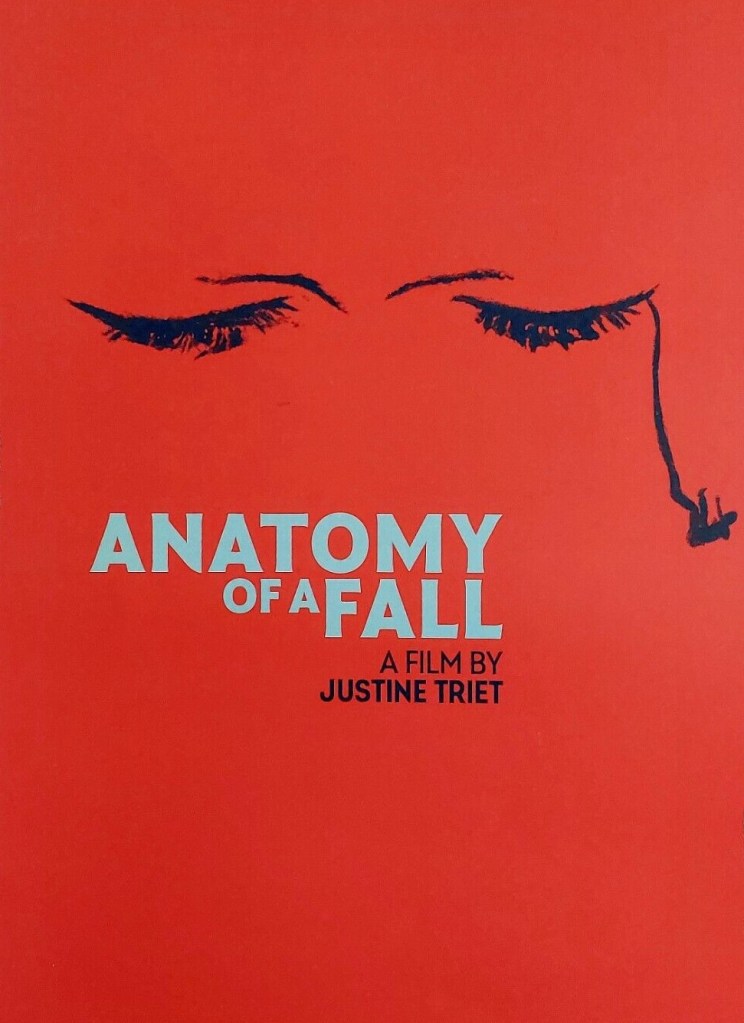
Anatomy of a Fall (2023) ***

I hate it when a mystery movie so blatantly cheats. Sure, we expect some sleight of hand, some vital piece of evidence retained, for the purposes of maintaining high tension, till the very end. Or a twist, a la Jagged Edge (1985), when a murderer, having got off scot-free, is revealed as the killer after all.

And while the central performances of accused, bisexual respected author and mother Sandra (Sandra Hueller), and accuser, smug unnamed prosecutor (Antoine Reinartz), are excellent and the exposition of the psychology of a marriage is well done, still the omission of the kind of critical forensic evidence that a modern audience would require works against the end result. Because otherwise, it plays like a 1940s courtroom drama, where the emphasis is solely on character rather than the weight of evidence.

So, here’s my complaint. The dead man has fallen from a window. Did he jump or was he pushed? Using forensics, the prosecution maintains he was hit by a heavy blow and some of the blood spatters down below were consistent with him losing blood when he was falling rather than when he hit the ground.

So we spend a great deal of time on examining how the body might fall and accounting for the blood, all of which appears to go against the accused, who is revealed as a not-so-nice person, possibly a sexual predator, possibly controlling, certainly a cheat – taking lovers while married and a heinous spot of plagiarism from her unpublished wannabe writer husband.

Only at the very end, when the half-blind child enters the loft space from which the father fell, do we realize that it would be impossible for this to be murder unless there was more evidence pointing to that eventuality. If the movie – prosecution and defence equally guilty of overlooking the obvious –  had spent a couple of minutes on the loft space both would have come to the conclusion not so much that murder could be counted out but that there would be clear evidence of it.  

The window is pretty small and an odd shape. But there was no evidence of a struggle, no scratches on the wood or glass, no tiny shred of material, and for the questionable spatters to end up where they did, the victim had to fall out backwards. So that means he needs to be pushed from the front and make no effort to save himself. The more obvious means of disposing of him – being thumped on the head from the back – was not consistent with the way he fell. And in any case, the space available for the wife to hit him with some heavy object would have meant leaving some evidence of that.

So, while it was certainly overlong, and could do with losing a good 15-30 minutes, I was happy to go along with the tale, held together as it was by the superlative performances and the usual courtoom duelling, though taking the last-minute evidence presented by the young boy as conclusive proof the father committed suicide seemed a step too far.

As a dissection of a marriage, of expectations of roles, and especially of the propensity for a failure to blame everyone else for their failings, it gets top marks. But it wears out its arthouse credentials by ignoring the forensic obvious.

I can’t also be the only one really annoyed that this Oscar-nominated performance basically skipped cinematic release. As far as I can work out, it was shown for one week in an arthouse in my neck of the woods way back last year and despite the Oscar nomination didn’t resurface except for a money-grab one-day showing two days (i.e. last night) before the Oscar ceremony. Like Maestro, it’s taken the streaming dollar and run, rather than allowed cinematic word-of-mouth to do what cinematic word-of-mouth is meant to do and build a groundswell of positive opinion prior to the awards.

So, yes, watch it for the psychology and the Oscar-worthy performance but don’t expect a contemporary approach to the mystery.

The Happy Thieves (1961) ****

A triumvirate of art thieves are blackmailed into stealing a famous Goya painting from the Prada museum in Madrid. Jimmy Bourne (Rex Harrison) is the actual thief, Eve Lewis (Rita Hayworth) smuggles the artworks out of the country and Jean-Marie (Joseph Wiseman, soon to be more famous as Dr No, 1962) creates the forgeries that replace the stolen masterpieces. Hayworth is the least reliable of the trio, her drinking (she had a problem in real life) jeopardizes their slick operation. Not only has the painting they have stolen slipped through their hands but the thief, Dr Victor Munoz (Gregoire Aslan), is not above a bit of murder on the side

Bourne is always one-step-ahead but  never overbearing, and the thefts are carried out with military precision. Even when let down by colleagues, who are inclined to scarper when threatened, he takes it all in his stride, the calm center of any potential storm. His marriage proposal is just as cool, coming by way of dictation, “the new Mrs Bourne.”

Bourne is the archetypal gentleman thief (“there is a touch of larceny in all successful men”) and Eve does her earnest best to keep up (“I want so much to be a first-class crook for you, I’m trying to be dishonest, honestly I am.”). But there is never the remotest chance of them being confused with real gangsters. “I thought that stealing was the only honest way Jimmy could live with himself,” says Eve.  In truth, their characters set the template for better-known later heist pictures like How to Steal a Million (1966), Gambit (1966) and A Fine Pair (1968) which couple one determined thief with one less so.   

Of course, heist pictures rely for much of their success on the actual heist. And Bourne’s plan for the Prada is brilliantly simple and carried out, as mentioned, with military precision. The get-out clause, which, of course, is how such films reach their conclusion, is more realistic and human than the other movies I have mentioned.

What’s more, there are number of excellent sight gags and great throwaway lines, while Jean-Marie and Dr Munoz are well-written, the villain’s motivation is particularly good. Other incidentals lend weight – their apartment is opposite a prison, the security guards at the Prada are caring rather than the idiots of How to Steal a Million, and a sub-plot involving a bullfighter (Virgilio Teixeira, Return of the Seven, 1966) also sheds light on Bourne.  There is a jaunty whistling theme tune by Mario Nascimbene (One Million Years B.C., 1966) which maintains levity throughout.

The movie does tilt from the gentleman thievery of the initial section into something much darker, but, so too, do the two principals and, unusually, rather than in the usual contrived fashion, Bourne and Eve undergo personal transition by the end.

Rex Harrison (Midnight Lace, 1960) and Hayworth are a delightful pairing. Hayworth has abandoned the sultry in favor of the winsome, Harrison shifted from sarcasm to dry wit. And there is genuine chemistry between them though his character’s matter-of-fact attitude tends to undercut the kind of passionate romance that moviegoers came to expect from top-class players thus paired. It would have been tempting for Hayworth to act as the ditzy blonde (brunette, actually) but instead she plays it straight, which is more effecting.

I found the whole exercise highly enjoyable. It’s very under-rated. My only quibbles are that it is shot in black-and-white, which seems bizarre when Spain is such a colorful location. The title, too, is an oddity. This was the only picture produced by Hayworth in partnership with husband James Hill. They split up before the picture was released which might explain its poor initial box office. 

Hill was an experienced producer, part of Hill-Hecht-Lancaster (The Unforgiven, 1960), but this proved his final film. Hayworth, too, had previously worn the producer’s hat for The Loves of Carmen (1948), Affair in Trinidad (1952) and Salome (1953). Hayworth was still a marquee attraction at this point, taking top billing here, and second billing to John Wayne in Circus World/The Magnificent Showman (1963). But this is quite a different performance to her all-out-passionate persona or the slinky deviousness of Gilda (1946).   

Director George Marshall (Advance to the Rear, 1964) knew how to stay out of the way and let his stars deliver the fireworks. John Gay (Soldier Blue, 1970) wrote the screenplay from the novel by Richard Condon (The Manchurian Candidate, 1962).

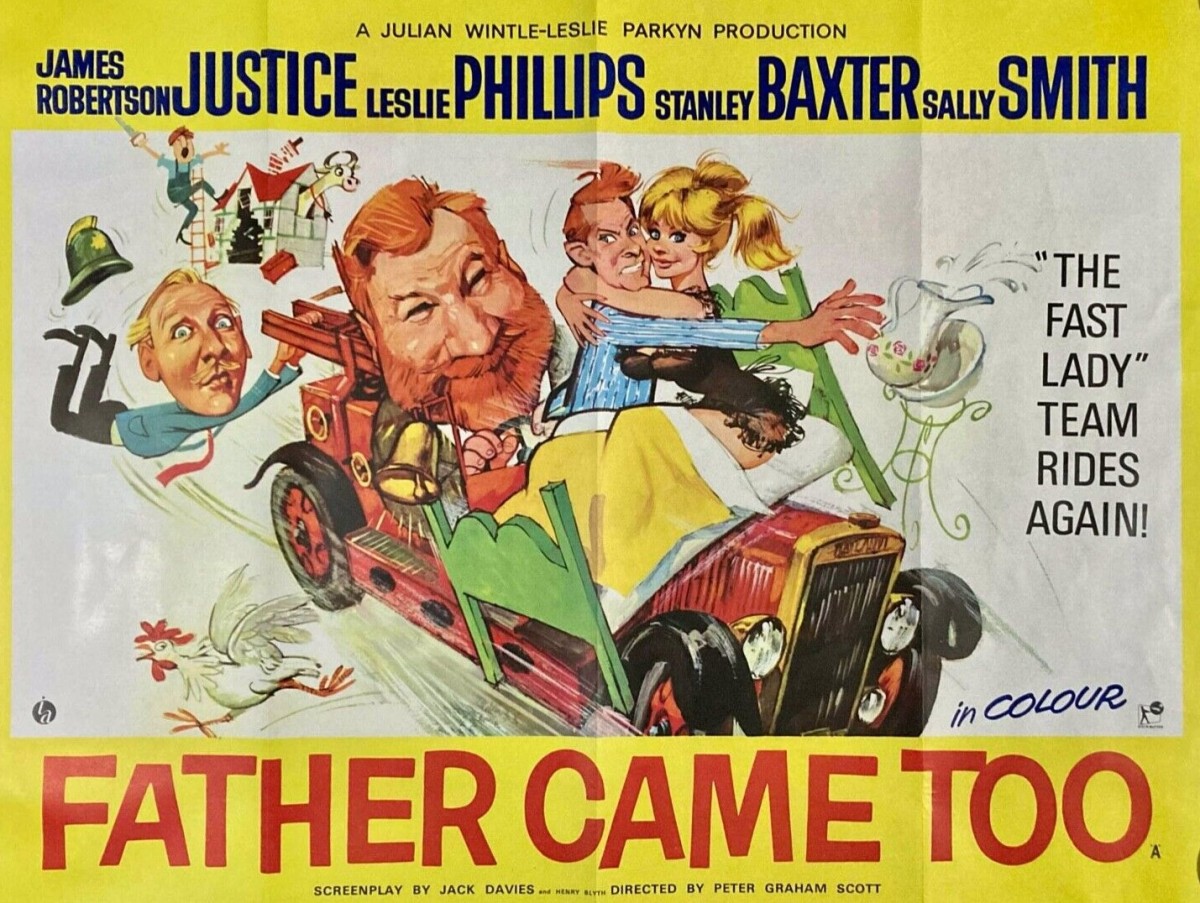
Father Came Too! (1964) ***

The gentlest of British comedies – a fading subgenre after the infiltration of the genre by the unsubtle Carry On pictures – that on the face of it appears a sequel to the very successful The Fast Lady (1962), featuring the same cast with the exception of Julie Christie. And with both Stanley Baxter (on television) and Leslie Phillips subsequently outpointing James Robertson Justice in the stardom stakes, contemporary audiences tend to come at this from a mistaken perspective.

James Robertson Justice was at the time very much a British institution and if not the star you cast him at your peril as he was likely to steal the picture from better-remembered actors such as Dirk Bogarde in the Doctor series, Margaret Rutherford in Murder, She Said (1961), David Niven in Guns of Darkness (1962) and Omar Sharif in Mayerling (1969). He was a big burly man with a bushy beard and a loud hectoring style, more Brian Blessed (Flash Gordon, 1960) than Robert Morley (Oscar Wilde, 1960).  

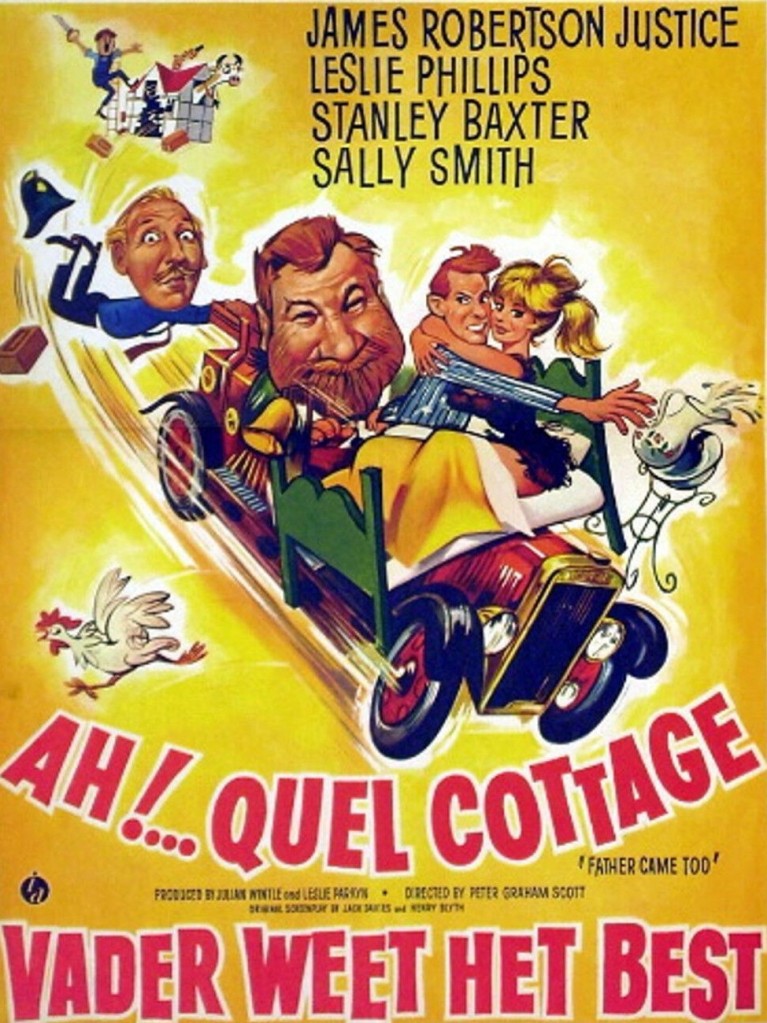
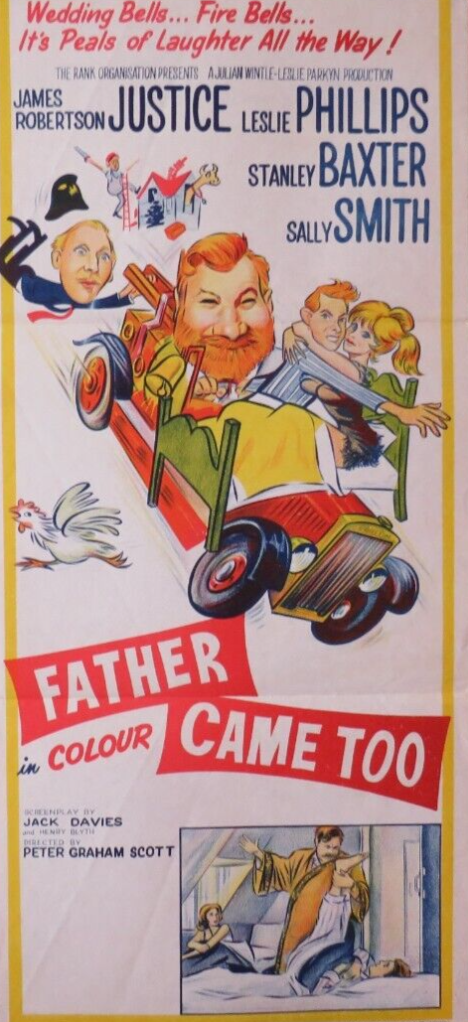
Misleadingly, the posters suggest another motor-centered tale.

He wasn’t the star of The Fast Lady and if it hadn’t been for the presence of Julie Christie (In Search of Gregory, 1969) he would have stolen that movie too. But when he was the denoted star, as here, the picture is built around him, so it’s not, actually, the tale of a young couple buying a money pit of a house, but of the male version of the interfering mother-in-law who makes their life merry hell.

Just married Dexter (Stanley Baxter) and Juliet (Sally Smith) purchase what appears an idyllic cottage in the countryside only to discover it requires a great deal of work. Renowned actor Sir Beverly Grant (James Robertson Justice) resents losing his daughter to a man he distrusts and to her moving out of his very grand home (named Elsinore, though I wonder how many viewers got that connection).

His attempts to take over the re-building programme are rebuffed by his son-in-law who hires the kind of builders, led by Josh (Ronnie Corbett), who give builders a bad name, tearing more tiles off the roof than they replace, creating more work for themselves or proving incompetent wherever they go. There’s a subplot involving real estate agent Roddy (Leslie Phillips), a budding thespian, desperate for the actor’s seal of approval.

But mostly, it’s everything going wrong and the father getting in the way and making things worse. But the tale doesn’t revolve around the hapless hero but around the domineering father and audiences back in the day would have recognized this, revelling in the father’s performance rather than trying to get on the side of the son-in-law.

Mostly, too, the comedic trick is slapstick, foot in paint pots, falling through floors, ceilings and roofs, an invasion of cows (one with the inevitable bonnet), being drenched by as much water as you could get on a set, and Dexter wringing his hands as the calamities – and the budget – mount.

Usually, the young couple taking on the world scenario just results in them encountering trouble from neighbors or various representations of authority and generally the focus from the outset is on them. But, here, it’s the opposite, audiences of the time waiting, not so much to see what new disaster will befall the couple, but to enjoy the carnage the father visits upon them. And viewed from that perspective it becomes far more enjoyable.

He’s far removed from the interfering mother-in-law cliché because that element of any comedy was usually a subplot played by a character actor who rarely evoked any audience sympathy. But audiences came to a James Robertson Justice picture to enjoy the mayhem he caused. He had screen charisma in spades, and especially when the screenplay was tilted in his favor, was apt to totally dominate a movie. And this is him at his best.

Stanley Baxter was somewhat miscast as a whiny incompetent husband – or, rather, he was not given a part which best utilized his uncanny skill for impersonation as later shown in his eponymous hugely successful television show. Leslie Phillips plays against type, more of an ingratiating Uriah Heep type than the uber-confident lady killer. Sally Smith (Naked You Die, 1968) hasn’t a hope of emulating Julie Christie. A slew of television comics – apart from Barker you can spot Terry Scott, Hugh Lloyd, Fred Emney and Kenneth Cope – put in an appearance.

Director Peter Graham Scott (Subterfuge, 1968) lacks prequel director Ken Annakin’s madcap zest but keeps it going none the less. Jack Davies (North Sea Hijack, 1980) and Henry Blyth (The Fast Lady) are as inventive as the idea permits.

Good old-fashioned fun but requires to be viewed from the correct character perspective.

Behind the Scenes: “The Man Who Haunted Himself” (1970) – The British Are Coming, Part One

The Man Who Haunted Himself (1970) appeared as part of new British production strategy. In fact, the British had been trying to dominate the global film industry since the silent era when  the population of its Commonwealth exceeded that of the United States. At various points, the British had launched various distribution attacks on Hollywood – aligning with U.S. cinema chains, organizing their own distribution system (Gaumont-British in the 1930s for example) and even taking over major Broadway houses as a launch platform for new releases. Come the end of the 1960s , Britain had lost its production grip on the world stage. Though movies were still being made in Britain they were often funded by Hollywood, or were B-movies or genre-specific such as Hammer horror.

In 1969, Associated British Picture Corporation, following a takeover by EMI, relaunched as a major production entity, aiming to provide increased programming for its own 270-strong ABC cinema chain as well as hitting the export market. Bernard Delfont, chairman of ABPC, set up two production strategies that he intended to run in parallel. He brought in director Bryan Forbes (King Rat, 1965) as production chief of ABPC while Nat Cohen, head of ABPC subsidiary Anglo-Amalgamated, would augment that effort.

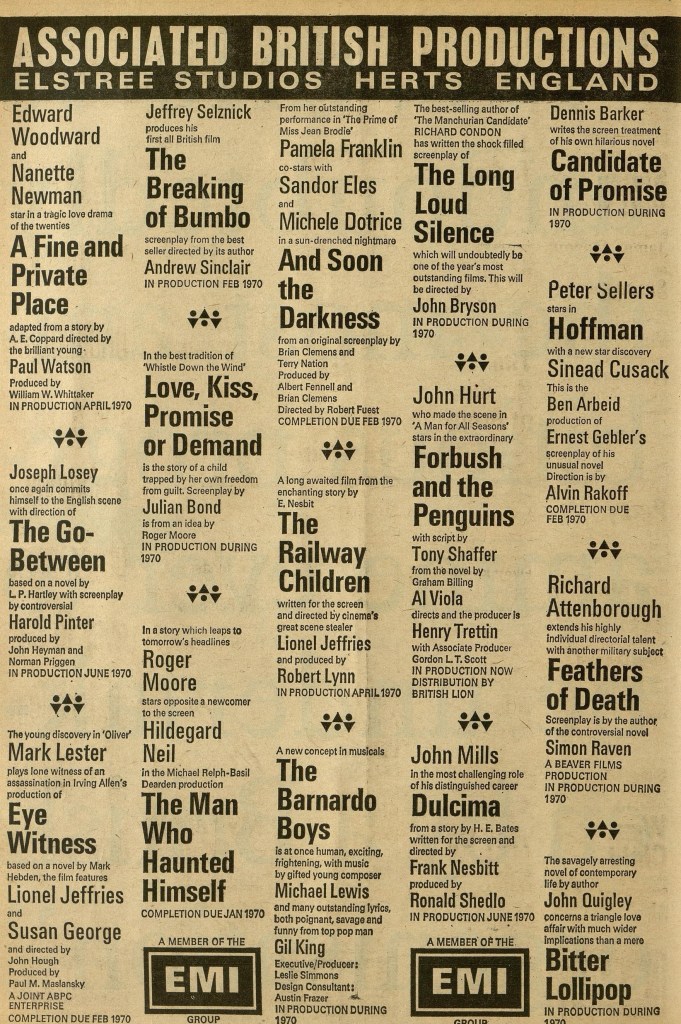
Full page ads (above and below) were taken in “Variety” to promote the MGM-EMI slate.
Of the 26 features planned, only 15 were made.

Forbes took on the role after initially signing a three-picture deal with Delfont which developed into “something wider…at a time of real crisis.” Forbes explained his motivation: “I think if you’ve been a critic as I have over the years…you’ve got to put up or shut up. And if the job is offered to you, you can’t turn it down and then go on criticising.”

The initial slate was being made with no guarantee of foreign distribution. Even getting a foothold in Britain was difficult. “We are very dependent…on getting West End outlets. There’s a long queue and we don’t have any particular pull.”

(In Britain at this point, roadshow – which to a large extent was no longer the favoured release device for big budget pictures in the U.S. – still dominated the West End and the type of picture being envisaged was more targeted towards the circuit. But a West End run was always seen as a mark of quality. The downside of the West End release was that it delayed movies reaching the provinces and by the time they did all the initial media interest was long forgotten.)

Budgets were being assessed to meet the prospect that a very successful film could recover its negative costs on a British release alone, with anything else pure profit. Trying to appeal to the international and/or U.S. market at the outset was too complicated and expensive a proposition. And there was always the prospect that with the production well running dry in American, that a distributor, with a hole to fill, would come calling.

ABPC allocated a total budget of £36 million to make 28 pictures, with Forbes’ outfit taking the lion share, leaving Nat Cohen only $7 million to make 13 movies. According to Delfont, it was the “most ambitious” program ever scheduled by a British company. While certainly an overstatement given the investment by Rank, ABPC and Gaumont-British in the past, it nonetheless captured media attention.

The Forbes project didn’t go according to plan. Hoffman (1970) with Peter Sellers, thriller And Soon the Darkness (1970), The Man Who Haunted Himself (1970) starring Roger Moore, The Breaking of Bumbo (1970) and Mr Forbrush and the Penguins (1971) headlining John Hurt and Hayley Mills all flopped, despite costing a lot less than originally expected. The Railway Children (1971) was the only undeniable hit while The Tales of Beatrix Potter (1971) made a profit. Raging Moon / Long Ago, Tomorrow (1971), with Forbes directing Malcolm McDowell and Nanette Newman, and Dulcima (1971) with John Mills and Carol White also ended up in the red. 

Forbes fared much better heading up MGM-EMI, a co-production unit set up in 1970, which produced hits The Go-Between (1971) and Get Carter (1971). Forbes resigned in 1971.

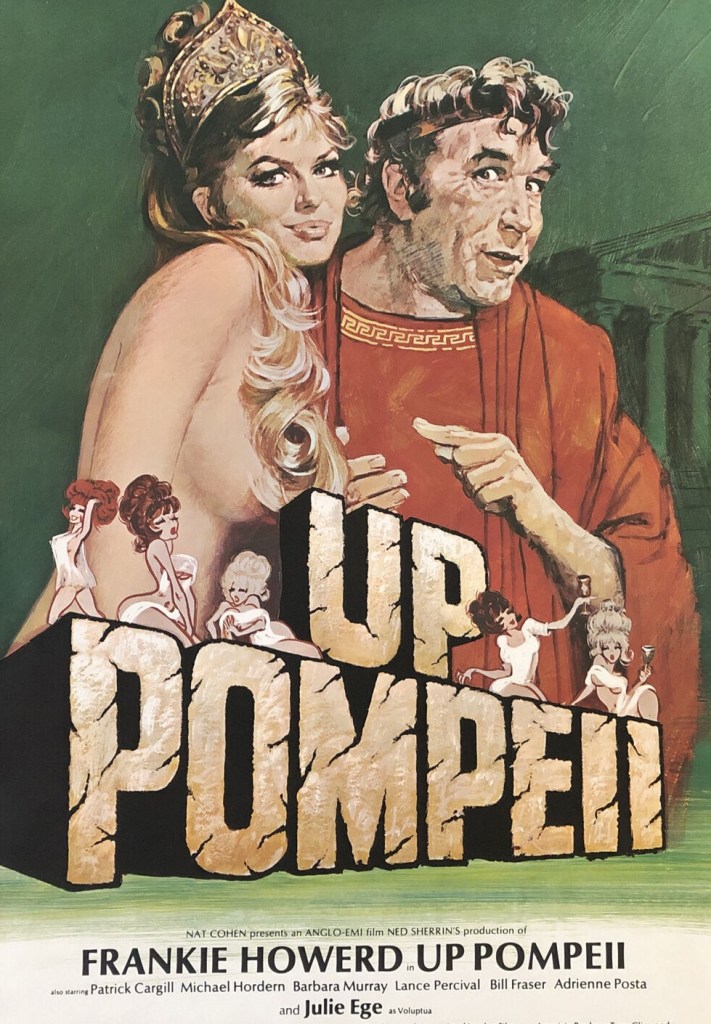
Nat Cohen, while pandering to a lower common denominator, enjoyed more straightforward success with sex-change comedy Percy (1971), and big screen versions of On the Buses (1971), Up Pompeii (1971) and Steptoe and Son (1972) – and their various sequels –  Richard Burton as Villain (1971), Fear Is the Key (1972), and Stardust (1974) while Murder on the Orient Express (1974) with an all-star cast was a huge global hit.

In 1976 Michael Deeley and Barry Spikings became joint managing directors of EMI and aiming for an international audience fronted part of the finance for The Deer Hunter (1978), Sam Peckinpah’s Convoy (1978) and Walter Hill’s The Driver (1978) and had significant investment in Columbia pictures like Close Encounters of the Third Kind (1977) and The Deep (1977).

But the British invasion amounted to very little in the end, as Hollywood, led by gargantuan hits of The Godfather (1972), Jaws (1975) and Star Wars (1977) swept all before them and made it impossible for British-made films to compete either on a commercial or artistic basis.

The experiment was a massive flop. EMI failed to break into the American market and, in fact, the box office achieved was on the dismal side. Best performers were Get Carter and The Go-Between both estimated to achieve rentals of just under $2 million. Tales of Beatrix Potter didn’t reach $1 million and Villain not $750,000. The Railway Children couldn’t manage $500,000 nor Percy $250,000 and none of the others even crossed the $100,000 mark. It was considered such a footnote in British movie history that it didn’t merit a mention in Sarah Street’s Transatlantic Crossing, British Feature Films in the USA (Continuum, 2002).

SOURCES: Alexander Walker, Hollywood England, (Orion paperback, 2005) p426-440; Advert, Variety, January 21, 1970, p12-13; Derek Todd, “The Emperor of Elstree’s First 300 Days,” Kine Weekly, March 7, 1970, p6-8, 19; “MGM-EMI In Joint Deal On British Filmmaking,” Box Office, April 27, 1970, p7; “MGM Setting EMI CoProds,” Variety, June 10, 1970, p3; “MGM-EMI To Produce 12 Films Annually,” Box Office, July 6, 1970, p6; “From $10-Mil and Up, Rentals, to $100,000 and Less,” Variety, November 12, 1972, p5.

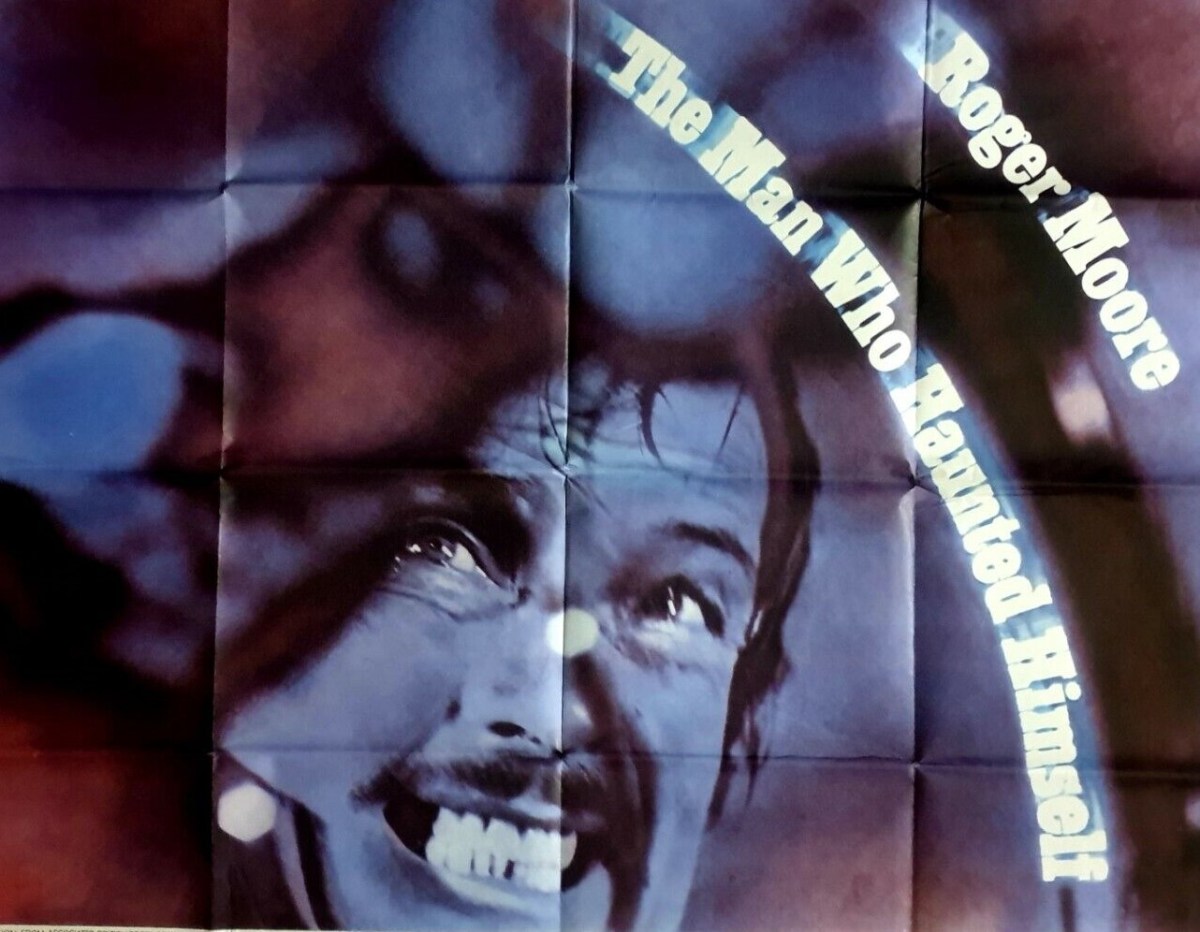
The Man Who Haunted Himself (1970) ****

I grant you, not many movies pivot on a broken matchstick. Nor, for that matter, play around with the screen persona of the imperturbable Roger Moore (Vendetta for the Saint, 1968) or call upon him to do more than raise an occasional eyebrow. No doubt I’m committing heresy in comparing this to The Wicker Man (1973) but there’s a certain similarity in the innocent being dragged into deep waters and, as in that picture, instead of our hero triumphing against sinister forces, ending up a victim.   

While the main narrative thrust is a doppelganger, the initial plot concerns murky business dealings, boardroom betrayal, and corporate espionage set against the backdrop of high living, upscale car, trophy wife, a spot of fun in a casino. The final film of Basil Dearden (The Assassination Bureau, 1969), who died prematurely aged 60, deals with the shattering of the life of strait-laced Pelham (Roger Moore).

He is fastening his car seat-belt a full decade before that was mandatory in Britain, punctuality his mantra, keeps to the speed limit, an immaculate dresser, and while hard work has taken its toll on his marriage he’s not the kind to have a mistress stashed away. But he crashes his car when, against all odds, he seems possessed by the desire to race along at 100mph, overtaking like crazy. For a moment, in surgery, his body registers two heartbeats.

Then people start reminding him of out-of-character activities, thrashing everyone at the club at snooker (and for money stakes), hitting the casino, receiving a nod-and-wink for under-the-table business dealings, while fashion photographer Julie (Olga Georges-Picot) makes sexual demands.

And outside his house his wife Eve (Hildegard Neil) spies a very swanky sports car and begins to suspect her husband is having an affair. Naturally, the upstanding Pelham tries to track down this imposter who has the habit of marking his territory with a broken matchstick. Some occurrences are downright weird. On meeting colleague Alexander (Anton Rogers) for a drink, he discovers he’s already had a drink. There’s the question of a piece of jewellery for Julie that he doesn’t recall buying. An astonished barber wonders why his client would need his hair cut two days in a row. And is someone stealing his shirts and ties?

This is the kind of picture where the normal resolution would be some kind of gas lighting, or tip into film noir with wife and/or the femme fatale involved in conspiracy, or at least some reasonable explanation for the dodgy goings-on.

Britain was going through a doppelganger mini-epidemic, Doppleganger/ Journey to the Far Side of the Sun appearing the year before, but that was a more straightforward sci-fi, being set in the future. And, of course, sci-fi was going through a new cycle what with 2001: A Space Odyssey (1968), Barbarella (1968) and Planet of the Apes (1968).

But it would be a tough call to place this in the same straightforward sci-fi category. The better fit, as I suggested, is The Wicker Man, the background one of a character upset by a different version of normality rather than inhabiting another world or discovering things have changed in the future. And there’s a psychological twist too, the sense of man losing grip on reality, battling  a madness he cannot escape, and while it could have done with dwelling on that aspect a while longer, nonetheless Dearden still achieves his result.

Roger Moore is excellent in twin roles, Hildegard Neil makes an interesting debut and Olga-Georges Picot (Farewell, Friend / Adieu L’Ami, 1968) brings surprising depth to her limited role.

The twisty stuff was written by Michael Relph (The Assassination Bureau) and Dearden based on the bestseller The Strange Case of Mr Pelham by Anthony Armstrong.

Violent City /Family (1970) ****

Of all the lazy, incompetent streamers this has to take the biscuit. Not content with branding as new films made over half a century ago, now we have films being screened which clearly nobody has bothered to watch even once. Otherwise, how to explain a picture where the language lapses into Italian at critical moments without the benefit of sub-titles.

Which is a big shame because, confusing through the movie is, it takes an unique approach to the femme fatale angle and serves up a noted screen tough guy as one whose heart is genuinely broken – suck that up, pale imitators going by the name of Stallone, Schwarzenner, Willis et al.

Post-Bullitt (1968) but pre-The French Connection (1971) we open with a dazzling car chase where the pursued race up stairs rather than down as is the current trope and batter their way through closely-packed streets in the Virgin Islands. That’s before wannabe retired assassin Jeff (Charles Bronson) is gunned down, although he’s still capable of diving under a burning car to escape immediate detection.

Jeff is on the lam with lover Vanessa (Jill Ireland). Dumped in jail with time to repent (no, strike that), mull over his circumstances, in the meantime dodging a tarantula (a real one!) crawling over his body, and coming to the conclusion that the moll has set him up and has returned to her previous lover, ace racing driver Coogan (no idea who plays him, imdb doesn’t know either). Despite having abandoned his profession, Jeff, not getting the hang of the broken-hearted moping malarkey, decides he’ll come out of retirement for the usual one last job, this time laying waste to Coogan.

But someone spots him and he’s blackmailed by Mafia chief Weber (Telly Savalas) into continuing his murderous ways. But here’s a sting in the tail – a wonderful twist to end all twists: Weber is Vanessa’s husband. She’s not a femme fatale at all just a sexual butterfly who dances from one lover to the next with Weber’s tacit approval.

But, in fact, in another twist, she is, after all, the femme fatale to end all femme fatales, setting up Jeff to bump off Weber so that she and attorney lover (what, another one) Steve (Umberto Orsini), Jeff’s best buddy, can take over her husband’s organization now that it has gone legit. And in the final twist to end all twists this ends with Jeff’s broken heart turning him suicidal (beat that Schwarzenneger, Stallone, Willis et al).

This is a very down’n’dirty Italian thriller, dashing from deadbeat locale to Southern Belle balls, from rusting riverboats to swampland, from factories to fashion shoots, the confusion factor infused further by the sudden incursions into Italian, often in mid-scene, as if this was some kind of artistic coup, determined to leave the viewer baffled.

Despite going the whole nine yards in the broken-heareted department, Jeff isn’t quite the full-blown romantic, an attempted rape of Vanessa in New Orleans only interrupted by (wait for it) three thugs beating another character to death. Naturally, Jeff isn’t the kind of good bad guy who intervenes, and these characters, even more naturally, have nothing to do with the plot (except as Jeff points out it’s a violent city after all). But what the hell, it’s that kind of film.

I’ve cutting Amazon Prime a big break here with my rating, because despite the language problems, it’s a cut above your normal thriller, and Charles Bronson (Red Sun, 1971) before being typecast by Death Wish (1974) gives a very good account of himself, certainly a lot more to do than just grimace, and, heck, you even feel sorry for him twisted inside out by emotion. Telly Savalas (A Town Called Hell, 1971) is a bit more polished and emotionally aware than his usual villain.

You might be tempted to call Jill Ireland (Rider on the Rain, 1970) the stand-out. She still can’t act for toffee, but she is well suited to playing this kind of jinxed minx, whose beauty snags dupes well below her league. And (spoiler alert) she does let it all hang out, indulging in copious nudity.

Directed with some flair by Sergio Sollima (The Big Gundown, 1967) and extra marks for coaxing unusual performances from the three principals. Six screenwriters (can’t you tell) put this together including Lina Wertmuller (The Belle Starr Story, 1968). Great score by Ennio Morricone.

Given I couldn’t understand half of what was going on thanks to streamer disinterest in sub-titles, I was still very impressed. Worth a watch.

NOTE: Amazon Prime has this under the title Family but once the credits roll it switches to original title Violent City.

Youtube has the trailer.

The Party’s Over (1963/1965) ****

Tricky little number that pivots on a tricky plot point and is almost sunk by the kind of moralizing voice-over that was attached to Riot on Sunset Strip (1967) but actually bears serious reassessment. Quite a brilliant two-minute opening sequence with a tracking camera. I’m a big fan of directorial technical skill so bear with me.

We open with a man dangling from a balcony whose cries for help go unheard at the party inside. We shift inside and with no dialogue the camera begins tracking to the right. A man moves down to kiss a girl and from behind the one being kissed a hand relieves him of his wine glass and the camera slides inches further over to a dark-haired girl in the act of removing a bowler hat from a man and placing it on her head and as she leans back into the sofa that allows a blonde to come to the fore whose cigarette is removed from her mouth to light the cigarillo of an unshaven character who grabs a bottle of wine and in glugging it down moves over to the window and observing the dangling man and pours the rest of the bottle on his head.

“Help him up,” calls out another woman. This request is ignored, but the unshaven character shouts for someone else to help. The man is rescued. With a cynical stare, the unshaven man asks of the woman who has intervened, “Anything else?” She retorts, “Drop dead.” He climbs onto the balcony, falls over, and when the partygoers rush over in horror we cut to the street below where he is swinging from a lamppost.

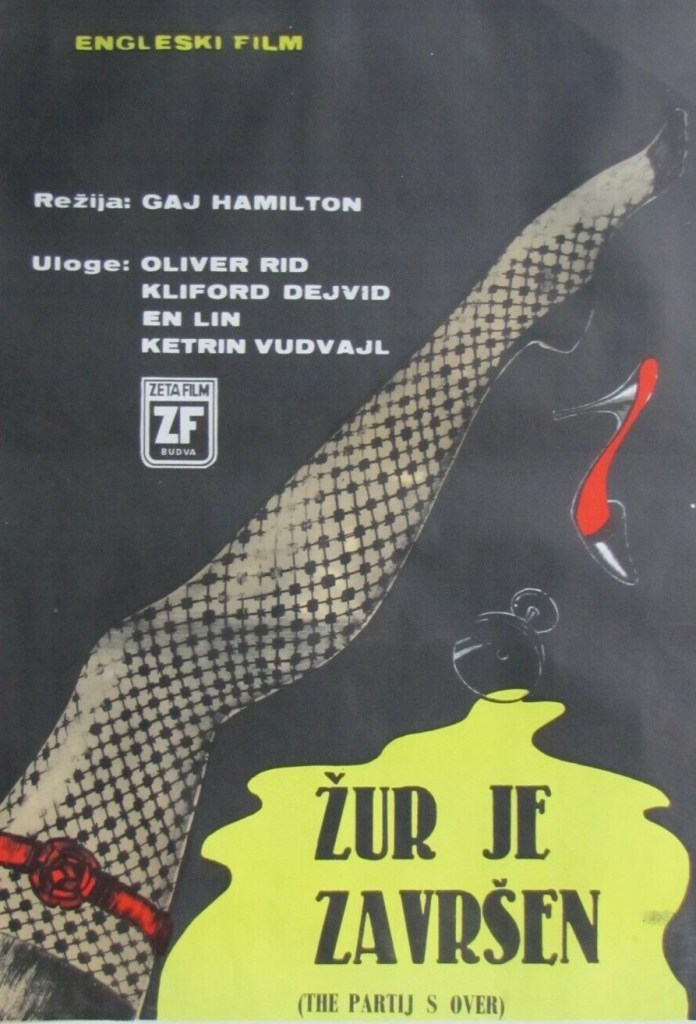
Easy enough to get away on the poster with what otherwise contractual credit billing forbids. Guy Hamilton could take his name off the credits but that wasn’t so easily enforced abroad.

Over the following credits comes the moralizing. “This film is the story of young people who become, for want of a better word, beatniks. It’s not an attack on beatniks…but shows the loneliness and unhappiness and eventually the tragedy that comes from a life lived without love for anyone or anything.” In other words – an attack on beatniks.

Actually, it’s far more about depression, though that’s scarcely acknowledged, not so much people trying to find themselves as not knowing where to look and in consequence spending a lifetime running away. You might only figure that out in retrospect but it gives the picture some punch. And they’re not overtly rebelling against society or authority as in The Damned (1962) or Riot on Sunset Strip (1967) beyond daubing a drunken face with a CND symbol.

These are less beatniks than, from their classy outfits, society debs slumming it. Yes, they don’t seem to do much else but party, although a number have artistic pretensions, sculpting and painting, for example, but mostly they seem able to lounge around without a care in the world, not like the motley secretaries living in bedsitters in The Pleasure Girls (1964).

The party characters quickly evolve into Moise (Oliver Reed), the unshaven character, who lusts in vain after sultry soul-eyed American Melina (Louise Sorel), the girl who gave him a ticking off, even though he has an adoring singer girlfriend, the blonde Libby (Ann Lynn), who he can, as he demonstrates rather misogynistically, summon with with a snap of his fingers. Bowler-hat is mysterious painter wannabe Nina (Katherine Woodville). The rescuer is sculptor and drummer Geronimo (Mike Platt).

Similarly, Guy Hamilton couldn’t prevent the marketing team sticking a sly reference to him – director of “Goldfinger” – elsewhere on the marketing material.

Melina has a wimp of a fiance, Phil (Jonathan Burn), and the story kicks into gear with the arrival of her American fiance Carson (Clifford David), a high-flying businessman, though owing rapid promotion to the fact she is the boss’s daughter. Since marriage is immiment, he is perturbed at being unable to contact his fiance.

But when he does try to find her, he is given the run-around. Nina tells him Melina is recovering from a terrible operation, someone else sends an easily-duped Yank to Buck House (Buckingham Palace), he finds her suitases packed in her room, that element backed up by the notion that she has given away clothes and jewellery (Nina wears her bracelet) and she has either skipped off to Paris or might be lying on a building site half-naked after being dumped there, dead drunk, as a prank by the gang.

So far, so black comedy. And you could believe all of it because Melina is “afraid of everything,” dreads having a daughter who might grow up to be “pawed by a thick hand” and otherwise seems to drift like a melancholy ghost. Phil, having failed his medical exams, commits suicide and like An American Dream/See You in Hell, Darling (1966) Carson is cast in the role of the person who could have saved him from diving from a roof.

Eventually, we do learn more about the other characters. Nina, who in the absence of Melina, takes up with Carson, is a provincial girl, who had an ill-advised marriage to please her parents. Libby is desperately in love with the womanizing Moise, who does a nice line in imitation and cutting remarks. When Melina’s father (Eddie Albert) turns up, the pace quickens.

And in a quite brilliant directorial coup, we realize that, ever since Carson’s arrival, the movie has been operating in flashback. There’s a better reason Melina is missing. She’s dead. She wasn’t drunk, she had toppled from a high staircase at a party and snapped her neck. But since everyone else is totally smashed, they assume she’s just out of it. Only Moise knows the truth, since she’d been trying to get away from him too fast. And since he makes no effort to prevent the prank going ahead, there would be some serious trouble should the police get involved.

Of course, the corpse turns up. Carson, reckoning he’s dodged a bullet, isn’t too torn up and he has a nice girl from the country, Nina, to hold his hand. Moise shows some remorse, but not enough.

Yes, a kind of morality tale but hardly enough to warrant the moralizing cautionary voice-over. Instead, it’s more prescient, Melina the forerunner of the kind of heroine who would find life just too tough and either end up in an institution or go on to ruin her own and everyone else’s life. As a study of depression it’s hard to beat. The spoiled brat who has everything only to realize it’s not enough. Guilt, too, if you count in Phil’s horror at kissing his dead girlfriend.

The credit sequence, which has been ripped off countless times, shows the motley post-party crew slinking across an iconic London bridge at dawn. And there are some wonderful scenes with a viciously playful Oliver Reed. In one he gives a Pythonesque take on the misunderstood waif – “my bathwater was never the right temperature, the servants always burned the toast.”

Oliver Reed (The Assassination Bureau, 1969) should have taken all the acting plaudits but in fact the women, with more emotion to openly play with, steal it. Katherine Woodville (The Wild and the Willing, 1962)  takes it by a nose from Louise Sorel, in her movie debut, and Ann Lynn (Baby Love, 1969).

Just superbly directed by Guy Hamilton (A Touch of Larceny, 1960), who mixes atmosphere, emotion and mystery, in just the right quantities, a difficult trick at the best of times. And who has the cojones to pull a fast one. It could as easily have been, upfront, a murder mystery. Instead, it’s much more. Screenplay is by Marc Behm (Charade, 1963).

It was made in 1963, when it would have been far more pertinent, but, thanks to the British censor, held back for two years. The censor was exercised by the scene where Phil kisses Melina, thinking she is dead drunk, only to realize some time later that she is actually dead, and the real reason he threw himself off the roof. In those days, nobody had come up with a solution to the knotty problem of a director who wanted their name removed from the credits. Several years later, Hollywood adopted an all-purpose pseudonym to cover that eventuality. But here, if you watch the credits, you’ll see that there is, to all intents and purposes, no director.

Best film ever to be made without a director.

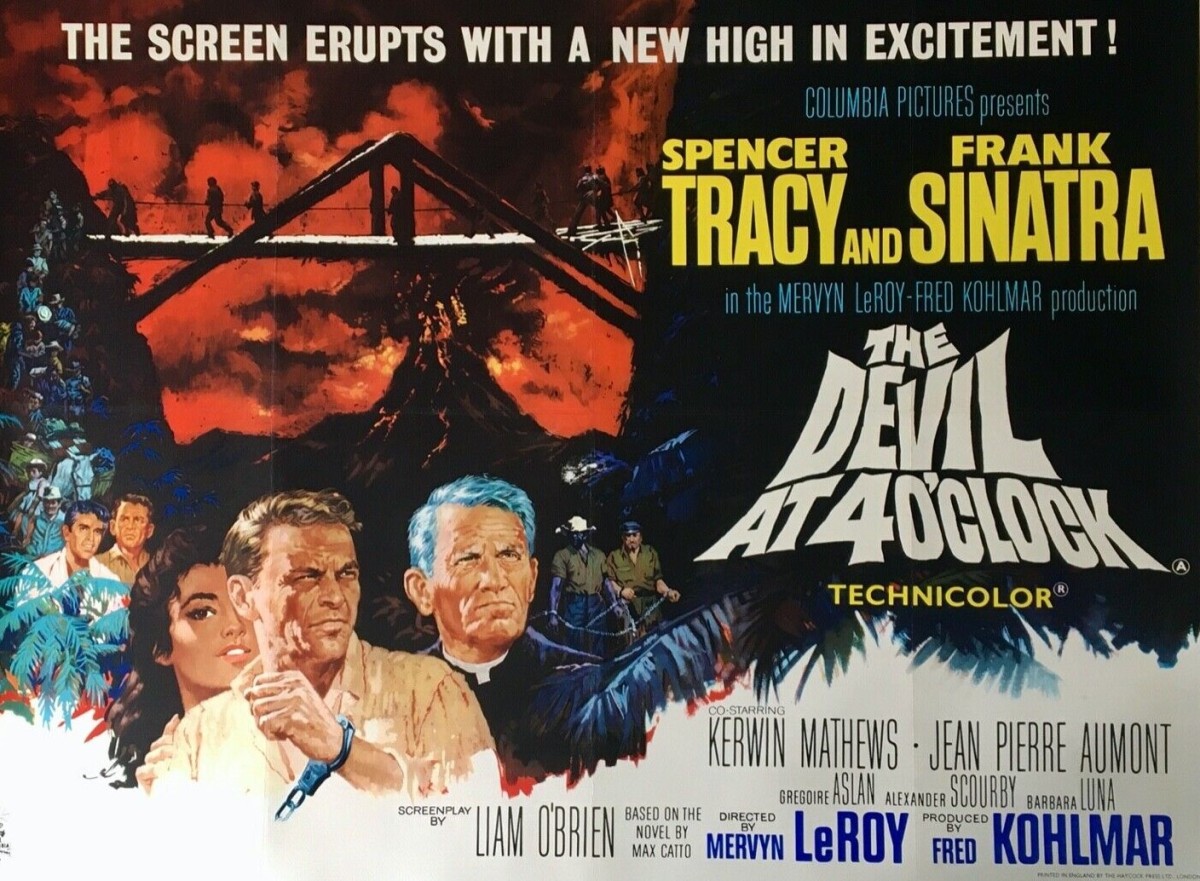
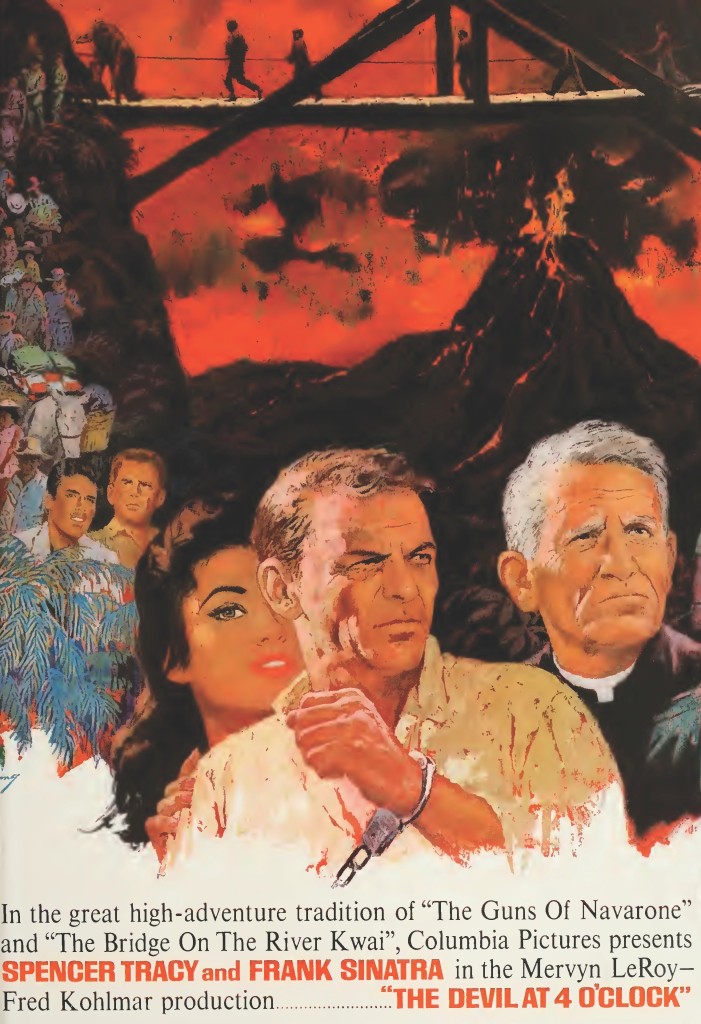
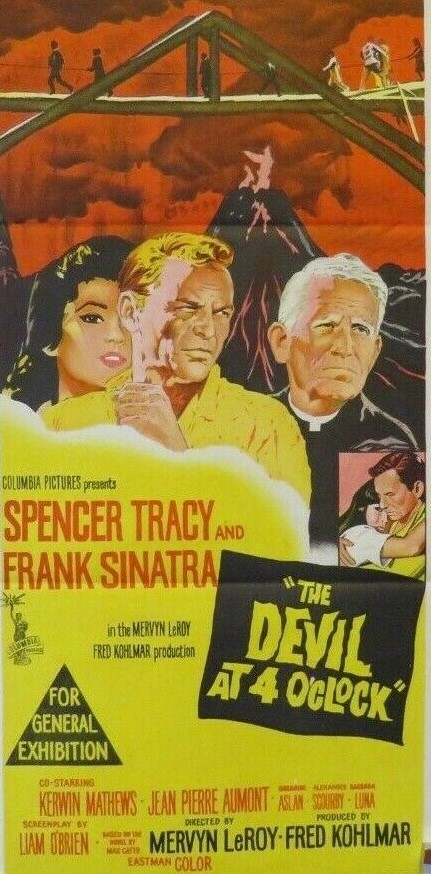
The Devil at 4 O’Clock (1961) ***

You took on Spencer Tracy (Judgment at Nuremberg, 1961) at your peril. Not even the best efforts of a volcano can wrest the screen from him. And certainly Frank Sinatra (The Detective, 1968) is put in the shade. And if you wanted to work with Tracy you had to cede, no matter how high-flying your career might be, top billing. Both names are above the title and if they were actually equally ranked they would appear in alphabetical order. And it wasn’t until a later disaster picture, The Towering Inferno (1974), that someone solved the tricky problem of designating equal billing by having Paul Newman’s name first on the left of the poster, but Steve McQueen’s name higher on the right.

Anyway, theoretically, nobody should be bothering much who is in a disaster picture when, again theoretically, the audience has come to gawk at the special effects – exceptional for the time but looking tame now. But Hollywood had learned from experience – and the same rules would apply in the disaster boom of the 1970s – that there was no point spending all that money on effects if there was not enough interest in the characters leading up to the disaster element, and also learned you needed stars to attract audiences in the first place.

In the tradition of…previous Columbia hits. Contractual billing agreements referred to the placing of names not faces on the poster , so Columbia could stick Sinatra in the center and
there was nothing Tracy could do about it.

So this scenario has old whisky priest Fr Doonan (Spencer Tracy) getting ready to leave a Pacific island, replaced by the younger Fr Perrau (Kerwin Matthews), while three convicts, led by Harry (Frank Sinatra), on the way to long prison stretches elsewhere make an unexpected pit stop. The rule is that Fr Doonan can make use of any prison labor so he hives them up the mountain to fix the hospital housing lepers that the authorities wish to keep a secret in case it scares off the tourists. Naturally, it’s not long before Harry is making a romantic pitch for  blind nurse (Barbara Luna) but that takes second place to hatching an escape plan.

Running away is only foiled when the volcano begins erupting and as the island authorities begin the evacuation it’s up to the priest and the convicts – Harry’s romantic instinct overcoming reluctance – to fetch the kids in the leper colony. Fr Doonan could have come straight from Boys Town (1938), the kind of two-fisted man of the cloth who tells it like it is, has no compunction about upsetting anyone who gets in his way, but with right on his side generally wins the day. The Governor (Alexander Scourby) isn’t viewed as a bad guy so much by refusing to acknowledge the lepers – especially as by that time the disease was not contagious, priest and hospital workers haven’t caught it, though begging the question why  young kids still did –  as by allowing brutal treatment of the prisoners, sticking three overnight in suffocating heat in a hole in the ground intended for one.

Narrative edge is added by the obstracizing of the lepers – at the time people contracting various illnesses would be treated as lepers and anyone with a serious mental condition stuck away out of sight. But the characters don’t occupy the moral twilight of the later disaster pictures, where the unscrupulous were often offered redemption. Here, the best we’ve got is a rehabilitated sex worker acting as hospital matron and the convicts agreeing to help out.

Kind of suffers from not enough scenes between the priest and Harry, they almost occupy separate narrative threads, but then Frank Sinatra’s got enough on his plate to avoid looking creepy when making advances on a woman who can’t see him. In fact, there’s a serious scene-stealer, another convict Marcel (Gregoire Aslan), getting in the way, his jovial devil-may-care attitude lifting the gloom.

As ever, the main audience concern is who lives and who dies and here the makers throw a curveball and you could interpret the ending as both triumphant and downbeat. The special effects are still pretty good – sensational for the time if truth be told – especially for the pre-CGI era, but the earthquake aspects come in ahead of the rolling lava, which no matter which way you cut it always resembles slow thick soup, although the explosion, done for real using tons of TNT, makes a mark. Technically, the makers pull a fast one in ignoring the tidal wave that follows an eruption, thus allowing most of the islanders to escape by sea.

It being the jungle there’s always a tricky bridge to navigate – Indiana Jones encountered a similar trope decades later – but there’s no snakes or big beasts to cause a narrative diversion. Whatever it is about Spencer Tracy’s screen presence that allows him to inhabit characters with such ease he brings in spades to the priest. Sinatra looks as though he’s learning a thing or two because his Harry bears some similarities in the the down-at-heel unkempt appearance and the lack of scene stealing.

In case you’re wondering, the “four o’clock” of the title is a deadline but appears too late in the picture to create the required tension. Hollywood veteran Mervyn LeRoy (Moment to Moment, 1966) is at helm. Screenplay by Liam O’Brian (The Great Imposter, 1960), in his last movie, from the bestseller by Max Catto (Seven Thieves, 1960).

Worth it for Tracy and Sinatra and Aslan and to see how they managed sfx in ye olden days.

The Big Day (1960) ****

Marvellous little drama.  Succession the old-fashioned way when promotion was determined by interview, the process not clogged up by internecine family warfare. Doesn’t, either, go for the easy target of the English class system, instead exploring the universality of office politics, the quite different attitudes taken by individuals to superiors and inferiors, the determination to find someone who is not your equal, and the ways of dodging responsibility or simply indulging in dodgy behaviour.

It’s lit up by four superb performances, Donald Pleasance (Soldier Blue, 1970) as the dull accountant, Colin Gordon (Subterfuge, 1968) – usually a comedy foil – as the Machiavellian boss, Harry H. Corbett (pre-Steptoe and Son) as a weaselling manager and Andree Melly (The Brides of Dracula, 1960) as a secretary skirting scandal. The narrative is simple. Prior to the interview we dip into the lives of the three candidates – Victor (Donald Pleasance), high-flying sales manager Selkirk (William Franklyn) and transport manager Harry (Harry H. Corbett) who happens to be the brother-in-law of George (Colin Gordon) the boss.

Donald Pleasance and Andree Melly let fly when the jig is up.

Each has a deficiency, Selkirk inclined to show too much initiative, Harry running his department by the seat of his pants, Victor with no initiative whatsoever, a plodder. Each is caught out in an error of judgement, Selkirk striking a deal with a dodgy customer, Harry operating a driver logbook scam, Victor having an affair with his secretary Nina (Andree Melly). And a most unlikely relationship that is, the young self-possessed girl madly in love with a middle-aged man riddled with self-doubt.

When she first appears, in frankly one of the most erotic scenes capable of passing the British censor at the time, I had assumed this was a financial arrangement. That Victor would be reaching into his pocket. It’s only later we discover she’s his secretary and nourishes no ambitions for him to climb the corporate ladder, just believing that at a suitable juncture he will jettison wife and children. Mostly, what they all have to lose is pride. Hen-pecked Harry terrified of reporting failure to his domineering wife, Selkirk already planning how to spend the expected salary increase, Victor desperate to justify his existence by having his name on the letterhead.

Everyone has ideas above their station; everyone gets put in their place. Even the backroom staff jockey for position, Selkirk’s secretary Madge (Marianne Stone) tearing into Nina for her loose morals, in return being hit by bitchy comments about her spinsterhood. Both make a point of wishing the other’s boss “good luck” on the day of the interview in case they win. Madge often refuses to carry out work she considers too menial and seems always on the point of resigning over a minor issue. There is envy over the size of one’s office.

The two secretaries previously at war bond over male inhumanity. Madge (left) comments that two people should bear the consequences of an affair not one.

The best elements of the script are how plans go awry, how conversations turn as new information enters the equation and especially how the boss uses any opportunity to destabilize his staff, pitting them against each other, turning triumph into disaster, deftly fending off any threat to his position. George employs a wonderful phrase, “I’ve called you in to tell you why you’ve NOT got the job,” softening the blow by a small salary increase.

And it’s indicative of failings in his personality that he hands the job to the person least likely to challenge his authority – Victor – and that the promotion comes with the rider that the accountant get rid of Nina. And, suddenly, Victor comes into his own, the mouse roaring like a lion, although triumph is temporary. The last scene one of the saddest committed to celluloid, Victor alone, huge pile of work to get through and no solace anywhere.

It’s short, too, would have been intended as a “quota quickie,” release guaranteed by the Eady system, and should really have been lost in the slush pile. Instead, without any of the brutality of Succession, dissects the office mind-set. Donald Pleasance is the standout, but Colin Gordon and Andree Melly run him close. Support from Susan Shaw (Carry On Nurse, 1960) and Roddy McMillan (The View from Daniel Pike series, 1971-1973).

Director Peter Graham Scott (Father Came Too!, 1964) keeps his foot on the narrative pedal, focus never wavering, brooking no diversions. Bill MacIlwraith (The Anniversary, 1968) delivers a tight script bristling with terrific lines. given it only cost £22,300 (about $70,000) it’s quite astonishing.

NOTE: In the absence of a poster, the main photo is by Allan Warren.

Discover WordPress

A daily selection of the best content published on WordPress, collected for you by humans who love to read.

The Atavist Magazine

by Brian Hannan

WordPress.com News

The latest news on WordPress.com and the WordPress community.