I am a published author of books about film - over a dozen to my name, the latest being "When Women Ruled Hollywood." As the title of the blog suggests, this is a site devoted to movies of the 1960s but since I go to the movies twice a week - an old-fashioned double-bill of my own choosing - I might occasionally slip in a review of a contemporary picture.
It was a rite of passage for rising male stars to take second- or third-billing to an established top-billed female. And, more importantly, rein in all attempts at scene-stealing. This is a Cliff Robertson minus the distinctive hunk of hair and lip-chewing of later performances and a David Janssen only beginning to learn the knack of talking out of the side of his mouth. They were probably kicking themselves for the indignity of ending up in such as harmless concoction, but the idea was, if it was a hit, it’d be a leg up the career ladder.
This frivolity, by the way, is probably offensive to a contemporary audience since the thrust of the story is an actress abandoning a successful Broadway career in favor of motherhood. On the other hand it is the very definition of comfort movie.
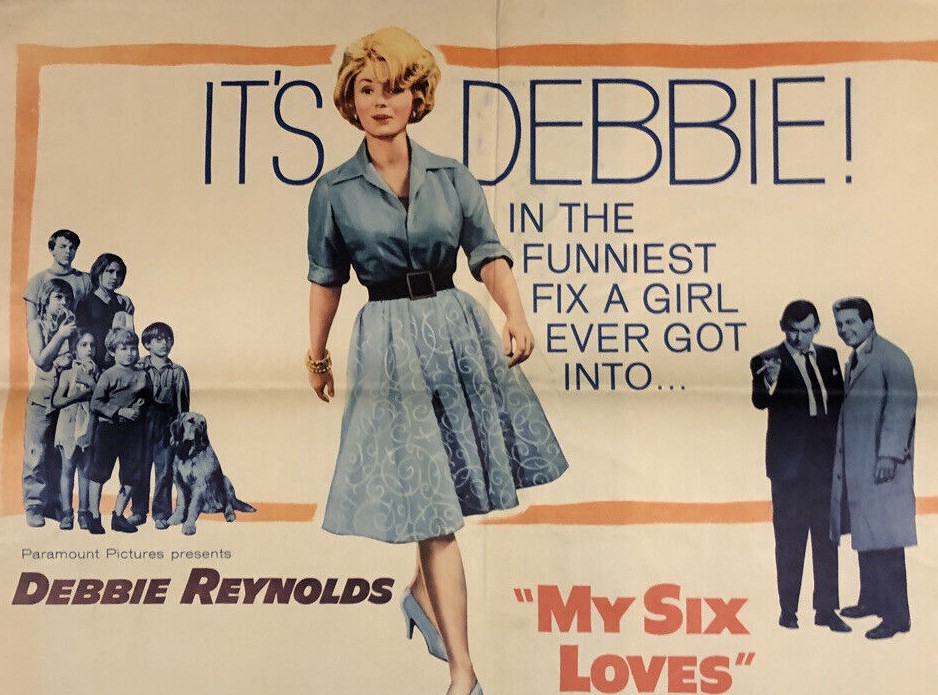
Janice (Debbie Reynolds), in love with her aggressive and somewhat conniving producer Marty Bliss (David Janssen), collapses at a publicity junket and convalesces at her second home in Connecticut, so far removed from the center of theatrical civilization that she never visits and in consequence the property has been taken over, for their own enjoyment, by her housekeeper and her daughter, who now object to spending a moment catering for their employers. In the grounds lurk a brood, half a dozen orphans taking refuge from their exploitative foster parents.
It doesn’t take long for Janice to sucker herself into taking them into her house, assistant Ethel (Eileen Eckhart) as clueless. On hand offering advice is local minister Jim (Cliff Robertson). If the kids are a handful, refusing to be separated which entails them all sleeping in the same room, they’ve got nothing on their boisterous hound Butch.
We’re past the halfway mark before it occurs to Janice that she is treading dangerous emotional waters and she jumps at the chance to star in a heavyweight drama by current Broadway playwright kingpin. Meanwhile, smelling a hefty payoff, drunken foster parents Doreen (Mary McCarty) and BJ Smith (Max Showalter) turns up, Jim takes an unrequited romantic interest in his neighbor, Janice discovers her community spirit by helping raise money for charity, one of the kids runs away from hospital, and another has trust issues, leaving the other four with little to do but look cute.
Somehow within all this there’s a cue for a song, “It’s a Darn Good Thing” before Janice has to take the decision to sink or swim with the kids or hi-tail it back to Broadway where the prospect of a Tony beckons.
You’ve probably seen this all before, but somehow – taking the career issue out of the equation – it all works, an overactive ice machine, racing in and out of the school bus, meal-time complications, and wouldn’t you believe it a slice of love. No prizes for guessing the ending.
But it’s testament to Debbie Reynolds (How the West Was Won, 1962) that the movie has an appealing center. Cute kids are ten a penny in Hollywood but an actress able to make believable such an old-fashioned family-friendly tale is hard to come by. Sure, by today’s standards it’s outdated, but if we can just slip on a retrospective hat, she would not be the first career-minded woman of that decade to find she had ignored her maternal instinct. It might have been better all round if she had found a way to have both career and motherhood but the planet and certainly not Planet Hollywood was not yet on that wavelength.
Of course, it being lightweight ensures none of the other characters have any depth and to their credit neither Cliff Robertson (Masquerade, 1965) nor David Janssen ((Warning Shot, 1967) resorts to showboating, a smart decision because with the charismatic Reynolds taking center stage they could hardly compete. And I have to confess I quite like this early version of Robertson before he was overtaken by a need for weightier roles. He showed a neat comedic touch, had some of the best lines, and proved no slouch in the verbal sparring department. Janssen, too, showed a lot of promise.
Max Showalter (How to Murder Your Wife, 1965) had such a convincing drawl that I was convinced I was watching Strother Martin (Cool Hand Luke, 1967). A good opportunity also to check out distinctive character actors Eileen Eckhart (No Way To Treat a Lady, 1968) and John McGivern (Midnight Cowboy, 1969)
You can hardly blame famed Broadway director Gower Champion (The Bank Shot, 1974), only too aware of the pressures of maintaining a stage career, for thinking that a life in Connecticut with a bunch of eventually pliant and cute kids would be a welcome alternative. It took three screenwriters to spin this tale – John Fante (Maya, 1966), William Wood (The Lively Set, 1964) and Joseph Calvelli (Death of a Gunfighter, 1969).
Bearing in the mind the aforementioned provisos, not a bad Sunday matinee. Alternatively, come at it from today’s perspective and you will be inclined to rip it to shreds before you give it a chance to be entertaining. You might even consider it a tad more adventurous in its more realistic approach than other multiple-kid pictures like Cheaper than the Dozen (1950) and Yours, Mine and Ours (1968).
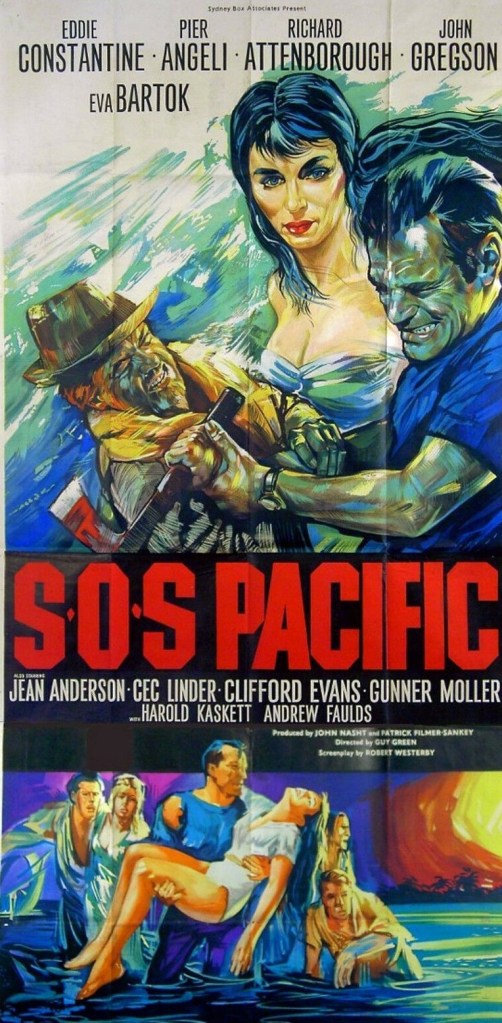
There’s a whole book to be written about poster deception. But this plays with audience expectation in an unusual manner. Here it’s a case of duping by billing. The top-billed Richard Attenborough (Only When I Larf, 1968) disappears in the last third, John Gregson (The Frightened City, 1961) spends most of the time out of it and the bulk of the heavy lifting is done by fifth-billed Eddie Constantine (The Great Chase, 1968).
That’s no bad thing because Constantine, self-deprecating tough guy in the Lee Marvin mold, does pretty well in this survival picture, airplane crashing in the Pacific, a motley bunch stranded on an island. And with the bonus of Attenborough and Gregson, typically of the English stiff-upper-lip persuasion, playing against type.
Alcoholic Jack (John Gregson), piloting a seaplane on its last legs, is ferrying wanted smuggler Mark (Eddie Constantine), handcuffed to cop Petersen (Clifford Evans), along with shifty witness Whitey (Richard Attenborough), stewardess Teresa (Pier Angela), physicist Krauss (Gunnar Moller), sparky spinster Miss Shaw (Jean Anderson) and the “loaded with sin” Maria (Eva Bartok).
When Mark attempts to put out an electrical fire on board he accidentally kills co-pilot Willy (Cec Linder) and with Jack out cold the plane heads for the drink. Luckily, there’s a deserted island nearby. Unluckily, it’s next door to a nuclear test site.
Meanwhile, Mark, emerging as the hero, is soon fighting off the attentions of Maria and Teresa, Jack’s girlfriend. Whitey, who pointed the finger at Jack and not wanting to be stranded on the same island as him, steals the cop’s gun, puts a hole in one of the two dinghies and sets off to sea on the other. On discovering lead-lined housing, Krauss is able to work out the nuclear issue. With barely five hours to detonation, Mark elects to swim two miles in shark-infested water to the tiny island housing the nuclear device, armed only with a few rudimentary tools.
There’s a surprise waiting for him of course. Should he succeed in his enterprise, there’s reward too because Jack, in best Scott of the Antarctic form, has sacrificed himself to the sharks to give Mark a chance.
There’s some good stuff here, namely seeing Attenborough as a snivelling spiv complete with dangling cigarette, and Gregson as a self-pitying drunk, killing his career one bottle at a time, an airsick cop, the doughty Miss Shaw still fancying herself as a femme fatale, some well-scripted dialog between bad guy Mark and bad girl Maria, and a host of twists.
Contemporary audiences will feel let down by the ending. If only it was as easy to prevent nuclear catastrophe. But on the other hand it is one of the first films to take the issue of the atom bomb seriously, Jack’s self-destruction the result of witnessing at first hand the devastation of Hiroshima.
Yank Eddie Constantine, hightailing it to France to improve his career prospects in the 1950s, and becoming a B-movie star, was still largely an unknown quantity. He had top-billed in French and German pictures and was the male lead to Diana Dors in Room 43 (1958). This should have kick-started a Hollywood career or at least a British one.
A potential inheritor of the Humphrey Bogart mantle, the tough guy with a soft centre, snappy with the one-liners, in this outing willing to go with the flow, confident he will end up back on his feet, if not at least enough appeal to have dames falling at his feet. But, probably, he would have had to work his way up again, which might be a slow business, whereas in France scripts were being written to suit his screen persona. If you’re interested check out his turn as Lemmy Caution in Your Turn, Darling (1963) and his outings as secret agent Jeff Gordon and private eye Nick Carter.
Eddie Constantine played by far the most interesting character here, and except for Jean Anderson (Solomon and Sheba, 1959) the women were underwritten, Pier Angeli (Battle of the Bulge, 1965) and Eva Bartok (Blood and Black Lace, 1964) there mainly to polish the hero’s ego.
Robert Westerby (Dr Syn, Alias the Scarecrow, 1963), television writer Gilbert Thomas and Bryan Forbes (Station Six Sahara, 1963) had varying hands in the screenplay.
Director Guy Green (The Magus, 1968) does a good job of marshalling his box of tricks, keeping tensions – whether romantic, criminal or survivalist – high especially as he had to find a way round the unexpected climax, and once you accept that neither Attenborough nor Gregson are going to leap to the rescue quite easy to get on the Eddie Constantine wavelength. Not in the class of The Flight of the Phoenix (1965) or Sands of the Kalahari (1965), and lacking their character complexities, but not far off.
Rejoice: a star is born. But it’s not Florence Pugh (Black Widow, 2021). It’s my habit going to the cinema to sit close to the screen in order to avoid the audience. This time I couldn’t help but noticing the streams of young women, often in large groups taking up an entire row. Out of curiosity, I chatted to quite a few at the end, imagining they might be turning up to support director Olivia Wilde’s new picture. Nope, they were here to see Harry Styles (Dunkirk, 2017). That’s what you call star power.
And he certainly has something. A screen charisma, an electricity, and without going too overboard, something akin to the danger of an early Michael Caine or Sean Connery, other British exports. When he was in a scene, it was easy to forget Florence Pugh. You knew what she’d be doing, emoting like crazy, but he was unpredictable, exactly what the camera adores.
Anyway, what we have here is a throwback, a slow-burn paranoia thriller in The Stepford Wives utopia vein with a dystopian twist. But the ending is a let-down, the kind of baffling logic Christopher Nolan often gets away with, and a rather worn trope of male supremacy.
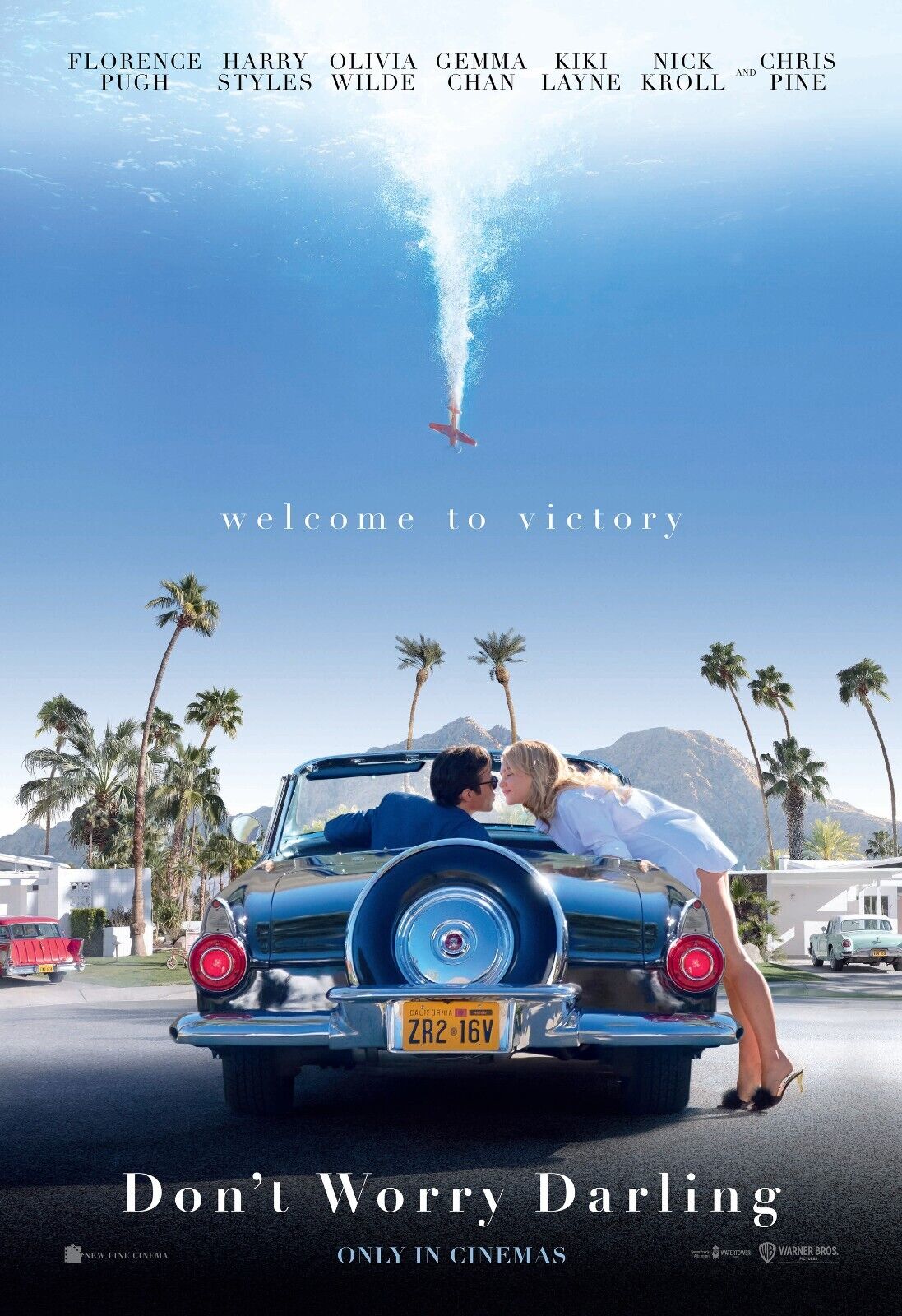
Happily married couple, still going at sex like rabbits, Alice (Florence Pugh) and Jack (Harry Styles) live in a stylized isolated 1950s community where husbands depart for work every morning and wives stay home to do the housework or endlessly shop and gossip. Every need, basic or more luxurious, is taken care of. The men are employed by the mysterious Victory Project, run by the charismatic and fun-loving Frank (Chris Pine), and beyond their housing estate is a forbidden zone.
But strange images keep zapping into Alice’s head. Eggs crumble into nothing and wrapping Saran Wrap/clingfilm round her mouth is not an acceptable lifestyle choice and when the suicide of neighbor Margaret (Kiki Layne) is denied, and she sees a plane crash into the hills, she decides to investigate. Exactly what she discovers we are never told, but her behavior becomes more paranoid, and men in red overalls are likely to scamper out of the woodwork at the hint of any threat along with a bogus psychiatrist only too keen to prescribe pills.
And although it turns out Jack is willing to try his hand at cooking, Alice is jeopardizing their relationship and without the cunning to outwit the devious Frank.
From the outset you were waiting for this fantasy to unravel, although Alice was a shade too overcooked too quickly, and there was no explanation for some of her terrors, being trapped by a sheet of glass for example, and the ending will far from satisfy. But I found the movie suspenseful overall, enough doubt sown to seed the growing tension, the characters by and large well-drawn, otherwise confident men kept insecure by jostling for recognition from boss Frank, and the playfulness occasionally teetering into the acceptably hedonistic.
However, once Alice got the bit between her teeth, there was too much teeth, flaring nostrils and general over-acting. The cooler Frank achieved more with very little.
Generally, though, quite enjoyable, although if director Olivia Wilde (Booksmart, 2019) intended making wider feminist comment, it’s too facile by far. The something that doesn’t add up emanates from the storyline for otherwise the picture is pretty well done, including a car chase and the sinuously sneaky Frank controlling and destroying lives.
As I said, I felt Florence Pugh was too over-heated but she was also let down by a screenplay by Katie Silberman (Booksmart) that failed to come up with any real answers. Harry Styles stole every scene he was in and Chris Pine (Wonder Woman, 2017), playing against heroic type, was excellent. Although there has been criticism of Styles’ performance, bear in mind that screen stardom has been built on less and it would give the industry a shot in the arm if a new star came out of nowhere. The women I encountered in the audience would certainly agree with giving him a bigger role.
From opening week box office, this looks as if it will do well enough to sustain Olivia Wilde’s career, as here her confident direction and visual skill proves she can handle a bigger budget.
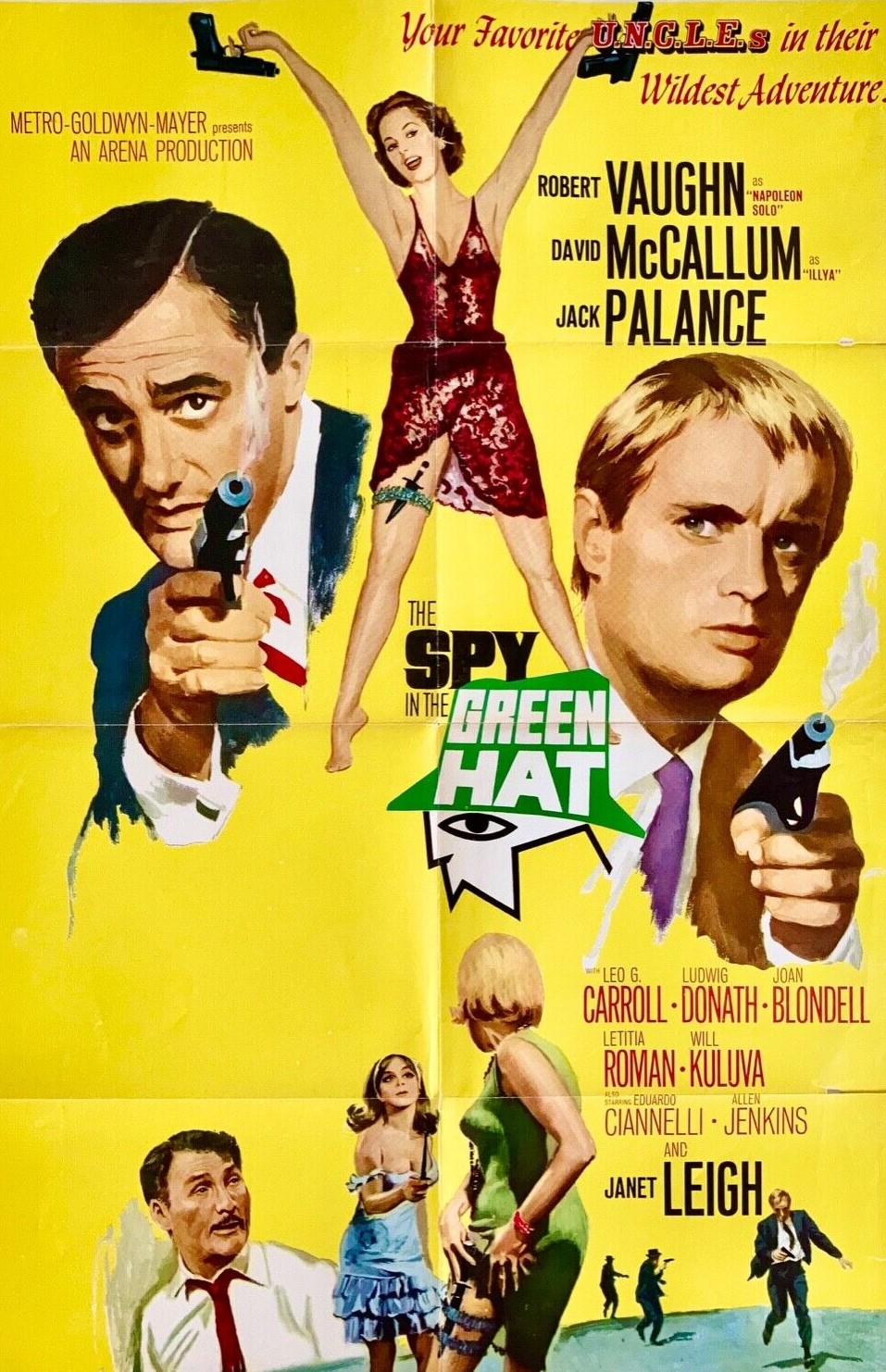
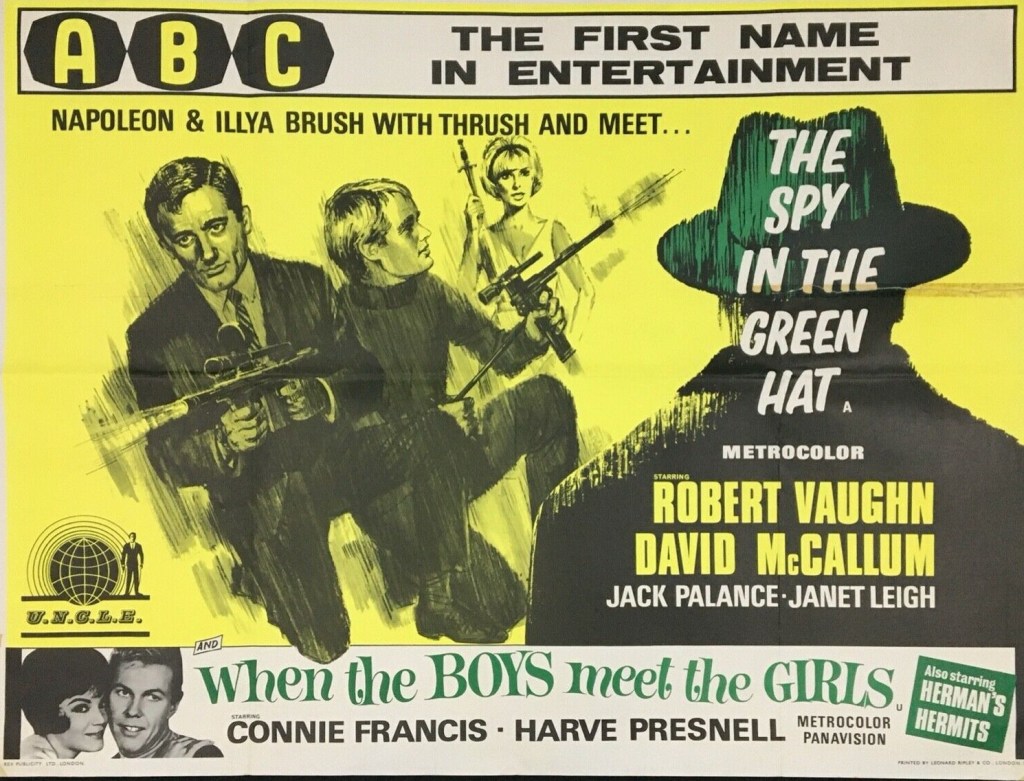
Unable to compete with the influx of big budget espionage pictures, The Man from U.N.C.L.E. throws in the action towel and comes out fighting as a comedy, and a more preposterous storyline you would be hard to find. As if spoofing a genre it helped create, our intrepid heroes find themselves in captivity one way or another, outwitted by a posse of retired Mafia hoods or sadistic females.
Napoleon Solo (Robert Vaughn) and Ilya Kuryakin (David McCallum) can’t even manage a chase, crashing the car in pursuit of former Nazi scientist Dr Von Kronen (Ludwig Donath). The trail leads to Sicily where Solo, again incapacitated, meets the sultry Pia (Leticia Roman) and as a result of a romantic misunderstanding is forced into a shotgun wedding in Chicago by her Mafia uncles, the famed Stilletto Brothers.
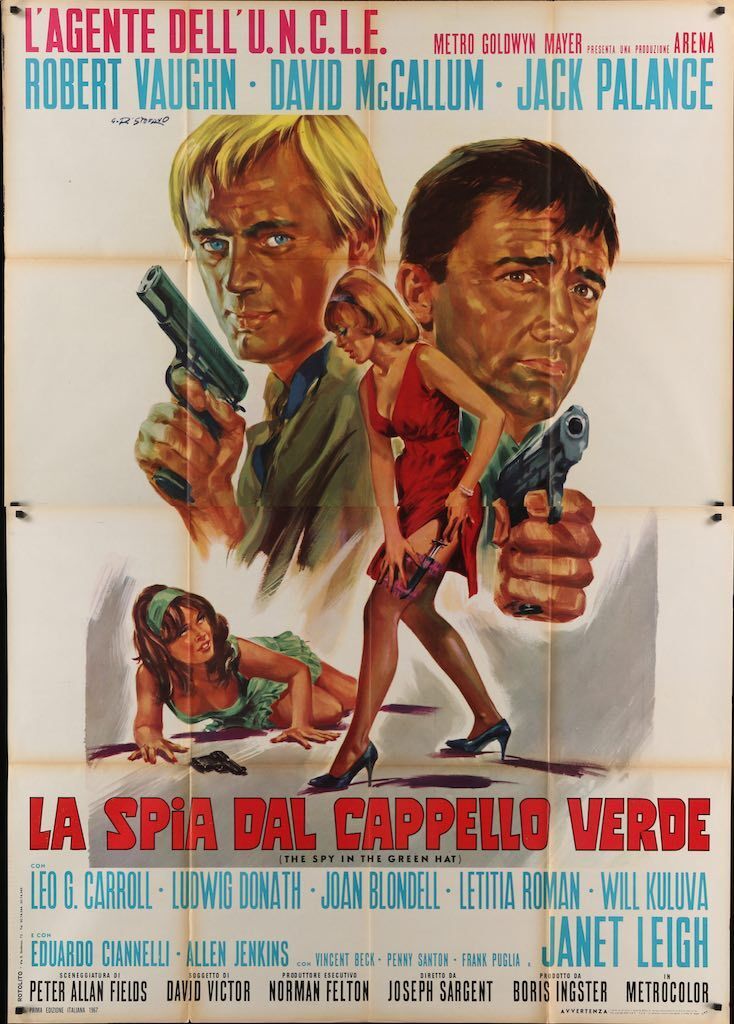
Meanwhile, Kuryakin makes the acquaintance of the deliciously sadistic Miss Diketon (Janet Leigh), assistant and masseuse to highly nervous Thrush boss Louis Strago (Jack Palance). The action finally shifts to the Gulf Stream, where Pia is imprisoned and the usual missiles are set to be launched in the presence of head Thrush honcho Mr Thaler (Will Kuluva) in the usual global takeover scenario.
Abandoning any attempt at serious drama, this is just a hoot, a score of sight and visual gags, references to Little Caesar and the St Valentine’s Day Massacre abound. Any time one of our heroes needs speedy access to a villain hideout along comes a guard to be bumped off and uniform purloined. Solo caught hiding under Pia’s bed is let off when discovered by a Thrush operative because he’s not the Uncle agent they are looking for. Not only is Solo constantly whacked over the head, but Kuryakin ends up as the plaything of Miss Diketon.
Solo and Kuryakin look as if they stepped onto someone else’s parade, trying to keep the narrative on an even keel, while the Mafia gang and Thrush personnel effectively play it for laughs. Pia has Wanted posters of her uncles on her wall on the assumption they are just wonderful guys. Von Kronen gets the hots for Miss Diketon because he admires her skill at torture, although a spurned Miss Diketon turns traitor leading Kuryakin to mutter to Solo when all three meet, “I brought Lucrezia Borgia, you brought the Mafia.”
What makes it work so well are the fabulous performances of the supporting cast. Jack Palance (The Professionals, 1966), completely playing against type, still a villain sure, is a masochistic sweaty bag of nerves. Janet Leigh (Psycho, 1960) camps it up as the deadlier-than-the-male luscious female, dress slit at the thigh to reveal a hidden knife, whose pulse races at the mere thought of the cruelty she can inflict and the slower the better. Will Kuluva (To Trap a Spy, 1964) is a bonus, the boss who just wants to party and has no idea of the technicalities of firing a missile.
Nobody even bothers to dress it up any more. The missiles look like something you would buy your kid for Xmas, the backdrops are as fake as anything on a backlot. But somehow it all works, as long as you weren’t expecting the original take on The Man from Uncle. And even so, director Joseph Sargent (One Spy Too Many, 1966) adds a few dabs of genuine cinematic icing, characters viewed from the ground-up, a fist fight that’s either in slo-mo or speeded-up freeze frame, the wife (Joan Blondell) of one of the Stiletto Brothers receiving a grapefruit in the mush.
After watching the original movie which came up better than expected in terms of action and spy malarkey, the last thing I anticipated that this would be headed in an entirely different direction. When that quickly became obvious, I feared the worst. Instead, I enjoyed a fun 90 minutes.
Of course, this wasn’t released theatrically in the U.S. just abroad with some added sex and violence, an expanded version, and in color, of a double black-and-white episode of the television series.
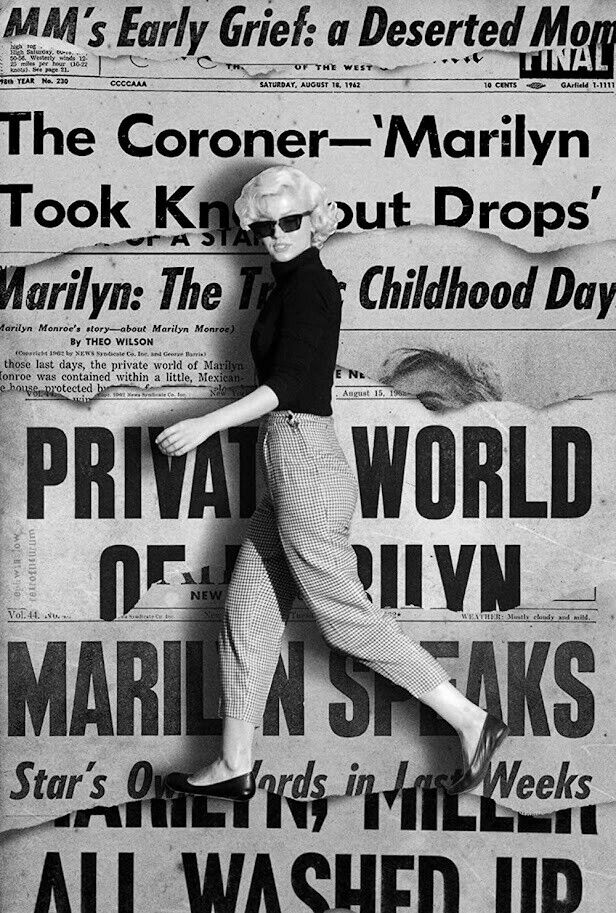
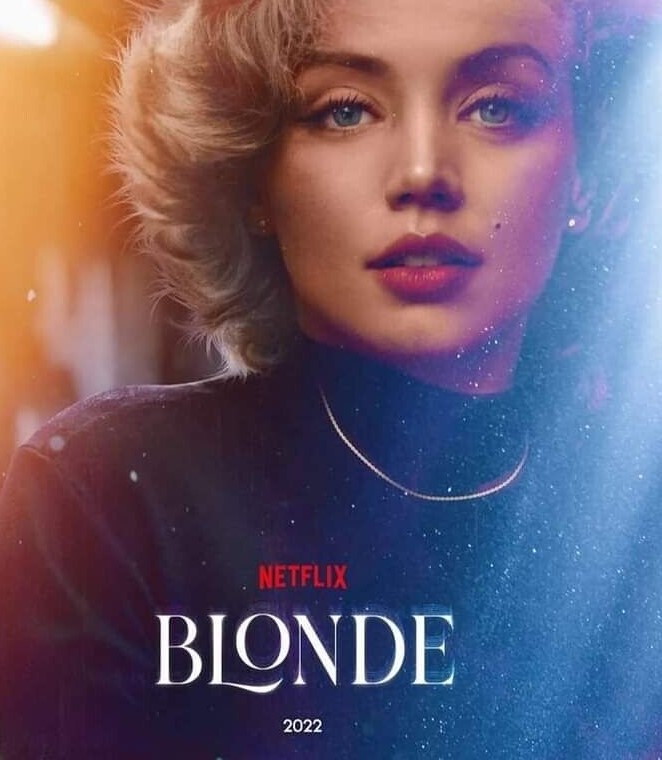
Stream of consciousness reimagining of Marilyn Monroe’s life mainlining on celebrity, identity, mental illness and vulnerability and held together by a mesmerizing performance by Ana de Armas. Director Andrew Dominik’s slicing and dicing of screen shape, occasional dips into black-and-white and a special effects foetus won’t work at all as well on the small screen. Monroe’s insistence on calling husbands “daddy” and letters from a never-seen potential father that turns into a cruel sucker punch, threaten to tip the picture into an over-obvious direction.
A very selective narrative based on a work of fiction by novelist Joyce Carol Oates leaves you wondering how much of it is true, and also how much worse was the stuff left out. As you might expect, the power mongers (Hollywood especially) don’t come out of it well, and her story is bookended by abuse, rape as an ingenue by a movie mogul and being dragged “like a piece of meat” along White House corridors to be abused by the President.
A mentally ill mother who tries to drown her in the bath and later disowns sets up a lifetime of instability. Eliminated entirely is her first husband, but the scenes with second husband (Bobby Canavale) and especially the third (Adrien Brody) are touchingly done, Marilyn’s desire for an ordinary home life at odds with her lack of domesticity, and each relationship begins with a spark that soon fades as she grapples with a personality heading out of control.
That she can’t come to grips with “Marilyn,” perceived almost as an alien construct, a larger-than-life screen personality that bewitches men, is central to the celebrity dichotomy, how to set aside the identity on which you rely for a living. It’s hardly a new idea, but celebrity has its most celebrated victim in Monroe.
According to this scenario, she enjoyed a threesome with Charlie Chaplin Jr (Xavier Samuel) and Edward G. Robinson Jr. (Evan Williams) but otherwise her sexuality, except as it radiated on screen, was muted. The only real problem with Dominik’s take on her life that there is no clear indication of when her life began to spiral out of control beyond the repetition of the same problems. She remains a little girl lost most of the time.
I had no problems with the length (164 minutes) or with the selectivity. Several scenes were cinematically electrifying – her mother driving through a raging inferno – or emotionally heart-breaking (being dumped at the orphanage) and despite the constant emotional turbulence it never felt like too heavy a ride. But you wished for more occasions when she just stood up for herself as when arguing for a bigger salary for Gentlemen Prefer Blondes.
I wondered too if the NC-17 controversy was a publicity ploy because the rape scene is nothing like as brutal as, for example, The Straw Dogs (1971) or Irreversible (2002), and the nudity is not particular abundant nor often sexual. That’s not to say there is much tasteful about the picture, and you couldn’t help but flinch at the rawness of her emotions, her inability to find any peace, the constant gnaw of insecurity, and her abuse by men in power.
Ana de Armas (No Time to Die, 2021) is quite superb. I can’t offer any opinion on how well she captured the actress’s intonations or personality, but her depiction of a woman falling apart and her various stabs at holding herself together is immense. The early scenes by Adrien Brody (See How They Run, 2022) as the playwright smitten by her understanding of his characters are exceptional as is the work of Julianne Nicholson (I, Tonya, 2017) as her demented mother. Worth a mention too are the sexually adventurous entitled self-aware bad boys Xavier Samuel (Elvis, 2022) and Evan Williams (Escape Room, 2017).
While there are no great individual revelations, what we’ve not witnessed before is the depth of her emotional tumult. Apart from an occasional piece of self-indulgence, Andrew Dominik, whose career has been spotty to say the least, delivers a completely absorbing with an actress in the form of her life. Try and catch this on the big screen, as I suspect its power will diminish on a small screen.
Easy Rider, more acceptable artistically, stole Night of the Living Dead’s thunder the following year as the poster boy for a low-budget phenomenon that would, temporarily at least, usher in a new way of Hollywood thinking. But Night of the Living Dead – initially entitled Monster Flick and Night of the Flesh-Eaters – was movie-making as fairy tale, virtually a throwback to the old trope of doughty characters putting on a show in a barn.
Using guerrilla production techniques, the movie took an astonishing six months to make starting July 1967. Bronx-born George A. Romero specialised in advertisements and industrial shorts through his Latent Image company before branching out in Pittsburgh with some work colleagues from Hardman Associates to form a movie production company Image Ten, the name indicative of the initial ten investors.
But don’t make the mistake of thinking Romero and his gang were movie neophytes out of their depth. Technically, they were pretty accomplished, churning out adverts and shorts at a steady pace, the kind of education the likes of Ridley Scott and Adrian Lyne enjoyed on the London advertising scene. According to Variety, Hardman was “the largest producer of record and radio shows in Pittsburgh…(running) the most completely equipped sound and film studio in the area” while Latent Image was the city’s “biggest producer of video and industrial shorts.”
The principals of both companies proved instrumental to the movie. While Romero took on directing, cinematography and editing duties, the screenplay was down to business partner John A. Russo while another partner Russell Streiner took on the role of producer. Hardman provided actors Karl Hardman, a former RKO contract player, and Marilyn Eastman, who also supervised make-up, costumes and special effects, while Kyra Schon, the dying daughter in the film, was Hardman’s real-life daughter. The rest of the cast were unknowns, Duane Jones in the lead had at least some stage experience, female lead Judith O’Dea had worked with the producers before, while Judith Ridley was a receptionist for the production company. Romance blossomed between O’Dea and Streiner.
Romero’s debut was heavily influenced by Powell and Pressburger’s British bizarre fantasy The Tales of Hoffman (1951) but the final film clearly draws on Richard Matheson’s celebrated 1964 sci-fi novel The Last Man on Earth – filmed in 1971 as The Omega Man and in 2007 as I Am Legend. Where Matheson’s book begins at the end, Romero wanted to show the beginning of how the undead came to rule the world. Since Matheson had used vampires, Romero needed an alternative.
Explained Romero: “I couldn’t use vampires because he did, so I wanted something that would be an earth-shaking change. Something that was forever, something that was really at the heart of it. So I said, what if the dead stop staying dead?” That tapped into the attractive notion of living forever – until you realized what that entailed.
Contrary to expectation – and myth – it didn’t exactly stumble at the box office. A month after initial release its opening salvoes were advertised in “Box Office” magazine (November 25, 1968) accompanied by some of the better reviews harvested.
Shockerama pictures would be the easiest way to find a foothold on the distribution ladder. Initially devised as a horror comedy it took several drafts, the first couple involving aliens, before arriving at the concept of flesh-eating re-animated corpses.
Ben was originally envisaged as a blue collar truck driver and evolved into the more educated character as a result of rewriting by Duane Jones who objected to playing such a cliché. But improvisation was very much the order of the day. Recalled O’Dea: “I don’t know if there was an actual working script. We would go over what basically had to be done and then just did it the way we each felt it should be done.”
The initial investors ponied up $600 each but that proved insufficient as production developed, the company eventually raising $114,000. (The average cost of making a movie at that time was $1.6 million.) Budget dictated location be as remote as possible, the main locale a house scheduled for demolition. Chocolate syrup doubled as blood, human flesh was roasted ham and entrails supplied by one of the actors who was also a butcher. Clothing was anything the cast possessed that they didn’t mind being ripped. Color film was too expensive, and the resulting black-and-white footage has the effect of newsreel, almost a documentary rather than a work of fiction.
Although a myth has arisen that the movie struggled to find its way into the distribution food chain, that was not the case. Studios were desperate to find product and happy to hang their shingle on anything that could keep their clients, cinemas starved of movies, happy. Columbia and American International were both interested, but demanded a happy ending. When Romero stuck to his guns, the movie ended up with the Walter Reade organisation, a noted distributor of foreign and cult pictures, better suited to this kind of fare.
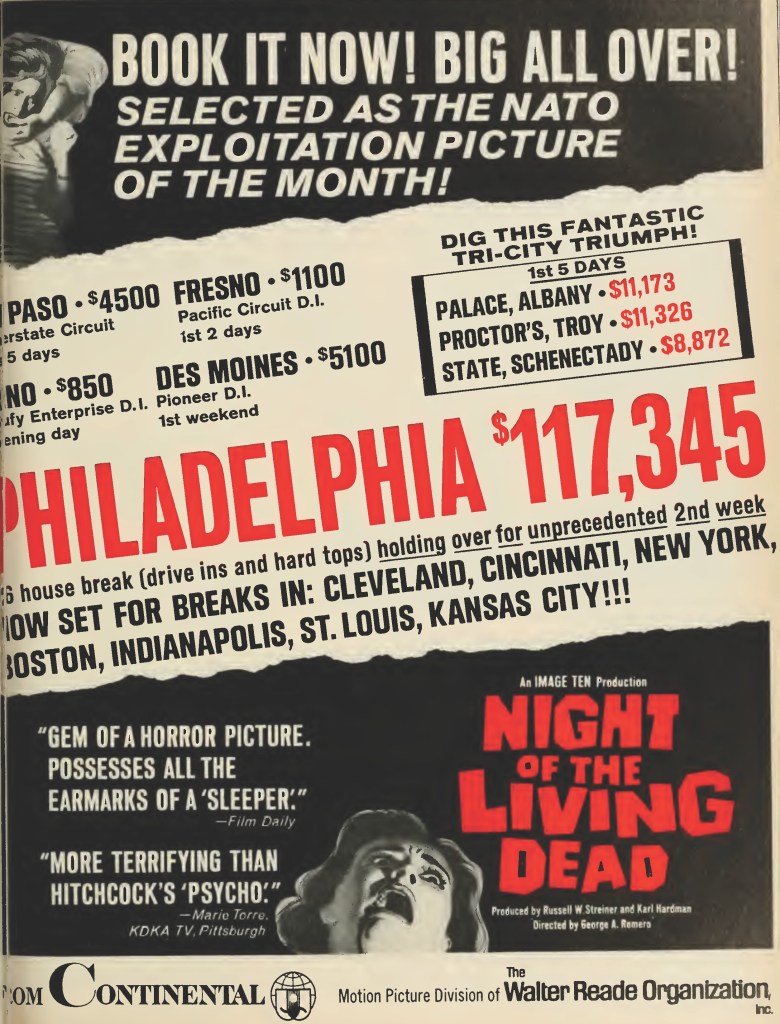
Nor was it sneaked out into cinemas as has been usually assumed. Given that by 1968 cinema managers owners were in part reliant on low-budget shockers, the National Association of Theater Owners instigated a nationwide “Exploitation Picture of the Month” campaign of which Night of the Living Dead was one of the early beneficiaries, as a result of its involvement scooping, for example, $117,000 from 26 houses in Philadelphia. and other pretty decent figures shown in the advertisement above.
Nor did it go out below-the-wire in Pittsburgh. A full-scale black-tie premiere was held on October 1, 1968, at the Reade-owned Fulton attended by Mayor Barr and the city’s safety director Norman Craig and various councillors. It rang a heavy box office bell, knocking up $62,000 – over $500,000 at today’s prices – for 11 theaters, outpointing Rosemary’s Baby (1968) which had played the same houses the week before. The distributor came up with a clever marketing ploy of taking out a $50,000 insurance policy with Lloyds of London against adverse audience reaction.
The film attracted controversy for going out un-rated. There was nothing unusual about that either. Only studios aligned with the MPAA Production Code had to submit their movies for the censor’s rating. Reade, which wasn’t involved in the Code, often imported movies from Europe and part of their attraction was that they were unrated, containing levels of nudity or violence that the official censor at the time would find impossible to pass. Lack of the vaunted Production Code Seal of Approval did not prevent a movie being shown, it just meant certain cinemas would not book it.
Chicago critic Roger Ebert made journalistic hay by complaining that kids were being allowed in to watch the movie. That he might be on hand to witness their shock at the images they saw seems hard to believe since critics usually viewed pictures in advance of opening at special screenings. In any case, in Chicago, Night of the Living Dead didn’t slip through the censorship net, but was passed by the local censorship board. His beef was with them, complaining that while the censors drew the line at nudity they had nothing against cannibalism. And it seems pretty odd that the management wasn’t aware of the film’s shocking content – presumably that being the reason it was booked in the first place – and permitted youngsters to troop in.
Although New York critics gave it the thumbs-down at least the New York Times (Vincent Canby no less), Post and Daily News took the trouble to see it, so it would at least benefit from editorial exposure. The trade press were mixed. While Variety railed that it “set a new low in box office opportunism,” its trade press competitor Box Office reckoned there was “an audience for this particular brand of sadism especially in drive-ins.”
Perhaps surprisingly given critical disapproval Night of the Living Dead enjoyed first-run outings in a variety of cities, though its main target was showcase (wide local release) and drive-ins. In Los Angeles it picked up a “hip” $10,500 at the 1,757-seat first-run Warren. (Multiply by ten to get an idea of how inflation would treat the gross and bear in mind this is pre-multiplex when cinema capacity could reach 5,000 and most city center emporiums seated 500-plus). In Boston it registered a “cool” $8,000 at the 1,250-seat Center. New York’s Broadway had to wait a year when the prestigious roadshow house the DeMille, in the week before it hosted 70mm extravaganza The Battle of Britain (1969), booked Slaves (1969)/Night of the Living Dead, grossing $21,000 in an eight-day fill-in run.
In its first New York showcase, when Night of the Living Dead was the main attraction with Dr Who and the Daleks in support, it scorched through $286,000 from 39 cinemas, the joint top result for the week. Returning a year later, as the support to Slaves put another $125,000 in the kitty from 26 plantations, again the top showcase performer for the week. Among notable wider releases were $14,300 from three in Dayton where it was “weekends at capacity in ozoners” (industry jargon for drive-ins). There was $10,000 from three houses in Minnesota.
Not being a contender for sale to television extended its screen life at a time when even big hits landed on small screens within a few years. As well as Slaves it was revived as the supporting feature to newer items Brotherhood of Satan (1971), Lust for a Vampire (1971) and The Nightcomers (1971). The teaming with Slaves racked up a “rousing” $82,000 in Detroit at the 5,000-seat Fox, and $55,000 the following week. The double bill with Brotherhood of Satan beat the previous week’s pairing of the reissued Butch Cassidy and the Sundance Kid/Mash. It formed part of an interesting triple bill at the 500-seat Plaza arthouse in Boston where it was teamed with Dutchman (1966) and Ulysses (1967).
But it was also building up a head of steam on the midnight screening circuit and began a record year’s run in that slot at the Plaza in Boston. Gradually, as it acquired more artistic credibility it turned up at prestigious New York 538-seat arthouse the Beekman with Invasion of the Body Snatchers in support (gross $5,000), ironically acting as trailer for a six-week programme of revivals based on “Ten Best” selections from critics which had avowedly spurned the movie. And it was chosen as the ideal companion for the once-banned Freaks (1932). Perhaps proof of the breakthrough into respectable cult territory, six years after initial release, was a New York showcase pairing with Pink Floyd: Live at Pompeii (1972), drumming up $63,500 from 29 bandstands.
By the end of December 1970, rentals (the amount the studio collects from cinemas as opposed to overall gross) stood at $1 million – which probably indicated a gross of around $3 million. It found a British distributor in Crispin and eventually rolled out successfully around the world with an estimated $18 million in global gross.
SOURCES: John Russo, The Complete Night of the Living Dead Filmbook (Imagine, 1985), p6,7, 31, 61, 70; Joe Kane, Night of the Living Dead (Citadel Press, 2010) p23; Jason Paul Collum, Attack of the Killer B’s (McFarland, 2004) p3; Roger Ebert, Chicago Sun-Times, January 5, 1969; Brian Hannan, In Theaters Everywhere, A History of the Hollywood Wide Release, 1913-2017 (McFarland 2019), p161; “Pittsburgh Premiere Held for Walter Reade Thriller,” Box Office, October 8,1968, p8; “Pittsburgh’s Hometown Horror to Reade: Surprise Boff BO,” Variety, October 9, 1968, p17; “Review,” Variety, October 16, 1968, p6; “Big Success Claimed for Image Ten Film,” Box Office, October 21, 1968, pE1; Advert, Box Office, November 25, 1968, p7; “N.Y. Critics: A Shooting Gallery,” Variety, December 11, 1968, p19; “Sun-Times Wants Chicago ‘Absurd’ Censorship Brought to Halt,” Box Office, March 14, 1969, p10; “Pittsburgh’s Latent Image Make 2nd Film,” Variety, December 3, 1969, p4; “Pittsburgh’s Cannibal Film Big Box Office,” Variety, April 8, 1970, p13; Advertisement, Kine Weekly, June 16, 1970, p61; “Big Rental Films of 1970,” Variety, January 6, 1971, p11; “Year of Friday Midnight Showings,” Variety, August 16, 1972, p6.
Box Office Figures from Variety: December 4, 1968, p13; December 11, 1968, p10-p11; December 18, 1968, p8-p13; July 9, 1969, p8; March 4, 1970, p12; October 13, 1971, p8-p12; October 20, 1969, p9; October 27, 1971, p16; Mar 17, 1972, p10; April 12, 1972, p10; May 12, 1971, p8; July 19, 1972, p12; August 9, 1972, p8; September 25, 1974, p8.
Ground-breaking thriller in the apocalyptic vein that appeared destined for oblivion after being judged too over-the-top by the AIP/Hammer criteria suitable only for the denizens of late-night horror quintuple bills. I say “thriller” because even by today’s slaughter-fest standards when the heroes/heroines generally escape, it was unheard-of for the entire cast to die, especially considering the post-ironic ending which made a sharp political point.
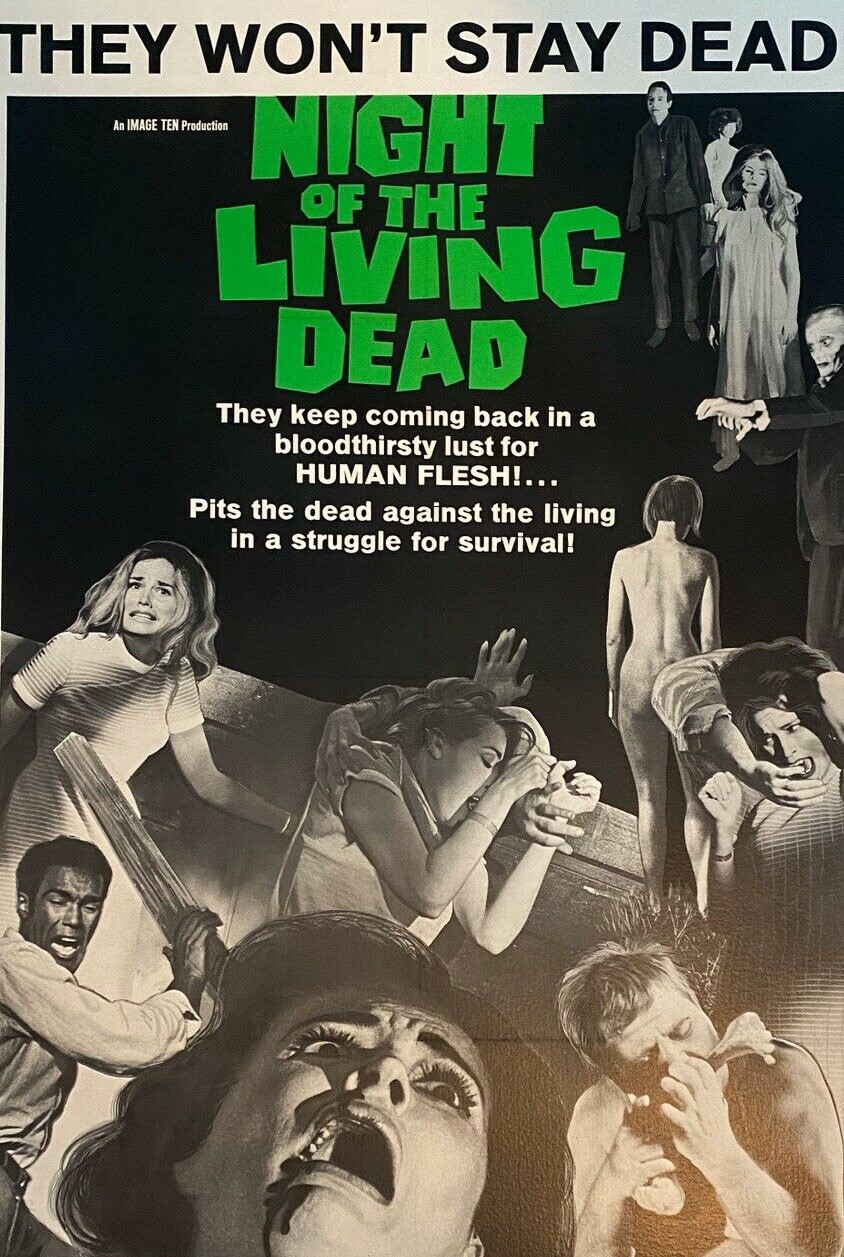
Brother and sister Johnny (Russell Streiner) and Barbara (Judith O’Dea), having driven 200 miles to visit their father’s grave, are ambushed in a cemetery by a zombie. Johnny is chalked up as victim number one. Barbara escapes to what appears to be an abandoned house, attacked by more zombies, where in a by-now near-catatonic state she is eventually joined by the more action-oriented Ben (Duane Jones) who boards up door and windows and fires at the ghouls with a rifle.
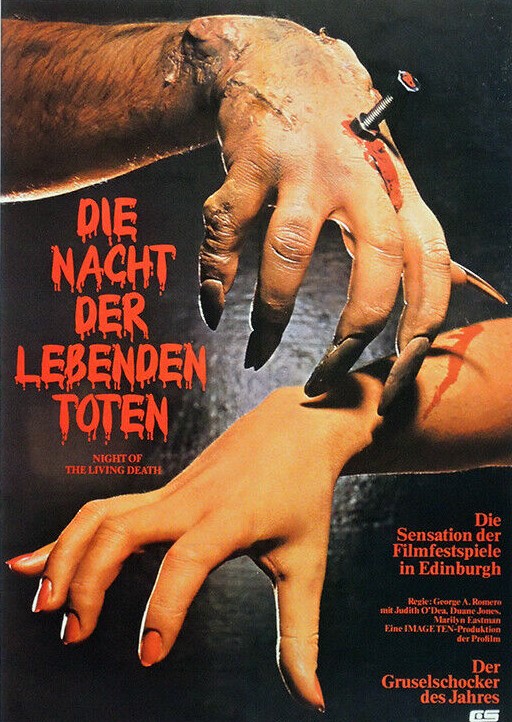
The days when the Edinburgh Film Festival could put its imprimatur on breakthrough movies is long gone.
Hiding in the cellar are the Coopers, Harry (Karl Hardman) wife Helen (Marilyn Eastman) and daughter Karen (Kyra Schon), ill from being bitten by the monsters after their car was overturned, and Tom (Keith Wayne) and girlfriend Judy (Judith Ridley). In the ensuing panic and continued onslaught, the numbers of zombies growing by the minute, Harry determined they would be better off hiding in the cellar and at one point locks Ben out of the house.
Radio and television broadcasts reveal a mass outbreak of people rising from the dead and feasting on the living, the result it appears of radiation in space, caused by man-made accident. The zombies can be killed off by a bullet or blow to the head or being burned. A gas pump being nearby, Ben, Tom and Judy drive there but while Ben lays down a carpet of fire to deter the marauders Tom accidentally spills gas over the truck which catches fire. Ben escapes but the couple are incinerated, turned into a tasty barbecue for the invaders.
While the relentless siege continues, Karen dies and is reanimated. And so, as you don’t expect, there is no escape, the survivors fighting zombies outside and the living dead inside.
The final image, a photographic montage, takes the movie in another direction, down the Civil Rights route, as the corpse of the only African American is hoisted up on meat hooks.
Until George A. Romero (Dawn of the Dead, 1978) took this idea and ran with it, the indie-scene was populated by cheaply-made movies of no discernible artistic credit aimed at the bottom end of the distribution market or by artistically-minded directors who hoped their talents might be acclaimed and lead to a fat Hollywood contract.
Although there was no shortage of shockers, most had laughable special effects, little in the way of narrative, and certainly no earth-shattering concept like nobody gets out of here alive.
A budget of just over $100,000 ensured there was little room for grandiose special effects but nonetheless the scenes of relentless zombies striding forward, the single creature at the outset joined by a mass, was cinematic genius. Nor were these fragile ethereal beings, but strong enough to physically kill and turn over cars. On top of that was the revelation that death did not sate their hunger, and they weren’t vampirically-inclined either, the tastes lying in the cannibalistic. If you were able to die quickly enough to be reanimated you might escape being turned into a meal.
Taboo-busting came easily. Never mind flesh-eating zombies, and graphic violence, what about matricide? And perhaps a nod towards the power of relentless pressure, the armies of the night here could easily translate to the armies of protesters taking to the streets in broad daylight to march against injustice and Vietnam, whose continued opposition to government would drive change.
No doubt the decision to film in black-and-white was budget-driven, but that turned out to be a boon, no need to invest in gallons of what might pass as red blood, or create bloody corpses, just focus on the relentless threat.
It helped, too, that the characters under siege were very human, Barbara going out of her head with fear, isolationist Harry willing to kill the others to defend his notion of hiding out in the cellar, hoping to escape unscathed.
This was the ultimate word-of-mouth picture, critically dismissed not to say reviled on initial release, but gradually picking up an audience until it became a must-see movie. Romero’s horror approach became widely imitated, though his influence took years to permeate down. Co-writer John A. Russo later became a director, helming Santa Claws (1996).
A more prescient picture you couldn’t find, tapping into a contemporary audience’s greatest fear – global warming. Its bold cliff-hanger ending would also appeal to a modern audience often left dangling at the climax of a blockbuster. And it cleverly skims on the special effects, relying on the more easily achieved downpours, thick fog, constant sweating, newsreel footage of natural disasters, water rationing and end-of-the-world riots than anything bigger.
But what surprised me more was the sheer pace. Not just a story moving at a frenetic pace but the British characters acting like they had been injected with a heavy dose of New York zap, talking over each other, hardly getting a complete sentence in before interruption, like Howard Hawks had taken command instead of a mere Englishman like Val Guest (Assignment K, 1968), a former journalist.
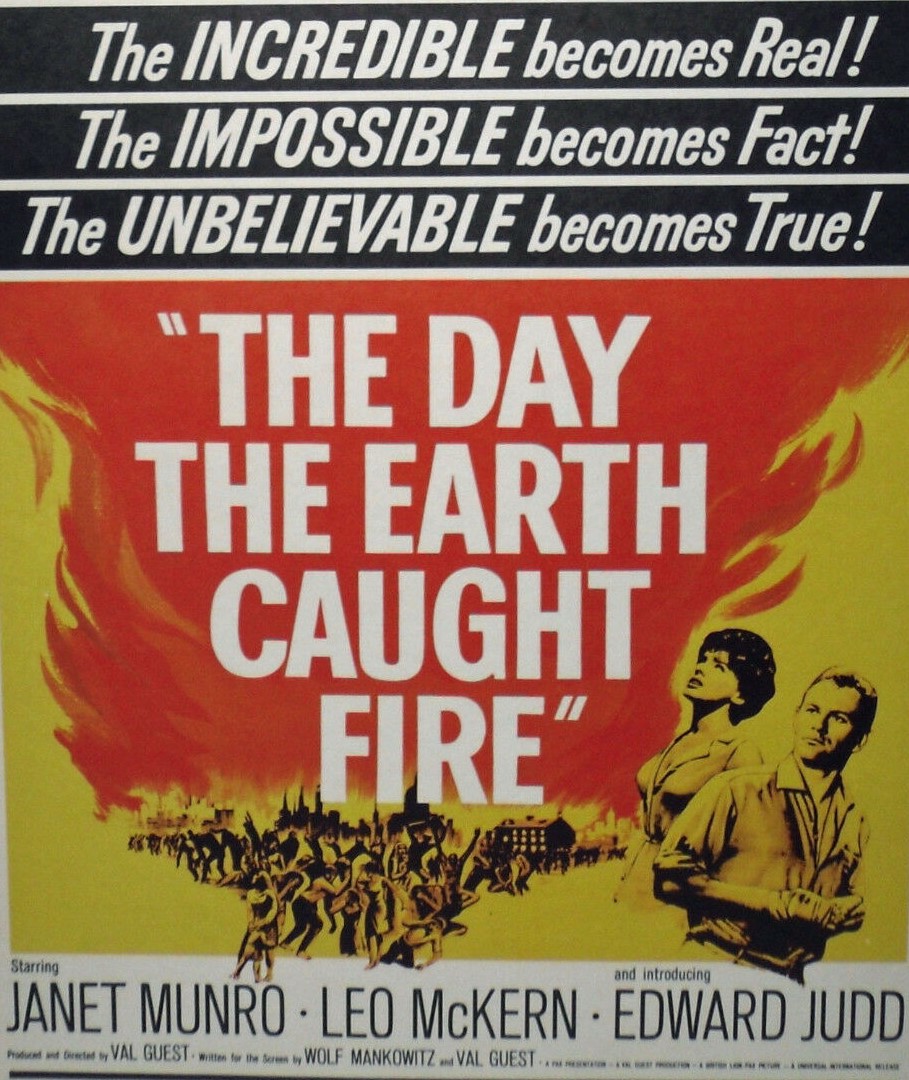
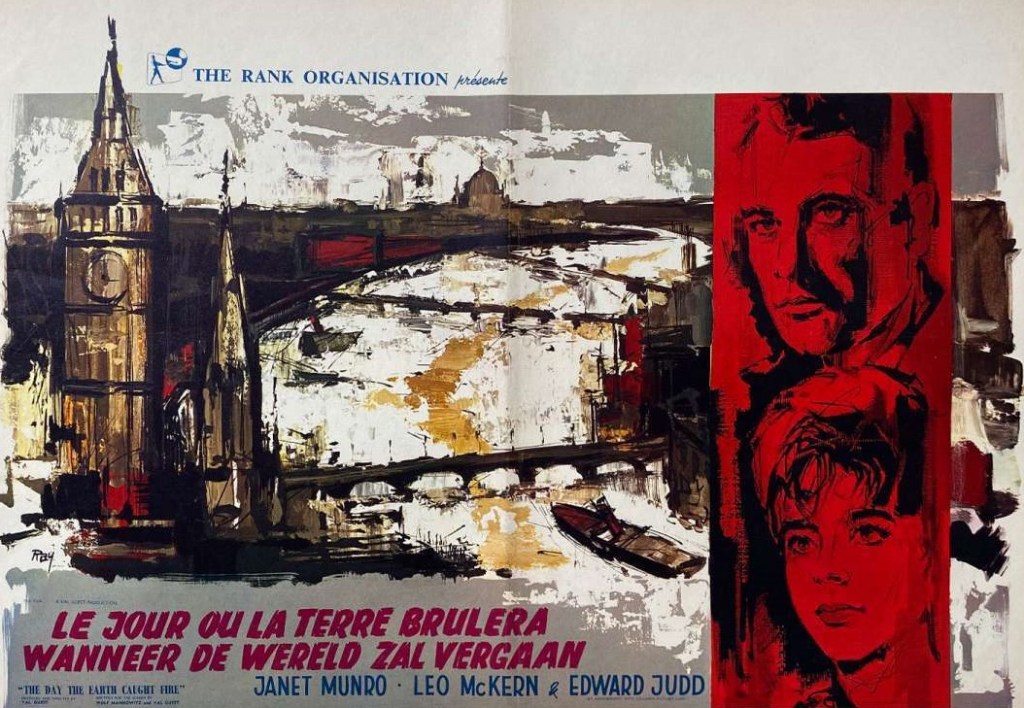
Front cover of the Pressbook.
It channels the director’s experience into creating the most realistic newspaper office you will ever come across, beating out All the President’s Men (1974) in its representation of how journalism really works, as concerned as much with the general fodder of unheralded stories as the scoops that normally drive such a narrative. And for a story that started off as pure pulp, the dialog is superb, so good it won the Bafta award.
It certainly helped that an actual newspaper editor, Arthur Christiansen (of the Daily Express) lent a guiding hand, playing the role of the editor of this downmarket daily. The summoning of copy boys (actually grown men), the demand for 500 words, the printers ready to switch the front page at a moment’s notice, the inevitable diet of pie and pint, and the emotional casualties as marriages crumble under the strain of a husband more concerned with this next story than wife or children, all serves to ground the film.
And yes, the narrative plays into the usual journalistic tropes, ambitious newspaperman Peter (Edward Judd), career on the line, uses typical wiles, duping lowly scientific secretary Jeannie (Janet Munro) into revealing more than she should. It’s a meet-cute of the old-fashioned variety, she hates him on sight.
Peter is as off-kilter as the world, knocked off its axis by the simultaneous explosion of nuclear devices, unable to come to terms with his divorce, finding solace in the time he spends with his child, and it seems fitting that much of that is spent diving into the darkness of the ghost train ride, the fog equally thematic as he wanders round in circles in that, as aimless as in his life, while a bath is just as cinematically important, not just for the obvious semi-nude scene but as a place of refuge from impending terror.
These journalists know how to sniff out a story, how to separate the what from the chaff of the official line, digging deeper, and with global connections able to put two and two together far swifter than officialdom. It helps that Peter’s guardian angel Bill (Leo McKern) has a scientific brain and is able to work out the source of the infernal rising temperature.
It’s axiomatic of how clever the screenplay is that Peter and Jeannie come together over a lost child, although Peter, cynical and bitter, but more vulnerable than most, remains a conniving character, happy to risk their burgeoning relationship for the sake of a scoop.
Like Quatermass and the Pit (1967) it’s one revelation after the other as the world hurtles towards oblivion, though not before ending up as the biggest barbecue of all time. The film acknowledges the anti-nuclear demonstrations of the time before piling on proof that man has sown the seeds of destruction on a four-month countdown to doomsday.
We have been here before with end-of-the-world scenarios but this story unfolds not in scientific or official offices, and there’s no President around to add gravitas or take the blame, but in the minds of the dogged journalists, soon appalled by their discoveries, and for once a scoop is unable to save the day or give the villain his just deserts. Whoever is behind the catastrophe remains nameless, although the outcome of superpowers duking it out for supremacy is never in doubt.
Edward Judd (First Men on the Moon, 1964) delivers a star-making performance as the jaded, jagged, journo capable of emotional depths while Janet Munro (Hide and Seek, 1964) escapes Disney tomboy servitude with a very adult role. Leo McKern (Assignment K) has the solid acting chops that would, two decades before television fame as Rumpole of the Bailey, see as a formidable heavyweight addition to any film and a threat to any co-star through jis charismatic ability to steal scenes.
But the film belongs to Val Guest, who constantly turns up the emotional heat and the terror scale, getting the most out of the riveting, sparkling screenplay he co-wrote with Wolf Mankowitz (The 25th Hour, 1967).
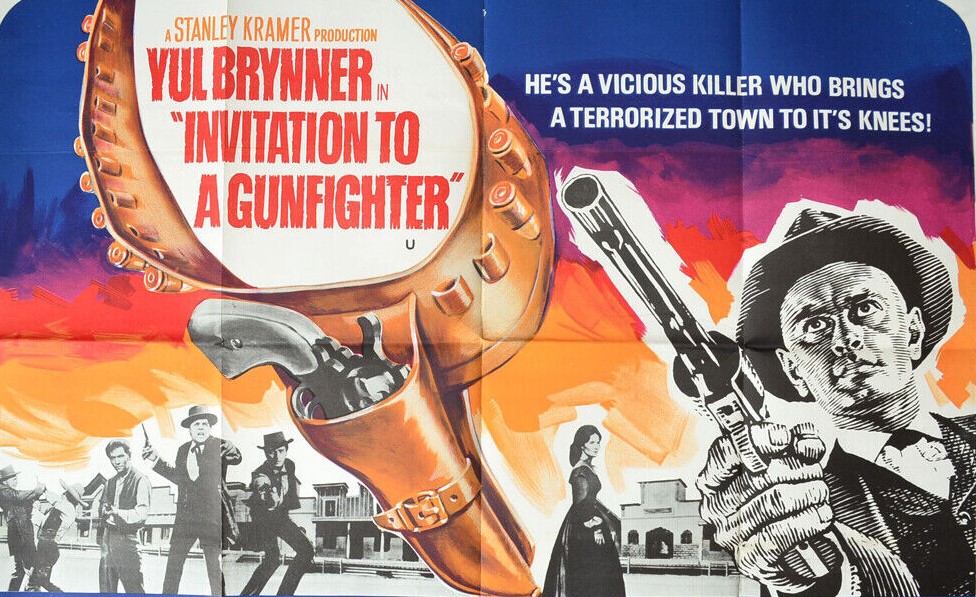
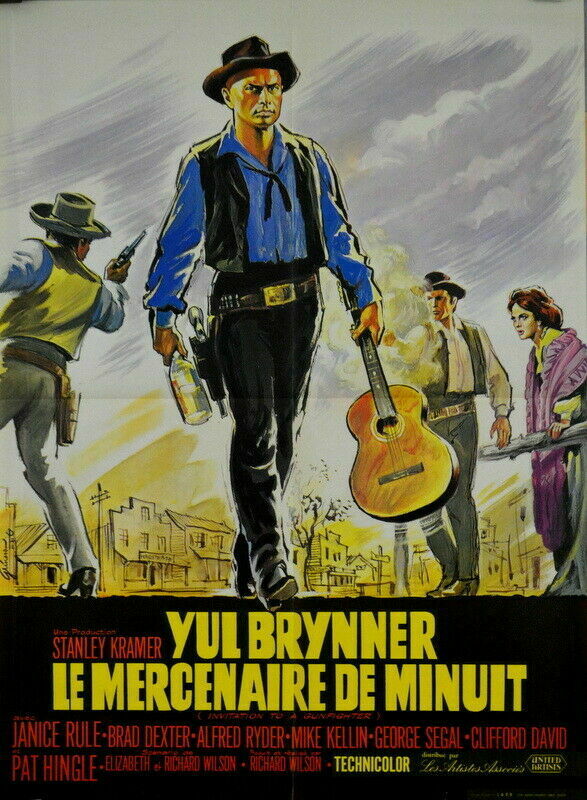
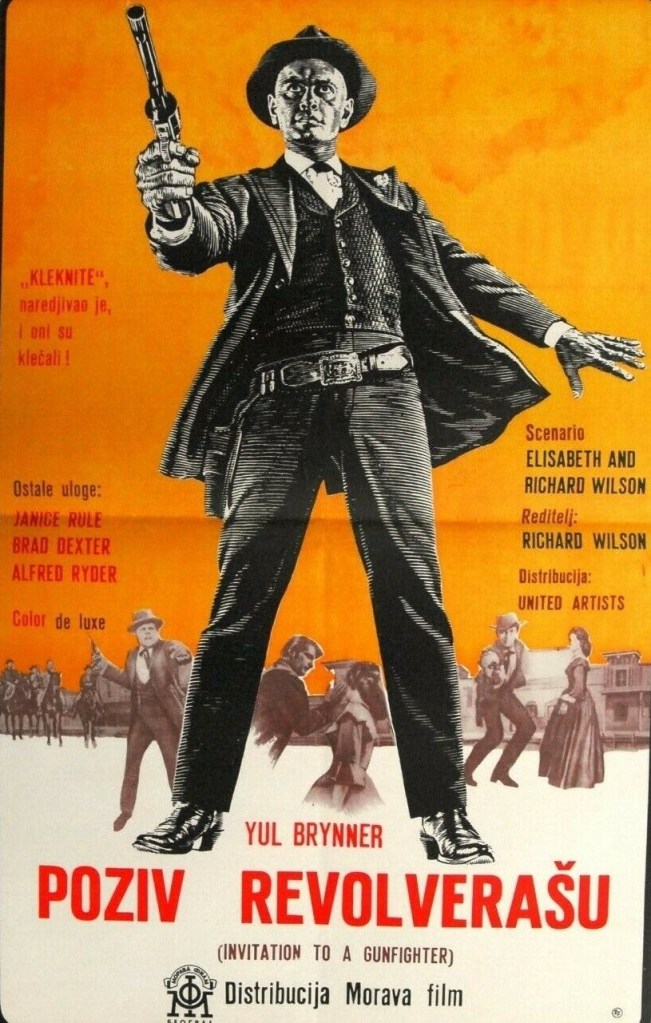
If ever a movie was in sore need of reappraisal it’s Richard Wilson’s western, which encountered both audience and critical indifference on initial release. If you’ve heard of Wilson at all it will, hopefully, either be down to his connection with Orson Welles or from his crime duo Capone (1959) with Rod Steiger and Pay or Die (1960) with Ernest Borgnine. On the other hand, you may be more familiar with the name from the Ma and Pa Kettle series in the 1950s or perhaps raunchy comedy Three in the Attic (1968). Or because he was an unlikely contender for the triple-hyphenate position (writer-producer-director) held on the Hollywood scene by the likes of Billy Wilder and less-heralded figures such as John Lemont ( The Frightened City, 1961).
Wilson was not first choice to direct since the western had been on the Stanley Kramer company slate since 1957 when it was planned for Paul Stanley before it moved in 1961 into Hubert Cornfield’s orbit with a script by James Lee Barratt and then repossessed by Kramer when Rod Steiger was briefly attached. The film, backed financially by Kramer, barely rates a paragraph in the director’s autobiography in which he describes the picture as “an adult western with a somewhat complicated plot.” There’s no getting past the fact that the plot is complicated, but it’s not the plot but the characters that held me in thrall.
Kramer thought the film contained elements of High Noon (1952). But for me the starting point was surely The Magnificent Seven (1960) and not just because Yul Brynner played a gunfighter complete with black outfit and cigar. It wasn’t Brynner’s look in the previous western that brought me to that conclusion, but the scene where the gunfighters sit around talking about where their career has taken them – to precisely nowhere: no wives, no family, no home.
Invitation to a Gunfighter makes more sense as an adult sequel to The Magnificent Seven than any of that movie’s other retreads. Imagine that Brynner, despite the boost to his esteem from beating the Mexican bandits, had not shaken off what we would most likely classify these days as a malaise or a depression. He is trying to make sense of a life that has proved unfulfilled. His options are salvation or suicide. At some point he will come up against a quicker gun, so it is suicide to continue in this profession.
But this gunfighter is also close kin to Clint Eastwood’s man with no name, the mercenary who takes full advantage of his power in lawless towns, and especially to the later embodiment of such a character in High Plains Drifter (1973). (Perhaps Eastwood got the idea of renaming the town ‘Hell’ and painting it red from the scene where Brynner, fed up with the hypocrisy of the righteous townspeople, goes on a drunken wrecking spree.) However, the hired gun Brynner is far from anonymous.
His name is so rich – Jules Gaspard D’Estaing – that the locals curtail it to the more peremptory Jewel. And he is cultured, plays the spinet (a kind of harpsichord) and the guitar, sings, quotes poetry and cleans up at poker. He is sweet to old ladies, but that is in the guise of righting wrongs. And he is defender of the under-privileged, in this case downtrodden Mexicans. He was himself the son of a slave. The most compelling aspect of this picture is that despite knowing so much about him he remains mysterious.
Brynner wasn’t the two-fisted kind of action hero, but more the guy who could disarm the opposition with a mean stare, and charm women with his brooding good looks. As mentioned, the plot is complicated so to get the best out of the picture you need to kind of set that to one side.
Simply put, Confederate soldier Matt (George Segal), returning from the Civil War, finds his farm has been appropriated and his sweetheart Ruth Adams (Janice Rule) has married someone else, the one-armed Crane Adams (Clifford David). D’Estaing is brought in to get rid of Matt whose principled stand is causing a nuisance to the immoral town.
So the story, rather than the plot, is the interaction between these four. Crane Adams clearly wants any opportunity to kill off his rival. Equally, Matt wants to win Ruth back. D’Estaing finds himself unexpectedly drawn to the sad, pensive Ruth, abandoning his planned stagecoach trip to Santa Fe on catching a glimpse of her, only hired when the townsfolk discover his occupation. D’Estaing has a fantasy of taking her away from all this, the pair of them riding off together, and there is no doubt Ruth is tempted as he implants himself in their household and shows himself to have everything her husband, or Matt for that matter, lacks.
Perhaps the best thing about the movie is that nothing is clear cut. Our sympathy shifts from D’Estaing to Matt to Ruth. Even when D’Estaing brings the town’s hierarchy to heel, there is no guarantee that will be enough to win over Ruth. And if he cannot have her, what does he have? The Eastwood loner never seems to care about emotional involvement, he just takes what he wants, but D’Estaing is more sensitive and does not want a one-sided relationship based solely on power.
For the movie to work at all, Ruth needs to engage our sympathies. Having clearly been somewhat mercenary herself in discarding Matt in favor of Crane Adams (presumably not originally disabled), she needs to come across as a woman who is not just going to jump at the next best thing. In this regard Janice Rule is especially good, far better than in more showy roles in Alvarez Kelly (1966) and The Chase (1966). Never given the opportunity to verbalize her emotions, nonetheless in scene after scene her quiet anguish is shown on her face.
Yul Brynner (Villa Rides, 1968) has a peach of a part and does it more than justice. Often derided or ignored for his acting, this shows him at the peak of his powers, portraying a contradictory and conflicted character, arrogance tempered by depression. George Segal (The Quiller Memorandum, 1966), a rising star at this point, has his meatiest role to date. In supporting roles are Pat Hingle, Brad Dexter (The Magnificent Seven), Strother Martin (Cool Hand Luke, 1967), Clifton James (Live and Let Die, 1973) and famed cinematographer John A. Alonzo (Chinatown, 1974).
Five names are attached to the screenplay: Richard and Elizabeth Wilson, Hal Goodman and Larry Klein credited for the story which they had originated as 1957 television drama directed by Arthur Penn, and Alvin Sapinsley for the adaptation.
I certainly saw a different picture to the “offbeat but confusing western” viewed by Variety’s critic and possibly, for once, because the passage of time has allowed this film to be seen in a new light. Rather than a morality play in the vein of High Noon, I recognized saw it as a character study of a gunfighter knocking on heaven’s door.
Kind of film that needs sold on word-of-mouth and a slow platform-release rather than being bundled out to fill the distribution gap. Let the audience sing its praises first before slinging it out in wide release. Because this is a definite audience-pleaser, a fun whodunit. Though a limiting factor might be that appeal may be restricted to those of a certain age familiar with The Mousetrap. I wouldn’t bet my last dollar, either, on modern young audiences even having a clue who Agatha Christie was, or responding to a picture set in dull, dull, Britain in a year -1953 – when there was a significantly more glorious event that might have suited better the average Downton Abbey moviegoer: the coronation of the recently-deceased Queen Elizabeth II.
Delightful pastiche on the detective story, too much to suggest it’s a piss-take on Knives Out or the latest big-screen veneration of Hercule Poirot, but it certainly has enough going for it even if none of those connections are eventually made. Certainly, there’s some sly humor in scoring points for mentioning, a la Murder on the Orient Express, that the initial murder could have been committed by all the suspects.
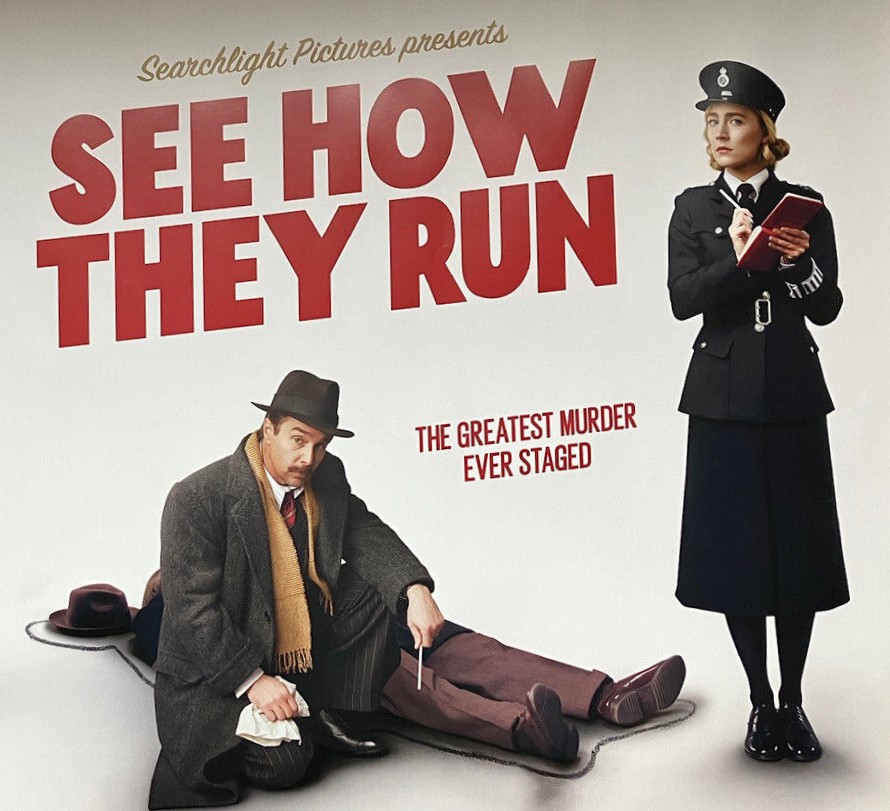
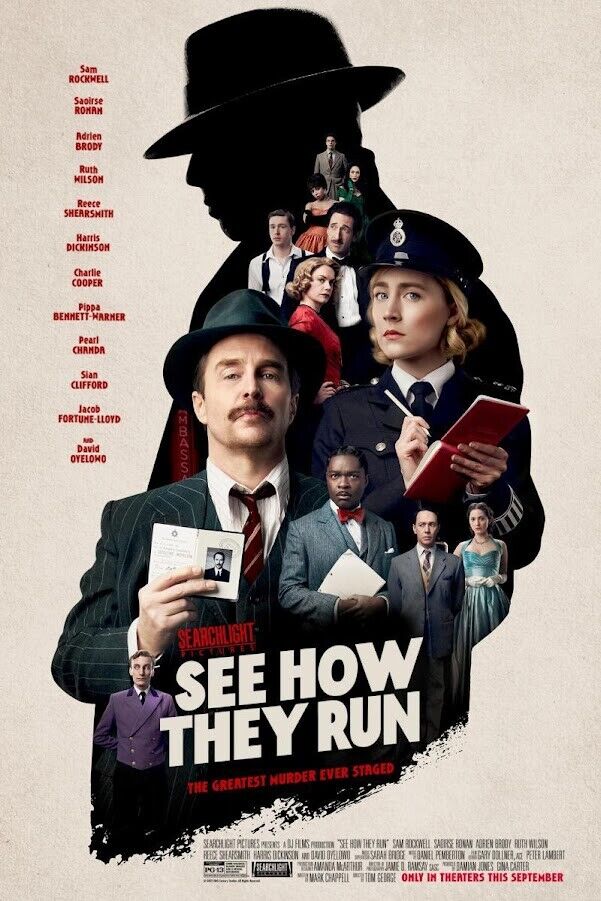
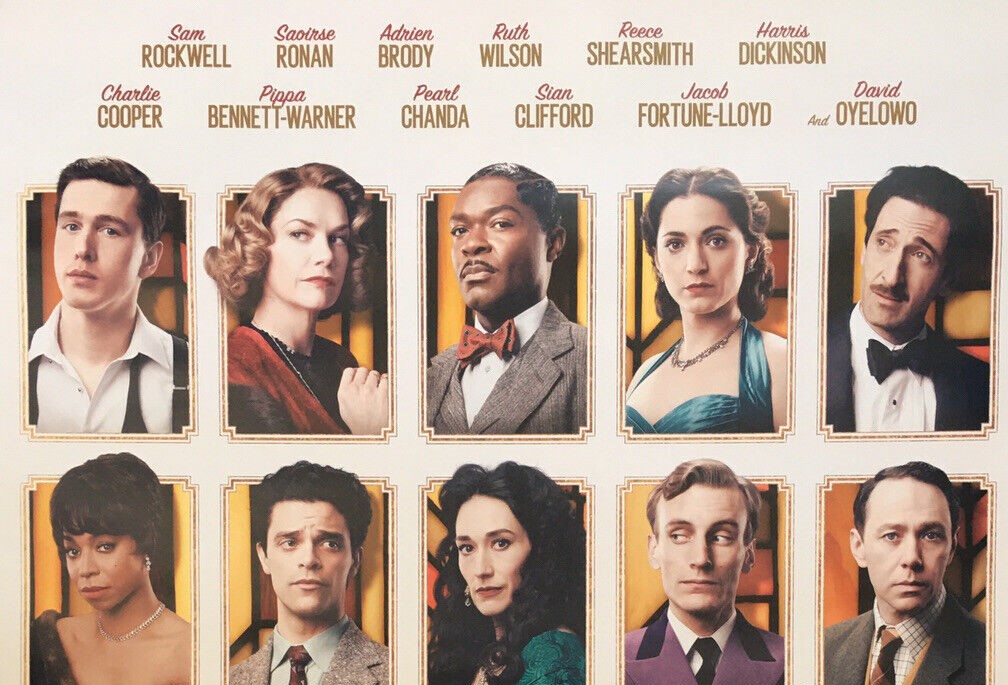
Basically, out of favor war hero and alcoholically-inclined cop Inspector Stoppard (Sam Rockwell) is saddled with rookie Constable Stalker (Saoirse Ronan) – two in-jokes right there, John Stalker being a very prominent British cop, playwright Tom Stoppard the author of The Real Inspector Hound – to investigate the death of Yank Leo Kopernick (Adrien Brody), in London to turn Agatha Christie’s famed play into a movie for real-life producer John Woolf (Reace Shearsmith) who made The African Queen (1951).
Virtually everyone associated with the play becomes a suspect. These include pompous playwright Mervyn Cocker-Norris (David Oyelowo), the play’s petulant producer Petula “Chew” Spencer (Ruth Wilson), real-life actor Richard Attenborough (Harris Dickinson) and even Agatha Christie (Shirley Henderson) is not above a bit of poisoning. Throw into the mix that the cops have assigned the bulk of their resources to tracking down the 10 Rillington Place serial killer – another in-joke, Attenborough playing the murderer in that movie.
One of the movie’s delights is that whereas both Stoppard and Stalker have considerable personal issues, we discover them in passing, and neither character makes a meal of them. Instead, their screen charisma works a treat, Stoppard dogged and the earnest Stalker inclined to jump the gun.
Even the “all-star-cast” is a spoof on films like “Death on the Nile.” The title was a popular one, movies in big-screen or small using it in 1955, 1964, 1984, 1999 and 2006.
The stage shenanigans are a hoot, puffed-up pride and ruthless machinations powering many of the sub-plots. There’s some pretty clever sleight-of-hand not to mention occasional cinematic avant-garde and there’s no shortage of laughs and that out-dated comedy fall-back – slapstick. The climax is particularly excellent, in part because it is a notion immediately discarded as the denouement of the proposed movie version of the play, one that succinctly critiques the differences between British and Hollywood approaches to movie-making.
Red herrings and cul-de-sacs abound, flashbacks remove any plot-holes, while managing to ram in a country-house finale takes some brio. And in among all the jokes, you might be surprised to find a serious point being made about reality vs fiction. Full marks to the virtually laugh-a-minute screenplay by Mark Chappell (The Rack Pack, 2016) and director Tom George in his movie debut who brilliantly shuffles the deck.
Dramatic heavyweight pair Sam Rockwell (Three Billboards, Outside Ebbing Missouri, 2017) and Saoirse Ronan (Mary, Queen of Scots, 2018) prove a double-act to cherish. In gentle comedic roles at odds with virtually their entire portfolios, a wise producer might already be sizing them up for a re-run. Everyone else gets to be bitchy/scheming/ruthless to their heart’s content and certainly in those categories Adrien Brody (The Grand Budapest Hotel, 2014) and Ruth Wilson (His Dark Materials, 2019-2022) win hands-down. But spare a thought for excellent performances from David Oyelowo (The Bastard King, 2020), Reace Shearsmith (of League of Gentlemen TV fame), Lucian Msamati (The Bike Thief, 2020) as the imperturbable Max Mallowan, husband of the distinctly perturbed Agatha, played with venomous glee by Shirley Henderson (Greed, 2019).
I went to see it not expecting much at all and came out singing its praises. Definitely worth a whirl.