Nine Hours to Rama (1963) **

Double Oscar nominee Mark Robson was a highly respected commercially successful director with hits like Peyton Place (1957) and From the Terrace (1960) behind him and The Prize (1963) and Von Ryan’s Express (1965) still to come. So what went wrong here, in this tale of the assassination of Ghandi, especially as he had successfully negotiated foreign climes in The Inn of the Sixth Happiness (1958)?

You could start with the Indian equivalent of “blackface.” Apart from Ghandi himself all the major roles are played by white actors. Even cutting back on his trademark plumminess, the sight (and sound) of Robert Morley trying to talk the Indian leader out of exposing himself to possible assassination would just be hilarious if it wasn’t such a cringingly bad misstep.

Sure, Hollywood struggled to find anyone in Bollywood who had the box office marquee or critical kudos to provide the necessary confidence for Twentieth Century Fox (a problem that hasn’t really gone away – witness Gandhi and Passage to India). But rising star Horst Buchholz, in the leading role of assassin Godse, was nobody’s idea of the kind of actor with the credentials of a Ben Kingsley or Alec Guinness who might make a decent stab at playing an Indian.

And it’s a bizarre narrative mixture, dragnet film noir hunt led by Supt Das (Jose Ferrer) for a potential assassin (done so well in Day of the Jackal, for example), biopic of the assassin, and providing sufficient room for Ghandi to spread his principles of love and peace as well as plenty of scenes of tourist India.

And even with all these deficiencies it might still have worked except that, in the modern idiom of altering characters, times and places for dramatic effect, this pretty much ignores the known facts about the assassin’s life and in its place presents a barmy mishmash of thwarted ambition and romance.

Set in 1948 after India gained independence from the British and during ongoing violence that followed Partition, the dividing of the country on religious grounds into India and Pakistan, we find Ghandi being blamed for everything that has gone wrong, even though he was never the country’s prime minister and disavowed political office.

According to this version, against his father’s wishes and at a very inconvenient time (he is about to enter an arranged marriage), Godse attempts to fulfil a lifelong ambition to become a soldier but is rejected on the grounds that as a Brahmin he will find it difficult to take orders. He becomes involved with a right-wing organization one of whose stated aims is to take down Ghandi.

It’s actually not that hard to attempt to do so and the film conveniently misses out the fact that Godse had previously been fond guilty twice of trying to kill Ghandi, only being spared prison by his target’s clemency. Instead of that grimly ironic touch, we are fed a hotchpotch. It’s hardly surprising that the film skips the potential gender conflict inherent in Godse, since for superstitious reasons he was initially brought up as a girl, including having his nose pierced in the female fashion. And for “dramatic purposes” his father is a priest rather than the postal worker of real life.

He falls in love with a married woman (Valeri Gearon) and is violent to a prostitute Sheila (Diane Baker) who rips him off. Theoretically, Ghandi would not have fallen to this assassin’s bullet if Mrs Gearon had done the decent thing and run off with Godse.

Or if Gandhi had accepted the presence of an armed bodyguard, but the spiritual leader, pacifist to the end, was also a fatalist, and at approaching 80 certainly had cause, should he indulge in such pride, to believe he had made a difference.

Nobody comes out of this well.  

The Belle Starr Story (1968) ***

Only spaghetti western directed by a woman. Brings a distinctly feminist feel to that most sexist of the subgenres. You tend to forget that the sexy female Europeans imported to Hollywood as co-stars or to add spice further down the credits were actually top-billed stars in their natïve countries and demonstrated a greater range than the American industry allowed.

Not only do we have Elsa Martinelli (Maroc 7, 1967) as the leather-clad cigar-smoking titular gunslinger, whose watchword is female independence, but it was helmed by arthouse icon Lina Wertmuller (Swept Away, 1974).  There’s a thematic consistency lacking in most Italian-made westerns, for example predating Once Upon a Time in the West (1969) in its water imagery. But any potential for lyricism is undercut by the risk attached to being a lone woman. And there’s a Tracy-Hepburn tone to the endless bickering and battle for superiority in her niggling romance with outlaw Blackie (George Eastman).

And, unusually in that decade, a woman who throws caution to the wind and will even bet her body when the money runs out at the poker table, as twisty a meet-cute as a screenwriter could devise. But thereafter it’s a struggle for dominance between the pair. She won’t take orders from a man. He won’t accept female equality even when she shoots the wooden fence  he’s sitting on from under him, making him fall to the ground, and for good measure putting a bullet in his heels.

The first act builds up Belle Starr, cool at the poker table, even cooler in the bedroom, and demonstrating the gunplay that attracted her notoriety. The second act take an odd route, a lengthy flashback that digs deep into feminism, the orphaned Belle Starr running away after being sold into marriage by her uncle to an ugly old rich powerful man, traded, effectively, for political favor.

She returns to save a servant condemned to death for the crime of attacking the uncle when he tried to rape her. Sexual humiliation is a theme. Another outlaw Harvey (Robert Woods), who she regards as a platonic friend, steals her clothes as she swims in a lake, and then, having saved her from a posse, forcibly tries to take his reward.

The third act, like the duel between The Man With No Name and The Man in Black, is a case of double- and triple-cross. She refuses to join Blackie’s gang when he plans a million-dollar jewel heist, but hijacks the concept, recruiting her own gang to beat him to the robbery, and teach him a lesson.

But it backfires. Blackie is waiting. She has inadvertently hired his men. In the subsequence shoot-out he is captured. She rides to his rescue. But with their opposing ideas of a woman’s place in the world part on good terms.

The flashback was more subtly observed in Once Upon a Time in the West, and while she shared with Charles Bronson gunslinging skills he was not at any time viewed as a commodity or a piece of property or a candidate for rape. The flashback here fleshes out for the audience the powerlessness of women. But also the kind of camaraderie that is generally also usually only conferred on male characters.

We are pretty conversant with the notion that the gun rules the West. But less conscious of what happens when you are gun-less. Depriving someone of their fundamental weaponry makes them instantly impotent, as humiliating as denying someone water in a desert.

There are some nice directorial touches, blood dripping from a ceiling onto a dinner table, a saloon door opening to cast sudden light onto a corpse, waterfalls suggest sanctuary whereas open water attracts predatory males, and the finale, as they part, of Blackie, desperate to demonstrate his superiority, shooting off her hat from some distance.

Elsa Martinelli is a revelation as a star working to her own beat rather than playing second fiddle to some Hollywood marquee name. This wasn’t Lina Wertmuller’s first film and she had already made an impact with the Rita the Mosquito series, featuring another rebellious woman. Don’t be fooled by the co-directing credit, she replaced debut director Piero Cristofani after a few days.

It’s somewhat ironic that in a contemporary Hollywood attempt to create a female outlaw leader in Cat Ballou (1965), Jane Fonda was upstaged by Lee Marvin, and that in Bonnie and Clyde (1967), despite taking precedence in the title, Faye Dunaway was not the dominant one in the relationship.

By no means a great western but worth a look to see what Elsa Martinelli can achieve when not slotted in to the Hollywood co-star cliche and to get a preview of what Lina Wertmuller could offer.  

Decent print on YouTube.

The Fixer (1968) ***

Stunning opening section thrown away by shifting tone and despite excellent performances by the Oscar-nominated Alan Bates and Dirk Bogarde drifts into Kafkaesque virtue-signalling.

But let’s get the title out of the way first. I had assumed a “fixer” was a manipulator, an underworld type of character who could, for a price or future favor, sort out problems or find someone a job or act as an intermediary between politicians or businessmen. Not so. Yakov (Alan Bates) is nothing more than a handyman, who can fix broken windows or railings and turn his hand to anything such as wall-papering or basic accountancy.

In the credit sequence he demonstrates his skills by fashioning with wood, a couple of screws and some steel, a razor, with which to remove the hair and beard that would identify him as a Hassidic Jew. He is, as soon becomes apparent, afflicted by dogs. As he departs his remote cottage in a cart, a vicious dog so disturbs his horse that it bolts, resulting in the loss of a wheel. He continues his travels on horseback, arriving in a small town in time to witness a parade and Cossacks rampaging through the streets.

As it’s set in Czarist Russia, his journey is accompanied by melancholy violin with, for some reason, a disturbing undercurrent of military drum. As the credits end, we cut to the Russian flag and a marching band. He hides in terror as the horsemen drag people along by the ear, slash with sabers, hang others. It’s a pogrom, the type of attack commonly experienced by Jews living in ghettoes.

Up to now, it’s just outstanding. Then it tips into the picaresque. Yakov helps an old drunk Lebedev (Hugh Griffiths) who’s fallen down in the snow in the street. As reward he is offered work wall-papering a room. He has a prick of conscience when he realises that Lebedev is an anti-Semite. Lebedev’s daughter Zinaida (Elizabeth Hartman) seduces him. But, on spotting some blood on a cloth, he refuses to go through with the act.

Luckily, my reading of crime novelist Faye Kellerman has alerted me to the fact that it is an act of faith for Jews not to make love when a woman is menstruating. Luckly, Zinaida isn’t so up on her Bible (Leiticus 15: 19-23 in case you were interested) that she catches on to this revealing fact, for, as has been pointed out earlier, minus the distinctive curl, Yakov doesn’t have the physical characteristics associated in those times with a Jew. In fact, you would say Lebedev would more easily pass for one.

Anyway, Lebedev gives him another job, of counting the loads leaving his brickworks because he suspects he is being swindled. But the foreman, who has been rumbled, and suspects Yakov of being a Jew, calls in the Secret Police, it being a crime for Jews to leave the ghetto.

Now we tip into Kafka. The initial charge against Yakov is that he harbored another Jew during Passover. But then things spiral out of control. He is accused of passing himself off as a Gentile (non-jew), attempted rape of Zinaida and then of ritual murder, killing a small child.

Investigating magistrate Bibikov (Dirk Bogarde) is sympathetic and manages to avoid the rape charge much to the fury of prosecutor Grubeshov (Ian Holm) but once the other charges mount, he is nailed, everyone determined to prove an innocent man guilty.

This is based on a true case and clearly was a case of persecution and Yakov’s transition from worker happy to hide his ethnicity to gain work to a man who rediscovers his religion is a piece of great acting from Alan Bates. But the points are hammered home endlessly and where director John Frankenheimer (The Train, 1964) so deftly dispensed with dialogue in the superb opening sequence, now he more than makes up for it with leaden speeches, and a film that would worked better for being considerably shorter.

It feels like Hollywood is hard at work. After some moments of mild happiness Yakov’s cinematic chore is to invoke sympathy for an entire nation rather than taking on the Holocaust directly. Dalton Trumbo’s (Lonely Are the Brave, 1962) screenplay is filled with brooding lines. But providing Yakov with an interior monologue when he dithers over having sex doesn’t work at all, certainly not next to the more effective use of that technique in John and Mary (1969).

At the outset, Frankenheimer treats violence with discretion. We don’t see the dog being impaled on a saber, just its corpse thrown at Yakov. We witness a rope being wound round a man’s neck, as innocent of any crime as Yakov, but not the actual hanging. So what begins as highly-nuanced turned into a battering ram of a picture and characters forced into lines like “the law will protect you unless you are guilty” and “I am man who although not much is still more than nothing.”

Alan Bates (The Running Man, 1963) certainly deserves his Oscar nomination and Dirk Bogarde (Modesty Blaise, 1966) might feel aggrieved he missed out on a Supporting Actor nomination. But too many of the rest of the cast over-act. It’s an all-star cast only if you’re British. But check it out if you’re a fan of Hugh Griffith (The Counterfeit Traitor, 1962), Elizabeth Hartman (The Group, 1966),  David Warner (Perfect Friday, 1970), Ian Holm (in his sophomore movie outing), Carol White (Daddy’s Gone A-Hunting, 1969) and Georgia Brown (Lock Up Your Daughters!, 1969).

Frankenheimer at his best when he lets the action play without the overload and there’s one almost Biblical scene, lit only by candlelight, that demonstrates his cinematic virtuosity. But  otherwise it’s drowned in the verbal rather than the visual. Trumbo based his screenplay on the Pulitzer Prize winner and bestseller by Bernard Malamud.

Some effective moments, but too long drawn-out to make the impact expected.

Tony Rome (1967) ***

Effervescent mystery punching a hole in the traditional private eye caper. Look elsewhere for film noir as Frank Sinatra (The Manchurian Candidate, 1962) reinvents his screen persona. On the one hand he’s such a cool cat, living on a boat in Miami, you half expect him to burst into song just with joy. On the other hand, you wouldn’t cross him. Corpses tend to pile up in his vicinity.

There’s a surprising self-awareness that’s dealt with through considerable subtlety, not with the usual angst of film noir where flaws not only tend to be magnified but spill over and drench the plot. Addicted to gambling, Rome steers clear of marriage and any long-term relationship, knowing such a move would be disastrous for the other party. A former cop, he is touchy though about his father, also a cop, who blew his brains out when some murky deal went wrong.

High on the glamorous side, houses the sizes of small cities, women parading in either next to nothing or with the current year’s hot fashion items. You’d be surprised there wasn’t a horse-riding scene, or one set at a hi-hat ball. But this is pretty much a procedural as the canny detective probes the low life as much as the high, bars where go-go dancing is the least of the illicit activities, jewellers who act as fences, and plumbs the life of millionaire Rudolph (Simon Oakland), tough on the business side, dumb as donuts when it comes to romance with former cocktail waitress (a profession often bracketed with quote marks) wife Rita (Gena Rowlands).

And oddly enough, romance here turns out to be touching, sex coming with responsibility rather than a free-for-all as you are initially led to believe. A lesbian scene for once is not exploitative.

Begins with one of the humdrum cases that must consume the bulk of a gumshoe’s time – the hunt for a valuable diamond brooch, lost from the dress of married drunken heiress Diana (Sue Lyon). Turns out he’s not the only one, inexplicably, looking. He takes a beating from a couple of hoods.

When his ex-partner meets his maker in a bathtub, it’s a cinch Tony Rome is next, which means he has a lot of explaining to do to his endlessly frustrated ex-colleague Lt Santini (Richard Conte). If it was a question of whiling away the time, Rome could spend it in the arms of Diana or multiple divorcee Anne (Jill St John).

As you might expect, everyone has secrets they prefer to keep hidden, and happy to do so with violence. Otherwise, they’re going to be knocked sideways by the past. There’s no shortage of suspects including the elusive Nimmo.

I’m assuming the censor enjoyed a chuckle when Mrs Schuyler (Templeton Fox) appeared rather than pursing their lips in disapproval at the way Sinatra wrapped his lips around the word “pussy.” There’s a certain amount of light-hearted sexual jousting but if you were looking for predatory behavior it’s women you’d point the finger at, though given a free pass since in Miami, apparently, men were vastly outnumbered by men and lasses who had not developed a come-hither would be left on the sidelines.

To properly appreciate the picture, you’d have to cast your mind back to a time before there was a surfeit of television detectives and when the general mystery picture (also encompassing spy movies) had gone AWOL or awry with balderdash plot and outsize villains whose only satisfaction in life was holding the world to ransom. In fact, in retrospect, it’s refreshing to find a picture where the director doesn’t pull the wool over your eyes and your hero isn’t an arrogant preening bantam.

So what you’ve got is a properly-plotted plot, clues aplenty that only our clever private eye can unravel, and, inevitably, in the Raymond Chandler tradition some heavy bursting through a door with a gun, and, in this case, also a shovel. This private dick doesn’t fall into the hard-working category of legend, often favors a Bud over the harder stuff, and though he can knock out the cynical one-liners they often come with a tinge of truth or melancholy.

And for once the MacGuffin (Maltese falcon might be a more apt reference) bears significance to the plot.

One of the interminable pot-shots critics took at Sinatra was his preference for working in a single take, the impression given that he was a lazy sod and a bit more effort would have resulted in a better performance. On the other hand, you could just be in awe of an actor who can hit the button stone dead in a single take.

Co-star Gena Rowlands, with something of a hard-boiled reputation herself, found him to be a “wonderful actor; he could do a whole complicated scene in one take…there was nothing pretentious about him, he was just awfully nice.”

Sinatra is no Bogart but for a time afterwards audience were saying of other pretenders to the shamus crown “he’s no Sinatra.” Jill St John (The King’s Pirate, 1967) makes the most of a more interesting part, including delivering the stinger in the tale. Gena Rowlands (Machine Gun McCain, 1969) reveals the little girl under the glam,  Richard Conte (The Lady in Cement, 1969) tones down his typical belligerence, Sue Lyon (Night of the Iguana, 1964) good as a young woman confused by sudden wealth.

The under-rated Gordon Douglas (Stagecoach, 1966) directed from a script by Richard L. Breen (A Man Could Get Killed, 1966) and Marvin H. Albert (Duel at Diablo, 1966), also author of the source novel.

The poster designer pulled a fat one. In typical titillating fashion, you think Sinatra is staring down at a half-naked corpse. But, in fact, no female was harmed in this picture.

Takes a little while to get going but once it hots up it’s perfect entertainment.

Behind the Scenes: “The Cardinal” (1963)

Otto Preminger was beaten to the punch on this one, the scandalous Henry Morton Robinson bestseller snapped up in 1955 by producer Louis de Rochemont (The Roman Spring of Mrs Stone, 1961) who had a tie-up with Columbia. Due to interference from the Catholic Church, de Rochemont dropped his option which Preminger picked up in 1961 while working on Advise and Consent (1962).

The last section of the novel, set in Austria during the Anschluss, reverberated with the director who was born in what was then the Austro-Hungarian Empire and although a Jew was well acquainted with Catholic society.  One of his most significant changes to the book was introducing the Austrian cardinal who endorsed Hitler.

The first two screenwriters James Lee (Banning, 1967) and Daniel Taradash (Castle Keep, 1969) failed to whittle down the complex novel to cinematic proportions. So Preminger brought in Robert Dozier (The Big Bounce, 1969) and began working with him in summer 1962 making other alterations to heighten the drama. The incident involving the unborn child of the sister of Fr Fermoyle (Tom Tryon) acquires greater emotional power in the film, touching on the ambiguities inherent in any institution and provoking the priest’s guilt.

Gore Vidal (The Best Man, 1964) also worked on the script, swapping the novel’s Italian countess for the Viennese Annemarie (Romy Scheider) who, abandoned by the priest had married and was reunited with him prior to the Anschluss, and is sympathetic to Hitler until her husband’s faith endangers them both. Ring Lardner, who had satirized the Catholic church in a recent novel, was the final screenwriter added, his main task to rewrite scenes “to achieve what he (Preminger) wanted,” and, more importantly, to introduce the flashback structure. Ironically, both Vidal and Lardner were atheists.

Tom Tryon and Romy Scheider meet again in Vienna.

The director considered five actors for the leading role – Hugh O’Brian (Africa – Texas Style, 1967), Stuart Whitman (The Commancheros, 1961), Cliff Robertson (The Devil’s Brigade, 1968), Bradford Dillman  (Circle of Deception, 1960) and Tom Tryon (In Harm’s Way, 1965), the latter three advancing to the screen-testing stage. The 34-year-old Tryon won the role and a five-picture contract he would later regret. Carol Lynley (Bunny Lake Is Missing, 1965) who plays the priest’s sister also pacted for five movies.

Romy Scheider’s (Triple Cross, 1966) part was enhanced by the work of cinematographer Leon Shamroy who “fell madly in love with her,” resulting in the actress virtually shimmering on screen, never before “looking as beautiful.” Held in warm regard by the director, she was exempt from his tirades.

It took considerable persuasion on the part of Preminger for John Huston to participate. Curd Jurgens, initially cast as the Austrian cardinal, pulled out and was replaced by character actor Josef Meinrad whose lack of English meant he had to learn his lines phonetically.

Tom Tryon described Preminger as “tyrant who ruled by terror.” He was fired on the first day and probably wished the director had not rescinded the decision, for thereafter the actor was tabbed “lazy…a fool…stupid and unprofessional.” Commented Tryon, “I was so frightened he was going to scream that…I (just) wanted the experience to end.”

One scene with John Huston took 78 takes because Tryon could not deliver what the director wanted. And at one point first assistant director Gerry O’Hara (later director of The Bitch, 1979) found the star in tears and refusing to return unless the director agreed not to shout at him. Eventually, during the Italian section of the shoot, Tryon collapsed from nervous exhaustion, and was prescribed two days rest, and after this incident Preminger let up on his demands of the actor. 

Explained Preminger, “I probably chose him without deliberation because he is weak.” He felt than an ordinary person would not side with the Church against a family member in a predicament, and that only a person “with weakness in his character” would be believable in the role. The character “fails because when you become a priest you substitute your own judgement and your own feelings for the law of the Church…The big decisions are made for him.” (Quite why he never chose an actor who could portray such weakness is not known.)

Tryon admitted that he owed a brief let-up in the bullying to “Schneider’s benign presence.” He commented, “The only fun I ever had on The Cardinal was a (ballroom) scene I did with Romy.” Prior to turning the cameras, Prior called both over, appeared ready to issue instructions, but instead waved them away “you know what to do.”

Added Schneider, “Preminger taught me an important thing: work fast. It’s true that it greatly helps our acting. Each of his directions, whether of gesture or of intonation, is precise and correct. Even better, it’s the only one possible…Each phrase, each world, each syllable are minutely weighed.” That dexterity applied to his positioning of the camera. He made decisions immediately, never hesitating “over the placement of the camera and each time…it was the simplest, the most natural and, dramatically, the best.”

Ossie Davis (The Scalphunters, 1968),  who professed to have enjoyed a marvellous relationship with the director, observed:  “I met actors whom Otto liked, I met actors that had no relationship or feelings one way or the other and I met actors who were almost absolutely destroyed, almost literally in panic because of Otto Preminger (who) was always looking for a spark…whether you had the spark or not, he was going to find it and even put it in you.”

But Patrick O’Neal stood his ground. “I woiuld not take it from him.” And they became friends.

The unit shot for five weeks in New England before heading to Vienna, Preminger choosing to stay in the same suite in the Hotel Imperial as appropriated by Hitler when visiting the city. Permission to shoot in the National Library, “one of the most beautiful monuments in the city” was attacked by the current minister of education who wanted the Hitler era erased from memory. And he was barred from using other government buildings for spurious reasons.

After four and a half months in Austria, the unit shifted to Rome, locations including St Peter’s Square and inside St Peter’s Cathedral and the Santa Maria sopra Minerva church, with priests and monks hired as extras for the various ceremonies. The Georgia scenes were shot in Hollywood on the Universal back lot.

Although generally dismissed by the critics and given a hard time as you might expect from the Catholic Church, The Cardinal hit a chord with audiences, who turned it into Premigner’s second-biggest hit of the decade.

The Cardinal (1963) ****

Would appear resolutely old-fashioned except for Forrest Gump (1994) adopting same premise of the main character present at major events. Here it’s issues affecting the Catholic Church between last century’s two world wars and the protagonist is an American priest, Father Stephen Fermoyle (Tom Tryon) of Irish stock,  who rises to the position of Cardinal.

So we move at a relatively stately pace through abortion, inter-denominational marriage, racism, a miracle, challenging church philosophy, and Hitler’s annexation of Austria on the eve of the Second World War, in which the church played an inglorious part. Along the way Fr Fermoyle is afflicted so badly by doubt that he takes a sabbatical only for his flesh to be sorely tempted.

Astonishingly, I saw this on YouTube (it’s still there) in a beautiful 70mm print preserved by the National Film and Television Archive. The roadshow print, to be exact, which begins with a marvellous five-minute overture. Oddly enough there’s something very settling about sitting in the darkness with the curtains drawn watching a blank (black) screen and listening to the majestic score by Jerome Moross (The Big Country, 1958).

And then it’s another few minutes of a stunning credit sequence, all sunlight and shadow, before the movie begins. The movie itself is over three hours long, so if you are put off by this kind of epic now’s the time to check out. But if you do, you will miss something genuinely to be savored.

For Otto Preminger (Hurry Sundown, 1967) certainly knows how to tell a story, even one as sweeping as this. For all its pomp, he manages to retain intimacy.

Immediately after his ordination just as America enters the First World War, Fr Fermoyle faces a crisis. His sister Mona (Carol Lynley) wants to marry a Jewish dentist (John Saxon) who refuses to convert to Catholicism. Fermoyle’s advice, in keeping with the church’s stringent rules: give him up.

A noted intellectual, Fermoyle is astonished to be sent by the worldly piano-playing cigar-chomping Archbishop Glennon (John Huston) to an impoverished parish to learn humility. There, he encounters the blind faith of parishioners and a pastor, Fr Halley (Burgess Meredith), so inclined to put others first that he will not seek help for a debilitating disease.

Meanwhile Mona, now a dancer and drinker, has become pregnant, and not by the dentist. But complications arise and she is forced to choose between herself and the unborn child. According to Church doctrine, as Fermoyle, advises, abortion being illegal, the mother must die to save the baby. Mona, not the sacrificial kind, does the opposite. Fermoyle, racked with guilt, wants to quit the church. Instead, he is promoted to Monsignor, and given a two-year timeout which he spends lecturing in Vienna.

There he falls in love with Annemarie (Romy Scheider). In the nick of time, he is recalled to the States and sent to the Deep South to help the black Fr Gillis (Ossie Davis) who is being harassed by the Ku Klux Klan. In standing by his colleague, Fermoyle undergoes a brutal whipping. Promoted to bishop, he is despatched to Austria “to instruct the princes of the church in the realities of the modern world.” Unfortunately, the clergy, siding with the Nazis, presides over the marriage of Germany and Austria.

Meanwhile, he is reacquainted with Annemarie, who has married a Jewish banker, and witnesses at first-hand Nazi treatment of the Jews, her husband so fearful of his future he jumps out a window.   When a mob ransacks a church, Fermoyle isn’t so intent on facing up to them and instead, with Annemarie, manages to escape.

At its best and its worst by the narrative being forced through the prism of an individual. His reactions to issues are regulated by his employers, the Church, which exerts as much control over personal thought as the Communist Party, so, in effect, it becomes a tale of a person initially bristling against authority until, it turns out, the Church shares the same antipathy to the worst of the century’s scandals, the Ku Klux Klan and the Nazis.

Father Fermoyle hardly seems suited to high office, given he is so often inclined to temptation, either in a sexual sense, or in taking the opposite view of the Church. And it’s almost as though the splendid backdrop as represented by the immense wealth of the Church has only been achieving by subjugation of the individual. That the worldly Glennon appears as the poster boy for the Church hierarchy is almost Preminger playing with the audience.

It might be sumptuously mounted, but once again Preminger takes no prisoners, showing up an institution that while purportedly set up for the benefit of mankind so often sabotages noble endeavor.

Tom Tryon (In Harm’s Way, 1965) is excellent in the leading role, personal conviction getting in the way of the easy path to the top. But the pick of the performers are the supporting stars, especially John Huston, more famous as a director (The Night of the Iguana, 1964) and here making his acting debut, and Romy Scheider (Triple Cross, 1966). Look out for Carol Lynley (Bunny Lake Is Missing, 1965), silent film star Dorothy Gish in her final movie appearance, Maggie McNamara (The Moon Is Blue, 1953) in her first picture in eight years, and John Saxon (The Appaloosa, 1966) before he was typecast as a heavy.

Otto Preminger (In Harm’s Way) directs in stately fashion from a screenplay by Robert Dozier (The Big Bounce, 1969) and Ring Lardner Jr. (The Cincinnati Kid, 1965).

Thoughtful and striking.

John and Mary (1969) ****

Woefully underrated. Remove the weight of expectation and you’re left with a bittersweet romance. This just wasn’t what critics anticipated from stars Dustin Hoffman, coming off the back of Midnight Cowboy (1969), and Mia Farrow, previous film the coruscating Rosemary’s Baby (1968), and certainly it seemed there was resentment at the audacity of British director Peter Yates attempting to switch from his action roots, best shown in Bullitt (1968). Worse, that Yates was trying to introduce a New Wave vibe.

In the end-up it’s sweet, but getting there is a prickly affair and it’s precisely this unique approach that creates its appeal. Where the standard set-up comprises meet-cute, break-up, back together, for the most part this looks as if actual romance, as opposed to sex, will never get off the ground, the pair smothered by doubt expressed in internal monologue.

Whereas, in The Fixer (1969), for example, hearing a character speak of their feelings outside of dialogue almost torpedoes the picture, here it works a treat, because it’s dealt with as if it was dialogue of the unspoken variety. Past experience that forces both characters to make suppositions about the other’s intent creates a very amusing and essentially true barrier to progress.

Back in the day, at the dawn of the singles generation, the idea of two young people hooking up for one-night stands filled the moral majority with shock, not just that widespread use of the Pill in avoiding pregnancy invoked promiscuity, but that random encounters immediately ended up in the bedroom rather than the becoming the start of a wooing (and discovery) process. These days, of course, Tinder and other such social media inventions, create umpteen opportunities for attraction to translate into instant sex.

But it doesn’t reduce the type of anxieties that are so well addressed here.

You can start with the basic morning-after notion of “how do I get rid of her?” all the way through to assuming such easy attitudes to sex on either side would destroy an ongoing relationship, and along the way dipping into such minefields as how to get to know another person, does he/she even like me or would they fall into bed with the first person to ask them, are they even as attractive in the cold light of day than when perceptions are muddied by alcohol and excitement, and, of course, the ultimate, was performance up to scratch.

The Carlton was one of the smaller London West End cinemas and often used for prestigious openings to create the hold-overs that would build audience awareness and, such as here with box office increasing week-on-week, encourage cinema bookings.

This takes the unusual route of being peppered with flashback while the pair engage in spikier dialogue than you would find in the standard Hepburn-Tracy Hudson-Day romcom. And often what they say is the opposite of what they feel. Setting off in several directions at once – back a year or so, taking in the activity of the previous night and ploughing through the current day – could be off-putting but I found it worked a treat.

Anal retentive domesticated furniture designer John (Dustin Hoffman) hooks up in a singles bar with untidy politically-motivated sometime-actress Mary (Mia Farrow). His first reaction on waking up is to explore the apartment (rather large for New York), wonder when his wife will return, and think of all the deceptions he could pull. His first reaction borders on pure fear: she’s already planning to move in.

That neither has a genuine idea of the other person’s feeling provides the movie’s dynamic and the entire movie consists of them adjusting their expectations against a very contemporary backdrop of protests, politics, cinema verite and sex. Though primarily non-sexist and quite gender-equal, she isn’t looking to become a kept woman, for example, it does touch upon the notion that an easily-available woman is not far short of a whore, whereas, naturally, a promiscuous male is entitled to a free pass.

Her last relationship was with a married man (Michael Tolan), but she dropped him once he started talking about divorcing his wife. For John, girlfriend Ruth (Sunny Griffin) dramatically upped the stakes, arriving at his apartment with luggage, items of furniture and a rampant dog, enforcing on John responsibilities he did not want. Unusually, for the era, he is not politically involved and can cook, both of which attributes/skills we discover are the result of a mother so committed to politics that she neglected her children, never stocked her fridge and left her children to fend for themselves.

Each could press the nuclear button at any time. They’re attractive singles so more sex is just round the corner, going their separate ways the easier option, building a relationship far more difficult.

Dustin Hoffman shakes off a lot of the tics that were already showing and would inhibit later performances in a character far removed in sexual confidence from The Graduate (1967), but in some ways still touchingly naïve, and delivers a very believable performance. That it doesn’t fall into the usual Tracy-Hepburn battle of the sexes with witty put-downs owes much to the highly-nuanced performance of Mia Farrow who isn’t, as you might expect, in the least fragile and expresses her independence and challenges his views in a non-aggressive fashion.

Completely ignored by the Oscars, technically it won plaudits from Bafta, bracketed with Midnight Cowboy for Dustin Hoffman picking up the Best Actor Award, and with Rosemary’s Baby and Secret Ceremony for Mia Farrow in  being nominated for Best Actress – such arcane rules later changed.

In small parts look out for Cleavon Little (Blazing Saddles, 1974), Tyne Daly (Cagney and Lacey TV series 1981-1988), Don Siegel’s son Kristoffer Tabori (Journey through Rosebud, 1972) and Olympia Dukakis (Moonstruck, 1987). John Mortimer (Bunny Lake Is Missing, 1965) wrote the screenplay from the Mervyn Jones bestseller.

Cinematically and narratively refreshing, manages to be entertaining and thoughtful at the same time.

Modesty Blaise (1966) ***

You might well enjoy this if a) you are in a very good mood, b) you love psychedelia, Pop Art and the Swinging Sixties, c) you fancy a spy film spoof or more likely d) you are a big fan of one or all concerned. Otherwise, you might be well advised to steer clear because it either takes the mickey out of a number of genres, not just espionage, or plays merry hell with narrative and character and is only loosely based on the source material by Peter O’Donnell.

Bear in mind it originated in a comic strip – later turned into a series of novels – that had more in common with the likes of Danger: Diabolik than the more straightlaced adventures emanating from DC Comics or Marvel. In particular, Modesty had a neat habit of distracting the villains by appearing topless in moments of crisis – a trick adopted in movies like 100 Rifles (1969) and El Condor (1970).

Fans of the comic strip/book may have been left indignant by the audacity of the filmmakers to introduce romance between Modesty and her sidekick Willie Gavin since in the book their relationship was strictly platonic. There was no place, in either comic strip or book, for the musical numbers that pepper the movie. And – check out The Swinger (1966) – for the notion of a character acting out a fictionalized version of herself.

You should be aware that Modesty is a very rich version of the gentleman sleuth, an idea that belonged to the old school, of a person, such as The Saint, bored with wealth, who takes on dangerous assignments in the eternal battle between good and evil.

Anyways, on with the story.

Modesty Blaise (Monica Vitti) is hired by the British government in the shape of MI5 chief Sir Gerald Tarrant (Harry Andrews), in return for immunity for her previous crimes, to deliver a secret shipment of diamonds, part-payment for oil imports, to Sheik Abu Tahir (Clive Revill). Modesty happens to be the sheik’s adopted daughter. Meanwhile, criminal mastermind Gabriel (Dirk Bogarde), believed to be dead, has his eyes on the consignment.

Meanwhile (again), Modesty upsets current lover Hagen (Michael Craig), Tarrant’s aide, by hooking up with old flame Willie Garvin (Terence Stamp). Meanwhile (again again), Garvin hooks up with another of his old flames, magician’s assistant Nicole (Tina Marquand), who has information on Gabriel.

Various assassins employing a variety of methods are sent to kill Modesty so a good chunk of the picture is her avoiding her demise. Gabriel is a pretty touchy employer, so upset by failure that he assigns his Amazonian bodyguard Mrs Fothergill (Rosella Falk) to eliminate all such assassins. Gabriel, however, is something of a contradiction, very sensitive to violence. And just in case you are not keeping up with the plot, conveniently, the bulk of the conversations between Tarrant and his superior (Alexander Knox) will fill you in.

Through a whole bunch of clever maneuvers on Gabriel’s part, Modesty and Willie are forced to steal the diamonds themselves. And, meanwhile, Hagen is on their tail, infuriated at being jilted.

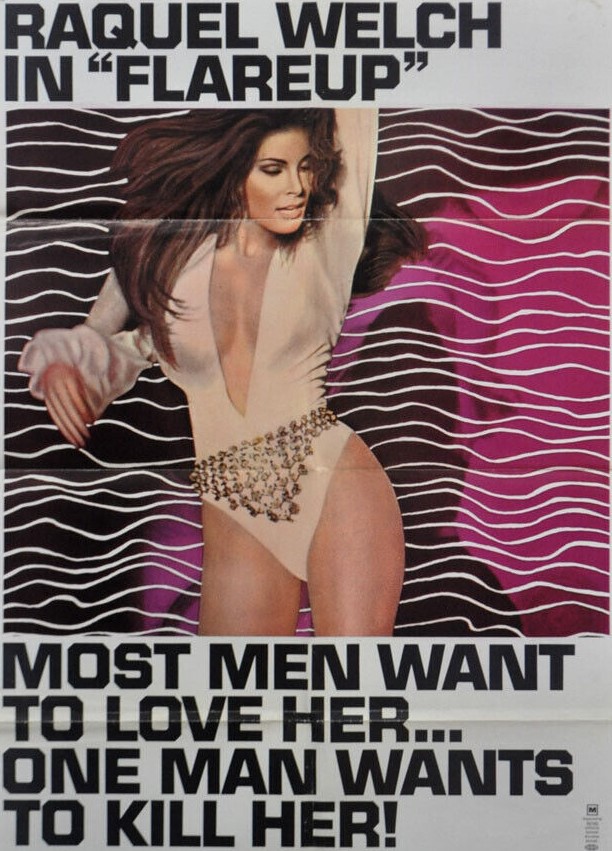
In between the umpteen shifts in plot, which basically lurches like a ship in a storm, the screen is ablaze with color. Nobody complained much when Raquel Welch found it necessary to change her bikini ever few seconds, or that a musical required continuous costume changes, and Modesty here seems to have fallen into the same pattern, the changes in outfit often so swift you imagine she has a disorder.

And be warned, this is a poster film for Pop Art, so if it’s not clothes that are being swapped, it’s décor. You might put Terence Stamp’s blond barnet in the discordant category. You can’t really complain about the plot because espionage storylines are usually something of a conjuring trick with the impossible little more than a standard mission. There’s much to enjoy if you’re of a mind and subscribe to one of the four ideas outlined in the opening paragraph and like the idea of the otherwise critical darling Joseph Losey (Accident, 1967) giving way to stylistic overkill.

Monica Vitti (Girl with a Pistol, 1968) inhabits the role with the necessary verve though Terence Stamp (The Collector, 1963) looks as if he has walked into a spoof and Dirk Bogarde (H.M.S. Defiant / Damn the Defiant!) appears still in experimental mode, having dumped the British matinee idol, unsure of what his screen persona should be. Evan Jones (Funeral in Berlin, 1966) is generally to be blamed/praised for the screenplay.

A movie for which the word confection was invented.

Behind the Scenes: “The Train” (1964)

A juggernaut of problems was coming down the track – director sacked, over a year in production, script changing by the minute, way over budget, star Burt Lancaster, his public halo slipping after being caught escorting women who weren’t his wife,  earning only 20 per cent of his normal $750,000 fee in order to pay off his massive debt to United Artists. And yet it set the template for “hi-tech shoot-em-ups” such as First Blood (1982) and Die Hard (1988), action pictures where a lone hero saved the day against overwhelming odds.

Lancaster’s hot critical run, Oscar winner for Elmer Gantry (1960), nominated for The Birdman of Alcatraz (1962), had turned sour with Luchino Visconti’s The Leopard (1963). Financially his career had hit an iceberg.

As part of the producing triumvirate of Hecht, Hill and Lancaster, responsible for pictures like Marty (1955), Trapeze (1956) and The Sweet Smell of Success  (1957), he found himself in a financial hole, only bailed out when United Artists picked up the tab for the company’s accumulated debt, the actor paying it back with a four-movie deal for which he was remunerated to the measly tune of $150,000 each, a contract he described as “slavery.”

The Train was third on that agenda. It was a risk for United Artists, its first venture into the complex world of the European co-production, this time teaming with French outfit Les Films Ariane. At that point, Lancaster was still considered a creative powerhouse, if not the actual producer, then carrying out a great deal of that function.

Walter Bernstein (Fail Safe, 1964), who had worked with Lancaster on Kiss The Blood off My Hands (1948) and  described the actor as “the gorilla on the bus,” was the only one of the original trio of screenwriters – the others being Franklin Coen and Frank Davis – not to receive a screen credit. It was based on a true story, a book Le front de l’art (1961) by Rose Valland. According to that narrative, Germans did try to transport by train a haul of Impressionist paintings. But it was bureaucracy and not the lone hero which prevented it reaching Germany.

But initially, the script had little traction, shelved  by the studio until Arthur Penn (Mickey One, 1965) happened upon it. The director’s curiosity was piqued by what he perceived as the peculiar French trait of being willing to risk their lives for art. Penn targeted Lancaster as capable of generating “a certain kind of French sensitivity to the idea of art needing to be protected.” When Lancaster signed on, it was with the proviso Penn direct.

The movie went into production in August 1963, a 15-week schedule, and cooperation from the Louvre, French National Railways, French Army and with a contingent of 40 rail cars. Shots of Nazis in Paris were shot very early in the morning so as not to upset Parisians. The production was based in a small village close to Paris.

Turned out Lancaster and Penn were at odds from day one. Pestered to show “vulnerability” Lancaster decided to show the director “the grin.” Penn only lasted a day, technically two if you include that the following day was a holiday. By 11pm that night Penn was gone. John Frankenheimer who had directed Lancaster in three previous movies, The Young Savages (1961), The Birdman of Alcatraz and Seven Days in May (1964), was his replacement.

Bernstein quit. Lancaster told the writer, “Frankenheimer is a bit of a whore, but he’ll do what I want.”

Why Lancaster didn’t want to make Penn’s version – a quieter film about art (the train didn’t leave the station till about 90 minutes in) – was down to the commercial and critical failure of The Leopard. He needed a hit. And having gone down the arthouse Visconti route, the actor wanted to return to his action roots.

Lancaster showed where the power truly lay. As part of Frankenheimer’s deal, he received a Ferrari; Lancaster told him to keep UA at bay by complaining about the color. Frankenheimer did better than that. He negotiated a credit that read “John Frankenheimer’s The Train.” He evaded French laws that demanded a co-director on set and he received final cut, not to mention a bigger budget.

Production shut down while Lancaster and Frankenheimer hammered out a new script, one that called for, among other things, a 70-ton locomotive, a complete station, more boxcars, signal tower and switch tower as well as a ton of TNT and 2,000 gallons of gas to create the 140 separate explosions for a one-minute sequence that took four months to plan. One of the most striking shots, where the locomotive smashes free and provides a terrific close-up of the upended train wheels spinning, was achieved by accident. Once all the plans were agreed, production was delayed again because winter conditions meant the ground was too hard to safely detonate explosives. The budget doubled to $6.7 million.

Some goodwill was involved. The French welcomed the idea of UA destroying a marshalling yard because it saved them the cost of doing it.

Shooting restarted in Spring 1964. But the schedule was cut to seven weeks, though that include the strafing sequence. You may remember Lancaster had to lug around a wounded leg. That was a clever accommodation. The actor had incurred a knee injury so wouldn’t it be a good idea to find a reason for him to limp such as being wounded. Circumstances – other movies taking precedence after the long lay-off – resulted in the death of Michel Simon’s character.

Injury didn’t tend to hamper Lancaster’s physicality. He runs, jumps, climbs, falls downhill. Said Frankenheimer, “Burt Lancaster (aged 50 mind you) was the strongest man physically I’ve ever seen. He was one of the best stuntmen who ever lived.”

The ending was conceived late in the day. Originally, it was going to be a proper shoot-out. But the idea of Paul Schofield with a gun going up against Lancaster was deemed “ridiculous” so, in effect, the snob German “talked himself to death.”

Reviews were mixed and many found the film too long, one critic complaining, the train “pretends it’s going somewhere and…isn’t.” But somewhere along the way, Lancaster invented the modern action hero.

It didn’t do him much good. The film failed at the U.S. box office but (as Roy Stafford has reminded me) it was in Top 13 in the UK and top 5 in France so there’s a fair chance it at least broke even and may well have gone into profit. Lancaster, forced by UA into making The Hallelujah Trail (1965), another box office calamity, lost out on The Spy Who Came In from the Cold (1965) and Khartoum (1967)

SOURCES: Kate Buford, Burt Lancaster, An American Life, (Aurum paperback, 2008) p230, 234-240; John Frankenheimer, A Conversation with Charles Champlin (Riverwood Press, 1995); Charlton Heston, In the Arena (Simon and Schuster, 1995), p315; Tino Balio, United Artists, The Company That Changed the Film Industry, (University of Wisconsin Press, 1979)  p279; Arthur Penn Interviews (University Press of Mississippi, 2008) p15, p45; Matt Zoller Seitz, “Those Hi-Tech Shoot-‘Em-Ups Got the Template from The Train,” New York Times, Apr 30, 1995;  Lancaster interview, New York Post, Mar 22, 1965; Jean-Pierre Lenoir, “Stalling a Great Train Robbery,” New York Times, November 3, 1963.

The Train (1964) ***

Director John Frankenheimer (The Gypsy Moths, 1969) tackles the movie’s off-putting central issue straight on. At various points, characters argue whether it’s worth risking lives to save a bunch of paintings, even if they are by masters like Cezanne, Matisse and Manet and even if they do constitute the “pride of France.”

Had this been an ordinary heist, some master criminal conspiring to steal a trainload of paintings, the loot would not have been so contentious, as there was little chance of lives being lost. And in any case, thieves, in the act of stealing, do have to accept that they might fall prey to the cops or, as commonly, fellow members of the gang.

There was another point. Art, then and now, was commonly perceived as a high-class aspect of life, especially once it diverted away from easily understood portraits and still lifes into the specific styles of a Monet or Picasso. Working-class people had little interest in it and felt excluded from it.

So, from the French perspective, coming towards the end of World War Two, post-D-Day and Paris close to being liberated, upper-class German Col von Waldheim (Paul Schofield) decides to hijack the contents of a museum and take hundreds of masterpieces to Germany, ostensibly to fund the fightback against the invaders, but more likely just a final act of a conqueror who has enjoyed, rather than destroyed, the captured French capital.

At first, station master Labiche (Burt Lancaster), while complicit in minor sabotage, has no interest in becoming personally involved, especially with liberation so close and the threat of death lifting by the hour. Others take a much more patriotic stand over the paintings and endeavor in small ways to prevent the trainload’s departure and slow down its progress to Germany.

A whole battalion of German soldiers, including Von Waldheim, who has commandeered a train in the first place, and railway workers, are aboard. But not all are in agreement with their commander’s aims, his deputy Major Herren (Wolfgang Preiss) outspoken in his opposition to this waste of manpower and diversion of energy.

Von Waldheim blames Labiche for the minor sabotage and forces him to take personal control of the train. And it turns out Labiche is much more than a bureaucrat, and knows everything there is to know about driving a train and how the tracks operate. And eventually it becomes a game of cat-and-mouse between Labiche and Von Waldheim.

But before that occurs and the movie really takes off, there’s tons of stuff that come into the sub-genre of a sub-genre category, to the delight of a railway-spotter but the irritation of the general audience as we are treated to endless scenes of the train running through the country or stopping and starting and points being switched. All very fascinating in its own way, but tending to the tedious.

I’m a bit pernickety when it comes to the heist picture and I’m just wondering how the Resistance, in what appears to be very short notice (in real time the movie only lasts a few days) to arrange for railway stations and towns along the route to manage to make massive signs, some I would guess 30-40ft long, to convince Von Waldheim he is taking the route he expects rather than being diverted along a different track. And then to get word to the Allied forces not to bomb a train that had a whitewashed roof. Try explaining the contents to an Army that is trying to get on with winning the war and couldn’t be less concerned about what might be interpreted as misplaced pride.

You would imagine that if those actions could be so easily carried out that there might have been a proper Resistance troupe ready to assist in blowing up the engine, but safeguarding the coaches, along the way. As the toll of ordinary Resistance members mounts, it’s left to Labiche, decidedly not an art lover, to save the day.

And that’s when the film does take off. He’s the most enterprising of individuals, managing, despite being wounded, to single-handedly derail the train twice, even with soldiers hounding him over the hills and patrolling the track.

Burt Lancaster (The Gypsy Moths, 1969) is superb as the doubter who becomes committed to the cause. It’s easy to forget just what a range Lancaster has. There’s not every actor you would believe when he’s twisting wires in the complicated business of setting an explosion or hammering loose sections of track. To slip effortlessly from the nuance and privilege of Luchino Visconti’s  The Leopard (1963) to the hard muscular graft of this is quite an achievement.  

Paul Schofield (A Man for All Seasons, 1966) was far more virile than his later screen persona suggested. He was a classic example of why Hollywood raided Britain, especially for villains. Outside of the stage, he was virtually unknown, only two previous films in the 1950s, so he was a fresh face. He didn’t quite master the art of cinema, a bit prone to shouting and facial expressions verging on the combustible. But he proves an excellent and inventive adversary.

It’s another for the futility of war department and it’s ironic that it’s the mutinous Maj Herren rather than the French who decides lives are not worth losing over a bunch of paintings.  

The action, when it finally emerges from the trainspotting, is excellent. But a bit of judicious pruning in the earlier stages would have worked wonders.

Discover WordPress

A daily selection of the best content published on WordPress, collected for you by humans who love to read.

The Atavist Magazine

by Brian Hannan

WordPress.com News

The latest news on WordPress.com and the WordPress community.