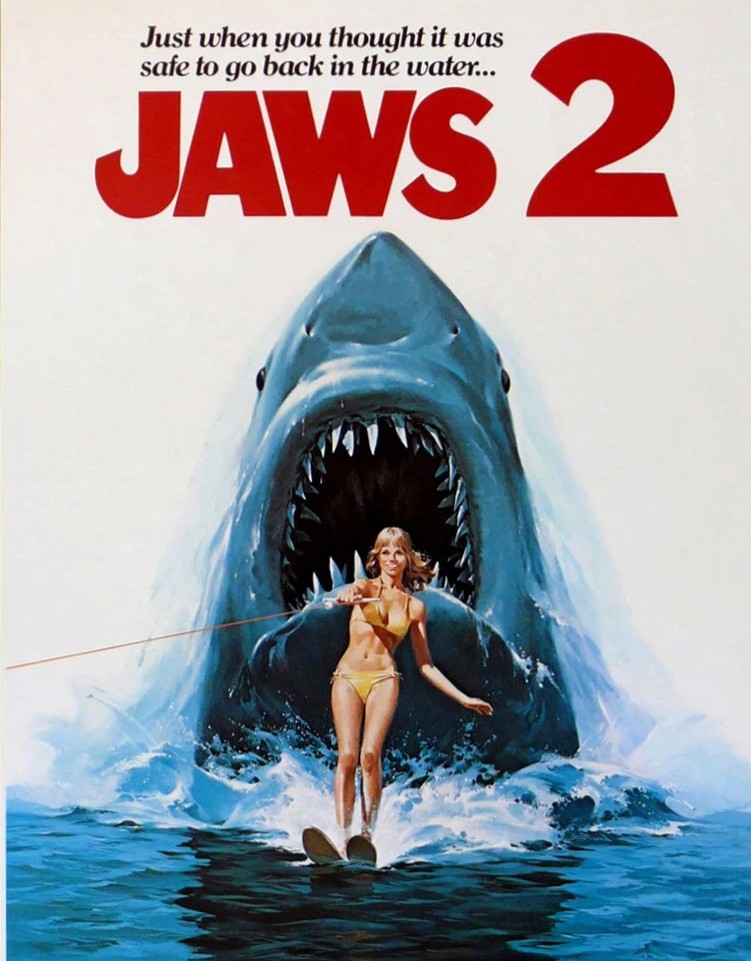
When your movie is best remembered for its tagline “just when you thought it was safe to go back into the water” – you know it’s in trouble. And although this is the best of the sequels, that’s a low bar. Possibly, studio Universal couldn’t have care less, given its performance at the box office, setting the weekend record and topping the annual box office league, with more receipts due when it was paired with the original in a reissue double bill.
The main problem isn’t that wunderkind Steven Spielberg avoided the project and deprived the movie of visual class. Or that original director John Hancock (Let’s Scare Jessica to Death, 1971) was axed in favor of Jeannot Swarc (Bug, 1975). But that the screenwriters took their eye off a very interesting ball and placed the emphasis on the kind of really annoying screaming teenagers you were begging for the shark to gobble up.
We already knew that Chief Brody (Roy Scheider) couldn’t swim but it turns out he’s next to useless in handling a boat and has never learned the most basic navigational skills. In some sense not surprising given his last voyage was unadulterated terror. But you might have thought he’d try better to acclimatize himself to the island’s ways and take a basic seamanship course.
Already, the movie sets the tone of him shifting towards the demented as, obsessed with the arrival of another great sea beast, he scares the hell out of beachgoers by blazing his six-shooter at a harmless tuna, this setting him firmly at odds with the community hierarchy who are involved in some money-making construction project.
We’ve leaned in pretty much to his emotions, the fear of a repetition of the previous incident, and the dissolution of his character as he falls apart under the pressure. So what better than to strand him in the middle of the ocean, barely able to master a boat, and completely lost and having to go mano a mano against a great white in a downscale version of The Old Man and the Sea.
Instead, having not bothered to flesh out the characters of any of the boating youngsters beyond that they were in the main cast for their physical attributes and for passing with flying colors the scream test, we are stuck with them for too long. Of course, you can make the argument that all the audience wants to see is a lot of chomping and a bunch of teenagers fits the bill as abundant prey, but that’s to deny the impact of just threat rather than gore that Spielberg achieved with his masterpiece.
It’s obvious why composer John Williams steered clear of his iconic Jaws theme because there just wasn’t sufficient threat to pin it on. Of course, we don’t need a know-it-all shark expert because the audience already received as much education on that score as was required via the previous iteration. But we sure do miss an old seadog like Quint.
Half the way in, I thought – not having seen it since it came out and my memory of that restricted to the tag line – this has all the makings of a very decent sequel with the emphasis at that point on Brody’s disintegrating character. Heap it on, I was almost yelling at the screen, put him through more angst and terror, get him out there alone with the shark and figure out a way to survive.
Quite how Brody would have killed off the beast without a deux ex machina in the shape of a seabed electricity cable that somehow the shark with a whole lunch and dinner of helpless teenagers sitting in his immediate line of sight instead heads for said cable because the Chief is able to attract him by beating out a tune on the cable is anybody’s guess. If your screenwriters had exhausted every other notion of how to kill the shark, then for sure, a cable comes in handy, but again that’s a very low bar.
Roy Scheider (Jaws, 1975) gets to be even more swivel-eyed and anxious than before but nobody else makes a mark and even Murray Hamilton, reprising his role as the sleazy mayor, isn’t on screen long enough. I would have stuck him out in the boat with the Chief and let him go through some rite of passage so that he turns into a good guy.
Clearly, Universal was depending on lightning striking twice with neophyte director Jeannot Swarc but he only shows what he lacks compared to Spielberg stuck with a lame screenplay by Carl Gottlieb (Jaws) and Howard Sackler (Gray Lady Down, 1978) which is connected in name only to the Peter Benchley bestseller.
Good up to a point then abruptly capsizes.


Something.
“Shortly after the enormous success of Steven Spielberg’s Jaws (1975, see entry), a 22 Jul 1975 DV news item reported that a sequel was approved for development. Steven Spielberg turned down Universal’s offer to direct, however, stating at the San Francisco Film Festival that “making a sequel to anything is just a cheap Carney trick”, according to a 21 Oct 1975 DV article. By spring 1976, John Hancock was signed to direct, as stated in a 28 May 1976 HR news item.
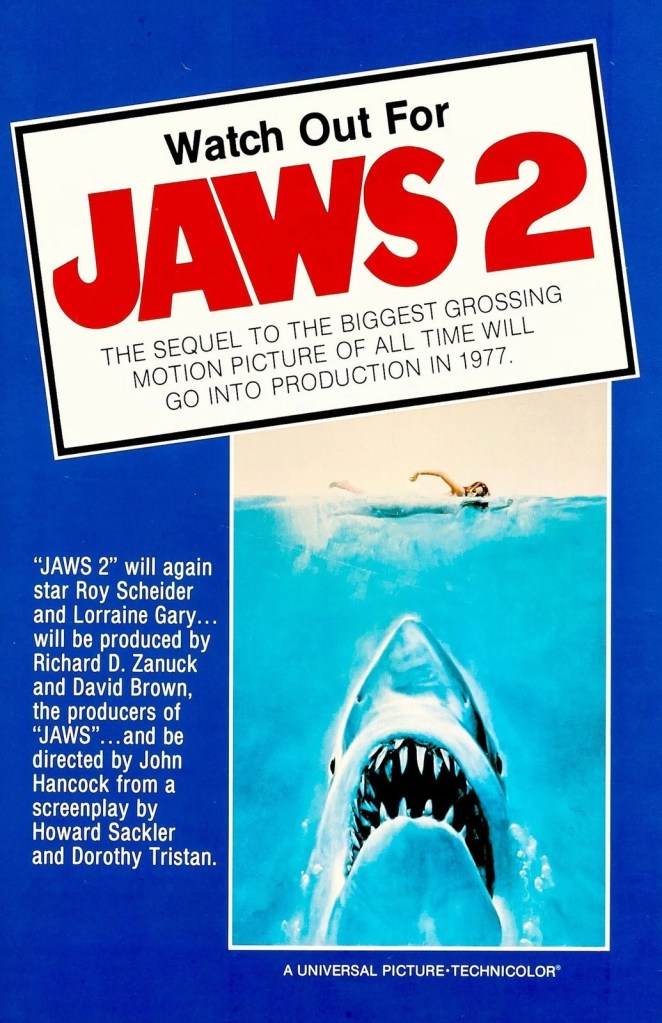
Principal photography was scheduled to begin in spring 1977 in Martha’s Vineyard, MA – the same location the original film was shot. Universal projected a 1978 release according to a 31 May 1976 Box news item. A 13 May 1977 DV article announced a 6 Jun 1977 start date with a projected twenty-week schedule. Filming would begin in Martha’s Vineyard then move to Pensacola, FL. Director Hancock hired his wife, Dorothy Tristan, to re-write Howard Sackler’s early draft of the screenplay.
Susan Ford, the daughter of former U.S. President Gerald Ford, dropped out of college to work on the production as a “special photographer” according to a 27 Jun 1977 Time news item.
A 27 Jun 1977 DV article reported that, three weeks into production, Hancock withdrew from the picture due to creative differences. Although directors John Frankenheimer and Otto Preminger were considered as replacements, and Steven Spielberg offered to step in, himself, “for a hefty fee,” Hancock was replaced by French director Jeannot Szwarc, who was best known for his television work. Screenwriter Carl Gottlieb, who worked on the original Jaws screenplay, was brought in to re-work the script. Gottlieb cut several characters and a few roles were re-cast, including the role of “Mike Brody,” according to a 1 Aug 1977 LAT article. Production resumed 1 Aug 1977 in Navarre Beach, FL with a scheduled fourteen-week shoot. By Oct 1977, filming in FL experienced more delays due to two hurricanes. The budget ballooned from a planned $10 million to an estimated $15 million according to the 9 Oct 1977 LAT article.
As stated in a 26 May 1978 St. Louis Globe-Democrat article, the final budget tally was closer to $20 million, with a promotional budget estimated at over $5 million. Promotions included a novelization of the film released ahead of the film’s premiere. In a rare move, Bantam Books published the first chapter of the book in major newspapers across the nation – including the Los Angeles Times, Washington Post and the Chicago Tribune. The novel was written by Hank Searls, and based on the first version of the screenplay written by Howard Sackler and Dorothy Tristan. Much like the first movie, merchandise was sold in conjunction with the release including: comic books, sneakers, lunch boxes and T-shirts.
According to a 20 Jun 1978 HR news item, Jaws 2 grossed $9,845,910 in its first three days of release, ninety-two percent of the opening weekend tally for Jaws. The film grossed $51,106,742 after five weeks according to a 25 Jul 1978 HR news item.
John Dukakis, the nineteen-year-old son of MA governor Michael Dukakis, made his feature film acting debut in the role of “Polo,” as reported in a 9 Oct 1977 LAT article.”
LikeLiked by 1 person
As plagued by trouble as the original but without any of the genius.
LikeLike