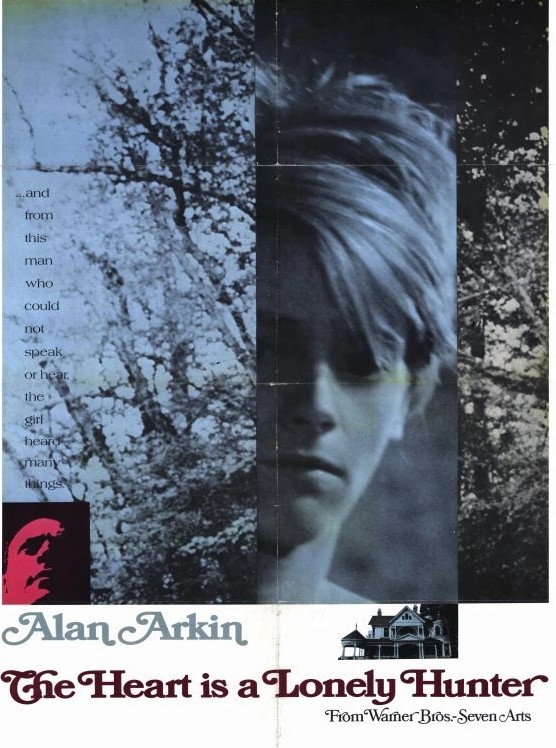
The American equivalent of the kitchen sink drama. Awash with the dispossessed, rejected, oppressed and underprivileged. You’re not going to be more of an outsider in the U.S. of the 1930s than to be a deaf mute or, worse, a mentally challenged deaf mute who can’t see a tasty cake in a baker’s shop without indulging in a bit of smash-and-grab.
By this point the Deep South had fallen out of favour. Adaptations of Tennessee Williams plays were now bombing at the box office – even the Burton-Taylor combo couldn’t rescue Boom! (1968) and a previous adaptation of the work of acclaimed novelist Carson McCullers (who wrote this), John Huston’s Reflections in a Golden Eye (1967), with Taylor again and Marlon Brando, had proved a commercial disappointment. Otto Preminger’s Hurry Sundown (1967) with Michael Caine and Jane Fonda did only marginally better.
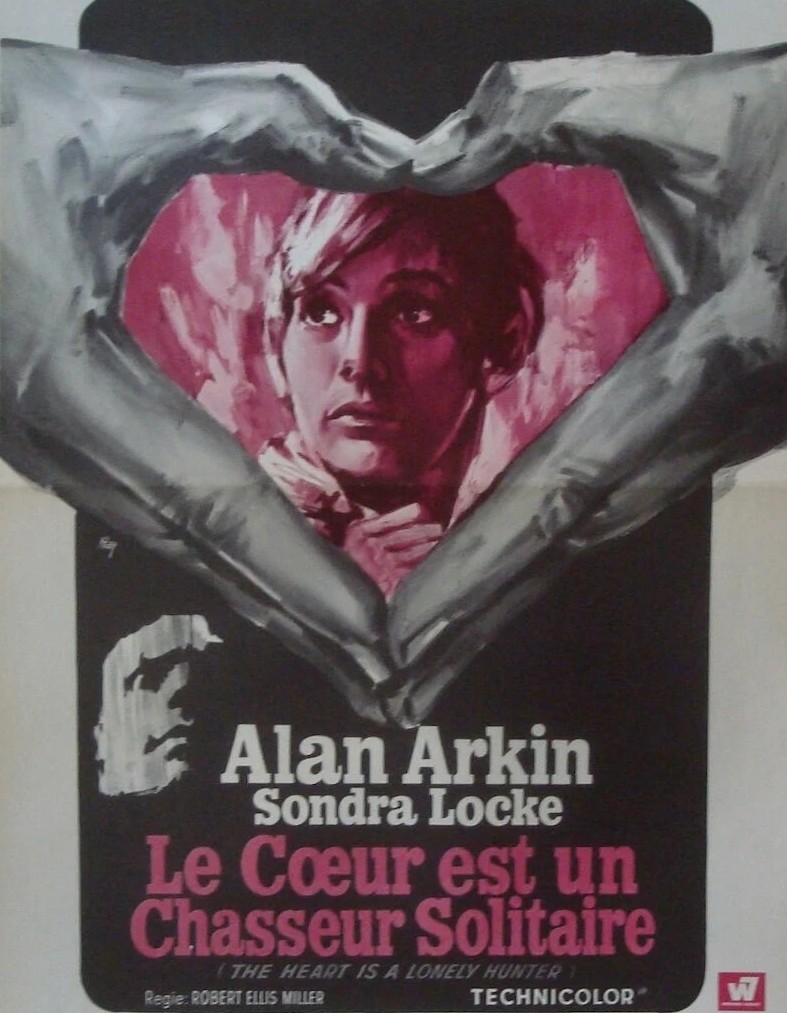
While on paper it’s unremittingly bleak, in reality it’s loaded down with the mawkish and the sentimental, as the characters struggle to fit in, fail to establish lasting relationships or are abandoned. Given he is playing a character, John, who can’t talk, star Alan Arkin is forced to abandon those irritating vocal tics.
John, an engraver, has befriended Spiros (Chuck McCann), the deaf mute with the sweet tooth. When Spiros is institutionalized, John moves town to be near him, taking up residence in the Kelly household. As the result of a recent injury, Mr Kelly (Biff McGuire) is forced to take in a boarder, his teenage daughter Mick (Sandra Locke) giving up her bedroom to accommodate the stranger.
There’s not much of story, John acting as a narrative conduit around whom various situations and characters revolve. John mostly fails to win over the resentful Mick but befriends alcoholic drifter Jake (Stacy Keach) and African American cancer ridden Dr Copeland (Percy Rodriguez).
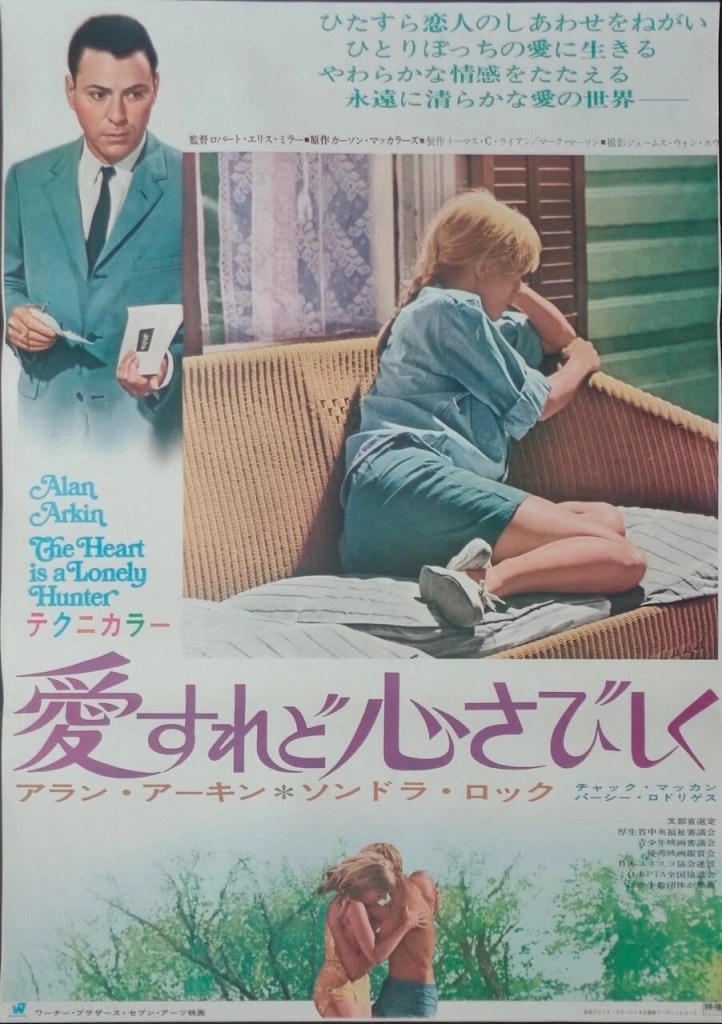
Copeland’s daughter’s husband has his leg amputated after being wrongly imprisoned. Mr Kelly ends up disabled, meaning Mick has to take a job to support the family rather than go to college. When she loses her virginity, you expect she’s going to end up pregnant, but, luckily she’s the only one whom fate favors. Unable to cope with the institute, Spiros rebuffs John’s friendship and, thoroughly depressed, gives up the ghost and dies. John commits suicide. We only later discover that Mick had fallen in love with his gentle nature.
So not what you’d call a feel-good picture. Nobody’s going to escape their situation. If anything, that’s only going to get worse. We’re talking two deaths here and another on the way, one fellow permanently disabled and a girl stuck in a cycle of poverty.
While I didn’t find it unrealistic or forced, I wasn’t as taken with it as I expected. It felt like a Charles Bukowski picture, minus the degradation, where the actors and director were given a free pass because they were putting the spotlight on an area of existence normally ignored by Hollywood. But it just felt too worthy. Beyond their indignities, none of the characters really took flight.
But don’t take my word for it. The Academy didn’t. Both Alan Arkin (The Russians Are Coming, The Russians Are Coming, 1966) and Sondra Locke, in her debut, were Oscar-nominated.
Prior to this, only a handful of pictures dealt with deafness. James Stewart, deaf in one ear in It’s A Wonderful Life (1946), Jane Wyman, winning an Oscar for Johnny Belinda (1948), and The Miracle Worker (1962), Anne Bancroft picking up an Oscar here, were the best known.
Robert Ellis Miller (Bachelor Girl Apartment/Any Wednesday, 1966) could have done better to steer clear of the obvious sentimentality. Written by Thomas C. Ryan (Hurry Sundown, 1967).

 The Magnificent 60s
Here is a bunch:
“The 14 Jun 1950 Var announced that documentary producers William and Helen Levitt, Sidney Meyers, and Janis Loeb were embarking on their first 35mm theatrical feature, an adaptation of Carson McCullers’s first novel, The Heart Is a Lonely Hunter, a critically acclaimed 1940 best-seller. The four were “currently dickering for outside financing” for what they estimated to be a $200,000 film.
Eleven years later, stage director Jose Quintero hoped to shoot The Heart Is a Lonely Hunter as a low-budget independent film, from a script by British screenwriter Gavin Lambert, according to the 11 Oct 1961 NYT and 12 Oct 1961 DV. Quintero wanted to film in the South, and expressed interest in hiring actors Paul Scofield, Zero Mostel, and Montgomery Clift. Two years later, the 1 Mar 1963 DV and 21 Apr 1963 NYT reported that producer David Susskind had taken over the project, but had a new screenplay by Thomas C. Ryan. Susskind planned to shoot The Heart Is a Lonely Hunter in New York City with director Sidney Lumet, and said that Zero Mostel and Montgomery Clift were still interested, as was Peter Falk, who flew to New York to discuss one of the roles with Lumet. Clift, as “John Singer,” was the linchpin of the production, but because of his erratic behavior and bad health, no insurance company would cover him. Several months later, as noted in the 23 Aug 1963 DV and 17 Nov 1963 Var, independent producer Ely Landau optioned the project as part of a three-picture deal with Sidney Lumet, and shooting was initially set to begin in New York City on 16 Sept 1963. Warren Beatty was “tentatively set to star,” but the project was held up indefinitely. Nothing came of any of these projects.
Four years later, the 8 Feb 1967 Var announced that television producer Marc Merson’s Brownstone Productions had taken over the film rights to The Heart Is a Lonely Hunter with the intention of shooting Thomas C. Ryan’s original script, with Ryan co-producing. Filming would begin in Georgia in Sep 1967, and New York stage actor Alan Arkin, who was suddenly “hot” because of his comic role in the popular The Russians Are Coming! The Russians Are Coming! (1966, see entry), was set to play John Singer. Ryan told the 26 Mar 1967 NYT he wrote the screenplay five years earlier, but “deeply believed in” the novel long before that. McCullers’s story “is a thing of beauty and truth and we hope to capture this in the film,” he said. Alan Arkin was also an admirer of the book, and “jumped at the chance to play Singer,” according to producer Merson. Although the 1 Jun 1967 DV broke the news that the project’s new producer, Warner Bros.-Seven Arts, Inc. had tapped Mark Rydell to direct the $1-million film, Merson hired Joseph Strick. For the important role of “Mick,” described as an “unspoiled, 14-year-old tomboy, not beautiful but appealing, not grown up but not a child,” Strick and casting director Marion Dougherty sidestepped the usual crop of polished, professional teen-age actresses by holding a “cattle call” in New York City, open to everyone. The 13 Jul 1967 NYT reported that “165 unknown and would-be actresses” auditioned on the first day. A month later, according to the 16 Aug 1967 Var, Dougherty set up further auditions in Atlanta, GA, as scouts looked for locations around the state, especially in Savannah and Carson McCullers’s hometown of Columbus, where the story took place. Filming was set to begin in Sep 1967 and last for six to eight weeks.
By the following month, however, the company moved to Selma, AL, a town of 28,000 people and turn-of-the-century neighborhoods that had not changed much over the years. Selma was notorious for its “Bloody Sunday” during the Deep South’s “Voting Rights Movement” in 1965, when county deputies and state troopers attacked marchers with tear gas and clubs. Selma Mayor Joe Smitherman told the 23 Aug 1967 Var that his “peaceful, law-abiding community” expected no difficulties with the production’s “racially-mixed cast,” because everyone was welcome in Selma and would be “treated fairly within the law.” He took the opportunity to compare Selma—“the safest place to be”—with cities in the North, where “you all are burning up the place up there,” referring to several recent race riots. Smitherman convinced the Selma Chamber of Commerce to embrace the film production because of its economic benefits. He also stressed that the film would be “a publicity advantage” to a town known nationally for its segregationist violence. Furthermore, the Depression-era story had “nothing to do with a civil rights story as such.”
The 29 Aug 1967 DV announced a starting date of 18 Sep 1967, but Joseph Strick held up the production over creative differences and finally walked off. Thomas Ryan later told the 10 Dec 1967NYT that Strick “wanted a decidedly homosexual interpretation to [Singer’s] love for the Greek. He saw [the movie] very downbeat, depressing. He even wanted the scenes filmed in gray.” Robert Ellis Miller was sent to Selma to replace him. Comic actor Jackie Vernon, presumably hired to portray “Spiros Antonapoulos,” left the film soon afterward.
Miller, the new director, later told the 1 Sep 1968 LAT that the production had to gain the local residents’ trust. “We went on radio and local TV for interviews nearly every day for the first two weeks to convince them” the film was not being made to “exploit their reputation.” Many citizens went out of their way to display Selma’s positive side. The city fire department lent its new fire engine with an eighty-five-foot crane to director of photography James Wong Howe for a carnival ferris wheel scene. Christmas decorations were removed from the main street during filming. Miller stated that members of the production agreed not to go anywhere the black actors could not go. Upon replacing Joseph Strick, Miller said he “changed the costumes and some of the casting.” He and Ryan also rewrote the script as they went along, and rehearsed the changes with actors at night. Along with Alan Arkin, Miller learned enough American Sign Language to be aware of continuity during editing. An article in the 10 Dec 1967 NYT described the film company’s headquarters as “an old B. F. Goodrich tire store next to the bus depot,” just a few blocks from the Pettus Bridge where state troopers violently stopped Dr. Martin Luther King’s peace march in 1965. One of the main sets, the “Kelly” boardinghouse, was a deserted Victorian residence that rented for $125 a month. Since the story took place during summer, the actors had to wear thin clothing in what was sometimes freezing weather, and occasionally their breath was visible. Lawns were sprayed green. For the role of “Mick Kelly’s” boyfriend, “Harry,” director Miller hired a local college student, Wayne Smith. Also discovered was young Sondra Locke from Shelbyville, TN, who drove to Birmingham, AL, for a casting call and was then taken to New York City for a final audition. Actress Bonnie Bedelia confided to the 8 Oct 1967 LAT that “they decided I was too old” when she auditioned for the same part as Locke. As it turned out, Bedelia was four years younger than Locke, who had lied about her age in order to more appropriately portray the fourteen-year-old tomboy.
Along with Sondra Locke and Wayne Smith, Stacy Keach, Jr. made his theatrical film debut in The Heart Is a Lonely Hunter. He thereafter dropped the “junior” from his name.
Just as production began, Carson McCullers, who had been in a coma for several weeks, died in Nyack, NY, on 29 Sep 1967 at the age of fifty.
The film had a twin world premiere at two New York City theaters on 10 Jul 1968, the 11 Jul 1968 DV noted. Critical reception was mixed. The 30 Jul 1968 DV called it “fragmented episodic melodrama, with uneven dramatic impact and formula pacing.” The 1 Aug 1968 NYT commented that the script did not satisfactorily update the 1940 novel at a time when race relations in the segregated South were changing, and that “accommodating modern sensibilities” and “political awareness” to the story weakened the plot and the characters’ motivations. When the film opened on 20 Nov 1968 in Los Angeles, CA, that day’s LAT declared that “despite some marvelous performances, something has been lost in the translation from Mrs. McCullers’ novel.” The film did reasonably well at the box office, and the 1 Jan 1969 Var reported that the film was breaking even on its modest budget.
The film received two Academy Award nominations for Best Actor (Alan Arkin), and Actress in a Supporting Role (Sondra Locke).”
LikeLiked by 1 person
I hadn’t realised it had such a tortuous history. Clift would have been ideal, well worth the health insurance risk. You certainly dug deep for this one. Thanks.
LikeLike