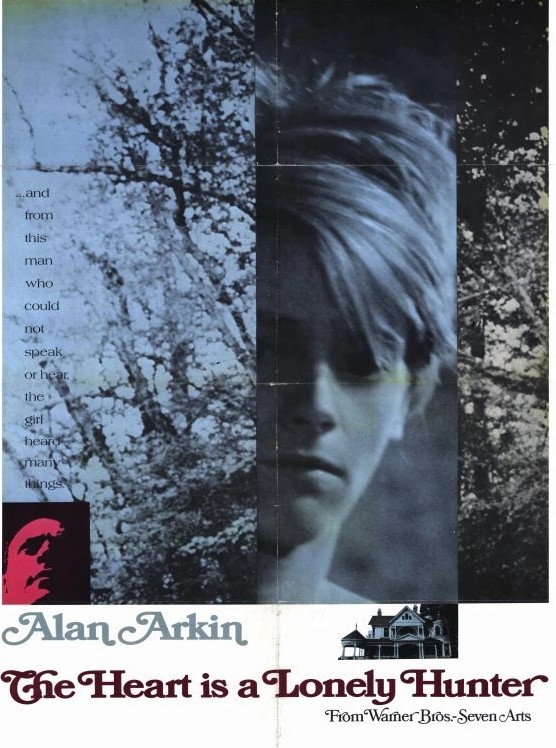
The American equivalent of the kitchen sink drama. Awash with the dispossessed, rejected, oppressed and underprivileged. You’re not going to be more of an outsider in the U.S. of the 1930s than to be a deaf mute or, worse, a mentally challenged deaf mute who can’t see a tasty cake in a baker’s shop without indulging in a bit of smash-and-grab.
By this point the Deep South had fallen out of favour. Adaptations of Tennessee Williams plays were now bombing at the box office – even the Burton-Taylor combo couldn’t rescue Boom! (1968) and a previous adaptation of the work of acclaimed novelist Carson McCullers (who wrote this), John Huston’s Reflections in a Golden Eye (1967), with Taylor again and Marlon Brando, had proved a commercial disappointment. Otto Preminger’s Hurry Sundown (1967) with Michael Caine and Jane Fonda did only marginally better.
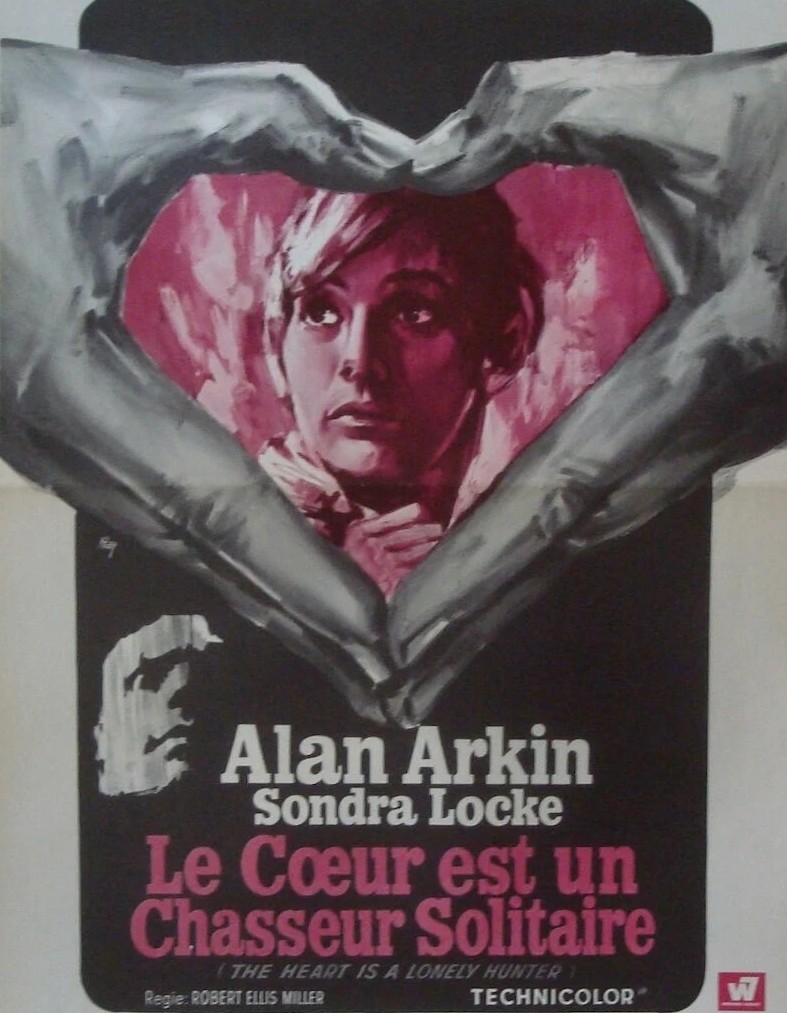
While on paper it’s unremittingly bleak, in reality it’s loaded down with the mawkish and the sentimental, as the characters struggle to fit in, fail to establish lasting relationships or are abandoned. Given he is playing a character, John, who can’t talk, star Alan Arkin is forced to abandon those irritating vocal tics.
John, an engraver, has befriended Spiros (Chuck McCann), the deaf mute with the sweet tooth. When Spiros is institutionalized, John moves town to be near him, taking up residence in the Kelly household. As the result of a recent injury, Mr Kelly (Biff McGuire) is forced to take in a boarder, his teenage daughter Mick (Sandra Locke) giving up her bedroom to accommodate the stranger.
There’s not much of story, John acting as a narrative conduit around whom various situations and characters revolve. John mostly fails to win over the resentful Mick but befriends alcoholic drifter Jake (Stacy Keach) and African American cancer ridden Dr Copeland (Percy Rodriguez).
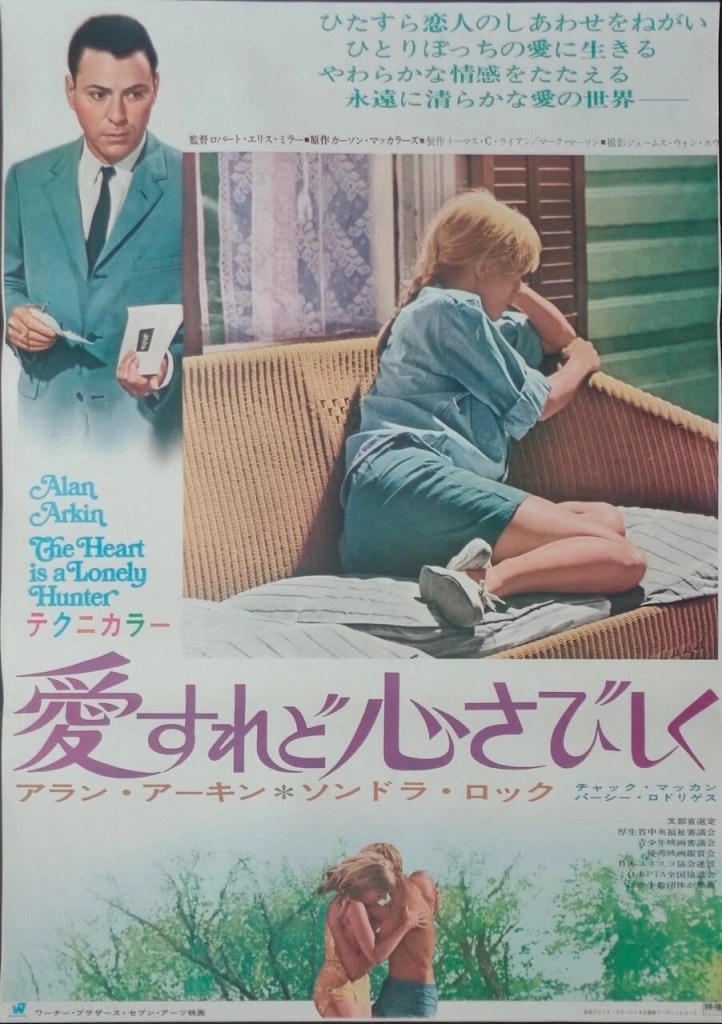
Copeland’s daughter’s husband has his leg amputated after being wrongly imprisoned. Mr Kelly ends up disabled, meaning Mick has to take a job to support the family rather than go to college. When she loses her virginity, you expect she’s going to end up pregnant, but, luckily she’s the only one whom fate favors. Unable to cope with the institute, Spiros rebuffs John’s friendship and, thoroughly depressed, gives up the ghost and dies. John commits suicide. We only later discover that Mick had fallen in love with his gentle nature.
So not what you’d call a feel-good picture. Nobody’s going to escape their situation. If anything, that’s only going to get worse. We’re talking two deaths here and another on the way, one fellow permanently disabled and a girl stuck in a cycle of poverty.
While I didn’t find it unrealistic or forced, I wasn’t as taken with it as I expected. It felt like a Charles Bukowski picture, minus the degradation, where the actors and director were given a free pass because they were putting the spotlight on an area of existence normally ignored by Hollywood. But it just felt too worthy. Beyond their indignities, none of the characters really took flight.
But don’t take my word for it. The Academy didn’t. Both Alan Arkin (The Russians Are Coming, The Russians Are Coming, 1966) and Sondra Locke, in her debut, were Oscar-nominated.
Prior to this, only a handful of pictures dealt with deafness. James Stewart, deaf in one ear in It’s A Wonderful Life (1946), Jane Wyman, winning an Oscar for Johnny Belinda (1948), and The Miracle Worker (1962), Anne Bancroft picking up an Oscar here, were the best known.
Robert Ellis Miller (Bachelor Girl Apartment/Any Wednesday, 1966) could have done better to steer clear of the obvious sentimentality. Written by Thomas C. Ryan (Hurry Sundown, 1967).

