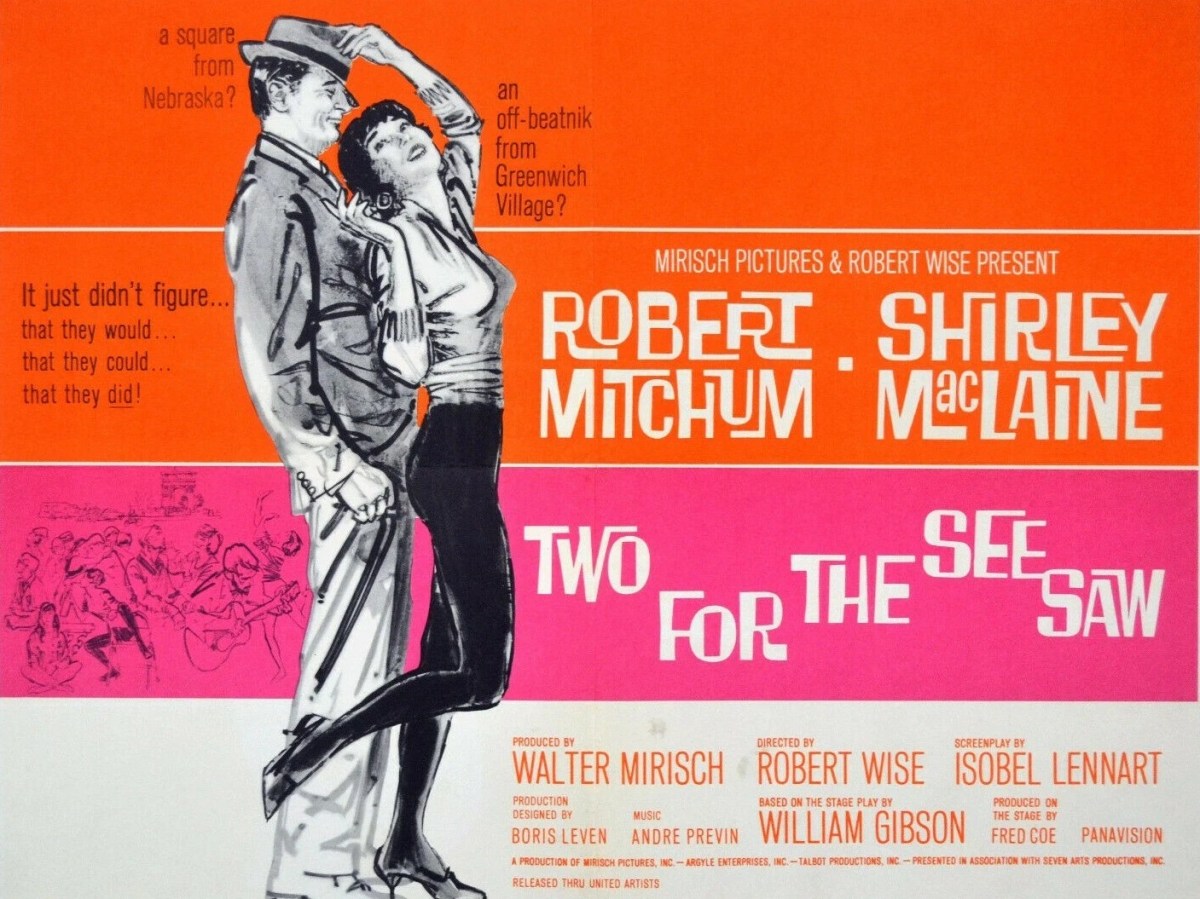
Whatever chemistry Robert Mitchum and Shirley MacLaine enjoyed in real life – they embarked on-set on an affair that lasted three years – does not come across on screen. Of course, we’re accustomed to the adage that opposites attract and this screen couple Jerry Ryan (Robert Mitchum), a lawyer running away from his marriage, and bohemian dancer Gittel Mosca (Shirley MacLaine) seem particularly ill-matched.
For a contemporary audience this gets off to the oddest of starts. There’s no meet-cute. If there’s something else we’re accustomed to these days it’s a clever, intriguing, smart or even dopey meet-cute. They barely acknowledge each other at first encounter, at the kind of party where intellectuals arguing obscure points of art or politics mingle with what would pass in those days for the in-crowd.
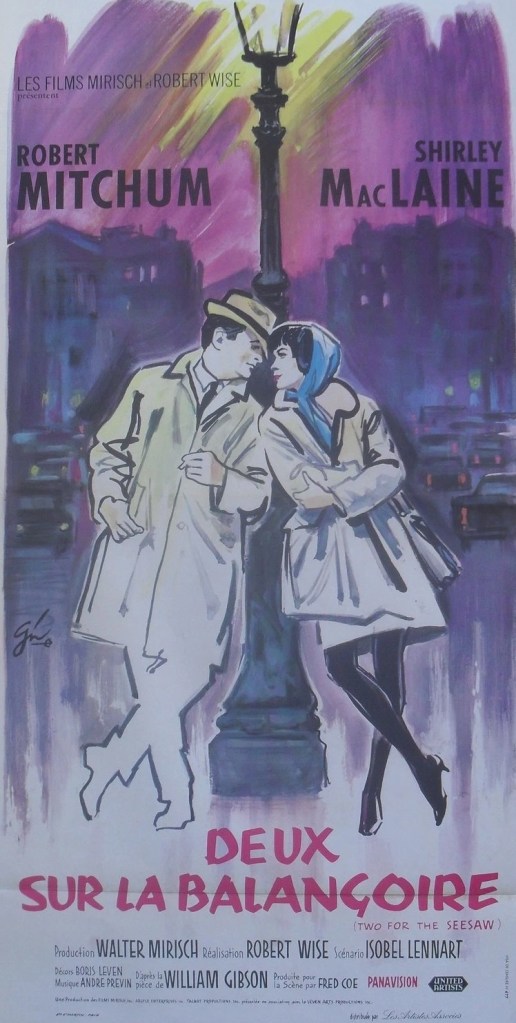
He couldn’t be more out of place, turning up at a trendy event in a trenchcoat, and he’s only there because he is friends with party host, artist Oscar. They exchange one line. It’s not as though that’s a zinger either. But, on an odd pretext, he pursues her.
Now any ditzy dame is going to run a mile from a stranger who has made virtually no impression on her and can hardly make up his mind whether he wants to see her or not and to whom she only relents when he tells her what a lonely spud he is. So it’s a big narrative hole to dig the audience out of. We establish that she’s good-hearted, but we already know he traipses around the streets of New York doing nothing and lives in a shoddy apartment.
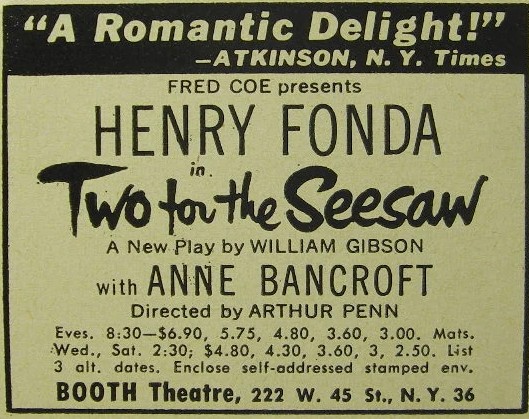
This derived from a Broadway hit and although director Robert Wise attempts to open it up it appears acutely stage-bound, but lacking the dialog zip that marked out such numbers as Barefoot in the Park (1967).
Despite MacLaine’s appealing screen personality, and the tremendous work she did establishing herself as a marquee name via The Apartment (1960), this is more of a romantic drama than a comedy, two ships (somewhat distantly) that pass in the night only to discover not only have they little in common and with opposite personalities but that he is having second thoughts about his impending divorce.
He doesn’t quite settle in New York and she hasn’t made it there. In some respects, they are too similar, emotional losers. She lacks the zap to make this work and he’s just too aggressive and quick with the put-downers to come across as a lonely guy. Once he found work – as an attorney – he’d have a swathe of dames on his trail.
He commits the mortal sin of the meet-cute romance by slapping her around. Although by this point I doubt if audiences went much for the idea of the unlikely couple getting it on. With a little financial help from him, she manages to make a success of herself, but in a business rather than an artistic sense, and you get the impression she’s going to end up as the joke in a tale he’s going to tell his buddies when he gets back home to Omaha, Nebraska.
It just seems too contrived a set-up to work. Turns out he’s going through a mid-life crisis – he spends a good deal of time just moping – and has been too indulged most of this life.
She’s more convincing, the type of free-spirited gal who, though street-smart is other ways, always falls for the wrong guy, unable to rein in her generosity of heart and waste her emotions on men who demand too much of her, including that she rein in that generosity of heart and free spiritedness.
For a May-December romance (she’s 17 years younger) it’s too weighted down by the dour. In recent years, Mitchum had appeared at his romantic best when up against a sprightly star like Deborah Kerr (Heaven Knows, Mr Allison, 1957, and The Sundowners, 1960) who could more than hold their own, rather than a relationship where, apart from his depression, he needs to have the upper hand.
Mitchum appears miscast and the flaw in the ointment. MacLaine, despite or because of the character’s flaws, is much more believable.
Robert Wise (The Sound of Music, 1965) directs from a script by Isobel Lennart (The Sundowners) based on the William Gibson play.
Hard going. Fans of MacLaine should be satisfied enough. Fans of Mitchum less so.


For you:
“The 18 May 1962 NYT reported that the Mirisch Company acquired motion picture rights for William Gibson’s 1958 stage play at the request of Elizabeth Taylor, who was interested in playing the character, “Gittel Mosca.” Taylor’s long-running obligation to Cleopatra (1963, see entry) rendered her unavailable and she was replaced by Shirley MacLaine. The 13 Jan 1961 LAT announced Glenn Ford as MacLaine’s leading man, before the role was assigned to Robert Mitchum, as noted in the 23 Mar 1961 LAT. Six months later, the 20 Sep 1961 DV stated that filming would be delayed until the following year. James Garner was temporarily considered to replace Mitchum. According to the 25 Sep 1961 DV, William Wyler was the producers’ first choice for director, but he declined in favor of a year-long vacation. Within two weeks, the 9 Oct 1961 DV reported that the position was filled by Robert Wise. Days later, he left for New York City to scout locations, as noted in the 13 Oct 1961 DV.
The 21 Dec 1961 DV reported that the current draft of the screenplay raised no objections from the Production Code Administration (PCA). The 8 Jan 1962 DV noted that, prior to filming, Shirley MacLaine prepared for her role by rooming with a resident of New York City’s Greenwich Village. A news item in the 23 Jan 1962 DV indicated that rehearsals were underway in Los Angeles, CA. According to the 29 Jan 1962 DV, wide-angle Panavision lenses were employed to capture the image of two adjacent apartments. One week later, the 2 Feb 1962 DV reported that principal photography began 26 Jan 1962 at Goldwyn Studios in West Hollywood, CA. However, production was interrupted soon after to allow Robert Wise to attend a royal command performance in England of his 1961 film, West Side Story (see entry).
Wise told the 12 Feb 1962 DV that the project was budgeted at $3 million, including a total of $350,000 paid to William Gibson, producer Fred Coe, and director Arthur Penn for the stage play, in addition to a percentage of profits. Although the original story featured only two characters, the film would include five additional characters mentioned in the dialogue, along with fifteen peripheral roles. Wise estimated that eighty percent of screen time would be devoted to the two principal characters. At that time, Colin Campbell had recently joined the cast, and producers were in negotiations with actor Larry Gates.
An article in the 11 Mar 1962 NYT stated that the film was shot sequentially “to stress the development of and relationship between the two central characters.” To overcome the cinematic limitations of the intimate setting, Wise photographed the actors using “close-ups and over-the-shoulder shots,” and added movement by having them perform mundane tasks, such as lighting cigarettes or tuning a radio. Shirley MacLaine developed a New York accent with “Jewish inflections” to suit her character, which she intentionally softened as the story progressed. According to the 25 Mar 1962 LAT, she also began every morning with a breakfast of bagels and lox. On 9 Apr 1962, DV reported that two weeks of location filming in New York City were scheduled to begin 10 Apr 1962. Locations included the Brooklyn Bridge, City Hall, the New York Public Library, the Metropolitan Museum of Art, the Bowery district, and Greenwich Village. A coffee house on Fourth Street served as a Chinese Restaurant. The company returned to Los Angeles, CA, on 21 Apr 1962, as stated in the next day’s NYT.
Five months later, the 21 Sep 1962 DV reported that MacLaine and her husband, Steve Parker, attended a preview screening in Beverly Hills, CA. Also in the audience were MacLaine’s brother, Warren Beatty, and actress Natalie Wood. The 15 Oct 1962 DV announced a preview that night at the Academy Award Theatre in Hollywood, CA, followed by an anticipated 26 Oct 1962 screening for the Cinema Editors Guild at Revue (Universal) Studios, as noted in the 17 Oct 1962 DV.
Two for the Seesaw opened 21 Nov 1962 in New York City at fifteen theaters, and on 20 Dec 1962 in Beverly Hills for an exclusive engagement, accompanied by the half-hour documentary, Jacqueline Kennedy’s Asian Journey. A citywide run began 4 Mar 1964. Reviews were mixed, with the 22 Nov 1962 NYT comparing the film unfavorably to its Broadway counterpart.
The 23 Jul 1963 DV noted that the picture would not be released in Japan, where audiences reportedly preferred “action pictures.”
A full-page advertisement in the 4 Feb 1963 DV quoted several journalists who predicted an Academy Award nomination for MacLaine. Although their predictions were incorrect, the film was nominated for Cinematography—Black-and-White, and for the original composition, “Song From Two For The Seesaw (Second Chance),” by André Previn and Dory Langdon.”
LikeLiked by 1 person
I’ve got a Behind the Scenes tomorrow but thanks.
LikeLike