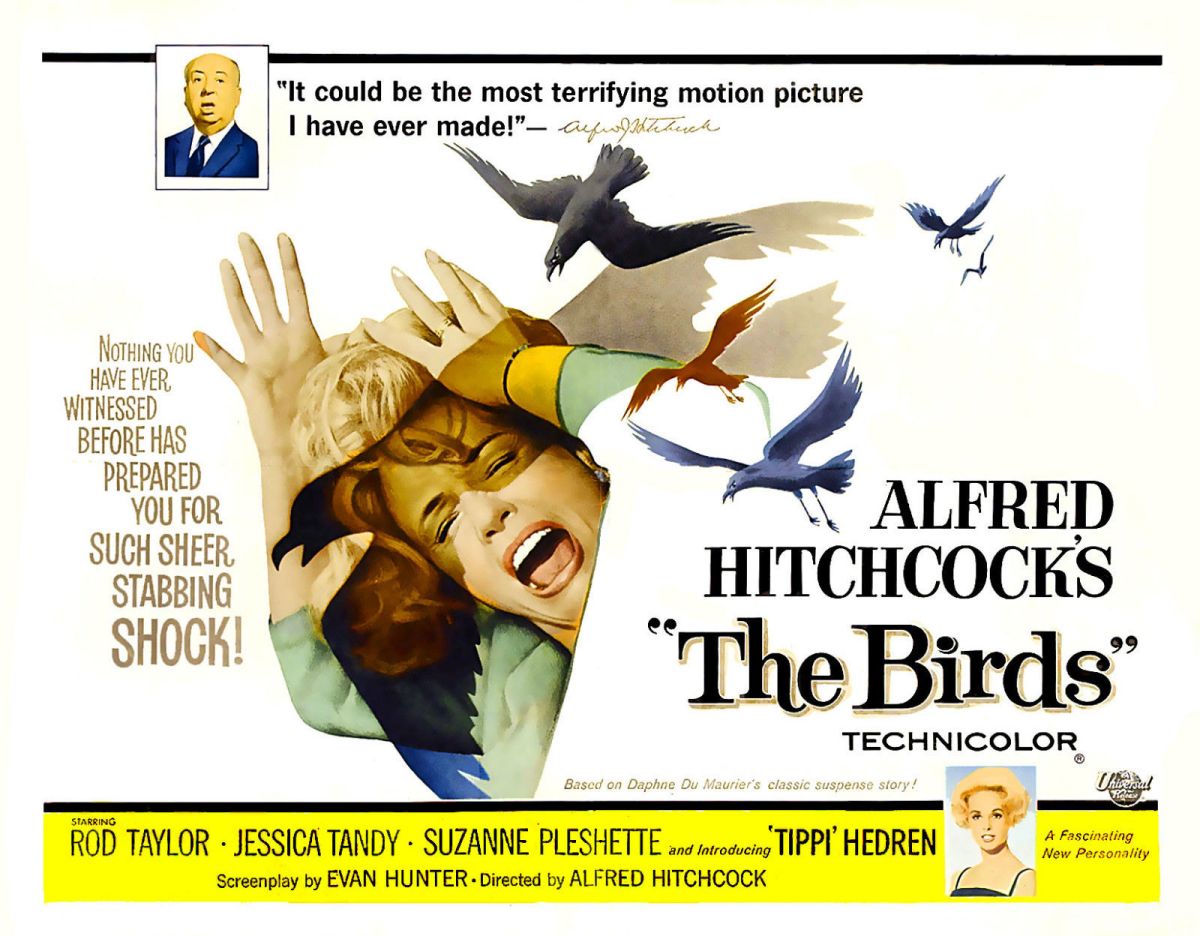
Years ago I was asked to write a book on the six best Hitchcock films and from those choose the one I considered his very best. My choice was The Birds (1963). And it is for these reasons.
Firstly, unusually in the master’s work, there is a proper meet-cute. In most of his films, the couple are either already together (Rear Window, 1954; Torn Curtain, 1966) or when they get together it is for a hidden reason, one is on the run, or being pursued by the other, and the getting together is a convenient way of reaching an ulterior goal. When Melanie (Tippi Hedren) and Mitch (Rod Taylor) meet in the pet shop it is a certainly a precursor for the future and ensures that Mitch gets in a stickier jam he would otherwise likely have avoided but in the true sense it is the traditional Hollywood boy-meets-girl.
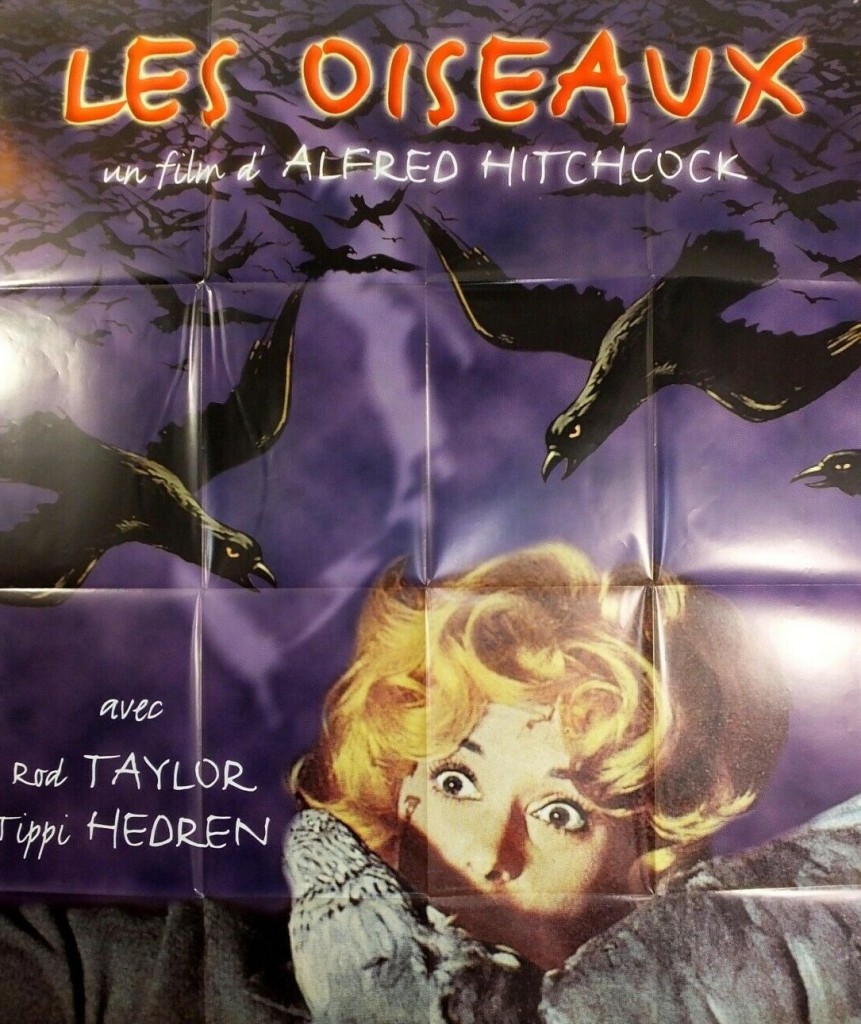
Secondly, and now cutting more to the chase, this is where the modern action film was invented. You might think that honour rested with Dr No (1962) or any other of the Bond pictures or even as late as Bullitt (1968) with its epochal car chase. But although the Bonds are filled with derring-do and escape, there is nothing to match the scene when the birds attack the town, wave after wave, as if they were World War Two bombers. There is even the point-of-view from the air which Hitchcock also invented and has been repeated in airplane war films ever since, most famously Pearl Harbor (2001).
But the way in which full-scale disaster, with everyone rendered helpless, unfolds is a true first. People in the café can see the river of petrol and the match about to be discarded and can only observe as the river of flame reaches the petrol tanker and in a perfectly ordinary town setting – rather than a military base – there is an almighty explosion. It is terror for the sake of it. And there is no escape, no one racing to the rescue, just pure devastation,
Lastly is the ending. It is apocalyptic. In every other Hitchcock when the hero/heroine escapes from dire peril, that is the end of the matter, there is no final twist as with a film like Carrie (1976). But although the birds are now silent and the couple can pick their way through their lines, you know full well this is not the end and that the birds will soon be as inexplicably massing somewhere else.
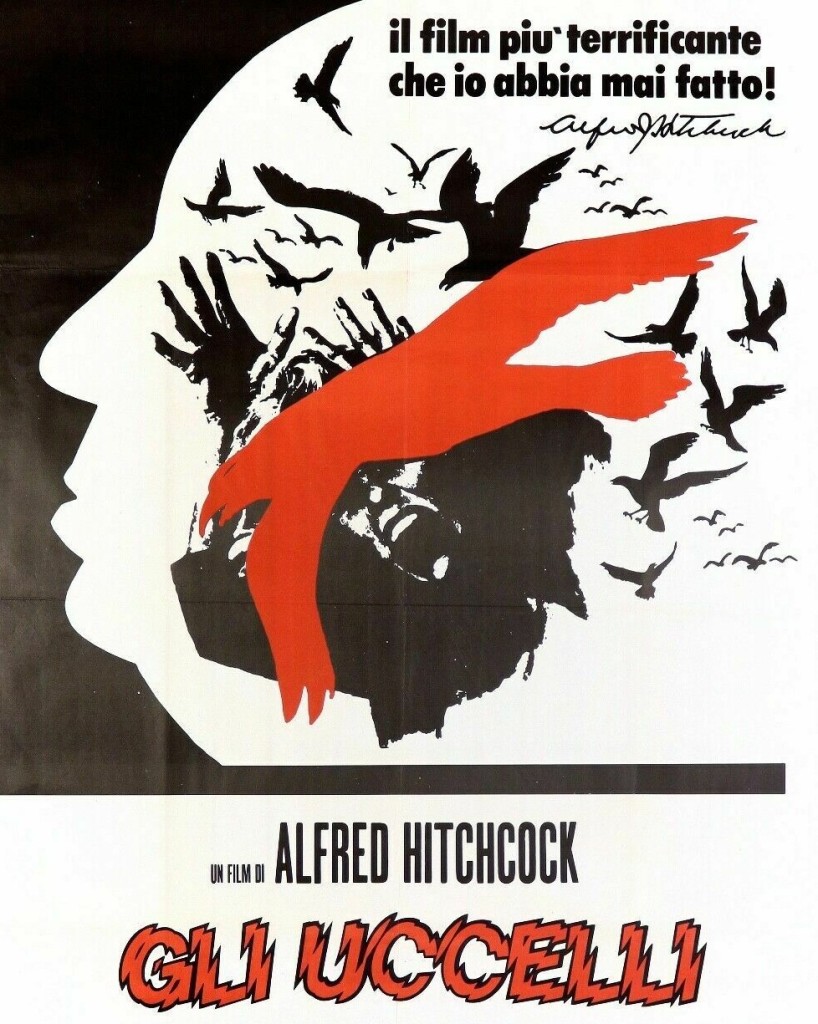
That’s three reasons but there are many more. For a start, in other films where the hero/heroine is in danger, the peril is not relentless. And often it is the threat of danger or of being captured that provides the narrative spring. And if there is physical threat in that era it was not unrelenting. And it is with another character whom you can fight or at least attempt to outwit. Not just, later in this instance rather than sooner, realize that there is no way to defeat these marauding creatures, no way at all. So, compared to his other films, when attacks of one kind or another punctuate a film, here it is like a battery of machine-guns and not episodic but virtually non-stop for over 30 minutes.
The storyline since it is after all a meet-cute is excessively simple. Melanie and Mitch meet, trade remarks, she leaves him what would easily be interpreted as a love token, and they link up after she is attacked by a gull. Wherever they go now, there will be no escape. Gulls attack children playing outside. The same day sparrows invade Melanie’s home. There is another attack on children. In town the gulls swarm in wholesale, wreaking the devastation mentioned above. All his is just a prelude to the final overwhelming siege. Except in modern horror pictures where a body is dispatched every ten minutes or so, there is nothing to match the unremitting attacks. It is as though Mitch and Melanie are in the front line of battle, under siege, Zulu (1964) with birds perhaps, but with no hope of salvation. Unlike Zulu, there is no sign that in raising the siege, the birds are hailing their bravery.
Unusually, too, for a Hitchcock film, there is considerable back story that informs current action. Mitch has an overbearing mother who seems to hover over his life attempting to scare off any woman who comes near. Annie has been left behind precisely because he needed to escape his mother. For her part, Melanie’s mother ran off with another man and she is a spoiled socialite with a habit of getting into trouble, possibly attention-seeking behaviour as a result of abandonment issues. Full to the brim with sophistication. Melanie is the least likely candidate for motherhood, yet her maternal feelings rush to the fore when she has to care for a terrified child.
Tippi Hedren’s career when south when she parted company with Hitchcock so we only have this and Marnie (1964) to consider her worth as a star. This is easily her best performance, shifting from icy cold to playful to romantic to maternal and of course no one has quite emoted such shock and terror. This is Rod Taylor (Dark of the Sun, 1968) coming into his stride as a leading man. He always had the charm and certainly the brawn, but rarely displayed both in the one picture. You would not have picked the Rod Taylor of Seven Seas to Calais to lead a squad of mercenaries in Dark of the Sun but he might well be first pick after this performance.
Hitchcock got so many of his effects by laying on the tension, a man or woman on the run, an innocent framed, a man displaying dubious morality (Rear Window, 1954, and Vertigo, 1958) nonetheless being presented as hero, the question in every instance being whether they will escape their fate. Here, the barrage of devilry is so intense it is almost inconceivable that anyone could get out alive. That they sneak out by the skin of their teeth, watched by their silent conquerors, for me was only the prelude to The Birds Part Two.

 The Magnificent 60s
You could argue that Psycho was the first ‘modern’ movie, but you make a great case for this; the process shots, however, are regrettable, as often in 60’s Hitchcock (Torn Curtain, Marnie)
LikeLiked by 1 person
I agree but it’s not as though everyone else had perfect process shots. By and large they were pretty dodgy in that era.
LikeLike
When I was 8 in ’63, I remember the “eyes pecked out” scene was the talk of the playground.
Some info:
“On 28 Jun 1961, DV announced that director Alfred Hitchcock had acquired screen rights to Daphne Du Maurier’s 1952 short horror story, “The Birds.” The news item noted that Hitchcock planned to make the film for his own company, Shamley Productions. A little over three months later, the 3 Oct 1961 LAT reported that the director was “undecided” about whether to use color or black and white film for the project. He was quite certain, however, about the changes he and writer Evan Hunter had made to Du Maurier’s story, which took place in a farming community in Cornwall, England: Hitchcock’s The Birds would be set in a coastal village near San Francisco, CA, and feature a group of more sophisticated characters.
Although the LAT anticipated that filming would begin in Jan 1962, a 2 Mar 1962 DV production chart indicated a start date of 6 Mar 1962. Various contemporary sources noted Hitchcock’s “discovery” of actress Tippi Hedren, who, up to that time, had appeared only in television commercials. The Birds would mark her first credited appearance in a theatrical feature, although she played a bit role in The Petty Girl (1950, see entry). A 22 Mar 1962 LAT article indicated that the start of principal photography in Bodega Bay, CA, was delayed a few days by rainy weather. Once shooting began, Hitchcock despaired about the bright sun, complaining to the 1 Apr 1962 NYT: “It’s a color film and I wanted it dark and gloomy. Now we’ll have to subdue the color in the film lab.” The old and somewhat ramshackle buildings in Bodega Bay and surrounding environs, however, were much more to the director’s liking. In addition to shooting sequences at a condemned 100-year-old schoolhouse and an unkempt oceanfront property located at Bodega Head, filmmakers took exterior shots of the local Tides Restaurant as well as a pet shop in San Francisco, CA, some sixty miles south.
While in Bodega Bay, Hitchcock was fined by the U.S. Fish and Wildlife Service for permit infractions. A 26 Mar 1962 DV news brief explained that Hitchcock Productions had obtained permits to collect a certain number of live seagulls, and a certain number of dead seagulls. Inspectors visited the site and found that the number of birds gathered by the film crew far exceeded what the permits allowed. In addition, there was no valid permit for the sixty various songbirds on set. Film critic Kyle B. Counts described the making of The Birds in the fall 1980 issue of Cinemafantastique and noted that the government fined the film company $400.
Throughout the early months of production, trade journals expressed curiosity over the financing of the film. A 22 Mar 1962 NYT article stated that the esteemed director was “using his own money,” and speculated that the budget was “well in excess of $1 million.” Hitchcock dismissed interest in the financial structure, later quipping in the 1 Apr 1962 NYT that the film was being made “with television money,” a reference to his successful television program Alfred Hitchcock Presents (CBS and NBC, Oct 1955–Sep 1962). Around the time of the picture’s release, Hitchcock acknowledged in a 3 Apr 1963 Var interview that The Birds cost $3 million.
On 4 Apr 1962, Var reported that cast and crew were close to finishing their Bodega Bay shoot. The company then returned to Revue Studios on the Universal Pictures back lot in Universal City, CA, to complete interior scenes and special effects work. Revue was where Alfred Hitchcock Presents was produced. The 7 Aug 1962 DV noted that Hitchcock had engaged Ub Iwerks, one of Walt Disney Studios’ “top technicians,” to assist with the special effects scenes.
Back in 1961, the director initially thought he might combine live action photography with animation. During production, however, the NYT observed that trained birds were being used for close-up shots, while in one particular scene, mechanical stuffed ravens were attached to actors’ clothing. “Thousands of other birds” were filmed at the San Francisco city dump, with the idea that the footage could be superimposed over the live-action Bodega Bay sequences. According to Cinemafantastique, the complex work of unifying disparate elements fell to Iwerks, who had developed a sodium vapor process that produced pristine composite shots. Unlike the blue screen technique, which often rendered a “fringe” effect around the superimposed matte, the sodium vapor process used a prism to simultaneously create a matte and counter-matte around the filmed object. When these matte shots were combined with other footage in an optical printer, the result was quite clean. Cinemafantastique noted that “all special effects and combination printing were to be executed under Iwerk’s supervision, with special design work and all the first generation optical printing his prime responsibilities.” The Birds received an Academy Awards nomination for Visual Effects, but lost to the epic Cleopatra, (1963, see entry).
The NYT reported, on 30 Oct 1962, that Universal Pictures had agreed to distribute Hitchcock’s independently made film, in addition to others produced in the future. The studio’s involvement guaranteed a strong publicity campaign. The 7 Feb 1963 DV described a ten-minute promotional short featuring Hitchcock and Universal president Milton R. Rackmil, while the 13 Feb 1963 Var made note of a “five-minute trailer” the director had filmed with Tippi Hedren. Various contemporary sources remarked on the grammatically incorrect phrase, “The birds is coming!” used on billboards nationwide to stir interest in the film.
Following the world premiere on 28 Mar 1963 at the RKO Palace in New York City, LAT critic Philip K. Scheuer panned the “implausibility” of the story in his 29 Mar 1963 review. However, he commended the “amazing trick photography” and visceral sound composition. The 27 Mar 1963 Var review concurred that the “absence of music” was a “novelty,” describing the “tone-less” electronic composition as “appropriate and arresting.” A 14 Dec 1962 DV news item indicated that Hitchcock went to Berlin, Germany, to work on creating the unusual score with musical innovators Remi Gassmann and Oskar Sala, who played a Trautonium—an expressive electronic instrument.
Two days after the picture’s 10 Apr 1963 Los Angeles opening, Var reported that the single-day box-office gross of $51,381 had set a record for Universal Pictures. The figure accounted for twenty-nine theaters and drive-ins in the Los Angeles area. On 9 May 1963, The Birds was presented on the opening day of the Cannes Film Festival as an out-of-competition entry.
The Birds was ranked #7 on 100 Years…100 Thrills, AFI’s 2001 list of the most thrilling American films of all time.”
LikeLiked by 1 person
Amazing background to the filming and promotion.
LikeLike