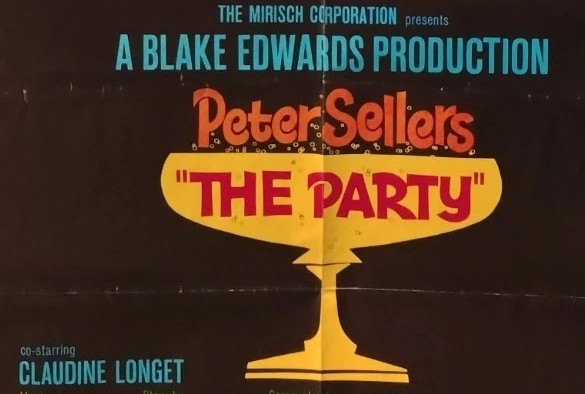
Had director Blake Edwards (The Pink Panther, 1963) stuck to his guns and followed his instinct and gone down the silent film route, this would have emerged in better shape. Blame star Peter Sellers (The Pink Panther) for deciding “brownface” had worked so well in The Millionairess (1960) that it was ripe for a repeat and that dialog was essential to the audience empathizing with his character.
On reflection, the fish-out-of-water concept would have been more acceptable with a character originating from anywhere but India which would have still permitted the star to adopt one of the zany voices that were his trademark.
The script was originally 58 pages long which would have delivered a finished product running just short of an hour. The extra time would have been made up by the actor’s improvisation.
His character probably didn’t need to be actor either to find himself at bigwig’s party in Los Angeles. When Sellers is at his inventive best this just purrs along. Some of the ideas are priceless – trying to retrieve a shoe from a pond, meddling with a electronics system, getting his tie stuck in an unlikely spot, spraying all with water. But when he opens his voice, it drags.
Part of the problem is that Hrundi V. Bakshi (Peter Sellers) lacks lines with any zap. He just mumbles along, repeating the same humorless drivel. And while other characters make fools of themselves through dialog, that’s rarely with incisive wit either, the audience just laughing at their inflated opinions of themselves.
Bakshi is an incompetent Indian actor who manages to blow up the expensive set on costume epic Son of Gunga Din movie set at the height of the British Raj. He should have been blacklisted, but instead elementary error sees him invited to the party of studio boss General Clutterbuck (J. Edward McKinley) where he encounters a drunken starlet, an alcoholic waiter determined to steal the slapstick high ground, pompous western star “Wyoming Bill” (Denny Miller) and French singer Michele Monet (Claudine Longet) trying to avoid the advances of movie producer Divot (Gavin MacLeod).
Although this was reputedly shot in sequence, the running order doesn’t really matter. Set Peter Sellers in his pomp down in any situation and chaos will ensure. Wigs will come off, shoes will rocket around a room, anything on a plate, bowl or tray will fall off, anyone in the vicinity will be drenched or battered. Tempers will rise until they are nicely cooking and set to explode.
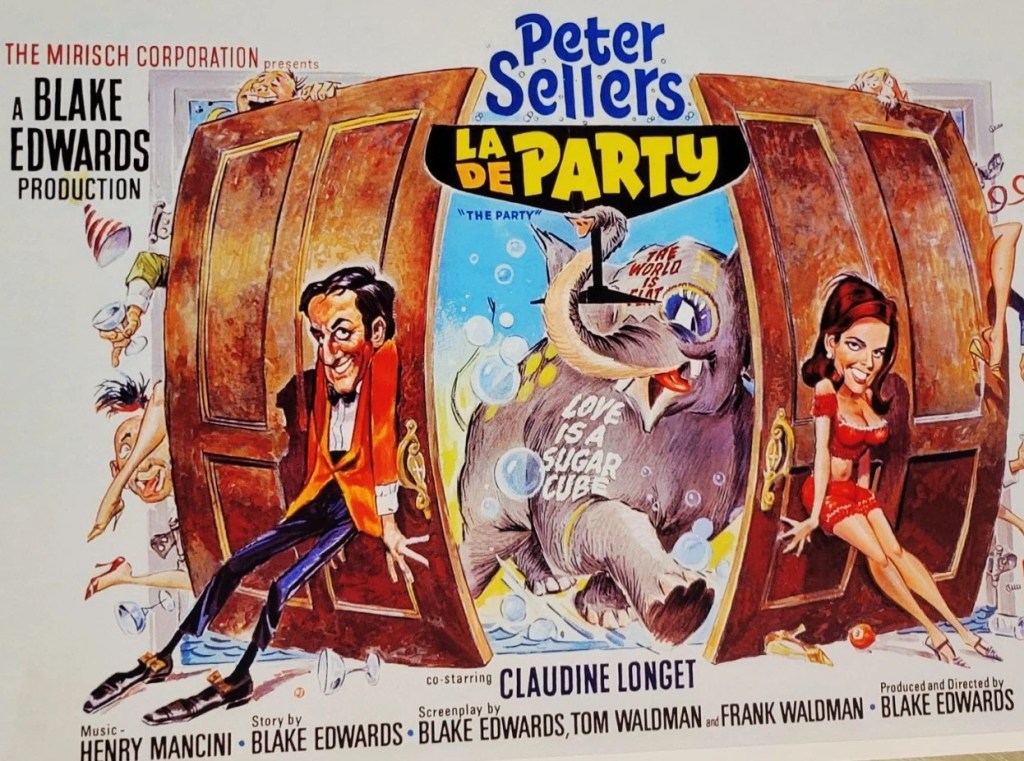
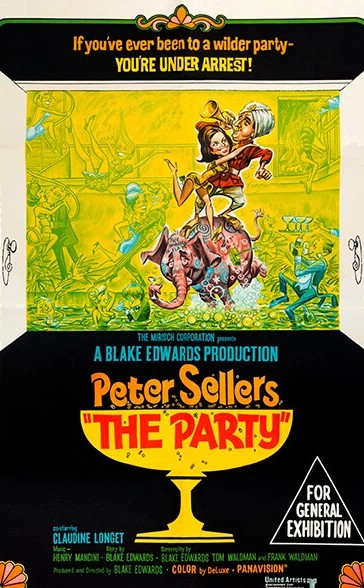
Quite where a Russian ballet troupe and a painted elephant fit into this is anyone’s guess except that both were intended as cues for further hilarity. When guests aren’t tumbling into the pool they’re soaked in soap suds. Naturally, Bakshi’s ineptitude triggers gentle romance with Michele.
This would certainly have built up a good head of steam if seen in a cinema with an audience. But the cinema audience would have encountered the same problem as anyone watching it at home. For every sequence that hits a comedic bulls-eye, others just fall flat. When the movie relies on the star’s charm rather than his ineptitude it falls apart.
It’s almost a highlights reel and my guess is that if it was cut back to the original one-hour length we might well have a classic on our hands. As it is, padded out, it doesn’t come close.
While at one time it acquired cult status my guess is that the contemporary audience won’t find enough to compensate for the offensive Brownface.
Certainly there are moments of genius, the shoe sequence and the electronics section are huge fun. But too much just doesn’t work.
You might end up fast forwarding every time Sellers opens his mouth. He is a master at finding fun in the inanimate, less impressive when dealing with people. Didn’t do anything for Claudine Longet, no more movies after this. And that was not surprising. Everyone was just a stooge to Sellers.
I apologize for falling back on that old analogy of the curate’s egg – good in parts – but that pretty much defines it.


I saw this when I was 13 in ’68. At the time I thought it was the funniest movie I had ever seen. Years later I watched it again…not so funny then.
“he Party marked a re-teaming of writer-director-producer Blake Edwards and actor Peter Sellers, who had begun a longtime collaboration on The Pink Panther series (see entry for 1964’s The Pink Panther) in the early 1960s. The project was announced in a 25 Feb 1967 NYT item. According to various contemporary sources including the 21 May 1967 NYT, it was briefly retitled R.S.V.P., before reverting to The Party.
The 8 Mar 1967 DV stated the production would cost $2.8 million, and that seventy-five percent of the film would be “without conversational dialog.” A later item in the 28 Jun 1967 DV claimed that Edwards had altered the script from its original silent-film-inspired concept by allowing Peter Sellers and co-star Claudine Longet to improvise as much dialogue as they wanted. In the 19 Mar 1968 DV review, the action-heavy screenplay was said to be only sixty-three pages long. The 6 Jul 1967 DV cited a budget of $2.9 million, slightly higher than earlier reported. According to the 11 May 1967 DV, Edwards, Sellers, and principals of the Mirisch Corporation had agreed to defer their salaries.
Principal photography was originally scheduled to begin on 1 May 1967, as stated in a 3 Mar 1967 DV production chart, but the start of filming was delayed two weeks. A 23 Jun 1967 DV production chart confirmed a start date of 15 May 1967. Shooting began on the Metro-Goldwyn-Mayer (MGM) studio lot, the 1 Jun 1967 DV reported. Except for a pre-title sequence that showed Sellers’s character, “Hrundi V. Bakshi,” on the set of a Hollywood film, the picture was set entirely at the home of “Fred Clutterbuck.” The interior of the house reportedly cost $150,000 and was built, at least partially, on Soundstage 5 at MGM, as noted in the 30 Jun 1967 and 6 Jul 1967 DV. With the aid of firefighting equipment, the set was covered in “cleansing foam” during the elephant washing scene.
In early Jul 1967, filming moved from MGM to a location in Beverly Hills, where principal photography was scheduled to conclude five days early, on 21 Jul 1967. Re-shoots on Saturday, 10 Feb 1968, required the set to be rebuilt, according to a 9 Feb 1968 DV brief. At the time, Sellers was filming I Love You, Alice B. Toklas! (1968, see entry) during the week.
In a 2 Jun 1967 DV article, Edwards was credited with employing a “breakthrough in camera technique” by mounting videotape equipment on top of the film camera to capture all action simultaneously. The videotaped footage allowed Edwards to review instant replays and determine whether or not to re-shoot scenes or change camera angles. Typically, directors were only able to review footage via dailies, processed overnight and not available until the next day. Beside Edwards, Jerry Lewis was said to have “employed a similar system for years.” The cost of the videotape process was said to be $1,100 per week, and Edwards claimed the money he saved thanks to the new system more than offset the expenditure.
Actress Julie Andrews, Edwards’s then girl friend and future wife, was anticipated to play a cameo, according to a 28 Jun 1967 DV item, which noted that Gower Champion might appear in the film as well. Kathe Green, Douglas Owen, and Linda Gaye Scott were said to be making their feature film debuts in items in the 25 May 1967 DV, 3 Jul 1967 and 25 Jul 1967 LAT. Natalia Borisova was named as choreographer in the 5 Jul 1967 LAT.
A wrap party took place on the set at MGM, as stated in the 24 Jul 1967 DV. Furnishings used as set decoration were sold off to attendees, including Harold Mirisch of the Mirisch Corporation, who bought patio furniture; and Sellers, who purchased a barbecue.
Critical reception for The Party was tepid. According to an 8 Jan 1969 Var box-office chart, the film grossed $2.9 million in film rentals, a figure equal to its estimated budget.”
LikeLiked by 1 person
Thanks for all that. Not surprised you reversed your opinion.
LikeLike