Spoiler alert – this film contains no giants unless you count the one-eyed Cyclops. It’s the Jason and the Argonauts story with a lot of political shenanigans thrown in.
Even lacking the Ray Harryhausen special effects of the film covering the same ground a few years later and without the kind of budget dropped into the lap of a Stanley Kubrick it’s not a bad stab at retelling the myth. And Carlo Rambaldi (later the creator of E.T.) does a decent job of the Cyclops at a time when special effects were primitive.
This belongs to the Italian-made “peplum” genre, out of which came Hercules (1958). What struck me most was the director’s use of the camera, very often tracking a character in scenes that would otherwise have been static. There are virtually no close-ups and hardly any medium close-ups. It’s quite strange to see.
On the one hand a moving camera is an expense and on the other hand lack of close-ups saves money, so it’s possible the money spent on one technique was the result of saving money from another.
Alternatively, much of the director’s work has gone into arranging characters in group scenes in such a way that dramatic impact is sustained while not moving the camera. There’s enough political chicanery going on to keep two different plots going. Back in Jason’s (Roland Carey) homeland, where he is a king, an usurper not only seeks his throne but wants his wife and tries to deceive the population into thinking Jason is dead.
Meanwhile, Jason faces mutiny on board the Argo and then the temptations of the Siren, battle with the Cyclops, and then a final bold act to reclaim the Golden Fleece. Possibly the best scene is kept for the end, when the Argo arrives home with its own brand of deception. The film is topped off with a clever trick. Sometimes what we would now view as a B-film, ideal Saturday matinee material, sticks in the mind because it has been the proving ground for a future director or star but writer-director Riccardo Freda had already turned out Spartacus the Gladiator (1953) and Theodora, Slave Empress (1954).
Star Roland Carey was unusual in this field because he was actually a trained actor rather than hired for his torso, but this did not exactly stoke his career – his appearance in Fall of the Roman Empire (1962) was uncredited. Female lead Ziva Rodann was unusual, too, in that she was Israeli rather than Italian, had appeared in Samuel Fuller’s Forty Guns (1957) and second- billed in exploitationer Macumba Love (1960) and would later play Nefertiti in the Batman television series. If you go in not expecting much, you might get a surprise, though, be warned, the acting is wooden and other special effects, such as the storm, not quite in the Rambaldi class
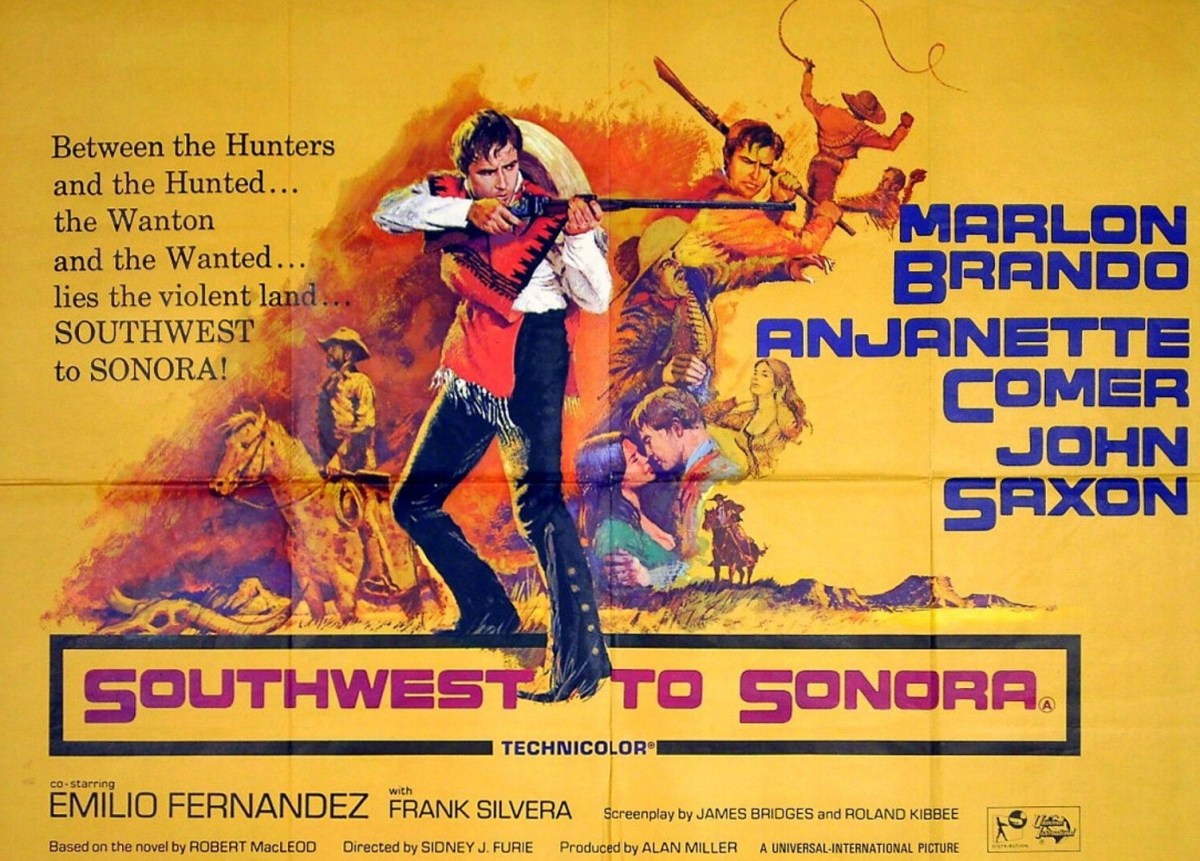
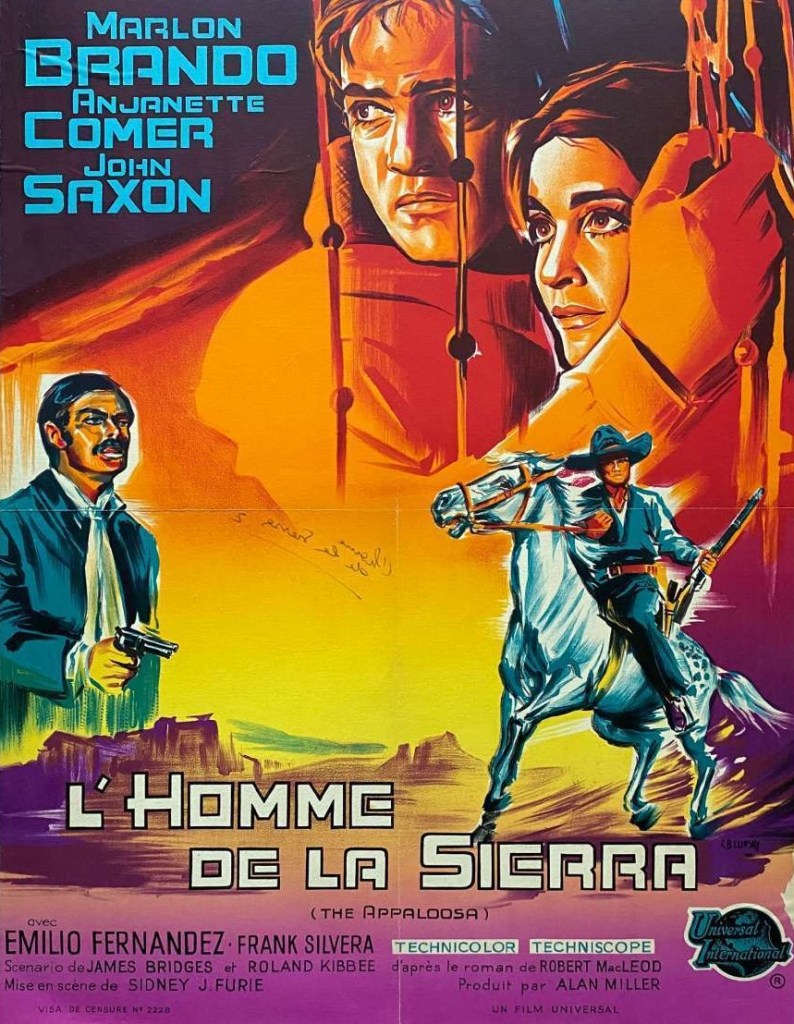
High expectation can kill a picture. Low expectation can have the opposite result. I came at The Appaloosa with the latter attitude in mind. I knew the picture had been a big flop and that critics had carped – as they had done through most of the 1960s – about the performance of Marlon Brando.
Neither was director Sidney J. Furie’s style to everyone’s taste. And it seemed an odd subject – Texan takes on Mexican warlord to recover a stolen horse. It is surely a slow burn, but it certainly worked well beyond my anticipation. There’s not much more to the story than two guys fighting over a horse.
First of all, Brando’s performance came across as natural, not mannered. Secondly, this was a real character. He was not a John Wayne striding into action to protect the underdog or a woman or out of some goddam principle.
At first it did seem odd that Matt Fletcher (Marlon Brando) placed so much importance on the horse given that said warlord Chuy Meena (John Saxon) had offered him a more than fair price for it. But in one brilliant two-minute scene, expertly directed and with virtually no close-ups – the actor caught mostly with his back to the camera or in silhouette – we discover why. Fletcher has been such a disappointment to his father that bringing home such an animal was proof that he had made something of himself. A buffalo hunter to trade, he was on the verge of starting a new life.
The second aspect of this intriguing picture was that Medena placed so much importance on a horse when he could easily buy any horse he wanted. But he was faced with losing face. His wife Trini (Anjanette Comer) had tried to escape from him on the horse and the only remedy was to persuade the watching federales that Fletcher had previously sold him the horse.
When Fletcher refuses, Medena takes the horse by force. Fletcher, in retaliation, and to save his own sense of pride, tries to take it back. He is not represented as a superhuman John Wayne or savage Clint Eastwood, but an ordinary guy who soon finds himself out of his depth. So ordinary that the first time he aims his rifle he misses the target by a mile.
Nor is he burdened with an over-enlarged empathy gland. He not only refuses to help Trini, but steadfastly refuses to take her with him, not even as far as the border, until in another of the film’s lengthy scenes she explains the reasons for her escape attempt.
Few films have exceeded it for atmosphere. This Mexico is grim, pitiless. Hostility and suspicion are endemic. Women are abused and discarded. The standout scene is Medena and Fletcher arm-wrestling over scorpions, played out against a soundtrack of scraping chairs and the poisonous insects scrabbling on the table.
This is a brooding western featuring the actor with the best eye for brooding in the business. Sidney J Furie (The Ipcress File, 1965) is gifted – or afflicted depending on your point of view – with an eye for the unusual camera angle. Here I think the gift not the affliction is on show.
When you watch this and The Chase (1966) together it’s hard to see what on earth got the critics so rattled about Brando’s mid-decade performances. This is realistic acting at his best. Where John Wayne or Clint Eastwood present a superhuman screen persona, even if for part of a picture they are downtrodden, Brando was happy to play very human characters. In both pictures he is just an ordinary joe – forced into action by circumstance.
Hollywood was never reined in by the strictures of history, much preferring fiction to fact for dramatic effect, and that’s largely the case here, although the titular hero’s real life remains shrouded in myth.
If you do catch this surprisingly good feature, make sure it’s not one of the many pan-and-scan atrocities on the market. I watched this in the proper Panavision ratio which meant it occupied only one-third of my television screen, but in that format it’s terrific. It’s a bit of an anomaly for a decade that churned out high-class historical epics like El Cid (1961) because this clocks in about a hour short of other films in the genre and there’s no star actor or director to speak of and no Yakima Canutt to handle the second unit action scenes.
Omar Sharif’s marquee value at this point was so low that if you check out any of the original posters you’ll note that his name hardly rates a mention and he also comes at the very end of the opening screen credits. Although this is post-Lawrence of Arabia (1962), it’s pre-Doctor Zhivago (1965), suggesting nobody had a clue how to market his talents.
Director Henry Levin was a journeyman, fifty films under his belt, best known for not a great deal except for, following this, the second and third in the Matt Helm spy series. Given this film was critically ignored on release and since, and a flop to boot, it definitely falls into the “Worth a Look” category. Although there are few stand-out scenes of the artistic variety such as pepper Lawrence of Arabia or El Cid, this is still well put together and Levin shows an aptness for the widescreen.
The narrative breaks down into three parts – the first section describing enslavement of Genghis Khan (Omar Sharif) by nemesis Jamuga (Stephen Boyd – the picture’s star according to poster and screen credits) – before banding together rival tribes in revolt; the second part a long trek to China; and the third encompassing a final battle and hand-to-hand combat with Jamuga. For a two-hour picture it has tremendous sweep, not just the scenery and the battle scenes, but political intrigue, romance, a rape scene and even clever comedy. Genghis Khan believes his glory is predestined, but he has very modern ideas about the role of women.
The best section, oddly enough, is set in China where Genghis engages in a duel of wits with the distinctively contradictory Emperor (Robert Morley), but that’s not to detract from the film’s other qualities, the action brilliantly handled, especially the chaos of battle, the romance touching, and the dialog intelligent and often epigrammatic.
Unlike James Mason (Age of Consent, 1969) who makes a calamitous attempt at a Chinese accent, Robert Morley (Some Girls Do, 1969), costume apart and looking as if he has just walked out of an English country house, but his plummy tones belie a very believable character. Stephen Boyd (Assignment K, 1968) shines as the villain of the piece. Telly Savalas (Battle of the Bulge, 1965) and Woody Strode (The Professionals, 1966) have decent parts as Khan’s s sidekicks, the former unexpectedly bearing the brunt of the film’s comedy. French actress Francoise Dorleac (Billion Dollar Brain, 1967) is effective as Sharif’s wife.
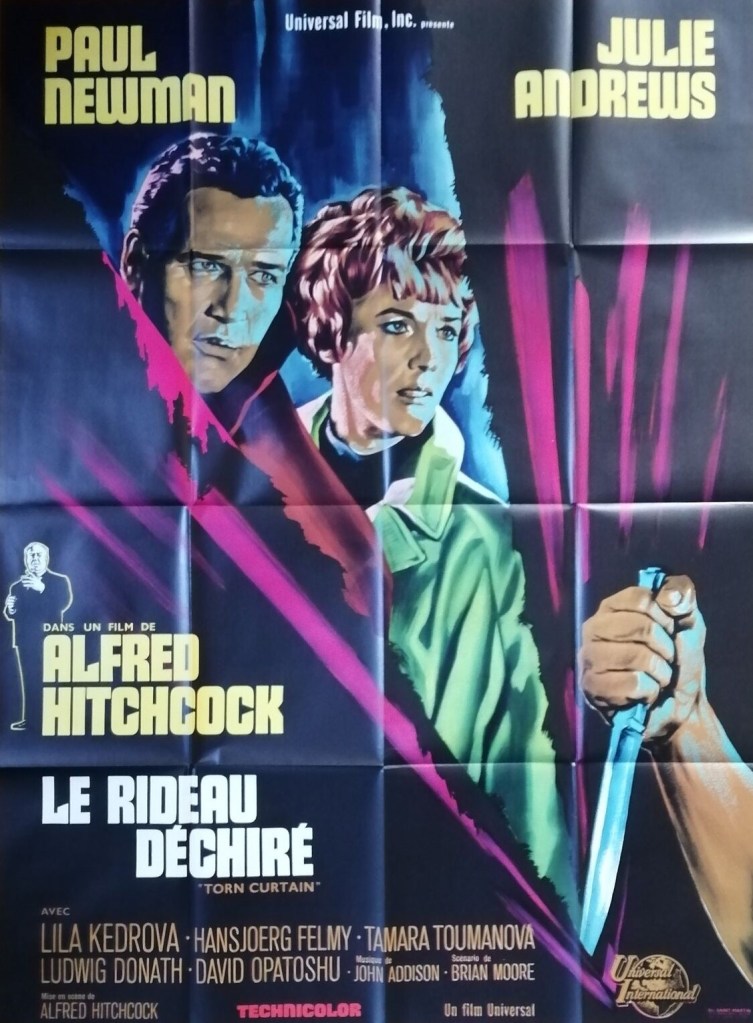
Hitchcock stole one of his most famous ideas from Genghis Khan. About the only scene in Torn Curtain (1966) to receive universal praise was a killing carried out to a soundtrack of nothing more than the grunts of assailant and victim. But, here, where the score by Yugoslavian composer Dusan Radic was extensively employed, the rape scene is silent and just as stunning. If the only prints widely available are of the pan-and-scan variety I’m not surprised the film has been for so long overlooked, but if you can get hold of one in the preferred format you will be in for a surprise.
I’ve never gone out of my way to watch a Doris Day picture with the exception of musical Calamity Jane (1953) when it became a camp classic as well as Hitchcock’s The Man Who Knew Too Much (1956) and films where she happened to be co-starring with Cary Grant.
So I came to The Glass Bottom Boat with low expectations, especially as this was towards the end of her two-decade career and her co-star was Rod Taylor, a different level of star to Grant and Rock Hudson. By now, she had dropped the musical and dramatic string to her bow and concentrated on churning out romantic comedies and also been supplanted by Julie Andrews as Hollywood’s favourite cute star.
But on the evidence here I can certainly see her attraction. This is entertaining enough. And she sings – the theme song, one other and a riff on one of her most famous tunes “Que Sera Sera.” Unless there’s a symbolism I’ve missed, the title is misleading since the boat only appears in the opening section to perform the obligatory meet-cute with Taylor as a fishermen hooking Day’s mermaid costume.
The plot is on the preposterous side, Day suspected as a spy infiltrating Taylor’s aerospace research operation. It’s partly a James Bond spoof – when her dog is called Vladimir you can see where the movie is headed – with all sorts of crazy gadgets. But mostly the plot serves to illustrate Day’s substantial gifts as a comedienne. For an actress at the top of her game, she is never worried about looking foolish.
And that’s part of her appeal. She may look sophisticated even when, as here, playing an ordinary public relations girl, but turns clumsy and uncoordinated at the first scent of comedic opportunity. There’s some decent slapstick and pratfalls and some pretty good visual gags especially one involving a soda water siphon. A chase scene is particularly inventive and there’s a runaway boat that pays dividends. But there are a couple of effective dramatic moments too, emotional beats, when the romance untangles.
She’s in safe hands, director Frank Tashlin responsible for Son of Paleface (1952) and The Girl Can’t Help It (1956). I also felt Rod Taylor was both under-rated and under-used, never given much to do onscreen except stick out a chiseled jaw and turn on the charm. Although he had been Day’s sparring partner in her previous picture Do Not Disturb (1965) he’s not in the Cary Grant-Rock Hudson league.
It’s also worth remembering that the actress had her own production company, Arwin, which put together over a dozen of her pictures, including this one, so she would be playing to her strengths rather than those of her co-star. On the bonus side, watch out for a blink-and-you-miss-it cameo by Robert Vaughn (The Man from Uncle), and a featured role by Dom DeLuise as a bumbling spy.
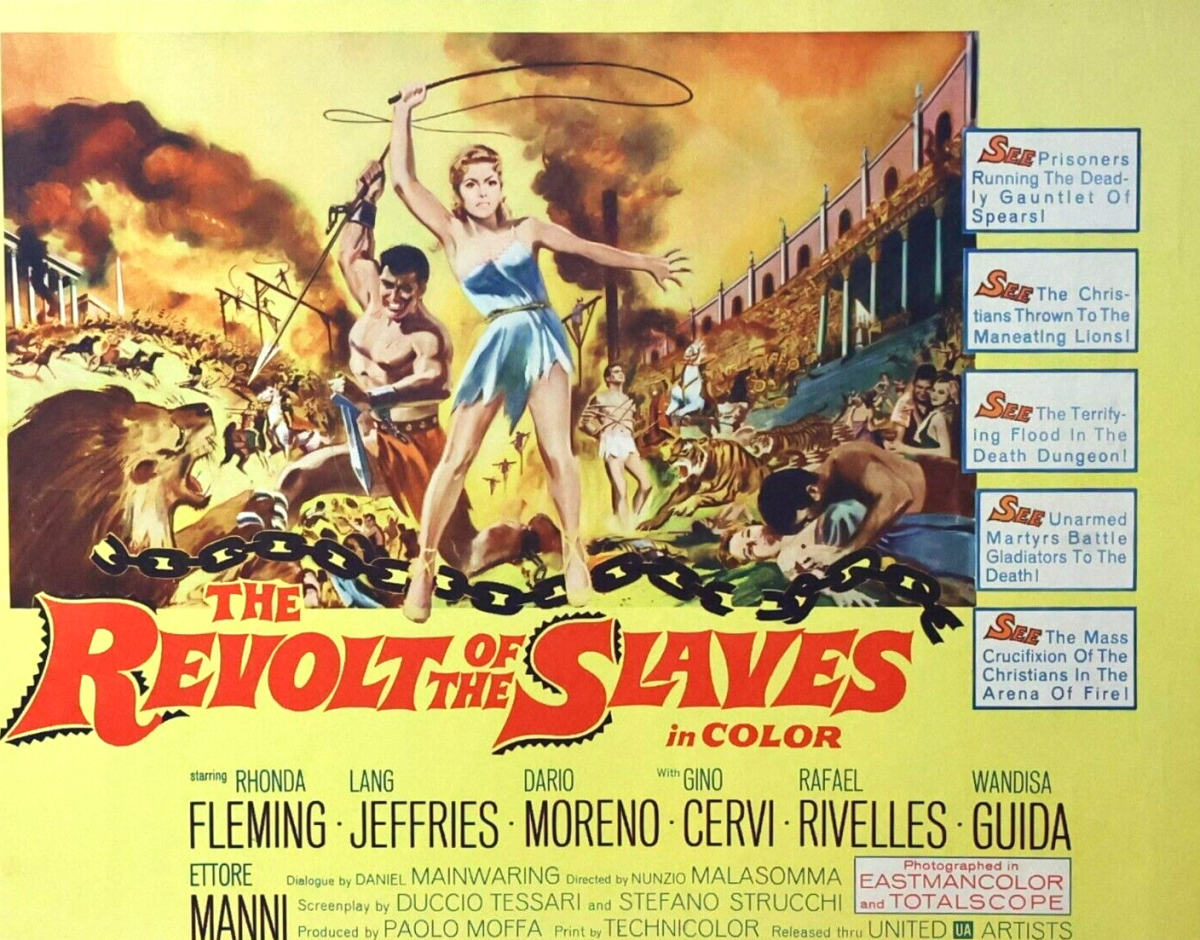
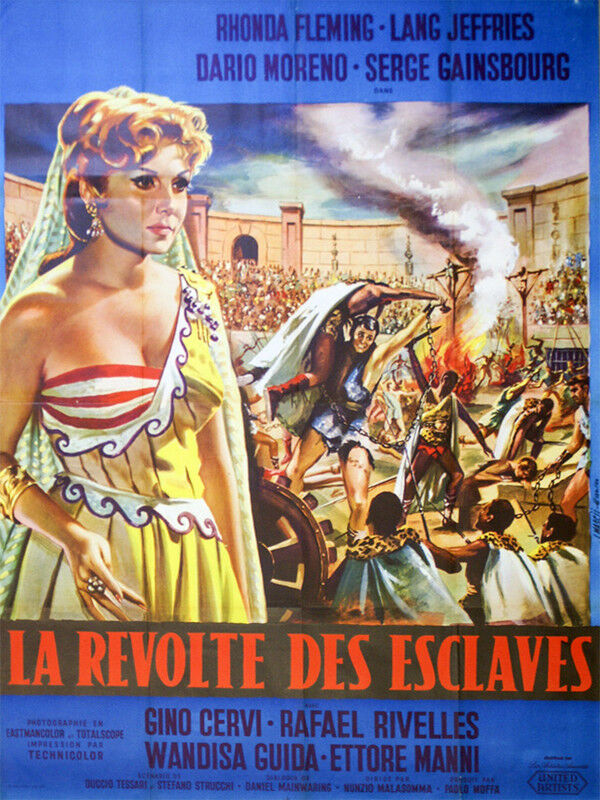
Time has been very kind to this underrated handsomely-mounted hugely enjoyable historical romp about victimised Christians in ancient Rome. Virtually a last hurrah for 1950s redhead Rhonda Fleming (Gunfight at the OK Corral, 1957), known as The Queen of Technicolor and here gifted lines like “the whip will do him good.” Fernando Rey (The French Connection, 1971) is thrown into a pit of ravenous hounds. Singer and serial lothario Serge Gainsbourg, immortalised by late Sixties bedroom anthem “Je t’aime,” plays a sadistic villain.
Despite the occasional over-the-top religious references – a character called Sebastian (Ettore Mane) is pinioned to a tree by arrows because the overseer (“don’t aim for the heart”) wants to prolong his agony, a prisoner facing death is baptised in a convenient flood – the piety is largely kept under wraps because these Christians refuse to turn the traditional cheek and inflict considerable damage on their masters. A voice that sounds like the Voice of God is revealed as an ordinary mortal. And there are nods to modern politics, the powers behind the throne.
Cool Hand Luke couldn’t have come up with better plans for escape, filling a cell with water from the sewer till inmates, except the aforementioned late convert, float to the hatch in the ceiling. A sojourn along a river is enough to put the pack of chasing hounds off the scent. Pursuers are trapped in the catacombs by the simple device of bringing down the roof.
After wealthy patrician Claudius (Gino Cervi) saves the life of escaped slave Vibio (Lang Jeffries) his arrogant daughter Claudia (Rhonda Fleming), introduced driving a chariot along packed streets with little regard for public safety, finds every excuse to humiliate him.
The plot is triggered when Claudia’s cousin/niece (the English translation is unclear) Agnese (Wandisa Guida) is followed by spy Corvino (Serge Gainsbourg) to a Christian hideout. Claudia becomes implicated when Agnese seeks refuge and for a good while she’s on the run, eventually committing her first act of unselfishness after falling for Vibio. But, to save her family, Claudia denounces the Christianity she has begun to accept, only to become involved in the finale in the arena where Christians are killed one by one, not by the waiting lions, but by spear.
It’s mostly heady and bloody action, the driving narrative only pausing now and then to make a religious point. The Emperor, like any leader in Game of Thrones, is afflicted with illness which makes his face burst out in spots. There’s some excellent use of music. In one sequence the hunters with a soundtrack of barking dogs are contrasted with a peaceful scene of the Christians not realising their pursuers are so close until the barking infuses their scene.
Fair bit of poetic license here. No tigers!
Star of the show is undoubtedly Rhonda Fleming. A huge post-war marquee idol, she starred opposite the likes of Bing Crosby (A Connecticut Yankee in the Court of King Arthur, 1949), Glenn Ford (The Redhead and the Cowboy, 1951), Dana Andrews (While the City Sleeps, 1956) and Burt Lancaster (Gunfight at the OK Corral). But she was equally well-known as the top-billed star of adventures like The Golden Hawk (1952), Serpent of the Nile (1953) and Those Redheads from Seattle (1953). It was once said of her by a cinematographer that her beauty was so flawless she was stunning from any angle.
Quite why roles had dried up so much that she headed across the Atlantic to Italy for this is anybody’s guess. It certainly failed to revive her career, possibly because the religious aspects would have been more grating for audiences of the period whereas now they are less dominant.
Oddly enough, it was virtually a last hurrah also for veteran Italian director Nunzio Malasomma (The White Devil, 1947) who didn’t make another picture – his last – for seven years. But he handles the whole venture with aplomb, interspersing humor with action, moving along at a terrific pace, and making the most of a dream cast. In his debut Lang Jefferies (Don’t Knock the Twist, 1962) shows some acting talent among the flash of muscle. But it’s Rhonda Fleming’s picture.
Note: dubbing into English has changed some names. In the Italian version Claudia is named Fabiola – it’s a remake of the earlier Fabiola (1949) starring Michele Morgan – and her father Fabio, so stand by for confusion on imdb.
Certainly a cut above the sword-and-sandals epics flourishing at the time. I’d add that it’s an ideal matinee feature except I watched it late at night and it was just as entertaining. Highly recommended as an easy watch or just to see Rhonda Fleming at her best. The rating might err a little on the high side but every now and then we are allowed our guilty pleasures.
I never thought I’d see the day when Paul Newman was out-acted by Julie Andrews. Or spent most of the time wondering how much better it would be with James Stewart or Cary Grant instead. They can both do stillness. For all the wrong reasons you cannot keep your eyes off Newman – he is such a jittery, fidgety commotion.
Which is a shame for all that is wrong with this often wrongly-maligned Hitchcock picture is the set-up. The opening love scene is only necessary to get it out of the way (“Newman! Andrews! Together!” type set-up) though it is something of a riff on Psycho, setting up the possibility of a bad girl (i.e. goody two-shoes Andrews having sex before marriage) being punished. You could have started more economically with Andrews just turning up in Copenhagen for whatever reason (fill in the blanks) and the story pushing on from there, unintentionally Andrews becoming involved in Newman’s plan to infiltrate the East German nuclear program.
The rest of the picture is classic Hitchcock, and as ever he uses sound brilliantly, just the clacking of feet as a bodyguard pursues Newman through an empty museum. And he riffs on North by Northwest in the tractor scene. The murder, also soundless apart from the noise of human terror, is quite brilliant. And another riff, on The 39 Steps, with the woman who knows their true identity but has her own reasons for not giving them away.
Every time we think they are going to be caught something unexpected prevents it, every time we think they are safe something unexpected prevents that. Clever twists all the way. Hitchcock has a knack of doing the same thing differently every time, he hated repeating himself, so when transport enters the picture, there are unexpected results.
Julie Andrews (The Americanization of Emily, 1964) is far better than you might expect. In fact, I would go so far as to say this is one of her best performances. Like Doris Day in The Man Who Knew Too Much, she is often the focal point of the story, getting Newman out of a spot. Two scenes in particular stand out: one in a bedroom where she is filmed side-on looking out of a window with Newman at the far back of the screen and the other when she lets a single tear leak out of her eye. Where Paul Newman (The Prize, 1963) just looks out of sorts (maybe he was annoyed Andrews was being paid more), she does a nice line in barely contained rage.
You never know what to expect with Alfred Hitchcock (The Birds, 1963). Yet he was always being taken to task by critics who expected something other than what he delivered. Taking us back to the espionage of North by Northwest (1959) he cleverly changes the male-female dynamic and delivers a different kind of thriller. Novelist Brian Moore (The Luck of Ginger Coffey, 1964) wrote the screenplay with a little help from British pair Keith Waterhouse and Willis Hall (Pretty Polly/A Matter of Innocence, 1967).
Even with the annoying Newman, Torn Curtain is still up there not at the very top of the Hitchcock canon but certainly in the second rank
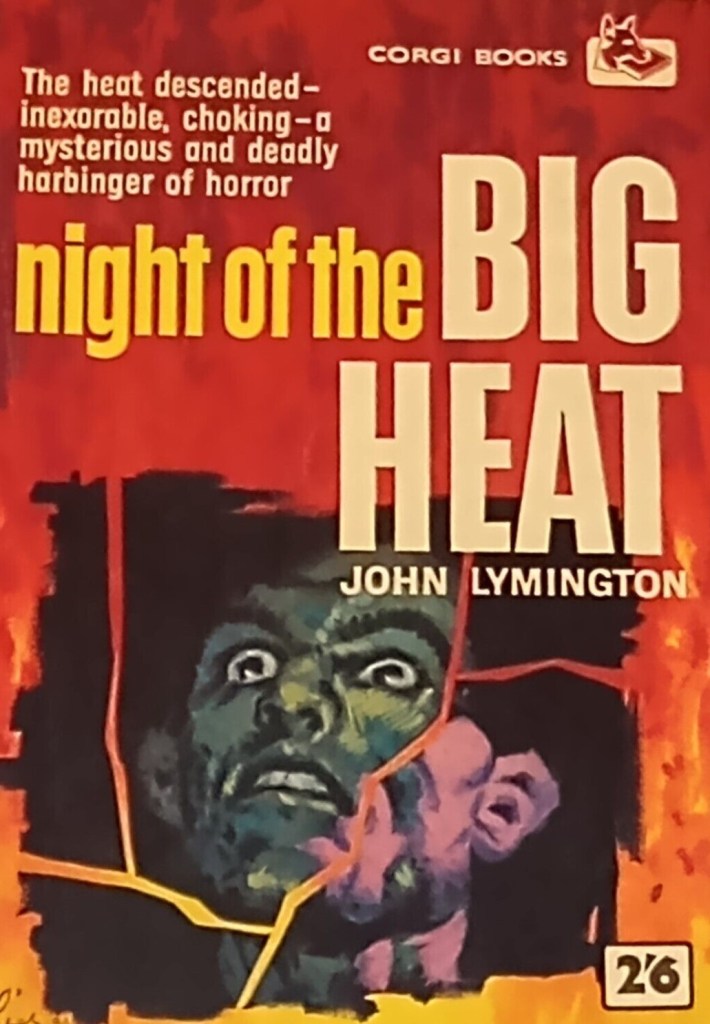
The Day the Earth Caught Fire (1961) meets War of the Worlds with a nod in the direction of Star Trek. In the absence of a decent budget director Terence Fisher (Dracula Prince of Darkness, 1966) loads the movie with decent actors and relies of suspense rather than revelation. Ignoring the obvious opportunities for beefcake, partially embraces cheesecake.
While you might anticipate a horde of sweat-soaked men you will be taken by surprise by that most un-English of scenes – delight in a downpour. This is more sensibly located on a remote island rather than a big city and dials down on the preachy stuff, nothing to do with atomic bombs, but still alien invasion.
Instead of The Old Dark House it’s a very hot English pub in winter – a time when the rest of the country is freezing – where all the characters congregate. We’ve got author Jeff (Patrick Allen), wife and pub landlady Frankie (Sarah Lawson), local doctor Vernon (Peter Cushing), mysterious guest Godfrey (Christopher Lee), mechanic Tinker (Kenneth Cope) and newly-arrived secretary Angela (Jane Merrow) who has been having an affair with Jeff.
It’s so hot Angela has to cool off with a lager and lime. The women appear to withstand the heat better than the men who are all in shirtsleeves and soaked through with sweat. Angela’s got the right idea, nipping down to the sea in her bikini, cooling her neck (and cleavage as it happens) with an ice cube.
As well as the unseasonable weather there’s a high-pitched eerie noise that especially afflicts automobile drivers, forcing them off the road. Various characters are despatched before disclosure. There’s a surprisingly vivid slice of sexual competition between the two women for Jeff’s attentions. In an excellent scene the wife works out what’s going by Jeff’s attitude towards Angela.
Naturally, Jeff has little idea how to retrieve the situation and maybe it’s just the acceptable misogyny of the period or maybe Frankie is just a bit dim, but I doubt if many women would be happy to hear husband describe lover as a “common slut” without wondering how often he attracted to such. Luckily, the crisis is much bigger than a marriage being potentially wrecked.
The sight of the eventually sweat-soaked Angela is too much for Tinker resulting in a brutal scene of attempted rape. While the males, except for being overcome by the noise, tended to remain cool, Angela turns hysterical, threatening suicide and murder in turn, but in the context of being shunned by Jeff and attacked by Tinker it’s hardly surprising she’s at the end of her tether.
Turns out the aliens have taken a leaf out of the Star Trek playbook and can beam themselves to Earth and dematerialize and that the endless human search for life among the universe has prodded an alternative life form into action. Seeing Earth as one giant platter of energy, they have landed and started sating their appetites.
It’s a fairly standard premise and exposition is left to Christopher Lee (The Devil Rides Out, 1968) rather than the more obvious choice of Peter Cushing (The Skull, 1965). Audiences expecting Lee and Cushing to be on opposite sides, with the former cast as villain, will be disappointed. Lee takes on the role of scientist that would normally fall to Cushing. He makes a good boffin, snappy, abrupt, remote and luckily without the slightest interest in any of the disporting damsels.
Patrick Allen (Puppet on a Chain, 1970) who spent most of the decade in television, the movies generally only interested in utilising his voice for narration duties (Carry On Up the Khyber, The File on the Golden Goose etc) takes the opportunity to grab the dramatic center, the character who has to work out what’s going on, while given a pair of conflicting love interests to increase the tension.
Jane Merrow (The System/The Girl Getters, 1964) is the surprise. Provided with the only genuine character arc in the picture, she goes from cool, confident, teasing chick to all-get-out-hysterical, but still with several ounces of sense, able to beat off her attacker, and willing to embrace the suicide option rather than being burned alive by invaders. The aliens, you won’t be surprised to learn, are not, despite the build-up, in the slightest bit scary.
But Fisher does a good job and the reason is a watchable low-budget sci-fi shocker.
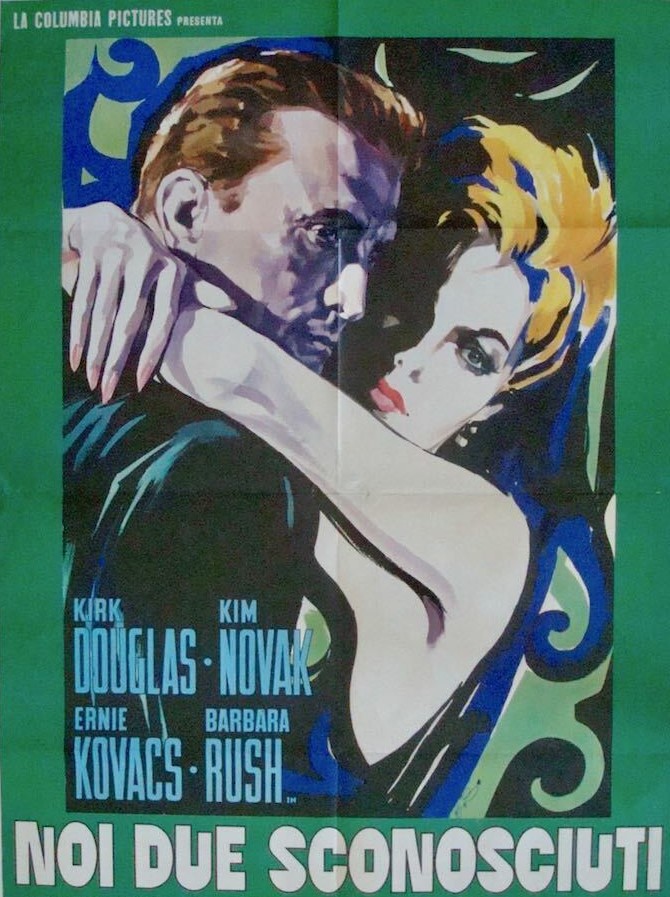
Something of a gamble for Kirk Douglas. Unlike son Michael – sexually voracious on screen (and in real life, apparently) in hits like Fatal Attraction (1987) and Basic Instinct (1992) – Douglas Snr had spent the Fifties primarily as an action star. Should romance feature, it was generally incidental. In several of his most successful movies – 20,000 Leagues under the Sea (1954) and Paths of Glory (1957), there’s either nary a female in sight or, Lust for Life (1956), he’s useless with the opposite sex.
In pictures where passion was core, The Bad and the Beautiful (1952) and The Secret Affair (1957), he was the leading man – to Lana Turner in the former and Susan Hayward in the latter – as opposed to the top-billed star. So he had a good deal of catching up to do. It’s generally forgotten, also, that Burt Lancaster took top billing in Gunfight at the OK Corral (1957) and The Devil’s Disciple (1959) and that Douglas had received top billing more recently usually when his company was helping foot the bill, as in Paths of Glory and The Vikings (1958).
Kim Novak, on the other hand, was the sex symbol du jour, second only to Marilyn Monroe in the provocative stakes, molten on screen, leading astray the likes of William Holden (Picnic, 1954), Frank Sinatra (Pal Joey,1957) and James Stewart (Vertigo, 1958).
That Douglas and Novak strike sparks off each other in this classy well-written tale of illicit love is largely because as much as Douglas emotes passion Novak plays down her inherent sexiness. But it’s unusual for a number of reasons. Female equality, for one, creativity, artistic fulfilment, for another.
Architect Larry (Kirk Douglas) feels trapped in building routine houses until he persuades unhappy novelist Roger (Ernie Kovacs), imprisoned in the restricted world of bestsellers and lacking critical approval, to invest in an avant-garde house. You couldn’t say Larry is in an unhappy marriage but hard-headed wife Eve (Barbara Rush) tends to trample on his dreams in her pursuit of money. Eve believes their marriage is a partnership in every sense, demanding an equality unusual for the era, a situation hammered home by Roger’s misogynistic treatment of his girlfriend.
Maggie’s (Kim Novak) marriage is arid, husband Ken (John Bryant) lacking passion. Although beautiful, Maggie is insecure and shy. Cold, too, according to her mother Mrs Wagner (Virginia Bruce), who has been condemned for having an affair. But there’s an early hint that Maggie has taken a similar route, being pestered on the phone.
Larry does all the running after catching Eve’s eye on the school run. Larry, who works from home, can use the excuse of meeting potential clients to slip out at night. Ken is so uninvolved in his wife’s life he doesn’t care if she pops out of an evening, disinterested when she dons revealing nightwear, unable to countenance that she might be meeting another man. Both Larry and Maggie are liberated by their affair, especially as she gives more credence to his artistic abilities than his wife.
We’re pretty much in Douglas Sirk territory, the wealthy suburbs and a simplified color palette with every housewife capable of turning into a hostess at the drop of an invitation to cocktails. You can imagine how this is going to end, but it doesn’t go that route, not even when the affair is rumbled by unlikely lothario Felix (Walter Matthau). There’s Larry’s ambition to take into account, and whether the prospect of building an entire town can match up to the excitement of an affair.
Director Richard Quine (who was Novak’s lover at the time) was on a roll – Bell, Book and Candle (1958), also with Novak, It Happened to Jane (1959) starring Doris Day and The World of Suzie Wong (1960) on the horizon. His direction is mostly spot-on, especially in keeping Novak’s overt sexiness under wraps, and a couple of times scenes really spark.
Felix’s failed seduction of Eve – male arrogance leading him to believe she will enter into adultery to square things up – ends in a stunning composition, the man standing dominant over the female as if rape is the next thing. The crisis scene between husband and wife is played by Eve walking away from the camera.
Solid melodrama with excellent performances all round. Judging from the box office, audiences agreed that Douglas and Novak clicked. Evan Hunter (The Birds, 1963) wrote the screenplay based on his bestseller.
Worth a look for the complexity brought to a standard tale.
The Godfather Part II of action movies. It’s taken me three visits to fully appreciate the visual, aural and thematic splendor. Usually when someone pays homage to the likes of John Ford, David Lean, Francis Coppola, Akira Kurosawa, Luchino Visconti, Ridley Scott, Michael Mann, James Bond (yup) and the myriad directors who filmed a car chase, the result is rarely top-notch. That’s not the case here.
Let’s begin with sound. The bone-jarring punch that opens this picture is easily the best aural opening of any picture and would make the case for Imax straight off the bat. That’s followed by thematic motifs, the sun (I can’t tell if it’s rising or falling) and the stairs that will figure so prominently, the sun especially a gorgeous palette, whether streaming through the Eiffel Tower or in fabulous sunrise mode to indicate the beginning of the climactic duel, a throwback to the classic western, and as operatic in its composition as anything Sergio Leone could throw at us.
Not to mention that this is essentially a story of bounty hunters, and that puts it squarely in the window of the spaghetti western. And could you get any closer to Leone than naming one of the pair of assassins in pursuit Mr Nobody? As the price on John Wick’s head reaches dizzying proportions – $40 million – it’s open season. Setting aside the punching and kicking and whacking and ramming with cars, nobody has filmed shoot-outs like these since the glory days of Michael Mann.
And that’s before we come to Hollywood’s best-ever dog, a cojones-chewing throat-mauling nutcase that can turn cute at any given moment. And if you are looking for thematic completion there you have it, this entire series began because an idiot killed John Wick’s dog. This is a dog as if it had somehow been born out of John Wick.
Perhaps the best element of the spoken and unspoken brotherhood that infuses the picture is the underlying cynicism that accompanies it. You save someone and they owe you. Mr Nobody (Shamier Anderson) comes to Wick’s rescue twice, once cynically because the price on his head is not yet high enough and then out of acknowledgement for his enemy’s action regarding the dog.
And it takes a moment, given Wick is never permitted explanation, to realise that Wick’s final action will provide a satisfactory outcome to all concerned.
Only a director of note would think to capture the sound of sand tricking through an hourglass and the silence when it stops, or the tap of a tiny spoon against the tip of a tiny coffee cup. The Marquis (Bill Skarsgard), tasked by the invisible High Table with bringing down Wick, enjoys such extraordinary wealth you wonder what more does a man need – except of course to satisfy his ambitions within the closed circle of the High Table. Probably no supporting member of any cast has ever been provided with such elegant narrative.
Underneath blazing chandeliers in a room the size of a small town, he chooses one cake from an immeasurably large selection – the rest of which presumably go to waste – and only, delicately with a fork, eats half. As if never sated, he must lick the last of his coffee from his spoon. The female riders in his stables are practising with sabers, you imagine for more than acrobatic purpose. His final act reveals the man in all his arrogance and cowardice.
You wonder where the heck did Chad Stahelski come from to make a movie of such majesty. Yes, I know he’s a former stunt man but that’s like asking Yakima Canutt to conjure up something as iconic as The Searchers. The preceding Wick trilogy, as good as they are, did not set you up for this.
There’s not a single wasted character. The previous betrayer Winston (Ian McShane) returns and is not just blamed for the whole debacle but finds his prospects tied in even more closer to his one-time buddy. The Harbinger (Clancy Brown), who begins as messenger and transitions to intermediary and finally judge, has such a mythical presence you wish Marvel could pay heed and hire someone with his gravitas.
Stahelski has such command of his material that he can set up twists for which his narrative skills provide solution. Instead of the traditional sons of gangster pictures, and bear in mind it was an errant son who started this whole business off, it’s daughters, one innocent of her father’s occupation, the other complicit. Some codes are replete with honor, others more practical.
Once the deadline is set for a duel to resolve the situation, blind assassin Caine (Donnie Yen) needs Wick to make it, but, having assisted him, evens the odds by slicing through his hand. At the end of a tortuous ordeal fending off the multitudes in Paris, Wick has a 200-step climb to his final destination. Further multitudes lie in wait. He gets to the top before he rolls back down and has to start all over again, the clock ticking.
And there can’t have been a better final image than in Wick loosening his belt.
Brilliant script by Shay Hatten (Army of the Dead, 2021) and Michael Finch (Predators, 2010), with some lines that will enter the screenwriting Hall of Fame, and Wick and his supporting cast are stupendous, but in the end this film belongs to the director and a movie that calls out to be seen in the cinema and to be called a masterpiece.
Although Billy Wilder had written a script based on The Life of Sherlock Holmes, he was not considered as its director. Mirisch was looking at a budget in the region of $2 million, which would rule out any big star. However, there were issues with the Conan Doyle Estate which was in the process of firing up other movies based on Sherlock Holmes, A Study in Terror (1965) being the most recent. That had been the brainchild of Henry Lester and perhaps to general astonishment these days Mirisch had agreed Lester would be allowed to make more Sherlock Holmes pictures as long as they remained very low-budget, on the assumption, presumably, that the marketplace would treat them as programmers rather than genuine competition.
However, Mirisch and UA retained the upper hand as regards the Conan Doyle Estate and “could cut him (Lester) off at such time as we have made definite plans to proceed.”
There was another proviso to the deal. The Estate would agree to forbid any further television productions unless Mirisch decided it wished to go down the small screen route itself. It was odd that Mirisch had eased Billy Wilder out of the frame given the mini-major had enjoyed considerable success with the director on Some Like it Hot (1959) and The Apartment (1960), a commercial partnership that would extend to The Fortune Cookie (1966).
Instead, Mirisch lined up British director Bryan Forbes who would be contracted to write a screenplay based on the Wilder idea. The sum offered – $10,000 – was considered too low, but it was intended as enticement, to bring Forbes into the frame as director. If Forbes refused to bite, “the only other name suggested and agreed upon was that of John Schlesinger.” Although David Lean was mooted, UA were not in favour. Mirisch didn’t want to risk paying for a screenplay before there was a director in position.
The offer of the Sherlock Holmes picture was seen as a sop to Forbes. At this meeting, Mirisch had canned The Egyptologists, a project which Forbes believed had been greenlit. And why would he not when he was being paid $100,000 for the screenplay. In bringing the project to an untimely close Mirisch hoped to limit its financial exposure to two-thirds of that fee. Should Forbes balk at Sherlock Holmes, he was to be offered The Mutiny of Madame Yes, whose initial budget was set at $1.5 million, plus half a million for star Shirley Maclaine. Another Eady Plan project, this was aimed to go before the cameras the following year. If Forbes declined, then Mirisch would try Norman Jewison with Clive Donner and Guy Hamilton counted as “additional possibilities.”
As for Billy Wilder he had much bigger fish to fry. He was seeking a budget of $7.5 million to adapt into a film the Franz Lehar play The Count of Luxembourg to pair Walter Matthau and Brigitte Bardot. Should Matthau pass, Wilder would try for Cary Grant (whose retirement had not yet been announced) or Rex Harrison. Both sides played negotiation hardball. UA currently in the hole for $21 million for The Greatest Story Ever Told (1965) and Mirisch, having pumped $13 million into the yet-to-be-release Hawaii (1966), didn’t want to commit to another unwieldy expensive project. So Mirisch insisted the project advance on a “step basis” allowing UA to reject the project after seeing the screenplay. Wilder countered by insisting that if it went into turnaround he, rather than the studio, would have the right to hawk it elsewhere (generally, studios tried to recover their costs if a movie was picked up by another studio). But Wilder was also in placatory mood and even if UA rejected this idea he was willing to work with the studio on a Julie Andrews project called My Sister and I.
However, UA and Mirisch were all show. “After Billy left the meeting,” read the minutes, “it was agreed we would not proceed with The Count of Luxembourg since we did not want to give Billy the right to take it elsewhere if United Artists did not agree to proceed.” Harold Mirisch was detailed to give Billy the bad news, but use a different excuse.
Mirisch was also on the brink of severing links with Blake Edwards. Negotiations for a new multiple-picture deal were to be terminated, which would mean the director would only earn his previous fee of $225,000 for What Did You Do in the War Daddy? It was also sayonara for Hollywood agent Irving Swifty Lazar, whose current deal was not working out to the studio’s satisfaction.
Other long-term deals with directors were under discussion. While its previous John Sturges movie, The Hallelujah Trail (1965), had flopped, UA was still keen on the Mirisches pursuing a long-term deal with the director, feeling that he was a “good picture-maker with the right project.” To that end, it was suggested Mirisch reactivate Tombstone’s Epitaph, but emphasising Stuges had to bring the cost down.
At this point nobody knew Norman Jewison was embarking on all almighty box office roll – The Russians Are Coming, The Russians Are Coming set to hit the screens, In the Heat of the Night at screenplay stage, so Mirisch was prescient in trying to put together a long-term deal with the director. Wind on Fire and Garden of Cucumbers were seen as tentpoles for a multi-picture deal. Mirisch had already agreed a $50,000 producer’s fee for Wind of Fire, payment of one-third of which was triggered for supervising the screenplay.
The meeting also gave the greenlight to Death, Where Is Thy Sting-A-Ling, a project that would be later mired in controversy with shooting ultimately abandoned. The go-ahead was given with the proviso the Mirisches secured the services of Gregory Peck or an actor of his stature. Budget, excepting Peck’s fee, was just over $3 million and it was another one hoping to take advantage of the Eady Plan.
This kind of production meeting was probably more typical than you would imagine, studios trying to keep talent sweet while not committing themselves to dodgy product. It’s perhaps salutary to note that of the projects under discussion, only a handful found their way onto cinema screens. Garden of Cucumbers (as Fitzwilly), How To Succeed in Business, having met budget restraints, and Tombstone’s Epitaph (as Hour of the Gun) with James Garner all surfaced in 1967 and Inspector Clouseau the following year. Neither of the Steve McQueen projects survived nor the pair proposed by Billy Wilder. High Citadel, Saddle and Ride, The Narrow Sea, The Great Japanese Train Robbery, and The Cruel Eagle failed to materialize. Billy Wilder eventually made The Private Life of Sherlock Holmes under the Mirisch auspices but not until 1970.











 The Magnificent 60s