Selling Natalie Wood – Pressbook for “Penelope” (1966)

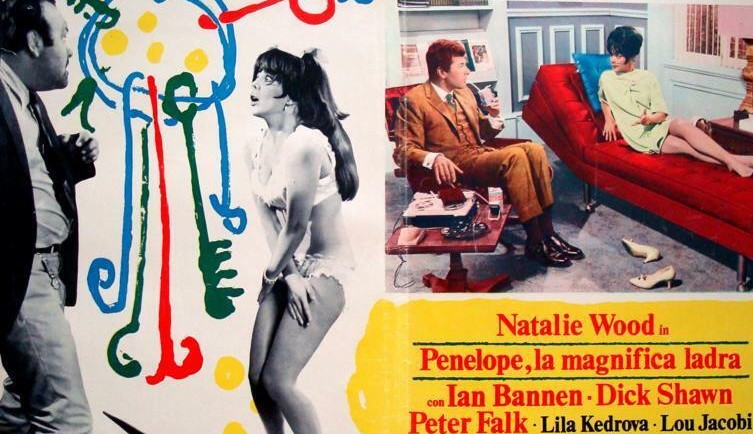
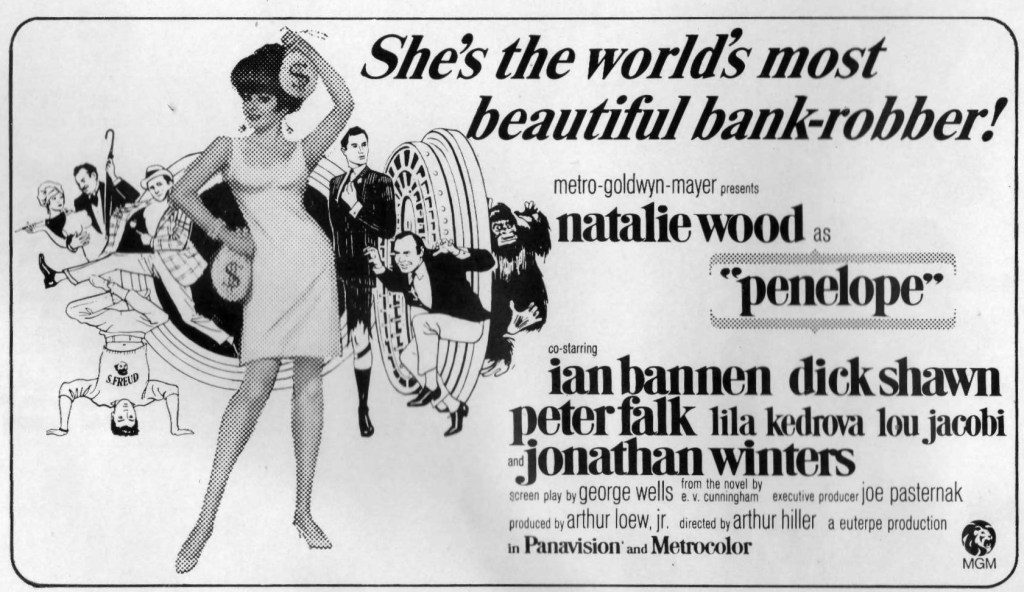
Marketeers quickly got a fix on how to sell Penelope: have star Natalie Wood holding up a bag of cash in each hand. The fact that in the most prominent of the three advertisements (a rather modest amount for movies in this decade) she was clutching the moneybags to her chest and dressed in only a bikini in what was undeniably a sexual pose could have been pure coincidence I suppose. In the second advertisement she was fully dressed and more stylishly posed in front of an open safe. The third less widely-used advertisement dispensed with the body, a head shot of her waving a wad of cash in one hand and a gun in the other.

The bikini advert features the other main characters in a variety of weird poses in comic fashion. “She’s Public Entertainment #1” ran the main tagline. Below that came: “That’s Penelope – the slick stick-up chick …and she’s leading the merriest men the hottest chase from safe to sofa” which in fact pretty much captured the storyline. A variation on the bikini ad was simply headlined: “She’s the world’s most beautiful bank-robber” – and you couldn’t argue with that either. Those two subsidiary taglines appear on an alternative bikini ad which shows four scenes from the film with a different catchline: “Attention! Put your hands in your pockets. If you find anything missing…Penelope probably took it.” The fully-dressed advertisement uses exactly the same sets of taglines.
Established stars were the hardest to find anything new to write about, hence the editorial on Natalie Wood only appearing on page four of the 16-page A3 Pressbook. For the picture she received one of the “most lucrative contracts ever given a young actress” plus fringe benefits like four dressing rooms. It was unusual for a big Hollywood star to harbor so many unfulfilled ambitions. “There are still so many doors to be opened,” she revealed. “I have only started. I want to try everything, perhaps appear in a foreign film or two. And I hope some day to make a stab at the Broadway stage.” Ironically, her aspirations resulted in her not working in Hollywood for another three years.

For some reason the marketeers felt it necessary to butter up New York’s Mayor Lindsay,  pointing out that the unit on location spent $15,000-$20,000 a day in the city, cast and crew housed in six floors of the Plaza Hotel, the basic cost swollen by the crew’s “thirsty eagerness for New York theater, ballet, museums, restaurants, night clubs.”  Two hundred extras a day were employed. Some playing policemen got into trouble for giving the cops a bad image by smoking while waiting to be called into a scene, passers-by mistaking them for the real thing. Locations included a sculpture garden in the Museum of Modern Art and a “beatnik joint” in Greenwich Village.
Fact-checking was rarely a priority for Pressbook compilers who here managed to geographically reposition Ian Bannen’s home from the Isle of Wight on England’s south coast to Wales. “This was my first venture into slapstick,” said the actor, better known for dramatic fare like The Hill (1965) and The Flight of the Phoenix (1965).  

Inadvertently, the Pressbook revealed secrets about Hollywood release schedules. Prior to making Penelope, director Arthur Hiller had been previously working on World War Two picture Tobruk. Yet Penelope hit theaters first – in November 1966 while Tobruk was delayed until February 1967. Hiller had fun with “weird” camera effects. “There are scenes in which we seem to have out-Dalied Dali.”

Oscar-winning designer Edith Head came up with what she termed a “schizophrenic wardrobe” for Natalie Wood, representing the two sides of her character, the stylish wife of a wealthy man and the larcenous opportunist. In one wardrobe were clothes representing “high style, comprising beautiful furs, discreet suits, svelte cocktail dresses and sophisticated evening gowns, all expressing financial worth.”  The other wardrobe, designated “way out,” suggesting the freedom from inhibition which Penelope strives so valiantly to achieve, comprised, among other items, “a wisp of a shortie nightgown in 14-carat gold and a negligee of golden coins,” a French lace number worn over “a nothing of a mini-bikini” and a red lace nightgown.

Peter Falk, playing a cop soft on Penelope, would not have been in the picture except that his television show The Trials of O’Brien was cancelled. Forty-eight hours later he was hired for Penelope, a week later signed for a television special of Brigadoon (1966) and shortly after won a big role in Luv (1967), taking second billing to Jack Lemmon.

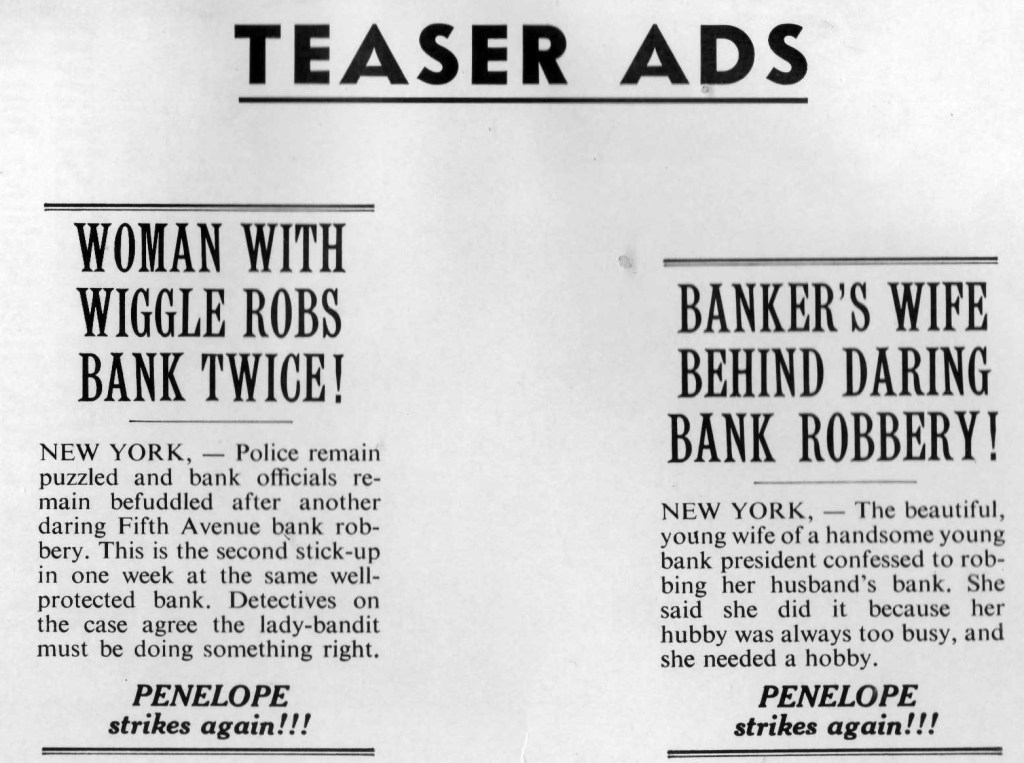
The $250,000 spent on Natalie Wood’s wardrobe provided ample scope for marketing tie-ins with fashion stores, hair stylists and shoe departments. Given the nature of the movie, it was inevitable that the marketeers suggest that exhibitors make up “Wanted” posters and plaster them around town especially at post offices, banks and police stations. Reflecting the  psychiatry element, one other marketing route was for exhibitors to tie up with a furniture retailer to promote the kind of couch a patient might lie on. Among other ideas touted to exhibitors were a limerick contest, a senior citizen competition and a tie-in with a local bank.

While the Pressbook promoted a soundtrack album that included Natalie Wood singing “The Sun Is Gray,” there was, unusually, no mention of the paperback of the book by E.V. Cunningham on which the movie was based.
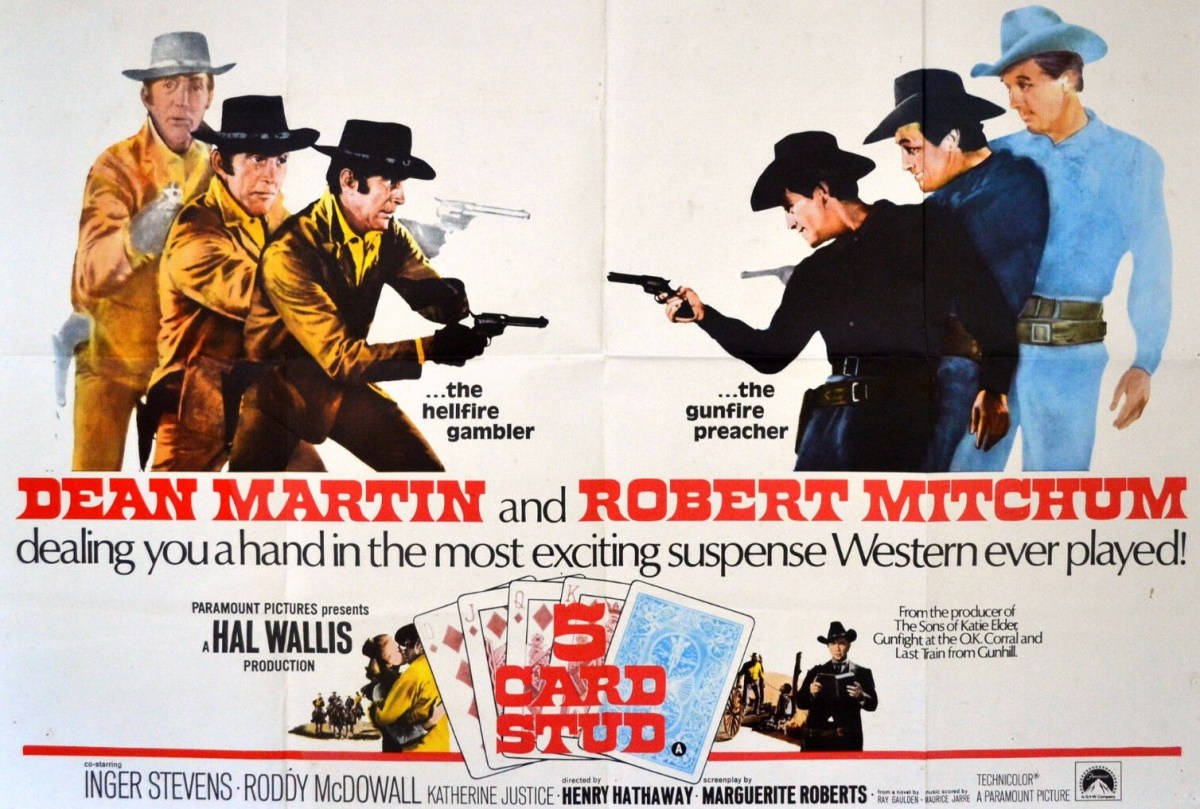
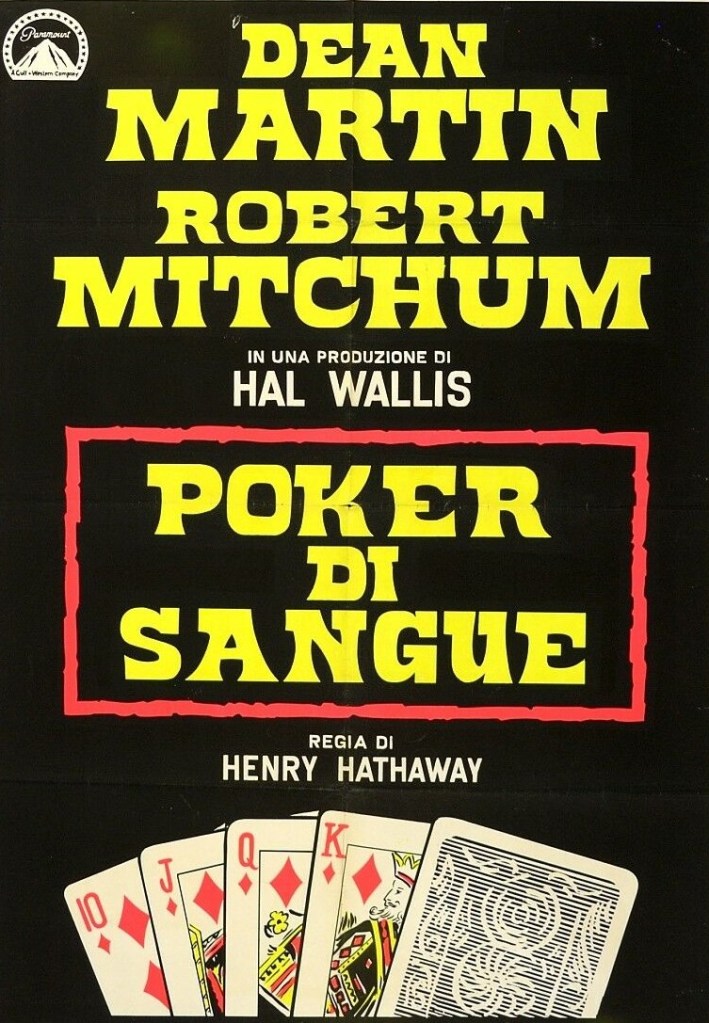
Five Card Stud (1968) ****

Another western in sore need of re-evaluation. Largely dismissed as a routine oater trading on the gimmick of a whodunit and packed with old stagers, this is in fact about a serial killer, a treatise on law and order, and almost acts as a conduit between the decade’s previous westerns when the good guys and the bad guys are easily defined to the end of the decade when such distinctions were muddied after The Wild Bunch (1969) and Butch Cassidy and the Sundance Kid (1969) invited audiences to root for the bad guys. In this rather well-structured picture, full of action and romance, we don’t know who the bad guy is.

The whodunit, however, is really a MacGuffin. The movie is more concerned with investigating the changing mores and hypocrisies of the West and predicting the inherent dangers in the proliferation of weaponry. It’s worth remembering that the movie came out at time when mass murderers such as Charles Whitman (the subject of Peter Bogdanovich’s Targets, 1968) who went on a killing spree in 1966 were becoming the norm.

A card sharp is lynched for cheating at poker in the quiet town of Rinchon where late-night gambling is the height of entertainment. One of the players, professional gambler Van (Dean Martin), attempts to stop the hanging but is beaten up for his troubles. No surprise then, that he ambles off to Denver. Sometime later the hangmen begin dying off and Van returns not just to solve the mystery but to ensure that his name isn’t on the list. “If someone is out to kill you, you don’t sit around and let him pick the time,” he concludes. With the number of killings, not to mention brawls and shoot-outs, it’s almost continuous action.

On his return, Van discovers, with a gold strike nearby, the incipient boom town has attracted unsavory elements, not just the high murder quotient but a whorehouse and loud music in the saloon. Acting as counterbalance is gun-toting preacher Jonathan Rudd (Robert Mitchum) who announces his presence by spraying bullets in the saloon floor, emerging as the self-proclaimed “conscience” of the town.

For a sometime protector of law and order, Van is rather lax in the morals department, unwilling to commit to main squeeze rancher’s daughter Nora (Katharine Justice) when the likes of Lily (Inger Stevens), the unlikely proprietor of a barbershop-cum-whorehouse, are on hand. Van is an interesting study. Once he becomes aware that the only people likely to end up in an early grave are the six men who played poker with the lynched individual, it doesn’t occur to him to fess up to Marshal Dana (John Anderson) which would ease the fears of the ordinary public. Awareness the only corpses belonged to the guilty would have prevented further outbursts of violence among a disaffected population. Interestingly, too, Dana makes no attempt to investigate the lynching.

At the core of this picture are a couple of amazing scenes as paranoia takes hold. One miner, without the slightest sense of irony, complains that in the old days a gunfight took place face to face, not by a murderer slinking round in the dark. Rudd adds some prophetic advice: “wear a gun and use it fast, wear a gun and use it slow – I say don’t wear a gun and you won’t use it at all.”

Van likes to think he has the measure of women, when in fact they have the measure of him. The story avoids the obvious lure of a love triangle, of jealous women competing for Van’s affections. Both the young Nora and the more mature Lily are pretty well grounded. “One wore-out no-account kiss” is Nora’s dismissive description of Van’s attempts at romance while Lily lets Van know she has taken a shine to him as a matter of convenience, he’s just a man and she hasn’t had one in three years. Expecting to be treated as a pariah, Lily, expressing the notion that “women don’t usually like women who like men,” strikes up a friendship with Nora.

Marshal Dana finds it increasingly difficult to maintain any kind of peace since as the death count mounts, paranoia grows rife, exacerbated by the kind of greed gold fever brings, resulting in citizens determined to challenge authority and take matters into their own hands.

The most antsy character is Nick (Roddy McDowall), Nora’s brother and the leader of the lynch mob. Nick seems to stir up bad feelings, provoking the ire of both his father and Van. The guilty are despatched in original ways, one man “drowns” in a barrel of flour, another strangled by barbed wire, a third wakes the town at night when the church bell to which his neck is attached starts ringing out. It’s not too hard in the end to work out who the killer is, but as I said, that is not the point of the picture, although the ending is satisfactory.

There a mass of small detail of the kind that director Henry Hathaway (True Grit, 1969) tends to work into his pictures. Van is a cut above. He travels to Denver and back by stagecoach not on horseback. Citizens can purchase Pocahontas Remedies and beer from the Denver Brewery. Shaves and haircuts at the Tonsorial Parlor are reasonably priced but “miscellaneous” comes in at $20. After the preacher shoots up her floor, saloon owner Mama (Ruth Springford) smooths out the holes.

And there is some distinctive direction. Rudd’s sermon that lasts nearly 90 seconds is delivered in virtually one take, a fistfight is conducted in silence except for a soundtrack punctuated by grunts and punches hitting their target, a dying man tries to leave a physical clue about the identity of the mysterious killer. And there is a superb main street gunfight with Van trying to rescue the marshal and Rudd striding down the street in old-fashioned gunslinger mode.  

Dean Martin (Rough Night in Jericho, 1967) and Robert Mitchum (The Way West, 1969), both with apparently easy-going but magisterial screen personas, come off well together. Inger Stevens (Firecreek, 1968)  always a great screen presence, an ethereal beauty, is vulnerable and strong at the same time. Katherine Justice (The Way West, 1967) is sassy and independent-minded and has a terrific facial response to coming across the first murder.  John Anderson (The Satan Bug, 1965) leads a fine supporting cast including Yaphet Kotto (Live and Let Die, 1973), Denver Pyle (Shenandoah, 1965) and Whit Bissell (Seven Days in May, 1964).

Screenwriter Marguerite Roberts, adapting the novel by Ray Gaulden, contributes some classic lines. “If that is a Bible, read it,” Van instructs Rudd, assuming the preacher has a gun planted in the Holy Book, “If it ain’t a Bible, drop it.” There’s a nod to a James Coburn scene in The Magnificent Seven (1960). Congratulated on his marksmanship in hitting the spinning wheels of a windmill six times out of six, Rudd protests his shooting was a failure since he was aiming for the spaces in between. It was ironic that her next assignment concerned a lawman who took much the same no-holds-approach to the criminal fraternity (True Grit, 1969) as the killer in this picture.

I was so intrigued by this picture, realizing it had much more to offer than a whodunit, that I watched it again within a few days and was pleasantly surprised by its depths.

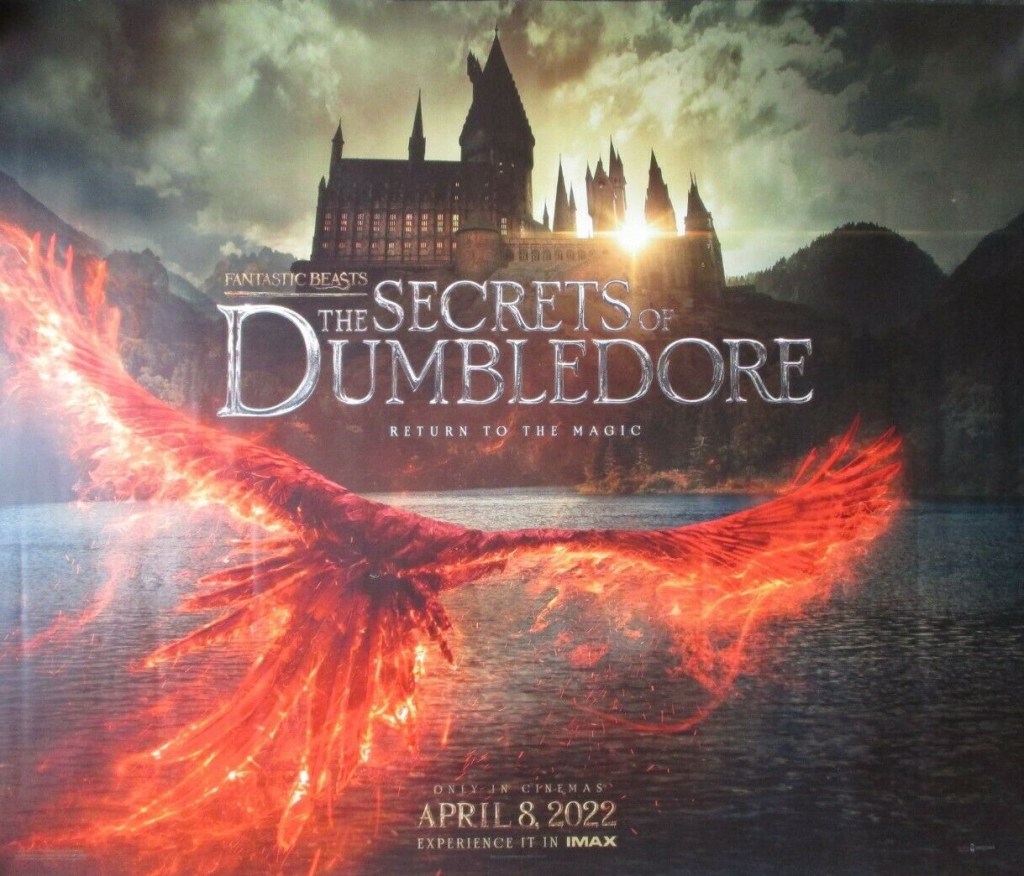
A Tale of Two Duds – The Northman (2022) ** / Fantastic Beasts: The Secret of Dumbledore (2022) ** – Seen at the Cinema

Hamlet goes Viking is basically as much of a story as “visionary director” Robert Eggers (The Witch, 2015) can be bothered with. Yes, there some Viking lore and for all I know this has been exceptionally well-researched but what it amounts to is the same kind of gobbledy-gook that makes no more sense than your average horror picture, with a ton of underdeveloped occult elements. Once our hero is freed from being hung from the rafters by crows beckoned, I presume, by some unexplained mystical power, pecking at the rope – and with a sword handily discarded in the vicinity – I was even more convinced this was a load of old cobblers.

So, basically a revenge saga. Amleth (Alexander Skarsgard) – pronounced Amlet for punters too stupid to get it – manages to escape when his uncle Fjolnir (Claes Bang) murders his brother King Aurvandil (Ethan Hawke). Vowing revenge, he is next seen “years later” as part of a raiding party slaughtering a village. He discovers that his uncle has been dethroned by a bigger king and sent into exile in Iceland. So he hauls himself off there, pretending to be part of a chain gang. He has every opportunity in the world to kill his uncle – and save his mother (Nicole Kidman) who has been carried off – but there is always a really dumb reason why he can’t.

Revenge delay seems a pretty odd way of stringing out a movie. Of course, when he gets round to saving his mother it turns out she doesn’t want to be saved and – a la Hamlet – was in on the plan to kill her husband. He falls in love with fellow prisoner Olga (Anya Taylor-Joy) who spouts a lot of witch-type stuff that is no less convincing than any of the other spiritual malarkey.

There’s a lot of bloody violence, but the sexual violence is kept to a minimum on screen though Olga has clearly been abused by Fjolnir. And there’s a game that seems close to the Irish game of hurling and whole bunch of oddities thrown in there wholesale as if such a joblot will add depth to the movie. A misconceived art picture that looks more like a top-of-the-range direct-to-DVD movie that might have cost around $40 million rather than the $90 million quoted.  

There’s a smorgasbord of dodgy accents and everybody speaks in stilted English, not far short of the “thee” and “thou” dialogue that critics used to make fun of. Alexander Skarsgard (Godzilla vs Kong, 2021) and Claes Bang (Locked Down, 2021) look rugged enough but neither has the screen presence of Schwarzenegger or even Stallone and it ends up Conan-lite. Anya Taylor-Joy (Last Night in Soho, 2021) looks as if she wondered how she managed to get talked into this. Nicole Kidman (Being the Ricardos, 2021) who has a plum scene towards the end offers the only acting of any distinction.

Fantastic Beasts: The Secret of Dumbledore

I kid you not, this is about an election. Yep, someone’s greenlit a $200 million fantasy picture about an election. Whatever delightful element the original entry to this series possessed has been destroyed not just by a preposterous storyline – this is for kids, remember – but a very somber tone. Everyone talks in a low voice, it is very darkly lit and there are those awful meaningful pauses.

The story they pretend is about to occur never happens. Something about “counter-sight” if I got that bit correct and how our heroes had to act together to “confuse” the bad guy because he could see into the future. There’s never any sign of him seeing in the future and most of the confusion arises because there are just way many characters.  With a piece of Hollywood wizardry Grindelwald has completely changed his appearance, no longer Johnny Depp but Mads Mikkelson. You will be aware of the reason for this but Mads has taken on an impossible task. There already was an over-large contingent of players – Newt Scamanger (Eddie Redmayne) and his brother Theseus (Callum Turner), Albus Dumbledore (Jude Law) and his brother Abeforth (Richard Coyle), Credence Barebone (Ezra Miller), Jacob (Dan Fogler) and assorted characters who have a romantic interest in the principals.

But basically – hold your breath – Grindelwald is trying to crash an election party. Two candidates are already in contention to be, I presume, Chief Wizard. He kidnaps something that might be called a “chillin” – a mythical creature that looks like a gryphon – which like the wands in Harry Potter has a way of choosing the best person for the job. There’s very little CGI for a fantasy picture. One monster, a bunch of dancing lobsters (maybe scorpions, I couldn’t work it out) and the usual contents of Newt’s suitcase is just about it. The wands are now used more like light sabers or pistols. You won’t be surprised to learn there’s not much in the secrets department either.

There’s not enough Newt and he’s not as delightful as he once was and there’s far too much of boring electioneering, huge crowds gathered for rallies in favor of their candidates. This one cost $200 million and I have no idea what that was spent on. Certainly not the script. A franchise-killer if ever I saw one.

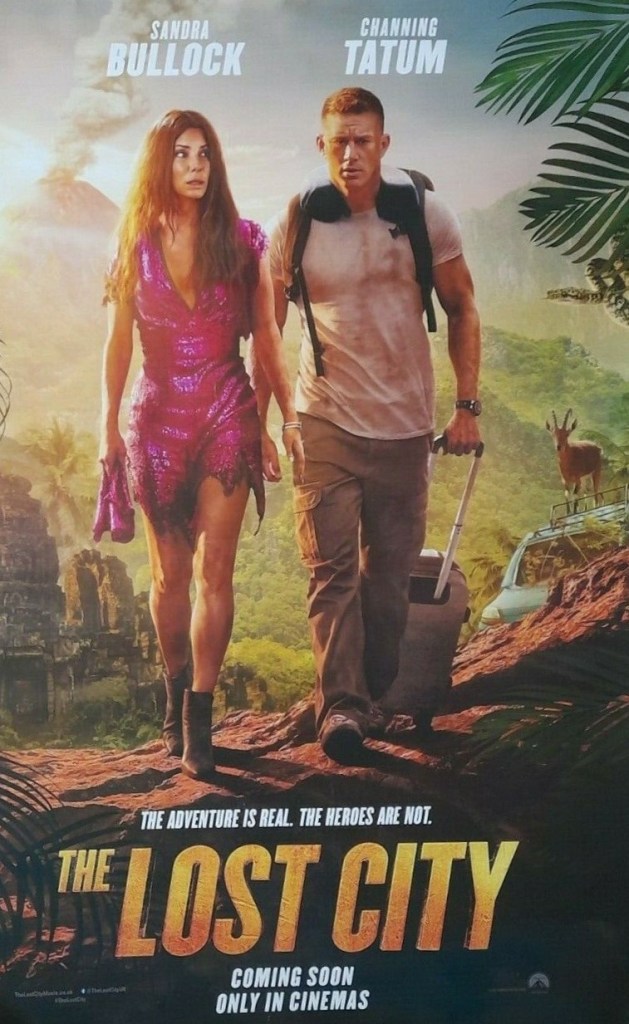
The Lost City (2022) *** – Seen at the Cinema

I was wondering when Brad Pitt would show up. Judging from the trailer it would be close to the end when he leaps, long hair blowing wild, to save the day. I didn’t expect him to show up almost right from the start. Nor, I have to say, that before the halfway mark – SPOILER ALERT – his brains would be splattered all over Channing Taum’s face. For me, in that one scene, the film never recovered, despite a bizarre post-credit sequence where it transpired that Pitt had in fact survived having his brains blown out all over Tatum’s face.

But let’s recap. Grieving widow romantic novelist Loretta (Sandra Bullock) whose fans prefer muscular cover model Alan Chaning Tatum) is kidnapped by over-the-top nutjob Abigail (yep!) Fairfax (Daniel Ratcliffe) to recover lost treasure from an island in the middle of nowhere. Alan, assuming that he must act like her fictional hero Dash, enlists Jack Trainer (Brad Pitt) to rescue her. Pitt, having lost none of the athleticism he displayed in Troy (2004), does just that but in the course of the escape – SPOILER ALERT AGAIN – he gets his brains splattered out.

Neither Loretta and Alan are really cut out for escapist adventure and spend most of the time making a hash of it, which is a nice twist on the genre. There’s not really enough chemistry between Bullock and Tatum, both playing personas we’ve seen before. There’s some cute stuff, snuggling up in a hammock, Alan discovering some survival skills and eventually she stops her endless whining and springs into proper heroine mode and the climax includes a romantic surprise when she finally decodes the meaning of the archaeological mystery. But the idea of him being allergic to water seems extreme and it makes even less sense – except as an excuse to show his bum and make a lame joke about the size of his manhood – for him to be only one covered in leeches.

But we hardly need a volcano simmering in the background especially as those special effects are poor. The idea of a deadline for this lackadaisical pair is a joke and reeks of writers struggling for a third act. Without the impending explosion Pitt could just have suffered a broken leg and been left behind; if he miraculously appeared for the coda in crutches that would have been perfectly acceptable, his superhuman skills already demonstrated. And there’s only so much humor you can stretch out of stretching a flimsy dress. And especially idiotic is that they require pushy agent Beth (Da’Vine Joy Randolph) to come to the rescue – the ending is singularly poorly worked-out unlike Uncharted where it all made logical sense. The problem is that everyone in his picture is just dumb without enough of the dumb and dumber-ness to make it an effective comedy.

The surprising part is that with all these misfiring elements and setting aside the brain-splatter the movie works well enough. There’s none of the personality clash – both irritate the other rather than hate them – that marked out Romancing the Stone (1984) and there’s not really enough derring-do but generally it jigs along and both Tatum and Bullock have strong enough fan bases. There’s a determinedly feel-good factor at play.

In particular it’s a welcome return to the big screen for Sandra Bullock (The Heat, 2013) who has somewhat ill-advisedly become the Netflix Queen. A movie star for nearly 30 years she has been very adept at choosing roles and switching her screen persona and her brand of awkward/prickly geek still works. Channing Tatum (Dog, 2022) always plays against his physique, strong but vulnerable and here he adds caring to the formula. Daniel Ratcliffe (Escape from Pretoria, 2020) doesn’t do much more than rant and look manic – Harry Potter in a hissy fit.

Could easily be renamed Search for a Lost Genre as the rom-com struggles to provide partnerships to match Richard Gere-Julia Roberts and Tom Hanks-Meg Ryan and no one has come close to repeating the legendary Tracy-Hepburn dynamic. And while we’re at it, I’m not sure by what authority Loretta concludes that (beyond a swipe at Indiana Jones) snakes have no logical place in ancient tombs.

Despite my nitpicking, they do make a good team and it’s enjoyable enough.

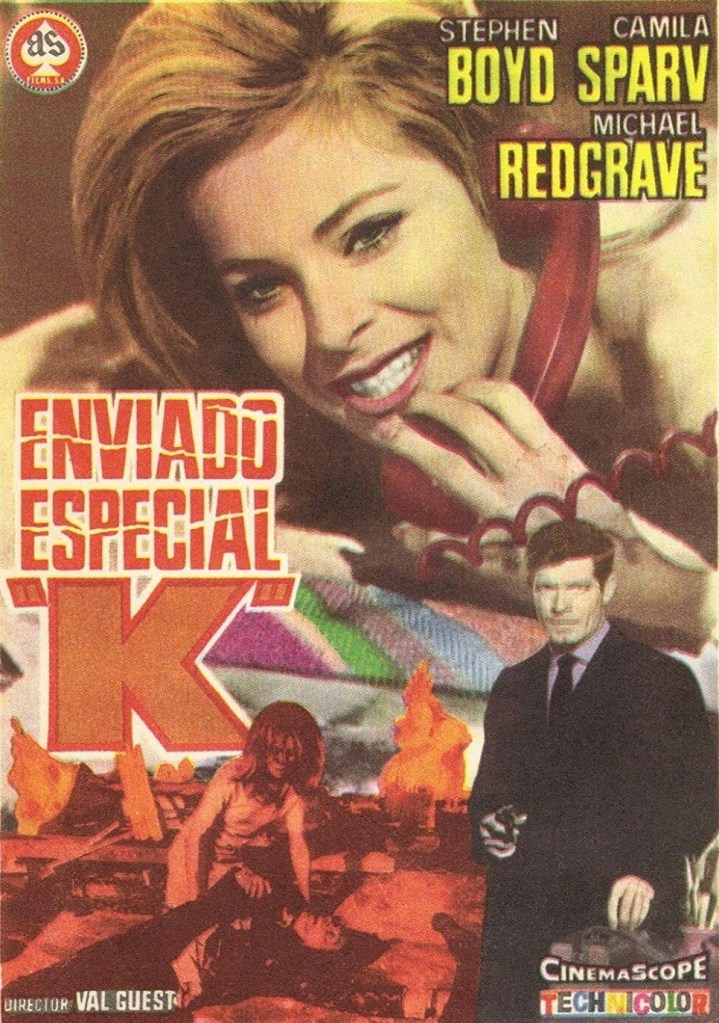
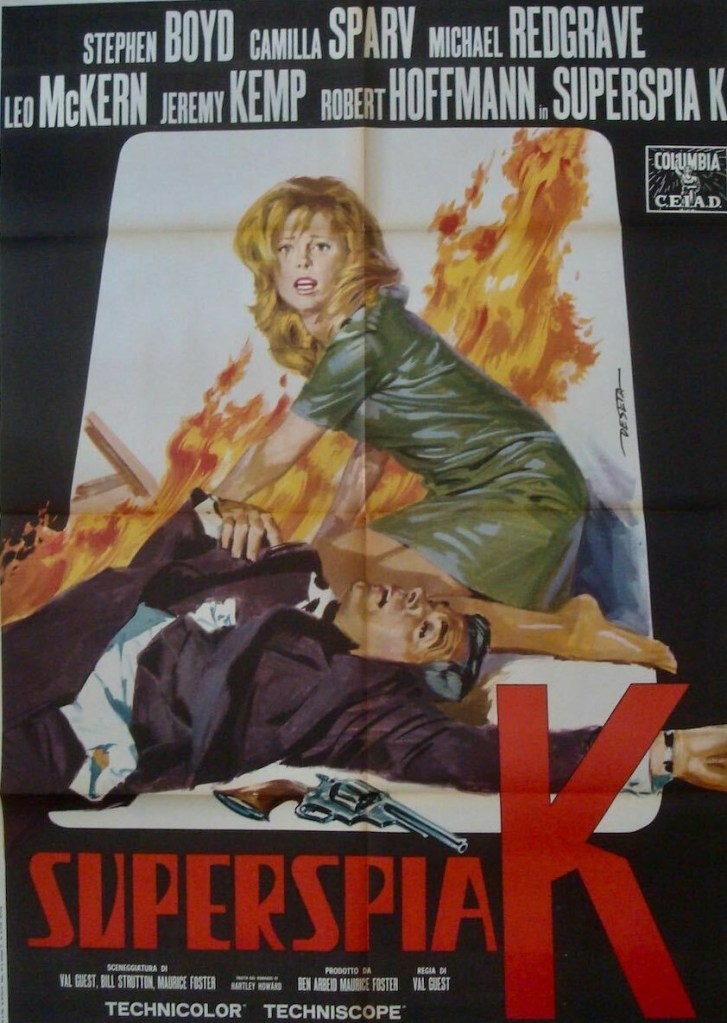
Assignment K (1968) ****

A good notch above the routine spy thriller, this deserves another look. By the mid-1960s the screen was awash with spies so other than trying to invent a new hero in the Matt Helm/Derek Flint vein or revamping older characters such as Bulldog Drummond  or sending up the entire genre in the style of Casino Royale (1967), it was difficult to find a fresh angle.

Assignment K does in some measure succeed, in part by going down the grimy  route of The Spy Who Came in from the Cold (1965), in part by stuffing the picture full of glorious scenery – the Austrian Alps – and in part by turning Stephen Boyd into the kind of spy who has begun to question the entire business. For reasons unspecified, former racing driver turned toy salesman Boyd (The Big Gamble, 1961) is running his own spy operation loosely linked into British intelligence but when the network is compromised his life and that of new love interest Camilla Sparv (Nobody Runs Forever/The High Commissioner, 1968) endangered. Things get trickier when she is kidnapped and he has to save her while not compromising his own agents.

There is enough mystery to keep the plot, uncoiling like Russian dolls, ticking along and the entire effort is underwritten by some decent tradecraft, dead letter drops, microfilm hidden inside cigarette filters and so on. Tension is surprisingly high. And Boyd is surprisingly human, falling properly in love for one thing, not just treating women in the James Bond/Matt Helm fashion as notches on a bedpost, not ice-cool under pressure either, face knotting in fury on occasion, and not so accomplished in the old fisticuffs department. There is less reliance on just sticking out his chin and looking handsome and this is a more assured performance than in The Big Gamble.

Michael Redgrave (The Hill, 1965), Leo McKern (Nobody Runs Forever) and a pre-Please, Sir John Alderton provide decent support though Jeremy Kemp (The Blue Max, 1966) is somewhat subdued. But Boyd is a revelation. Here, his screen charm and charisma are at their best and while he was never going to attract the attention of the Oscar fraternity is entirely believable as a spy coming to wonder at decisions taken.

Sparv, too, is much better than I have ever seen her. Unlike her turn in Murderers Row (1966), her role is not merely decorative and the unfolding romance would work perfectly well just as a love story never mind tucked away in the guise of a spy thriller. There is a lovely demonstration of her acting skill, although an odd one to describe, as she pulls on a bathrobe and shimmies out of the towel underneath; I can’t believe that was ever scripted, but if you watch it you will see what I mean.  Swedish Sparv was often viewed just as another of the decade’s ubiquitous European starlets but in fact she shows genuine acting ability.  

Director Val Guest was usually labelled a “journeyman” despite a repertoire that included The Quatermass Xperiment (1955) and its sequel, Yesterday’s Enemy (1959) and sci-fi The Day the Earth Caught Fire (1961) and he had previous form in this genre with Where the Spies Are (1966) which played more to the comedy gallery and did some work on Casino Royale to boot. Guest was also involved in the screenplay along with two first-timers Bill Strutton and Maurice Foster, the former primarily a television writer, the latter a producer. Guest’s work here falls into the efficient category, but it does zip along at the same time as allowing Boyd and Sparv to develop their characters and make their relationship believable. All in all quite enjoyable.

CATCH-UP: The Blog has reviewed Camilla Sparv in Dead Heat on a Merry-Go-Round (1966) Nobody Runs Forever/The High Commissioner (1968) and Downhill Racer (1969). Stephen Boyd pictures reviewed so far are The Big Gamble (1961), The Fall of the Roman Empire (1964) and The Third Secret (1964).

The Devil-Ship Pirates (1964) ***

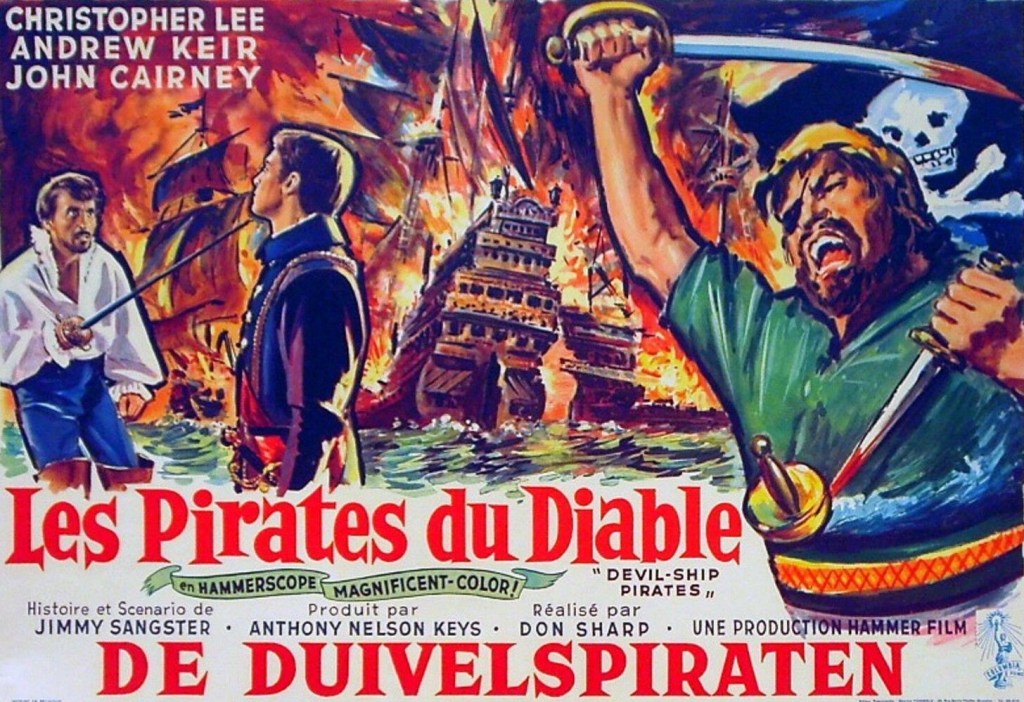
Despite the title and Hammer’s penchant for the unholy, there is nothing satanical about this picture. Christopher Lee (The Whip and the Body, 1963)  less cadaverous than in his better-known incarnation as Dracula, plays the captain of ship called Diablo, part of the defeated Spanish Armada, who lands in 1588 on British shores and by convincing the locals that the British have been defeated  imposes an occupation.

Writer (and later director) Jimmy Sangster’s clever premise works, the lord of the manor (Ernest Clark) immediately surrendering and befriending the invaders, most of the villagers succumbing, a few more doughty lads (Andrew Keir and son John Cairney to the fore) rebelling. 

Running alongside its regular horror output, Hammer had a sideline in swashbucklers, the Men of Sherwood Forest (1954), Sword of Sherwood Forest (1960), The Pirates of Blood River (1962) and The Scarlet Blade (1963) – aka The Crimson Blade – preceding this, and all, interestingly, aimed at the general rather than adult market. Australian director Don Sharp, in the first of several teamings with Lee, does extraordinary well with a limited budget. Although the village square was a leftover from The Scarlet Blade, there is a full-size galleon, swamps, fog, floggings, a hanging, fire, chases, a massive explosion, and a number of better-than-average fencing scenes.

In other hands, more time could have been spent exploring the psychology of occupation, but despite that there is enough of a story to keep interest taut. Lee has a high-principled lieutenant who secretly subverts his master’s wishes. Tension is maintained by Lee’s ruthlessness, the efforts of captured women to escape, and attempts to seek outside help. While the intended audience meant toning down actual violence, Sharp creates a menacing atmosphere. The final scenes involving sabotage are tremendously well done.

A rare outing for Lee outside of the horror genre, he truly commands the screen, an excellent actor all too often under-rated who holds the picture together. Andrew Keir (The Viking Queen, 1967) and Ernest Clark (Masquerade, 1965) provide sterling support. Suzan Farmer (The Crimson Blade, 1963) plays the requisite damsel in distress.  Director Don Sharp (Bang! Bang! You’re Dead!, 1966) was another horror regular responsible for, among others, Curse of the Fly (1965) and Rasputin: The Mad Monk (1966), the latter reuniting him with Lee.

I should acknowledge a vested interest as John Cairney was a distant relative and I do remember as a child being taken to see his previous outing Jason and the Argonauts (1963) but, strangely enough, this one was given a miss by my parents. I wonder if the title put them off.

CATCH-UP: Christopher Lee was so prolific I have only so far reviewed a fraction of his 1960s output: Beat Girl/Wild for Kicks (1960), Sherlock Holmes and the Deadly Necklace (1962), The Whip and the Body (1963), The Gorgon (1964), She (1965), The Skull (1965), The Brides of Fu Manchu (1966), Five Golden Dragons (1967). The Devil Rides Out (1968),  The Curse of the Crimson Altar/The Crimson Cult (1968) and The Oblong Box (1969).  Quite enough to be getting on with if want an idea of this fine actor’s range and ability.

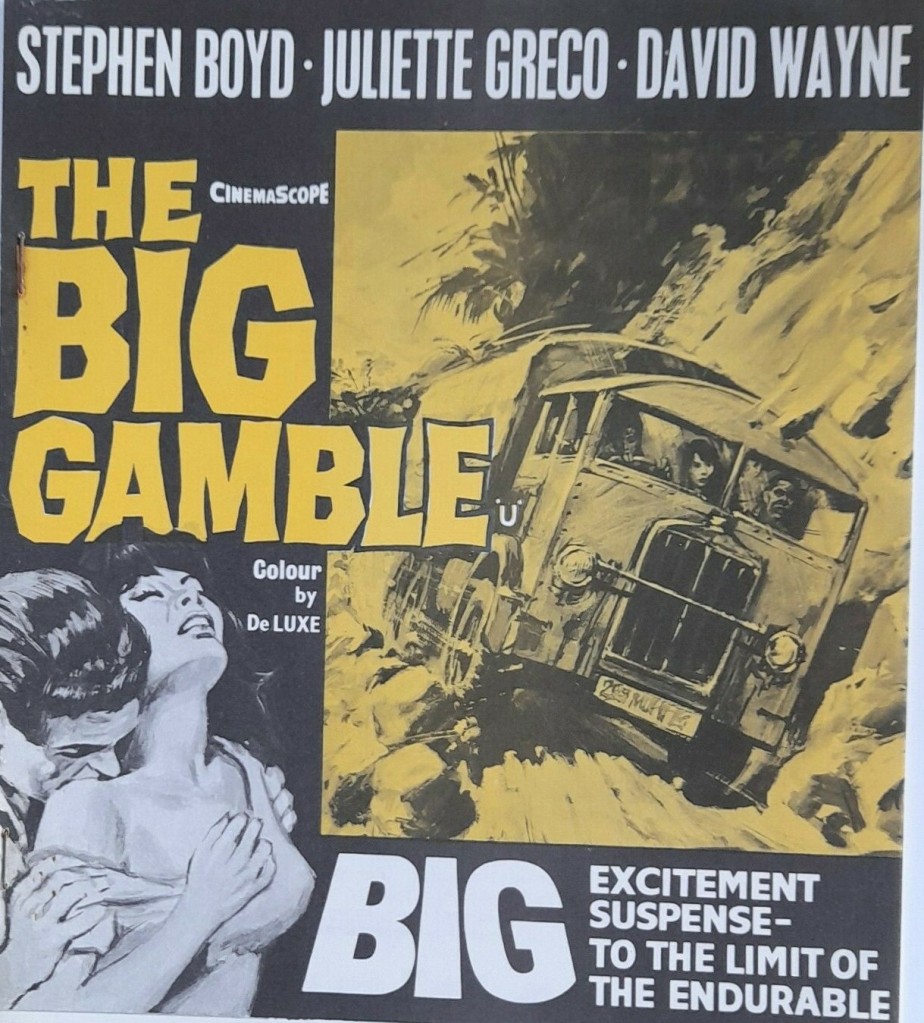
The Big Gamble (1961) ***

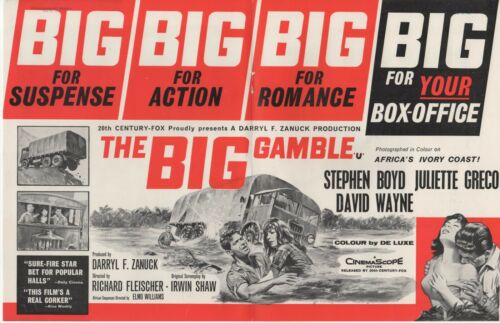
If only there had been some serious money put behind this picture it would have been an absolute cracker, custom-made for the likes of Cinerama which didn’t go down the dramatic route until a few years later. It’s a bit “Hell Drivers or Wages of Fear Goes to Africa” but with some really quite stunning sequences.

Whatever French chanteuse Juliette Greco (Crack in the Mirror, 1960) had to offer on stage and in a personal capacity – lovers included Miles Davis and this film’s producer Darryl F. Zanuck – never seemed to translate to the screen in this particular role and the most we get is a kind of tomboyish perkiness. It’s a medium-grade cast, the lead taken by Northern Irishman Stephen Boyd (here playing a Dubliner). David Wayne (The Three Faces of Eve, 1957) is the sad sack brother who joins the other two in a bold plan to set up a haulage business on the Ivory Coast in Africa.

The opening sequence demonstrates the dreary Irish life Boyd is trying to escape with a sparkling cameo from Sybil Thorndike (Shake Hands with the Devil, 1959) as the family matriarch before the African sequences kick in. Apart from scenes shot at Ardmore Studios in Bray, Ireland, the rest is clearly filmed on pretty dangerous locations if the unloading of a lorry onto what looks like little more than a large canoe is anything to go by. After an unpromising start, the intrepid trio (well, two are bold, Wayne is not) set off into the wilderness.

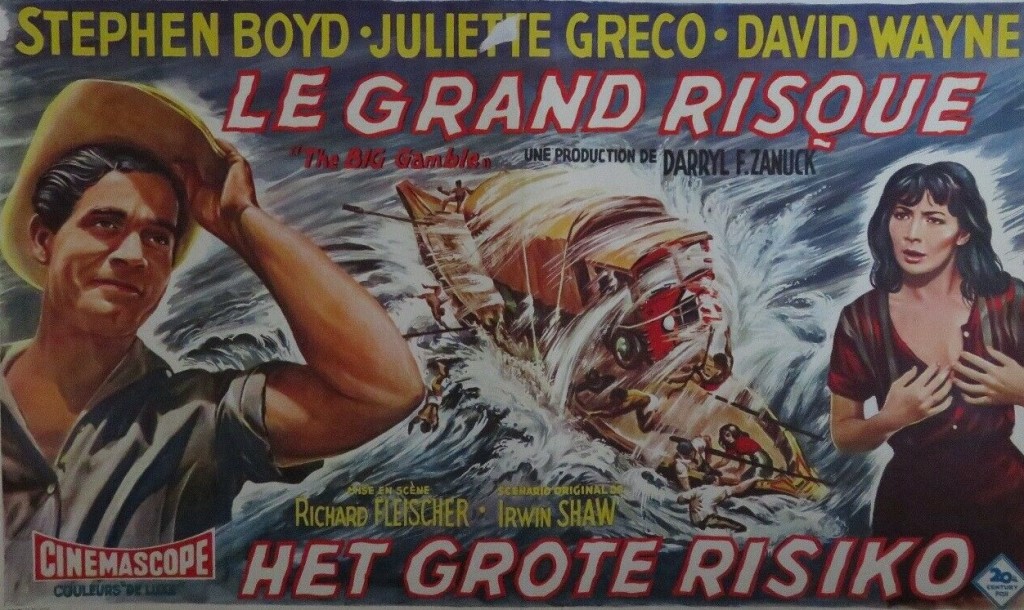
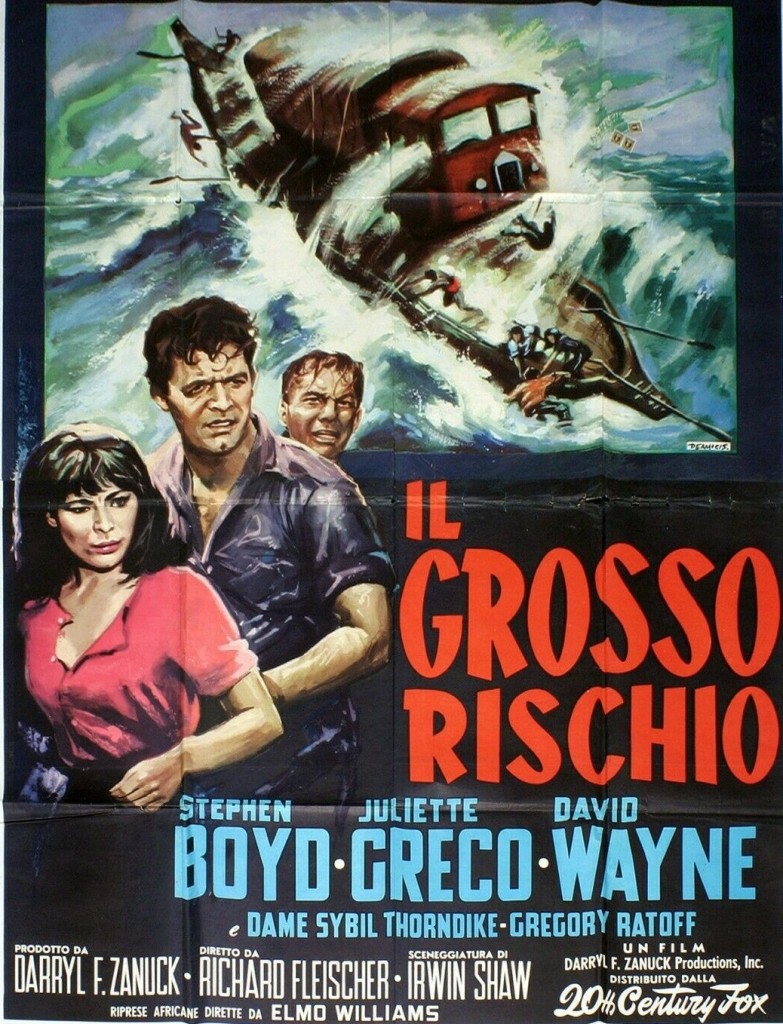
There are two edge-of-the-cliff sequences that would have The Italian Job fans frothing at the mouth, a runaway lorry in the best Cinerama tradition and an astonishing section crossing a swollen river where clearly the actors did their own stunts (and Boyd was in reality saved from drowning by his co-star). In between we have snippets of genuine Africa, especially canoeists braving the surf and an African funeral party. Emotionally, beyond Boyd sticking out his chin as much as possible, the main drama focuses on fraternal rivalry with Wayne trying to pull himself together in the face of a mission he believes doomed to failure.  Their plans are further hit by sabotage by the German Kaltenberg (Gregory Ratoff in his final role).

While some of the posters highlight the river crossing, others focus on the cliff-top sequences.

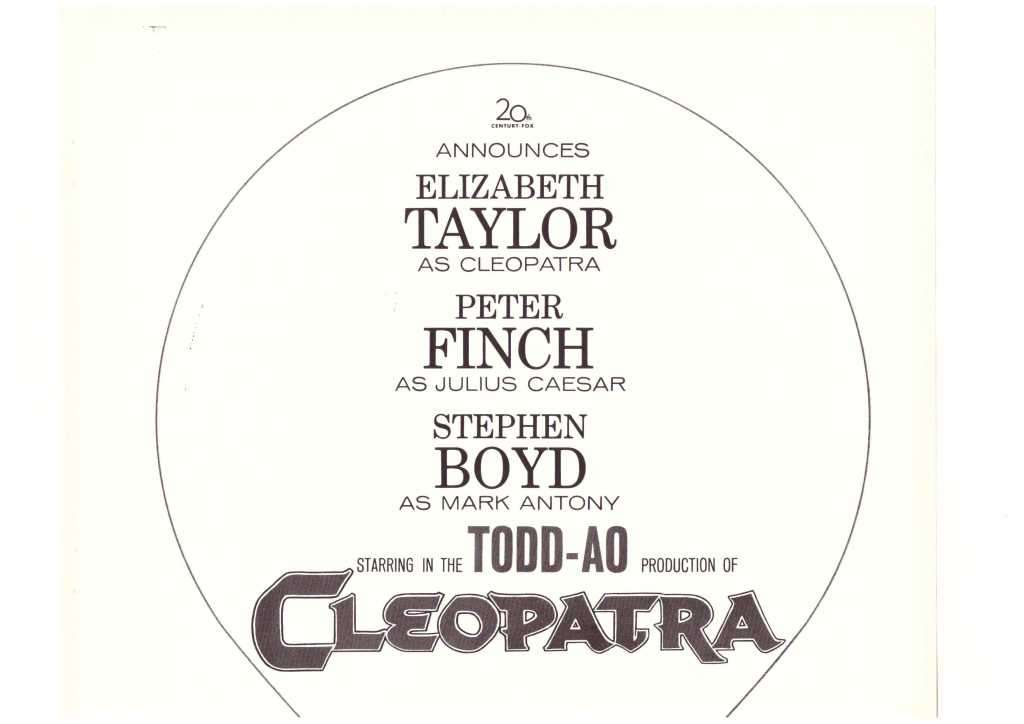
This was Boyd’s bid for stardom. Five years into a seven-year contract with Twentieth Century Fox, he had worked his way up the ranks at that studio to become male lead to top-billed females like Susan Hayward (A Woman Obsessed, 1959) and Hope Lange (The Best of Everything, 1959) before his career received a massive boost after a loan-out deal to MGM for Ben-Hur (1959). He might have been hotter yet had Fox not abandoned its first Rouben Mamoulian-directed version of Cleopatra in which he played Mark Anthony, a role that later brought Richard Burton worldwide fame and a new wife. Boyd would be hot at various times during his short-lived career (he died at 45) while equally never making the transition to major star.

One of the great Hollywood what-ifs – how would Boyd’s career have developed
if he had followed up “Ben-Hur” with “Cleopatra.”

Directed by the underrated Richard Fleischer, best known for 20,000 Leagues under the Sea (1954), Compulsion (1959), Crack in the Mirror (1960) and later The Boston Strangler (1968) and here with some help for the African sequences from Elmo Williams (The Longest Day, 1962) – the nerve-wracking clifftop sequences and river crossing were actually shot in France – it has a decent enough script from novelist Irwin Shaw (The Young Lions).

All-in-all this tight little film more than does justice to its miserable budget with some genuinely exciting sequences.  Filmed in CinemaScope, this is one of the films of the era which does justice to the widescreen. As a wee bonus, if you listen hard to Maurice Jarre’s score you will hear strains of some themes that turned up in Lawrence of Arabia.

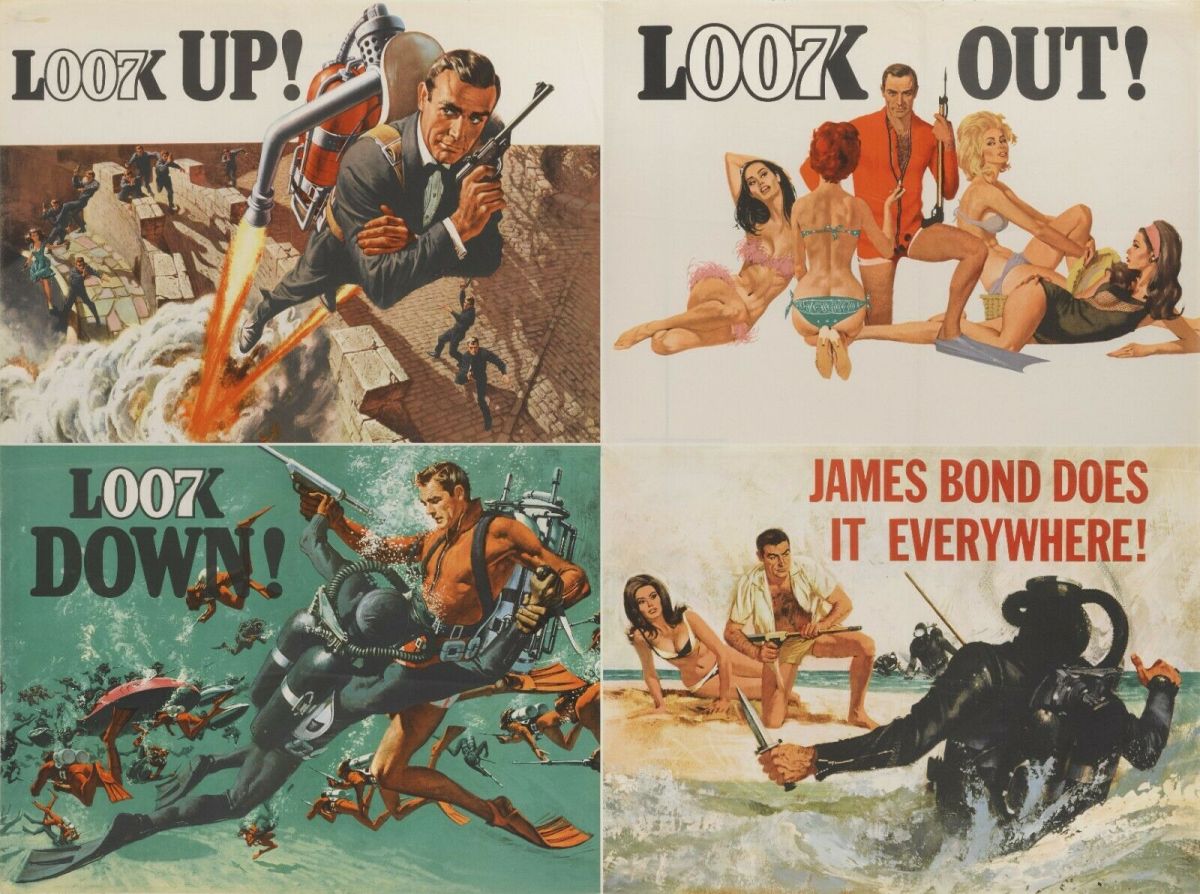
Selling James Bond: Part Two – Pressbook for “Thunderball” (1965)

Wooing the audience was no longer required after Goldfinger (1964) had broken the box office bank. Thunderball, claimed producers Cubby Broccoli and Harry Saltzman, was “the hottest merchandise campaign you have ever handled” as the first four pages of the Pressbook went to show. No longer was there a retailer free-for-all with companies which had nothing to do with endorsements jumping on the Bondwagon.

The potential for promotional tie-in was so high that retailers and manufacturers were willing to spend a fortune to become involved and, in so doing, provide a massive spread of free advertising. Colgate had an entire line of toiletries for men including after shave, shaving lotion, deodorant, and talcum powder, each item branded with the 007 logo with Colgate investing in a massive advertising campaign aimed not just as men but the women who buy for men.

Shoe-wear manufacturer Endicott Johnson set up a nationwide contest through the Montgomery Ward chain of stores. Customers were invited to participate in a free sweepstake and store managers were encouraged to become active in promoting Thunderball at sales points throughout their shops.

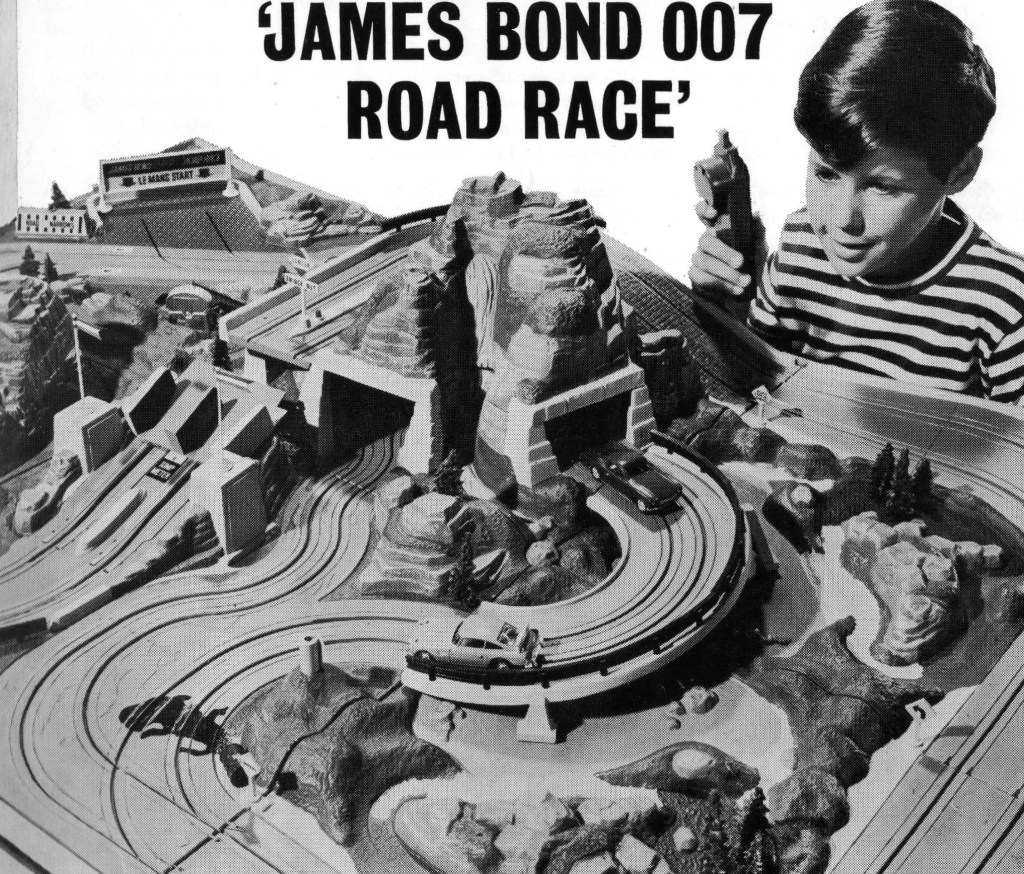
Toy manufactuer A.C. Gilbert had devised a James Bond 007 Road Race which would be promoted in the biggest marketing campaign in Sears Roebuck history to 60 million homes. The catalog would feature a five-page spread. “Beatles fans will be reached through a TV buy that Sears has made advertising the Road Race on ABC-TV’s Beatles Cartoon Show.” Adlers Slacks was the exclusive licensee for James Bond 007 Boys Slacks – with two hidden pockets. Revere Knitting Mills was promoting four sweaters “as worn by James Bond.”

Other licensed products included The Official James Bond Secret Agent 007 Shooting Attache Case, Harry Diamond sports shorts with the Bond logo, Allison tee-shirts and sweat shorts, bubble gum and trading cards from the Philadelphia Chewing Gum Corp, and a walkie-talkie set from Gabriel. In addition, Weldon was selling “007 Pyjamas – Go to Bed Dressed to Kill,” Voit manufactured underwater equipment, Spatz advertised its trenchcoats in Playboy, Trimount clothing range included items for men and boys, and Milton Bradley had four board games and six jigsaw puzzles.

So for the first time in history, exhibitors had to do nothing to attract customers, no zany attention-grabbing gimmicks required, because the massive cross-promotional campaign devised by the producers ensured that potential moviegoers could hardly go anywhere without coming across something alerting customers to the movie.

All this was in addition to the normal standard promotional tools such as original soundtrack album and paperback movie tie-in. Tom Jones had released a single and six other artists had brought out instrumental singles and albums. Trade magazine Cash Box noted that the Bond name signified “something big in the worlds of film and music…many labels have themed LPs after the valuable James Bond Agent 007 image.” Signet had brought out the movie tie-in paperback with artwork on front and back covers.

The bulk of the Pressbook was taken up with advertising and information about the licensed products leaving just three pages for the editorial section. By now of course Sean Connery was a big box office star so he received considerable coverage, explaining that he had been chosen for Dr No as a result of a London newspaper poll. There was space too for the movie’s playgirls – former Miss France Claudine Auger, villainess Luciana Paluzzi best known to American audiences through the Five Fingers television series, Molly Peters and a return for Martine Beswick who had appeared in From Russia with Love.

Not surprisingly, the Aston Martin DB5, which had caused a sensation in Goldfinger, also returned. The customised version cost $45,000 (worth $400,000 today), compared to the usual price of $13,000, and came complete with twin Browning machine guns, tire slashers, revolving number plates, radar screen, ejector seat, and retractable bullet proof shields.

Selling the Obvious: Pressbook for “Kisses for My President” (1964)

Fred MacMurray doesn’t actually wear a woman’s hat in this picture, he just imagines himself wearing one. But that image was all it took for the marketeers to do it to death. Warner Brothers clearly believed the picture was going to be a winner and produced a whopping 32-page A3 Pressbook (double the normal size) in a bid to persuade exhibitors of its potential. That included a blockbusting two dozen adverts. Although in the 1960s as this series on Pressbooks has shown, movies were not sold just on the basis of one core image, but even so a limit was generally called when the number of options reached eight or nine.

On top of that, the Pressbook writers provided interesting copy for editors who might file a snipper or two around the movie’s launch. Arlene Dahl, for instance, contended that a large proportion of the most prominent women in history – Salome, Cleopatra, Elizabeth I – had, like her, red hair. Writing a syndicated beauty column, Dahl also offered advice on wearing perfume.

Eli Wallach put forward a convincing argument for remaining a supporting actor. “Get your name above the title,” he opined, “and if you make a hit you have to play the same thing over and over – the actor gets sick of the monotony and sooner or later so does the public.” Polly Bergen, who based her screen wardrobe on Jackie Kennedy, argued that ordinary women were well turned out in America whereas abroad that was the preserve of the wealthy. Starting out in Wisconsin Fred MacMurray scraped paint off cars for $20 a week.

To get exhibitors in the mood to sell a political comedy, the Pressbook offered eight “punchy and funny” spoof campaign posters, suggesting they be positioned in door panels or along one wall in a straight line and on a voting booth in the lobby. Expanding on the concept in their local area, exhibitors were encourage to recruit an important woman “holding some office” who could be corralled into acting as a “president” embarking on an imitation tour backed up by supporters carrying placards.

Silent screen star Carmel Myers, who manufactured a fragrance line for men, was enrolled by Warner Brothers for a nationwide tour in part talking about the subject that is key to the movie’s subplot – “can a beautiful and glamorous woman be a successful business executive?” A high-flying vamp of the silent era, Myers starred in Ben-Hur: A  Tale of the Christ (1925) and later had her own short-lived television series before entering the beauty business.

Except twice, each of the other myriad adverts stuck with a photo of MacMurray wearing a hat. The taglines, running on the theme of what happened to the female President’s male consort, varied only slightly. “When a woman becomes President, what happens when her poor husband becomes First Lady?” / “President arrives in New York today, leaves First Lady home with knitting”/ “Women rise, men revolt, everybody cheer”

Inevitably, advertising focused on politics. “Republicans and Democrats agree this is the funniest picture you’ll ever see” / “First male First Lady takes Washington by storm” / “Is America prepared for the first woman president and her First Lady?

Some taglines took a different approach. “This year a woman will be elected President of U.S….and a man will be elected to the Comedy Hall of Fame” /”Vote the sdtraight ticket (the movie ticket, we mean” / “When you cast your next vote for President, be sure to do it at (this) theatre” / My father is the hostess with the moistest.” 

Banned, Ignored, Shelved: Part Two

It wasn’t just the censor who put paid to the chances of some films receiving a cinema release. Even more likely, a movie fell foul of distributors or cinema circuits especially in countries where chians were more dominant such us Britain.

Some cultural boundaries were never meant to be crossed. A country like Britain that barely saw a drop of sunshine from one year to the next could hardly be expected to appreciate the joys of endless sunshine instanced in the sub-genre of movies revolving round surfing and beach activity. This was slightly surprising given that every spy picture came with a bevy of beauties in bikinis, but the slight stories and even more miniscule budgets of the beach movies failed to find an audience in Britain. Although Beach Party (1963) with Robert Cummings and Bikini Beach (1964) starring Frankie Avalon and Annette Funicello got the series off to a decent start, it was quickly downhill thereafter, the bulk of this kind of picture never shown not even the likes of The Ghost in the Invisible Bikini (1966) boasting an impressive cast in Boris Karloff, Basil Rathbone, Elsa Lanchester and Nancy Sinatra.

Whether or not they might have fared better at the box office will never be know because they were not given a chance. In Britain two cinema chains – ABC and Odeon (also including Gaumont) – predominated and if a movie failed to win a circuit release on either there was little chance of it opening at all. In general, assuming a programme did not always comprise a double bill, ABC/Odeon/Gaumont  between them showed around 200 films a year. Allowing that Hollywood produced 300 movies on an annual basis and the domestic industry produced about 75-100 and space had to be found for the occasional reissue or foreign blockbuster, it was no surprise that some films were just ignored altogether – never seen in Britain or received a derisory release.

This was not a situation that would be restricted to Britain. Every country in the world in the 1960s wanted to protect its domestic output, limiting audience access to American or British films by various embargoes or through the censor. Spain, for example, had 370 films on its backlog in 1962. But Britain is an interesting example since culturally it was closest to America and in theory at least there should have been no bar to movies making the Atlantic crossing.

As well as the beach party anathema, Britain film bookers proved resistant to the charms of country-and-western music, no homes found for the likes of Hootennany Hoot (1963), Nashville Rebel (1966) starring Waylon Jennings and That Tennessee Beat (1966). A variety pictures concerning serious subjects like racism, politics, drug addiction, or mental illness put paid to the prospects of, respectively, Black Like Me (1964), The Best Man (1964) – directed by Franklin J. Schaffner and starring Henry Fonda and Cliff Robertson – Synanon (1965) with Stella Stevens and Andy (1965).

Neither did stars necessarily open doors. Henry Fonda led the field in circuit disfavor with The Best Man, The Dirty Game (1966) and Killer on a Horse (1966). Also out in the exhibition cold: Act One (1963) with George Hamilton, Jason Robards and George Segal, Virna Lisi and James Fox in Arabella (1967), Who Has Seen the Wind (1965) with Edward G. Robinson, Maximilian Schell in Beyond the Mountains (1966), Ginger Rogers and Ray Milland in The Confession (1965), Rossano Brazzi and Shirley Jones in Dark Purpose (1964), Anthony Perkins in Violent Journey (1965), Robert Taylor and Anita Ekberg in The Glass Sphinx (1966), and Alec Guinness and Gina Lollobrigida in Hotel Paradiso (1965).

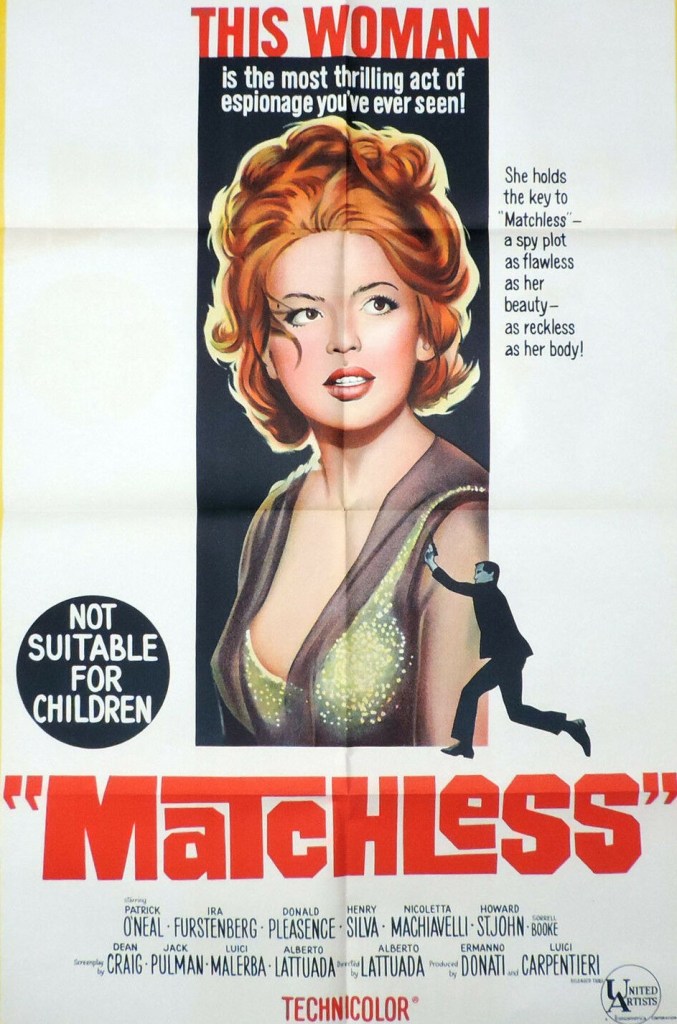
Other big names unwanted by the circuits: James Mason in Love Is Where You Find It (1967), Patrick O’Neal in Matchless (1966), Marcello Mastroianni and Pamela Tiffin in Paranoia (1965), Anthony Quinn and Rita Hayworth in The Rover (1967), Raquel Welch in Shout, Shout, Louder, I Don’t Understand (1966), Rod Steiger in Time of Indifference (1966), Troy Donahue in Come Spy with Me (1967), Angie Dickinson in I’ll Give My Life (1960),  and Elke Sommer in The Wicked Dreams of Paula Schultz (1967)

On the comedy front add to that list: Jackie Gleason in Papa’s Delicate Condition (1962), The Outlaws Is Coming (1965) with The Three Stooges and Woody Allen in What’s Up, Tiger Lily? (1966). Despite headlining Jayne Mansfield, Las Vegas Hillbillies (1966) found no takers. But that was not unusual for Mansfield. Other films never considered for the circuits were Promises, Promises (1963), The Fat Spy (1966), Panic Button (1964) co-starring Maurice Chevalier, and Single Room Furnished (1968). No room was found for  Jeffrey Hunter trio – Battle Royal (1965) with Luciana Paluzzi hot after Thunderball, The Christmas Kid (1967) and Witch without a Broom (1967). John Saxon – generally appreciated as a supporting actor – found no circuit support for pictures in which he was top-billed such as The Ravagers (1965) and The Cavern (1965) with Rosanna Schiaffino.

There was very low interest in William Castle gimmick-ridden horror films 13 Ghosts (1960), Mr. Sardonicus (1961) and 13 Frightened Girls (1963) and none at all in Project X (1967) while  the films of Samuel Fuller scarcely got a look-in, in part due to censorship, Underworld USA (1960) the only one to get any bookings. Despite the general demand for horror, The Blood of Dracula’s Castle (1969), Blood Bath (1966), Queen of Blood (1966) directed by Curtis Harrington, and Orgy of Blood (1968) did not get onto the bookings starting grid. Nor did Michael Rennie in Cyborg 2087 (1966) or Scott Brady in Destination Inner Space (1966) or Women of the Prehistoric Planet (1966).

Tammy and the Millionaire (1967) was one too many in the previously popular series. While topping the pop music charts, Sonny and Cher were considered box office busts, Wild on the Beach (1965), Good Times (1967) directed by William Friedkin and Chastity (1967) all failing to bag a booking.

The term “shelved” had a different meaning in the United States and tended to means films which had been cancelled at the production stage, rather than completed but not finding their way into the release system. In 1969, when Warner Brothers tied up with Seven Arts, around 40 projected pictures bit the dust including Sam Peckinpah pair The Diamond Story and North to Yesterday, Heart of Darkness to be directed by Andrej Wadja, William Friedkin’s Sand Soldiers, Edward Dmytryk’s Act of Anger, Paradise from a story by Edna O’Brien, and Sentries from the Evan Hunter novel.  Some movies killed off at this point would eventually be filmed: The Man Who Would Be King (filmed in 1975), 99 and 44/100%  Dead (1974) and a musical version of Tom Sawyer (1973)

While not on this scale, movies were cancelled all the time. Some movies carried hefty price tags. Shirley MacLaine nabbed $1 million after a pay-or-play deal after the cancellation of musical Bloomer Girl to be directed by George Cukor. the director was also initially involved in a version of Lady L to star Tony Curtis and Gina Lollobrigida. it was scrapped in 1961 but later filmed with different stars in 1965.

Even so, the shelf of unreleased films in the U.S. was at times very crowded. Although the vast majority of studio pictures received some kind of release, either in the arthouse or drive-in circuits if not deemed commercial enough for first run, sometimes they sat around for an unusually long time. When Variety determined in 1967 that the Hollywood vaults were bulging with over 125 completed pictures, among them were several movies that would not see the light of day until well into 1968 including Dark of the Sun, Planet of the Apes, Hang ‘Em High and The Odd Couple.

Although there were circuits in the United States, they were not national nor as dominant as in the U.K. so most films managed to find a way into the system somewhere, and therefore until the likes of The Picasso Summer (1969) and The Extraordinary Seaman (1969) – as previously mentioned in the Blog – were deemed to not hold sufficient commercial attraction and were dumped more or less straight into television then the number of movies not screened was considerably lower than in Britain.

SOURCES: David McGillivray, “The Crowded Shelf,” Films and Filming, September 1969, p15-22; “Lady L Cold,” Variety, June 21, 1961, p19; “Spain’s Unreleased Backlog: 370,” Variety, May 2, 1962, p120; “Shirley Yens $1-Mil on Fox’s Unmade Bloomer,” Variety, September 7, 1966, p7; “H’wood Backlog Hefty at 125,” Variety, September 13, 1967, p3; “Courtesy of the Film Road,” Variety, July 23, 1969, p 5; “Deferred Film Deals at W-7,” Variety, July 23, 1969, p 5; “Projects Scratched at Warners,” Variety, October 22, 1969, p6.

Discover WordPress

A daily selection of the best content published on WordPress, collected for you by humans who love to read.

The Atavist Magazine

by Brian Hannan

WordPress.com News

The latest news on WordPress.com and the WordPress community.