Bedtime Story (1964) ***

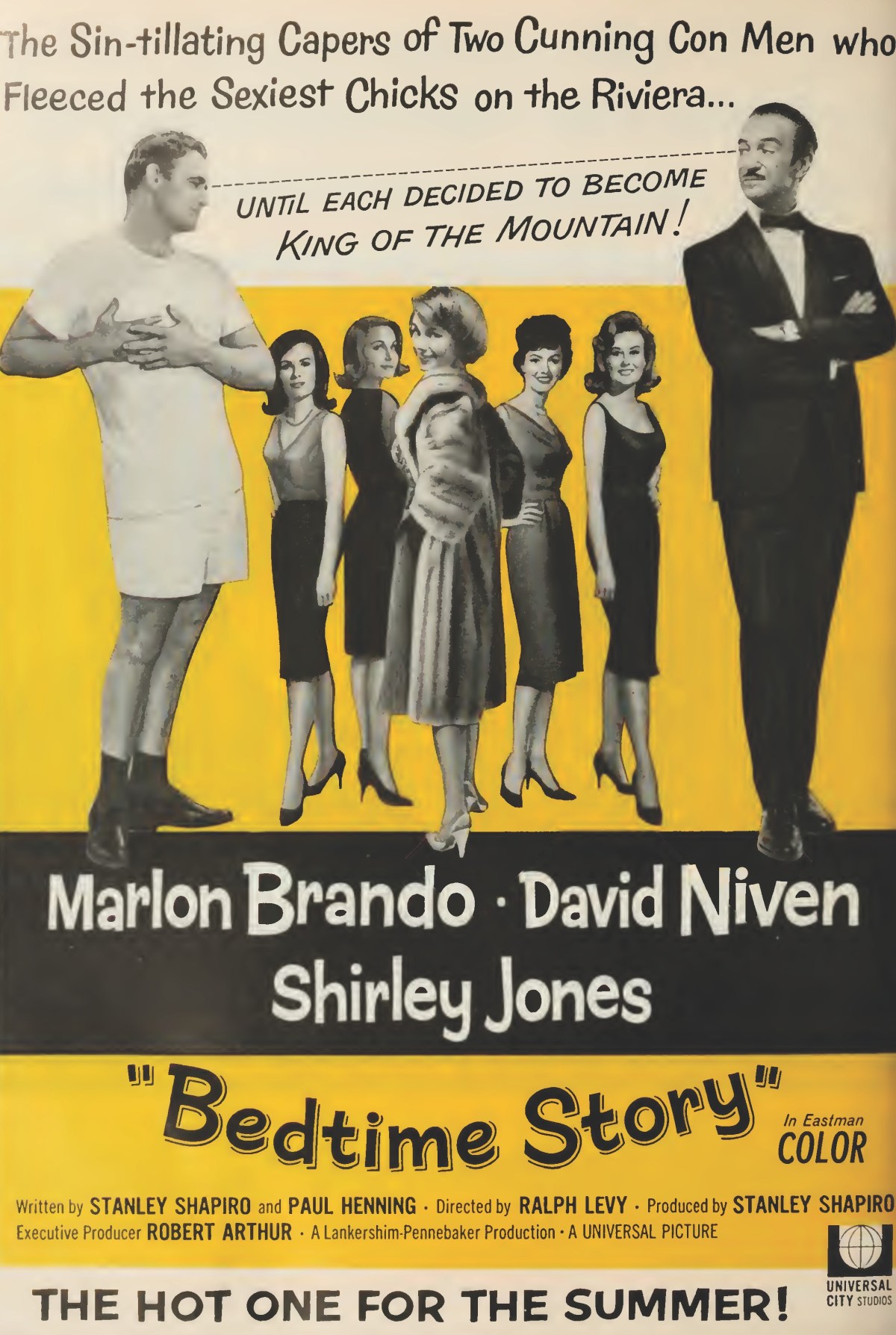
Con men at opposite ends of the grifter divide face off in a duel over territoriality in the French Riviera. Freddy Benson (Marlon Brando) is a low-level scam artist who is happy to scrounge a meal or talk his way into an innocent damsel’s bed. Lawrence Jameson (David Niven) is his polar opposite, posing as an impoverished aristocrat to relieve gullible women of their wealth, seduction an added extra.

Initially, Jameson gets the better of their encounters until Benson realizes just what a killing the Englishman is making. Initially, too, Benson is happy to pair up with Jameson, although that involves demeaning himself as a supposed mad brother kept in a dungeon, until the Englishman dupes him out of his share. Eventually, they agree a winner-take-all battle. Whoever can swindle heiress Janet Walker (Shirley Jones) out of $25,000 shall inherit the shyster kingdom.
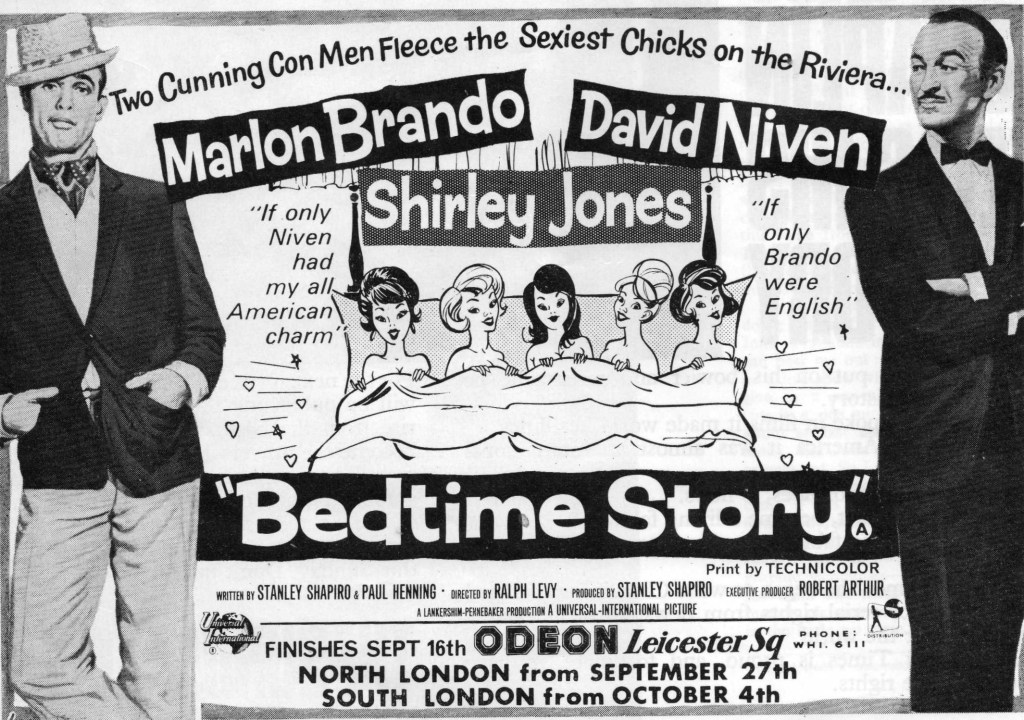
An example of the older style of British movie distribution. The prints started off in one section of London the first week and switched to another sector the following week. Even if the film was a big hit, it could not be retained since the prints were already promised elsewhere. Only after it had played London, would general release follow in the provinces. There was no point watching West End release dates for an idea of when a new movie would play in your local city, it would not be anywhere near you until it had completed the North and South London runs.

Benson takes the sympathy route to the woman’s heart, turning up in a wheelchair, while James adopts a psychological approach, persuading Ms Walker that Benson’s illness is psychosomatic for which he has the cure for the small consideration of $25,000. And then it’s one devious twist after another as the pair attempt to out-maneuver, out-think and generally embarrass the other. Both have a despicable attitude towards women, whom they view as dupes, but it is a woman who proves their undoing.

Most comedies rely on familiar tropes and you can usually see the twists coming, but this is in a different imaginative league and once the pair are in their stride I defy you to work out what they will come up with next. It is full of clever quips and a small dash of slapstick and because neither actor chases the laughs but plays their roles straight proves a very effective and entertaining morsel.

Director Ralph Levy in his movie debut knows more than where to just point a camera since he had decades of experience extracting laughs in television with top comedians like Jack Benny and Bob Newhart. Brando (Mutiny on the Bounty, 1962), free of the shackles of the angst he normally incorporated into his dramatic performances, looks as if he is having a ball and while teetering occasionally on the edge of mugging never quite overplays his hand. This was a conscious effort by Brando, whose company Pennebaker was involved on the production side, to shift his screen persona.

David Niven (The Pink Panther, 1963) was born with a stiff upper lip in his mouth and while this kind of aristocratic character is a doddle for an actor of his stature the portrayal here is much more like the sharpest tool in the box. While oozing charm, Niven exhibits deadly spite. Screenwriters Stanley Shapiro and Paul Henning had previously collaborated on Lover Come Back (1961) and Shapiro particularly made his bones on the Doris Day-Cary Grant-Rock Hudson axis so it is interesting to see him shift away from the romantic comedy cocoon into something with considerably more edge.

Enjoyable and original with excellent performances from the two principals and great support from Shirley Jones (The Music Man, 1962) as the mark and Egyptian Aram Stephan (55 Days at Peking, 1963) as an only too congenial French policeman.

Originally, it was lined up with a quite a different cast – Gregory Peck, Tony Curtis and Tippi Hedren. It was remade as Dirty Rotten Scoundrels (1988) with Steve Martin and Michael Caine.

CATCH-UP: The Blog has previously featured Brando in more dramatic vein in The Chase (1966) and The Appaloosa (1966) and also the dramatic side of David Niven in The Guns of Navarone (1961), Guns of Darkness (1962) and 55 Days at Peking (1963).

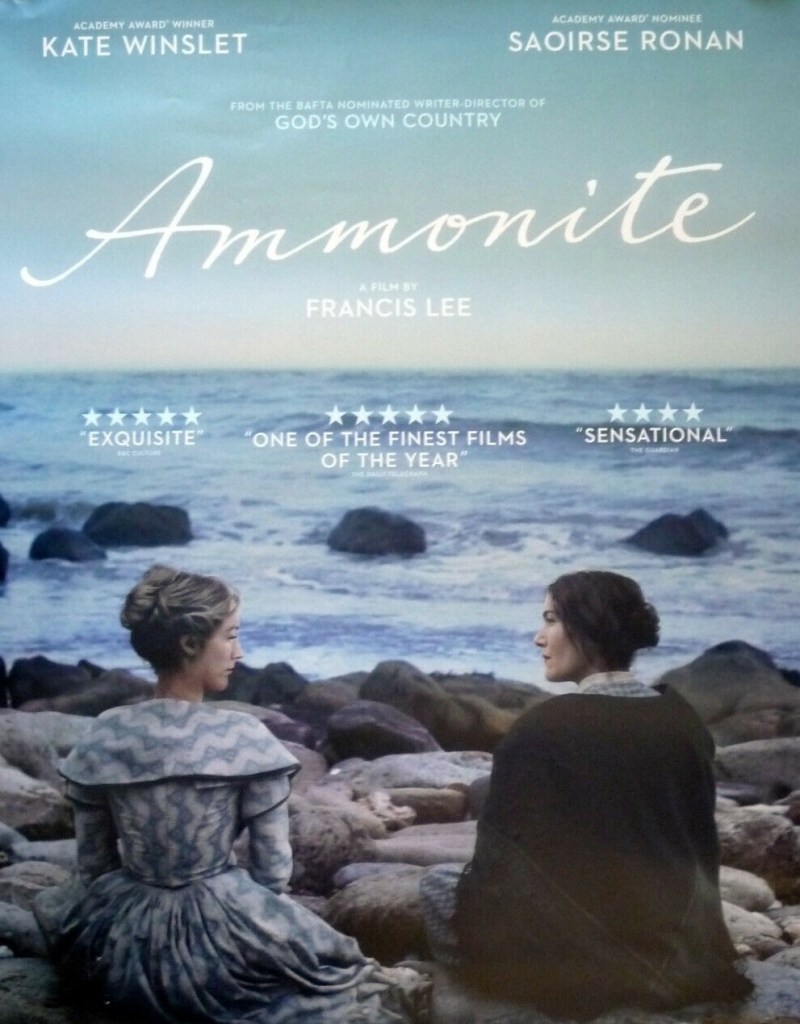
Ammonite (2020) ****

I came at this picture with some trepidation and in truth only watched it at the cinema because I had seen everything else worth a look in the few weeks since the picture houses have reopened. Although initially attracting Oscar buzz, that failed to materialize when it mattered and it was left out of the Oscar loop. While kate Winslet was a proven commercial box office draw, this appeared to have arthouse sensibilities and the few reviews I had read promised a turgid evening.

The reality was something different and as a result of what I can only describe as the magic of the big screen. Watching a film in a cinema is automatically more involving than on the small screen: there are fewer distractions, the dominating size of the screen is unavoidable and it is dark. Had I watched it at home I could well have switched it off after fifteen minutes in reaction to the slow pace. But in a cinema, slowness did not matter, and until it widened out in the final few scenes it was like an absorbing chamber piece, featuring a handful of characters.  In approach it was closest to a film about an artist, Pollock (2000) and Mr Turner (2014) come to mind, where obsession is the driving force, narrative and plot merely subservient. We are exposed to considerable detail about the character’s archaeological work, which is often filthy and undertaken outside in all sorts of weather, requiring the constitution of a miner or farmer rather than a painter, as well as the patience of a saint to brush, wash or poke clean her discoveries.

Mary Anning (Kate Winslet) was not an attractive personality, downright truculent and rude for the most part, given that she depended for her living on selling the archaeological items she had found in the Lyme Regis area to tourists and collectors. That her major archaeological discoveries resided in the British Museum brought no personal satisfaction because thanks to the male archaeological hierarchy they were presented there under the names of the purchasers rather than the finder. What she earned for major pieces could keep herself and her ageing and infirm mother (Gemma Jones) for a year. By and large, they lived in poverty, existing on soup mostly, the mother at least as obsessive as the daughter with her collection of knick-knacks, one for each of her eight children who had died prematurely, which she washed and polished every day. Mary spurned any male overtures and indeed appeared to resent any friendship, the hint of some kind of betrayal in brief scenes with Elizabeth Philpot (Fiona Shaw), a local worthy.

Mary is hired by wannabe archaeologist Roderick Murchison (James McArdle) to look after his insipid, annoying, depressed wife Charlotte (Saoirse Ronan). Gradually a friendship forms, leading to desire. Nothing is more illustrative of the Victorian attitude to sex than that the idea of a lesbian relationship ran counter to all imagination. Perhaps one of the more refreshing aspects of the picture is that while Victorian women clearly resented having sex with their husbands that was largely down to the fact the men had no idea how to satisfy a woman. That is not the case here and though the sex scenes have been criticised in places as “too strong” I thought it was essential just to be sure that the women did know what they were doing and clearly derived enormous satisfaction from the sexual act if properly performed. A chaste kiss and cuddle would hardly do justice to the passion suddenly erupted.

While Mary experiences jealousy when Charlotte is entranced by Elizabeth, romance does not produce complete fulfilment and when Charlotte, as if she were a man, appoints herself Mary’s protector that independence for which the archaeologist had fought so hard is imperilled. Love miraculously changes Charlotte’s outward demeanour, the same is not true of Mary.

This isn’t the picture-postcard version of a Victorian seaside town, rather its harsher cousin. Writer-director Francis Lee (God’s Own Country, 2017) refuses to soften the rude edges of life and the best a true romanticist can expect is that the storms occasionally abate and the surf does not pound so heavily.

Powerful roles have been in short supply of late for Kate Winslet (Blackbird, 2019) and she is superb as the stoic woman in a male-dominated world, unable to express passion except in whittling away at pieces of ammonite. Saoirse Ronan (Little Woman, 2019) moves from bitter and confused child-woman to finding joy and from then to taking charge. Veteran British character actors Gemma Jones (Rocketman, 2019) and Fiona Shaw (My Left Foot, 1989) are impressive while James McArdle (Mary, Queen of Scots, 2018) and Alec Secareanu  (Amulet, 2020) offer different interpretations of the entitled male.

To be sure there is no conclusive proof that Mary Anning was this way sexually inclined but in these days of Hollywood reinvention or reimagining for little more than comic-book glory it would be hard not to allow the director some leeway in providing his love story with an interesting backdrop and a fascinating character. At times it is a painful watch, but a rewarding one.

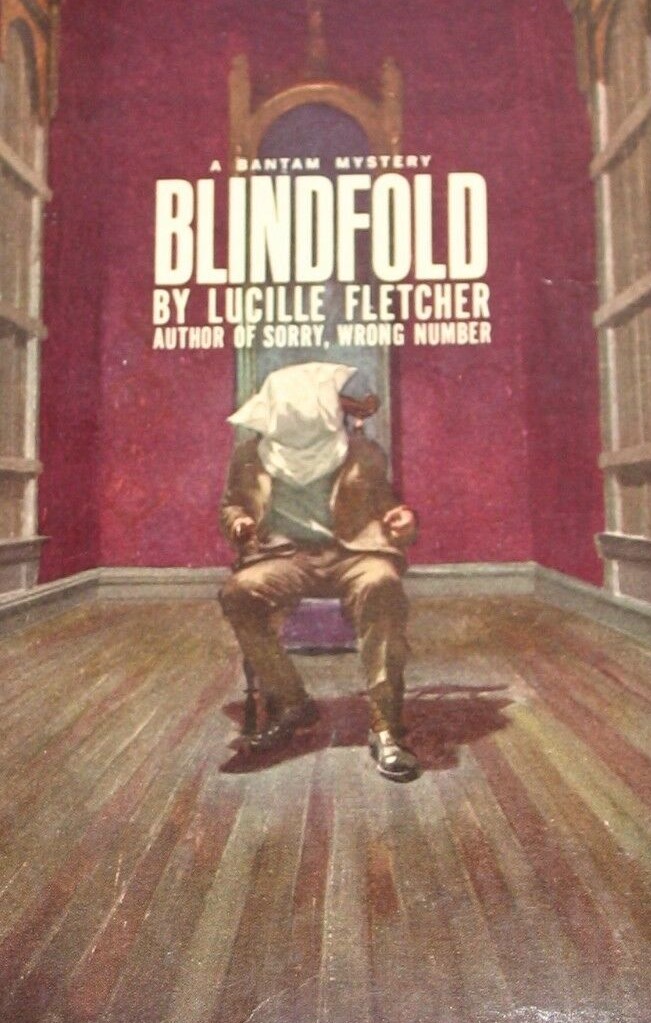
Book Into Film – “Blindfold” (1965)

In the book by Lucille Fletcher the leading male character (played in the film by Rock Hudson) doesn’t own a horse so he doesn’t go riding in Central Park. The leading female character (Claudia Cardinale in the film) doesn’t own a bicycle and so doesn’t collide with Rock Hudson in Central Park.  The man isn’t a playboy, he’s not dubbed “Bluebeard” by the media and he doesn’t have a commitment phobia. The woman isn’t the secreted-away patient’s sister – she’s his wife and she doesn’t work in burlesque.  

About the only places where the screenplay by Philip Dunne and W.H. Menger touches base with the Fletcher novel is in the basic premise of psychiatrist recruited to treat an atomic scientist who may be in danger of kidnapping and in the business of the hero working out the secret location through auditory clues.

Names have been changed wholesale. The book’s Dr Richard Fenton turns into the film’s Dr. Benjamin Snow (Hudson); likewise the book’s Angela Mallory becomes the film’s Vicky Vincenti (Cardinale). The General in the book is anonymous but, for the sake of a mild pun, is called General Prat (Jack Warden) in the film.

So basically pretty much everything in the film is the invention of the screenwriters. In the book, Fenton carries out all the investigation on his own until assisted late in the day by Mrs Mallory and there is a brief hint of potential romance at the end because by this time the scientist is dead and they were a mismatched couple anyway.  

Two of the cleverest and most intriguing elements of the film were nothing to do with the book. The first was how the psychiatrist (Hudson) was able to analyze many of the characters with whom he came in contact, both good guys and bad guys. The second element was how it was impossible, given government penchant for secrecy, for Hudson to determine if any of the people who claimed they were from the National Security Council, the FBI or the CIA, actually belonged to those organisations.

While we’re at it, there was no Detective Harrigan (Brad Dexter) in the book either. Nor did the heroine, for lack of a better word, have an endearing family. Hudson’s secretary Smitty (Anne Seymour in the film) is an amalgam of his housekeeper Louisa and his secretary Edna in the book, neither of whom possesses Smitty’s dry wit. Even the dubious Fitzpatrick (Guy Stockwell) underwent a name change, if only partially, in the book called Fitzgerald.  And I’m sorry to disappoint you but the book did not boast a mule called Henry.

Lucille Fletcher, as it happened, was a very distinctive personage in the creative world. She had originated Sorry, Wrong Number, one of the most famous and enduring crime tales ever written. Sorry, Wrong Number first appeared a 22-minute radio play, a monologue by Agnes Moorhead with sound effects, on CBS in May 1943, so successful it was broadcast seven times in five years. The author wrote the screenplay for the 1948 film noir starring Barbara Stanwyck and Burt Lancaster. Three times it was turned into a television drama – in 1946, 1954 and 1958.  Prior to Blindfold, she had only written three novels, a novelization of Sorry, Wrong Number with Allan Ullman, Night Man also with Ullman, and The Daughters of Jasper Clay.

The Oscar nominations for the best adapted screenplay in the Blindfold year were for Doctor Zhivago (the winner), Ship of Fools, The Collector, and A Thousand Clowns. The first two certainly required considerable condensation and the others must have endured surgery of some kind, but I doubt very much if they had to discard virtually the entire source material and begin all over again, bringing a different tone, plot and character to the proceedings.

Philip Dunne was a double Oscar nominee in the screenplay department but for films – How Green Was My Valley (1941) and David and Bathsheba (1951) – that could not have been further from this one and he had written pictures as diverse as The Rains Came (1939), The Ghost and Mrs Muir (1947), Pinky (1949), The Robe (1953) and The Agony and the Ecstasy (1965) but nothing hit as sweet a spot as Blindfold with its mix of romantic thriller and comedy.

The screenplay comes with another mystery. Who is W.H. Menger the co-writer? I can find nothing relating to this person beyond that he/she co-wrote Blindfold.

Anyway, kind of the point of writing these non-film reviews of the screenwriting process of various films is to examine a largely unexamined aspect of turning books into films. Original screenplays tend to get greater coverage. Adaptations, unless sourced from difficult subject matter, tend to pass under the radar. This, along with Fathom and The Venetian Affair (1967) are, in my opinion, classic examples of adaptations of novels which have some intrinsic cinematic interest but lack the story/character values necessary to turn them into watchable films and therefore require full-on assistance from a screenwriter.  

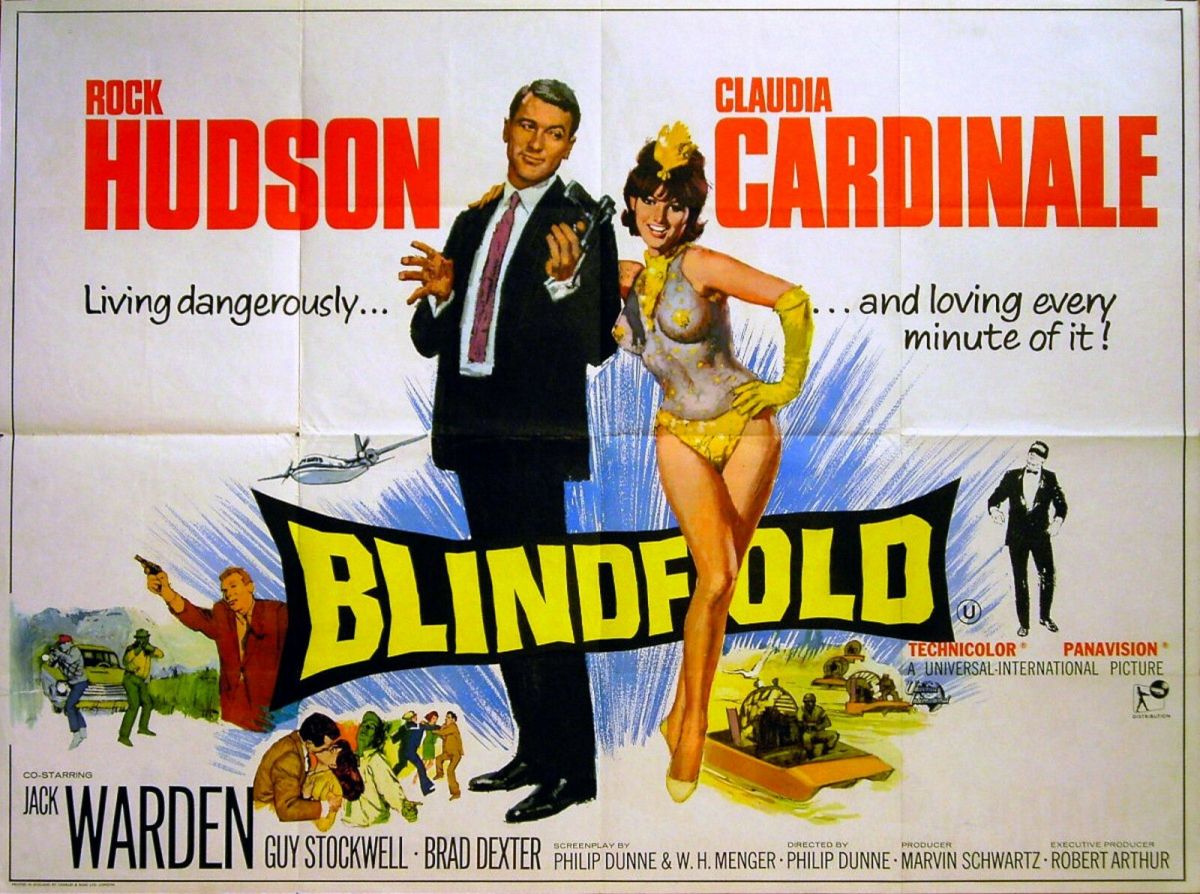
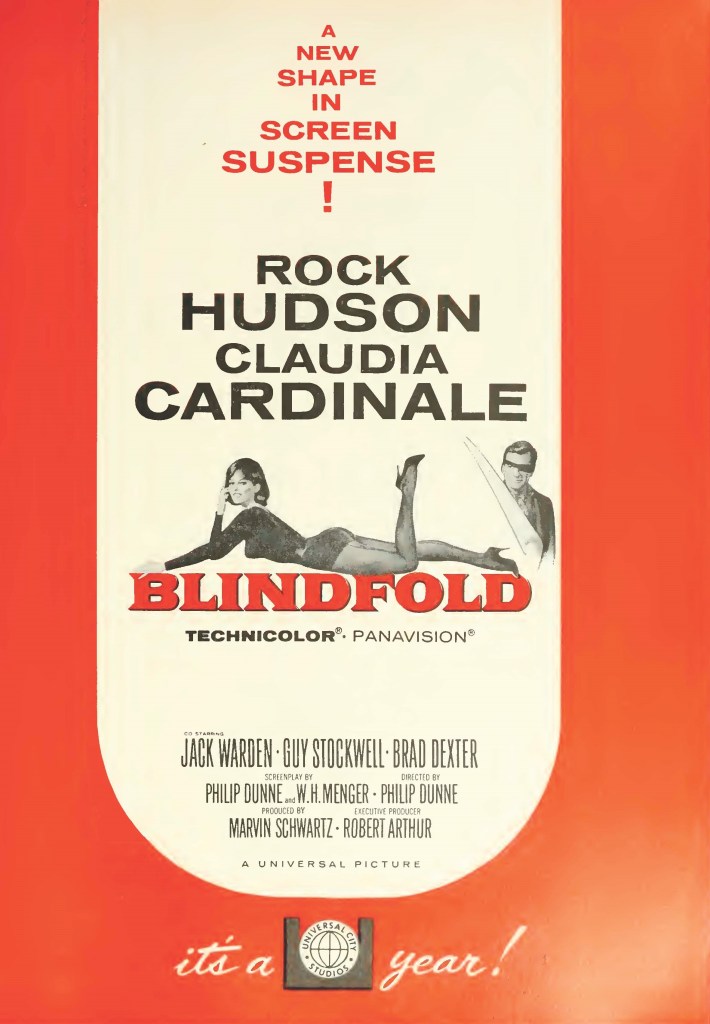
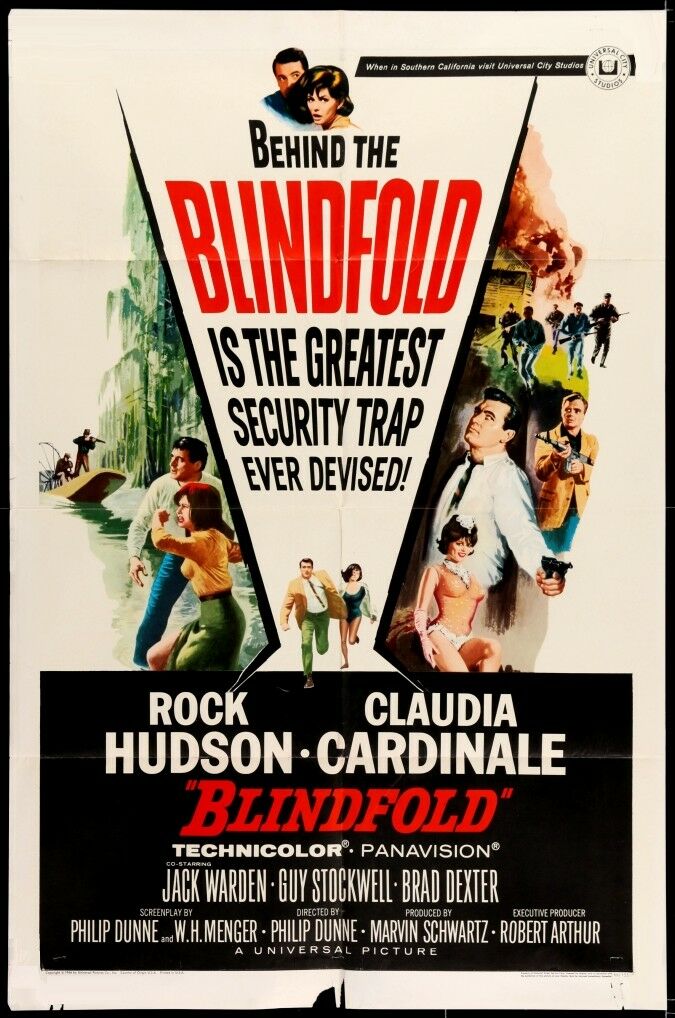
Blindfold (1965) *****

Hugely enjoyable superior addition to the romantic thriller genre with charismatic stars and a touch of screwball comedy. Dr Stone (Rock Hudson), a psychiatrist with such commitment issues he is dubbed “Bluebeard” by the media, is recruited by General Prat (Jack Warden) of the National Security Council to prevent former patient Arthur Vincenti (Alejandro Rey) falling victim to an international scientist-kidnapping ring. Getting to the patient, a plane and car ride away, requires the titular blindfold so Stone has no idea where he is. When Vincenti attacks Stone as a traitor, Prat explains the scientist has been brainwashed.

Ballet dancer Vicky (Claudia Cardinale) engineers an accidentally-on-purpose meet-cute in Central Park by running her bicycle into Stone’s horse but when, to nurse her injury, he carries her into his office she steals the scientist’s file. Turns out her artistic skills are somewhat lower than ballet, she is a go-go dancer, but she is the scientist’s brother whom she claims has been kidnapped. Stone is arrested and to get out of another sticky situation announces he is engaged to Vicky.

Complications are added when the C.I.A and F.B.I. enter the equation as well as a very suspicious cop Harrigan (Brad Dexter) with an inferiority complex, a couple of shady homburg-wearing hoods and new patient Fitzpatrick (Guy Stockwell), who, all, in one way or another, hound Stone and Vicky. The couple’s relationship is one of those on-again off-again romances which come with the territory. Soon, of course, Stone doesn’t know who to believe.

Bearing in mind we still have to get to the geese, the alligators and a mule called Henry, the witty, inventive script delivers on all fronts. Both Stone and Vicky are believable characters, and Stone’s psychiatric skills are not just window dressing – the kind of tony job associated with innocents thrust into peril. He uses his proficiency to get out of scrapes and eventually solve the mystery. Despite her glamor-girl persona, Vicky is the opposite of the sleek high-living characters often shoehorned into this kind of picture, a down-to-earth lass living in a brownstone with her mama and papa. Both leads turn out to be handy with their fists and in Vicky’s case her high-kicking feet.

And the comedy, rather than getting in the way or looking ridiculously out of place, aids and abets the storyline. It falls into three distinct camps. There is repartee not just between Stone and Vicky but Stone’s secretary (Anne Seymour) operates a sideline in dry quips. Slapstick comes mainly in the form of a fire extinguisher employed as a weapon and Stone nearly losing his trousers scaling a fence. Bureaucratic brick walls that hint of paranoia come close to classic black comedy. Not to mention some visual gags – “undie dummies” anyone – and some neat reversals.

This is Hudson at his very best and while often confused is never flustered, and without recourse to the double-takes that appeared so essential in any previous film with a comedic element. His character is assured, self-aware, thoughtful (he has to be to think things out), and very human. Cardinale is more than a match, a nice girl in the wrong line of work, passionate, determined and very warm. Director Philip Dunne find dramatic reasons to reveal her famous assets in body stocking, leotard and underwear, but in reality it is her smile that is the killer.

Dunne (Lisa, 1962) keeps up a cracking pace. He had a hand in the screenplay, adapted from the novel by Lucille Fletcher (Sorry, Wrong Number, 1948), one-time wife of composer Bernard Herrmann. Here, incidentally, the music is by Lalo Schifrin. Among the decade’s romantic thrillers this is out-ranked only by Charade (1963).

Nobody (2021) ****

Blistering stylish thriller in the Taken (2008) / John Wick (2014) tradition sees former secret service badass Hutch Mansell (Bob Odenkirk) trying to live a normal suburban life with wife Becca (Connie Nielsen) and two kids while working as a nerdy book-keeper in a small factory, the kind, should the need arise and with the right skill set, that can be turned into a fortress.  

Devised by John Wick writer Derek Kolstad, this is a more realistic twist on the sub-genre he helped create. Where John Wick and indeed Bryan Mills (Taken) tend to often escape pretty unscathed from violent episodes, Hutch is beaten black and blue. But like John Wick he wants to keep the past buried. And he would do except he gets mixed up with two inept burglars and from that encounter segues into a confrontation with the Russian mob, the head of which Yulian (Aleksey Serebryakov) is a candidate for the all-time gangster hall of fame as well as the oddball hall of fame since he fancies himself as a nightclub singer.  

Interestingly, it’s clear that living the boring life is guaranteed to turn your marriage stale and that relationship only recovers when Hutch gets his mojo back. Unusually, too, Hutch spends a good deal of his time trying to make or keep the peace, preferring compromise to a bullet tsunami. But you know what these Russians are like!

Like John Wick, we enter a completely new world of assassins and their codes and the way they operate – attacking a man in his own home a mortal sin – and Hutch can call on a bundle of characters who know their way around, including his father David (Christopher Lloyd) and unspecified relative Harry (RZA) not to mention a mixture of hard-asses like Eddie (Michael Ironside) and upper-class Brit with the usual unusual moniker in this case The Barber (Colin Salmon).

In his sophomore outing Russian director Ilya Naishuller (Hardcore Henry, 2015), while delivering a sufficient quota of fisticuffs and shootouts, brings a certain flair to the proceedings, Hutch as reliant on whatever pieces of metal prove handy as well as the normal selection of firearms and a more extensive supply of weaponry, committing violence to the unlikely accompaniment of classics from the American musicals songbook like “The Impossible Dream” and “You’ll Never Walk Alone.”

Naishuller has gathered a wonderfully eclectic cast with Connie Nielsen sprung back to leading lady status after bit parts in Wonder Woman (2017) and Justice League (2017). As if to remind myself of the emotional quality she brings to the movies, I happened to see her on the same day in a big-screen revival of Gladiator (2000) – part of my weekly cinematic triple bill. And you’re gonna love the reincarnation of Christopher Lloyd (Back to the Future, 1985), probably the only shotgun-toting inhabitant of an old folks home, off the big screen since 2018 and really without a decent movie role in nearly a decade.  

If you only know Bob Odenkirk from playing sleazeball lawyer Jimmy McGill in the television series Breaking Bad (2009-2013) and its offshoot Better Call Saul (2015-2021) and you wondered how he was ever going to break away from that typecasting, here’s the answer in spades. This is such a transformation you would forget he was ever McGill.

Nobody didn’t exactly hit the ground running when it was released in the U.S. in March during the pandemic but it will gradually build up a following on streaming and DVD and it’s almost certainly going to turn into a series. Remember, the first John Wick didn’t pack the commercial punch of the sequel. But once the word gets round, Nobody will attract a healthy fanbase.

Don’t miss this – highly recommended.

Not sure when the DVD is out but if you miss it in the cinema, you can get your order in now.

The Crimson Cult/ Curse of the Crimson Altar (1968) ***

Horror is a small world and at any moment you are likely to bump into stars of the caliber of Christopher Lee, Boris Karloff and Barbara Steele – or in this picture all three. Investigating his missing brother Peter sends antiques dealer Robert Manning (Mark Eden) to a remote country mansion where he encounters owner Morley (Christopher Lee), his seductive niece Eve (Virginia Weatherall), the wheelchair-bound authority on witchcraft Professor Marsh (Boris Karloff), deaf mute Elder (Michael Gough) and a centuries-old mystery.

Morley can legitimately deny that Peter has ever set foot on the premises since it was common for the brother to adopt an alias when seeking out significant antiques. By the time Robert amasses sufficient clues to challenge Morley on this particular issue, it appears that further ideas of more sinister goings-on may be illusory. On his first night Robert observes an annual celebration of the Black Witch but although an effigy is burned this festival appears to have more to do with the innocent consumption of alcohol and heady bouts of sex than satanism.

Thanks to career reinvigoration after Peter Bogdanovich’s “Targets” (1967)
Boris Karloff gained top billing in the British release.

And after a while, Robert indulges in carnal delight with Eve. However, he is plagued by a nightmare that involves a grotesque trial by a jury wearing animal heads. Gradually, he learns that Morley, meanwhile, is such a congenial host, and his niece delightful and sybaritic company, that the finger of suspicion points at Elder, who does take a pot shot at Robert, and the professor who has a collection of instruments of torture.

Were it not for veteran director Vernon Sewell (Urge to Kill, 1960) beginning proceedings with some kind of black mass complete with floggings and female sacrificial victim, the audience might have been kept in greater suspense. As it is, the non-violent annual celebration throws us off the scent as does the seduction of Eve and the prospect that Robert’s nightmare is little more than psychedelic hallucination. The denouement is something of a surprise. The ritualistic aspects of the picture are well done and given this is a Tigon film rather than Hammer you can expect harsher treatment of the S&M element, flagellation delivered by women, especially for the period.  

In the U.S. – where it was shown both as “The Crimson Cult” and “The Crimson Altar” – Christopher Lee was accorded prime billing status.

The eerie atmosphere and well-staged witchcraft scenes are a plus, but, despite the involvement of a handful of horror gods, the movie’s reliance on lesser players to drive the narrative is a minus. Lee, Karloff and Steele (though in a more minor role) are all excellent as is the demented Michael Gough but Mark Eden (Attack on the Iron Coast, 1968) is too lightweight to carry the picture although Virginia Wetherall in her first big part suggests more promise.  More of Lee, Karloff and Steele would have definitely added to the picture but since this type of film often requires the young and the innocent to take center stage that was not to be.

“MeToo” Warning – The Pressbook for “Claudelle Inglish” (1961)

Unusually timely in today’s MeToo era, the 10-page A3-size Pressbook had a warning for young actresses 60 years ago about the sex predators operating in Hollywood. On the subject of “coping with an amorous male,” star Diane McBain commented: “The first months in Hollywood are likely to be dreadfully discouraging to any girl trying to gain a foothold as an actress. She needs an older person in whom she can confide.” In other words, get yourself a chaperone to fend off the men.

This was somewhat at odds with the tone of the film itself, which suggested that Claudelle Inglish was a male magnet.

The marketing team took the easy way out in selling this picture. Sleaze was the hook with  copy lines and images as the big come-on. Pick of the copy lines: “When she was seventeen there wasn’t a man she’d let near her…When she was eighteen there wasn’t one she’d keep away.”  More in keeping with the actual film was: “She liked boys looking at her…and thinking…and then she’d take her delicious kind of revenge on them all!”

The promotional people did not have much else in the way of ideas, beyond a glamor portrait of star Diane McBain as a means of stimulating a newspaper poll under the title “The Screen’s Most Beautiful Woman?” Another idea was a contest to list movie titles comprising a female name such as Mildred Pierce, Gigi etc. Probably the most original notion was a tie-up with a shoe store since the film’s main character had a predilection for red shoes.

Otherwise the emphasis was on the provocative. Exhibitors were encouraged to use a sidewalk stencil of the “voluptuous young girl”  or arrange a lobby display of all the gifts Claudelle had received from her suitors. Slightly more complicated was getting restaurants involved in a contest where the letters of the character’s name could be used to part-spell out the titles of Erskine Caldwell books.

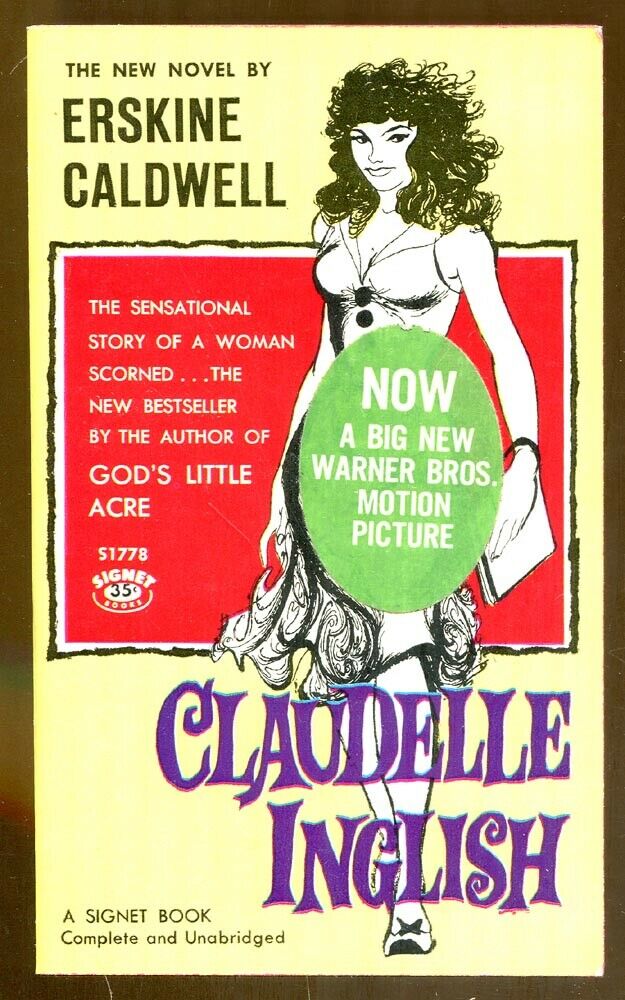
Author Erskine Caldwell, the all-time best-selling writer in America at that point with  41 million copies in print, was another big selling point. He had also authored other steamy yarns like God’s Little Acre and Tobacco Road and another 36 books besides so his novels were likely to command prime space in a bookstore. Signet had printed a movie tie-in edition that would go on sale in 100,000 outlets.

In terms of star push, the Pressbook concentrated on Diane McBain, promoted as a newcomer, despite having already appeared in Ice Palace (1960) and Parrish (1961) and with an ongoing role in television series Surfside 6 (1960-1962). Exhibitors were informed that McBain had “soared to stardom in little more than a year.” But also that her legs had given her a “big lift up the ladder of stardom” with several scenes revealing those attributes. McBain was only 20 at the time of the film’s release, born in 1941 in Cleveland, Ohio, but already earning money as a model at college. A Warner Brothers talent scout had spotted her on a modelling assignment which led to a role as the grand-daughter of Richard Burton in Ice Palace.

At the other end of the fame ladder, five-time Oscar nominee Arthur Kennedy appeared content to acknowledge that he was “rarely recognized in public” and if so was usually mistaken for someone else. Constance Ford, who played his wife in the picture, had already been paired with the actor three times, previously, twice on stage – Death of a Salesman and See the Jaguar – and in A Summer Place (1959).

There is a sad postscript to this which was pointed out to me by one of my readers. Sexual assault on women is not restricted to the movie industry. In 1982, Diane McBain was raped and attacked in her garage on Christmas Day after she had returned from a party. The culprits were never found. And although she began a second career as a rape victim counselor, she told the Los Angeles Times eight years later: “The shock of what happened caused loss of memory, inability to concentrate and I’m still startled out of all proportion.” (Gerald Peary, “In Search of…Diane McBain,” LA Times, May 27, 1990, 23).

Claudelle Inglish (1961) ****

Simple small-town morality tale, brilliantly told, with a quiet nod to The Blue Angel and Citizen Kane. Shy dirt-poor farmer’s daughter Claudelle Inglish (Diane McBain) after falling for the handsome Linn Varner (Chad Everett) expects to be married when he returns from his Army stint until she receives a “Dear John” letter. Initially devastated, keeping all his letters and the dancing doll she had won with him at a fair, she decides that lying in bed all day and staring at the ceiling is not going to work. So she smartens up her frumpish look with lipstick and turns her simple wedding dress into a more attractive outfit.

She discovers that the boys are so desperate to come calling on this new-look creature that they will bring presents to every date, ranging from the biggest box of candy in the shop to a pair of red shoes. Encouraging her determined manhunt, dissatisfied mother Jessie (Constance Ford), who has endured twenty years of broken promises throughout marriage to hardworking Clyde (Arthur Kennedy),  beseeches her to go after a rich man. Luckily, there is one in the vicinity, the widowed S.T. Crawford (Claude Akins) who happens to be their landlord. Crawford tries to bribe Clyde with free rent and other benefits to put in a good word, but to no avail, the father believing that true love cannot be bought and, furthermore, will alleviate abject poverty.

Advertisement to the trade encouraging exhibitors to book for one
of the key dates on the U.S. release calendar.

Claudelle bluntly rejects Crawford as “too old and too fat” but takes his present anyway and, under pressure, agrees to go for a ride with him without allowing him to stop the car. Dennis Peasley (Will Hutchins), elder son of a store owner, believes he is the front runner, deluging her with gifts, naively believing she is his sweetheart until he realizes he is in competition with a horde of other local boys, including his younger brother, and outsider Rip (Robert Colbert). Jessie, seeing the prospect of a rich husband slip away, embarks on an affair with Crawford. Soon, Claudelle has the entire male population in the palm of her hand, piling up presents galore. However, tragedy, in the way these things go, is just round the corner.

What struck me first was the subtlety. Nothing here to bother the censor, beyond the immorality on show and despite Hitchcock breaking all sorts of sexual taboos with Psycho the year before. This isn’t an all-hot-and-bothered essay like the previously reviewed A Cold Wind in August or a picture that pivots on twists-and-turns like A Fever in the Blood, both out the same year. It is so delicately handled that took me a while to work out that Claudelle was actually having sex with all these guys.

Erskine Caldwell was America’s bestselling author at the time with over 40 million books sold and most famous, of course, for God’s Little Acre, filmed in 1958, and Tobacco Road (1941).

The initial shy girl blossoming under the first blush of love is done very well, a gentle romance ensuing, Claudelle still withdrawn in company, agreeing to an engagement even though Linn cannot afford a ring, waiting anxiously for his letters, adoring the dancing doll,  paying off a few cents at a time material for a wedding dress. It’s only after she receives a Dear John (Dear Jane?) letter that it becomes clear, though not crystal clear, that sex has been involved because that word is never spoken and that action never glimpsed. Only gradually do we realise that present-givers are being rewarded, and as her self-confidence grows she is soon able to pick her own presents.  One look is generally all it takes to have men falling all over themselves to give her what she wants, which is, essentially, a life where promises are not broken. But the closest she gets to showing how much she is changed from her original innocent incarnation is still by implication, telling a young buck she is “pretty all over.”

I was also very taken with the black-and-white cinematography by Ralph Woolsey. The compositions are all very clear, but in the shadows Claudelle’s eyes become glittering pinpoints. The costumes by Howard Shoup won an unexpected Oscar nomination, his third in three years. Veteran director Gordon Douglas (Them!, 1954) does an excellent job of keeping the story simple and fluent, resisting all temptations to pander to the lowest common denominator while extracting surprisingly good performances from the cast, many drawn from Warner Brothers’ new talent roster.

Diane McBain (Parrish, 1961) handles very well the transition from innocence to depravity (a woman playing the field in those days would be tagged fallen rather than independent) and holds onto her anguish in an understated manner. In some senses Arthur Kennedy (Elmer Gantry,1960) was a coup for such a low-budget production, but this could well have been a part he was born to play, since in his movie career he knew only too well the pain of promise, nominated five times for Best Supporting Actor (some kind of record, surely) without that nudging him further up the billing ladder. His performance is heartbreaking, working his socks off without ever keeping head above water, repairs getting in the way of promises made to wife and daughter, kept going through adoration for his wife.

Constance Ford (Home from the Hill, 1960) is heartbreaking in a different way, scorning her loving husband and dressing like her daughter in a bid to hook Crawford.  Television regular Claude Akins is the surprise turn. In a role that looked like a cliché from the off – i.e. older powerful man determined by whatever means to win the object of his desires – he plays it like he was auditioning for The Blue Angel, hanging on every word, being twisted round her little finger, demeaning himself as he is made to wait, sitting downcast outside the Inglish house like an rejected schoolboy. Of the younger cast, Will Hutchins was Sugarfoot (1957-1961), Chad Everett was making his movie debut, and Robert Overton had appeared in A Fever in the Blood (1961). Leonard Freeman (Hang ‘Em High, 1968) wrote the screenplay based on the Erskine Caldwell bestseller.

And where does Citizen Kane come into all this? The dancing doll Claudelle won at a fair when dating Linn is something of a motif, never discarded, as if a symbol of her innocence, and in close-up in the last shot of the film.

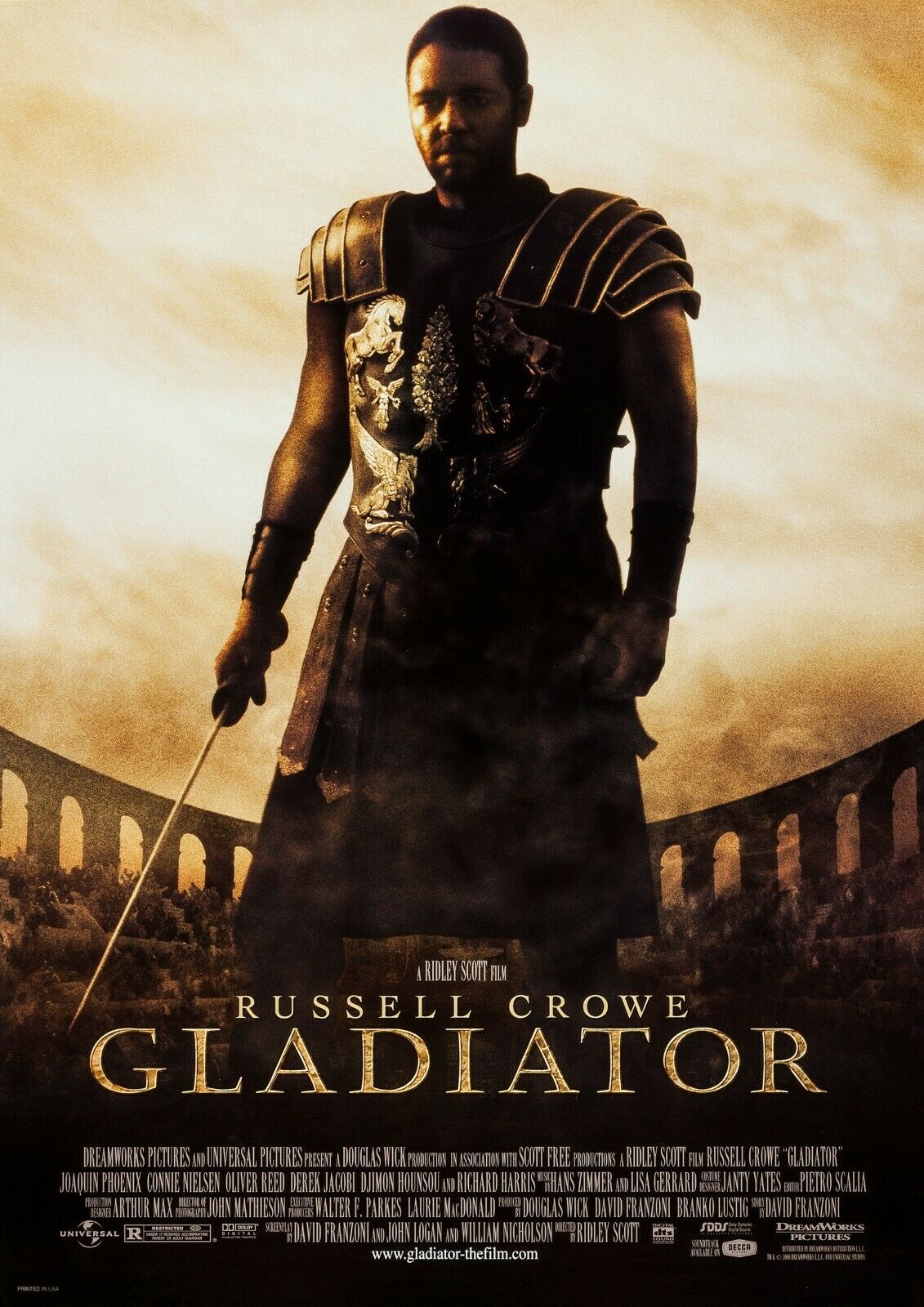
Gladiator (2000) *****

As well as being first in the queue to see The Gladiator on original release over two decades ago and enjoying countless viewings since on DVD and television, the chance to see a big-screen revival (as part of this week’s cinematic triple bill) was not to be missed. There’s always some worry in going back to see a movie you adored that time will have caught up with it or that the big screen will magnify flaws. Instead, this was a pure blast, one of the greatest epics of all time and definitely one of the most brilliant scores.

I always feel kind of sorry for people who’ve only see this kind of picture on a small screen – no matter how big your television it comes nowhere near the cinematic experience. I’m not even sure why it was showing on the big screen – the 20th anniversary has passed so maybe the draw was the upcoming British Father’s Day.

If you’re quick, you will be able to see it until June 17 at the Showcase cinema chain in the U.K. This is a new 4K print. It may run longer if it picks up sufficient demand.

Director Ridley Scott was in something of a career lull after the highs of Blade Runner (1982) and Thelma and Louise (1991) and his previous historical adventures – The Duellists (1977) and 1492: Conquest of Paradise (1992) – had been box office duds, so this was a considerable big-budget gamble for Dreamworks and Universal.

Few historical epics begin with action. Directors tended to want to build up the various characters before any battle got under way. But apart from a few seconds of an idyllic pastoral setting establishing how much Roman General Maximus (Russell Crowe) wants to get back to his Spanish farm, we are immediately, with foot-tapping music by Hans Zimmer, into one of the best battles ever filmed, not just for the tactical detail, and the sense of danger – an emissary is returned missing his head – but the ferocity of the action.

Backgrounding this is politics. Dying Emperor Marcus Aurelius (Richard Harris) distrusts his son Commodus (Joaquin Phoenix) and want to make Maximus the power in Rome. The reaction of Commodus is to smother his father and murder his rival. Maximus escapes but ends up a slave in a gladiator camp in North Africa and eventually returns to Rome plotting revenge.

Into the mix comes Commodus’s sister Lucilla (Connie Nielsen) who had romantic yearnings for Maximus in the distant past and various senators plotting to remove Commodus from office. The story basically shifts from dramatic action in the arena to outside intrigue with Maximus being seen as a man who could potentially unseat the emperor.

But Ridley Scott has such a fine eye for everything, genuine locations mix in brilliantly with CGI, the action sequences are astonishing, and emotions are kept at a peak. Even when the main narrative pauses here and there to allow philosophic and patriotic speeches they are so deftly written they often amount to the best pieces of dialogue in the picture.

Few movies have as many memorable lines. Sample: “what we do in life echoes in eternity;” “death smiles at us all, all we can do is smile back;” “people should know when they are conquered;” “father to a murdered son, husband to a murdered wife, I will have my vengeance in this life or the next;” the “little bee” sequence;  and the lines that ended up as taglines on the advertising posters” a general who became a slave, a slave who became a gladiator, a gladiator who defied an emperor.”

While he could easily have let the action speak for itself and who would not have welcomed more battles with Roman foes or more combat in the arena – and many other movies with a character in a similar predicament have succumbed to that temptation – Scott ensures that the tensions between the characters are never lost. So Commodus is driven both by wishing to please his father and desiring an incestuous relationship with his sister. Lucilla is torn between protecting her son (Spencer Treat Clark), her growing attraction to Maximus and trying to keep her brother at bay while plotting against him. Maximus, who has no head for politics, finds himself involved in intrigue as a way of gaining revenge on Commodus.   

Nor does Scott get bogged down with too much exposition or the intricacies of character as has often been the downfall of epics. The story has been whittled down to essential conflict.

It’s hard to pick a winner from the various action scenes – the opening clash in the forests of Germania with snow beginning to fall; the first gladiatorial combat where Maximus takes control; a small band of gladiators fighting what seems a losing battle against chariots; Maximus being unexpectedly attacked by tigers in the arena; or his climactic fight with Commodus.

And there are substantial cameos for British stars – Richard Harris, Oliver Reed, David Hemmings – who have lost their box office luster but not their acting ability. Connie Nielsen was a revelation.

Russell Crowe became instant superstar with his majestic portrayal. His name had already been on the lips of Oscar voters, having been nominated the previous year for The Insider (1999), but he took the Best Actor Oscar here. Although the film was named Best Picture Ridley Scott lost out – unfairly I felt – in the Best Director category to Steven Soderbergh for Traffic. (How do the two films compare now, I wonder). Joaquin Phoenix and Hans Zimmer were also nominated and the movie also picked up nominations for cinematography and screenplay (David Franzoni, William Nicolson and John Logan.) All told it won five Oscars and seven nominations.

This was the climax to my cinematic triple bill this week and since it also included Nobody and The Father, it could well turn out to be one of the best days I have ever spent at the cinema.

CATCH-UP: I reviewed The Fall of the Roman Empire (1964) a while back and if you compare both pictures you can clearly see how much Ridley Scott owes a debt to the previous film.  

There’s a company called Park Circus – http://www.parkcircus.com – which has the rights to show on the big screen virtually all the old movies made by Hollywood studios and it’s worth checking out whether this might be coming your way soon.

4 for Texas (1963) ****

To my mind the best of the Frank Sinatra-Dean Martin collaborations, outside of the more straightforwardly dramatic Some Came Running (1958), and for the simple reason that they are rivals rather than buddies. The banter of previous “Rat Pack” outings is given a harder edge and it is shorn of extraneous songs.

I came at this picture with some trepidation, since it did not receive kind reviews, “stinks to high heaven” being a sample. But I thought it worked tremendously well, a delightful surprise, the ongoing intrigue intercut with occasional outright dramatic moments and a few good laughs.

It’s unfair to term it a comedy western since for a contemporary audience that invariably means a spoof of some kind, rather than a movie that dips into a variety of genres. In some respects it defies pigeonholing. For example, it begins with a dramatic shoot-out, stagecoach passengers Zack Thomson (Frank Sinatra), a crack shot with a rifle, and pistolero Joe Jarrett (Dean Martin) out-shooting an outlaw gang headed by Matson (Charles Bronson). When director Robert Aldrich (Sodom and Gomorrah, 1962) has the cojones to kill off legendary villain Jack Elam in the opening section you know you are in for something different.

After out-foxing Matson, Jarrett attempts to steal the $100,000 the stagecoach has been carrying from its owner Thomas. Jarrett looks to be getting away with it until he realizes he is still in range of Thomas’s rifle. Then Thomas looks to have secured the money until Jarrett produces a pistol from his hat. And that sets the template for the movie, Thomas trying to outsmart Jarrett, the thief always one step ahead, and the pair of them locking horns with corrupt banker Harvey Burden (Victor Buono), in whose employ is Matson.

The movie is full of clever twists, cunning ruses, scams, double-crosses, reversals and sparkling dialog. Whenever Jarrett and Thomas are heading for a showdown, something or someone (such as Matson) gets in the way. While Thomas has the perfect domestic life, fawned over by buxom maids and girlfriend Elya (Anita Ekberg), Jarrett encounters much tougher widow Maxine (Ursula Andress) who greets his attempts to invest in her riverboat casino by shooting at him.  

Take away the comedic elements and you would have a plot worthy of Wall Street and ruthless financiers. The story is occasionally complicated without being complex and the characters, as illustrated by their devious intent, are all perfectly believable.

It’s a great mix of action and comedy – with some extra spice added by The Three Stooges in a laugh-out-loud sequence – and it’s a quintessential example of the Sinatra-Martin schtick, one of the great screen partnerships, illuminated by sharp exchanges neither lazily scripted nor delivered. Even the blatant sexism is played for laughs.

Sinatra and Martin, especially, are at the top of their game. Forget all you’ve read about Aldrich and Sinatra not getting on. Sinatra never got on with any director. But an actor and director not getting on does not spell a poor picture. Sinatra brings enough to the table to make it work, especially as he is playing against type, essentially a dodgy businessman who is taken to the cleaners by both Martin and Buono.

The only flaw is that Ursula Andress (Dr No, 1962) does not turn up sooner. She has a great role, mixing seductiveness and maternal instinct with a stiff shot of ruthlessness, not someone to be fooled with at all, qualities that would resonate more in the career-making She (1965).  Anita Ekberg (La Dolce Vita, 1960) on the other hand is all bosom and not much else. Charles Bronson (The Magnificent Seven, 1960) demonstrates a surprising grasp of the essentials of comedy for someone so often categorized as the tough guy’s tough guy.

The biggest bonus for the picture overall is the absence of the other clan members – Sammy Davis Jr, Peter Lawford and Joey Bishop – who appeared in previous Rat Pack endeavors Oceans 11 (1960) and Sergeants 3 (1963). Without having to laboriously fit all these other characters in, this film seems to fly along much better. As I mentioned, the fact that Sinatra and Martin play deadly enemies provides greater dramatic intensity.

Robert Aldrich was a versatile director, by this point having turned out westerns (Vera Cruz, 1954), thrillers (Kiss Me Deadly, 1955), war pictures (The Angry Hills, 1959), Biblical epic Sodom and Gomorrah (1962) and horror picture Whatever Happened to Baby Jane? (1962). But 4 for Texas called for even greater versatility, combining action with quickfire dialog, a bit of slapstick and romance and shepherding the whole thing with some visual flair.

If you are a fan of Oceans 11 and Sergeants 3 you will probably like this. If you are not, it’s worth giving this a go since it takes on such a different dynamic to those two pictures.

Catch-Up: Previously reviewed in the Blog: Oceans 11 and Sergeants 3; Frank Sinatra in The Naked Runner (1967); and Ursula Andress in The Blue Max (1966) and The Southern Star (1969).

Discover WordPress

A daily selection of the best content published on WordPress, collected for you by humans who love to read.

The Atavist Magazine

by Brian Hannan

WordPress.com News

The latest news on WordPress.com and the WordPress community.