A post-WW2 operation to save a handful of Japanese adrift at sea in a storm is endangered when three members of the U.S. Air Force Air Rescue Service confront conflicts from their past. Despite tense rescue action, this is basically a three-hander about guilt and how men deal – or fail to deal – with emotions. Extended flashbacks illuminate the tangled relationships between Sgt Takashima (Yul Brynner), Lt Col Stevenson (Richard Widmark) and Second Lieut Gregg (George Chakiris). Unusually, for the period, tough guys actually emote.
So really it’s like one of those portmanteau films that are occasionally popular – like Trio (1950) made up of Somerset Maugham short stories or similar to something like the Oscar-winning Crash (2004) where characters interconnect after an accident. While each of the episodes stands up in its own right, the thrust of the narrative revolves around actions taken in the past having a direct bearing on the present situation.
Gregg is haunted by causing an avalanche after flying his helicopter too close to a mountain and, as a result, by having to leave behind many of the victims, due to restricted capacity on board, and now he is terrified of flying solo. As a consequence Stevenson has no faith in abilities as a pilot.
Stevenson also has an abiding hatred of Japanese – colleague Takashima of Japanese ancestry also bears his wrath – because his ill wife Caroline (Shirley Knight) and child died in a Japanese prisoner-of-war camp because medical supplies were reserved only for the Japanese. Faced with rescuing Japanese, he is enraged.
For his part, Takashima, a paratrooper during the war, inadvertently caused the death of his Algerian girlfriend Leila (Daniele Gaubert). It’s not so much an examination of tough guys under pressure as about their inability to deal with the consequences of action. There’s certainly a sense that the only way men like these have of dealing with trauma is to throw themselves into dangerous action.
Yul Brynner (The Double Man, 1967) gives a more thoughtful performance than you might expect while Richard Widmark (The Secret Ways, 1961), himself dabbling in production elsewhere, was good value. Goerge Chakiris (The Young Girls of Rochefort, 1967) was a weaker link. The presence of Suzy Parker (Circle of Deception, 1960) and especially Daniele Gaubert (The Golden Claws of the Cat Girl, 1968) strengthen the film.
Unusually, at a time when product was in short supply and for a film boasting a strong cast, the picture was shelved for two years after completion. Presumably explained by the demise of Harold Hecht’s production company after he split with Burt Lancaster. Michael Anderson (The Shoes of the Fisherman, 1968) directed from a screenplay by Waldo Salt (Midnight Cowboy, 1969) based on the novel by Elliot Arnold (Kings of the Sun, 1963).
The title’s a bit of a misnomer, suggesting someone is trying to escape from Ashiya when, in fact, that is just the name of the air base where the rescue team are located.
Critics complained it was neither one thing nor the other, but in fact I found it a perfectly satisfactory combination of action and drama, especially as it dealt with rarely-recognized male emotions.
It could as easily have been Cecil B. DeMille (The Ten Commandments, 1956) in the director’s chair. And Yul Brynner (The Magnificent Seven, 1960) and Jeanne Moreau (Jules and Jim, 1962) as the stars.
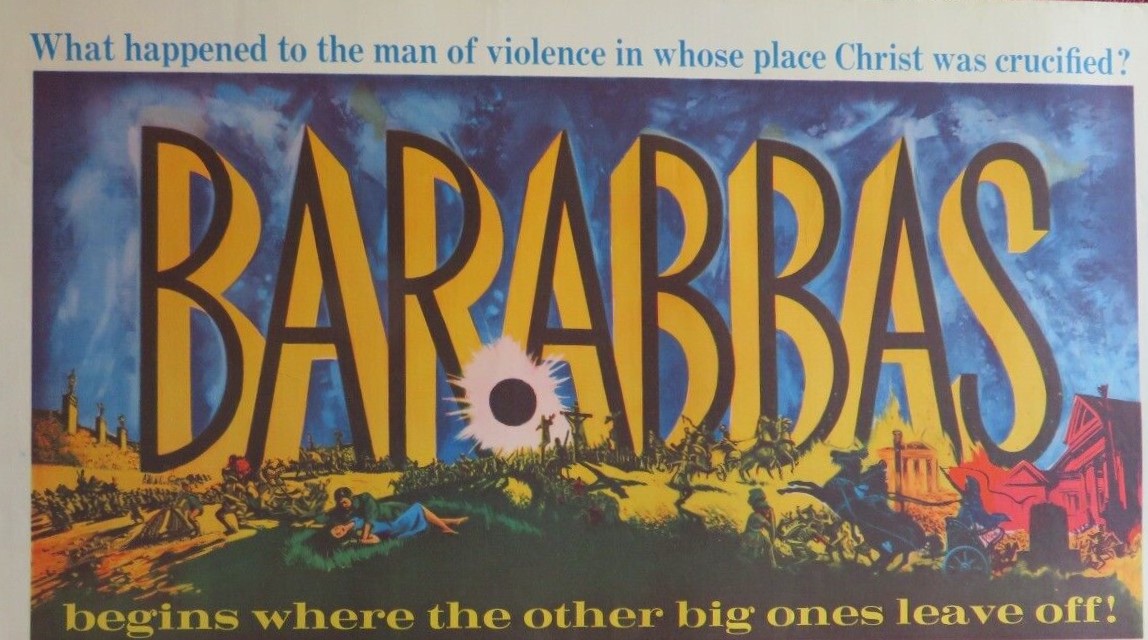
The Barabbas tale had already been plundered before Swedish novelist Par Lagerkvist published his relatively short bestseller – only 144 pages – in 1950. An earlier novel of the same name by Emery Bekessy hit American bookstalls at the height of the mid-1940s religious cycle kicked off by Going My Way (1944) and The Bells of St Mary’s (1945). DeMille – whose portfolio included Biblical epics The Ten Commandments (1923), King of Kings (1927) and The Sign of the Cross (1932) – was in competition with British producer Alexander Korda to buy the rights.
While that production never entered production, just to confuse matters a British film, Now Barabbas, based on a successful West End play and with no Biblical element, was released in 1949.
Swedish director Alf Sjoberg (Miss Julie, 1951), twice winner of the Grand Prix at Cannes, turned the Lagerkvist book into a black-and-white film in 1953, the first Swedish picture to be dubbed into English.
A bigger-budgeted version, piggybacking on the success of Ben-Hur (1959), was the brainchild of Italian producer Dino De Laurentiis who had pacted with Hollywood studio Columbia on a four-picture slate worth $17 million, the bulk of which, $10 million, was to be spent on Barabbas “with a cast of thousands headed by some of the biggest names in motion pictures.”
“Hollywood on the Tiber” was producing movies at a record rate – topping 200 a year – and De Laurentiis, who had shot to fame with Bitter Rice (1949) starring future wife Silvana Mangano and Fellini’s La Strada (1954) was intent on gaining a foothold in America beyond the arthouse market. Producing King Vidor’s War and Peace (1956) for Paramount had not done the trick and the Columbia slate was a last-ditch attempt to break into the Hollywood game.
Hollywood had originally invested in Europe to take advantage of tax breaks or to access monies frozen by countries after the Second World War, but by the 1960s the continent had become more attractive as a cheaper production alternative. While Britain had been a substantial recipient of Hollywood largesse, Italy was fast catching up as the chosen locale for pictures as varied as Cleopatra (1963), The Pigeon That Took Rome (1962) and Jason and the Argonauts (1963).
Director Richard Fleischer’s career was at a curious impasse. The son of world-famous animator Max Flesicher, creator of the Popeye cartoons, Richard had won critical acclaim for low-budget thriller The Narrow Margin (1951), followed up with a pair of stupendous action hits, 20,000 Leagues under the Sea (1954) and The Vikings (1958), both starring Kirk Douglas, and a daring examination of the world’s first “thrill killing” Compulsion (1959) with Orson Welles.
But he was at loggerheads with Twentieth Century Fox, to whom he was contractually tied, having turned down North to Alaska (1960) with John Wayne. As a result, he was relegated to lesser projects, Crack in the Mirror (1960), again with Orson, and The Big Gamble (1961), a picture with virtually no stars unless you count the questionable marquee value of Juliette Greco and Irishman Stephen Boyd trying to capitalize on his success in Ben-Hur (1959).
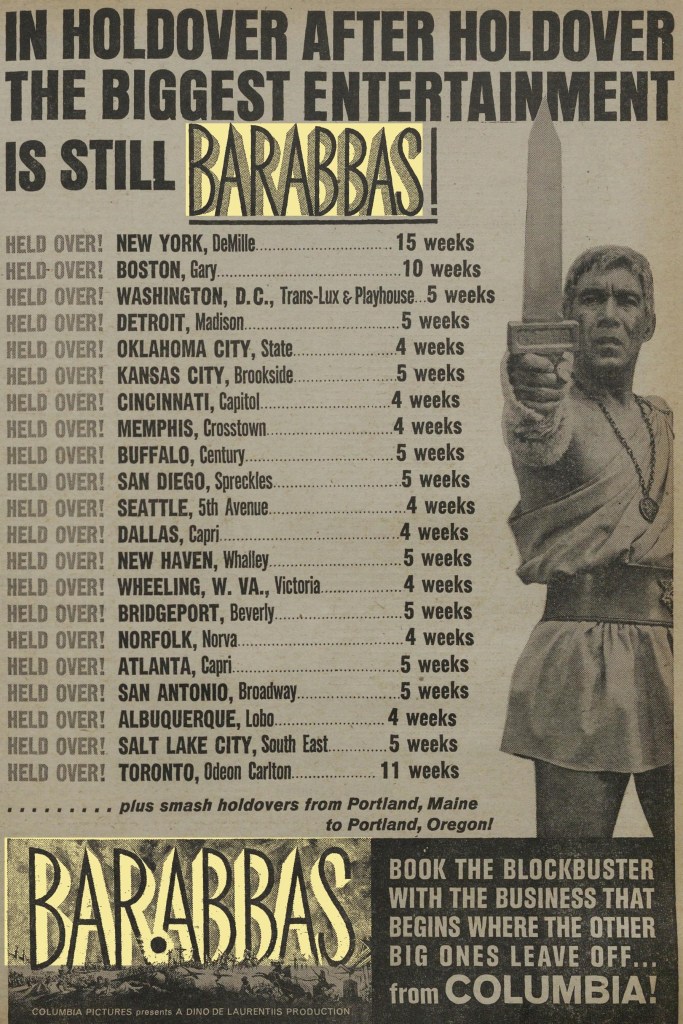
“Holdover” also meant it was not playing as a roadshow. In the roadshow exhibition situation, a cinema would be required to play a movie for an agreed number of weeks, generally a minimum of eight or thirteen. Non-roadshow films relied on box office performance for the length of their run, the engagement extended week-by-week.
He had been on Dino De Laurentiis’ radar before, approached to helm War and Peace, circumstances dictating otherwise, and a $10 million project, a 70mm roadshow, presented an ideal opportunity to resuscitate his moribund career. As Fleischer put it, “Even if I had loved Darryl (F. Zanuck, the legendary Fox producer of The Big Gamble), I would gladly have jilted him for this assignment.”
Despite the promise of the budget, the reality was off-putting. The De Laurentiis studio was housed in a “dreary industrial slum” and consisted of a two-storey wooden building housing the offices and “three decaying stages.” However, there was little downbeat about De Laurentiis, “an impeccably tailored bundle of raw energy,” according to Fleischer, “the impact of meeting him for the first time is something akin to sticking your finger into an electric light socket.”
The Italian producer possessed a quality that was appreciated in Hollywood, especially among old-school mavens. He was a showman. He could drum up publicity at the drop of a hat. His first publicity coup was hiring French star Jeanne Moreau, at the time considered one of the few foreign actresses who need not rely on buxom figure, as the female lead. Her arrival in Rome for pre-production prerequisites such as costume and make-up testing induced a flurry of front pages. A mob of about 30 reporters almost prevented any testing. “Even though the tests were purely mechanical, she became the character in the script the moment the camera turned,” observed Fleischer.
Unfortunately, De Laurentiis had no intention of hiring her, not when he had wife Silvana Mangano at home. The press reaction to Moreau might have suggested he was backing the wrong horse, despite Mangano’s own marquee appeal, but he appeared delighted to have achieved a publicity coup, no matter that he had manipulated and duped a great actress and the director.
De Laurentiis pursued Yul Brynner for the titular role, a suggestion with which the director was in accord. This was the real thing, attempted recruitment not just a publicity gag. Until Charlton Heston muscled in with Ben-Hur, Brynner was the go-to actor for historical epics, The Ten Commandments (1956) making him an instant star, a position solidified with an Oscar for The King and I (1956) and commanding a $750,000 payday, on a par with john Wayne and William Holden.
Brynner was initially disinclined to play the role but after a day in discussion with Fleischer they shook hands on a deal only to have it torpedoed by De Laurentiis.
Scriptwriters Christopher Fry, famed English playwright but novice screenwriter, Nigel Balchin (The Man Who Never Was, 1956) and Diego Fabbri (The Corsican Brothers, 1961) were recruited with De Laurentiis reporting that they were “currently at work after having studied the material at length.” Later added to the roster was Italian Nobel prize-winning poet Salvatore Quasimodo. Not trusting the producer to stick to the text, Lagerkvist assigned his son as overseer, a tactic that singularly failed to work.
Still lacking a male lead, De Laurentiis announced the movie would start shooting on January 7, 1961, with French pair Jeanne Moreau and Simone Signoret (Room at the Top, 1958) in the top female roles, neither of whom were ultimately involved.
Despite two Oscars as Best Supporting Actor, Anthony Quinn (Guns for San Sebastian, 1968) had failed to reach the top echelons of Hollywood stardom, stuck in the rut of male lead to top-billed female or starring in lower-budgeted pictures. To rectify the situation, he had embarked on a project intended to provide a prestigious showcase for his acting skills. He had signed up to play opposite Laurence Olivier in the Broadway production of Jean Anouilh’s acclaimed play Becket.
He had to be prised away from the Broadway run by De Laurentiis who forked out $37,500 in compensation and guaranteed the actor time off halfway through the shoot to fulfil a commitment to Lawrence of Arabia (1962). In fact, Becket, while attracting good notices, was a Broadway flop, the production only going into the black as a result of the De Laurentiis pay-off.
The all-star cast never materialized. But there was prestige aplenty, three members of the cast Oscar winners, another trio nominees. Vittorio Gassman (Ghosts of Rome, 1961) was at best a rising star, marquee value restricted to Italy. Jack Palance (Shane, 1953), was better known in Italy than the U.S., having spent the previous five years in Italy and now attempting a Hollywood comeback as a director. He was signed to play the notorious gladiator intent on killing Barabbas in combat. Ernest Borgnine (The Vikings) was still clinging on to vestiges of stardom after unexpectedly winning the Best Actor Oscar for Marty (1955). His wife Katy Jurado (High Noon, 1952) remained a starlet. Despite a bout of Oscar nominations in the supporting actor category Arthur Kennedy (Elmer Gantry) and never-nominated Harry Andrews (Solomon and Sheba, 1959) were no more than character actors.
It would have been impossible to make Barabbas on the tiny studio De Laurentiis owned so, encouraged by tax breaks, he invested in hundreds of acres of cheap land to build a new state-of-the art studio. But when Fleischer first saw it, it was nothing but a barren wasteland. Even so it was in these empty fields that production designer Mario Chiari would construct the ancient world.
Over several hours, simply by pointing his finger in vague directions, the pair came up with over 100 buildings, and the sets for Jerusalem and the Praetorium. The movie already had its arena – the 2,000-year-old structure in Verona – which would double for the Rome Colosseum. The complicated gladiatorial spectacle was the first sequence to be shot, with a world-record 9,115 costumed extras, arriving on a fleet on 75 buses from nearby towns. The only obstacle to rolling the cameras: Anthony Quinn’s specially designed gladiator sandals had been left behind in Rome. A temporary pair were mocked up so the first shot could be completed before lunch.
On the second day of shooting occurred a Hollywood fairy story. Looking for good characters to focus on in the crowd “one face truly stood out, that of an eighteen-year-old girl of stunning beauty.” The daughter of an officer at a U.S. military base in Vicenza, her name was Sharon Tate. Shortly afterwards, she moved in with Jack Palance, and not too long after that she was on the Hollywood glory trail prior to her premature death.
Another mishap threatened to spoil the scene where Quinn and Gassman, playing prisoners in the sulphur mine, were going to be chained together. The location was the top of Mount Etna in Sicily. On hand were 500 extras dressed as Roman slaves. It was a Sunday since that was the only day the roads would be clear enough to transport so many people and all the equipment up the two-hour drive from Catania up the twisty route.
The weather was terrible, the sky so black, the volcanic cinder ground a perfect match, with barely enough light to get an exposure. The only section of the scene unrehearsed was the riveting of the chains. And that required charcoal. But someone had forgotten the charcoal. A race down the mountain to bring back the charcoal took till the afternoon. But just as the charcoal arrived there was a break in the clouds and a spot of perfect light. It lasted just long enough for the shot to be taken.
The solar eclipse was no special effect. It was actually taking place on February 15, 1961, and Fleischer had cameras in place to record the phenomenon, the only genuinely ethereal scene in a movie that was more concerned with realism. The burning of Rome was also filmed “in camera,” the sets consumed in one take in one night.
While there were other occasional production errors, Fleischer found the Italian crew as professional as he required. And as accommodating. One day he was informed the crew had to go on strike for one hour. But after consultation with the director, the crew was happy to strike during the lunch break.
Even with a schedule rearranged to include Quinn’s time away filming Lawrence of Arabia (1962), shooting went smoothly with no overages or budget-blowing.
The production faced other threats. The 1953 version, already conveniently dubbed, was being reissued. There was a television production called Give Us, Barabbas, and a new play was launched off-Broadway by Belgian playwright Michel de Ghelderode, all of which could have stolen the limelight.
The movie followed an unusual distribution pattern. Launched in Italy at the tail end of 1961 to big box office it was another six months before it made a mark in London. In June 1962 it was the opening presentation for a new cinema, the Odeon Haymarket in London’s West End, a 600-seat underground emporium set up to take advantage of the demand for hard-ticket roadshow venues. The premises had not operated as a cinema since 1939 when it had been known for a short period as the Gaumont. It was only the second cinema built in London since the Second World War, the other being the Columbia in Shaftesbury Ave which had opened in 1959. In separate-performance advance-booking format, and tickets priced at $1.05-$2.80, Barabbas would remain at the Odeon for over six months.
It didn’t reach the United States – at the DeMille in New York – until October and even then was beaten to the North American punch by the 2,318-seat Odeon Carlton in Toronto, the largest cinema to enter the roadshow arena. And although available as a 70mm roadshow, in most locations it was more likely to be presented in 35mm minus the separate performances that were the hallmark of the prestigious hard-ticket presentation.
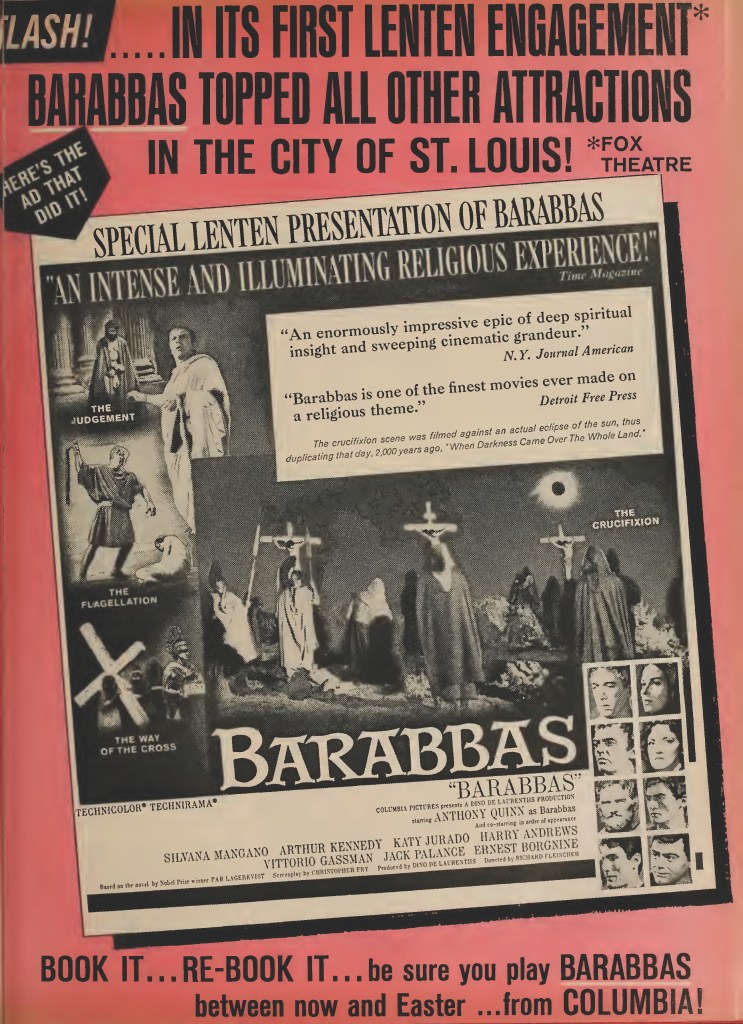
Columbia created some enterprising marketing concepts for the U.S. launch, including a touring exhibit by six well-known painters who had all used the film as the basis of artworks. A 41-foot high float including a 10-foot high revolving figure of Barabbas had been seen by 1.2 million people when paraded through Los Angeles. A special 190-page “making of” book was published in hardback. Six months after launch, the film was promoted as a “Special Lenten Presentation” in local cinemas with prices increased by 25 cents.
Although a huge success in native Italy and generally well-received at the international box office, Barabbas came up short in the U.S., rentals barely hitting $3 million, earning a lowly 35th place in the annual chart.
SOURCES: Richard Fleischer, Just Tell Me When To Cry, A Memoir (Carroll & Graf, 1993) p217-226; “Another Religious Picture May Be Barabbas Novel,” Variety, December 4, 1946, p4; “Now Barabbas Was A Robber,” Variety, June 1, 1949, p1; “First Swedish Picture Dubbed Into English,” Variety, June 23, 1954, p4; “Swedish Barabbas,” Variety, June 1, 1960, p4; “Lagerkvist, Nobel Winner, Assigns Son To Rome As Watchman on Barabbas,” Variety, December 14, 1960, p17; advert, Variety, January 4, 1961, p71; “Barabbas Budget over $10,000,000,” Variety, February 15, 1961, p3; “Dino De Laurentiis No 1 Indie Producer?,” Variety, February 15, 1961, p24; “Figure $17,500 for Off-Broadway Barabbas,” Variety, February 15, 1961, p71; advert, Variety, April 26, 1961, p71; “Becket Got 37½G On Quinn’s Exit,” Variety, May 3, 1961, p83; “Becket Folds As 40G Sleeper; Had Seemed Prestige-Only Flop,” Variety, May 31, 1961, p59; “Quinn Back To Work in Barabbas,” Variety, October 11, 1961, p17; “No Time To Fiddle in Rome,” Variety, November 15, 1961, p1; “To Write Barabbas Dialog,” Box Office, November 27, 1961, pW6; “Canada Coin,” Variety, March 21, 1962, p40; “Barabbas Exhibits Start Key City Tour,” Box Office, March 26, 1962, pE8; “Barabbas London Event: New York Date Oct 10,” Box Office, June 11, 1962, p14; “Barabbas Premiere Set For Oct 4 in Toronto,” Box Office, July 23, 1962, pE8; “Hard Cover Book to Ballyhoo Barabbas,” Box Office, July 30, 1962, p10; “Palance Back, Try Directing,” Variety, October 17, 1963, p3; “Big Barabbas Float,” Box Office, January 4, 1963, pA1; advert, Variety, January 23, 1963, p27; “Barabbas at Eight,” Box Office, February 18, 1963, pK2; “Lenten Angle for Barabbas Date,” Variety, March 13, 1963, p17; “Top Rental Features of 1963,” Variety, June 8, 1964, p37.
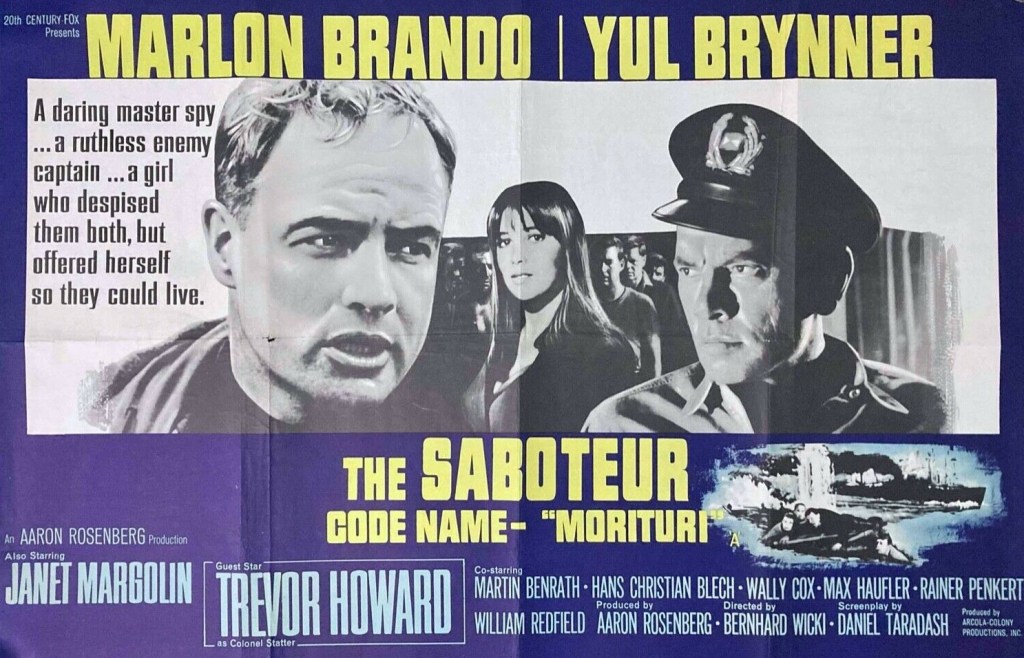
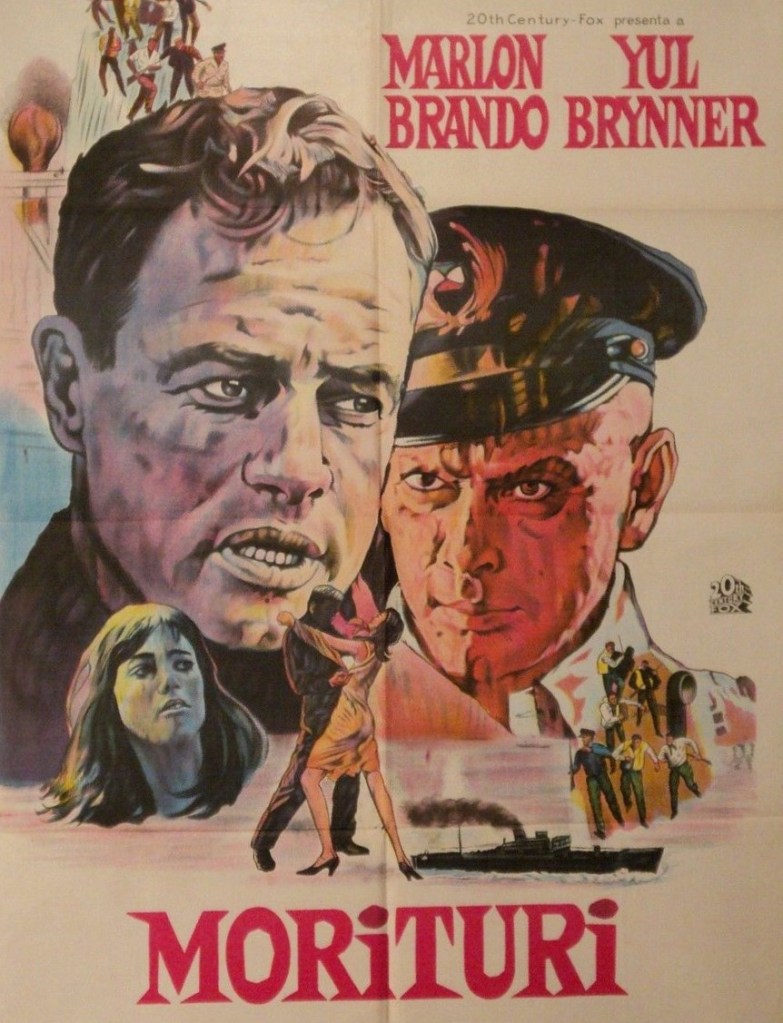
For a film that staggered around trying to find a plot to justify its tale of moral ambiguity during World War Two the final third is surprisingly potent. Featuring two good Germans and a bunch of bad Yanks ostensibly it’s a straightforward story of a saboteur trying to prevent a German cargo ship captain from scuttling his ship should it come under attack from the British determined to lay their hands on its vital supplies of rubber.
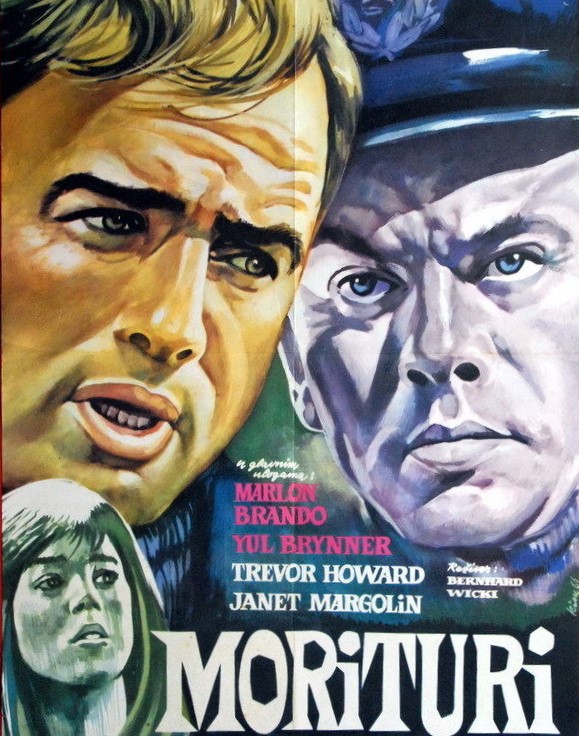
Supposed German pacifist Robert Crain (Marlon Brando) – actually a coward – hiding out in India is blackmailed by British Col Statter (Trevor Howard) into posing as a high-ranking SS officer on the German ship in order to prevent it being sunk by Captain Mueller (Yul Brynner). After his last command ended in drunken disgrace, Mueller assumes Crain has been sent to keep an eye on him. So Crain spends an almighty time down in the engine room and various below-decks spots defusing the wiring that would cause the ship to blow up at the touch of a button by the captain.
Mueller’s second-in-command Kruse (Martin Benrath) is suspicious of the cosmopolitan art-loving Crain but it’s a renegade band of criminals, led by Donkeyman (Hans Christian Blech) forced into armed service, who rumble Crain. But he talks them into mutiny. The ship avoids detection by disguising itself as a neutral Swedish freighter. Mueller’s attitude to Crain changes when the latter prevents him hitting the self-destruct button as a British destroyer seems poised to attack, changing its mind at the last minute.
Meanwhile, a group of American prisoners, from a ship sunk by a Japanese U-boat, come on board, including Jewess Esther (Janet Margolin). Surprisingly, Mueller steps up to the plate, protecting her from his crew, providing her with a private berth and permitting her to eat in the officer’s mess. On board the submarine are Admiral Wendel (Oscar Beregi), who commissioned Mueller, and a German counter-intelligence officer and, surprised to find Crain on the cargo ship, challenge him. Crain calls their bluff, but when the Admiral leaves he plans to radio Berlin to check Crain’s credentials, information passed on to Crain, who now has a very short deadline to organise mutiny, take over the ship and sail it to safety.
To do that, the mutineers require the support of the prisoners, a task detailed to Esther, who can only achieve that mission by surrendering her body to the prisoners, in much the same way as she has done previously to the Gestapo.
Mueller goes to pieces on hearing that his beloved son, also a ship’s captain, has been given a medal for sinking his fifth enemy vessel – only this time it is a hospital ship. After Mueller drinks himself unconscious, and Kruse assumes command, Crain fails to enlist Mueller to the mutiny which then begins. The surprise ending is both brutal and poetic.
But despite almost capsizing under the weight of an unwieldy cargo of plot and double-plot, the picture finally makes its points, that in war, ambiguity reigns. Mueller, who hates the Nazis but stoutly defends his Fatherland, proves to have the highest moral standards, agreeing to help Esther when they reach their destination, and preventing further molestation of her while aboard. Crain, purportedly the good German, has no compunction about sending Esther to do his dirty work, knowing the risks a sole woman faces in a hold of desperate sex-starved men. The good Yanks turn into rapists at the slightest opportunity, every bit as heinous in their depredations as their enemy.
That the movie stays afloat for so long is largely down to the excellence of Marlon Brando (The Chase, 1966) and Yul Brynner (The Double Man, 1967). Brynner’s magisterial presence, chest out, legs apart, serves him well, and the ongoing duel with Brando is an acting treat, though Brynner has the best scene, the look of anguish on his face when he realises what his son has done. Brando, reprising the silky German accent of The Young Lions (1958), is very convincing as the dilettante pressed into service, negotiating his way round the recalcitrant Brynner, and living on his wits when faced with the criminals and then the Admiral. And while Janet Margolin (Nevada Smith, 1966) is little more than a symbol, she invests the role with terrifying humanity, a woman reduced to being a sex object, utter submission her only way to achieve temporary reprieve. Most of her best acting is just with the look on her face.
In his Hollywood debut Martin Benrath appears just a standard German until his mask slips and we realise how much he covets the captain’s uniform. Wally Cox (The Bedford Incident, 1965) is another compromised by immoral behaviour, the doctor who steals the ship’s supply of morphine. Hans Christian Blech (Battle of the Bulge, 1965) excellent as a vengeful mutineer. You might also spot William Redfield (Fantastic Voyage, 1966). Trevor Howard (Von Ryan’s Express) is only there at the outset.
Austrian director Bernhard Wicki (The Visit, 1964) does his best with a plot bursting at the seams, but the scenes of sabotage are well done, and he does recreate the claustrophobic atmosphere of a ship, and the final sequence is worth waiting for. Daniel Taradash (Castle Keep, 1969) wrote the screenplay.
I started this Blog two years ago this month and to my astonished delight it is now read in over 120 countries. I am now well past over 500 reviews. So I thought you might be interested to know which of these reviews has attracted the most attention. This isn’t my choice of the top films in the Blog, but yours, my loyal readers. The chart covers the films viewed the most times since the Blog began, from June 1, 2020 to May 31, 2022.
The Secret Ways (1961). Richard Widmark exudes menace in this adaptation of an early Alistair MacLean spy thriller set in Hungary during the Cold War. Senta Berger has a small role.
Jessica (1962). Innocently gorgeous widow Angie Dickinson finds her looks turn so many male heads in a small Italian town that the female population seeks revenge.
Ocean’s 11 (1960). The Rat Pack makes its debut – Frank Sinatra, Dean Martin, Sammy Davis Jr. et al plan an audacious Las Vegas robbery.
Pharoah(1966). Priests battle kings in Polish epic set in ancient Egypt. Fabulous to look at and thoughtful.
Fraulein Doktor (1969). Suzy Kendall in the best role of her career as a sexy German spy in World War One.
The Golden Claws of the Cat Girl (1968). Cult French movie starring Daniele Gaubert as a sexy cat burglar.
The Swinger (1966). Ann-Margret struts her stuff as a magazine journalist trying to persuade Tony Franciosca she is as sexy as the character she has written about.
It’s Not All Rock’n’Roll (2020). Ageing rocker Dave Doughman aims to mix a career with being a father in this fascinating documentary
A Place for Lovers (1969). Faye Dunaway and Marcello Mastroianni in doomed love affair directed by Vittorio De Sica.
The Venetian Affair (1966). Robert Vaughn hits his acting stride as a former CIA operative turned journalist investigating suicide bombings in Venice. Great supporting cast includes Elke Sommer and Boris Karloff.
Moment to Moment (1966). Hitchcockian-style thriller with Jean Seberg caught up in murder plot in the French Riviera. Also features Honor Blackman.
4 for Texas (1963). Frank Sinatra and Dean Martin face off in a Robert Aldrich western featuring Ursula Andress and Anita Ekberg with Charles Bronson in a smaller part.
Age of Consent (1969). Helen Mirren stars as the nubile muse of jaded painter James Mason returning to his Australian roots.
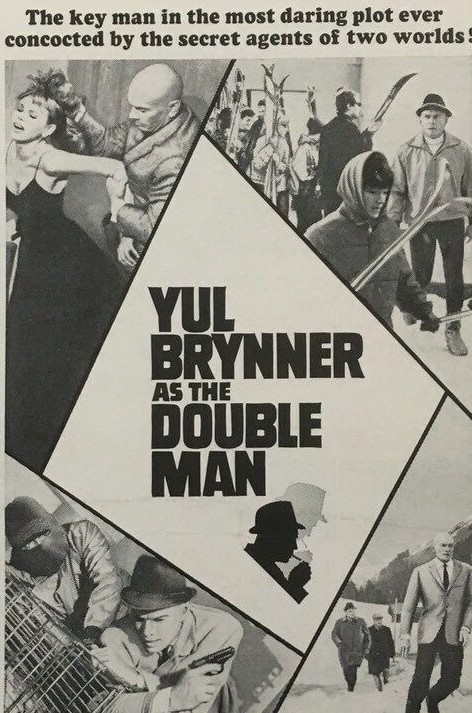
The Double Man (1967). Yul Brynner chases his doppelganger in the Swiss Alps with Britt Ekland adding a touch of glamour.
Subterfuge(1968). C.I.A. operative Gene Barry hunts an M.I.5 mole in London. Intrigue all round with Joan Collins supplying the romance and a scene-stealing Suzanna Leigh as a villain.
A House Is Not a Home (1965). Biopic of notorious madam Polly Adler (played by Shelley Winters) who rubbed shoulders with the cream of Prohibition gangsters.
Can Heironymous Merkin Ever Forget Mercy Humpe and Find True Happiness? (1969). Off-the-wall musical directed by star Anthony Newley that has to be seen to be believed. Joan Collins pops up.
Pressure Point (1962). Prison psychiatrist Sidney Poitier must help racist Nazi Bobby Darin.
Deadlier than the Male (1967). Richard Johnson as Bulldog Drummond is led a merry dance by spear-gun-toting Elke Sommer and Sylva Koscina in outlandish thriller.
Valley of Gwangi (1969). Special effects genius Ray Harryhausen the star here as James Franciscus and Gila Golen encounter prehistoric monsters in a forbidden valley.
The Naked Runner (1967). With his son held hostage, Frank Sinatra is forced to carry out an assassination in East Germany.
Orgy of the Dead (1965). Bearing the Ed Wood imprint, mad monster mash-up with the naked dead.
Once a Thief (1965). Ann-Margret is a revelation in crime drama with ex-con Alain Delon coerced into a robbery despite trying to go straight. Supporting cast boasts Jack Palance, Van Heflin and Jeff Corey.
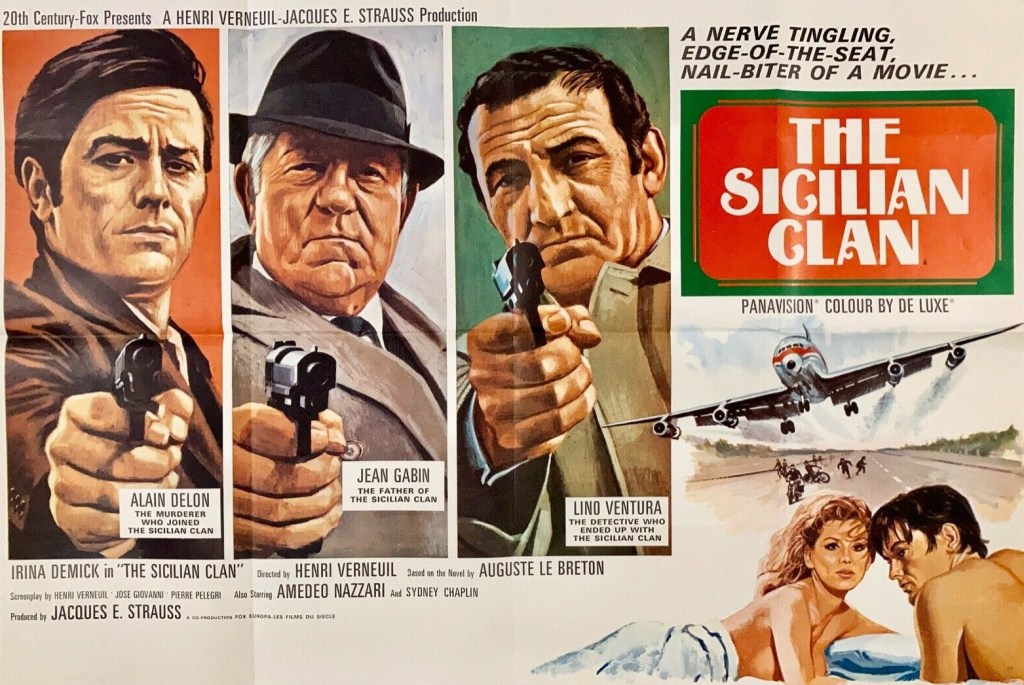
The Sicilian Clan (1969). Stunning caper with thief Alain Delon and Mafia chief Jean Gabin teaming up for audacious jewel heist with cop Lino Ventura on their trail. French thriller directed by Henri Verneuil. Great score by Ennio Morricone.
Dark of the Sun / The Mercenaries (1968). More diamonds at stake as Rod Taylor leads a gang of mercenaries into war-torn Congo. Jim Brown, Yvette Mimieux and Kenneth More co-star. Based on the Wilbur Smith bestseller
Stiletto (1969). Mafia hitman Alex Cord pursued by tough cop Patrick O’Neal. Britt Ekland as the treacherous girlfriend heads a supporting cast including Roy Scheider, Barbara McNair and Joseph Wiseman.
Maroc 7 (1967). Yet more jewel skullduggery with Gene Barry infiltrating a gang of thieves in Morocco who use the cover of a fashion shoot. Top female cast comprises Elsa Martinelli, Cyd Charisse, Tracy Reed and Alexandra Stewart.
The Rock (1996). Former inmate Sean Connery breaks into Alcatraz with Nicolas Cage to prevent mad general Ed Harris blowing up San Francisco. Michael Bay over-the-top thriller with blistering pace.
The Swimmer (1968). Burt Lancaster’s life falls apart as he swims pool-by-pool across the county. Superlative performance.
Hour of the Gun (1967). James Garner as a ruthless Wyatt Earp and Jason Robards as Doc Holliday in John Sturges’ realistic re-telling of events after the Gunfight at the O.K. Corral.
Fade In (1968). Long-lost modern western with Burt Reynolds serenading low-level movie executive Barbara Loden whose company is actually filming Terence Stamp picture Blue.
Dr Syn Alias the Scarecrow (1963). The British movie version of Disney American television mini-series sees Patrick McGoohan as a Robin Hood-type character assisting local smugglers.
P.J./New Face in Hell (1968). Private eye George Peppard is duped by shady millionaire Raymond Burr and mistress Gayle Hunnicutt in murder mystery.
Sol Madrid/The Heroin Gang (1968). In his second top-billed role David MacCallum drags hooker Stella Stevens to Mexico to capture drugs kingpin Telly Savalas.
A Twist of Sand (1968). Diamonds again. Smugglers Richard Johnson and Jeremy Kemp hunt long-lost jewels in Africa. Honor Blackman is along for the voyage.
Genghis Khan (1965). Omar Sharif plays the legendary warlord who unites warring Mongol tribes. Stellar cast includes Stephen Boyd, James Mason, Francoise Dorleac, Eli Wallach, Telly Savalas and Robert Morley.
Interlude (1968). Bittersweet romance between famed conductor Oskar Wener and young reporter Barbara Ferris.
Woman of Straw (1964). Sean Connery tangles with Gina Lollobrigida in lurid tale of murder and inheritance.
Bedtime Story (1964). Marlon Brando and David Niven are rival seducers on the Riviera targeting wealthy women.
Sisters (1969). Intrigue, adultery and incest haunt Nathalie Delon and Susan Strasberg as they try to recapture the innocence of the past.
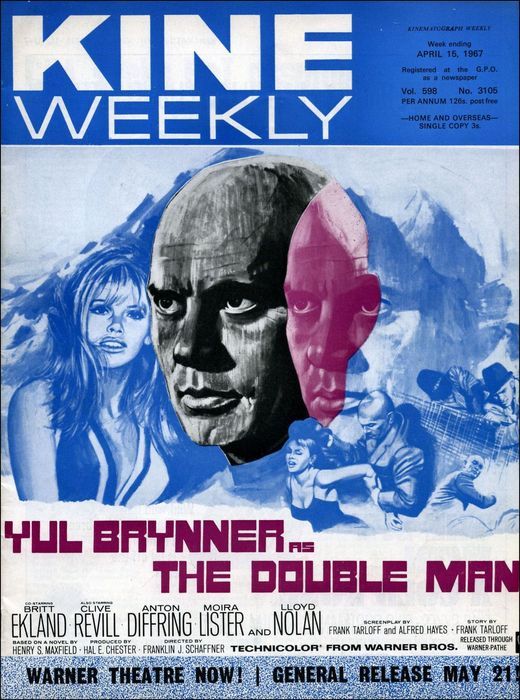
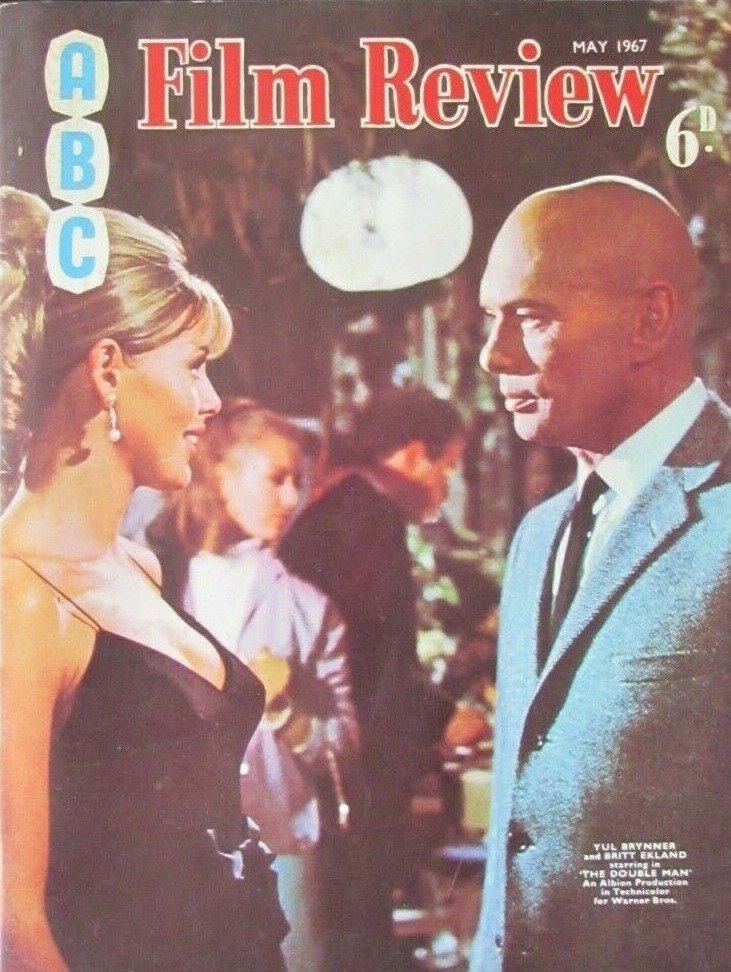
A bit more action and this could have been a John Wick-style winner because C.I.A. agent Dan Slater (Yul Brynner) is a big-time bad ass, all steely stare and resolve, and no time for anyone who gets in his way as he investigates the unexpected death of his son in the Austrian Alps.
It’s probably not this picture’s fault that any time a cable car hovers into view I expect to see Clint Eastwood or Richard Burton clambering atop all set to cause chaos, or any time a skier takes off down the slopes anticipate some James Bond malarkey. Luckily, director Franklin J. Schaffner (Planet of the Apes, 1968) avoids inviting comparison in those areas but rather too much reliance on the tourist elements of the ski world puffs out what would otherwise be a tighter storyline. And he also sets too much store by loud music to warn the audience of impending danger.
Slater is out of the ruthless espionage mold and, convinced on paltry evidence that his son has been murdered, determines to track down the perpetrators. There is a reversal of the usual plot in that those he asks for help are unwilling to give it, retired agent Frank Wheatly (Clive Revill) and chalet girl deluxe Gina (Britt Ekland) who initially views him as an older man to be fended off but turns out to have the vital information he seeks.
There’s a lot of tension but not much action and today’s modern vigilante would have beaten the information out of anybody who crossed his path rather than taking Slater’s path. Despite this, the relentless tone set by Slater ensures violent explosion is imminent. To be sure, you will probably guess early on, from the appearance at the outset of some Russians, that Slater is heading into a trap, but the reasons are kept hidden long enough.
There are some excellent touches. Slater’s boss (Lloyd Nolan) has a nice line in keeping his office underlings in check, chalet hostess (Moira Lister) is all style and snip, the Russian Col. Berthold (Anton Diffring) clipped and menacing. And the skiing sequences that relate to the picture are well done while the others are decently scenic.
It’s a shame that Brynner is in brusque form for it gives Britt Ekland in a switch from her comedy breakthroughs not enough to do. Revill is excellent as the former agent who has had his fill of espionage and dreads being pulled back into this murky world. Producer Hal E. Chester clearly spent more on this than on The Comedy Man (1964) but with varying results, top-notch aerial photography but dodgy rear projection. And there are some screenwriting irregularities, such as why conduct the son’s funeral before the father is present.
Catch-Up: Yul Brynner performances previously reviewed in the Blog are The Magnificent Seven (1960), Escape from Zahrain (1962), Flight from Ashiya (1964), Invitation to a Gunfighter (1964), Return of the Seven (1966) and Villa Rides (1968). Britt Ekland movies already covered are: The Happy Thieves (1961), The Night They Raided Minsky’s (1968), Machine Gun McCain (1969) and Stiletto (1969).
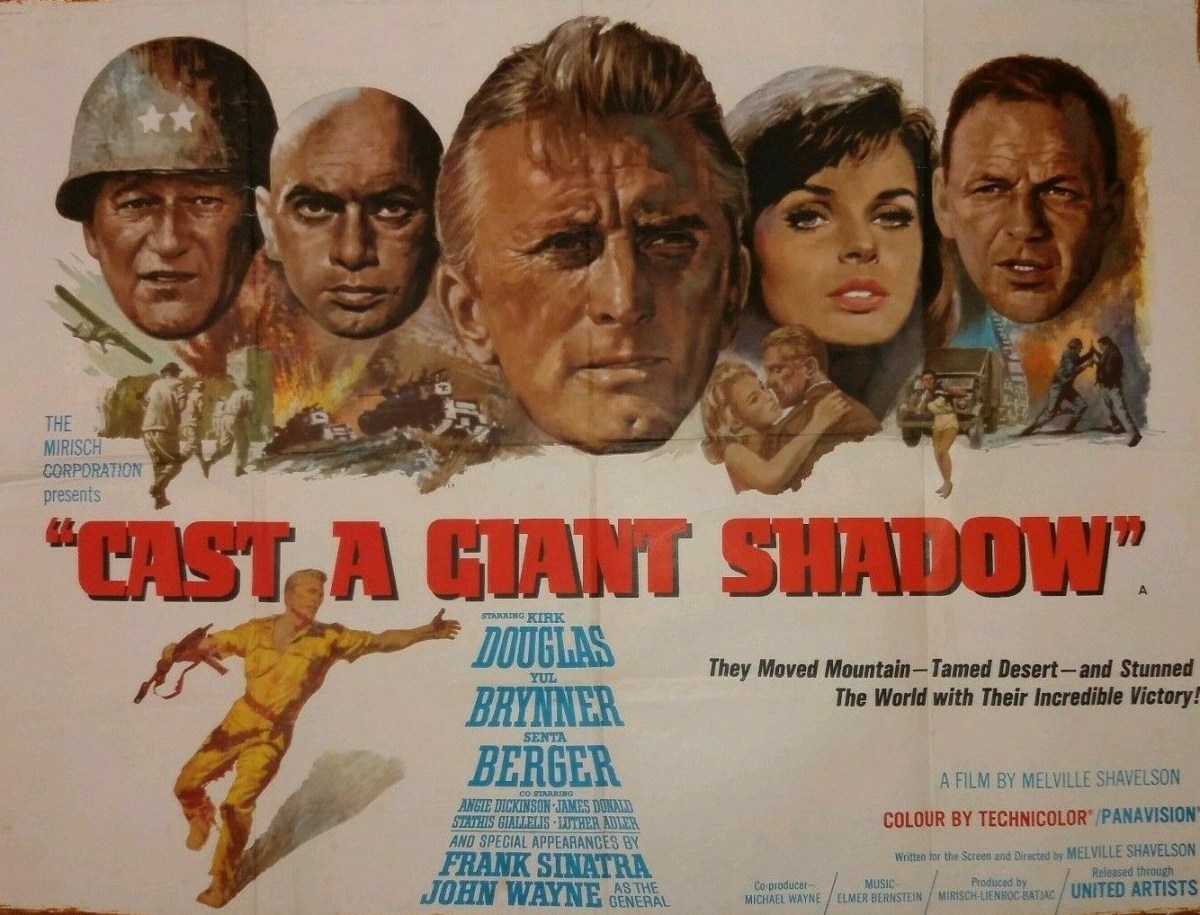
If recruiting John Wayne is essential to getting your new picture off the ground, it would help not to have fallen out with him big-style previously. After every studio in Hollywood had turned down Cast a Giant Shadow, writer-producer-director Melville Shavelson turned to the Duke. The only problem was the pair had hit trouble on football picture Trouble All the Way (1953) should take.
In his capacity as producer of Trouble All the Way, Shavelson, also co-writing the screenplay, had given Wayne one version of the script while behind his back instructing director Michael Curtiz to shoot a different version with subsidiary characters that would change the film’s plotline. When Wayne found out, Shavelson was the loser. When you make an enemy of John Wayne, it takes a lot to win him back as a friend.
After that debacle, Shavelson had gone on to win some kudos and occasional commercial success as a triple hyphenate on pictures like Houseboat (1958), It Started in Naples (1960) and A New Kind of Love (1963) with top-ranked performers in the vein of Cary Grant, Sophia Loren, Clark Gable and Paul Newman. When Shavelson pitched to Wayne the story of Cast a Giant Shadow, about the birth of Israel and based on the bestselling biography of Mickey Marcus by Ted Berkmann, the star’s response was: “That’s the most American story I ever heard.” Wayne was hooked on the idea that America had helped Israel achieve its independence and that top American soldier Colonel Mickey Marcus had died in the process.
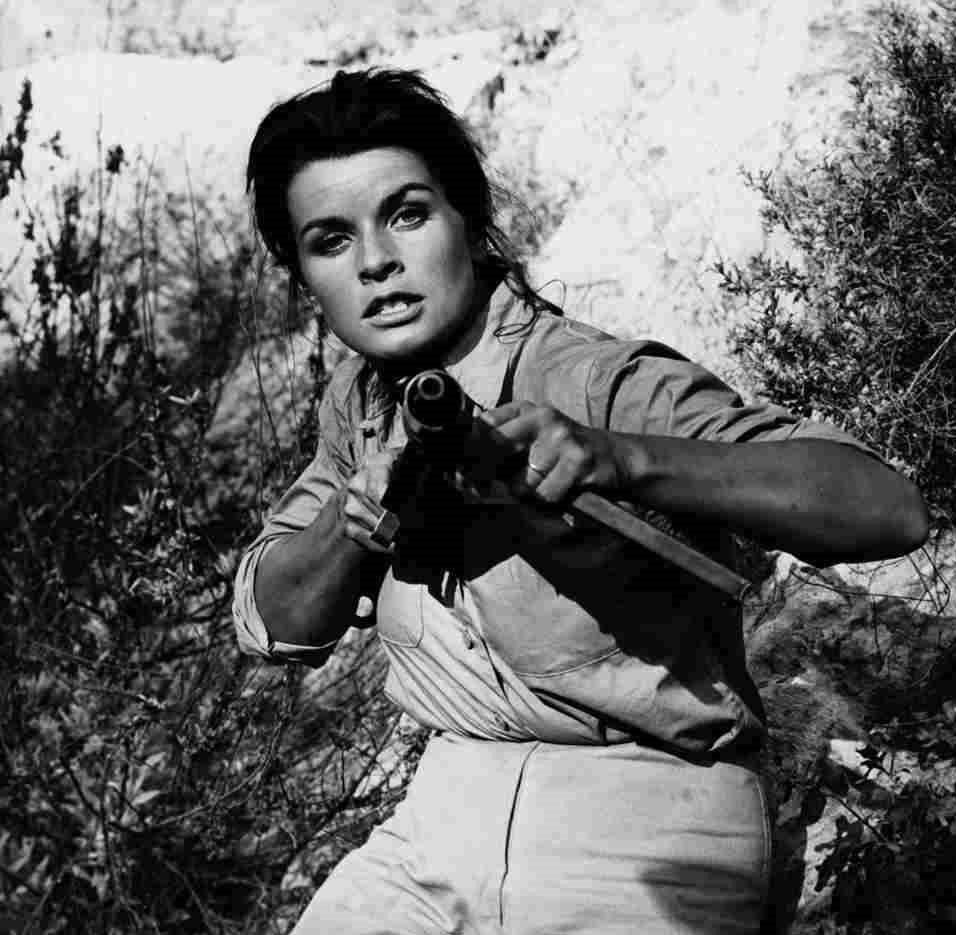
Senta Berger as the gun-toting Magda.
Wayne’s potential involvement came with a proviso – he had script approval. And while Shavelson owned the rights to the book, he didn’t have a screenplay. Nor, with his background as a writer being primarily concerned with comedy, did he consider himself best suited to the job.
He had, however, written a treatment. In his eyes, a treatment was not just about encapsulating the story, but about selling it to a studio. So his first few paragraphs included references to box office behemoths Lawrence of Arabia, The Guns of Navarone and Bridge on the River Kwai – planting in the minds of potential backers the notion that this film was headed down the same route of substantial profit – and a reference to an “American of heroic proportions…with the ability to love,” the latter being code for sex.
But in the end he wrote the screenplay as well. Wayne put his imprimatur on the picture in more ways than one. Part of the deal was that his production outfit Batjac become involved, with son Michael in line for a co-producer credit. Shavelson managed to snag Kirk Douglas for the starring role only by giving up part of his own salary to meet the star’s fee. Douglas and Wayne, with the credit ranking reversed, had starred together in In Harm’s Way (1965).
It was Douglas who insisted his character’s role be change from passive to active. Shavelson invented an American general for John Wayne and a female Israeli soldier (Senta Berger) for Douglas – in reality his character was a married man – to have an affair with. “I’m introducing a fictitious romance into the film with the full consent of Marcus’s widow,” Shavelson told Variety, though it’s doubtful that real-life wife Emma Marcus went along so merrily with this notion.
It wasn’t only Wayne who demanded script approval. The Israeli government, with whom cooperation was essential to guarantee the use of troops and equipment, had made the same condition. The Israelis worried that the film would fall into the usual Hollywood trap and to that extent the government insisted that the picture not end up as a “an Errol Flynn Burma stunt” – a reference to Objective Burma (1945), originally banned in London for Americanizing the film. The government spelled it out: “Col Marcus didn’t win our war, he just helped.” But the production was offered “further facilities than normal.” Two sound stages – the first in the country – were being built in Tel Aviv.
Shavelson was shown military locations that no other civilian had ever seen. When the Israelis did “approve” the script it was with the proviso that 31 changes were made including the deletion of the “sex-starved woman” (Senta Berger), although in reality Shavelson got away with his vision intact.
When the film went ahead it had a crew of 125 plus 800 Israeli soldiers, 1,000 extras and 34 featured players including Yul Brynner, Frank Sinatra, and Angie Dickson. Only some of the film was made in Israel. The interiors for the Macy’s department store were built in Rome, along with the concentration camp sequence, one of the battles, and scenes set in Coney Island that were edited out from the final picture.
The biggest problem was the supply of soldiers and equipment at a price the production could afford. Shavelson was being charged twice as much for the soldiers as the producers of Judith (1966). It took the intervention of the Israeli Prime Minister for sensible negotiation to get under way and for prices to drop to a tolerable level. Neither was it possible to film on the original battle sites in Israel since they were basically in a no man’s land, covered in barbed wire and littered with mines.
Principal photography began on May 18, 1965, in 115 degree heat – so hot the film buckled in the cameras – at the fortress of Iraq Suidan to recreate the Battle of Latrun. Shavelson had been denied permission to access the Latrun fortress itself which stood across the Jordanian border even though the engagement had been an Arab victory. To keep the sun off his face, Kirk Douglas decided to wear an Australian Army forage cap, and it did the job so successfully he kept it on for the entire movie.
On another location – this time when the temperature reached 126 degrees – a $40,000 Panavision camera exploded filming too close to a tank-muzzle firing, the jeeps got vapor lock, three soldiers were wounded by dummy bullets and the charging tanks vanished after the first take when their commander received new instructions from his army superiors.
Shavelson had met Sinatra some years before when he and scripting partner Jack Rose had helped write the Inaugural Gala organized by the singer in honor of President John F. Kennedy. Using that connection and the fact they shared the same agent, Sinatra, who had a pilot’s license, agreed to play a two-day role as a Piper Cub aviator dropping seltzer bottles on tanks. When filming began Shavelson discovered that what he had imagined was his own inspired invention turned out to be close to the actual truth. To write the score, Elmer Bernstein visited Israel to conduct his own research.
He also discovered the real reason for Sinatra’s eagerness to be involved. His salary had been donated to set up the Frank Sinatra Arab-Israeli Youth Centre in Nazareth. Actually, there was another less noble reason for Sinatra signing up. He had begun an aviation business, Cal-Jet Airways, supplying planes to Hollywood, and clearly thought appearing as a pilot in a picture would help promote the new company.
However, when filming of his scenes began Sinatra proved unintelligible. He had taken the script at face value and thought he was playing a Texan and delivered his lines with a Texan accent. Eventually, Sinatra was persuaded to play it with his own normal voice. But Sinatra could only be filmed in the plane on the ground since his insurance didn’t cover him being in the air unless accompanied by a co-pilot.
By the time they came to film the immigrants’ landing scene the picture was already half a million dollars over budget. With the country enjoying full employment and nobody inclined to take time off to work in the blazing sun as an extra, the 800 extras were in reality all newly arrived immigrants – and therefore unemployed – from Hungary, Rumania, Poland, Russia and Czechoslovakia.
The only item that was lacking to complete the landing scene was a ship offshore, but the owners were asking too much money. Instead, the director came up with the idea of a “glass shot.” An artist had painted in smoke billowing from the funnels, but it was blowing in the wrong direction from the wind. The solution – a double-exposure job in the lab – cost as much as hiring the ship.
Once the production headed home, Shavelson discovered that virtually all the sound recordings made in Israel were unusable. Frank Sinatra and Kirk Douglas re-recorded their dialog in Hollywood, Yul Brynner and Senta Berger in London and dozens of Israeli students attending Los Angeles universities were called upon to replicate background Hebrew voices.
For prestige purposes, the movie was launched at the end of March 1966 as a restricted roadshow, just three cinemas in New York – the DeMille in the Broadway area, the Fantasy Theater in Long Island and Cinema 46 in New Jersey. Douglas employed a helicopter to fly from venue to venue. The first wave of first run houses followed in Baltimore, Philadelphia, San Francisco and Miami.
Most of the promotional activity centered on the true story of Mickey Marcus but in London, where the character was unknown, United Artists took the gimmick route, placing an advert in The Times newspaper calling for “giant men” standing over six foot seven inches tall. Expecting to find 25 such giants, they ended up with 100 attending the British premiere, the tallest seven foot three inches. In keeping with this gimmicky approach, tickets for the first performance were also a king-sized twelve inches by nine inches.
SOURCES: Melville Shavelson, How To Make a Jewish Movie, W.H. Allen, 1971; “Wayne To Co-Produce, Star in Israeli War Pic,” Variety, May 27, 1964, 2; “We’ll Lift Part of Local Expenses, Israeli Offer to UA,” Variety, July 1, 1964, p3; “Kirk Douglas Set to Star in Cast a Giant Shadow,” Box Office, March 8, 1965 pW-2; “Batjac Productions Moves to Paramount Lot,” Box Office, March 29, 1965, pW-2; “Shavelson Aim on Mickey Marcus Film: Realism,” Variety, March 31, 1965, p25; “WB-Sinatra Film in October; Sinatra’s Aviation Firm,” Box Office, August 23, 1965, 6; “Elmer Bernstein to Israel for Film Music Research,” Box Office, October 18, 1965, pW-3; “Cast a Giant Shadow Set for 3 N.Y. Roadshow Dates,” Box Office, December 6, 1965, pE3; “Kirk Douglas To Helicopter to All 3 Shadow Openings,” Box Office, March 28, 1966, pE-7; “Cast a Giant Shadow set in 14 Key Centers, April 6-8,” Box Office, April 11, 1966, p6; “Small Ad Brings 100 Giant Men to London Opening of United Artists’ Cast a Giant Shadow,” Box Office, October 3, 1966, pA3.
In some respects a sequel to the film Exodus (1960) as Israel, on the eve of independence in 1948, prepares to repel invasion from neighboring Arabs. Colonel Mickey Marcus (Kirk Douglas) is recruited to help organise the Jewish forces even though he has little actual combat experience, having sat out the Second World War behind a desk until D-Day, and having already resumed his legal career.
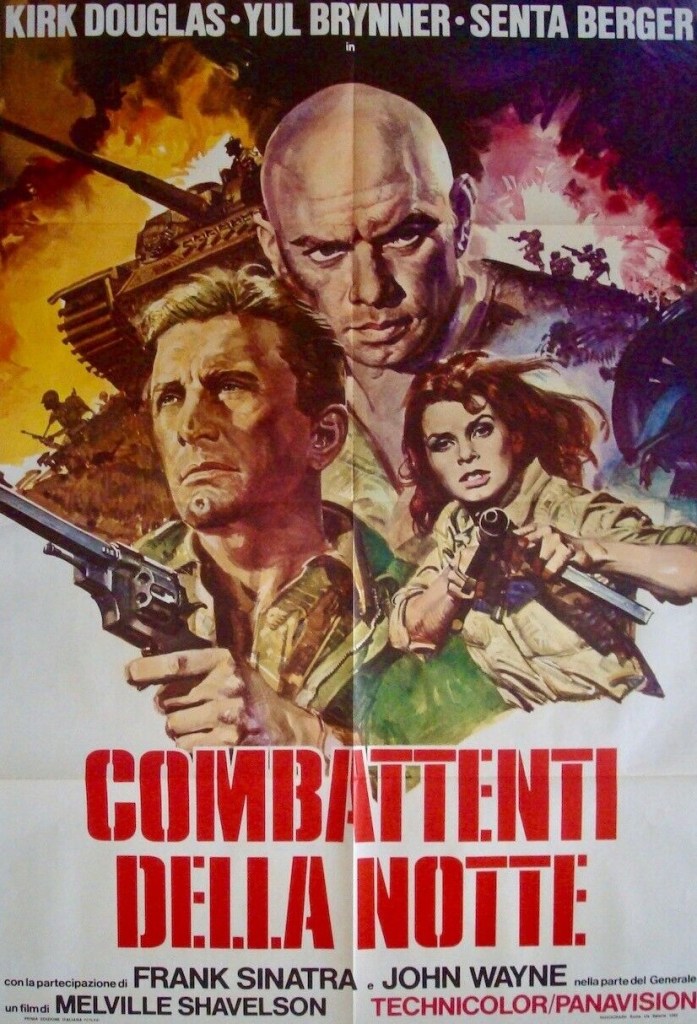
To facilitate entry to Palestine, he is met at the airport by Magda (Senta Berger), herself a soldier, pretending to be his sister. The journey from the airport in armored bus reveals the perilous reality of the situation, the vehicle strafed as they pass through towns. He finds a rabble of a fighting force, lacking in weaponry, disorganised, and made up of various groups at each other’s throats, and focused on defense rather than attack. Initially, Marcus is strictly an advisor, writing training manuals until he encourages a commando raid and is eventually, at the behest of Asher (Yul Brynner) put in complete command of all the units, effectively the country’s first general.
In the background, General Mike Randolph (John Wayne) is helping organise support in the United States to recognise Israel’s independence. Marcus organises a campaign to lift the siege of Jerusalem, first through direct attack, but then through an incredible foray into impassable mountains, building the “Burma Road,” equivalent in the tactical sense to Lawrence of Arabia’s trek through the desert to attack Aqaba.
A fair bit of the early part of the picture is flashback to establish Marcus’s military credentials, which are scant, in sum total no more than a week of active combat, and it would have been better to concentrate on why he was recruited in the first place, because of the name the real-life Colonel had made for himself in organizing the war crimes trials in Germany.
Apart from the action and military politics, the drama concerns Marcus abandoning wife Emma (Angie Dickinson) in New York, embarking on a romance with Magda and establishing a sense of identity with his adopted country. The action is particularly good, audacity the Israeli’s major weapon.
It is mostly through Magda that we view the Jewish experience. She married Andre (Michael Shillo) in order to save his life, although she did not love him. A veteran of many skirmishes, she suffers a breakdown when trapped in her vehicle during one particularly vicious battle. In what is possibly the most imaginative scene in the film, when Marcus encourages her to keep driving her stalled truck with cries of “Come on, Magda,” in cruel torment the surrounding Arabs take up the cry until it echoes round the hills. Once she falls for Marcus, of course, she never knows if he will return safe from battle.
Kirk Douglas (A Lovely Way to Die, 1968) leads mostly with his chin, never letting subtlety get in the way of his performance, but given the character assigned he has little option and is nonetheless effective as a leader and believable as a man torn between wife and lover. Senta Berger (Major Dundee, 1965) has never been better (or not so far in the films thus reviewed) with a meaty role that shows soldiering from a female perspective in a country where sacrifice is a given.
John Wayne (The Undefeated, 1969) has a small role as a grumpy general and Frank Sinatra (The Naked Runner,1967) a cameo as a commercial pilot who finds himself dragged into the war. Angie Dickinson (Fever in the Blood, 1961) is the long-suffering wife and singer Topol (Sallah, 1964) has a small role. The smattering of Brits includes Michael Hordern (Khartoum, 1966), Gordon Jackson (Danger Route, 1967), Jeremy Kemp (The Blue Max, 1966) and James Donald (The Great Escape, 1963).
Melville Shavelson wouldn’t be your first choice for an action picture given he made his name with comedies like It Started in Naples (1960), but does a fair job of directing, especially the action, the “Come on, Magda” scene and the confrontation with the British when immigrants land. He wrote the screenplay based on the biography by Ted Berkman.
Regular readers will know that I don’t just write movie reviews but pick up on “Other Stuff” relating to the 1960s. This will take the form of articles about interesting aspects of the decade, book reviews and analyses of how particular movies were sold to the exhibitor via the studio’s Pressbooks / Campaign Manuals.
In addition, I have become especially interested in how works of fiction were adapted for the screen and these go out under the general heading of “Book into Film.” And, lastly, I have written a number of Behind The Scenes posts on the making of specific pictures.
So given I have been highlighting those movies that were the most highly regarded either by myself or my readers during the year, I thought it only fair to include some mention of the “Other Stuff.”
So these are my Top Ten posts of “Other Stuff”- as measured by reader response – during my inaugural year as a movie blogger. It’s worth pointing out that had the “Other Stuff” been included in the same chart as the Top 30 Readers’ pictures, five would have made the Top 20.
“Box Office Poison 1960s Style” highlighted the stars whose attraction was beginning to fade.
The Gladiators vs Spartacus was a two-volume book that I reviewed about the ill-fated production launched by Yul Brynner against the Kirk Douglas production of Spartacus (1960).
Behind the Scenes of “Genghis Khan” (1965) related the battle to bring this Omar Sharif vehicle to the screen
Behind the Scenes of The Night They Raided Minskys (1968) produced a surprising amount of interest given the film, directed by William Fredkin and starring Britt Ekland, was a notorious flop.
The Pressbook for “The Dark of the Sun” / “The Mercenaries” (1968) identified the efforts of the MGM marketing wizards to sell the Rod Taylor-Jim Brown action picture to the wider public.
Behind the Scenes of “The Guns of Navarone” (1961) was based on my own successful book The Making of The Guns of Navarone which had been reissued with additional text and illustrations to celebrate the film’s 60th anniversary.
Behind the Scenes of “The Girl on a Motorcycle” tracked how director Jack Cardiff beat the censor and cajoled a decent performance from Marianne Faithful even though it was yanked form U.S. release.
Book into Film – “The Venetian Affair” explained how screenwriter E. Jack Neumann took the bare bones of the Helen MacInnes thriller and turned it into an excellent vehicle for Robert Vaughn trying to escape his The Man from Uncle television persona.
Selling “Doctor Zhivago” (1965) examined the media campaign run by MGM for the London launch of the David Lean blockbuster.
Book into Film – “A Cold Wind in August” demonstrated how screenwriter John Hayes toned down the sexy novel by Burton Wohl to escape the wrath of the censor while turning it into a touching vehicle for Lola Albright.
It’s a been a fabulous year for watching the movies and my pictures of the year (the first full year of the Blog running from July to June, I hasten to add) make up an eclectic collection ranging from historical epics, dramas and westerns to horror, thrillers and comedy. Although this is my chosen decade, many of the films I was seeing for the first time so it was interesting to sometimes come at a film that had not necessarily received kind reviews and discover for one reason or another cinematic gems. There was no single reason why these pictures were chosen. Sometimes it was the performance, sometimes the direction, sometimes a combination of both.
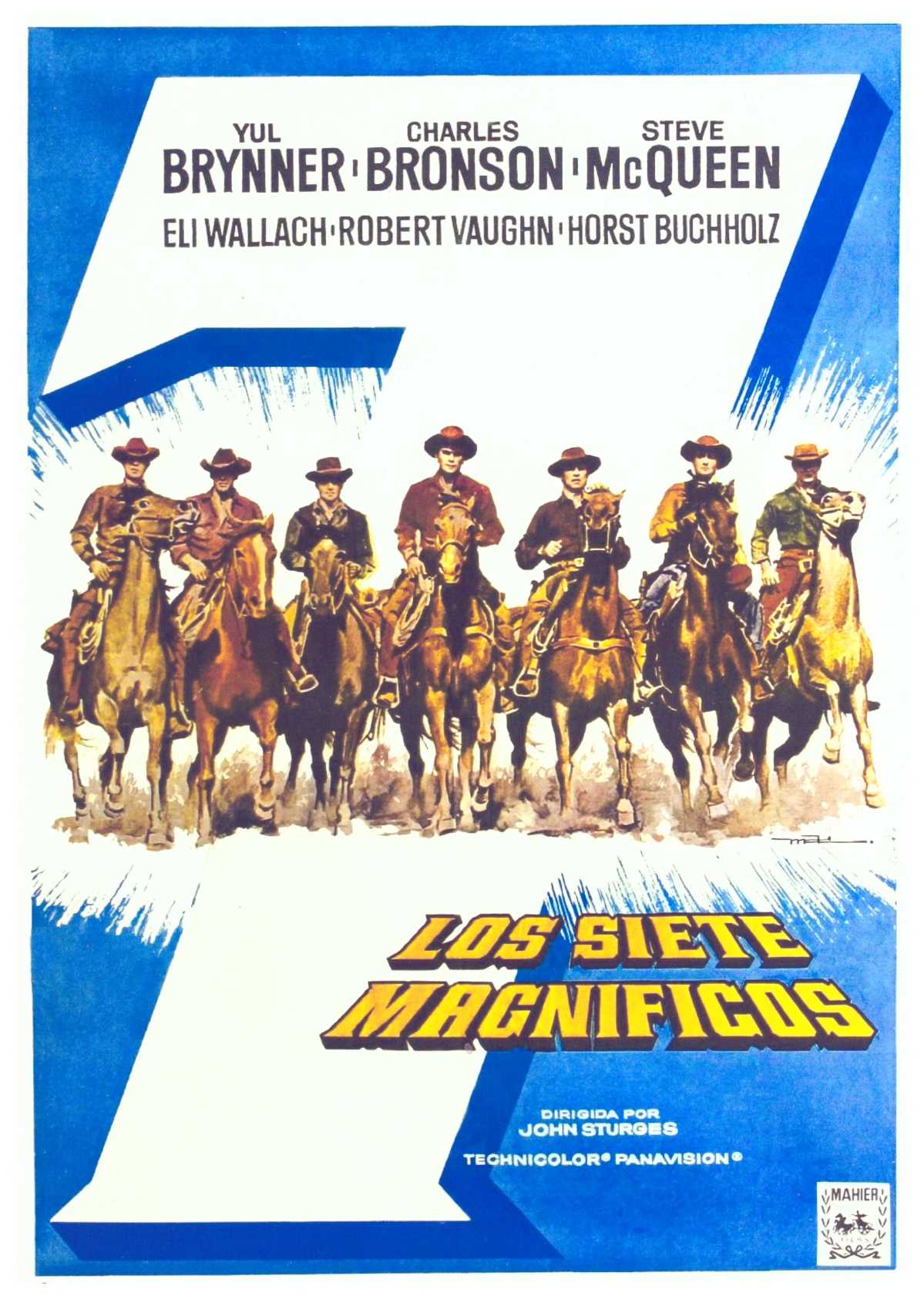
The westerns I most enjoyed came from either ends of the decade – John Wayne and Rock Hudson in magnificent widescreen spectacle The Undefeated (1969) and Yul Brynner, Steve McQueen, Charles Bronson, James Coburn and the team in The Magnificent Seven (1960).
There was another ensemble all-star cast in J. Lee Thompson war film The Guns of Navarone (1961) one of the biggest hits of the decade with Gregory Peck, Anthony Quinn, David Niven, Stanley Baker et al.
Horror brought a couple of surprises in the shape of Daliah Lavi as the Italian peasant succumbing to The Demon (1963) and Peter Cushing menaced by The Skull (1965).
Not surprisingly perhaps Alfred Hitchcock headed the ranks of the five-star thrillers, but surprisingly to some, this was in the shape of Marnie (1964) with Sean Connery and Tippi Hedren rather than some of his decade’s more famous / infamous productions. Heading the romantic thrillers was the terrifically twisty Blindfold (1965) with Rock Hudson and Claudia Cardinale teaming up to find a missing scientist. The Sicilian Clan (1969) proved to be a fine heist picture in its own right as well as a precursor to The Godfather with a topline French cast in Alain Delon, Lino Ventura and Jean Gabin.
Only one comedy made the five-star grade and what else would you expect from Billy Wilder’s Some Like It Hot (1959), slightly outside my chosen remit of films from the 1960s, but impossible to ignore the chance to see Marilyn Monroe, Tony Curtis and Jack Lemmon strutting their stuff on the big screen. For the same reason I had the opportunity to re-evaluate Ridley Scott’s Oscar-winning historical epic The Gladiator (2000) that gave Hollywood a new action hero in Russell Crowe. Stylish contemporary sci-fi chiller Possessor (2000), from Brandon Cronenberg, was another one seen on the big screen, one of the few in this year of the pandemic.
Most people would certainly put Paul Newman as prisoner Cool Hand Luke (1967) in this elevated category but, to my surprise, I found several other dramas fitted the bill. The clever sexy love triangle Les Biches (1968) from French director Claude Chabrol made his name. Burt Lancaster turned in a superlative and under-rated performance in the heart-breaking The Swimmer (1968) about the loss of the American Dream. Rod Steiger, on the other hand, was a hair’s-breadth away from picking up an Oscar for his repressed turn as The Pawnbroker (1964).
Two films set in the Deep South also made the list – Marlon Brando in Arthur Penn’s depiction of racism in small-town America in The Chase (1966) with an amazing cast also featuring Jane Fonda and Robert Redford, and Michael Caine as a more than passable arrogant southerner in Otto Preminger’s Hurry Sundown (1967) opposite rising star Faye Dunaway. Dennis Hopper and Peter Fonda’s hymn to the freedom of the motorbike in Easy Rider (1969) turned into a tragic study of attitudes to non-conformity.
For only eighteen films out of a possible two hundred to make the cut indicates the high standards set, and I am looking forward to as many, if not more, brilliant films in the year to come.
The success in 1968 of such disparate movies as The Graduate (1967), Valley of the Dolls (1968) and 2001: A Space Odyssey (1968) with no discernible stars got Hollywood thinking whether they needed stars anymore. Stars were viewed as insurance. Their names were attached to pictures in the hope that they would bring a sizeable audience.
But for some time that had proved not to be the case. Certainly actors with the box office clout of Paul Newman, Julie Andrews, Elizabeth Taylor, Lee Marvin, John Wayne, Richard Burton and Elvis Presley justified their extravagant salaries. But exhibitors had begun to complain that studios were forcing them to carry the cost of stars who did not deliver, the salaries inflating “the terms that theatres must pay for films.”
Big names viewed as box office poison in 1968 included Marlon Brando, Tony Curtis, William Holden and Natalie Wood. An investigation by trade magazine Variety uncovered the fact that in each case the last four pictures of each star – who earned $250,000 or more per movie – had flopped. Average movie budgets by now had climbed to $3-$4 million not counting marketing costs so most movies had to bring in over $10 million at the global box office to break even
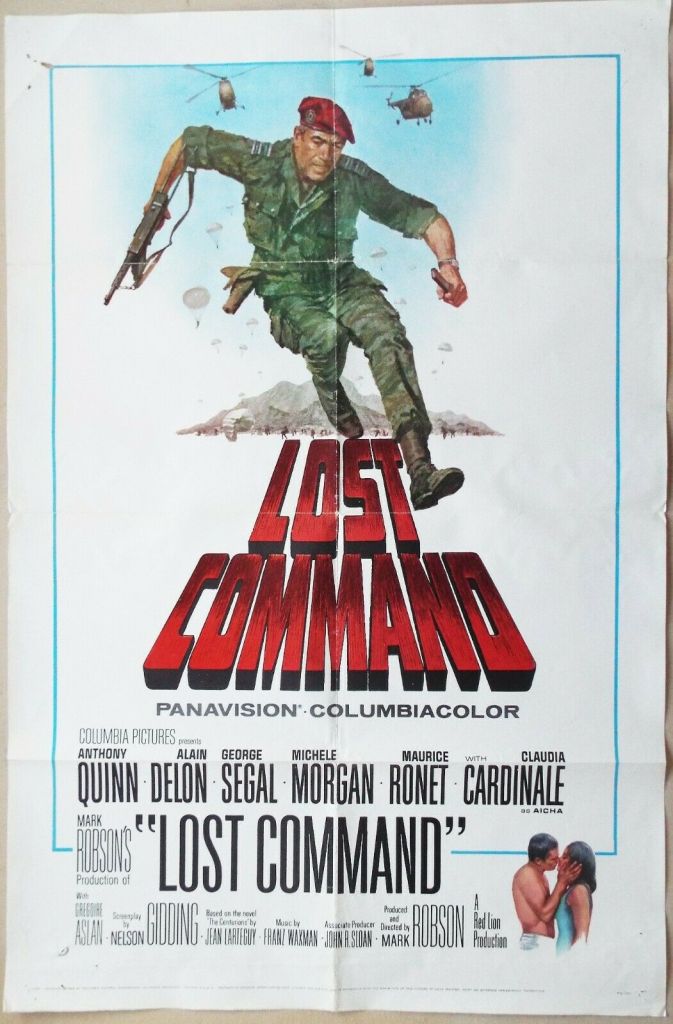
The star with the worst track record was Anthony Quinn. Average rental for his past four pictures – $800,000. While Zorba the Greek (1964) had been an unexpected hit, what followed was anything but. Discounting a cameo in Marco the Magnificent (1965), the box office duds comprised adventure A High Wind in Jamaica (1965), Lost Command (1965), war film The 25th Hour and misconceived hippie comedy The Happening (1967).
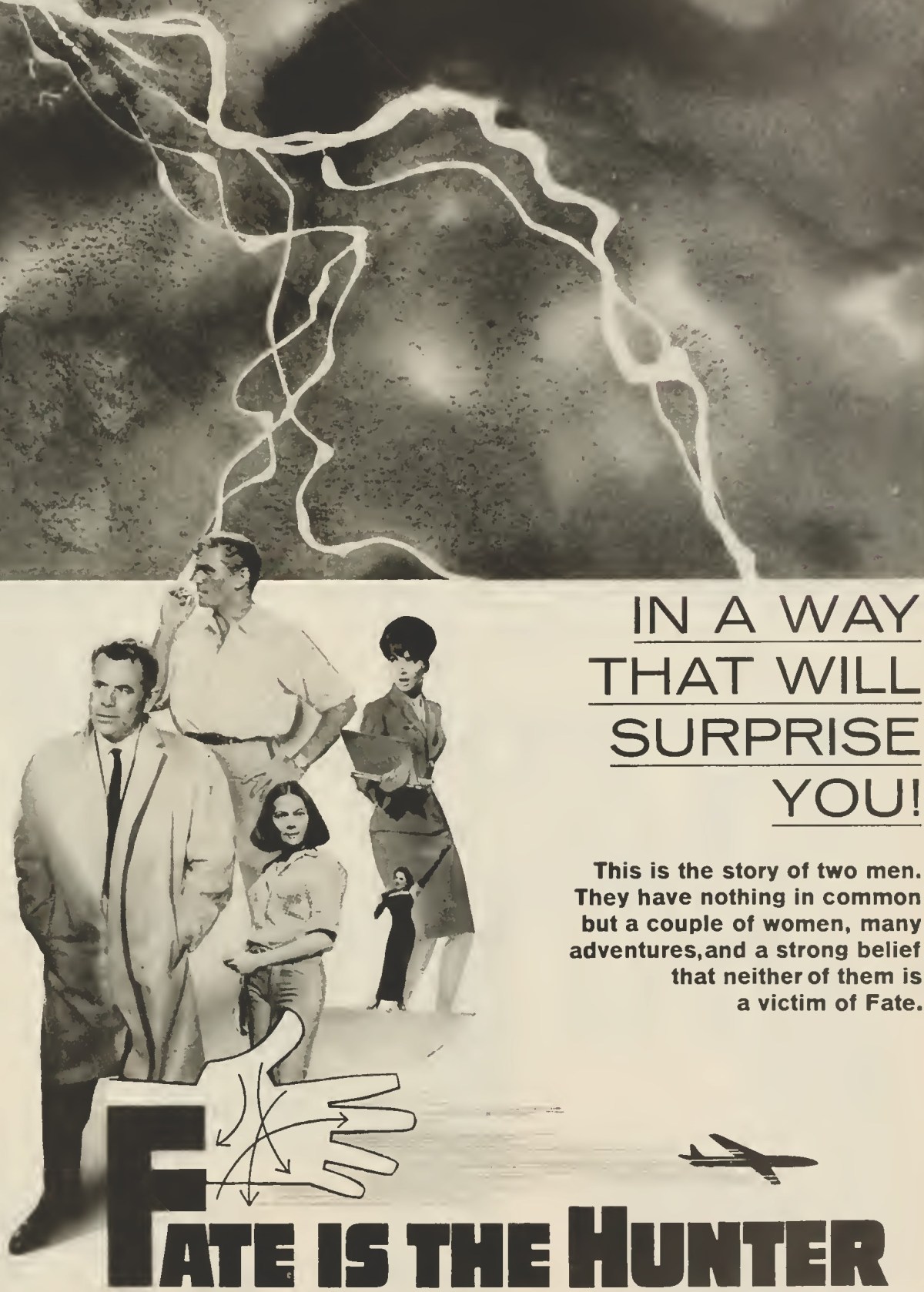
Not far behind was Glenn Ford, a star from the days of Gilda (1946), The Blackboard Jungle (1955) and The Sheepman (1958). He had begun the current decade badly with big-budget losers Cimarron (1960) and The Four Horsemen of the Apocalypse (1962) and his career never recovered. His last eight pictures brought in an average of less than $1 million apiece in rentals. The sad bunch were: comedy western Advance to the Rear, Dear Heart and aerial drama Fate Is the Hunter (all 1964) followed by western The Rounders and thriller The Money Trap (both 1965) as well big budget war epic Is Paris Burning? (1966), rabies drama Rage (1966) and western The Long Ride Home (1967).
Scarcely any better was William Holden, star of David Lean Oscar-winner Bridge on the River Kwai (1957), John Ford western The Horse Soldiers (1959) and The World of Suzie Wong (1960). His last four efforts – The Lion (1962), romantic comedy Paris When It Sizzles (1964), war drama The 7th Dawn (1964) and Civil War western Alvarez Kelly (1966) – returned an average of $1.05 million in rentals. Variety reckoned he was struggling with the problem of how to “gracefully mature his screen image.”
James Garner, once seen as the natural successor to Clark Gable, had failed to capitalize on the success of John Sturges’ The Great Escape (1963). Five of his last seven films had dredged up a mere $1.3 million average. Making up the awful quintet were thriller 36 Hours (1964), comedy thriller A Man Could Get Killed (1966), western pair Duel at Diablo (1966) and Hour of the Gun (1967) plus drama Mister Buddwing (1966). Quite why comedy The Art of Love (1965) had done better – $3.5 million in rentals – nobody could ascertain and even though roadshow Grand Prix (1966) was a hit Garner, who was billed below the title, was not considered a reason for it, with some insiders claiming his name had held it back and it would have done much better with someone else in his role.
Morituri (1965), Cast a Giant Shadow (1966), The Poppy Is Also a Flower (1966), western sequel Return of the Seven (1966), Triple Cross (1966) and The Long Duel (1967) had mustered an average of $1.4 million leaving observers to the conclusion that Yul Brynner’s “brand of sex appeal” no longer attracted audiences in America.
Marlon Brando had generated just $8.4 million in total rentals – an average of $1.6 million – for his previous six films. No matter what he did, regardless of genre, he had lost his box office spark whether it was comedies like Bedtime Story (1964) and The Countess from Hong Kong (1966), dramas like The Chase (1966) and Reflections in a Golden Eye (1967), western The Appaloosa (1966) or thriller Morituri (1965). From the industry perspective he was by far the worst performer since his movies cost so much in directors (Charlie Chaplin, John Huston), co-stars (Elizabeth Taylor. Sophia Loren) and sets.
A string of comedies had sounded the box office death knell for Tony Curtis. Boeing, Boeing (1964), Not with My Wife You Don’t (1966), Arrivederci, Baby! (1966) and Don’t Make Waves (1967) delivered a lamentable $1.77 million on average.
Rock Hudson had fallen far from the pedestal of being the country’s top male star in the early 1960s. Two romantic comedies Strange Bedfellows (1965) and A Very Special Favor (1965), a brace of thrillers Blindfold (1966) and Seconds (1965) plus war film Tobruk (1967) did nothing to restore his standing with just $1.86 million in average rental.
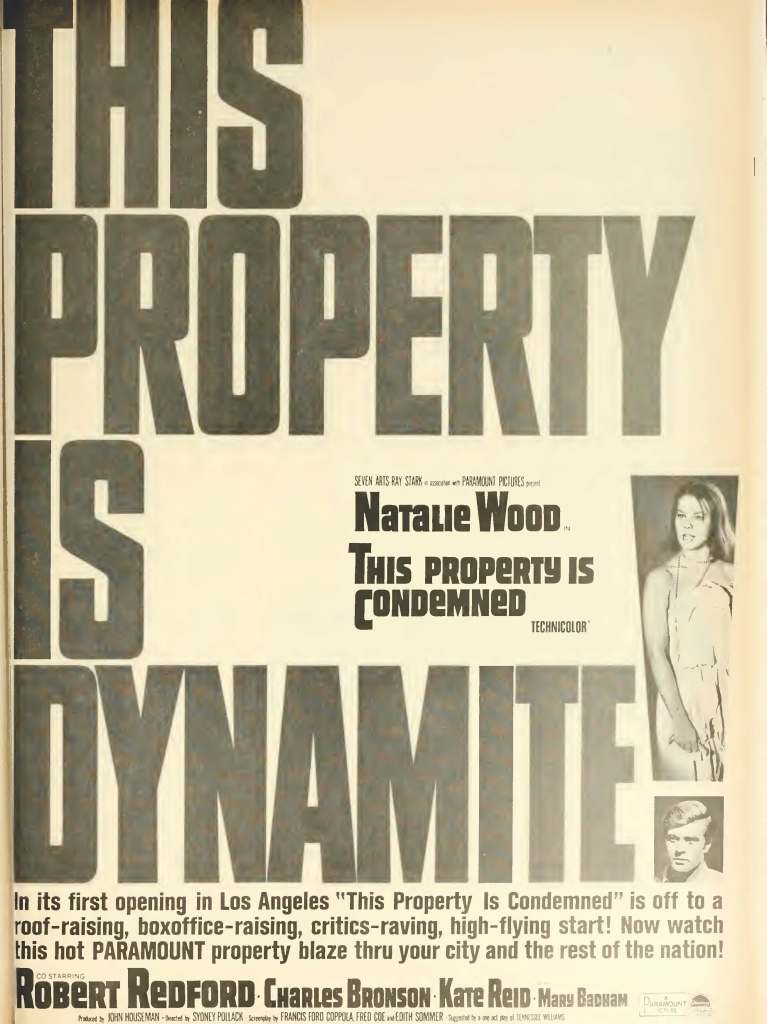
Added to the list of dubious stars was Natalie Wood whose career was considered to be in such jeopardy that she had not made picture in two years. Small wonder after dramas Inside Daisy Clover (1965) and This Property Is Condemned (1966) and crime caper Penelope (1966) which averaged $2.2 million.
Whether anybody’s career could be resuscitated after these disasters was anybody’s guess.
Strangely enough, some did regain at least a measure of their former glory, Marlon Brando the obvious example after The Godfather (1972). James Garner had his biggest-ever hit with Support Your Local Sheriff (1969). Tony Curtis revived his fanbase with The Boston Strangler (1968). William Holden returned to favor after the double whammy of The Devil’s Brigade (1968) and The Wild Bunch (1969). Natalie Wood hit the spot in Bob and Carol and Ted and Alice (1969) and Yul Brynner as a robotic gunslinger turned his career around in Westworld (1973).
But Glenn Ford’s career was coming to an end and Anthony Quinn followed up this bunch of flops with two more of the same ilk in the Shoes of the Fisherman (1968) and The Magus (1968) although he would still be offered starring roles for more than a decade.
Of course, luckily, decades on, we are not so much guided by the box office various films had and many pictures that were once dubbed flops are now being re-evaluated by a new generation of film fans.
SOURCE: Lee Beaupre, “Rising Skepticism on Stars,” Variety, May 15, 1968, p1








 The Magnificent 60s