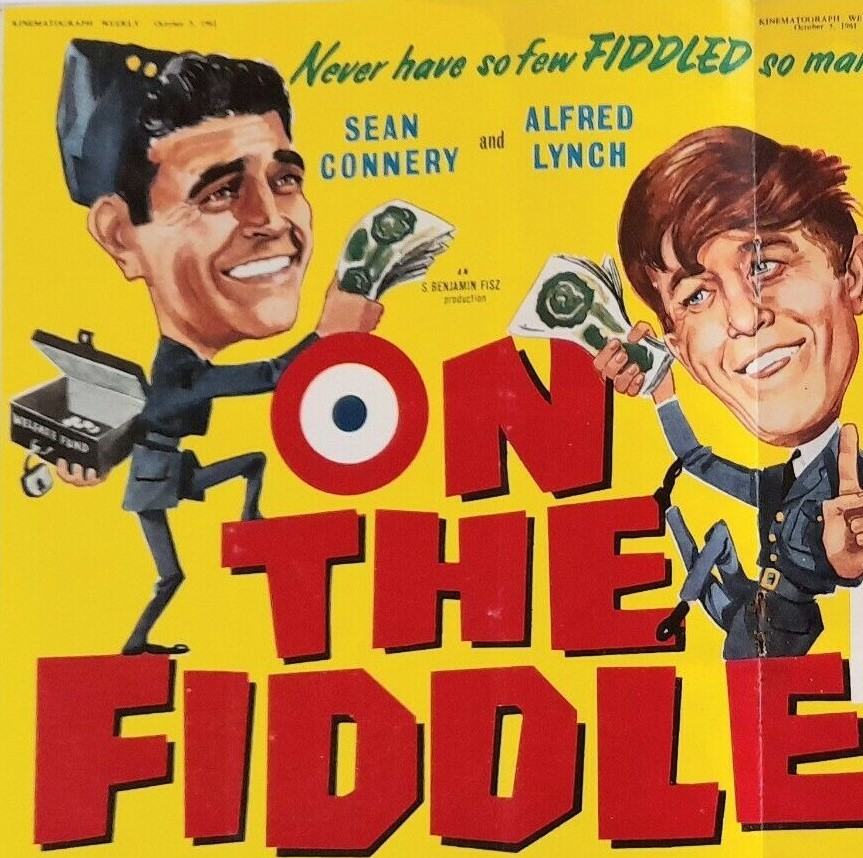
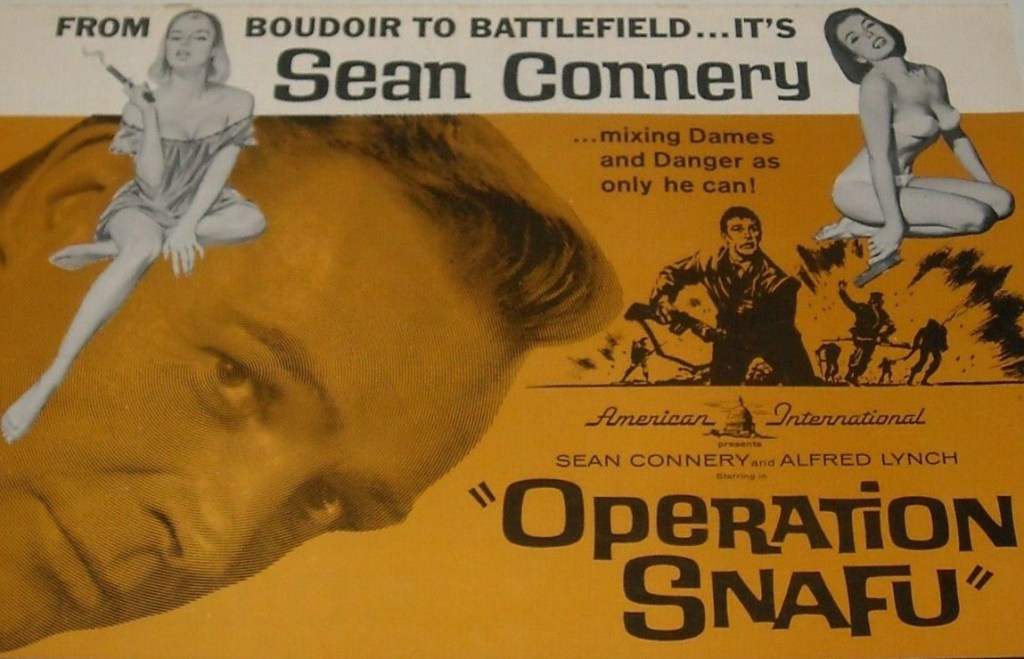
Unassuming but undeniably charming British World War Two comedy denied U.S. release until four years later when a savvy distributor jumped on the James Bond bandwagon. Primarily of interest these days for the opportunity to see a pre-Bond Sean Connery (Dr No, 1962) in action its merit chiefly lies in ploughing the same furrow, though with a great deal less pomposity and self-consciousness, as the later The Americanization of Emily (1964), of the coward backing into heroism.
Horace Pope (Alfred Lynch) is a scam merchant who only dodges prison by enlisting. Assigned to the RAF he teams up with Pedlar Pascoe (Sean Connery) and they embark on a series of schemes designed to keep them as far away from the front line as possible. It’s hardly an equal partnership, Pope dreams up the fiddles while Pascoe just falls in with them. It’s not dumb and dumber but a collaboration that goes no further back in the annals of movies than brain and brawn.
Needless to say, the movie lacks the the damsels in bikinis which were a prerequisite of the Bond pictures. Sean Connery takes top billing Stateside where he was originally behind Lynch.
It’s certainly a cynical number, reflecting the boredom experienced by many of the Armed Forces backroom staff, the administrators whose inefficiency turns them into easy dupes, and the determination of soldiers to take advantage of every opportunity to bend the rules. It takes the unusual position of presenting the ordinary soldier as smart and every officer as a numbskull, an approach that would only have been possible 15 years after the war ended and in marked contrast to the determined heroism of other British war films – such intrepid stiff-upper-lip behavior a hallmark of the British version of the genre.
First stop is to run an operation issuing leave passes – for a price – and the sheer effrontery exhibited by Pope is a joy to behold. Next up is selling stolen meat on the black market.
While Pedlar is the wide-eyed camp follower, and more likely to forever sit on the sidelines, cheerful but shy, and only a few pratfalls away from being a bumbling idiot, they do make a good team. Being sent to France is more of a heaven-sent opportunity to increase their bankrolls than a hazardous wartime mission as Pope sells rations to the French. Eventually, of course, their various scams are rumbled and they are forced into battle.
The only thing better than one pre-Bond Connery picture is two.
The movie switches a bit more deftly into serious mode than the aforementioned The Americanization of Emily mostly because these are actual soldiers trained to be soldiers rather than an officer who landed a cushy number and whose main effort is to avoid combat. War is presented as horrific rather than comedy and it must have been the same experience for an ordinary soldier at the time, after months of inactivity suddenly thrust into the cauldron.
The picture moves at a brisk pace and is continually amusing if not particularly laugh-out-loud. You’ve probably seen most of the set-ups before but they are reinvented with an appealing freshness and briskness As a bonus there’s reams of British character actors and comedians – plus token American Alan King (who would appear in Connery starrer The Anderson Tapes, 1971) – along the way. The term “snafu” in case you’re interested, has a similar meaning to the “fubar” of Saving Private Ryan (1998).
Alfred Lynch (The Hill, 1965) doesn’t milk the Cockney patter overmuch and he’s got a greater international screen appeal than the likes of the more English Sid James (Carry On films) or Norman Wisdom. Think a shiftier Sgt Bilko, if the Phil Silvers creation could be any more untrustworthy.
Connery’s performance is well worth a watch as a prelude to what was to come once his roles were tailor-made. He is an effortless scene-stealer, gifted in expressing emotion through his eyes, and although verbally Lynch dominates it’s difficult to take your eyes off Connery.
The roll-call of character actors includes Cecil Parker (A Study in Terror, 1965), Stanley Holloway (My Fair Lady, 1964), John Le Mesurier (The Moon-Spinners, 1964), Graham Stark (The Wrong Box, 1966) and Victor Maddern (The Lost Continent, 1968).
Cyril Frankel (The Trygon Factor, 1966) comfortably cobbles this together from a screenplay by Harold Buchman (The Lawyer, 1970, and who had ironically enough penned the picture Snafu in 1945) based on the novel Stop at a Winner by R.F. Delderfield.
When the box office supremacy of the Bond pictures was underscored by the reissue of the Dr No/From Russia with Love double bill in 1965, distributors, as had been their wont, racked the vaults for anything featuring Connery that could be re-sold to a willing public.
While there is a readily available DVD, this turns up on a regular basis, in Britain at least, on television.
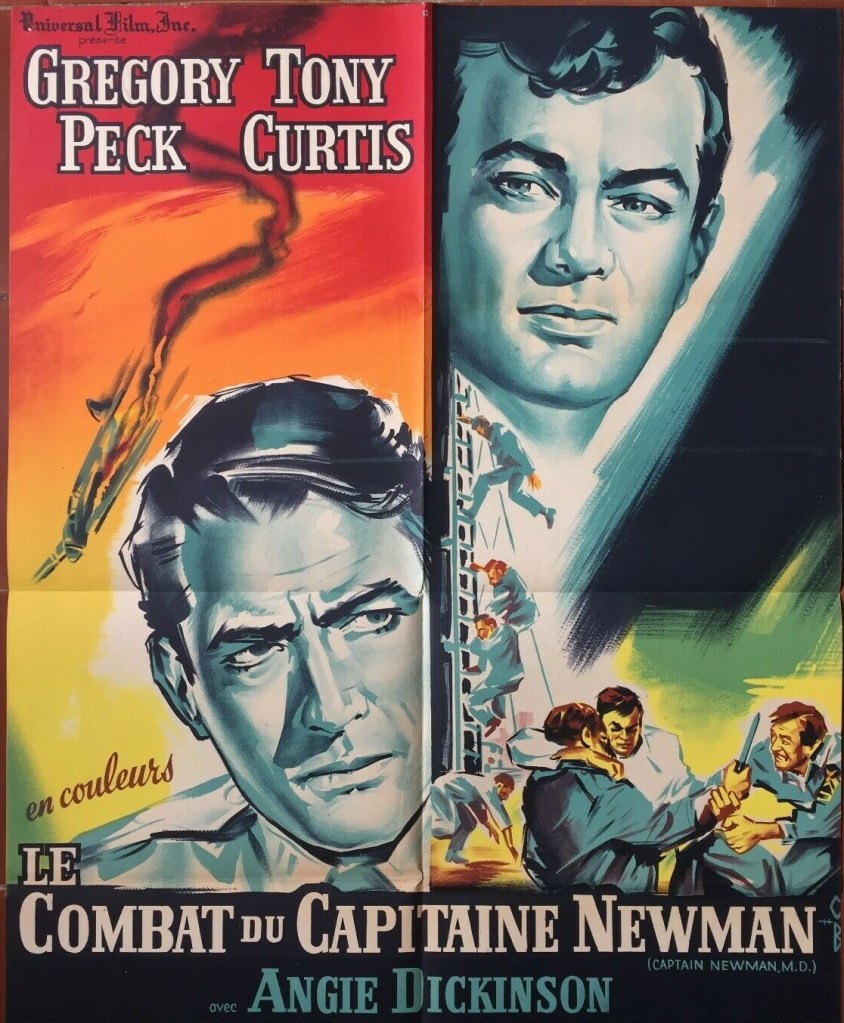
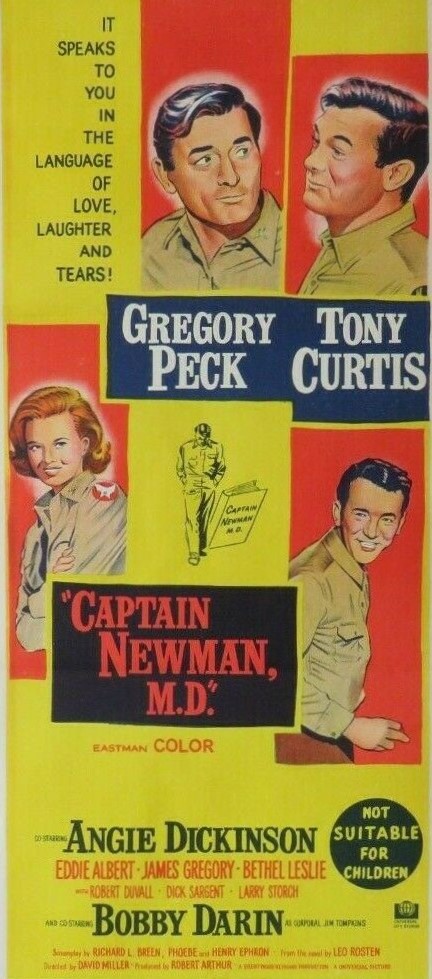
Somewhat lost in the rush to acclaim star Gregory Peck for his Oscar-winning To Kill a Mockingbird (1962), this bold attempt to tackle mental illness among the armed forces deserves reassessment.
Set towards the end of World War Two, psychiatrist Captain Newman (Gregory Peck) heads up a unit addressing the previously ignored mental health issues of U.S. airmen. One of the first to identify post- traumatic stress disorder, Newman employs a whole raft of unusual techniques such as allowing his clients to tend sheep. And he’s not above using romantic sleight-of-hand to woo Lt. Corum (Angie Dickinson), a nurse in a non-psychiatric department, to join his team. Orderly Corporal Leibowitz (Tony Curtis), more of a con artist than a medical professional, is the other key member of the team.
As you might expect, Newman has to battle superiors to allow him to even attempt to cure any of the men under his care since in standard armed forces opinion they are really just cowards trying to duck out of their duty. Given there’s no prescribed treatment for his clientele, Newman basically improvises on a case-by-case basis to get to the heart of what caused mental collapse.
While the movie motors along nicely on the interplay between these three characters – the potential for real romance between Newman and Corum and Newman’s acceptance of Leibowitz’s alternative, more down-to-earth and decidedly un-medical approach – it focuses on three critical cases. Col Bliss (Eddie Albert) suffers from split personality, Capt Winston (Robert Duvall) is catatonic and Corporal Tompkins (Bobby Darin) too bubbly by far.
In dealing with each, Newman adopts a different persona, occasionally entering into the make-believe world of his clients to expose how much of a fiction they are. Stern with some, he is gentle with others and when he appears to go over the score explains he is not shouting at a person but at his symptoms.
And while at time it feels like a mental equivalent of episodes of a hospital soap, the underlying drive, the knowledge that men are hiding from the horrors of war or endure guilt over action they may have taken or are unable to face the consequence of orders they carried out takes this into a different level. Almost all suffer from the standard conviction that they must be cowards. Newman’s task is to make all face up to their fears.
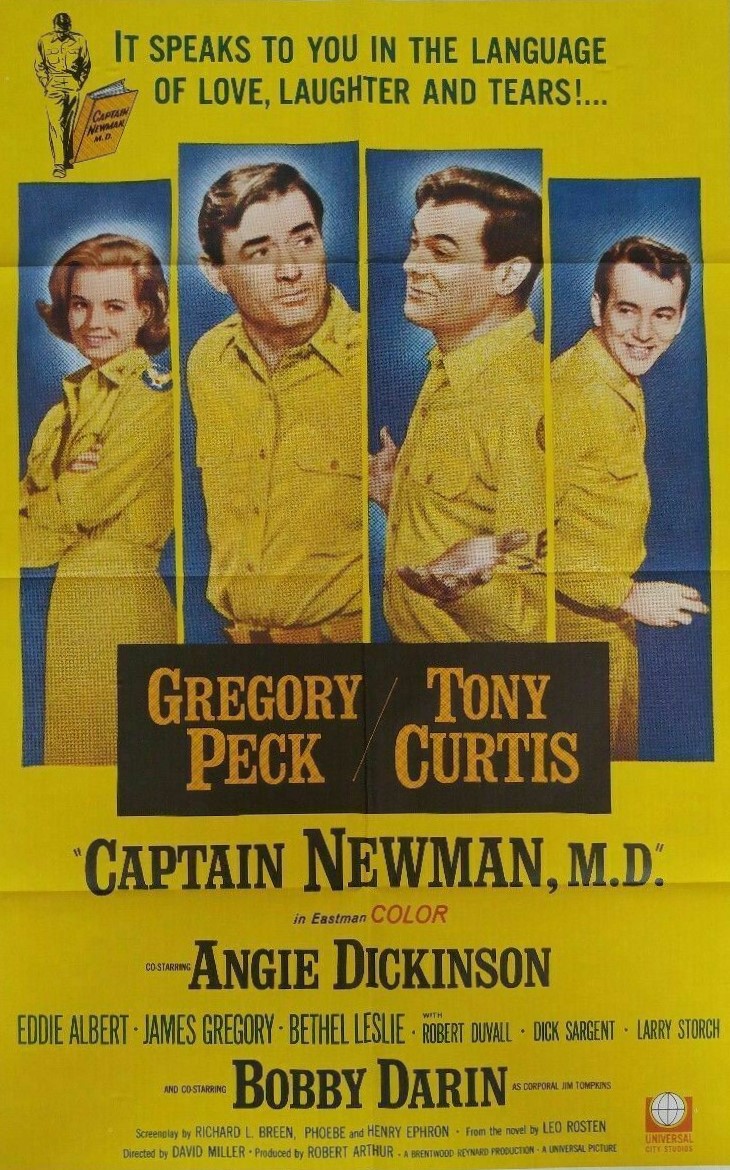
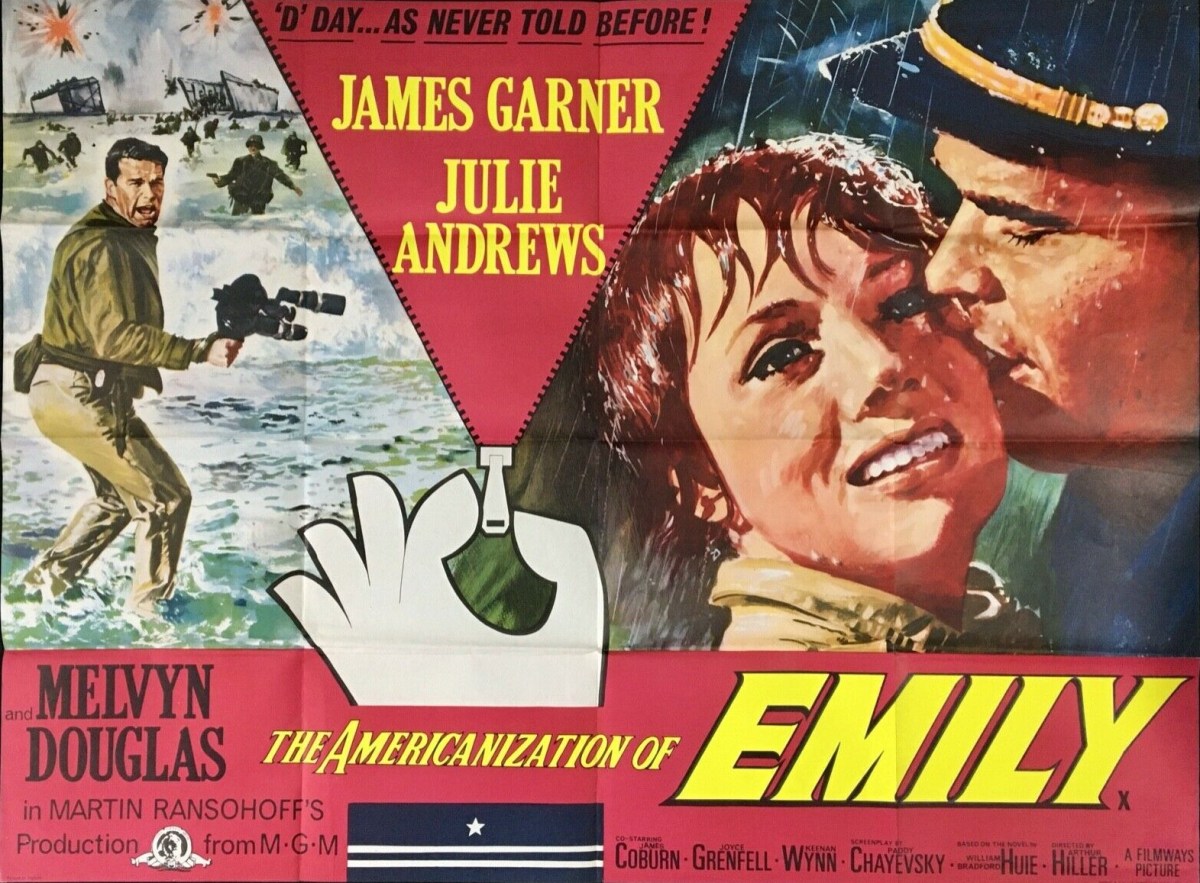
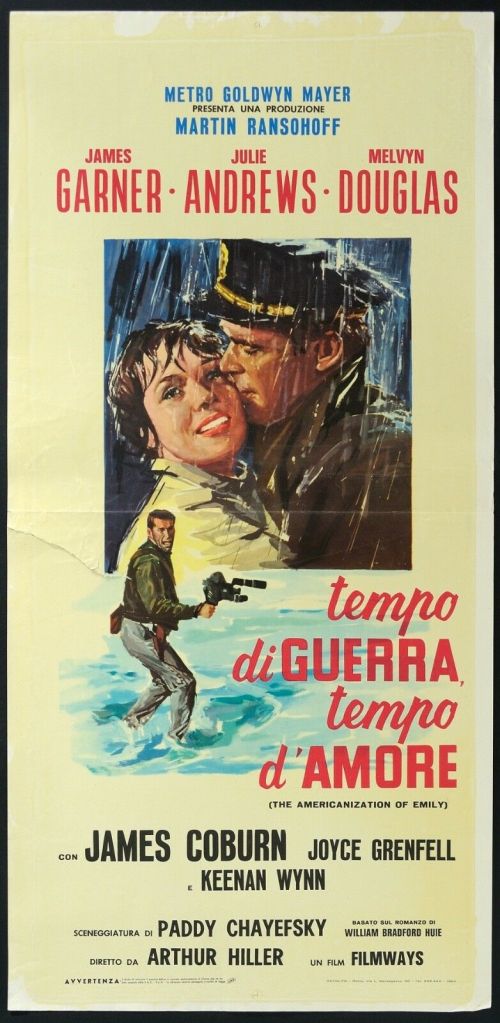
Presumably to overcome fears of audience resistance to the downbeat subject matter, the U.S. poster plain misled the public – “love, laughter and tears” were not much in evidence.
And it’s Corum’s self-appointed job to get under Newman’s skin and in so doing get to the heart of the terrible irony of his role. If he fails and men are discharged without being cured they will be returned to their units while mentally unstable and make decisions that could endanger thousands of men. If he succeeds, he sends men back to face potential death.
Luckily, it’s far from dour. Instead of taking the audience down a medical jargon rabbit-hole, the movie sensibly concentrates of character and humanity. It is filled with brilliant dialogue and whenever Newman appears overwhelmed up pops Leibowitz like the self-appointed class clown to bring events to a cheerier conclusion. Up till the end – a Xmas show by inmates and the arrival of a bunch of Italian POWs – the movie steers well clear of sentimentality and delivers a lucid exploration of the effects of war on the human psyche.
Gregory Peck (Mirage, 1965) is outstanding, not just from the way he adapts his character to suit the situation, but because quite a lot of his role is just to react to what is being said. Most stars would run a mile from being on the receiving end of chunks of dialog and insist on altering the script to make them appear more dynamic. Unlike Atticus Finch who is convinced he can find a solution, Newman knows his detection skills are very basic.
Tony Curtis (The Boston Strangler, 1968) might appear as if inhabiting a custom-made role suited to his natural effervescence and charm, but this is a deeper character than initially seems the case and rather than ride along and enjoy himself he has spells of challenging Newman’s authority. It’s a more subdued role for Angie Dickinson (Jessica, 1962), too, but she also brings a level of seriousness to the part and is integral to the picture’s success.
Bobby Darin (Pressure Point, 1962) was Oscar-nominated but I found his acting over-the-top. Eddie Albert (Green Acres television series 1965-1971) and Robert Duvall (To Kill a Mockingbird), in particular, were more assured. Look out for James Gregory (The Secret War of Harry Frigg, 1968) and former child star Jane Withers.
David Miller (Hammerhead, 1968) strikes the correct tone, leavening the seriousness with humor, but not avoiding the deeper issues. In their final screenplay assignment Henry and Phoebe Ephron (Carousel, 1956), parents of Nora Ephron (When Harry Met Sally, 1989), teamed with Richard L. Breen (A Man Could Get Killed, 1966) for an intelligent screenplay based on the bestseller by Leo Rosten.
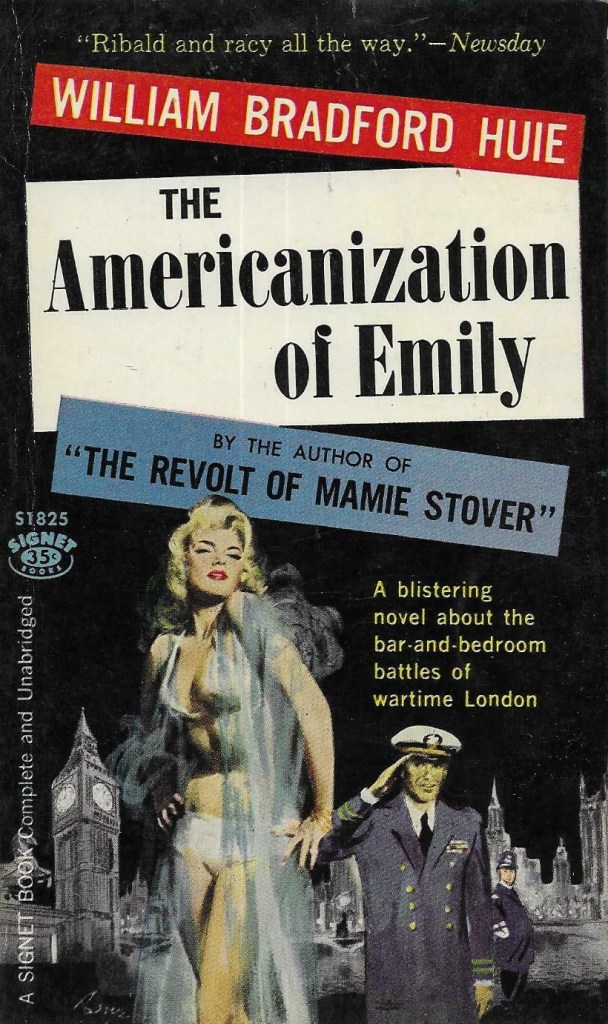
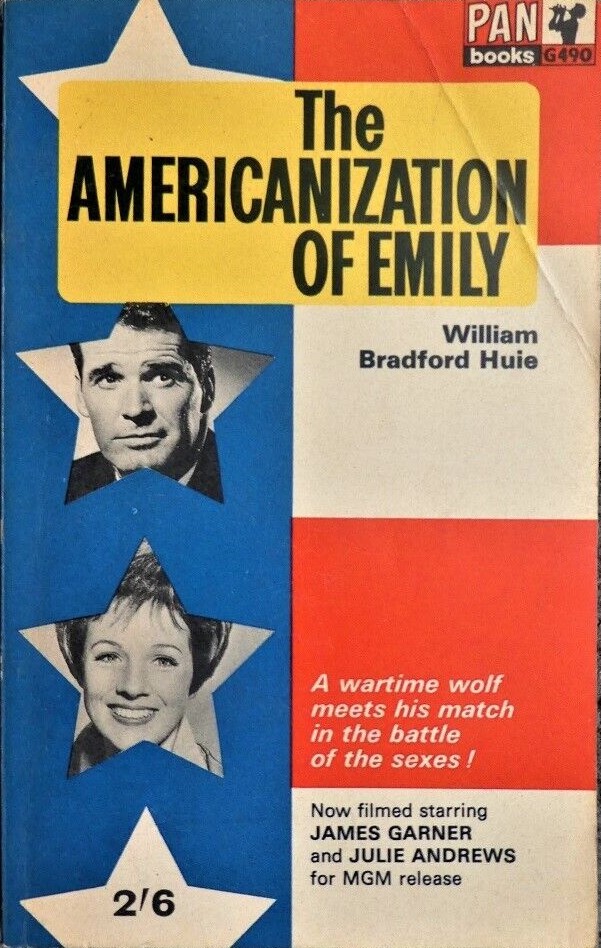
Author William Bradford Huie’s cry of outrage could be heard from one side of Hollywood to the other.
Not that anyone would commiserate. A bestselling writer dealt with the movie industry at his or her peril. If you succumbed to the lure of Hollywood gold you might as well kiss goodbye to any expectation they were actually going to film the book you had written.
In this case, screenwriter Paddy Chayefsky stuck to the plainest of knitting, the romance between oversexed Yank Lt Col Edison (James Garner) and English rose Emily (Julie Andrews). He kept in the “dog-robbing,”* Edison stashing away crates of steaks, whisky, nylons, chocolates, whatever will keep the admiral happy and at the same time smooth the path for whatever officer or politician he was trying to schmooze.
But Huie’s tale went down a different route that Chayefsky chose to ignore. Yes, D-Day played a part, forming the climax, and the author did intend to score a political point. In Huie’s version, Edison’s role in D-Day was merely to film some of the proceedings. Keen to highlight the risk to the common soldier, the hero was prone to film the sordid aspect of war, focusing as much on death and injury as heroism. He even opened with a prologue, a dedication to the three men who died in the making of the film.
But his film never saw the light of day. Or at least not his director’s cut. He was forced to eliminate all scenes of dead Americans. Dead Germans were okay, just not dead Americans. Especially irksome was a sequence showing bulldozers covering American corpses with sand. He only won one battle with his superiors, refusing to stick in the cliché of a chaplain praying over sailors before they embarked on the D-Day vessels, but only because there was no chaplain present and he refused to shoot such a scene.
Of course, since he didn’t die in Huie’s book, there was no reason to come back from the dead. In fact, post D-Day, he and Emily spend a good chunk of time together before he is despatched elsewhere on another task with the admiral and there is a happy ending, fourteen months later, a reunion as Emily turns up where he is now stationed.
So where did all the cowardice malarkey come from? The mind of Paddy Chayefsky is the simple answer. In the book, the hero, as much as the next man, does not want to die in the war, but his fears are the normal ones, he doesn’t go out of his way to avoid action, profess his cowardice and stand up for the rights of cowards everywhere. So the book isn’t larded with long speeches about the horrors of war.
What attracted a producer like Ransohoff to the picture was the film the hero wanted to make. Not one that glorified war. A film that refused to see heroism as a great and noble thing was, of course, the same as sticking up two fingers to all those who could only justify war if it provided the opportunity for heroism as a sop to the wives and children the dead left behind. It was a strong point to make. And, prior to filming, there was plenty Edison had to say on the subject. While the admiral saw the landing as a great success because the casualties were much lower than expected, Edison felt for every man killed.
There’s no need in the book for the admiral to be a loony because it would be quite plausible to film for documentary or PR purposes action on World War Two beaches – what were John Ford and other famous directors doing if not that? Lt Cummings (James Coburn) who comes up with the dastardly idea of killing off Edison does not come up with such a dastardly idea in the book. In fact, in the original novel he’s a relatively minor character. And the much-vaunted nudity, revolving in the main around Cummings, is not particularly obvious in the novel, though Huie is perfectly blunt about the role of the bulk of the women. The novel opens with the classic line: “Twelve Englishwomen, known as Sloane’s Sluts, served America during the Second World War.”
However, the said Sloane is eliminated from the film, in order to provide the immoral Edison with something of a moral tinge. In the movie, with so many women easily available, he doesn’t indulge beyond a bit of bottom slapping. But in the book, he has sex with said Sloane while romancing Emily and again at the end while separated from her.
The Chayefsky version is peppered with dialogue about war that is primarily, even though Edison’s life is at stake, in the aesthetic vein. Huie, on the other hand, provides a salutary commentary on the war, filling the reader in on aspects rarely covered, the kind of unfamiliar material that would later be the bedrock of the airport bestseller like, well, Arthur Hailey’s Airport.
* “A dog-robber is a personal attendant of a general or an admiral. To ensure his superior has the best food and lodging, a dog-robber is willing to rob not only troops, widows and orphans but even the goddam dog.” So runs Huie’s description, a little note at the bottom of a page just in case the reader did not quite work out to what depths this ultra-scrounger would go to satisfy his boss.
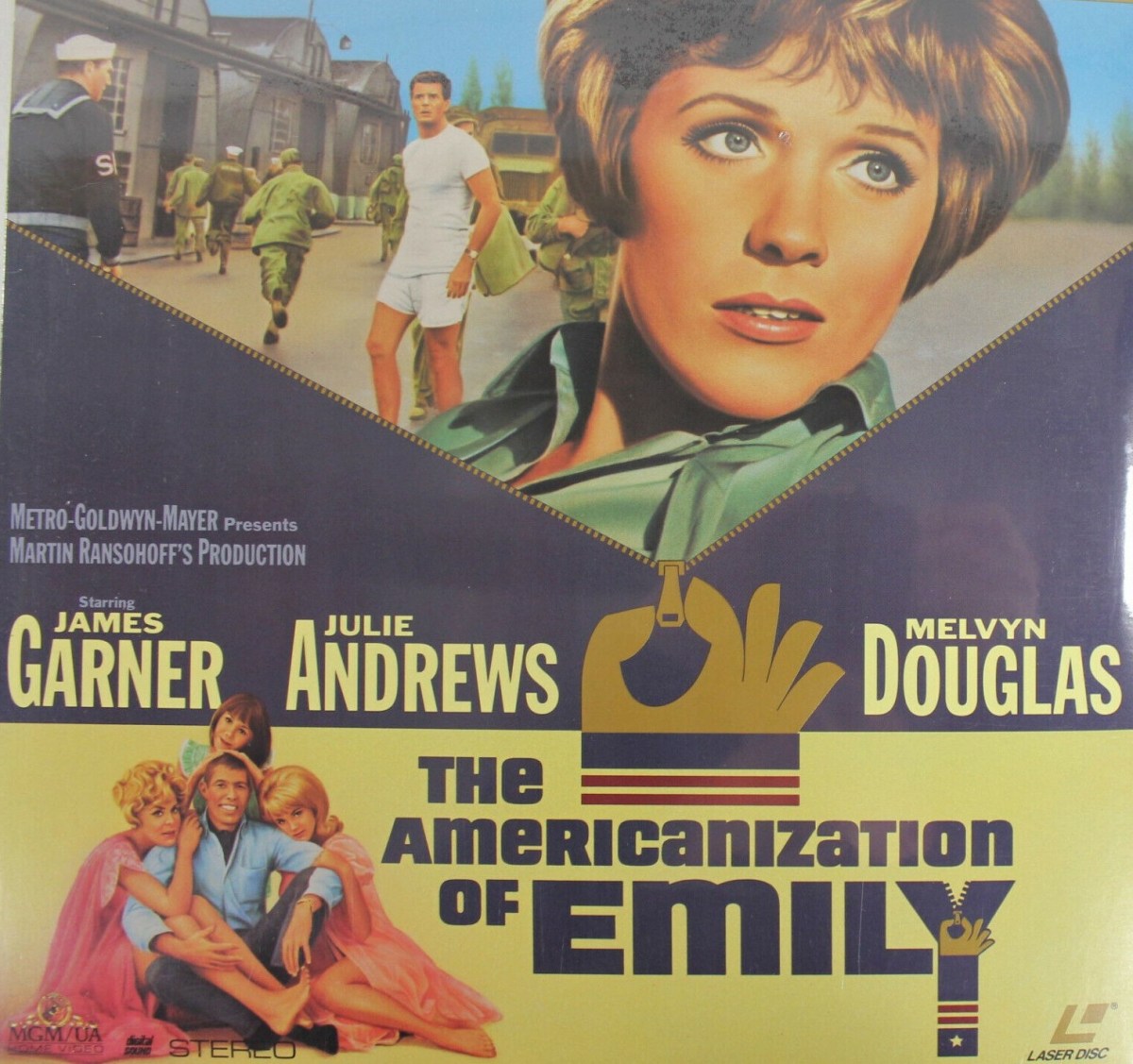
Julie Andrews could not have made a more controversial choice in her bid to prove she was more than a Hollywood goody two-shoes as introduced in her debut Mary Poppins (1964). In the months leading up to release, The Americanization of Emily movie made all the wrong sort of headlines, aligning the innocent Andrews with the unsavory matter of producer Martin Ransohoff (The Cincinnati Kid, 1965) challenging the all-powerful Production Code, the self-censorship system in operation in the United States until the late 1960s.
Ransohoff demanded the right to include four scenes of substantial nudity in the film, at a time when any flashes of skin in mainstream pictures were taboo. He argued that the scenes were “necessary for the farcical overtones of the picture.” But more to the point, he was annoyed that foreign filmmakers, who did not have to abide by the stringent rulings of the Code, could show nudity, sometimes even condoned by censor Geoffrey Shurlock who accepted their artistic validity. Ransohoff railed: “We are losing our market because we allow pictures that are full of nudity done in an artistic manner to play our top houses but we can’t get into them because the Code robs us of our artistic creativity.”
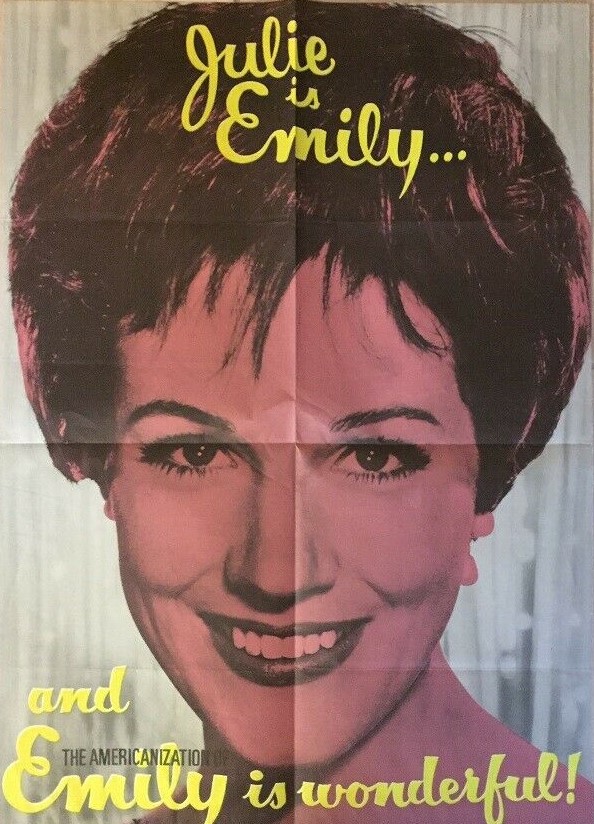
I’m not sure exactly when MGM dropped the “Americanization” element from the title and made Julie Andrews the star by promoting her image more than that of top-billed James Garner.
Faced with a lawsuit from studio MGM for delivering a movie not fit for the Code, Ransohoff conceded he had gone “overboard” with the nudity and that Judy Carne – who later sprang to fame in Rowan and Martin’s Laugh In (1969-1973) – in particular, was “over exposed.” Other actresses named as revealing too much were Janine Gray (The Pumpkin Eater, 1964) and Kathy Kersh in her movie debut. The women were identified in the movie credits as, disgracefully, “Nameless Broad.”
At the outset, such agitation would not have preyed so much on Andrews’ mind as a possibly limitation in her future career, Mary Poppins not due to be unveiled until the summer and few members of the public aware of what a game-changer that would prove for studio and star alike. But once Mary Poppins hit the box office heights, there was every chance the star would quickly lose the adoration of the public if seen to play the female lead in a steamy picture. Ransohoff complicated matters by failing to come out and say whether Andrews was involved in the nude scenes, no matter they were considerably toned down by the time the movie hit cinemas in October 1964. (Had he delayed the picture’s release six months, his approach might have been deemed more acceptable, as, by that time, a flash of breasts had been passed by Shurlock for The Pawnbroker.)
It had been a troubled picture from the start. As early as 1962, Oscar-winner William Holden (The World of Suzie Wong, 1960) had been signed up to star and the movie was due to go before the cameras in London in July 1963 and, following a slight delay, re-scheduled for the next month under the direction of Oscar-winner William Wyler (Ben-Hur, 1959). Production was not quite settled because Andrews was only hired in September 1963. But when Wyler pulled out a month later he was quickly followed by Holden. Andrews was such an unknown quantity that when she signed up, the news did not even receive a headline in Variety, just a few lines at the bottom of a page.
And there were screenplay issues. Norman Rosten had begun work on the adaptation of the William Bradford Huie bestseller in April 1962 only for, 10 months later, the author to be drafted in. But scripting problems would continue until after shooting was complete (see below) with the filmmakers unable to make up their mind about the tone of the picture.
Despite Rosten being assigned, a story later emerged that the book had struggled to reach Hollywood. Huie contended that it had, after all, not been sold to Ransohoff in 1962 and that the sale only occurred later after the author had written the screenplay on spec and sold it to the producer. He tied this up with another contention, little borne out by fact, that producers had turned against buying blockbuster novels in favour of original screenplays.
At that point Ransohoff was on a roll as one of the biggest independent producers in Hollywood, on his slate The Sandpiper, which would appear in 1965, Topkapi (1964), The Loved One (1965), The Wheeler Dealers (1963) and The Americanization of Emily, a fantastic batting average for a neophyte producer. Emily would be his third production, The Sandpiper, with two of the biggest stars in the world, Elizabeth Taylor and Richard Burton, his fourth.
James Garner, who had blown his entire fee of $100,000 from three years’ work on television series Maverick on getting out of his contract with Warner Brothers, had been given a helping hand by Ransohoff, winning second billing behind Kim Novak in Boys Night Out (1962) and Lee Remick in The Wheeler Dealers. Ransohoff gambled Garner was ready to make the jump up to top billing in The Americanization of Emily.
In fact, it would take several years before Garner was considered a proper star, thanks to Support Your Local Sheriff (1969), with the kind of marquee appeal that produced box office commensurate with his fees. In fact, James Coburn was considered a better prospect with a seven-picture deal with Twentieth Century Fox – for whom he would make his breakthrough movie Our Man Flint (1966) – a five-film deal with Ransohoff and Major Dundee (1965) on the starting grid with Columbia.
The three-minute sequence of the D-Day beach landing cost $250,000. It was shot in California, sixty miles north of Hollywood, on a public beach though anyone happening upon the site would possibly be put off by signs proclaiming “Explosives next ½ mile.” The shoot involved 5,000lb of explosives, mostly dynamite and black powder, planted in iron tubs buried in the sand and connected by wires to a central control board. The complicated set-up involved four cameras rolling simultaneously with a 250ft high crane lifting a camera platform into the sky for aerial shots. Another platform was sited in the surf. Special effects expert Paul Byrd was on hand to point out to participants where explosions would occur. Eighty smoke pots were lit, each in an assigned position. Rehearsals soaked James Garner and while he waited for the scene to be set up again he lay down on the beach, still in n his wet clothes, but covered in a towel.
Preparing the segment had taken four months with bulldozers clearing the area. Ransohoff himself climbed into a camera platform to test the rig. Camera positions were selected to capture close-ups of the actors going ashore. To maximize daylight the lunch break was limited to 30 minutes.
Ransohoff, as much a maverick in marketing as in production, took out a double-page advertisement in Variety in July 1964 – nearly four months before the movie opened – to promote the response of the preview audiences. And although the comment cards returned easily promotable lines like “you have a blockbuster on your hand” and “one of those rare films that combine tragedy, comedy and drama properly,” Ransohoff was clearly intending to continue to court controversy by including quotes along the lines of “I’m broadminded but this time you’ve gone too far” and “a disturbing and terrible thing.”
But you couldn’t argue with Ransohoff seeking an alternative marketing strategy with such a recalcitrant publicist as Garner. The actor had a marked aversion to talking about his private life, which, of course, meant the focus would have to shift to his dubious star quality or the controversial scenes. Nothing infuriated journalists more, especially in those days when the media was not so tightly controlled, than to turn up for an interview with an actor who had nothing to say. “My private life is just that and I’ll keep it that way,” he averred.
Quite why the movie took so long to open is not really a mystery. Sneak previews might be followed by a little tweaking but the film would expect to be in cinemas within a month or so, the previews intended to build public awareness and word-of-mouth buzz rather than tell the director where he had gone wrong. But clearly Ransohoff held back in order to capitalize on the box office of Mary Poppins. Despite the wrangling with the Code being over and done with by March 1964 and the preview taking place three months later, the film did not open until October, going wide at Xmas, with the additional purpose of aiming for Oscar voters.
Even as Ransohoff was adding the finishing touches to the advertising campaign, there were doubts about what kind of picture the public would be shown. Four endings were considered, two filmed with Edison (James Garner) dead which turned the movie into a straightforward black comedy, but the other two retained the romantic ending.
The black comedy approach dictated that the unsuspecting Edison (James Garner) was lured to his death on Omaha Beach by the glory-hunting Cummings (James Coburn). With no return from the dead, this left Emily (Julie Andrews) in one version to carry the movie to a dutiful conclusion, commiserating with Admiral Jessup, who had been committed to a mental asylum, while a parade commemorating Edison’s sacrifice and led by the treacherous Cummings took place in the background. This was junked when the parade prove too expensive an addition.
All the other endings kept Edison alive, but in one, partly filmed, Cummings was banished to the North Pole, the producers going as far as to film Coburn with penguins.
The major adjustment in all versions was to present Jessup as off his head when he conceived the plan. That meant the Navy could not be blamed for outrageous publicity-seeking, with the finger instead pointed at a maverick officer, whose decisions could be tempered by his temporary instability.
SOURCES: “Holden’s Americanization,” Variety, May 23, 1962, p11; “Screenplay (Ready to Shoot) Cost-Conscious Producers Goal in Retreat from Pre-Sold,” Variety, January 30, `1963, p3; “Emily Screenplay to Be Done by William Bradford Huie,” Box Office, February 11, 1963, pW1; “Ransohoff’s Big Spurt of Features,” Variety, February 17, 1963, p3; “Ransohoff To Start Five Films in 6 Month Period,” Box Office, June 17, 1963, p27; “Julie Andrews,” Variety, September 11, 1963, p16; “Bill Holden Follows Wyler in Leaving Emily,” Box Office, October 7, 1963, pW2; “Garner Gets Emily Lead,” Box Office, October 14, 1963, p9; Michael Fessier Jr., “Can’t Be Americanized With Duds On,” Variety, November 20, 1963, p5; “Martin Ransohoff To Seek Production Code Seal,” Box Office, November 26, 1963, p6; “Emily and Her Attire Settled,” Variety, March 25, 1964, p5;“Nudies In Emily Are Cut to Get MPAA’s Seal,” Box Office, March 30, 1964, pW4; “Advertisement,” Variety, July , 1964, p14; “Admiral’s Glory Seeking Is Final Ending of Metro’s Emily,” Variety, November 4, 1964, p5; “Mad Film Promotion,” Variety, November 4, 1964, p15; “Promo Credo of Hollywood Actor,” Variety, November 4, 1964, p15; Action on the Beach (1964) MGM promotional featurette.
It’s an immoral job but someone’s got to do it. In wartime, generals need their perks – Winston Churchill with his cigars and champagne the best advocate. And those who supply the perks – Dog-Robbers in American parlance – expect their own perks in the form of a backroom job where they are never exposed to danger. Top U.S. Navy dog-robber in World War Two London on the eve of D-Day is Lt. Commander Edison (James Garner) who can spirit up whisky, steaks, nylon stockings and women, happy even to deliver shoulder massages for boss Admiral Jessop (Melvyn Douglas).
And like the recently-reviewed The Charge of the Light Brigade (1968) what’s mostly on the minds of top commanders is jostling for power, how to win the public relations battle on D-Day and prevent the politicians considering scrapping the service post-war. So Jessup comes up with a brilliant wheeze. What if the first man to die on Omaha Beach was a sailor? Allowing for the construction of a memorial to the “unknown sailor,” a feasible proposition given the Navy demolition unit is scheduled to land on French shores in advance of the invasion force. Edison is enlisted to film the anticipated death.
But Edison, whose brother died at Anzio, is a coward and does everything possible to avoid the job. He struggles to get English girlfriend Emily (Julie Andrews), whose father and brother died in the war, to share his perspective and is counting on buddy Lt. Commander Cummings (James Coburn) to get him out of it. But Cummings has his own ideas and Edison ends up the sacrificial lamb.
And it would be a brilliant black comedy except that, in the interests of a happy ending, Edison, despite being shot on the beach by Cummings, turns up alive.
In that case it becomes a fascinating exploration of the realities of war, the moral and immoral coming to grief in a moral vacuum that ensures that the higher up the food chain the less likelihood there is of dying and, ironically enough, the better opportunity to enjoy, while the masses are on strict rations, the good things of life. Emily would act as the movie’s conscience except that Edison is having none of war’s hypocrisy. He doesn’t want to die for his country and may be following to the letter General Patton’s dictat of making the “other poor bastard die for his country.” He doesn’t so much take a stand against the absurdities of war as stand up for the sanctity of life, in particular his own life, unwilling to fall for the “futile gesture of virtue.”
There’s plenty of what you should and shouldn’t do during wartime, arguments passionately argued for and against duty, though even the self-appointed conscience Emily stops short of turning her nose up at the finer things of life, no matter by what dodgy means they fall her way. that her life teeters on hypocrisy is scarcely explored.
And it does its utmost not to fall into the trap of the wartime romance genre, will-he-won’t-he survive the dangerous mission, precisely because you could never mistake Edison for a hero. And you need a hero not an ordinary joe for that particular genre to work. So what you’re left with is something else entirely, a man brave enough to be seen naked, exhibiting exactly the same lack of scruples in saving his own life as his commanders would employ to have him lose it. It’s kind of complicated that way.
Throw in another get-out clause on behalf of the Allied command, the notion that no high-up would embark on such a selfish vainglorious action, and that Jessup only does so because he is temporarily unhinged after the loss of his wife, when in fact history is littered with generals committing troops to wholesale slaughter for their own reasons.
Ediuon is such a charming character that if you wanted someone to plead the case on behalf of the cowardly you couldn’t make a better choice. The whole idea shouldn’t work at all because it’s only the bad guys, the shifty ones that turn up in every war movie, who carry the cowardice flag. The film is so cleverly structured, with examples of the impact of loss all around, that it’s virtually impossible to vote against Edison. And part of the cleverness is the casting. If such a good egg as Emily can fall in love with Edison it somehow makes him a less despicable character. He’s certainly not as shifty as Jessup who dreamed up the bizarre stunt in the first place or Cummings, intent on exploiting it.
James Garner (36 Hours, 1964) excelled at playing the morally dubious, the cowardly sheriff played for laughs in Support Your Local Sheriff (1969) his biggest box office hit, but this isn’t far short of his very best work, and an exceptionally bold role for a star. Julie Andrews was already trying to move away from her goody-two-shoes debut in Mary Poppins (1965) that would be further enhanced by The Sound of Music (1965) and while her characterisation is not, on the surface, that far away from either role, the depth she displays here, the sorrow and the soulfulness, give this a edgier riff.
Good support from James Coburn (Dead Heat on a Merry-Go-Round, 1966), Melvyn Douglas (Hotel, 1967), Keenan Wynn (Man in the Middle/The Winston Affair, 1964) and Joyce Grenfell (The Yellow Rolls Royce, 1964).
Director Arthur Hiller (Tobruk, 1967) most of the time walks a very fine line but manages to create a very thoughtful movie that humanized what other anti-war pictures failed to make personal. Oscar-winner Paddy Chayefsky (Marty, 1955) based the screenplay on the bestseller by William Bradford Huie (Wild River, 1960).
Another in the mini-genre concerning power politics in the Armed Forces. Would make a good triple bill if teamed with The Charge of the Light Brigade and Man in the Middle.
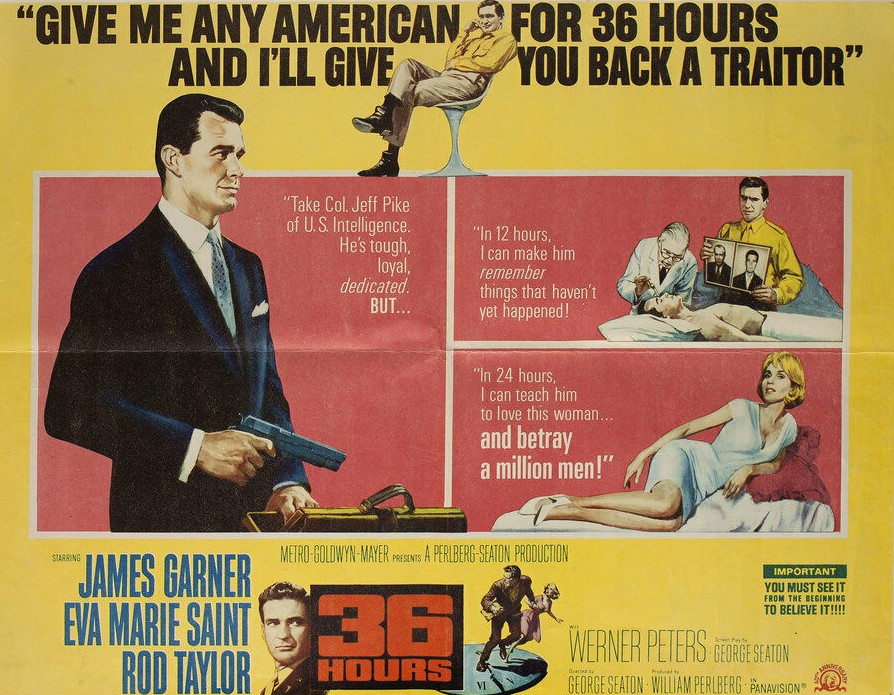
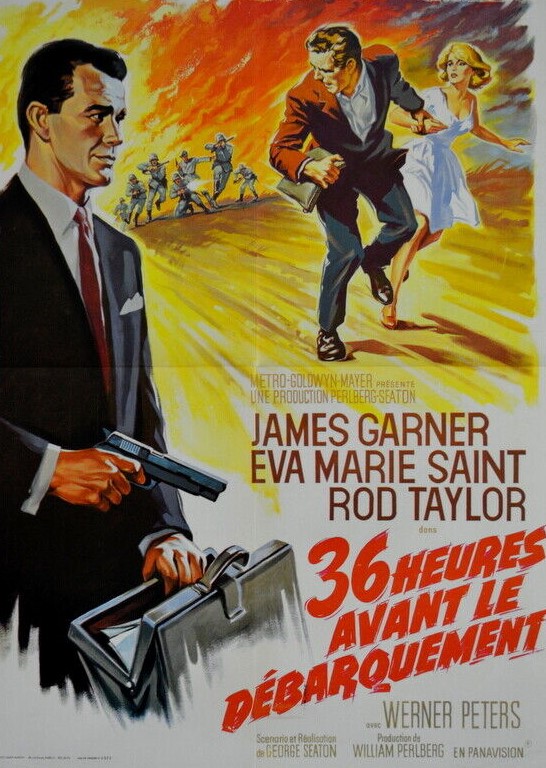
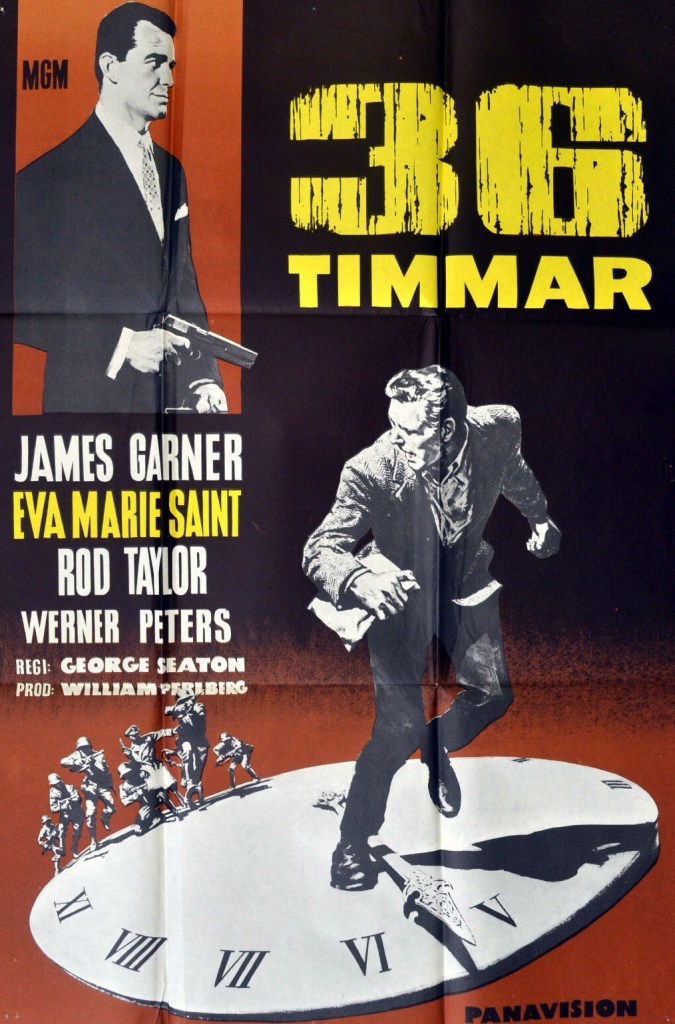
High concept thrillers that derails two-thirds of the way through. While it’s a battle of wits between German psychiatrist Major Gerber (Rod Taylor) and kidnapped spy Major Pike (James Garner), and between the German and his cynical superior, S.S. chief Schack (Werner Peters), it’s a fascinating insight into the power of mind games, almost slipping into the sci fi genre. Pike has intimate knowledge of the Allied D-Day plans but instead of submitting him to routine torture, he is handed over to Gerber who convinces him he has been suffering from amnesia for six years.
Pike finds himself in what he perceives to be an Allied hospital where everyone wears Yank uniforms, speaks English and listens to baseball scores on the radio. Pike has aged, thanks to greying hair and vision blurred so badly he requires spectacles. There’s even a wife, Anna (Eva Marie Saint), he doesn’t remember marrying. On the eve of D-Day the Germans expect the main invasion thrust to target Calais, the shortest crossing from England, not the Normandy beaches further to the south. Someone who knows the truth might well be willing to suffer extreme torture to keep the secret out or enemy hands, therefore justifying this approach.
While the idea of a prefabricated existence would not be foreign to today’s audience, it was an unusual idea at the time, although films as diverse as The Wizard of Oz (1939) and 1984 (1956) revolved around alternative reality. That the whole scheme is entirely plausible is down to Gerber. Rather than the one-dimensional villain, he’s an early version of the “good German,” whose scientific breakthroughs have alleviated suffering. Yes, he’s charming and suave and clever enough to hurry Pike along, but also very humane.
As you might expect, the best part is the constructed universe, Pike’s understandable disbelief at suffering from amnesia, and for so long, the shock to his vanity that his hair and eyes show signs of ageing. Just like Battle of the Bulge (out the next year) where American-born Germans were dropped behind enemy lines as saboteurs, Gerber’s ease with American idiom and culture is key to making the enterprise work. An easy-on-the-ear scientist, he employs a cupboard as a prop to explain the differences in the various types of amnesia. Pike is fooled and does inadvertently betray his country and the twist is that Schack, with so much invested in the notion of the invasion at Calais, refuses to believe it.
As ever in this kind of semi-sci-fi film it’s something incredibly simple (along the lines of the aliens susceptible to water in Signs or the common cold in War of the Worlds) that makes the clever construct unravel. In this case it’s Pike finding a paper cut on his finger and working out it should not be so sore after six years. So, thereafter, the film shifts into escape mode, which is considerably less thrilling compared to the sci-fi hi-jinks. A sub-plot involving Anna, a Jew willing to do anything to avoid the concentration camp, adds some depth to the proceedings.
Oddly enough, despite the title there’s no real sense of a deadline, nor does it come close to achieving the tension racked up in Day of the Jackal (1973) for an event the audience knew never took place, since 36 Hours fails to convince us the D-Day landings were ever in jeopardy.
It’s much more involving, not to mention highly successful, in the middle section where Pike is being duped, the lengths to which Gerber has gone to create the perfect fiction under audience scrutiny, while we watch Pike twist and turn as he comes to terms with what in those days would be perceived as serious mental illness, and from which there is no defined cure. That the escape is triggered by Gerber’s ego adds another element.
The picture did not hit the box office target on release in part I guess because by that time no enemy had to kidnap anyone to fill in the blanks in their scientific knowledge since there was such a plethora of defectors and in part because it seems insane that anyone would go to such excesses when less costly and proven torture implements were to hand.
That it works at all is down to the acting. James Garner (Hour of the Gun, 1967) straddles a number of his screen personas, from his instantly recognisable cocky character of The Great Escape (1963) to the befuddled double-takes of A Man Could Get Killed (1966) and tougher incarnation of Grand Prix (1966). Rod Taylor (Dark of the Sun, 1968) is his match with one of his best performances, infusing the mad scientist with surprising humanity at the same time as wriggling out from under the maw of the inhuman Schack, and, despite clearly being desperate to see his plan work, managing to keep his character on an even, chatty, keel. Eva Marie Saint (The Stalking Moon, 1968), the go-to choice for a vulnerable woman, brings an edge to her role.
Audiences glimpsing the name Roald Dahl in the credits in those days would not have been expecting an imaginative confection in the Willie Wonka and the ChocolateFactory (1971) vein but something much more adult given the twist-ridden short stories which had made his name. This was based on his Beware of the Dog (1946) tale, the first of his pieces to be made into a film although some of the best of Alfred Hitchcock Presents (1958-1961) had lent heavily on his work.
Writer-director George Seaton put the project together, with occasionally some elan, but as with The Counterfeit Traitor (1962) it’s a film of two distinct parts, but whereas with that film the latter stage was the more interesting here it is the first section. This is best approached as an offshoot of the kind of sci fi themes that inform the work of Philip K. Dick.
Catch-Up: Rod Taylor’s acting development can be traced through films already reviewed in the Blog – Seven Seas to Calais (1962), Fate Is the Hunter (1964), The Liquidator (1965), The Glass Bottom Boat (1966), Hotel (1967), Dark of the Sun (1968) and The High Commissioner (1968). James Garner pictures previously reviewed are: Doris Day comedy Move Over, Darling (1963), spy spoof A Man Could Get Killed (1966) and the westerns Duel at Diablo (1966) and Hour of the Gun (1967).
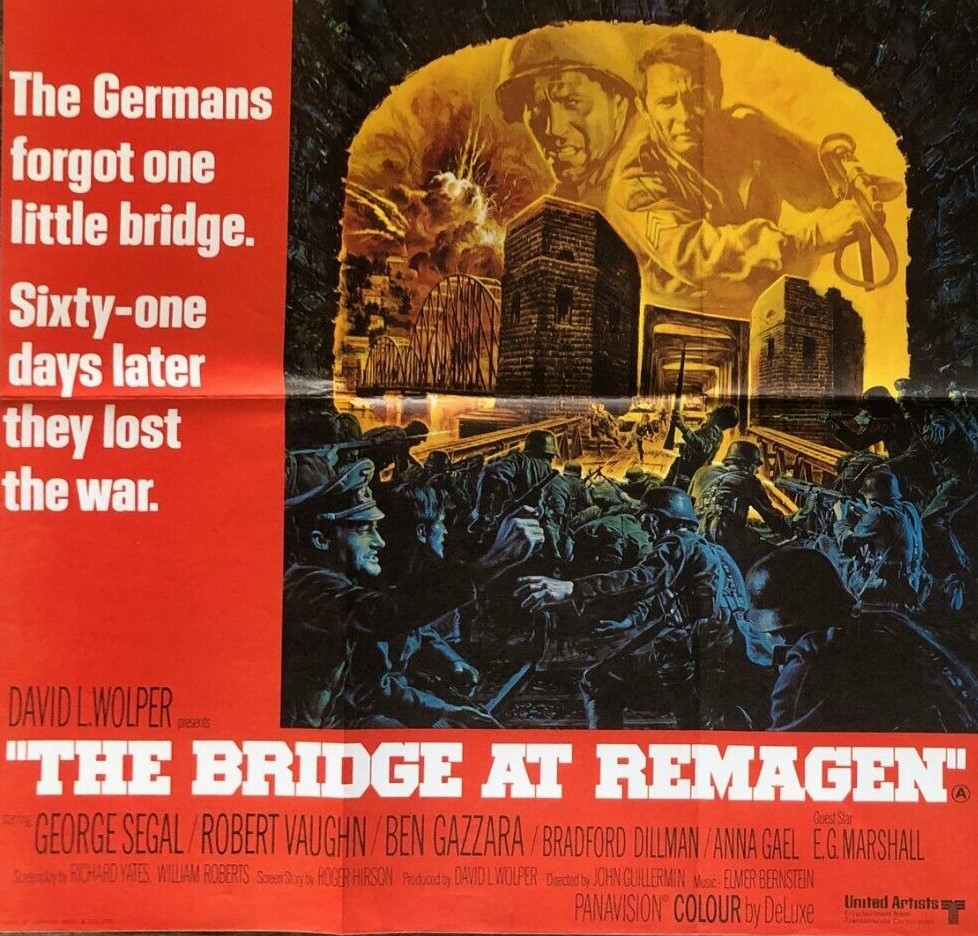
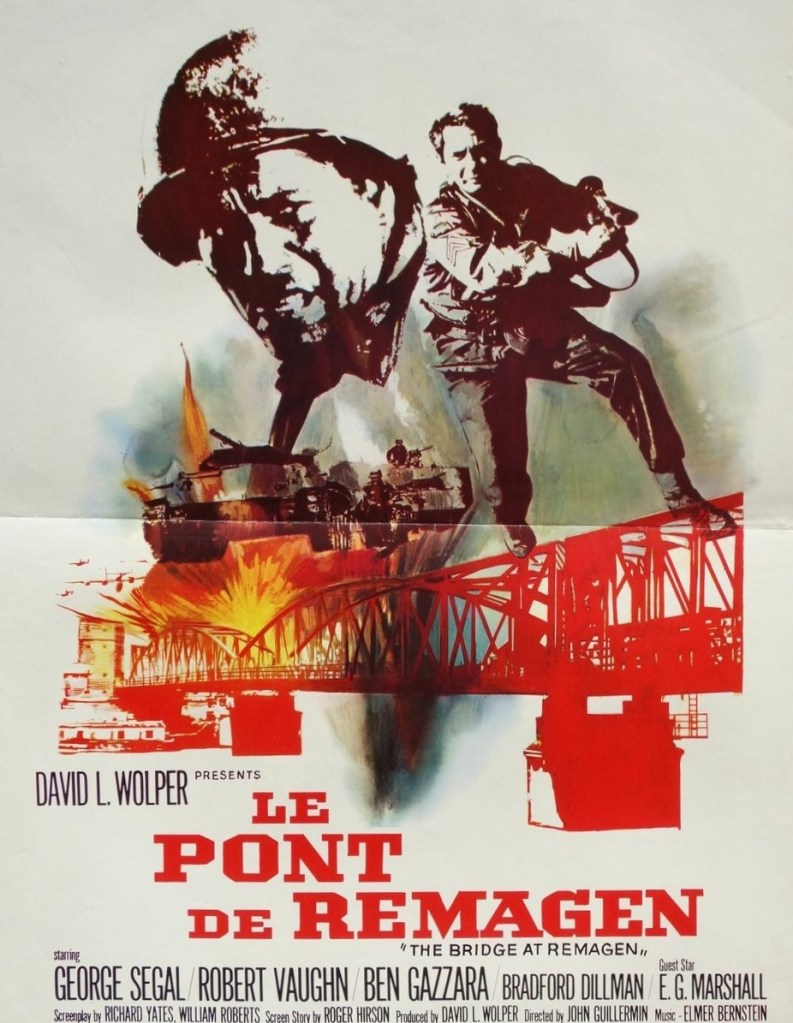
Superior war film, somewhat underrated. Not just realistic battle scenes, but realistically weary soldiers and taking an even-handed approach to war in the manner of Battle of the Bulge (1965). The Americans want to destroy the bridge to trap 75,000 German soldiers on the wrong side of the Rhine, the German Major Krueger (Robert Vaughn) overrides his orders to also destroy the bridge and prevent the Allies with a direct route to Berlin. Instead with depleted forces – think Zulu (1963) – and hugely outnumbered he attempts to keep the bridge open so the cornered Germans can escape.
Unlike most war films there’s no time for comedy to lighten the spirits, it’s gruelling non-stop action. Even when the advance company, headed by grizzled Lt. Hartman (George Segal) find an abandoned village where the exhausted squad could rest up for a bit, they are ordered to keep going until they find more enemy to engage. Unlike the humane Krueger, the Allied high command are merciless, gung-ho Major Barnes (Bradford Dillman) and glory-hunter Brigadier Shinner (E.G. Marshall) drive their troops on, the latter not bothered how many of his men die in an attempt to blow up the bridge – “it’s a crap shoot” is the closest he gets to apology, claiming his actions will shorten the war.
When Allied attempts to blow the bridge fail and with the enemy so close Krueger has to proceed with detonating the explosives littering the bridge and that plan is also scuppered, it’s a battle to the death to secure the crossing. And the story itself is accentuated by nods to the grisly cost of war – on both sides. Heartless Sgt Gazzaro (Ben Gazzaro), whose freebooting Hartman despises, is brought up short when he kills a youth commandeered into action by Krueger in a bid to bolster his meagre outfit – barely 200 men when he expected a force of around 1600. Krueger is sickened to see a German firing squad executing deserters, but has little sympathy for an innkeeper who has lost a son to the fighting when four million Germans are already dead.
While reining in the worst excesses of Angelo, preventing him taking advantage of a captured woman (Anna Gael) and refusing himself to accept her offer of sex, Hartman does not rail (like Patton, 1970) against those of his men who succumb to pressure. Finding one soldier collapsed, he sympathizes, “sometimes it hits you like that,” and he refuses to put his men in unnecessary line of fire, prompting Barnes into almost killing him. Unlike Battle of the Bulge, however, there is no arrogant German commander (like Robert Shaw) nor complacent Americans.
The action is not only non-stop but hectic and the film begins brilliantly with tracking cameras scarcely able to keep up with American tanks barrelling along the road and aerial shots showing the destruction of another bridge over the Rhine. American tanks and German artillery exchange fire over the river. Buildings are blown out or majestically collapse (turns out these were real buildings, not mock-ups). Bridge stanchions fall in slow motion into the water. Refugees are collateral damage, the camera hardly registering a crying child or an abandoned doll.
As in the best war pictures, strategy and tactics are laid out for the audience, the American blunderbuss approach compares poorly to Krueger’s desperate attempts to utilise every advantage to the point of arming a barge in the river. Hartman and Krueger are well-matched in courage, the former thrown endlessly into action by cynical superiors, the latter, having discharged himself from hospital to fight on, landed with the task of rallying defeatist troops, and leading them into harm’s way in a manner that the American’s immediate superior, Barnes, point-blank refuses to do. Pride drives on the German, the war is almost lost, but surrender would be tantamount to humiliation. All Hartman has to fall back on is an inner core and the chain of command, soldiers obey orders.
Both George Segal (The Quiller Memorandum, 1966) and Robert Vaughn (The Venetian Affair, 1966) are well outside their acting comfort zone. Two stars whose hallmarks are cocky characters and suave charm turn into determined men who barely crack a smile. Segal has done cynical before but not to this degree and what catches the eye more is his sheer physical exhaustion. This is an early career highlight for Vaughn, rarely offered such juicy roles.
Although associated in the general audience mind for playing creepy, not to mention sleazy, characters, Ben Gazzara (Capone, 1975) had not made much impact on 1960s moviegoers, and beyond a handful of supporting roles best known to Americans for a starring role in television series Arrest and Trial (1963-1964). The general untrustworthy screen persona he would come to inhabit is given a good work-out here except for two scenes where his character takes unselfish action. Bradford Dillman, also best known for television (Court Martial, 1965-1966), portrays a largely one-dimension character lifted out of the ordinary in a couple of scenes.
E.G. Marshall (The Defenders, 1961-1965) and Peter Van Eyck (Station Six Sahara, 1963) are the opposing commanders. You can also spot Hans Christian Blech (Battle of the Bulge), Anna Gael (Therese and Isabelle, 1968), Sonja Zieman (The Secret Ways, 1961) and Bo Hopkins (The Wild Bunch, 1969).
John Guillermin (The Blue Max, 1966) directs with aplomb from a screenplay by William Roberts (The Devil’s Brigade, 1968) and novelist Richard Yates (Revolutionary Road, 2008) in his only work for the screen.
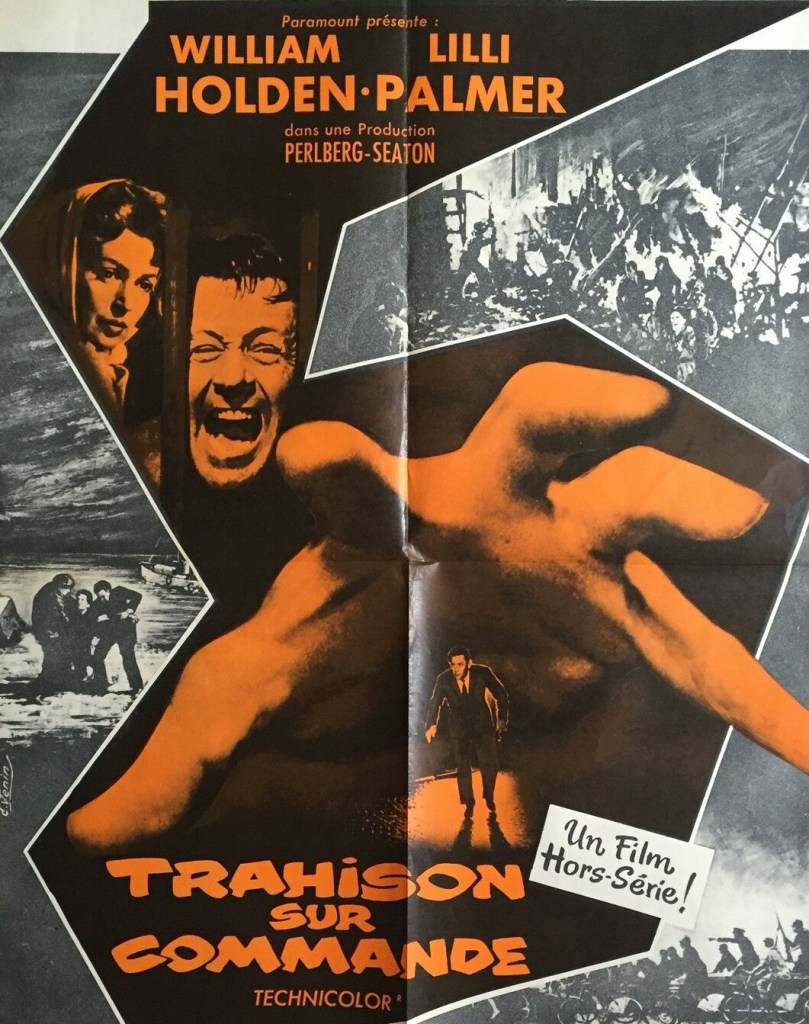
Cynical and opportunistic Swedish oil executive Eric Erickson (William Holden) blackmailed into World War Two espionage finds redemption after witnessing first-hand the horrors of Nazi Germany. Two extraordinary scenes lift this out of the mainstream biopic league, the first Erickson witnessing an execution, the second a betrayal. While some participants in the espionage game pay a terrible price, others like spy chief Collins (Hugh Griffiths) manage to maintain a champagne lifestyle.
Structurally, this is something of a curiosity. The first section, with over-emphasis on voice-over, concerns Holden’s recruitment and initial attempts at spying on German oil installations on the pretext of building a refinery in Sweden. Although resenting the manner in which he was recruited, Erickson has no qualms about resorting to blackmail himself to enlarge his espionage ring.
But it’s only when Marianne Mollendorf (Lili Palmer) enters the frame as his contact in Germany that the movie picks up dramatic heft. As cover for frequent meetings, they pretend to be lovers, that charade soon deepening into the real thing. While abhorring Hitler, she suffers a crisis of conscience after realising that the information she is passing on to the Allies results in innocent deaths. The final segment involves Erickson’s thrilling escape back home.
The picture is at its best when contrasting the unscrupulous Erickson with the principled Marianne. Virtually every character is trying to hold on to a way of life endangered by the war or created by the conflict and there are some interesting observations on the way Erickson manages to harness foreign dignitaries while being held to hostage in his home country. Loyalties are sparing and even families come under internal threat.
Sweden was neutral during the Second World War so in assisting the Allied cause Erickson was effectively betraying his country and once, in order to keep proposed German investors sweet, he begins to spout Nazi propaganda at home finds himself deserted by friends and, eventually, wife.
In some respects, Holden (The Devil’s Brigade, 1968) plays one his typical flawed personalities, easy on the charm, fluid with convention, but once he learns the true cost of his espionage a much deeper character emerges. The actor’s insistence, for tax reasons, on working abroad – this was filmed on location in Europe – would hamper his box office credibility and although not all his movie choices proved sound this was a welcome diversion. Whether American audiences were that interested in what a Swede did in the war was a moot point, as poor box office testified. And the title might have proved too sophisticated for some audiences, given there was no counterfeiting of money involved.
Lili Palmer (Sebastian, 1968) is excellent as the manipulative Marianne, betraying her country in order to save it from the depredations of Hitler, not above using her body to win favour, but paralyzed by consequence. Hugh Griffith (Exodus, 1960) provides another larger-than-life portrayal, disguising his venal core. Werner Peters (Istanbul Express, 1968) puts in an appearance and Klaus Kinski (Five Golden Dragons, 1967) has a bit part.
Double Oscar-winner George Seaton (Airport, 1970) makes a bold attempt to embrace a wider coverage of the war than the film requires and could have done with concentrating more on the central Erickson-Mollendorf drama, especially the German woman’s dilemma, but, made before James Bond reinvented the idea of espionage, this remains a more realistic examination of duplicity in wartime.
CATCH-UP: William Holden pictures reviewed in the Blog are Alvarez Kelly (1966) and The Devil’s Brigade (1968); Lili Palmer movies reviewed are Operation Crossbow (1965), Sebastian (1968) and Hard Contract (1969).
Except for an ingenious escape attempt and Paul Newman spoofing his Cool Hand Luke persona, this World War Two POW number falls into the “sounded like a good idea at the time” category. Harry Frigg (Newman), the American army’s most notorious escapee (though from British military prisons), is promoted from buck private to two-star general and parachuted into northern Italy to organize a breakout of five one-star generals.
The premise that the war effort is hampered by embarrassment at the generals being captured seems far-fetched as is the notion that the quintet are hopelessly incompetent when it comes to doing anything that sounds like proper army stuff. Adding another offbeat element is that they are being held in effectively a deluxe POW camp, an ancient castle run by Colonel Ferrucci (Vito Scotti), a former Ritz hotel manager with a lapdog attitude to the rich and powerful.
Almost immediately Frigg discovers an escape route through a secret door but is disinclined to go any further since it leads into the boudoir of the countess (Sylva Koscina). New Jersey inhabitant Frigg feels out of the place with the high-falutin’ generals and proceeds to get himself a cultural education. Meanwhile, the countess, obtaining her position through marriage rather than birth, trying to bolster his confidence naturally triggers his romantic impulses.
The humor is of the gentlest kind – Frigg taking advantage of his superiority, Italians speaking tortured English – and not much in the way of bellylaffs either. Director Jack Smight, who collaborated so well with Newman in Harper (1966) and manages to achieve a tricky balance in No Way to Treat a Lady (1968), loses his way here, not least structurally, as the movie pingpongs between the generals, the commandant and Frigg and, thematically, issues of power. Crucially, he fails to rein in Newman.
The generals, squabbling among themselves for power, would be caricatures except that their characters are rounded out by the players, the pick being Charles Gray (The Devil Rides Out, 1968) as Cox-Roberts and Tom Bosley (Divorce American Style, 1967) as Pennypacker. The other generals are played by Andrew Duggan (Seven Days in May, 1964), John Williams (Harlow, 1965) and Jacques Roux (The List of Adrian Messenger, 1963). Representing the American top brass in England are James Gregory ( a repeat role in the Matt Helm series) and Norman Fell (The Graduate, 1967).
After her excellent turn as a mischievous and vengeful villain in Deadlier than the Male (1967), Yugoslavian Sylva Koscina comes down to earth with a less rewarding role as charming leading lady with a sly sense of humor rather than the femme fatale of A Lovely Way to Die (1968). Werner Peters (The Corrupt Ones, 1968) makes a late appearance as a Nazi and you might spot screenwriter Buck Henry (The Graduate) in a bit part.
The screenplay by Peter Stone (Arabesque, 1966) and Oscar-winner Frank Tarloff (Father Goose, 1968) is an odd mixture of occasional sharp dialogue and labored story. The set-up takes too long and you keep on wondering when it is going to get to the pay-off.
No doubt looking for some light relief after a quartet of heavier dramatic roles – Harper (1966), Torn Curtain (1966), Hombre (1967) and Harper (1967) – Newman acts like he has escaped the straitjacket of a considered performance and instead indulges in mugging and hamming it up, his body freeing up a barrage of mannerisms previously held in check.
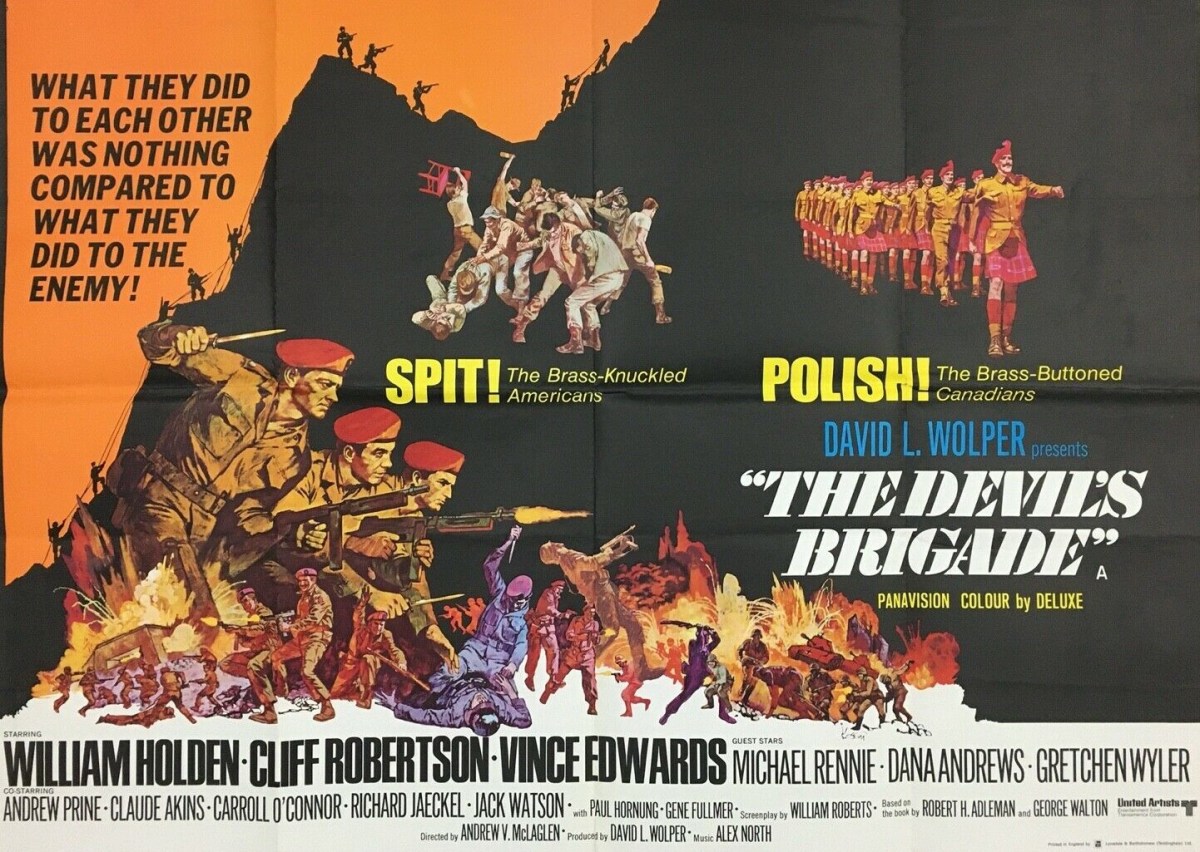
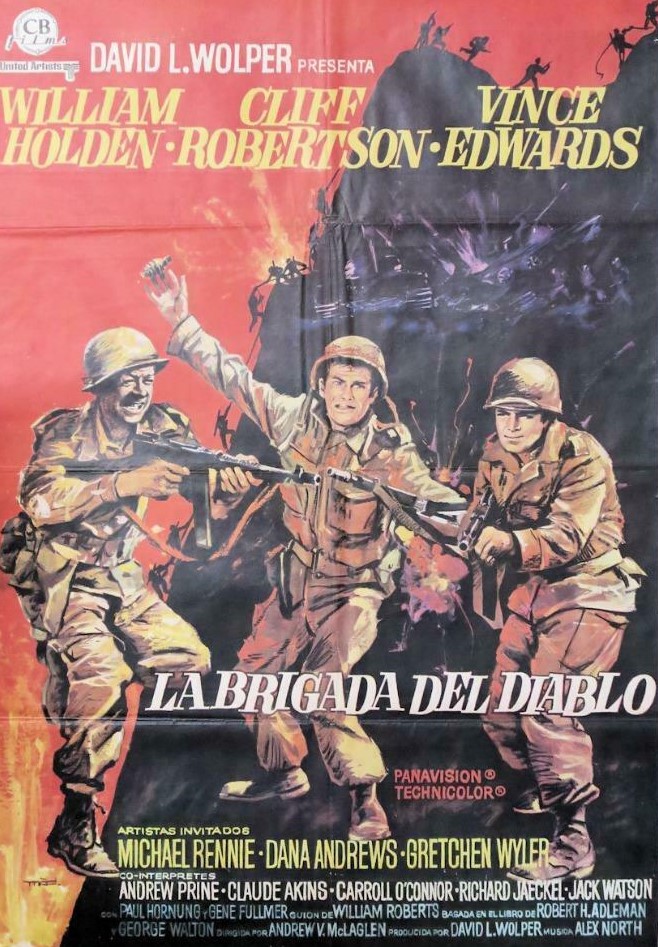
I couldn’t get my head around the idea of the U.S. Army recruiting a bunch of undisciplined misfits, many with jail time, in order to link them up with a crack Canadian outfit. Turns out this part of the film was fictional, the Americans in reality responding to advertisements at Army posts which prioritized men previously employed as forest rangers, game wardens, lumberjacks and the like which made sense since the original mission was mountainous Norway. I should also point out the red beret the soldiers wear is also fictional and while depicted on the poster sporting a moustache commanding officer Lt. Col. Frederick (William Holden) is minus facial hair in the film.
But, basically, it follows a similar formula to The Dirty Dozen (1967), training and internal conflict followed by a dangerous mission. The conflict comes from a clash of cultures between spit-and-polish Canucks and disorderly/juvenile Yanks though, as with the Robert Aldrich epic, the leader taking some of the brunt of the discontent. Collapsible bunk beds, snakes under the sheets and a tendency to fisticuffs are the extent of the antipathy between the units, which is all resolved, as with The Dirty Dozen, when they have to take on people they jointly hate, in this case local bar-room brawlers in Utah.
The movie picks up once they are sent to Italy. Initially employed on reconnaissance, Frederick challenges Major-General Hunter (Carroll O’Connor) who wants to do things by the book and sets out to take an Italian position by trekking two miles up a riverbed, creeping into town by stealth and capturing the location without firing a shot.
Next up is the impregnable Monte la Difensa. Taking a leaf out of the Lawrence of Arabia playbook, in a brilliant tactical move, the Americans attack the mountainous stronghold from the rear by way of a mile-high cliff. But that’s the easy part. The rest is trench-by-trench, pillbox-by-pillbox, brutal hand-to-hand fighting.
The battle scenes are excellent and the training section would be perfectly acceptable except for the high bar set by The Dirty Dozen. That said, there is enough going on with the various shenanigans to keep up the interest, but we don’t get to know the characters as intimately as in The Dirty Dozen and there is certainly nobody in the supporting cast to match the likes of Telly Savalas, Charles Bronson, Jim Brown and John Cassavetes. That also said, the men do bond sufficiently for some emotional moments during the final battle.
At this point William Holden’s career was in disarray, just one leading role (Alvarez Kelly, 1966) and a cameo (Casino Royale, 1967) in four years, and although his screen persona was more charming maverick than disciplined leader he carries off the role well, especially solid when confronting superiors, exhibiting the world-weariness that would a year later in The Wild Bunch put him back on top. Ironically, Cliff Robertson was coming to a peak and would follow his role as the strict disciplinarian Major Crown, the Canadian chief, with an Oscar-winning turn as Charly (1968). Vince Edwards (Hammerhead, 1968) as cigar-chomping hustler Major Bricker makes an ill-advised attempt to steal scenes.
This was the kind of film where the supporting cast were jockeying for a breakout role that would rocket them up the Hollywood food chain – as it did with The Dirty Dozen. Jack Watson (Tobruk, 1967) is the pick among the supporting cast, but he has plenty of competition from Richard Jaeckel (The Dirty Dozen), Claude Akins (Waterhole 3, 1967), Jeremy Slate (The Born Losers, 1967), Andrew Prine (Texas Across the River, 1966), Tom Stern (Angels from Hell, 1968) and Luke Askew (Cool Hand Luke, 1967). Veterans in tow include Dana Andrews (The Satan Bug, 1965) and Michael Rennie (Hotel, 1966).
William Roberts (The Magnificent Seven, 1960) adapted the bestselling book by Robert H. Ableman and George Walton. Director Andrew V. McLaglen (Shenandoah, 1965) was more at home with the western and although there are some fine sequences and the battle scenes are well done this lacks the instinctive touch of some of his other films.







 The Magnificent 60s